




Abstract
The Danish silent movie Himmelskibet (in English, A Trip to Mars or The Sky Ship) premiered in 1918, and a novelization of the movie appeared in 1921. The film is about a trip to Mars and portrays a Martian civilization that embraces a life of peace, vegetarianism, and non-alcoholism. Both movie and novel, though especially the novel, provide insight into the plurality-of-worlds debate in Denmark in the early 20th century, forming as it did a part of a general debate about the relationship between science and religion. Yet The Sky Ship did not only form part of this debate but also displayed strong religious currents itself. Most notably, a romantic, Neo-Platonically inspired Christian version of Druidry informed the portrayal of the Martians and their society. Finally, the medium itself played a role in the story. By transcending language barriers, silent movies were imagined by some to be a kind of “Esperanto of the eye” that would usher in a new golden age for mankind, even contributing to ending the horrors of World War I. Thus, The Sky Ship offers insight into an intriguing conglomeration of pluralism, religion, and technology that should be of interest to historians of astrobiology. Key Words: Himmelskibet—Science fiction—Holy Grail—Mysticism—Druids—Silent movies. Astrobiology 12, 998–1014.
Introduction
I
At the same time, the plurality-of-worlds question was debated, including the question of the nature of the canals thought to exist on Mars. Though taking place at the edges of the value debate, the religious implications of the question reverberated with the general discussions of the relationship between science and religion. The idea of an infinite universe with an infinite number of inhabited worlds was, to some, a proof of the greatness of God and the commensurability of science and religion. To others the thought was anathema and underscored the already perceived incommensurability between the two (Petersen, 2001, especially pp 88–109).
Alongside this, a religious trend had emerged that was intertwined with a new technology: cinema. The birth of the silent movie was, for some, accompanied by a belief in its salvational powers. By force of being silent, cinema was believed to “speak” in a new, universal language—a kind of “Esperanto of the eye”—that might usher in an age of global peace. This belief was held by such cinema luminaries as American film director D.W. Griffith (1875–1948) but was also present in Denmark. The gravity of this belief was increased by the horrors of World War I, which was seen as the result of the curse of Babel and underscoring the necessity of a universal language transcending national barriers. In this scheme, silent movies pointed to a solution to the terrible consequences of the nations' inability to understand each other (Brown, 2002).
These three trends of the first decades of 20th-century Denmark—religious revival, the plurality-of-worlds debate, and the techno-religion of silent movie cinema—converged in The Sky Ship to form a unique response to the questions of the time. One by one, this paper investigates each topic in relation to The Sky Ship, first dealing with the techno-religion of cinema, then pluralism and religion, and finally zooming in on Druidry. Given that astrobiology as a discipline takes seriously the study of its own history and its interactions with the science fiction genre, The Sky Ship functions as a prism refracting the historical context, spectrographically differentiating themes relevant to the history of astrobiology (Dick, 2007; Sullivan and Carney, 2007, especially p 26).
The Sky Ship and Sophus Michaëlis
The original Danish title of the movie The Sky Ship was Himmelskibet. 2 It premiered in Copenhagen on February 18, 1918, in the newly opened Palace Theater (in Danish, Palads-Teatret). It was directed by Holger-Madsen (1878–1943). Sophus Michaëlis (1865–1932) and film producer Ole Olsen (1863–1943) were listed as authors of the script, although Olsen's contribution actually was just the idea of a trip to Mars (Schröder, 2011, pp 522–523). In 1921, Michaëlis published a novelization of the movie with the same title. Thus, if one includes the synopsis of the movie presented in the program for the film, there were four different versions of the story: movie script, movie, film program, and novel (Fig. 1). 3

Portrait of Sophus Michaëlis given to Rigmor Stampe, 1913. The Royal Library, Denmark. Color images available online at
The Sky Ship was Michaëlis' only work of science fiction and belonged to the turn-of-the-century space literature which, according to Karl S. Guthke, was characterized by a new awareness of the physical properties of the planets inspired by “Laplace's nebular hypothesis, Darwin's theory of evolution, and Kirchoff's spectrum analysis” (Guthke, 1990, p 369). It shared this new literary trend's preoccupation with Mars and the idea of the existence of a perfected civilization there, thousands of years ahead of Earth's. The Sky Ship bears some resemblance to Kurd Lasswitz's On Two Planets (German, Auf Zwei Planeten, 1897), one of the two seminal works of the time highlighted by Guthke (the other being H.G. Wells' The War of the Worlds, 1897), especially as regards the elevated state of Martian civilization. 4
Sophus Michaëlis was a novelist, poet, dramatist, and one of the most important Danish art critics at the turn of the century (Wivel, 2009, p 361). He was characterized by a contemporary critic as belonging to the 1890s' new romantic movement which, frightened by “the noisy brutality of the time of machines, by the electrical rays of science, by the rumble of social clashes” hid “piously in religion's maternal bosom.” Yet there was also rebellion in the young poetry, which, as in Michaëlis' “scientific romanticism,” dreamt itself “boldly beyond society” and was marked by “mysticism and sensuality” (Jensen 1898, pp v–vi). 5 Michaëlis defied Christianity in its institutionalized form and revered the sun, thereby conforming to the contemporary vitalist movement (Wivel, 2009). 6 Michaëlis' generation has been called “The Spiritual Breakthrough,” predominantly wrote poetry, and reacted against naturalism (Jacobsen, 1993, p 230). 7 A modern critic has characterized Michaëlis as being at the intersection of “the decadence of symbolism and vitalism” (Wivel, 2009, p 361), and Michaëlis was renowned for his light-hearted style and eroticism (cf. Jensen, 1898; Rimestad, 1922, p 61; Jacobsen, 1993). He was chairman of the Danish Authors' Society from 1915 until his death in 1932, was a lauded figure in Danish literary life, and gained international fame, in no small part due to the theatrical smash hit Revolution Marriage (Danish, Revolutions-Bryllup) (1906), which conquered the stages of both Europe and the USA (Jacobsen, 1993, p 232; Wivel, 2009, p 370). 8 After his death, his fame gradually faded, perhaps due to his lack of popular appeal to a broader audience. Posterity's Danish literary criticism has judged him somewhat harshly (Jacobsen, 1993, p 231, p 242).
The Narrative of The Sky Ship as Embodied in the Movie
In the movie, the explorer and pilot Avanti undertakes a journey to Mars. He is accompanied by Dr. Krafft, who is betrothed to Avanti's sister Corona, and by a group of people from different nations who serve as the crew of the “sky ship” Excelsior (Fig. 2). On Mars they are received by a large group of Martians, all quite human in appearance, led by the “wise man,” in Danish the “Ruler of the Wise.” 9 Though the actors' lips are clearly moving when they speak (though, of course, their words are not audible), Avanti exclaims: “Look, we understand everything they say without words. They have found a language we have been fumbling for: the mutual language, understandable for all souls.”

The “Sky Ship” Excelsior leaves Copenhagen for Mars. Still picture from the movie The Sky Ship by Great Northern Film Company. Kindly made available by the Danish Film Institute.
The Martians turn out to be teetotaling, pacifist vegetarians, and when the Earthlings introduce them to wine they are not happy. Their reaction is even more negative when they are offered canned meat—for how have the Earthlings procured this? Avanti instantly demonstrates how by shooting a bird. The Martians are utterly shocked by this—the sound of gunfire has not been heard on Mars for thousands of years—and they gather threateningly around the Earthlings. Things get out of control, and Dr. Krafft throws a hand grenade, seemingly killing one of the Martians (Fig. 3).
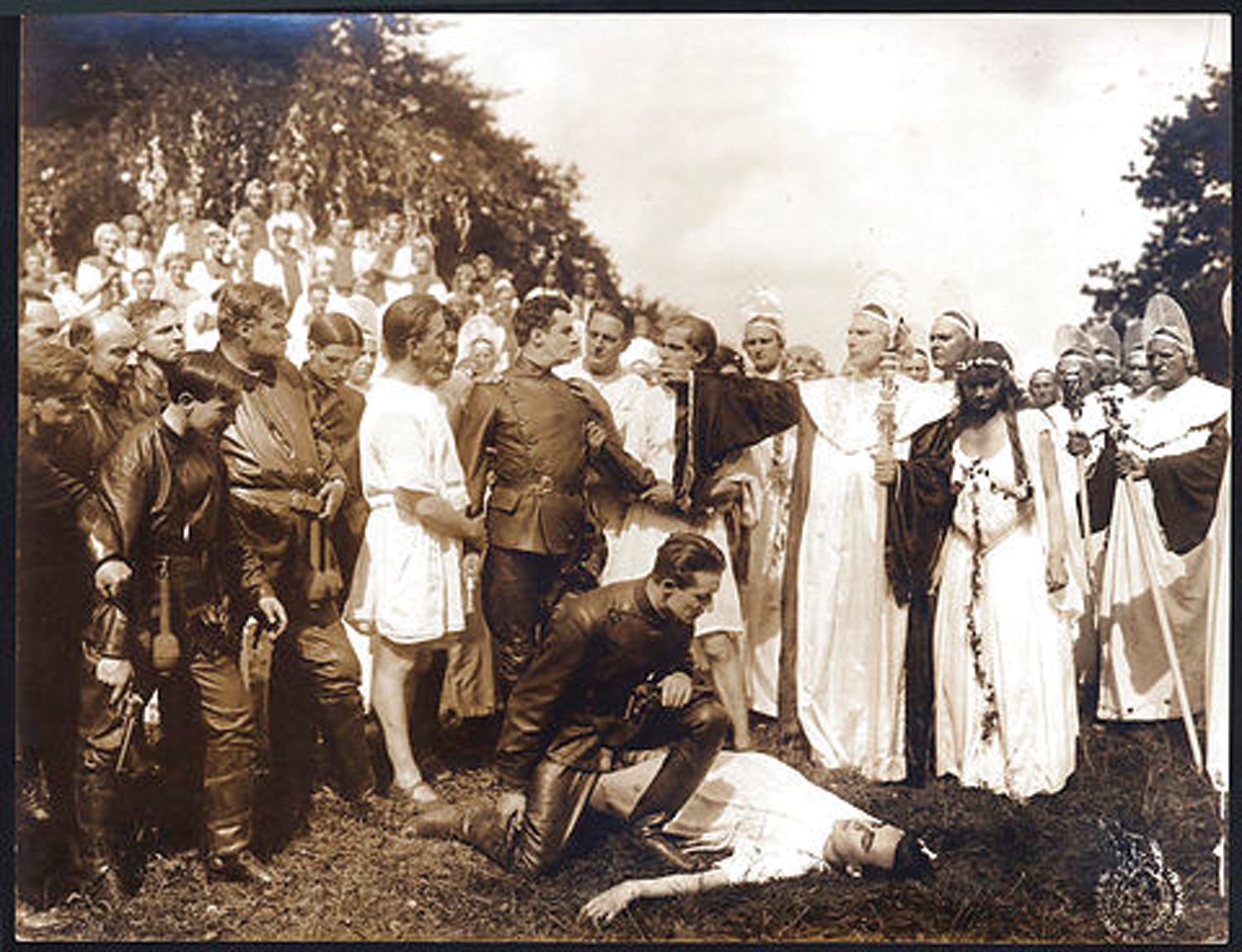
Installation of scene from The Sky Ship, Great Northern Film Company. Kindly made available by the Danish Film Institute. Color images available online at
The Earthlings are led to the “house of judgment.” The daughter of the wise man, Marya, prays for mercy on their behalf, dons the “garb of mercy,” and shows them a kind of movie in the house of judgment about Mars' past, meant to teach them better ways. It depicts a time when the Martians fought each other in terrible wars until, at last, they came to their senses and embraced a peaceful way of living. Having seen this, the Earthlings regret their actions, the wounded Martian is revived, and they are welcomed into the Martian society. Here, they are initiated in the wonders of Mars, which, among other things, consist in watching a “dance of chastity,” solemnly performed in a grove by Martian children and women, dressed in floating, white gowns, on a glass floor lit from beneath. The title card reads: “On Mars everything is pure and innocent…but on earth…,” whereupon various scenes of debauchery on Earth are seen, putting the elevated existence on Mars into relief.
Marya and Avanti fall in love with each other, and Marya decides to accompany Avanti back to Earth. Marya's father is not too pleased by this prospect, stating: “How can you think of following him to a planet which is thousands of years behind ours?” To this Marya replies: “I will bring your message of enlightenment to earth!” 10 Marya's father then accepts her descent to Earth and declares that his time for dying has arrived anyway and that he is “ready for the happiness of death!” In front of the “cave of the dead” the wise man bids his farewells to Avanti and exclaims: “Strangers, be blessed and bring to earth the message of what you have seen. The mystery of space has been solved for you. You shall be as we are!” Then he explains that death is not to be feared, for “it is just the beginning of a superior life!” In a boat he sails toward the “island of the dead,” and in the final goodbye scene the Martians have gathered to sing a song in honor of the departing Earthlings that ends: “Our seeds you will sow on earth,/ridding you of lowly speach [sic],/flawlessness you shall reach/through the force of love!/:Love is the force you call God.:” 11
When the sky ship enters Earth's atmosphere, it is met by a terrible thunderstorm. A certain Professor Dubius, who back on Earth has ridiculed the expedition all along and thus represents the cynic doubter (though in fact he himself has dreamt of accomplishing something similar), gets news of the arrival of Excelsior. 12a In a dramatic scene, he is seen on a hilltop in silhouette against a blackened sky shot through with lightning, one fist clenched threateningly against the sky. He is hit by lightning and falls to his death. The sun breaks through the clouded Copenhagen sky, and cheering crowds rush to greet the sky ship. 12b Back home with his father, Professor Planetaros, Avanti kneels in front of Marya, and Planetaros blesses them with prophetic words: “In you I greet the new generation—the flower of a superior civilisation, the seed of which shall be replanted in our earth, so that the ideals of love may grow strong and rich!” 13
Universal Peace and the Religion of Cinema
In the poem “The Adventure of Cinema” (Danish, “Filmens Eventyr”), dated October 17, 1913, at the “Palace Theater,” Michaëlis anticipates his own involvement in movie-making with The Sky Ship, while at the same time propagating his poetics of cinema. 14 The poem must have been written as a celebration of the one-year anniversary of the opening of the Palace Theater, October 17, 1912, in Copenhagen's refurbished “Second Central Station.” 15 The new movie theater provided unheard-of luxuriant surroundings with a Versailles-styled tea salon and room for 2,500 spectators and a 30-man orchestra (Tybjerg, 2001a, p 36). As is evident from pictures taken at the time, the cinema itself was situated where before there had been railroad tracks (Fig. 4).
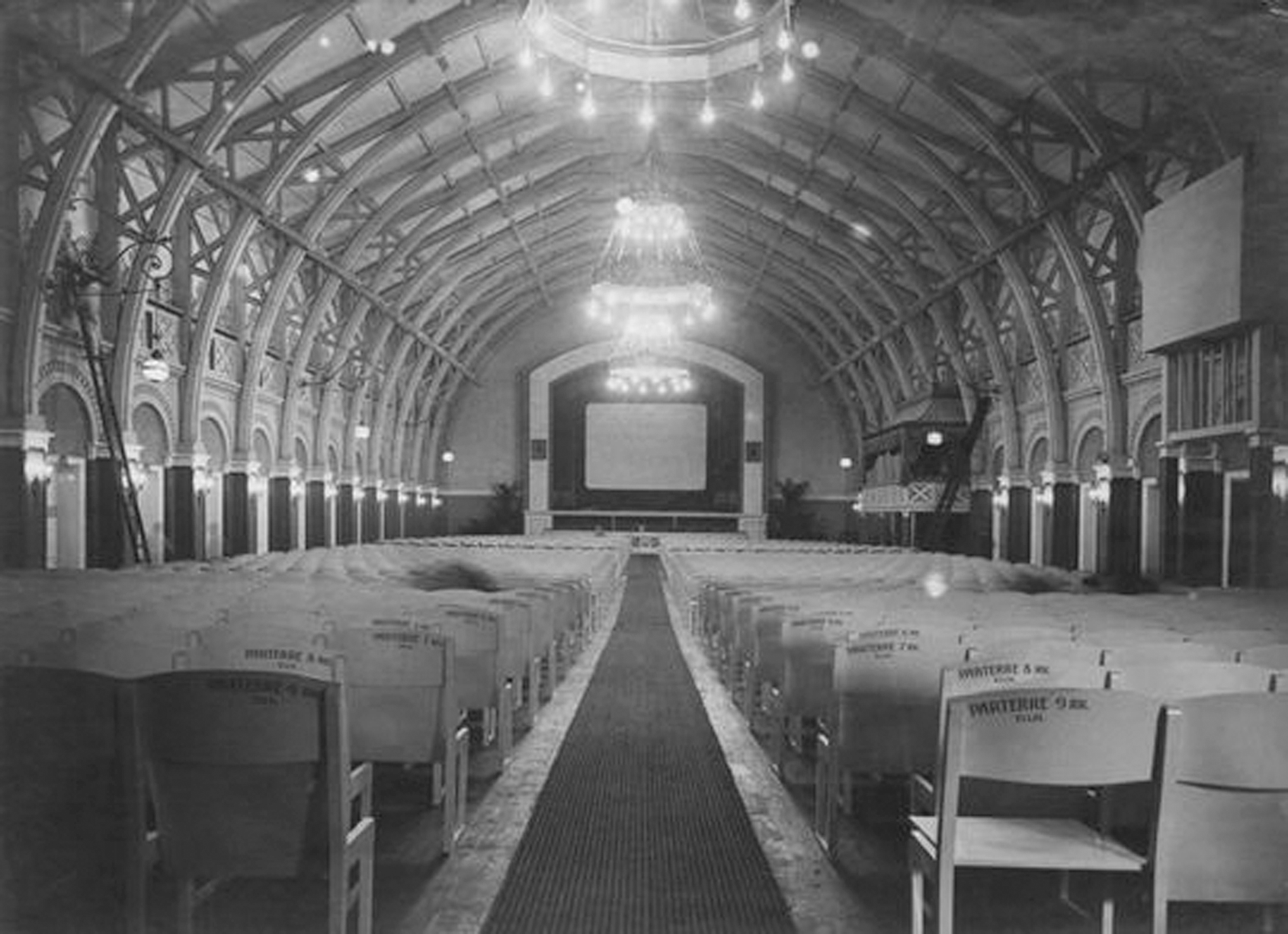
Photo of the interior of the Palace Theater in the refurbished “Second Central Station” of Copenhagen. Museum of Copenhagen.
This clearly inspired Michaëlis' poem: “Look, this hall is still a station:/for all those who want to take the express/and watch the series of images run past the window/every evening the train is ready to leave.” 16
In the poem, the atmosphere and sound of the cinema hall is vividly described, but soon Michaëlis reaches the central message. He rhetorically asks if one can only ask for “nerve excitation” and “comedy jokes” from the “picture book”? The answer is no—more sophisticated content should be called for: “Yes, we'd rather visit the country of imagination,/where new worlds spread out in our view/and the airship of the thought glides through the ether,/winged by the roaring orchestra.” 17 The poem continues by relating how the flickering images can magically capture the flimsiness of life and thus (in a sense) resurrect the dead. Yet still the white screen awaits the hand to fill it: “—let the dream of the future gild it/with more than what you and I have lived.” The poem then moves into cosmic scenes where Earth itself is likened to the light of the projector on the screen: “On the abyss veil of space/our little Earth floats like a spot of light …” 18 Near the end of the poem, the salvational potential of cinema is underscored: “Like golden falcons over the halls of Earth/new possibilities. And miracles happen:/the deaf can hear and the blind can see,/the silent movie soon begins to speak.” 19 Thus, Michaëlis had high ambitions on behalf of the new cinematic medium and connected it with millenarian hopes for the future.
Of course, there was much else besides lofty transcendental urges at play in the movies created by the Great Northern Film Company. Often, they were about “forbidden passions: extramarital relationships and love across class borders that lead to mistakes and misdeeds: unwanted pregnancies, forgery, embezzlement, jealousy, suicide or attempted murder” (Tybjerg, 2001a, p 38). 20 Indeed, at the time, Danish movies were widely known for their audacious material (Tybjerg, 2001a, p 39). So bold were the movies that in 1911 it was decided to introduce a new “amusement tax” which added 20% to the price of tickets, and in 1913 film censorship was introduced (Tybjerg, 2001a, p 40, p 51). Michaëlis was well aware of the popular appeal of the relatively new film medium among the general populace, yet only partly shared the contemporary idea that the medium was incommensurable with the creation of real art. In fact, he thought that he himself might elevate cinema to the pinnacles of true art. 21 Michaëlis, inspired as he was by Neo-Platonism, understood cinema as a kind of “non-medium,” by which one was able to directly—unmediated—view beauty. Likewise, Michaëlis was convinced that the new silent language of cinema could speak to people beyond their nationalities, creating mutual understanding across national borders. Thus, Michaëlis hoped the movie would create a feeling of universal brotherhood on Earth that would initiate universal, lasting peace (Schröder, 2011, pp 527–541). In this, Michaëlis was part of a larger trend.
Alongside the development of cinema, a continual tension between nationalism and internationalism had influenced the debate about the status of the medium. At the beginning of the era of silent movies, focus had been on their international qualities. This changed, especially in Germany, during the beginning of the 1910s when nationalism was on the rise. In Denmark, due to the country's smallness, the production of movies had been directed at an international market, to the degree of eradicating things that would mark Danish movies as specifically Danish. Some, however, worried that this internationalistic trend would prevent the creation of real works of art and thus suggested that more specifically Danish national character traits ought to be discernible. As the tensions between the nations of Europe increased, however, the trend again veered toward internationalism, even transnationalism, this time not for economic reasons but because of the looming world war (Schröder, 2011, pp 717–722).
The idea that silent movies might help usher in a pre-Babel, prelapsarian era for humanity lay at the roots of what was to become the world's greatest imperium of moving images. In her book Hollywood Utopia, Justine Brown uncovers the utopian dimensions of early Hollywood where movie colonists felt, reasonably enough, that they were pioneers of a new art form (Brown, 2002, p 36). She describes how, amid World War I, “artists like D. W. Griffith and Lillian Gish hoped that by transcending geographical and linguistic barriers the screen pantomime of cinema might unite mankind” (Brown, 2002, p 29). 22 Griffith began to see cinema as an “Esperanto of the eye,” and thus, cinema could bring peace because war was seen as ensuing from miscommunication (Brown, 2002, p 41, p 82). Brown concludes, “If the Babel story depicts a second Fall of Man, the Universal Language [of silent movies] offered redemption, a recovery of prelapsarian possibilities” (Brown, 2002, p 41).
On a movie set, the famous director of The Birth of a Nation (1915) and Intolerance (1916), D.W. Griffith, one day told his actors:
Do you know, we are playing to the world! What we film tomorrow will stir the hearts of the world—and they will understand what we're saying. We've gone beyond Babel, beyond words. We've found a universal language—a power that can make men brothers and end war forever. Remember that. Remember that, when you stand in front of a camera! (quoted in Brown, 2002, p 40)
The Birth of a Nation premiered in Denmark March 22, 1918, and Intolerance September 30, 1918. The Birth of a Nation outshined contemporary Danish movies, and a comparison in a Danish journal with The Sky Ship was not to the latter's advantage (Tybjerg, 2001a, pp 61–62). This notwithstanding, the mindset of Griffith and Ole Olsen was quite similar with regard to the importance of the cinematic medium's transnationalist potential. In fact, Olsen gave a speech to the actors on the set of The Sky Ship that was astonishingly similar to Griffith's oration:
Ladies and Gentlemen! On you depends not only the success of our great film; a much graver task falls to you. It is your office to ingratiate into the hearts of men the ideals trampled by the World War. You must, each in your own modest place, be heralds of the future. (quoted in Tybjerg, 1996, p 244)
As already suggested, Griffith's idea—which he shared with Olsen and Michaëlis—that movies could restore humankind to a prelapsarian state and lead to universal peace (Brown, 2002, p 80) was part of a larger movement. Movies with peace messages abounded at the time: Griffith's Intolerance was one; the Great Northern Film Company's Eternal Peace (Danish, Pax Æterna) (1917), about the consummation of peace through a unification of the European states, was another (Tybjerg, 1996, pp 244–245; 2001a, pp 57–58).
Around 1912–1913 the connection between the Biblical story of Babel and the medium of the silent movie was established in Denmark in a newspaper article. Here it was said of the silent movie that it
spans the entire Earth, speaking with the same tongue to all peoples and is understood by all. It will kill Babel, it will spread enlightenment and bind humanity together in a huge bundle, which will make them take up construction work anew. Then, the tower will soar, the tower of culture, enlightenment and understanding, and it will reach all the way into heaven (quoted in Schröder, 2011, p 724, n 2231). 23
Similarly, in 1913 the Danish author and dramatist Emma Gad (1852–1921) came to the defense of cinema:
You can say what you want—living images are…a wonderful invention, sprung from the very spirit of the time, democratic in the best sense of the word because they, through being cheap, make it possible for all to take part and especially because they bring the peoples closer to each other, the different races, whose mutual understanding throughout millennia has been hampered by inconsistent languages. 24
How the medium of silent movies was to transform humanity is better understood when taking into account the romantic undercurrents in the conceptions of early cinema that combined both elements of eroticism and, quoting Frank McConnell, a conception of art as “totally representational, totally autonomous counter-reality” (Tybjerg, 1996, p 47; McConnell, 1975, p 2). 25 The romantic idea of creating an alternate reality, writes McConnell, lies at the heart of cinema, and the audience experiences the effect when they leave the movie theater and approach the real world, either to find the reality of the movie “truth, or to find our ordinary world a lie” (McConnell, 1975, p 3). The potential power of creating an alternate reality lies in its ability to instill a wish in the spectator to change the real world in accordance with the hyperreal cinematic world, something which both Ole Olsen and Sophus Michaëlis were very aware of and did not hesitate to announce publicly (Tybjerg, 1996, pp 241–242). In a private letter, Michaëlis wrote: “I am currently working on a great assignment: to make cinema perform the poetic mission it has hitherto forsaken: to refine through seeing, to spread ideals.” 26 This great assignment was the creation of The Sky Ship.
On February 22, 1918, about a month after the American rocket scientist Robert Goddard wrote his essay “The Great Migration,” about the dispersal of humanity throughout the solar system (Launius, 2006, p 39), The Sky Ship premiered in a newly built Palace Theater. The old Palace Theater in the former railway station had been torn down in 1916, and in 1918 the new Palace Theater opened nearby. The Sky Ship was the second movie to be shown there, the first being a Swedish movie called Mountain-Ejvind and His Wife (Swedish, Berg-Ejvind och hans hustru) (Tybjerg, 2001a, p 60). According to the program, The Sky Ship was “an attempt, through the imagination, to prefigure one of the great problems of the future,” namely, that once the planet becomes too small for its inhabitants they will be “forced on a journey towards those planets closest to Earth” (Michaëlis, 1918c). 27 World War I was still ongoing, and before the movie was shown, scenes of Russian war prisoners were displayed (Schröder, 2011, p 529). Clearly, the movie's portrayal of a peace-loving, vegetarian, and teetotaling people of wisdom in the form of the Martians was intended as a depiction of an utopian alternative to the horrendous behavior of people on Earth.
Yet, despite its appealing message, the movie got a mixed reception. After the premiere, several reviews of The Sky Ship indicated that all through the movie laughter had been lurking and that it broke out in the wrong parts. In the words of one reviewer The Sky Ship “was so sentimental and naïve that it repeatedly evoked laughter but at the solemn places” (quoted in Schröder, 2011, p 539, n 1715). 28 One of the things that no doubt contributed to undermining the solemnity of the movie was the fact that The Sky Ship was shot on outside locations all too recognizable by Danes (Schröder, 2011, p 538). In addition, due to Michaëlis' image as Denmark's ultimate elitist poet and chairman of the Danish Authors' Society, The Sky Ship became a pawn in the general debate about the collaboration between fine artists and the movie industry, resulting in the publication of a row of articles and caricatures and even a parody (Dam, 1918; Schröder, 2011, pp 516–527). Despite the presence of the “Copenhagen Grin” at the premiere, Michaëlis was confident that it would be victorious in the end. It did in fact become a huge commercial success, not least in Germany. Still, the critical reception of the movie disappointed Michaëlis, who seems to have ended up loosing faith in cinema's salvational potential and quality of “non-medium” (Schröder, 2011, p 516, n 1648, and pp 527–541). 29 Three years later, when he published the novelization of the movie, it was partly as a reaction to its reception, and the book contained several displacements compared to the movie. For example, it displayed a strong criticism of the film media, and furthermore the utopian Martian society became depicted in a more ambiguous light. 30
Michaëlis and the Extraterrestrial Perspective
But why did Michaëlis choose to create a movie in the science fiction genre? Apart from Ole Olsen's initial idea for The Sky Ship, there is ample evidence that astronomical and pluralistic themes, seasoned with religious sentiments, formed part of Michaëlis' intellectual makeup from the beginning of his writing career. Already in his novel People of Habit (Danish, Vanemennesker) (1892), the main character, Titus Bøg, defending a kind of cultural relativist standpoint, imagines a colony of people from Earth on the Moon. Separated from the development on Earth, Bøg argues, these people, having no knowledge of Christian revelation, would nevertheless be able to develop a revelation just as good as the Christian, given that it contained the “true humanity” (Michaëlis, 1892, pp 259–260; cf. also Wivel, 2009, p 370). In the poem “Shooting Star” (Danish, “Stjerneskud”), published in Flowers of the Sun (Danish, Solblomster) (1893), the poet lies beneath “the sky ocean of the stars” and “senses every fiber and fold shiver/in my throbbing organism,/and burning spectra of stars shine/refracted through the prism of my brain.” 31 These sensations make the poet feel that he belongs “to a fatherland/far greater than Earth” (Michaëlis 1893, pp 139–40). 32 In Flowers of the Sun, we also find allusions to space travel, cosmic transmigration, and pluralism. In “Evening,” the final verse reads: “I know—that trammels cannot tie/the wing span of the souls:/Once they shall find the road/amongst countless planets' motion,” 33 and in “In the Observatory” (Danish, “I Observatoriet”), the poet addresses the planet Saturn: “do you have any life, which might sense/that from a planet far and veiled in darkness/through millennia eyes have watched you/and every pitch-dark night followed your quiet course?” (Michaëlis 1893, p 68, p 107). 34
Michaëlis also wondered about the possibility of contact with extraterrestrial intelligence in a poem about the telegraph from 1904: “Our planet like a brain/moves through space—/who knows if once we'll establish/contact with a star?/Unknown is the capacity of the electricity/our finger sends forth/and no one knows the appointment/to which its message goes” (Michaëlis, 1904, p 135). 35 Also worth mentioning in connection with Michaëlis' lyrical preoccupation with extraterrestrial themes is the poem “The Sky Ship,” which is a longer version of the farewell song sung in The Sky Ship by the Martians when the Earthlings depart (Michaëlis, 1921b, pp 137–140). Finally, in the essay “Ant Perspective and Star Perspective” (Danish, “Myreperspektiv og Stjerneperspektiv”), also from 1921, Michaëlis meditates on the relationship between people and ant hills and connects this to an extraterrestrial perspective. Just as people do not care about the life in an ant hill, beings in outer space, compared to which we are nothing but mollusks, do not care about our existence:
night after night the same stars are in the same sky, like silent watchers of the small ant hill that our planet is in the universe. And we can be pretty sure that the gazes our weak eyes send into space are crossed by some at least as strong, passing our little, half-obscure one-horse town of a planet, wandering towards some meaningless goal. (Michaëlis, 1918a, 192) 36
Thus, it is clear that Michaëlis from the beginning of his oeuvre was preoccupied with cosmic themes and questions relating to the plurality-of-worlds debate. It is therefore no wonder that he chose to produce a work of science fiction and that the debate about the plurality of worlds featured saliently in it.
Pluralism and Religion in The Sky Ship
Michaëlis' interest in pluralism and outer space, however, was part of a larger contemporary drift. In a thesis from 2001, Jesper Krogh Petersen surveys the history of the plurality-of-worlds debate in Denmark, concluding that at large the debate in Denmark mirrored the debate in Europe (Petersen, 2001). Prominent among the figures in the Danish debate were astronomer Thomas Bugge (1740–1815), the great scientist and discoverer of electromagnetism H.C. Ørsted (1777–1851), and the author Johan Ludvig Heiberg (1784–1873), all of whom, to a lesser or greater extent, were favorable to pluralism. Worth mentioning is also the theologian Hans Lassen Martensen (1808–1884), who argued against pluralism because of the problems it created for the belief in the salvation of Christ (Petersen, 2001, pp 5–38).
Throughout the 19th century, the plurality-of-worlds debate was a common staple of the intellectual climate in Denmark, not least because of translations of such works as Camille Flammarion's Inhabited Worlds (Danish, Beboede Verdener) (Flammarion, 1875). 37 At the beginning of the 20th century, just prior to the premiere of The Sky Ship, a new phase in the debate was initiated by the grandson of the above-mentioned Martensen. Hans Martensen-Larsen (1867–1929), a theologian like his grandfather, wrote two influential books, both issued in several imprints, that dealt with the question of the relationship between modern science and astronomy on the one hand, and Christian faith on the other (Martensen-Larsen, 1913, 1915). Like his grandfather, Martensen-Larsen argued against pluralism on account of his Christian faith. He drew upon the arguments of scientists, such as English astronomer Edmund Walter Maunder (1851–1928) and English naturalist Alfred Russel Wallace (1823–1913), in order to refute pluralism. Highly displeased with Martensen-Larsen's use of the scientific material, the two astronomers Erik Buch Andersen (1892–1937) and Luplau Janssen (1889–1971) commenced a newspaper debate with Martensen-Larsen lasting two months and encompassing seven articles. The two astronomers did not defend pluralism per se but argued that, based on known science, one could neither affirm nor disaffirm pluralism (Petersen, 2001, pp 88–128).
Other factors point to the fact that pluralism was salient in Denmark at the time. For example, the Danish amateur astronomer Thorvald Køhl (1852–1931) spoke in favor of pluralism, giving a total of 1,814 public lectures throughout Denmark on astronomy and pluralism, sometimes with up to a thousand people attending. Apart from lecturing, Køhl wrote books and articles on the question of pluralism. He was also an avid spokesman for the notion of “canals” on Mars first proposed by Italian astronomer Giovanni Schiaparelli (1835–1910) as canali (which in Italian can mean both natural channels or constructed canals) and then popularized in English as “canals,” with the American astronomer Percival Lowell (1855–1916) insisting on their artificial nature (Petersen, 2001, pp 53–54; Sullivan and Carney, 2007, p 20). 38a Also, the existence of intelligent life and artificial canals on Mars was presented in the Danish popular press. An example is an article by Otto Asmussen in Gads Danske Magasin from 1908, “Is Mars Inhabited?” (Asmussen, 1908). This article was in large part a paraphrase of an article in Cosmopolitan Magazine by the British science fiction author H.G. Wells (1866–1946) and displayed the exact same—highly fascinating—images of Martian fauna (Wells, 1908). The Danish article suggested that the Martian civilization had a highly developed culture devoid of war—how else would they have been able to work together to build the enormous canals (Asmussen, 1908, p 636; cf. also Petersen, 2001, pp 58–62)? Internationally, the existence of artificial canals on Mars was debated from the 1870s until around 1912 when the idea was abandoned. The idea that the canals on Mars were of an artificial nature lingered on in the popular imagination, though, and Jesper Krogh Petersen has suggested that the notion was kept alive in Denmark until the 1920s (Petersen, 2001, pp 62–63; Sullivan, and Carney, 2007, p 19). 38b However, in 1917 Luplau Janssen published a pamphlet titled (with a nod to Flammarion) Inhabited Worlds (Danish, Beboede Verdener) in which he refuted the idea of Mars being inhabited (Luplau Janssen, 1917, p 11). 39 Thus, the notion and debate of the existence of life, and intelligent life, on other worlds, including the question of the Martian canals, were a prevalent feature of the Danish public sphere at the time when The Sky Ship premiered. As mentioned above, however, this did not necessarily entail that the audience was convinced by the movie's vision.
In the movie, mainly two ingredients mark an awareness of the contemporary plurality-of-worlds debate. The first is the canals on representations of Mars that are clearly inspired by Lowell's canal drawings (Fig. 5). The second is an incident on Mars where Dr. Krafft is tortured by yearnings for Corona. As a way of sending a message to Earth that the expedition has arrived safely, the star constellation Corona is recreated across the surface of Mars by means of light. The signal is seen and understood by Planetaros and Corona on Earth, and they are overjoyed to learn that the Earthlings have arrived safely. The idea of signaling Mars has been attributed to Carl Friedrich Gauss, (1777–1855), and Michaëlis presumably read about this somewhere, perhaps in Flammarion (on Gauss and signals, cf. Crowe, 1999, pp 204–208; Flammarion, 1875, pp 187–188).

Screenshot from The Sky Ship depicting Mars with canals from a scene where Avanti presents his plans for an expedition to Mars to a scientific society.
However, in order to find direct references to thinkers that have inspired Michaëlis' narrative, one has to look to the novel. Here, when the spaceship, called Kosmopolis in the book, approaches Mars, Dr. Krafft and Avanti debate for and against the existence of intelligent life on Mars. During their dialogue, “Arrhenius and Lau” are mentioned as opponents of life on Mars, and “Schiaparelli or Lowell or Flammarion” as proponents (Michaëlis, 1921a, pp 95–96). In 1910, the Swedish chemist Svante Arrhenius (1859–1927) attacked Lowell's theories of the canals on Mars as created by intelligent beings, and “Lau” can be none other than the Danish astronomer Hans Emil Lau (1879–1918) (concerning Arrhenius' attack of Lowell, cf. Crowe, 1999, p 538). Lau was involved for a stint in the debate between Martensen-Larsen, Luplau Janssen, and Buch Andersen referred to above. Lau concurred with Janssen's and Buch Andersen's positive position toward the existence of channels, not canals, on Mars (Petersen, 2001, p 119). 40 But the objective existence of observable “channels” on Mars was one thing; the idea that they were artificial “canals,” built by intelligent beings, was quite another. In a thesis about the Martian canals published in 1913, Lau made it clear that he himself did not believe they were artificial (Lau, 1913, p 35). Therefore, Michaëlis put Lau in the category of opponents.
The proponents are well known, and two of them have already been mentioned. Worth dwelling on, however, is Flammarion. The French astronomer and author Camille Flammarion (1842–1925) was a highly influential proponent of pluralism and convinced that intelligent life of a higher developed form than on Earth existed on Mars. 41 He combined belief in transmigration of souls with pluralism and imagined that the souls of the deceased, through a process of reincarnation, moved from Earth to higher and higher forms of life on other planets (cf. e.g., Flammarion, 1875, p 285; Crowe, 1999, p 379). In The Sky Ship, the wise man's conviction that death is but a passage to a higher form of life is very likely inspired by Flammarion. 42 Likewise, Michaëlis' notions of the existence of higher developed forms of life, even “the paradise of life,” on other planets and “the progress of living reason towards greater and finer forms of culture” (Michaëlis, 1921a, pp 95–96) also resemble Flammarion's: “From whatever point of view one sees the question of man, everywhere you find incontestable evidence of our planet's lowly state and sure intimations that a more refined existence must be found outside Earth …” (Flammarion, 1875, p 248). 43
As we saw earlier, such ideas were expressed throughout the movie, and in the poem “The Sky Ship” several passages iterate it. For example, Michaëlis writes of another planet “which long since has surpassed our culture,” and this again is connected to Christian conceptions of paradise: “on other planets the paradise is sought,/the gates of which our flaming swords shut” (Michaëlis, 1921b, pp 38–39). 44 Both Flammarion's and Michaëlis' view of cosmic existence and evolution reverberated with the idea of the “great chain of being,” alongside its roots in Neo-Platonism and its combination with pluralism. 45 That is, the idea that through the omnipotence of God and the “principle of plenitude,” all possible variations of things and entities must be realized somewhere, for example on other planets and even in other star systems (Lovejoy, 1948). In the words of Flammarion, “Who might say if not the great, unified humanity consists of an unbroken row of individual humanities, standing on all rungs of the ladder of perfection?” (Flammarion, 1875, p 229). 46 Or in Michaëlis' words, in “The Sky Ship”: “Know that we are steps on the same ladder/that will build the realm of eternity” (Michaëlis, 1921b, p 139). 47 As mentioned in the introduction, Darwin's theory of evolution was one thing being debated in Denmark around the time of The Sky Ship. The notion of cosmic evolution presented in The Sky Ship can be seen as an indirect comment in this debate, as it was decidedly not inspired by Darwinism but rather something like Neo-Platonism. As is made clear in the short story “The Struggle for Sumptuousness” (Danish, “Kampen for Overdaadighed”), Michaëlis vouched for the survival of the beautiful and the sumptuous rather than the survival of the fittest (Michaëlis, 1918b).
Michaëlis, however, was not only well versed in arguments for and against pluralism, he was also aware of the theological problems inherent to the question. I have not been able to establish whether Michaëlis read the books by Martensen-Larsen or followed the debate between him and the astronomers mentioned above; yet it is very likely that he knew of their existence, and it is quite certain that it would have provided a context for the educated part of the audience of the movie. In the novel, the main character is not Avanti (though he is in there, too), but Ercole Sabene, an Italian soldier and Catholic who is rescued from a trench during a poisonous gas attack by Kosmopolis before it leaves Earth. During the trip to Mars, Sabene wonders, in a passage that merits full quotation, what they will find on Mars:
Had the savior of the world ever been on a journey like this into the blind and wild chaos of stars? That was surely blasphemy. But Ercole Sabene suddenly asked himself: Is he only an Earth savior? Born of the Earth's conditions and needs? Created to save Earth people and raise them from earthly silt and sin? Or did he also have his mission to perform in the new world, towards which “Kosmopolis” hurtled? Did it also need a savior? Would he meet Christ here also? Would he find churches, where he was worshipped, fragments of the cross on which he had hung, graves, from which he had risen? (Michaëlis, 1921a, pp 103–104) 48
The answers Michaëlis gave to these questions in the novel are complex. On the one hand, it is clear that Christianity is unknown to the Martians. When Sabene greets the leader of the wise Martians, he hands him a crucifix. The Mars leader investigates it, even smells at it, but without any sign of recognition. On the other hand, the novel is shot through with mystic thoughts about God.
Throughout the novel, the journey up and away from Earth is described as being also a journey away from all earthly concepts, not just about earthly life but also about God. When the expedition from Earth at one point is led into a Martian temple, which as in the movie has an observatory at the top, they are put in front of the closest thing resembling a religious symbol on Mars: a flower. Here, the Martians worship “the lord of all life, the ineffable, the ungraspable who is above us and below us and in us, who speaks in the eternal silence, who lives in the flowers' scent and thinks in the orbits of the stars” (Fig. 6). 49 They attend a silent ritual in the temple, and the only music accompanying the ritual is a gong, which is struck: “For the first time they sensed the pure thought's eternal tone—wordless, devoid of concepts, not tied to any idea—only as a scent that breathes out into the endless sky.” 50 When Avanti has a long conversation with the wise man, Avanti declares: “God is the good that is in me. I am a blood-grain in his eternal blood circulation. One cell in his all-encompassing Body. One Atom in his all-life” (Michaëlis, 1921a, p 167). 51 Here a chord is struck that is central to the religious outlook of The Sky Ship: mysticism. At the same time, Michaëlis offers a kind of solution to some of the theological problems that have riddled the idea of pluralism. By suggesting the existence of a mystic, formless, and cosmic divine principle, devoid of concepts of any kind, the problem of humanity's special relationship to Christ and the possible range of his salvational powers that so aggravated theologians like Martensen-Larsen and made them produce elaborate refutations of pluralism are circumvented. In this scheme, these problems namely belong to a lower state of existence and reasoning, a state that is in the past of the Martians yet still in the present of the evolutionarily backward Earthlings.
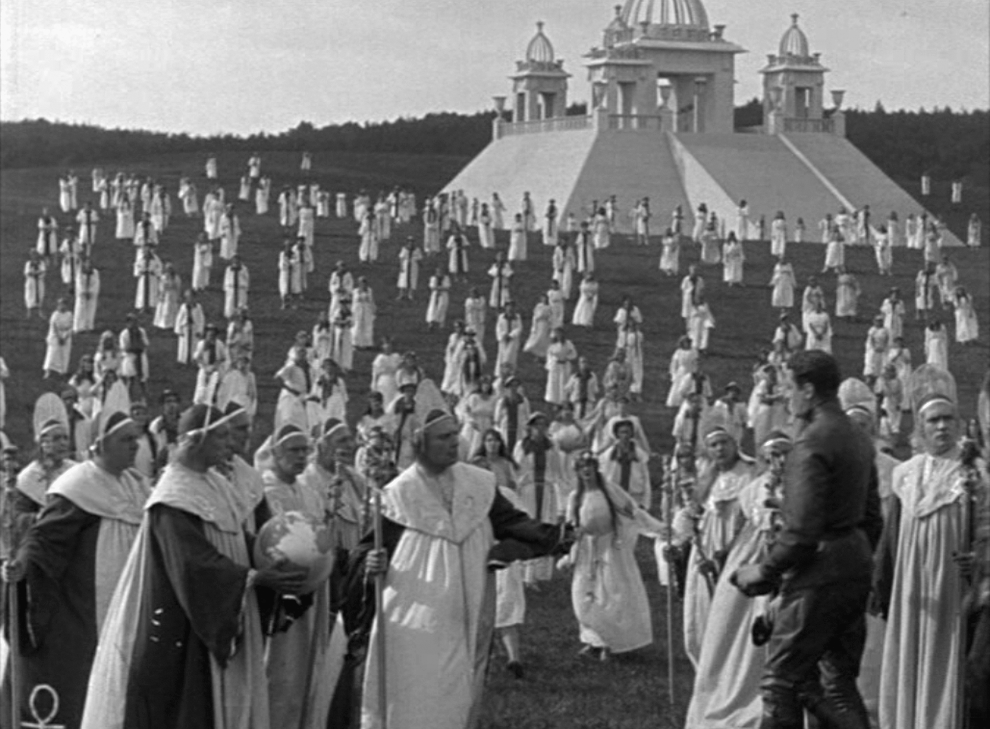
Screenshot from The Sky Ship depicting Martians and Earthlings meeting for the first time, an observatory temple in the background.
When Avanti tells of Christ, the wise man admits that on Mars they have had something similar. Before the so-called “Sin War,” which is presented as a counterpart to the Biblical Flood, “People were sacrificed so that the stern and terrible God, angry with wicked humanity, could be reconciled and appeased by blood sacrifices.” 52 The wise man believes that something similar is expressed in the story of Christ. On Mars, however, there is no longer such “superstition”—even though the wise man admits to the beauty of the story. The idea of a God, though, who, remorseful of the degenerate human race, butchers himself has something bestial about it that on Mars belongs to remote “Predatorial times” before the Sin War: “Not a single man, but all of Ral's [i.e., Mars'] population butchered itself to expiate its guilt, its rapacity and its malice.” 53 Now, these perceptions are not current anymore, because the Martians are not saved “through blood but through striving after a clean life and a healthier reason” (Michaëlis, 1921a, pp 180–181). 54
In conclusion, The Sky Ship was influenced by pluralistic speculations in general and specifically by the discussion regarding the existence of Martian canals, and it incorporated many of the religious currents and questions connected to the idea of a plurality of worlds. Two concepts from the discipline of comparative religion are helpful in gaining further understanding of the religious elements in The Sky Ship; one I have already mentioned, namely, mysticism, and the other is apocalypticism. Lack of space prevents me from dealing with these in detail; I have, however, dealt with both concepts in relation to The Sky Ship elsewhere. 55 Yet there was a further religious ingredient in Michaëlis' The Sky Ship that I have so far circumvented but which played a crucial role in forming Michaëlis' portrayal of the Martians and their elevated civilization: Druidry.
Druids in Space: The Esoteric Message of The Sky Ship
As pointed out by Casper Tybjerg, the Martians of the movie The Sky Ship resemble modern-day Druids (Fig. 7). 56 “This simile,” Tybjerg advocates, “irresistibly suggests itself because Michaëlis himself was in fact member of a fraternal order of druids and wrote a rather endearing pamphlet about their hallowed traditions” (Tybjerg, 1996, p 245; cf. also Tybjerg, 2001a, p 60). Yet the resemblance between the Martians and modern Druids is not merely superficial—it goes right to the core of The Sky Ship and reflects the seriousness with which Michaëlis embraced Druidry.

Modern Druids gathered at Stonehenge. A Wiki Commons photograph by Sandy Raidy, 2007. Color images available online at
Before proceeding, however, a word on “Druids” and “Druidry” might be helpful. “Druids” seem to have existed at least since 200 BC in Iron Age Europe as part of European Celtic culture and they may have functioned as some sort of magico-religious specialists (Hutton, 2009, p 1–2). Among the first preserved written sources mentioning Druids are those of Caesar and Cicero—yet already here, uncertainties abound. What “Druids” were and what “Druidry” consisted of are questions that will probably never be settled with finality (Hutton, 2009, pp 1–48). What is certain, though, is that in Europe from around 1500 up until today, a continual construction (and deconstruction) of Druidic traditions has been taking place (Hutton, 2009, p 49 ff). Through this, Druidry has been put to a variety of uses, from the postulate of an ancient common religion of mankind to the construction of national identities. Drawing on Ronald Hutton's comprehensive work on Druidry in Great Britain, Blood and Mistletoe, yet by necessity condensing the huge amounts of historical detail to a few themes of relevance to the present study, it can be said that Michaëlis' take on Druidry reflected ideas that were already extant. All the following conceptions of Druidry which Michaëlis harbored have also, at one time or another, been present in the British construction of Druidry. These encompass Druids as lofty peace-lovers, astronomers, and embodiments of a common, “true” religion of mankind combinable with, indeed anticipating, Christianity; as originating from the mythical continent of Atlantis; as believing in the transmigration of souls, and as highly evolved religious philosophers of an elevated ethical and spiritual quality; as having migrated into Britain from India, thus having connections to both Hinduism and Buddhism but also to ancient Egypt; and Druids as being connected to Arthurian legends. Druids have also, in parallel with these idealized images, been constructed as evil, blood-thirsty, human-sacrificing primitives. Needless to say, Michaëlis did not subscribe to this latter view of Druidry (Hutton, 2009). 57
In 1917, Michaëlis published a translation of the capacious medieval poem Parzival by Wolfram of Eschenbach in two volumes. The poem draws on Arthurian legend, and central to it is the notion of the Holy Grail (Wolfram of Eschenbach, 1917; Michaëlis, 1927). 58 According to a Danish Druidic lodge website, Sophus Michaëlis founded the first Danish Druidic lodge, “Grail” (“Gral”) on August 27, 1921 (the same year that the novelization of The Sky Ship was published). The lodge was a daughter lodge of the Swedish lodge “Vasa” in Malmö, part of the United Ancient Order of the Druids, which in turn was a split branch of the Ancient Order of the Druids founded in London in 1781. 59 According to Michaëlis, the lodge “Grail of Denmark” was founded on August 26 (not 27), 1921, and on September 24 the Danish Druidic Order inaugurated its own premises under the Swedish National Grand Lodge. Subsequently, two more lodges emerged from “Grail,” namely, “Parsifal” (September 29, 1923) and “Artus” (February 27, 1924) (Michaëlis, 1927, p 31). In 1927, The Order of the Druids (Danish, Druide-Ordenen) was published by the Parsifal Lodge. It was written by Michaëlis, and on the title page he called himself “Druid-brother of the Parsifal Lodge” (Michaëlis, 1927). Here, Michaëlis insisted that occult brotherhoods, such as the Parsifal Lodge, ought not be considered “religious”: indeed, many even “prohibit religious discussions.” Nevertheless, he continued, they do have a “sheen of confession-less religion,” and their goal is “always a raising of the human soul through brotherly interaction and common journeying towards the light” and “an ideal quest for the answer to the deepest riddle of life, to penetrate the darkness by which death blocks the earthly eye's ability to see and to be initiated in a spiritual vision, which is not of this world” (Michaëlis, 1927 p 10). 60
To Michaëlis, the central symbol of this spiritual quest was the Holy Grail, and he connected it with “the mysticism of the East and West, a conglomerate of ecstatic Christianity and Celtic Druidic tradition” (Michaëlis, 1927, p 34). 61 According to Michaëlis, the grail was the chalice which had been used at the Last Supper and in which Joseph of Arimathia had collected the blood from Jesus when he bled on the cross (Michaëlis, 1927, pp 34–35). As he explained in the introduction to Parzival, the legend of the grail gradually combined with tales of “Artus,” that is, Arthur, “originally an old Celtic chieftain in Southern England from the 5th or 6th century” (Michaëlis, 1917, p xix; cf. also Michaëlis, 1927, pp 26–27). 62 Ancient Druidic magic, divination, and wisdom were personified in the magician Merlin, who in turn was connected with the veneration of the Holy Grail (Michaëlis, 1927, p 27). According to Michaëlis, the grail was “the symbol of the very faith, the touchstone for virtuous purity, chastity, faithfulness, the knightly duty to worship the extrasensory, the holy, to provide protection against profane arrogance and improvidence, against sin and injustice” (Michaëlis, 1917, p xxix). 63 In the beginning of the 20th century the interest in the grail theme was extant in Europe (Wood, 2000, p 170), and as already mentioned, Michaëlis was not alone in connecting grail mysticism, Druidry, and Arthurian legend. Ronald Hutton provides several examples of how druids and the legendary figures of both King Arthur and Merlin became intertwined in the British imagination (Hutton, 2009). In another book, Hutton gives another such example: during the 16th century, Joseph of Arimathia became associated with Glastonbury Abbey, which already in the 12th century had been associated with King Arthur. By the late 19th century, local stories that the grail was buried somewhere on the Isle of Avalon (that is, Glastonbury) were told (Hutton, 2003, pp 60–68; cf. also Wood, 2000). In general, Michaëlis seems to have built his understanding of Druids and Druidry on the Welsh tradition constructed by figures such as the fraudulent Iolo Morganwg (Hutton, 2009, p 150 ff), utilizing the division of Vates, Bards, and Druids and insisting on the continuity of the Druidic tradition from prehistory, up through the Middle Ages until his own day, with the Druidic gatherings, “eistedvodds,” as contemporary manifestations of unbroken tradition (Michaëlis, 1927, pp 27–28). Michaëlis may also have been inspired by interpretations of the grail myth from around the turn of the century, such as the work of Alfred Trübner Nutt (1856–1910), who speculated that the grail myth had roots in early Celtic culture and the later medieval romances were a reworking of this material; Rudolf Steiner's (1861–1925) Theosophical exposition, which ventured that the grail story was about symbolic, initiatory experience; 64 and the work of Jessie Weston (1850–1928), which culminated in the book From Ritual to Romance from 1920 in which she connected the grail to ancient mystery rites—and Druidry (Wood, 2000, 181–183; Weston, 1993). 65
In The Order of the Druids, there were numerous elements that linked it to the vision expressed in The Sky Ship. First of all, it was permeated with passionate pleas for peace on Earth, and the ancient Druids were described as peacemakers (Michaëlis, 1927, p 21, p 30, p 32, p 37). Secondly, several passages situated The Order of the Druids in the exact same discursive place as The Sky Ship. For example, the United Ancient Order of the Druids was portrayed as fulfilling a need for “initiation into a higher and nobler vision” at a time when “national hate and the struggle of the classes have put peoples and individuals in attack positions against each other and a world war brutally has broken the trust in all connections” (Michaëlis, 1927, pp 12–13). 66 And what did The Sky Ship offer if not this “higher and nobler vision”? In the ceremonies of the ancient lodges, “the glowing temples are glimpsed,” just as they are on Mars (Michaëlis, 1927, p 13). 67 As already suggested, according to Michaëlis the ancient Druids cultivated the sciences in the form of mathematics and physics, studied medicine, were knowledgeable astronomers, deeply ethical, and believed in the immortality and transmigration of the soul—all characteristics that fit the Martians of The Sky Ship (Michaëlis, 1927, 21).
When Michaëlis described the transforming effects of the initiation into the Druidic lodge, Michaëlis evoked images that were really a sort of condensed poetic script for The Sky Ship: “Intuition opens the eyes of the soul so that they see the invisible. The thought lets go of the earthly and rises into a lighter and finer air. The silence mounts to a temple. And a single, small peal of a bell carries the mind up into endless heights” (Michaëlis, 1927, pp 33–34). 68 Through the cinematic medium, the soul's eyes are opened (the blind can see) to the hidden mysteries of utopian, Druidic society. The thought travels, like The Sky Ship, up through and out of the atmosphere. On Mars (where the air is thinner and finer than on Earth), the mystic silence is encountered in one of the observatory temples where, as we saw above, a gong (bell) is struck, and “pure thought's eternal tone” is heard.
Thus, The Sky Ship may be seen as cinematic ritual or, perhaps more precisely, a cinematic sermon with elements of ritual initiation. According to Michaëlis, part of the ancient Druids' training consisted in elaborate initiations that encompassed ritual purifications, the donning of a three-colored cloth, and isolation in total darkness for three days, culminating in the novice being let out again into “the light and the new life” (Michaëlis, 1927, p 22). 69 In the cinematic version of The Sky Ship, as described above, the killing of a bird and wounding of a Martian forced the Earthlings to dwell in the “house of judgment.” It is here that they are shown movies of the terrible Martian past, an idea that is repeated in the novel, and in the script version there are living images being shown in a kind of mirror above the entrance to the cave (Michaëlis and Olsen, n.d., pp 32–33). Schröder has suggested that the Martian “cinema” in the novel reflected Michaëlis' idealized conception of cinema, which exists in a pure, nontechnological form on Mars (Schröder, 2011 544–545). But, in the movie version, it is equally tempting to read it as an allegory of the ritualistic quality of cinema itself, in turn boosted by the salvational qualities already ascribed to the medium. 70 As the atonement in the abode of judgment is also a ritual purification and initiation into the mysteries of Martian civilization, resulting in the donning of the “garb of mercy,” so the act of watching this mise-en-scène in the darkened space of cinema is a replication of the initiation rite, ideally producing the same effects in the viewer. In the movie script, Dr. Krafft and Avanti even bathe in the Lake of Purification, a rite that Marya has made a prerequisite for Avanti to undergo before he can be deemed worthy of her hand (Michaëlis and Olsen, n.d., p 41).
It is easy to see how Michaëlis' concept of Druids and Druidry were combinable with, for example, Flammarion's articulations of the Neo-Platonic idea of a great chain of being, and one could perhaps ask whether Michaëlis' interest in Druidry in itself can really function as an interpretational key to The Sky Ship. 71 But there is in fact more solid evidence than that given above for the connection being there and important at that. One of the lighter pieces of evidence is the fact that the wise of the Martians wear Egyptian ankh signs on their gowns, for as mentioned above, according to Michaëlis, the Druidic tradition might have been influenced by ancient Egyptian religion (Michaëlis, 1927, p 15). More important, however, is the fact that in Roman Spring (Danish, Romersk Foraar) (1921), Michaëlis chose to situate the poem “The Grail” (Danish, “Gralen”), describing the horrors of the great World War in terms of grail mysticism, immediately before the poem “The Sky Ship” (Danish, “Himmelskibet”), which, as already mentioned, was an enlarged version of the farewell song at the end of the movie The Sky Ship. 72 Both poems figured in a section dedicated to World War I (“Litanies 1914–18”) (Danish, “Litanier 1914–18”), and their order of succession further strengthens the intimate connection between the two subjects (Michaëlis, 1921b, pp 135–140). This again may imbue an enigmatic row of bowls at the beginning of the movie, from which smoke rises toward an image of Mars, with more meaning than that of being mere offerings (Fig. 8). In “The Grail” we read: “The lamps of the spirits are extinct/by smoke from the suffocating fires./We see only the blood steaming/high from the ravished bowl.//We butcher humanity like cattle,/defaces its memories by murder./We cut off by the root the eden/the palms of which shaded our Earth” (Michaëlis, 1921b, p 135). 73 With these lines in mind, the smoking bowls of the movie may be seen as a visual metaphor for the grail and thus point to the close affinity between Michaëlis' Mars vision and his version of Druidic grail mysticism. Furthermore, the nontechnological and natural Martian setting of the movie also strengthens the Druidic interpretation. Plants and trees were considered among the holiest of holiest by the Martians, which according to Michaëlis was also the case with the ancient Druids (Michaëlis, 1927). 74
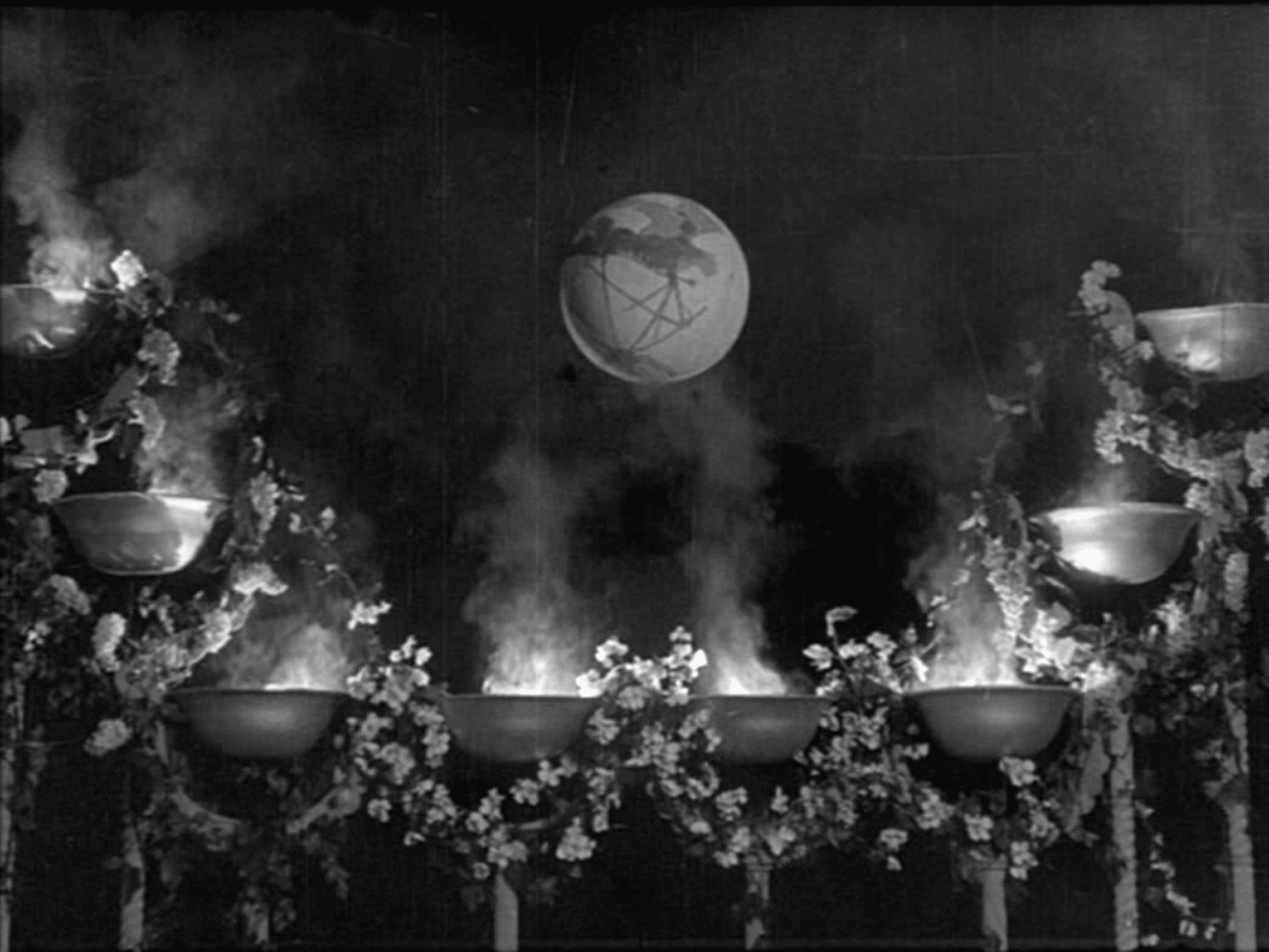
Screenshot from The Sky Ship. Smoke rising from bowls toward an image of Mars. A visual metaphor for the Holy Grail.
Finally, further substantiation of a “Druidic” reading of The Sky Ship can be found in the letters Michaëlis wrote to the Danish baroness Rigmor Stampe (1850–1923). Stampe was married to the Danish composer Victor Bendix (1851–1926), related to the famous cultural radicalist Georg Brandes (1842–1927), and frequented the same social circles as Sophus Michaëlis, with whom she became close friends. The letters from Michaëlis to Stampe are a rich source regarding Michaëlis' personal views of The Sky Ship. The tone is highly romantic and saturated with a mystic outlook, including recurrent references to telepathy. Though Druids are not mentioned in the letters, the connection Michaëlis saw between Druidry and grail mysticism, and which Stampe must surely have known about, makes it reasonable to suppose that Michaëlis' adherence to Druidic beliefs was a well-known subtext in the letters.
In the letters, Michaëlis speaks of both the grail and The Sky Ship in the same breath. In a letter from 1917 where Michaëlis writes that Stampe's reading of his works turns him into a “knight of the Grail” and relates how The Sky Ship is currently under production, Michaëlis thanks Stampe for a “red Grail-heart” that she has put in a letter to him. He tells her it shines the light for him while he is finishing his translation of Parzival. He continues:
How wonderful to feel that grail is still alive and works, even if it only shows itself visible to the guardians of the shrine. Yes, the grail—the mystical and holy power of the wonder, the carbuncle of eternity: our heart—shines the light for us even in the darkest times, when the world daily hides in heavier gloom, threatening to swallow the sun itself. 75
Thus, the holy power of the grail was very real to both, and the indeterminate form of the first “grail” might even suggest that Stampe was somehow involved in the creation of the first Druidic lodge in Denmark. 76 For certain, Michaëlis connected Stampe with the powers of the Holy Grail. For example, at the premiere of The Sky Ship, Michaëlis carried a telegram from Stampe in a pocket near his heart and felt it protected him against the negative elements among the audience. 77 Several of the letters also suggest that Michaëlis and Stampe considered Michaëlis' vision of Mars a higher reality that could manifest itself on Earth. Stampe often sent Michaëlis flowers and trees; an especially beautiful lilac tree was so “big and wonderful, as if it were gathered from Mars itself,” and a spruce twig was described as being “from the very eating garden on Mars.” 78 When Michaëlis relatively late in life had his first child, he was overjoyed and wrote to Stampe: “It is a Mars-child. You may laugh, but it is true. My imperfect Sky Ship came sailing back with it.” 79 That Michaëlis could write congenially about sublime objects and beings being descended from Mars to a person with whom he shared the mysteries of the grail suggests the affinity of the ideas, at least in the minds of the two. 80
Conclusion
The study of The Sky Ship and its religious and pluralistic context offers a window through which a period can be observed in which people struggled with ontological and epistemological questions relating to science and religion and the negotiation of their interrelationship, not unlike today. At the same time, it throws new light on how pluralistic ideas were used and articulated in a geographical area, which has as yet received relatively little attention in the history of astrobiology. Also, The Sky Ship is an example of scientific ideas intermingling with religious imagination, something that is not uncommon in the history of astrobiology as expressed in popular science writing and science fiction. By letting the audience in on the esoteric mysteries of Druidry through the visions of utopian Mars, Michaëlis seems to have hoped to transform them into a higher state of seeing and perceiving, a state that ultimately would lead to universal peace and the salvation of the human race. As the reception of the movie shows—and despite its commercial success—he failed in doing this. Though World War I did in fact end, it was hardly because of The Sky Ship, and neither was Earth's humanity transfigured because of it. This, understandably enough, lead to disappointment on Michaëlis' part. In conclusion, The Sky Ship provides an example of how several different religious currents conglomerated in a work of art that aimed to transcend time and space yet was inescapably bound by both. As such, The Sky Ship functions as a prism through which a certain, localized historical period's preoccupation with religion and astronomy is refracted and thus, hopefully, broken down into elements of interest to the history of astrobiology. It may indeed serve as a reminder that certain aspects of modern astrobiological speculations on the subject of (contact with) extraterrestrial intelligence, which tend to suppose that it will be of a benign and highly evolved nature (cf. e.g., Drake and Sobel, 1997), may have roots in (or, at least, resemble closely) beliefs that have a history of existing in parallel with the scientific method yet cannot be deduced from it.
Footnotes
Acknowledgments
Thanks to Ralf Bülow, who told me about the existence of The Sky Ship in the first place; to Alexander C.T. Geppert and Thomas Brandstetter for pointing out The Sky Ship's affinity to On Two Planets; to Jesper Krogh Pedersen, Stephan Michael Schröder, Casper Tybjerg, and Lea Hjorth for helpful suggestions and assistance in obtaining relevant literature; and to the Danish Film Institute, especially Lisbeth Richter Larsen. Thanks also to James Coplien for proofreading and correcting my broken English. In general, Pedersen's and Schröder's works have been indispensable for this study, not least as guides to useful primary literature. The conclusions reached here, though, are solely my responsibility. This article is dedicated to the memory of Erik Kjærgaard Larsen, 1950–2012.
Disclosure Statement
No competing financial interests exist.
1
2
Though the English title is mainly known as A Trip to Mars, I will use the title The Sky Ship throughout this paper, since this is the semantically correct translation of the title. The Danish himmel can mean both “sky” and “heaven.” Therefore, Himmelskibet can both refer to a ship of heaven and of the sky. The translation used by Casper Tybjerg, The Heaven-Ship, is therefore also semantically correct (Tybjerg,  , p 241).
3
Thus, when I refer to The Sky Ship without qualifying which version in particular, I refer to the “generic” story underlying all four versions. Despite various differences between the versions (the script, for example, has scenes that are not in the movie), they have enough in common to make this a sensible choice.
4
On Two Planets was translated into Danish in 1898 and published as an issue of the popular family reading magazine In Leisure Hours (Danish, I Ledige Stunder) (Lasswitz, 1898). Michaëlis could easily have read On Two Planets in German (Jacobsen, 1993, p 218). Yet, if he did not learn of this work at the time of its German publication, it is reasonable to assume that its existence would at least have been brought to his attention by its translation into Danish. Thus, given his general interest in astronomical themes and the plurality-of-worlds debate, it is highly likely that he read On Two Planets and that it inspired The Sky Ship. That On Two Planets was well known in Denmark, at least in astronomical circles, at the time of The Sky Ship is attested by Luplau Janssen (), in which it is mentioned. The Sky Ship was translated into German in 1926 as Das Himmelschiff by Charlotte Weigert, S. Fischer, Berlin.
5
Danish, “for Maskintidens larmende Brutalitet, for Videnskabens elektriske Straaler, for Bulderet af de sociale Sammenstød,” “gemmer sig fromt i Religionens Moderfavn,” “drømmer sig dristigt ud over samfundet.” All quotes by Michaëlis—except title cards in the movie—have been translated into English by me. Though the lyrical verse rhymed in the original, I have not tried to transfer the rhymes into English, preferring to get the meaning across rather than conforming to the original form.
6
cf. also Jacobsen (1993, p 225). In many of his poems, Michaëlis praised the life-giving properties of the Sun; see also Rimestad (, p 61 and 70) on the special “heathen” religiousness of Michaëlis.
7
Danish, “det sjælelige gennembrud.”
8
9
10
A translation of the Danish title card would read: “I will ignite your sun in the world of imperfection!”
11
A translation of the Danish title card would be: “Our seed you shall sow in your earth/Our perfection you shall yourself attain/where the harmony of universal love/shall deliver you of every vice!//: Love's high, omnipotent law/is the radiant power you call God.:”
12a
In the script Professor Dubius is designated “Judas, the traitor” in a scene—not in the movie—where Avanti is gathering the crew for the expedition, counting thirteen people including Avanti and the disguised Dubius, thus underscoring the parallel to Jesus Christ and his disciples, Avanti clearly taking the place of Jesus (Michaëlis and Olsen, n.d., p 9).
12b
It is not stated explicitly that it is Copenhagen, though it is evident from the footage.
13
In the Danish title card it is not only “love” but also “peace” that may grow strong.
14
The poem almost reads like a public job application for the position of scriptwriter at Northern Film Company. Michaëlis' involvement with the film industry, however, was evident already in 1909, when the Great Northern Film Company bought the movie rights to his theatrical play Revolution Marriage (Schröder, , p 512). Yet it seems that Michaëlis was not involved in concrete movie script work at The Great Northern Film Company before 1916 with a revision of the script to the movie Pax Æterna (Schröder, 2011, p 514). Note that the Danish word eventyr can both mean “adventure” and “fairy tale.”
15
16
17
18
19
20
Danish, “forbudte lidenskaber: udenomsægteskabelige forbindelser og kærlighed på tværs af klasseskel, der fører til fejltrin og misgerninger: uønskede graviditeter, dokumentfalsk, underslæb, jalousi, selvmord eller mordforsøg.”
21
22
cf. also Schröder (2011, pp 534–536) and Tybjerg (, p 242).
23
Danish, “spænder over den ganske Jord, taler med samme Tunge til alle Folkeslag, forstaas af dem alle. Den vil dræbe Babel, den vil sprede Oplysning og binde Menneskene sammen i eet uhyre Bundt, der vil faa dem til at tage fat paa Byggeriet igen./Og da vil Taarnet rejse sig, Kulturens, Oplysningens og Forstaaelsens Taarn, og det vil rage helt ind i Himlen.”
24
Emma Gad, “Films-Eventyret,” in Politiken, 6.3.1913. Danish, “Sig, hvad I vil, de levende Billeder er ligefuldt en vidunderlig Opfindelse, udsprungen af selve Tidens Aand, demokratisk i Ordets bedste Forstand, fordi de gennem Prisbillighed bevirker, at Alle kan være med, og især, fordi de nærmer Folkene til hverandre, de forskellige Racer, hvis indbyrdes Forstaaelse i Aartusinder har været hemmet af uensartede Sprog” (quoted in Tybjerg, , p 50).
25
26
Danish, “en stor Opgave har jeg netop for: at bringe Filmen til at udøve den digteriske Mission, den hidtil har forsømt: at forædle gennem Synet, at sprede Idealer” (Letter to Rigmor Stampe, Hellerup d. 30. maj, 1917, Royal Library, NKS 4793 I.2 4°).
27
Danish, “et Forsøg paa gennem Fantasien at foregribe et af de store Fremtids-Problemer”; “tvinges ud i Verdensrummet for at gaa paa Togt mod de Kloder, der er Jorden nærmest.”
28
Danish, “Den var helt igennem saa sentimental og naiv, at den Gang paa Gang fremkaldte Latteren, men paa de højtidelige Steder.”
29
“Copenhagen grin” and Michaëlis' own estimation of the success of the movie in a letter to Rigmor Stampe, February 26, 1918, Royal Library, NKS 4793 I.2 4°. In fact, Michaëlis went on to write the script of yet another movie, The Friend of the People (Danish, Folkets Ven), which premiered in 1918 too and was a more unequivocal success.
30
Conspicuosly, the Martians are revealed to be engaged in eugenistic strategies to refine their racial purity, something that does not appeal to the protagonist of the novel, Ercole Sabene. Lack of space prevents me from dealing with this important theme here; see Schröder (2011) and Bjørnvig (2011). As Clarence H. Miller has pointed out in an introduction to Thomas More's foundational utopian text, the aim of More's Utopia was not “to give the reader a view of a perfect society” but rather to encourage “taking a new view of social and political problems by seeing alleged (and strange) solutions to them” (Miller, , p ix). Whereas I think Michaëlis' Martian society in the movie version of The Sky Ship did depict his notion of a perfect society, the book version's portrayal of the Martian civilization was more ambiguous.
31
Danish, “føler sitre hver Fiber og Fold/i min bankende Organisme,/og luende Stjernespektre staa/brudt gennem min Hjernes Prisme.”
32
Danish, “hører et Fædreland til/langt større end Jorderige.”
33
Danish, “Jeg véd—at Baand kan ej binde/Sjælenes Vingefang:/Engang skal de Vejen finde/blandt talløse Kloders Gang.”
34
Danish, “har du mon noget Liv, som kunde ane,/at fra en fjærn og mørkesvøbt Planet/Aartusinder har Øjne paa dig set/og fulgt hver bælgmørk Nat din stille Bane?”
35
Danish, “Vor Klode som en Hjerne/sin Vej i Rummet går—/hvem véd, om med en Stjerne/engang Kontakt vi faar?/Ukendt er Strømmens Evne,/vor Finger sender ud,/og ingen véd det Stævne,/hvortil den bærer Bud.”
36
Danish, “Nat efter Nat [staar] de samme Stjerner paa den samme Himmel som tavse Betragtere af den lille Myretue, vor Klode udgør i Universet. Og vi kan være temmelig forvissede om, at de Blik, vore svage Øjne sender ud i Rummet, krydses af mindst lige saa stærke, der vandrer imod eller ligegyldigt forbi vor lille halvobskure Ravnekrog af en Planet.”
37
38a
The roles of Schiaperelli and Lowe in the debate of the existence of intelligent life on Mars are treated in the chapter “The Battle over the Planet of War” in Crowe (1999, pp 480–546).
38b
39
In the solar system, Luplau Janssen only granted Venus a realistic possibility of harboring life. As for other star systems, he thought that most would have planetary systems some of which might have life.
40
Petersen states that Lau “as far as I can see agreed with Luplau Janssen and Buch Andersen that the Mars channels existed” (Danish, “så vidt jeg kan se, [var] enig med Luplau Janssen og Buch Andersen i, at Marskanalerne eksisterede”). That this is in fact the case is confirmed by Lau (1913). Note that the Danish word kanal, like the Italian canali, can mean both “canal” and “channel.”
41
Flammarion also played a major role in popularizing Schiaparelli's work on Mars and insisted that the canals had been built by Martians (cf. Sullivan and Carney, 2007, p 21).
42
On Flammarion's ideas of a civilization on Mars that is superior to Earth's, see Crowe (1999, p 496).
43
Michaëlis: Danish, “Livets Paradis,” “den levende Fornufts Fremskridt til større og finere Kulturformer.” Flammarion: Danish translation, “Fra hvilket Synspunkt man end betragter Spørgsmaalet om Mennesket, finder man overalt de uigjendriveligste Beviser paa vor Klodes lave Tilstand og de bestemteste Antydninger af, at der maa findes en fortrinligere Existents udenfor Jorden …”
44
Danish, “der længst har vor Kultur tilbagelagt,” “paa andre Kloder søges Paradiset,/hvis Porte vore Flammesværd slog i.” This idea also found support in Laplace's nebular hypothesis, which stated that the closer to the Sun, the younger the planet would be. When this was combined with Darwinian theory of evolution, the idea formed in the popular imagination that the “planets constituted a sort of evolutionary time machine” (McCurdy, , p 110).
45
Both Wivel and Schröder have pointed out the importance of Neo-Platonism for The Sky Ship; I will not pursue this theme in detail here (Wivel, 2009, p 370; Schröder, , p 540).
46
Danish translation, “Hvem siger os, om ikke den store samlede Menneskehed dannes af en uafbrudt Række individuelle Menneskeheder, der staa paa alle Trin af Fuldkommenhedens Stige?” “Unified humanity” here means all intelligent beings in the universe.
47
48
Danish, “Havde Verdens Frelser nogensinde været paa en Fart som denne ud i det blinde og vilde Stjernekaos? Det var vist en Gudsbespottelse. Men Ercole Sabene spurgte pludselig sig selv: Er han kun en Jordfrelser? Født af Jordens Kaar og Behov? Skabt til at frelse Jordmennesker og rejse dem af jordisk Dynd og Synd? Eller havde han også sin Mission at øve i den ny Verden, hvortil “Kosmopolis” nærmede sig? Trængte ogsaa den til en Frelser? Vilde han møde Christus ogsaa her? Vilde han finde Kirker, hvorhan tilbades, Stumper af Korset, hvorpaa han havde hængt, Grave, hvoraf han er opstanden?”
49
Danish, “Allivets Herre, den uudsigelige, den ugribelige, som er over os og under os og i os, som taler i den evige Tavshed, som bor i Blomsternes duft og tænker i Stjernernes Kresgang.”
50
Danish, “For første Gang fornam de den rene Tankes Evighedstone—ordløs, begrebsløs, ikke bundet til nogensomhelst Forestilling—kun som en Duft, der aandes ud i det endeløse Himmelrum.” Sabene, though, cannot help but compare the flower to the cross: “Perhaps the world savior on Mars had incarnated in a martyrdom in which the blue flower had become the symbol for his suffering, death, and resurrection. The fragrant flower was worshiped like the cross and rosary on Earth” (Danish, “Maaske havde Verdensfrelseren paa Mars inkarneret sig i et Martyrium, hvor den blaa Blomst var blevet Symbolet paa hans Lidelse og Død og Opstandelse. Den duftende Blomst var Genstand for en Tilbedelse som Kors og Rosenkrans paa Jorden.”) (Michaëlis, , p 162).
51
Danish, “Gud er det gode, der er i mig. Jeg er et Blodkorn i hans evige Blodomløb. En Celle i hans altomspændende Legem. Et Atom i hans Alliv.”
52
Danish, “ofredes der Mennesker, for at den strenge og skrækkelige Gud, der harmedes paa den vanartede Mennskeslægt, kunde forsones og formildes gennem Blodofre.”
53
Danish, “Ikke et enkelt Menneske, men hele Rals Befolkning slagtede sig selv for at sone sin Skyld, sin Rovlyst og sit Nid.”
54
Danish, “gennem blod, men gennem Stræben efter et renere Liv og en sundere Fornuft.” Here, the parallel between the Sin War and the great World War on Earth is obvious. The war that rages on Earth belongs to a level of development long since left behind by the Martians. During this conversation, the wise man clearly expresses the notion of the great chain of being. He states that the Martian society should be seen as a projection of Earth into an already defined future: “much on your planet must be as it once was on ours, before the Sin War purified us and taught us to seek higher and nobler goals.” (Danish, “meget på din Klode maa være, som det engang har været paa vor, før Syndkrigen lutrede os og lærte os at søge højere og ædlere Maal”) (Michaëlis, , p 169). The wise man even admits that his refined face may well be compared to Earthly conceptions of angels, if any doubt should linger as to where in the great chain of being the Martians are situated (Michaëlis, 1921a, p 178).
55
As I—among others—have argued (Bjørnvig, 2011, 2012), the science fiction genre displays many apocalyptic elements. One of these is the heaven-journey along a vertical axis, an element clearly present in The Sky Ship, something which Tybjerg has also noted. Tybjerg has also pointed out the importance of Avanti being an aviator and the aviator's role in connection of the theme of “ascent” (Tybjerg, , p 246). This element in The Sky Ship should be further explored, utilizing insights from Corn (1983), something I hope to do in the future.
56
Though none of the Martians in The Sky Ship wear “father christmas beards” as Tybjerg suggests; this must be something Tybjerg projects from photographs of modern-day Druids back upon the Martians of The Sky Ship.
57
Once more it should be stressed that pretty much everything Michaëlis had to say of the Druids does not reflect known historical facts but is rather an example of the “invention of tradition” (cf. Hutton, 2009; Cunliffe, ).
58
59
See
60
Danish, “forbyder endog religiøse Diskussioner”; “et skær af almen, konfessionsløs Religion”; “altid en Højnelse af Menneskesjælen gennem broderligt Samvirke og fælles Vandring mod Lyset”; “en ideel Stræben efter at løse Livets dybeste Gaade, at gennemtrænge Mørket, hvormed Døden spærrer af for det jordiske Øjes Sekraft, og at indvies i et aandeligt Syn, der ikke er af denne Verden.”
61
Danish, “Østens og Vestens Mystik, et Konglomerat af ekstatisk Kristendom og keltisk druidisk Tradition.”
62
Danish, “Oprindelig en gammel keltisk Høvding i Sydengland fra 5. eller 6. Aarh.”
63
Danish, “Symbolet på selve Troen, Prøvestenen paa sædelig Renhed, Kyskhed, Troskab, Ridderpligten til at dyrke det oversanselige, det hellige, til at danne Værn mod verdsligt Hovmod og Letsind, mod jordisk Synd og Uretfærdighed.”
64
Steiner held a series of lectures on the Holy Grail and the Parzival story in 1913; these were subsequently circulated in shorthand reports which might have reached Michaëlis; cf.
65
As Weston translated Parzival into English in 1894, Michaëlis must surely have been aware of her work.
66
Danish, “et højere og ædlere Syn”, “Nationalhad og Klassekamp har stillet Folk og Mennesker i Angrebsstilling til hverandre, og en Verdenskrig brutalt har sønderbrudt Tilliden til alle Forbindelser.”
67
Danish, “øjnes de lysende Templer.”
68
Danish, “Intuitionen aabner Sjælens Øjne, saa de ser det usynlige. Tanken slipper det jordiske og stiger op i en lettere og finere luft. Stilheden taarner sig til et Tempel. Og et enkelt lille Klokkeklemt bærer Sindet op i endeløse Højder.”
69
Danish, “til Lyset og det nye Liv.”
70
71
72
The poem “Grail” also featured as a poetic introduction of Michaëlis' translation of Wolfram of Eschenbach's Parzival.
73
Danish, “Udslukte er Aandernes Lamper/af Os fra de kvælende Baal./Vi øjner kun Blodet, der damper/højt af den skændede Skaal.//Vi kvægslagter Menneskeheden,/besudler dens Minder i Mord./Vi hugger ved Roden det Eden,/hvis Palmer beskygged vor Jord.”
74
In fact, Michaëlis directly criticized modern technology in his Druidic pamphlet (Michaëlis, 1927, pp 12–13), despite the movie's obvious preoccupation with aviation and spaceship technology (cf. Tybjerg, , pp 245–246).
75
Danish, “Hvor vidunderligt at mærke, at Gral endnu lever og virker, selv om den kun aabenbarer sig synlig for Helligdommens Vogtere. Ja, Gralen—Underets mystiske og hellige Krafft, Evighedskarfunklen: vort Hjerte—lyser for os selv i de sorteste Tider, da Verden daglig hytter sig i tungere Mulm, der truer med at sluge selve Solen” (Letter to Rigmor Stampe, July 24, 1917, Royal Library, NKS 4793 I.2 4°).
76
The indeterminate form of “grail” (Danish, “Gral,” see note above) could be interpreted as a proper name as well. Otherwise, the indeterminate form is hard to explain, except if the omission of a determinate ending (Danish, “Gralen”) was a writing error (and note that at this point in Danish orthography both nouns and proper names were capitalized). Too, the reference to the guardians guarding a shrine is reminiscent of experienced ritual, though it might of course just as well be there for the symbolic content. However, this would be four years before Michaëlis founded Grail, the first Druidic lodge in Denmark, and this, together with the fact that women were excluded from the Druidic lodges except on special occasions, makes it doubtful that Michaëlis and Stampe were involved in lodge activities at this point.
77
Letter to Rigmor Stampe, February 26, 1918, Royal Library, NKS 4793 I.2 4°.
78
Danish, “saa stort og dejligt, som var det hentet fra selve Mars”; “fra selve Spisehaven paa Mars” (Letters to Rigmor Stampe, March 29, 1918, and January 16, 1919, Royal Library, NKS 4793 I.2 4°).
79
Danish, “Det er et Mars-Barn. Du maa godt le, men det er sandt. Mit ufuldkomne Himmelskib kom sejlende tilbage dermed” (Letter to Rigmor Stampe, June 30, 1920, Royal Library, NKS 4793 I.2 4°). As this passage suggests, the meaning of some of the esoteric utterings in the letters might have been intended as allegory rather than concrete belief; the seriousness of Michaëlis' Druidic beliefs, though, are attested to by his founding of a Druidic lodge.
80
Theosophy might have influenced Michaëlis' version of grail Druidism, too. As for example Freeman (1924) indicates, Theosophy and Druidism did become connected; a fact that is also interesting given Justin Brown's thesis of an intimate connection between Theosophy and the belief in the salvational power of early cinema (Brown, ). Also, Rudolf Steiner's Theosophic interpretation of the grail myth in 1913 might, as already mentioned, have been known to Michaëlis.