




Abstract
For several reasons, spacecraft are constructed in so-called clean rooms. Particles could affect the function of spacecraft instruments, and for missions under planetary protection limitations, the biological contamination has to be restricted as much as possible. The proper maintenance of clean rooms includes, for instance, constant control of humidity and temperature, air filtering, and cleaning (disinfection) of the surfaces. The combination of these conditions creates an artificial, extreme biotope for microbial survival specialists: spore formers, autotrophs, multi-resistant, facultative, or even strictly anaerobic microorganisms have been detected in clean room habitats.
Based on a diversity study of European and South-American spacecraft assembly clean rooms, the European Space Agency (ESA) has initialized and funded the creation of a public library of microbial isolates. Isolates from three different European clean rooms, as well as from the final assembly and launch facility in Kourou (French Guiana), have been phylogenetically analyzed and were lyophilized for long-term storage at the German Culture Collection facilities in Brunswick, Germany (Leibniz-Institut DSMZ-Deutsche Sammlung von Mikroorganismen und Zellkulturen). The isolates were obtained by either following the standard protocol for the determination of bioburden on, and around, spacecraft or the use of alternative cultivation strategies.
Currently, the database contains 298 bacterial strains. Fifty-nine strains are Gram-negative microorganisms, belonging to the α-, β- and γ-Proteobacteria. Representatives of the Gram-positive phyla Actinobacteria, Bacteroidetes/Chlorobi, and Firmicutes were subjected to the collection. Ninety-four isolates (21 different species) of the genus Bacillus were included in the ESA collection.
This public collection of extremotolerant microbes, which are adapted to a complicated artificial biotope, provides a wonderful source for industry and research focused on very unusual properties of microbes. For ESA, this collection is an essential resource with which to evaluate the contamination potential of spacecraft-associated biology and validate new biological contamination control and reduction procedures. Key Words: Culture collection—Extremophilic microorganisms—Planetary protection. Astrobiology 12, 1024–1034.
1. Introduction
T
Space agencies have defined standards by which to measure the bioburden on spacecraft. The procedure is based on a wipe- or swab-sampling, followed by a heat shock (80°C, 15 min) that should kill all vegetative organisms and support the survival of (probably space-travel resistant) spore-forming microbes. Although several weaknesses of these standard assays have been declared (Probst et al., 2010), this method is necessary to ensure the comparability of the cleanliness of different spacecraft and to understand whether contamination limits have been exceeded or not.
Nevertheless, cultivation alone does not allow for assessment of the overall microbial diversity present. It has been expected that only a very low percentage of microorganisms are cultivable when standard laboratory media are used (Amann et al., 1995). During the last years, different molecular methods have additionally been used to assess the microbial diversity on, and around, spacecraft (Venkateswaran et al., 2001; La Duc et al., 2009, 2012; Cooper et al., 2011). Besides genome-based methods, ATP and limulus amoebocyte lysate (LAL) measurements have helped in understanding the diversity and abundance of microbes present (Bruckner et al., 2008). Cultivation-independent methodologies are advancing rapidly, can produce more data in a shorter time, and have revealed an amazingly broad diversity of spacecraft-associated microorganisms.
Nevertheless, some major questions remain unanswered with the use of molecular-based methods: Which metabolic capabilities and resistance properties do detected microbes have? Were they alive at the moment of sampling? Could they possibly survive the harsh conditions during launch, space travel, and impact, and even in an extraterrestrial environment?
Cultivation and resistance testing can address all these questions and are therefore an important prerequisite for the understanding of the microbial clean room diversity. Isolates can be properly analyzed, their resistances can be measured, and possible risks can be assessed.
Certainly, cultivation is time-consuming and therefore comparably expensive. Additionally, cultivation success cannot be guaranteed, as major groups of microorganisms remain uncultivated. This problematic issue has also been discussed with regard to the detection of archaeal signatures in clean rooms, since archaea are still considered to be one of the most complicated groups to be cultivated (Moissl et al., 2008; Moissl-Eichinger, 2011).
Interestingly, clean room isolates can show special properties that are sometimes very different among closely related, environmental strains, as has been shown by the analysis of strain B. pumilus SAFR-032, one of the most UV-resistant bacteria (Newcombe et al., 2005). The mechanisms behind resistances or possible adaptations to clean room conditions are often poorly understood or not understood at all, though they could provide valuable information for researchers who work in astrobiology and any number of related disciplines. Unfortunately, in most cases, clean room samples and isolates are not accessible for the broad scientific community. Spacecraft-associated isolates are predominately the property of space agencies that use them in their own investigations; nevertheless, due to current budget constraints at most space agencies and, consequently, fewer investigators to do the work, hundreds of isolates that have not been investigated remain in storage.
The logical follow-up step is now to open these collections to the public and allow interested groups to work with the isolates obtained from spacecraft and spacecraft assembly clean rooms.
Here, we report on the foundation of the first public collection of microbial isolates, from spacecraft-assembly facilities of the European Space Agency (ESA), which have been characterized, organized, and stored with the intent to be distributed to interested researchers.
2. Materials and Methods
At the date of publication, the culture collection was mainly composed of isolates that were obtained during a sampling period of 3 years, which was performed in European and South American spacecraft assembly clean rooms. In the following, we address the sampling performance, the isolation, and characterization of microbes obtained during this campaign in order to provide a reference for researchers who work with culture collection isolates.
2.1. Sampling sites
Overall, three European spacecraft assembly clean rooms were analyzed in the frame of five sampling events. Additionally, one South American facility was sampled. For further details on the “Herschel campaign” see also Stieglmeier et al. (2012). A summary is given in Table 1. During sampling, all clean rooms were operated and environmentally controlled with regard to humidity, temperature, and air circulation.
2.2. Sampling
Spacecraft assembly clean rooms (clean room floor, spacecraft, and ground-support equipment) were sampled by using wipes (VWR Spec-Wipe 4; VWR International GmbH, Darmstadt, Germany, 15×15 cm), SpongeSicles (Biotrace [3M], St. Paul, MN), and swabs (nylon-flocked swab; MicroRheologics, Copan, Brescia, Italy). The sampling procedures for SpongeSicles were described elsewhere (Stieglmeier et al., 2009). Sampling with swabs and wipes was performed as outlined in European Cooperation for Space Standardization (ECSS) document ECSS-Q-ST-70-55C (ECSS-Q-ST-70-55 Working Group, 2008). Samples were taken either by using pre-moistened, sterile wipes for larger surface areas (up to 1 m2) or nylon-flocked swabs (pre-moistened with sterile water) for spacecraft and selected clean room surfaces (25 cm2). After sampling, swabs were transferred to tubes containing 2.5 mL of sterile PBST (i.e., phosphate-buffered saline solution including 0.02% [v/v] Tween 80), and wipes were transferred to tubes containing 36 mL sterile PBST.
Air samples were taken by two parallel operated air samplers (Satorius, AirPort MD8). Five hundred liters of air were sampled with a flow rate of 30 L/min. Samples were collected on disposable gelatin filters (Φ 80 mm, pore size 3 μm). All samples were kept at 4–8°C and processed within 24 h of collection; sampling tools were extracted via vortexing and sonication; the remaining liquids were used for inoculation of appropriate media.
Field blanks were taken during each sampling and from each location by waving the sampling material through the air for a few seconds instead of surface sampling.
2.3. Media, media preparation, and cultivation strategies
Media [trypticase soy agar (TSA), R2A, malt extract agar] were prepared according to manufacturer's instructions. If not given otherwise, samples were spread-plated on solid media and incubated at 32°C. Growth in liquid media was observed by using microscopy, and solid media (agar plates) were visually checked for the presence of colonies. Media blanks and extraction controls were run for each medium and sampling. Desiccation-tolerant microbes were obtained by letting them dry for 1 week under ambient conditions.
For cultivation on solid media, thioglycolate agar plates (
Basal medium (see AHM) was used for the production of media aiming at methanogenic Archaea (
2.4. Isolation, strain purification, and phylogenetic analyses
Due to the enormous number of colonies obtained on different media, colonies for further characterization were randomly picked and purified. Strains grown on solid media were purified by two subsequent streak-outs. Microbes grown in liquid medium were transferred onto solid medium and purified. If streak-out purification failed, microbes were isolated by using the optical tweezers technology as described elsewhere (Huber et al., 1995; Fröhlich and König, 2000).
Colony morphology and cell morphology were checked via microscopic investigation. Extraction of DNA was done by use of the MasterPure Gram-positive DNA Purification Kit (Epicentre), and the purified DNA was then disposed as target for amplification of the 16S rDNA with PCR primers 9b/1406 (Baker et al., 2003). Cycle sequencing was done according to the manufacturer's instructions. Sequence analysis was performed on a CEQ8000 Beckman Coulter automated capillary sequencer. All partial and nearly complete sequences were checked and analyzed by the internet tools NCBI-BLAST (Altschul, 1990) and EzTaxon (Chun et al., 2007). Most of the sequences obtained were submitted to GenBank. The accession numbers are available on the DSMZ ESA culture collection internet platform (see below).
2.5. Additional isolates
Besides isolates obtained during the sampling of European and South American clean rooms, bacterial strains isolated from clean room facilities (ISO 5) at the NASA Jet Propulsion Laboratory, Pasadena, California, USA, were submitted to the culture collection. The wipe samples were taken in November 2010, and strains were isolated by F. Chen and W. Schubert (Jet Propulsion Laboratory) on TSA.
2.6. ESA microbial strain collection and internet platform
All isolates were forwarded to DSMZ for further characterization and deposition. For long-term storage, isolates were freeze-dried and stored under ambient conditions. In parallel, cryopreservation of the bacterial strains above liquid nitrogen was applied as described earlier (Hippe, 1991). The bacterial strains that are currently publicly available as well as their DSM numbers are given in Table 2. The strains can be ordered from DSMZ and will be supplied as freeze-dried cultures in glass ampoules or as actively growing culture on request. Detailed information about each strain is accessible via the Internet at
Spore formers are shown in bold letters.
DSM numbers as assigned by DSMZ.
Number of individual isolates that were submitted to DSMZ.
Abbreviations: CA (Cannes), ES1 (first sampling at ESTEC), ES2 (second sampling at ESTEC), FR1 (first sampling in Friedichshafen), FR2 (second sampling in Friedrichshafen), KO (Kourou); each x indicates that one or more isolates were obtained and submitted to DSMZ.
Media that led to the positive enrichment of the isolates indicated. Abbreviations: malt (malt extract agar), R2A 10° (incubation temperature 10°C), R2A 4° (incubation temperature 4°C), R2A 50° (incubation temperature 50°C), R2A 1:10 (R2A diluted 1:10), R2A 1:100 (R2A diluted 1:100), R2A 3.5% (R2A containing 3.5% [w/v] NaCl), R2A 10% (R2A containing 10% [w/v] NaCl), ma (microaerophilic conditions: 3% [v/v] O2), an (anaerobic conditions), des (desiccation tolerant), N2fix (medium for diazotrophs), ASM (Archaea-supporting medium), AHM (autotrophic homoacetogen liquid medium), AAM (autotrophic all-rounder medium), SR (medium for sulfate reducers), TG (thioglycolate medium), DSM63 (DSMZ medium 63 for sulfate reducers), Methano (medium for methanogens).
Isolates isolated after performing the heat-shock procedure (80°C, 15 min).
Location in clean room where isolates were obtained; abbreviations: crs (clean room surface), sc (spacecraft), gse (ground support equipment), fair (Ariane 5 fairing), fb (field blank), cont (container), wp (witness plate).
3. Results/Description of the Culture Collection
The six samplings performed in Europe and South America resulted in the submission of almost 300 bacterial strains to the ESA culture collection. Overall, 39 different bacterial genera are currently part of the collection, belonging to four different phyla (Proteobacteria, Actinobacteria, Firmicutes, Bacteroidetes/Chlorobi). The majority of the isolates are representatives of the Gram-positive phyla, whereas Gram-negative phyla account for up to approximately 20%. Detailed descriptions of all isolates and their DSM numbers are given in Table 2. As shown in Fig. 1, most of the isolates belong to the phylum Firmicutes (with Bacillus and Staphylococcus being represented by 20 and 11 different species, respectively). Nevertheless, the broadest diversity was detected within the Actinobacteria: 16 different genera were isolated from this phylum, whereas the phylum Bacteroidetes/Chlorobi is represented by only one isolate (Hymenobacter). The overwhelming majority of isolates was obtained from clean room surfaces and ground support equipment; this is mainly due to the extensive sampling of these locations (Fig. 2, Table 2). Nevertheless, 13 isolates were derived from the spacecraft itself (see Fig. 2). Figure 3 summarizes the different media used and the number of different isolates. The former standard medium TSA was used for the growth of heterotrophs and spore formers (in combination with the heat shock applied during the standard procedure). Nevertheless, most of the isolates were obtained on R2A medium but under different conditions. For instance, many isolates preferred higher pH (9 or 11) and lower nutrient concentrations. A considerable proportion of the isolates was obtained on media for anaerobes (see also Stieglmeier et al., 2009), for nitrogen fixers, or under autotrophic conditions. The isolates showed diverse morphologies and cell characteristics; examples of different appearances are given in Fig. 4.
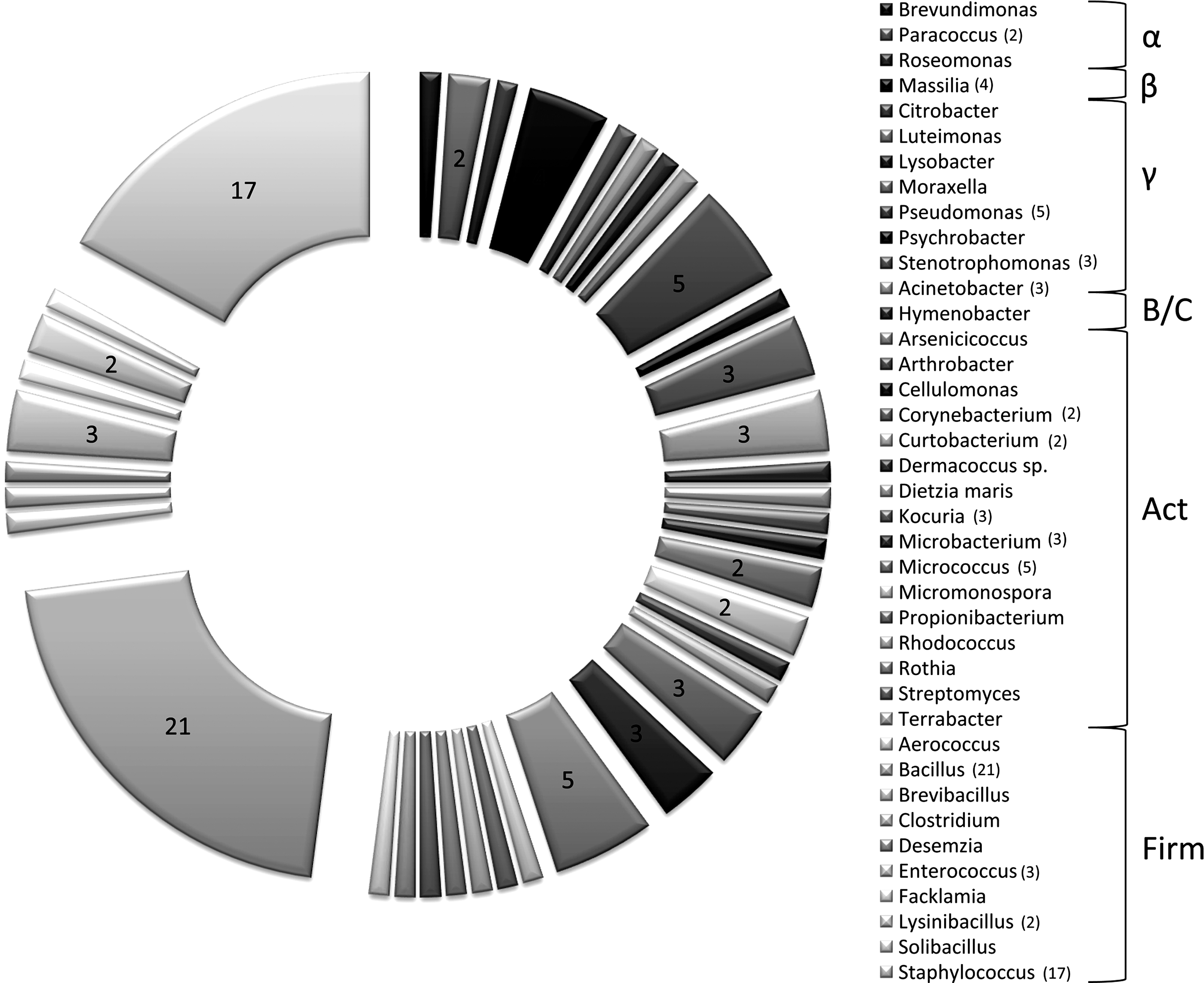
Phylogenetic diversity of isolates currently available in the culture collection (α: α-Proteobacteria; β: β-Proteobacteria; γ: γ-Proteobacteria; B/C: Bacteroidetes-Chlorobi; Act: Actinobacteria; Firm: Firmicutes); numbers of different species available are given in parentheses and on the chart.

Number of isolated species from different sampling locations within the clean rooms (fairing: fairing of Ariane 5 rocket, sampled in Kourou; container: fairing containment, sampled in Kourou).
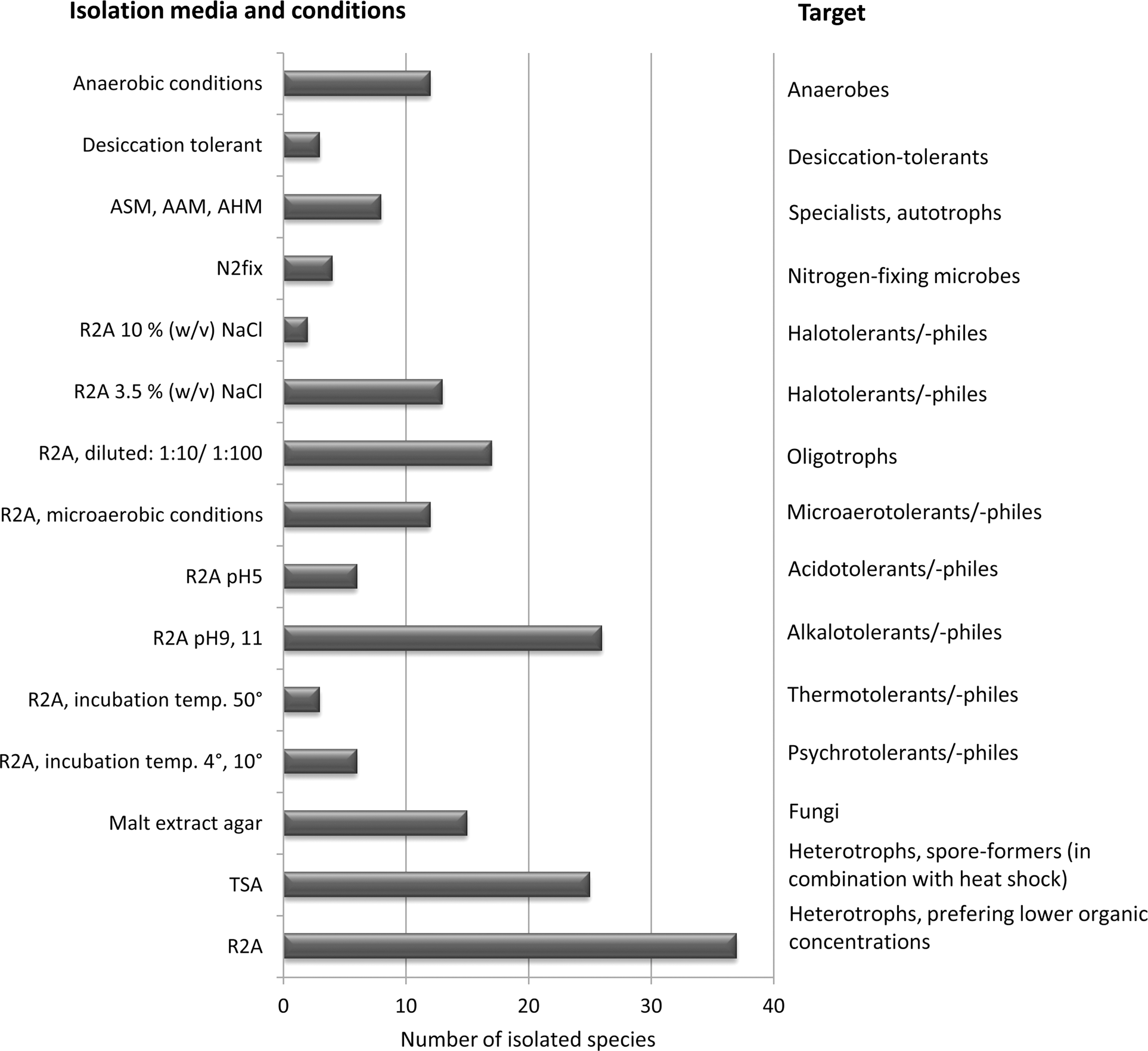
Number of isolated species with respect to the culture conditions and media used.
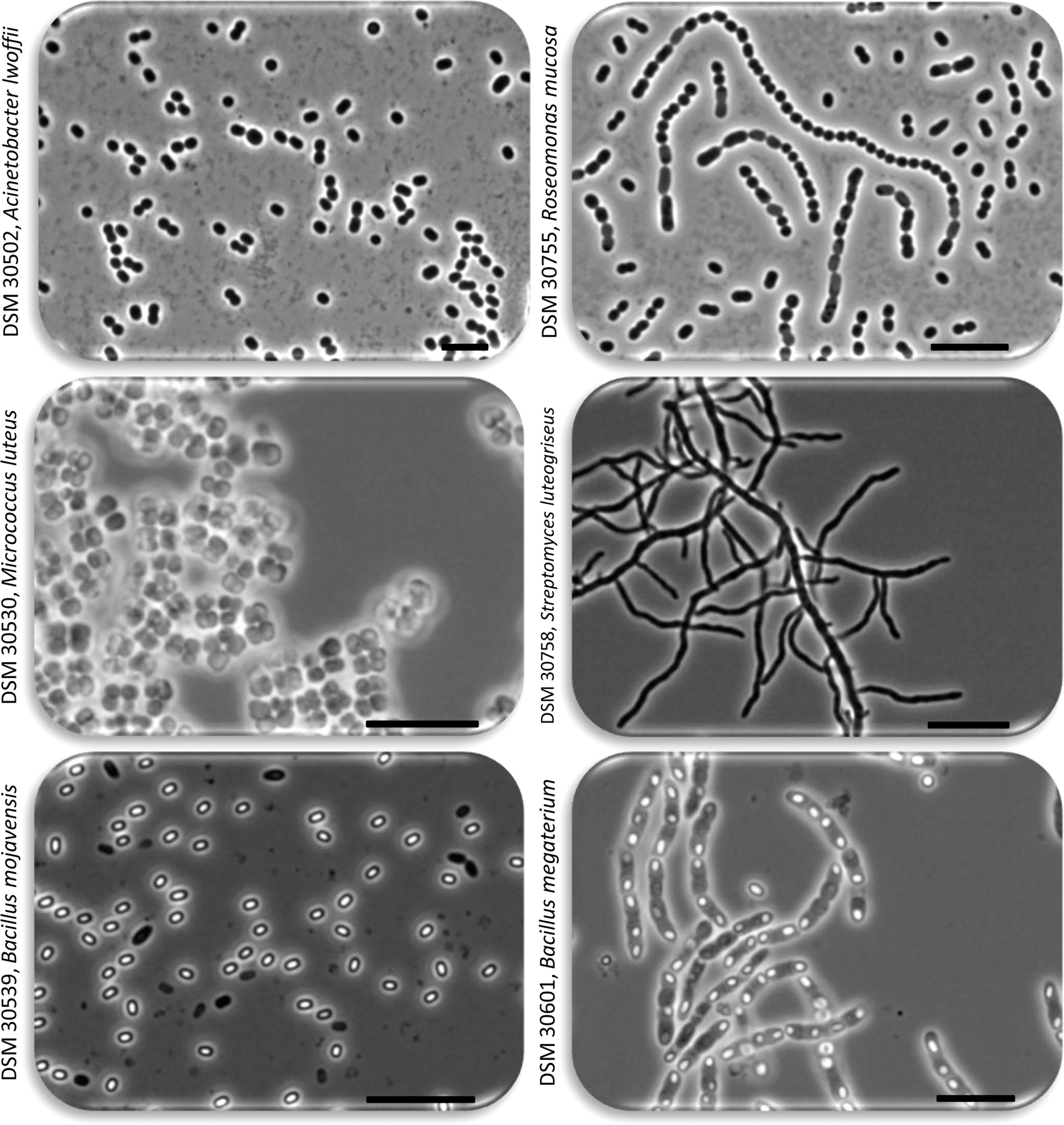
Examples of isolated microorganisms. Bar: 10 μm.
Bacillus pumilus was found in, and cultivated from, each of the facilities analyzed. This spore-forming microbe was obtained on a broad variety of media, even under anaerobic conditions (Table 2). The application of a heat shock supported the enrichment of spore formers; nevertheless, some non–spore formers survived the harsh heat-shock conditions (Acinetobacter, Paracoccus, Stenotrophomonas, Micrococcus, Staphylococcus).
A relatively high number of isolates (53) have not been assigned to a certain species yet, since their 16S rRNA gene sequence reveals more than 2.5% difference to already described microorganisms.
Besides the microbes obtained from the European and South American samplings, isolates from the Jet Propulsion Laboratory were recently also added to the culture collection. Their specifics are given in Table 3.
4. Conclusion
Here, we report on the foundation of the first public collection of spacecraft-associated microorganisms, which will hopefully be a valuable source for the scientific community interested in a microbial diversity that is adapted to extreme clean room conditions.
The combination of harsh environmental conditions (dryness, disinfectants, etc.) seems to support the proliferation of (multi-)resistant microbial inhabitants (e.g., Bacillus strains), of which some have been the subject of very interesting and amazing studies (e.g., Link et al., 2004). Nevertheless, the overwhelming majority of isolates remains currently uninvestigated.
Clean room inhabitants and their capabilities are certainly interesting for different technological fields (pharmacy, electronics, and biotechnology) besides space science. In particular, pharmacy and biotechnology (as well as planetary protection) are interested in the highest (microbiological) quality of the final product in order to avoid, for example, septic reactions of patients, problems in product quality, or a possible cross contamination. The knowledge of isolates from such environments is critical for validating decontamination processes and identifying a possible contamination source. The isolates that were submitted to the culture collection in the frame of the presented study have proven to have the capacity to adapt to different culturing conditions, and some of them have revealed primary producer abilities (autotrophy, nitrogen fixation) or the capability of growing under anaerobic conditions. In addition, we have identified non-spore-forming strains that were capable of surviving a harsh heat shock at 80°C. These might be interesting features for upcoming analyses, as well as the characterization of, to date, non-characterized species.
Upcoming sampling campaigns will certainly lead to an increase of the current culture collection, as will the inclusion of diverse paenibacilli that were already obtained during the Herschel sampling campaign. These spore-forming microbes are currently under investigation by the German Aerospace Center and the University of Regensburg with the intent to determine their specific properties and resistances and describe novel species obtained. As soon as these investigations are finished, these isolates will also be released to the public. In the future, it is planned that the ESA culture collection will also include other extremophilic microorganisms (derived from non-spacecraft-related environments) that could prove useful for planetary protection studies.
We hope that the collection will spark interest among a broad variety of scientific groups and industrial entities that work within the above-mentioned fields and beyond. Additionally, the new culture collection can provide a wonderful platform for crucial planetary protection research and efforts to control biological contamination of other planets and moons in the course of exploring these worlds.
Footnotes
Acknowledgments
We thank ESA for funding the projects that were the basis for successful cultivation of novel spacecraft assembly isolates (20508/07/NL/EK and 20234/06/NL/EK). We also thank ESA for funding the ESA collection at DSMZ (P1091253). Additionally, we gratefully acknowledge the valuable contribution (sampling, cultivation, and microbial analysis) of Michaela Stieglmeier, Maria Bohmeier, Simon Barzcyk, Petra Schwendner, Anna Auerbach, Nicole Mrotzek, and Melanie Duckstein.
Abbreviations
AAM, autotrophic all-rounder liquid medium; AHM, autotrophic homoacetogen liquid medium; ASM, Archaea-supporting medium; BM, basal medium; DSMZ, Deutsche Sammlung von Mikroorganismen und Zellkulturen (German Collection of Microorganisms and Cell Cultures); ECSS, European Cooperation for Space Standardization; ESA, European Space Agency; TG, thioglycolate liquid medium; TS, trypticase soy liquid medium; TSA, trypticase soy agar.