




Abstract
Motivated by the possibility of comparing theoretical predictions of Lake Vostok's composition with future in situ measurements, we investigated the composition of clathrates that are expected to form in this environment from the air supplied to the lake by melting ice. To establish the best possible correlation between the lake water composition and that of air clathrates formed in situ, we used a statistical thermodynamic model based on the description of the guest-clathrate interaction by a spherically averaged Kihara potential with a nominal set of potential parameters. We determined the fugacities of the different volatiles present in the lake by defining a “pseudo” pure substance dissolved in water owning the average properties of the mixture and by using the Redlich-Kwong equation of state to mimic its thermodynamic behavior. Irrespective of the clathrate structure considered in our model, we found that xenon and krypton are strongly impoverished in the lake water (a ratio in the 0.04–0.1 range for xenon and a ratio in the ∼0.15–0.3 range for krypton) compared to their atmospheric abundances. Argon and methane were also found to be depleted in the Lake Vostok water by factors in the 0.5–0.95 and 0.3–0.5 ranges, respectively, compared to their atmospheric abundances. On the other hand, the carbon dioxide abundance was found to be substantially enriched in the lake water compared to its atmospheric abundance (by a factor in the 1.6–5 range at 200 residence times). The comparison of our predictions of the CO2 and CH4 mole fractions in Lake Vostok with future in situ measurements will allow disentangling between the possible supply sources. Key Words: Lake Vostok—Subglacial lakes—Composition—Clathrates—Statistical thermodynamic model. Astrobiology 13, 380–390.
1. Introduction
O
After cumulated decades of effort, researchers succeeded in drilling through 4 km of ice to the surface of the subglacial Lake Vostok on 5 February 2012 (Showstack, 2012). The precise sampling of Lake Vostok in the near future will bring important constraints on the delivery processes of volatiles to the lake and the chemical pathways that may, or may not, make life possible deep below the ice sheet.
Ice overlying the lake is characterized by air bubbles that are trapped at the air/ice interface and compressed with increasing depth. As a consequence, these air bubbles transform to clathrate hydrates (hereafter clathrates) below a certain depth, depending on the temperature of the ice sheet. In the contact region between the bottom of the ice sheet and the lake surface, most of the air in the ice sheet is trapped within these clathrates. In situ measurements have shown that the average N2/O2 ratio of the clathrates in this contact region approaches the atmospheric value (Ikeda et al., 1999). Melting of these clathrates is thus responsible for a transfer of most of the atmospheric air to the Lake Vostok water through the ice sheet (Lipenkov and Istomin, 2001). However, in the contact region, clathrates could also be stable in the lake water and thus reduce the amount of gases in aqueous solution. This might have an impact on the oxygen availability for possible life in the lake, and it is thus very important to thoroughly investigate the composition of Lake Vostok.
The lake composition was previously investigated by McKay et al. (2003) (hereafter MK03). (i) Based on the prediction that air clathrate is stable at depths higher than ∼1500 m in subglacial lakes (Lipenkov and Istomin, 2001) and (ii) due to the fact that selective gas trapping occurs during the formation of clathrates (van der Waals and Platteeuw, 1959; Miller, 1974; Lunine and Stevenson, 1985), MK03 estimated the level of gases dissolved in Lake Vostok as a function of its evolution. To do so, they modeled the balance between the gas (i.e., air) supplied by ice melting and gas trapped by clathrate and assumed that the lake is a closed system with no gas escape. However, the approach followed by MK03 to calculate the relative partitioning of volatiles trapped in clathrate is not adapted for a gas mixture in which more than two species are included (Lunine and Stevenson, 1985), as is the case for air clathrate. Also, the formalism used by the authors is a crude approximation of the statistical thermodynamic model that is usually used to investigate the composition of multiple guest clathrates. Indeed, it is based on the assumption that the Langmuir constants (see Section 2.2) are very close to each other for the different gases, irrespective of the considered type of clathrate cages (Lunine and Stevenson, 1985).
In this paper, motivated by the possibility of comparing theoretical predictions of Lake Vostok composition with in situ measurements in the near future, we reinvestigate the assumptions of MK03 by considering a more complete set of species dissolved in the lake. We thus determine more accurately the composition of clathrates that should form in this environment. To establish a better correlation between the lake composition and that of air clathrates formed in situ, we used a statistical thermodynamic model based on experimental data and derived from the original work of van der Waals and Platteeuw (1959). This approach, used today in industry and science, has saved substantial experimental effort for the determination of (i) the equilibrium pressure of a clathrate formed from various mixtures and (ii) the mole fraction of the different species trapped in the clathrate from a given fluid phase (see Sloan and Koh, 2008, for details). The major ingredient of our model is the description of the guest-clathrate interaction by a spherically averaged Kihara potential with a nominal set of potential parameters. Section 2 is devoted to the description of (i) the strategy utilized to compute the lake composition and (ii) the statistical thermodynamic model used in this work. In Section 3, we present the results of our calculations concerning the time evolution of clathrate and lake compositions. In Section 4, we compare our results with those of MK03 and discuss their implications for the physical and biological processes that may take place in Lake Vostok and analogous environments such as the putative internal ocean of the jovian icy moon Europa.
2. Modeling the Lake Composition
2.1. Computational approach
Our basic assumptions are similar to those formulated by MK03. We assume that Lake Vostok is a closed system at constant pressure of 35 MPa with a mean temperature of −3°C and is physiographically stable over time (see Lipenkov and Istomin, 2001, for a description of Lake Vostok's thermodynamic conditions). In our system, water and air are delivered to the lake when melting occurs due to the slow downward motion of the overlying gas-rich ice layers, and gas-free water leaves the lake as ice accretes to the bottom of the ice sheet in regions where ice moves outward (Jouzel et al., 1999; Bell et al., 2002; MK03). Air is assumed to be supplied to the lake at a concentration of about 90 cm3 at STP (T=273.15 K and P=0.1013 MPa) per kilogram of melted ice (Jouzel et al., 1999; Lipenkov and Istomin, 2001). We express the age of the lake in units of the residence time (denoted by RT in the following), defined as the time required for all the water of the lake to be renewed through the melting-freezing cycle of water flowing through the volume of the lake. Estimates of the RT for Lake Vostok range from 5,000 years (Philippe et al., 2001) to 125,000 years (Siegert et al., 2003).
Because the clathrate formed in Lake Vostok is crystallized from dissolved air, it is expected to be dominated by N2. A good approximation of its dissociation pressure is to assume it is equivalent to that of pure N2 clathrate. The dissociation pressure
where
Since the time for dissolved gases to diffuse through the lake is smaller than 1 RT, and due to the long timescales involved (several tens of RT, see hereafter), the gas concentration should be uniform in the lake water at 25 RT. Thereafter, the total amount of dissolved gas in Lake Vostok remains approximately constant, and excess gas continuously forms clathrate. Because the composition of clathrate may depart from that of the coexisting gas phase, progressive clathrate formation could in turn influence the composition of the gas dissolved in Lake Vostok. Table 1 gives the composition of the air dissolved in the lake water at the beginning of our computation (i.e., at 0 RT).
From left to right: composition of dry air by volume (Lodders and Fegley, 1998), critical temperatures and pressures (Lide, 2002), partial molar volumes (aRudakov et al., 1996; bAnderson, 2002; cKennan and Pollack, 1990), Henry's constants at STP (Sander, 1999) and calculated at 35 MPa of hydrostatic pressure and 270.15 K, and fugacities calculated at 25 RT and at pressures of 1 atm and 35 MPa, respectively. Properties of species that are not incorporated in clathrate are intentionally left blank (see text).
Based on this approach, we have elaborated a computational procedure (see Fig. 1) with the intent to calculate the volume of each gas dissolved in Lake Vostok (per unit of kilogram of lake water) and trapped in the newly forming air clathrates, as a function of the temporal evolution of the lake (in units of RT). The procedure is depicted as follows:
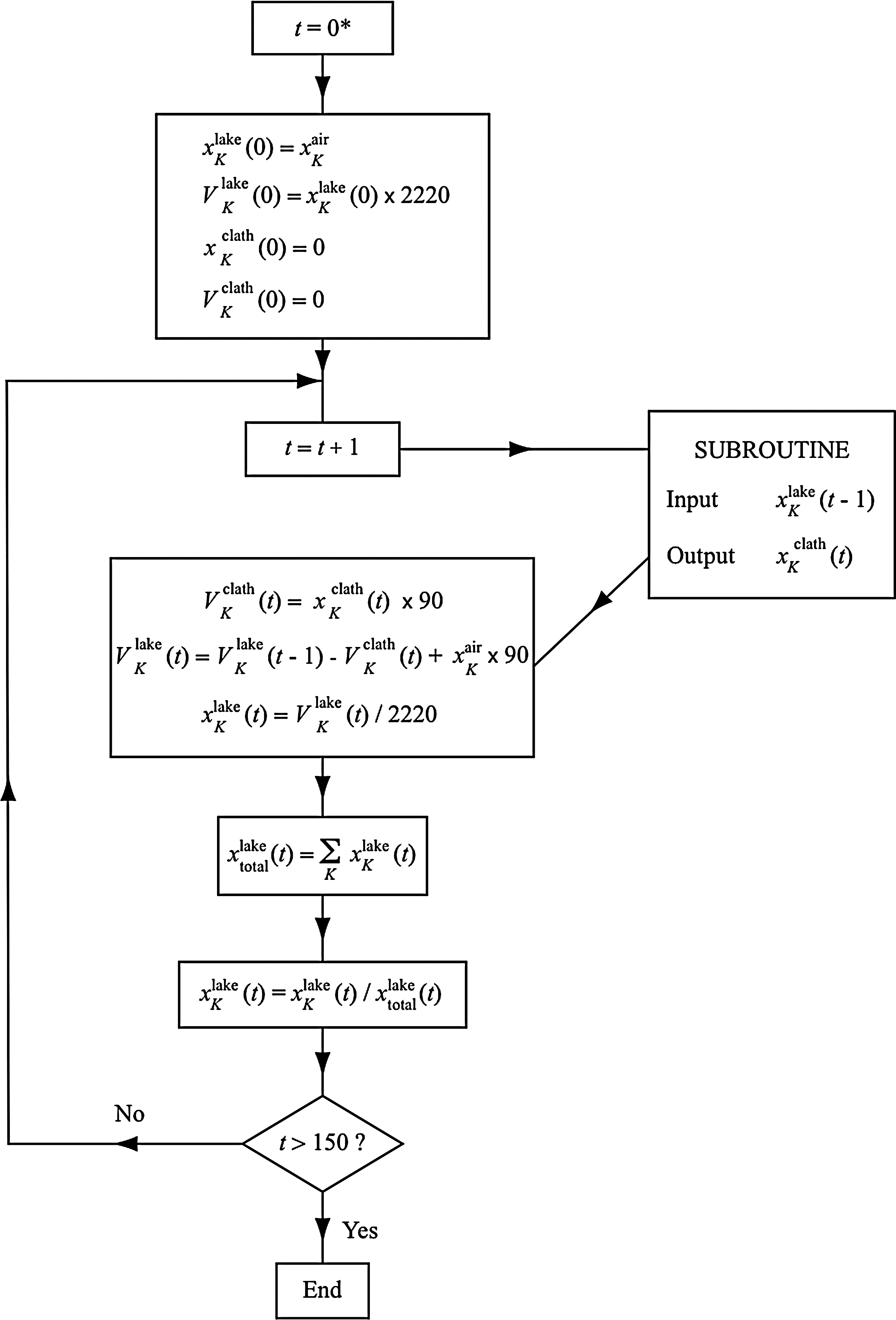
Structural scheme of our computational approach.
• At time t=0, the mole fraction
• at t=t+1, a subroutine (depicted in Section 2.2) allows us to compute the mole fraction
• the new volumes
2.2. The statistical thermodynamic model
To calculate the relative abundances of guest species incorporated in a clathrate from a coexisting gas of specified composition at given temperature and pressure, our subroutine follows the method described by Lunine and Stevenson (1985), Thomas et al. (2007, 2008, 2009), and Mousis et al. (2010), which uses classical statistical mechanics to relate the macroscopic thermodynamic properties of clathrates to the molecular structure and interaction energies. It is based on the original ideas of van der Waals and Platteeuw (1959) for clathrate formation, which assume that trapping of guest molecules into cages corresponds to the three-dimensional generalization of ideal localized adsorption. This approach is based on four key assumptions:
(1) The host molecules' contribution to the free energy is independent of the clathrate occupancy. This assumption implies that the guest species do not distort the cages;
(2) the cages are singly occupied, and guest molecules rotate freely within the cage;
(3) guest molecules do not interact with each other;
(4) classical statistics is valid, that is, quantum effects are negligible.
In this formalism, the fractional occupancy of a guest molecule K for a given type q (q=small or large) of cage in a clathrate structure can be written as
where the sum in the denominator includes all the species that are present in the gas dissolved in lake water. CK,q is the Langmuir constant of species K in the cage of type q, and f hydro,K is the fugacity of guest species K computed at the considered hydrostatic pressure (see Section 2.3).
The Langmuir constant CK,q
depends on the strength of the interaction between each guest species and each type of cage and can be determined by integrating the molecular potential energy within the cavity as
where R
c represents the radius of the cavity assumed to be spherical, k
B is the Boltzmann constant, and wK,q
(r) is the spherically averaged potential (here Kihara or Lennard-Jones potential) representing the interactions between the guest molecules K and the H2O molecules that form the surrounding cage q. This potential w(r) can be written for a spherical guest molecule, as (McKoy and Sinanoglu, 1963),
with the mathematical function δN
(r) in the form
In Eq. 4, z is the coordination number of the cell. Parameters z and R c depend on the type of cage (small or large) and also on the structure of the clathrate. Indeed, the air clathrates considered here may have structure I or II that are characterized by different arrangement of small and large cages of different sizes (Sloan and Koh, 2008). The corresponding parameters z and R c are given in Table 2. The intermolecular parameters a, σ, and ɛ describing the guest molecule-water (K-W) interactions in the form of a Kihara or Lennard-Jones potential are listed in Table 3.
R c is the radius of the cavity (values taken from Parrish and Prausnitz, 1972). b represents the number of small (b s) or large (b l) cages per unit cell for a given structure of clathrate (I or II) with volume V c; z is the coordination number in a cavity.
σK-W is the Lennard-Jones diameter, ɛK-W is the depth of the potential well, and aK-W is the radius of the impenetrable core, for the guest-water pairs.
Finally, the mole fraction
where b s and b l are the number of small and large cages per unit cell, respectively, for the clathrate structure under consideration. Note that the sum of the mole fractions of the enclathrated species is normalized to 1. We also neglect Ne, He, and H2 in our computation of the composition of clathrates as these species have low trapping propensities in these structures (Lunine and Stevenson, 1985; Sloan and Koh, 2008).
2.3. Determination of the fugacities
To determine f
hydro,K
, we first calculate the specific volume v of the considered mixture via the Redlich-Kwong equation of state (Redlich and Kwong, 1949):
with
where R is the gas constant, T the ambient temperature, T
c and P
c the critical temperature and pressure of the substance (see Table 1), and P its vapor pressure. Just as any other cubic equation of state, the Redlich-Kwong equation of state has to be applied only to pure substances. For mixtures, however, the same equation is applied, but certain mixing rules are applied to obtain parameters a and b, which are functions of the properties of the pure components. This corresponds to the creation of a new “pseudo” pure substance that has the average properties of the mixture. Following Redlich and Kwong (1949), we use the mixing rules:
Here the mixture pressure P
m dissolved in water corresponds to the sum of the individual gas pressures PK
. Each PK
is expressed as a function of the Henry's law coefficient as
where H
hydro,K
is the Henry's law constant calculated for species K at the lake's hydrostatic pressure and ambient temperature, and
where P
hydro is the lake's mean hydrostatic pressure (∼35 MPa),
The fugacity of the mixture at 1 atm pressure f
1atm,m is then determined from the following relation (Redlich and Kwong, 1949):
Because it is calculated at the hydrostatic pressure, f
hydro,m is related to f
1atm,m via (Miller, 1974)
where a
W is the activity of water relative to pure liquid water (here a
W is ∼1), n is the moles of water per mole of species K in the clathrate (n ∼ 6),
3. Results
3.1. Evolution of clathrate composition
The composition of structures I and II clathrates that might form from the air dissolved in Lake Vostok has been computed with the approach presented above. If the lake has experienced less than ∼25 RT, the different species remain completely in solution. At longer times, clathrates start to form. Figures 2 and 3 display the compositions of the clathrates of same structure successively formed at different epochs of the lake evolution. At each time step, the total volume of enclathrated gases is 90 cm3. Irrespective of the clathrate structure, the mole fractions of volatiles trapped in clathrates converge toward their atmospheric mole fractions at infinite RT as the result of mass conservation (MK03). Steady state is reached 40–80 RT after clathrate formation. In both structures, N2 and O2 remain the main gases trapped in clathrates with variations of their mole fractions depending on the considered structure and epoch of clathrate formation. In the case of structure I clathrates, the mole fractions of trapped N2 and O2 change slightly over time. Indeed, the mixing ratio of N2 decreases from ∼0.86 in clathrates formed at early epochs to 0.78 in clathrates formed at infinite time, whereas that of O2 simultaneously increases from ∼0.12 to 0.21 in clathrates successively formed during the same time interval. In the case of structure II clathrates, the mole fractions of N2 and O2 incorporated in clathrates are even less sensitive to their formation epoch in the lake. Thus, the mole fraction of N2 increases from 0.74 to 0.78 while that of O2 decreases from 0.24 to 0.21 in clathrates formed between first formation and steady state.
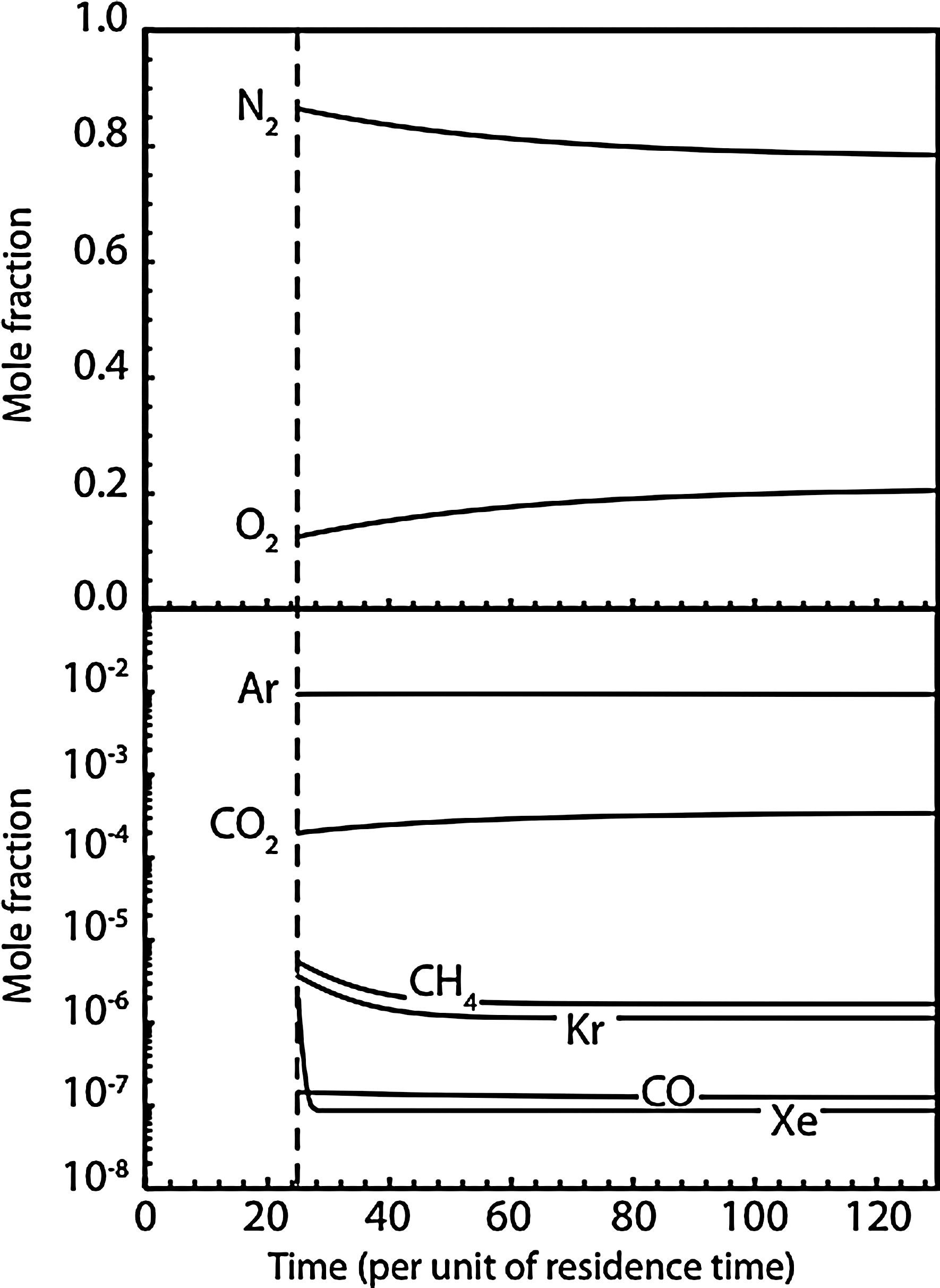
Mole fractions of N2, O2, Ar, CO2, CH4, Kr, Xe, and CO trapped in structure I clathrates formed at different ages of the lake, with age expressed in units of RT. Clathrate formation starts at ∼25 RT (see text).
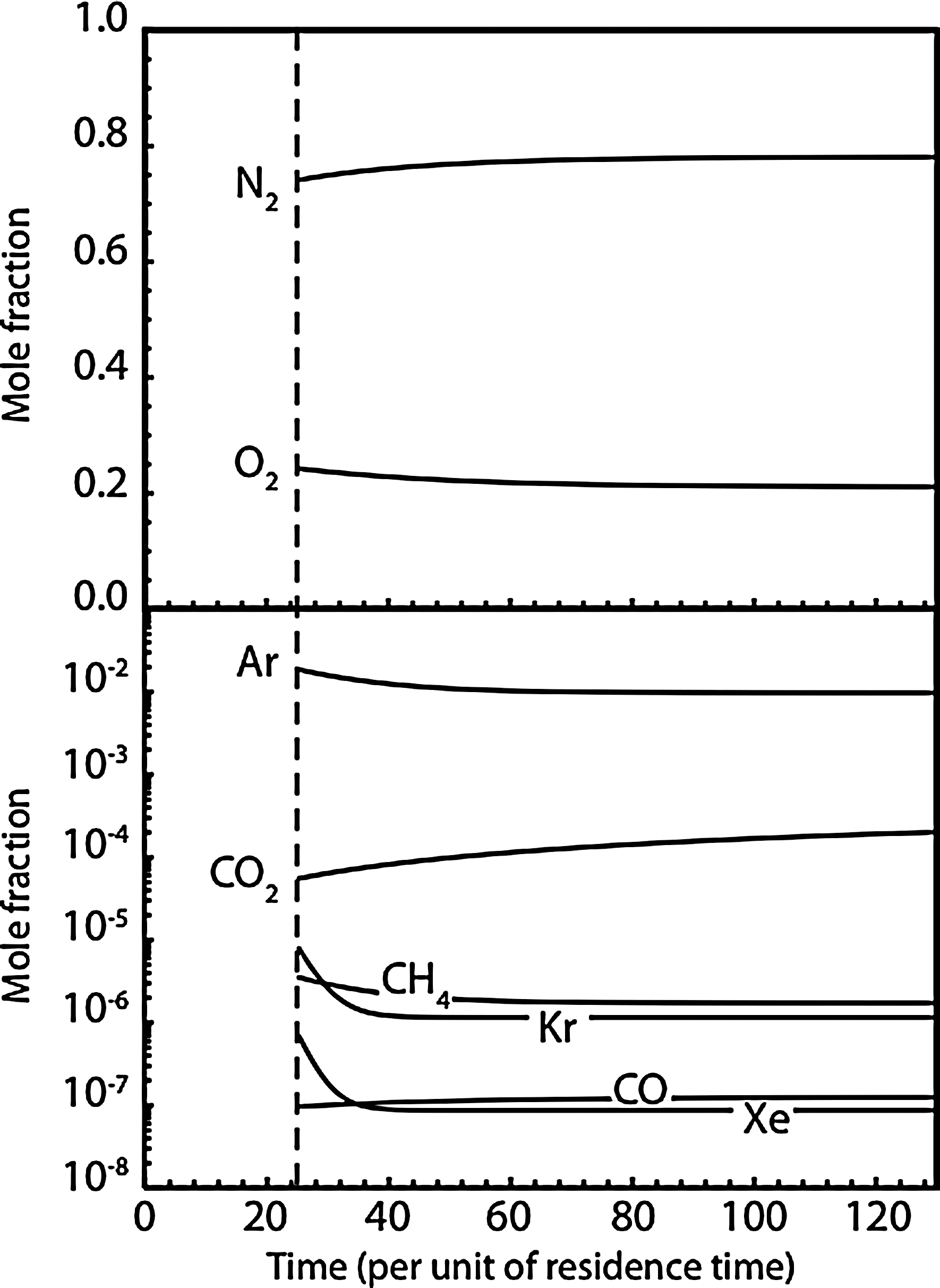
Mole fractions of N2, O2, Ar, CO2, CH4, Kr, Xe, and CO trapped in structure II clathrates formed at different ages of the lake, with age expressed in units of RT. Clathrate formation starts at ∼25 RT (see text).
Moreover, we note that, with an enrichment factor of ∼22 compared to the atmospheric abundance (see Table 1), Xe is efficiently sequestrated at early formation epochs (∼25 RT) in structure I clathrates. To a lesser extent, a similar trend is calculated for Kr and CH4, whose mole fractions are both enriched by a factor of ∼3.2 at early epochs of structure I clathrate formation in the lake. The same remarks apply for the trapping of volatiles in structure II clathrates, for which the mole fractions of Xe, Kr, and CH4 are enriched by factors ∼78, 6.7, and 2 at early formation epochs. On the other hand, the trapping efficiencies of Ar and CO in clathrate depend on the considered structure. In structure I, the mole fraction of Ar remains similar to its atmospheric value, irrespective of the considered RT. In structure II, however, we note that Ar is initially enriched by a factor of ∼2 in clathrate. In addition, CO is initially slightly enriched by a factor of ∼1.2 in structure I clathrate, while it is impoverished by a factor of ∼0.8 in structure II clathrate. In both structures and at early epochs of clathrate formation, the mole fraction of trapped CO2 is lower than its atmospheric value (factors of ∼0.6 and 0.15 in structures I and II, respectively). In both cases, the mole fractions of all volatiles trapped in clathrate progressively converge with time toward their atmospheric values.
3.2. Evolution of the lake composition
Figures 4 –7 illustrate the evolution of the composition of the gas phase dissolved in Lake Vostok as a function of its RT in the cases of structures I and II clathrates. In both cases, the mole fractions of the different volatiles relative to the sum of all mole fractions of dissolved gases and present in the lake linearly increase as long as its lifetime has not exceeded ∼25 RT. After this epoch, these volatiles have reached their solubility limit in the lake, and clathrate forms from the gas supplied in excess by ice melting. The resulting volatile content of the lake at a given time is then controlled by the balance between the sequestration of gas by the forming clathrate and the air supplied by the melting ice.

Mole fractions of N2, O2, Ar, CO2, CH4, Kr, CO, and Xe dissolved in Lake Vostok calculated in the case of structure I clathrate formation and expressed as a function of the age of lake, with age expressed in units of RT.
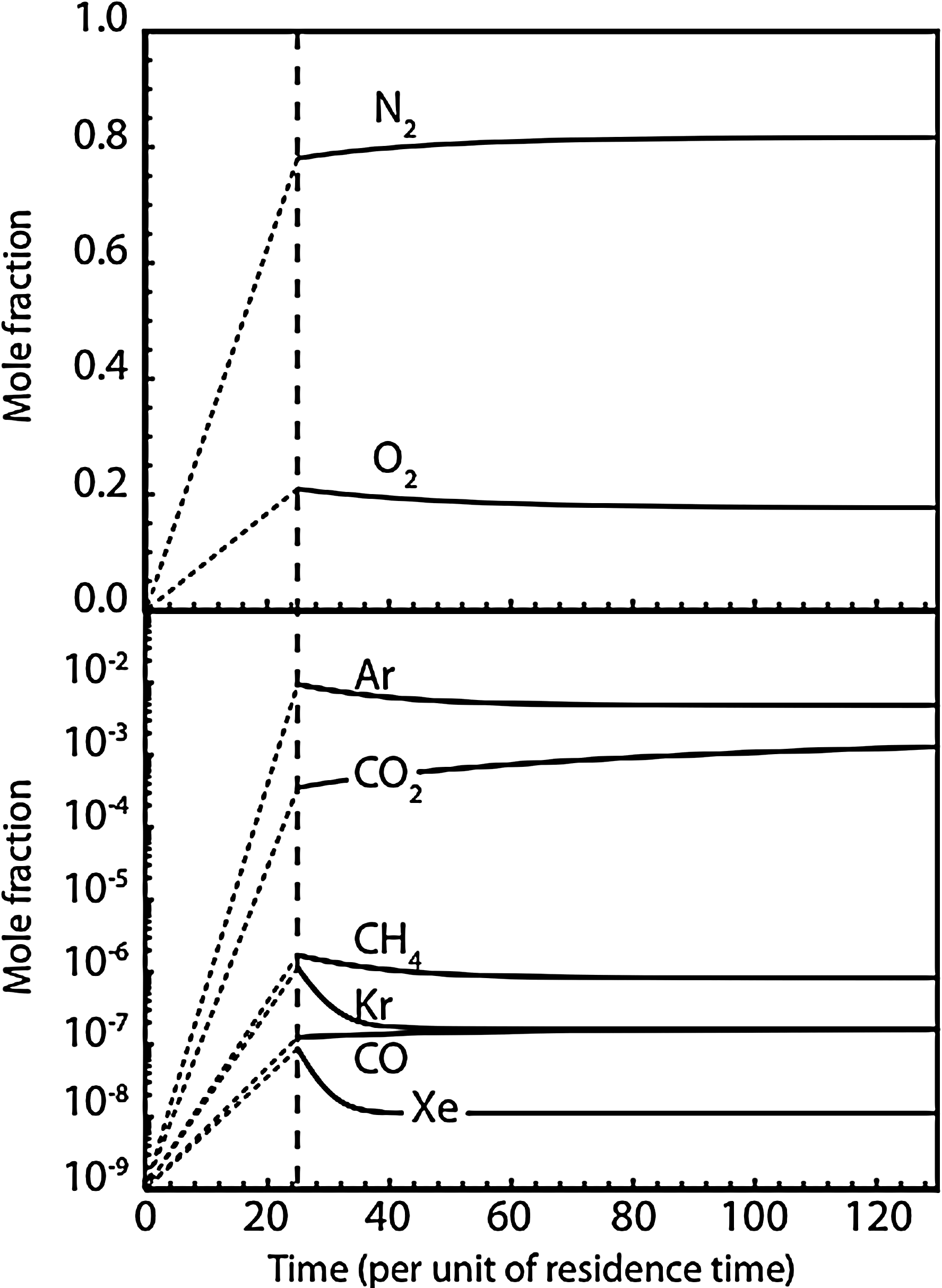
Mole fractions of N2, O2, Ar, CO2, CH4, Kr, CO, and Xe dissolved in Lake Vostok calculated in the case of structure II clathrate formation and expressed as a function of the age of lake, with age expressed in units of RT.

Top panel: Evolution of the N2/O2 ratio in lake and in structure I clathrate as a function of time. Bottom panel: Evolution of the mole fractions of Ar, CO2, CH4, Kr, CO, and Xe relative to their atmospheric values in lake as a function of time in the case of structure I clathrate formation.
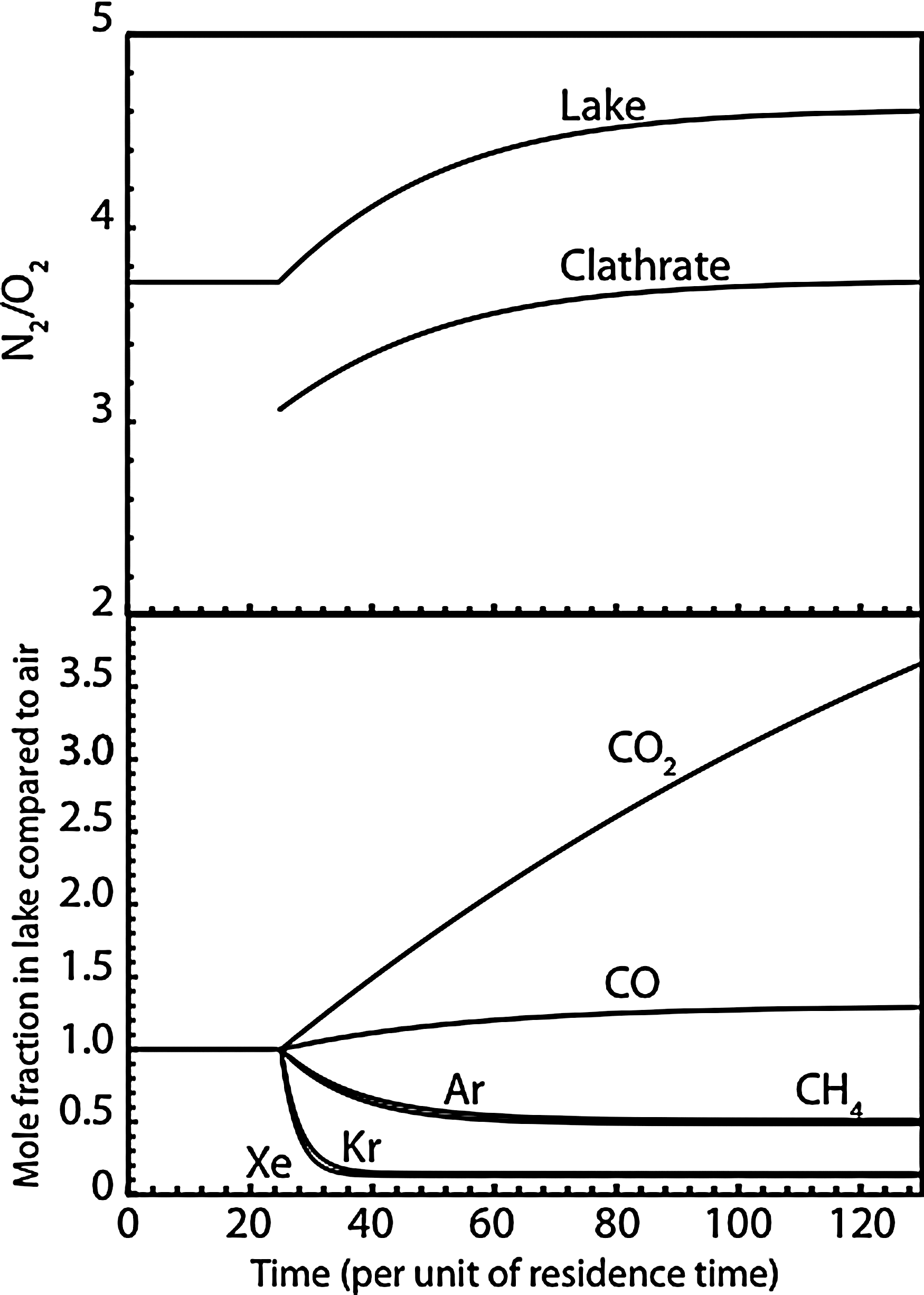
Top panel: Evolution of the N2/O2 ratio in lake and in structure II clathrate as a function of time. Bottom panel: Evolution of the mole fractions of Ar, CO2, CH4, Kr, CO, and Xe relative to their atmospheric values in lake as a function of time in the case of structure II clathrate formation.
In the two cases, N2 and O2 remain the main gases dissolved in water. When considering the formation of structure I clathrate, and irrespective of the considered epoch, the N2 mole fraction in the lake water decreases from its atmospheric value (0.78) down to 0.66 at steady state. On the other hand, the O2 mole fraction slightly increases with time from 0.21 (the atmospheric mole fraction) to 0.33 in the lake. As a result, the N2/O2 ratio in the lake water is much lower than the N2/O2 ratio in structure I clathrate (see Fig. 6). Because the mole fractions of Xe, Kr, CH4, and CO are all enriched in structure I clathrate, they become correspondingly depleted by factors ∼0.04, 0.3, 0.3, and 0.8 in the lake water compared to their atmospheric abundances (see Table 1) and irrespective of the considered RT. In contrast, the mole fraction of Ar in the lake water remains very close (by a factor of ∼0.95) to its atmospheric value, while that of CO2 rapidly increases with time up to 1.6 times its atmospheric mole fraction at 200 RT.
In the case of structure II clathrate formation in Lake Vostok, the N2 mole fraction in the lake water increases from its atmospheric value (0.78) up to 0.82 at steady state. Inversely, the O2 mole fraction decreases in water from its atmospheric value (0.21) down to 0.18 at steady state. The resulting N2/O2 ratio is then significantly higher in the lake water than the N2/O2 ratio in structure II clathrate, irrespective of the considered RT (see Fig. 7). The mole fractions of Xe, Kr, CH4, and Ar also become rapidly impoverished by the factors ∼0.1, 0.15, 0.5, and 0.5 in the lake water, respectively, compared to the atmospheric values (see Table 1) and irrespective of the considered RT. On the other hand, CO becomes moderately enriched by a factor ∼1.3 in the water compared to its atmospheric value. Moreover, due to its lower propensity to be trapped in structure II clathrate, the CO2 mole fraction in the lake water presents the highest enrichment (up to a factor of ∼5 at 200 RT) compared to its atmospheric abundance.
3.3. Clathrate density
Once formed, clathrate may either float on the surface or sink to the lake floor according to its density with respect to that of the lake water. To investigate this point, we computed the densities of structures I and II clathrates formed in Lake Vostok by following the method depicted by Sloan and Koh (2008, Eq. 5.2.1, p 268). We found that, in both cases, these clathrates are all lighter than liquid water (see Fig. 8). This conclusion is in agreement with the results obtained by MK03, although we did not calculate the same clathrate composition. However, air clathrates have not been observed in the accreted ice above the lake (Siegert et al., 2000). To explain this, MK03 argued that significant amounts of CO2 could have been produced in Lake Vostok and subsequently incorporated in clathrates, thus changing their density with respect to that of clathrates simply formed in contact with air that enters the lake through the ice sheet. These clathrates would have sunk to the lake floor as a result of their higher density. We computed the minimum fraction of CO2 present in the lake necessary to be trapped in air clathrates so that the clathrates sink to the lake floor. In the case of structure I clathrate, our model suggests that the minimum mole fraction of CO2 present in Lake Vostok must be around ∼0.05, with a corresponding mole fraction that is similar in clathrate (see Fig. 8). In the case of structure II clathrate, the minimum mole fraction of CO2 needed to induce a higher clathrate density than that of lake water largely exceeds 0.5, which implies that this species becomes dominant in the lake. With such a high mole fraction of CO2 in the lake, structure I clathrate should be the most stable form (Sloan and Koh, 2008), so we should expect a transition from structure II to structure I clathrate, which would present an even higher density.
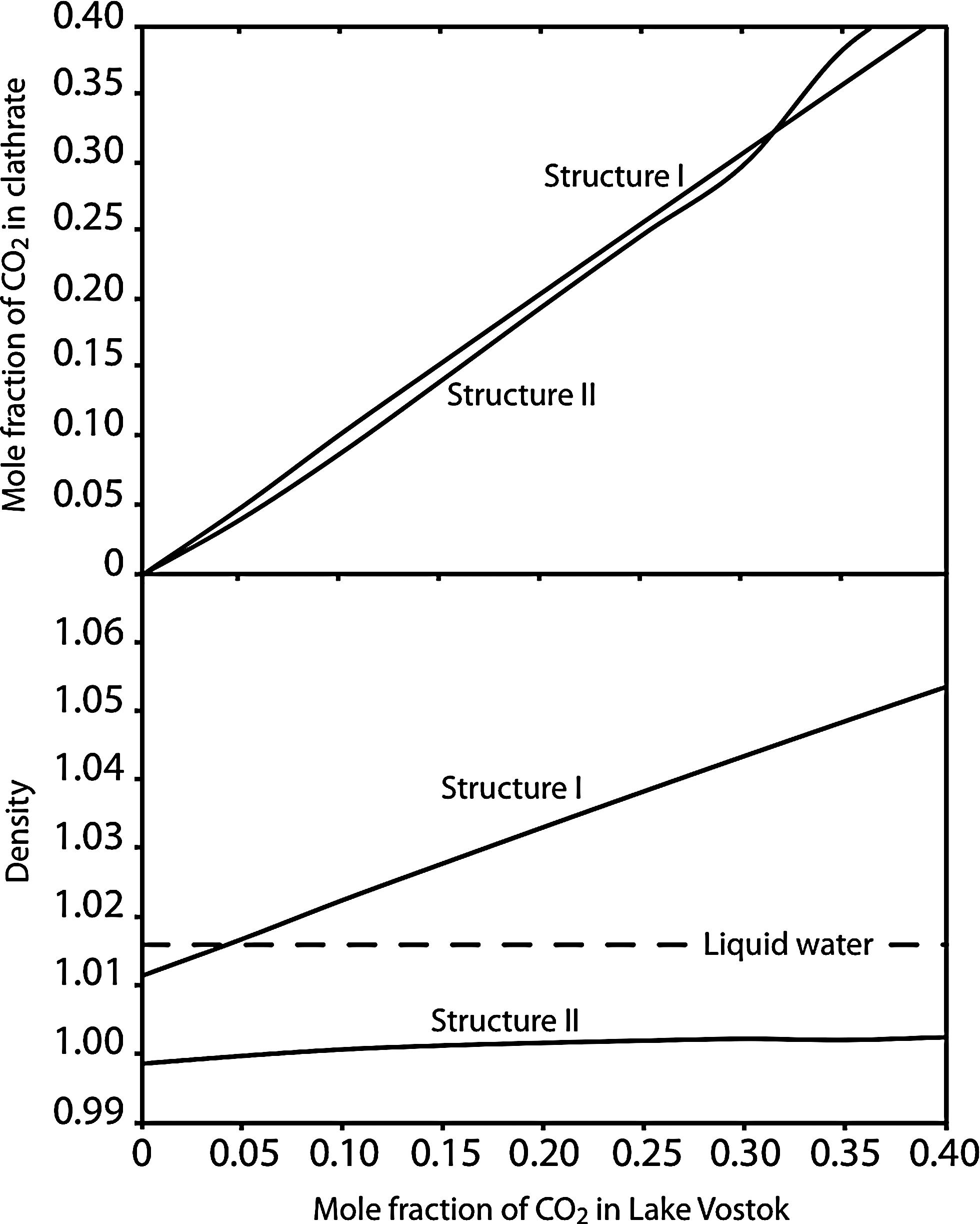
Top panel: Mole fraction of CO2 incorporated in structures I and II clathrates as a function of the mole fraction of CO2 dissolved in Lake Vostok. Bottom panel: Densities of structures I and II clathrates as a function of the mole fraction of CO2 dissolved in Lake Vostok. The horizontal dashed line corresponds to the density of liquid water in Lake Vostok (Lipenkov and Istomin, 2001).
4. Discussion
The composition of Lake Vostok calculated with the present approach displays significant differences with the one predicted by MK03. These differences come from the consideration of a larger set of molecules in the gas phase dissolved in the lake (we include CH4 and CO) and from the use of a more sophisticated model to compute the mole fractions of all species simultaneously trapped in the clathrates, in a self-consistent way. As a consequence, our calculations suggest enhancements of the Xe and Kr mole fractions trapped in clathrate by factors of ∼7.6–26.9 and 2.0–4.2, respectively, compared to the values previously determined by MK03. Our model therefore suggests that Xe and Kr abundances are ∼0.04–0.13 and 0.24–0.5 times those predicted by MK03 in Lake Vostok water. Our model also predicts an impoverishment of the Ar abundance in the lake water (factor ∼0.5–0.95 compared to the atmospheric abundance), in contrast with the enrichment (factor ∼1.4) predicted by MK03. Moreover, our calculations show that CO2 is significantly enriched in the lake water (factor ∼1.6–5 at 200 RT following the considered clathrate structure) compared to their atmospheric abundances. In both cases, CH4 appears depleted in the lake water compared to its atmospheric mole fraction (factor ∼0.3–0.5). Depending on the considered structure, CO can be found in the lake water moderately depleted (factor ∼0.8 in the case of structure I clathrate) or enriched (factor ∼1.3 in the case of structure II clathrate) compared to its atmospheric value. It is important to note that, if the composition of the dissolved gas is dominated by N2, and because this molecule forms structure II clathrate (Sloan and Koh, 2008), we expect that structure II clathrate is the most likely to be formed in Lake Vostok.
Note that the CO2 atmospheric abundance considered in this work corresponds to the one measured at the present in Earth's atmosphere, which is affected by industrial emissions. In the same way, the CO2 atmospheric abundance is estimated to have been 30% lower than the current value some 300 years ago and might have even been 10% higher 1–15 million years ago. Moreover, it has been inferred that extreme fractionation of gases could occur by formation of clathrates in Vostok ice due, at least partly, to different diffusion coefficients in ice of the considered gases (Ikeda et al., 1999). As a consequence, using the present atmospheric abundances for determining the composition of clathrates formed from air trapped for perhaps thousands of years in the ice sheet above the lake could be questionable. However, in situ measurements have shown that the N2/O2 ratio delivered to the lake at the bottom of the ice sheet is similar to the present atmospheric ratio (Ikeda et al., 1999). Similarly, for CO2, it has been shown that the fractionation process in Vostok ice is smoothed out with depth, regaining the initial mean atmospheric concentration below the clathrate zone formation (Luthi et al., 2010). This information is unfortunately lacking for the other gases. However, additional tests performed by changing the CO2 composition in our approach showed that, in any case, these variations do not affect our conclusions concerning the efficiency of CO2 trapping in clathrates and its consecutive impoverishment in Lake Vostok.
The comparison of our calculated CO2 and CH4 mole fractions in Lake Vostok with future in situ measurements will allow for distinction between their different supply sources. Indeed, CH4 and CO2 abundances in Lake Vostok will vary according to the amount and type of biological and abiotic activity affecting the speciation of carbon. If biological activity and water-rock interactions are minimal, then the concentration of both of these gases should approach the amount present in the gases at the time of Lake Vostok's formation. However, microbes, if present (as is highly likely—see Karl et al., 1999; Priscu et al., 1999), would significantly alter the abundances of these gases in the fluids. If water-rock interactions are minimal, then microbes should likely consume methane and other reducing compounds, oxidizing them to form CO2. As such, the CO2 content of the fluid should increase relative to the amount predicted, and the CH4 content should decrease, especially because O2 would be abundant in these oxidizing waters. However, if water-rock interactions are present within the lake, then chemolithotrophic microbes might survive in these environments, as suggested by Bulat et al. (2004), and may perhaps accelerate oxidation of rock material with dissolved O2. The ability of microbes to do so would be contingent on the composition of the rocks at the base of the lake.
Lake Vostok may be compared favorably with Europa in terms of pressure, temperature, and potentially water composition. The pressure at the water-ice layer of Lake Vostok would be comparable to a water-ice layer on Europa occurring at 30 km. Furthermore, the presently calculated quantity of O2 dissolved within Lake Vostok is also similar to those predicted by Hand et al. (2006) and Greenberg (2010) on Europa, in which O2 would be an abundant constituent of the water. Although the composition of gases present on Europa is unclear, O2 has been detected on the surface of Europa (Hall et al., 1995; Carlson et al., 1999). This O2 is likely transported from the surface to the subsurface ocean. The gas composition of other species is less certain; however, it is also highly likely that the original icy material from which Europa formed also had several gas clathrates, including those of the noble gases (Mousis and Gautier, 2004; Mousis and Alibert, 2006; Mousis et al., 2011; Kereszturi and Keszthelyi, 2013). These gases would be unlikely to have escaped from Europa and, hence, should still be present in some quantity in the subsurface ocean. As the water-rock interactions at the base of the lake are unlikely to produce abundant hydrothermal systems, as the underlying rock is felsic or silicic in composition (van de Flierdt et al., 2008), there is little likelihood of significant acidification occurring as O2 reacts with H2S produced by hydrothermal systems, as suggested for Europa by Pasek and Greenberg (2012). For these reasons, water in Lake Vostok and in Europa is likely close to neutral in pH and highly oxidizing. Because of the similitude between Lake Vostok and Europa, our approach would thus be a very useful tool for accurate predictions of the composition of Europa's internal ocean, if validated by comparison with in situ measurements in Lake Vostok.
