




Abstract
The low-molecular-weight alkanes—methane, ethane, propane, and butane—are found in a wide range of terrestrial and extraterrestrial settings. The development of robust criteria for distinguishing abiogenic from biogenic alkanes is essential for current investigations of Mars' atmosphere and for future exobiology missions to other planets and moons. Here, we show that alkanes synthesized during gas-phase radical recombination reactions in electrical discharge experiments have values of δ2Hmethane>δ2Hethane>δ2Hpropane, similar to those of the carbon isotopes. The distribution of hydrogen isotopes in gas-phase radical reactions is likely due to kinetic fractionations either (i) from the preferential incorporation of 1H into longer-chain alkanes due to the more rapid rate of collisions of the smaller 1H-containing molecules or (ii) by secondary ion effects. Similar δ13CC1–C2+ and δ2HC1–C2+ patterns may be expected in a range of extraterrestrial environments where gas-phase radical reactions dominate, including interstellar space, the atmosphere and liquid hydrocarbon lakes of Saturn's moon Titan, and the outer atmospheres of Jupiter, Saturn, Neptune, and Uranus. Radical recombination reactions at high temperatures and pressures may provide an explanation for the combined reversed δ13CC1–C2+ and δ2HC1–C2+ patterns of terrestrial alkanes documented at a number of high-temperature/pressure crustal sites. Key Words: Methane—Alkanes—Abiogenic—Carbon and hydrogen isotopes—Life detection. Astrobiology 13, 483–490.
1. Introduction
On Earth, the absolute isotope ratios of methane (δ13CCH4 and δ2HCH4) and the ratio of methane/C2+ alkane concentrations are useful criteria for aiding in distinguishing microbially generated (archaeal) methane, thermogenic methane (i.e., organic matter sourced), and abiogenic methane (Schoell, 1980; Welhan and Craig, 1983; Jenden et al., 1993; Whiticar, 1999). Abiogenic methane and C2+ alkanes can be either mantle-derived (Welhan and Craig, 1983; Jenden et al., 1993) or formed by a variety of water-rock reactions in both oceanic and continental crust (Abrajano et al., 1990; Sherwood Lollar et al., 1993; Berndt et al., 1996; Horita and Berndt, 1999; Charlou et al., 2002; Sherwood Lollar et al., 2002; Fiebig et al., 2009; Etiope et al., 2011; Tassi et al., 2012). Recent field measurements and laboratory experiments have shown a blurring of the δ13CCH4 and δ2HCH4 boundaries between archaeal, thermogenic, and crustally derived (e.g., nonmantle) abiogenic methane and C2+ alkanes (Horita and Berndt, 1999; Sherwood Lollar et al., 2002; Valentine et al., 2004; McCollom and Seewald, 2006; Fu et al., 2007; Taran et al., 2007, 2010a; Takai et al., 2008; McCollom et al., 2010). Interpreting the origin of methane and resolving the relative contributions from multiple sources have arguably become more complex, not less, as the plethora of recent field and experimental studies have progressed. Clearly, multiple lines of evidence are essential, well beyond simply measuring carbon and hydrogen isotope signatures, but a definitive set of measurements for differentiating the origin of hydrocarbons is as yet unavailable.
Problems in interpreting the source of terrestrial volatile alkanes can be exacerbated by the mixing of alkanes from different sources (Jenden et al., 1993; Sherwood Lollar et al., 2006; Taran et al., 2007; Liu et al., 2008; Etiope et al., 2011) and by microbially mediated oxidation of methane and/or C2+ alkanes (McLee et al., 1972; Whiticar, 1999; Kinnaman et al., 2007; Bradley and Summons, 2010; Etiope et al., 2011). In extraterrestrial settings, problems interpreting the provenance of methane and C2+ alkanes by using δ13CCH4 and δ2HCH4 criteria are further compounded by uncertainties in the starting isotopic composition of the reaction substrates, for example, due to the differing losses of volatiles during the initial formation of planets or moons from the solar nebula (Woods and Willacy, 2009) or the differing fractionation of isotopes from mantle to crust during crustal formation (Grady and Wright, 2006).
Intermolecular compound-specific isotopic analysis can provide important additional information into the reaction pathways that form methane and C2+ alkanes (Des Marais et al., 1981; Berner et al., 1995; Sherwood Lollar et al., 2002, 2008; Fu et al., 2007; Taran et al., 2007, 2010a, 2010b; McCollom et al., 2010; Etiope et al., 2011). For example, thermogenic hydrocarbon deposits typically have δ13Cmethane<δ13Cethane<δ13Cpropane, and so on, and δ2Hmethane<δ2Hethane<δ2Hpropane, and so on, known as “normal” isotopic distributions (Berner et al., 1995). In contrast, gas-phase radical reactions produce reversed δ13CC1–C2+ distribution patterns (Des Marais et al., 1981), while abiogenic water-mineral reactions can produce a variety of normal, flat, or reversed δ13CC1–C2+ patterns (Fu et al., 2007;Taran et al., 2007, 2010a; McCollom et al., 2010). There is at present, however, a paucity of δ2HC1–C2+ alkane data from abiogenic synthesis experiments, with experiments (utilizing the high-temperature Fischer-Tropsch reaction) producing, to date, either varied (Fu et al., 2007) or normal (McCollom et al., 2010; Taran et al., 2010a; Shi and Jin, 2011) δ2H alkane intermolecular distribution patterns.
The only reported extraterrestrial δ13C1–4 intermolecular alkane data is from the Murchison meteorite, one of the carbonaceous chondrite group of meteorites (Yuen et al., 1984). The heavy absolute δ13C and δ2H isotopic ratios (relative to terrestrial values) of methane and the C2+ alkanes point to their extraterrestrial origin, likely through low-temperature (e.g., 10–100 K) free-radical reactions in interstellar space (Yuen et al., 1984; Cronin and Chang, 1993). The δ13CC1–C2+ of alkanes extracted from the Murchison meteorite is reversed, similar to that produced during radical recombination reactions in electrical spark discharge experiments (Des Marais et al., 1981). The δ2H1–4+ alkane intermolecular pattern of alkanes has yet to be determined in any carbonaceous meteorite. It has been suggested, however, that gas-phase radical reactions in interstellar space or the cooling solar nebula produce organic molecules with reversed δ2HC1–C2+ as well as reversed δ13CC1–C2+ intermolecular patterns (Huang et al., 2005). The latter hypothesis is based on the combined reversed δ13CC3–C4+ and δ2HC3–C4+ intermolecular patterns of monocarboxylic acids analyzed from the Murchison meteorite (Huang et al., 2005). Alternatively, however, it has been proposed that isotopic exchange during secondary hydrothermal reactions on asteroid parent bodies could have also resulted in reversed isotopic intermolecular monocarboxylic acid patterns (Herd et al., 2011).
In this study, electrical spark discharge experiments were carried out to quantify the combined δ13C and δ2H intermolecular alkane patterns produced from gas-phase radical recombination reactions. Methane was abiogenically polymerized to C2+ alkanes and their combined δ2H and δ13C intermolecular patterns determined. The relevance of the results to interpreting the origin of hydrocarbons in terrestrial and extraterrestrial settings is discussed.
2. Materials and Methods
2.1. Experimental apparatus
Electrical spark discharge experiments were carried out in a similar apparatus to that described by Des Marais et al. (1981) and Schlesinger and Miller (1983). In the first experiment, the composition of the gases and δ13C of methane, ethane, propane, isobutane, and n-butane were measured. The second experiment was identical to the first with the exception that the δ2H values of methane and C2+ alkanes were measured in addition to the δ13C values. In both experiments, a four-port 3 L borosilicate round-bottomed flask was used, which was fitted with two pure tungsten electrodes (1/16″ diameter) with a spark gap of 2 cm. The electrodes were inserted through silicone rubber bungs, and the tops of the bungs were sealed to the glass with epoxy resin. An additional silicone rubber bung was used to seal the sampling port. A high-vacuum fitting allowed attachment of the flask to a vacuum line. The flask was evacuated to a vacuum of better than 6×10⁻³ torr and filled with 2.5 psi of reagent-grade methane of known isotopic value through a dry ice/isopentane trap (to remove any residual water vapor in the vacuum line/flask). The electrical discharge was created by using model BD-10A (Electro-Technic Products, Inc., USA) high-frequency 50,000 V Tesla coils with a frequency of approximately ½ MHz, with no ground. Experiments were sparked continuously for 8 h in both experiments to produce sufficient C2+ alkanes for precise δ2H determinations. Three separate Tesla coils were rotated every 15 min to prevent overheating of the units. The bottom third of the flask was immersed in a −160°C isopropanol/liquid N2 trap. The temperature/pressure combination of −160°C and 2.5 psi was chosen to freeze out C2+ alkanes but not methane during the experiments and hence preserve the initial products of reaction by preventing secondary exchange of hydrogen isotopes. Liquid N2 was added as required during the experiments to maintain the −160°C temperature, and periodic testing of the slush with a digital thermistor confirmed that this temperature was maintained throughout the experiments. Samples of gas were taken through the silicone rubber sampling port with a 1 mL gas-tight syringe at both the start and end of the experiments, the latter after allowing the flask to thaw to room temperature.
2.2. Compositional and isotopic analyses
A Varian 3400 gas chromatograph (GC) equipped with a flame ionization detector was used to determine the concentrations of methane, ethane, propane, isobutane, and n-butane. The hydrocarbons were separated on a J & W Scientific GS-Q column (60 m×0.32 mm i.d.) with a helium gas flow and the following temperature program: 32°C for 6 min, ramping to 220°C at 20°C min−1. Reproducibility was±5%. A Varian 3800 GC equipped with a micro-TCD detector was used to determine the concentration of H2. H2 was separated from other gases with a Varian Molecular Sieve 5A PLOT column (25 m×0.53 mm i.d.) with argon as carrier gas and the following temperature program: 35°C for 6 min, ramping to 220°C at 20°C min−1. Reproducibility was ±5%.
δ13C analyses were performed by gas chromatography–combustion–isotope ratio mass spectrometry (GC-C-IRMS) with the use of a Finnigan MAT 252 mass spectrometer interfaced with a Varian 3400 GC with a 60 m GS-Q capillary column. The following temperature program was used: 32°C for 6 min, ramping to 220°C at 5°C min−1. δ2H analyses were measured by GC-C-IRMS with a Finnigan MAT Delta+ XL mass spectrometer interfaced to a HP 6890 GC. A 60 m GS-Q capillary column was used along with the same temperature program as for the δ13C analyses. A working laboratory standard of methane, ethane, propane, isobutane, and n-butane was used to calibrate the δ13C and δ2H analyses. Total error for δ13C analyses incorporating both accuracy and reproducibility (after the method of Sherwood Lollar et al., 2007) was ±0.5‰ with respect to V-PDB standard over the range of sample signal sizes in this study (0.5–6 V). Total error for δ2H analyses incorporating both accuracy and reproducibility was ±5‰ with respect to V-SMOW standard over the range of sample signal sizes in this study (1–6 V).
The δ13C and δ2H of methane sampled from the experimental flask in initial tests of the sampling and experimental setup (n=13) and at the start of both experiments were −41.1±0.3‰ (n=15) and −52±2‰ (n=15), respectively, where error bars are one standard deviation (1σ). These values were indistinguishable from isotopic values determined for the feedstock methane for the experiment, a laboratory working standard with a δ13C of −40.8±0.3‰ (1σ, n=38) and δ2H of −52±4‰ (1σ, n=38). This indicates that no detectable fractionation of carbon or hydrogen isotopes occurred during the filling of the 3 L flask on the vacuum line or in sampling the gases from the flask.
3. Results
3.1. Methane and C2+ alkane concentrations
Ethane, propane, and butane were synthesized from methane during the spark discharge experiments alongside substantial hydrogen production (Table 1), with a logarithmic decrease in alkane concentration with increasing carbon chain length (Fig. 1). These data are consistent with the higher-molecular-weight alkanes originating via radical recombination from precursor methane. In both experiments, the ratio of the branched-chain isobutane to the straight-chain n-butane was 1:2.1.
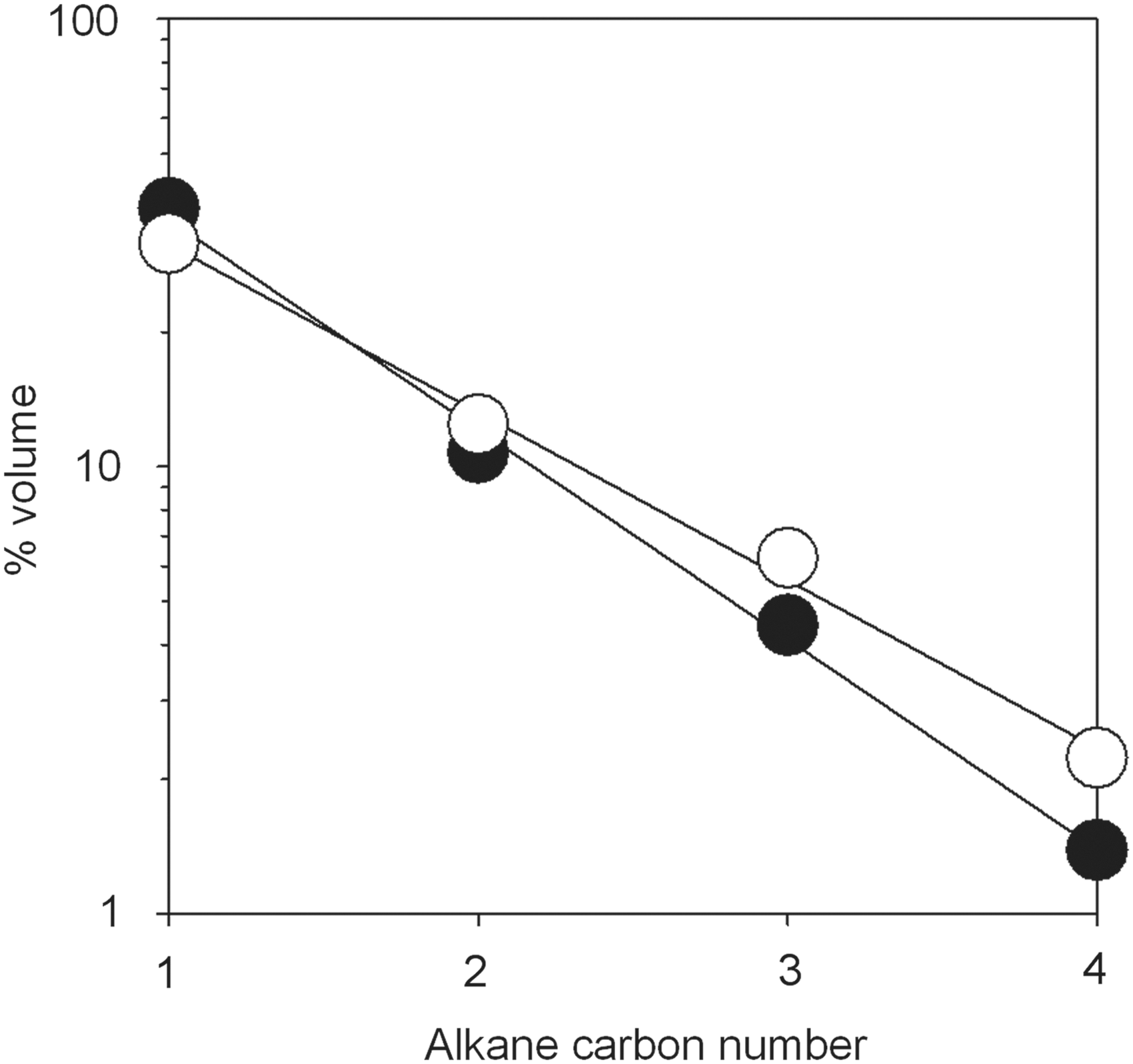
Plot of % volume of alkanes versus carbon number produced in spark discharge experiments. Open circles represent first experiment (δ13C measurements only); closed circles represent second experiment (δ2H and δ13C measurements). Error bars (1σ) are smaller than the plotted symbols.
Total molar volume composition of analyzed gases relative to start.
The molar composition of the analyzed gases at the end of the experiments did not quantitatively match that of the starting molar composition: 22.1% of the carbon and 14.4% of the hydrogen were unaccounted for in Experiment (Expt) 1, and 16.1% of the carbon and 9.8% of the hydrogen were unaccounted for in Experiment 2 (Table 1). These apparent losses are likely due to the formation of higher-molecular-weight gaseous and condensed hydrocarbons that were not analyzed in this study, a conjecture supported by the visualization of a condensate at the electrodes at the end of both experiments. The final H/C ratios in the two experiments (4.4 and 4.3) were both higher than the starting ratio of 4 (Table 1), indicating that the undetected hydrocarbons had lower H/C ratios than those of the C1–C4 alkanes, which is consistent with longer-chain alkanes.
3.2. δ13C and δ2H isotopic values
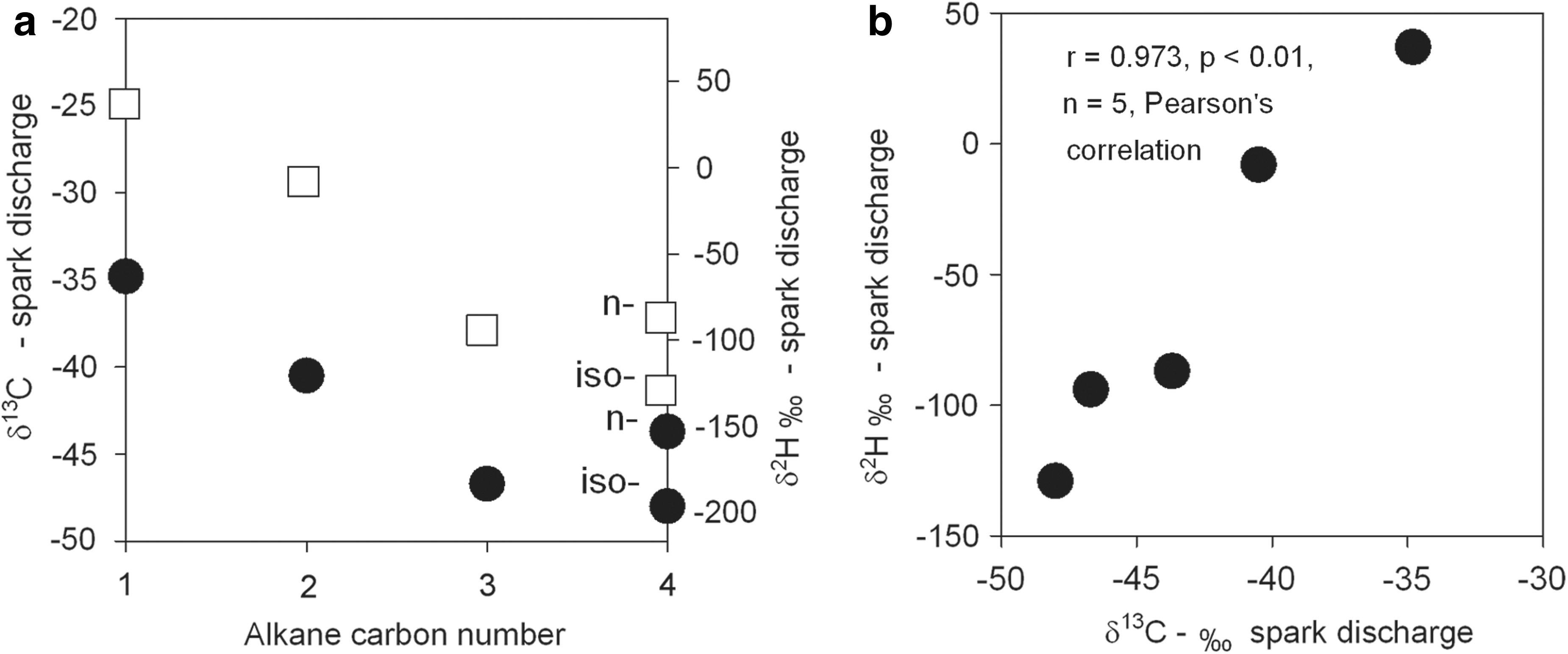
There was a reversed intermolecular δ13C pattern between methane, ethane, and propane in both experiments (Fig. 2). The concentration of isobutane in the first experiment was insufficient for quantitative δ13C analysis. The δ13C value of isobutane was significantly lighter than n-butane in the second experiment, however, contrary to the pattern previously documented in alkanes extracted from the Murchison meteorite (Fig. 2). The δ2HC1–C2+ pattern in the second spark discharge experiment was similar to the δ13CC1–C2+ pattern (Fig. 3a), with a positive correlation between δ13C and δ2H values (r=0.973, p<0.01, n=5; Pearson's correlation, two-tailed t test; Fig. 3b).
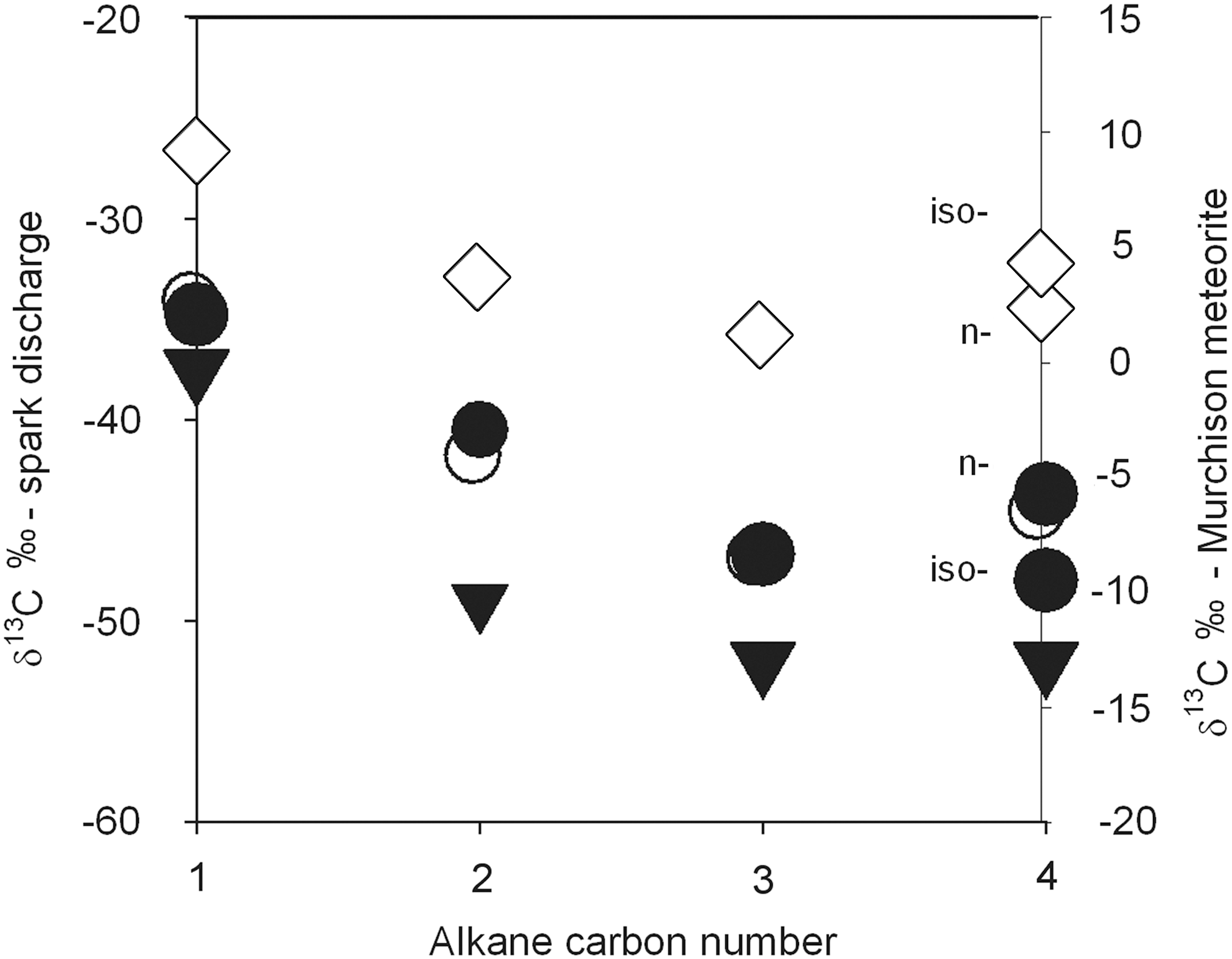
δ13C values of alkanes from spark discharge experiments. The δ13C values of alkanes produced in both the first experiment (open circles) and second experiment (closed circles) show a pattern of decreasing isotopic value with increasing molecular weight between methane and propane. This decreasing δ13C trend with increasing molecular weight is similar to that documented in spark discharge experiments of Des Marais et al. (1981) (inverted solid triangles) and methane and C2+ alkanes extracted from the Murchison meteorite by Yuen et al. (1984) (open diamonds).
(
The mean δ13C of all analyzed compounds at the end of both experiments (−39.1‰ and −40.2‰; Table 2) was slightly heavier than that of the starting methane isotopic composition (−41.1‰; Table 2), indicating that the δ13C values of the undetected hydrocarbons (likely those of higher molecular weight; see above) were isotopically lighter than the detectable ones. Similarly, the mean δ2H of all analyzed compounds at the end of Experiment 2 (−44‰) was slightly heavier than that of the starting methane composition (−52‰), indicating that the δ2H values of the undetected hydrocarbons were also lighter than the detectable ones.
4. Discussion
4.1. Intermolecular δ13C and δ2H signatures of alkanes formed via gas-phase radical reactions
In this study, we replicated the reversed δ13CC1–C3 pattern for gas-phase radical recombination reactions previously established by Des Marais et al. (1981) (Fig. 2) and provide for the first time the complementary δ2H values for all compounds. In the 1981 study, the reversed δ13CC1–C3 pattern was attributed to kinetic fractionations during recombination due to 12CH3 reacting faster than 13CH3 to form longer carbon chains, resulting in more 12C incorporated into heavier alkanes (Des Marais et al., 1981). Importantly, the δ2HC1–C2+ and δ13CC1–C2+ intermolecular patterns in the spark discharge experiment were positively correlated (Fig. 3b). This suggests that the distribution of hydrogen isotopes in gas-phase radical reactions is controlled by kinetic fractionations in an analogous way to the carbon isotopes. The reversed δ2H pattern may be due to the preferential incorporation of 1H into longer-chain alkanes due to more rapid rate of collisions of the smaller 1H-containing molecules (Huang et al., 2005). Alternatively, the reversed δ2H pattern may be due to secondary ion effects, that is, the presence of the lighter 1H in 1H-C-C causes a weaker C-C bond than in 2H-C-C (Bigeleisen, 1965). Significant secondary hydrogen exchange in the spark discharge experiments is unlikely, as the experiments were designed to freeze out the initial C2+ alkane products and prevent secondary hydrogen exchange reactions. Isotopic mass balance considerations suggest that higher-molecular-weight hydrocarbons have lighter δ13C and δ2H values than the C1–C4 alkanes (Tables 2 and 3). This suggests that the reversed δ13C and δ2H patterns seen in these experiments are not only applicable to C1–C4 alkanes but also to higher-molecular-weight compounds via continued radical recombination reactions. The experimental data of this study therefore support the hypothesis that organic molecules formed by gas-phase radical recombination reactions in the low temperatures of interstellar space or the outer solar nebula will have combined reversed δ13CC1–C2+ and δ2HC1–C2+ intermolecular patterns (Huang et al., 2005). Although temperatures and pressures in interstellar space are substantially lower than those used in the spark discharge experiments, the mechanisms of radical recombination reactions (and the resulting isotopic distribution patterns) should be similar. This is because radical recombination reactions have very low activation energies and can take place at temperatures as low as 10 K (Herbst, 1995).
Reversed δ2HC1–C2+ and δ13CC1–C2+ patterns may also be typical of methane and C2+ alkanes, and perhaps other low-molecular-weight organic molecules, formed by gas-phase radical reactions in a variety of extraterrestrial environments. One such environment is the atmosphere and surface of Saturn's moon Titan, where episodic cryovolcanism releases gaseous methane from reservoirs of clathrate hydrates into the atmosphere, where it undergoes radical recombination reactions in the atmosphere dominantly driven by UV-radiation photolysis, with further contributions from cosmic ray radiation and magnetospheric electrons derived from Saturn's magnetic field (Sagan and Thompson, 1984; Tobie et al., 2006). As the average surface temperature of Titan is −179°C and the atmospheric pressure is 1.6 bar, the C2+ products (primarily ethane) condense out in liquid lakes on the surface (Brown et al., 2008; Lunine and Atreya, 2008) or potentially on dust particles in the atmosphere, which settle onto the surface (Hunten, 2006). Spectral measurements on Titan's atmosphere have demonstrated that δ13Cethane is likely lighter than δ13Cmethane by ca. 8‰ (Jennings et al., 2009), while the δ2HC1–C2+ has yet to be measured.
Reversed δ2HC1–C2+ and δ13CC1–C2+ alkane patterns might also be present within the upper atmospheres of the gas giant planets of Jupiter, Saturn, Neptune, and Uranus, where the polymerization of gaseous methane can be energized by lightning strikes in addition to UV photolysis (Romani et al., 1993; Sada et al., 1996; Moses et al., 2005; Hammel et al., 2006). Testing of this hypothesis awaits future, more precise measurements of the δ2H and δ13C of methane and ethane in the gas giants' atmospheres.
4.2. Intermolecular δ13C and δ2H signatures of alkanes in crustal environments
Experimental data indicate that abiogenic hydrocarbons can have a wide range of δ13C and δ2H alkane distribution patterns (Sherwood Lollar et al., 2002, 2008; McCollom and Seewald, 2006; Fu et al., 2007; Taran et al., 2007, 2010a, 2010b; McCollom et al., 2010), which likely reflects differences in reaction pathways, in catalysts, and in kinetic limitations such as absorption/desorption effects on catalyst surfaces (Sherwood Lollar et al., 2008; McCollom et al., 2010; Taran et al., 2010a). To date, no high-temperature mineral-water experiments in the laboratory have, however, replicated the combined reversed δ13C and δ2H distribution patterns documented in a number of terrestrial abiogenic hydrocarbon deposits (Potter and Longstaffe, 2007; Proskurowski et al., 2008; Taran et al., 2010b). It has been suggested that these “completely” reversed hydrocarbons could be formed by radical reactions at relatively high temperatures and pressures within the lower lithosphere (Du et al., 2003; Taran et al., 2010a). The experimental results of the spark discharge experiments (Figs. 1 –3) provide the first experimental verification of this hypothesis.
Both experimental and field evidence indicate that, while relatively shallow, “traditional” terrestrial thermogenic hydrocarbon deposits have normal δ13C and δ2H intermolecular alkane patterns, hydrocarbons generated at high temperatures and pressures deeper within the crust can have reversed δ13C and δ2H patterns (Burruss and Laughrey, 2010). These reversed thermogenic δ13C and δ2H alkane patterns have previously been interpreted in one of two ways: first, by the mixing of different sources of alkanes (Liu et al., 2008), and second, by the combination of mixing with either Rayleigh fractionation (for carbon isotopes) or the exchange of methane hydrogen with formation water (for hydrogen isotopes) (Burruss and Laughrey, 2010). The results of the spark discharge experiments (Fig. 1) suggest an alternative possibility for the reversed δ13C and δ2H alkane patterns in “deep-seated” thermogenic hydrocarbon deposits, which is that at high temperatures and pressures C2+ alkanes are destroyed and then reformed via radical reactions, producing similar reversed patterns to those seen in the spark discharge experiments. Further support for the latter hypothesis is given by an experimental study showing that completely reversed δ13C1–4 alkane patterns are produced during the high-temperature/pressure (500–700°C, 1–3 GPa) pyrolysis of lignite (Du et al., 2003).
4.3. Future research
While current results, based on the bulk isotopic compositions of compounds, do not as yet provide a definitive means by which to differentiate abiogenic from biogenic hydrocarbons, experiments such as those described in this paper represent important progress toward understanding reaction mechanisms involved in abiogenic synthesis under different temperature and pressure conditions. Future progress in this field may focus on the analysis of isotopologues—the small set of molecules that contain more than one rare isotope, such as in the case of methane
5. Conclusions
The results of this experimental study expand our understanding of the intermolecular isotopic signatures of hydrocarbons formed in various extraterrestrial and terrestrial environments. C2–C4 alkanes synthesized from methane during gas-phase radical recombination reactions have δ2Hmethane>δ2Hethane>δ2Hpropane, similar to previously documented intermolecular carbon distribution patterns (δ13CC1–C2+) with δ13Cmethane>δ13Cethane>δ13Cpropane. These “reversed” patterns are likely typical of gas-phase radical reactions in a variety of extraterrestrial settings, including interstellar space, the atmosphere, the liquid hydrocarbon lakes of Saturn's moon Titan, and the outer atmospheres of Jupiter, Saturn, Neptune, and Uranus. Radical recombination reactions at high temperatures and pressures also provide a possible explanation for the combined reversed δ13CC1–C2+ and δ2HC1–C2+ patterns of terrestrial alkanes documented at a number of both abiogenic and high-temperature/pressure thermogenic gas sites.
Footnotes
Acknowledgments
This study was supported by grants from the Canada Research Chairs program, NSERC Special Research Opportunity Program, and Canadian Space Agency to B.S.L.
Author Disclosure Statement
No competing financial interests exist.
Abbreviations
GC, gas chromatograph; GC-C-IRMS, gas chromatography–combustion–isotope ratio mass spectrometry.