




Abstract
Properties of avenues of transformation and their mutualism with forms of organization in dynamic systems are essential for understanding the evolution of prebiotic order. We have analyzed competition between two avenues of transformation in an A↔B system, using the simulation approach called BiADA (Biotic Abstract Dual Automata). We discuss means of avoiding common pitfalls of abstract system modeling and benefits of BiADA-based simulations. We describe the effect of the availability of free energy, energy sink magnitude, and autocatalysis on the evolution of energy flux and order in the system. Results indicate that prebiotic competition between avenues of transformation was more stringent in energy-limited environments. We predict that in such conditions the efficiency of autocatalysis during competition between alternative system states will increase for systems with forms of organization having short half-lives and thus information that is time-sensitive to energy starvation. Our results also offer a potential solution to Manfred Eigen's error catastrophe dilemma. In the conditions discussed above, the exponential growth of quasi species is curbed through the removal of less competitive “genetic” variants via energy starvation. We propose that one of the most important achievements (and selective edges) of a dynamic network during competition in energy-limited or energy-variable environments was the capacity to correlate the internal energy flux and the need for free energy with the availability of free energy in the environment. Key Words: Modeling studies—Origin of life—Prebiotic evolution—Early Earth—Astrobiology. Astrobiology 13, 454–464.
1. Introduction
Forms of organization and avenues of transformation are often connected to each other. For example, one avenue of transformation may lead to a specific form of organization, and vice versa some forms of organization may either catalyze or inhibit specific avenues of transformation. Yet these two types of system features (i.e., forms of organization and avenues of transformation) have properties that are sufficiently dissimilar to merit separate analysis. Examples can be found where a single form of organization is produced by two avenues of transformation with dissimilar intermediates, kinetic properties, and energy dissipative potential. Three examples of simple models for studying competition between avenues of transformation, between forms of organization, and mutualism between these are shown in Fig. 1. With regard to prebiotic evolution, separate analysis between avenues of transformation and forms of organization is warranted, because two of the most important drivers of negentropic organization of dynamic systems are in essence dynamic, unidirectional, and energy-related. These two drivers are (1) the entropic direction of the second law of thermodynamics and (2) the continuous expansion (and ensuing cooling) of the Universe (Bak, 1996; Chaisson, 2003). These drivers influence changes in a system's nondynamic hardware (i.e., forms of organization) indirectly through its dynamic properties or modus operandi (i.e., avenues of transformation). Henceforth, understanding what drove the origin of life demands models tailored specifically for distinguishing consequences of avenues of transformation from those of forms of organization.
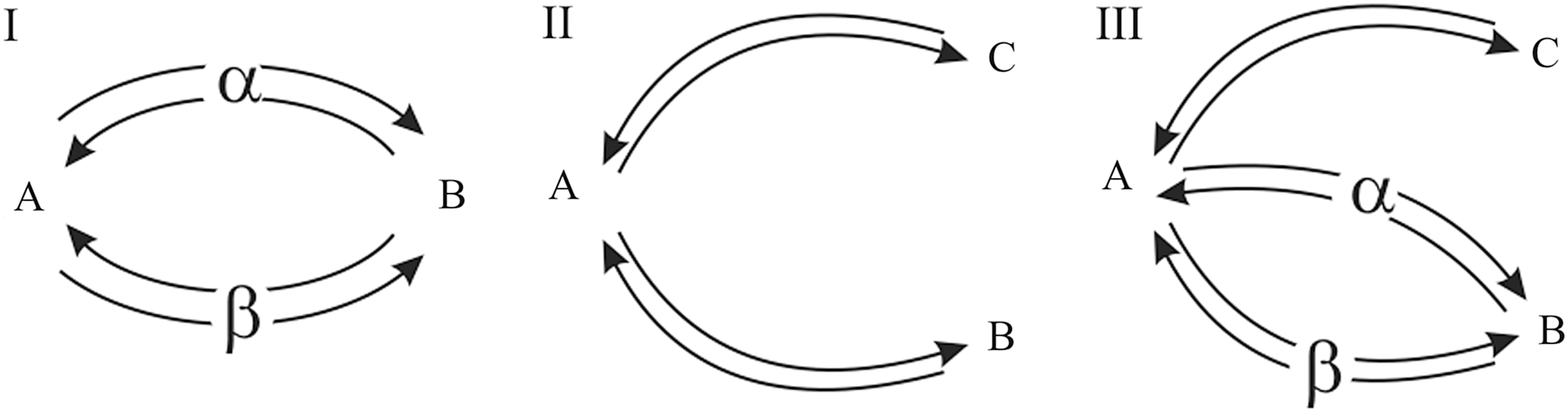
Three basic model templates for analyzing properties of avenues of transformation and forms of organization, how they interact with each other, and how they (separately or together) influence prebiotic evolution. (I) Model for analyzing competition between two alternative avenues of transformation (α and β) that link two forms of organization (A and B). (II) Model of competition between two alternative forms of organization (B and C) derived from the same initial state (A). In this model the energy dissipative and intrinsic kinetic properties of the two paths (A↔B and A↔C) are assumed to be similar, but B and C have dissimilar E G, E S, and half-life properties. (III) Combined model for analyzing the contribution of competition of forms of organization vs. competition between avenues of transformation. These models can also be used to analyze the effect of cooperation or interference between specific forms of organization and specific avenues of transformation.
1.1. Characteristics of competing avenues of transformation
Alternative avenues of transformation between two given forms of organization (say, A and B) have similar properties with regard to the variation in free energy (dG) and entropy (dS) but can be dissimilar from other perspectives. These include the properties of the intermediate states, the activation energy, the efficiency of free energy exchange, and the efficiency of exchanging meaningful information between A and B: the efficiency of exchanging energy with the exterior and the kinetics of the transformation. Figure 2 summarizes the types of energy exchanges between energy reservoirs in an A↔B system that have to be accounted for by calculating the various efficiencies listed above. The overall energy dissipative potential and the heat and entropy yield, which are important for explaining competition between dynamic systems, can also be derived from Fig. 2 features.
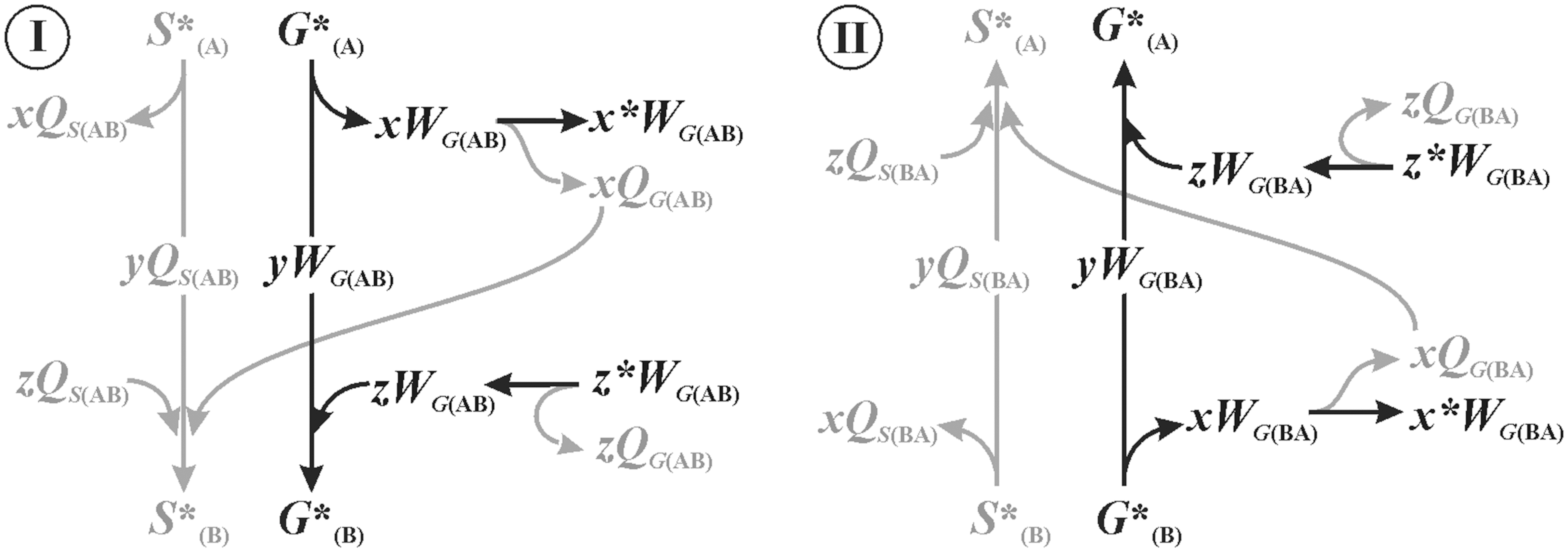
Types of energy exchanges between two forms of organization (A and B) in a BiADA-type simulation of a chemical system. Each form of organization contains energy in two reservoirs S* (or E S) and G* (or E G), where S*(A) and S*(B) are the absolute entropy of A and B, respectively. G*(A) and G*(B) are free energy content of A and B, respectively. In BiADA, E S is assumed to be the only heat reservoir, while E G is the only reservoir of free energy. All stocks and transformations representing changes in entropy-related energy (E S) are shown in gray. All stocks and exchanges of free energy (E G) are shown in black. In order to account for all the energy transfer efficiencies, all transformations analyzed in this study (and in BiADA in general) are analyzed as independent uniflows (i.e., brut changes), as opposed to budgets of reversible processes (i.e., net changes). Panel I gives all major types of forward transformations (i.e., the A→B direction). Panel II shows the reverse transformations (i.e., B→A).
In the model shown in Fig. 2, the amount of building materials is assumed to be similar between A and B; thus no material is exchanged with the exterior during a transformation. In each panel, x, y, and z represent output, transfer, and input, respectively. Q is heat energy, and W is free energy. Depending on the similarities or differences between A and B, the parameters shown in the figure may have zero or positive values. In BiADA-based models, energy values for stocks and flows are never negative. The meaning of the forward exchange parameters from Panel I, that is, during transformation of A into B, is given next.
xQ S(AB)=Heat energy output during degradation of A;
yQ S(AB)=Direct heat energy transfer from A to B;
zQ S(AB)=Heat energy input from exterior into B;
xW G(AB)=Free energy released from A toward the exterior;
xQ G(AB)=Heat produced during the release of free energy from A toward the exterior;
x*W G(AB)=Actual free energy released from A and reaching the exterior;
yW G(AB)=Free energy directly transferred between A and B;
zW G(AB)=Free energy entering B from the exterior;
z*W G(AB)=Free energy removed from the exterior in order to be introduced into B; and
zQ G(AB)=Heat energy generated during the input of free energy into B.
The parameters from Fig. 2 Panel II are reciprocal to those from Panel I. All quantities in Fig. 2 refer to one unit of transformation (i.e., x
A=x
B). The relationship between parameters from Fig. 2 and conventional thermodynamic parameters for the forward transformation is
For this study, we have produced a model that is based on Fig. 1 (Panel I) and Fig. 2, and we show its use for analyzing competition between avenues of transformation (α and β) and competition between forms of organization (A and B). We explain and justify the simulation approach that we have selected for this study (i.e., BiADA), discuss advantages and limitations when using such models, and show simulation results illustrating the effect of energy availability, an external heat sink, and autocatalysis on the system's evolution.
2. Materials and Methods
2.1. The BiADA approach
Numerous simulation platforms and models have been developed for studying the evolution of prebiotic networks (Rosen, 1973; Ray, 1991; Fontana and Buss, 1994; Pargellis, 1996; Bro, 1997; McMullin, 1997; Adami, 1998; Morán et al., 1999; Bedau et al., 2000; Rand and Wilensky, 2006). Trying to emulate chemical systems in all details leads to complex models, because numerous interactions, physical-chemical factors, and complex consequences of autocatalysis have to be taken into consideration (Eigen and Schuster, 1979; Gánti, 1979, 1997; Varela, 1979; Luisi, 1993; Palyi et al., 2012). This often makes the understanding of fundamental drivers of the origin of life difficult and leads to complex interpretations for otherwise straightforward evolutionary features (Eigen and Schuster, 1979; Kauffman, 1993; Szathmáry, 1995, 2002; Adami, 1998; Bedau et al., 2000; Bedau, 2003). Consequently, it is often practical to develop models of abstract systems in which only the most essential parameters and forces are analyzed. The selection of the modeling principles and software depend on the system properties that have to be analyzed and on the model's complexity. The model shown in this study uses Biotic Abstract Dual Automata (BiADA), a novel simulation concept designed for analyzing the energy budget, energy flow, and the evolution of order and information in simple networks (Cimpoiasu and Popa, 2012).
BiADA-based models use four key principles.
(1) The Gibbs-related energy (E G) and the entropy-related energy content (E S) of each form of organization (see Fig. 2) have absolute values, and their budget and energy exchanges are analyzed separately;
(2) Forward and reverse transformations (i.e., uniflows) are analyzed separately, resulting in measurements of the brut, rather than net changes and exchanges;
(3) The efficiency of the input and output of free energy as well as the conservation of free energy and information during exchanges are integral parts of the model;
(4) All transformations are first expressed in units of transformation (rather than units of organization), and all transformations are discrete increments (or decrements) of building materials, energy, and information.
Some types of models (BiADA included) require the use of absolute values for the Gibbs free energy (G* or E G) and entropy (S*=E S/T) (Rodebush, 1927; Szarecka et al., 2003; White and Meirovitch, 2004, 2006; Meirovitch, 2009; Lin et al., 2010; Cimpoiasu and Popa, 2012). Using absolute values for E G and E S helps constrain the quantitative relationship between information and its energy cost. The quantitative relationships between energy, entropy, order, and information used in BiADA models are derived from basic principles of thermodynamics and statistical mechanics (Jarzynski, 1997a, 1997b, 1997c; Ladyman et al., 2007; Shinitzky et al., 2007; Gough, 2008; Toyabe et al., 2010; Cimpoiasu and Popa, 2012; Popa and Cimpoiasu, 2012). Brut changes in forms of organization are used very differently than they are in conventional kinetics and thermodynamics where the main emphasis is on bi-flows (i.e., difference between forward and reverse transformations) and on net changes in the system's state (i.e., difference between the before and after state). To the novice in thermodynamics, the amount of energy exchanged per unit of organization may appear to depend on the distance from equilibrium; thus changes in energy may not appear to be correlated with changes in order. This comes from the fact that when systems are far from equilibrium one of the transformation directions prevails, while near equilibrium forward and reverse transformations tend to balance each other. Hence, only analyzing the net changes in a system leads to incomplete pictures of the exchanges of free energy, heat, and information among the system's forms of organization and between the system and the exterior. In BiADA, the energy exchanged is independent of the distance from equilibrium, and it is correlated with exchanges in meaningful information between the various forms of organization. The detailed accounting of each and all transformations increases the complexity of BiADA models but also helps explain the energy dissipative behavior of systems in states of dynamic stability and competition between dynamic systems based on their energy dissipative potential. BiADA models are useful in the analysis of asymmetric evolution such as chirality (Cimpoiasu and Popa, 2012; Popa and Cimpoiasu, 2012) and, we believe, will prove useful in describing the behavior of one-way cycles. Because enantiomers are virtually identical with regard to E G and E S, during L↔D transformations dG=0 and dS=0. Derived from BiADA principles, racemization increases the overall entropy because the information of the two enantiomers (i.e., forms of organization) is dissimilar. During racemization, the exchange of meaningful information between enantiomers is not 100% efficient; thus free energy cannot be exchanged with 100% efficiency. As a result, during racemization free energy enters the system, and it is continuously dissipated, explaining in part why the overall entropy increases with racemization.
2.2. Basic structure of the model
The basic structure of the model developed for this study (Fig. 3) was implemented in the Stella 8 software (isee systems, 2012). Because the model and the software are available online, and because all formulas are explicit and most of them were explained in an earlier paper (Cimpoiasu and Popa, 2012), interested readers can easily experiment with the model or modify it for addressing other questions regarding prebiotic evolution. Stella has some limitations that have to be known before simulations are done. Stella uses a rather small number of steps (∼37,000 for DT=1). It also uses a “step by step” approximation of increments (and decrements) as opposed to a true integration of mathematical functions. Stella models that contain many stocks, flows, converters, and connectors may become cluttered with graphical details and hard to debug. Yet for studying simple models with a low number of stocks and flows, Stella is an excellent platform that is relatively easy to learn and experiment with.

Summary of the types of energy flow paths from the model analyzed in this study. This diagram only includes one forward and one reverse avenue of transformation. In the final model, each flow forward and reverse takes two alternative pathways. Continuous lines represent exchanges of free energy. Dotted lines represent exchanges of heat.
The full model created for this study has five principal sectors (posted in
Sector 1. Input Conditions contains user-defined values for temperature, system volume, the initial amount of various forms of organization, the mass per unit of organization, standard rates for various avenues of transformation, the effect of temperature on these rates, the number of liberties for the various forms of organization (Ω), the Landauer bound (k L) for the type of system analyzed (e.g., in chemical systems k L≈9.572·10−24 J bit−1 K−1; Jaynes, 1957; Landauer, 1961; Lindgren, 1988; Cimpoiasu and Popa, 2012; Popa and Cimpoiasu, 2012), the E G per each type of unit of organization, an energy availability factor describing how much free energy may enter from the environment, the efficiency of uptaking free energy into E G, the autocatalytic potential of various forms of organization, the energy dissipative potential associated with various avenues of transformation, and the heat conductivity of the environment (a proxy for the magnitude of the terminal heat sink). The implementation of these parameters in a BiADA-Stella model was shown in an earlier study (Cimpoiasu and Popa, 2012).
Sector 2. Exchange budgets monitors the energy exchanged during various transformations and the number of units of transformation predicted as an integer, based on the abundance of various forms of order, the properties of various transformations, and energy availability. In this model, the parameter “Eg” represents E G. Given two forms of organization (A and B) and the stoichiometry of their interconversion (x A and x B, respectively), the variation in “Eg” during x A to x B conversion, as given in the Stella model, is
“dEg of xA to xB”=“EgB_J_per_unit”·“xB” – “EgA_J_per_unit”·“xA”
where “dEg of xA to xB” from the model=the net E G budget during x A to x B transformation;
“EgB_J_per_unit” from the model=the E G content of one B unit; and
“EgA_J_per_unit” from the model=the E G content of one A unit.
Similar parameters were defined for E S-related exchanges.
Sector 3. Energy exchange model gives the basic structure of the network showing how energy (free energy and heat) flows through the various stocks of the system.
Sector 4. System evolution parameters monitored by the model. This sector shows the energy flux through each avenue of transformation, the energy turnover, the energy dissipative potential, a fitness parameter, and order-related parameters. These parameters were also described in an earlier paper (Cimpoiasu and Popa, 2012).
Sector 5. Conventional thermodynamic and kinetic parameters. This sector is not mandatory, but it is helpful in models of chemical systems. It contains values for dG, dS, dH, and transformation rates. Because the Gibbs free energy (G°) and standard entropy (S°) of A and B are relative, they cannot be derived from the parameters given in this model or parameters shown in Fig. 2. To calculate G° and S°, we have to know the dG° and dS° between the A and B states and other form(s) of organization with similar composition, but G°=0 and S°=0.
Relative to earlier models (Cimpoiasu and Popa, 2012; Popa and Cimpoiasu, 2012), the model shown in this manuscript has three key additions: a parameter called Gibbs bound (k G), a technical description of the relationship between entropy and disorder, and the quantitative relationship between forward and reverse tranformation rates as a function of E G values, transformation stoichiometry, and temperature.
The parameter called Gibbs bound (k
G) (named in analogy with the Landauer bound, k
L) represents the mean free energy associated with a unit of meaningful information of a specific form of organization.
where k G=Gibbs bound (in J bit−1);
E G=Gibbs-related energy of a form of organization (in J per unit of organization); and
I rm=removed information in a system, (in bits per unit of organization); see description below.
Unlike k L, k G is assumed to be temperature-independent, which makes E G also temperature-independent. As discussed earlier (Cimpoiasu and Popa, 2012), E G represents a part of the system that has no temperature and thus cannot exchange heat. Unlike E S, which increases constantly with temperature and has positive values at all temperatures (except 0 K), E G only exists within a specific range of temperatures, from 0 K to an upper threshold where the accumulated E S makes a nonrandom form of organization unstable. The point of instability (i.e., temperature-controlled destruction or phase transition into another form of organization) is assumed to be reached near the temperature where E S equals E G.
In BiADA-based models, the relationship between various forms of information from a system is
where I vt=maximum information capacity (I C) of a system or form of organization with zero order and largest possible Ω. I vt is similar in meaning to the information capacity (C i) or Shannon channel capacity of a system (Shannon, 1948);
I rs=residual information capacity. I rs is the I C due to the Ω that is still present after ordering has occurred. I rs is similar in meaning with the disorder capacity (C D) of a system (Landsberg, 1984);
I rm=removed information capacity. I rm is the I C lost due to ordering, and it is similar in meaning with the order capacity (C o) of the system (Landsberg, 1984). Similarity between the I rm of two forms of organization is important in the energy transfer efficiency between them (Fig. 4).
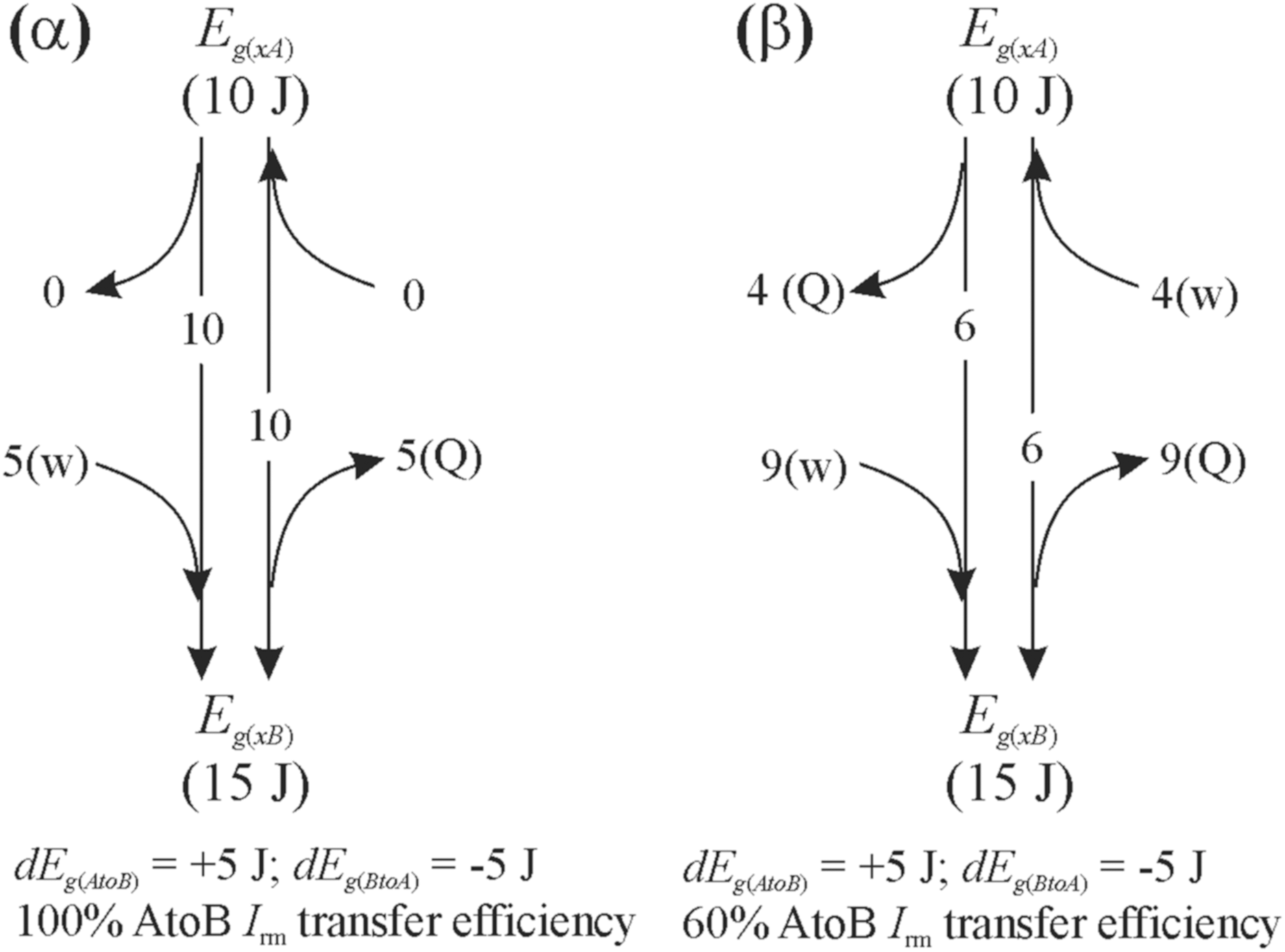
The brut energy exchanges associated with two alternative avenues of transformation (α and β) between the E G reservoirs of two forms of organization (A and B) depend on more than the dE G value. They also depend on the similarity between the I rm(A) and I rm(B), where I rm=remnant, removed, or meaningful information (Cimpoiasu and Popa, 2012).
Although in general more free energy means less I rs, the relationship between k G and I rm is not universal but varies among various forms of organization. A hypothetical form of organization where I rs=0 (i.e., no Ω left after organization) has I vt=I rm and would be indestructible by temperature if placed in an isolated milieu without contact with other forms of organization. Because Ω=0, such a hypothetical form of organization would not absorb heat from the exterior irrespective of temperature. This extreme situation does not occur in the real world because no form of organization exists that has Ω=0. Hence, the susceptibility of a form of organization to being degraded depends on four factors: I rs, I rm, k L, and k G. This relationship is not discussed here.
In the history of thermodynamics, instances exist when loose use of the term entropy led to confusion (Hutchens et al., 1960, 1969; Müller, 2007). In this model, we use a technical definition of entropy as the heat that can be absorbed by a system, due to its I rs, when temperature increases by 1 K. The BiADA approach helps explain why the statement “entropy is a measure of disorder” is neither accurate nor sufficient. First, not all systems absorb heat or produce entropy that is measurable in conventional units of energy; well-known examples include cybernetic systems and socioeconomic systems. Second, entropy can only be used to analyze order in systems where I vt does not change with time or temperature. And third, entropy can only be used to compare disorder between thermodynamic systems with similar I vt. The accurate measure of disorder in the general case is I rs/I vt, which is analogous to C o/C i (Landsberg, 1984). Hence, entropy can only be used as a measure and comparison of disorder if it is I vt-normalized (i.e., S/I vt).
The relationship between forward and reverse tranformation rates as a function of E
G values, stoichiometry, and temperature is included in the model from this study in Sector, that is, “Test for Eg and unisense rate values”. From the general theory of chemical equilibrium described by the classical equation
where ΔG r is the Gibbs energy change for the reaction, and k + and k -=the rates for the forward and reverse transformations, respectively
we can extract the relationship between unisense rate values, temperature, and E
G values
where R AtoB and R BtoA=rates of the forward and reverse transformations, i.e., A into B and B into A, respectively;
E G(A) and E G(B) are the E G values for the two forms of organization (A and B respectively);
T=temperature in K; and
x A and x B=indices used to describe the stoichiometry of the transformation.
The effect of temperature on a unisense transformation varies from one type of system to another, controlled by the general relationship:
where R=the unisense transformation rate;
ct=R 0·e F/T ;
R 0=the rate of a unisense process at standard temperature (298.15 K);
F=a factor showing how a process depends on the temperature; and
T=temperature in K.
3. Results
We show results of simulations in which we analyzed the effect of three variables (the external source of free energy, the magnitude of the terminal heat sink, and differences in rates between the two avenues of transformation due to autocatalysis of one of the avenues of transformation) on (a) the competition between forms of organization, (b) the competition between avenues of transformation, (c) the contribution of one avenue of transformation to energy dissipation, and (d) the system's overall energy dissipative potential. In this model, we use changes in equilibrium (i.e., OoB level) for analyzing the effect of competition between forms of organization and changes in the relative energy flow through a specified path (i.e., percent path alpha) for analyzing competition between avenues of transformation.
3.1. Simulation cluster #1. Effects of energy availability
In this series of simulations, we varied the “E availability factor” and maintained all other parameters constant. The effect of E availability on two system parameters is shown in Fig. 5. For this simulation, we used a bottomless sink (i.e., “Heat conductive”=1,000) to curb the accumulation of internal heat from influencing the transformation rates during episodes of high energy flux. The intrinsic rate of the alpha avenue of transformation was larger than the rate of the beta avenue. The efficiency of free energy uptake from the exterior and the efficiency of direct energy transfer were similar between the alpha and beta avenues (i.e., 1). In this and all subsequent simulations, we used the following reaction coefficients: x
A=2 and x
B=1 and a dG
r of 602 J mol−1. Based on
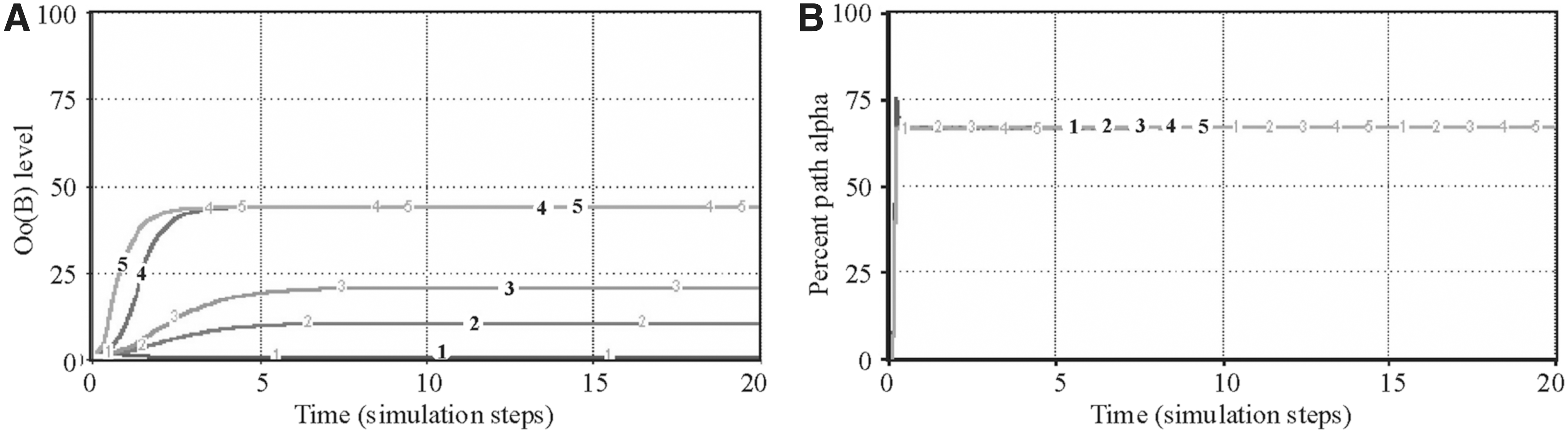
The effect of the availability of free energy on the competition between forms of organization (panel A) and between avenues of transformation (panel B). The five plots represent effects of various values for the “E availability factor” (i.e., plot 1=1, plot 2=100, plot 3=200, plot 4=1,000, and plot 5=10,000). Heat conductive=1,000. Free E availab=1e-18. EgA J per unit=6.36e-18. EgB J per unit=1.2721e-17. Ro AtoB 1 (forward alpha avenue rate)=1. Ro AtoB 2 (forward beta avenue rate)=0.64. Ro BtoA 1 (reverse alpha avenue rate)=0.5. Ro BtoA 2 (reverse beta avenue rate)=0.32.
3.2. Simulation cluster #2. Effects of the energy sink
In this model, the export of heat from the system is controlled by the heat gradient and by the heat conductivity. We predicted that when energy dissipation is little, heat accumulated inside the system will influence the competition between forms of organization and the overall heat dissipative potential but not the competition between avenues of transformation. We performed simulations by using large energy availability to restrict energy limitation from interfering with the effect of the energy sink. In these simulations, heat conductivity was used as a proxy for the capacity of the environment to absorb heat. During simulations, a critical threshold was reached (called here the “point of kinetic choke”) where the theoretical capacity for transformation (say, the rate of A-to-B transformation) during a single simulation step became larger than the capacity of the source reservoir (i.e., A). Because beyond the point of kinetic choke the reservoir of building materials is insufficiently large and often contains a number of units that does not divide accurately between the two avenues of transformation, simulations were stopped. Decreasing the length of the time intervals (i.e., DT in Stella) does not solve this problem. This limitation can be delayed by beginning the simulation with very large populations or by making changes in the rules of internal partition of units between flows. Yet this complicates the model beyond its purpose, that is, studying effects produced during an internal accumulation of E S-related energy due to an ineffectual energy sink.
Our results (Fig. 6) confirm that, up to the point of kinetic choke, accumulation of internal heat influenced the internal equilibrium (i.e., competition between forms of organization). Up to about 1670 steps the energy sink influenced competition between avenues of transformation. We also verified the effect of temperature on the transformation rates; the drop in plots 4 and 5 seen in panel B of Fig. 6 is attributed to a combination of energy limitation and increased rate. This model is not comprehensive in the sense that in the real-world systems various rates of production and destruction may significantly alter this relationship. For example, no provision was made in the model to account for variable rates of destruction of organization as a function of temperature. The amendment we propose here is to define a value for the half-life of each type of order and the point of total order destruction based on the conjecture that a form of order is destroyed by heat when E S≥E G. Modifications can be made to the model to adjust the effect of temperature on rates in such a way that the point of kinetic choke falls beyond the point where B is significantly destroyed by the accumulated heat. As expected, the accumulation of heat did not influence the competition between avenues of organization because in this model heat influences all rates proportionally. This simulation cluster also revealed another potential limitation of abstract modeling. When the units available for transformation become limiting, the software favored the “beta” avenue. This is equivalent with introducing meaningful information from the exterior, which is contrary to the desired functioning of the model. Our results suggest that even a little informational bias or asymmetry can be amplified in a dynamic system with fast kinetics (large energy flux or internal turnover), when free energy becomes limiting and the half-life of the existing forms of organization is short.
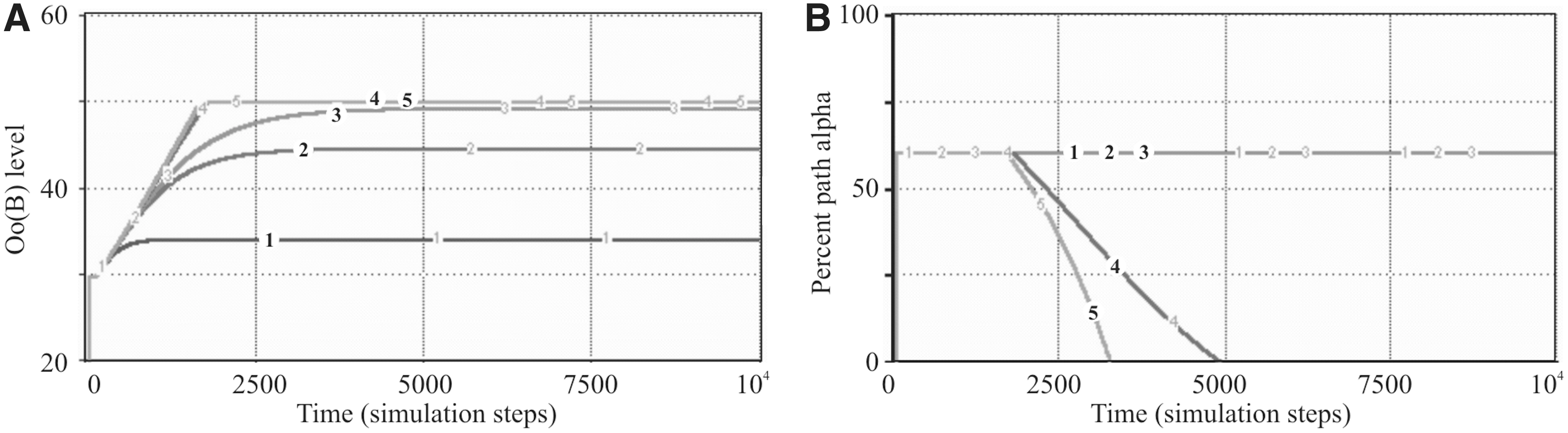
Effect of the magnitude of a heat sink on the competition between forms of organization (panel A) and competition between avenues of transformation (panel B). The five plots represent effects of various values for “Heat conductivity” (i.e., plot 1=1e-2, plot 2=1e-3, plot 3=6e-4, plot 4=1e-4, and plot 5=1e-8). Free E availab=1e-18. E avail factor=20,000. EgA J per unit=6.36e-18. EgB J per unit=1.2721e-17. Ro AtoB 1 (forward alpha avenue rate)=1. Ro AtoB 2 (forward beta avenue rate)=0.64. Ro BtoA 1 (reverse alpha avenue rate)=0.5. Ro BtoA 2 (reverse beta avenue rate)=0.32.
3.3. Simulation cluster #3. Effects of autocatalysis
We hypothesized that autocatalysis influences both the competition between forms of organization and the competition between avenues of transformation, and also that the efficiency of autocatalysis will depend on energy availability and the presence of inhibitors. This cluster of simulations exemplifies the effect of autocatalysis by a form of organization (i.e., “B”) via a specific avenue of transformation (“beta” or avenue #2). The “Ref” parameters, or catalytic effects, take values between zero and ∞. Autocatalysis was assumed to be absent when “Ref”=zero.
“RefB autocat rate AtoB 1”=catalytic effect of B on the A-to-B transformation via the alpha avenue;
“RefB autocat rate AtoB 2”=catalytic effect of B on the A-to-B transformation via the beta avenue;
“RefB autocat rate BtoA 1”=catalytic effect of B on the B-to-A transformation via the alpha avenue; and
“RefB autocat rate BtoA 2”=catalytic effect of B on the B-to-A transformation via the beta avenue.
This model assumes that “RefB autocat rate AtoB 1”=“RefB autocat rate BtoA 1” and “RefB autocat rate AtoB 2”=“RefB autocat rate BtoA 2”. Formulas for simulating the effect of B on the transformation kinetics are included in Sector 2 of the model (i.e., converters labeled “Largest number…etc.”). These converters measure how many units of organization may be produced per unit of time via an avenue of transformation if the product of a transformation was autocatalytic. Results of this series of simulations are shown in Fig. 7. Effects of “A” on transformation rates and inhibition can also be added as additional variables to the model, but this possibility was not pursued in this simulation cluster. Our results show that, in the absence of autocatalysis, energy availability influenced the evolution of competition between forms of organization (in favor of “A”) but also the evolution of competition between avenues of transformation. Catalysis without energy availability altered the final equilibrium, but when more energy was added the system returned to its expected state based on Q. The beta avenue of transformation became more competitive when both catalysis and energy availability increased. This result was expected because the capacity of “B” to catalyze the beta avenue was programmed to add more activity to an already existing natural rate.
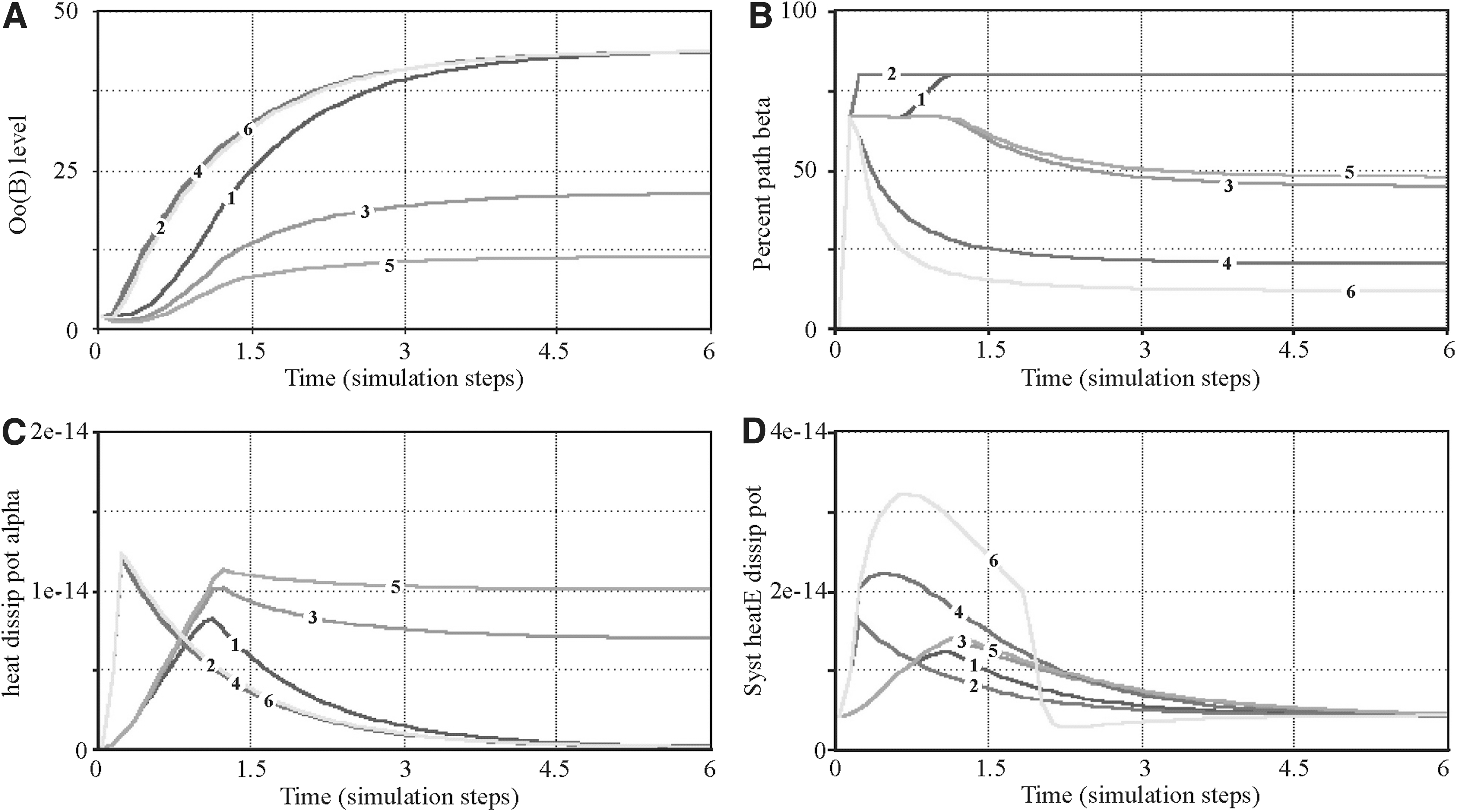
The effect of autocatalysis of “B” via one avenue of organization on the competition between forms of organization (panel A), the competition between avenues of transformation (panel B), the heat dissipative potential for the alpha pathway (panel C), and the heat dissipative potential of the entire system alpha plus beta (panel D). The five plots represent effects of three values for RefB autocat rate AtoB 2 (0, 5e-5, and 1e-4) each at two energy levels (1,000 and 20,000). Plot 1: RefB autocat rate AtoB 2=0 with E avail factor=1,000. Plot 2: RefB autocat rate AtoB 2=0 with E avail factor=20,000. Plot 3: RefB autocat rate AtoB 2=5e-5 with E avail factor=1,000. Plot 4: RefB autocat rate AtoB 2=5e-5 with E avail factor=20,000. Plot 5: RefB autocat rate AtoB 2=1e-4 with E avail factor=1,000. Plot 6: RefB autocat rate AtoB 2=1e-4 with E avail factor=20,000. In this model the change in Ref in one direction has similar catalytic effects in the opposite direction as well. Free E availab=1e-18. Heat conductiv=1,000. EgA J per unit=6.36e-18. EgB J per unit=1.2721e-17. Ro AtoB 1 (forward alpha avenue rate)=1. Ro AtoB 2 (forward beta avenue rate)=0.64. Ro BtoA 1 (reverse alpha avenue rate)=0.5. Ro BtoA 2 (reverse beta avenue rate)=0.32.
4. Discussion
4.1. Direct results of simulations
In this study, we produced a simple, BiADA-based, A↔B model of a dynamic system with two alternative avenues of transformation and showed how this model can be used to study factors controlling prebiotic evolution. We analyzed reported results concerning the effect of three factors (energy availability, terminal heat sink, and autocatalysis) on competition between avenues of transformation, competition between forms of organization, and energy dissipative potential. We also analyzed the energy dissipative potential of the system. As expected, energy availability influenced the final equilibrium (i.e., competition between forms of organization) but only within a specific range. Above a given upper threshold, which is system- and temperature-dependent, increase in energy availability did not influence the system's composition. Unless more information is added to a system in the form of instructions regarding functional priorities, energy availability does not influence the competition between avenues of transformation. This is important for prebiotic evolution because it shows that energy availability alone is insufficient for controlling the organization of dynamic systems. The magnitude of the heat sink influences competition between forms of organization but also between avenues of transformation. Decreased heat conductivity favored the form of organization with the largest E G value. The simulations we performed were done within a narrow range of temperature variation and did not necessitate accounting the variation in the rate of structure decay with temperature. Autocatalysis influenced both the competition between forms of organization and competition between avenues of transformation. Similar to a heat sink, autocatalysis also influenced the evolution of the heat dissipative potential of the system. The effect of autocatalysis on competition between the avenues of transformation was complex. Amplification of competition between avenues of transformation and order was produced by specific combinations of autocatalysis, energy availability, heat dissipation potential, and initial level of order. Our results indicate that in the absence of inhibition autocatalysis would not help an avenue of transformation eliminate competitor avenues, irrespective of the magnitude of energy availability and of the heat dissipative potential. These results indicate that during prebiotic evolution autocatalysis could not have increased the level of order if energy availability remained low. The evolution of prebiotic catalysis is therefore linked with that of energy availability.
4.2. Advantages and disadvantages of BiADA-type simulations
BiADA-based simulations simplify rationalizing the effect of various controllers and drivers of prebiotic evolution. This approach helps us study the quantitative relationship between order, information, and energy. The BiADA approach emphasizes the importance of the efficiency of energy import and export in the study of energy dissipation. When the efficiency of information transfer between a source and a target form of organization is low, even exergonic transformations may require free energy from the exterior. Hence, the ability of quantifying energy dissipation is directly correlated with the unisense analysis of transformations. The BiADA approach includes conventional thermodynamic and kinetic analyses, but it is more comprehensive because it also allows analyzing efficiency of unisense transformations and systems that are not chemical in composition yet are classified as dynamic networks. Net transformations and net changes in a system's state cannot fully explain the turnover of energy and information. In contrast, BiADA analyzes forward and reverse transformations independently, and it can be used to show why prebiotic selection favored forms of organization and avenues of transformation capable of producing energy limitation in their environment.
Similar with other types of dynamic simulation platforms, BiADA-based models are sensitive to various factors and require understanding, corrections, and monitoring. In our simulations, we identified and discussed an artifact called the “point of kinetic choke.” To avoid misinterpreting the results, continuous monitoring of this threshold is needed. In models that use integer values for the forms of organization, the partition of building materials and energy between alternative avenues of transformation may be difficult or inaccurate. Using small populations and low DT values aggravates this problem. A systemic disadvantage of all computer-based simulations is that they are based on a deductive “step-by-step” logic with instructions being added in a sequence of lines of code or at precise time intervals. This is contrary to most real-world systems where physical forces are continuous functions and operate simultaneously throughout the entire space and integers are probabilistic outcomes. Uncorrected in the software, this limitation would introduce priorities in the competition between avenues of transformation during starvation episodes. Artificially favoring one type of order over the other is similar to adding external information to the functioning of the system. Interestingly, the bias contained in the software can be used as substitute genetic information, allowing a model to turn from an automaton into an informaton (for description of differences between automaton and informaton, see Popa, 2004, and Popa and Cimpoiasu, 2012). Furthermore, in stepwise simulations it is incorrect to compare inputs with outputs directly if they are separated by a number of steps. Specific model changes have to be introduced in such cases in order to obtain accurate analyses of budgets and system efficiency. Last but not least, the BiADA model presented in this study only explores general thermodynamic and kinetic effects and disregards properties of the specific building materials of a form of life (e.g., temperature range for the liquid state, density, type of bonds, main chemical elements). To explain the origin of a particular form of life, future models will have to integrate these two elements, as well as properties of the environment.
4.3. Implications of the results for the origin of life
Prebiotic evolution was a complex competition between forms of organization but also between avenues of transformation and mutualism between these two features. We propose that avenues of transformation were the path through which life's physical drivers controlled prebiotic evolution. Autocatalysis was important in prebiotic competition and in the mutualism between forms of organization and avenues of transformation. Yet the evolution of catalysis was also linked with energy availability. To be successful, prebiotic systems must have evolved simultaneously toward maximum energy dissipation potential and the preservation of information. During transformations, the energy dissipative capacity is inversely correlated with the efficiency of preserving meaningful information. Catalyzed processes are transformation avenues that are better at preserving information and thus superficially may appear less efficient at dissipating energy. This loss is compensated via lower activation energy, faster transformation rates, and faster turnover. Hence, for catalysts to be selected in prebiotic evolution they have to be part of systems with forms of organization with a short half-life. We hypothesize that life originated in an environment where free energy was available but was also the first resource to become limiting, as opposed to other resources such as space and building materials. This is contrary to the common belief that life originated in an energy-rich environment. Furthermore, the elimination of underachieving forms of organization and avenues of transformation was likely the main way to avoid building up infinite information diversity. This buildup is also known as Manfred Eigen's “error catastrophe” (Eigen, 1971). The effect of temperature on the half-life of forms of organization depends on the relationship between E G and E S. In models, dynamic forms of organization can be programmed to be destroyed when the damaging random energy of E S becomes equal or larger than the accretionary (and holding together) effect of E G. Our results suggest that mechanisms of amplification of asymmetry (and by extension the buildup of order) require forms of organization with relatively short turnover and kinetics and energy dissipation active enough to produce energy limitation in their environment. We hypothesize that, apart from energy availability, energy sink, autocatalysis, and fast turnover of structures, the genesis of prebiotic networks also required increase in the internal energy flux proportional to the availability of energy. This situation (which we propose was the most important for the origin of pre-living automata) could have been achieved through the creation of a unisense catalyzed internal cycle.
5. Conclusions
In this study, we analyzed the evolution of energy flow in a model of a simple A↔B system with two competing avenues of transformation linking two forms of organization (A and B). We show results of simulations verifying the effect of three factors (energy availability, heat dissipation, and autocatalysis) on the evolution of order, energy dissipation, competition between forms of organization, and competition between avenues of transformation. Our simulations emphasize that the selection of prebiotic order required the co-presence of catalysis and inhibition, order forms that require energy to be maintained, and the need to disperse heat into a bottomless reservoir faster than it is internally produced. We have discussed benefits of BiADA (a novel type of approach used to analyze dynamic systems) and potential pitfalls and solutions for abstract modeling of prebiotic evolution. We have used the results to show the importance of combining autocatalysis with inhibition and autocatalysis with energy availability when explaining the origin of order in prebiotic systems. This work aids in the understanding of energy flow and energy dissipation in dynamic systems and the minimal conditions required for amplifying information. One key observation made in this study is that successful prebiotic competition between forms of dynamic order requires environments and fluxes that lead to energy limitation, rather than energy-opulent environments.
Footnotes
Acknowledgments
The authors contributed equally to this work.
Abbreviation
BiADA, Biotic Abstract Dual Automata.