




Abstract
The Viking landers conducted the only life-detection mission outside Earth nearly 40 years ago. We believe it is time to resume this proactive search for life and propose a new approach based on Locally Targeted Ecosynthesis (LoTE) missions: the engineering of local habitable hotspots on planetary surfaces to reveal any subdued biosphere and enhance the expression of its biological activity. LoTE missions are based on a minimum set of assumptions about life, namely, the need for liquid solvents, energy sources, and nutrients, and the limits imposed by UV and ionizing radiation. The most promising destinations for LoTE missions are Mars and Saturn's moon Titan. We describe two LoTE mission concepts that would enhance the unique environmental conditions on Mars and Titan to reveal a subdued biosphere easily detectable with conventional instruments by supplying biologically essential yet critically limited compounds and by engineering local habitable conditions. Key Words: Mars—Titan—Life detection—Mission—Nutrient—Biomarker. Astrobiology 13, 674–678.
1. Introduction
I
We believe it is time to resume the spirit of the Viking approach to search for life with a more proactive in situ search for extant life on other worlds. To that end, we propose examples of how this can be done inexpensively and incorporated into current mission planning. We call our approach “Locally Targeted Ecosynthesis” (LoTE) missions. Conceptually, LoTE missions would enhance on a very small scale the local environmental conditions to elicit a subdued biosphere and possibly trigger a biological response from indigenous life that could be detected with conventional instruments. Mars and Titan would be the most suitable destinations for initial LoTE missions. We posit that lack of liquid water, low temperature, and the high radiation environment on Mars are the main limiting factors for life, and providing sheltered conditions with the availability of liquid water on a local scale could potentially generate life responses. On the opposite side of nutrient starvation is Titan: our premise is that in the titanian environment inorganic metal ions would be the most limiting factor for life; therefore, supplying bioessential ions could trigger a response from extant organisms.
2. LoTE Missions on Mars Using Sheltered Conditions
There is evidence for life on Earth at least 3.800 million years ago (Schidlowski, 1988). At that time, Mars was a relatively wet planet with abundant liquid water and an active hydrosphere (e.g., Clifford and Parker, 2001; Fairén, 2010). Oceans could have existed episodically (Baker et al., 1991; Fairén et al., 2003; Perron et al., 2007), coincident with an active magnetic field (Acuña et al., 1999) and a thicker atmosphere of at least 1 bar (Brain and Jakosky, 1998; de Niem et al., 2012). Given the similarity between early Mars and early Earth, whatever steps led to the emergence of life on Earth may have also occurred independently on Mars. It is also conceivable, and perhaps even likely, that life could have been transported from Earth to Mars or vice versa during the early history of the Solar System (Mileikowsky et al., 2000).
Today, the surface of the planet is extremely dry and cold (McKay and Stoker, 1989), and the atmosphere is very thin at a pressure of a few millibar. Liquid water on the surface is only present temporarily and is very constrained in location (Haberle et al., 2001), quickly sublimating if it makes it to the surface (Malin and Edgett, 2000). Because liquid water is an essential ecological requirement for life on Earth, its absence near the surface of Mars is assumed to be a key limiting factor for life. Additionally, while extremely cold temperatures are in principle not incompatible with life, they are incompatible with biological activity. Therefore, any possible extant biosphere on Mars will likely be dormant owing to the negative synergy of extreme dryness and cold.
A third constraint for extant life on Mars is the UV and ionizing irradiation that, largely unimpeded, reach the surface of the planet. As such, any extant martian biosphere would be sheltered in the near subsurface. While organic compounds per se are not an essential requirement for life, they enable a wide range of heterotrophic metabolisms. Organics largely derived from meteoritic input are predicted to exist near the surface only and in oxidized form (Benner et al., 2000) despite the null detection by the Viking pyrolysis gas chromatograph–mass spectrometer. The apparent lack of organic compounds so far might be due to the presence of perchlorate in the soil (Hecht et al., 2009; Glavin et al., 2013), which is incompatible with organic detection with pyrolysis-type experiments (Navarro-González et al., 2010). A reinterpretation of the Viking results suggests in fact that chloromethane and dichloromethane detected by the Viking pyrolysis gas chromatograph–mass spectrometer at picomolar levels up to 40 ppb (initially interpreted as contamination from cleaning solvents, Biemann et al., 1977) could have formed by oxidation of indigenous organic matter in the presence of perchlorates (Navarro-González et al., 2010). If present, organic compounds would likely be at very low concentrations (<10 ppm at the Viking landing sites). Therefore, the first-order factors that would limit extant life on Mars are the lack of liquid water and the high UV and ionizing radiation, while the second-order factors would be the absence, or very low amounts, of organic compounds.
Following this logic, we propose a LoTE mission to Mars that we have named “Detection Of Mars Extant life in the near-Subsurface” (DOMES). DOMES would engineer the conditions for life in local hotspots created by placing small domes on the surface, where liquid water and organic compounds would be supplemented. The objective here would be to spur local hotspots for indigenous life by generating very confined warmer and moister conditions and allowing access to energy sources (light and organic compounds), while providing a shelter against UV and ionizing radiation. The placing of the domes would require a previous centimeter-depth excavation/scratching (likely not deeper than the scuffing that can be done with a rover's wheels) to allow communication between the content of the dome and the hypothesized near-subsurface inhabited niches. To replicate the conditions existing on the martian near subsurface, where possible settled spots may exist, the domes would have to meet certain key requirements. First, the material must shield the interior of the dome against radiation to some extent, mimicking the radiation-shielding effects of the martian soil/dust layer previously removed. At the same time, the cover would have to allow for a certain amount of visible light to stimulate any possible photosynthetic metabolism and ease the monitoring of the inside of the domes with just visual inspections. Second, the dome must have a thermal insulation capable of reducing the amplitude of daily thermal fluctuations near the surface. And third, planetary protection concerns would strongly advise toward a thorough sterilization effort of the dome structure and all its cargo.
The simplicity of DOMES would allow for the incorporation of this experimental scheme in every lander and rover scheduled for Mars during the next few decades, which would allow for completion of an extensive survey for life in very different settings on the planet in a reasonably reduced time span. We find analogues to this approach on Earth; in the Namib Desert, small plastic domes placed on the desert floor become crammed with lichen and moss that were otherwise sparsely distributed in the surrounding locations (Fig. 1).
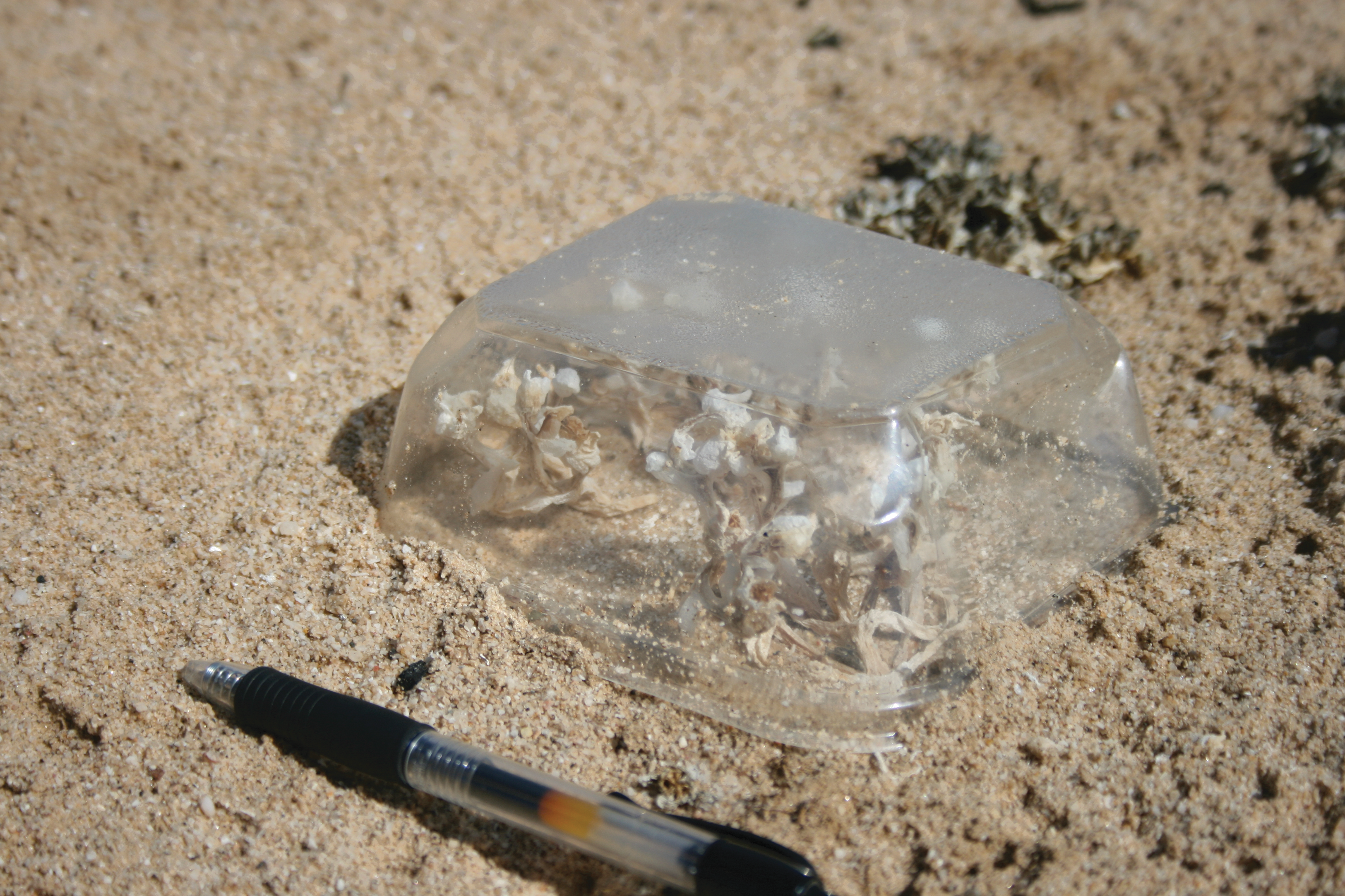
Small plastic dome on the desert floor in the Namib Desert creating a “hotspot” of lichen and moss, a response from an otherwise subdued biosphere, in a challenging environment for life. Photo is courtesy of Sophie Nixon, UK Centre for Astrobiology. Color image available online at
3. LoTE Missions on Titan Using Metal Ions
LoTE missions are also a plausible approach to an in situ search for indigenous extant life on Saturn's moon Titan. Titan is the only moon in the Solar System with a substantial, but extremely reducing, atmosphere (1.5 bar near the surface). Nitrogen and methane are its major components (94% and 5–6%, respectively), and a variety of organic compounds complete the atmospheric constituents, while water and carbon dioxide are extremely rare. Instead of a hydrological cycle based on water, Titan has a cycle that is based on liquid hydrocarbons, mostly methane, including the presence of liquid methane lakes that are ponded on the moon's surface and fed by networks of fluvial channels (Stofan et al., 2007). Despite the frigid surface temperature (95 K), there have been suggestions of possible life on Titan that uses metabolic pathways involving reactions with photochemical acetylene, hydrogen, and heavier hydrocarbons (McKay and Smith, 2005; Schulze-Makuch and Grinspoon, 2005). Also, the National Academy of Sciences suggested in a report “that the environment of Titan meets the absolute requirements for life, which include thermodynamic disequilibrium, abundant carbon containing molecules and heteroatoms, and a fluid environment” and further concluded that “this makes inescapable the conclusion that if life is an intrinsic property of chemical reactivity, life should exist on Titan” (Baross et al., 2007).
Given the abundance of carbon on Titan, any existing life would most likely be based on carbon. However, the environment offered by a frigid hydrocarbon lake would be so different from any on Earth there would be little doubt that any life found would represent a second origin (Shapiro and Schulze-Makuch, 2009) and surely possess an exotic biochemistry. For example, it has been suggested that cellular membranes embedded in a nonhydrophilic solvent would likely be hydrophobic on the outside and hydrophilic at their cores (Schulze-Makuch and Irwin, 2008). In such a solvent, putative organisms would be able to use hydrogen bonding more effectively, because the bonds would have the appropriate strengths for low temperatures. Many enzymes used by Earth's life are believed to catalyze reactions by having an active site that is not waterlike (Baross et al., 2007). Benner et al. (2004) suggested various alternate protein and nucleotide structures that might be a result of an alternate route to life and be applicable to a more exotic environment such as Titan.
However, there is one critical problem for putative life on Titan, and this is the central role of inorganic chemistry in biology. Soluble ions play a fundamental role in the most relevant biological processes on Earth, including redox chemistry (Fe, Cu, Mn, Co, Mo, Se, S), acid-base catalysis (Zn, Ni), transmission and storage of energy and information (S, B, Si), and cell structure and homeostasis (Ca, Na, K). Most importantly, metabolic pathways require metal ions, which occupy the active sites or function as cofactors in metallic enzymes, and catalyze the flow of electrons that drives the chemistry of life. For example, iron and magnesium alone are involved in photosynthesis, respiration, N2 and CO2 fixation, and methanogenesis. Hence metabolism, and therefore life (at least as we know it), cannot exist without inorganic chemistry.
Thus, for life to exist on Titan, soluble ions must be available. On Earth, the interaction of liquid water and crustal rocks continuously supplies essential elements for life, and at the same time the aqueous environment allows elements and molecules to interact with each other and chemical bonds to form and break in a cyclical manner. In Titan's environment, however, metal ions would be exceedingly rare, because the solubility of magmatic rocks in nonpolar solvents is extremely low. Phosphorous, for example, is a key element for replication and information (RNA and DNA), metabolism (ATP, NADPH, and other coenzymes), and structure (phospholipids). The only possible sources of P on Titan are exogenous (from rocks and ices in the saturnian subnebula) or endogenous (from possible aqueous chemistry in the suggested subsurface water-ammonia ocean) (Fortes, 2000). In the case of exogenous P, only the most reduced form of phosphine (PH3) would be soluble in methane and ethane, but it would be extremely insoluble in a water-ammonia mixture. Other water-soluble forms of phosphate would be very much depleted in the subsurface water-ammonia ocean due to the cold temperatures, which would prevent the chemical attack of magmatic rocks and therefore the release of P into solution. Hence, any putative life on Titan would have to rely on exogenous sources of P, while other elements such as Fe, Mg, Ca, K, Na, and Cl could be even rarer. Generally speaking, the chemical stability of basaltic and igneous rocks in nonpolar liquids severely limits the possibility of life on planets with these types of solvents on their surface.
Alternatively, putative life on Titan could have evolved a chemolithotrophic metabolism to supply inorganic ions directly from crustal rocks. Remarkably, this scenario would imply that metal ions could be the best biosignatures on the moon's surface. This opens up intriguing possibilities for the search for life.
A LoTE mission that we have named “Cannonball” could be launched to Titan loaded with a “nutrient cocktail” of inorganic constituents, including Cl, Na, S, P, Fe, Mg, Ca, and other trace elements. The objective would be to observe whether the cannonball is degraded with time as a food source providing basic inorganic ingredients for putative titanian organisms. The only instrument embedded within the cannonball would have to be a transmitter, so it could be easily located by following missions to the outer Solar System. The cannonball would be designed in a way that it would crack open upon landing to increase the exposed surface area and facilitate access to the “inorganic nutrient source.” Every future mission to the outer Solar System, whether targeted to Saturn or to any other body, could easily monitor the cannonball for deterioration. Given the extremely cold temperatures on Titan, the processing of ions would occur very slowly, even if biologically enhanced, in terms of our (human) time scale.
There is already one possible inorganic nutrient source on Titan: the Huygens spacecraft. However, this probe might more suitably compare to a sour apple, since it does not have a great deal of “tasty components,” or so it would seem. The main structural element is aluminum, an element that is toxic to life as we know it and avoided by most terrestrial life. However, the main reason why aluminum is toxic is because it competes with other metal ions in enzymes and proteins, particularly Mg(II), Ca(II), and Fe(III) (Exley and Birchall, 1992). Yet, in a reducing, metal-poor environment such as Titan, life may have chosen the more common aluminum for biological processes [note that, for example, Fe(III) is not available at all in the very reducing titanian environment], even if resulting enzymes would arguably be less efficient. Thus, aluminum, which makes up to 75% of the landing mass of the 200 kg Huygens probe (R. Lorenz, John Hopkins University Applied Physics Lab, personal communication, 2012), might after all be tasty to putative titanian life. Other more minor parts include titanium (e.g., the front shield separation interface) and organic parts [e.g., PTFE (polytetrafluoroethylene), fiberglass/epoxy], which may or may not be of use, but copper (e.g., in the wiring) and stainless steel (in some fasteners) could provide very much needed trace elements.
Based on the above, we suggest a very simple and inexpensive two-tiered approach to test the presence of life on Titan in the next few decades, as a way to advance our astrobiology agenda. First, we propose to enhance the scientific return of the Huygens mission by monitoring the degradation and decay (if any) of the spacecraft with future missions. And second, we advocate shooting off a cannonball, a mission that would be very cheap and technically uncomplicated, because it can (and should) crash-land on Titan. The cannonball nutrient cocktail would include the following elements: 56–57Fe, 53,55Mn, 24–26Mg, 40,42Ca, 39,41K, 23Na, 35,37Cl, 28–30Si, 31P, 75As, 77,79Se, 16,18O, 32,34S, and 64,66Zn. Stable isotopes of the inorganic elements above are included (and in case of Mn a long-lived radioisotope) to measure isotopic fractionation rates. Life on Earth preferentially uses the light isotopes, and this is assumed to be the case for putative titanian life as well (Schulze-Makuch and Grinspoon, 2005). Thus, biological degradation can be distinguished from chemical degradation in two ways: (1) by the preferential use and decay of the lighter isotope and (2) if the degradation exceeds the amount expected from chemical kinetics under titanian conditions.
Furthermore, as it would be impossible for any form of Earth life to survive the long travel time in space and the near-surface environment of Titan, planetary protection concerns could be forfeited for such a probe, simplifying and reducing the cost of such a mission. Even if still required, the cannonball probe could be sterilized and would not constitute harm to any putative life on Titan.
4. Perspectives
The concept of LoTE missions can be extrapolated to the in situ search for life on other planetary bodies of the Solar System such as Venus (e.g., Schulze-Makuch et al., 2004) and Europa (Chyba, 2000). Missions would need to be tailored to the perceived needs of putative indigenous organisms. With a better understanding of the basic requirements for life and the environmental conditions of planetary bodies, including exoplanets, the design and launch of such missions would provide a cost-efficient way to make tremendous strides to resolve whether other planetary bodies are inhabited.
Footnotes
Author Disclosure Statement
No competing financial interests exist.
Abbreviations
DOMES, Detection Of Mars Extant life in the near-Subsurface; LoTE, Locally Targeted Ecosynthesis.