




Abstract
Mars for Earthlings (MFE) is a terrestrial Earth analog pedagogical approach to teaching undergraduate geology, planetary science, and astrobiology. MFE utilizes Earth analogs to teach Mars planetary concepts, with a foundational backbone in Earth science principles. The field of planetary science is rapidly changing with new technologies and higher-resolution data sets. Thus, it is increasingly important to understand geological concepts and processes for interpreting Mars data. MFE curriculum is topically driven to facilitate easy integration of content into new or existing courses. The Earth-Mars systems approach explores planetary origins, Mars missions, rocks and minerals, active driving forces/tectonics, surface sculpting processes, astrobiology, future explorations, and hot topics in an inquiry-driven environment. Curriculum leverages heavily upon multimedia resources, software programs such as Google Mars and JMARS, as well as NASA mission data such as THEMIS, HiRISE, CRISM, and rover images.
Two years of MFE class evaluation data suggest that science literacy and general interest in Mars geology and astrobiology topics increased after participation in the MFE curriculum. Students also used newly developed skills to create a Mars mission team presentation. The MFE curriculum, learning modules, and resources are available online at
1. Introduction
T
1.1. A new era of high-resolution data sets
With the recent acquisition of CRISM and HiRISE data sets, we can interpret mineralogies and terrain at decameter to submeter scales for more direct comparisons to geological processes and products on Earth. Furthermore, Mars rovers have acquired hand-specimen- to microscopic-scale imagery and analyses of sedimentary rocks. On Mars, we now have the first robotic geochemist deployed, the Mars Science Laboratory (MSL) Curiosity rover, which increases the need for robust geological and astrobiological analyses and interpretations.
The MFE curriculum integrates current Mars imagery as a method of exploration for students to apply what they learn of Earth analogs. Students see the integration of geology, planetary science, and biology disciplines. They develop experience and skills for remote sensing image analysis, gain an appreciation for the scope of NASA missions (e.g., Kellogg and Zierenberg, 2007), and realize the limitations of instrumentation.
1.2. Engaging higher education
Curriculum on Mars content is generally created for the K–12 grades at a cursory level or in graduate courses where faculty have active programs in Mars research. The MFE curriculum bridges the gap of K–12 planetary science education and graduate course work in the planetary/astrobiological sciences by targeting the undergraduates in higher education institutions. Many researchers view astrobiology education as both a scientific and cultural imperative (Rodrigues and Carrapico, 2005). Courses that include astrobiology content, such as MFE, are inherently interdisciplinary and of public interest (Staley, 2003). With astrobiology's cultural imperative of “Are we alone in the Universe?” early exposure to astrobiology concepts encourages student interest in STEM topics and can open a conduit to new integrations of science knowledge content in social science, computer science, and other majors.
We propose that the integration of planetary science curriculum into general education geology courses can reach a higher percentage of students and expose them to planetary science and astrobiology concepts early in their educational careers. The U.S. Census Bureau (2008) reports that over 19.7 million students are registered with over 4409 degree-granting institutions throughout the United States. If only 1% of those students chose to take a geology course (that also includes some MFE-type curriculum) to satisfy a physical science general education requirement, then over 190,000 students could be exposed to planetary and astrobiological sciences before graduation, and some small fraction of those would likely decide to enter a STEM field. Although nationwide data of geoscience disciplines and majors are available through the American Geological Institute, information on introductory geoscience classes for nonmajors is lacking. In an attempt to gain some perspective on introductory geoscience classes for nonmajors, we present a representative view of an individual state (see Table 1). Table 1 suggests that a higher percentage of students can be exposed to planetary or astrobiology fields through the infusion and introduction of content in geology courses, versus just strictly physics/astronomy courses alone where planetary science would normally be introduced. While a dedicated course such as MFE would be optimum, here we encourage the incorporation of various or individual learning modules in the MFE curriculum into existing geology courses tailored by individual faculty teaching large classes of nonmajors.
Online only, nonprofit.
2. Curriculum and Methods
2.1. The power of an analogue
Duit (1991) defined the term analogy as a comparison of the structures of two domains. For our purposes, we compare the domain of Earth to that of Mars; the structure being that Earth-based knowledge is the launching pad to apply concepts to other planetary bodies. Earth is the only tangible model (our known data points) by which we can make comparisons to Mars with any degree of confidence. For the majority of students, Mars represents an “unknown” only to be exemplified in their imaginations, assisted by science-fiction books, movies, or comics. Earth analogies or analogs, therefore, serve the purpose of making the unfamiliar, Mars, familiar (Duit, 1991). Earth analogues provide us experience and boundary conditions, although the detailed history of life makes our planet unique. Earth analogs are routinely used by scientists to understand martian geology (e.g., NASA Quest; 2005; Chapman, 2007; Garry and Bleacher, 2011). We use Earth knowledge to help us formulate the right search patterns to decode similar-looking martian geology and predict where to direct future explorations.
According to Shapiro (1985), analogies may make new information more concrete and easier to imagine. In two offerings of the MFE nonmajors course on the University of Utah campus, most students entering the course initially either questioned the presence of water on Mars or had not even considered the idea. With a lesson module in minerals (particularly those with an aqueous history) and mineral formation on Earth followed by direct comparison of mineral interpretation on Mars with CRISM and/or HiRISE imagery, students were intrigued about the idea of abundant water being present at one point in Mars' history but largely convinced by the mineralogy alone. Other evidence of water history on Mars was confirmed by the examination of Mars' surface and crust via modules on the erosional forces of rivers, fluid flow of groundwater, depositional sediments of deltas and alluvial fans, and shorelines from large standing bodies of water. The evidence of past water on Mars opens the tantalizing possibility of extraterrestrial life. By example, it is apparent that concepts that were formerly abstract in the context of Mars are made easier to understand and imagine when provided a foundation in Earth processes.
Using an analog can also promote the higher-order learning level of problem solving. Gentner and Gentner (1983) reported that analogies can facilitate problem solving. In the MFE curriculum, teams of students are asked to create their own mission to Mars to be presented before a review board at the end of the term. Students learn what roles scientists can play by using multimedia resources about real people. Short, 1–2 minute “Meet the Scientist” video clips profile diverse Mars scientists (5 women, 10 men) at various career stages (students to experienced professionals). All introduce who they are, what they do, and why they love their science. These profiles help students see the passion and what drives a scientist. Throughout the term, students are provided the tools and resources to complete their mission, but in the end the mission must be unique and not replicate prior NASA or NASA-affiliated missions. Students provided sound projects that were delivered with enthusiasm, innovation, and creativity, while relying on Earth analogs as a context and reasoning for their chosen method of research on Mars. At the onset of the term, a mission to Mars appeared to be an insurmountable challenge for students to conquer. By the end of the course, the challenge became a mission wherein students confidently navigated Mars imagery, stated mission objectives, and used a wide vocabulary of science terminology in relating their ideas and goals.
2.2. Earth science backbone
Using an Earth science curriculum as a basis for planetary and astrobiology instruction is relevant to current research queries; more importantly, it provides a reliable conceptual structure for Mars knowledge assimilation using a familiar or already established Earth science curriculum. To compensate for a lack of prior knowledge on processes at work on Mars, analogies draw on content that is familiar (Braasch and Goldman, 2010), partly because it is tangible and accessible. In the simplest sense, the MFE curriculum assumes students have familiarity with Earth as a consequence of living, working, and playing in it.
The curriculum is currently divided up into 6 thematic units housing 24 individual learning modules: (1) Introduction & Perspective, (2) Materials, (3) Driving Forces, (4) Sculpting Forces, (5) Extraterrestrial Life, and (6) Current & Future Endeavors (Table 2). With the exception of (6) Current & Future Endeavors, all learning modules utilize Earth science curriculum to relate Mars content. Each learning module has the following resources available: in-class activities, homework sets, and a PowerPoint image file that contains public domain images for use in homework sets and in-class activities. Table 3 provides a sampling of curriculum units/topics with associated in-class activities and homework sets (Chan and Kahmann-Robinson, 2012), all of which are available online for viewing and download (
2.3. Evaluation
Each MFE class utilized voluntary evaluations to answer before (January date at the beginning of semester) and after (April date at the end of semester) questions, under the guidelines of the University of Utah Institutional Review Board. During the first year, we utilized on-campus resources via the Center for Teaching and Learning Excellence (CTLE). The CTLE consultant helped us formulate learning objectives, review lesson plans for active learning, and administer a mid-semester review evaluation with in-class session observations.
A select group of evaluation questions related to the course learning objectives are presented in Fig. 1 and Table 4. We performed a statistical t test to compare the means of each data set and determine whether the before and after results of these learning outcomes were significantly different. Evaluation questions for all the surveys were anonymous handwritten responses except for the April 2012 date, which was done with audience response clickers. On that date, the majority of students participated with the audience response clickers, but not everyone brought them. Students commented that for small classes and other various reasons they preferred to not use the clickers, so the second year responders used only handwritten responses. The raw numbers of students in introductory classes vary, often dependent on the time the class is slotted for. In these particular MFE courses, the time slots were ones that did not directly compete for students in other previously scheduled departmental nonmajor course offerings, meaning that MFE was offered during the less popular lunch hour time.
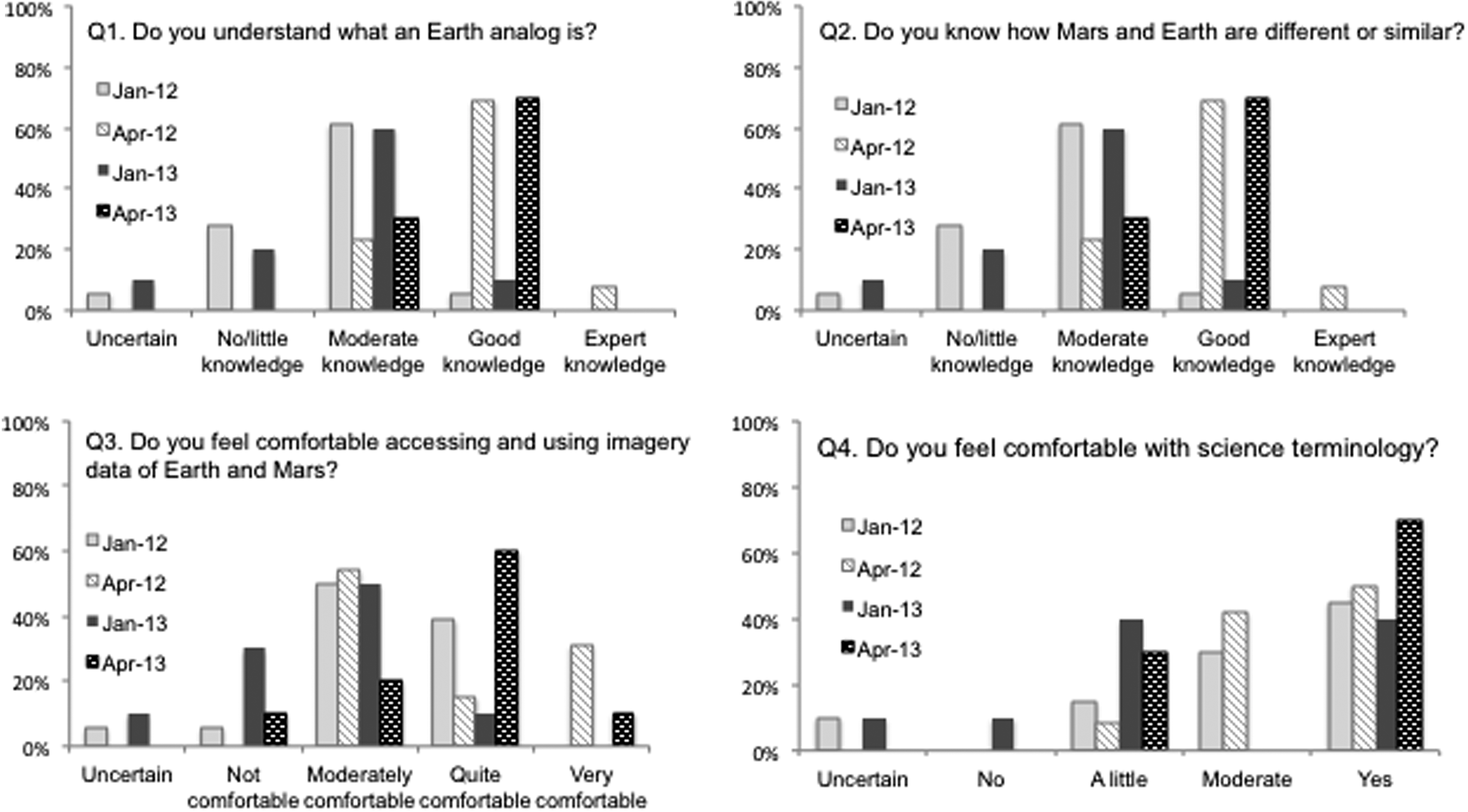
Student evaluation results for two semesters (i.e., 2 years) of MFE course offerings at the University of Utah. “Before” results (Jan. 2012, n=18 or 20 and Jan. 2013, n=10) are shown as shaded and “After” results (Apr. 2012, n=12 or 13 and Apr. 2013, n=10) as patterns. Note that the n values vary because in some cases one or two students chose to not answer the question. However, all percentages are adjusted to the appropriate n for each question. For Q4, data were not taken for Year 2013 answer of Moderate.
t
N=Number of respondents.
Survey evaluations were conducted for other short course and short lecture formats where MFE content was shared with different groups. The survey formats were different and dependent on the way the hosting programs administered their own surveys. The results of these surveys are generalized in the results sections.
3. Results
3.1. Sharing the curriculum resources
The MFE curriculum is now available via the well-established, award-winning Science Education Resource Center (SERC) Web site for geoscience higher education, with future plans for EarthSpace higher education website (
In an effort to promote and share this curriculum with higher education faculty, we conducted a short course at the 2012 Annual Meeting of the Geological Society of America (GSA) in Charlotte, North Carolina, with a second GSA offering in 2013. Partnerships with GSA Divisions (Sedimentary Geology, Planetary Science, Quaternary Geology & Geomorphology, Geobiology and Geomicrobiology) and society partnerships (National Association of Geology Teachers) enhanced the diversity of participation. Participants were provided sample-learning modules and participated in simulated in-class activities in which Mars planetary science research data were used. All participants (100% for n=13 respondents) indicated (through survey) that they would recommend the GSA short course, found the analog material relevant for students, and indicated the short course increased their familiarity with NASA-related online resources. The majority of short course participants were initially unfamiliar with and/or had not heard of some of the Mars software and technology-related tools. Eighty-five percent of the respondents indicated a likelihood of integrating planetary geology into current courses they were teaching.
The authors are also contributors and presenters within the NASA Science Mission Directorate (SMD) community and share ideas, present best practices, and promote the NASA SMD Education and Public Outreach (E/PO) vision with the intent to share the story, science, and adventure of NASA scientific exploration through stimulating and informative activities created by experts (SMD E/PO, 2010).
3.2. Inquiry-driven activities and project synthesis
Mars for Earthlings successfully created and implemented over 24 in-class activities (Table 3) that engage students in hands-on learning and inquiry-based discussion. Each in-class activity is designed by using the 5-E instructional model of Bybee et al. (2006): (1) Engage, (2) Explore, (3) Explain, (4) Elaborate, and (5) Evaluate (e.g., Chan and Kahmann-Robinson, 2013). With MFE's inquiry-driven format, students use written and oral communication skills to relate their ideas in the form of presentations, written reports/papers, and general class discussion. Student evaluations suggest that they enjoy media and technology-associated instruction because it provides them an opportunity for observation of scientific principles at work. This “Generation Y” prefers a technology platform for their mode of communication and visualization. Student discussion was heightened, increasing student participation, when media visualization was implemented. In every case, more questions were posed, and students began to draw upon their own experiences and personal observations to apply the concepts.
The Mission to Mars project represents the culmination of student learning and application of the Earth analog concept. Curriculum topics provided students tools of investigation, imagery, and interpretation in order to successfully identify and plan mission objectives. In addition, students gained practice in the creation of a mission budget and the selection of mission personnel. All the student groups commented on particular considerations that they had not anticipated would be required to formulate realistic budget allocations and decisions.
To exemplify students who used their disciplines to apply MFE curriculum, one student, a gaming major, designed a multiplatform Mars Mission online interactive game for her team's education and outreach plan of their mission to Mars. The game provided a competitive element, interaction between online users, a positive feedback/reward system, and a learning interface that allowed users to progress in the game. In the learning interface, users needed to identify martian geographic regions and lithologies, tinker with rover design, and be predictive in what could be observed in their “planned mission.” For the instructors, student implementation of their disciplines was creative and exciting to observe.
3.3. Engagement and class evaluations
Four major learning outcomes were established to expand engagement in STEM-related disciplines. By the end of each semester, students (1) understood and could relate what an Earth analogue is, (2) knew how Mars and Earth are different or similar, (3) felt comfortable accessing imagery data of Earth and Mars, and (4) felt comfortable with science terminology (Fig. 1). The majority of students had little to no prior knowledge of the above-evaluated objectives at the beginning of MFE. Students were able to apply scientific principles and shared their varying interests from their chosen majors (e.g., sociology, art) to learn and apply MFE curriculum effectively.
The student responses to survey questions on the four learning outcomes are listed in Fig. 1 and Table 4, and the means of each data set for before and after data of each year are compared with a statistical t test. Here, the null hypothesis is that there was no change in the outcomes or that there is not a significant difference between the before and after data sets. The null hypothesis is rejected if the probability of its being true is <0.05 (95% confidence interval). The n values are relatively small numbers (<20), and the number of before and after responses was not always the same. In some instances, students chose not to answer particular questions. However, for these four questions important to the course content, there is generally a significant change in the student responses after they have taken the course versus their evaluations at the very beginning of the course, with the exception of two questions in the 2012 before and after data (Table 4). These simple statistics suggest that the students achieved the learning outcomes we projected.
The test results and student class performances also indicated that students had grasped the important concepts related to the learning outcomes (Fig. 1 and Table 4). Students understood many Earth analog examples of surficial processes and did direct comparisons to Mars (e.g., rivers, groundwater, diagenesis). They knew how Mars and Earth were similar and yet how strikingly different Earth is because of the conditions that support the prevalence of life. They could access imagery with different programs and software specifically for their final mission projects. Finally, they could read Web pages and news articles with appropriate science terminology and contribute to conversations on the directions Mars science research might go in the future.
3.4. Age perspectives
Fascinating perspectives, interactions, and learning occurred across different age groups. In our two offerings of MFE to date, the classes attracted older, retired students that composed about 20% of the class makeup in both (2 years) iterations of the course. In the state of Utah, seniors can take advantage of a state-legislated House bill that allows those 62 and older to take any university class for no credit at a cost of $25. These seniors (mostly retirees) are typically attracted to learn about Mars at the introductory level that has no prerequisites. Most seniors would participate in the activities but would not turn in homework assignments or take the formal tests. However, in one case a senior did complete all aspects of the course and consistently produced outstanding work. Older and nontraditional students could offer a different perspective with their experience of budgets and organization, whereas traditional students could provide youthful enthusiasm and technology applications. Although certain working groups were purposely set up to mix the different age groups, it was clear that there was respect for the knowledge and perspectives that each age group could contribute. This mix offered students of all ages an enjoyable class experience where they also often interacted on a personal level, with some fun banter back and forth.
The University of Utah Osher Lifelong Learning Institute also offers a continuing education short course aimed at introducing seniors to relevant topics across the sciences. The senior author presented a 1-hour MFE lecture on how we use Earth analogues to better understand martian geology. This introductory lecture was in part an outreach effort to promote lifelong learning, where seniors might be intrigued to take other classes if they want to pursue the topic further. The positive results and student comments are shown in Table 6 (in the format chosen by the Osher Institute). It is clear from the results that senior students were interested in the content, learned new information, could grasp the value of using Earth analogues in new Mars explorations, and were intrigued enough to want to learn more in the future.
Results show that high percentages of the audience understood and learned from the lecture content.
4. Discussion
As results indicate, students increased their science literacy; applied their learning to their respective disciplines; and became more aware of how team projects, coordination and cooperation, and budgets work. Throughout the course of instruction, three take-home lessons became apparent, as follows: (1) learning modules must be tech-savvy, (2) topics should stay current and relevant, and (3) students need to keep engaged during class. The modules that relied more upon Internet-based simulation and/or software programs such as Google Mars and JMARS engaged students in a manner that promoted greater retention of skills and knowledge. As a consequence of the “plugged-in” nature of this Generation Y, the application of technology is not only familiar but is also the source of information. In fact, minimal instruction is needed to acquaint students with programs, as they are familiar with visualization platforms and navigate them easily. With familiarity, they are also willing to help others (e.g., seniors less familiar with the technology) and rise to the challenging science content when they can build upon their tech savvy skills.
Much of the success of MFE can be espoused to the media attention of MSL Curiosity. With frequent MSL updates via the NASA/JPL website, we kept students on the cutting edge of Mars research, and they were anxious for more. As students learned about martian mineralogies and surface processes, the accompanying findings of MSL Curiosity made the subject matter both relevant and “real.” Students also enjoyed the updates on discoveries via the Kepler mission. The Kepler mission receives some media attention but is not as familiar to students as the rover missions. When students discovered that planets beyond the Solar System were scientifically proven to exist and that a few of those planets were found to be within the habitable zone, they were engaged to learn more about them and discern what their neighboring students had found out about them as well. The implementation of the online citizen science project Planet Hunters (
Utilizing technology and staying relevant contributed to the active learning atmosphere, in which students thrive. It is our experience that students want to talk and discuss their ideas if afforded the opportunity. Each in-class activity is run in such a manner that it promotes critical thinking and problem-solving skills. In most cases, students are not provided a right or wrong answer immediately but are encouraged to substantiate their positions in an open-discussion format.
One of the more intrinsic effects and intangibles of the MFE curriculum was the heightened awareness students had of their potential contribution as informed citizens. In comparing Earth and Mars, students comprehended just how “rare” Earth truly is and the multiplicity of drivers that affect Earth, from biological interactions to the albedo effect. With presentation of the Drake equation (Ćirković, 2004), students could comprehend and see all the real uncertainties in determining just how many civilizations might exist elsewhere in the Universe. These realizations naturally lead into discussions of the sustainability of a habitable world. Students felt a responsibility to remain informed, contribute as voters regarding funding of research endeavors, and wrestle with the ethics of research-related activities and the needs of a struggling global economy. Students will likely remain lifetime learners as they continue to stay up to date with media-released Mars and planetary science research. They will also appreciate their understanding of Earth environments and processes around them as they read or hear about Earth events (e.g., earthquakes, natural disasters), ponder global issues (e.g., climate change), or pause to wonder about some of their surroundings on a hike or on a vacation in a natural rock surrounding. They learn that Earth is a dynamic planet distinguished by life and that Mars was also once more dynamic and may hold clues as to the origin of life.
At the end of the class, students participated in a discussion of perspectives in controversial, sociopolitical, and economic topics of the role of government versus privatization endeavors in future explorations of Mars. Students pondered the sustainability of exploration programs and the need for international collaborations with the globalization of space interest.
5. Conclusions
The blending of Earth science content and martian geology at the undergraduate level has strong potential to engage an increasing number of students in STEM disciplines. The MFE content shows the interdisciplinary connections between multiple science fields and the relevance to society. This can result in more informed students who will value science and, in future years, contribute to space exploration and society as a whole.
Topical teaching modules provide an easy way for many instructors to immediately import MFE content into introductory higher education classes (e.g., introductory geoscience courses for nonmajors) while fulfilling many of the learning objectives for science requirements. The MFE curriculum is accessible through an established higher education Web site portal, short courses for instructors at national meetings, Webinars, participation in the NASA SMD E/PO community, and science outreach venues. Our results of using an Earth analog approach to Mars indicate increased student awareness of scientific theory, principles, and applications to Mars. Technology and media-driven curriculum heightens student engagement and promotes inquiry-based learning and critical thinking skills. Short “Meet the Scientist” video clips give students a glimpse of scientists as real people, and these provide role models where students can potentially envision themselves as a scientist in the future. As lifetime learners, students will be more active citizens and feel a responsibility to remain aware of ongoing Earth, planetary, and astrobiology research as it continues to shape the human perspective and fuel passion for exploration beyond our known world.
Footnotes
Acknowledgments
We gratefully acknowledge funding support from NASA-EPOESS grant number NNX11AH29G and support from scientists who participated in the Mars for Earthlings project. We thank Rai Farrelly for her evaluation help through the CTLE program. We are grateful to Emily CoBabe-Ammann and members of the NASA Science Mission Directorate–Education and Public Outreach community for their encouragement to publish this work and to anonymous reviewers for their helpful comments to improve the manuscript.
Author Disclosure Statement
No competing financial interests exist.
Abbreviations
CRISM, Compact Reconnaissance Imaging Spectrometer for Mars on MRO; CTLE, Center for Teaching and Learning Excellence; E/PO, Education and Public Outreach; GSA, Geological Society of America; HiRise, High Resolution Imaging Science Experiment on MRO Mars Reconnaissance Orbiter; MFE, Mars for Earthlings; MOLA, Mars Orbiter Laser Altimeter; MSL, Mars Science Laboratory; SERC, Science Education Resource Center; SETI, Search for Extraterrestrial Intelligence; SMD, Science Mission Directorate; THEMIS, Thermal Emission Imaging System on Mars Odyssey.