




Abstract

D

David was born near Titusville, Pennsylvania, on September 26, 1936. He was the second of three sons. David is survived by his older brother Gene of Orlando, Florida. His younger brother Gordon, who also worked for NASA at JSC, passed away February 4, 2008. The McKay family moved from Pennsylvania to Tulsa, Oklahoma, after World War II. After completing high school in Tulsa, David entered Rice University in Houston and completed a bachelor of science in geology. A master's degree in geology was completed at the University of California, Berkeley. David worked in the petroleum industry for a year in Alaska and offshore California. He returned to Rice University for a PhD in geochemistry, which he completed in 1964. As a graduate student at Rice University, David was present at John F. Kennedy's speech in 1962 announcing the goal of landing a man on the Moon within the decade. A postdoctoral fellowship in the area of crystal chemistry was offered to David by Bill Fyfe of the University of California, Berkeley. After the one-year fellowship, a former Rice colleague informed him NASA was hiring geologists. David departed Berkeley in June 1965 for the NASA Manned Spacecraft Center in Houston, Texas, to train astronauts to collect rocks on the Moon.
For four years David McKay trained America's astronauts in the basic skills of field geology. He worked with the first six groups of astronauts both in the classroom and in the field. Field trips were taken by the astronauts every month to some of the most unique locations in the Western Hemisphere. These sites included the Grand Canyon, Arizona; Hawaii Volcano Observatory; Nevada Test Site; Meteor Crater, Arizona; Katmai, Alaska; Iceland; Medicine Lake, California; Zuni Salt Lake, New Mexico; Pinacates, Mexico; Bend, Oregon; Valles Caldera, New Mexico; Big Bend, Texas; Sierra Blanco, Texas; Kilbourne Hole, New Mexico; Quitman Mountains, Texas; Painted Desert, Arizona; and Hopi Buttes, Arizona. David became very close to the first two astronauts to land on the Moon, Neil Armstrong and Buzz Aldrin. They requested that David be in Mission Control during the first lunar landing. He was the only geologist present in Mission Control during the lunar landing. The media were eager for someone to explain the lunar geology and features noted by the Apollo 11 astronauts during their brief walk-around of Tranquility Base. David McKay was that person. The press frequently sought out David because he could clearly explain what the astronauts were doing and why the rock selections were important. He also was able to explain what the scientific community could gain from the rock and soil samples collected at the site where mankind put its first footprints on Earth's moon.
Kathy Sawyer's book, The Rock from Mars, summarizes David McKay's plan for studying the Apollo 11 samples. She stated:
Because McKay knew that most of the others would be working on the rocks, he'd decided to focus on the finer material that made up the lunar regolith. He saw the promise of a pioneering field expedition. Moon dust was the last stage in the pulverizing of lunar rocks, a tossed salad of all kinds of moon stuff, remixed by impacts. The dust had memories he wanted to unlock, molecule by molecule, a record of events that would lead him far back into the history of the cosmos. If he followed it far enough, he might enjoy a thrill akin to Armstrong's, of being the first to plant his flag on a patch of frontier knowledge. (Sawyer, 2006, pp 34–35)
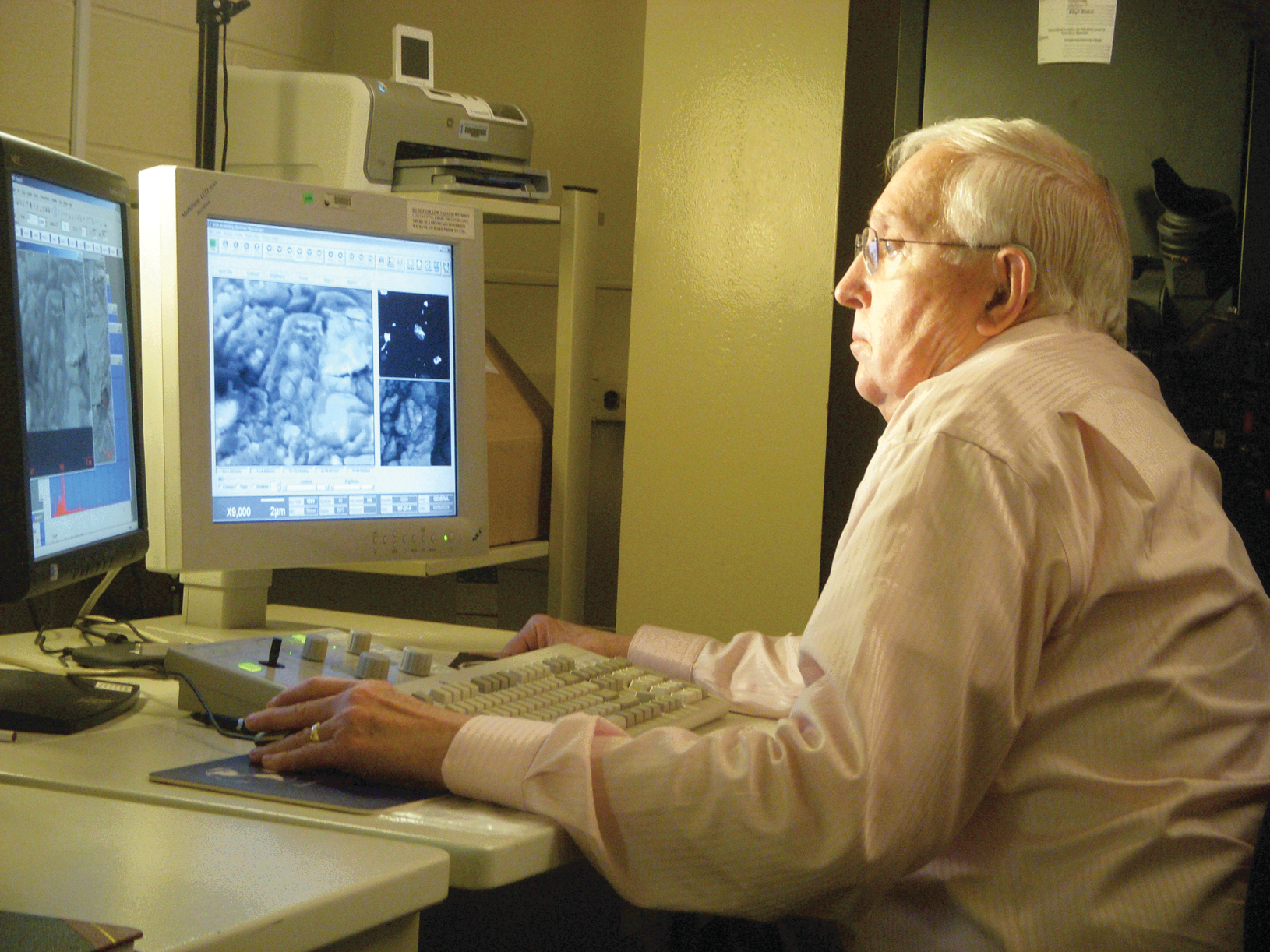
David published hundreds of scientific papers and abstracts on his findings about the lunar regolith. His studies of lunar soils resulted in several major findings. Among those were (i) sources of vapor deposition on lunar soil grains; (ii) formation of nanophase iron crystallites on lunar soil grains; (iii) processes occurring on the lunar surface that contribute to grain size distributions; (iv) space weathering and chemically activated nature of in situ lunar dust; and (v) the glassy agglutinates within the soils, produced by the micrometeoroid environment, that contain a record of the energetic and violent processes operating on the lunar surface.
David was one of the first people to recognize the resource potential of lunar soils. In fact, he and a group of colleagues at the Manned Spacecraft Center submitted a patent for extraction of oxygen from lunar soils, a potential resource for long-term human habitability of the Moon. Unfortunately this patent request was turned down by the Patent Office as having “no application” (very short-sighted). He was also involved in determining the effects of long-term exposure of fine-grained lunar particulates to human health. These studies were still ongoing at the time of David's passing.
David founded many of the laboratories (electron beam instrumentation, experimental petrology, soil analysis, astrobiology) at JSC. One of David's greatest skills was recognizing the importance of using the scanning electron microscope (SEM) to characterize small regions of interest in a wide variety of samples. He was masterful in his use of the SEM to glean the maximum information from the tiniest of samples. It was often said that if one used the SEM after David, the microscope was unusable—left in unrecognizable orientations—for the routine user.
To a large number in the scientific community, David McKay is best known as the point person in the Allan Hills 84001 (ALH84001) Life on Mars hypothesis. David was the lead author of the 1996 Science manuscript which jarred the scientific community into reexamining our concepts about life on Mars. The paper was a team effort lead by David, Everett Gibson, and Kathie Thomas-Keprta. The three team leaders and all the other members of the team (Christopher Romanek, Hojatollah Vali, Simon J. Clemett, Xavier D.F. Chillier, Claud R. Maechling, and Richard Zare) contributed to the hypothesis.
The chain of evidence presented in the McKay et al. (1996) manuscript was believed to be compatible with the existence of past life on Mars: (i) an igneous martian rock (age around 4–4.5 Ga) that had been penetrated by a low-temperature fluid along fractures and pore spaces, which then became the sites for secondary mineral formations and possible biogenic activity; (ii) a formation age for the carbonate globules (∼3.9 Ga) younger than the age of the igneous rock; (iii) SEM and TEM images of carbonate globules and features resembling terrestrial microorganisms, terrestrial biogenic carbonate structures, or microfossils; (iv) magnetite and iron sulfide particles that could have resulted from oxidation and reduction reactions known to be important in terrestrial microbial systems; and (v) the presence of organic molecules associated with the carbonate globules. None of these observations is in itself conclusive for the existence of past life. Although there are alternative explanations for each of these phenomena taken individually, when they are considered collectively, particularly in view of their spatial association, they provided evidence for primitive life on early Mars (McKay et al., 1996). This paper has become one of the most heavily cited papers in planetary science. With continued research, the team remains convinced their evidence is solid and the best interpretation to explain these data is that biogenic processes operated on early Mars.
The publication of the Science paper created an explosion of excitement and criticism in equal measure at a time when NASA's Mars Exploration Program was in disarray with the subsequent failures for Mars missions (Mars Observer, Mars Climate Orbiter, and Mars Polar Lander) to the Red Planet. The excitement of the potential that Mars may have harbored evidence of relict life resulted in the spacefaring nations of the world reigniting their Mars exploration programs. The US began developing the Pathfinder, Mars Odyssey orbiter, Mars Exploration Rovers, Mars Reconnaissance Orbiter, Phoenix polar lander, and Curiosity. The European Space Agency's Mars Express with its Beagle 2 lander was inspired by the potential of life existing on Mars.
NASA Administrator Daniel S. Goldin was a strong supporter for the research being carried out by the JSC Mars Meteorite Research Team. His appreciation for their research and what it meant for the agency was demonstrated by one of his famous “notes” written on May 21, 1998. The note is given below:
Dear Dave, Everett and Kathy,
It's always a highlight of my trip to JSC to meet with you and your talented team. Your intensity of focus, spirit and commitment to scientific truth and excellence set a high standard for all of us.
You have not yet proven your point beyond a shadow of a doubt yet, but you appear headed in the right direction. Best of luck. I love what you are attempting to do. Daniel S. Goldin (May 21, 1998).
The NASA Astrobiology Institute (NAI) was established in 1998 “to develop the field of astrobiology (the study of the origin, evolution, distribution, and future of life in the universe) and provide a scientific framework for flight missions” and was a direct consequence of David's pioneering work on ALH84001. The NAI is a virtual organization that integrates astrobiology research and training programs in concert with the national and international science communities. Although NASA had explored the idea of forming an astrobiology institute in the past, the public lost interest when the Viking biological experiments returned negative results for life on Mars, and federal funds for exobiology dried up. The 1996 McKay et al. manuscript led to new interest in the subject. To date 25 different partners, including those from universities and NASA centers, have been involved in the NAI.
Numerous tributes to David McKay have been published, but the Explore Mars Web site offered a touching one:
Explore Mars is saddened to hear of the passing of Dr. David McKay. As an exobiologist, he was a pioneer among pioneers who are seeking evidence of life beyond Earth. It may honestly be said that his team's discoveries related to proof of biogenic sources for fossilized microbes in martian meteorites remains the best evidence we have that microbes once populated Mars, and may still do so.
His team's science was carried out to a level of precision that is rarely seen. He demanded that their results be challenged by others no less than they were challenged by him, and he challenged them relentlessly.
Those of us who have closely monitored their achievements in this area are confident that studies already in progress will soon further substantiate his excellent life's work.
The International Astronomical Union has recognized David for his contributions to planetary sciences and named asteroid 6111 “Davemckay.” The citation stated
(6111) Davemckay=1979 SP13
David McKay (b. 1936) of NASA's Johnson Space Center has helped highlight the complexity and wealth of information contained in lunar regolith. His study of the martian meteorite Allan Hills 84001 caused scientists to reexamine the issue of life beyond the Earth and prompted NASA to renew efforts in exploring Mars.
Upon receiving the honor, he commented, “It was an unexpected but very high honor to have an asteroid named after me. If it ever crashes into Earth, I will probably get the blame, but in the meantime it is very nice to have it out there orbiting the Sun for perhaps the next few billion years.”
David's career ranged from field assistant for Exxon to Chief Scientist for Astrobiology and Planetary Sciences and Exploration at the Johnson Space Center.
Professional positions: • Chief Scientist for Astrobiology and Planetary Science and Exploration, NASA JSC, 1996–2013 • Assistant for Exploration and Technology, NASA JSC, 1994–1996 • Chief, Planetary Programs Office, NASA JSC, 1991–1994 • Chief, Mission Science and Technology Office, NASA JSC, 1990–1991 • Chief, Space Resources Utilization Office, NASA JSC, 1987–1990 • Staff Scientist, NASA JSC, 1965–1987 • Exploration Geophysicist, Exxon and Marine Geophysical, 1960–1961
Throughout David McKay's career he was recognized with a variety of honors. Among them were • Outstanding Graduate Student Award, Rice University Geology Department, 1963 • Certificate of Special Commendation for Astronaut Training in Geology, Geological Society of America, 1973 • NASA Superior Achievement Award for Lunar Science Contributions, JSC, 1973 • Visiting Scientist Fellowship, Government of Japan, 1974–1975 • NASA Principal Investigator Recognition Award, 1979 • Multiple Outstanding Performance and Sustained Superior Performance awards by NASA • Eight Group Achievement awards: Field Geology Training Team, Lunar Science Team, Lunar Landing Team, Lunar Surface Experiments Team, First Lunar Outpost Team, Orbital Debris Team, Planetary Materials Curation Team, and Mars Life Public Affairs Team • Laurels Award by Aviation Week and Space Technology, 1996 • Life on Mars Team awarded Rotary National Stellar Award for Space Achievement • Life on Mars Team awarded Popular Science Magazine Award: The Best of What's New: Grand Award Winner • NASA Exceptional Scientific Achievement Medal (NASA's highest award for science), July 1997 • Distinguished Texas Scientist Award, The Texas Academy of Science, 2000
David is survived by his wife Mary Fae Coulter McKay, their three daughters Amy, Susy, and Jill, along with their husbands, and three grandchildren.
We miss you and thank you, David, for your friendship and guidance over these many years. You have helped point the way to the Moon and to Mars.