




Abstract
The characterization of any organic molecules on Mars is a top-priority objective for the ExoMars European Space Agency–Russian Federal Space Agency joint mission. The main instrument for organic analysis on the ExoMars rover is the Mars Organic Molecule Analyzer (MOMA).
In preparation for the upcoming mission in 2018, different Mars analog samples are studied with MOMA and include samples collected during the Arctic Mars Analog Svalbard Expedition (AMASE) to Svalbard, Norway. In this paper, we present results obtained from two different Mars analog sites visited during AMASE11, Colletthøgda and Botniahalvøya. Measurements were performed on the samples during AMASE11 with a MOMA gas chromatograph (GC) prototype connected to a commercial mass spectrometer (MS) and later in home institutions with commercial pyrolysis-GCMS instruments. In addition, derivatization experiments were performed on the samples during AMASE11 and in the laboratory. Three different samples were studied from the Colletthøgda that included one evaporite and two carbonate-bearing samples. Only a single sample was studied from the Botniahalvøya site, a weathered basalt covered by a shiny surface consisting of manganese and iron oxides.
Organic molecules were detected in all four samples and included aromatics, long-chained hydrocarbons, amino acids, nucleobases, sugars, and carboxylic acids. Both pyrolysis and derivatization indicated the presence of extinct biota by the detection of carboxylic acids in the samples from Colletthøgda, while the presence of amino acids, nucleobases, carboxylic acids, and sugars indicated an active biota in the sample from Botniahalvøya.
The results obtained with the prototype flight model in the field coupled with repeat measurements with commercial instruments within the laboratory were reassuringly similar. This demonstrates the performance of the MOMA instrument and validates that the instrument will aid researchers in their efforts to answer fundamental questions regarding the speciation and possible source of organic content on Mars. Key Words: MOMA—ExoMars—Pyrolysis-GCMS—Derivatization—Svalbard—AMASE. Astrobiology 14, 780–797.
1. Introduction
T
The analysis of martian surface soils (upper 10 cm) by thermal volatilization–gas chromatography–mass spectrometry on the Viking landers did not detect any organic molecules other than two chlorinated hydrocarbons, which were believed at the time to be terrestrial contaminants (Biemann et al., 1977; Biemann, 2007). This conclusion, however, has been challenged (Navarro-González et al., 2006, 2010, 2011), defended (Biemann, 2007; Biemann and Bada, 2011), and debated (Navarro-González and McKay, 2011). The nondetection of organics by Viking was unexpected considering the model estimates of up to 500 ppm of organic molecules on the martian surface from meteorites, micrometeorites, and cometary infall (Flynn, 1996; Benner et al., 2000). The lack of organics on the surface of Mars could be the result of their destruction by oxidants present in the soil and by the intense UV, solar, and cosmic radiation (Flynn, 1996; Benner et al., 2000; Pavlov et al., 2012). One of the biological experiments on the Viking landers, the “labeled release” experiment, had a positive response based on prelaunch criteria (Levin and Straat, 1977), which was interpreted by the designers of the experiment as evidence of life in martian soil (Levin, 1997). However, the nondetection of organics by the Viking gas chromatograph–mass spectrometer and the specifics of the release experiment led the Viking team to conclude that the labeled release was in response to an unknown inorganic oxidant in the sample (Biemann et al., 1977). Later, the subsequent discovery of perchlorate in martian soil by the Phoenix mission (Hecht et al., 2009) seemed to confirm this. Today, most agree that the Viking mission did not detect signs of life on Mars (Klein, 1999).
More recently, the Curiosity rover confirmed the presence of an oxychlorine phase in martian soil and rocks, most likely in the form of perchlorates (Glavin et al., 2013; Leshin et al., 2013; Ming et al., 2014). The SAM instrument on board Curiosity has detected chlorinated organics (Glavin et al., 2013; Leshin et al., 2013; Ming et al., 2014) that are thought to be derived from martian oxychlorine phases that interact with SAM baseline terrestrial carbon as well as a possible martian organic phase. A 100% terrestrial contribution to the formation of the detected chlorohydrocarbons has not been ruled out (Glavin et al., 2013; Leshin et al., 2013; Ming et al., 2014), although with increased-fidelity measurements and quantitative background correction the possibility for a martian organic input appears to be more likely (Freissinet et al., 2014).
An organic carbon component has been detected in martian meteorites (Wright et al., 1989; McKay et al., 1996) of which numerous sources have been proposed including contamination (Jull et al., 1998; Stephan et al., 2003), chondritic meteoritic input (Benner et al., 2000), biology (McKay et al., 1996), and various abiotic processes (Zolotov and Shock, 2000; Treiman, 2004; Steele et al., 2007, 2012b). Recent in situ studies of the organic component in 11 martian meteorites concluded that a significant portion of this organic carbon is indigenous to Mars and that Mars has its own internal source of organic carbon in the form of polycyclic aromatic hydrocarbons (Steele et al., 2012a).
The detection of perchlorates at two very different locations on Mars (Hecht et al., 2009; Glavin et al., 2013) and in the martian meteorite EETA79001 (Kounaves et al., 2014) suggests that distribution of oxychlorine phases is widespread at Mars' surface and that pyrolysis analyses of martian surface samples will be challenging (Glavin et al., 2013), as the chlorine present in these samples will interact with any organics during analyses (Steininger et al., 2012). The ability of the ExoMars rover to retrieve samples 2 m into the regolith and sediments (Baglioni et al., 2006) might mitigate some of these effects, as samples that contain more pristine organic molecules and less oxidants are more likely to be found below the surface, especially a few meters down, where they have been protected from solar and cosmic radiation (Dartnell et al., 2007; Pavlov et al., 2012).
The main instrument for organics analysis on ExoMars is the Mars Organic Molecule Analyzer (MOMA) (Goetz et al., 2011a). MOMA has two fundamentally different operational modes: (a) pyrolysis–gas chromatography–mass spectrometry and (b) laser desorption ionization mass spectrometry. In short, MOMA consists of ovens where the sample will be deposited for single use, a gas chromatograph (GC) with four different column types, a pulsed UV laser, and a mass spectrometer (MS, designed as a 2-D ion trap).
The pyrolysis-GCMS experiment is capable of heating a sample to high temperature, ∼1000°C, and the gases evolved from the sample are then sent directly to the MS or to the GCMS unit for separation and identification of the components. To extend the range of detectable molecules to polar and nonvolatile compounds such as amino acids, carboxylic acids, and nucleic bases, MOMA has the capability of performing thermochemolysis and derivatization on the sample, as some of the MOMA ovens will contain capsules filled with tetramethylammonium hydroxide (TMAH) for thermochemolysis and N,N-methyl-tert-butyl-dimethylsilyltrifluoroacetamide (MTBSTFA) or dimethylformamide dimethylacetal (DMF-DMA) for derivatization (Rosenbauer et al., 1999). In addition, DMF-DMA allows derivatization with conservation of enantiomeric centers of the molecules, enabling the chiral analysis of a wide range of exobiology-relevant refractory organic molecules. Derivatization, which is complementary to pyrolysis, allows analysis of more complex molecules due to two intrinsic principles. First, derivatization makes the molecules more volatile by capping any reactive groups and thus prevents them from interacting with tubes and the chromatographic column (Fig. 1). Polar organic molecules such as amino acids and carboxylic acids are too refractory for normal pyrolysis–gas chromatography–mass spectrometry. Second, contrary to pyrolysis, which breaks down the heavy components, derivatization protects the high-molecular-weight organic molecules. In fact, it has been shown (Glavin and Bada, 1998) that amino acids require chemical extraction from the solid mineral matrix prior to pyrolysis heating to avoid such decomposition. Moreover, the reaction occurs at mild temperatures, which helps to preserve the integrity of the molecules of interest. However, this chemical transformation also adds complexity to the analysis of derivatized compounds.

The derivatization reaction with MTBSTFA on an amino acid. The reactive groups (labile H) are silylated by the derivatization reagent, protecting the molecule and making it more volatile and thus amenable to gas chromatography–mass spectrometry. The product is a tBDMS ester of the initial molecule. Color images available online at
In preparation for missions to Mars, martian analogues on Earth are investigated with flightlike protocols and instrumentation (Steele et al., 2006; Bishop et al., 2013). Samples from these types of environments typically contain low levels of organic and biological material in mineralogical assemblages relevant to Mars (Navarro-González et al., 2003, 2006). The Svalbard archipelago, situated in the Arctic Ocean north of mainland Europe (74° to 81°N, 10° to 35°E), has a cold (average temperature −6°C) and dry (210 mm of annual rainfall in Longyearbyen) climate and harbors numerous sites analogous to Mars (Steele et al., 2006). In addition, minimal vegetation and the presence of glacier valleys that cut through the sedimentary layers has resulted in excellent rock exposure and easy access to numerous sites where different aspects of martian habitability might be explored (Steele et al., 2006; Blake, 2010). Svalbard has been visited since 2003 by the Arctic Mars Analog Svalbard Expedition (AMASE), where a team of scientists and engineers who study the Mars analog environment use instruments and techniques that may be used for current and future planetary missions, including the Mars Science Laboratory, ExoMars, and Mars Sample Return (Steele et al., 2006). During AMASE 2010 and AMASE 2011, the MOMA team employed a GC breadboard to test the MOMA prototype instrument on samples in a Mars analog environment. These samples were then retrieved from the field and investigated in home institutions with commercial instrumentation under more optimal conditions. This paper describes analysis results of samples from two different field sites, Colletthøgda and Botniahalvøya, which were visited by way of the research vessel (R/V) Lance during AMASE11. This was the first successful coupling of a MOMA-type GC system with a MS for field analysis of samples. Because the MOMA MS was under development and not ready for field testing when these experiments were performed, a commercial MS had to be used. All the reagents used and experiments performed in this study met the technological and operational constraints imposed by spaceflight experiments; thus these analyses demonstrated the capabilities of near-term landed missions.
2. Field Sites on Svalbard
During the AMASE11 campaign, two different sites on Svalbard, Colletthøgda and Botniahalvøya, were visited and found to be good Mars analogues with a range of relevant mineralogies that include evaporites, carbonates, and weathered basalts (Fig. 2).
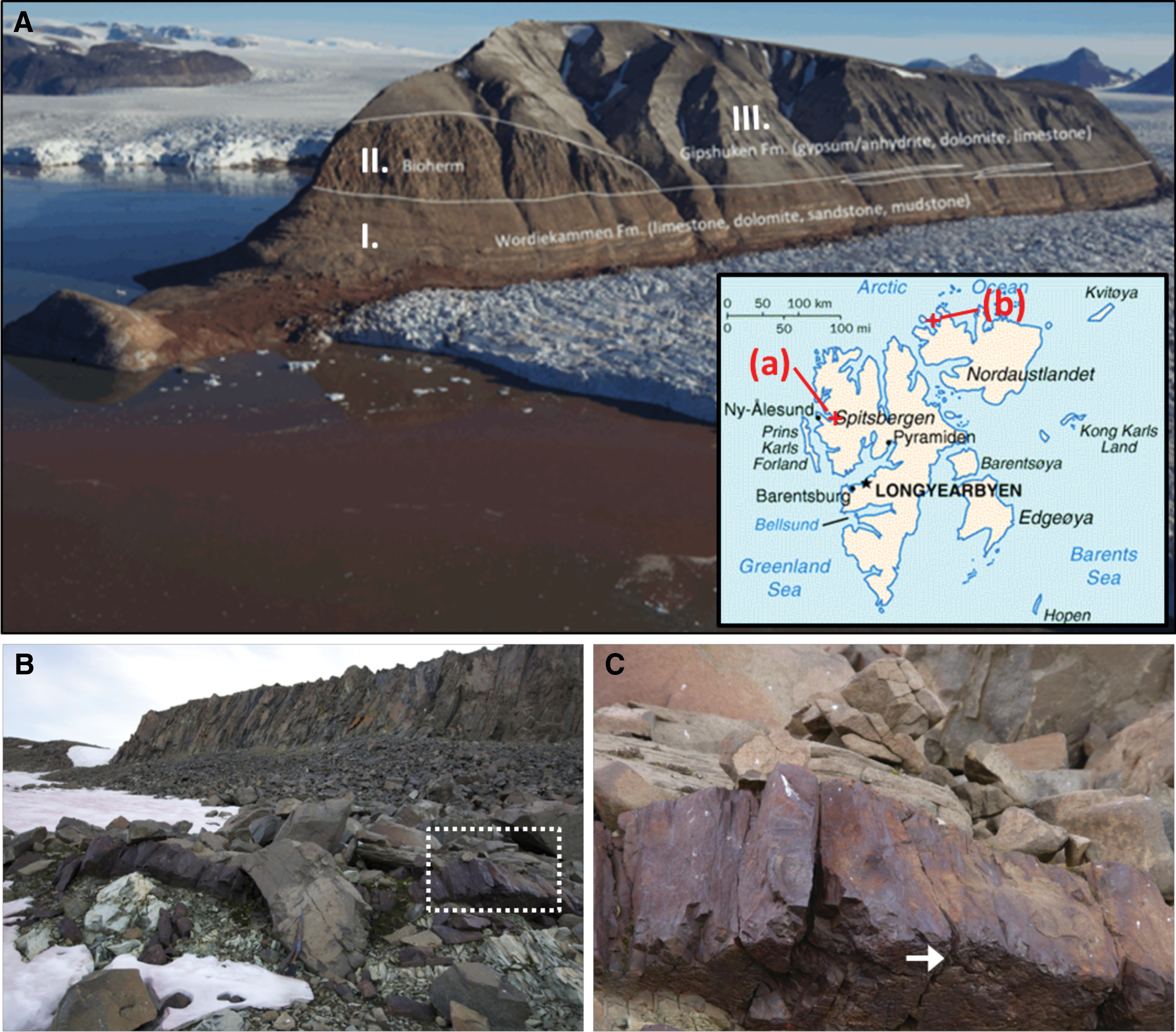
Field sites on Svalbard. (
2.1. Colletthøgda
Colletthøgda is situated on the west coast of Svalbard just north of Ny Ålesund (Fig. 2A, 78.89°N,12.55°E) and is a marine succession that is part of the Carbonificerous/Permian Dickson land subgroup and the superior Gipsdalen group, which cover parts of central Svalbard (Dallmann, 1999). The Gipsdalen group represents the development from a clastic continental graben to an open-shallow marine shelf with the Dickson land subgroup representing the later part of this development (Dallmann, 1999, 2002). The Dickson land subgroup consists of mainly carbonate rocks, represented by the Wordiekammen Formation, with subordinate evaporites, the Gipshuken Formation (Dallmann, 1999). At the field site at Colletthøgda (Fig. 2A), the Wordiekammen Formation is exposed at the bottom as layered strata, which the Gipshuken Formation overlies as a homogeneous structure. In addition, at Colletthøgda another homogeneous structure can be seen intersecting the Gipshuken and Wordiekammen Formations (Fig. 2A). It has been proposed that this structure is a bioherm, that is, a reeflike structure.
Features that contain similar mineralogy to that found at Colletthøgda are found on Mars. Evaporites have been identified in martian meteorites such as Nakhla and EETA 79001 (Gooding, 1992; Sawyer et al., 2000) and in various places on Mars (Squyres et al., 2004; Gendrin et al., 2005; Langevin et al., 2005; Bibring et al., 2006) including Gale Crater (Milliken et al., 2010). Evaporites have been suggested to be a good habitat for microbes in an extreme environment such as the surface of Mars (Rothschild, 1990) and have shown to have good preservation potential for organic matter (Aubrey et al., 2006). Carbonates have been found on Mars (Ehlmann et al., 2008; Morris et al., 2010) and in martian meteorites (McKay et al., 1996). Although a bioherm is not expected to be found on Mars, it is a suitable analogue for biologically produced carbonates.
2.2. Botniahalvøya
Botniahalvøya is situated on the Nordaustlandet island in the northeast of the Svalbard archipelago (Fig. 2B, 80.25°N, 19.25°E). At the field site, Precambrian lava (the Kaap Hansteen suite) is cut by dolerite sills that are part of the Diabasodden suite (Fig. 2B–2C) (Dallmann, 2002). This suite is found mainly in parts of eastern Svalbard and is believed to have formed during the early Cretaceous (Dallmann, 1999, 2002). At the field site on Botniahalvøya, the sill is exposed and has been weathered by water seeping through it, which has created a horizon of differentially weathered basalts. Some parts of the weathered surface have a shiny appearance much like desert varnish. Desert varnish is a type of coating that consists of clay minerals cemented to rock by oxyhydroxides of manganese and iron, which are found on many rocks in arid environments (Dorn, 1998). It has been suggested that biology is involved in the formation of desert varnish (Dorn and Oberlander, 1981; Taylor-George et al., 1983).
The rocks in the field site at Botniahalvøya are analogues to weathered basalts found on Mars. During the Viking mission, rocks with shiny surfaces were reported that could possibly be desert varnish (Moore et al., 1987; Arvidson et al., 1989; Guinness et al., 1997). It has been suggested that desert varnish could be a potential habitat for martian microorganisms (DiGregorio, 2002). Although recent findings of desert varnish at Gale Crater are not indicators of biology per se, this exciting find suggests that further investigation of terrestrial analogues would be advantageous (Lanza et al., 2014). In addition, various clay assemblages have been found on Mars (Bibring et al., 2006; Vaniman et al., 2014), and hematite is known to be present in the martian regolith (Ming et al., 2006; Morris et al., 2006; Vaniman et al., 2014).
3. Materials and Methods
3.1. Samples
Three different samples (Table 1) were studied from the Colletthøgda site: an evaporite (Snickers) and two carbonates (KitKat and Butterfinger). One sample was studied from the Botniahalvøya site, AM11-162 (Table 1).
The samples from Colletthøgda (KitKat, Butterfinger, and Snickers) were collected as float at the base of the outcrop at Colletthøgda, while the Botniahalvøya sample was collected from the exposed outcrop. The collected samples were immediately wrapped in ashed aluminum foil before being placed in a labeled plastic bag. The rocks were analyzed in laboratories on board the R/V Lance and were initially cracked open with a rock hammer. Small pieces of the freshly fractured rock were collected from the inner part (Colletthøgda) or from the outer part (Botniahalvøya) of the samples. The collected pieces of rocks were ground to powder with an agate mortar and pestle previously cleaned with distilled water, isopropanol, and ethanol (Eigenbrode et al., 2009).
3.2. X-ray diffraction/X-ray fluorescence
X-ray diffraction (XRD)/X-ray fluorescence (XRF) measurements of the bulk mineralogy of the samples were performed with the Terra XRD/XRF (InXitu Inc., Mountain View, USA). The Terra instrument is similar to the Chemistry and Mineralogy (CheMin) instrument on board the NASA Curiosity rover (Blake, 2010).
3.3. Pyrolysis–gas chromatography–mass spectrometry
3.3.1. Analyses during AMASE11
Pyrolysis
The hardware used during AMASE11 consisted of a simplified MOMA GC from the Max Planck Institute for Solar System Research (MPS) and a commercial GCMS (Griffin Minotaur 400 field GCMS) from NASA Goddard Space Flight Center (GSFC).
The MOMA GC hardware was based on the current MOMA flight hardware developments at MPS. It consists of MOMA ovens (stepped or ramped heating up to ∼1000°C), a MOMA tapping station interfaced to the ovens, a thermal injection trap (Tenax TA) where evolved volatiles are trapped at temperatures below 0°C, an analytical column module with a MXT20 capillary column (20 m×0.25 mm×0.25 μm; Restek Cooperation), a thermal conductivity detector (Varian Inc.), as well as prototype electronics controlled by in-house-developed LabView software.
A commercial Griffin Minotaur 400 field GCMS was used both as stand-alone for the derivatization experiments and as the ion trap MS of the MOMA GC to perform MOMA-like pyrolysis–gas chromatography–mass spectrometry. The Griffin Minotaur 400 is designed for operation outside a typical laboratory environment, with larger ambient temperature range and relative humidity constraints. It contains an electron impact ionization source and a cylindrical ion trap mass analyzer. The MS assembly is operated at a pressure of 10−3 to 10−4 mbar, which is significantly higher than the pressure used for many other types of mass analyzers. The mass range of the Minotaur 400 is from 10 to 425 u.
During the AMASE11 field trip, the team managed to operate the two instruments (MOMA GC and the Griffin Minotaur GCMS) separately and successfully when interfacing the two together (Fig. 3). To interface the MOMA GC with the Griffin Minotaur MS, we by-passed the GC part of the Minotaur and connected a helium gas tank directly to the MOMA GC setup, which was further connected downstream to the Griffin MS (Fig. 3). This scheme allowed the MS and the GC to operate together in GCMS mode for separation (MOMA GC) and definitive identification (Griffin MS) of organic compounds, thus making it possible to obtain pyrolysis-GCMS data from the crushed rock samples during AMASE11.
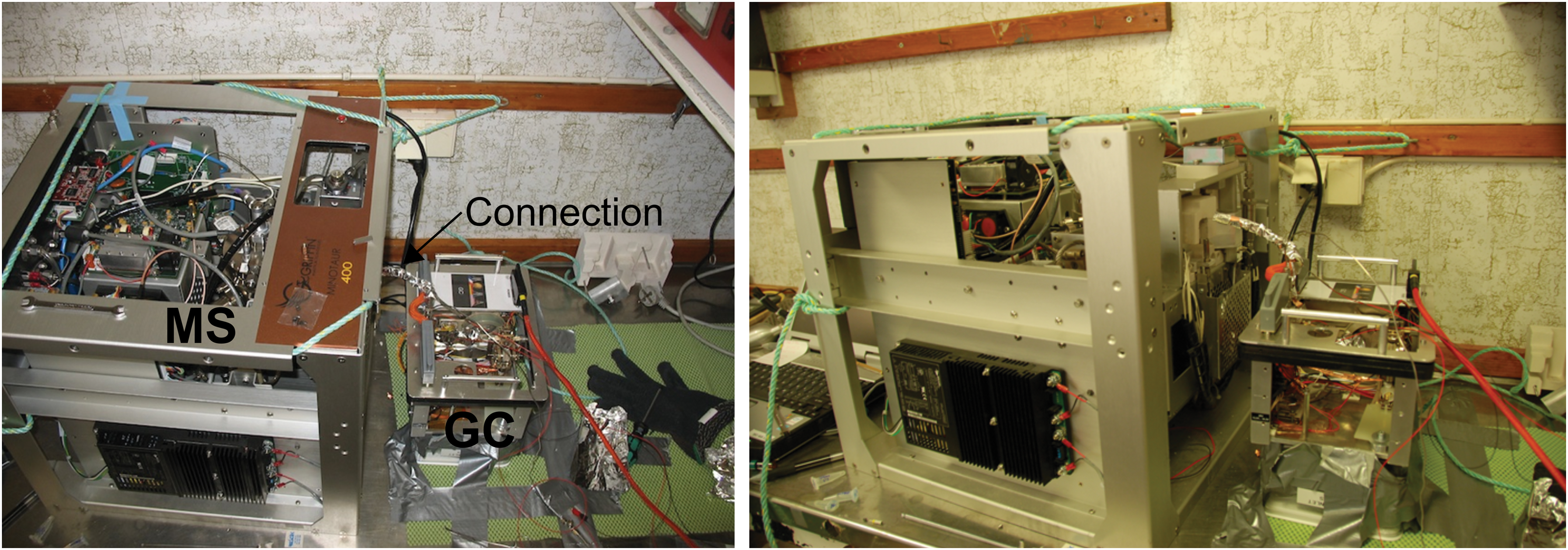
Instrumental setup of MOMA GC to Griffin MS on board the R/V Lance during AMASE11. Color images available online at
The operating condition of the interfaced MOMA GC and Griffin Minotaur MS were as follows: the GC tubing and the GC column were preheated to 60–70°C and 30°C, respectively, and a constant gas pressure corresponding to ∼2 mL/min He flow through the GC column was established. Around 200 μg of powdered rock sample (Butterfinger, KitKat, Snickers, or Botniahalvøya) was placed in the oven. The oven was then heated to 600°C under He flow to pyrolyze and release any organics from the sample. The evolved gases were flushed and collected into the trap that was cooled down to <5°C. The trap was then heated to 250°C for around 10 s to release the volatiles and send them to the GC column. After injection, the column temperature was ramped at 5°C/min to 150°C. After elution from the GC column, the discrete molecules entered the thermal conductivity detector, where they were recorded. These molecules were then routed via the exhaust of the MOMA GC and a heated (60–70°C) tube into the ion trap MS of the Griffin Minotaur, which was operated independently. The MS was operated between 40 and 425 u to exclude signals from the air such as nitrogen and oxygen and thus improve the signal-to-noise ratio. Between each sample measurement, a complete measurement cycle as described above was carried out by using an empty oven to retrieve the baseline and keep track of contamination from the surrounding environment.
Derivatization
In this study, MTBSTFA was used as a derivatization reagent and dimethylformamide (DMF) as its solvent, which allowed an efficient and nonselective derivatization on a wide range of organic molecules. MTBSTFA performs silylation of any labile hydrogen and thus transforms polar organic compounds of low volatility, such as amino acids and carboxylic acids, into volatile tert-butyldimethylsilyl (tBDMS) derivatives that can be separated and identified by gas chromatography–mass spectrometry (Knapp, 1979).
To perform derivatization, the Griffin GCMS was used on a stand-alone base. The preparation of the sample included a deposit of a few milligrams (∼10–20 mg) of the sample into a glass vial, the addition of 15 μL of MTBSTFA/DMF (4:1), the heating of this mixture during 10 min at 175°C in a heater block to allow both extraction of the organic content by thermodesorption and by the DMF solvent, and subsequent derivatization of the extracted organics (one-pot one-step procedure), followed by the direct injection of 2 μL of this sample into the GCMS. The sample was introduced into the GC inlet by direct injection of a liquid phase with a microsyringe, where it was rapidly heated and swept onto the analytical column by the He carrier. Only the samples from Colletthøgda were analyzed on board the R/V Lance.
In addition, because MTBSTFA leads to a lot of decomposition products that can interfere with the peaks of interest, and to ensure that the reaction is working, a blank was prepared by heating a solution of 10 μL of MTBSTFA/DMF (4:1) to 75°C during 10 min. Because of the constraints of an on-site experiment, no other blanks were run between the samples. Both blank and samples were run with a GC program from 70°C held 5 min to 300°C held 5 min, with a 10°C/min ramp, in splitless mode and with a constant He inlet pressure of 690 mbar. The operational mass range of the MS was between 40 and 425 u.
The Griffin MS has an unresolved offset of mass calibration of 1–2 u, which means that the NIST mass spectral library cannot directly be used to identify the detected compounds. Therefore, commercial laboratory runs were performed to confirm whether a specific compound was present in the AMASE11 runs.
3.3.2. Laboratory analyses at home institutions
Pyrolysis
Pyrolysis was performed at MPS. A commercial Varian GCMS (GCMS 4000) coupled to a commercial pyrolysis unit (Pyrola) was used. A chromatographic column with the identical retention phase (MXT20: 20 m×0.25 mm×0.25 μm) as the MOMA GC was used. The temperature profiles of the oven and column reproduced those used during AMASE11, except for the Botniahalvøya sample (AM11-162), which was pyrolyzed at 900°C instead of 600°C.
Derivatization
Derivatization experiments were performed at GSFC with a commercial Thermo Finnigan Trace GC Ultra DSQII quadrupole MS. It consisted of a solvent extraction of the organic molecules from the sample followed by a derivatization of the extract. The four samples were weighed in cleaned glass ampules: 187.2 mg of KitKat, 163.0 mg of Snickers, 81.5 mg of Butterfinger, and 149.2 mg of Botniahalvøya. One milliliter of a mixture of H2O/isopropanol (1:1) was then added to each sample. Blanks consisted of an ampule only filled with the H2O/isopropanol (1:1) mixture. All the ampules were then sealed and placed in an oven at 100°C. After 24 h, the supernatant was transferred out to a clean vial where it was evaporated under vacuum. Five microliters of a mixture of MTBSTFA/DMF (4:1) was added, and the vials were then heated to 75°C for 15 min to allow the derivatization reaction to proceed, after which 0.1 μL of this solution was injected in the GCMS. The GCMS was set in splitless mode with a temperature program from 50°C to 300°C at 10°C/min and a 3 min hold at 300°C, under a constant pressure of 903 mbar of He. The MS scans from 3 to 535 u from 6 min of run to the end (solvent delay).
3.4. Scanning electron microscopy/energy dispersive X-ray analysis
The sample from Botniahalvøya (AM11-162) was also investigated in a scanning electron microscope (SEM; Leitz Amray 1600T) with energy-dispersive X-ray (EDX; Tracor Northern) analysis to study the difference in morphology and chemistry between the outer (most altered) and inner (least altered) part of the sample. The samples were sputter-coated with 10 nm gold before analysis. SEM imaging was conducted at 30 kV with subsequent EDX spectra acquired with a similar acceleration voltage.
4. Results
4.1. Field XRD/XRF data
The data collected by Terra XRD/XRF during AMASE11 is summarized in Table 1. The mineralogy of the Butterfinger, KitKat, and Snickers samples is consistent with their respective assignment to the formations of Wordiekammen and Gipshuken as described in the literature (Dallmann, 1999, 2002). The mineralogy of Botniahalvøya samples is that of a weathered basalt (Nejbert et al., 2011) containing clay as well as iron and manganese oxides.
4.2. Pyrolysis and derivatization
4.2.1. Comparison between the AMASE11 prototype and commercial laboratory measurements
Pyrolysis
For direct comparison of the results from the MOMA prototype and commercial laboratory systems, total ion chromatograms (TICs) were obtained for the Butterfinger and Botniahalvøya (AM11-162) samples. Two sets of pyrolysis data were acquired for each set of samples: one set on the MOMA prototype during AMASE11 and the other on the commercial systems at MPS (Fig. 4, Tables 2 and 3). The chromatograms of Butterfinger from both systems (Fig. 4A) show the presence of numerous organic molecules including long-chained hydrocarbons and aromatic molecules such as benzene, naphthalene, and a range of alkylated benzenes, while the chromatograms of Botniahalvøya (AM11-162; Fig. 4B) show long-chained hydrocarbons, nitrogen-, oxygen-, and sulfur-containing aromatics, and various kinds of heterocyclic compounds. In Fig. 4C, the mass spectra of the trimethylbenzene (peak 8 in Fig. 4A) found in the Butterfinger sample are compared. The mass spectra compared were retrieved from the Griffin MS, the commercial Varian system, and the NIST library. The data quality acquired on the MOMA prototype system was surprisingly good considering that this was the first joint operation of the MOMA GC and a commercial MS and the analyses took place in sub-optimal conditions on board the R/V Lance. The produced data were reproducible across several analyses, with different samples producing unique signatures that were different from the blanks analyzed during AMASE11. Any differences in results between the commercial and the prototype systems are explained by the fact that the operational parameters were optimized for the Svalbard setup, not for the commercial equipment. At low retention times (<5 min), the commercial chromatogram is less resolved than the AMASE11 chromatogram, while at higher retention times (>5 min) there is virtually a one-to-one correlation between the two systems. This can be explained by the fact that, in the commercial pyrolysis-GCMS, the sample is heated directly in the helium flow of the GC—that is, the pyrolysis and the injection are one single step—while in the prototype (MOMA oven and MOMA GC coupled to Griffin MS), the sample is first heated in a helium flow, and the volatiles are trapped in an injection trap. In a second step, the volatiles are desorbed from the trap and injected into the GCMS. This results in a higher resolution of the MOMA GC than the commercial instrument at low retention times. At higher retention times, the heavier volatiles are better transferred in the commercial GCMS.
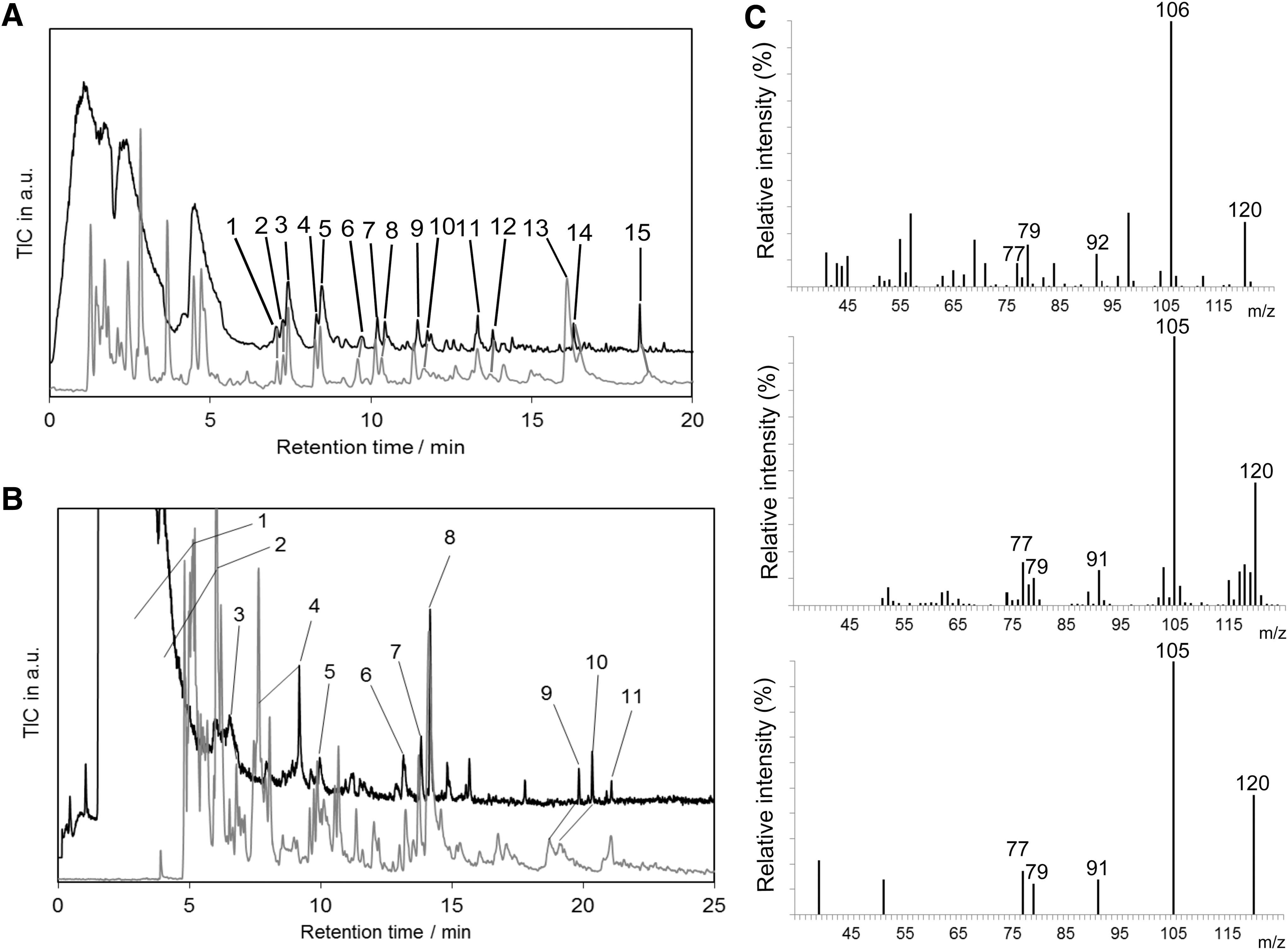
Comparison of pyrolysis results from the MOMA prototype during AMASE11 and commercial measurements. (
The TIC of the Butterfinger sample. Note that the Griffin MS has an unresolved offset of mass calibration of 1–2 u.
The TIC of AM11-162 from Botniahalvøya.
The meaning of these results is twofold. First, the measurement obtained on the prototype during AMASE11 can be reproduced in the laboratory. Second, apart from very few exceptions (one prominent peak around 18 min), all peaks found in the chromatograms of the MOMA prototype during AMASE11 are also present in the laboratory data (Figs. 4, 6, and 8), that is, the contamination is the same in both data sets and, since the empty runs with the MOMA prototype during AMASE11 and laboratory equipment are clean, rather small.
Derivatization
The chromatograms of the derivatized sample of KitKat (Fig. 5), Butterfinger (not shown), and Snickers (not shown) obtained during the AMASE11 campaign on the Griffin GCMS are compared to the chromatograms of these same samples obtained at GSFC on a Thermo Finnigan GCMS (Fig. 7). The on-site results from KitKat, Butterfinger, and Snickers are consistent with the laboratory experiments with various organic species such as carboxylic acids detected above background in KitKat (Fig. 5 and 7), while a lower variety of organics was detected in Snickers and Butterfinger (not shown). This confirms the success of a one-pot, one-step extraction and derivatization of organics from a solid sample, a procedure that will be performed on MOMA. It should be noted that the Griffin GCMS used during AMASE uses an ion trap MS, while the MS used back at GSFC is a quadrupole.
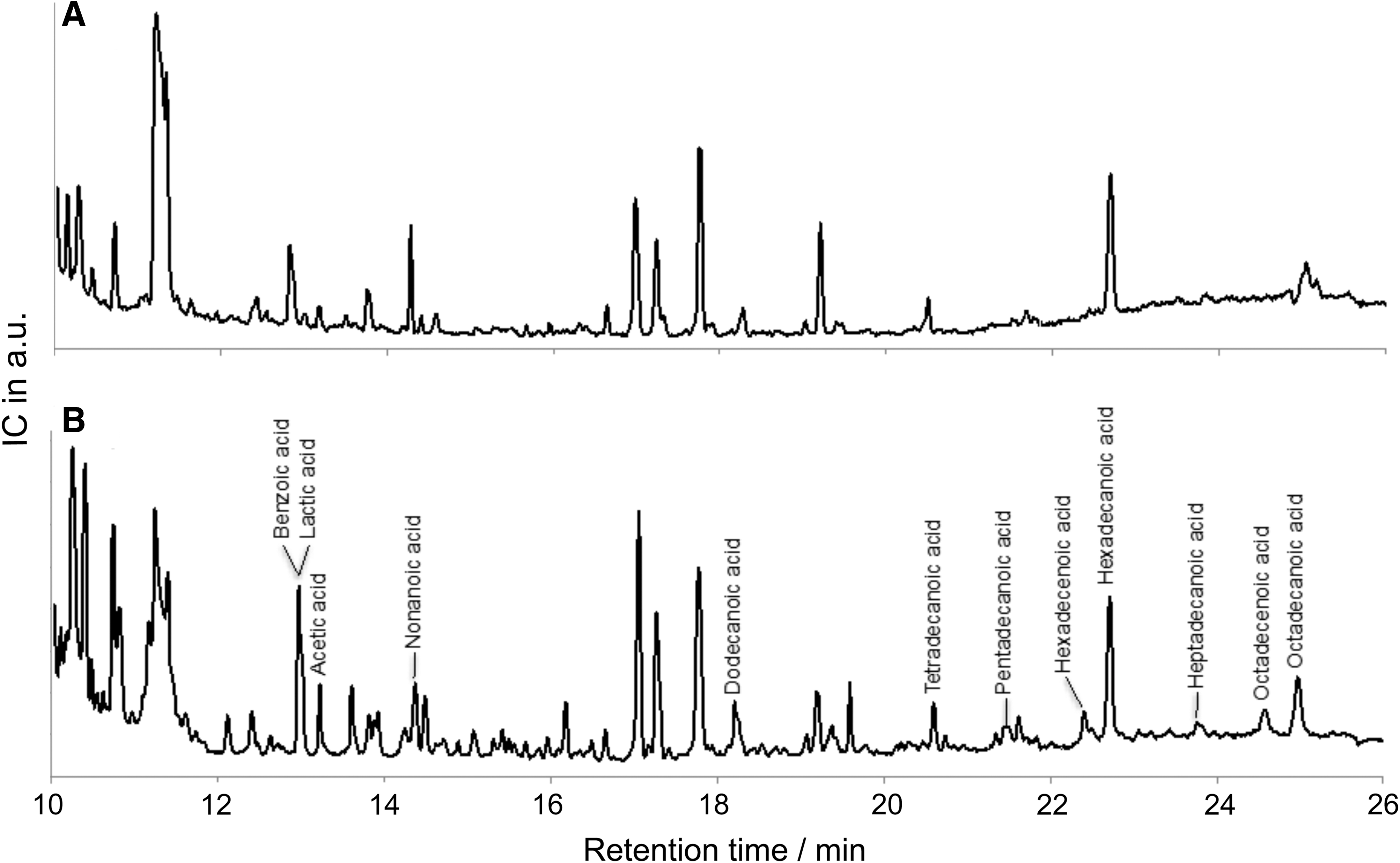
Derivatization experiments performed during the AMASE11 campaign. (
4.3. Laboratory measurements at home institutions
4.3.1. Colletthøgda
Pyrolysis
Snickers, KitKat, and Butterfinger (Fig. 6A, 6B) all contain low amounts of organic material (Butterfinger organic carbon ≤0.05% as measured by IR spectroscopy) of mainly aliphatic nature and aromatic nature. Butterfinger contains significantly more organics than the other two samples of both aliphatic and aromatic nature.
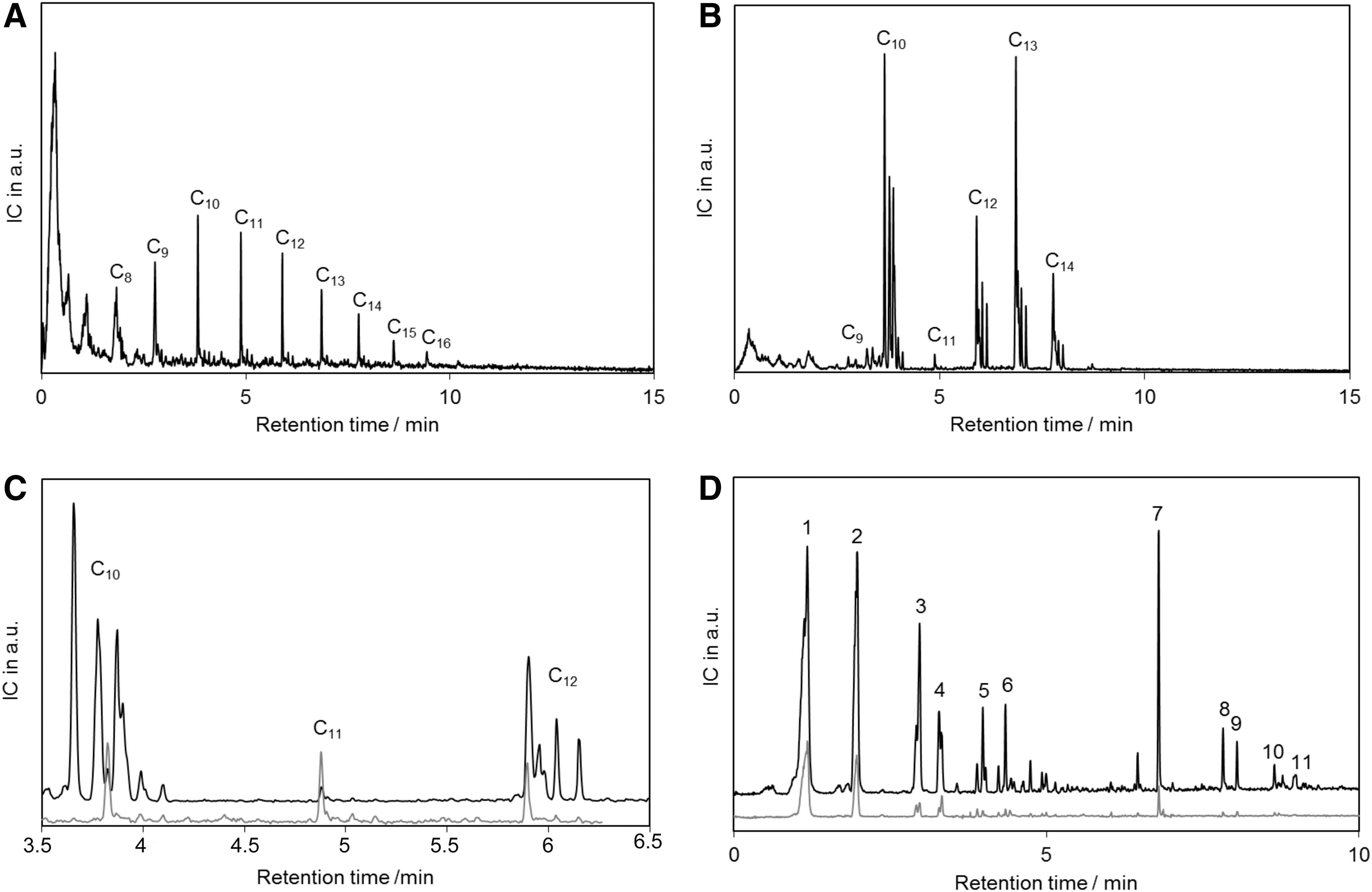
Pyrolysis (600°C) results from Colletthøgda samples. Selective ion mode (m/z 55, 56, and 57) chromatograms of (
The m/z 55, 56, and 57 are diagnostic masses for saturated and unsaturated aliphatic hydrocarbon molecules. The selective ion chromatogram (m/z 55, 56, and 57) of the Butterfinger sample reveals only a single discrete peak, an alkene with a terminal double bond, for each chain length between C8 and C16 (Fig. 6A, 6C). By comparison, in the selective ion chromatogram (m/z 55, 56, 57) of the KitKat (Fig. 6B, 6C) and the Snickers (not shown) samples, there are several peaks for each chain length between C10 and C14. Chain length C10, C12, C13, and C14 dominate, while C11 is present but at a much lower concentration (Fig. 6B, 6C). The chromatogram of Snickers is similar to that of KitKat. The decreased signal intensity at higher chain lengths can be either sample-based (real), procedure-based (cracking of longer chains by pyrolysis), or instrument-based (longer chains have a lower probability of passing through the GC).
The selective ion chromatograms of the aromatic fractions (m/z 78, 91, 105, 120, 128, and 154) of the Butterfinger and KitKat samples are plotted in Fig. 6D (assignments of peaks in Table 4). If the chromatograms are normalized to the largest peak (benzene, peak 1), it is obvious that Butterfinger contains a higher quantitative abundance of the larger aromatic hydrocarbons than KitKat and Snickers (not shown), though it is of similar qualitative composition. Aromatics found in the samples include benzene, naphthalene, toluene, xylene, and various alkylbenzenes and alkylnapthalenes. No compounds (aromatic or heterocyclic) containing nitrogen, oxygen, and sulfur were detected in either sample.
Selective ion mode (m/z 78, 91, 105, 120, 128, and 154) chromatogram of Butterfinger and KitKat.
Derivatization
In the derivatization experiment, organics were detected in the KitKat (Fig. 7B) and Butterfinger (not shown) samples but not in the Snickers sample (not shown). The organic molecules are detected as their tBDMS ester derivatives but are referred to as their parent molecule before derivatization in the figures and in the text.

Derivatization experiments of (
The KitKat sample is the most qualitative organic-rich of the three samples and primarily contains a large variety of carboxylic acids, from simple molecules (<C10) such as benzoic acid, lactic acid, acetic acid, or nonanoic acid, to heavier long-chain carboxylic acids from dodecanoic (C16) to octadecanoic acids (C18). Interestingly, some of the carboxylic acids display their alkane as well as their alkene form, such as octadecanoic/octadecenoic acid (C16) or hexadecanoic/hexadecenoic acid (C18). A few dicarboxylic acids were detected, and a significant amount of carboxylic acids could not definitely be identified. In addition to carboxylic acids, a possible long-chain alcohol is present in the sample, extending the family of compounds detected in the samples.
The Butterfinger sample does not contain organic compounds above the background level, apart from some lactic and benzoic acid at low levels of concentration, while the Snickers sample does not contain any organics that could be detected by MTBSTFA derivatization. However, Snickers does contain a significant concentration of sulfur-containing compounds; sulfuric acid is the main compound retrieved after derivatization, and a molecule that is thought to be sulfamate was also detected. The sulfuric acid probably originates from the dissolution of the anhydrite and gypsum of the sample in the water/isopropanol mixture, which is then dried out and derivatized.
Interpretation
Pyrolysis and derivatization show similar results for the samples from Colletthøgda (Figs. 6 and 7B). Both samples, for example, indicate the presence of carboxylic acids in the samples. However, one main difference is that, in the pyrolysis experiment, the most organic-rich sample was Butterfinger, while for the derivatization experiment it was KitKat. A probable explanation for this discrepancy is due to sample heterogeneity. Butterfinger contains veins that could contain a higher concentration of organic material than the cement. Additional pyrolysis experiments of Butterfinger revealed a lower concentration, but of qualitative similar distribution, of organics (20–50% less) than observed in the initial measurements. Furthermore, the organic composition of Butterfinger and KitKat samples could be different, with more polar compounds present in the KitKat sample and more apolar present in the Butterfinger sample. Derivatization would be more likely to detect polar compounds, while pyrolysis would be more likely to detect apolar compounds.
It is likely that some of the molecules found in the pyrolysis experiment are pyrolysis products of compounds detected in the derivatization experiment. For example, the long-chained hydrocarbons detected in the Butterfinger, KitKat, and Snickers samples may have been formed during decarboxylation of carboxylic acids during pyrolysis (Simmonds et al., 1969; Wilson et al., 1983). However, carboxylic acids were only detected in KitKat during the derivatization experiment. Therefore, alternative sources for the long-chained hydrocarbons detected in the pyrolysis experiments must be considered. One possibility would be alkanes that are cleaved during pyrolysis to produce alkenes (Holman et al., 1966; Henderson et al., 1968). A further possibility could be fossil material. Chromatograms obtained from pyrolysis experiments of fossils often contain a significant amount of alkanes/alkenes (Gupta et al., 2007). The alkanes/alkenes are thought to originate from cross-linking of these types of molecules into the original organic material in the fossil (Gupta et al., 2007).
In the derivatization experiment, saturated carboxylic acids (C14–C18) were found in KitKat. The two most abundant carboxylic acids, C16 and C18, were also found in their unsaturated form, such as octadecenoic acid (C16) and hexadecenoic acid (C18). Saturated and unsaturated fatty acids, especially palmitoleic (C16) and oleic (C18) acids, are important components of the cell membrane of bacteria and eukaryotes (Peters et al., 2005).
In addition to the carboxylic acids, benzoic and phthalic acids were detected in significant concentration in the derivatization of KitKat and at lower abundances in Butterfinger. Those compounds are typical stable degradation products of organic molecules due to oxidation in the soil (Benner et al., 2000; Navarro-González et al., 2006). In addition to being an oxidation product, phthalic acids may also originate from phthalates, a common organic contaminant (Peters et al., 2005). Acetic acid, a simple carboxylic acid, is also present above background level in the derivatization experiment of KitKat. This molecule is believed to be a metastable decomposition product of various components such as amines and primary alcohols (Benner et al., 2000). It is possible that some of the aromatic compounds found in the pyrolysis experiment, such as benzene, are pyrolysis products of the benzoic and phthalic acids found in the derivatization experiment.
The detection of the various organic molecules in KitKat, Butterfinger, and Snickers—including the extended range of long-chained hydrocarbons in pyrolysis and carboxylic acids in derivatization—and the absence of amino acids might indicate the presence of a once-thriving biota in the rocks at Colletthøgda. The presence of carboxylic acids in KitKat indicates either excellent preservation potential of now nonviable organisms or the presence of an active biota. Fatty acids have a better survival potential in sediments and fossils than many other biomolecules (Lee et al., 2004; Petsch, 2011). For example, fatty acids have been detected in the Messel oil shale from the Eocene and in fossils from the Miocene (Lockheart et al., 2000; Thiel and Sjövall, 2011). They have even been detected in carbonate samples from the Devonian (Melendez et al., 2013). However, preservation of fatty acids usually occurs under very specific conditions such as euxinia, that is, anoxic conditions in the presence of H2S. It is possible that the carboxylic acids found in samples from Colletthøgda have been preserved since the Permian, though it is more likely they are remains of more recent colonization. Laboratory experiments have also shown that many types of organic molecules, including long-chained hydrocarbons and carboxylic acids, may also form abiotically under hydrothermal conditions (McCollom et al., 1999; Rushdi and Simoneit, 2001). However, the mineralogy of the samples of Colletthøgda and the overall geology of the site as a shallow marine environment suggest a low-temperature environment, and the dominance of C16 and C18 carboxylic acids favors a biological origin for these molecules.
4.3.2. Botniahalvøya
Pyrolysis
In the pyrolysis experiment, the TIC of the bulk sample is dominated by sulfur-containing compounds such as S6, SO2, and benzothiophenes (Fig. 8A, Table 5). It is not clear whether those compounds were created during pyrolysis (Simmonds, 1970) or are breakdown products of larger molecules present in the sample. In any case, the release of SO2 and S6 requires a significant sulfur source (Faber, 1920; Beerwald, 1950). To investigate whether such a source of sulfur exists in the Botniahalvøya sample, SEM/EDX analysis was performed (Fig. 9). Analysis results show strong peaks from iron, silica, and oxygen with smaller peaks of calcium, titanium, magnesium, and aluminum present, especially in the outer layer. Sulfur is present in localized spots (not shown). Sulfide minerals (sulfates cannot produce S6) present might produce enough sulfur to generate various reactions during the pyrolysis and generate the sulfur-containing organic molecules (McAdam et al., 2014). When the visible black layer—the proposed desert varnish—was scraped from the rock and analyzed separately, the TIC (Fig. 8B) shows much higher levels of organic material with virtually no sulfur in the form of S6 and SO2. The dominant molecule in the chromatogram is styrene. This suggests that most of the organics present in the sample are located in the outer layer.
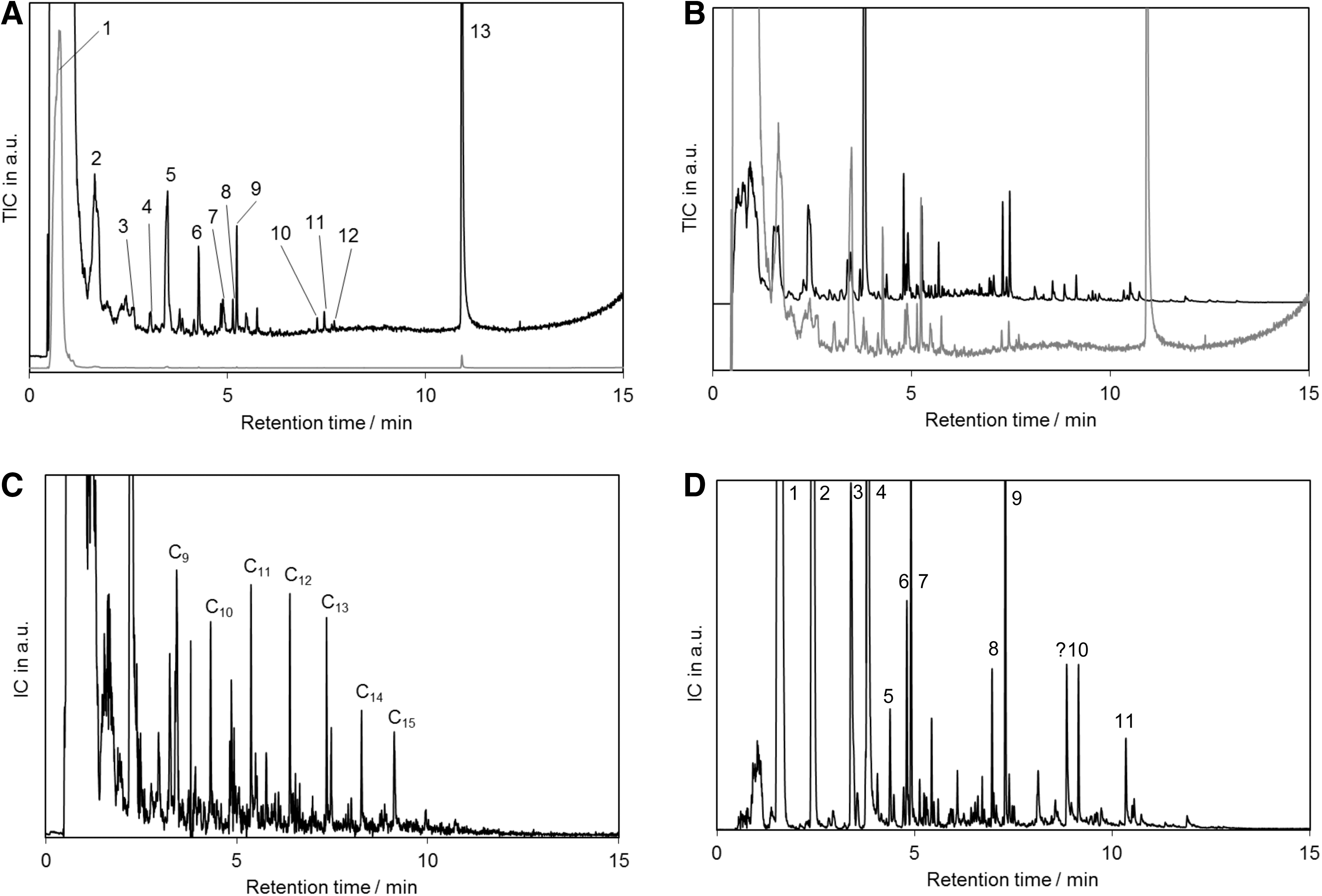
Pyrolysis results from Botniahalvøya samples. (

(
The TIC of AM11-162 from Botniahalvøya.
The selective ion chromatogram (m/z 55, 56, 57) of the outer layer of the sample shows a range of alkenes with terminal double bonds of chain length between C9 and C17 (Fig. 8C).
The selective ion chromatogram (m/z 78, 91, 105, 120, 128, and 154) of the outer layer of the Botniahalvøya sample displays sulfur-containing compounds such as thiophenes and benzothiophenes (Fig. 8D), in addition to the normal pyrolysis products of organic material such as benzene, toluene, and naphthalene. Other detected compounds in the sample included nitrogen- and oxygen-containing molecules such as nitriles and furans, which is characteristic for materials that contain living biota as opposed to more ancient material that primarily contains hydrocarbons and aromatics (Simmonds, 1970). Molecules detected in Botniahalvøya include furfuraldehyde, which may be created during pyrolysis of sugars such as glucose and ribose (Kato, 1967; Simmonds, 1970; Wilson et al., 1983). Other furan derivatives such as benzofuran and 1-(2-furanyl)-ethanone were also detected (Fig. 8D, Table 6) (Simmonds, 1970). In addition, nitrogen-containing compounds such as benzonitrile and 2-furancarbonitrile were detected. Benzonitrile is one of the molecules created during the pyrolysis of phenylalanine (Chiavari and Galletti, 1992) and has been found to be indicative of this type of amino acid (Gutteridge and Norris, 1979).
Selective ion chromatogram (m/z 78, 91, 120, 128, 154) of AM11-162 from Botniahalvøya.
Derivatization
The derivatization experiment of Botniahalvøya after water/isopropanol extraction is presented in Fig. 7C. As in the pyrolysis experiment, this sample displayed the richest diversity of both organic and inorganic molecules. Detected inorganic molecules include S-containing sulfite and sulfuric acid, and detected organic molecules include N- and/or O-containing molecules such as urea, carboxylic acids, nucleobases, and amino acids.
Amino acids such as glycine, alanine, and proline are identified with high confidence, and the presence of valine is also suspected. These amino acids would not be seen in the pyrolysis experiment, as they mostly decompose to smaller molecules such as CO2, NH3 and small nitriles, imines, and amines (Simmonds et al., 1972; Chiavari and Galletti, 1992), which was not resolved by the GC conditions used in this experiment. The tentative detection of phenylalanine in the pyrolysis experiment and its absence in the derivatization experiment may indicate a low efficiency of the extraction procedure used here for this type of molecule. Indeed, the procedure used for extraction (water/isopropanol) was chosen because it is a nonselective method that allows a large number of compound families to be extracted. However, the specific efficiency toward different amino acids is not known.
Thymine and uracil, two nucleobases of DNA and RNA, were detected in the sample in the derivatization experiment. These two bases are pyrimidine bases, and their detection rather than that of the purine bases was expected due the smaller size of the molecule. Nucleobases were not detected in the pyrolysis experiment, as they decompose to smaller molecules such as HCN (Gutteridge and Norris, 1979), which was not resolved in the pyrolysis experiment.
Moreover, phosphoric acid was detected. Phosphoric acid is a key component of the DNA skeleton, and its presence, along with nucleobases and amino acids, is a definite sign of a living biota, as the preservation potential of DNA is poor in most sediments.
Interpretation
The Botniahalvøya sample is rich in organics, especially in the outer layer. The detected organic molecules include sugars, amino acids, carboxylic acids, and nucleobases as indicated by both the pyrolysis and derivatization experiments. The detection of these compounds indicates the presence of extant biota or a recently extinct one, as many of these compounds usually start degrading directly after the death of organisms (Brocks and Grice, 2011; Petsch, 2011). Visual inspection and XRD analysis of the sample indicated the presence of clays and iron oxides, with manganese oxides on the samples indicating the presence of desert varnish. Living organisms are often associated with desert varnish.
The Botniahalvøya sample is heterogenic and probably contains sulfide minerals based on the detection of S6 in the pyrolysis experiment and its oxidized form, sulfite, in derivatization. Evolved gas analysis data obtained on the same sample during the AMASE campaign indicate the possible presence of pyrite in the sample (Amy McAdam, personal communication). Also, results of the EDX analysis indicate the presence of localized sulfur, possibly in the form of pyrite in this sample.
5. Discussion
5.1. Implications for exploration of the organic content of Mars
Laboratory instrument test stands have been developed to allow modeling of various MOMA subsystems, but at the time of deployment no overall breadboard was currently available. Before AMASE11, the MOMA GC had only been tested on a stand-alone base (Goetz et al., 2011b) and had never been coupled to a MS. The coupling of the MOMA GC with a commercial MS during AMASE11 was the first successful interfacing of the MOMA GC with a MS.
The results obtained from samples from Svalbard indicate that the current setup of MOMA for pyrolysis and the MTBSTFA derivatization experiment allows for the detection of different types of inorganic and organic molecules in an extended range of Mars analog samples. The accordance of the results obtained in the laboratory and during the expedition is very promising regarding both pyrolysis and derivatization (Mahaffy et al., 2012). The derivatization experiments also show that similar results are obtained when the extraction and derivatization are performed in successive steps or in a single step. Together with information about the mineralogy of the samples and overall geology of the sample site, it is also possible to draw some conclusions on the source of organics (abiotic or biotic origin, extinct or extant life) and how these organics might have been affected by later geological events after the deposition of the organics. Another valuable lesson from these experiments is the complementary data that can be obtained by combining these two modes, which will reveal important information on any complex organic molecules present in future samples analyzed by MOMA.
5.2. Future work
The tested MOMA prototype is only a subset of the final instrument, which will contain three additional GC columns, additional derivatization experiments, and a laser desorption ionization mass spectrometer (LDI-MS) (Goetz et al., 2011a). The MS used in this study was a commercial ion trap and is different from the ion trap being built for MOMA. The additional columns combined with the range of possible derivatization experiments are expected to yield crucial information about more polar organic components that are important for life such as amino acids, nucleobases, and sugars. In addition, measurements of the chirality of these molecules might be determined by using the enantioselective derivatization reagent (DMF-DMA) and the chiral column on the flight instrument, which were unfortunately not available for this field test. Furthermore, the LDI-MS will have the capacity to detect larger molecules and provide information on the mineralogy as a complement to the Raman of ExoMars. All these different components of the MOMA instrument need to be tested prior to flight.
Depending on the landing site, the joint ESA/Roscosmos ExoMars mission could analyze a wide variety of soils. These soils could include basalt, carbonate, sulfate, phyllosilicate, and so on and could contain a wide range of hydrated or oxidative species such as hydrogen peroxides and perchlorates as detected by Phoenix (Hecht et al., 2009). Therefore, it is very important to understand how the pyrolysis, derivatization reactions, and LDI-MS behave in the presence of these species, which is why multiple Mars analog samples must be analyzed a priori to understand the behavior of the organics under the conditions of the experiments. Future work will combine and test all the aspects of MOMA in a Mars-relevant terrestrial environment. Although valuable information can be obtained from the study of mineral mixtures spiked with organics, they cannot completely replace natural samples that are tested with a scientific hypothesis in mind. It is therefore of great importance to study samples from Mars analog environments on Earth.
6. Conclusion
The first successful coupling of the MOMA GC prototype with a commercial MS was accomplished during the AMASE11 field campaign. Pyrolysis and derivatization experiments were performed under MOMA-like conditions on Mars analog samples collected in Svalbard. These experiments have been replicated in the laboratory with the use of commercial instruments.
The diversity and repartition of organic molecules detected at Colletthøgda, including aromatics, long-chained hydrocarbons, and carboxylic acids, suggest the presence of once-living biota in these samples. The organic compounds detected at Botniahalvøya include carboxylic acids and nitrogen- and oxygen-containing compounds such as amino acids, nucleobases, and sugars. The presence of these compounds indicates the presence of living biota in the sample. A significant source of sulfur is also present at Botniahalvøya.
These results obtained in the field and in the laboratory indicate that, together, the MOMA pyrolysis and derivatization experiments will aid researchers in their efforts to answer questions regarding the organic chemistry of Mars' samples. This is extremely positive and promising for the ExoMars mission goal of searching for biosignatures.
Appendix: The AMASE11 Team
Eivind Aksnes, Earth and Planetary Exploration Services.
Hans E.F. Amundsen, Earth and Planetary Exploration Services.
Arnold Bauer, Joanneum Research.
Dave Blake, NASA Ames Research Center.
Tom Bristow, NASA Ames Research Center.
Caroline Freissinet, NASA Goddard Space Flight Center.
Mihaela Glamoclija, Carnegie Institution of Washington.
Fred Goesmann, Max Planck Institute for Solar System Research.
Garret Huntress, Carnegie Institution of Washington.
Fabien Jordan, SEI-Swiss Engineering Institute.
Laureline Josset, SEI-Swiss Engineering Institute.
Ingrid Kårstad, Earth and Planetary Exploration Services.
Amy McAdam, NASA Goddard Space Flight Center.
Francis McCubbin, University of New Mexico.
Kjell Ove Storvik, Earth and Planetary Exploration Services.
Stephen Pugh, Aberysthwyth University.
Nicole Schmitz, DLR German Aerospace Center.
Sandra Siljeström, SP Technical Research Institute of Sweden.
Pablo Sobron, Washington University in Saint Louis.
Steve Squyres, Cornell University.
Verena Starke, Carnegie Institution of Washington.
Andrew Steele, Carnegie Institution of Washington.
Jen Stern, NASA Goddard Space Flight Center.
Tor Viscor, Kayser-Threde GmbH.
Footnotes
Acknowledgments
The authors would like to thank David Blake and Tom Bristow at NASA Ames Research Center and Steve Squyres at Cornell University for the collection and interpretation of the XRD/XRF data. The authors also would like to thank Amy McAdam at GSFC for her AMASE11 evolved gas analysis work and insights on the sulfur story, the CLUPI team for providing images of the samples, and the two anonymous reviewers for their useful comments that improved the initial manuscript.
The financial support of AMASE by ESA is gratefully acknowledged. The participation of F.G. was supported by Deutsches Zentrum für Luft- und Raumfahrt (DLR; FKZ: 50QX1001). The participation of S.S. in AMASE11 was supported by MPS and a Swedish National Space Board travel grant. S.S. was further supported by the Deep Carbon Observatory (A. Steele, PI), the postdoctoral fellowship program of the Geophysical Laboratory, Carnegie Institution of Washington, and the Swedish National Space Board (Contract No. 121/11). The participation of C.F. was supported by GSFC. AMASE11 was strongly supported by NASA ASTEP (A. Steele, PI).
Author Disclosure Statement
No competing financial interests exist.
Abbreviations
AMASE, Arctic Mars Analog Svalbard Expedition.
DMF, dimethylformamide.
DMF-DMA, dimethylformamide dimethylacetal.
EDX, energy-dispersive X-ray.
GC, gas chromatograph.
GSFC, Goddard Space Flight Center.
LDI-MS, laser desorption ionization mass spectrometer.
MOMA, Mars Organic Molecule Analyzer.
MPS, Max Planck Institute for Solar System Research.
MS, mass spectrometer.
MTBSTFA, N,N-methyl-tert-butyl-dimethylsilyltrifluoroacetamide.
R/V, research vessel.
SAM, Sample Analysis at Mars.
SEM, scanning electron microscope.
tBDMS, tert-butyldimethylsilyl.
TIC, total ion chromatogram.
XRD, X-ray diffraction.
XRF, X-ray fluorescence.