




Abstract
Evidence from recent Mars missions indicates the presence of perchlorate salts up to 1 wt % level in the near-surface materials. Mixed perchlorates and other oxychlorine species may complicate the detection of organic molecules in bulk martian samples when using pyrolysis techniques. To address this analytical challenge, we report here results of laboratory measurements with laser desorption mass spectrometry, including analyses performed on both commercial and Mars Organic Molecule Analyzer (MOMA) breadboard instruments. We demonstrate that the detection of nonvolatile organics in selected spiked mineral-matrix materials by laser desorption/ionization (LDI) mass spectrometry is not inhibited by the presence of up to 1 wt % perchlorate salt. The organics in the sample are not significantly degraded or combusted in the LDI process, and the parent molecular ion is retained in the mass spectrum. The LDI technique provides distinct potential benefits for the detection of organics in situ on the martian surface and has the potential to aid in the search for signs of life on Mars. Mars—Mass spectrometry—Search for Mars' organics—Perchlorate reduction. Astrobiology 15, 104–110.
1. Introduction
R
The occurrence of perchlorate salts on the martian surface has drawn significant attention. The Phoenix lander that touched down on the northern plains of Mars was the first to positively detect perchlorate anions (0.4–0.6 wt %) in martian soil (Hecht et al., 2009). Chlorine has been a well-documented component of the regolith since the Viking landers measured abundances of 0.1–0.9 wt % Cl at Chryse and Utopia Planitiae (Clark et al., 1976). Subsequently, Mars Pathfinder measured 0.55 wt % Cl at Ares Vallis (Wänke et al., 2001), Spirit detected 0.06–0.68 wt % at Gusev Crater (Gellert et al., 2004), Opportunity found 0.2–2.6 wt % at Meridiani Planum (Rieder et al., 2004), and Odyssey's gamma ray spectrometer estimated 0.2–0.8 wt % globally across the martian surface (Keller et al., 2006). However, until the Phoenix mission, the origin of chlorine was not well established. The Wet Chemistry Laboratory analyses indicated that almost all the chlorine detected in surface samples was in the form of perchlorate salt, with only 0.01–0.04 wt % present as chloride—an observation that could hold globally. This discovery led to at least one reevaluation (Navarro-González et al., 2010) of the Viking lander results, which did not find evidence of martian organic compounds in the soils (Klein, 1978). The Viking gas chromatograph–mass spectrometer did detect releases of chloromethane and dichloromethane, which were attributed to residual terrestrial cleaning solvents. In reanalyzing these findings after the discovery of perchlorate, Navarro-González et al. (2010) found that as little as 0.1% perchlorate, mixed with soils bearing 0.7–6.5 ppm organic carbon, could have produced the observed chloromethane/dichloromethane signatures. Most recently, MSL/SAM analyses of Gale Crater sediments have shown that near-surface materials contain oxychlorine compounds such as perchlorates at ∼0.1 to 1 wt % levels (Glavin et al., 2013; Leshin et al., 2013; Ming et al., 2014). These measurement results, as well as the proposed formation models, support the idea of global distribution of perchlorate in the martian regolith (Glavin et al., 2013). While perchlorate salts are highly stable under martian conditions, perchlorates will decompose upon heating, releasing oxygen and chlorine that can then combust and/or react with organic molecules (Steininger et al., 2012; Glavin et al., 2013). Given these complicating effects, there is a benefit to considering additional, new techniques for future Mars missions searching for organics.
The Mars Organic Molecule Analyzer (MOMA), a key instrument on the ExoMars 2018 rover payload, includes a linear ion trap (LIT) mass spectrometer capable of both pyrolysis gas chromatography and Mars-ambient laser desorption/ionization (LDI) operational modes. The LDI approach offers a rapid, high-throughput means of direct mass spectrometric analysis of a solid sample without surface preparation or processing. This technique works especially well for detecting relatively high-mass (i.e., >100 Da), nonvolatile organics. More importantly, LDI permits the detection of organics even in the presence of perchlorates (Johnson et al., 2014). Nanosecond laser pulses, such as those produced by most solid-state Nd:YAG and commercial N2 laser systems, desorb and ionize solid samples on timescales approaching phonon relaxation rates of many geological materials (i.e., 10−12 to 10−9 s; e.g., Bäuerle, 1996), thereby mitigating any appreciable heating of the sample substrate. Techniques relying on bulk heating (e.g., pyrolysis gas chromatography–mass spectrometry) involve the slower mechanism of thermal conduction, leading to the evolution and migration of volatiles through powder samples; alternatively, nanosecond LDI from a sample surface happens too quickly for effective organic oxidation through gas phase and surface-mediated reactions to occur, enabling preservation of organic parent ions. To demonstrate this analytical benefit, we applied LDI analyses to laboratory-synthesized Mars analog samples with a variety of reference organics (two are presented here: coronene and Rhodamine 6G as nonvolatile representatives of an aromatic hydrocarbon and a mixed, heterosubstituted species, respectively) plus ∼1 wt % perchlorate salt spiked into a suite of geological matrices. The MOMA breadboard instrument has demonstrated detection of these organic molecules at the sub-part-per-million level (w/w) in these analog samples via LDI at Mars ambient pressures.
2. Experimental
Mars analog samples were prepared by spiking organics, such as coronene or Rhodamine 6G, and perchlorate salt into mineral matrices (without further cleaning) including a basalt (BCR-2, Columbia River Basalt; U.S. Geological Survey), a carbonate (MgCO3, reagent magnesite; Fisher Scientific), and a hydrated clay (SWy-2, montmorillonite, Crook County, Wyoming; Clay Mineral Society). The geological matrices were physically admixed in suspension (typically employing acetone to dissolve the organic species) with a 1 wt % water solution of calcium perchlorate (Ca(ClO4)2; Sigma-Aldrich) and trace amounts of the organics coronene or Rhodamine 6G (Sigma-Aldrich). Subsequently, the powder mixtures were ultra-sonicated while drying down at room temperature. Mass spectrometric analysis was carried out with two different ion trap mass spectrometers, the commercial Thermo MALDI LTQ XL as well as a breadboard version of the MOMA mass spectrometer (MS). A detailed comparison between LTQ XL and MOMA-MS is given in Table 1.
The data presented here were collected with a commercial 3 ns laser since the flight laser is still in development.
The Thermo system is a high-performance LIT mass spectrometer that supports a laser desorption–based ion source. Samples were introduced to the instrument on a stainless steel plate, with powdered samples being affixed to the plate with double-sided tape (3M 966, acrylic adhesive tape); tape was used since the sample plate is vertically orientated. We confirmed that negligible background signal from the tape would be observed at the laser wavelength and energies employed for our analyses; also, the sample is thick enough to screen the tape background. The laser-based ion source on the LTQ XL is based on a sample load-lock setup where the sample plate is held at a pressure of ∼75 mtorr (He) during operation. Ions created from the laser pulse are transferred into the mass analyzer via several multipole ion guides that direct ions to successively lower pressure regions toward the ion trap analyzer. The source is equipped with a nitrogen laser (337 nm, 3 ns pulse) focused to an elliptical spot with approximate dimensions of 0.1×0.2 mm. For the samples tested in this study, the laser was operated with an energy of 5–70 μJ per pulse (yielding intensities of ∼11 to ∼150 MW·cm−2). Spectra were obtained in both positive and negative ion modes, collecting data over a mass range from 50 to 2000 Da, and without the use of an automatic gain control algorithm.
MOMA-MS is based on a LIT mass analyzer (Fig. 1) that is essentially a miniaturized version of the Thermo design (Brinckerhoff et al., 2013). Compared to the commercial Thermo LTQ XL, the MOMA-MS breadboard instrument can achieve a similar mass range; however, achieving the miniaturization and higher pressure tolerances required for operation on the martian surface leads to more modest dynamic range, sensitivity, and mass resolution compared to the commercial instrument. The MOMA LDI source is designed to operate with samples loaded on the rover's “refillable tray” at Mars ambient pressures (4–10 torr, primarily CO2). The data presented here were collected under 7–10 torr CO2. This sampling infrastructure represents a significant simplification specifically designed for Mars implementation, as no sealing mechanism is required to bring the samples under vacuum. An ion transfer tube, interrupted by a fast-acting aperture valve, is used to transmit ions into the mass spectrometer (which is held at vacuum pressures, ∼10−6 torr). The source is operated by first opening the aperture valve and allowing gas to enter the vacuum system, resulting in an increase in the pressure to between 20 and 100 mtorr (depending on the number of laser shots used). A burst of laser pulses is then fired on the sample, desorbing and ionizing atomic and molecular species directly from the surface. The ions are transferred through the tube and valve by entrainment in the gas flow, eventually expanding directly into the ion trap central volume. Following the last laser pulse, the valve is closed (total valve open times are between 20 and several hundred ms), and the ion trap chamber pumps down. The detector high voltages are then switched on, and the ions are scanned out and detected. This scheme is modeled after the discontinuous atmospheric pressure ionization (DAPI) approach (Gao et al., 2008).

(
MOMA uses a frequency-quadrupled (266 nm) passively Q-switched Nd:YAG laser with pulses of up to ∼200 μJ, incident at ∼44 degrees to the sample surface and focused to a spot size of dimensions ∼0.4×0.6 mm. This yields intensities of a few to hundreds of MW·cm−2 (comparable to the laser energy on commercial LTQ XL), which covers a range of desorption thresholds at 266 nm for mineral substrates including some translucent silicate phases. Detectable fractions of the organic moieties desorbed from these substrates can survive intact along with their multiphoton ionization fragments, permitting their characterization even at sub-pmol·mm−2 concentrations in some cases. In contrast to the LTQ XL, which enables analysis in both positive and negative modes, MOMA-MS detects positive ions due to flight instrument electronics limitations. A more detailed review of the MOMA instrument and experimental cycle can be found elsewhere (Brinckerhoff et al., 2013).
3. Results
Figure 2 contains LDI mass spectra collected on the LTQ XL from various simulated martian samples with a fixed laser energy (15 μJ, ∼32 MW·cm−2), the setting of which was selected to give high signal-to-noise ratios for organic molecular ions in the spiked samples. BCR-2 basalt, spiked with 1 wt % Ca(ClO4)2 but no additional organic, was tested in both positive (Fig. 2a) and negative (Fig. 2b) ion modes. Low signal levels were observed in the positive mode spectrum, while strong peaks, which can be assigned to Ca(ClO4)3 - ions, were observed in the negative mode spectrum. After spiking the BCR-2/Ca(ClO4)2 mixture with 10 ppm coronene (Fig. 2c) and, separately, Rhodamine 6G (Fig. 2d), the molecular ion of coronene was seen as the dominant base peak at m/z 300 (Fig. 2c). Similarly, in the Rhodamine 6G spiked sample (Fig. 2d), the base peak at m/z 443 was attributable to the positively charged conjugated dye molecule of Rhodamine 6G, with lower-intensity peaks appearing as fragments of the parent species. The MOMA breadboard results are similar to those obtained with the LTQ XL instrument, as shown in Fig. 3, in terms of the detection of the trace organics as intact molecular ions in the presence of perchlorate.
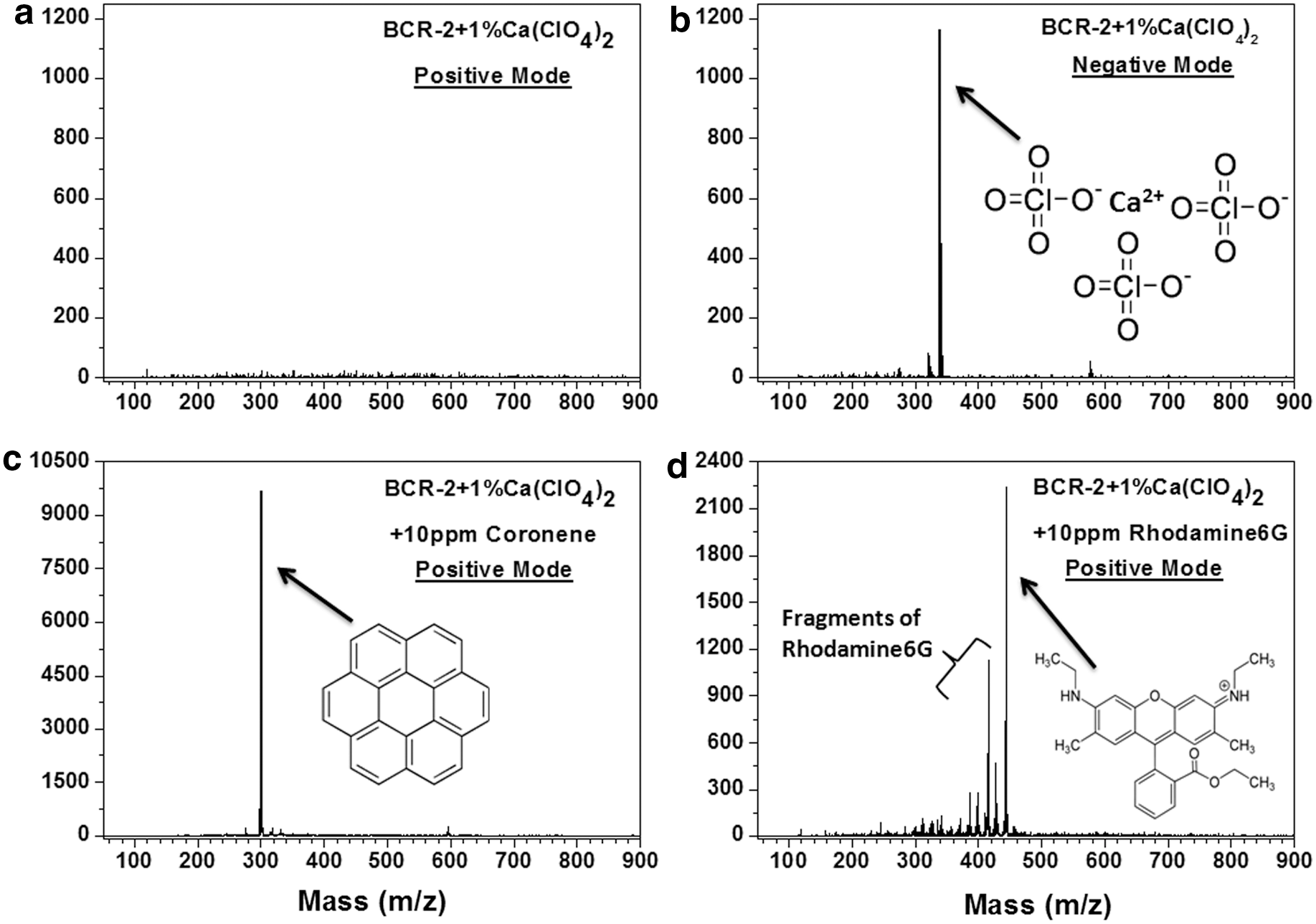
Typical LDI mass spectra collected on Thermo LTQ XL. Mass spectra of BCR-2 mixed with 1 wt % Ca(ClO4)2 in (
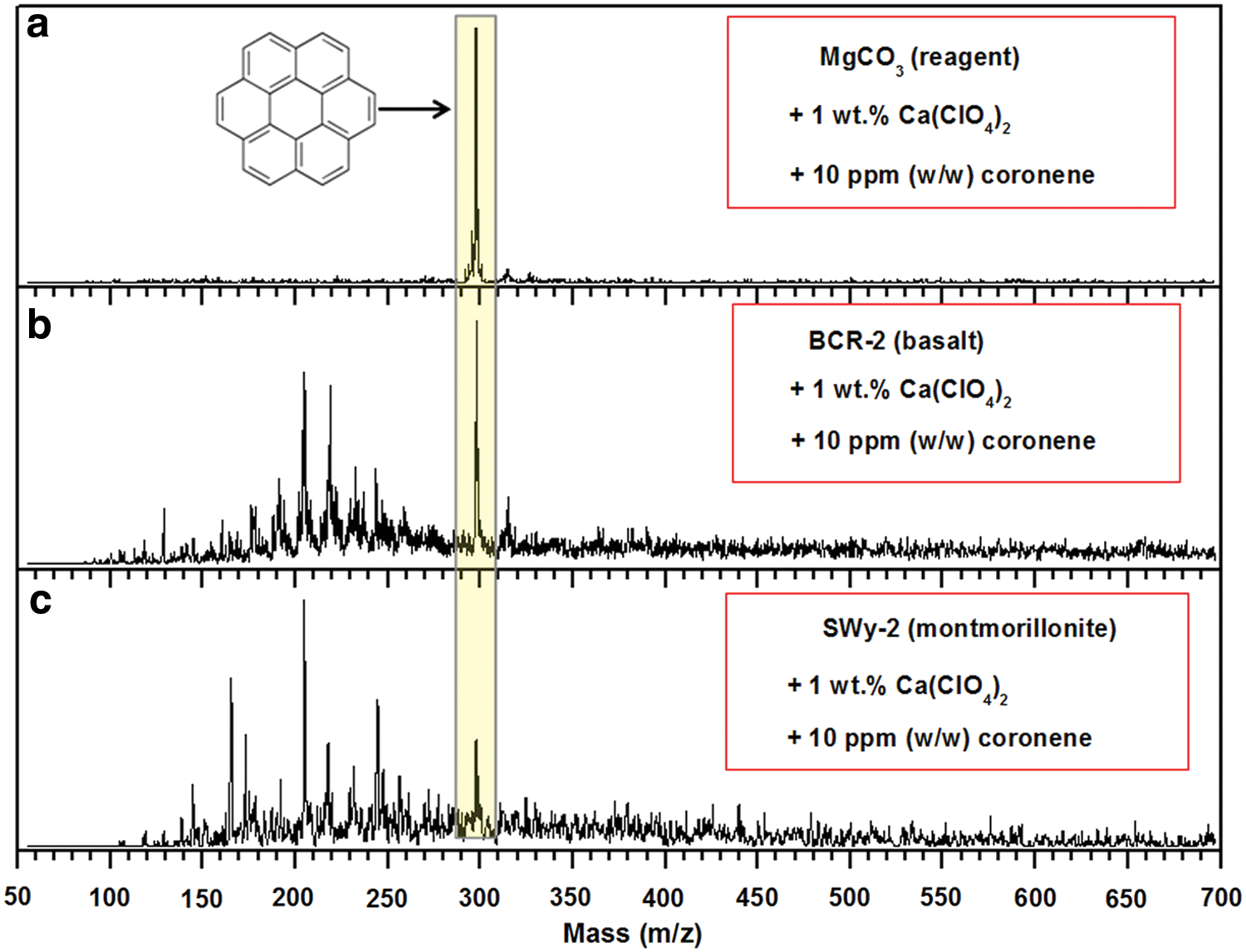
LDI mass spectra collected on MOMA-MS breadboard. (
4. Discussion
Organic-spiked mineral matrices, as well as the corresponding un-spiked minerals, were analyzed on the LTQ XL to provide a reference for comparison with the MOMA-MS breadboard instrument. As shown in Fig. 2, the negative ion spectrum (Fig. 2b) confirmed the presence of perchlorate salt, while the perchlorate salt has little contribution to the positive ion mass spectrum (Fig. 2a). In the organic-spiked samples (Fig. 2c, 2d), the positive ion spectrum exhibits organic species signals as dominant features. The fragments observed in the Rhodamine 6G spectrum are generated by the desorption/ionization event and/or from interactions during ion introduction and trapping phases. Similar results were also observed for coronene and Rhodamine 6G spiked into magnesite and montmorillonite clay (see Supplementary Fig. S1, available online at
When directly comparing the same samples between the two instruments, some differences can be observed. For example, Fig. 3b shows a clear parent ion signal for coronene as well as many additional organic fragments and mineral matrix peaks, which are absent in Fig. 2c. There are several possible reasons for the differences observed between Figs. 2 and 3. First, the MOMA instrument must operate under higher pressures of CO2 gas and with a simplified ion extraction and transfer method, typically leading to higher required laser energies compared to the LTQ XL. In addition, the MOMA laser wavelength (266 nm), which was selected for the analysis of mixed planetary surface samples with a range of absorbance, produces photons with ∼25% more energy than photons produced by the LTQ XL nitrogen laser system (337 nm).
The spectra in Fig. 3 show that the signal intensity of the organic species also depends on the characteristics of mineral matrices. For example, the MgCO3 reagent chemical contributed very low levels of additional “matrix” signals. As such, the coronene-spiked MgCO3 sample produced a mass spectrum with the cleanest background and the most evident coronene peak (compare Fig. 3a and 3c). Additional spectral contributions in complex mixed mineral samples, which can arise from inorganic (mineral) phases, native organics, or contamination, can influence the detection of a given trace organic compound. Coronene spiked into the clay sample (montmorillonite, Fig. 3c) is more difficult to resolve than the same concentration in basalt or carbonate. Matrix effects from the clay involving stronger binding to organics likely lower the ion desorption efficiency. A similar observation was previously reported in wet chemistry studies showing that extracting organics from clay matrices may be generally challenging (e.g., requiring optimized DNA extraction protocols; Direito et al., 2012).
Overall, these results demonstrate that, like the LTQ XL, the MOMA-MS breadboard has the capability for detecting trace amounts of organics in complex mineral matrices, even in the presence of perchlorate salts. On the basis of these initial characterization experiments, analog samples of increasing complexity will be studied in the near future, employing both instruments and a similar performance comparison method.
5. Conclusions
The data presented here demonstrate that the LDI technique has distinct potential benefits for detecting trace amounts of organics in mineral matrices that mimic the martian surface environment. Coupling the LDI technique to a LIT mass analyzer also provides benefits for application to future Mars missions. The overall instrument size, compatibility with higher background pressures, performance over a large mass range, and tandem mass spectrometry capabilities for structural analysis are all compelling benefits for the use of a LIT (Brinckerhoff et al., 2013). The MOMA instrument on the ExoMars 2018 rover is therefore well matched to the mission goal of detection of organics in drilled samples, in support of the search for signs of life on Mars. While MOMA detects only cations, both positive and negative ions are generated in LDI, and implementation of a negative ion mode in an LDI instrument could provide important complementary results, such as direct detection of perchlorate and electronegative organic species. In addition, the LDI technique has potential for further development and use on future missions to Mars and other planets. For example, the small laser spot size used in LDI can provide precision point-by-point analysis, offering detailed information with high spatial resolution and, thus, temporal insights into even the most complex samples. Such precision in situ detection could be used to guide the sample selection for a Mars sample return mission.
Footnotes
Acknowledgments
MOMA is a collaboration between NASA and ESA. Funding for MOMA-MS was provided by the Mars Exploration Program. We also thank Dr. Daniel P. Glavin for the valuable discussion.
Abbreviations Used
References
Supplementary Material
Please find the following supplemental material available below.
For Open Access articles published under a Creative Commons License, all supplemental material carries the same license as the article it is associated with.
For non-Open Access articles published, all supplemental material carries a non-exclusive license, and permission requests for re-use of supplemental material or any part of supplemental material shall be sent directly to the copyright owner as specified in the copyright notice associated with the article.
