




Abstract
Granitoids are silicic rocks that make up the majority of the continental crust, but different models arise for the origins of these rocks. One classification scheme defines different granitoid types on the basis of materials involved in the melting/crystallization process. In this end-member case, granitoids may be derived from melting of a preexisting igneous rock, while other granitoids, by contrast, are formed or influenced by melting of buried sedimentary material. In the latter case, assimilated sedimentary material altered by chemical processes occurring at the near surface of Earth—including biological activity—could influence magma chemical properties. Here, we apply a redox-sensitive calibration based on the incorporation of Ce into zircon crystals found in these two rock types, termed sedimentary-type (S-type) and igneous-type (I-type) granitoids. The ∼400 Ma Lachlan Fold Belt rocks of southeastern Australia were chosen for investigation here; these rocks have been a key target used to describe and explore granitoid genesis for close to 50 years. We observe that zircons found in S-type granitoids formed under more reducing conditions than those formed from I-type granitoids from the same terrain. This observation, while reflecting 9 granitoids and 289 analyses of zircons from a region where over 400 different plutons have been identified, is consistent with the incorporation of (reduced) organic matter in the former and highlights one possible manner in which life may modify the composition of igneous minerals. The chemical properties of rocks or igneous minerals may extend the search for ancient biological activity to the earliest period of known igneous activity, which dates back to ∼4.4 billion years ago. If organic matter was incorporated into Hadean sediments that were buried and melted, then these biological remnants could imprint a chemical signature within the subsequent melt and the resulting crystal assemblage, including zircon. Key Words: Hadean Earth—Biological activity—Peraluminous granites—Lachlan—Sediments—Ce anomaly—Zircon. Astrobiology 15, 575–586.
1. Introduction
W
Without the known existence of older sedimentary rocks, locating evidence for a >3.8 Ga biosphere will require nontraditional approaches. Hadean igneous rocks and detrital minerals represent the only identified material from this time period. Zircon (ZrSiO4) is a potential standout target because it represents the oldest known terrestrial material; furthermore, it retains chemical information through time. In many ways, zircon is unsurpassed in its physical and chemical durability. Multiple lines of zircon-based geochemical evidence are consistent with an early Earth that contained water-rock interaction, sediment burial, and subsequent remelting to form Hadean zircons and their host rocks (Mojzsis et al., 2001; Wilde et al., 2001; Cavosie et al., 2005; Trail et al., 2007; Harrison et al., 2008; Hopkins et al., 2008; Ushikubo et al., 2008). Other evidence for recycling of Hadean crust is found in inherited ∼4.2 and 4.079 Ga zircons incorporated into younger tonalitic rocks from the Acasta Gneiss, and Akilia Island, Greenland (Mojzsis and Harrison, 2002; Iizuka et al., 2006). In an effort to better understand how recycled biomass could possibly interact and modify the chemical properties of rocks and minerals in igneous environments (Sleep et al., 2012), the study of more modern igneous rocks that incorporated sedimentary material in the presence of an established biosphere is a logical first step. Here, we limit our study to zircon so that this research is potentially applicable to Hadean samples. Zircon is the only known datable mineral with ages that span the 3.9–4.4 Ga interval in early Earth history where known rocks are sparse or altogether absent (Harrison et al., 2005; Manning et al., 2006; Holden et al., 2009; Bell et al., 2011; Mojzsis et al., 2014).
In this study, we present a series of geochemical analyses of zircons from igneous (I-type) and sedimentary (S-type) granitoids from the Lachlan Fold Belt (LFB) located in eastern Australia. We specifically examined the oxidation state of these rocks through zircon trace-element chemistry coupled with the application of a redox-sensitive experimental calibration based on the incorporation of Ce into zircon (Trail et al., 2011, 2012). We observed that zircons in S-type granitoids formed under more reducing conditions than I-type granitoids of virtually the same age. The ultimate source of this difference (discovered in other minerals besides zircons) is believed to be from incorporation of reduced biomass located within the sedimentary material that melted to form the S-type granitoids (Whalen and Chappell, 1988). Thus, it is hypothesized that sediments with a biomass component are capable of influencing the chemical properties of zircons formed in magmas; Hadean zircons (and their inclusions) exhibiting characteristics consistent with sedimentary cycling that also grew in reduced magmas may be key targets for identifying a Hadean biosphere.
2. Overview of Field Area and Selection of Samples
As the goal of this contribution is to examine the chemical differences in zircon-forming magmas that assimilated sediments versus those that formed from remelted igneous rocks, we converged on the LFB of southeastern Australia for several key reasons. First, the S- and I-type granitoid classification was originally developed based on the chemistry and mineralogy of these rocks (Chappell and White, 1974). Southeastern Australia's geological and tectonic history make it one of the few places in the world where it is particularly easy to investigate spatially and chemically the differences between these granitoids (Clemens, 2001). This subsequently led to significant study of the rocks in this region, even though some of the views on the origins of these granites are controversial (see Section 5 for more details). The LFB granitoids were also chosen for the present study because S-type granitoids assimilated Ordovician sediments (i.e., 448–443 Ma), which formed in the presence of an established biosphere. Workers have also proposed that the input of biological matter into the sediments forming S-type granites could have contributed to their more reduced characteristics (Flood and Shaw, 1975; Clemens and Wall, 1981; Chappell and Simpson, 1984).
Many papers describe the geology and geochemistry of the LFB (e.g., Chappell and White, 1974; White and Chappell, 1983; Chappell, 1984; Foster and Gray, 2000; Hawkesworth and Kemp, 2006); we provide only a brief review here that highlights some key details. The LFB hosts a range of igneous rocks that includes over 400 different granitoid plutons, most with ages from 420 to 390 Ma (White and Chappell, 1983; Chappell, 1984). To describe and classify these rocks, Chappell and White (1974) proposed two lithological groups that outcrop in roughly equal proportions: S- and I-type granitoids. One goal of these workers was to classify igneous rocks based on the source rock type, which is also the distinction we wish to make in this study.
Sedimentary-type granitoids are formed partially from melting of weathered sedimentary or igneous material, whereas I-type granitoids are produced in part from the remelting of igneous material that did not experience a weathering cycle (e.g., crystal fractionation or partial melting of a preexisting mafic rock would satisfy this criterion). This distinction is based on petrographic, chemical, and isotopic differences among the two groups. S-types typically display peraluminous bulk composition (Al/[Na+K+2Ca]>1.1 molar) and are depleted in seawater-soluble elements Na, Ca, and Sr relative to I-type granitoids. Chappell and White (2001) proposed that the depletion of these elements in S-type samples is the result of weathering processes. S-types may contain aluminous phases (e.g., cordierite, garnet, or muscovite), and they may also contain metasedimentary enclaves. I-types, by contrast, are often metaluminous in bulk composition (Al/[Na+K+2Ca]≤1.1 molar), are generally hornblende-saturated, and may contain mafic enclaves. Isotope systematics also reveals differences: I-types have δ18O whole rock values <10‰ (VSMOW), and S-types are >10‰ (O'Neil and Chappell, 1977), whereas isotope ratios such as 87Sr/86Sr have some overlap (0.704–0.712 for I-types; 0.708–0.717 for S-types; Chappell and White, 2001). Modern geochemical and petrological studies have demonstrated that most granitoids experience complex geochemical evolution beyond the simple I- and S-type end-member scenarios (Clemens and Wall, 1981; Holtz and Barbey, 1991; Gerdes et al., 2002; Appleby et al., 2010). Nevertheless, for the purposes of this contribution, the S- and I-type notation remains a valid classification, as it identifies fundamental differences in the properties of the source rocks (Fig. 1).

Simplified schematic of a subduction zone that shows the early formation conditions of igneous- and sedimentary-type granitoids. Remelted rocks that have not experienced a weathering cycle are termed I-types (e.g., see the rectangular boxed region on the left of the figure). The second group (see the right rectangular box) represents the early stages of the formation S-type granitoids by the melting of sediments, which may contain organic matter.
We also analyzed a single sample from a volumetrically smaller A-type granitoid group in the LFB (Table 1). Alkaline or anorogenic (A-type) granitoids are believed to be formed from melting of the lower crust (Collins et al., 1982; Clemens et al., 1986; Whalen et al., 1987) and have typically lower water contents when compared to S- and I-types; for our purposes, they are most comparable to the I-type sample group and are therefore grouped together during the discussion.
3. Methods and Zircon Data Collection
It has been demonstrated that many zircons contain a (chondrite-normalized) excess of Ce relative to La and Pr. This excess is attributed to the multivalent behavior of Ce in terrestrial magmas—as Ce can exist in both the tetravalent and trivalent state—while La and Pr are only found in the trivalent states. Tetravalent Ce is very compatible in the zircon lattice relative to La3+, Ce3+, and Pr3+, which results in a positive Ce anomaly in zircons. The magnitude of this anomaly ([Ce/Ce*]CHUR=CeCHUR/√[LaCHUR×PrCHUR]), where CHUR represents chondrite-normalized values, depends on the Ce4+ content in the crystallizing magma; it follows that more-oxidizing magmas will contain a higher abundance of Ce4+, and therefore the resulting zircons will have larger Ce anomalies. Laboratory experiments have demonstrated that zircon Ce anomalies increase as a function of oxygen fugacity, and Trail et al. (2011, 2012) developed an empirical calibration to calculate the oxygen fugacity of a magma based on zircon Ce anomalies. These experiments also revealed that the magnitude of a zircon Ce anomaly is also temperature-dependent. Zircon crystallization temperatures can be determined by measuring Ti contents and then applying the experimental calibration relating Ti solubility in zircon to crystallization temperature (Watson and Harrison, 2005; Watson et al., 2006; Ferry and Watson, 2007). Application of these two experimental calibrations (e.g., Ce/Ce* vs. oxidation state and Ti-in-zircon thermometry) can be used in conjunction to determine the oxidation state of zircon-saturated magmas of the granitoids explored here (see Trail et al., 2012, 2013, for review of the experimental methodology).
Zircons were extracted from igneous samples by standard crushing and heavy mineral separation techniques. Grains were mounted in ∼2.5 cm epoxy rounds and polished to 1 μm in preparation for laser ablation inductively coupled plasma mass spectrometry (LA-ICP-MS) analysis. Prior to trace element analysis, grains were soaked and sonicated in cold hydrofluoric acid (HF) for ∼10 min; the goal was to clean the zircons and remove HF-soluble inclusions exposed at the surface that could interfere with trace element analysis (crystalline zircon is insoluble in cold HF). A small fraction (∼10%) of the grains were lost from the epoxy during this procedure, but the remaining grains were much cleaner; that is, optical inspection showed that many of the inclusions were removed during this cleaning step. Additional care was taken to select clean analytical regions on the grains; while zircons with inherited cores are rare in I-types, most zircons in S-type samples contain an older core that did not completely dissolve during granitoid genesis (Williams, 1992). This is a well-known phenomenon; zircons survive the sediment melting process because the mineral has slow kinetics of dissolution and because S-type sources have relatively high Zr contents when compared to the Zr needed for zircon saturation in magmas of crustal composition (Harrison and Watson, 1983; Watson and Harrison, 1983; Boehnke et al., 2013). Thus, zircons were screened by reflected light and cathodoluminescence imagery. Inherited core regions were avoided during analysis because the goal of this study was to characterize the chemical state of the melted rocks that eventually crystallized these zircons, rather than some preexisting rock. In this study, only rims were analyzed, and no post-analysis geometric filtering of the laser ablation data was conducted.
All zircon analyses were carried out on an ICP-MS Bruker 820-MS (formerly Varian) quadrupole mass spectrometer outfitted with a Photon Machines 193 nm eximer laser housed at Rensselaer Polytechnic Institute. Analysis employed a laser spot size of 30 μm, with a mass table (and detection limit) consisting of 49Ti (detection limit=0.5 ppm), 57Fe (4 ppm), 44Ca (90 ppm), 139La (0.003 ppm), 140Ce (0.005 ppm), and 141Pr (0.002 ppm), 145Nd (0.05 ppm), 147Sm (0.04 ppm), 153Eu (0.008 ppm), 157Gd (0.04 ppm), 163Dy (0.03 ppm), 166Er (0.02 ppm), and 175Lu (0.01 ppm). The elements Fe and Ca are not structurally accommodated by the zircon lattice in appreciable quantities and were analyzed because they are common elements in inclusions and are also found in altered zircon regions, such as cracks, radiation-damaged zones, or fluid-altered regions that do not reflect primary magma chemistry (e.g., Rayner et al., 2005; Geisler et al., 2007). These elements thus serve as a monitor of contaminants during laser ablation; approximately 5% of the grains analyzed exhibited features of contamination and were therefore not considered further. Laser fluence was set at values from 5.6–9 J/cm2 with a pulse rate of 10 Hz, and a He carrier gas (flow rate=0.7 L/min) was used to transport the analyte from the laser ablation sample chamber to the mass spectrometer. Laser ablation was carried out over a ∼30 s counting period, with a background counting period of 35–45 s before and after each ablation (e.g., a total mass spectrometer counting period of 100–120 s). Mass 29Si was used as an internal standard, and concentration was standardized against NIST612 glass (Pearce et al., 1997). A secondary in-house zircon standard believed to be from the same locality as 95100 was also analyzed along with unknowns. Data were reduced with the Iolite software package (Woodhead et al., 2007; Paton et al., 2010).
4. Results
A total of 289 zircons were analyzed in this study: 128 zircons from S-types, 134 zircons from I-types, and 27 zircons from a single A-type granitoid. A results summary is provided in Table 2, which represents averages of all analyses from each granitoid sample (individual grain analyses can be found in the Supplementary Material, available online at
Number of grains analyzed.
Temperatures calculated using titania/silica activities of 0.7/1.
Average chondrite-normalized rare earth element (REE) zircon patterns for S-, I-, and A-type granitoids are plotted in Fig. 2. Experimental calibrations show that Ce anomalies vary as a function of crystallization temperature (Trail et al., 2011, 2012), but since the zircon crystallization temperatures of the S- and I-type granitoids appear to be indistinguishable, the Ce anomalies are qualitatively comparable. In this regard, it is clear from careful visual inspection of Fig. 2 that Ce anomalies are more pronounced in I-type granitoids (note that data are represented on a log scale). Quantitatively, the Ce anomalies of zircons from S-type rocks range from an average of 17 to 23, while those from I-type samples range from an average of 45 to 57. A direct comparison of the single A-type granitoid is less straightforward because zircons in this sample crystallized at a higher temperature, which means that a direct comparison of Ce anomalies among these zircons is not meaningful. That said, Ce anomalies in this A-type sample are muted; the value of 13 is close to Ce anomalies found in the S-type suite.
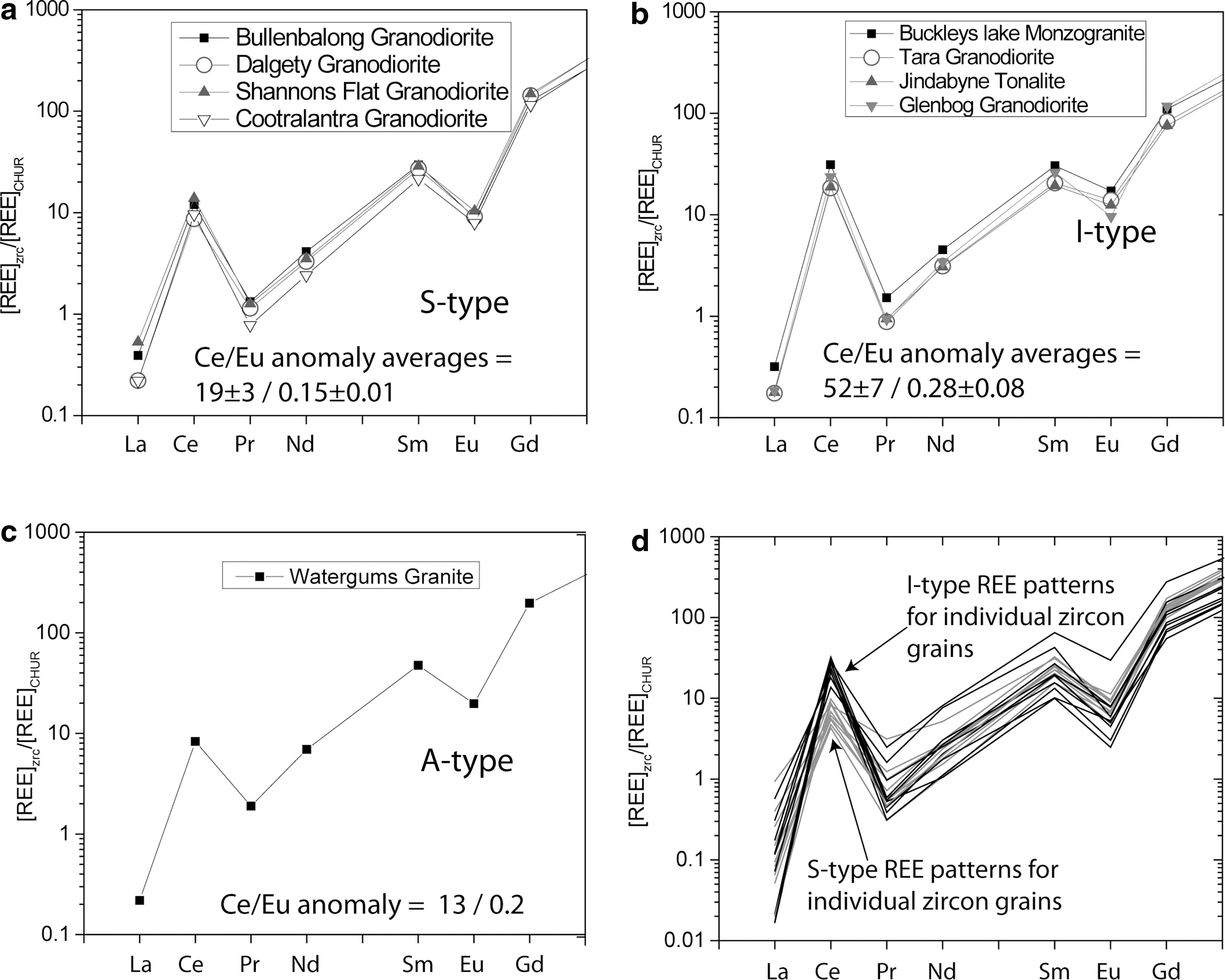
Chondrite-normalized REE patterns for igneous zircon. (
The oxygen fugacity of granitoid melts was calculated from La, Ce, and Pr zircon contents (and crystallization temperature). In some cases, La content (required to estimate the magnitude of a zircon Ce anomaly) is at or below the LA-ICP-MS detection limit. Rather than exclude these analyses (or estimate an unrealistic Ce anomaly), zircon data from individual granitoid samples were summed and averaged to estimate the oxygen fugacity. The calculated oxygen fugacity is presented as the difference in log units from the fayalite-magnetite-quartz buffer (FMQ buffer; i.e., 3Fe2SiO4+O2↔2Fe3O4+3SiO2), which is a common and well-characterized oxygen fugacity reference. For example, FMQ+1 represents an oxygen fugacity that is one log unit above the FMQ buffer. Oxygen fugacity errors for granitoid samples are determined by taking the standard deviation of the oxygen fugacities calculated from individual zircons with La concentrations above the detection limit.
The oxygen fugacities calculated for individual granitoids are plotted in Fig. 3 (relative to the FMQ buffer). As a point of reference, the oxygen fugacity of Earth's mantle through time is generally believed to be within FMQ±2 (Canil, 1997, 2002; Li and Lee, 2004; Trail et al., 2011). Here, zircons from S-type granitoids (i.e., those that assimilated a supracrustal source) record oxygen fugacities that range from FMQ-1.9 to FMQ-0.8 (average=FMQ-1.45). I-type granitoids, by comparison, range from FMQ+0.7 to FMQ+2.4 (average=FMQ+1.93). The most important and fundamental observation from the analysis of zircons (as presented in Fig. 3) is that grains from S-type and I-type granitoids record distinctly different groupings in redox state. It should also be noted that, while zircons from A-types record Ce anomalies that are smaller than I-types, the calculated oxygen fugacity of FMQ+1.7 is within the range of values for I-types. These zircons crystallized at higher temperature, which results in smaller Ce anomalies for an equivalent oxygen fugacity (Trail et al., 2011, 2012).
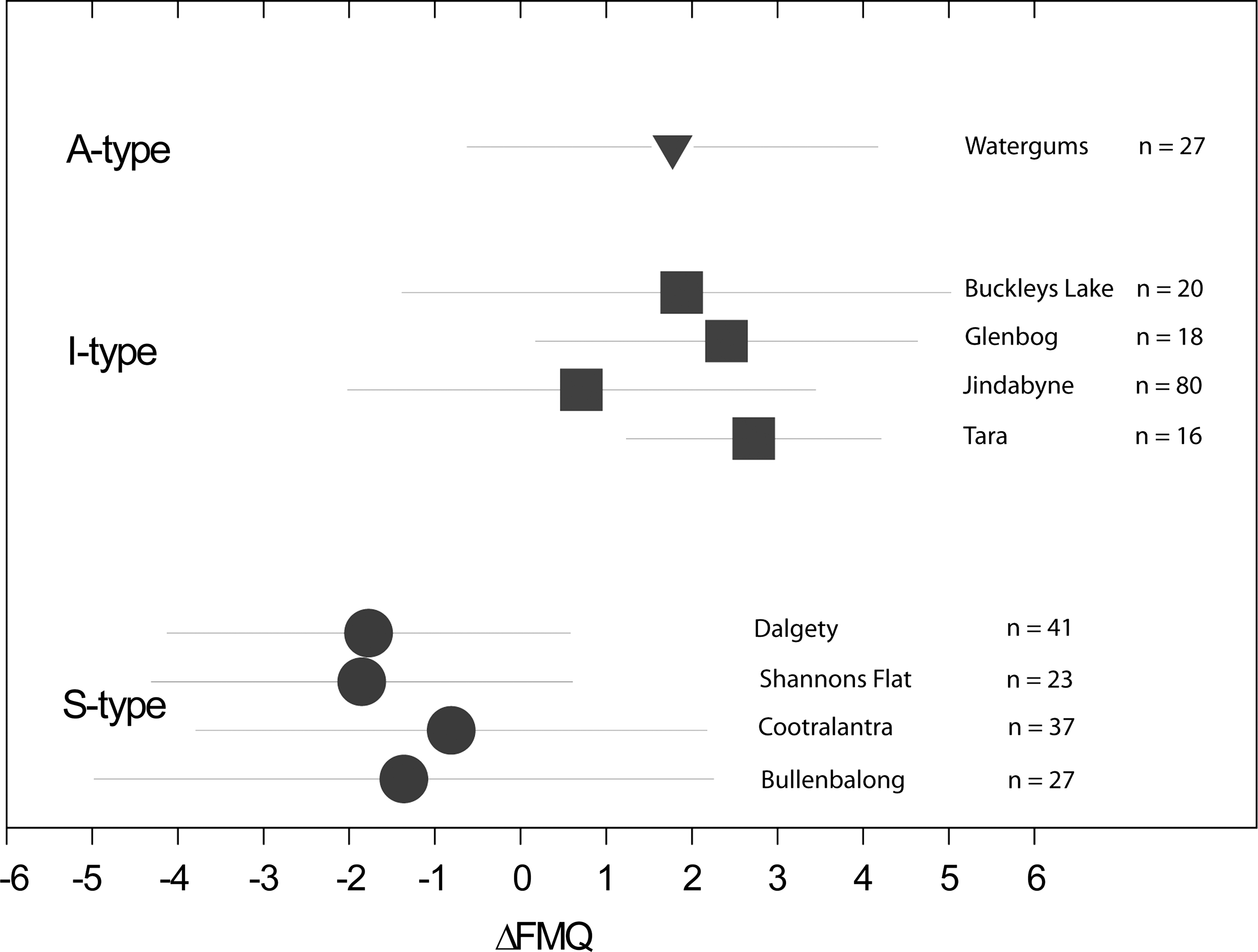
Oxygen fugacities from S-, I-, and A-type granitoids calculated using zircon crystallization temperatures and Ce anomalies. The results show a clear grouping, where the S-types are more reduced than the I-types. The A-type sample has a calculated oxygen fugacity that is in close agreement with I-type samples.
Experiments have also demonstrated that zircon Eu anomalies also vary as a function of oxygen fugacity (Burnham and Berry, 2012; Trail et al., 2012). A larger negative Eu anomaly implies more-reducing conditions due to the increased presence of Eu2+, which is very incompatible in zircon. However, the value of zircon Eu anomaly-based redox calculations is of limited value because feldspars deplete the melt in bulk Eu content, meaning that Eu anomalies in zircon depend on at least two variables: the magma oxygen fugacity and the abundance of feldspars. That said, samples with a larger Ce anomaly also contain smaller Eu anomaly, meaning that Ce/Eu anomalies are qualitatively consistent (Table 2).
5. Discussion
5.1. Origin of the Lachlan Fold Belt source rocks
Before discussing the possible influences of the incorporation of organic matter into S-type granitoids and possible implications for Hadean Earth, we first turn our attention to some of the arguments that have been developed surrounding the origins of these rocks that readers should be aware of when considering our data. Chappell and White (1974, 2001) essentially argued that the LFB granitoids “image” their source rocks, whether sedimentary or igneous in origin. This model was proposed because LFB granitoids have properties that broadly fall into two distinct groups and are therefore interpreted to result from partial melting of two kinds of aforementioned source rocks (this is known as the restite model). Evidence to support this view takes many forms; for example, there is a lack of sedimentary enclaves in I-type rocks, whereas S-type rocks contain supracrustal enclaves carried from depth (White et al., 1999). Williams (1992) also noted that zircons from S-types almost always contain older relic cores; this is the expected result, as zircons are often found “enriched” in sediments relative to igneous rocks due to high physical and chemical durability. The low rate of zircon dissolution also implies that grains are capable of surviving crustal anatexis and magma genesis without completely dissolving (Watson, 1996). In contrast, zircons with inherited cores are rare in I-type samples. Chappell and White (1974, 2001) also identified key differences in seawater-soluble elements (e.g., Na, Sr) as well as Sr/Nd isotopic differences among their two proposed classes of rocks.
Others have challenged this model, as explored above, by invoking more complex interactions between melt generation and crustal assimilation in granitoid genesis (e.g., Clemens and Wall, 1981; Clemens, 2001). While these researchers recognize the physical and chemical differences between I-type and S-type LFB granitoids, they also point out that the restite model is not a unique solution that describes how the granitoid chemical variations might have arisen. For instance, Clemens (2001) interpreted the sedimentary enclaves found in S-type granites as midcrustal xenoliths that do not significantly contribute to the chemical makeup of S-types. Furthermore, even though restitic zircons are found in S-types, this does not necessarily imply an equally substantial component of other assembled material. The isotopic arguments against the restite model are typically derived from the interpretation of mixing model arguments. For instance, Keay et al. (1997) proposed that the isotopic compositions of the granitoids they studied were derived from a mixture of three different source materials, two igneous and one sedimentary. Similar isotope mixing arguments were also proposed by Gray (1984), who argued that all granites are from a single broad family and that differences represent variable mixing of basaltic material (or materials) and the regional basement in different proportions.
Despite these uncertainties, most workers accept that S- and I-types exhibit distinct chemical characteristics. Even though the origin of the enclaves is not agreed upon, the fact that hornblende-bearing enclaves occur in the I-type granites and metasedimentary enclaves are seen in the S-type granites suggests some distinction among the sources. It is generally accepted, however, that sedimentary material will end up in I-type samples (either from local country rock origin, or via other means) and vice versa. In light of these differing views, and in spite of nomenclature, it should be noted that S-types do not unequivocally mean that sediments were incorporated in the melts. These points should be kept in mind when considering the meaning of the zircon data we present here.
5.2. Trace elements in Lachlan Fold Belt zircons and implications for Hadean Earth
The trace element composition of zircons from LHB granitoids records different chemical features caused by incorporation of diverse materials into the melts. In this regard, we are especially interested in how residual biological material—in the form of organic matter in the recycled crustal sediments—has influenced the chemical properties of the newly formed rocks and minerals. This idea itself is not new; for instance, the presence of carbonaceous material in S-type rocks, including partially melted sediments (metapelites), is well documented in many locations on Earth. (e.g., Zeck, 1992; Luque et al., 1993; Kanaris-Sotiriou, 1997; Cesare et al., 2003; Lindgren and Pamell, 2006). In the LFB, the mineralogical variations in S- and I-types were the first piece of information used to argue for the presence of organic matter in S-type samples. Since Earth's atmosphere contained oxygen at this time, sediments might have been either oxidized or reduced. Whalen and Chappell (1988) suggested that that S-type granitoids are more reduced because they contain ilmenite (an Fe2+-bearing mineral), whereas I-types can contain magnetite (a mixture of Fe3+ and Fe2+); by inference, these authors suggested that reduced sediments such as black shales were assimilated by the S-type granites. K feldspars in I-type granites sometimes appear pink due the presence of micro-inclusions of magnetite. In contrast, unweathered K feldspars in S-type granites are always white because the host magmas were not oxidized enough to stabilize sufficient Fe3+ for magnetite saturation (Chappell and White, 2001). This was also supported by the presence of pyrrhotite (S2-) in the more reduced S-types, whereas S measured in apatite from I-type granitoids is believed to be in the hexavalent state. (Whalen and Chappell, 1988; Sha and Chappell, 1999). In oxidizing I-type magmas, more S occurs as S6+, which can be structurally accommodated in the phosphorus site of apatite, but in reducing S-type magmas, S mainly occurs as S2-, which results in sulfide crystallization. This observation is consistent with experimental studies that have demonstrated an increase in the concentration of S6+ in silicate magmas at oxygen fugacites greater than FMQ (Klimm et al., 2012).
Based on these lines of evidence, it was concluded that more reducing crystallization conditions existed during the formation of S-type magmas (vs. I-types); this difference was attributed to the incorporation of organic matter into the sedimentary source rocks (Flood and Shaw, 1975; Clemens and Wall, 1981; Chappell and Simpson, 1984). In this scenario, it is the “buffering capacity” of the organic matter—that is, the cumulative capacity for the organic matter to serve as an electron acceptor—that exceeds the buffering capacity of any oxidized sedimentary material formed by interaction with the atmosphere (e.g., hematite). In other words, if oxidized sedimentary components dominated, then S-type granitoids would be more oxidized than I-types. However, it is possible that the S-type granites analyzed in this study did not contain (reduced) organic material. If this is the case, then there must be an alternative explanation for why multiple lines of evidence suggest that S-type samples are more reduced than I-type rocks. One possibility is that organic matter was oxidized (e.g., CO2, SO2) during S-type magma genesis, but the decrease in magma redox state was preserved (i.e., the system remained broadly closed). Another possibility is that the S-types sampled source material that is simply more reduced, and therefore does not require organic matter to explain the results.
Nevertheless, our results demonstrate that zircon chemistry (in particular the Ce anomaly) further supports a more reduced source for S-type rocks. Because this work shows that zircon is sensitive to the chemical nature of its melt source, this general observation has important implications for the study of early Earth processes. There are no known sedimentary rocks from prior to 3.82 Ga (e.g., Manning et al., 2006); however, there are several lines of evidence that suggest Earth may have settled into a pattern of crustal sedimentary recycling similar to today. Oxygen isotope studies of some Hadean zircons, for instance, yield elevated δ18O values that are consistent with a protolith that experienced at least one weathering cycle (Mojzsis et al., 2001; Wilde et al., 2001; Cavosie et al., 2005; Trail et al., 2007). Additionally, Ti contents of Hadean zircons reveal crystallization temperatures that are consistent with derivation from melts at or near water saturation (Watson and Harrison, 2005). Others have also suggested that the Li concentrations and isotopes can be used to infer extensive weathering in the Hadean (Ushikubo et al., 2008) and that the source melts of some Hadean zircons included remelted clay-rich material (Hopkins et al., 2008). In other words, there are multiple lines of evidence that Hadean zircons (and LFB zircons) were formed from at least some material that interacted with the surface or near-surface environment.
Accepting for the moment that some material that generated the source melts of ancient zircons did interact with the near-surface environment, how might we search for evidence of biosphere-lithosphere interactions in the Hadean? Unlike the more “modern” example explored here, there are many unconstrained or underconstrained variables that could influence the Hadean magma oxidation state. For instance, there is a high degree of confidence that the earliest atmosphere and oceans were more reducing than those of modern times (e.g., Pavlov and Kasting, 2002; Mojzsis et al., 2003; Bekker et al., 2004). In this case, incorporation of oxidized surface material and its subsequent influence on the oxidation state of the generated magma would have been limited.
It is well accepted that the early Earth impactor flux was higher than that of modern times, even though the mass, frequency distribution, and type of impactors (e.g., comet vs. asteroids) are still topics of debate (Ryder, 2002, 2003; Gomes et al., 2005; Strom et al., 2005; Abramov and Mojzsis, 2009; Morbidelli et al., 2012). If these materials were sufficiently reduced and subsequently incorporated into magmas in appreciable quantities, then this material would also serve as an electron acceptor, thus leading to reduced magmas.
It is less straightforward to uniquely identify reduced magmas generated in this manner (if they existed) versus reduced magmas that are the product of reprocessing of biologically generated organic material. Friend et al. (2008) successfully used REE+Y contents to investigate chemical sedimentation in the Archean; with the appropriate zircon-melt REE+Y partitioning studies, it might be possible to search for evidence of banded iron formation or shale contamination of Hadean magmas. Biological processes leading to modestly oxidized environments might also fractionate redox-sensitive actinides such as Pu or U from tetravalent Th in zircon (Harrison, 2009; Sleep et al., 2013). Another possible solution is to examine the isotopic systems in which exogenous sources are distinct from terrestrial materials. For instance, Willbold et al. (2011) suggested that tungsten isotope ratios of ancient rocks from Greenland are distinctly different from the tungsten isotopic composition of the modern Earth samples; these workers used this line of reasoning to argue that exogenously sourced material “contaminated” the isotopic composition of these ca. 3.8 Ga rocks. It may be worth investigating the isotopic character of ancient zircons (W isotopes or other isotopic systems/elements), in concert with the redox state of the magmas. For instance, evidence for reduced melts that also show evidence for an exogenous isotopic anomaly could yield interesting constraints on the earliest delivery of material. That said, a zircon from a reduced melt in the absence of any isotopic anomaly could, in principle, be consistent with a biologically contaminated host rock.
Available REE and Ce anomaly data in Hadean zircon (Cavosie et al., 2006) suggest there might be a weak correlation between the redox state of Hadean magmas and the δ18O values of the same zircons (see Trail et al., 2013, for discussion). Earth's Hadean crust might not have been strongly oxidized when compared to the mantle. Specifically, zircons that preserve δ18O values consistent with crystallization from mantle-derived source melts (∼5.3‰) are generally more oxidized than samples that have δ18O values of ∼7‰, which are consistent with surface contamination (Trail et al., 2013). Even though a subset of the Hadean zircon population does in fact appear to be from reduced magmas (Trail et al., 2011; Yang et al., 2014), the small number of data along with the errors associated with these oxygen fugacity calculations prohibits a more robust evaluation of this result. Igneous minerals exhibiting reduced characteristics that also have trace element or isotope signatures suggesting a sedimentary protolith may be important targets for revealing the chemical traces of ancient biological activity. The Hadean biosphere would likely not have been equivalent in size to that of present-day Earth, so there is a good possibility that any possible influence on Hadean magma chemistry would be subdued when compared to the S-type granitoids of the LFB.
6. Concluding Remarks
This work explores how biological activity might modify the distribution of trace elements within the crust and mantle and how these signals could be detected in the rock and mineral record. In particular, we focused on the mineral zircon and the element Ce, an element that is variably compatible depending on the conditions of formation. Both the mineral and the element are unlikely targets; zircon often forms in igneous environments and is therefore traditionally viewed as having limited application to understanding the processes of biology, while Ce is not known to serve any particular major function in biological processes.
Here, we examined zircons formed in granitic melts derived by partial melting of sediments and a complementary zircon population from granitic melts formed by remelting of igneous rocks. We found that the concentration of Ce in zircon, which is a redox-sensitive element (and therefore variably compatible in minerals in general), is demonstrably different among these two rock types. Cerium contents (or more appropriately Ce anomalies) are, in aggregate, lower in S-type samples when compared to I-type samples. Since Ce is less compatible in zircon under reducing conditions, the S-type samples are more reduced. This difference is possibly due to the incorporation of organic matter from sediments into S-type magmas. Different lines of evidence for these same rocks have led workers to come to similar conclusions, but to the best of our knowledge, this is the first evidence that suggests that the chemistry of igneous zircon can also be affected by the recycling of organic matter.
This example represents a reasonably well understood terrain, and these early results may help us understand ancient zircon samples, especially those that survive sedimentary cycling and do not reside in their host rock. The study of zircon chemistry may provide a new, albeit highly obscured, window for the search for biological activity on Hadean Earth. This remains an important target because the earliest history of our planet is only represented by these zircons and their mineral inclusions, though note that the diamond “inclusions” found within Jack Hills zircons were later discovered to be contamination (Dobrzhinetskaya et al., 2014). Admittedly, the path to a unique interpretation is complex, but unless >3.82 Ga sediments are discovered, this remains the only direct source of material to probe for the existence of a Hadean biosphere.
Footnotes
Acknowledgments
This work was supported by the NASA Astrobiology Institute grant no. NNA09DA80A to RPI and by NSF Grant No. EAR-1447404 to D. Trail. We wish to thank M.T. and G.T. “Banger” for their hospitality during the field work portion of this study. We also thank William Amidon and Mary Roden-Tice for access to their laboratories. LA-ICP-MS work was made possible through the generosity of F. Dale Corman. Reviews from Aaron Cavosie and an anonymous reviewer greatly improved this paper. Comments from Senior Editor Norm Sleep are also greatly appreciated.
Author Disclosure Statement
The authors declare that no competing financial interests exist.
Abbreviations Used
References
Supplementary Material
Please find the following supplemental material available below.
For Open Access articles published under a Creative Commons License, all supplemental material carries the same license as the article it is associated with.
For non-Open Access articles published, all supplemental material carries a non-exclusive license, and permission requests for re-use of supplemental material or any part of supplemental material shall be sent directly to the copyright owner as specified in the copyright notice associated with the article.
