




Abstract
Abundant evidence indicates that significant surface and near-surface liquid water has existed on Mars in the past. Evaluating the potential for habitable environments on Mars requires an understanding of the chemical and physical conditions that prevailed in such aqueous environments. Among the geological features that may hold evidence of past environmental conditions on Mars are weathering profiles, such as those in the phosphorus-rich Wishstone-class rocks in Gusev Crater. The weathering profiles in these rocks indicate that a Ca-phosphate mineral has been lost during past aqueous interactions. The high phosphorus content of these rocks and potential release of phosphorus during aqueous interactions also make them of astrobiological interest, as phosphorus is among the elements required for all known life. In this work, we used Mars mission data, laboratory-derived kinetic and thermodynamic data, and data from terrestrial analogues, including phosphorus-rich basalts from Idaho, to model a conceptualized Wishstone-class rock using the reactive transport code CrunchFlow. Modeling results most consistent with the weathering profiles in Wishstone-class rocks suggest a combination of chemical and physical erosion and past aqueous interactions with near-neutral waters. The modeling results also indicate that multiple Ca-phosphate minerals are likely in Wishstone-class rocks, consistent with observations of martian meteorites. These findings suggest that Gusev Crater experienced a near-neutral phosphate-bearing aqueous environment that may have been conducive to life on Mars in the past. Key Words: Mars—Gusev Crater—Wishstone—Reactive transport modeling—CrunchFlow—Aqueous interactions—Neutral pH—Habitability. Astrobiology 15, 1060–1075.
1. Introduction
A
Champagne received two RAT abrasions and analyses (included in table). NR = Not reported, no depth has been reported for Champagne RAT 1. Only one RAT operation was performed on Wishstone, and no analysis of the unbrushed surface was conducted. Depth data from Arvidson et al. (2006) and chemical data from Brückner et al. (2008).
To further investigate the aqueous conditions under which Wishstone-class rocks may have weathered, with implications for more widespread weathering conditions and phosphorus mobility on Mars, we have applied reactive transport modeling to quantitatively interpret weathering profiles on Wishstone-class rocks. Our modeling results suggest that the weathering profiles in Wishstone-class rocks may indicate dissolution of multiple phosphate minerals by near-neutral waters, with important implications for the past habitability of Mars.
2. Background
Weathering profiles, persistence of primary minerals, and mineral alteration products from weathering of martian rocks are the result of a combination of chemical (e.g., mineral dissolution kinetics, thermodynamics, solution pH, reactive surface area) and physical (e.g., porosity, tortuosity, mineralogy) factors. They are indicators of past aqueous conditions that occurred, such as the pH and duration of water/rock interaction (Elwood Madden et al., 2004; Klingelhöfer et al., 2004; Papike et al., 2006; Stopar et al., 2006; Olsen and Rimstidt, 2007; Hausrath et al., 2008a, 2008b, 2011; Elwood Madden et al., 2009; Hecht et al., 2009; Hausrath and Olsen, 2013; Gainey et al., 2014; Grotzinger et al., 2014). Many of the rocks investigated by the MER science instruments show evidence of weathering and dissolution of minerals from rock surfaces and thus may hold clues to past weathering environments (e.g., Arvidson et al., 2006; Squyres et al., 2006b). Among these rocks are the Wishstone-class rocks encountered by the MER Spirit at Gusev Crater. Wishstone-class rocks comprise the dominant population of float rocks encountered by Spirit on the northwest flank of Husband Hill and are common among the float rocks of Cumberland Ridge in the Columbia Hills region (Arvidson et al., 2006; Squyres et al., 2006a). The Miniature Thermal Emission Spectrometer (Mini-TES) classified over 95 Wishstone-class rocks at Columbia Hills (Ruff et al., 2006), although only two rocks of the class, Wishstone and Champagne, were subjected to the full MER Spirit analysis package. No source or outcrop for the rocks has been identified, and the exact petrogenesis of the rocks has not been conclusively established. Elemental analysis by the Alpha Particle X-ray Spectrometer (APXS) of Wishstone-class rocks (i.e., Wishstone and Champagne) showed them to be typified by high phosphorus (∼5% P2O5) and low Cr (below detection limit) (Gellert et al., 2006; Ming et al., 2006) (Supplementary Table S1). The MER science package allowed for only limited direct mineralogy measurements by Mini-TES or by Mössbauer of Fe-containing phases. Thus, the exact mineralogy has not been determined, although a number of studies suggest mineralogies for the class based on differing assumptions (Hurowitz et al., 2006b; McSween et al., 2006, 2008; Ming et al., 2006, 2008; Usui et al., 2008) (Supplementary Table S2). The phosphorus concentrations of the rocks are considered high for common basaltic rock (Ming et al., 2006; Squyres et al., 2006a), although the phosphorus-rich basalt flows (up to 2.9 wt % P2O5) (Kuntz et al., 1992) of Craters of the Moon National Monument (COTM) in Idaho, USA, have been suggested as plausible analogues for the martian rocks (Usui et al., 2008). Images from Spirit's Microscopic Imager (MI) show some angular grains present in the rocks, and combined with the lack of outcrop, the rocks have also been suggested to be pyroclastic in origin or possibly impact breccias (Squyres et al., 2006a) rather than basalts.
The Wishstone-class rocks in which the surfaces and near-surface materials are depleted in Ca and P relative to their interiors are of particular interest. These chemical profiles have been interpreted to suggest that a Ca-phosphate mineral has been dissolved out of the surfaces of the rocks (Hurowitz et al., 2006a; Ming et al., 2006). Measurements of Ca and P exist from APXS analyses of two Wishstone-class rocks (Wishstone and Champagne) of “as is” surfaces, brushed surfaces, and Rock Abrasion Tool (RAT) abraded surfaces. The analyses indicate ∼25% less Ca and 50% less P in the brushed surfaces of the rocks than in the interiors (Gellert et al., 2006; Brückner et al., 2008) (Table 1). It is also notable that the APXS measurements are very consistent between the two rocks, and the P measured by APXS at the brushed surfaces of both Wishstone and Champagne (Wishstone = 2.64 wt % and Champagne = 2.63 wt % P2O5) are nearly identical (Table 1).
Ratios of the Ca and P depletions suggest that the dissolved Ca-phosphate mineral is likely apatite or merrillite (Hurowitz et al., 2006a; Ming et al., 2006). This is consistent with martian meteorites where the dominant primary phosphates are merrillite and apatite minerals (McSween and Treiman, 1998), often found coexisting. Most of the apatite in martian meteorites is chlorapatite, although fluorapatite dominates in a few settings (McCubbin and Nekvasil, 2008). The secondary mineral brushite (CaHPO4·2H2O) is also consistent with the Ca and P ratio of the elemental losses (Hurowitz et al., 2006a), and secondary phosphate minerals are present on Mars. Fe phosphates have been suggested in Paso Robles soils based on Mössbauer data, specifically ferristrunzite, strengite, and ferrian giniite (Lane et al., 2008; Hausrath et al., 2013). Because of overlapping features, the confident identification of phosphate minerals by Mössbauer alone in the presence of sulfates is difficult (Dyar et al., 2014). Nonetheless, secondary/altered phosphate minerals are likely on Mars. However, brushite is not favored as part of the Wishstone mineralogy on the basis that the rock class appears to be less altered than other rocks in Columbia Hills (Ming et al., 2006). Additionally, on Earth, brushite commonly forms in the presence of acidic, phosphorous-rich solutions in contact with limestone (Fiore and Laviano, 1991; Usui et al., 2008). Calcite or other carbonates have not been observed in large quantities at Gusev Crater by Mini-TES (Ruff et al., 2006; Morris et al., 2010).
Previous work has suggested that Wishstone-class profiles could be the result of highly acidic weathering. Wide-spread acid vapor or acid fog alteration has been suggested for Mars (Settle, 1979; Banin et al., 1997; Tosca et al., 2004; Golden et al., 2005; Hurowitz et al., 2006a; Yen et al., 2008; Hausrath and Tschauner, 2013; Hausrath et al., 2013). From the kinetics of fluorapatite dissolution, Hurowitz et al. (2006a) suggested that the observed chemical profiles in the Wishstone rocks might have been caused by episodic leaching events, initiated by volcanically generated acid fogs. Gellert et al. (2004) also suggested that the profiles are the result of acidic conditions, based on laboratory observations of powdered martian meteorites interacting with dilute acids under sonication (Dreibus et al., 1996). In the present study, we used reactive transport modeling to quantitatively investigate plausible environmental characteristics and pH conditions responsible for these weathering profiles.
Numerical modeling has been extensively applied to help understand past conditions on Mars (Elwood Madden et al., 2004; Tosca et al., 2005; Chevrier, 2006; Zolotov and Mironenko, 2007; Hausrath et al., 2008a; McAdam et al., 2008; Schwenzer and Kring, 2008; Hausrath and Olsen, 2013; Bridges et al., 2015; Gainey et al., unpublished data). We used the reactive transport code CrunchFlow, which, in addition to mineral dissolution kinetics, can consider the effects of a range of physical and chemical factors (e.g., thermodynamics, porosity, tortuosity, diffusion, and specific surface area) simultaneously and quantitatively. To configure our model, we used Mars mission data, laboratory-derived kinetic and thermodynamic data, and data from terrestrial analogues, including observations of petrographic thin sections of basalts from COTM (see Supplementary Material), to constrain model inputs for a Wishstone-class rock.
3. Methods
3.1. Reactive transport modeling
CrunchFlow (Steefel, 2010) was used to model alteration of the Wishstone-class rocks. CrunchFlow uses the global implicit method (GIMRT) in which transport and reaction terms are solved simultaneously (Steefel and Lasaga, 1994; Steefel and MacQuarrie, 1996; Steefel, 2009). CrunchFlow has been used in a number of previous water-rock interaction studies, including those applied to Mars (Giambalvo et al., 2002; Knauss et al., 2005; Maher et al., 2006, 2009; Hausrath et al., 2008a; Dontsova et al., 2009; Navarre-Sitchler et al., 2011; Shen et al., 2011; Beisman et al., 2013; Hausrath and Olsen, 2013), and has been demonstrated to generate weathering profiles that match those observed in natural systems when using documented mineralogical inputs, laboratory-measured dissolution rate laws, and known durations of weathering (e.g., Maher et al., 2006, 2009; Hausrath et al., 2008a; Navarre-Sitchler et al., 2011).
Therefore, to quantitatively investigate the aqueous conditions, such as pH, under which phosphorus-rich rocks weathered on Mars, we modeled them using CrunchFlow. The models consist of a conceptualized Wishstone-class rock with exposed surfaces in contact with waters on the martian surface. The modeled waters had initial pH values varied from 2–8 in single pH intervals (i.e., 2, 3, 4…). Models were run as uninterrupted water/rock interactions but can be applied to an episodic scenario if results are treated as “cumulative weathering.” Because the mineralogy and petrogenesis of Wishstone have not been fully constrained, whenever possible we chose modeling inputs that were intermediate or appropriate for a plausible range of Wishstone-class rock mineralogies and formation mechanisms. To develop model mineral surface areas, we used an investigation of mineral grain sizes in COTM rocks, as they are suggested as analogues to Wishstone-class rocks (Usui et al., 2008).
3.2. Model inputs
The modeled rock consisted of a column of 150 cells of 50 μm depth representing Wishstone from the surface to the interior, and included a Dirichlet boundary for aqueous and gaseous species at the rock surface. The water contacting the rock was modeled as a low-ionic-strength solution with the initial pH set for each model over a range of 2 to 8. Although freshwater scenarios have been suggested for Mars (Grotzinger et al., 2014), brines are also likely on Mars based on mineralogical and meteorite evidence (e.g., Zent and Fanale, 1986; Treiman and Lindstrom, 1997; McLennan et al., 2005; Dixon et al., 2015). However, few kinetic data exist for dissolution in brines. Kinetic data that are available (i.e., Pritchett et al., 2012; Dixon et al., 2015; Olsen et al., 2015; Steiner et al., unpublished data) indicate a similar decrease in dissolution rates with decreasing activity of water for three very different minerals, suggesting that one strong effect may be an overall reduction in mineral dissolution rates. The solution temperature was set to 1°C, and O2 and CO2 were set to 0.13% and 95% respectively at a pressure of 10 mbar to approximate present-day martian atmospheric conditions (Carr, 1996; Haberle et al., 2001). Models were run for up to 100,000 years of water-rock interaction.
There are several different mineralogies suggested for Wishstone-class rocks (Supplementary Table S2) (Hurowitz et al., 2006b; McSween et al., 2006, 2008; Ming et al., 2006; Ruff et al., 2006; Usui et al., 2008), each based on different assumptions. Most utilize, at least in part, CIPW norm calculations (Cross et al., 1902) using MER Spirit APXS data. A potential limitation of the CIPW norm is that, unmodified, it assumes a volcanic rock forming under dry magmatic conditions at low pressure. This petrogenesis may or may not apply to Wishstone-class rocks. Wishstone-class rocks could be impact breccias, pyroclastics, or extrusive igneous rocks (Arvidson et al., 2006; Squyres et al., 2006a). To address this issue, we based model inputs for mineralogy of a conceptualized Wishstone-class rock on McSween et al. (2006) calculations. These calculations considered Mössbauer, Mini-TES, and near-IR Pancam measurements as part of the CIPW norm, and the mineralogy is also very close to the median of all the different published mineralogies of Wishstone (Supplementary Table S2) and may therefore be more likely to represent an interpretation applicable to different petrogenetic scenarios.
To simplify the model, minerals present at less than 5 wt % were not included in the models, ilmenite and magnetite were combined into a single ilmenite mineral, and feldspars were also input as a single mineral with an intermediate composition (An25) (Table 2). Though published mineralogies assume a single phosphate mineral for Wishstone-class rocks (Supplementary Table S2) (Hurowitz et al., 2006b; McSween et al., 2006, 2008; Ming et al., 2006; Ruff et al., 2006; Usui et al., 2008), we included both chlorapatite and merrillite as these are commonly found in martian meteorites (McSween and Treiman, 1998) and therefore likely also in Wishstone-class rocks. Due to the lack of constraints on the amount of each mineral present, in these models chlorapatite and merrillite were set to 50% each of the total phosphate mineral volume. To investigate the weathering behavior of each phosphate mineral separately, we also configured models with merrillite, chlorapatite, and fluorapatite each as the only Ca-P-bearing mineral. Models with different Ca-P minerals (i.e., 50% chlorapatite and 50% merrillite, 100% merrillite, 100% fluorapatite, and 100% chlorapatite) used otherwise identical mineralogical inputs. Small variations in mineral volumes made during model testing (±3 vol % or less) did not have an appreciable effect on output.
To simplify model inputs, minerals comprising <5 wt % in McSween et al. (2006) were not included in the model. Ilmenite and magnetite were combined into a single mineral “Ilmenite.” Weight percent values were then renormalized to 100% before mineral volume fractions were calculated.
Total Feldspars [Feldspars were combined into a single mineral of representative composition (An25) in the model].
For a table of all mineralogies considered, see Supplementary Table S2.
Mineral dissolution rate laws and solubilities from the literature were input into the model (Table 3). Plagioclase dissolution rates vary greatly and nonlinearly between end-member compositions. We therefore used a dissolution rate law for An25 based on dissolution data for albite and anorthite compiled by Bandstra and Brantley (2008) from multiple sources (i.e., Chou and Wollast, 1984; Knauss and Wolery, 1986; Holdren and Speyer, 1987; Casey et al., 1991; Rose, 1991; Amrhein and Suarez, 1992; Stillings and Brantley, 1995; Hodson, 2003) and data on the nonlinear relationship between Ca and Na end-members and dissolution rates from Blum and Stillings (1995) (see also Table 3). The minor amount of potassium feldspar documented by McSween et al. (2006) (3.4%) was not considered in the modeling since it fell below the 5% cutoff for inclusion. Aluminum is often relatively immobile during weathering, as it tends to form low-solubility secondary phases (Ruxton, 1968; Chesworth et al., 1981; Harnois, 1988; Nesbitt and Young, 1989; Chadwick et al., 2003). To account for potential Al immobility, a generalized Al-bearing amorphous or poorly crystalline phase based on kaolinite/halloysite kinetics and thermodynamics was allowed to precipitate in the models (Table 3). The presence of amorphous phases is consistent with martian observations, including detection of the phases from orbit (Poulet et al., 2008; Rampe et al., 2012) and X-ray analysis conducted by MSL at Gale Crater (e.g., Bish et al., 2013; Blake et al., 2013; Dehouck et al., 2014). This phase is not listed in Table 2 because it is a precipitate rather than an initial component in the modeled rock and it is the only secondary phase considered in this modeling. A set of earlier models was run without the secondary phase, which we discuss for comparison; however, the normative corundum in the McSween et al. (2006) mineralogy calculation suggests that some secondary Al-bearing phase may be present. Thus, subsequent and finalized models allow for this secondary precipitation. No evidence for secondary phosphates was observed by the MER Spirit, but phosphate was allowed to sorb to mineral surfaces in the model after that of Dzombak and Morel (1990).
Based on work by Maher et al. (2009) for An25.
Plagioclase kinetics based on data compiled by Bandstra and Brantley (2008) from multiple sources of dissolution rates for albite and anorthite (i.e., Chou and Wollast, 1984; Knauss and Wolery, 1986; Holdren and Speyer, 1987; Casey et al., 1991; Rose, 1991; Amrhein and Suarez, 1992; Stillings and Brantley, 1995; Hodson, 2003) and data on the nonlinear relationship between Ca and Na content and dissolution rates from Blum and Stillings (1995).
Palandri and Kharaka (2004) from compiled mineral data by Schott and Berner (1985) and White et al. (1994).
Lawrence Livermore National Laboratory thermochemical modeling database
Adcock et al. (2013).
Harouiya et al. (2007).
Solubility values for Ca-phosphate minerals were varied by ±2 orders of magnitude, based on variations in measured solubilities for fluorapatite in the literature (±5 orders of magnitude, Oelkers et al., 2009). This variation caused some change in the overall depth of dissolution of Ca-phosphate minerals in preliminary models (see Supplementary Figs. S3 and S4 for a general description of model output profiles and the effects of solubility on Ca-phosphate minerals, respectively). Finalized models were run with measured solubility and kinetic values for the calcium phosphate minerals from the work of Adcock et al. (2013).
Initial porosity values were set to 5% based on image analysis of COTM basalt samples (Supplementary Material), data for volcanic breccias (Rejeki et al., 2005; Benning and Barnes, 2009), tuffs (Keller, 1960; Rejeki et al., 2005), terrestrial basalts (Davis, 1969; Freeze and Cherry, 1977; Sato et al., 1997; Rejeki et al., 2005), lunar basalts (Kiefer et al., 2012; Macke et al., 2012), and brecciated basalt or fractured basalt (Freeze and Cherry, 1977) (Table 4). We varied porosity from 3% to 10% in early modeling and found that porosity variations did not significantly change the relative dissolution depths of minerals.
Tortuosity (T) is a measure of the complexity of pathways through porous media. Although tortuosity can be calculated several ways, the parameter used in CrunchFlow is equivalent to
where D e is the effective diffusion coefficient and D w is the coefficient in pure water (Steefel, 2008, 2009). Tortuosity values using diffusion data from both basalt and volcanic breccias (Sato et al., 1997; Benning and Barnes, 2009) range from 5.76 × 10⁻³ to 3.56 × 10⁻⁶. In preliminary modeling, varying the tortuosity over 2 orders of magnitude changed the absolute depths of the reaction fronts but did not change their relative positions. For our final models we used an intermediate value of 1 × 10⁻⁴.
Mineral dissolution rates are generally normalized to mineral surface areas. To estimate mineral surface areas for this study, grain size measurements from thin sections of the COTM Kimama lava flow, chosen for its lower glass content and therefore presumed greater relevance to Wishstone, were used to derive grain diameters for the minerals ilmenite, plagioclase, and fluorapatite (Supplementary Tables S3 and S4). Kimama basalt does not contain appreciable pyroxene; however, pyroxenes and plagioclase in both Blue Dragon and Minidoka basalts at COTM are roughly the same size, so we assumed pyroxene grain sizes to be similar to Kimama plagioclase for modeling. We also assumed merrillite and chlorapatite grain sizes to be similar to fluorapatite in Kimama thin sections. The relative grain sizes are as follows: feldspar ∼ pyroxene > ilmenite > Ca-phosphate mineral. The geometric (A
geo) specific surface area (SSA) was then determined for the minerals by using the expression
where V
m is the molar volume in m3 mol−1, W
m is the molar mass in g mol−1, and D is the grain diameter in meters for a spherical grain (Rimstidt et al., 2012). Most dissolution rate laws measured in the laboratory (including those used as inputs in this study) normalize dissolution rates to surface areas determined by gas sorption with the Brunauer, Emmett, and Teller (BET) method (Brunauer et al., 1938). The relationship between gas sorption–measured surface areas and geometrically calculated surface areas (i.e., the roughness) is expressed as
where λ is a unitless roughness coefficient, A BET is the SSA as measured by BET in m2 g−1, and A geo is the geometrically calculated SSA also in units of m2 g−1. Geometric SSAs calculated for minerals were multiplied by roughness coefficient values from the literature (White et al., 1994; Brantley and Mellott, 2000; Adcock et al., 2013) (Supplementary Table S4) to obtain BET SSAs. The mineral surface area that interacts with aqueous solutions (i.e., the total reactive surface area) is considered the largest source of uncertainty in field calculations of mineral dissolution rates on Earth (White, 2002). Previous research has shown that the mineral surface actually in contact with weathering fluids during rock/water interactions may only be 0.1–10% of the measurable mineral surface area (Velbel, 1993). To approximate this effect in our modeling, we chose an intermediate value of 5% and applied it to our mineral surface areas, shown in Table 3. Varying the surface areas over 2 orders of magnitude did not change the relative positions of reaction fronts in the model outputs. Changes in total surface area during reaction are calculated by CrunchFlow using a shrinking sphere model (Levenspiel, 1972; Lasaga, 1998) and updated at the end of each time iteration along with other parameters (e.g., mineral volumes, porosity, and solution chemistry).
During chemical weathering, some component of surface retreat is expected as porosity develops to a point where the rock is no longer competent. CrunchFlow is capable of incorporating surface retreat or erosion at a specific rate; however, we wished to incorporate surface retreat due to porosity caused by chemical weathering. Based on observed maximum total porosities for altered or fractured basalt (Freeze and Cherry, 1977; Sak et al., 2004; Navarre-Sitchler et al., 2009) and typical porosities of unconsolidated sediments (Davis, 1969; Freeze and Cherry, 1977), we considered 50% porosity as a reasonable threshold for surface retreat in our models and applied the surface retreat component to results after modeling. It is important to note that the retreat is applied postmodeling and that during modeling the material above the threshold still exists. However, within 1 mm above the porosity threshold there is generally less than 15% of the rock remaining, and the impact on relative reaction front positions is assumed to be minimal.
We also applied a component of physical erosion in our final interpretations beyond that associated with surface retreat from chemical weathering. This was based on the observation that many of the rocks at Gusev Crater are ventifacts and Wishstone itself has rounded edges, some faceting, and streaking associated with RAT-abraded surfaces (Greeley et al., 2006) (Supplementary Figs. S1 and S2).
Output from CrunchFlow is generated at user-defined times (e.g., after a specific number of years of modeled weathering). It includes values for bulk chemistry, mineralogy, surface area, and porosity within the conceptualized rock, as well as gas concentrations, pore-water chemistry, pH, and the saturation state of solution at each cell location, which correspond to depths into the exposed surfaces of the float rock in this study. Modeled output data can therefore easily be plotted as a function of depth into the rock from an exposed surface down into the parent material. In this study, we plot mineral volume output data versus depth from the surface of the rock to the interior. These plots represent modeled weathering profiles from the original surface of the rock to unaltered (or less altered) parent material. Figure S3 in the Supplementary Material is an annotated example of such a modeled weathering profile.
4. Results
Twenty-eight individual modeled weathering profiles from single Ca-phosphate-bearing models and our finalized two phosphate models are presented in the Supplementary Material as Figs. S5–S8. Dotted lines in the figures represent postmodeling-applied surface retreat from chemical weathering. Additional physical weathering was not determined quantitatively and is covered in the Discussion section.
4.1. Effect of pH on dissolution trends
In all modeled profiles, the trend of overall increasingly deeper dissolution of minerals into the rock with decreasing pH from neutral to acidic is present (Fig. 1 and Supplementary Figs. S5–S8). This is consistent with the kinetics and thermodynamics of the minerals used in the models, which all have faster dissolution rates and higher solubilities with decreasing pH. The depth of 50% porosity development in model outputs, our threshold for surface retreat due to chemical weathering, follows the same trend of increasing depth with more acidic pH values (Fig. 1).

Modeled dissolution profiles (100 ky models at pH values of 3, 5, and 7) of a Wishstone-type rock containing chlorapatite as the Ca-phosphate mineral. Mineral volume output data from CrunchFlow plotted against depth represent modeled mineral weathering profiles from the original surface of the rock down to unaltered (or less altered) parent material. Mineral volumes in the lower part of the figure represent parent concentrations. In the upper part of the figure, the curves in the lines represent reaction fronts where dissolution has occurred. Dashed horizontal lines represent estimated surface retreat due to chemical weathering of the rocks based on 50% porosity. The overall trend of deeper dissolution of minerals with decreasing pH is consistent with the thermodynamics and kinetics of the minerals in the modeled rock. Dissolution profiles of the nonphosphate minerals at a given modeled pH were similar in all models regardless of the Ca-phosphate minerals used in the modeled rock, including in the more Mars-relevant models containing both merrillite and chlorapatite. Plots of all models over the modeled pH range and for all phosphate minerals are contained in the Supplementary Material.
4.2. Ca-phosphate mineral dissolution
In models with single Ca-phosphate minerals (i.e., 100% merrillite, fluorapatite, or chlorapatite) but otherwise identical mineralogical inputs, the relative depths of the reaction fronts of the three primary Ca-phosphate phases are in agreement with laboratory-measured dissolution rate laws and solubilities of the minerals (Table 3) (Adcock et al., 2013). At all pH values modeled (i.e., 2, 3, 4, 5, 6, 7, and 8), fluorapatite shows the least dissolution of the three Ca-phosphate minerals (Fig. 2 and Supplementary Figs. S6–S8). Chlorapatite has the deepest reaction fronts (greatest amount of dissolution) of the Ca-phosphate minerals at any given pH, and merrillite fronts are intermediate between chlorapatite and fluorapatite, although in pH 7 and 8 models, merrillite and fluorapatite reaction fronts are similar (Supplementary Figs. S7–S8).
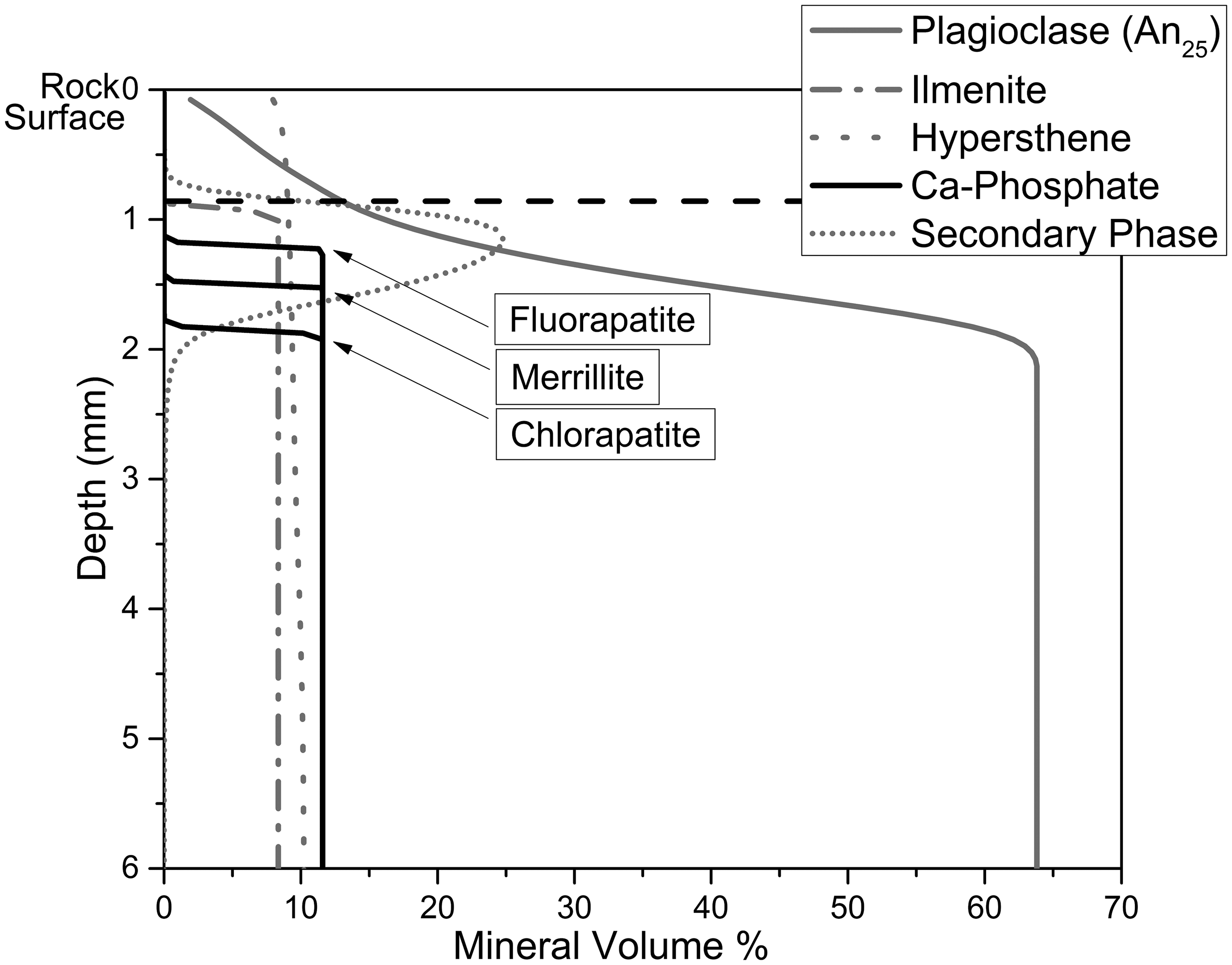
Comparison of three Ca-phosphate minerals weathering at pH 6 with 100 ky of model time. Dashed horizontal line represents surface retreat of the rocks based on 50% porosity. Dissolution profiles for minerals other than the Ca-phosphate and depth of surface retreat do not significantly change between models for a given initial modeling pH (chlorapatite model profiles shown). Figure shows chlorapatite dissolution to the greatest depth and fluorapatite to the shallowest, with merrillite in between. This is consistent with thermodynamic and kinetic data for these minerals (Adcock et al., 2013) and is similar at all pH values. Data are from single mineral models; however, this behavior applies to the more Mars-relevant chlorapatite + merrillite bearing models as well, in which the chlorapatite reaction front is deeper than that of merrillite.
The more Mars-relevant models containing the two Ca-phosphate minerals chlorapatite + merrillite show the same overall trends as single Ca-phosphate mineral models, with reaction front depths of chlorapatite and merrillite generally matching those of the same Ca-phosphate mineral in single phosphate mineral models run under the same conditions (Fig. 2 and Supplementary Fig. S5). Thus, the chlorapatite reaction front in these models was always deeper than the merrillite reaction front. Early models run without the secondary aluminosilicate phase but under conditions corresponding to the finalized models showed the same Ca-phosphate behaviors (Supplementary Figs. S9–S12).
4.3. Nonphosphate mineral dissolution and formation of a secondary aluminosilicate phase
All models show plagioclase dissolution over the entire modeled pH range, deeper than the surface retreat applied for chemical weathering. Reaction fronts are also relatively gradual in shape (Supplementary Figs. S5–S8). Ilmenite reaction fronts are generally shallow in depth, and with the exception of pH 2, the depth of estimated surface retreat from chemical weathering exceeds or coincides with the reaction front depth for the mineral. Thus, the surface retreat from chemical weathering would effectively remove the ilmenite reaction fronts from weathering profiles in these models with pH values above 2. In all pH 2 models, ilmenite reaction fronts exceed or match the Ca-phosphate reaction fronts. This is also the case for merrillite and fluorapatite reaction fronts in pH 3 models. Hypersthene shows no significant dissolution except in models with pH <5, and in all models the surface retreat due to chemical weathering exceeds any significant hypersthene dissolution (Supplementary Figs. S5–S8).
The plagioclase dissolution is accompanied by precipitation of a secondary Al-bearing phase at all but pH 2 and 8. The depth of the plagioclase reaction fronts generally match, or are deeper than, the Ca-phosphate fronts in all models (Supplementary Figs. S5–S8). In early models run without the secondary phase, plagioclase reaction fronts are similar, though slightly suppressed in some models (Supplementary Figs. S9–S12) and lag behind chlorapatite reaction fronts under pH 4–7 conditions.
5. Discussion
One of the striking characteristics of the weathering profiles on Wishstone-class rocks is the nearly identical values of P concentrations at the surface of the Wishstone and Champagne rocks (Wishstone = 2.64 wt % and Champagne = 2.63 wt % P2O5) (Table 1), corresponding to a partial loss of approximately 50% of the P. An important second characteristic is the lack of any other chemical changes attributable to dissolution (Supplementary Table S1). These unusual characteristics are what we explored in the modeling, as we discuss below.
In previous studies, the weathering profiles on Wishstone-class rocks have been suggested to be the result of acidic chemical weathering, possibly by volcanically generated acid fogs (Hurowitz et al., 2006a). These interpretations were based either on kinetic values for fluorapatite dissolution or the observation of phosphate mineral dissolution from powdered martian meteorites by dilute acids in the laboratory (Dreibus et al., 1996; Gellert et al., 2004; Hurowitz et al., 2006a). The reactive transport modeling performed here considers a broad range of factors that affect mineral dissolution, including kinetics, thermodynamics, porosity, tortuosity, and SSA, both simultaneously and quantitatively.
Incorporating physical erosion into our modeled profiles (due to observations of physical abrasion of the Wishstone-class rocks) yields modeled profiles consistent with profiles observed by the MER Spirit, including the very similar P values measured on Wishstone and Champagne (Table 1). In the models including both chlorapatite and merrillite, physically eroded rock surfaces that lie between the merrillite and chlorapatite reaction fronts produce profiles consistent with the partial loss of Ca and P, and nearly identical P values on Champagne and Wishstone (Fig. 3A). The model run at pH 6 results in the greatest difference in depths of the reaction front between chlorapatite and merrillite and therefore the largest possible variability in the amount of physical erosion that would still allow modeled results to match observations (Fig. 3C and Supplementary Table S5). It is thus the most plausible modeling scenario. This situation also applies to early models run without a secondary phase (Supplementary Fig. S13) with the near-neutral pH values resulting in the largest difference in depth between the reaction fronts and therefore the most room for variation in erosion.

Dissolution of a 50% chlorapatite, 50% merrillite bearing model at pH 6 for 100 ky. (
It is also possible to produce profiles consistent with observations that Wishstone and Champagne have only lost a fraction of the original Ca and P present in the parent material in single mineral models. In this case, the physical erosion would have to intercept the phosphate mineral reaction front, allowing a fraction of the phosphate to remain, as in Fig. 4A. However, because the P measured by APXS at the surfaces of both Wishstone and Champagne is nearly identical (Table 1), the physical erosion would have to precisely intercept the Ca-phosphate reaction fronts in both Wishstone and Champagne rocks at the exact same point. Such a scenario seems unlikely, further supporting the presence of multiple Ca-phosphate minerals in Wishstone-class rocks.

Output dissolution profile for chlorapatite-bearing model at pH 5 for 100 ky. (
A second important characteristic of weathering profiles observed on Wishstone and Champagne rocks on Mars is the absence of other observed chemical losses attributed to weathering. In our finalized models that allow for a secondary mineral to precipitate, plagioclase dissolution exceeds, or matches, that of the merrillite and chlorapatite in the models, which at first observation is not consistent with APXS measurements. However, the presence of the secondary phase and/or salts present would potentially mask plagioclase dissolution from elemental-only analytical techniques such as APXS. Figure 3B is a plot of Al content normalized to Ti using the equation (Chesworth et al., 1981; Brimhall et al., 1988; Anderson et al., 2002)
where τ i,j is the fraction of element j lost or gained assuming that element i (Ti in this case) is immobile, w and p refer to weathered and parent material respectively, and C is the concentration of the immobile or mobile elements in the parent and weathered materials. Aluminum concentrations remain relatively stable for models at pH 4–7 despite significant plagioclase dissolution (Figs. 3B, 4B, and Supplementary Fig. S5). This is also the case for other elements including Si, indicating that even in profiles with significant plagioclase dissolution, APXS analyses might detect only dissolution of a Ca- and P-containing mineral. Models outside the pH 4–7 range show significant changes in Al and thus are less consistent with observations from Mars. In early models that contain no secondary phase, plagioclase behavior is similar but with dissolution slightly suppressed.
The modeled plagioclase dissolution behavior is consistent with previous terrestrial observations. Plagioclase has been observed to be the first mineral to dissolve from rocks in natural terrestrial systems and otherwise display relatively rapid dissolution in comparison to other minerals (White, 2008; Brantley and White, 2009; Maher et al., 2009; Navarre-Sitchler et al., 2009, 2011). Relative solubilities, which can allow plagioclase to keep dissolving after the near-interface solution is near saturation for other minerals, can play an important role in controlling the mineral's weathering (White, 2008; Brantley and White, 2009; Maher et al., 2009; Navarre-Sitchler et al., 2009, 2011). For example, oligoclase, similar to the An25 used in the model, has a solubility that leads to final Ca concentrations in pure water of approximately 80 μmol/L (Huang and Kiang, 1972). In contrast, final concentrations of Ca measured under the same conditions for the Ca-phosphate minerals used in the model are much lower (22–47 μmol/L) (Adcock et al., 2013). Even though the phosphates dissolve faster, once Ca concentrations approach 22–47 μmol/L, phosphate mineral dissolution will slow, while feldspar dissolution can continue. Therefore, in low-porosity rocks such as these and others on Mars, significant dissolution of plagioclase is not inconsistent with what we would expect from interaction of rock surfaces with liquid water.
Like the plagioclase and Ca-phosphate modeling observations, modeled ilmenite reaction fronts also do not indicate highly acidic weathering. In models run at pH 2, the ilmenite reaction fronts exceed or coincide with the Ca-phosphate mineral reaction fronts. This is also the case with pH 3 models for the single-mineral merrillite and fluorapatite models. Therefore, a scenario where only Ca and P loss would be indicated in APXS analyses is not possible as modeled, regardless of any added physical erosion component in these models.
Considering the plagioclase, ilmenite, and Ca-phosphate model observations, models with multiple Ca-phosphate minerals (which are most consistent with martian meteorite observations) run at initial pH values from 4 to 7, and incorporating a component of physical erosion produce profiles that fit Wishstone and Champagne APXS measurements. The most likely fit is produced by the pH 6 model (Fig. 3C and Supplementary Table S5) where the separation distance between the reaction fronts of the two Ca-phosphate minerals is the greatest and allows for the most variation in physical erosion. Thus, our modeling results suggest a near-neutral aqueous history for Wishstone-class rocks at Gusev Crater.
While reactive transport models such as those used in this study are numerical approximations that by necessity contain assumptions and simplification, and the system is by necessity not completely constrained, the models presented here reasonably approximate dissolution in Wishstone-type rocks on Mars with the available data. The models indicate that Wishstone-class rocks are best explained if they contain more than one Ca-phosphate mineral, a likely scenario based on martian meteorites (McSween and Treiman, 1998; McCubbin and Nekvasil, 2008). The modeled profiles also suggest alteration of Wishstone-class rocks by mildly acidic to neutral waters, with pH 6 models allowing the best fit. These conditions are consistent with recent results, based on observations and modeling applied to Comanche class rocks, that indicate mildly acidic to near-neutral (pH 5–6) waters may have been episodically present in Gusev Crater at Columbia Hills in the form of an ephemeral lake (Ruff et al., 2014). The results are also not incompatible with the suggestion by Wang et al. (2006) that an open hydrologic system may have been present at Gusev Crater in the past.
The potential for past near-neutral aqueous alteration of Wishstone-class rocks at Gusev Crater has important implications for past martian habitability. Though the pH conditions most favorable to life are not conclusively known, certain potentially prebiotic reactions and the stability of some biomolecules are favored under more neutral, rather than acidic, conditions (Lindahl, 1993; Madigan et al., 2000; Knoll et al., 2005; Powner et al., 2009). Further, the P weathering from Wishstone-class rocks is a bioessential nutrient thought to be prebiotically important. Thus, the results of this study indicate potential P release into near-neutral water, with positive implications for past martian habitability.
6. Conclusions
Weathering profiles can be used as indicators of past aqueous conditions, preserving characteristics such as the duration of liquid water, pH, temperature, and other factors (Olsen and Rimstidt, 2007; Hausrath et al., 2008a, 2008b, 2011; Brantley and White, 2009; Maher et al., 2009; Hausrath and Olsen, 2013; Baumeister et al., 2015; Yesavage et al., 2015; Gainey et al., unpublished data). In Wishstone-class rocks on Mars, profiles measured by the MER Spirit APXS indicate Ca and P loss only, suggesting that dissolution of a Ca-phosphate mineral has occurred during past aqueous interactions (Gellert et al., 2006; Hurowitz et al., 2006a; Ming et al., 2006). These profiles have previously been suggested as an indicator of chemical weathering by highly acidic fogs or possibly dilute acidic waters (Gellert et al., 2004; Hurowitz et al., 2006a). In this study, models that contained multiple Ca-phosphate minerals, were run over initial pH values of 4–7, and included a component of physical erosion, produced profiles consistent with important characteristics of those in Wishstone-class rocks on Mars, with the pH 6 models being most consistent with the APXS-measured data. These modeling results suggest that past environmental conditions at Gusev Crater may have included aqueous dissolution into mildly acidic to neutral solutions.
Although the exact range of required conditions under which life can originate are unknown, certain prebiotic reactions and the stability of some biomolecules are favored under more neutral conditions (Lindahl, 1993; Madigan et al., 2000; Knoll et al., 2005; Powner et al., 2009). In addition, phosphate is a bioessential nutrient, and phosphorus, either as phosphate or a more reduced species such as phosphite, is considered crucial in prebiotic reactions that may have led to the origin of life on Earth (Westheimer, 1987; Schwartz, 2006; Powner et al., 2009; Pasek and Kee, 2011). The results of this study, which indicate the possible dissolution of phosphate minerals by near-neutral waters on Mars, therefore have positive implications for potentially habitable environments on Mars.
Footnotes
Acknowledgments
This research is based on work supported by a Mars Fundamental Research Program grant no. NNX10AP58G and NASA grant NNX10AN23 issued through the National Space Grant College and Fellowship Program to E. Hausrath. Additional support was provided from a Nevada Space Grant Consortium fellowship and GSA research grant to C. Adcock. The authors thank C. Steefel for providing the CrunchFlow code. In addition we thank A. Udry, A. Simon, E. Smith, H. Sun, P. Forster, O. Tschauner, V. Tu, S. Gainey, and M. Steiner for assistance related to this work. We also thank Amanda Olsen and an anonymous reviewer for thoughtful reviews that greatly improved this work.
Author Disclosure Statement
Christopher T. Adcock: No competing financial interests exist. Elisabeth M. Hausrath: No competing financial interests exist.
Abbreviations Used
References
Supplementary Material
Please find the following supplemental material available below.
For Open Access articles published under a Creative Commons License, all supplemental material carries the same license as the article it is associated with.
For non-Open Access articles published, all supplemental material carries a non-exclusive license, and permission requests for re-use of supplemental material or any part of supplemental material shall be sent directly to the copyright owner as specified in the copyright notice associated with the article.
