




Abstract

Introduction
T
Martin undertook a PhD at University College London on the ecology and microhabitats of modern benthic foraminifera, algae, and sea-grass communities of the Caribbean island of Barbuda. Martin was engaged as ship's scientist aboard the Royal Navy ship HMS Fox and Fawn, an opportunity which he likened to Darwin's position on the HMS Beagle, and during that time he undertook much fundamental research. Martin was both a conventional and unconventional micropaleontologist, as described in the contribution by Owen Green below. In the 1970s Martin undertook mathematical studies of foraminiferid morphospace to investigate the evolution of foraminifera photosymbioses through time. The concept of morphospace analysis was an approach that Martin would later return to in other areas of his research, for example, to test the biogenicity of carbonaceous microfossils, also to investigate the evolution and growth of the Ediacaran biota.
In the 1980s while based at the University of Hull, Martin worked on Lower Cambrian reef systems, particularly on several expeditions to Mongolia, one important outcome of which was to reveal the sponge-like biology of archaeocyathids. At this time Martin was also undertaking an ecological and taphonomic assessment of the Cambrian diversification of skeletal fossils. Throughout his career Martin was an advocate of the high-resolution analysis of fossils in their sedimentological and geological context (see, e.g., the contribution by Duncan McIlroy below, reflecting on work to characterize the Ediacaran and Cambrian evolutionary radiations). In 1988 Martin moved to the Department of Earth Sciences at the University of Oxford and took a leading role in the International Geological Correlation Programme (IGCP), particularly in their work to formally define the Cambrian time period, and in the selection of the global stratotype section in Newfoundland.
Martin worked extensively on Proterozoic geobiological evolution; for instance, he coined the phrase “the Boring Billion” to refer to the apparent evolutionary quiescence of the Mesoproterozoic. In Australia he worked with John Lindsay, undertaking chemostratigraphic analysis of key sedimentary basins and exploring connections between geological and biological evolution. For several years Martin also worked on glacial sections in the Neoproterozoic of Oman, described in the contribution by Philip Allen below. More recently, Martin and his students were investigating some of the earliest terrestrial eukaryotes in lake sediments from the Torridonian group of North West Scotland. This work involved organic remains preserved in phosphatic nodules, a project that combined several of Martin's research interests: carbonaceous microfossils, in situ high-resolution geochemical and morphological analysis, and mechanisms of phosphogenesis.
Martin attracted some attention in the early 2000s for his reassessment of the so-called Apex Chert microfossils, whose biogenicity he questioned in his 2002 Nature paper. In this study Martin and colleagues combined field mapping, microfabric and contextural analysis with Raman spectroscopy to propose that the Apex Chert microtextures were not bona fide microfossils but rather abiotic hydrothermal artifacts. This debate focused on carbonaceous remains found in thin sections of an Archean chert from Western Australia, and in his contribution below Andy Knoll recalls visiting Martin and spending a revealing afternoon in lively discussions debating the origins of the carbonaceous material. As part of his Apex Chert work Martin proposed the use of the null hypothesis, namely, “that all ancient candidate fossil structures should not be accepted as biological in origin until all possibilities of their non-biological origin have been tested and falsified.” This is a philosophical approach that continues to cause much debate among the paleontological community but by which Martin stood unwavered. He advocated for a wider application of the null hypothesis to other key events in the history of life, for example, to the biogenicity of stromatolites, the origins of eukaryotes, and the origins of animals, as reported in the contribution by Jonathan Antcliffe below.
In the field of astrobiology Martin also strongly advocated the use of the null hypothesis, stressing the caution and rigor it requires when investigating candidate biosignatures in meteorites and extraterrestrial samples. Those who were present at the NASA Ames conference in 2002 will never forget Martin's reasoning and delivery during the Schopf–Brasier debate over the Apex Chert “microfossils” described in the contribution by Robert M. Hazen below. It was during this period of Martin's research on the Archean biosphere that he developed fundamental protocols for the study of putative traces of early microbial life, employing the careful mapping of features and fabrics at various scales, combining field observations with the critical interpretation of petrographic thin-sections to test the history of microbial life on Earth. Martin frequently referred to this as his most satisfying research project, and he was extremely proud of the renewed emphasis he had placed on the testing of abiotic processes and in developing approaches to distinguish these from bona fide fossils.
Martin can be characterized as much more than a paleontologist; he was a true Natural Scientist in the classical sense, with broad-ranging interests in the natural world. For instance, he collected antique microscopes owned by eminent scientists and diverse scientific curiosities discovered on his travels. His field notebooks were a work of art, recording his observations and thinking of complex geobiological processes in intricate diagrams and sketches. He had the amazing capacity to recall a section he had visited decades ago, or a lecture given by a visiting scientist, and pull out the relevant notebook to check the facts, often with astute contextural remarks jotted in the margins. Martin was an inspiring teacher and great storyteller, and his many experiences of life as a scientist were made available to the public in his popular science books Darwin's Lost World and Secret Chambers. In these books Martin brought the Cambrian explosion to life and the history of cellular evolution to a wider audience, as described in the contribution by his editor and PhD student Latha Menon below.
In early 2014 Martin's contributions to the geological sciences were recognized by the award of the prestigious Lyell Medal from the Geological Society of London. His scientific career was celebrated in Oxford on the occasion of his retirement from undergraduate teaching in September 2014 with a day of talks in the Earth Sciences department. This was a remarkable occasion described below by one of the attendees, Eugene Grosch, and was a wonderful event at which Martin's academic family gathered to review his many scientific projects both past and current that we sadly did not realize would be cut abruptly short in December 2014. Martin's lifework will live on, however, in the many colleagues and students that he inspired and in his approach to broad-ranging questions concerning the history of life on Earth and perhaps beyond. Martin is survived by his wife Cecilia, two sons Matthew and Alexander, a daughter Zoë, and two grandchildren.
Individual Contributions
Martin was remarkable. Extraordinarily dedicated to his science and very determined, he was forthright and courageous but also a kind and supportive colleague. Our final meeting was at the 2011 Brazilian Palaeontological Congress in Natal. Martin was in great form, lively as ever, and took a lot of time and pleasure in encouraging young researchers at the meeting, sitting among them long into the evening. Way back in 1975, when we were both at the start of our careers, Martin and I wrote a Nature paper together. In hindsight I suppose it could mark his first step into relatively deep time. Within a few years, both of us had distanced ourselves from some of the things we wrote in that article. But that's science, and it was still a good early foray. Martin went on to work far and wide, up and down the geological column and around the world. He was an excellent scientist in all the important ways: clever, knowledgeable, questioning, persistently curious and interested in everything, full of vitality, open, iconoclastic, and never boring. Highly productive, too. He was able to excel across an astonishing range of topics—which was perhaps the distinguishing feature of his career—all the time remaining incisive, alert, and committed. Martin was an engaging companion and a good friend. Great to work with and to share a drink with beside a bright Brazilian beach.
Robert Riding
University of Tennessee, Knoxville
Despite co-inhabiting the Department of Earth Science with Martin Brasier in the 1990s, I never really got to know him until we set off together for the Sultanate of Oman, the Jewel of Arabia. Coming from the greyness of an Oxford January, with that deflated feeling following Christmas, I was struck by the sheer brightness of the place. We embarked on a joint field campaign to understand the surface outcrops of Neoproterozoic rocks. We explored long wadis incised deeply into towering and unstable mountains, in search of dark cliffs in the hazy distance. These cliffs hold the mystery of time in their ravines and slopes; the rocks making up the cliffs were formed as mud, sand and pebbles on an ancient sea bed, so ancient that Earth had barely awoken from her microbial slumber. We were in the Jabal Akhdar—a simple fold of rock, more than a kilometre high, its centre hollowed out as if by an ice cream scoop to reveal the object of our interest, surrounded by the chocolate brown rocks of inner Earth.
We found evidence of ancient ice ages in the dark cliffs of the wadis. Year after year we returned, to those same mountain slopes, to the quiet, remote desert of the Huqf, and finally to the great escarpment of Dhofar, where summer monsoonal mists blown in from the Indian Ocean produce a strange annual greening. Each year our notebooks became filled with measurements and the codified hieroglyphics of our trade, and each year others got to hear about our discoveries; thus the age of innocence was ended, and the great Snowball fight began. The great Snowball fight is about the idea of a glaciation deep in Earth's past that is alleged to have been global in extent, with temperatures falling to about −50°C for tens of millions of years.
Testing the Snowball Earth hypothesis was to preoccupy me for a decade, but Martin had his mind on other things. I can remember waking early in our field camps to the sound of slabs of rock being turned over. Raising my head from the camp bed, I saw Martin's silhouette in the slanting morning sun. He used the early morning to benefit from the obliqueness of the sun's rays to emphasize bedding plane markings and was forever optimistic of finding something biogenic. Alas, the Neoproterozoic of Oman, despite offering a feast of sedimentology and chemostratigraphy, never released its secrets of ancient life. Far from becoming disconsolate, Martin revealed the breadth of his expertise and enthusiasm in helping our team understand the geology under our feet. Our achievements would not have been possible without him.
I no longer go to the Jewel of Arabia, but I occasionally reminisce on the enjoyable time doing fieldwork with Martin and on the eerie peace of our camps in the desolate wilderness of the Huqf. There was a low hum that broke the desert silence in that place; it seemed to be drawn from somewhere deeper, as if originating in the very rocks and dunes that surrounded us. How little did I appreciate, sitting on a rocky platform at sunset, with the wind gently rippling the sleeping bag as a sea breeze flowed from the Indian Ocean across our faces, that Martin would tragically lose his life so very soon after retiring.
For me, the great Snowball fight is over. Passions have subsided, and adrenaline has been put to alternative uses. Does it really matter whether planet Earth froze over completely and profoundly, and had the audacity to do it at least once more, deep in her microbial past, like an out-of-control, binge-drinking teenager? It frames one's view of how resilient Earth is when pushed to the limit and of its ability to recover to spawn the evolutionary processes that led to you and me and in which Martin was passionately interested. Our findings in the desert of Oman suggest that teenage Earth was not quite as rebellious as thought—we had simply discovered her mood swings. We are left with an abiding image of a resilient, complex, nurturing and forgiving Earth, not the reckless and temperamental planet of alarmists' dreams. And that, perhaps, matters.
Philip Allen
Imperial College London
The first time I visited Martin as a final-year undergraduate in 1991, he generously spent hours showing me his Cambrian collections, throwing out ideas and problems like confetti. At the time, Martin was new to Oxford and heavily involved in IGCP (International Geological Correlation Programme), isotope stratigraphy and his work as Chair of the Cambrian Commission, who made their decision on the Precambrian-Cambrian boundary just before I arrived to start my PhD with Martin in 1992. The choice of the boundary section was at Fortune in Newfoundland, and it was to Newfoundland that he sent me the following summer for my first field season. What I loved about my time in Oxford was the freedom that Martin gave me to explore my interests. He also gave me free access to his lab and field notebooks. For anyone who has not seen them, they are the epitome of science as art, his characteristic detailed observations and insightful thought often integrated into beautiful sketches of fossils, thin sections or field logs. I remember on one page from about 1974 there was a note in the margin that said, “The rock is the father of the fossil”. That quote stuck with me and was something I would often remind myself of while involved in my own work.
After my thesis and a short Royal Society postdoc in Australia, I returned to a flat job market in the UK and ended up retraining as a petroleum geologist/sedimentologist. This was much to Martin's dismay, but in 2000 he invited me to the field in Anglesey with some of his students, and his son Alex, and things started to come full circle. I had learned the skills to interpret the sedimentary rocks much better than I had been able to before. Our paths realigned, and we became close highly complementary collaborators again.
Once I moved to back to Newfoundland as a professor in 2004, we shared a long string of graduate students working mainly on the Ediacaran of Newfoundland. In doing so, I learned what field teaching and supervision could be. I saw firsthand Martin's ability to convey complex ideas in the field with a sketchbook and pencil. The students enjoyed the benefit of a mixture of our research expertise but the same scientific ethos with its focus on exploration, careful observation, freethinking and rigor.
The second to last time I saw Martin was in Newfoundland, where he presented at a conference. We spent a delightful day by my fire chatting mainly about science but also about his worries for retirement. We talked particularly about legacy and the importance, not so much of the published word, but his impact on his students who have taken his ideas and philosophies forward and who will pass them down through the generations. From that came Martin's concept of our joint “academic family,” a concept that he was looking forward to embracing long into his retirement.
The last time we spent together was at his retirement conference in 2014, where he was quite simply the happiest I had ever seen him, surrounded by his “academic family” celebrating his legacy just as he celebrated their successes. I would like to restate my last slide of my talk of that wonderful day. All of us that he touched with his kindness and intellect are part of his legacy, his ripples in the fabric of palaeontology that will spread and grow who knows where.
Duncan McIlroy
Memorial University Newfoundland
Martin was both a conventional and unconventional micropalaeontologist. He followed convention by pursuing a PhD on the ecology of living benthic foraminifera associated with marine sea-grass habitats within the shallow waters surrounding the Caribbean island of Barbuda. Results were detailed in a series of papers published in the late 1970s. However, although the microhabitats of Tertiary and Recent larger benthic foraminifera were revisited in the 1990s, Martin's focus was turning towards evolution and deep time—initially through a theoretical approach of the study of foraminiferal architecture and evolution, quantifying the minimum distance or line of communication, from the back of the first chamber formed to the nearest aperture (MinLOC), and qualifying the changes with the Parsimony Index (PI). These methods were applied to a taxa Martin found fascinating: the deep-sea foraminifera Discospirina italica. Coincidently, this was a topic Martin returned to at the UK Micropalaeontological Society AGM at Oxford in November 2014. Martin's research interests were now dominated by events of the Precambrian-Cambrian boundary. These included global facies variations, stable isotope stratigraphy and phosphatic biomineralisation and evolutionary radiation of the major invertebrate groups, in particular the small shelly fossils (SRFs), and the agglutinated foraminifera Platysolenties sp. Although Martin's reputation is unquestionably secured with his work on Ediacaran faunas, there was a return to his micropalaeontological roots—his re-examination and reinterpretation of putative microfossils of the Archean. This unconventional area of micropalaeontological research is not easily confined within the “normal” micropalaeontological groups of the UK Micropalaeontological Society (TMS), and in a review commemorating 25 years of the Society's Journal of Micropalaeontology in 2006 (Gregory et al., 2006), Martin's innovative contribution to micropalaeontology was inadvertently overlooked. Thankfully, this unusual micropalaeontologist has left us a wealth of diverse literature to cite and use.
Owen Green
Oxford University
You've got to be able to tell a good story. That's the typical advice that editors of popular science books give to their authors. You should be able to kindle the imagination, draw out the deep questions, open the reader's eyes to the wonders of the natural world and how science pieces together its workings and its history. Oh, and it helps if you have some lively personal accounts to throw into the mix. Martin Brasier had all that in spadefuls. My main task as commissioning editor of his two popular books, Darwin's Lost World and Secret Chambers, for Oxford University Press was to try to bring some restraint—he just had so many stories to tell, such verve in their telling, and so many extraordinary experiences to recount. “It's too much!” I would say. Hold this back, and this, and this, for another time. End this book here; it's terrific. That is how we worked together in the creation of his books, and much fun we had of it. I imagine he envisaged recounting the stories to a group of friends by the fireside, over a glass of wine. His narrative certainly carried that warmth and intimacy. He was proud of his books, and rightly so. They have done what good popular science books should do—brought the excitement of science to a wide readership and, he would certainly hope, inspired a new generation of scientists, too.
There was to have been another book, on the earliest life. But it didn't get started, in part because of his many research commitments but also because of me: I had become his research student and could not in my professional role commission him while he was my supervisor. The red pen was firmly in his hand for the time being.
I had not planned to become Martin's student, and the idea of attempting a doctorate in palaeobiology did not originate from his books. Geology pairs naturally with astronomy, which was my background, and both had been loves from childhood. I had been planning to do a doctorate for some time and consulted lots of people about the possibilities. But Martin was very persuasive: why did I need to go elsewhere, when such exciting work was being done by his team just 10 minutes down the road from Oxford University Press? He showed me the whole range of research in which he was involved, with characteristic delight and pride. Of course I was persuaded. The wild shores of Newfoundland followed, several times. And Charnwood, and the Long Mynd, and the exhilaration of a field trip to the Mato Grosso do Sul in Brazil. Martin was inspirational in the field. He encouraged his students to think big and think critically—to question everything. And he was one of the most creative thinkers I have known.
Martin's sudden death has left a big hole in our lives. I can only express my gratitude to him for introducing me to so many wonderful rocks and fossils, for being an inspiring and generous mentor and friend. His spirit and enthusiasm for science will live on through his students, and his books.
Latha Menon
Oxford University Press
Martin Brasier was my PhD supervisor and for the last 12 years a dear friend, mentor, and one of the most formative influences on my scientific life. Soon after first meeting Martin, we headed to Western Australia to embark on joint fieldwork, and there I soon learned of Martin's wide-ranging intuition for both modern and ancient geobiological processes. On the long drive from Perth to the Pilbara we stopped at the Ningaloo Reef, and while snorkeling next to Martin, his insight into modern carbonate ecosystems became as crystal clear as the Indian Ocean waters in which we swam. But the main target of our field season that year was the Archean rocks and putative traces of life found in the Pilbara craton. Here we camped on Chinaman Creek, mapping the Apex Chert and debating around the campfire the nature and source of Archean carbonaceous matter, while listening to the dingoes howling in the night. Here we enjoyed Martin's incisive mind and erudite commentary, always the great companion around the campfire, recounting stories that would later feature in his popular science books. During the daytime heat and red dust of the Australian outback we investigated the ancient cherts that hosted the by then rather infamous Apex Chert “microfossils,” critically evaluating their origins together with John Lindsay, Owen Green, and Cris Stoakes over several field seasons (Brasier et al., 2005, 2011).
On returning to Oxford I pursued a project based around an intriguing laminated specimen we termed the “paint stromatolite” purchased by Martin in a fossil collection. Martin was a great collector of curiosities from the natural world, and this paint stromatolite was one such example. On the face of it, this laminated structure resembled a stromatolite being finely laminated and pseudo-columnar. But on closer examination under the SEM (scanning electron microscope), we found that it was made of lead-based paint, and with further detective work, Martin discovered that it had originated from the spray-painting workshop at the Mini car factory in Oxford! To us, this presented an interesting experimental opportunity to construct in the laboratory a depositional system for creating abiotic, laminated stromatolites. After months spent in a fume hood depositing layers of spray paint, much to the amusement of colleagues, we created columnar and branched microstromatolites a few tens of millimeters high in the chaotic outer parts of the spray beam. In this way, a curious find made by Martin turned out to be a useful abiotic model that led us to test morphological biosignatures and gave insight to possible mechanisms of stromatolite growth (McLoughlin et al., 2008). This story is just one example of how Martin's wide-ranging curiosity for the natural world drove exciting, diverse, and often untraditional research questions. It was a real privilege to have worked with Martin, and he will continue to be a great inspiration.
Nicola McLoughlin
University of Bergen
When I think of Martin Brasier, which in recent weeks I've done a lot, I nearly always return to a single day in early September 2000. That summer I was working on a book that would eventually see light of day as Life on a Young Planet and realized that of all the geological materials I was discussing, there was one that I had never seen—the carbonaceous microstructures described as fossils from the Warrawoona Group, Australia. I was scheduled to attend a Goldschmidt Conference in Oxford that September and so figured I could stop by the Natural History Museum in London for a viewing. By chance, I met up with Martin in Namibia in July and learned that he had the Warrawoona thin sections on loan in Oxford. Thus we met in Martin's rooms that September and spent a good eight hours discussing what we saw under the microscope. It was Martin at his best—careful, insightful, provocative, and completely open to discussion—and for me it was a revelation. We went on and on, debating one section after another, until fatigue and thirst drove us late in the day to Martin's favorite pub, a sometime set for Inspector Morse. Here, and at a long dinner to follow, I enjoyed another side of Martin, also at his best. This was the convivial Martin—the engaging raconteur and witty commentator. Both the science and friendship that day were memorable, and they remain fresh fifteen years later, dimmed only by the fact that we can't do it again.
Andrew Knoll
Harvard University
Much has been written about the famous debate concerning the timing of the origin of life. Martin controversially proposed the use of a null hypothesis when examining the biological affinities of fossils (Brasier et al., 2002). This was resisted by many palaeontologists, yet it is a fundamental core of thinking in the rest of the biological and medical sciences. It is not simply enough, Martin argued, to build a narrative case of the biological affinities for a fossil; one must test that against a null hypothesis that the particular fossil structures are not biological at all. This led Martin to conclude that much of what was known about the earliest fossil record did not stand up to critical re-examination. But Martin was far from pessimistic about the early fossil record. In receiving the Lyell medal from the Geological Society last year, Martin gave a lecture which put forward his vision for future research on the early fossil record. The content of this lecture is the core of our recent paper in PNAS (see Brasier et al., 2015), in which we explore the exciting nature of the early fossil record and how there is still so much to learn from it. There are so many places still to search for fossils—new environments, new localities—and these earliest fossils still have so much to teach us about the diversity of life.
It is very easy to see Martin Brasier as an antagonist of the settled and perceived wisdom concerning an early origin of bacteria. But it would be wrong to do so and would miss what motivated Martin as a scientist. He was not an opponent of any one scientist or any one idea; rather Martin was a proponent of the scientific method. It was doubt that motivated Martin, an endless worrier about the quality of his own work. “It is always better to find your own mistakes than to have someone else find them for you” was advice I received from Martin on an almost weekly basis for much of the last fifteen years. Most of the time this was simply in reference to an errant comma but occasionally to an interpretation stretched thinly over, as yet, too little evidence. But it was advice that was the foundation of how he worked, to check everything over and over again. Because that way you are testing the fitness of your own hypotheses and critically doing so before you let those delicate ideas loose. This was a process we undertook jointly on many occasions, questioning our own evidence, moving our ideas forward quicker. Our recent re-examination of the earliest fossil record of sponges (Antcliffe et al., 2014) shows this self-critical tendency in Martin's work. One of Martin's most highly cited papers is a report of some of the oldest sponge spicules from Mongolia (Brasier et al., 1997). However, on studying the material with another PhD student of Martin's, Richard Callow, we realized that these were not sponge spicules at all. They were accidental associations of arsenopyrite crystals that had overlapped and looked rather like sponge hexacts in thin section but clearly had a different and non-animal origin. Our recent paper retracted the claims of Brasier et al. (1997) whilst applying what we had learnt in the process to many other suites of putative early sponge fossils. Martin did not care where the axe fell in terms of severing ideas from the corpus of knowledge. It isn't personal, it is science, and if it is wrong we need to move on.
The idea of perpetual motion in science is what excited Martin, and it is an enthusiasm he transmitted so readily to younger colleagues, myself included. Nothing annoyed him more than when scientists, for the sake of narrative, overstate their case or argue that some great scientific problem has been solved and little else needs to be done. What really suffocates ideas is not questioning and doubting and “being difficult” but old ideas that ossify because no one dares to question them. Rather, Martin believed, that creativity in science first needs doubt. To him it was all about evidence and methodology, not about interpretation and narrative, which he cuttingly referred to as “story-telling.” To Martin all science was active, live, and open to question. That is what science is, a way to ask questions. Or as he regularly said, “Science is a unique method for the exploration of doubt.” And this is what he realized so excited young scientists, the idea that nothing is sacred in science, no one is to be revered, that everything and anyone can be questioned at any time. His message was that “you as a young scientist can join in the debate and contribute to it.” That is not to say that you will always be successful when you question an established idea, but in asking your question you will learn something, and so too might everyone else.
Jonathan Antcliffe
Oxford University
I know Martin Brasier as one of the sharpest critics of my work on early life in the fossil record, and I remember our many delightful discussions on the various aspects of this research. In 2006, my working group and Robert M. Hazen, Carnegie Institution, published our paper on early Archean “microbially induced sedimentary structures (MISS)” that we detected in rocks in South Africa. Shortly thereafter I received a long e-mail from Martin. He congratulated me for this fine paper and then discussed in all detail every thought of ours. I had it all wrong. However, I was able to respond to each point of his criticism. Mainly, Martin had not realized that we are not simply describing “wrinkle structures” (fossil microbial mats in ancient sandstone) macroscopically. Rather, one must consider their pattern of distribution in a paleoenvironment (lagoons, tidal flats, shelves); their internal textures (filaments of fossil bacteria forming the typical network of microbial mats; oriented grains; and many more); their mineralogical composition (pyrite, hematite, chamosite, and other specific minerals); and their geochemical signal (isotopes) (Noffke, 2008). Only if all criteria are fulfilled is a wrinkle structure regarded as of biological origin. Martin realized upon my response that we were likely right and never launched the counter paper that he originally had in mind. In the following years we had many good conversations, and despite our differing opinions on many findings, we remained friends. One of the most memorable moments, however, was the visit at Cape Canaveral, Florida, to attend the launch of Mars Science Laboratory in November 2011.
It was sheer luck that we ran into each other given the thousands of visitors at this special day for NASA. Martin and his sons Alexander and Matthew had arrived early and secured a great place with a clear view of the Atlas rocket. I joined them, and we had a good time, watching the crowd gathering, talking about the best cameras pointing toward the launch site, trying to get some last-minute food, and waving to colleagues, whom we spotted in the farther distance. While it looked first as if it would rain, the clouds decided otherwise. We got really nervous when the loudspeakers started to transmit the commands and comments of the main control room. Alexander and Matthew took close-up photos of the rocket; then the family decided to film the launch—difficult because of the many folks around us.
Finally, the countdown started—transmitted by the loudspeakers—and the crowd joined the counting of the numbers as a chorus. Expelling a great cloud, the rocket lifted off majestically; under the ear-bursting cheers of the crowd, the huge machinery ascended seemingly slowly into the skies, producing a cometlike fan of light. We watched the breathtaking picture until the rocket disappeared in the far distance. What Earthians can come up with, if they all work together!
Holding the camera high in one hand, Martin followed the launch and filmed without actually seeing what the camera would catch. He was so touched by this great moment of the launch of this enormous technology and the excitement of the crowd that Martin actually had tears in his eyes. We all hugged each other as if we all were at a great party. Then the crowd started to disperse, heading to the many busses that took us back to the hotels.
I still show Martin's documentation of the launch to my undergraduate students in class, and we hear Martin laughing and his voice saying, “It is so bright!”
Nora Noffke
Old Dominion University, Virginia
Martin Brasier was a thoughtful, kind, scholarly researcher who did not generally seek controversy. Nevertheless, one of his most public moments was framed by a major paleontological debate. In 1993, Professor William (Bill) Schopf of UCLA claimed to have discovered Earth's oldest fossils—tiny black squiggles and smudges in the 3.5-billion-year-old Apex Chert of Western Australia. Brasier was unconvinced and led microscopic investigations that cast the Apex fossils in a new light. Under 3-D confocal microscopy, Schopf's purported filamentous cellular structures appeared more like irregular planes or sheets, in some cases branched—a feature never observed with cells. Brasier gave some of the more curious shapes wry nicknames like “wrong trousers” and “Loch Ness monster.” Thin sections with the most convincing cell-like objects contained numerous additional black shapes that bore no resemblance at all to cells—forms that Schopf failed to detail in his original Science paper. In 2002, Brasier et al. challenged Schopf's claims in a widely read Nature article, which concluded, “We reinterpret the purported microfossil-like structure as secondary artifacts.”
The controversy came to a head at a dramatic public debate, held on April 9, 2002, at the second biennial NASA Astrobiology Science Conference, with Schopf and Brasier squaring off like graying, bespectacled wrestlers. The entertaining spectacle took place deep inside the gargantuan antique dirigible hanger of Moffett Field, home to NASA Ames Research Center. A sturdy lectern embossed with the NASA logo stood on the stage, to the left of a large projection screen about 12-feet square. Both speakers were seated on the stage, before a rapt audience of several hundred scientists.
Schopf spoke first. A flamboyant presenter even under the calmest of circumstances, Bill Schopf was fighting to preserve his scientific reputation. Barely controlling his anger, his voice booming, he lectured Brasier as if the Englishman were a recalcitrant schoolchild. Step by step, in a talk rich in withering rhetorical questions and exaggerated dramatic pauses, he reviewed the dozen or so necessary and sufficient criteria to establish the authenticity of ancient fossil cells. Step by step, he provided the data to back up his Apex claim. Schopf concluded by summing up all the evidence he had mustered: “If it fits with all other evidence for life, well folks, most likely it's life.”
Brasier gently ascended the stage and began his calm and witty rebuttal: “Well, thank you Bill for a truly hydrothermal performance. More heat than light, perhaps.” In soft-spoken Oxonian English, he began to cast doubt on Schopf's case. The most damning evidence were the fossils themselves. With the right lighting, field of view, and level of focus, the Apex features do look like strings of cells. But raise or lower the focus slightly, or shift to another field of view, and doubts arise. What are all those shapeless black blobs next to the “fossil”? How can that supposed straight chain of cells suddenly branch like a Y?
As Brasier warmed to his task, an agitated Schopf stood up and began to pace distractingly a dozen feet behind the podium. Back and forth he walked, hunched over, hands clasped firmly behind his back—a tense backdrop to Brasier's staid delivery. Ignoring these diversionary tactics, Brasier fired salvo after salvo. The fossil shapes are misleading. Schopf had the geology wrong. Chemical experiments easily produce structures similar to the supposed Apex fossils' form.
As Brasier calmly outlined his arguments, the scene on stage shifted from awkwardly tense to utterly bizarre. We watched amazed as Schopf paced forward to a position just a few feet to the right of the speaker's podium. He leaned sharply toward Brasier and seemed to glare, his eyes boring holes in the unperturbed speaker. After a few seconds, Schopf retreated to the back of the stage, only to return and stare again. Perhaps Schopf was just trying to hear the soft-spoken Brasier in the echoing hall, but the audience was transfixed by the scene. But Martin Brasier never wavered from his refined delivery. He had changed the way all of us view evidence when it comes to Earth's oldest fossils.
Robert M. Hazen
Carnegie Institution of Washington, DC
(adapted from Genesis: The Scientific Quest for Life's Origins)
Martin Brasier presented the plenary talk on the second day of the Biosignatures across Space and Time conference held in Bergen, Norway, in May 2014 (Fig. 1). This was intended as a general introduction to the main themes of the day and centered on deciphering the earliest fingerprints for life on Earth and Archean habitable environments. Martin was on top form. He delivered a beautiful scientific and philosophical presentation on the search for the earliest signs of life and the relevance to astrobiology in terms of identifying potential traces of life beyond Earth (see his abstract below, Brasier, 2014). It was a great pleasure and honor to host him at the meeting.

Photograph taken at Troldhaugen Bergen, on the occasion of the Biosignatures across Space and Time meeting, May 2014. From left to right: Martin Brasier, Nicola McLoughlin, Margee Hazen, and Robert Hazen. Photo credit: Eugene Grosch.
Later last year in September 2014, I was fortunate to be invited to Martin's retirement event at Oxford University. There, I was impressed by the number of former and current students, as well as departmental colleagues, who all met up to celebrate Martin's successful and extensive career as a paleobiologist and as a kind friend. Although I came from a different scientific background, Martin always made me feel that I was part of his academic family. One of my favorite memories was when he took us up to his college library at St Edmund Hall after his retirement dinner to show us an original copy of the Micrographia with Robert Hooke's extremely detailed drawing of the flea under his early microscope (Fig. 2). Even though Martin was having a “retirement” party, it was clear that he was still extremely active and busy on various manuscripts with students and colleagues on a wide range of topics, from the earliest evidence for microbial life in the 3.43-billion-year-old Strelley Pool Chert of Western Australia to early nonmarine eukaryotes in the 1.2-billion-year-old Torridonian of Scotland. In addition, he was planning to write his third book on Archean life, following his previous works Secret Chambers: The Inside Story of Cells and Complex Life and Darwin's Lost World: The Hidden History of Animal Life.
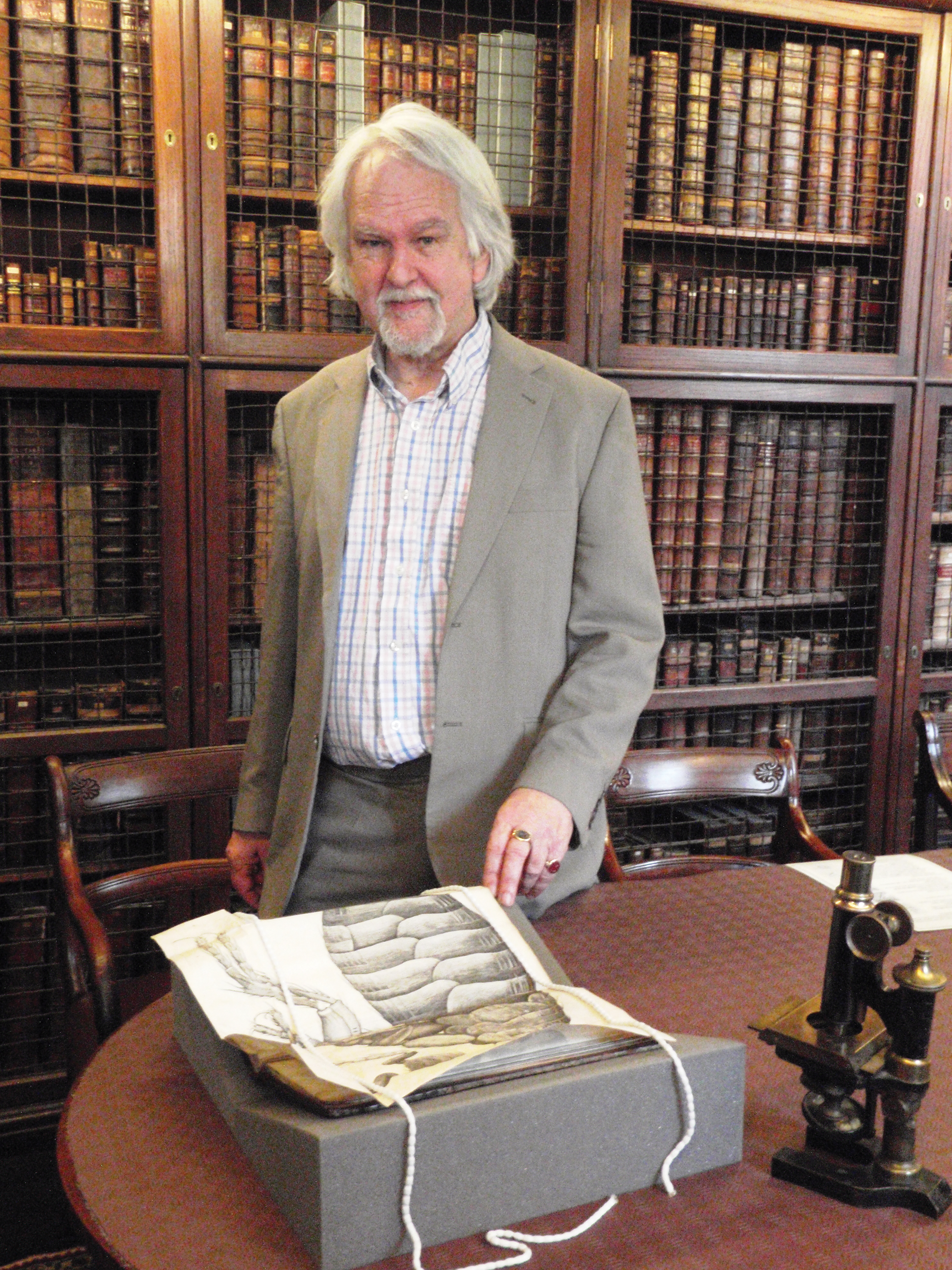
Martin Brasier with Robert Hooke's Micrographia (1665) at St Edmund Hall College Library, Oxford. Photo credit: Alex Liu.
Over the short time I knew Martin, I found him to be a true inspiration, a kind person and rigorous scientist. It is very sad for me to think that we will not be able to fulfill Martin's invitation to visit his cottage in Wales. However, I can imagine that if we could have gone we would be having plenty of fun listening to Martin playing away on the piano, listening to his very many field stories, and chatting about geology, Archean rocks, earliest traces of life and astrobiology! I have no doubt in my mind that Martin Brasier's scientific legacy will not only be left behind in his many published contributions but will also continue to propagate through time with all his academic friends, recent collaborators, and former students who admired him greatly.
Eugene Grosch
University of Bergen
In Search of the Earliest Signs of Life
How good is the earliest fossil record on a terrestrial planet like our own? And what does it teach us about searching for early life remote in space as well as time? Microfossils hold important potential for our understanding the emergence of life during the Precambrian interval that not only spans nearly ninety percent of Earth history (c. 4550–540 Ma) but also contains most of the major biological revolutions in the biosphere (origins of life, oxygenic photosynthesis, eukaryotes, animals, life on land). Progress in this field has demanded close attention to definitions, better protocols, constant debates, much networking and ever-expanding team work.
New analytical tools, approaches and fossil discoveries are now helping to clarify the picture, allowing us to refine and extend our knowledge about the nature of the early Precambrian fossil record. In this talk, I will show how an expanding range of early habitats and exciting new 3D microtaphonomic techniques (e.g., synchrotron, FIB-TEM) are, together, helping to transform thinking.
High-resolution data from 3.46 Ga Apex Chert “microbiota” reveal the need for constant and rigorous attention to biogenicity criteria for the characterization of simple cellular fossils. Preservational windows within the 1.88 Ga Gunflint chert provide a valuable case history for analysis of the critical role played by taphonomic processes in shaping the record of early microbial fossils. Micro-mapping of the 3.43 Ga Strelley Pool sandstone, a silica beach deposit formed on the earliest preserved shoreline; and of the 1.2 to 1.0 Ga Torridonian red beds, with contrasting lakes of evaporitic and freshwater character; remind us that many kinds of ancient habitat have yet to be properly explored.
Martin D. Brasier
Department of Earth Sciences, University of Oxford
Plenary Talk at the Biosignatures across Space and Time meeting, Bergen, Norway, May 2014