




Abstract
The oxidation of molecular hydrogen (H2) is thought to be a major source of metabolic energy for life in the deep subsurface on Earth, and it could likewise support any extant biosphere on Mars, where stable habitable environments are probably limited to the subsurface. Faulting and fracturing may stimulate the supply of H2 from several sources. We report the H2 content of fluids present in terrestrial rocks formed by brittle fracturing on fault planes (pseudotachylites and cataclasites), along with protolith control samples. The fluids are dominated by water and include H2 at abundances sufficient to support hydrogenotrophic microorganisms, with strong H2 enrichments in the pseudotachylites compared to the controls. Weaker and less consistent H2 enrichments are observed in the cataclasites, which represent less intense seismic friction than the pseudotachylites. The enrichments agree quantitatively with previous experimental measurements of frictionally driven H2 formation during rock fracturing. We find that conservative estimates of current martian global seismicity predict episodic H2 generation by Marsquakes in quantities useful to hydrogenotrophs over a range of scales and recurrence times. On both Earth and Mars, secondary release of H2 may also accompany the breakdown of ancient fault rocks, which are particularly abundant in the pervasively fractured martian crust. This study strengthens the case for the astrobiological investigation of ancient martian fracture systems. Key Words: Deep biosphere—Faults—Fault rocks—Seismic activity—Hydrogen—Mars. Astrobiology 16, 690–702.
1. Introduction
T
On both planets, water–rock reactions and groundwater radiolysis may generate high enough concentrations of H2 in the subsurface to sustain microbial hydrogenotrophy (e.g., McCollom, 1999; Chapelle et al., 2002; Lin et al., 2005; Onstott et al., 2006; Blair et al., 2007; Nixon et al., 2013). Faulting and fracturing may locally accelerate these processes by exposing fresh rock surfaces to groundwater. They may also both generate and liberate hydrogen from minerals; a number of studies have demonstrated experimentally that H2 evolves during the crushing or grinding of rocks and minerals. Among these, Freund et al. (2002) reported a passive role for cracking and fissuring in accelerating the outward diffusion of H2 from interstitial sites in crystalline rocks, where it can form during cooling from the redox conversion of OH− into peroxy defects and H2 (Freund et al., 2002, and references therein). Kita et al. (1982) described an active role for frictional grinding (on a fault plane) in generating silicon radical species that react rapidly with water to yield H2, a process represented by the summary reaction:
Experimental support for this “mechanoradical” mechanism was furnished by Saruwatari et al. (2004), while Hirose et al. (2011) showed that frictional grinding liberates H2 from a range of silicate and non-silicate rocks (as a function of the friction applied) and that even dry basalt (maintained at 100°C for 2 weeks to expel intergranular water) generates H2 under friction, probably derived from crystallographic water. In support of these experimental results, an association between earthquake activity and high fluxes of H2 has been observed in natural fault zones (Wakita et al., 1980; Wiersberg and Erzinger, 2008). Freund et al. (2002) and Hirose et al. (2011) suggested that this earthquake-generated (or earthquake-liberated) H2 might fuel pockets of microbial activity around faults on Earth; Michalski et al. (2013) extrapolated this proposal to Mars.
The present study aimed to determine (1) whether the unique rock-types produced by faulting contain molecular hydrogen, and if so (2) whether the H2 and H2O contents of these rocks, if representing original pore fluids, would imply a hydrogen concentration sufficient to support microbial hydrogenotrophy, and (3) whether the empirical model of frictionally controlled H2 release during earthquakes furnished by Hirose et al. (2011) is quantitatively appropriate to suggest an explanation for the measured enrichments. We then asked (4) whether biologically significant quantities of hydrogen are predicted by this model when applied to the present-day subsurface of Mars.
1.1. Measurement of H2 in fault rocks
Movement on fault planes generates two unique rock types: cataclasites and pseudotachylites. Cataclasites are fault breccias that comprise angular clasts of wall rock in a comminuted fine-grained matrix; these rocks are produced by brittle fracturing and grinding during seismic activity. Pseudotachylites (also spelled “pseudotachylytes”) are glassy or very-fine-grained fault rocks formed under more intense friction by melting; the molten rock forms under pressure along fractures and other planes of weakness, often flows considerable distances, and quenches rapidly to form dike-like or veinlike structures (Macloughlin and Spray, 1992). Pseudotachylites on faults represent planes of weakness along which new fractures propagate to accommodate tectonic strain, and typically show complex, fractured microstructures indicative of brittle deformation (e.g., Wenk, 1978; Kirkpatrick and Rowe, 2013).
Faulted rocks commonly contain healed microfractures bearing ancient fault-zone fluids (e.g., Lespinasse and Cathelineau, 1990; Anders et al., 2014). In the present study, cataclasites and pseudotachylites were crushed to evacuate fluids for sampling by a mass spectrometer. The cataclasites were collected from Cambrian quartzites associated with the Moine Thrust Belt in Scotland. Impact-related pseudotachylites were collected from two very large Precambrian crater structures—the Sudbury Crater in Canada (granite host) and the Vredefort Crater in South Africa (quartzite host)—and non-impact-related pseudotachylites were recovered from Permian granite in the Isles of Scilly (UK) and Precambrian gneiss in the Outer Hebrides of Scotland. Control samples representative of the original prefaulting lithologies were collected from the Outer Hebrides, the Moine Thrust Belt, and the Isles of Scilly, with an additional Precambrian quartzite sourced from Kiruna in northern Sweden.
We analyzed the bulk fluid content of our samples using the crush-fast-scan (CFS) mass spectrometry technique previously used by our team to liberate and analyze volatiles from serpentinites, mineral veins, basalts, and most recently martian meteorites (Parnell et al., 2010; McMahon et al., 2012, 2013; Blamey et al., 2015). This method involves crushing the sample and immediately passing the volatiles released through a quadrupole mass spectrometer, and offers very low detection limits.
2. Methods
2.1. Materials
The fault-rock samples are tabulated in Table 1. Two of the pseudotachylite samples were collected from Earth's two largest known impact structures, the 1.85 Ga Sudbury Crater in Canada and the 2.02 Ga Vredefort structure in South Africa. Control samples were unfortunately not recovered from the crater localities. The remaining pseudotachylites and appropriate control samples were collected from the Outer Hebrides and the Gairloch region in Northwest Scotland, and the Isles of Scilly, all in the United Kingdom.
Samples included (a) gneiss- and granite-hosted pseudotachylites, (b) gneiss and granite controls for the pseudotachylites, (c) quartzite-hosted cataclasites, and (d) quartzite controls for the cataclasites. All pseudotachylite host rocks are Precambrian except for those from the Scilly Isles granite, which are about 290 Ma old (Chen et al., 1993). All cataclasites and quartzite controls are Cambrian except for the Paleoproterozoic control from Kiruna, Sweden. Figures 1, 2, and 4 present the sample localities in context.
The Sudbury Crater spans about 70 km and is tectonically distorted into an elliptical shape (Fig. 1a). Pseudotachylites occur as the matrix in the “Sudbury breccia,” which forms a 15 km wide collar around the Sudbury Igneous Complex. The sample analyzed here was collected by Alison Wright from granite host rock near Creighton in the Creighton pluton, adjacent to the Sudbury Igneous Complex. The Vredefort structure, which occurs within the Witwatersrand Basin, is much larger, spanning 250 km. Pseudotachylites occur here as veins and dikes on scales from millimeters to tens of meters within the central Vredefort Dome, which represents the central uplift of the original crater (Riller et al., 2010). The sample analyzed in the present study was donated by Roger L. Gibson, who collected it from a quartzite unit in the Witwatersrand Supergroup, at a locality about 10 km north-northwest from the town of Parys, toward the edge of the Vredefort Dome (Fig. 1b). It has been suggested that the Sudbury and Vredefort pseudotachylites are impact melts injected across large distances rather than local frictional melts derived from the fault walls (Riller et al., 2010). However, both impact-related and non-impact-related pseudotachylites are rich in healed microfractures and other microstructural features indicative of brittle deformation and cataclasis and as such may contain H2 and other fluids trapped during fault motion (e.g., Wenk, 1978; Boullier et al., 2001; Lafrance and Kamber, 2010).
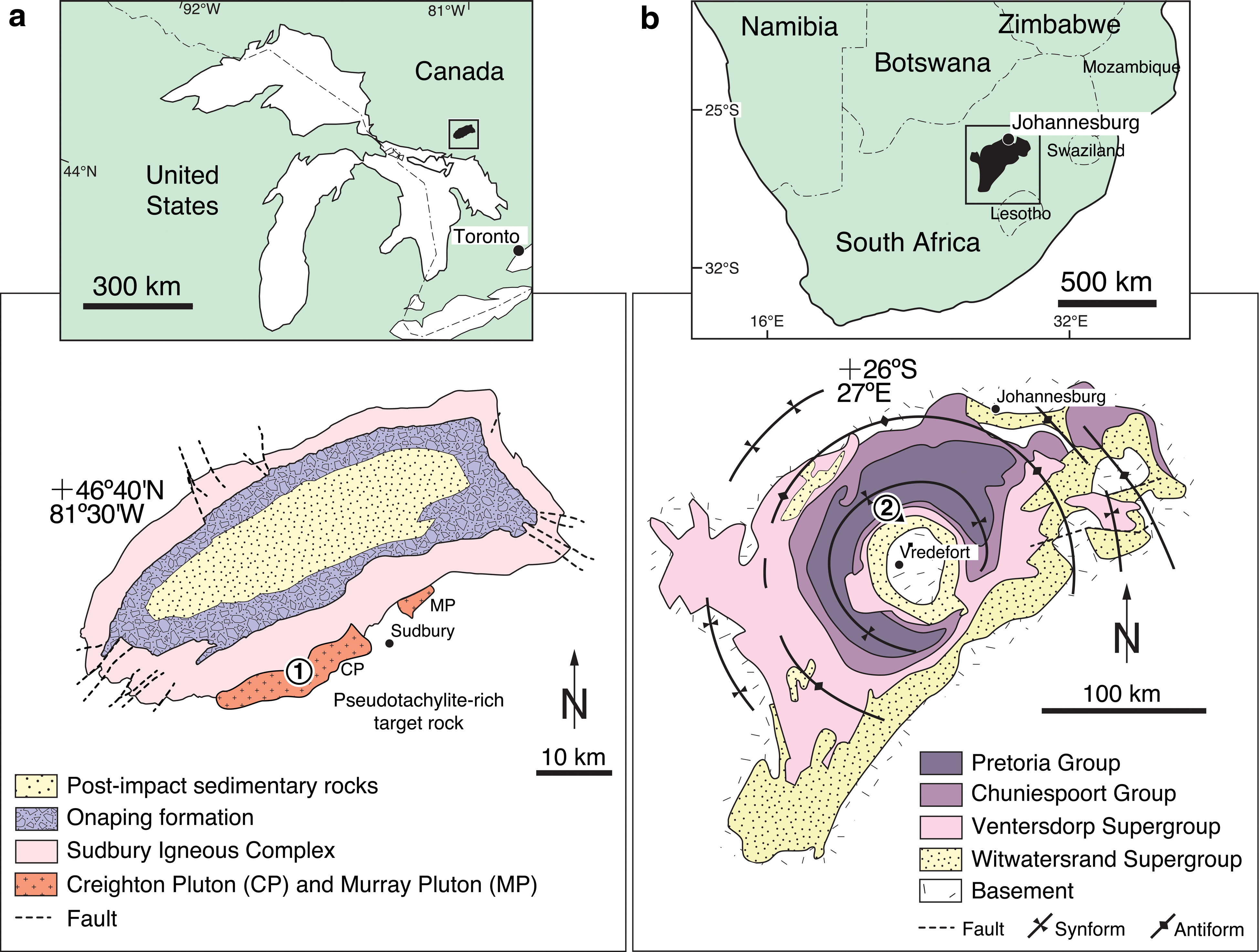
Sudbury (
The samples from the Outer Hebrides were collected on the islands of Barra, South Uist, and North Uist and represent pseudotachylites of the Outer Hebrides Fault Zone (OHFZ), which runs about 170 km approximately north–south down the eastern seaboard of the islands (Fig. 2). Pseudotachylites in this region are hosted by the Late Archean/Early Paleoproterozoic Lewisian gneiss and appear to have been formed during several different fault reactivation events during the Precambrian, including one at ∼1250 Ma and one at ∼700 Ma (Sherlock et al., 2008). Pseudotachylites recovered from coastal exposures on Barra are illustrated by Fig. 3 and were found to contain healed microfractures probably representing brittle deformation during fault reactivation.

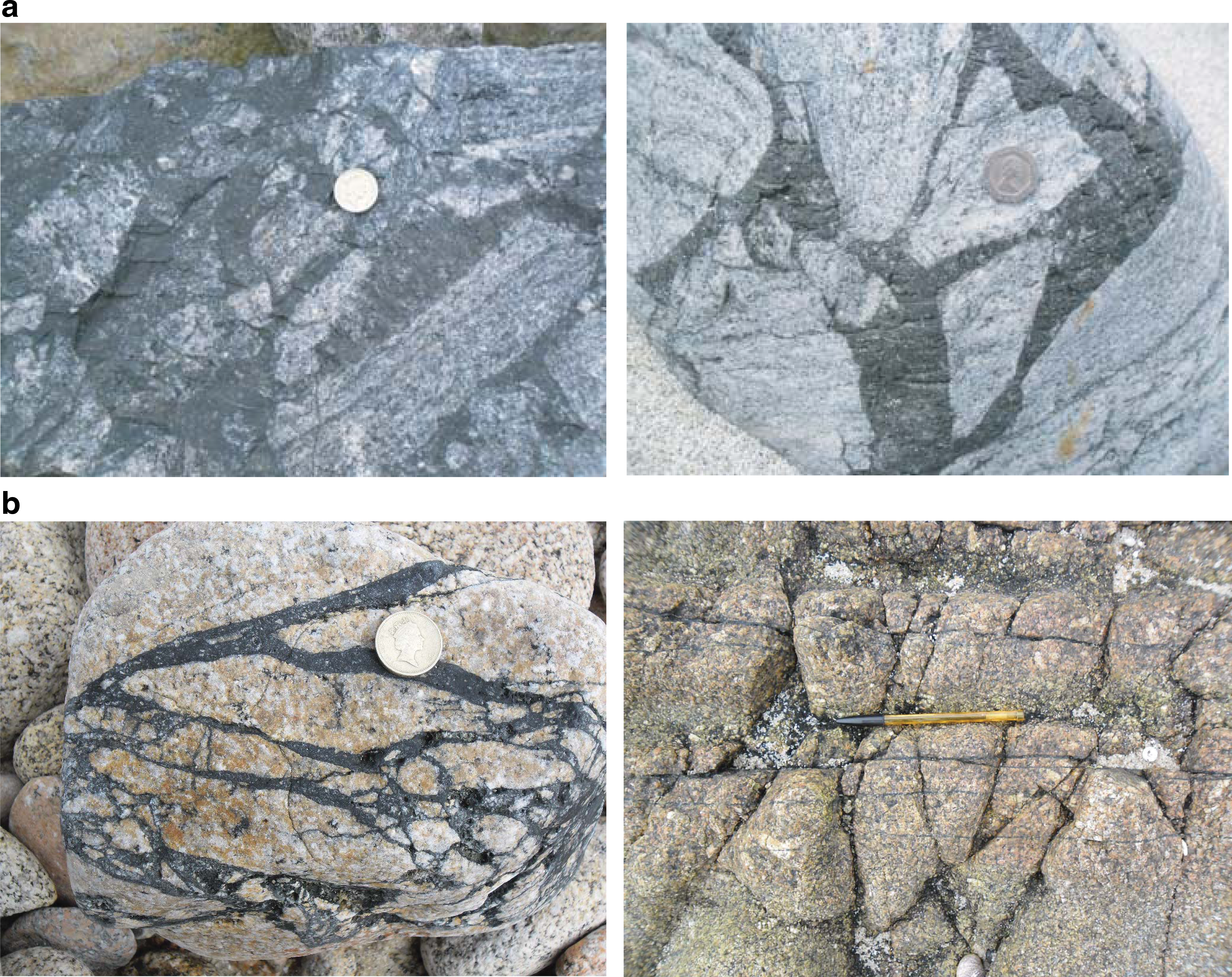
Pseudotachylites from the British Isles. (
Pseudotachylites in the Gairloch region on the northwest Scottish mainland are also hosted by Lewisian gneiss but are associated with a different fault system and have been dated to around 1 Ga (Sherlock et al., 2008). The samples analyzed here were collected from the Loch Tollie Quarry, west of Loch Tollie, and from a second locality to the east of Loch Tollie, where the control gneiss sample was also collected. The loch lies between two “crush belts” (shear zones) about 1 km distant to the northeast and southwest (Sherlock et al., 2008; Fig. 4). Each of the Scottish pseudotachylite occurrences consists of glassy black vein networks up to meters in width, containing fragments of unaltered gneiss country rock. The pseudotachylites are locally cut by planar quartz veins, representing brittle reactivation of the fault system. Samples from the Loch Tollie localities contain pyrite up to 1 mm size, particularly around healed microfractures (Fig. 5). The analyses were made of glassy material free of country rock, quartz, or pyrite.
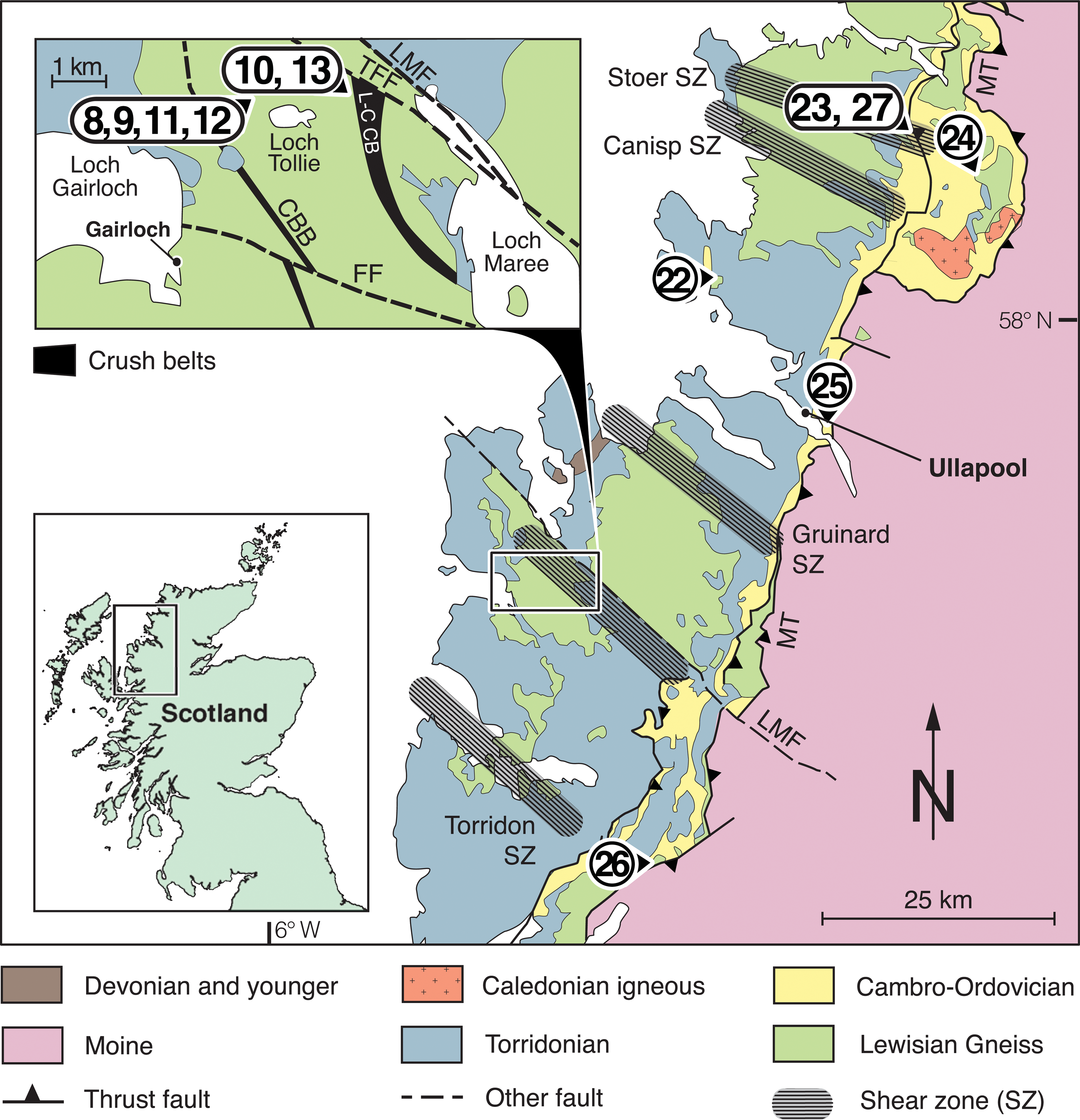
Sample localities in the Moine Thrust Belt, Northwest Highlands. Figure adapted from the work of Krabbendam and Leslie (2010), with inset showing Gairloch region adapted from Sherlock et al. (2008). MT = Moine Thrust; LC = Langwell Culmination; DC = Dundonell Culmination; FH = Faraid Head; SZ = shear zone. Details east of the Moine Thrust are not shown. LMF = Loch Maree fault; TFF = Tollie Farm fault; L-C CB = Leth-chreige crush belt; TA = Tollie antiform; CBB = Creag Bahn belt; FF = Flowerdale fault. See Table 1 for key to sample localities. (Color graphics available at

Scanning electron microscope image showing polished thin section of pseudotachylite from Loch Tollie in Northwest Scotland. Scale bar = 100 μm. Healed microfractures run from the upper left to the lower right of the field of view. Note large fractured and comminuted grains of quartz and feldspar suspended in the glassy groundmass. White areas (e.g., lower right) are pyrite; black grains are iron oxides.
The Isles of Scilly are located about 50 km west-southwest from the westernmost point of mainland Cornwall, England. They are dominated by a large Hercynian (Permo-Carboniferous) granite pluton, with superficial sedimentary cover. As far as we can discover, pseudotachylite has not previously been described in the Isles of Scilly, although Barrow and Flett (1906) referred to “greisen veins” in the granite, by which the pseudotachylite may be intended. The samples analyzed here were collected from float material of granitic rock cut by centimeters-width black, glassy veins on a beach on St Agnes Island where the pseudotachylite can also be seen in situ (Fig. 3b). The control granite (predominantly quartz and feldspar, identical to the pseudotachylite host rock) was also collected at this locality.
Cambrian cataclasites (originally quartzites) were sampled from faults associated with the Moine Thrust Belt in the vicinity of Ullapool in western Scotland (Fig. 4). Each of the Cambrian samples was originally a quartz arenite (almost pure quartz sandstone), consisting of rounded grains of medium-coarse quartz sand, cemented by quartz overgrowths, such that there is negligible residual porosity. This large and structurally complex thrust zone developed during the Caledonian orogeny around 450–430 Ma (Goodenough et al., 2011) and extends for nearly 200 km. Samples were collected by the present authors from a beach outcrop near Achiltibuie, a roadcut at Skiag Bridge, the mountain Conival near Inchnadamph, and a roadcut at Corry Bridge near Ullapool. Skiag Bridge is a well-known locality close to the shore of Loch Assynt, where the Cambrian Pipe Rock quartzite is offset by a minor thrust fault, with “damage zones” on both sides (Lloyd, 2000). The Conival sample is from a crushed zone in which brecciated quartzite fragments are cemented by a matrix rich in iron oxide and kaolinite. The Corry Bridge exposure (on the A835 road) is also a well-known locality, where fractured Cambrian quartzite outcrops along a fault where rocks of the Proterozoic Torridonian Supergroup are thrusted over limestone of the Ordovician Durness Group (Allison et al., 1988). Five control samples for the cataclasite analyses were selected from a range of Cambrian quartzites from western Scotland, and an additional specimen was sampled from the Paleoproterozoic Hauki quartzite at Kiruna, Sweden. The control sample from Coulags is conspicuously veined by quartz as a result of Moine Thrust deformation, but it is not a cataclasite (and the quartz veins themselves were excluded from the analyzed portion). The sample from Ord, Isle of Skye, was obtained from close to a thrust fault but is not a cataclasite.
2.2. Crush-fast-scan mass spectrometry
Samples were extracted from the interiors of rock specimens with a water-lubricated diamond circular saw to avoid (as far as possible) superficially weathered and contaminated material. Match-head-sized samples of about 250 mg were obtained by crushing specimens with a stainless steel fly-press that was scrubbed clean with acetone. Samples were rinsed in hydrogen peroxide, potassium hydroxide, and deionized water to remove superficial organic matter and dried in a laminar flow hood before sealing in sterile plastic bags for shipping.
Volatiles were extracted and analyzed at the New Mexico Institute of Technology by using the CFS mass spectrometry technique (Norman and Moore, 1997; Moore et al., 2001; Parry and Blamey, 2010; Blamey, 2012; Blamey et al., 2015). Samples were crushed incrementally under an ultrahigh vacuum (∼10−8 torr), with each crush liberating a swift burst of mixed volatiles. Each crush increment may liberate fluids from multiple sites. A typical sample size of about 250 mg released 4–10 bursts of volatiles into the vacuum chamber, which remained there for 8–10 analyzer scans (∼2 s) before removal by the vacuum pump. This method does not require a carrier gas, and volatiles are not separated from each other but released simultaneously into the chamber. The crushing area and crushing bellows were cleaned with potassium hydroxide and swabbed with deionized water and isopropanol prior to analysis. Crushing of fused silica cuvettes with low gas-content (“blanks” used to support the analysis of geological samples) produces a burst of hydrogen 3–4 orders of magnitude smaller than that released from fluid inclusions in rocks; these bursts are likely to represent trace gases already present in the blanks.
3. Results
The main constituents of the evacuated fluids were H2, N2, CO2, and H2O (Table 2), with most samples dominated by water (typically >90%). CO2 was the most abundant of the nonwater phases. All pseudotachylites with local country rock controls were enriched in H2 compared to the controls. For comparison with model predictions and microbial requirements expressed as aqueous concentrations, we report H2 relative to H2O (mol dm−3) using the H2O and H2 percentages; however, the measured values generally exceed the solubility of H2 in water under standard conditions (∼0.8 mM), indicating that some hydrogen is actually present in a free gas phase coexistent with water. (An almost identical overall distribution of results is found if H2/N2 or % H2 is considered.) Results for the pseudotachylites are shown in Fig. 6a. H2 abundance per volume of water in the pseudotachylites ranged from 1.9 × 10⁻² mol dm−3 (an outlier) to 8.3 mol dm−3, with most values between approximately 0.1 and 1.0 mol dm−3. The high value at Barra Quarry (1.1% H2 or 6.2 mol dm−3) should be interpreted with caution because the fluids from this sample were uniquely dominated by CO2 rather than water. Country-rock controls ranged from 0.4 to 5.3 × 10⁻² mol dm−3. The average H2 enrichment in the pseudotachylites compared to the controls was 1.3 mol dm−3 H2O in the Outer Hebrides gneiss (0.4 mol dm−3 if Barra Quarry is excluded), 0.13 mol dm−3 in the gneiss west of Loch Tollie, 1.1 mol dm−3 in the gneiss east of Loch Tollie, and 4.6 mol dm−3 in the granite from St Agnes Island. No significant difference in H2 abundance was observed between the tectonic and the impact-crater pseudotachylites, although suitable controls were not available for comparison with the latter. The two pseudotachylites from the western locality at Tollie, Gairloch are over an order of magnitude discrepant; the higher of the two samples is closer to the pseudotachylites from other localities.
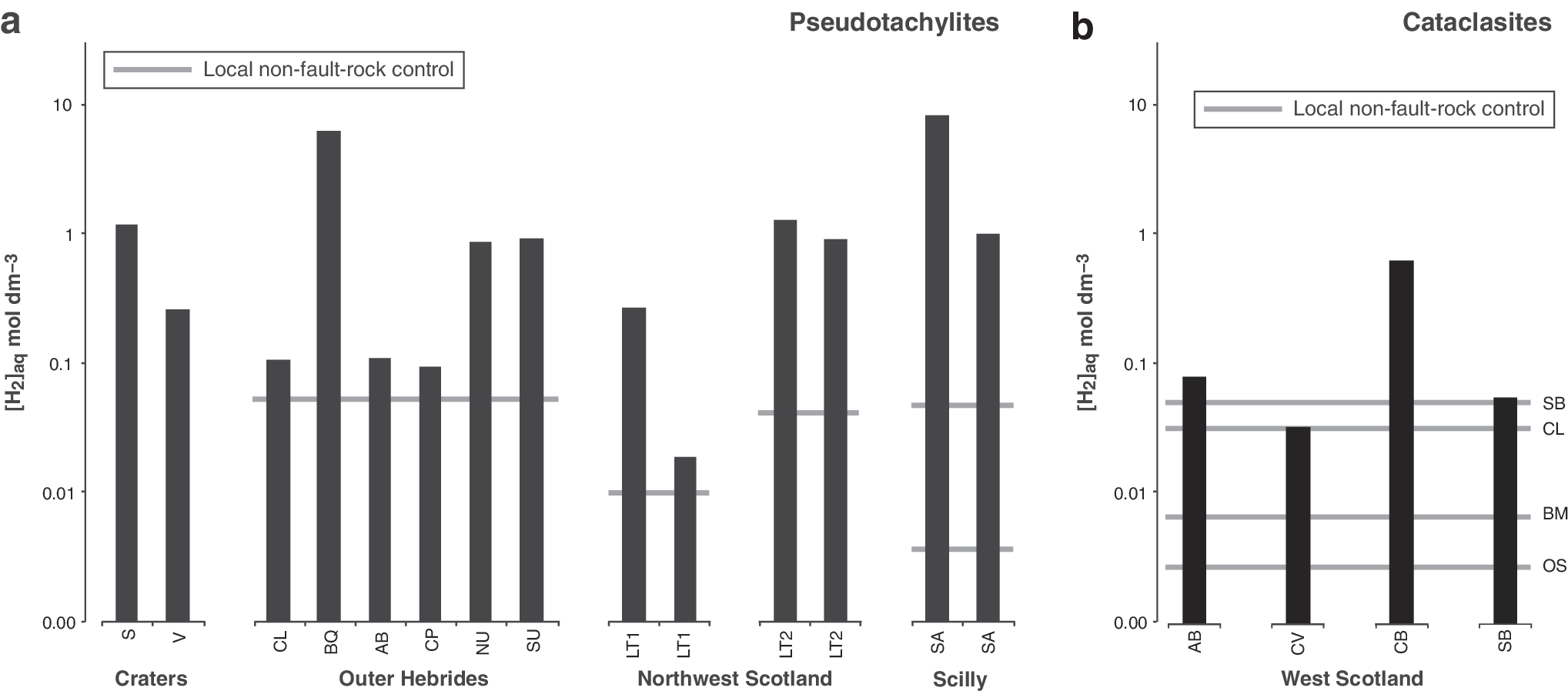
H2 in pseudotachylites (
Each row represents the average of several fluid bursts released by one sample.
Results for the cataclasites are shown in Fig. 6b. The H2 enrichments are slightly higher on average in the cataclasites than the local quartzite controls but lower than those detected in most of the pseudotachylites. The average H2 enrichment in the cataclasites compared to the local controls was 0.18 mol dm−3 (H2O).
4. Discussion
The gas analysis shows that the pseudotachylites are consistently enriched in hydrogen compared to suitable controls, while an enrichment in the cataclasites is more equivocally suggested. Notably, there is no evidence of hydrogen enrichment in the cataclasite sample from the minor thrust at Skiag Bridge compared to the noncataclasite quartzite from the same locality. However, it may be significant that the Corry Bridge cataclasite, which is particularly well developed and has been described as “ultracataclasite” (Allison et al., 1988), yields the highest H2 abundance among the cataclasites we analyzed.
4.1. Possible sources of measured hydrogen
The rocks are of low permeability, and the exposures sampled are not close to mafic or ultramafic rocks, to serpentine- or talc-bearing units, or to organic-rich sediments from which H2 might otherwise have been derived. Radiolysis and water–rock reactions are the most widely discussed mechanisms for generating H2 within rocks. Radiolysis over long timescales has previously been suggested to account for most of the H2 in the Precambrian basement (Sherwood-Lollar et al., 2014). However, we find H2 enrichments in the Phanerozoic pseudotachylites comparable to those in the more ancient samples, and the Paleoproterozoic quartzite sample analyzed (Kiruna, northern Sweden) is poorer in H2 than most of the Cambrian samples. Water–rock reactions capable of generating H2 during the oxidation of ferrous iron are well known in mafic and ultramafic igneous rocks but have not been widely described in gneiss or granite (which do nevertheless contain some ferrous iron, e.g., in biotite).
The sampled rocks must have lost some H2 by diffusion over geological time, but the nonfault rocks should not have lost substantially more H2 than the fault rocks; nor should the cataclasites have lost more than the pseudotachylites. Hence, the H2 enrichment in the fault rocks compared to the controls implies a process of faulting-related H2 production or release. The fact that pseudotachylites are found to record a greater H2 enrichment than cataclasites supports this inference, since the former represent a greater intensity of fault activity and, being glassy or very fine-grained, are especially vulnerable to disruption, including microfracturing, during fault reactivation (Kirkpatrick and Rowe, 2013). However, the difference between the H2 content of the two rock types may be less significant than the differing tectonic and lithological settings of the particular localities sampled, particularly the fact that the faults sampled for cataclasites had smaller displacements.
Faulting stimulates both water–rock reactions and radiolysis by exposing fresh rock surfaces to groundwater (e.g., Sherwood Lollar et al., 2007; Sleep, 2012), but the addition of water through fractures would not necessarily increase the amount of H2 per volume of water as recorded in our samples. Moreover, these are slow processes, whereas H2 generated rapidly at the time of fault motion should be more abundantly trapped (in concurrently propagating microfractures). Such rapid fracture-enhanced processes include the diffusion of existing H2 out of interstitial sites in crystals (Freund et al., 2002) and the mechanoradical mechanism described by Kita et al. (1982) and Hirose et al. (2011). The melting of the pseudotachylite would only have led to minimal H2 formation because, given the absence of organic matter and graphite, conditions were insufficiently reducing. However, while a crystalline rock is cooling after crystallization, the redox conversion of OH− into peroxy defects and H2 can occur (Freund et al., 2002, and references therein). This may have contributed some portion of the H2 we measured in the pseudotachylites, which would be retained interstitially independently of any fluid inclusions trapping original pore fluids from the fault zone. Additional fluids, including water, may have been exsolved during cooling after crystallization both of the pseudotachylites and of their precursor crystalline rocks, forming inter- and intragranular fluid-filled cavities.
Assuming that the fluids we measured in the pseudotachylites mostly represent original pore water trapped in microfractures during faulting activity, we now ask whether the measured H2 enrichments are broadly consistent with the measurements made by Hirose et al. (2011) of gas liberated during the grinding together of rock surfaces. From these measurements, Hirose et al. derived a semi-empirical equation describing the concentration of mechanically derived H2 in fault-zone pore water immediately after an earthquake:
where α is an empirical coefficient describing the slope of the graph of hydrogen production against frictional work, σ eff is the effective stress acting on the fault surface, μ d is the average dynamic friction coefficient during fault motion, and φ is the average porosity. The use of this equation assumes that (1) all pore spaces in the original fault zone are filled with fluid and (2) there is negligible fluid flow over the recurrence time of the seismic motion. These variables—and therefore the estimate of H2 concentration—are independent of event magnitude. It should be noted that the “concentration” calculated may exceed the actual solubility of hydrogen in water under the relevant conditions and that a separate gas phase may be generated; nevertheless, the equation predicts the quantity of H2 per volume of water. The protolith for pseudotachylite samples 1–7 was the famous Lewisian gneiss. These pseudotachylites probably formed at depths of 4–5 km (Sibson, 1975). At the present day, the porosity of Lewisian gneiss is reported by geophysical surveys as 0.07% at 1 km depth and 0.005% at 2 km depth (Hall, 1987). Substituting into Eq. 1 the value of the empirical coefficient α determined for granite by Hirose et al. (2011, 2012; these authors did not report a value for gneiss) therefore yields an estimated H2 abundance (per volume of water) of 0.2 mol dm−3 at 1 km depth and 5 mol dm−3 at 2 km depth, with still higher concentrations at greater depths. Thus, it is realistic to explain the comparable H2 values measured in our pseudotachylites (Section 3) as the product of ancient earthquakes in the Lewisian gneiss, generated mechanically and trapped in groundwater within fluid inclusions. Isotopic study of the H2 (i.e., D/H ratio) would facilitate more rigorous testing of genetic hypotheses but may be technically challenging for such small volumes.
4.2. Biological utility of measured hydrogen enrichments
Hirose et al. (2011) reported that seismogenic H2(aq) in fault zones may attain concentrations in excess of 1 mM, which they followed Takai et al. (2006) in regarding as the lower limit for the support of lithoautotrophic microbial communities. Both thermodynamic considerations and field measurements suggest that the true requirement may be much lower. To be metabolically viable, archaeal methanogenesis must yield free energies of at least −10 kJ mol−1 CH4 (Hoehler et al., 2001; Heuer et al., 2009). In deep marine sediments, it has been shown that H2(aq) concentrations of only 1 nM (10−9 mol dm−3) enable methanogenic CO2 reduction to meet this criterion (Heuer et al., 2009). The steady-state H2(aq) concentration measured in natural hydrogen-powered ecosystems provides an upper limit for the minimum viable concentration. Lovley and Goodwin (1988) estimated that the steady-state H2(aq) concentration in sediments with hydrogenotrophic methanogenesis or sulfate reduction should be 13 or 1 nM, respectively. More recently, H2 concentrations of ∼10 nM were measured in a 200 m deep igneous aquifer supporting hydrogenotrophic methanogens (Chapelle et al., 2002). Hence, even H2 concentrations of millimolar magnitude are probably far in excess of minimum biological requirements.
If the measured fluids are indeed representative of groundwater trapped during fault motion, then they therefore support the hypothesis that fault-generated gas (from all sources) could supply energy to microbes in fracture zones. Moreover, while most fault-related H2 presumably escapes into pore and fracture waters where it could support microbial hydrogenotrophs, these results may indicate that another (no doubt far smaller) portion of it is trapped and retained by fault rocks, producing the strong H2 enrichments we observed. Once preserved in fault rocks, the trapped H2 may be subsequently liberated by reactivation of the fault, along with any newly generated gas. For example, the numerous reactivation events in the Outer Hebrides Fault Zone may have repeatedly released H2 from pseudotachylites into local groundwater (e.g., Osinski et al., 2001). Pseudotachylites are particularly vulnerable to alteration and destruction in a variety of other ways that could liberate H2 (Rabinowitz et al., 2011; Kirkpatrick and Rowe, 2013). As noted, concentrations of H2 as low as 10−9 M can probably support hydrogenotrophic methanogens. Our samples liberated on average about 2 × 10⁻¹¹ mol H2 per gram of pseudotachylite (with a range from 5 × 10⁻¹³ to 9 × 10⁻¹¹); hence, the H2 contents of 1 g of pseudotachylite are sufficient to stimulate methanogenesis in 10 mL of water, at least instantaneously. The CO2 necessary for methanogenesis is also available from groundwater (and detected in our pseudotachylites; Table 2).
4.3. Implications for martian habitability
It is widely recognized that the most hospitable environments for life on present-day Mars are likely to occur in the deep subsurface (e.g., Boston et al., 1992; Fisk and Giovannoni, 1999; Westall et al., 2013; Cockell, 2014). There is good evidence that liquid water was abundant at the martian surface for long periods of geological time, and most of this water is expected to remain on Mars in the form of ground ice and subpermafrost liquid aquifers, which potentially achieve thicknesses of up to several hundred meters (Clifford et al., 2010; Cockell, 2014). If present, these aquifers are likely to be buried, on average, ≥5 km below the surface, although local variation may be considerable (Clifford et al., 2010).
To assess whether frictionally controlled H2-generating processes on fault planes could generate biologically significant quantities of hydrogen in present-day subsurface aquifers on Mars, we adapt the model of Hirose et al. (2011, 2012) for the martian geological context (compaction curve, rock type, and gravitational field strength).
Equation 1 yields the approximate H2 concentration in a fault zone immediately after a seismic event as a function of porosity, dynamic friction coefficient, and effective stress (Hirose et al., 2011). Both porosity and effective stress (lithostatic pressure minus fluid pore pressure) vary with depth below the martian surface. Figure 7 shows the modeled concentrations of seismogenic H2 as a function of Marsquake depth according to the porosity–depth relationships given by Athy's formula (φz = φ 0e−kz where φ = porosity, φ 0 = surface porosity, k = the compaction coefficient, and z = depth; Athy, 1930) supplied with the martian parameters of Clifford et al. (2010). Fracture porosity and cataclasis in fault zones could either increase or decrease bulk porosity away from this background curve. Higher porosities yield smaller concentrations because the volume of fluid into which the H2 is dispersed is greater. It is assumed that the dynamic friction coefficient is 0.25, pore pressure is hydrostatic, and fluid does not flow away from the fault during seismic activity.

Approximate instantaneous seismogenic H2(aq) concentrations after a Marsquake as a function of depth and porosity below the surface. (
It was suggested in Section 4.2 that hydrogenotrophic communities require H2(aq) concentrations of at least 10 nM (10−8 mol L−1). The modeled seismogenic H2 concentrations below a few kilometers depth are 5 or 6 orders of magnitude above this threshold and therefore eminently capable of supporting life. The volume of fluids in which these high H2(aq) concentrations are actually present depends on the magnitude of the seismic event as well as the availability of liquid water; if all the pores are filled with water, it is simply the product of the average displacement D(M) on the fault, the surface area S(M) on which displacement occurs, and the porosity (Hirose et al., 2011). Following Hirose et al. (2011), we derive both D(M) and S(M) from the magnitude by the empirical formulae of Utsu (2001): D(M) = 10½M−3.1; S(M) = 10 M+2. Under martian conditions, if the fluids are trapped within the fault zone and all pores are filled with fluid, the groundwater volume varies from only 5.0 m3 for a magnitude-2 event at 5 km depth to 3.7 × 10⁷ m3 for a magnitude-7 event at 10 km depth, if porosity follows the higher curve in Fig. 7 and the empirical coefficient α in Eq. 1 is given the experimental value determined for water-saturated basalt under terrestrial air (Hirose et al., 2011).
At the present day, events of these magnitudes or greater occur somewhere on Mars on average every 34 days and every 4500 years, respectively, according to the most conservative model of martian seismicity proposed by Knapmeyer et al. (2006). This model is based on a fault catalogue compiled from Mars Global Surveyor altimetry data; direct measurement of seismic activity on Mars awaits the arrival of the SEIS planetary seismometer to be carried on the InSight mission (Mimoun et al., 2012). Combined with the results of Hirose et al. (2011, 2012), it predicts that average annual cumulative H2 production is less than 10 tonnes over the entire planet. Hence, although seismic H2 production could sporadically fuel pockets of microbial activity on Mars, it would be highly spatially and temporally restricted to fault activity and its aftermath, with small total biomass. Nevertheless, faulting and fracturing during seismic activity on Mars (Marsquakes and impact events) can improve subsurface habitability in at least two other ways. Firstly, permeability and potentially porosity are increased in the fracture zone, creating new habitable space and enabling fluid flow and cell transport (Sleep, 2012). Secondly, fresh rock surfaces may be brought into contact with circulating water, enabling life-supporting water–rock reactions and H2 production by radiolysis (Sleep and Zoback, 2007). It is interesting to note that, like radiolysis, the crushing of quartz in water has also been found to produce hydroxyl radicals (e.g., Shi et al., 1988). Thus, there is a previously unrecognized possibility that pyrite is abiotically oxidized to sulfate in the vicinity of active faults, supplying another electron acceptor of key interest on Mars. Experimental work would be worthwhile to determine whether this phenomenon could generate the anomalies in the sulfate concentration of groundwater reported in association with earthquakes (e.g., Song et al., 2006; Harabaglia et al., 2008).
Mars may have had something more like a plate tectonic regime in the distant past (e.g., Yin, 2012). Numerous large faults are exposed at the martian surface, which is also heavily fractured and cratered by billions of years of impacts. It has been proposed that craters could have provided local refugia for microbial life on Mars (and early Earth) by increasing the temperature and porosity of the target region, enabling hydrothermal circulation over geological timescales (Cockell, 2004). One might speculate that these conditions could also have stimulated the origin of life itself on either planet, providing “crucibles” in which the components necessary for the origin of life evolved through a slow cooling curve, favoring a sequence of prebiotic reactions in a long-lived hydrothermal system (Cockell, 2004, 2006). Our results suggest that a supply of seismogenic H2 may have contributed to both the habitability and prebiotic chemical evolution of these systems.
5. Conclusions
This study has shown that fault rocks contain elevated quantities of hydrogen gas. The hydrogen concentrations implied by the measured H2 and H2O contents are sufficient to support hydrogenotrophic microorganisms, with implications for the habitability of fault zones, if the fluids measured represent trapped fault-zone pore waters. Although fluids derived from other sources may also be present, the enrichment in the fault rocks compared to controls is consistent with faulting-related H2 production, for which several possible mechanisms have been described. Extending to Mars the empirical model of Hirose et al. (2011) for frictionally controlled H2 production on fault planes, we find that the low level of martian seismicity is sufficient by itself to support spatiotemporally limited hydrogenotrophy in the subsurface. These considerations together with many others suggest that fault rocks or fault-related mineral vein networks deserve consideration as a target for biosignature sampling by future Mars missions.
Footnotes
Acknowledgments
S.M. thanks the STFC Aurora Programme for a PhD studentship and the NASA Astrobiology Institute for additional funding (NNAI13AA90A; Foundations of Complex Life, Evolution, Preservation and Detection on Earth and Beyond). Alison Wright, Roger Gibson, and Edward Lynch are thanked for contributing samples. We thank three anonymous reviewers for their insightful comments.
Author Disclosure Statement
No competing financial interests exist.