




Abstract
The chemical history of carbon is traced from its origin in stellar nucleosynthesis to its delivery to planet surfaces. The molecular carriers of this element are examined at each stage in the cycling of interstellar organic material and their eventual incorporation into solar system bodies. The connection between the various interstellar carbon reservoirs is also examined. Carbon has two stellar sources: supernova explosions and mass loss from evolved stars. In the latter case, the carbon is dredged up from the interior and then ejected into a circumstellar envelope, where a rich and unusual C-based chemistry occurs. This molecular material is eventually released into the general interstellar medium through planetary nebulae. It is first incorporated into diffuse clouds, where carbon is found in polyatomic molecules such as H2CO, HCN, HNC, c-C3H2, and even C60 +. These objects then collapse into dense clouds, the sites of star and planet formation. Such clouds foster an active organic chemistry, producing compounds with a wide range of functional groups with both gas-phase and surface mechanisms. As stars and planets form, the chemical composition is altered by increasing stellar radiation, as well as possibly by reactions in the presolar nebula. Some molecular, carbon-rich material remains pristine, however, encapsulated in comets, meteorites, and interplanetary dust particles, and is delivered to planet surfaces. Key Words: Carbon isotopes—Prebiotic evolution—Interstellar molecules—Comets—Meteorites. Astrobiology 16, 997–1012.
1. Introduction
C
Radio and millimeter astronomy offer a powerful venue for the study of carbon compounds in interstellar matter through observations of gas-phase molecules. In the colder temperatures typical of the dense ISM (T ∼ 10–100 K), the rotational energy levels of interstellar compounds are chiefly populated, principally by collisions. Heterodyne receivers employed on radio telescopes, such as the Sub-millimeter Telescope (SMT) of the Arizona Radio Observatory (ARO), located on Mt. Graham, Arizona (Fig. 1), allow for measurements at very high spectral resolution, typically one part in 106 to 108. By using such receivers, the rotational spectra of molecules can be detected, thus offering a “fingerprint” method for identification and study. Therefore, millimeter-wave telescopes can be viewed as sensitive spectrometers for remote sensing of molecules. The spectral signature must be well known, however, thus necessitating laboratory spectroscopic measurements.
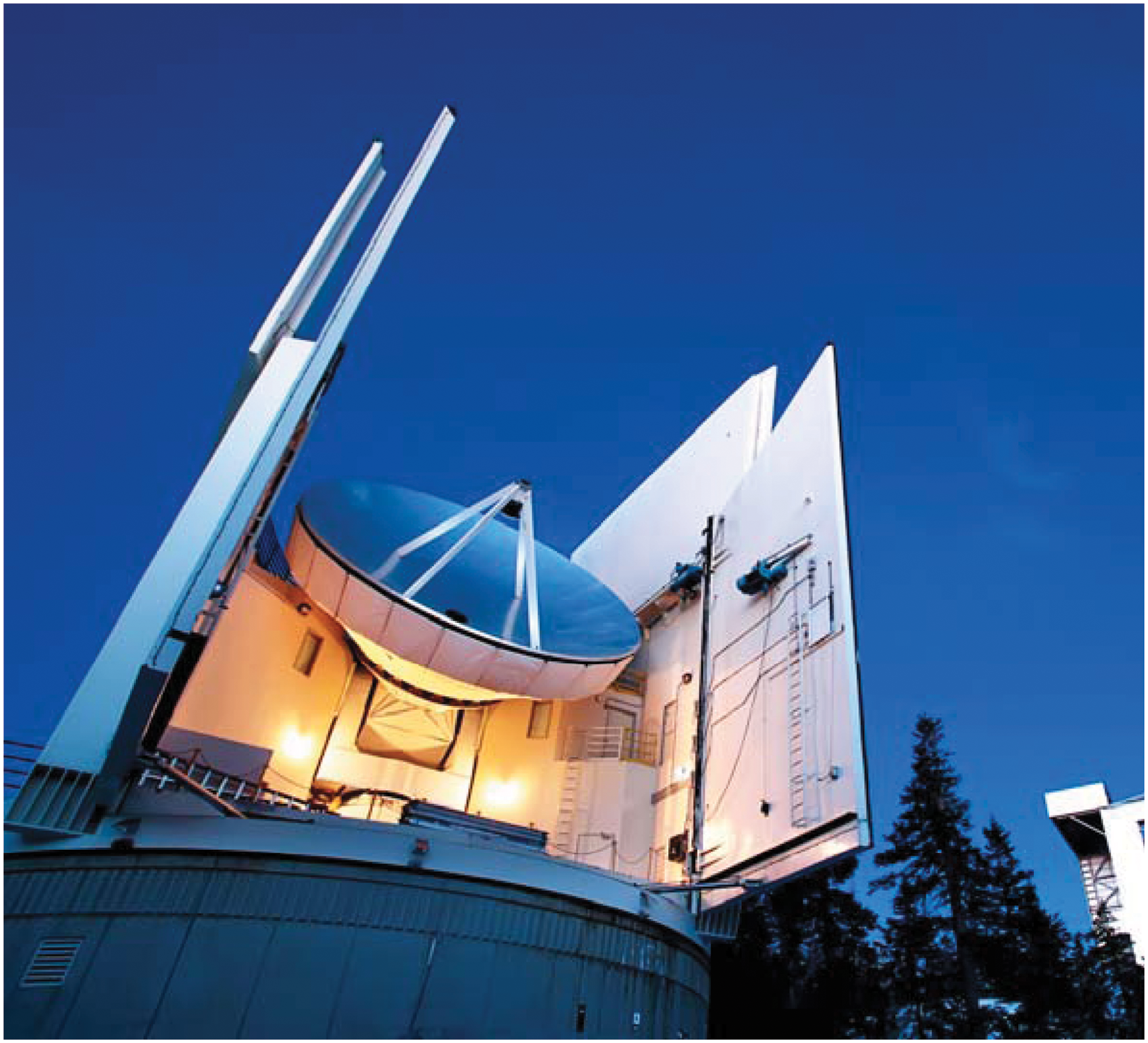
The Sub-millimeter Telescope (SMT) of the Arizona Radio Observatory (ARO) located on Mt. Graham, Arizona—one of the sub-millimeter-wave facilities used to study carbon-bearing molecules in interstellar gas. (Photo credit: David A. Harvey)
Radio astronomical methods focus on the gas-phase component of the ISM, but it is well known that such gas is mixed with dust grains. Typically, the dust mass in the ISM is about 1% of that of the gas in the general ISM (e.g., Jones, 2001). Dust grains are mostly silicate or carbonaceous in composition and have a size distribution ranging from ∼1 nm to 1 mm. The composition of these grains is best studied at IR wavelengths. Dust plays a critical role in the overall carbon budget.
Millimeter-wave astronomy has shown that, on a simplistic level, carbon chemistry is ubiquitous in the Galaxy, based on the carbon monoxide molecule, CO. An image of the galactic distribution of this molecule is shown in Fig. 2. Here, a map of the intensity of CO emission in its J = 1 → 0 rotational transition at 115,271.2 MHz (lower panel: color contours) is displayed, superimposed across the optical image of the Galaxy, shown individually in the upper panel. It is clear that CO traces all regions where stars are present and extends into areas well beyond the galactic plane. However, CO is a simple diatomic species, hardly “organic” in nature. As shown in Table 1, which lists all known interstellar C-bearing compounds, the chemistry of this element in terms of gas-phase molecules extends well beyond CO, forming species as complex as sugars, alcohols, and amides. The degree of chemical complexity of interstellar organic chemistry is not known, but it is becoming increasingly clear that the molecular content of the ISM is immense. It would therefore seem highly likely that this chemistry influences that on planetary surfaces. Following the history of carbon-bearing species through interstellar space, into nascent solar systems, and onto planets is critical to our understanding of astrobiology. This paper is intended to provide some insight into this history, as is currently known.
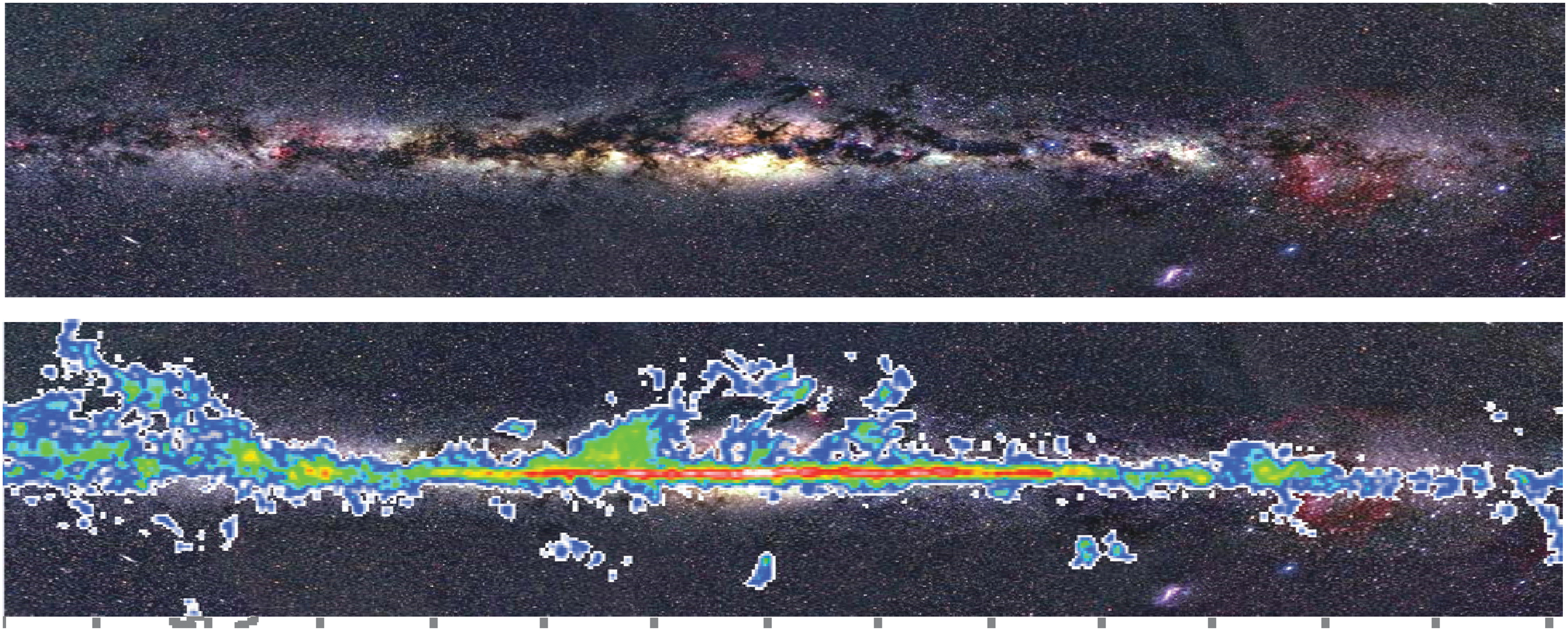
Upper panel: Optical image of the Milky Way Galaxy. Lower panel: The Milky Way Galaxy observed in carbon monoxide emission (CO: from Dame et al., 2001), superimposed over the optical image. The color contours represent the intensity of the CO emission in the J = 1 → 0 transition, with red being the highest and blue the lowest. The emission traces the molecular clouds in the Galaxy, which lie both in and above/below the galactic plane.
2. The Origin of Carbon in Stars and Their Ejecta
2.1. Stellar nucleosynthesis of carbon and transport into the ISM
The origin of carbon lies in aging stars. Carbon-12 is predicted to be formed in the triple-α process, in which extremely high temperatures and pressures in stellar interiors cause the fusion of three α particles: 34He → 12C (Timmes et al., 1995). This process occurs in very massive stars as they become Type II supernovae; 12C is formed in two separate shells in the layered structure of the stellar interior as the star explodes and is subsequently ejected into the ISM (Clayton, 2003). It is thought that about half the carbon-12 comes from Type II supernovae. The remaining half originates in the final phases of stellar evolution for low- to intermediate-mass stars (M * ∼ 1–8 M ⊙), as does the less abundant isotope, 13C. The concluding stages of the life cycle of these stars are illustrated in a tool known as the Hertzsprung-Russell (HR) diagram, as presented in Fig. 3.
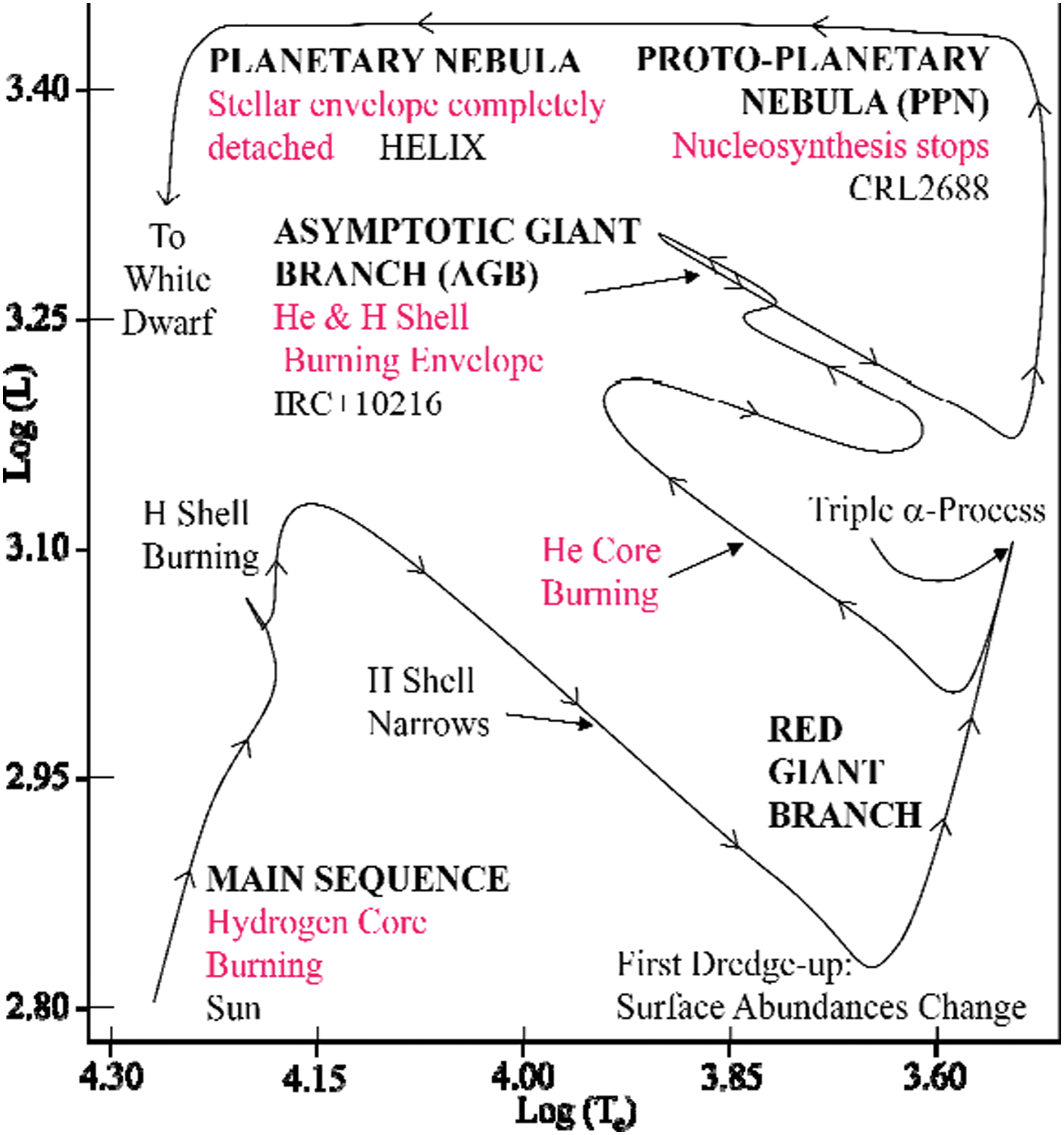
Qualitative Hertzsprung-Russell (HR) diagram, showing the evolution of an intermediate-mass star through the red giant and asymptotic giant branch (AGB) phases and into the planetary nebula (PN) stage. Important steps in nucleosynthesis in the stellar interior and names of representative objects are shown on the diagram.
As shown in Fig. 3, low/intermediate-mass stars evolve off the so-called “main sequence” when they have converted all the hydrogen in their cores into helium. About 90% of all stars are currently on the main sequence, a stage characterized by core hydrogen burning. When the hydrogen is depleted, the stellar core consequently contracts, causing a rise in temperature that ignites hydrogen in a surrounding shell, the “H-Shell Burning” phase. During the contraction, the outer envelope expands and cools, creating a red giant star (e.g., Pagel, 1997). As the object ascends the so-called red giant branch (RGB) (see Fig. 3), convection becomes the dominant energy transport mechanism. The convective envelope eventually reaches down into the H-burning shell, bringing by-products of the CNO cycle to the surface, including 13C, in what is termed the “First Dredge-up.” Note that the CNO cycle converts hydrogen into helium with 12C as a catalyst. The First Dredge-up sweeps the 13C out of the interior and to the stellar surface before it is destroyed in the CNO cycle. It is then ejected into the ISM by mass loss, which starts to become significant on the RGB. Gravitational contraction of the core continues on the RGB, and finally the helium in the core ignites. For stars with mass >4 M ⊙, a “Second Dredge-up” can occur, and subsequent mass loss brings additional 13C into the ISM.
When the helium supply is exhausted, the star consists of a carbon core surrounded now by He- and H-burning shells, and the asymptotic giant branch (AGB) begins (e.g., Herwig, 2005). In the He-burning shell, the triple-α process forms copious amounts of 12C. As the star continues along the AGB, the star becomes thermally unstable and thermal pulses (TP) develop, which allows the convective zone to reach into the He-burning shell and mix significant amounts of 12C into the outer layers of the atmosphere. This mechanism, the so-called “Third Dredge-up,” creates a “carbon-rich” star, such as the object IRC + 10216. In such stars, the surface C/O ∼ 2:1 (Iben and Renzini, 1983; Mowlavi, 1999). AGB stars are in fact one of the few interstellar environments where carbon is more abundant than oxygen, because typically, C/O ∼ 1:2 in the general ISM. The carbon-enhanced circumstellar material is then expelled into the ISM through the increased mass loss that occurs in the AGB stage.
Not all AGB stars end up carbon-rich. It is speculated that more massive AGB stars (>4 M ⊙) can undergo so-called “hot-bottom burning” or HBB (e.g., Herwig, 2005). HBB occurs when the bottom of the convective layer reaches into the active H-burning shell, effectively mixing the by-products of the CNO cycle into the envelope. The main result of HBB is that the 12C needed to create a carbon-rich star is converted into nitrogen and 13C and effectively destroyed (Frost et al., 1998, and references therein). The AGB star thus reverts back into an O-rich object.
2.2. The circumstellar environment of AGB stars
Mass loss from evolving stars becomes quite significant on the TP-AGB, with typical rates of 10 −5 to 10−4 M ⊙ per year (e.g., Zijlstra, 2006). This material flows from the star and creates a circumstellar envelope. As shown in the diagram in Fig. 4, these envelopes have considerable temperature and density gradients, which foster a rich chemical environment. Near the stellar photosphere (shown in orange), the circumstellar gas is hot (∼1000–2000 K) and dense (∼1010 cm−3), as it has just been driven from the star's surface (see Fig. 4). As this material flows from the star, it cools and becomes more diffuse. As the gas reaches the envelope edge, the temperature drops to ∼25 K, and the density is lowered to ∼104 particles cm−3 (e.g., Glassgold, 1996; Crosas and Menten, 1997). Therefore, in the inner envelope (at ∼10 stellar radii or 10 R *; see Fig. 4), three-body collisions occur that result in equilibrium (or “LTE” for local thermodynamic equilibrium) chemistry and the formation of stable molecules. Dust grains form in this region as well, which helps accelerate the shell material to typical expansion velocities of 10–20 km s−1 as a result of radiation pressure on grain surfaces. In C-rich stars, the dust is thought to be principally silicon carbide in composition, but for more evolved objects, amorphous carbon dominates (Kwok, 2004). Circumstellar dust in carbon stars is about 0.3% of the total mass (Knapp, 1985). The envelope material therefore moves fairly quickly from the star such that much of the LTE chemical composition becomes “frozen” through the intermediate part (white in Fig. 4) of the shell. However, in the outer regions, photochemistry and radical-radical reactions become important, as UV radiation from nearby stars impinges on the envelope.

Graphic representation of a cross section of an AGB circumstellar envelope, plotted as a function of radial distance (log scale) from the center of the star. The star is shown in green (or light gray), the dust acceleration zone in orange (or dark gray), and the remainder of the shell in white with a red (or black) border. Representative temperatures and densities are shown for the dust zone, in which chemistry occurs near thermodynamic equilibrium (“LTE” or “local thermodynamic equilibrium”), and the outer envelope, where photochemistry is dominant. (Color graphics available at
As discussed, many AGB stars become carbon-rich, and this elemental composition is reflected in the circumstellar shell. A very distinctive gas-phase carbon chemistry occurs in these envelopes, as characterized by long, acetylenic chain–type species of the type HC n N, C n H, and C n N, where n = 1, 2, 3, …. The most studied object of this type is IRC +10216, which lies about 150 pc from Earth and is thought to be representative of C-rich envelopes (see Cernicharo et al., 2000; Tenenbaum et al., 2010a). In this object, the series HCN, HC3N, HC5N, HC7N, and HC9N is found, as well as the allenic species HCCN and HC4N (e.g., Guélin and Cernicharo, 1991; Cernicharo et al., 2000). Radicals and negative ions consisting of long carbon chains are also present, including the hydrocarbon series C2H, C3H, C4H, C5H, and so on, and species with nitrogen (CCN, C3N, C5N; C3N−, C5N−: e.g., Thaddeus et al., 2008; Anderson and Ziurys, 2014). Various other C-bearing compounds have been identified as well, as represented by HCN, HCCH, CH3CN, and CH3CCH, and some unusual species such as SiC2, FeCN, and NaCN, containing carbon-silicon and carbon-metal (in the chemists' sense) bonds (e.g., Tenenbaum et al., 2010b; Zack et al., 2011). In fact, in the 1 mm region of the electromagnetic spectrum, the most common molecules are C4H, SiC2, and NaCN (Tenenbaum et al., 2010b). The complete list of C-containing molecules in IRC +10216 is given in Table 2. A sample spectrum of this object, showing some of the carbon-bearing compounds present, is shown in Fig. 5.
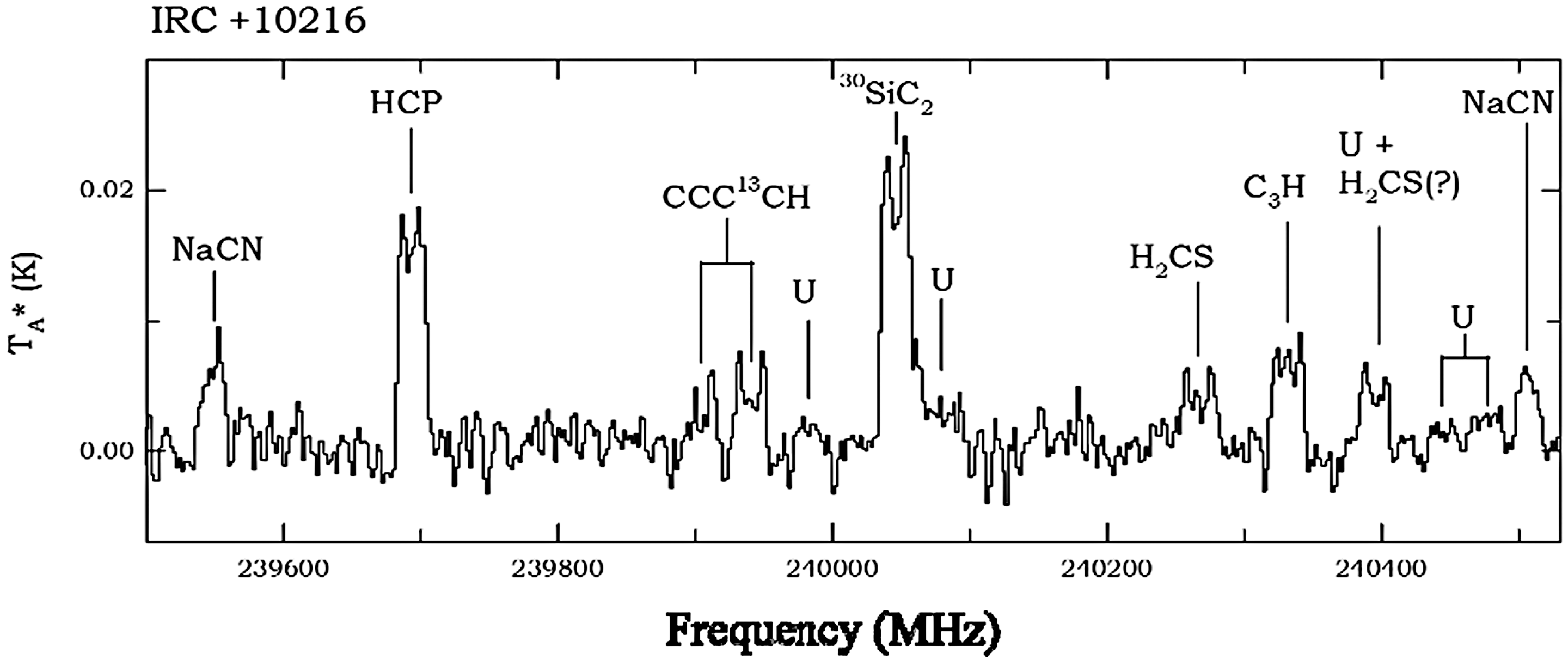
Representative spectrum of the carbon-rich envelope of the star IRC+10216, showing emission lines originating from various carbon-bearing molecules, measured with the ARO SMT at the frequency of 240 GHz (from Tenenbaum et al., 2010b). “U” indicates an unidentified line.
The more stable molecules such as HCN and HCCH in C-rich shells are thought to be formed by equilibrium chemistry in the inner envelope and thus are “parent” species. Their abundances are not altered through most of the shell as the material expands outward (e.g., Glassgold, 1996). In the outer envelope near∼100–1000 R
*, however, photodissociation of parent species begins to take place, creating radical species that initiate a complex neutral-neutral chemistry that leads to carbon chains. Photodissociation is only important in the outer shell because it can be penetrated by UV radiation from the local ISM. Two major photodissociation processes involve the destruction of HCN and HCCH (Glassgold, 1996):
CN and CCH then react with other neutral species, building to multicarbon chains, for example,
Observations have shown that the various chain species have narrow shell-like distributions in the outer envelope, each exhibiting peak abundances at different radii from the star (Bieging and Tafalla, 1993; Anderson and Ziurys, 2014). An example of this phenomenon is shown in Fig. 6. Here, the abundances of four carbon-chain molecules, along with HCN and CN, are plotted as a function of radial distance from the star (Anderson and Ziurys, 2014). The plots were derived by modeling observed line profiles of the molecules. It is clear that the abundance of HCN decreases as that of CN increases, and CN is the dominant outer envelope species. C3N and HC3N have similar shell-like distributions and comparable abundances, while CCP is created in the extreme outer shell. C-bearing molecules appear to originate in different, concentric rings, as also noted by Mauron and Huggins (1999) and predicted by theory (Glassgold, 1996).
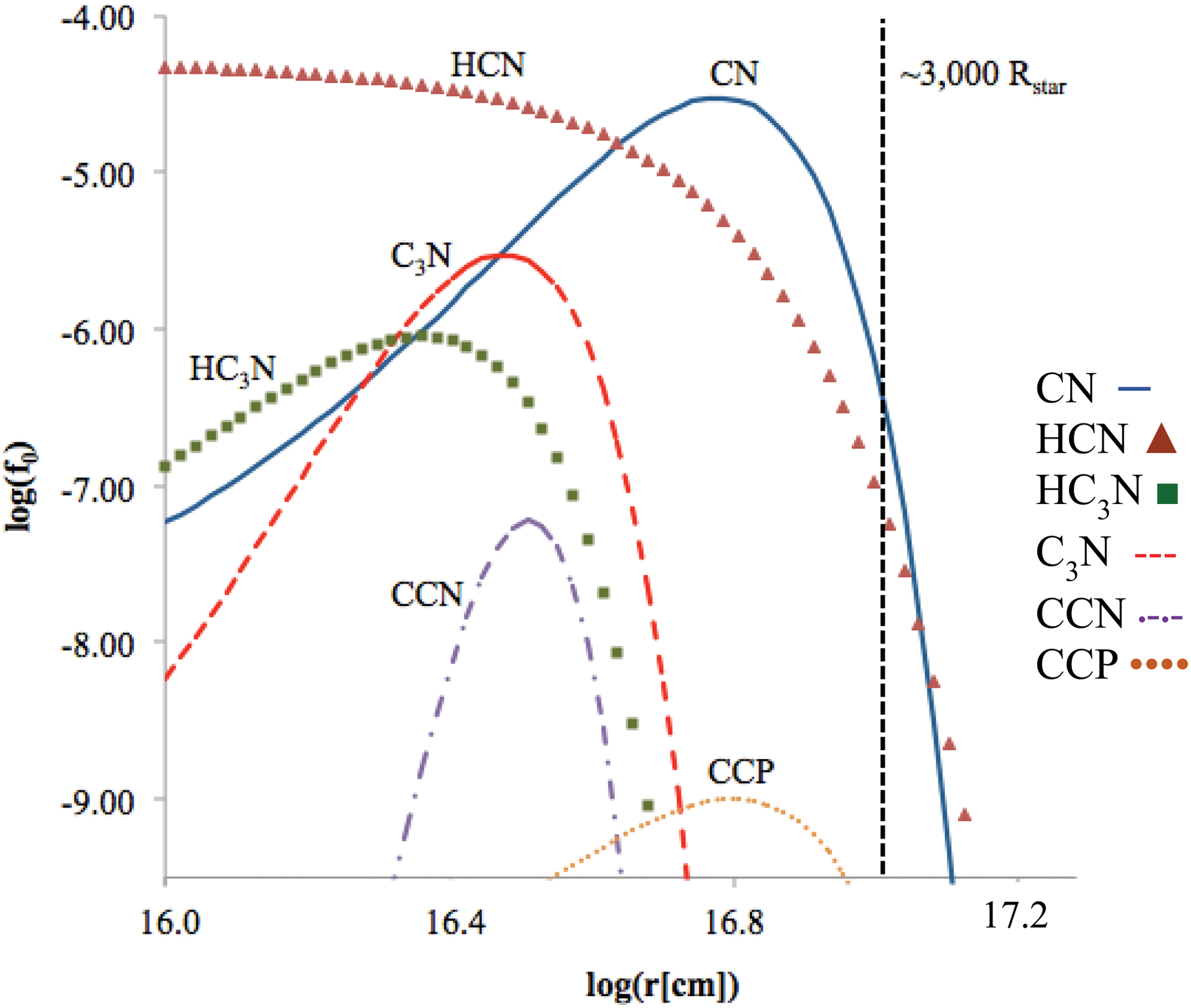
The outer shell abundances, relative to H2, of related carbon-chain molecules and their precursors in the envelope of IRC+10216, plotted as a function of the radial distance from the star (log scale), beginning at r∼1016 cm (from Anderson and Ziurys, 2014). The distributions were obtained by modeling observed spectral line profiles obtained with the ARO SMT and 12 m. The chain molecules appear to be present in successive shells. (Color graphics available at
Oxygen-rich envelopes of evolved stars support a less complex carbon synthesis. In these objects, carbon is typically represented by CO, HCN, CS, CN, HCO+, and HNC (e.g., Ziurys et al., 2009). O-rich stars also appear to have far fewer polyatomic species than their C-rich counterparts, with the most complicated compounds having only 3–4 atoms (NH3, SO2, HCN: see Tenenbaum et al., 2010a, 2010b). Dust grains are mostly oxidic in nature (e.g., Lodders and Amari, 2005). Therefore, very active molecular synthesis in an evolved stellar envelope appears to require C > O.
2.3. Into the planetary nebula phase
As shown in Fig. 3, eventually an AGB star expels almost all its initial mass through envelope loss and subsequently becomes a hot, UV-emitting white dwarf of approximately 0.5 M ⊙ (e.g., Kwok, 2000). Nucleosynthesis ceases at this juncture. The former circumstellar envelope continues to flow from the star and is partially ionized by the UV radiation, first creating a short-lived “protoplanetary” nebula and then a “planetary nebula”—a bright, colorful object characterized by high-energy atomic emission lines (with nothing to do with planets). CRL 2688 and the Helix are classic examples of these two types of objects (see Fig. 3). The common perception is that the molecular gas from the previous AGB envelope is mostly destroyed via photodissociation in planetary nebulae (PNe). Such molecular destruction is predicted by chemical models of these objects (e.g., Ali et al., 2001; Redman et al., 2003; Kimura et al., 2012). Molecular material in PNe should therefore be severely depleted as a function of time after leaving the AGB. Because PNe supply over 85% of the matter forming the ISM (e.g., Dorschner and Henning, 1995), the exact fate of the carbon-rich molecular material from C-rich envelopes is of interest.
However, very recent molecular studies of PNe show that, even in their very late stages, polyatomic molecular material survives, much of it containing carbon. Evidence for this new paradigm comes in part from a series of studies focusing on the Helix Nebula (NGC 7293), the oldest PN known at 12,000 years. This nebula has a large spatial extent on the sky. At first, various C-bearing molecules were found only at one position near the western edge of the nebula; the list of species present is composed of CO, HCN, CN, HCO+, HNC, H2CO, CCH, and c-C3H2 (Bachiller et al., 1997; Tenenbaum et al., 2009). Subsequently, both HCO+ and H2CO were detected at eight additional positions, sampled across the whole of the nebula (Zack and Ziurys, 2013), followed by HCN and CCH (Schmidt and Ziurys, 2016). The J = 1 → 0 transition of HCO+ was additionally mapped across the entire nebula, as traced by the optical image, and was found to be present virtually everywhere, as displayed in Fig. 7. The line profiles of this molecule varied with location as well, indicating a complex velocity structure within the nebula. Fractional abundances of HCO+ and H2CO relative to H2 were estimated to be f(HCO+/H2) ∼0.3–7.3 × 10⁻⁸ and f(H2CO/H2) ∼0.3–2.1 × 10⁻⁷—several orders of magnitude higher than predicted by any chemical model (Zack and Ziurys, 2013).
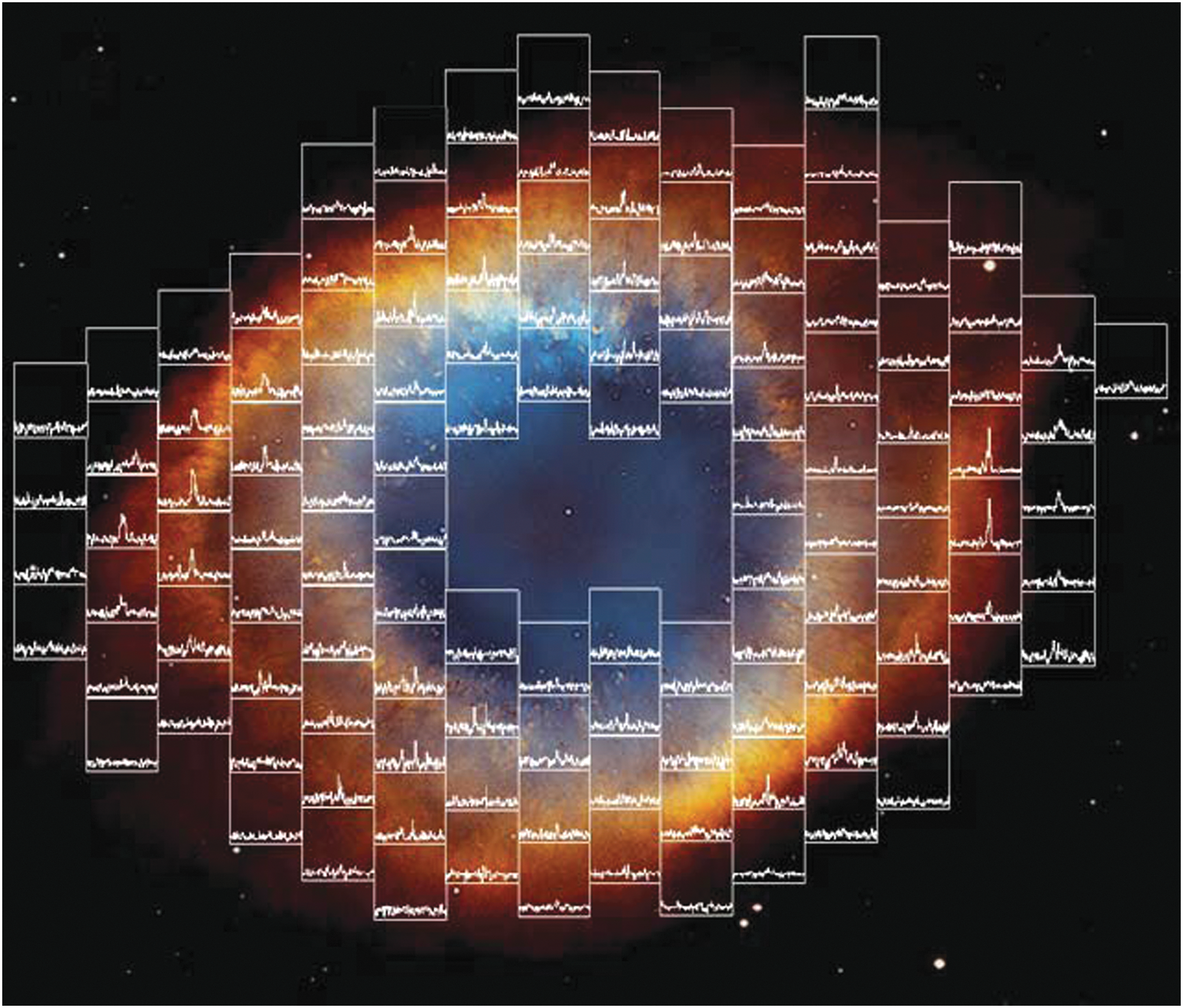
Spectra of the J = 1 → 0 transition of HCO+ observed across the Helix Nebula, the oldest known PN, superimposed over the optical image of the object (from Zeigler et al., 2013). The data show that HCO+ is present where bright, ionized atomic gas also exists.
Subsequent observations have shown the presence of carbon-bearing molecules such as HCN, H2CO, HCO+, and CCH in numerous other nebulae, including K4-47, M2-48, NGC 6537, K3-58, M1-7, M4-14, M3-28, M3-55, NGC 6720, and NGC 6853 (e.g., Edwards et al., 2014; Schmidt and Ziurys, 2016). Sample spectra of the CCH radical in PNe are shown in Fig. 8 (Schmidt and Ziurys, 2017). Clearly, carbon chemistry remains quite active in PNe. Observational evidence suggests that the C-bearing compounds arise from remnant AGB shell molecular material and in situ nebular chemistry (e.g., Edwards et al., 2014). The density of the molecular gas in PNe is typically ∼105 cm−3 and therefore high enough to foster chemical reactions (Zack and Ziurys, 2013; Edwards et al., 2014; Schmidt and Ziurys, 2016). The molecules are also likely mixed with dust, which aids in their preservation by providing shielding from UV radiation.
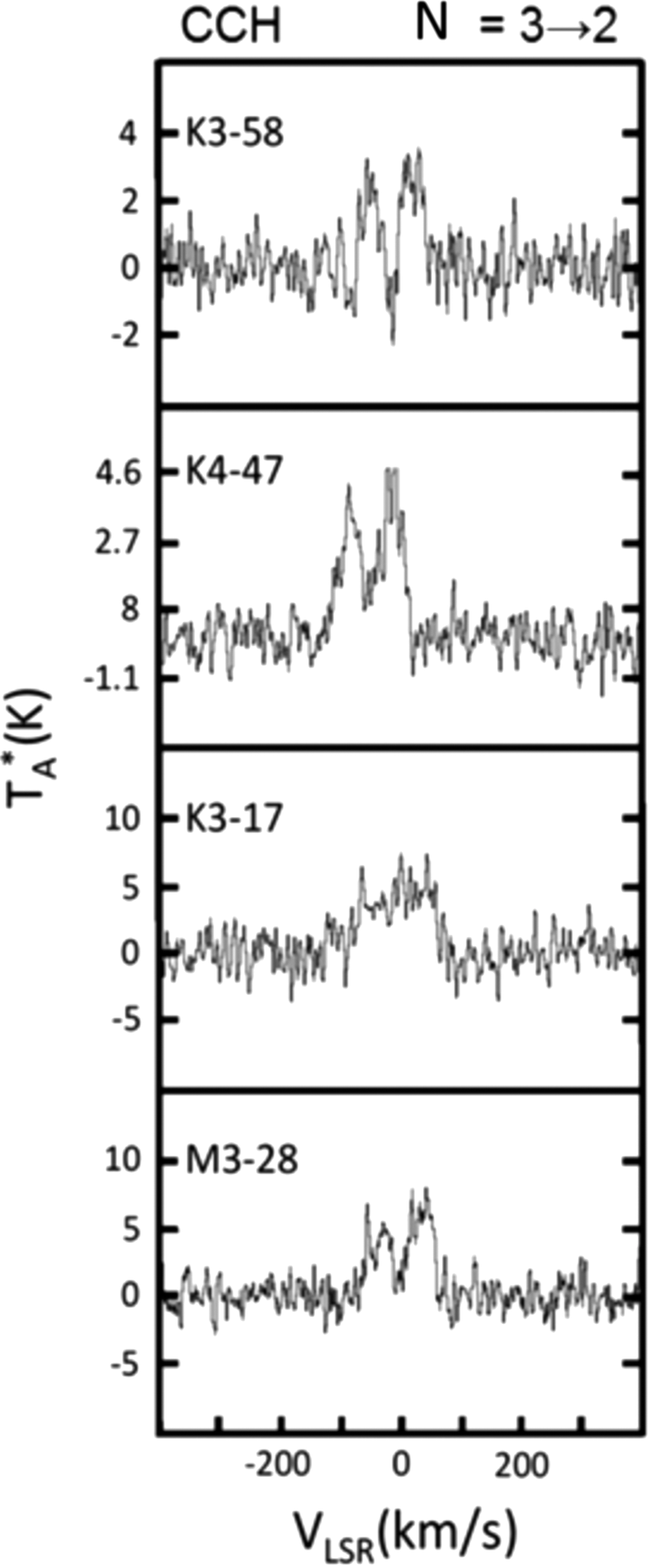
Spectra of the N = 3 → 2 transition of the CCH radical observed with the ARO SMT toward four different PNe spanning the age range 500–10,000 years. The spin-rotation doublet structure is apparent in the spectra (from Schmidt and Ziurys, 2017).
Current chemical models of PNe chiefly are concerned with molecule destruction, not production. However, photoionization does initiate ion-molecule reactions that can lead to some polyatomic species. For example, Kimura et al. (2012) suggested that HCO+ and HCN could be synthesized in these nebulae via the following pathways:
However, the HCN abundance these authors derive is a factor of 100–1000 less than those observed, although that for HCO+ is comparable. The gas-phase carbon chemistry of PNe is a topic that clearly needs further exploration, both observationally and theoretically.
Carbon also appears to be present in some PNe in what could be termed macromolecules. During the early PN phase, features appear in the IR spectra of these objects between 3 and 14 microns in wavelength, which are thought to arise from both carbon aromatic and aliphatic stretching and bending vibrations. Some are characteristic of aliphatic side groups attached to aromatic rings (Kwok, 2004). These spectra suggest the existence of large carbonaceous macromolecular material in PNe, perhaps with a mixed aromatic/aliphatic structure as shown in Fig. 9, from Kwok and Zhang (2011), or large ionized polyaromatic hydrocarbon (PAH) species (e.g., Jones, 2009). It is also interesting to note that the fullerene species C60 and C70 have now been detected in a few younger PNe (e.g., Zhang and Kwok, 2013).
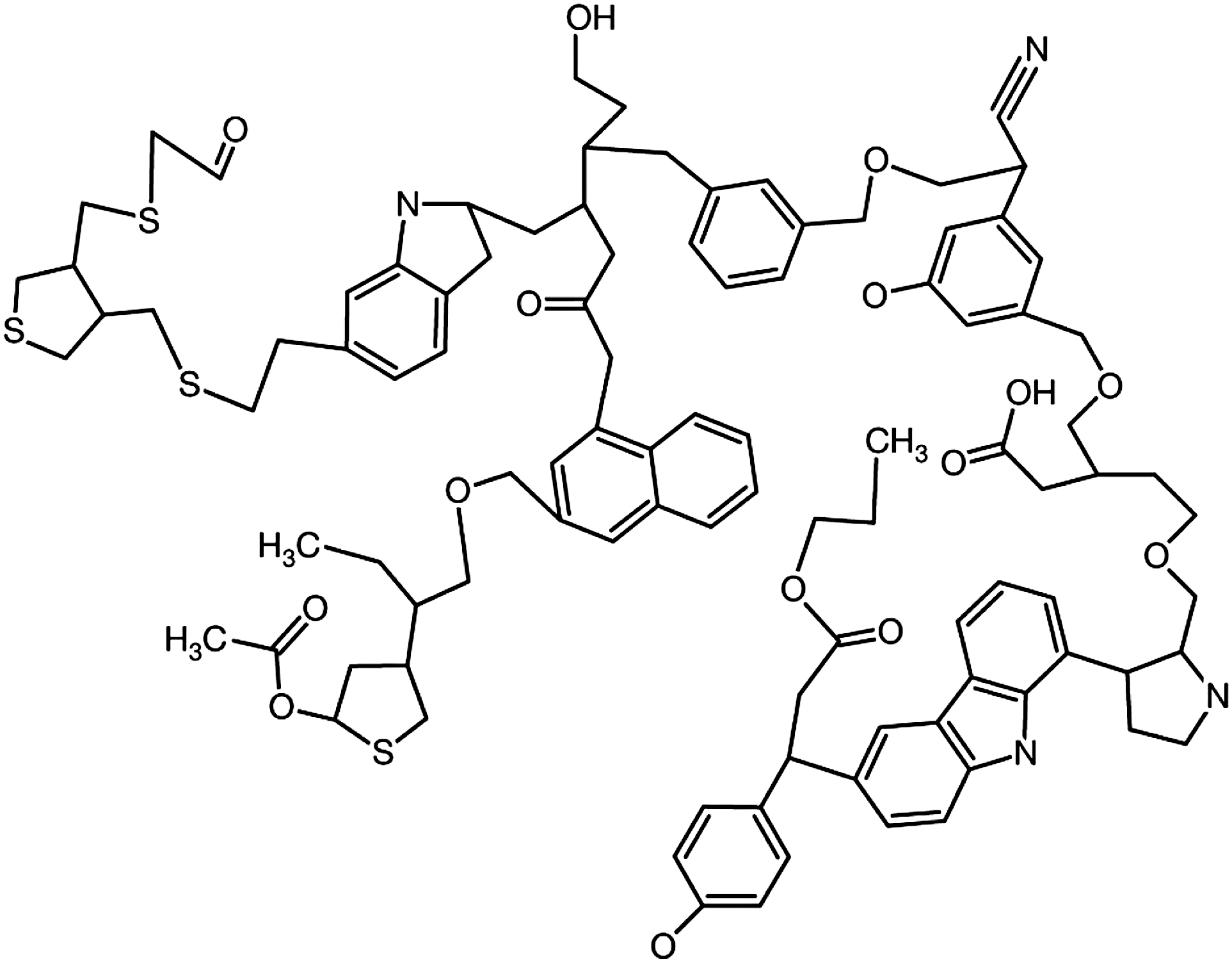
A proposed carrier of the unidentified infrared bands (UIBs), which are found in the spectra of young PNe (from Kwok and Zhang, 2011). The UIBs contain both aromatic and aliphatic carbon features apparently arising from macromolecular material, as suggested in the figure.
3. Carbon in Interstellar Clouds
3.1. From planetary nebulae to diffuse clouds
The matter ejected from PNe becomes part of the diffuse ISM and ultimately is incorporated into “diffuse clouds.” These clouds are categorized by low densities (∼10–100 cm−3) and warm temperatures (T ∼ 30–100 K); the ambient stellar UV radiation field is somewhat attenuated so that the H2 content is >0.1 of the total available hydrogen, although the gas-phase carbon is predominantly in the form of C+ (e.g., Snow and McCall, 2006). Diffuse clouds were for decades thought to be relatively devoid of molecules, except for simple diatomic species. However, this picture has changed over the past 10 years with the discovery of numerous polyatomic species, including carbon-bearing compounds, as summarized in Table 3 (Liszt et al., 2006, 2008; Snow and McCall, 2006). As shown in the table, carbon is represented in C3, H2CO, CCH, HCN, HNC, HCO+, and c-C3H2, as well as diatomic species. Very recently, C60 + has been identified in diffuse gas as well (Campbell et al., 2015).
The origin of the polyatomic molecules is unknown, because diffuse clouds are too low in density to produce them in situ. Molecule synthesis is again driven by photochemistry in these objects, with ion-molecule and neutral-neutral reactions playing important roles. CO and HCO+ are thought to be created from C+ (Snow and McCall, 2006):
CO+ then leads to HCO+ via Reaction 4, and CO forms from the dissociative electron recombination of HCO+. The synthesis of molecules such as H2CO and HCN remains a mystery. However, the widespread distribution of HCO+, HCN, CCH, and H2CO in the Helix Nebula, the oldest PNe known, and the presence of C60 in PNe, suggest that carbon-containing molecular material is ejected into the diffuse ISM. In fact, there is a remarkable similarity between the molecules observed in PNe relative to diffuse clouds, as shown in Table 4; and the relative abundances are not incompatible, particularly for C-bearing species. Typically, molecular abundances in diffuse clouds are a factor of 10–100 less than those in older PNe, as shown in the table. Furthermore, molecular ratios appear to be similar. The HCN/HNC ratio is about 1–2 in PNe and about 5 in diffuse clouds. The CO/HCO+ ratio is typically ∼103 in both types of sources, while CN/HCN ∼ 4–9 in PNe and CN/HCN ∼ 7 in diffuse clouds. These results are consistent with the scenario of molecular material being injected into the diffuse ISM from PNe, with some fraction surviving as the matter collapses into diffuse clouds. Calculations suggest that a clump with n ∼ 3 × 105 cm−3 will dissipate into diffuse material with Av = 1 in about 107 years (e.g., Tenenbaum et al., 2009).
Relative to H2.
Edwards and Ziurys (2014); Tenenbaum et al. (2009); Zack and Ziurys (2013); Schmidt and Ziurys (2016).
Liszt et al. (2006).
Significantly larger organic species may also be present in diffuse clouds, perhaps containing tens to hundreds of atoms. The recent discovery of C60 + in these regions supports this hypothesis (Campbell et al., 2015). Evidence for these as-yet-unidentified molecules comes from the observation of the same 3–14 micron IR bands observed in PNe, as discussed, as well as broad spectra measured in the optical region, the “diffuse interstellar bands,” or DIBS. Some theories to the origin of both types of features include PAHs, long carbon chains, and fullerenes (e.g., Snow and McCall, 2006). With the exception of C60 +, the exact identities of both the IR and optical features remain a mystery. They likely are related to the macromolecules found in PNe. Based on elemental depletions measured in diffuse clouds, about 50% of the carbon is in the gas phase as atoms; the remainder is in molecules and dust (e.g., Palme and Jones, 2005).
3.2. The transition to dense clouds
Dense clouds, characterized by gas densities near 104 to 106 cm−3, are thought to be created from diffuse clouds, either by collapse or by accretion caused by shock waves (e.g., Inoue and Inutsuka, 2012). These objects are typically colder than their diffuse counterparts, with T ∼ 10–50 K. Because they are dense, these sources are rich in molecular material and are usually referred to as “molecular clouds.” Dense clouds contain a large fraction of the mass in our galaxy, as much as half the total gas mass in the inner 8–9 kpc. Most of the clouds are present in an annulus between 3.5 and 7.5 kpc from the Galactic Center, the so-called “molecular ring” (e.g., Ferrière, 2001). Dense clouds have a wide range of masses. The largest, “giant molecular clouds,” or GMCs, contain between 103 and 106 M ⊙ and are 10–100 pc in size. These objects are typically the sites of both high- and lower-mass star formation, as well as planetary system creation. There are also less massive dense clouds, such as Bok globules, which have 2–50 M ⊙ and are no larger than ∼0.3 pc across. Very cold clouds (T ≤ 10 K) are sometimes referred to as “dark clouds.” Evidence of star formation has been seen in all types of dense clouds (e.g., Stutz et al., 2010).
The chemistry of carbon reaches a new degree of complexity in these objects, in particular for the GMCs. Oxygen plays a major role in the synthesis, producing compounds that are typical of the organic laboratory. As shown in Fig. 10, alcohols (CH3OH, CH3CH3OH), carboxylic acids (HCOOH, CH3COOH), aldehydes (CH3CHO), ketones (CH3COCH3), ethers (CH3OCH3), and even esters (CH3OCHO) are represented in the chemical inventory of GMCs. There are also a few non-aromatic ring species, c-C3H2 and CH2OCH2, and a simple sugar, glycolaldehyde, CHOCH2OH. Such large molecules and their D and 13C isotopologues help generate the very complex spectra observed in GMCs. An example spectrum is shown in Fig. 11, which displays data at the frequency of 142.6 GHz, observed toward Sgr B2(N), a very large GMC in the center of the Galaxy. The density of spectral lines is so high in GMC data that the “confusion limit” is now being reached; that is, there are continuous spectral features and no obvious baseline. The plethora of lines brings enhanced difficulty to the identification of new molecules.

Common organic functionality observed in interstellar molecules found in dense clouds. Alcohols, ketones, carboxylic acids, etc. are commonly observed in interstellar gas. (Color graphics available at

A typical spectrum exhibited by dense molecular clouds with star formation, in this case the Sgr B2(N) cloud, observed with the ARO 12 m. The center frequency is 142.6 GHz. The molecular carriers of the spectral features are labeled, with those that are unidentified marked as “U.” A variety of organic-type compounds are present in this spectrum, including CH3CH2CN, NH2CHO, CH2CHCN, and HCOOCH3. (Color graphics available at
There are numerous models of the chemistry of carbon-bearing molecules and related species, usually involving thousands of chemical reactions; for example, see the work of Garrod and Herbst (2006) and references therein. The gas-phase chemistry of carbon is chiefly thought to involve ion-molecule reactions, along with neutral-neutral processes and radiative association pathways (e.g., Herbst and Millar, 2008). Radiative association is particularly important for carbon, as the simplest ion-molecule reaction of this element, C+ + H2, is endothermic. Thus, synthesis involving carbon is initiated by the association reactions:
The rate of the first process has been calculated to be 2 × 10⁻¹⁶(T/300)−1.3 cm3 s−1 in the range 10–300 K, but few studies have been conducted for the second pathway. A third initiation reaction is also thought to be important:
These three pathways serve to bring carbon into molecular form (Herbst and Millar, 2008). The larger species are then produced via carbon “insertion,” condensation, and radiative association of heavier fragments. The insertion and condensation processes can occur either with ion-molecule or neutral-neutral reactions. Insertion can take place with either C+ or C, building larger hydrocarbons:
Note that such reactions have more than one product channel and that the branching ratios between these pathways are often not known. Condensation also builds larger organic species, including those with a heteroatom (also see Eq. 3):
Radiative association can lead to larger polyatomic species as well:
The product ions such as CH3NH3 + and CH3CO+ then lead to the neutral species by dissociative electron recombination, in this case creating CH3NH2 and CH2CO.
Reactions on grains can also involve carbon, but such processes are even less well understood and more difficult to accurately model (e.g., Herbst and van Dishoeck, 2009). There is evidence that CO, once frozen onto grain surfaces, can become hydrogenated, leading to methanol. Hydrogenation of HCN is also speculated to lead to CH2NH and CH3NH2 (e.g., Watanabe and Kouchi, 2002). However, observations suggest that these two molecules may be created by neutral-neutral processes in the gas phase (Halfen et al., 2013). Most recent models include both gas-phase and surface chemistry, as well as variations such as grain “freeze-out” and subsequent evaporation (e.g., see Herbst and Millar, 2008, and references therein and below).
Carbon is of course also contained in dust grains in dense clouds, primarily in amorphous form (e.g., Jones and Nuth, 2011). There seems to be an evolution from H-rich hydrocarbon solids to more aromatic material. Such carbon grains are easily destroyed in shocks, however, such that toward jets and winds, most of the carbon is in the gas phase (e.g., Jones, 2009). It is thought that the carbonaceous grains readily reform through accretion onto surviving grains and silicates. Dust grains in dense clouds also readily acquire icy mantles with water, CO, CO2, and methanol, and grain-grain collisions may lead to grain growth (e.g., Jones, 2001).
The majority of dense cloud models begin with atoms as the initial constituents. However, if diffuse clouds already contain significant amounts of molecular material, then a more realistic starting point might be simple polyatomic molecules. Certainly this approach is more consistent with observations and could lead to the creation of ever more complex species over the 106 to 107 lifetime of a GMC. This avenue of modeling is a subject of future work.
4. Carbon in Star-Forming Regions
4.1. Prestellar and protostellar cores
Formation of stars usually starts in compact cores inside dense clouds, which have molecular densities in the range 104 to 106 cm−3. Typical core masses are found to lie between 0.5 and 5 M
⊙. Other star formation sites are the small (diameter < several parsecs; mass < 50 M
⊙), dark, spherical Bok globules. Molecular hydrogen is the dominant species in all these environments. In such cores, carbon-containing molecules like CO, CH3OH, and CH4 freeze out on interstellar grains. This process reduces the chemical abundance of these species in the gas phase. When star formation begins, the increase in temperature caused by the embedded young stellar object leads to re-sublimation of the frozen-out molecules, which triggers a “second generation” chemistry that leads to the formation of fairly complex carbon-containing molecules (Brown et al., 1988). For example, larger organic molecules like acetylene can be formed from methane through carbon insertion (see Eq. 10). The C2H2
+ ions formed from this process can further react with molecular hydrogen through radiative association:
Subsequent dissociative recombination of C2H4
+ then leads to acetylene; the C2H3
+ also created in Eq. 10 can generate HCCH or CCH (Kalhori et al., 2002; Ehlerding et al., 2004). The intermediate ions C2H2
+ and C2H3
+ formed in these processes can further react with methane to form larger ions, for example,
which by dissociative recombination can yield cyclic species such as c-C3H2 (Mookerjea et al., 2012). In certain instances, it is thought that sublimated methane enhances carbon-chain chemistry in a warmer environment (e.g., Sakai and Yamamoto, 2013).
Very often radiative association leads to protonated species, followed by dissociative recombination, which have been invoked to explain the formation of complex organic compounds like alcohols, esters, and ethers encountered in star-forming regions, for example,
However, recent experiments have demonstrated that only small branching ratios occur for the production of alcohols and ethers upon dissociative recombination. Fragmentation into small radicals and fracturing of C-C and C-O bonds are very common (Geppert et al., 2006; Hamberg et al., 2010). In some cases (e.g., dimethyl ether and formic acid), organic molecules can be formed through ion-molecule reactions followed by dissociative recombination (Garrod and Herbst, 2006):
Such reaction sequences, however, appear to be unsuccessful in producing certain other molecules in their observed abundances, such as methanol. Processes on grain surfaces, such as the successive hydrogenation of CO, as mentioned, or neutral-neutral reactions in the gas phase, may be responsible for the formation of methanol. One major challenge for surface production of CH3OH is the mechanism for grain desorption, which is difficult at the low temperatures characteristic of dark clouds (Geppert et al., 2006).
Gas-phase radical-neutral and atom-neutral reactions are also involved in the formation of carbon compounds in star-forming regions, as represented by Eq. 10. Another example is the formation of HC3N via the radical-neutral process:
Such reactions often have considerable rates (∼10−10 to 10−11 cm3 s−1), because one of the reactants is an unstable radical species.
A universal (grain surface or gas-phase) mechanism for generating complex molecules in star-forming regions cannot really be formulated. The formation pathway of each species must be explored individually. However, mapping the formation routes of complex species in star-forming regions has important consequences for biochemical evolution.
4.2. Collapse to protostellar disks
Young stars are usually surrounded by rotating protoplanetary disks, in which dust grains coagulate into planetesimals and then further assemble into planets and asteroids. Protoplanetary disks are transient features with lifetimes of 3,000,000–10,000,000 years, composed of mostly of gas and dust. From a simplistic viewpoint, they consist of a warm inner zone (the site of planet formation) and a cold outer zone (e.g., Henning and Semenov, 2013). In the perpendicular direction, they can be divided into a dense midplane (where planets form and molecules are frozen out onto grains, obscured from observations), the surface (where chemistry is dominated by photons), and the intermediate (warm molecular) zone in between. Several carbon-containing molecules and ions have so far been identified toward protoplanetary disks: H2CO, CS, C2H, c-C3H2, HCN, HNC, CN, DCN, HC3N, HCO+, and DCO+.
Ultraviolet radiation from the star and the interstellar background penetrates the surface zone and photodissociates/photoionizes most molecules. Gas-phase molecular abundances thus tend to peak in the intermediate zone, where molecules are desorbed from the grains but not yet photolyzed (Aikawa and Herbst, 1999). Models of protoplanetary disks predict that C+ is the prevalent ion close to the disk surface, whereas over the whole disk HCO+ is the most abundant ionic species. In the outer, cooler regions of protoplanetary disks, the chemistry is driven by high-energy radiation and cosmic rays (Harada et al., 2010) and is dominated by ion-molecule reactions followed by dissociative recombination as the terminal step leading to stable neutrals, among other by-products. This type of reaction sequence also leads to carbon-chain molecules (C
n
H), which are probably formed by the dissociative recombination of C
n
H2
+ ions (Markwick et al., 2002):
Deep in the interior of the outer disk, however, most molecular species freeze out onto grain surfaces. In the densest parts of the inner disk, where high temperatures (100–5000 K) and high densities (up to 1012 cm−3) prevail and ionizing radiation is attenuated, neutral-neutral reactions with barriers and 3-body processes contribute to the chemistry (Willacy et al., 1998; Furuya et al., 2013). Also, surface reactions play a decisive role in the synthesis of molecules in protoplanetary disks (e.g., Furuya and Aikawa, 2014; Walsh et al., 2014). HNCO is thought to be produced on grain surfaces from OCN and H, and methanol from CH2OH and H. Observations have also shown that grain growth and dust settling occurs in protoplanetary disks, with the gas-to-dust ratio increasing by at least a factor of 10 relative to the ISM (e.g., Horne et al., 2012). Such grain growth likely leads to planetesimals. Although crystalline silicates are readily identified in disks via their IR signatures, carbonaceous dust is harder to identify. Its presence in these objects is inferred from modeling (e.g., Apai and Lauretta, 2010). The rich chemistry in protoplanetary disks can exert a great influence on the composition of planets, their atmospheres, asteroids, and comets (Aikawa and Herbst, 1999; Henning and Semenov, 2013). Further studies with the Atacama Large Millimeter/submillimeter Array (ALMA) will help probe the connection between disk and planetesimal chemistry.
5. Arrival on Planet Surfaces: Comets, Meteorites, and Interplanetary Dust Particles
Stellar systems are created from protoplanetary disks in collapsing dense clouds. Grain growth and coagulation lead to planetesimals and longer bodies. Clearly, there is a large reservoir of carbon-containing material in these objects. The fraction of this material that is delivered to planet surfaces and the transport mechanisms are extremely important issues for astrobiology. Studies of comets, meteorites, and to some extent interplanetary dust particles, or IDPs, can certainly help elucidate our understanding of this highly relevant topic.
Comets are among the most primitive bodies in the Solar System and are thought to contain a chemical record of the forming solar nebula (Biver et al., 2014; Marboeuf and Schmitt, 2014). A range of volatile carbon-bearing species have been observed in various comets, presumably vaporized from the nucleus. These include simpler compounds such as CO, HCN, CH4, and HCCH (e.g., Bockelée-Morvan et al., 2000). However, more complex organic species have also been observed in comets, including H2CO, CH3OH, HCOOH, and NH2CHO (e.g., Biver et al., 2014). The solid-state component of comets is also extremely important, as comets are estimated to have gas-to-dust ratios near one. Infrared observations of the comet 9P/Temple 1 impact showed the existence of amorphous carbon, carbonates, and polycyclic aromatic hydrocarbons, as well as ice and silicates (Lisse et al., 2006). IOM-like material and CHON particles are also part of the refractory cometary composition (e.g., Alexander et al., 2007). The recent Rosetta mission has also identified several new organic compounds in vaporized dust, including methyl isocyanate, acetone, and acetamide through in situ mass spectroscopic detection (Goesmann et al., 2015). All these organics are common constituents of dense clouds with star-forming cores. For example, NH2CHO has been found in 12 such clouds, mostly within the galactic habitable zone (Adande et al., 2013), while CH3NCO is present in at least five GMCs (e.g., Halfen et al., 2015). Long-period comets, namely those originating in the Oort Cloud, seem to exhibit the most chemical diversity. The organic inventory of comets also appears to reflect that of interstellar ices, although this topic is an ongoing study.
Certain types of meteorites, namely carbonaceous chondrites, are known to contain a wide variety of soluble organic compounds, as shown in Fig. 12. Isotopic analyses of these molecules have shown that they are often enriched in D, 13C, and 15N. For example, a D enrichment as large as δD = +7200‰ (or D/H ∼ 0.0012) has been found for 2-amino isobutyric acid. These enrichments suggest an origin in the very cold environment of interstellar gas (e.g., Pizzarello, 2007). Note that δD (‰) = 1000 × [(D/H)sample - (D/H)standard]/(D/H)standard. In this case (D/H)standard is the terrestrial value of 1.5 × 10⁻⁴.
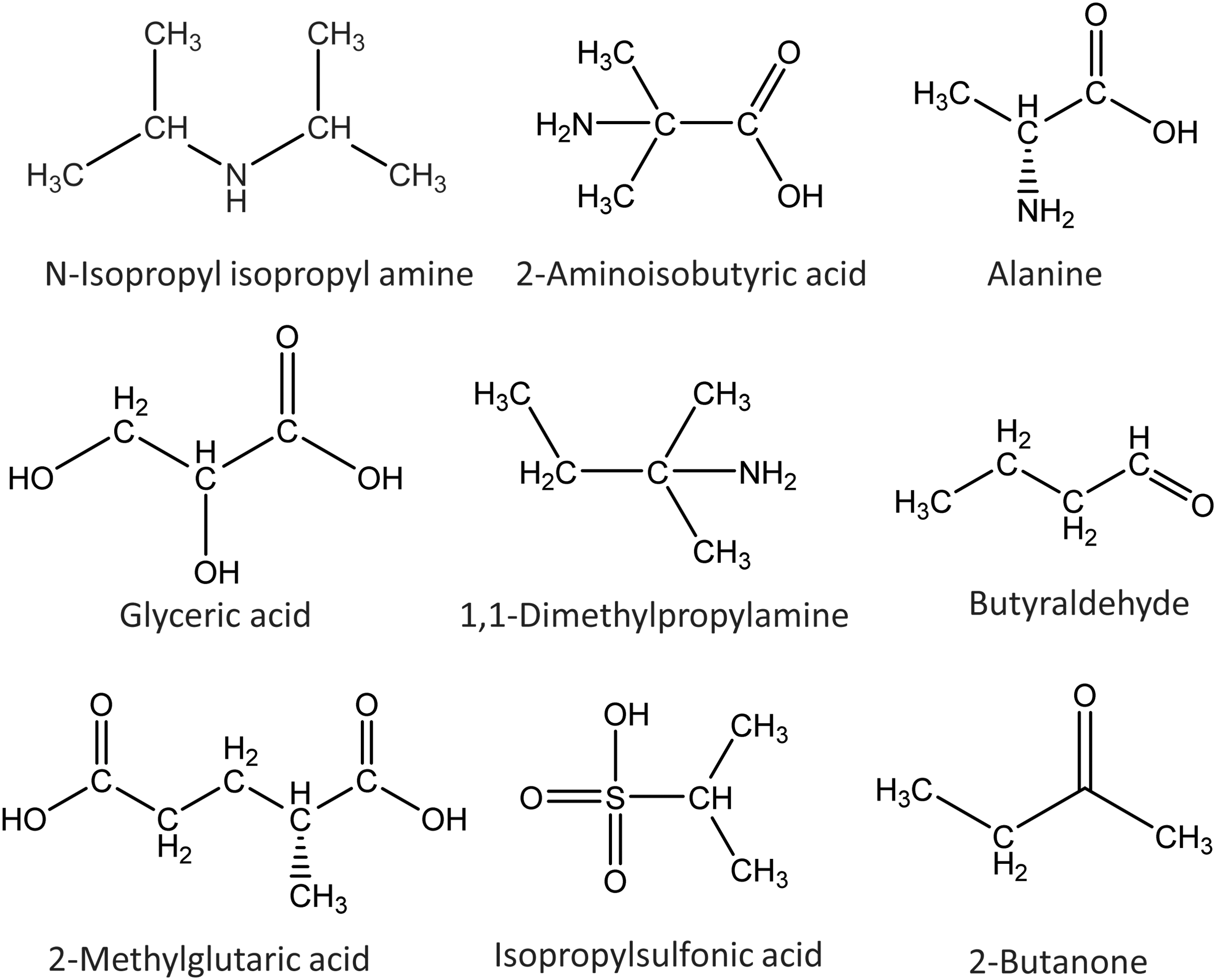
Representative organic molecules found in meteorites, including amines, acids, ketones, and aldehydes (from Pizzarello et al., 2006).
Based on analysis of the Murchison meteorite, which is considered to be about 50% processed, the most prominent organic species are carboxylic acids of the general formula RCOOH, as well as hydrocarbons (e.g., Schmitt-Kopplin et al., 2010). Hydroxyacids RHOHCOOH are very abundant in some meteorites that are thought to have undergone aqueous processing, such as Bells (Monroe and Pizzarello, 2011). In Murchison, over 85 different amino acids of the general formula NH2CRCOOH have been identified. These acids mainly appear as alkyl species, with the amino group NH2 located at different positions along the alkyl chain. Abundances also decrease with chain length (Monroe and Pizzarello, 2011). Aldehydes, ketones, amines, alkanes, and some aromatic molecules are additionally found. An estimate of the total number of individual compounds found in Murchison is over 5000, most of which contain carbon (see Schmitt-Kopplin et al., 2010).
CR-type and CM-type carbonaceous chondrites are thought to be more pristine than Murchison. These meteorites also contain a wide range of amino acids (e.g., Elsila et al., 2012). The most abundant amino acids present in CR meteorites EET 92042 and GRA 95229 are α-types: glycine, isovaline, alanine, and α-aminoisobutyric acid (Martins et al., 2007). GRA 95229 and the CR-type LAP02342 have been found to contain compounds never observed before in meteorites, namely hydroxyamino acids and tertiary amines—very reactive species signifying pristine material (Pizzarello and Holmes, 2009). Both these objects also contain a larger suite of aldehydes and ketones than Murchison.
In addition to these soluble species, carbonaceous chondrites also contain insoluble organic matter, or IOM. This material likely represents the bulk of the organic matter in these types of meteorites, as much as 2% by weight (Alexander et al., 2007). IOM is macromolecular in nature, with a typical elemental composition C100H71N3O12S2. This material has been found to exhibit very high D and 15N enrichments, as high as 19,400‰ and 3200‰, respectively, found in “hotspots” mingled in the aggregate (Busemann et al., 2006). These values correspond to D/H ∼ 0.003 and 14N/15N ∼ 65, with 14N/15Nstandard ∼ 272. These findings once again suggest that at least some of the IOM had a pristine origin in the ISM. Note that high D/H ratios are also observed in molecular clouds, with values ranging from 0.001 to 0.1 (e.g., Caselli and Ceccarelli, 2012). The deuterium, 13C, and 15N enrichment can be caused by chemical fractionation in molecular clouds (Millar et al., 1989). Chemical bonds to the heavier isotope are slightly more stable and therefore become favored at low temperatures (≤ 20–30 K). The 13C and 15N enhancements could also be directly preserved from stellar nucleosynthesis, such as from J-type stars (Adande et al., personal communication).
Nuclear magnetic resonance, electron spin resonance, and IR studies of IOM have revealed its complex chemical nature, as well as pyrolysis and other degradation analyses. It is composed of both aromatic and aliphatic carbons. The aromatic material appears to consist of one to a few benzene-like rings, while the aliphatic sections have highly branched, short chains (Remusat et al., 2006; Alexander et al., 2007). Oxygen-containing functional groups are also found in the IOM, mostly carbonyl and carboxylic types.
Interplanetary dust particles (IDPs) are also known for their high D/H and 15N/14N ratios (e.g., Keller et al., 2004). For example, δD ∼ 24,800‰ has been found in certain cluster particles, or D/H ∼ 0.003 (Messenger, 2000). These particles are thought to be fragments of comets and asteroids, and are collected from Earth's atmosphere. They are typically 5–50 microns in size. IDPs are variable in their carbon content, with a mean weight value of ∼12%—higher than carbonaceous chondrites, although this effect could be caused by preferential survival on atmospheric transport (e.g., Pizzarello et al., 2006). The carbon in IDPs appears to be more aliphatic than aromatic in structure, with a longer mean carbon chain length than in Murchison compounds. They also exhibit C = C and C = O functional groups, as X-ray absorption near-edge structure (XANES) analyses have demonstrated.
It could also be that much of the organic material found in meteorites and comets could also have been formed directly in the young Solar System. Fischer-Tropsch-type (FTT) synthesis is a possible avenue, in which gas-phase CO + H2 leads to various hydrocarbons via surface catalysis on mineral grains such as iron silicates (e.g., Kress and Tielens, 2001). Dust grains that fall into the protostellar nebula would provide the requisite surfaces, and CO and H2 are certainly abundant gas-phase molecules in the presolar nebula. Laboratory experiments have shown that hydrocarbons can be produced from FTT reactions on Fe-silicate surfaces (e.g., Johnson et al., 2007). There is some thought that IOM is also created by FTT synthesis in the presolar nebula, although such a pathway would not likely lead to the high 15N and D enrichments found in this material. Another possibility is that organic compounds are formed on icy dust grains through UV irradiation of HCN or other carbon-bearing precursors frozen on the surface (e.g., Gerakines et al., 2004). Formamide and HCNO, for example, have been created from mixtures of HCN with water and ammonia in laboratory photolysis studies. It has also been speculated that gas-phase ion-molecule reactions in the outer solar nebula, where conditions are cold, can mimic interstellar synthesis (Remusat et al., 2006). The relative contributions of “local” versus interstellar molecule formation have yet to be determined.
It is becoming increasingly clear that a significant amount of carbon is delivered to Earth, and possibly Earth-like planets in other solar systems, via bombardment by meteorites and IDPs. Given the anomalous isotopic excesses measured in carbon-bearing substances in these bodies, it is quite probable that some of the material originated in the general (cold) ISM. It is noteworthy that alkyl-type chain backbones are common structures in meteorites and in IDPs. Chain-type compounds are prolific in the envelopes of carbon-rich stars and suggest that some of the material deposited on Earth may be traced even further back than molecular clouds.
6. Conclusion
Carbon plays a critical role in the molecular ISM, beginning with its formation in stellar nucleosynthesis. Its footprint can be traced throughout the life cycle of molecular material, beginning with circumstellar ejecta, through the diffuse and dense cloud phases, and into protoplanetary disk and solar systems. Some of this carbon-containing matter appears to survive planet formation and becomes incorporated into solar system bodies, arriving on planet surfaces in pristine form. The contribution of such compounds to the origin of life, both as distinct molecules and in macromolecular assemblies, remains an open question for astrobiology.
Footnotes
Acknowledgments
This material is based upon work supported by the National Aeronautics and Space Administration under Agreement No. NNX13ZDA017C issued through the Science Mission Directorate interdivisional initiative Nexus for Exoplanet System Science. This work was also supported by NSF grants AST-1140030 and AST-1515568. The SMT and Kitt Peak 12 m are operated by the Arizona Radio Observatory (ARO), Steward Observatory, University of Arizona, with support through the NSF University Radio Observatories program (URO: AST-1140030). Yuri Aikawa acknowledges partial support by a grant-in-aid for Scientific Research (23103004, 23540266) of the Ministry of Education, Culture, Sports, Science, and Technology of Japan (MEXT).
Author Disclosure Statement
No competing financial interests exist for any of the authors.