




Abstract
In 1976, the Viking landers carried out the most comprehensive search for organics and microbial life in the martian regolith. Their results indicate that Mars' surface is lifeless and, surprisingly, depleted in organics at part-per-billion levels. Several biology experiments on the Viking landers gave controversial results that have since been explained by the presence of oxidizing agents on the surface of Mars. These oxidants may degrade abiotic or biological organics, resulting in their nondetection in the regolith. As several exploration missions currently focus on the detection of organics on Mars (or will do so in the near future), knowledge of the oxidative state of the surface is fundamental. It will allow for determination of the capability of organics to survive on a geological timescale, the most favorable places to seek them, and the best methods to process the samples collected at the surface. With this aim, we review the main oxidants assumed to be present on Mars, their possible formation pathways, and those laboratory studies in which their reactivity with organics under Mars-like conditions has been evaluated. Among the oxidants assumed to be present on Mars, only four have been detected so far: perchlorate ions (ClO4 −) in salts, hydrogen peroxide (H2O2) in the atmosphere, and clays and metal oxides composing surface minerals. Clays have been suggested as catalysts for the oxidation of organics but are treated as oxidants in the following to keep the structure of this article straightforward. This work provides an insight into the oxidizing potential of the surface of Mars and an estimate of the stability of organic matter in an oxidizing environment. Key Words: Mars surface—Astrobiology—Oxidant—Chemical reactions. Astrobiology 16, 977–996.
1. Introduction
T
The two Viking landers reached the surface of Mars in 1976, with a payload that included three biology experiments [Pyrolytic Release (PR), Gas Exchange (GEx), and Labeled Release (LR)] and a thermal vaporizer instrument coupled with a gas chromatograph–mass spectrometer (TV-GC-MS). The three biology experiments were designed to investigate whether biological activity was taking place in the martian regolith (Levin and Straat, 1976a). Despite much-debated results, the most widely accepted conclusion is that no biological activity has been identified in the samples (Horowitz et al., 1976, 1977; Levin and Straat, 1976b, 1977a, 1977b, 1979; Oyama et al., 1976, 1977, 1978; Oyama and Berdahl, 1977). This conclusion was based on (i) the nondetection of organics at levels above the detection limit of the TV-GC-MS instrument, other than chlorinated organic molecules interpreted as terrestrial contamination (Biemann et al., 1976, 1977; Biemann and Lavoie, 1979), and (ii) the results of the biology experiments, which could be explained by the presence of oxidizing species in the martian regolith, such as iron-bearing species, clays, reactive oxygenated species, or hydrogen peroxide (H2O2) (Oyama and Berdahl, 1977; Oyama et al., 1977; Klein, 1978). Besides the lack of biological activity, these experiments have indirectly pointed to the presence of oxidizing species in the regolith.
Although the overall conclusion was that organic species were absent from the samples analyzed during the Viking mission, the suitability of the device to analyze and detect organic molecules in regolith samples has been debated (Benner et al., 2000; Glavin et al., 2001; Navarro-González et al., 2006, 2009; Biemann, 2007).
In 2008, the Phoenix mission landed at a higher latitude than the Viking landers and searched as well for organic molecules in the martian regolith. The attempt was again unsuccessful, as the Thermal and Evolved Gas Analyzer (TEGA) instrument could not demonstrate the presence of organic matter at the landing site (Boynton et al., 2009). Meanwhile, the Wet Chemistry Laboratory (WCL) of the Microscopy, Electrochemistry, and Conductivity Analyzer (MECA) instrument detected approximately 0.4 to 0.6 wt % of perchlorates, powerful oxidizing agents, in all regolith samples analyzed (Hecht et al., 2009). Following the detection of perchlorates, it was questioned whether the chlorinated organic molecules detected with Viking's TV-GC-MS experiment were oxidation products of organic molecules present in the pyrolyzed samples (Navarro-González et al., 2010, 2011; Biemann and Bada, 2011). More recently, the Curiosity rover of the MSL mission confirmed the presence of oxychlorine compounds in the regolith of Mars and detected traces of indigenous organic molecules (Freissinet et al., 2015). However, the structure of the molecules present in the regolith may have been altered over geological time in the harsh environment of Mars and may also have been modified during their extraction prior to their detection by in situ analysis instruments. Consequently, a good knowledge of the reactivity of the martian regolith is essential to understand the possible transformations and ultimately the origin of organic molecules.
Clays were detected on Mars by the Mars Express orbiter (Bibring et al., 2005; Poulet et al., 2005), with an abundance of 4–5 wt % in the regolith calculated from the Thermal Emission Spectrometer data of the Mars Exploration Rovers (McSween et al., 2010). Curiosity analyzed mudstone samples in Gale Crater, which showed the presence of clays in this region (Vaniman et al., 2014). Clays could be widespread on the planet and in some regions hidden under a layer of volcanic residue. Clays themselves are not oxidants, but they can catalyze oxidation reactions likely to take place in the regolith. Hence, we include them in this review and discuss their formation mechanism and reactivity with organics in Section 3. The role of clays as potentially preserving organics against oxidation is also discussed.
Both Viking and Phoenix space missions highlighted the strong reactivity of the martian regolith, which is possibly caused by oxidative species. This reactivity may explain the failure to detect organics, which could have been degraded in the regolith or during the analysis of the samples. To prepare future missions dedicated to the search for organics, it is important to characterize the potential oxidants present in the regolith by focusing on their formation pathways and on their reactivity with organic molecules in Mars-like conditions and during the thermal extraction step. The present article reviews the oxidants detected or proposed to be present on Mars, such as perchlorates (Hecht et al., 2009), iron-bearing species and clays (the latter a catalyst of the oxidative activity of martian regolith), reactive oxygenated species, and hydrogen peroxide (H2O2) (Oyama and Berdahl, 1977; Oyama et al., 1977; Klein, 1978). The main oxidants detected or suggested on the surface of Mars are summarized in Table 1. Other assumptions on the nature of oxidants have been made but are too scarcely documented to be described here (Ballou et al., 1978; Nussinov et al., 1978; Plumb et al., 1989; Zent and McKay, 1994).
The Fe2O3 group includes hematite and maghemite; only hematite has been detected at the surface of Mars.
The clays studied to explain the Viking results were enriched with iron; the presence of this type of clay on Mars has not been confirmed yet.
Carter et al. (2010).
2. Perchlorates
2.1. Perchlorate formation at the surface of Mars
Recently, the MECA instrument of the Phoenix mission detected unexpectedly high concentrations of perchlorate salt (ClO4 −) in association with Ca2+, Mg2+, and Na+ ions (Kounaves et al., 2014) in all regolith samples of the north polar region of Mars. The average perchlorate concentration measured was 2.4 (± 0.5) mM, which corresponds to 0.4–0.6 wt % of the regolith (Hecht et al., 2009). The TEGA instrument confirmed the presence of perchlorates in a regolith sample, despite the low ability of this instrument to detect chlorinated species, due to the formation of a complex between chlorine and nickel atoms of the oven walls (Hecht et al., 2009; Lauer et al., 2009). The high concentrations of perchlorates measured in the regolith samples may result from concentration processes that occur in water ice as salt crusts (Cull et al., 2010). Perchlorates have also been detected in Gale Crater by the Sample Analysis at Mars (SAM) instrument on board Curiosity (Glavin et al., 2013). Their presence has also been inferred on the landing sites of the Viking missions (Navarro-González et al., 2010).
Perchlorates are strong oxidants (Ming et al., 2009); on Earth, they are localized in water-depleted areas, such as the stratosphere and deserts. High perchlorate concentrations have been observed in the Atacama Desert, the soil composition of which is similar to that of Mars' regolith (Navarro-González et al., 2003; Parker, 2009); however, the perchlorate concentration in the Atacama Desert [0.03 wt % (Parker, 2009)] is lower than that measured by Phoenix on Mars [0.4–0.6 wt % (Hecht et al., 2009)]. Perchlorates have also been detected in Antarctic Dry Valleys; they are thought to be produced in Earth's atmosphere by photochemical reactions between ozone and chlorinated species (Bao and Gu, 2004; Catling et al., 2010) and to accumulate in arid environments (Kounaves et al., 2010). The physical and chemical conditions of Mars' atmosphere make it a possible host for the formation of perchlorates following pathways described in Fig. 1. Meanwhile, the chlorine sources required in this scheme still need to be clearly identified; we suggest possible chlorine sources on Mars below. Perchlorate and chlorate (ClO4 − and ClO3 −) ions have also been detected in lunar regolith samples and in two chondrite meteorites (Jackson et al., 2015), suggesting they may be ubiquitous throughout the Solar System.
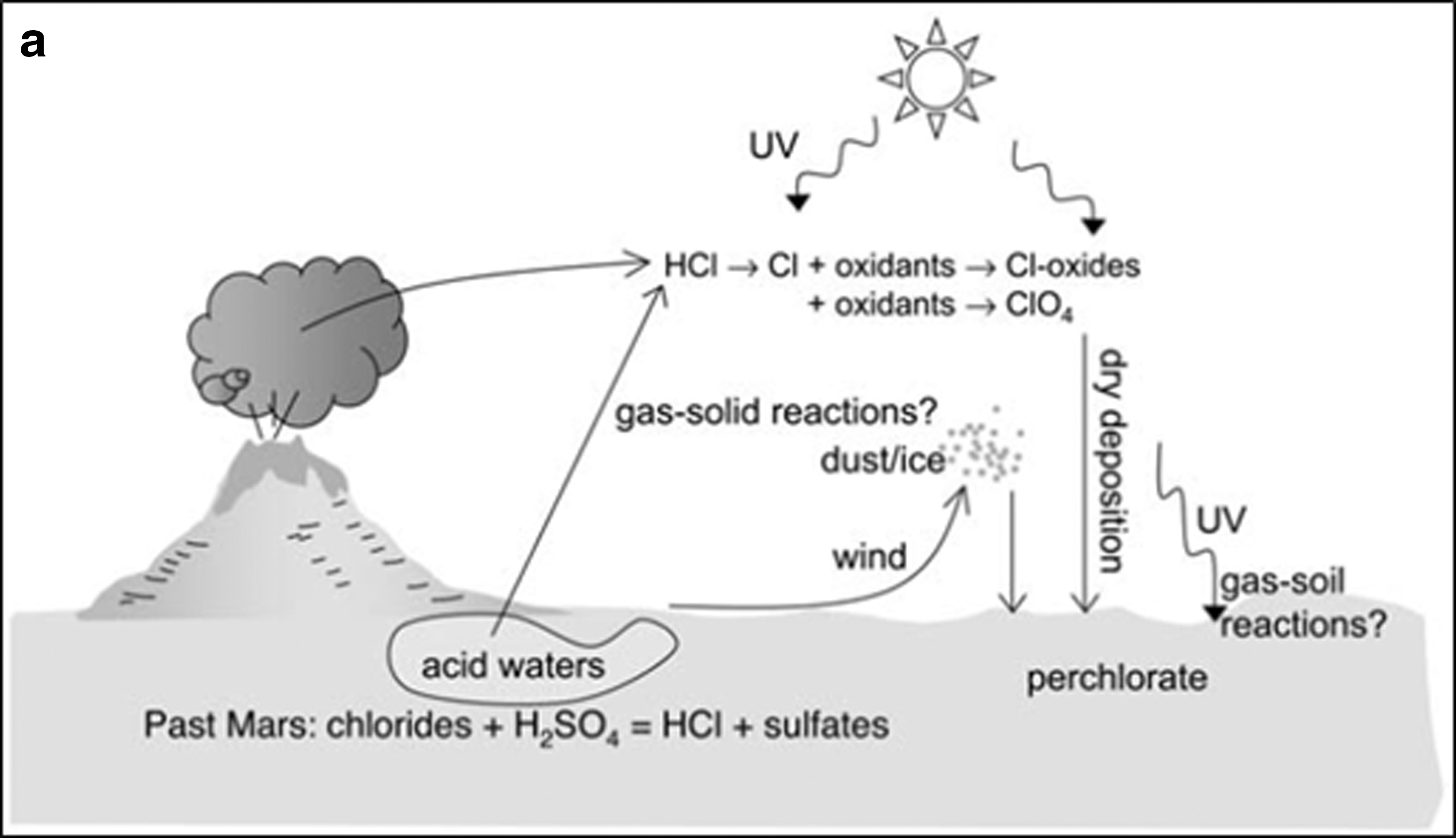
Chemical pathways for the formation of perchlorates on Mars. From Catling et al. (2010).
Chlorine may be provided by HCl gas emitted by past volcanism, or released by aerosols present in Mars' atmosphere. Other perchlorate formation pathways have been suggested, such as the reaction between water ice and ClO radicals produced by the atmospheric oxidation of chlorine. This reaction leads to the formation of OClO (McKeachie et al., 2004) and eventually to the formation of perchlorates after reaction with ozone or oxygen atoms (Wayne et al., 1995). Perchlorates could also form from chlorinated aerosols during electrostatic events (Dasgupta et al., 2005), such as “dust devils.” However, Catling et al. (2010) showed that this pathway is unlikely on Mars because of the high number of electrostatic events required to explain the ClO4 −:Cl− ratio measured by Phoenix.
Another pathway for perchlorate formation on the surface of Mars was suggested recently by Carrier and Kounaves (2015), who studied in the laboratory the formation of perchlorate and chlorate ions from UV irradiation of NaCl in regolith simulants composed of Fe2O3, Al2O3, and TiO2. The addition of SiO2 to the mixture largely increased the perchlorates' yield, suggesting that SiO2 behaves as a photocatalyst, producing O2 − ions under UV irradiation (Carrier and Kounaves, 2015); this observation is consistent with the ClO4 −:Cl− ratio measured by Phoenix and makes the formation of perchlorates on irradiated chlorine-bearing surfaces a credible hypothesis.
Three observations suggest that martian and terrestrial perchlorates originate from different processes. Firstly, the production of chlorinated species by volcanism on Mars slowed down drastically several hundred million years ago, along with volcanic activity of the planet; hence, the preservation of perchlorates on a geological timescale is a key question. Moreover, in the regolith samples collected by Phoenix, perchlorates represent the majority of chlorinated species, which is not the case for terrestrial perchlorates, which are found only as trace species. Earth is expected to have more mechanisms that could dissolve or reduce perchlorates; therefore, less chlorine is locked up in perchlorates on Earth than on Mars. This shows that Earth has perchlorate decomposition mechanisms that Mars lacks. Finally, perchlorates could have been formed by several processes during Mars' history, especially in the gas phase, but the “early” atmospheric origin of the perchlorates detected by the Phoenix mission has to be confirmed.
2.2. Oxidizing potential of perchlorates
The most important question about perchlorates concerns their potential for degrading organic molecules, especially during in situ analysis. The instruments devoted to the detection of organic matter on board the Viking, Phoenix, and MSL missions require an initial pyrolysis step of the regolith samples before performing gas chromatography–mass spectrometry (GC-MS) experiments (a wet extraction at lower temperature is also possible with MSL and could avoid the oxidation by perchlorates during the analysis of the samples). During pyrolysis, perchlorates are thermally decomposed into oxygen and chlorine, which oxidize and/or chlorinate organic molecules to generate mainly carbon dioxide and/or the chlorine-bearing compounds, such as those detected in martian samples (Freissinet et al., 2015). The oxidizing potential of perchlorates depends on the pyrolysis temperature and on the nature of the cation associated to the perchlorate ion. The latter affects the decomposition temperature of the perchlorates; for example, in similar pyrolysis conditions, Fe perchlorate is thermally decomposed between 200°C and 350°C, whereas Ca perchlorate decomposes between 400°C and 500°C and Mg perchlorate between 400°C and 550°C (Ming et al., 2014). The perchlorates' potential to oxidize organic matter also depends on the nature of the organic compounds as well as that of the other minerals present in the samples. Combustion by oxygen and chlorination of organics compete; depending on their structure, for example, the number of hydrogen atoms connected to the carbon atoms on benzene rings, organic molecules are more readily chlorinated or oxidized (Steininger et al., 2012). Iron-bearing minerals can catalyze the oxidation and/or chlorination of organic molecules with the fragments formed by the thermal decomposition of perchlorates (Rudloff and Freeman, 1970; Navarro-González et al., 2006; Vollhardt and Schore, 2009). On the other hand, organic molecules trapped in sulfate minerals are protected from oxidation, and potentially from chlorination, if their release occurs at a higher temperature than thermal decomposition of perchlorates (François et al., 2016).
Ming et al. (2009) tested the ability of a TEGA test bed to detect mellitic acid in a matrix containing SiO2 and 2.3 wt % Mg perchlorate. They showed that perchlorates can oxidize mellitic acid during a TEGA measurement, releasing CO2 (Ming et al., 2009). For this reason, the TEGA instrument on board Phoenix may have decomposed the organics possibly present in the regolith during the pyrolysis step, by activation of the perchlorates' reactivity. Their subsequent detection was therefore difficult.
The analysis by GC-MS of the gases released after pyrolysis of martian regolith samples revealed the presence of water at both Viking landing sites, with traces of chloromethane at VL-1 and carbon dioxide and traces of dichloromethane at VL-2 (Navarro-González et al., 2010, 2011). Chloromethane and dichloromethane signatures were initially interpreted as terrestrial contamination, despite their nondetection at such levels in the blank runs. Navarro-González et al. (2010, 2011) provided experimental evidence for the degradation of organics by perchlorates during pyrolysis: they mixed natural Atacama soil containing low concentrations of organic material with 1 wt % magnesium perchlorate. Using thermal volatilization and GC-MS, they identified water, carbon dioxide, and low concentrations of chloromethane and dichloromethane as end products, similarly to what was observed by Viking on Mars. Lately, Curiosity detected chlorobenzene and dichlorobenzene, the origin of which has been tentatively assigned to indigenous organics present in the regolith (Freissinet et al., 2015). Hence, organic matter may have been present in the regolith samples collected by the Viking probes but degraded by the perchlorates during pyrolysis.
Perchlorates have been identified at the surface of the northern polar region of Mars and at Gale Crater. The oxidation kinetics of organics by perchlorates is very slow at low temperature, for example with amino acids, purines, and pyrimidines (Kolb, 2009); heating is required to activate the reaction. It is therefore likely that perchlorates do not degrade organic molecules under the usual environmental conditions of Mars. This conclusion is also suggested by the work of Schuerger et al. (2012), who showed that perchlorates added to martian regolith simulants did not increase the destruction rate of UV-irradiated Bacillus subtilis spores. Meanwhile, several studies (Quinn et al., 2013; Góbi et al., 2016; Turner et al., 2016) suggest that radiolysis of perchlorates by cosmic rays or energetic solar particles may form reactive species, such as ClO− and O2, potentially destroying organics in the regolith and explaining their nondetection.
The reactivity of perchlorates with organics at low temperatures relevant to Mars' surface needs to be further investigated, especially in interaction with cosmic rays (protons, electrons) and UV photons, since perchlorates seem to be widespread and with an important concentration (ca. 0.5 wt %) in the regolith. During in situ analysis involving heat treatment of the regolith samples (as was the case for the Viking and Phoenix missions), perchlorates may have degraded organic molecules, precluding their identification.
3. Iron-Bearing Species
3.1. Formation of iron-bearing species at the surface of Mars
The red color of the martian surface is due to the presence of high concentrations of iron oxides. The martian regolith contains about 10–20 wt % of iron oxides (Rieder et al., 1997; Foley et al., 2003), but so far only hematite and goethite have been firmly identified at the surface of Mars and in martian meteorites (Morris et al., 2000). To the best of our knowledge, the reactivity of goethite under Mars-like conditions has not been studied yet. This section focuses on iron-bearing species proposed to be present on Mars and potentially interacting with organic matter.
3.1.1. Fe2O3
Hematite (α-Fe2O3) and maghemite (γ-Fe2O3) are thermodynamically stable in the current martian environment (Gooding, 1978). Different forms of hematite have been detected at the surface of Mars by Mars Global Surveyor and the Mars Exploration Rovers (Christensen et al., 2000, 2004), but maghemite has not been unambiguously identified (Hargraves et al., 1977; McSween et al., 1999; Bell et al., 2000; Morris et al., 2000).
3.1.2. Ferrate (VI)
The presence of ferrate (VI) in FeO4 2- salts has been suggested to explain the reactivity of the martian regolith (Tsapin et al., 2000a, 2000b), although this hypothesis has been challenged (Levin, 2002). Ferrates are not stable in most terrestrial conditions, since they are reduced to Fe(OH)3 or decomposed in the presence of water, even in a medium where water is not the dominant species (Delaude and Laszlo, 1996). According to orbital measurements, the water content of the martian regolith lies between 2 and 15 wt % (Milliken et al., 2007). Thus, the presence of ferrate (VI) in the regolith is not likely, but it may be found as a minor phase (Chevrier and Mathé, 2007).
3.1.3. Clays
The presence of clays on the surface of Mars has been suggested since the Viking mission (Toulmin et al., 1977), and their involvement in the reactivity of the regolith has also been proposed (Banin and Rishpon, 1979; Banin and Margulies, 1983). The first clear detection of phyllosilicates on the surface of Mars was realized with the IR spectrometer OMEGA on the Mars Express orbiter (Bibring et al., 2005; Poulet et al., 2005). The presence of clays seems to be limited to ancient terrains (Mustard et al., 2008). Recently, however, clays have been identified in large impact craters in the northern plains of Mars (Carter et al., 2010), suggesting that clays could be widespread over the entire planet (hidden under the volcanic cover in the northern plains). Clays detected by OMEGA are likely nontronite (Fe-rich), montmorillonite (Al-rich), and saponite (Mg-rich) (Chevrier and Mathé, 2007). No information about the cation content of the interlayer of those clays can be drawn from these data. Clays may also preserve organics from the oxidative conditions of Mars; their high specific area makes their interlayer spaces a favorable location to protect and concentrate organics (Kennedy et al., 2002). On Mars, such a favorable environment has been found by the Mars Reconnaissance Orbiter in a clay-rich fluvial-lacustrine delta in Jezero Crater (Ehlmann et al., 2008).
3.2. Oxidizing potential of iron-bearing species
3.2.1. Fe2O3
Maghemite (γ-Fe2O3) is likely to directly oxidize organics in a liquid water solution (Oyama and Berdahl, 1977) and participates in their catalytic oxidation by H2O2 (Oyama and Berdahl, 1977, 1979; Oyama et al., 1977). Oyama and Berdahl (1979) tried to replicate the Viking LR experiments in the laboratory by mixing a solution of sodium formate, H2O2, and iron oxide. They performed experiments with three different iron oxides: maghemite, hematite, and magnetite (the composition of the latter is Fe3O4). CO2 was released during all experiments, but the intensity of the release was similar to the observations during the LR experiment only in the presence of maghemite; the release was 10 times lower with hematite and magnetite (Fig. 2). Oyama and Berdahl (1979) proposed a mechanism for the degradation in the liquid phase of organics containing a carboxyl group, in the presence of maghemite and hydrogen peroxide by the formation of a complex between iron oxides and organics, eventually yielding CO2 and H2O.
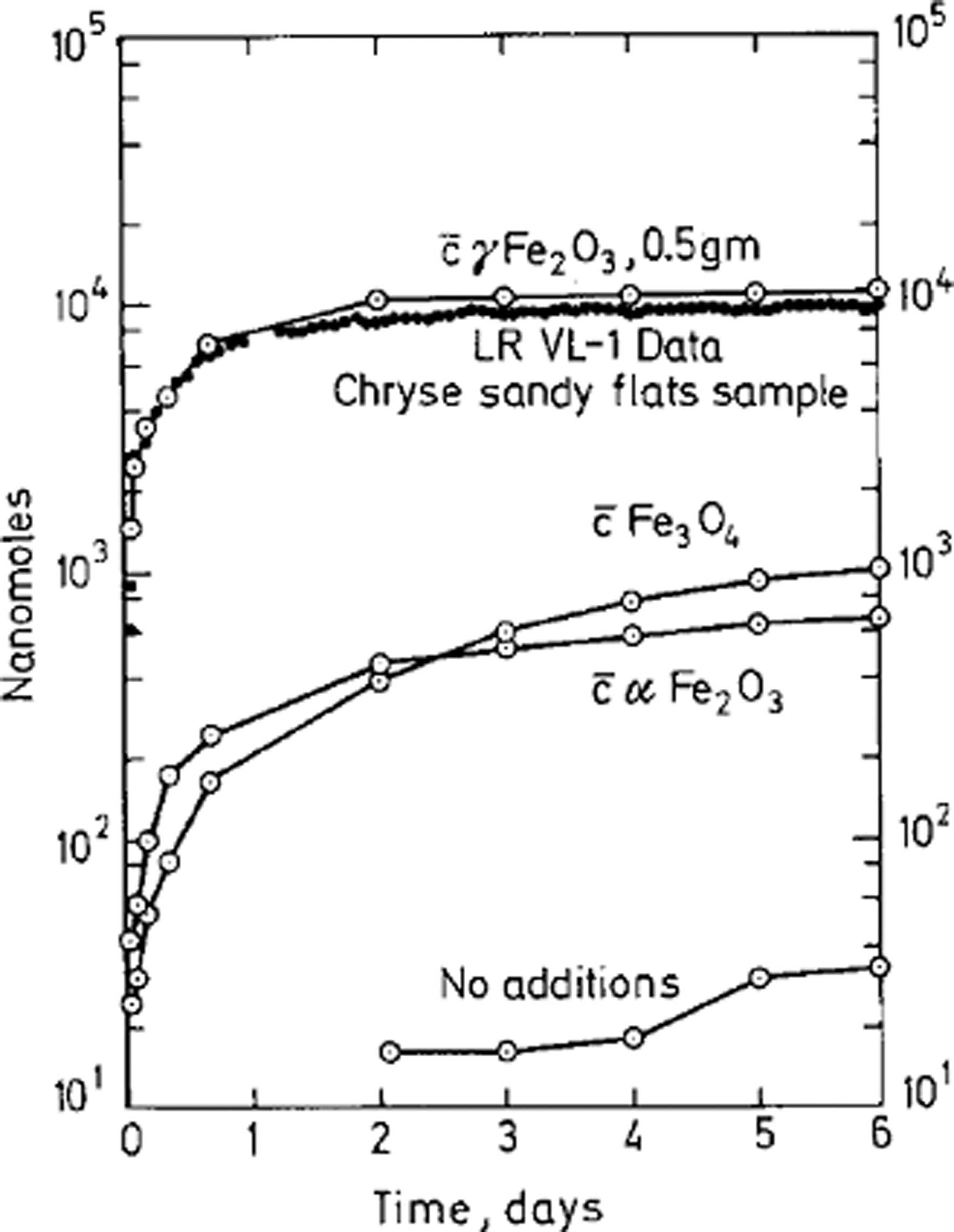
Total gas released during laboratory experiments simulating the Viking LR experiment. The samples contained 0.5 g of iron oxide and 1 mL of sodium formate (0.02 M). At time zero, 1 mL of H2O2 (0.01 M) was added to the samples. From Oyama and Berdahl (1979).
Hubbard (1979) simulated the PR experiment with pretreated hematite and maghemite (iron oxides were exposed to UV light (λ > 220 nm) in the presence of various mixtures containing CO, CO2, air, or NH3). The pretreated samples were exposed to 14CO2 and 14CO and UV irradiated under various temperature and humidity conditions (Hubbard, 1979). Heating the samples caused the emission of organic compounds containing 14C. However, this response was different from that given by the in situ PR experiment. This abiotic reactivity could not explain the global response of the martian regolith. The author of this study deems that the relevance of his results to Mars is “compromised because of the probability of differences between the model soils and the martian surface material” (Hubbard, 1979).
3.2.2. Ferrate (VI)
Delaude and Laszlo (1996) studied the degradation of organics by ferrates in liquid water and in nonaqueous media in the presence of montmorillonite as a heterogeneous catalyst, under conditions not relevant to Mars. At room temperature, they observed the degradation of alcohols into aldehydes or ketones, of thiols into disulfide, and the oxidation of nitrogen derivatives. Montmorillonite has been identified only locally at the surface of Mars (Ehlmann et al., 2013); therefore, it is not likely to play a catalytic role on a planetary scale. However, this experiment demonstrated the reactivity of ferrates and its potential for degrading organics.
A few years later, the thermal stability and reactivity of ferrate (VI) were studied in a martian context in an attempt to explain some of the Viking GEx and LR biology experiments' results (Tsapin et al., 2000a, 2000b). The thermal decomposition of potassium ferrate releases oxygen, similarly to the observations of the Viking GEx experiment. Tsapin et al. (2000a, 2000b) developed two sets of experiments at room temperature, that is, with ferrate in contact with liquid or gas-phase water. Oxygen scavenging was observed in all experiments but was more intense in the presence of liquid water. This result could not be observed during the GEx experiment, during which samples were not put in contact with liquid water. The oxygen release was not suppressed by a heat pretreatment of ferrates at 170°C for 3 h, in agreement with in situ observations; however, it was suppressed after preheating the ferrates at 185°C for 4 h.
Tsapin et al. (2000a) reproduced the same experiment with various nutrient solutions to study the chemical reactivity of ferrates. The results showed the importance of pretreating the substrate; when the ferrate was not subjected to prior heat treatment, a CO2 release due to the oxidation of organic carbon was observed. When Fe(VI) was preheated at 145°C or 170°C, CO2 production was reversed to CO2 consumption. Thus, ferrate is capable of oxidizing water and organic matter. The kinetics of such reactions are different from those of the Viking biology experiments due to the higher concentrations of the nutrient solutions used in the laboratory experiments, but could partly explain them, although this conclusion has been disputed (Levin, 2002; Tsapin et al., 2002).
3.2.3. Clays
Smectite clays have a layered structure and a high specific surface area, allowing the absorption of ions. Terrestrial crude clay powders contain mostly Na+ and Ca2+ ions, while clays with selected absorbed ions can contain H+, Na+, Ca2+, Mg2+, Al3+, Fe3+, or Fe2+. As a consequence, clays can play a catalytic role for the oxidation of organics (Barrault et al., 2000).
The oxidizing potential of nontronite and montmorillonite has been studied with various ions absorbed in the interlayer (Banin and Rishpon, 1979; Banin and Margulies, 1983). In these studies, clay samples were exposed to an organic solution containing formate, similar to that used in the LR experiment. A rapid CO2 release was observed for 2–3 days and then reached a plateau with all types of clays. Furthermore, the reactivity of heated smectite clays was lower than that of unheated samples, in agreement with the observations of the Viking biology experiments. The intensity of the CO2 release by martian regolith samples was well reproduced only with iron-enriched montmorillonite and nontronite (see Fig. 3).
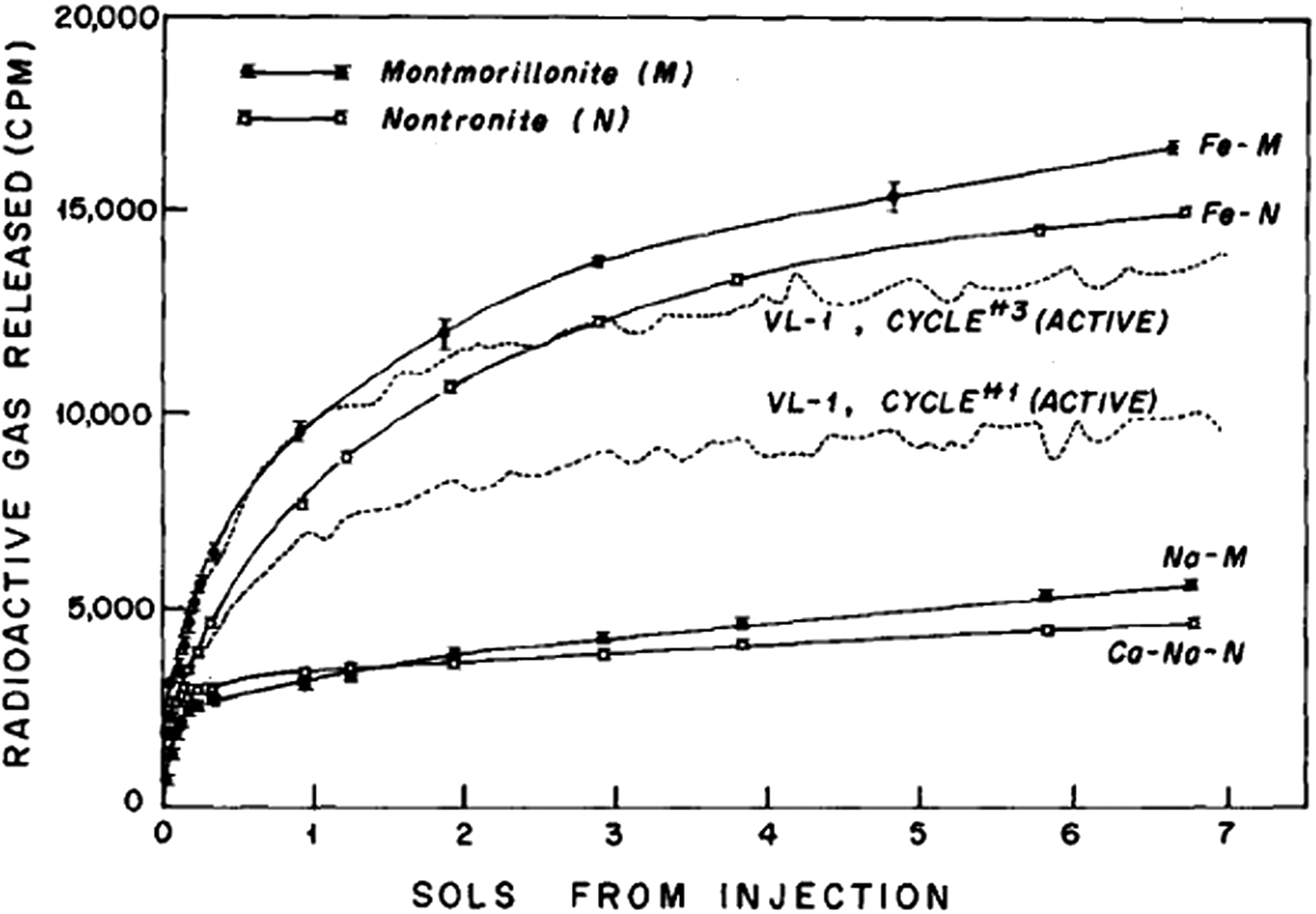
Radioactive gases released during the Viking LR experiment and simulation of the LR experiment in the presence of various clays and the LR medium. The clays were previously converted to different ionic forms with H+, Na+, Ca2+, Mg2+, Al3+, Fe3+, or Fe2+. Sols are martian days, or 24.6 h. From Banin and Rishpon (1979).
Banin and Rishpon (1979) and Banin and Margulies (1983) demonstrated that the activity of clays was similar to that of metal oxide catalysts, such as iron oxides. The catalytic potential of clays in liquid water is 3–4 times higher than that of metal oxides because of their larger specific surface area.
Iron is one of the most widespread elements at the surface of Mars, and it could explain part of the chemical reactivity of the regolith. Iron-bearing species could oxidize organic matter or catalyze its degradation by oxidizing agents, even deeply buried in the regolith (UV irradiation is not required to activate iron).
4. Reactive Oxygenated Species
We include in the reactive oxygenated species family all oxygen-bearing active species such as peroxides, superoxides, and oxides. This family also includes the superoxide radical ion O2 −• (and its conjugated acid, the perhydroxy radical HO2•). The oxidation state of oxygen is -II in oxides (e.g., MnO2), -I in peroxides (e.g., ZnO2), and -1/2 in superoxides (e.g., KO2). Hydrogen peroxide also belongs to this classification, but it is the subject of a dedicated section due to the high number of studies on H2O2.
4.1. Formation of reactive oxygenated species at the surface of Mars
4.1.1. Peroxides, superoxides, and oxides
Several species other than iron (such as Si, Na, Mg, Al, K, Ca, Mn, Zn, Cr, and Ti) have been detected on Mars and form oxides (Baird et al., 1976; Bell et al., 2000; Ming et al., 2008; Schmidt et al., 2009). Peroxides (such as zinc peroxide, ZnO2), superoxides (potassium superoxide, KO2), and dioxides (pyrolusite, β-MnO2) have been suggested since the Viking mission to explain the high reactivity of the regolith in the presence of liquid water and organic matter (Ponnamperuma et al., 1977; Oyama and Berdahl, 1977; Klein, 1978; Blackburn et al., 1979). Potassium was identified at the surface of Mars during the Viking mission and confirmed since in the form of potassium oxide (K2O) (Baird et al., 1976; Ming et al., 2008). More recently, zinc concentration was measured up to several hundred milligrams per kilogram by the Mars Exploration Rovers; like manganese, it seems to be one of the less abundant metals on the surface of Mars (Brückner et al., 1999; Evans et al., 2008; Ming et al., 2008).
4.1.2. Superoxide radical ions (O2 −•)
The presence of O2 −• at the surface of Mars was suggested for the first time 30 years ago (Chun et al., 1978; Yen et al., 2000; Zent et al., 2008; Georgiou et al., 2015). Among the reactional pathways suggested to lead to O2 −• formation, two possibilities seem relevant to the conditions prevailing on Mars: (i) interaction with H2O2 and (ii) photoinduced electron transfer. Laboratory studies focusing on O2 −• formation in environmental conditions similar to Mars' are described in Table 2.
The presence of O2 −• is monitored by electron paramagnetic resonance.
(i) The first pathway for O2
−• formation, relevant in the environmental conditions of Mars, is based on hydrogen peroxide. Zent et al. (2008) reported the detection of stable superoxide radicals on H2O2 chemisorbed on TiO2 samples, prepared a few years before and never dehydrated (Quinn and Zent, 1999), to show the reproducibility of the Viking PR experiment's results. TiO2 has been identified on the surface of Mars with an abundance of 0.5–2 wt % by the Viking and Mars Pathfinder landers and the Mars Exploration Rovers (Baird et al., 1976; Rieder et al., 1997; Ming et al., 2008). The chemical pathway proposed to form superoxide radicals initially requires the decomposition of H2O2 into hydroxyl radicals on TiO2 (R.1):
Reaction R.1 is not spontaneous and requires an external energy source. The hydroxyl radicals produced in R.1 can further react with H2O2 to form the hydroperoxyl radical (HO2•), the conjugated acid of the superoxide radical O2
−• (Anpo et al., 1999; Pignatello et al., 1999; Kwan and Voelker, 2002; Zent et al., 2008):
This process seems suitable for the martian environment as it requires three elements present on Mars: metal oxides, H2O2 (detected in the atmosphere of Mars), and UV radiation increasing the production of hydroxyl radicals.
Anpo et al. (1999) reported that superoxide radicals are formed when oxide substrates are heated after addition of H2O2; this heat treatment could induce the decomposition of H2O2. The work of Zent et al. (2008) suggests that such a treatment is not necessary to the formation of O2 −•; the long contact between TiO2 and H2O2 (6 years) in their samples could explain this result. On Mars, this reaction could be very efficient with the intense solar UV flux providing an energy source that could also trigger the photoinduced electron transfer from the oxide surface to adsorbed oxygen molecules (Anpo et al., 1999) detailed below.
(ii) In the laboratory, photoinduced electron transfer experiments involve the UV irradiation of a solid surface and are often performed in the presence of oxygen, which is found in Mars' atmosphere with an abundance of 0.13%. Surfaces efficiently photogenerating superoxide anion are semiconductors (such as TiO2), due to the formation of electron-hole pairs (e−, h+) under irradiation; insulators such as albite and labradorite (two feldspars) also form electron-hole pairs (e−, h+) upon photolysis, since their crystal structures contain defects that alter the electronic structure of the minerals (Zent et al., 2008). The work function of the Fe-terminated surface of hematite (4.3 eV (Wang et al., 1998)), a mineral ubiquitous on Mars (Christensen et al., 2000, 2004), can be overcome by the most energetic photons arriving at the surface of Mars (190 nm or 6.2 eV (Cockell et al., 2000; Patel et al., 2002)). Thus, iron oxides may also behave as semiconductors and provide electrons. In most cases, the (e−, h+) pair recombines instantaneously, but the electrons can also diffuse to the surface, where they reduce adsorbed oxygen. The holes can oxidize water to form hydroxyl radicals (Zent et al., 2008). These reactions are described below, where M represents a molecule of the surface under irradiation:
TiO2 promotes the production of superoxide ions by transfer of the photogenerated electrons (Anpo et al., 1999; Konaka et al., 1999; Attwood et al., 2003; Zent et al., 2008) and hence may speed up the evolution or the degradation of organic matter on the surface of Mars (Chun et al., 1978). Photocatalysis experiments have shown that carboxylic acids, amino acids, and peptides adsorbed on iron and titanium oxides are decomposed into CO2 and CH4 at 77–200 K (Shkrob and Chemerisov, 2009; Shkrob et al., 2010). Experimental studies on the formation of the superoxide radical by photoinduced electron transfer on TiO2 suggest that hydrated TiO2 produces O2 −• more efficiently than the dehydrated form (Gonzalez-Elipe et al., 1979; Zent et al., 2008). As the water content at the surface of Mars seems higher than the TiO2 content (Baird et al., 1976; Rieder et al., 1997; Feldman et al., 2002, 2004; Milliken et al., 2007; Ming et al., 2008), it is likely that TiO2 is hydrated, making the production of O2 −• efficient in the martian regolith. Assuming a pseudo-first-order kinetics, Zent et al. (2008) showed that the O2 −• surface population on Mars would not go extinct overnight; however, O2 −• ions would disappear from environments deprived of UV irradiation on a longer timescale (Attwood et al., 2003), that is, when photolysis is inhibited by seasonal CO2 caps or by a layer of regolith.
The formation of superoxide radicals by photogenerated electron transfer was also studied on plagioclase feldspars (Yen et al., 2000; Zent et al., 2008), insulating minerals found on Mars (Bandfield et al., 2000). Experimental simulations were conducted under various conditions (composition of the atmosphere, flux of the UV source; see Table 2) and showed the formation of stable O2 −• ions on hydrated and untreated substrates. Yen et al. (2000) showed the formation of thermally stable superoxide radicals at the surface of labradorite (Ca,Na)(Al,Si)4O8 particles under a simulated martian atmosphere. In their study, higher concentrations of oxygen in the atmosphere during the irradiations lead to the production of greater amounts of superoxide radicals, suggesting that O2 −• derives from atmospheric oxygen. The authors proposed that UV radiation mobilizes electrons, subsequently captured by molecular oxygen adsorbed on the mineral (R.4). Their article, however, does not clearly mention the hydration degree of the labradorite substrate (Yen et al., 2000). Full dehydration of silicates requires a heat treatment above 350°C (Hurowitz et al., 2004), but no such pretreatment is mentioned in Yen et al. (2000), suggesting that their substrate may be partly hydrated.
Zent et al. (2008) also observed the formation of O2
−• after UV irradiation of hydrated mineral surfaces, but the radicals were not thermally stable. The addition of O2 in the atmosphere above the substrate did not change this result. From there, Zent et al. (2008) proposed a mechanism that explains the formation of unstable O2
−• ions from the water molecules absorbed in the mineral phase. The mechanism is based on Reactions R.3 and R.5, that is, the splitting of a water molecule into OH• and H+ by a hole formed during irradiation of the mineral surface. The hydroxyl radical formed during Reaction R.5 can then interact with H2O2 and lead to the formation of O2
−•. The net reaction is
The low lifetime of O2
−• may be explained by the reactions with hydrated protons (R.7) or water molecules (R.8) (Yen et al., 2000; Zent et al., 2008). Because water is present in the crystal structure of hydrated albite, O2
−• radicals are consumed rapidly by R.7 and R.8; this explains their low lifetime in the absence of a source term (UV radiation).
Zent et al. (2008) assumed that this reaction list is not exhaustive but can explain the formation of short-life oxidants in the regolith.
The difference in stability of O2 −• radicals produced by photoinduced electron transfer in the works of Yen et al. (2000) and Zent et al. (2008) is puzzling. The heat treatment of the two feldspars, that is not explicit in the work of Yen et al. (2000), could explain these discrepancies. Another hypothesis is the presence of water vapor during the experiments of Yen et al. (2000), in contrast with those of Zent et al. (2008). Indeed, if present, a small amount of water vapor may contribute to the formation of hydrogen peroxide and hydroxyl radicals after UV irradiation. These species could then interact on the sample via (R.2) to form •HO2, which would subsequently release a proton to form stable O2 −• radicals in the structure of labradorite. The production of H2O2 from water vapor therefore requires the presence of O2 to form •HO2 with the H• radical produced by H2O photolysis (Atreya and Gu, 1994), which is consistent with the observations of Yen et al. (2000). This interpretation is supported by the experiments of Georgiou et al. (2015), who studied soil samples from the Atacama and Mojave Deserts, and found that O2 −• was photogenerated in desiccated samples, while OH• was produced in aqueous extracts in dark conditions.
Both processes may occur on Mars. Photogenerated electron transfer is a surface process, since UV radiation is required. The formation of O2 −• from H2O2 may also occur in the subsurface, depending on the diffusion depth of H2O2.
4.2. Oxidizing potential of reactive oxygenated species
4.2.1. Peroxides, superoxides, and oxides
Few studies had been conducted on the reactivity of oxides before the Viking missions, but it was established that metal superoxides (Fe2O3) can cause outgassing of O2 after contact with water vapor at low temperatures (Oyama and Berdahl, 1977). Several studies were later initiated to reproduce the results obtained by the Viking experiments with oxides.
Ponnamperuma et al. (1977) exposed samples of KO2 and ZnO2 to isotopically labeled water (H2
18O) under reduced pressure conditions in order to simulate the GEx experimental conditions. A release of 16O18O was observed, particularly on KO2 samples. This release probably originates from the oxidation of water (Ponnamperuma et al., 1977), following the mechanism (R.9)–(R.10):
Ponnamperuma et al. (1977) also exposed several peroxides and superoxides (such as KO2) and hydrogen peroxide to 13C-labeled sodium formate in a setup replicating the LR experiment. The release of 13CO2 was observed, attesting the oxidation of formate. After various pretreatments of pyrolusite (β-MnO2; dry irradiated, humidified irradiated, and dry non-irradiated samples), Blackburn et al. (1979) exposed it to water vapor and liquid water to mimic the GEx experimental conditions. They found that only the humidified irradiated samples released oxygen and concluded that the presence of water is necessary to activate pyrolusite during irradiation. They hypothesized that the oxidant is a species that contains manganese with an oxidation number higher than that of pyrolusite (IV), and proposed a mechanism consisting in the photoinduced oxidation of MnO2 (net reaction R.11) and a water-vapor-catalyzed reduction of surface MnO3 to MnO2 (net reaction R.12) (Blackburn, 1984):
This formation mechanism of MnO3(VI) involves the photolysis of CO2, which occurs at wavelengths below 227 nm that can reach the surface of Mars according to numerical models (wavelengths higher than 190 nm are not absorbed by atmospheric CO2) (Cockell et al., 2000; Patel et al., 2002). The Mn(VI), MnO3 species formed may then release oxygen via a catalytic cycle involving water vapor:
Blackburn et al. (1979) and Blackburn (1984) suggested that the surface reactivity of manganese or other transition metal oxides with water vapor, leading to the release of oxygen, could explain the results of the Viking GEx experiment.
4.2.2. Superoxide radical ions (O2 −•)
O2 −• is a highly reactive species used in heterogeneous catalytic oxidation reactions (at gas-solid and liquid-solid interfaces) (Anpo et al., 1999). Reaction R.8 shows the decomposition of water into oxygen and ions by the superoxide radical, a possible explanation for the results of the GEx experiment. The oxidative strength of O2 −• toward organic molecules has been studied, although not under Mars-like conditions. Alkanes, alkenes (Lunsford, 1984), and aliphatic (Gasymov et al., 1984) or aromatic (Gasymov et al., 1982) hydrocarbons are oxidized by O2 −• adsorbed on surfaces. O2 −• ions have also been suggested to destroy polychlorobiphenyls (PCB) and chlordanes, two organic pollutants that are extremely resistant to environmental degradation (Matsunaga et al., 1991); again, the physical conditions of this oxidation are very different from those encountered on Mars.
The species described in this section are likely to form on Mars and lead to the UV-assisted oxidation of water and organic molecules at the surface, or in subsurface layers through the production of radicals from H2O2.
5. Hydrogen Peroxide (H2O2)
5.1. Formation of H2O2 on Mars
5.1.1. In the atmosphere
The production of H2O2 in the atmosphere of Mars has been proposed (Hunten, 1979). Chemical atmospheric models initially evaluated the concentration of H2O2 in the low atmosphere to be in the 109 and 1010 molecules cm−3 range (Kong and McElroy, 1977; Krasnopolsky and Parshev, 1979). Recent models give a more widespread value, between 106 and 1010 molecules cm−3 (i.e., 10 ppt to 100 ppb) depending on the season and latitude considered (Krasnopolsky, 1993, 2006; Atreya and Gu, 1994; Nair et al., 1994; Moudden, 2007; Encrenaz et al., 2008) (see Fig. 4).
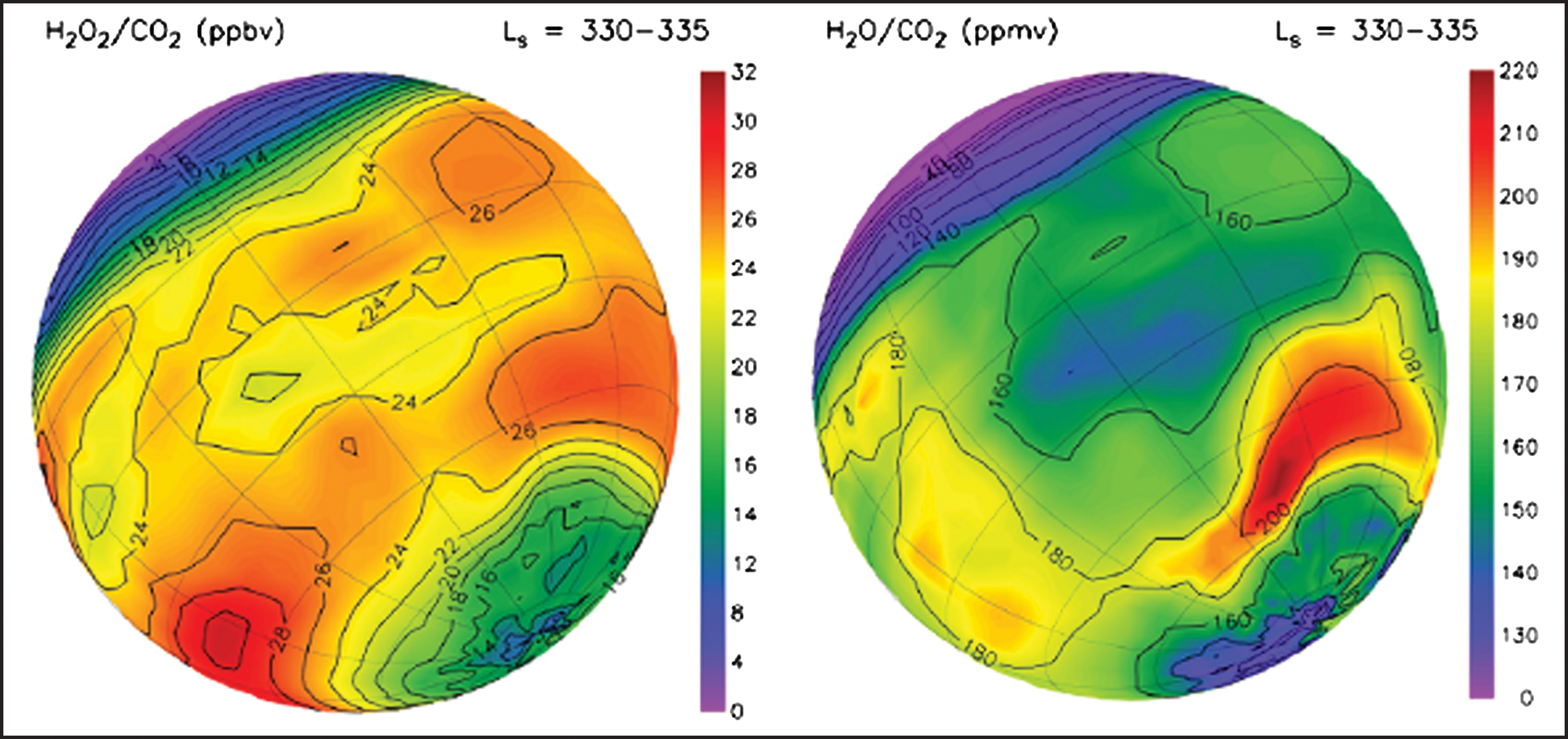
Mean hydrogen peroxide (left) and water (right) volume mixing ratios modeled between areocentric longitudes Ls = 330° and 335°. The H2O2 production efficiency depends on the amount of water vapor available. From Encrenaz et al. (2008). (Color graphics available at
In 2003, hydrogen peroxide was directly observed in the martian atmosphere, with a global average mixing ratio ranging from 18 ± 0.4 ppb (Clancy et al., 2004) to 32 ppb with an uncertainty of ∼10% (Encrenaz et al., 2004); in 2014, the H2O2 mixing ratio reached 20 ± 7 and 30 ± 7 ppb, respectively, in March (Ls = 96°) and July (Ls = 156°), respectively (Encrenaz et al., 2015). These values are all consistent with model predictions. However, a large heterogeneity was observed in the H2O2 atmospheric concentration; the maximum was detected near the subsolar point. On the other hand, Clancy et al. (2004) analyzed the H2O2 concentration in an area that did not include the subsolar point and therefore likely missed the maximum H2O2 concentration, leading to a lower average H2O2 abundance. New observations in 2005 evidenced concentrations lower than those of 2003, with an average of 15 ppb (Encrenaz et al., 2008). An explanation for this is the difference in seasons during which the observations were performed; the amount of hydrogen peroxide in the atmosphere, ultimately dependent on the abundance of atmospheric water vapor and water ice clouds (Encrenaz et al., 2015), is highly variable seasonally. A review of observations of Mars' atmosphere highlights that the highest H2O2 concentration measured is 40 ppb (Encrenaz et al., 2012).
Although the models taking only into account H2O2 photochemical formation give concentrations in good agreement with observations, atmospheric H2O2 has a short lifetime with respect to its diffusion rate in the regolith (Chyba et al., 1989; Bullock et al., 1994; Encrenaz et al., 2012). The reactivity of the regolith inferred from Viking's results, if attributed to H2O2, suggests that an additional source of H2O2 exists. Atreya et al. proposed that, in addition to the photochemical pathway, H2O2 can be formed by electrostatic fields generated in dust devils and storms (Atreya et al., 2006; Delory et al., 2006). A collisional plasma model including electrochemical reactions relevant to H2O2 formation was developed to simulate atmospheric changes in H2O2 concentration during dust devils and storms (Delory et al., 2006). The results show that, depending on the strength of the electrostatic field, H2O2 abundance could be up to 200 times higher with this process relative to photochemical reactions alone. This extra source of atmospheric H2O2 could balance the sink by diffusion in the regolith and reconcile the observed abundance with the models taking into account the diffusion of H2O2 in the regolith.
5.1.2. In the regolith
Numerical models have estimated the H2O2 diffusion depth in the martian subsurface with and without impact gardening. The results are widespread due to the high uncertainty on the input data: the maximum H2O2 penetration depth in the regolith ranges from a few centimeters to hundreds of meters (Chyba et al., 1989; Bullock et al., 1994; Hartman and McKay; 1995, Zent, 1998), the latter value being found with impact gardening.
In addition to diffusion from the surface-atmosphere interface, H2O2 can also be produced by the interaction between minerals that compose the regolith and water (Huguenin et al., 1979; Huguenin, 1982; Hurowitz et al., 2007; Davila et al., 2008). Mars Odyssey and Mars Express results show that the martian regolith contains liquid or solid water in amounts varying with latitude. In the equatorial region (between +45° and −45° latitude), the water content of the subsurface could reach 2–15 wt % (Feldman et al., 2002, 2004; Milliken et al., 2007). Furthermore, the 2008 Phoenix mission confirmed the presence of ice in the polar regolith (Smith et al., 2009), making this formation process of H2O2 in the regolith possible.
The production of H2O2 by interaction between the regolith and liquid water has been studied with laboratory experiments and computer modeling (Borda et al., 2001, 2003; Hurowitz et al., 2007; Davila et al., 2008). Hurowitz et al. (2007) focused on the immersion of a fine-grained silicate powder in water. After filtration of the sample, they observed the production of H2O2 in the solution. A laboratory study suggests the formation of H2O2 by exposure of olivine and pyroxene samples to H2O vapor at temperatures (251–262 K) that allow the formation of frost on the mineral surface (Huguenin et al., 1979; Huguenin, 1982). The authors did not unambiguously identify H2O2 but assumed it was formed; they suggested the 4-step formation mechanism shown in Fig. 5 and described below.
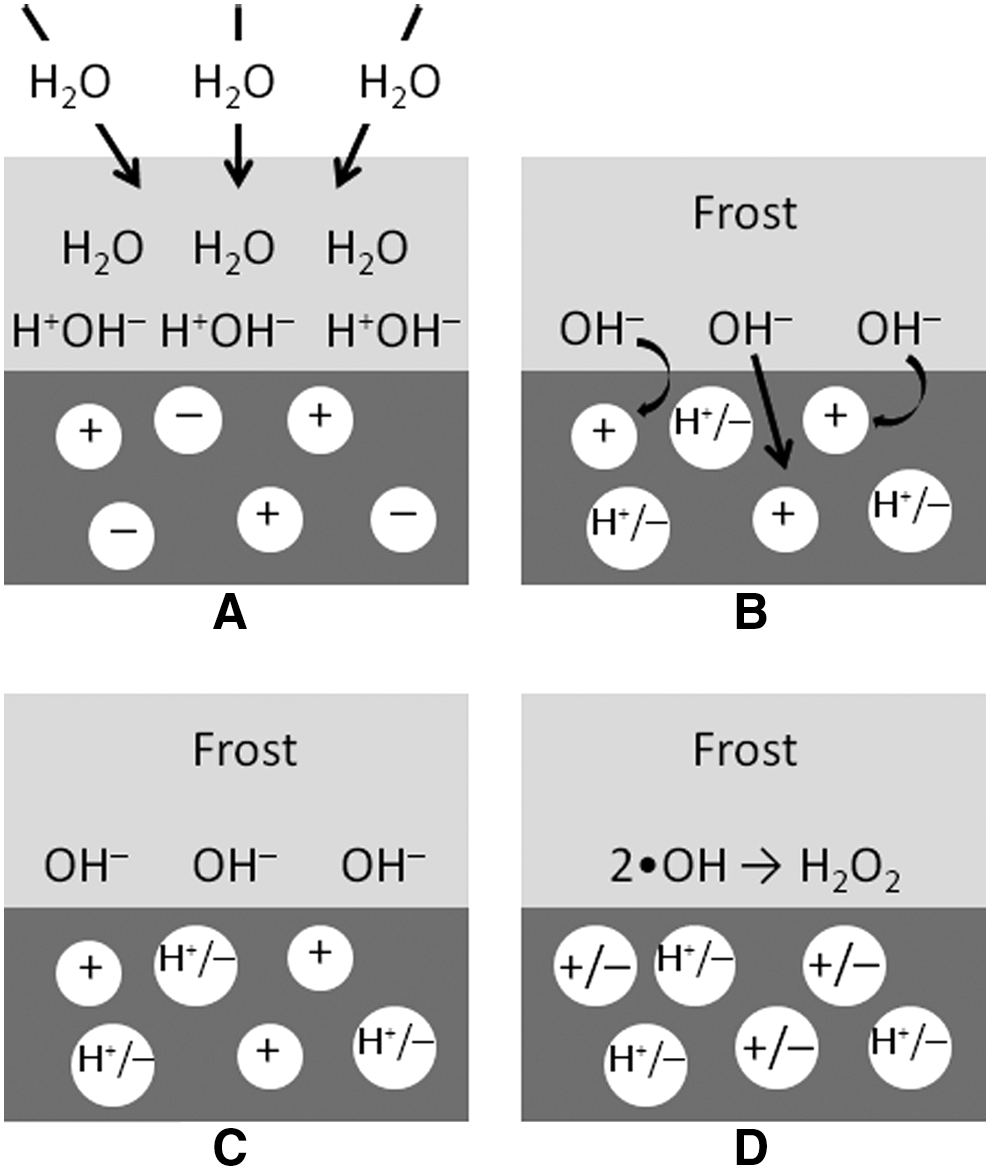
The four steps of the mechanism proposed by Huguenin et al. (1979) and Huguenin (1982) for the formation of H2O2 chemisorbed on mineral surfaces at 251–262 K: (
Step (A) consists in the adsorption of water on the mineral surface, followed by dissociative ionization into H+ and OH− fragments. During step (B) protons diffuse into negatively charged defects of the mineral. The OH− ions are restricted to the near-surface, leading to the development of a high potential and to the migration of electrons into the positive crystal defects. During step (C), OH• radicals are formed on the mineral surface by silicate reduction. Finally, step (D) involves the formation of H2O2 by the combination of two adjacent OH• radicals.
The steps proposed for the formation mechanism of H2O2 on minerals involve elements present at the surface or subsurface of Mars: widespread solid water (Feldman et al., 2002, 2004; Milliken et al., 2007), intermittent liquid water (Möhlmann, 2010), silicates (Bandfield et al., 2004; Chevrier and Mathé, 2007), or pyrite (not detected at the surface of Mars to date but suspected to be one of the iron sulfides involved in the formation of the widespread sulfate-rich regions on Mars (Zolotov and Shock, 2005)). Hence, the 4-step mechanism detailed above could take place on Mars and form H2O2 in the regolith, where it would be available to react with organics either directly or after decomposition into OH• fragments.
5.2. Oxidizing potential of hydrogen peroxide
5.2.1. In the atmosphere
To our knowledge, few studies have been conducted on the oxidation of organic molecules by gas-phase H2O2 (see, e.g., Claeys et al., 2004). One of us has recently studied the ability of gas-phase H2O2 to react with organics under conditions relevant to Mars (Noblet, 2008). Two organic compounds of astrobiological interest, glycine (an amino acid present in meteorites) and diplopterol (a biomarker synthesized by some terrestrial bacteria, which main carbon chain can survive hundreds of millions of years on Earth (Ourisson and Albrecht, 1992; Ourisson and Rohmer, 1992)), were exposed to a gaseous flow containing 200–400 ppm of H2O2. Diplopterol resisted oxidation by gas-phase H2O2; this shows the high stability of this hopanoid and advocates in favor of attempts to detect hopanoids as remains of past life on Mars. However, the study of glycine was inconclusive and revealed the limitations of the experimental setup; the presence of water vapor used as a carrier for H2O2 changed the structure of the glycine films studied, thus modifying their IR absorbance and precluding the quantification of glycine during exposure to H2O2 (Noblet, 2008).
5.2.2. In the regolith
The oxidizing capacity of liquid and solid H2O2 has been extensively studied in experimental conditions far from the environmental conditions of Mars (see, e.g., Cohn et al., 2004, 2010). The reactivity and stability of liquid H2O2 were also studied in conditions relevant to Mars, in order to investigate the oxidation of the nutrient used during the LR experiment with or without a martian regolith analogue (15:85 wt % mix of maghemite and silica sand) (Levin and Straat, 1981). In this study, a release of 14CO2 from the oxidation of nutrients by H2O2 was observed, with kinetics similar to the Viking LR experiment results. A catalytic effect of the martian regolith analogue on the degradation of organics was observed. Moreover, H2O2 exhibited a thermal response similar to that of oxidants in the LR experiment in the presence of a catalyst and/or a species that stabilizes H2O2. Similarly, Oyama and Berdahl (1979) reproduced the CO2 release obtained during the LR experiment by mixing H2O2, labeled formate, and maghemite (see Fig. 2).
Huguenin et al. (1979) added a formate solution to water ice condensed on silicates; they observed a CO2 release corresponding to the degradation of 43% of the formate injected, and suggested chemisorbed H2O2 had been formed from the reaction of adsorbed water molecules with the substrate.
The reactivity and thermal stability of H2O2 chemisorbed on TiO2 were studied by Quinn and Zent (1999) in order to interpret the LR and GEx data. The samples designed to simulate the GEx experiment were submitted to a 50°C heat treatment prior to the experiments to remove water and test the thermal stability of the peroxide complexes. They were exposed to a 14C-labeled organic solution, and the evolution of the gas-phase content was monitored. An O2 release was observed during these experiments; however, the thermal sensitivity of the oxidant seemed to be slightly different from that of the Viking GEx reagent (which decomposes at 150°C during laboratory simulations). Quinn and Zent (1999) explained the O2 release by the substitution of the chemisorbed H2O2 by water followed by the decomposition of H2O2 into H2O and O2 in the gas phase. During the LR simulations, the CO2 release suggested that H2O2 chemisorbed on TiO2 had a reactivity and thermal stability similar to the martian regolith chemical agent (decomposition at approximately 50°C). The data of Quinn and Zent (1999) suggest the formation of two different peroxide complexes on TiO2 following the hydration state. These two complexes are the inner-sphere peroxo-complexes of Ti4+ ions for dehydrated TiO2 and the outer-sphere peroxo-complexes hydrogen-bonded to hydroxyl groups in the hydrated crystal (Munuera et al., 1980; Quinn and Zent, 1999). In the GEx simulation, TiO2 was partially dehydrated and therefore could have contained more inner-sphere complexes that seem more stable with respect to heat treatment than the outer-sphere complexes.
As already pointed out in Section 4.1.2, Zent et al. (2008) re-examined the samples of Quinn and Zent (1999) and recorded a signature of stable superoxide radicals on TiO2. However, they did not specify what samples they studied (samples used in the GEx or LR simulations). In the GEx simulation, the sample was heated to 50°C after contact with a H2O2 solution, which could have favored the production of O2 −•. In the LR simulation, the sample was not heated and was washed with liquid water before introduction of the organics; the lack of heat treatment did not favor the production of superoxide ions that also react with water (R.8). Therefore, the reactivity of H2O2 chemisorbed on TiO2 may actually be due to the production of O2 −• radicals in GEx experiments.
Hydrogen peroxide is present in the atmosphere and probably in the subsurface of Mars. It likely reacts with organic matter, especially in the presence of a catalyst such as TiO2.
6. Synergy between Oxidants
Three of the main categories of oxidants—oxygenated species, iron-bearing species, and H2O2—are chemically linked. On Mars, the presence of iron, water, and hydrogen peroxide may result in the formation of reactive species like superoxide ions and hydroxyl radicals. The Haber-Weiss cycle (R.13 to R.15) is known as a pathway for the formation of hydroxyl radicals from the reaction of superoxide ions and hydrogen peroxide, catalyzed by iron ions. The net Haber-Weiss reaction can be expressed as
This cycle involves two reactions (R.14 and R.15) with iron ions (Spacek et al., 1995; Pignatello et al., 1999). Reaction R.15 is called the Fenton reaction, which is often used to destroy organic pollutants.
These reactions are responsible for the formation of hydroxyl radicals, a highly reactive species. Hydroxyl radicals can combine to form hydrogen peroxide. The Fenton reaction requires the presence of superoxide ions that can form, for example, via Reaction R.2. We propose a simplified scheme that shows the synergy between H2O2, superoxides, and iron ions (Fig. 6), which does not include the complex temperature-dependent chemistry of perchlorates.

Schematic diagram representing reactions involving some of the main oxidants assumed to be present at the surface of Mars (Zuo and Hoigné, 1992; Spacek et al., 1995; Pignatello et al., 1999; Kwan and Voelker, 2002). Gray arrows highlight the Haber-Weiss cycle. (Color graphics available at
The presence of water in the atmosphere and in the regolith of Mars can lead to the formation of OH• radicals, which in turn can react with organics, forming hydrogen peroxide or being regenerated via the Haber-Weiss cycle. The cycle described in Fig. 6 is not exhaustive but illustrates the synergy between species known to be present at the surface or in the atmosphere of Mars: water, hydrogen peroxide, and iron. Numerous reactions involving these species lead to the formation of reactive species, such as superoxide ions or hydroxyl radicals (Lefticariu et al., 2007). We therefore propose a simplified scheme of the oxidation state of the various layers that compose the martian regolith, shown in Fig. 7.
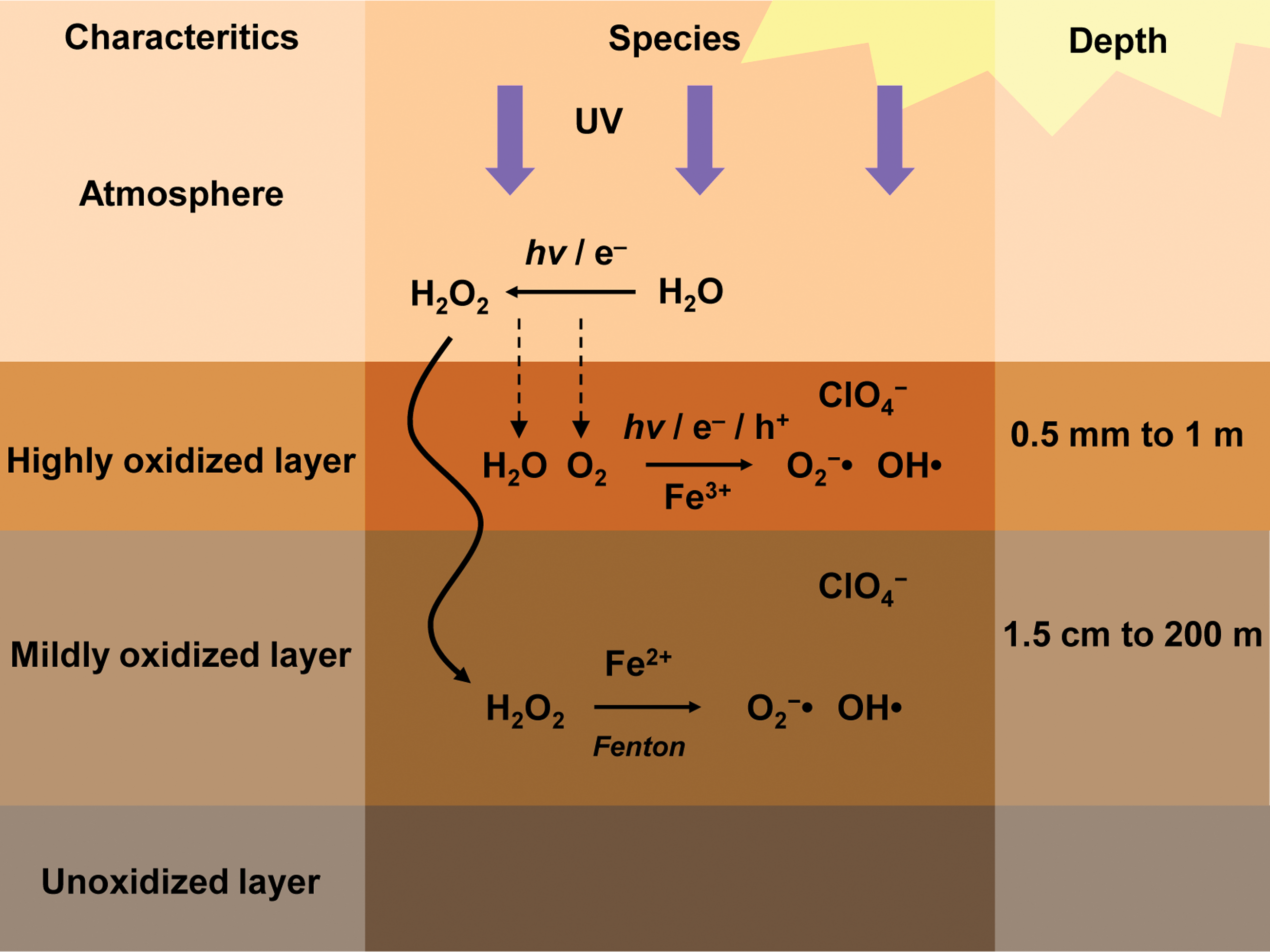
Simplified scheme of the supposed oxidation layers of the martian regolith. (Color graphics available at
The highly oxidized layer at the very surface of Mars originates from the interaction between the regolith, the atmosphere, and UV radiation, that could form radicals such as O2 −• and OH• (Yen et al., 2000; Zent et al., 2008). Radiative transfer models and laboratory experiments on martian regolith analogues allow for estimation of the penetration depth of UV radiation in the martian regolith to 0.5–1 mm (Cockell et al., 2000; Cockell and Raven, 2004; Muñoz Caro et al., 2006; Schuerger et al., 2012) and to a few centimeters to meters under a layer of snow or of H2O/CO2 ice (Córdoba-Jabonero et al., 2005; France et al., 2010). Córdoba-Jabonero et al. (2005) estimated that a 1 m thick water ice layer absorbs enough UV radiation to reduce the UV dose to a level similar to that found at the surface of Earth. Given the presence of seasonal carbon dioxide ice and dust in the atmosphere, this 1 m penetration depth should be considered as an upper limit.
The mildly oxidized layer is limited by the H2O2 diffusion depth. Numerical models have estimated this parameter in the subsurface, with and without impact gardening by meteorites. The results vary greatly, from a few centimeters to hundreds of meters (Chyba et al., 1989; Bullock et al., 1994; Hartman and McKay, 1995; Zent, 1998), due to the high uncertainty on the input data. Models simulating H2O2 diffusion in the regolith without impact gardening probably underestimate the diffusion depth. Zent (1998) estimated the maximum H2O2 diffusion depth to 150–200 m using a specific crater production population and early oxidative conditions on Mars in his model.
7. Conclusion
The formation pathways and reactivity with organics of oxidants proposed to be present at the surface of Mars have been reviewed. The main oxidants are perchlorates, iron-bearing species, reactive oxygenated species, and hydrogen peroxide. Reactive oxygenated species have not been identified in the martian surface yet, but hydrogen peroxide has been detected in the atmosphere, and iron oxides and perchlorates have been detected in the regolith.
Hydrogen peroxide likely diffuses in the subsurface to a depth that needs to be determined experimentally. Together with water and ferrous minerals encountered there, H2O2 is involved in the formation of very reactive species such as superoxide radical ions (O2 −•), hydroxyl radicals (OH•), and peroxy radicals (HO2•). The presence of these species leads to a crucial question: how long can organics remain in the regolith of Mars before being degraded by oxidants? The extent and strength of the oxidative processes in the regolith also need to be carefully studied; recent Phoenix results suggest that the oxidation-reduction potential of the regolith is actually moderate, with less than 1 ppm of strong oxidants (Quinn et al., 2011). Then, perchlorates' reactivity with organics under martian conditions or during the pyrolysis step of the samples' analysis could explain the nondetection of organics on Mars.
Numerous studies have explored the evolution of organics subjected to UV irradiation in the laboratory under simulated martian conditions (see, e.g., Oro and Holzer, 1979; Ten Kate et al., 2005, 2006; Stalport et al., 2008, 2009; Poch et al., 2013, 2014, 2015) and in low-Earth orbit (see e.g., Stalport et al., 2010), but so far few experiments have been devoted to the study of the stability of organics in the presence of oxidants under martian conditions (McDonald et al., 1998; Garry et al., 2006; Shkrob and Chemerisov, 2009; Johnson and Pratt, 2010; Shkrob et al., 2010; Poch et al., 2015). Future laboratory investigations should focus on the impact of martian oxidants, such as perchlorates and H2O2, on the survival of organics under martian conditions. The determination of the degradation kinetics of organics under UV irradiation in the presence of oxidants will complete our picture of the impact of the martian environment on organic molecules and will provide important insights for the search for traces of past life at the surface of Mars by future missions.
Since the 2000s, NASA has been leading Mars exploration, focusing on the past and recent presence of water, in connection with past and present climatology. The main missions were the Mars Odyssey (2001) and Mars Reconnaissance Orbiter (2005) orbiters, the two Mars Exploration Rovers (2003), and the Phoenix lander (2007). The data collected have been augmented by the European Mars Express mission (2003) and support the modern picture of the geological and climatic history of Mars. This new picture was used to design the ambitious MSL mission; the detailed geological, mineralogical, and chemical analysis currently carried out by the Curiosity rover in Gale Crater has brought crucial information on the oxidation state of Mars, as discussed in the present study.
After the MSL mission, and due to unexpected financial limitations, the Mars Exploration Program has been recently revised (stand-by of the MetNet program and of the Sample Return plan) and is currently limited to the most important actions listed here: (i) The MAVEN orbiter (2013, NASA, currently in extended mission until 2022): MAVEN will explore the upper atmosphere and ionosphere of Mars and study their interactions with the solar wind (Jakosky et al., 2015a); (ii) The Mars Orbiter Mission (2013, ISRO, currently extended), a technological demonstrator with scientific aims similar to those of MAVEN, including a dedicated study of atmospheric components such as CO2 and CH4 (Arunan and Satish, 2015; Mishra et al., 2016); (iii) The ExoMars Trace Gas Orbiter (2016, ESA and Roscosmos) will map the sources of CH4 and other gases on Mars (Vago et al., 2013); (iv) The InSight lander (2018, NASA), a single geophysical lander to study the deep interior of Mars; (v) The ExoMars rover (2020, ESA and Roscosmos) will search for past and present potential biosignatures on Mars. It will aim at the characterization of the distribution of chemical species (including H2O) as a function of depth under the surface; (vi) The Mars 2020 (2020, NASA) rover's main goal is to return samples from Mars' surface, selecting and caching two or three dozens cores (the core acquiring system is half the rover payload).
With regard to oxidative processes, the next steps of Curiosity exploration, including a potential extended mission, may be very informative when Curiosity will investigate the chemical species trapped in ancient sulfates and clay layers. Then a clear clue of the oxidative or protective properties of these microenvironments will be available from the preservation level of organics, if Curiosity manages to identify them in such environments. The MAVEN mission is investigating the loss of volatile compounds such as CO2, N2, and H2O from the martian atmosphere to space. Understanding atmospheric loss will have impacts on our knowledge of the history of Mars' atmosphere and climate, liquid water, and planetary habitability (Jakosky et al., 2015b; Rahmati et al., 2015); on the other hand, ExoMars will use a core drill, designed to retrieve potential oxidant-free samples down to a depth of 2 m under the surface. The knowledge of the budget in oxidants and oxidized species will be of prime importance to understand which of the phenomena described in this article are preponderant at the surface of Mars.
Footnotes
Acknowledgments
We are grateful to two anonymous referees for their helpful comments that improved the manuscript. J.L. acknowledges a postdoctoral research fellowship from CNES (Centre National d'Etudes Spatiales). R.N.G. acknowledges support from UNAM-PAPIIT IN109416 and CONACYT 220626. P.C. acknowledges Institut Universitaire de France for funding.
Author Disclosure Statement
No competing financial interests exist.