




Abstract
The UV environment is a key boundary condition to abiogenesis. However, considerable uncertainty exists as to planetary conditions and hence surface UV at abiogenesis. Here, we present two-stream multilayer clear-sky calculations of the UV surface radiance on Earth at 3.9 Ga to constrain the UV surface fluence as a function of albedo, solar zenith angle (SZA), and atmospheric composition.
Variation in albedo and latitude (through SZA) can affect maximum photoreaction rates by a factor of >10.4; for the same atmosphere, photoreactions can proceed an order of magnitude faster at the equator of a snowball Earth than at the poles of a warmer world. Hence, surface conditions are important considerations when computing prebiotic UV fluences.
For climatically reasonable levels of CO2, fluence shortward of 189 nm is screened out, meaning that prebiotic chemistry is robustly shielded from variations in UV fluence due to solar flares or variability. Strong shielding from CO2 also means that the UV surface fluence is insensitive to plausible levels of CH4, O2, and O3. At scattering wavelengths, UV fluence drops off comparatively slowly with increasing CO2 levels. However, if SO2 and/or H2S can build up to the ≥1–100 ppm level as hypothesized by some workers, then they can dramatically suppress surface fluence and hence prebiotic photoprocesses.
H2O is a robust UV shield for λ < 198 nm. This means that regardless of the levels of other atmospheric gases, fluence ≲198 nm is only available for cold, dry atmospheres, meaning sources with emission ≲198 (e.g., ArF excimer lasers) can only be used in simulations of cold environments with low abundance of volcanogenic gases. On the other hand, fluence at 254 nm is unshielded by H2O and is available across a broad range of
1. Introduction
U
Simulating UV-sensitive prebiotic chemistry in laboratory contexts requires understanding what the prebiotic UV environment was like, both in overall fluence level and in wavelength dependence. Prebiotic chemistry on Earth is generally assumed to have occurred in aqueous solution at the surface of the planet or at hydrothermal vents deep in the ocean. UV-dependent prebiotic chemistry could not have occurred too deep in the ocean due to attenuation from water and so must have occurred near the surface. Therefore, to understand the fidelity of laboratory simulations of UV-sensitive prebiotic chemistry, it is important to understand what the prebiotic UV environment at the planetary surface was like.
In the present study, we use a two-stream multilayer radiative transfer model to constrain the prebiotic UV environment at the surface. We calculate the surface radiance as a function of solar zenith angle (SZA), surface albedo (A), and atmospheric composition. We convolve the calculated surface radiance spectra against action spectra that correspond to two different simple photochemical reactions (one a stressor, the other a eustressor) that may have been important during the era of abiogenesis, and we integrate the result to compute the biologically effective dose rate (BED) and estimate the impact of these parameters on prebiotic chemistry. Previous work (e.g., Cockell, 2002; Cnossen et al., 2007; Rugheimer et al., 2015) has ignored the effect of SZA and albedo; we demonstrate that, taken together, these factors can lead to variations in BED of more than an order of magnitude. Earlier analyses have focused on “case studies” for the atmospheric composition; we step through the plausible 1 range of abundances of CO2, H2O, CH4, SO2, H2S, O2, and O3 to constrain the impact of varying levels of these gases on the surface UV environment.
In Section 2, we discuss previous work on this topic and available constraints on the prebiotic atmosphere. In Section 3, we describe our radiative transfer model and its inputs and assumptions. In Section 4, we describe the tests we performed to validate our model. Section 5 then presents and discusses the results obtained through use of our model and the implications for the prebiotic UV environment, and Section 6 summarizes our findings.
2. Background
2.1. Previous work
Recognizing the relevance of UV fluence to life (though mostly in the context of a stressor), previous workers have placed constraints on the surface UV environment of early Earth. In this section, we present a review of some recent work on this topic and discuss how our work differs from it.
Cockell (2002) calculated the UV flux received at the surface of Earth at 3.5 Ga using a monolayer delta-Eddington approach to radiative transfer, assuming a solar zenith angle SZA = 0° (i.e., the Sun directly overhead) 2 , for an atmosphere composed of 0.7 bar N2 and 40 mbar and 1 bar of CO2, as well as an atmosphere with a sulfur haze. Cockell (2002) found the surface UV flux to be spectrally characterized by a cutoff at >190 nm imposed by CO2. The author further found the surface UV flux for non-hazy primordial atmospheres to be far higher than that of the modern day due to a lack of UV-shielding oxygen and ozone, with hazes potentially able to provide far higher attenuation.
Cnossen et al. (2007) calculated the UV flux received at the surface of Earth at 4–3.5 Ga at SZA = 0°. To calculate atmospheric radiative transfer, they partitioned the atmosphere into layers. They computed absorption using the Beer-Lambert law. To account for scattering, they calculated the flux scattered in each layer and assumed half of it proceeds up and half proceeds down. They iterated this process to the surface and explored the effect of atmospheric composition on surface flux, assuming an N2-CO2-dominated atmosphere with levels of CO2 varying from 0.02 to 1 bar, levels of CH4 spanning 1 order of magnitude, and levels of O3 spanning 5 orders of magnitude. Cnossen et al. (2007) found that atmospheric attenuation prevented flux at wavelengths shorter than 200 nm from reaching the surface in all the case studies they considered. In all cases, they found the surface flux to be far higher than that of modern Earth, again due to lack of UV-shielding oxic molecules. They further found that the surface flux was insensitive to variation in CH4 and O3 concentration at the levels they considered and that the wavelength cutoff from CO2 rendered the surface flux insensitive to H2O level. Cnossen et al. (2007) also used observations of a flare on an analogue to the young Sun, κ Ceti, to estimate the impact of solar variability on the surface UV environment; they found the effect to be minor due to strong atmospheric attenuation.
Rugheimer et al. (2015) used a coupled climate-photochemistry model to compute radiative transfer through, among others, an atmosphere corresponding to that of Earth at 3.9 Ga. Their model assumes an atmospheric pressure of 1 bar. It assumes atmospheric mixing ratios of 0.9, 0.1, and 1.65 × 10⁻⁶ for N2, CO2, and CH4, respectively, coupled with modern abiotic outgassing rates of gases such as SO2 and H2S, and iterates to photochemical convergence. They reported the resulting actinic fluxes (spherically integrated radiances) at the bottom of the atmosphere. Rugheimer et al. (2015) reiterated the findings of previous workers that, overall, far more UV flux reached the surface of the primitive Earth compared to that of the modern day, with a cutoff at 200 nm due to shielding from CO2 and H2O.
Our work builds on these previous efforts. Like Rugheimer et al. (2015), we employed a two-stream multilayer approximation to radiative transfer, which consequently accounts for multiple scattering. Proper treatment of scattering is crucial in studies of the anoxic primitive Earth because of the uncovering of an optically thick, yet scattering-dominated, regime due to the absence of oxic shielding. For example, for a 0.9 bar N2/0.1 bar CO2 atmosphere of the kind considered by Rugheimer et al. (2015), the N2 column density is 1.88 × 1025 cm2, and the CO2 column density is 2.09 × 1024 cm2. At 210 nm, the Rayleigh scattering cross section due to N2 is 2.9 × 10⁻²⁵ cm−2, and the Rayleigh scattering cross section due to CO2 is 6.8 × 10⁻²⁵ cm−2, corresponding to a scattering optical depth of τ = 6.8 > 1. This optically thick scattering regime is shielded on Earth by strong O2/O3 absorption but is revealed under anoxic prebiotic conditions. In this regime, scattering interactions and reflection from the surface become common, and self-consistent calculation of the upward and downward scattered fluence becomes important. We argue that, consequently, the radiative transfer formalism of Cnossen et al. (2007) is inappropriate, because it implicitly neglects multiple scattering; it also ignores coupling between the upward and downward streams and implicitly assumes an albedo of zero. Such an approximation may be reasonable on modern Earth, where the scattering regime is confined to the optically thin region of the atmosphere by O2 and O3, meaning there are few scattering events and limited backscatter of reflected radiation. However, it is inappropriate for the anoxic prebiotic Earth where much of the prebiotically critical 200–300 nm regime is both scattering and optically thick, especially when treating cases with high albedo (e.g., snowfields).
Like Cnossen et al. (2007) and Cockell (2002), we explored multiple atmospheric compositions. However, we treated variations in the abundance of each gas independently in order to isolate each gas's effect individually, and explored a broader range of gases and abundances. We also explored the effects of albedo and zenith angle, which these earlier works did not.
Finally, Cnossen et al. (2007) and Cockell (2002) reported the surface flux. However, as pointed out by Madronich (1987), the flux “describes the flow of radiant energy through the atmosphere, while the [intensity] concerns the probability of an encounter between a photon and a molecule.” The distinction is often academic from a laboratory perspective, since in such studies the zenith angle of the source is often 0, meaning that the flux and spherically integrated radiance 3 are identical. However, the flux can deviate significantly from the radiance in a planetary context (see, e.g., Madronich, 1987). Rugheimer et al. (2015) reported the actinic flux (i.e., the integral over the unit sphere of the radiance field; see Madronich, 1987) at the bottom of atmosphere (BOA). This quantity, however, includes the upward diffuse reflection from the planet, which a molecule lying on the surface would not be exposed to. We instead report what we term the surface radiance, which is the integral of the radiance field at the planet surface, integrated over the hemisphere defined by positive elevation (i.e., that part of the sky not blocked by the planet surface). Figure 1 demonstrates the difference between the surface flux, the BOA actinic flux, and the surface radiance for the model atmosphere of Rugheimer et al. (2015), with a surface albedo corresponding to fresh snow and SZA = 60°.

Top-of-atmosphere solar flux, surface flux, BOA actinic flux (reported by Rugheimer et al., 2015), and surface radiance for a planet with an atmosphere corresponding to that calculated by Rugheimer et al. (2015) for the 3.9 Ga Earth, with an albedo corresponding to fresh snow and a solar zenith angle of 60°. In this example, these quantities can vary by up to a factor of 3.6, despite being for identical physical conditions and having the same units. In this paper, we report the surface radiance.
2.2. Constraints on the composition of the atmosphere at 3.9 Ga
In this section, we briefly summarize available constraints on the terrestrial atmosphere at ∼3.9 Ga. A more detailed discussion is available in our earlier paper (Ranjan and Sasselov, 2016, Appendix B).
Measurements of oxygen isotopes in zircons suggest the existence of a terrestrial hydrosphere by 4.4 Ga, usually interpreted as evidence that liquid water was stable at Earth's surface (Mojzsis et al., 2001; Wilde et al., 2001; Catling and Kasting, 2007). Since the Sun was 30% less luminous in this era (the “faint young Sun paradox”), an enhanced greenhouse effect, for example, through higher levels of CO2, is usually invoked (Kasting, 1993, 2014; Wordsworth and Pierrehumbert, 2013). The initial nebular atmosphere is thought to have been lost soon after planet formation, and the subsequent atmosphere is thought to have been dominated by volcanic outgassing from high-temperature magmas. Measurements of ancient volcanic rocks suggest that the redox state of Earth's mantle and, hence, the gas speciation from magma melts have not changed since 4.3 Ga (Delano, 2001; Trail et al., 2011), which suggests that an outgassed atmosphere would be dominated by CO2, H2O, and SO2, with H2S also being delivered. Measurements of N2/Ar fluid inclusions in 3.5 Ga quartz crystals (Marty et al., 2013) have been used to demonstrate that N2 was also a major atmospheric constituent, established at levels of 0.5–1.1 bar by 3.5 Ga (comparable to the present day). SO2 and H2S are not expected to have persisted at high levels in the atmosphere due to their tendency to photolyze and/or oxidize; however, it has been suggested that, during epochs of high volcanism, volcanogenic reductants could exhaust the surface oxidant supply, permitting transient buildup of gases vulnerable to oxidation, for example, SO2, to the 1–100 ppm level (Kaltenegger and Sasselov, 2010). O2 and its by-product O3 are thought to have been rare due to strong sinks from volcanogenic reductants coupled with a lack of the biogenic oxygen source. This low-oxygen hypothesis is reinforced by measurements of mass-independent fractional of sulfur in rocks from >2.45 Ga (Farquhar et al., 2000), which suggests atmospheric UV throughput was high and oxygen/ozone content was low in the atmosphere prior to 2.45 Ga (Farquhar et al., 2001; Pavlov and Kasting, 2002), and by measurements of Fe and U-Th-Pb isotopes from a 3.46 Ga chert, which are consistent with an anoxic ocean (Li et al., 2013).
In summary, available geological constraints are suggestive of an atmosphere at 3.9 Ga with N2 levels roughly comparable to that of the modern day, with sufficient concentration of greenhouse gases (e.g., CO2) to support surface liquid water. O2 (and hence O3) levels are thought to have been low. If the young Earth were warm, water vapor would have been an important atmospheric constituent. During epochs of high volcanism, reducing volcanogenic gases (e.g., SO2) may also have been important constituents of the atmosphere.
3. Surface UV Radiation Environment Model
We used the two-stream approximation to compute the radiative transfer of UV radiation through Earth's atmosphere. We chose this method to follow and facilitate intercomparison with past work on this subject (e.g., Cockell, 2002; Rugheimer et al., 2015). We followed the treatment of Toon et al. (1989), and we used Gaussian quadrature to connect the diffuse radiance (intensity) to the diffuse flux since Toon et al. (1989) found Gaussian quadrature to be more accurate than the Eddington and hemispheric mean closures at solar (shortwave) wavelengths. We did not include a pseudo-spherical correction because the largest SZA we considered was 66.5°, and radiative transfer studies for modern Earth suggest the pseudo-spherical correction is only necessary for SZA > 75° (Kylling et al., 1995).
While we are most interested in radiative transfer from 100 to 400 nm due to the prebiotically interesting 200–300 nm range (Ranjan and Sasselov, 2016), our code can model radiative transfer out to 900 nm. The 400–900 nm regime where the atmosphere is largely transparent is useful because it enables us to compare our models against other codes (e.g., Rugheimer et al., 2015) and observations (e.g., Wuttke and Seckmeyer, 2006), which extend to the visible. We include both solar radiation and blackbody thermal emission in our source function and boundary conditions. Planetary thermal emission is negligible at UV wavelengths for habitable worlds; we include it because the computational cost is modest and because it may be convenient to those wishing to adapt our code to exotic scenarios where the planetary thermal emission is not negligible compared to instellation at UV wavelengths. We note as a corollary that this makes our model insensitive to the temperature profile and surface temperature.
Our code includes absorption and scattering due to gaseous N2, CO2, H2O, CH4, SO2, H2S, O2, and O3. We do not include extinction due to atmospheric particulates or clouds; hence our results correspond to clear-sky conditions. Laboratory studies suggest that [CH4]/[CO2] ≥ 0.1 is required to trigger organic haze formation (DeWitt et al., 2009). Such levels of CH4 are unlikely to be obtained in the absence of biogenic CH4 production (Guzmán-Marmolejo et al., 2013); hence organic hazes of the type postulated by Wolf and Toon (2010) are not expected for prebiotic Earth. Modern terrestrial observations suggest that clouds typically attenuate UV fluence by a factor of ≤5× under even fully overcast conditions (Cede et al., 2002; Calbó et al., 2005). Since our work focuses on the potential of atmospheric and surficial features to drive >10× changes in surface UV, we might expect our conclusions to be only weakly sensitive to the inclusion of clouds. However, clouds on early Earth may have been thicker or had different radiative properties than those of modern Earth. Further work is required to constrain the potential impact of particulates and clouds on the surface UV environment of prebiotic Earth, and the results presented in this paper should be considered upper bounds.
We take the top-of-atmosphere (TOA) flux to be the solar flux at 3.9 Ga at 1 AU, computed at 0.1 nm resolution from the models of Claire et al. (2012). Claire et al. (2012) use measurements of solar analogues at different ages to calibrate a model for the emission of the Sun through its history. We choose 3.9 Ga as the era of abiogenesis because it coincides with the end of the Late Heavy Bombardment and is consistent with available geological and fossil evidence for early life (see, e.g., Hofmann et al., 1999; Noffke et al., 2006, 2013; Buick, 2007; Javaux et al., 2010; Ohtomo et al., 2014). Since two-stream radiative transfer is monochromatic, we integrate spectral parameters (solar flux, extinction and absorption cross sections, and albedos) over user-specified wavelength bins and compute the two-stream approximation for each bin independently. We use linear interpolation in conjunction with numerical quadrature to perform these integrals. Our wavelength bin sizes vary depending on the planned application but in general range from 1 to 10 nm.
We set the extinction cross section of the gases in our model equal to laboratory or observational measurements from the literature when available and equal to the scattering cross section when not 4 . We assume all scattering is due to Rayleigh scattering and compute the Rayleigh scattering cross section for all our molecules. Where total extinction cross section measurements lie below the Rayleigh scattering prediction, we set the total extinction cross sections to the Rayleigh value and the absorption cross section to zero. This formalism implicitly trusts the Rayleigh scattering calculation over the reported cross sections; we adopt this step because at such low cross sections, the measurements are more difficult and the error higher. For example, several data sets reported negative cross sections in such regimes, which are clearly unphysical. The extinction cross section measurements and Rayleigh scattering formalism used in our model are described in Appendix A.
Two-stream radiative transfer models require the partitioning of the atmosphere into N homogeneous layers; this requires the user to specify the optical depths (τi
), single-scattering albedo (
We make the following modifications to the Toon et al. (1989) formalism. First, while Toon et al. (1989) adopted a single albedo for the planetary surface for both diffuse and direct streams, we allow for separate values for the diffuse and direct albedos (Coakley, 2003). We use the direct albedo when computing the reflection of the direct solar beam at the surface and the diffuse albedo for the reflection of the downwelling diffuse flux from the atmosphere off the surface. Appendix B discusses the albedos used in more detail.
The Toon et al. (1989) two-stream formalism provides the upward and downward diffuse flux in each layer of the model atmosphere as a function of optical depth of the layer, Fi
↑(τ) and Fi
↓(τ), where τ is the optical depth within the layer. From these quantities, we can compute the net flux at any point in the atmosphere,
We can also calculate the surface radiance I
surf = FN
↓
/μ
1 + F
dir(
For each run of our model, we verify that the total upwelling flux at TOA F
↑(0) was less than or equal to the total incoming flux F
dir(0) integrated over all UV/visible wavelengths, which is required for energy conservation since Earth is a negligible emitter at these wavelengths. The code and auxiliary files associated with this model are available at
4. Model Validation
In this section, we describe our efforts to test and validate our radiative transfer model. We describe tests of physical consistency in the pure absorption and scattering limiting cases, comparisons of our model to published radiative transfer calculations, and the efficacy of our model at recovering published measurements of surficial UV radiance and irradiance.
4.1. Tests of model physical consistency: the absorption and scattering limits
We describe here tests of the physical consistency of our model in the limits of pure absorption and pure scattering. We use the atmospheric model (composition and T/P profile) of Rugheimer et al. (2015) described in Section 4.2 and evaluate radiative transfer through this atmosphere in these two limiting cases. This atmospheric model includes an optically thick regime (τ > 1) from 130 to 332.5 nm and an optically thin regime (τ < 1) from 332.5 to 855 nm. For each of these limiting cases, we evaluate radiative transfer corresponding to a range of albedos and solar zenith angles. We evaluate uniform albedos of 0, 0.20, and 1, corresponding to the extrema of possible albedo values and the albedo assumed by Rugheimer et al. (2015). We evaluate solar zenith angles of 0°, 60°, and 85°, corresponding to extremal values of the possible solar zenith angle along with the value corresponding to the Rugheimer et al. (2015) findings. We choose 85° as our limit instead of 90° since the plane-parallel approximation breaks down when the Sun is sufficiently close to the horizon.
4.1.1. Pure absorption limit
As noted by Toon et al. (1989), in the limit of a purely absorbing atmosphere, the diffuse flux should vanish, and the surface flux should reduce to the direct flux. In exploring the pure absorption limit, we cannot set ω 0 = 0 as under Gaussian quadrature γ 2 = 0 for ω 0 = 0, leading to a singularity when evaluating Γ under the Toon et al. (1989) formalism. We tried values for ω 0 ranging from 10−3 to 10−10 for the A = 0.20, θ 0 = 60° case. For all values of ω 0, we found the diffuse surface flux to be highly suppressed relative to the direct TOA flux. For ω 0 = 10−5, the diffuse flux was suppressed relative to the TOA flux by ≳6 orders of magnitude in each wavelength bin. The diffuse flux is also strongly suppressed relative to the direct surface flux, except at short wavelengths (λ < 198 nm) where extinction is so strong that that the diffuse layer blackbody flux dominates over the direct solar flux.
We evaluate the surface flux for ω 0 = 10−5 for a range of A and θ 0. Figure 2 presents the results. In all cases, the diffuse flux is highly suppressed relative to the TOA flux across all optical depths. Toon et al. (1989) reported that, while the pure absorption limit is satisfied by two-stream approximations with Gaussian closure for A = 0, for A > 0 exponential instabilities may lead to anomalous behavior. We do not observe this phenomenon in our model. We conclude that our implementation of the two-stream algorithm passes the absorption limit test.
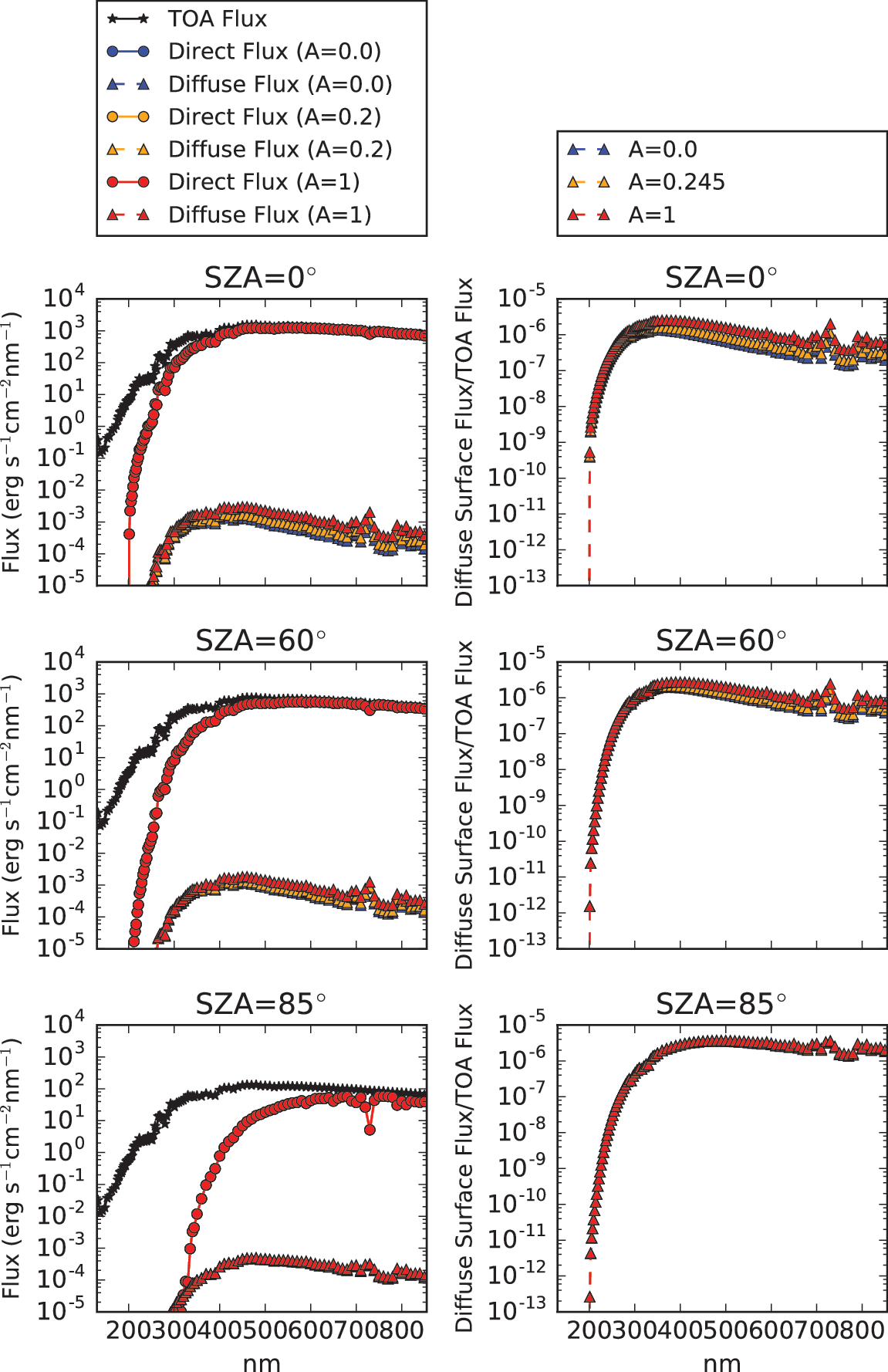
Direct, diffuse, and TOA fluxes (left-hand column) and diffuse flux at the surface normalized by TOA flux (right-hand column) for different solar zenith angles and surface albedos, for an atmosphere corresponding to the Rugheimer et al. (2015) 3.9 Ga Earth model with ω 0 = 10−5. The diffuse flux vanishes in this limit, as expected.
4.1.2. Pure scattering limit
In the limit of a purely scattering atmosphere (ω 0 = 1), F net should be a constant throughout the atmosphere at all wavelengths since radiation is neither absorbed nor emitted by the atmospheric layers (Liou, 1973; Toon et al., 1989). In exploring this limit, we cannot set ω 0 = 1: separate solutions are required for the fully conservative case (see, e.g., Liou, 1973). However, in practice we can set ω 0 arbitrarily close to 1 (Toon et al., 1989) and ensure that the net flux is constant throughout the atmosphere or at least that its variations are small compared to the incident flux. We computed F net at layer boundaries in the atmosphere for the A = 0.20, θ 0 = 60° case, for values for ω 0 ranging from 1–10−3 to 1–10−12. For each wavelength bin, we computed the maximum deviation from the median net flux in the atmospheric column and normalized this deviation to the incident flux. For ω 0 = 1–10−3, the variation of F net from the median value ranged from 6 × 10⁻² at short wavelengths to 7 × 10⁻⁵ at long wavelengths. The increase in deviation toward shorter wavelengths is expected because of the higher opacity at shorter wavelengths. Increasing ω 0 decreased the variation in F net. For ω 0 = 1–10−7, the fractional deviation of F net from the columnar median varied from 6 × 10⁻⁴ to 7 × 10⁻⁹; and for ω 0 = 1–10−12, the deviation of F net varied from 2 × 10⁻⁶ to 7 × 10⁻¹⁴.
We compute the maximum deviation of F net at the layer boundaries from the columnar median as a function of wavelength for ω 0 = 1–10−12 for a range of A and θ 0. Figure 3 presents the results. At optically thin wavelengths, larger albedos and zenith angles lead to higher deviations; we attribute this to higher levels of flux scattered into the more computationally difficult diffuse stream. At optically thick wavelengths, the magnitude of the deviations is insensitive to the planetary albedo. We attribute this to the extinction of incoming flux higher in the atmosphere, meaning that surface properties have less impact on the flux profile. In the optically thick regime, smaller zenith angles lead to higher deviations. For all values of θ 0 and A considered here, the columnar deviation from uniformity is <3 × 10⁻⁶ of incoming fluence across all wavelengths for ω 0 = 1–10−12, and the deviation decreases as ω 0 approaches 1 as expected.
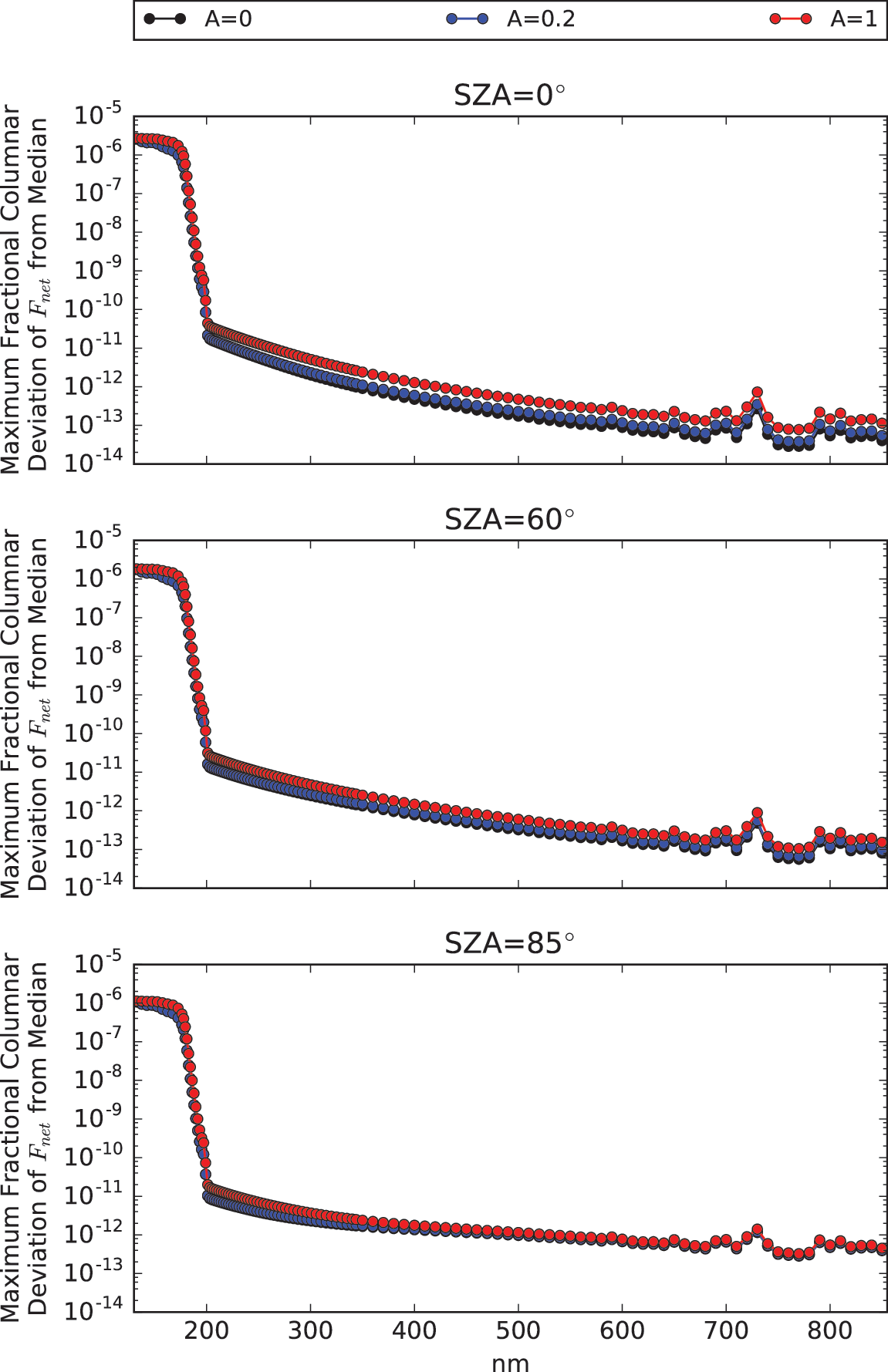
The maximum deviation of F net from its median value in a given atmospheric column as a function of wavelength for an atmosphere corresponding to the Rugheimer et al. (2015) 3.9 Ga Earth model, with ω 0 = 1–10−12 and a variety of surface albedos and solar zenith angles. In the scattering limit, F net approaches a constant value, with the variation in F net decreasing as ω 0 approaches 1.
4.2. Reproduction of results of Rugheimer et al. (2015)
In this section, we describe our efforts to recover the results of Rugheimer et al. (2015) with our code. Rugheimer et al. (2015) presented a model for the total BOA actinic flux on the 3.9 Ga Earth orbiting the 3.9 Ga Sun 7 from 130 to 855 nm. They couple a 1-D climate model (Kasting and Ackerman, 1986; Pavlov et al., 2000; Haqq-Misra et al., 2008) and a 1-D photochemistry model (Pavlov and Kasting, 2002; Segura et al., 2005, 2007) and iterate to convergence. They assume an overall atmospheric pressure of 1 bar and atmospheric mixing ratios of 0.9, 0.1, and 1.65 × 10⁻⁶ for N2, CO2, and CH4, respectively. For all other gases, their model assumes outgassing rates corresponding to modern terrestrial nonbiogenic fluxes.
When computing layer-by-layer radiative transfer, Rugheimer et al. (2015) included absorption due to O3, O2, CO2, and H2O, and Mie scattering due to sulfate aerosols. Rayleigh scattering is computed via an N2-O2 scattering law (Kasting, 1982) that is scaled to include the effect of enhanced CO2 scattering. Rugheimer et al. (2015) partitioned their atmosphere into 64 one-kilometer layers and assumed a solar zenith angle of 60°. As with our model, they computed the solar UV radiative transfer using a Toon et al. (1989) two-stream approximation with Gaussian quadrature closure. The surface albedo A = 0.20 is tuned to yield a surface temperature of 288 K in the modern Earth/Sun system to approximate the effect of clouds (Rugheimer et al., 2015).
We obtained the metadata 8 for an updated version of the 3.9 Ga Earth model of Rugheimer et al. (2015), courtesy of the authors. We used this metadata to run our radiative transfer model on the Rugheimer et al. (2015) atmospheric model. Figure 4 summarizes the results. The top row compares the incident flux at TOA (black) with the Rugheimer et al. (2015) results (red) and our model computations (blue, orange). The Rugheimer et al. (2015) results are not visible due to the close correspondence between our models. The bottom row gives the difference between our model and the Rugheimer et al. (2015) results, normalized to the TOA flux.
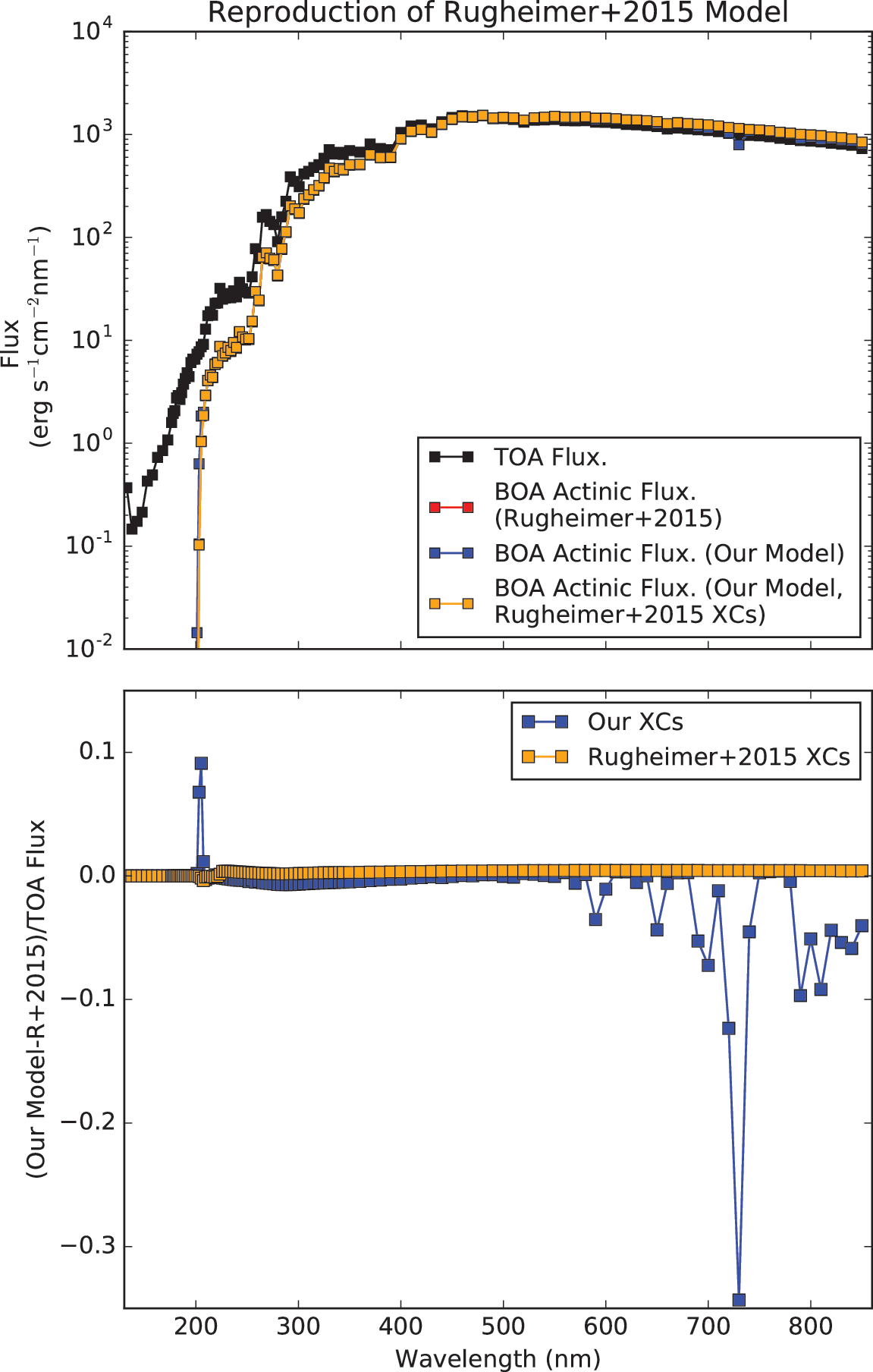
Comparison of the BOA actinic fluxes obtained with our radiative transfer model for the updated 3.9 Ga Earth atmosphere of Rugheimer et al. (2015) versus that computed by the authors. The top shows the computed actinic fluxes and TOA flux, while the bottom shows the fractional difference between our models, normalized by the TOA flux. The difference between our results and those of Rugheimer et al. (2015) is driven by the use of different cross-section compilations; if we use the same cross sections as Rugheimer et al. (2015) (orange curves), we agree with Rugheimer et al. (2015) to better than 0.45% of the TOA flux.
Our model reproduces the Rugheimer et al. (2015) results to within 34% of the TOA flux. Much of the difference between our model and the Rugheimer et al. (2015) model can be accounted for by differences in the absorption cross sections we use. Our cross section lists are more complete than those of Rugheimer et al. (2015); for example, our H2O cross section tabulation includes absorption at wavelengths longer than 208.3 nm, whereas that of Rugheimer et al. (2015) does not. Further, we include absorption due to SO2 and CH4, compute explicitly Rayleigh scattering on a gas-by-gas basis, and include blackbody emission from atmospheric layers and the planetary surface, whereas Rugheimer et al. (2015) did not (though this last is not a significant factor given the paucity of planetary radiation at UV wavelengths).
If we run our model using the Rugheimer et al. (2015) cross sections and scattering formalism and include only absorption due to O2, O3, CO2, and H2O, we arrive at the orange curve. This curve matches the Rugheimer et al. (2015) results to within 0.45% of the TOA flux. Our model, both with and without the Rugheimer et al. (2015) absorption, scattering, and emission formalism, can reproduce the scientific conclusions of Rugheimer et al. (2015) such as the 204 nm irradiance cutoff due to atmospheric CO2. We conclude that our model is capable of reproducing the results of Rugheimer et al. (2015).
4.3. Comparison to modern Earth surficial measurements
We describe here comparisons of our radiative transfer model calculations to surface measurements of UV reported in the literature.
4.3.1. Reproduction of Antarctic diffuse spectral radiance measurements
Wuttke and Seckmeyer (2006) reported measurements of the diffuse spectral radiance (observed in the zenith direction) in Antarctica. We compare our model to their measurements of the diffuse radiance collected under low-cloud conditions (since our model does not include scattering processes due to clouds). The measurement site was flat and uniformly covered by snow, and the solar zenith angle during the measurements was 51.2°. When running our model, we assume the same solar zenith angle and take the albedo of the site to match freshly fallen snow. We run our model at a spectral resolution that matches the Wuttke and Seckmeyer (2006) measurements, that is, from 280 to 500 nm at 0.25 nm resolution and from 501 to 1050 nm at 1 nm resolution. We run our model from 0 to 60 km of altitude, at 600 m resolution (i.e., 100 layers evenly spaced in altitude) and assume a surface pressure of 1 bar. We assume composition and T/P profiles that match that of Rugheimer et al. (2013) for modern Earth. To reproduce the Wuttke and Seckmeyer (2006) measurements, we are obliged to reduce the water abundance by a factor of 10 relative to the Rugheimer et al. (2013) models. This makes sense, since Antarctica is a dry, desert environment. Similarly, the Rugheimer et al. (2013) model has an ozone total column depth of 5.3 × 1018 cm−2 or 200 Dobson units (DU). For comparison, Earth's typical ozone total column density is around 300 DU (Patel et al., 2002), and a column depth of 220 DU is considered to be the start point for an ozone hole 9 . It is therefore unsurprising that matching the observed diffuse radiance in Antarctica requires scaling up the ozone abundance of Rugheimer et al. (2013) by a factor of 1.25. While our simple model, which excludes trace absorbers, clouds, and aerosols and is based on a globally averaged composition profile, cannot be expected to precisely replicate this measurement, we can reasonably expect it to identify major features of the modern surface UV environment.
Figure 5 presents the measured diffuse radiance observed by Wuttke and Seckmeyer (2006) and our model calculation smoothed by a 10-point moving average (boxcar) filter. Our code correctly replicated the major features of the modern terrestrial UV environment, such as the existence and location of the shortwave cutoff due to ozone. Figure 5 also presents the fractional difference between our model prediction and the measurement. The difference is within a factor of 2.2 and is highest in regions of strong atmospheric attenuation of UV. This accuracy is sufficient to distinguish between spectral regions of low and high (>100 ×) atmospheric attenuation, that is, to identify the UV fluence that is suppressed by atmospheric absorbers (e.g., Section 5.3). It is similarly sufficient to identify order-of-magnitude or greater changes in dose rates due to varying columns of a given absorber (e.g., Section 5.7), particularly because the highest error occurs at the lowest throughput and hence has the least weight in the dose rate calculation. We conclude that our code is sufficiently accurate for the applications considered in this work.
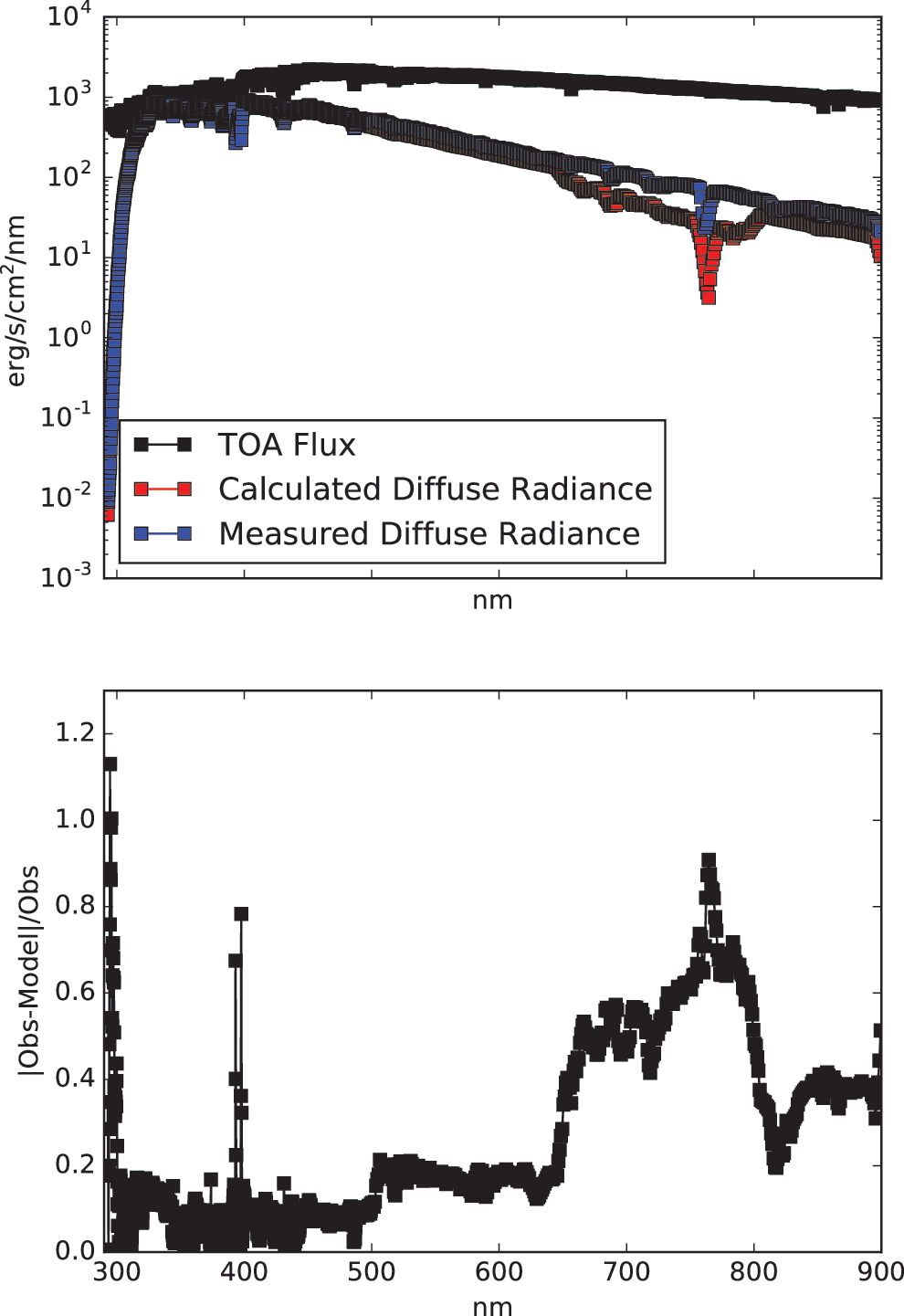
Top: Zenith diffuse radiance measurement by Wuttke and Seckmeyer (2006) in Antarctica compared to the diffuse radiance calculated by our model for an atmosphere corresponding to the Rugheimer et al. (2013) modern Earth model, with the H2O levels scaled down by a factor of 10 and the ozone column density scaled up by a factor of 1.25. Bottom: Fractional difference between the measurements of Wuttke and Seckmeyer (2006) and our model calculation. Our code recovers key features of the terrestrial UV environment, such as the shortwave cutoff due to ozone.
4.3.2. Reproduction of Toronto surface flux measurements
The World Ozone and Ultraviolet Radiation Data Centre (WOUDC;
Figure 6 presents the measured UV flux compared to our model prediction and the fractional difference between the two. Our model correctly replicates the shortwave UV cutoff due to ozone, which is characteristic of the modern surface UV environment. The relative difference between our model and the measurement is within a factor of 2.3, with the difference highest where the fluence is strongly suppressed. This performance is similar to that of our reproduction of Wuttke and Seckmeyer (2006) and is sufficient for the purposes of this paper.
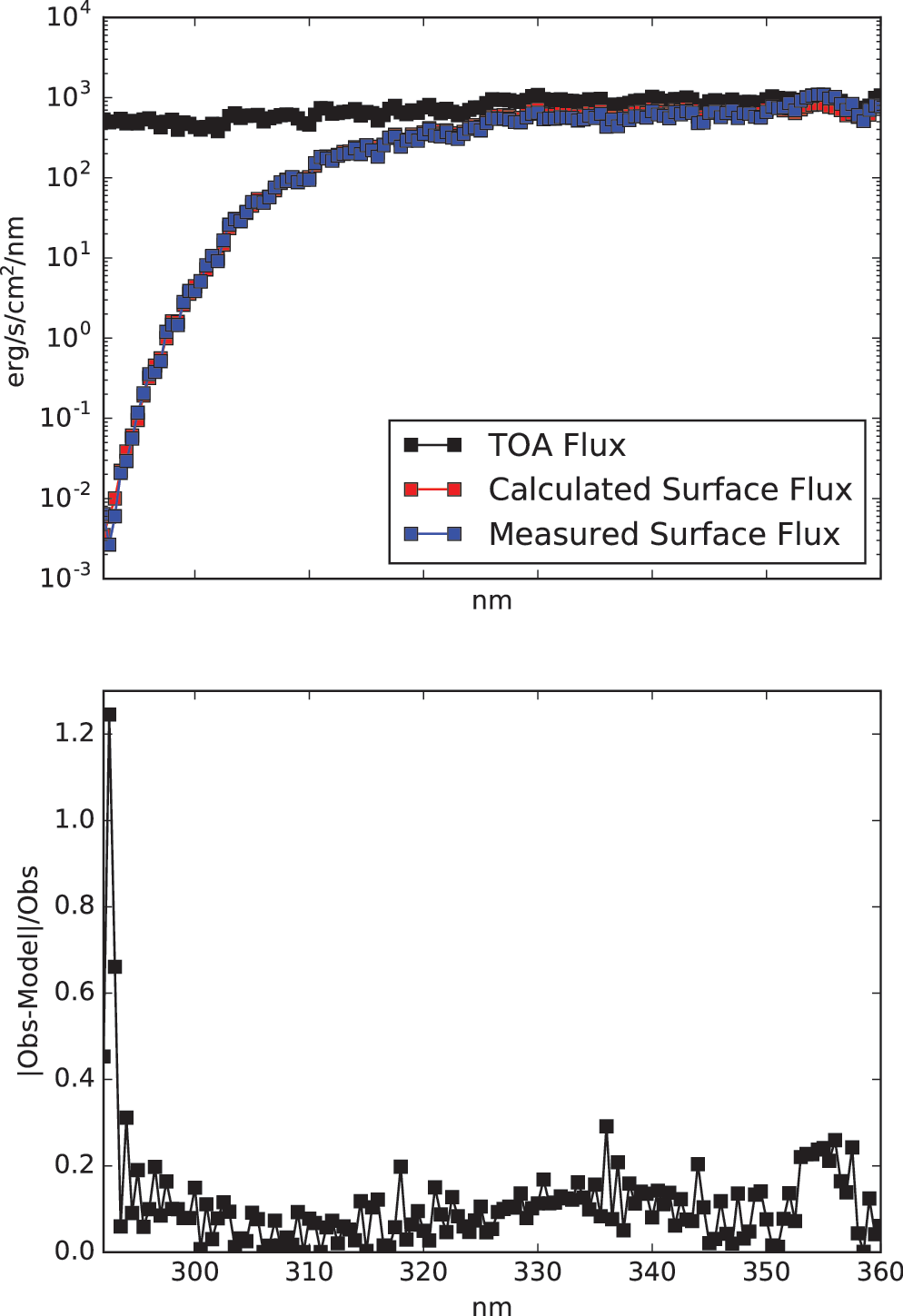
Top: Surface flux reported by a WOUDC station near summer noon in Toronto, compared to the surface flux calculated by our model for an atmosphere corresponding to the Rugheimer et al. (2013) modern Earth model with the ozone column density scaled up by a factor of 1.77. Bottom: Fractional difference between the measurements and our model. Our code clearly identifies and locates the shortwave cutoff due to ozone.
5. Results
In this section, we apply our two-stream radiative transfer model to the Rugheimer et al. (2015) 3.9 Ga Earth atmospheric model and variants. We explore the impact of albedo, zenith angle, and atmospheric composition on the surface radiance. We again note that, unlike Rugheimer et al. (2015), we do not self-consistently calculate the photochemistry. Rather, we adopt ad hoc values for these parameters to place bounds on the surface radiance environment. Our objective is to enable prebiotic chemists to correlate hypothesized prebiotic atmospheric composition (e.g., high levels of water vapor on a warm, wet young Earth) to the range of surficial UV environments that such gases would permit in a planetary context.
In calculating our models, we step from 100 to 500 nm of wavelength, at a resolution of 1 nm. This wavelength range includes the prebiotically crucial 200–300 nm range (Ranjan and Sasselov, 2016) and the onsets of CO2, H2O, and CH4 absorption. Unless stated otherwise, we assume the atmospheric composition and T/P profile calculated for the 3.9 Ga Earth by Rugheimer et al. (2015). We calculate radiative transfer in 1 km layers starting at the planet surface and ending at a high of 64 km, which corresponds to 7.7 scale heights for this atmosphere.
5.1. Action spectra and UV dose rates
To quantify the impact of the surface radiation environments on prebiotic chemistry, we follow the example of Cockell (1999) in computing biologically weighted UV dose rates. Specifically, we compute the biologically effective relative dose rate
where A(λ) is an action spectrum, λ0 and λ1 are the limits over which A(λ) is defined, I surf(λ) is the hemispherically integrated total UV surface radiance, and I space(λ) is the solar flux at Earth's orbit. An action spectrum parametrizes the relative impact of radiation on a given photoprocess as a function of wavelength, with a higher value of A meaning that a higher fraction of the incident photons are being used in said photoprocess. Hence, D measures the relative rate of a given photoprocess for a single molecule at the surface of a planet, relative to in space at the location of the planet. If we compute the dose rate Di , which corresponds to two UV surface radiance spectra I surf,1 and I surf,2 on a molecule that undergoes a photoprocess characterized by an action spectra A and find D 1 > D 2, we can say that the photoprocess encoded by A proceeds at a higher rate under I surf,1 than I surf,2.
Previous workers have used the modern DNA damage action spectrum (Cockell, 2002; Cnossen et al., 2007; Rugheimer et al., 2015) as a gauge of the level of stress imposed by UV fluence on the prebiotic environment. However, this action spectrum is based on studies of highly evolved modern organisms. Modern organisms have evolved sophisticated methods to deal with environmental stress, including UV exposure, that would not have been available to the first life. Further, this approach presupposes that UV light is solely a stressor and ignores its potential role as a eustressor for abiogenesis.
In this work, we used the action spectra that correspond to the production of aquated electrons from photoionization of tricyanocuprate and to the cleavage of the N-glycosidic bond in uridine monophospate (UMP, an RNA monomer) to compute our biologically effective doses. These processes are simple enough to have plausibly been in operation at the dawn of the first life, particularly in the RNA world hypothesis (Gilbert, 1986; Copley et al., 2007; McCollom, 2013) 10 . In the following sections, we discuss in more detail our rationale for choosing these pathways and how we construct the action spectra associated with them.
5.1.1. Eustressor pathway: production of aquated electrons from photoionization of CuCN3 2−
Ritson and Sutherland (2012) outlined a synthesis of glycolaldehyde and glyceraldehyde from HCN and formaldehyde. This pathway depends on UV light for the photoreduction of HCN mediated by the metallocatalyst tricyanocuprate (CuCN3 2-), and Ritson and Sutherland (2012) hypothesized that this photoreduction is driven by photoionization of the tricyanocuprate, generating aquated electrons (e − aq). Such aquated electrons are useful in a variety of prebiotic chemistry, participating generally in the reduction of nitriles to amines, aldehydes to hydroxyls, and hydroxyls to alkyls 11 ; see Patel et al. (2015) for an example of a potential prebiotic reaction network that leverages aquated electrons in numerous reactions.
We define an action spectrum for the generation of aquated electrons from the irradiation of tricyanocuprate by multiplying the absorption spectrum of tricyanocuprate by the quantum yield (QY, number of e
−
aq produced per photon absorbed) of e
−
aq from the system. We take our absorption spectrum from the work of Magnani (2015), via Ranjan and Sasselov (2016). The QY of e
−
aq production,
5.1.2. Stressor pathway: cleavage of N-glycosidic bond of UMP
UMP is a monomer of RNA, a key product of the Powner et al. (2009) pathway and critical molecule for abiogenesis in the RNA-world hypothesis for the origin of life. Shortwave UV irradiation of UMP cleaves the glycosidic bond that joins the nucleobase to the sugar (Gurzadyan and Görner, 1994), which destroys the biological effectiveness of this molecule. The reaction is difficult to reverse; indeed, the key breakthrough of the Powner et al. (2009) pathway was determining how to synthesize and incorporate this bond into the RNA monomers abiotically. Hence, this pathway represents a stressor for abiogenesis in the RNA-world hypothesis.
Glycosidic bond cleavage is not the only process operating in UMP at UV wavelengths. The (wavelength, QY) measured by Gurzadyan and Görner (1994) for glycosidic bond cleavage in UMP in an anoxic aqueous solution are (193 nm, 4.3 × 10⁻³) and (254 nm, (2–3) × 10−5). By comparison, the (wavelength, QY) they measure for chromophore loss (a measure of unaltered UMP abundance, based on absorbance at 260 nm) are (193 nm, 4 × 10⁻²) and (254 nm, 1.2 × 10⁻³), 1–2 orders of magnitude higher. The chromophore loss at 254 nm is well studied; for UMP, it is mostly due to photohydration, with a minor contribution from photodimer formation. The photohydration can be reversed with 90–100% efficiency via heating or lowering the pH (Sinsheimer, 1954), whereas further UV light (especially shortward of 230 nm) can cleave the photodimers. Since these processes are reversible via dark reactions, the UMP in some sense is not fully “lost,” unlike the glycosidic bond cleavage. We therefore argue the bond cleavage is more important than photohydration/photodimerization in measuring UV stress on UMP.
We define action spectra for the cleavage of the glycosidic bond in UMP by multiplying the absorption spectrum of UMP by the QY for the process. We take the absorption spectra from the work of Voet et al. (1963), which gives the absorption spectra of UMP at pH = 7.6. The QY of glycosidic bond cleavage as a function of wavelength has not been measured. To gain traction on this problem, we use the work of Gurzadyan and Görner (1994), which found the QY of N-glycosidic bond cleavage in UMP in neutral aqueous solution saturated with Ar (i.e., anoxic) to be 4.3 × 10⁻³ at 193 nm and (2–3) × 10−5 for 254 nm. We therefore represent the QY curve as a step function with value 4.3 × 10⁻³ for λ ≤ λ0 and 2.5 × 10⁻⁵ for λ > λ0. We consider λ0 values of 193 and 254 nm, corresponding to the empirical limits from Gurzadyan and Görner (1994), as well as 230 nm, which corresponds to the end of the broad absorption feature centered near 260 nm corresponding to the π–π* transition and also to the transition to irreversible decomposition suggested by Sinsheimer and Hastings (1949). As shorthand, we refer to this photoprocess under the assumption that λ0 = Y nm by UMP-Y.
Figure 7 shows the action spectra considered in our study. Action spectra are normalized arbitrarily (see, e.g., Cockell, 1999, and Rugheimer et al., 2015); hence they encode information about relative, not absolute, UV dose rate. We arbitrarily normalize these spectra to 1 at 190 nm.
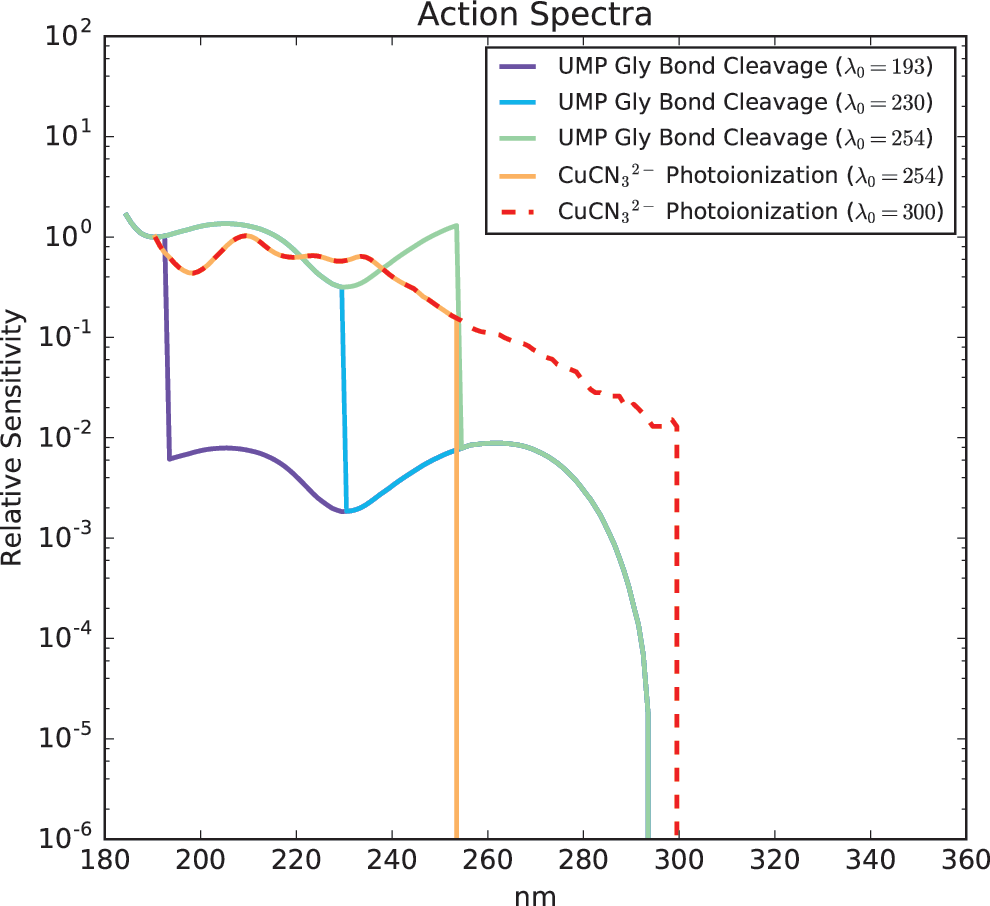
Action spectra for photolysis of UMP and photoionization of CuCN3 2-, assuming a step-function form to the QY for both processes with step at λ = λ0. The spectra are arbitrarily normalized to 1 at 190 nm.
5.2. Impact of albedo and zenith angle on surface radiance and prebiotic chemistry
In this section, we quantify the impact of varying albedo and zenith angle on surface radiance, and on prebiotic chemistry as measured by our action spectra.
The atmospheric radiative transfer computed for the prebiotic (3.9 Ga) Earth by Rugheimer et al. (2015) assumed a spectrally uniform albedo of 0.20 and a solar zenith angle of 60°. However, much broader ranges of albedos and zenith angles are available in a planetary context. In this section, we explore the impact of different albedos (A) and solar zenith angles (SZA) on the surface radiance (azimuthally integrated) on the 3.9 Ga Earth.
We calculate the surface radiance at SZA = 0°, 48.2°, and 66.5°, for a range of different surface albedos. SZA = 0° is the smallest possible value for SZA and corresponds to the shortest possible path through Earth's atmosphere. It is achieved at tropical latitudes. SZA = 48.2° corresponds to the insolation-weighed mean zenith angle on Earth (Cronin, 2014). SZA = 66.5° corresponds to the maximum zenith angle experienced at the poles (noon at the summer solstice) 12 . Our choices of zenith angle thus encapsulate the minimum possible zenith angles and, hence, the shortest possible atmospheric path lengths over Earth's surface. As such, they may be understood as corresponding to the range of maximum possible UV surface radiances accessible at different latitudes on Earth's surface. It is of course possible to achieve arbitrarily large zenith angles (and hence arbitrarily low surface radiances) anywhere on Earth through the diurnal cycle and through seasonal variations at polar latitudes.
When considering albedos, we consider fixed uniform albedos of 0, 0.2, and 1. Albedos of 0 and 1 correspond to the lowest and highest possible values of A and, hence, the lowest and highest 13 surface radiance, respectively. The A = 0.2 case corresponds to the Rugheimer et al. (2015) base case. We also consider albedos that correspond to different physical surface environments, including ocean, tundra, desert, and old and new snow, including the dependence on z (see Appendix B for details). We consider this wide range of possible surface albedos because the climate state of the young Earth is minimally constrained by the available evidence, and climate states different than modern Earth's are plausible. For example, Sleep and Zahnle (2001) argued for a cold, ice-covered Hadean/early Archean climate, which would imply high-albedo conditions even at low latitudes.
Figure 8 presents the surface radiance computed for the Rugheimer et al. (2015) atmospheric model for these different zenith angles and surface albedos. The results match our qualitative expectations. Low-albedo surfaces correspond to lower surface radiances, with spectral contrast ratios as high as a factor of 7.4 between the A = 1 and A = 0 cases for λ > 204 nm (i.e., the onset of the CO2 cutoff, see Ranjan and Sasselov, 2016). Similarly, small zenith angles correspond to higher surface radiances, with spectral contrast ratios as high as 4.1 between SZA = 0° and z = 66.5° for λ > 204 nm. Taken together, the effect is even stronger: for λ > 204 nm, the A = 1, SZA = 0° case (the highest-radiance case in the parameter space we considered) has spectral contrast ratios as high as a factor of 30 with respect to the A = 0, SZA = 66.5° case (the lowest-radiance case considered in our parameter space). When using more physically motivated albedos, the spectral contrast ratio between a model with SZA = 0° and albedo corresponding to fresh snow (i.e., the brightest natural surface included in our model) and a model with SZA = 66.5° and albedo corresponding to tundra (i.e., the darkest natural surface included in our model) was as high as a factor of 21. This means that at some wavelengths, 21 times more fluence would have been available on the equator of a high-albedo snow-and-ice covered “snowball Earth” compared to the polar regions of a warmer world with tundra or open ocean at the poles, for identical planetary atmospheres.
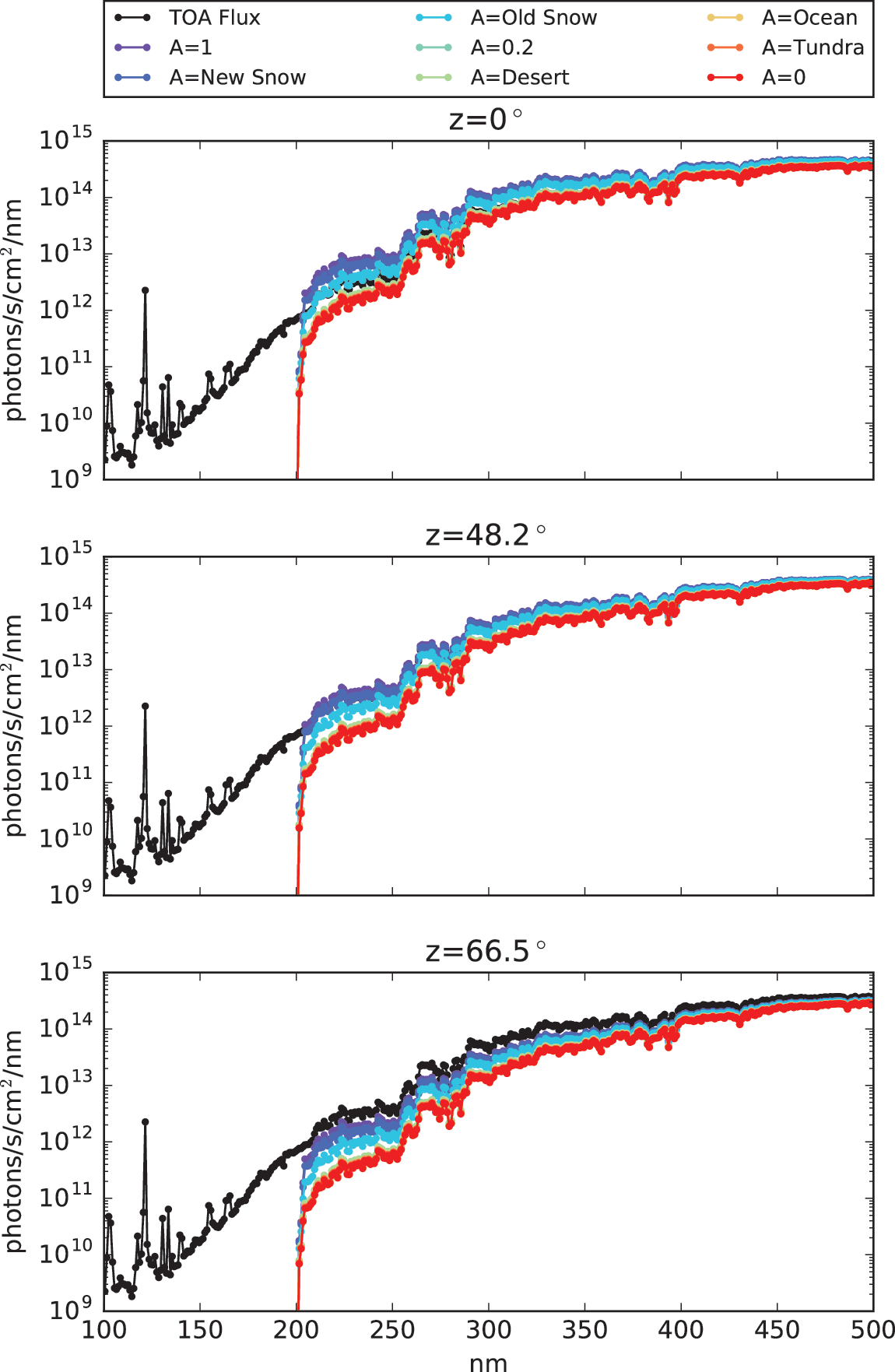
Surface radiance for Earth at 3.9 Ga, assuming an atmosphere corresponding to the model of Rugheimer et al. (2015) and a range of solar zenith angles and surface albedos. Taken together, albedo and zenith angle can drive variations in spectral surface radiance as high as a factor of 20.6 for λ > 204 nm at 1 nm resolution.
We note that, somewhat non-intuitively, for some values of albedo and zenith angle, surface radiances exceeding the incident TOA radiance are possible (see, e.g., the A = 1, SZA = 0° case in Fig. 8). This is due to two factors. First, the downwelling diffuse radiance is enhanced by the backscatter of the upwelling diffuse radiance. Second, our flux conservation requirement coupled with our assumption of an isotropically scattering surface means that the upwelling radiance field is enhanced over the downwelling radiance field for low values of SZA and high values of A, meaning even more radiance is available to be backscattered. For a more thorough discussion of this phenomenon, see Appendix C. For a discussion of a similarly non-intuitive result for surface flux, see the work of Shettle and Weinman (1970).
We quantify the impact of albedo and zenith angle from a biological perspective by computing the biologically effective relative dose rates Di for the photoprocesses described in Section 5.1 for the hemispherically integrated surface radiances corresponding to the different surface types and zenith angles considered in this study. These values are reported in Table 1. Variations in albedo can affect the BEDs of UV by factors of 2.7–4.4, depending on the zenith angle and the action spectrum used to compute the dose rate. Variations in zenith angle can affect the BED of UV by factors of 3.6–4.1, depending on the surface albedo and action spectrum. Taken together, variations in albedo and zenith angle can change the biologically effective dose of UV by factors of 10.5–17.5, depending on the action spectrum used to compute the dose rate. We conclude that local conditions like albedo and latitude could impact the availability of UV photons for prebiotic chemistry by an order of magnitude or more.
NS = new snow, OS = old snow, T = tundra.
5.3. Impact of varying levels of CO2 on surface radiance and prebiotic chemistry
Ranjan and Sasselov (2016) argued that shortwave UV light would have been inaccessible on the young Earth due to shielding from atmospheric CO2. Specifically, we noted that atmospheric attenuation decreased fluence by a factor of 10 by 204 nm, with the damping increasing rapidly with the atmospheric cross section (driven by CO2) at shorter wavelengths. This shielding is important because it screens out photons shortward of 200 nm that are expected to be harmful, while still permitting the potentially biologically useful flux in the >200 nm range (see, e.g., Guzman and Martin, 2008; Barks et al., 2010; Patel et al., 2015) to reach the planetary surface.
However, this argument is based on the models elucidated by Rugheimer et al. (2015). Rugheimer et al. (2015) assumed a CO2 partial pressure at 3.9 Ga of 0.1 bar. This value is ad hoc: no direct geological constraints on CO2 levels are available, and a variety of models with a wide range of CO2 levels have been proposed that are consistent with the available climate constraints. Proposed CO2 levels for the ∼3.9 Ga Earth range from 8 × 10⁻⁴ bar (Wordsworth and Pierrehumbert, 2013) to 7 bar (Kasting, 1987).
In this section, we examine the sensitivity of the shielding of UV shortwave fluence due to varying levels of CO2 in the atmosphere. We compute radiative transfer through an atmosphere with varying levels of CO2 and N2 under irradiation by the 3.9 Ga Sun. We evaluate radiative transfer at (zenith angle, albedo) combinations of (SZA = 0°, A = fresh snow) and (SZA = 66.5°, A = tundra), corresponding to the extremal values of the range of plausible maximal surface radiances accessible on Earth assuming present-day obliquities. We omit attenuation due to other gases in our model (H2O, CH4, etc.) in order to isolate the influence of CO2. We emphasize, therefore, that the UV throughputs we calculate should not be taken to correspond to the surface radiance plausibly expected on the 3.9 Ga Earth for a given CO2 column, since they do not include attenuation from other gases and/or particulates or hazes that may have been present. Rather, these calculations represent the upper limits on surface radiance that are imposed by a given CO2 column.
We assume a fixed background of N2 gas, with column density
We parametrize CO2 abundance by scaling the CO2 column calculated by Rugheimer et al. (2015) corresponding to 0.1 bar of CO2, with total column density
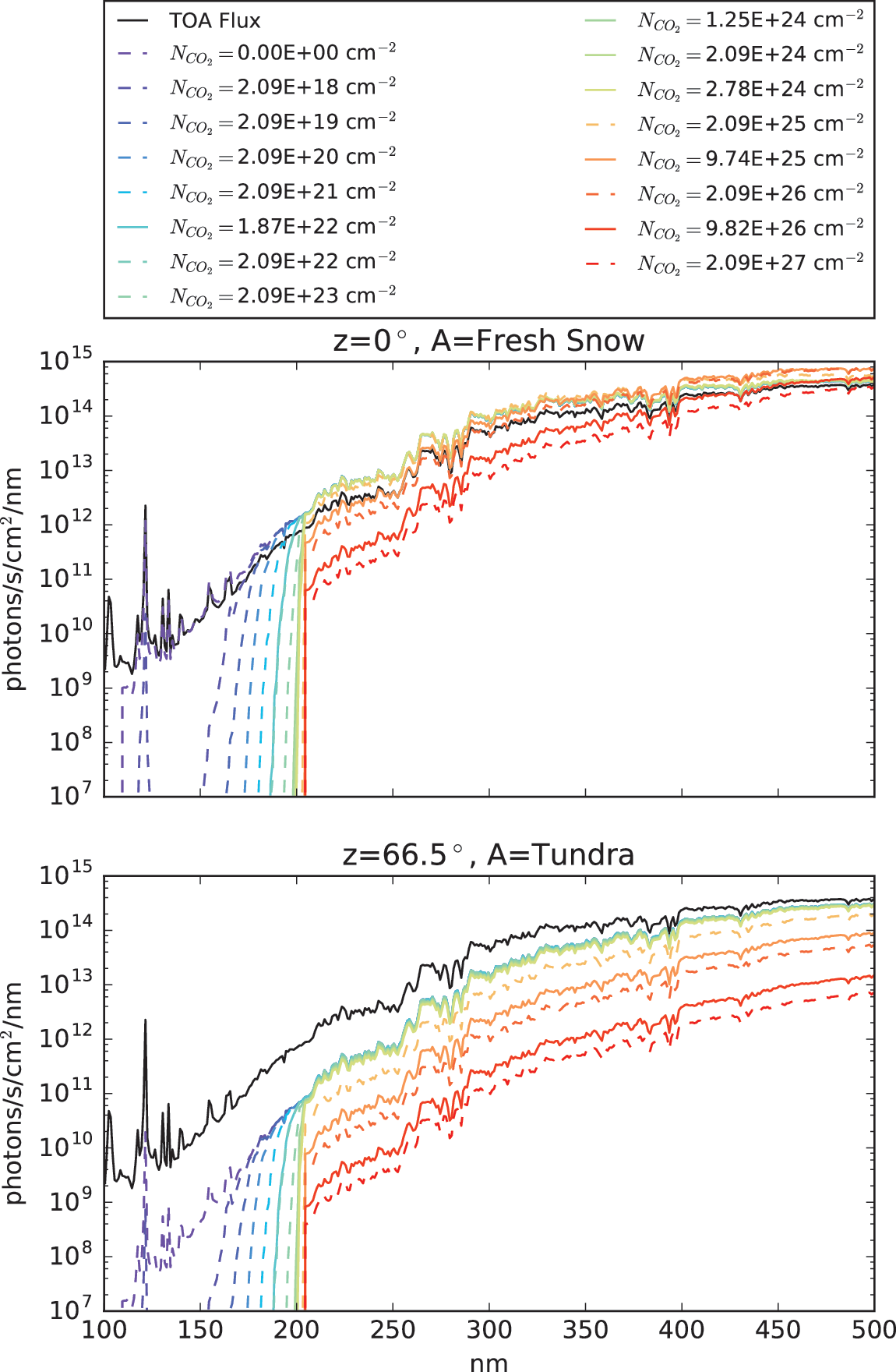
Surface radiances for an atmosphere with
Also given are the mean molecular weight and surface partial pressures of CO2 and N2 associated with each model atmosphere. A background column density of
To place these column densities in context, we compute the CO2 columns associated with different climate models in the literature.
• Kasting (1987) calculated the range of CO2 partial pressures required to sustain a plausible (i.e., consistent with an ice-free planet with liquid water oceans) climate on Earth throughout its history assuming a CO2-H2O greenhouse with 0.77 bar of N2 as a background gas. Interpolating between model calculations, for 3.9 Ga the authors suggest a plausible CO2 pressure range of .2–7 bar (calculated using a pure-CO2 atmosphere equivalence). The lower limit corresponds to a surface temperature of 273 K, whereas the upper point is interpolated between the CO2 level required to sustain a temperature of 293 K at 2.5 Ga and the 10 bar limit for pCO2 proposed by Walker (1985) at 4.5 Ga. This corresponds to CO2 column density range of 2.79 × 1024 to 9.76 × 1025 cm−2.
• If the requirement on global mean temperature is relaxed to 273 K from the >278 K of Kasting (1987) (Haqq-Misra et al., 2008), von Paris et al. (2008) found only 0.06 bar of CO2 is required at an insolation corresponding to 3.8 Ga (Gough, 1981) in a CO2-H2O greenhouse with 0.77 bar of N2 as a background gas. This corresponds to a CO2 column density of 1.26 × 1024 cm−2.
• More dramatically, Wordsworth and Pierrehumbert (2013) modeled an N2-H2-CO2 atmosphere, including the effects of collision-induced absorption of N2 and H2 under the assumption of high levels of N2 and H2 relative to present atmospheric levels (PALs). By including N2-H2 collision-induced absorption for a solar constant of 75% of the modern value (corresponding to 3.8 Ga using the methodology of Gough, 1981), they were able to maintain global mean surface temperatures suitable for liquid water with dramatically lower CO2 levels than H2O-CO2 greenhouses. For an atmosphere with 3× PAL N2 and an H2 mixing ratio of 0.1, only 2× PAL of CO2 (7.8 × 10⁻⁵ bar) is required, corresponding to 1.87 × 1022 cm−2.
• Finally, as an extreme upper bound, we consider the observation of Kasting (1993) based on the works of Ronov and Yaroshevsky (1969) and Holland (1978) that Earth has ∼1023 g of carbon stored in crustal carbonate rocks. If this entire carbon inventory were volatilized as CO2, it would correspond to a CO2 column of 9.84 × 1026 cm−2.
We compute the surface radiance for N2-CO2 model atmospheres with
5.3.1. Surface radiance
An N2-CO2 atmosphere with even small amounts of CO2 is enough to form a strong shield to extreme UV radiation. A column density as low as
Ranjan and Sasselov (2016) argued that atmospheric CO2 would have cut off fluence at wavelengths shorter than 204 nm and, hence, that UV laboratory sources like ArF excimer lasers with primary emission at 193 nm were inappropriate for simulations of prebiotic chemistry. This was based on the assumption that
Kasting (1987) suggested a climatologically plausible upper limit of 7 bar of pure CO2 at 3.9 Ga, interpolating between the upper bound of Walker (1985) at 4.5 Ga and the CO2 level required to sustain T ≈ 293 K at 2.5 Ga. This corresponds to
Overall, the UV surface fluence is relatively insensitive to the level of atmospheric CO2. The conventional H2O-CO2-N2 minimal greenhouses with pCO2 = 0.06–0.2 bar (
5.3.2. Biologically effective doses
Figure 10 presents the BEDs for the photoprocesses considered in our study under irradiation by surface fluences corresponding to attenuation by different levels of CO2, normalized by the dose rates corresponding to
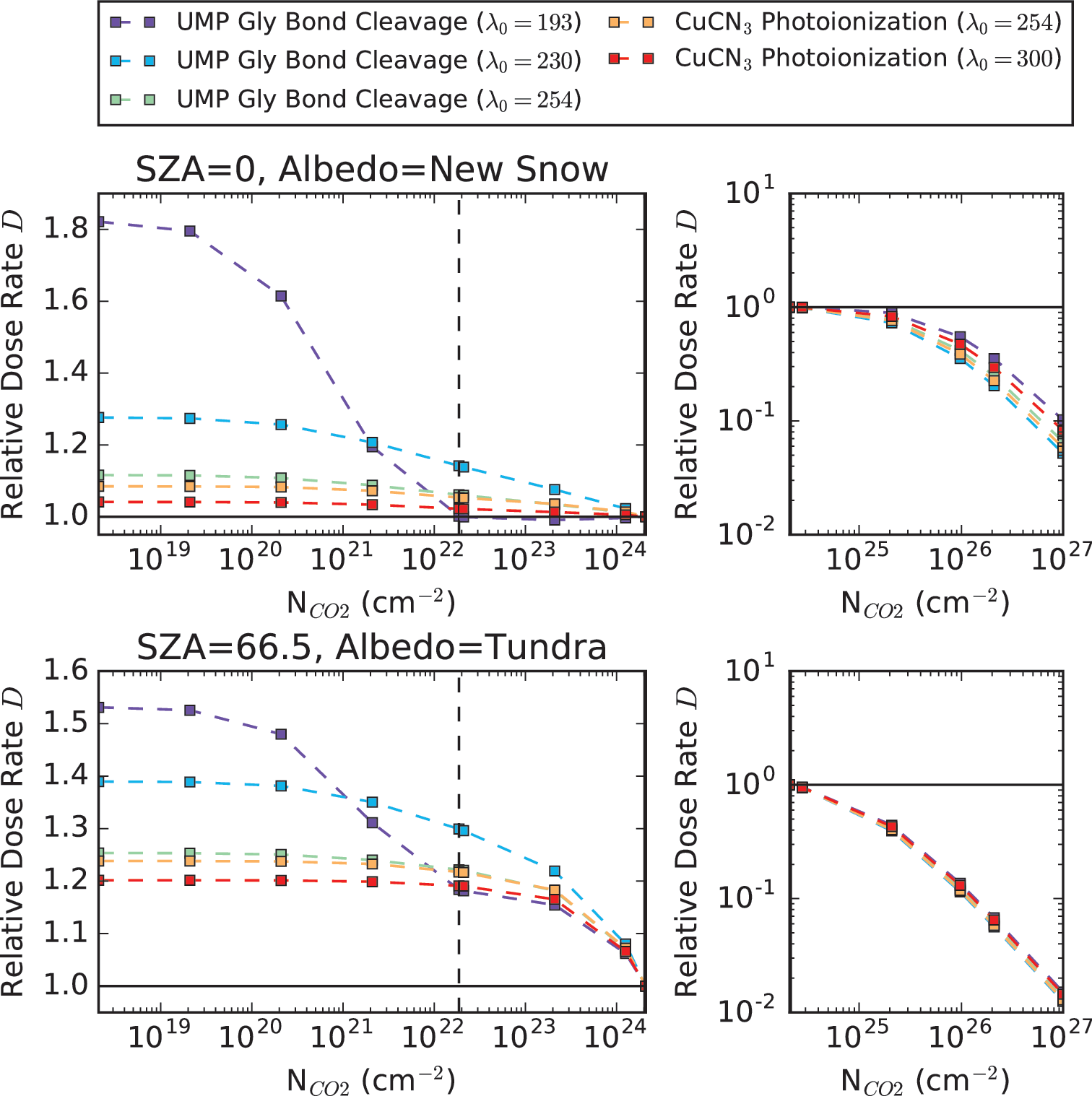
Biologically effective dose rates for UMP-X and CuCN3-Y as a function of
For the minimum radiance case, we observe that the BEDs uniformly decrease with increasing
In the maximum radiance case, the BEDs generally also follow the same trend with
High levels of atmospheric CO2 can suppress prebiotically relevant photoprocesses as measured by our action spectra. For
Low levels of atmospheric CO2 can modestly enhance prebiotically relevant photoprocesses as measured by our action spectra. For
Overall, across the range of possible CO2 levels (
5.4. Alternate shielding gases
In the previous section, we considered the constraints placed by varying levels of atmospheric CO2 on the surficial UV environment. However, CO2 is not the only plausible UV absorber in the atmosphere of the young Earth. Other photoactive gases that may have been present in the primitive atmosphere include SO2, H2S, CH4, and H2O. These gases have absorption cross sections in the 100–500 nm range, and as such if present at significant levels could have influenced the surficial UV environment. O2 and O3, while expected to be scarce in the prebiotic era, are strongly absorbing in the UV and might have an impact even at low abundances.
In this section, we explore the potential impact of varying levels of gases other than CO2 on surficial UV fluence on the 3.9 Ga Earth. We consider each gas species G individually, computing radiative transfer through two-component atmospheres under insolation by the 3.9 Ga Sun, with varying levels of the photoactive gas G and a fixed column of N2 as the background gas. We consider a range of column densities of G corresponding the levels computed by Rugheimer et al. (2015) scaled by factors of 10. Table 3 gives the abundance of each gas computed by Rugheimer et al. (2015).
The H2S abundances listed are upper bounds estimated from SO2 levels.
As in the case of CO2 (Section 5.3), we assume that G is well mixed, and we omit attenuation due to other gases in order to isolate the effect of the specific molecule G. We evaluate radiative transfer for an (A, SZA) combination corresponding to (fresh snow, 0°) only; hence, the surface radiances we compute may be interpreted as planetwide upper bounds. We assume a fixed N2 background with column density of
The model metadata we secured from the work of Rugheimer et al. (2015) do not include H2S abundances. We estimate an upper bound on the H2S abundances by assuming that the relative abundance of H2S compared to SO2 traces their emission ratio from outgassing. Halmer et al. (2002) found the outgassing emission rate ratios of [H2S]/[SO2] = 0.1–2 for subduction zone–related volcanoes and 0.1–1 for rift zone–related volcanoes for modern Earth. Since the redox state of the mantle has not changed from 3.6 Ga and probably from 3.9 Ga (Delano, 2001), we can expect the outgassing ratio to have been similar at 3.9 Ga. Therefore, we assign an upper bound to the H2S column of 2× the SO2 column.
5.5. CH4
Rugheimer et al. (2015) fixed by assumption a uniform CH4 mixing ratio of 1.65 × 10⁻⁶ throughout their 1 bar atmosphere, corresponding to

Surface radiances for an atmosphere with
Absorption of UV light by CH4 is negligible in an atmosphere with even trace amounts of CO2, due to the extremely shortwave onset of absorption by CH4 (165 nm). At CH4 levels of
5.6. H2O
There exist few constraints on primordial water vapor levels. The terrestrial water vapor profile is set by the temperature profile; evaporation rates and H2O saturation pressures increase with temperature, meaning that a hot planet is likely to be steamier than a cold planet. Knauth (2005) used oxygen isotope data from cherts to argue that the ocean temperature was 328–358 K (55–85°C) at 3.5 Ga, though this is not universally accepted (Kasting, 2010), in part due to the extraordinary inventory of greenhouse gases that would be required to sustain such high temperatures. By contrast, Rugheimer et al. (2015) computed a surface temperature of 293 K for Earth at 3.9 Ga.
The model of Rugheimer et al. (2015) corresponds to an atmosphere with an H2O column density of
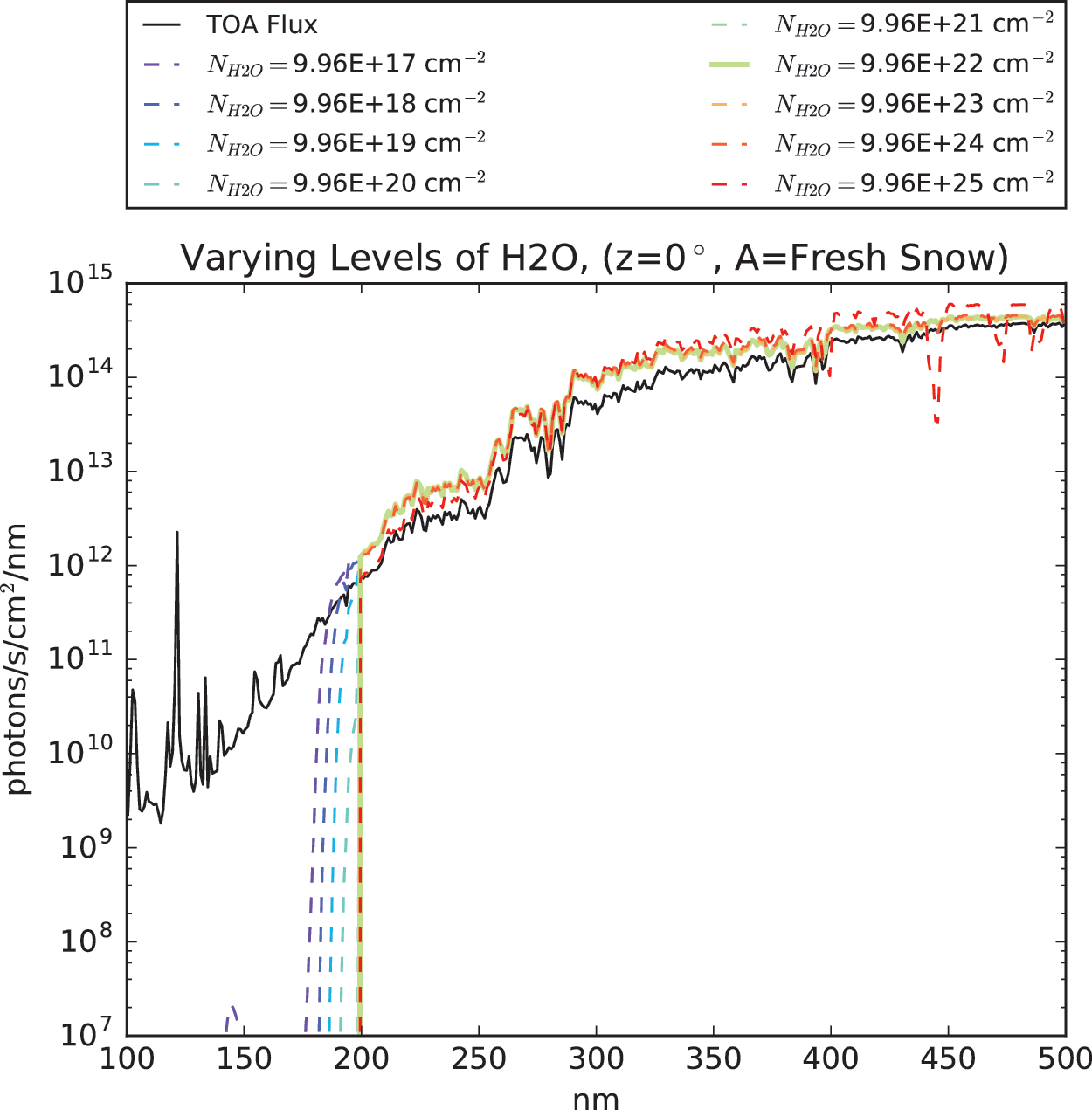
Surface radiances for an atmosphere with
H2O is a robust UV absorber, with strong absorption for λ0 < 198 nm.
Figure 13 presents the dose rates Di
(
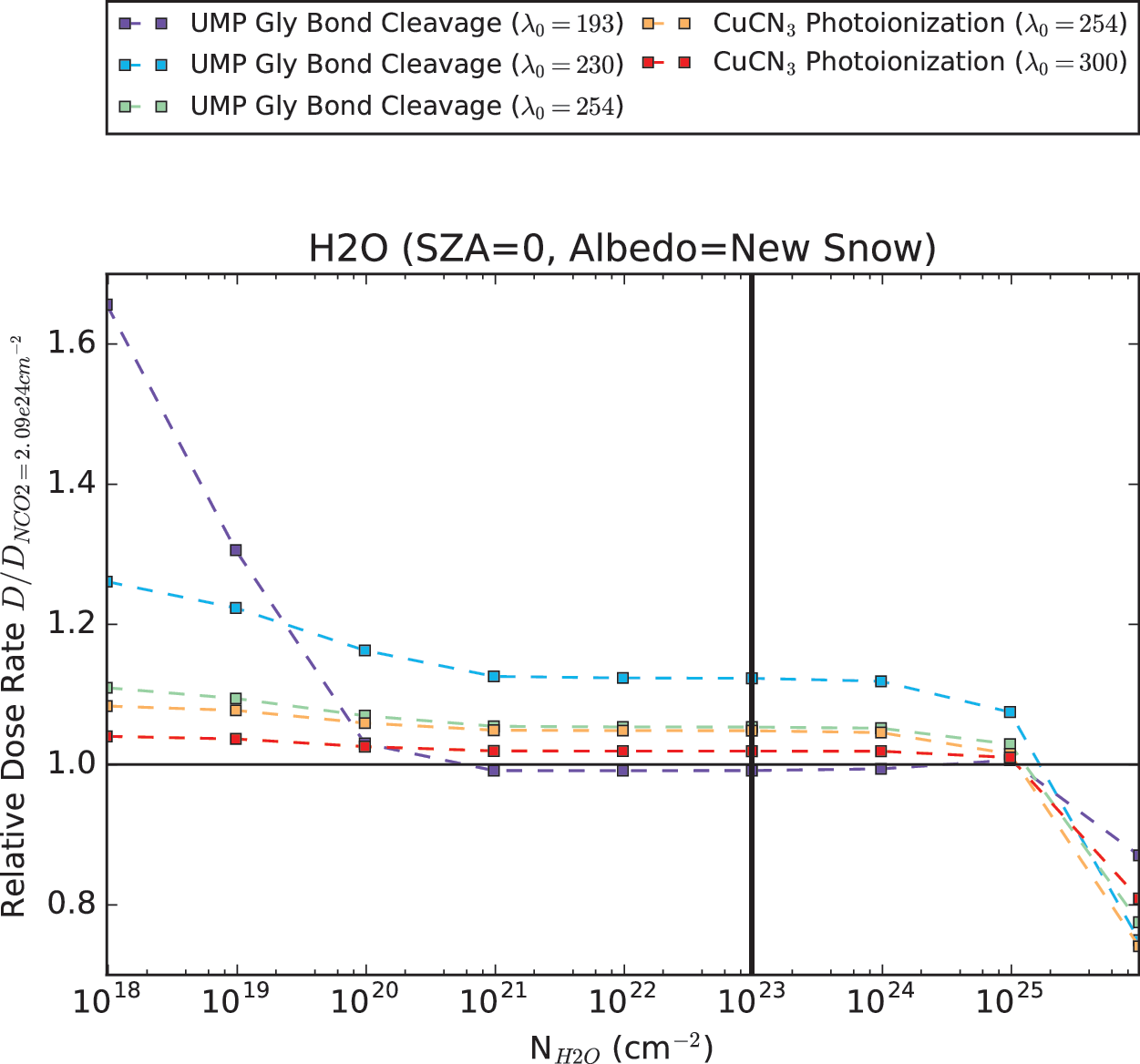
Biologically effective dose rates for UMP-X and CuCN3-Y as a function of
5.7. SO2
SO2 absorbs more strongly and over a much wider range than CO2 (Fig. A5). However, SO2 is vulnerable to loss processes such as photolysis and reaction with oxidants (Kaltenegger and Sasselov, 2010); consequently, SO2 levels are usually calculated to be very low on the primitive Earth. Assuming levels of volcanic outgassing at 3.9 Ga comparable to the present day, as did Rugheimer et al. (2015), SO2 levels are low, with
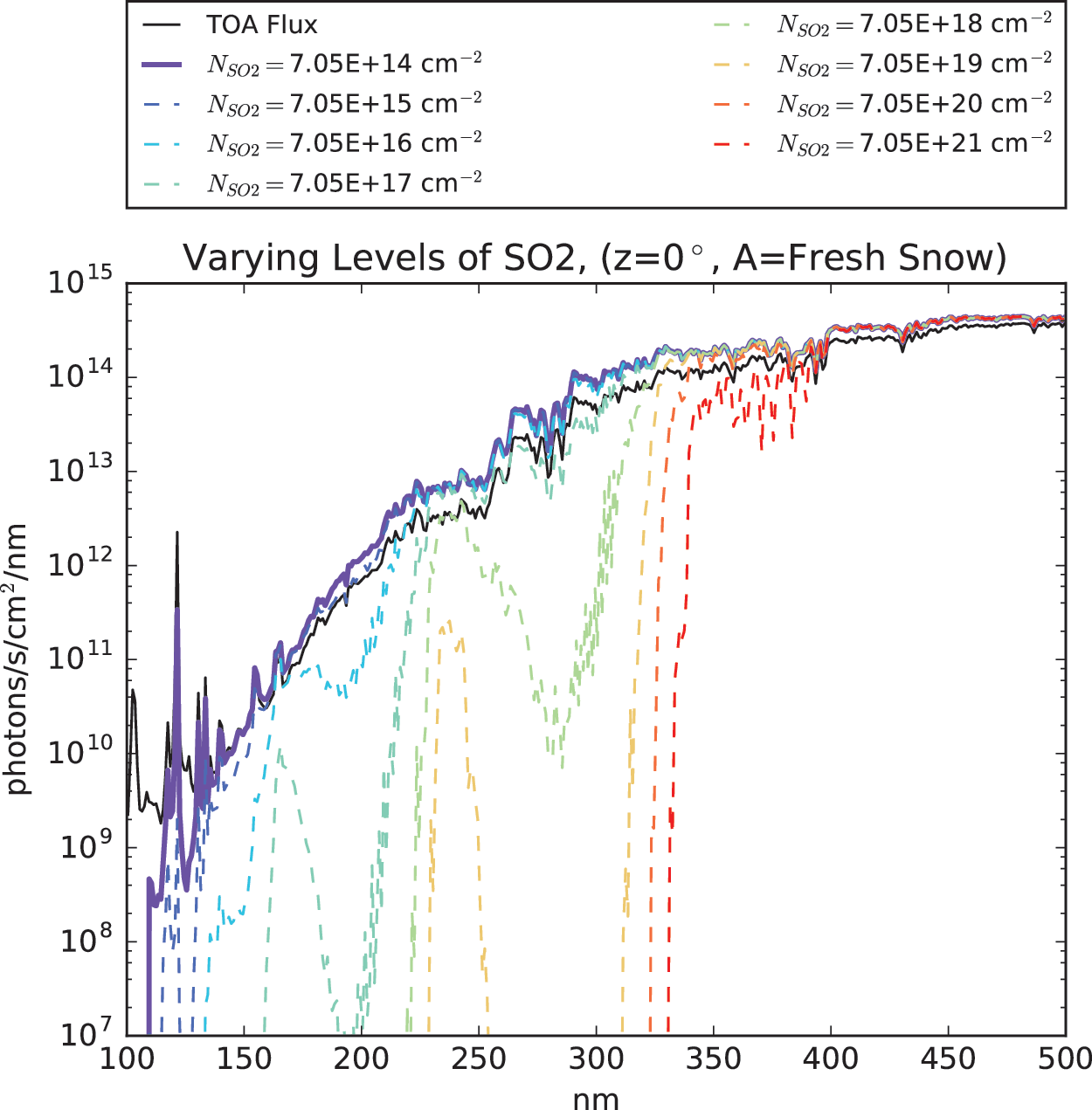
Surface radiances for an atmosphere with
However, relatively little is known about primordial volcanism. During epochs of high enough volcanism on the younger, more geologically active Earth, volcanic reductants might conceivably deplete the oxidant supply. While an extreme scenario, if it occurred, SO2 might plausibly build up to the 1–100 ppm level (Kaltenegger and Sasselov, 2010), at which point it might begin to supplant CO2 as the controlling agent for the global thermostat
16
(cf. the model of Halevy et al., 2007, for primitive Mars). Assuming a background atmosphere of 0.9 bar N
2 and 0.1 bar CO2, this corresponds to column densities of
Such high SO2 levels would be transient and would subside with volcanism. But while they persisted, SO2 could dramatically modify the surface UV environment. At
We quantify the impact of high SO2 levels on UV-sensitive prebiotic chemistry by again convolving our surface radiance spectra for an SO2-N2 atmosphere against our action spectra and computing the BEDs as functions of
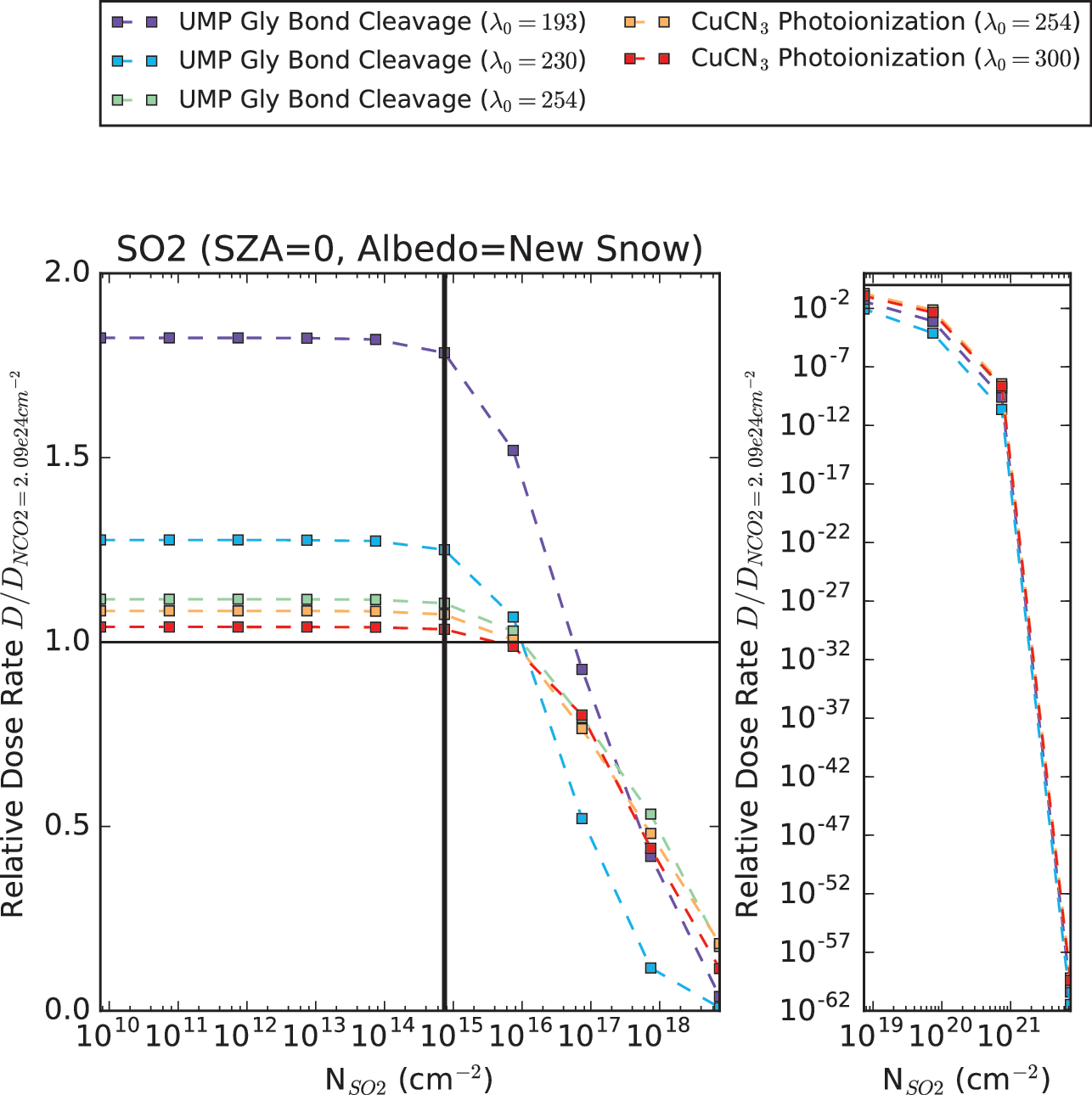
Biologically effective dose rates for UMP-X and CuCN3-Y as a function of
These BEDs do not fall off at the same rates. Figure 16 plots the ratio between UMP-X and CuCN3-Y, for all X and Y, as a function of
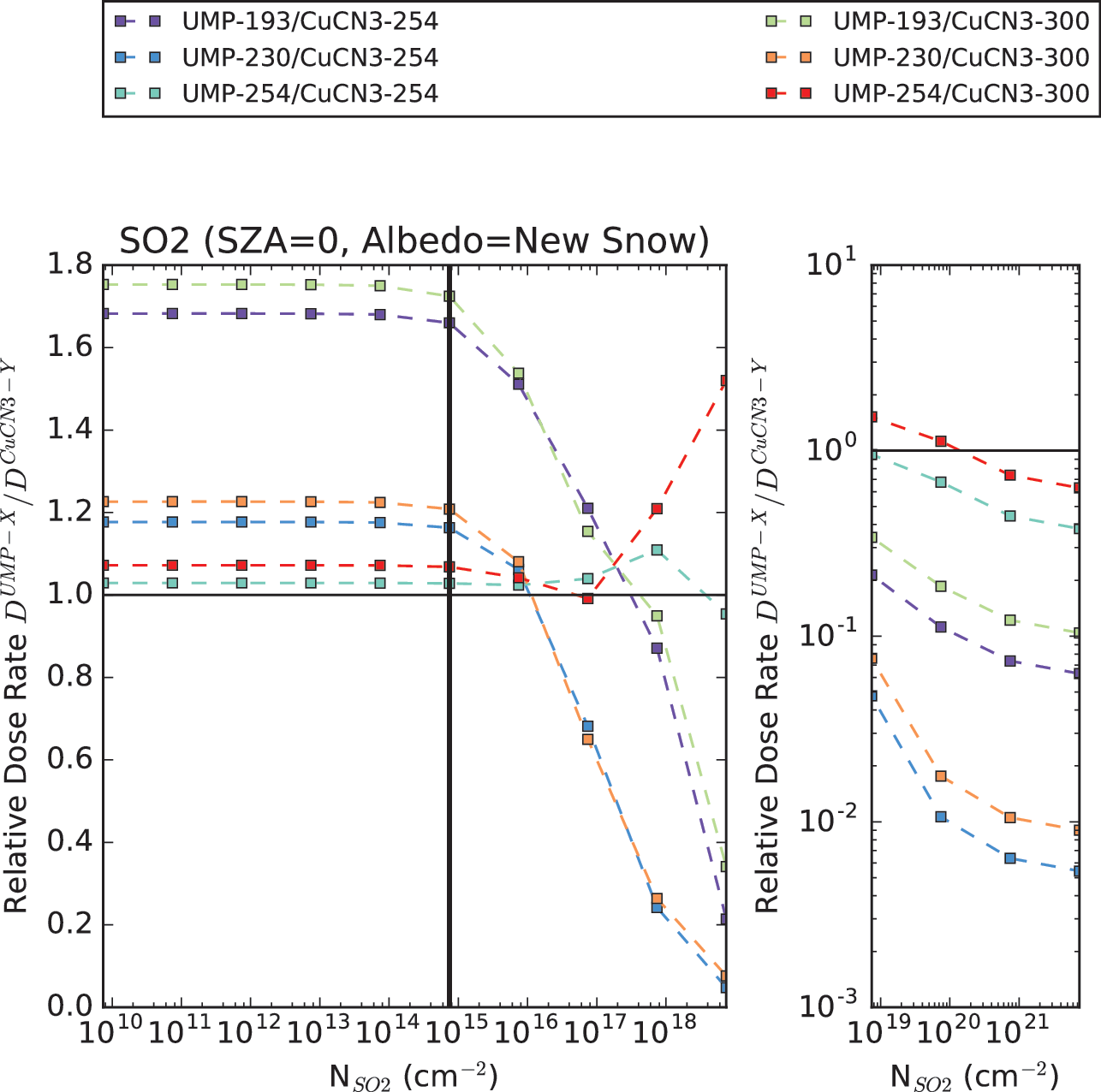
Ratio of biologically effective dose rates UMP-X/CuCN3-Y, for X = 193, 230, and 254 nm and Y = 254 and 300 nm, as a function of
5.8. H2S
H2S shares similar properties to SO2. Like SO2, H2S is a stronger and broader absorber in the UV than CO2. Like SO2, H2S is primarily generated through outgassing from volcanic sources and is lost from the atmosphere due to vulnerability to photolysis and reactions with oxidants. Consequently, H2S is not expected to have been a major constituent of the prebiotic atmosphere.
Rugheimer et al. (2015) did not calculate an abundance for H2S in their model. We estimate an upper bound on
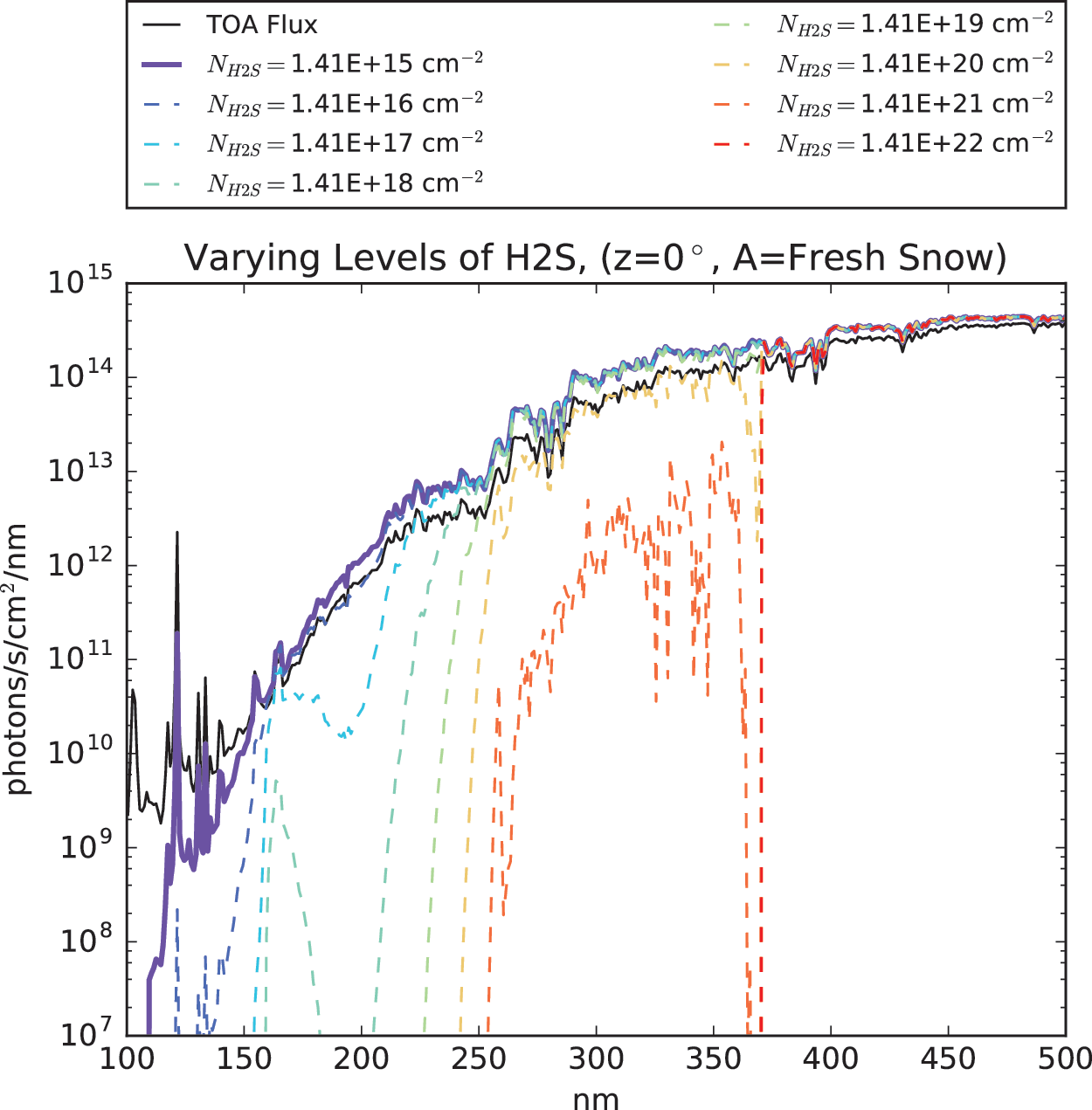
Surface radiances for an atmosphere with
For
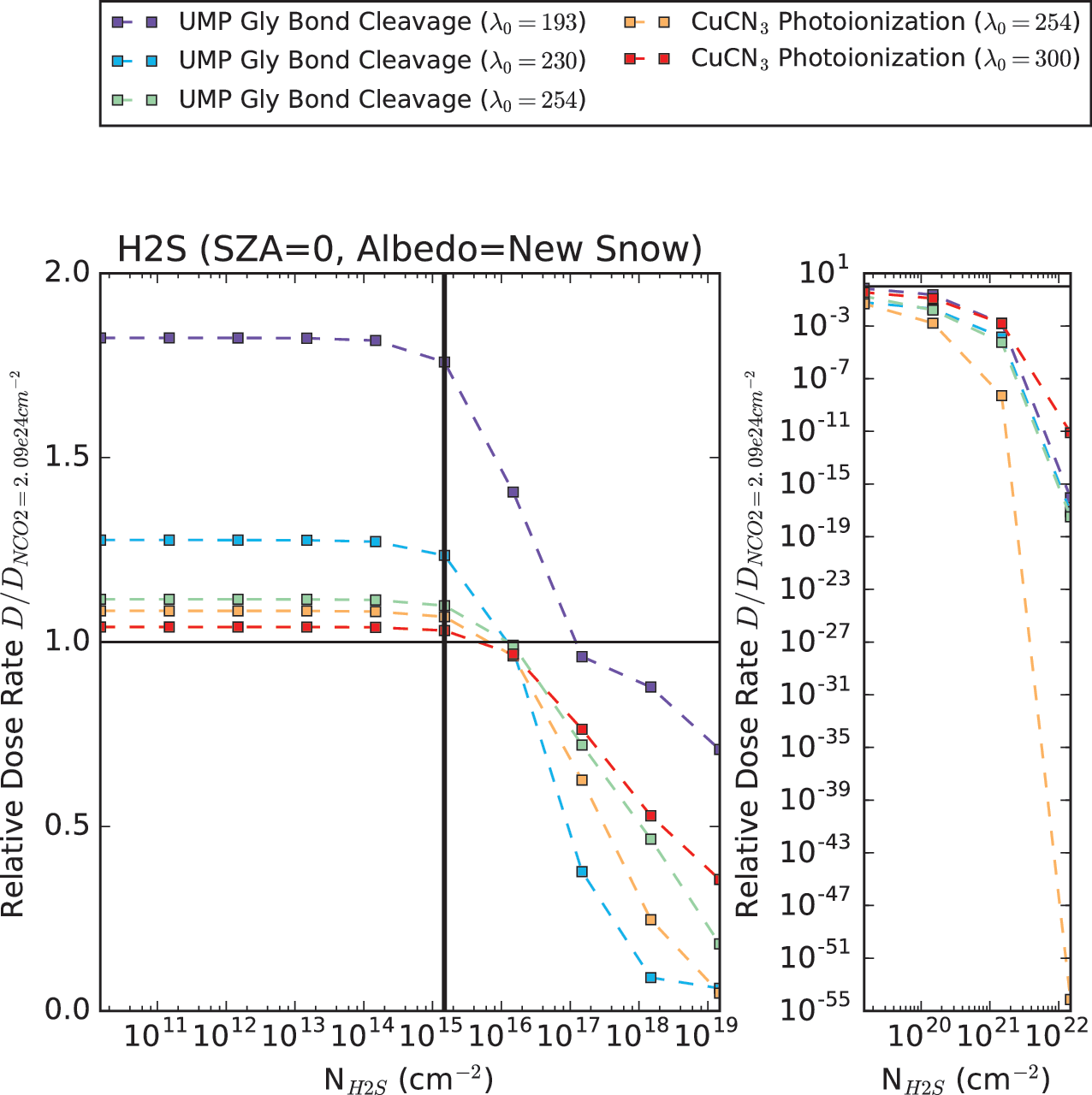
Biologically effective dose rates for UMP-X and CuCN3-Y as a function of
Similarly as with SO2, the various BEDs fall off at different rates with increasing
Figure 19 plots the ratio between UMP-X and CuCN3-Y, for all X and Y. The CuCN3-254 dose rate falls off faster than the other dose rates, and the CuCN3-300 dose rate falls off slower. This is because H2S absorbs much more strongly at λ < 254 nm than for λ > 254 nm. As presently defined, the CuCN3-254 dose rate can only utilize λ < 254 nm radiation; the UMP-X dose rates can make use of λ > 254 nm fluence, though at a much lower efficiency; and the CuCN3-300 dose rate can fully utilize the λ > 254 nm radiation. Hence, D
UMP-X/D
CuCN3-254 increases with
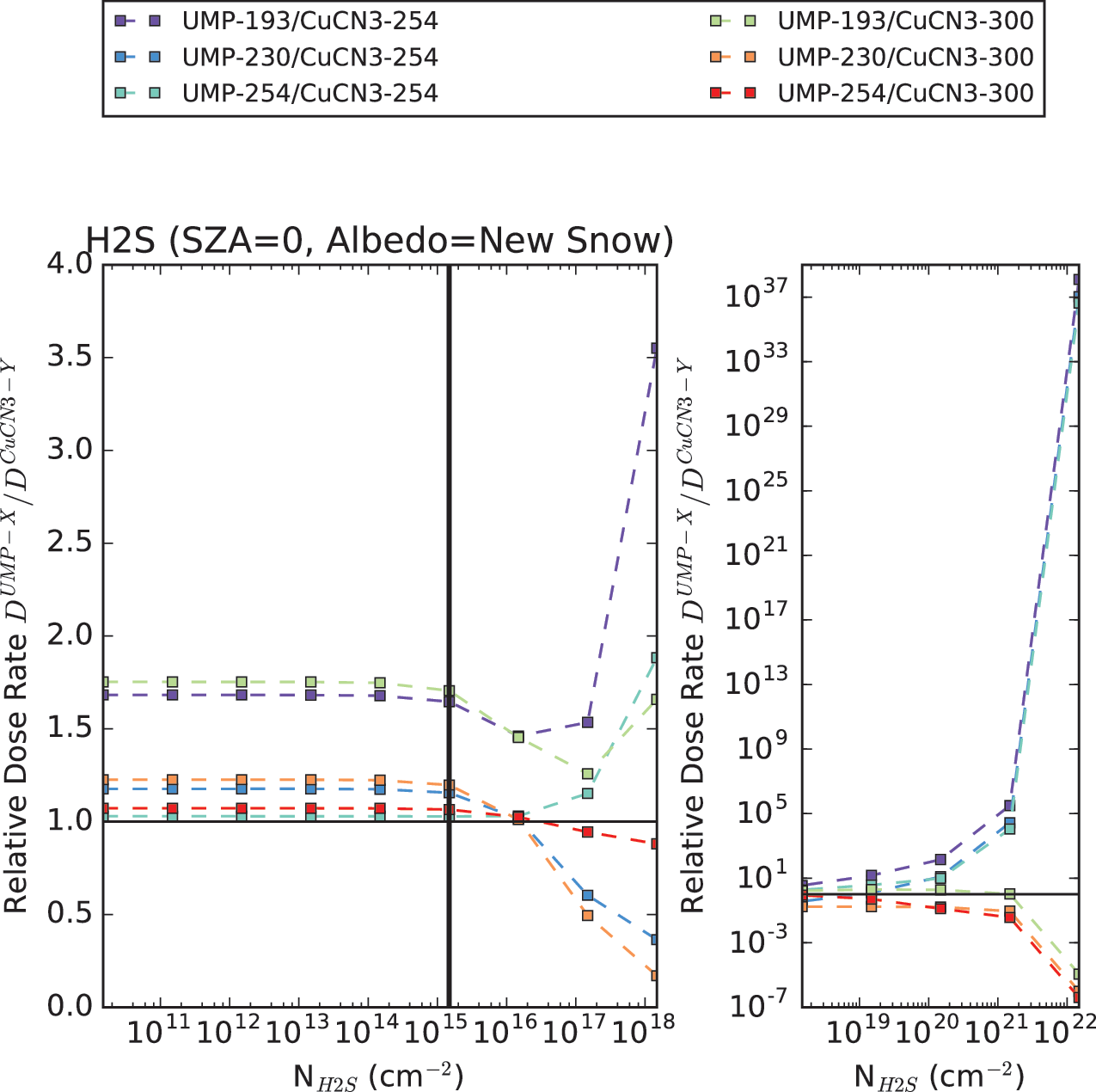
Ratio of biologically effective dose rates UMP-X/CuCN3-Y, for X = 193, 230, and 254 nm and Y = 254 and 300 nm, as a function of
5.9. O2
O2 is a robust UV shield. In the prebiotic era, O2 is thought to have been generated from photolysis of CO2 and H2O, with sinks from reactions with reductants. Measurements of sulfur mass-independent isotope fractionation (SMIF) imply O2 concentrations <1 × 10⁻⁵ PAL prior to 2.3 Ga (Pavlov and Kasting, 2002), and Fe and U-Th-Pb isotopic measurements from a 3.46 Ga chert are consistent with an anoxic ocean during that era (Li et al., 2013). Rugheimer et al. (2015) calculated an O2 abundance corresponding to

Surface radiances for an atmosphere with
At the Rugheimer et al. (2015) level of
5.10. O3
Similarly to O2, O3 is a well known, strong UV shield. It is generated from 3-body reactions involving photolysis of O2; hence its abundance is sensitive to O2 levels, with sinks from photolysis and reactions with reducing gases. Rugheimer et al. (2015) estimated an O3 column density of
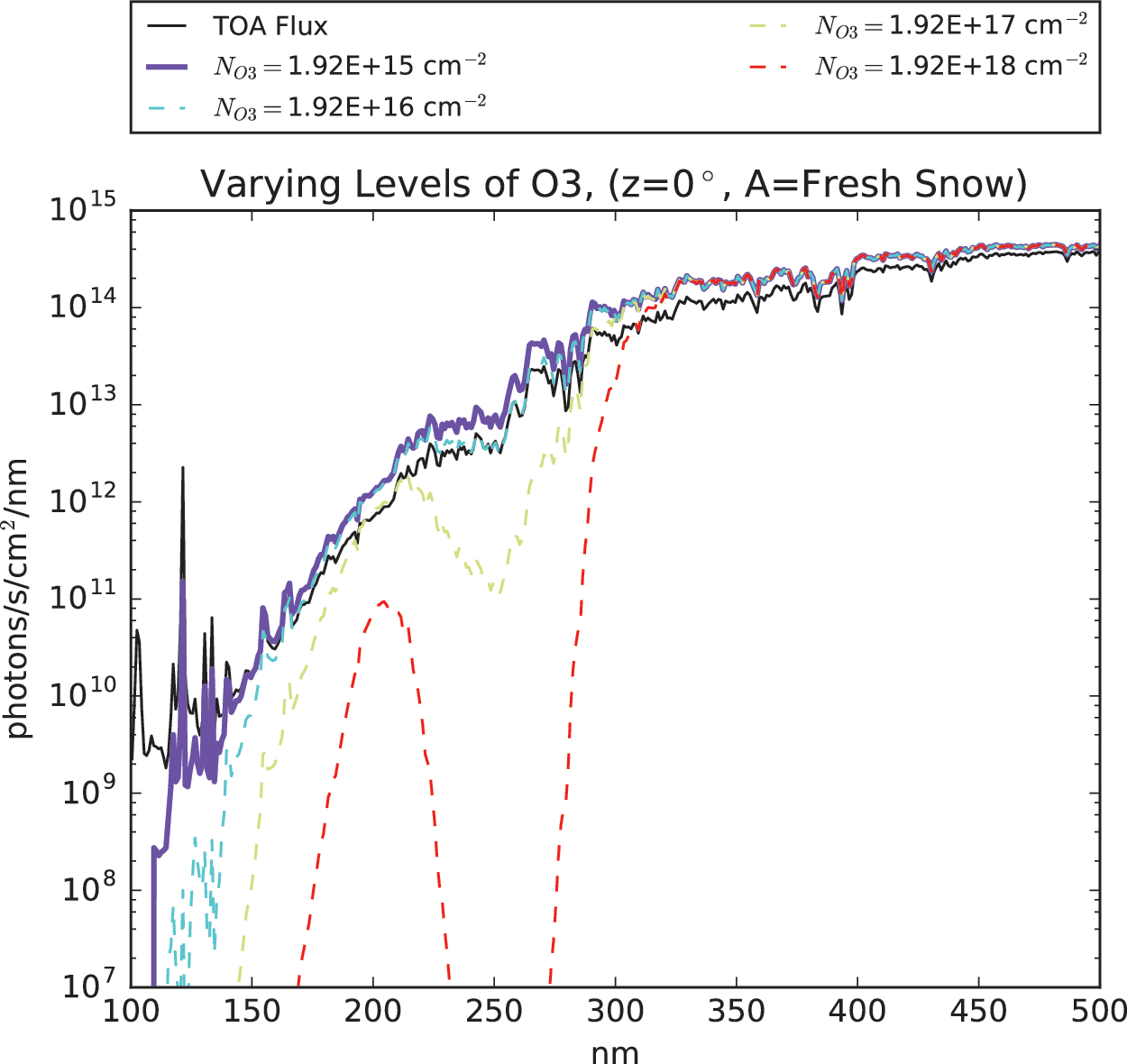
Surface radiances for an atmosphere with
6. Conclusions
We used a two-stream radiative transfer model to calculate the hemisphere-integrated surface radiance at UV wavelengths for different surface albedos, solar zenith angles, and atmospheric compositions for the 3.9 Ga Earth. To estimate the effect of these different variables on UV-sensitive prebiotic chemistry, we convolved the surface radiance spectra with action spectra for glycosidic bond cleavage in UMP (a stressor for abiogenesis) and production of solvated electrons from photoionization of CuCN3 2- (a eustressor for abiogenesis) formed from absorption spectra and assumed QY curves, and integrated the result over wavelength to compute the BED.
Our findings demonstrate the importance of considering albedo and zenith angle in calculations of surface UV fluence. For the model atmosphere calculated by Rugheimer et al. (2015) for the 3.9 Ga Earth, variations in albedo (tundra vs. new snow) can affect BEDs by a factor of 2.7–4.3, and variations in zenith angle (0–66.5°, corresponding to the range of minimum SZA available on Earth) can affect BEDs by a factor of 3.7–4.3, depending on the photoprocess and the assumptions we make about its QY curve. Taken together, albedo and zenith angle can affect BEDs by a factor of 10.4–17.1, meaning that local conditions like latitude and surface type can drive variations in prebiotic photoreaction rate by an order of magnitude or more, independent of atmospheric composition.
While CO2 levels on the 3.9 Ga Earth are debated, even minute amounts of CO2 (
The BEDs vary by less than an order of magnitude as a function of CO2 level for
For climatically reasonable levels of CO2 (
SO2 and H2S also do not impact the UV surface fluence at concentrations derived assuming modern levels of volcanism. However, it has been hypothesized that SO2 and H2S could have built up to higher (1–100 ppm in a 1 bar atmosphere) levels during epochs of high sustained volcanism. If this scenario occurred, such epochs were low-UV eras in Earth's history. At SO2 levels of
At the lowest CO2 level proposed in the literature from climate constraints (
Conversely, water vapor does not absorb at 254 nm, and for
In summary, variations in surface albedo and solar zenith angle can, taken together, affect prebiotically relevant photochemical reaction rates by an order of magnitude or more. Surficial prebiotic photochemistry is insensitive to the precise levels of CO2, H2O, O2, O3, and CH4, across the levels of these gases permitted by available constraints; however, it is sensitive to the inventories of SO2 and H2S, if these gases are able to build up to the part-per-million levels (e.g., during epochs of enhanced volcanism). Surface fluence shortward of 198 nm is available only for a very narrow range of parameter space. However, fluence at 254 nm is available across most of parameter space, meaning that mercury lamps are good candidates for initial studies of prebiotic chemistry (though with the caveat that their use might miss wavelength-dependent effects).
Appendix A. Extinction and Rayleigh Scattering Cross Sections
This appendix specifies the sources of the total extinction and Rayleigh scattering cross sections for the gases used in the surface UV environment model. Total extinction cross sections were taken from literature measurements, while Rayleigh scattering cross sections were computed from theoretical formalisms. Unless otherwise stated, all measurements were collected near room temperature (∼295 K) and 1 bar of atmospheric pressure, and the digitized data files of the empirical measurements were taken from the MPI-Mainz UV-VIS Spectral Atlas. As discussed in Section 3, when the Rayleigh scattering cross sections exceeded the total measured cross section from a literature source, the total cross section was set equal to the Rayleigh scattering value, and the absorption cross section was set equal to zero. When integrating the cross sections over a wavelength bin, we linearly interpolated within a given data set when computing the integral.
A.1. N2
We compute the Rayleigh scattering cross-section of N2 using the formalism of Vardavas and Carver (1984): σ = 4.577 × 10⁻²¹ × KCF × [A(1 + B/λ2)]/λ4, where λ is in μm and KCF is the King correction factor, where KCF = (6 + 3δ)/(6–7δ), where δ is the depolarization factor. This approach accounts for the wavelength dependence of the index of refraction but assumes a constant depolarization factor. We take the values of the coefficients A and B from Keady and Kilcrease (2000) and the depolarization factor of δ = 0.0305 from Penndorf (1957).
We take empirically measured N2 extinction cross sections shortward of 108 nm from Chan et al. (1993a), who measure the extinction cross section from 6.2 to 113 nm (≤5 nm resolution). No absorption is detected longward of 108 nm (Huffman, 1969; Chan et al., 1993a); hence, we take Rayleigh scattering to account for the extinction for λ > 108 nm. Figure A1 presents the total and Rayleigh scattering cross sections for N2 from 100 to 900 nm.
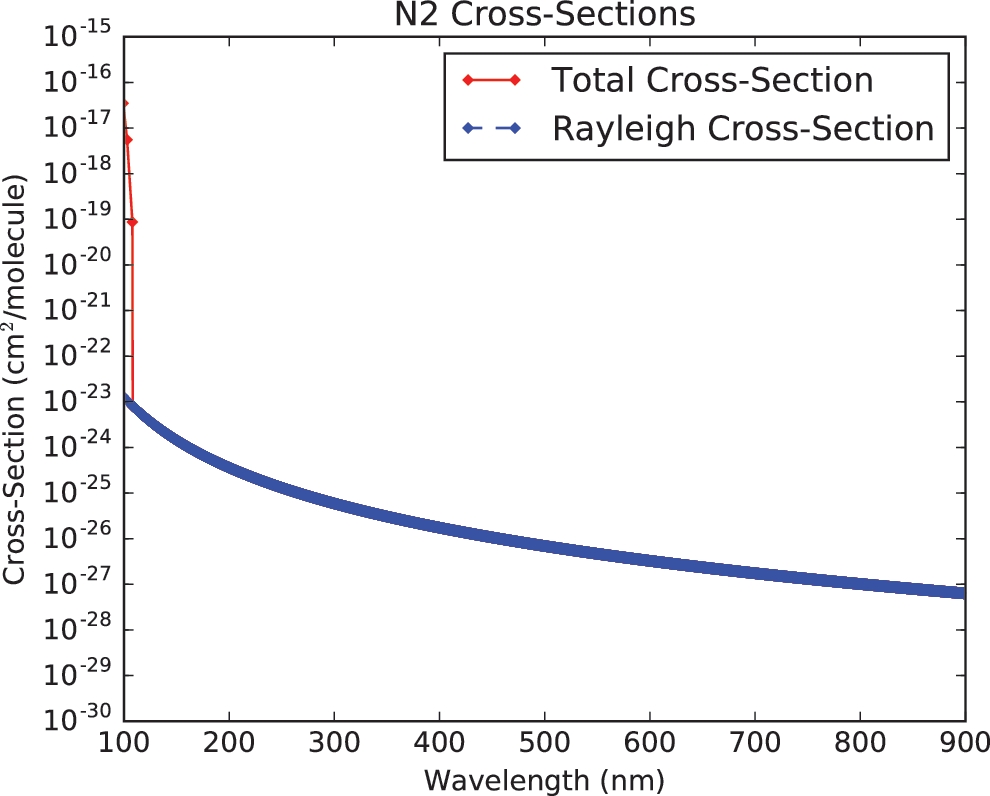
Total extinction and Rayleigh scattering cross sections for N2.
A.2. CO2
We compute the Rayleigh scattering cross section of CO2 using the formalism of Vardavas and Carver (1984): σ = 4.577 × 10⁻²¹ × KCF × [A(1 + B/λ2)]/λ4, where λ is in μm and KCF is the King correction factor, where KCF = (6 + 3δ)/(6–7δ), where δ is the depolarization factor. This approach accounts for the wavelength dependence of the index of refraction but assumes a constant depolarization factor. We take the values of the coefficients A and B from Keady and Kilcrease (2000) and the depolarization factor of δ = 0.0774 from Shemansky (1972).
We take empirically measured cross sections shortward of 201.6 nm from Huestis and Berkowitz (2010). Huestis and Berkowitz (2010) reviewed existing measurements of extinction cross sections for CO2 and aggregated the most reliable ones into a single spectrum (<1 nm resolution). They tested their composite spectrum with an electron-sum rule and found it to agree with the theoretical expectation to 0.33%. From 201.75 to 300 nm, the measurements of Shemansky (1972) provide coverage. However, the resolution of these data ranges from 0.25 nm from 201.75–203.75 nm to 12–25 nm from 210–300 nm. Further, Shemansky (1972) found that essentially all extinction at wavelengths longer than 203.5 nm is due to Rayleigh scattering (Ityaksov et al., 2008, derive similar results). Therefore, we adopt the measurements of Shemansky (1972) from 201.75 to 203.75 nm and take Rayleigh scattering to describe CO2 extinction at longer wavelengths. Figure A2 presents the total and Rayleigh scattering cross sections for CO2 from 100 to 900 nm.

Total extinction and Rayleigh scattering cross sections for CO2.
A.3. H2O
We compute the Rayleigh scattering cross section of H2O following the methodology of von Paris et al. (2010) and Kopparapu et al. (2013). We compute the wavelength-dependent index of refraction of water vapor using the observation by Edlén (1966) that the refractivity of water vapor is 15% less than that of air (itself 1–2% water vapor by volume). We compute the refractivity of standard air from the formulae of Bucholtz (1995). von Paris et al. (2010) and Kopparapu et al. (2013) used a value for the depolarization factor of 0.17, based on the work of Marshall and Smith (1990); however, this value was measured for liquid water. We instead adopt δ = 0.000299 from the work of Murphy (1977). We note that the equations of Bucholtz (1995) have a singularity at 0.15946 μm (159.46 nm) due to a (39.32957−1/λ2) (λ in μm) term in the denominator, which causes the Rayleigh scattering cross section to go to infinity at that value. To circumvent this problem, in this term only, we adopt λ = 0.140 μm for 0.140 μm < λ < 0.15946 μm, and λ = 0.180 μm for 0.15946 μm < λ < 0.180 μm. This removes the singularity from the Rayleigh scattering curve (see Fig. A3).
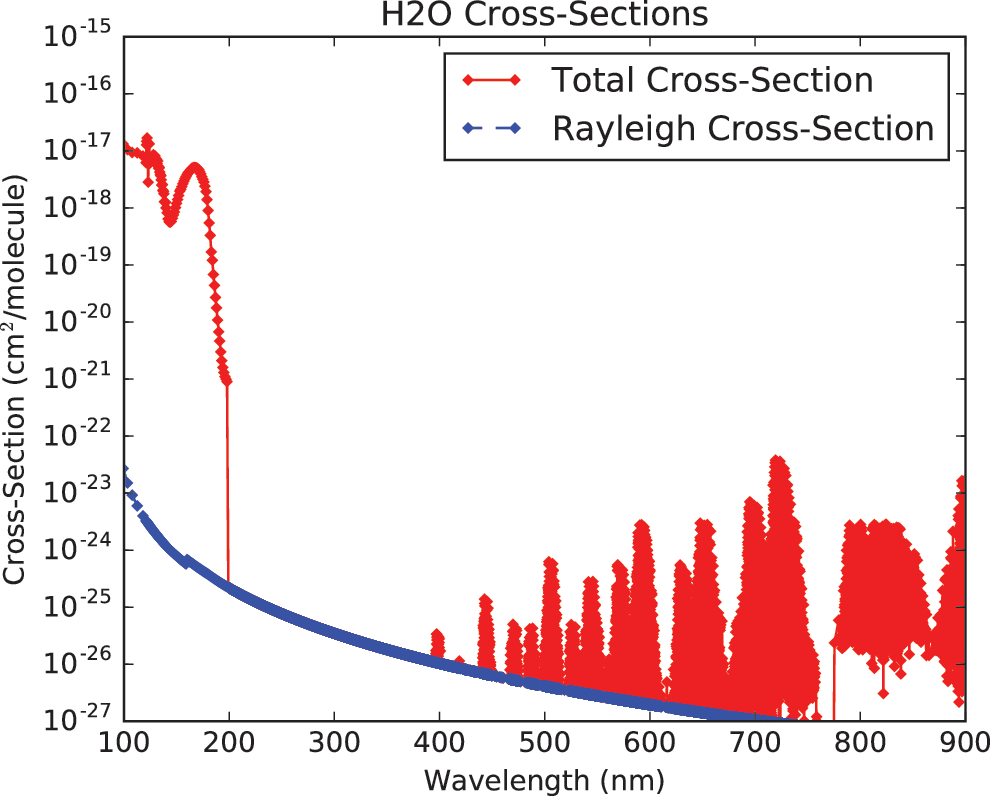
Total extinction and Rayleigh scattering cross sections for H2O.
We take empirically measured cross sections shortward of 121 nm from the dipole (e,e) spectroscopy measurements of Chan et al. (1993b) (≤6 nm resolution). From 121 to 198 nm, we use the compilation of Sander et al. (2011), who surveyed the measurements of H2O vapor cross section data to arrive at a recommended tabulation of cross sections for planetary science studies (<1 nm resolution). From 396 to 755 nm, we use the gas-cell absorption results of Coheur et al. (2002) and Fally et al. (2003), as combined by the MPI Atlas (mode of 0.0073 nm resolution). From 775 to 1081 nm, we use the measurements of Mérienne et al. (2003) (mode of 0.0077 nm resolution). At all wavelengths not covered by these data sets, we take the extinction to be due to Rayleigh scattering. Figure A3 presents the total and Rayleigh scattering cross sections for H2O from 100 to 900 nm.
A.4. CH4
We compute the Rayleigh scattering cross section of CH4 using the formalism of Sneep and Ubachs (2005). This method accounts for the wavelength dependence of the index of refraction and assumes a constant depolarization factor of 0.0002, which is equal to the depolarization factor of CCl4, which has a similar structure. Comparing their computations to data, Sneep and Ubachs (2005) found that their formalism overestimates the absorption cross section of CH4 at 532.5 nm by 15%; therefore, we follow Kopparapu et al. (2013) in scaling down the Sneep and Ubachs (2005) estimate by 15% at all wavelengths.
We take empirically measured cross sections shortward of 165 nm from the dipole (e,e) spectroscopy measurements of Au et al. (1993) (<5 nm resolution for λ < 113 nm, 610 nm resolution thereafter). Absorption due to CH4 has not been detected from 165 to 400 nm (Mount et al., 1977; Chen and Wu, 2004). Rayleigh scattering is taken to account for extinction at wavelengths longer than 165 nm. Figure A4 presents the total and Rayleigh scattering cross sections for CH4 from 100 to 900 nm.
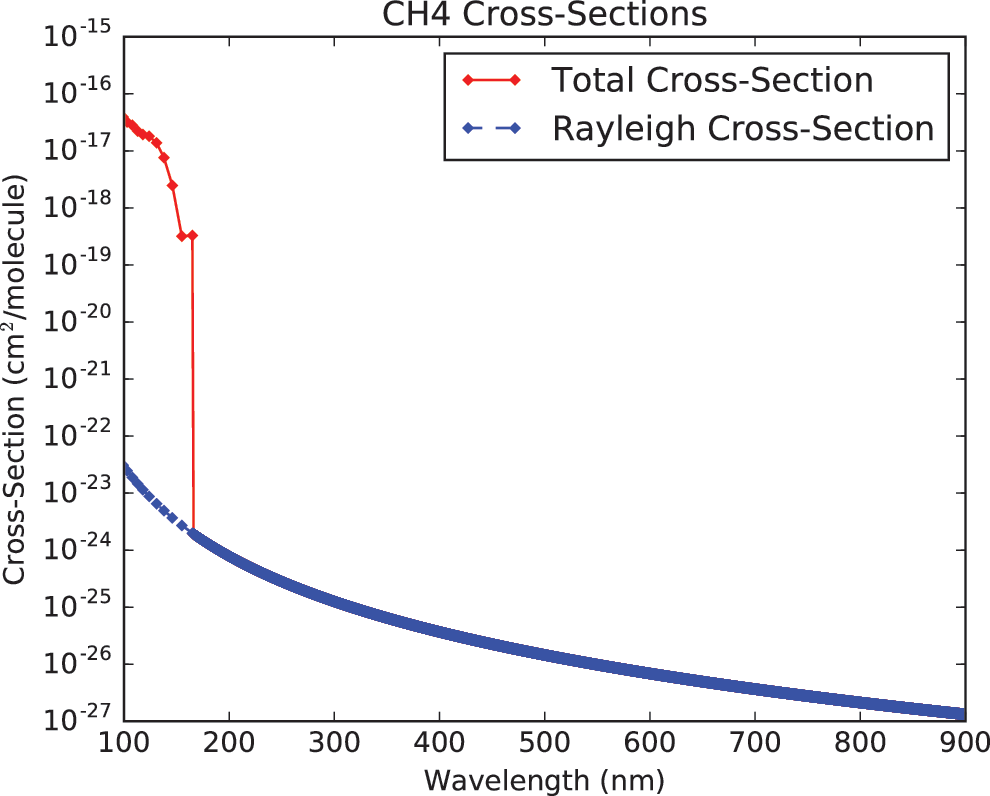
Total extinction and Rayleigh scattering cross sections for CH4.
A.5. SO2
We compute the Rayleigh scattering cross section of O3 using the formalism of Keady and Kilcrease (2000): σ = 1.306 × 10²⁰ × KCF × α 2 /λ4, where σ is in cm2 and λ is in μm, where KCF refers to the King correction factor, KCF =(6 + 3.δ)/(6–7δ) (Sneep and Ubachs, 2005), and where α refers to the polarizability of the molecule and δ is the depolarization factor. Bogaard et al. (1978) listed the polarizability α and depolarization ratio δ for SO2 at 488, 514.5, and 632.8 nm. We use α 488nm and δ 488nm for λ < 501.25 nm, α 514.5nm and δ 514.5nm for 501.25 < λ < 573.65 nm, and α 632.8nm and δ 632.8nm for 573.65 nm < λ nm.
We take empirically measured cross sections of SO2 shortward of 106.1 nm from the dipole (e,e) spectroscopy measurements of Feng et al. (1999a) (<5 nm resolution). From 106.1 to 403.7 nm, we take the cross sections for SO2 extinction from the compendium of SO2 cross sections of Manatt and Lane (1993) (0.1 nm resolution). Manatt and Lane (1993) evaluated extant UV cross sections for SO2 extinction and aggregated the most reliable into a single compendium covering this wavelength range at 293 ± 10 K. From 403.7 to 416.7 nm, we take the Fourier transform spectrometer measurements of Vandaele et al. (2009) (<1 nm resolution). Many of the cross sections reported in this data set are negative, corresponding to an increase in flux from traversing a gas-filled cell. These cross sections are deemed unphysical and removed from our model. Figure A5 presents the total and Rayleigh scattering cross sections for SO2 from 100 to 900 nm.
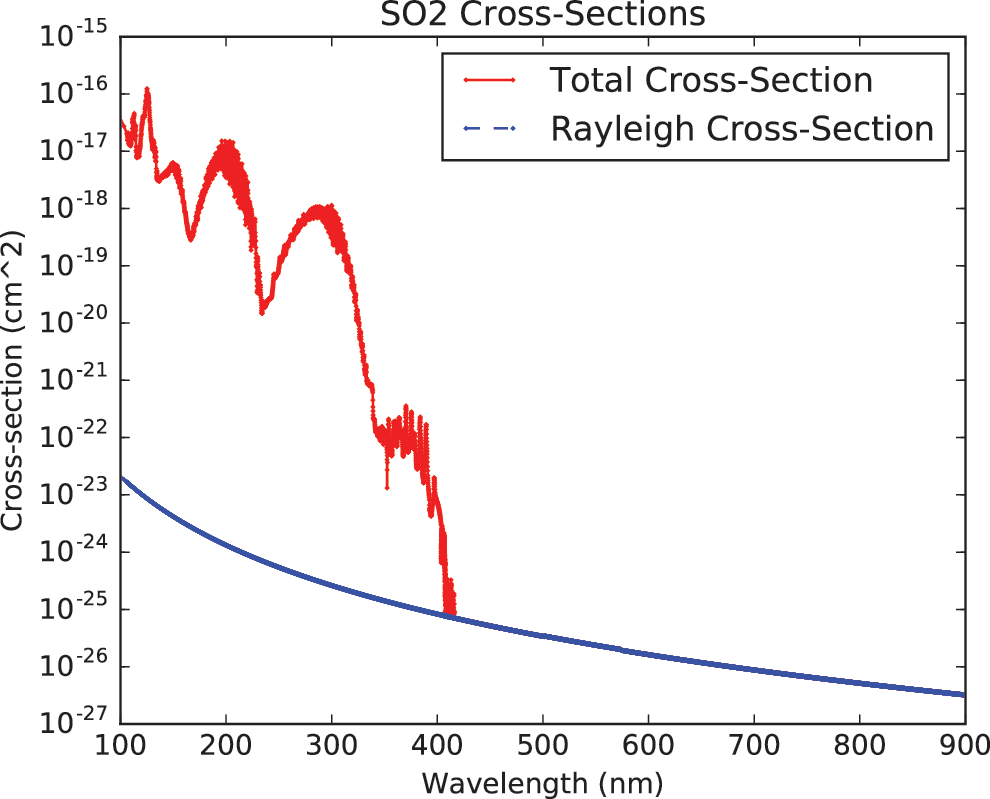
Total extinction and Rayleigh scattering cross sections for SO2.
A.6. H2S
We compute the Rayleigh scattering cross section of H2S using the formalism of Keady and Kilcrease (2000): σ = 1.306 × 10²⁰ × KCF × α 2/λ4, where σ is in cm2 and λ is in μm, where KCF refers to the King correction factor, KCF = (6 + 3.δ)/(6–7δ) (Sneep and Ubachs, 2005), and where α refers to the polarizability of the molecule and δ is the depolarization factor. Bogaard et al. (1978) listed the polarizability α and depolarization ratio δ for H2S at 488, 514.5, and 632.8 nm. We use α 488nm and δ 488nm for λ < 501.25 nm, α 514.5nm and δ 514.5nm for 501.25 < λ < 573.65 nm, and α 632.8nm and δ 632.8nm for 573.65 nm < λ nm.
We take empirically measured cross sections of H2S shortward of 159.465 nm from the dipole (e,e) spectroscopy measurements of Feng et al. (1999b) (<10 nm resolution). From 159.465 to 259.460 nm, we take the cross sections for H2S extinction from the gas cell absorption measurements of Wu and Chen (1998) (0.06 nm resolution), as recommended by Sander et al. (2011). From 259.460 to 370.007 nm, we take the gas cell absorption measurements of Grosch et al. (2015) (0.018 nm resolution). Many of the cross sections reported in this data set are negative, corresponding to an increase in flux from traversing a gas-filled cell. These cross sections are deemed unphysical and removed from our model. Figure A6 presents the total and Rayleigh scattering cross sections for H2S from 100 to 900 nm.

Total extinction and Rayleigh scattering cross sections for H2S.
A.7. O2
We compute the Rayleigh scattering cross section of O2 using the formalism of Vardavas and Carver (1984): σ = 4.577 × 10⁻²¹ × KCF × [A(1 + B/λ2)]/λ4, where λ is in μm and KCF is the King correction factor, where KCF = (6 + 3δ)/(6 − 7δ), where δ is the depolarization factor. This approach accounts for the wavelength dependence of the index of refraction but assumes a constant depolarization factor. We take the values of the coefficients A and B from Keady and Kilcrease (2000) and the depolarization factor of δ = 0.054 from Penndorf (1957).
We take extinction cross sections of O2 shortward of 108.75 nm from the work of Huffman (1969) (<12.6 nm resolution). Huffman (1969) reviewed previous literature measurements of vacuum UV extinction cross sections of O2 and provided recommended values for aeronomic studies. From 108.75 to 130.0 nm, we use the gas absorption cell measurements for ground-state O2 of Ogawa and Ogawa (1975) (<0.2 nm resolution). From 130.04 to 175.24 nm, we use the absorption cell measurements of Yoshino et al. (2005) (<0.42 nm resolution). From 179.2 to 202.6 nm, we use the gas absorption cell measurements of Yoshino et al. (1992) (300 K, 0.01 nm resolution). Duplicate values in this database (presumably due to rounding error) were removed. From 205 to 245 nm, we use the compilation of Sander et al. (2011), recommended by the Jet Propulsion Laboratory for use in planetary atmospheres studies (<1 nm resolution). From 245 to 294 nm, we use the gas absorption cell extinction cross sections measured by Fally et al. (2000) (<0.008 nm resolution.) From 650 to 799.6, we use the gas-cell absorption measurements of the SCIAMACHY calibration data from Bogumil et al. (2003) (<0.21 nm resolution,). As in the case of SO2, several of the cross sections reported for this data set are negative; these cross sections are rejected as unphysical and removed from the model. Figure A7 presents the total and Rayleigh scattering cross sections for O2 from 100 to 900 nm. We note that the cross sections presented here are for O2 extinction only. Extinction due to molecular complexes, for example, the O2-O2 complexes observed by Greenblatt et al. (1990), are not included in our parametrization. This does not materially impact the fidelity of our model since the cross sections associated with these complexes are small at relevant partial pressures of O2 (<3 × 10⁻²⁶ cm2 for 1 atm of O2).
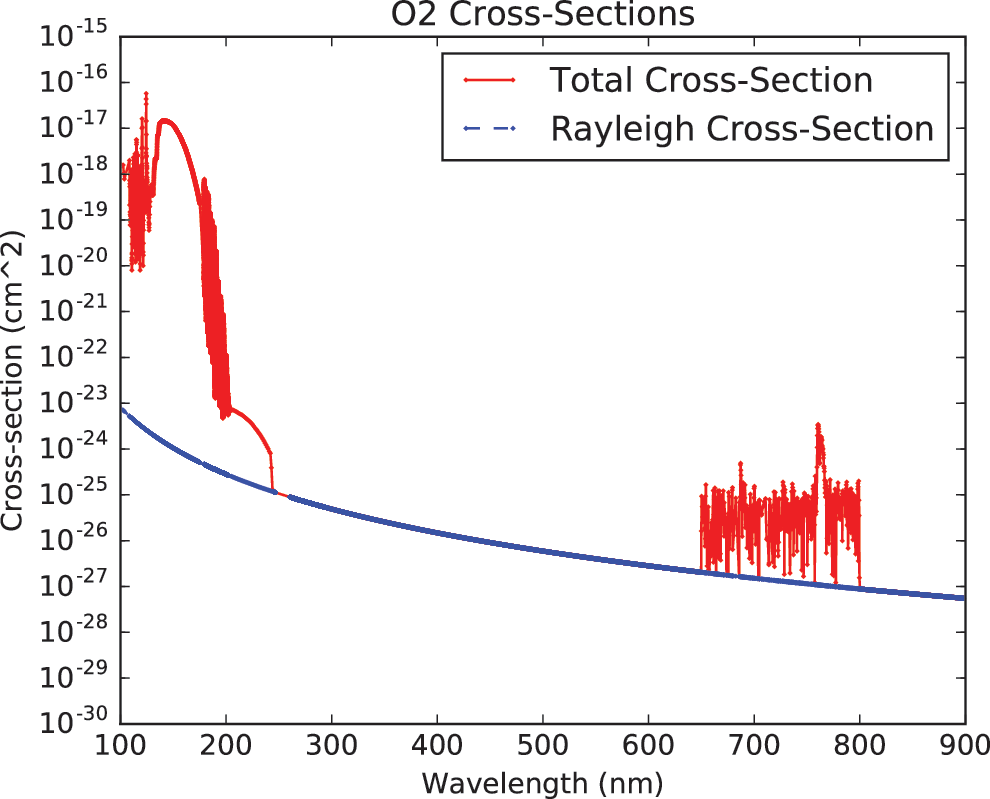
Total extinction and Rayleigh scattering cross sections for O2.
A.8. O3
We take the Rayleigh scattering cross section of O3 using the formalism of Keady and Kilcrease (2000): σ = 1.306 × 10²⁰ × KCF × α 2/λ4, where σ is in cm2 and λ is in μm, where KCF refers to the King correction factor, KCF = (6 + 3.δ)/(6–7δ) (Sneep and Ubachs, 2005), and where α refers to the polarizability of the molecule. From Brasseur and De Rudder (1986), KCF = 1.06 for ozone. We adopt α = 3.21 × 10⁻²⁴ cm3 based on the average electric dipole polarizability listed for ground state O3 in Miller (2009). This formulation assumes constant polarizability (index of refraction) and depolarization factor.
We take empirically measured cross sections of O3 shortward of 110 nm from the gas cell absorption measurements of Ogawa and Cook (1958) (<9.5 nm resolution). We take cross sections from 110 to 172 nm from the gas cell absorption measurements of Mason et al. (1996) (<2 nm resolution for λ ≤ 139.31, 3–17 nm resolution for λ = 139.31–172 nm). Following the recommendations of Sander et al. (2011), we take cross sections from 185 to 213 nm from the gas cell absorption measurements of Molina and Molina (1986) (0.5 nm resolution). Finally, we take the cross sections for 213–1100 nm from the gas cell absorption measurements recently published in joint papers by Serdyuchenko et al. (2014) and Gorshelev et al. (2014) (0.02–0.06 nm resolution, interpolated to 0.01 nm; 293 K). Gorshelev et al. (2014) compared this data set to previous measurements and find good agreement. Figure A8 presents the total and Rayleigh scattering cross sections for O3 from 100 to 900 nm.

Total extinction and Rayleigh scattering cross sections for O3.
Appendix B. Spectral Albedos
This section describes the sources for the direct and diffuse spectral albedos, α dir and α dif, corresponding to different surface environments used in this study. In this section, μ = cos(θ 0) refers to the cosine of the solar zenith angle. For all albedos, we enforce a physical albedo range of 0–1 by setting any negative albedos to 0 and any albedos greater than 1 to 1.
B.1. Ocean
We approximate the albedo of pure (ice- and land-free) ocean via the methodology of Briegleb et al. (1986), who in turn rely upon Payne (1972). Briegleb et al. (1986) took α dif = 0.06 and α dir = 2.6/(μ 1.7 + 0.065) + 15(μ − 0.1)(μ − 0.5)(μ − 1.0).
Payne (1972) measured the reflectance of the ocean surface under a variety of conditions using a spectrometer with uniform sensitivity coverage from 280 to 2800 nm. Hence, albedos calculated from this work represent a fit to the mean albedo integrated 280–2800 nm, which includes 98% of solar flux. Briegleb et al. (1986) argued that the variation in ocean albedo as a function of wavelength is modest, due to the modesty of variations of the index of refraction of water across this wavelength range. Briegleb et al. (1986) modeled this variation and found the spectral corrections to the oceanic albedo due to the wavelength dependence of the optical properties of water to be +0.02 for 200–500 nm, −0.003 for 500–700 nm, −0.007 for 700–850 nm, and −0.007 for 850 nm to 4 μm. They calculated these corrections to have minimal impact on the TOA broadband albedo and, hence, ignored them.
However, for our applications (computing the spectral radiance over different surface environments), these corrections can be significant, especially in the case of diffuse radiation, where the shortwave correction is 1/3 of the diffuse albedo. Hence, we include these corrections by adding a correction term α corr to α dir and α dif. Lacking any better assumption, we extend the 200–500 nm value to all wavelengths <500 nm. Hence, α corr = 0.02 for λ < 500 nm, α corr = −0.003 for λ = 500–700 nm, and α corr = −0.007 for λ > 700 nm.
B.2. Snow
We approximate the albedo of pure snow using the methodology outlined by Briegleb and Ramanathan (1982) and reviewed by Coakley (2003). This methodology treats new-fallen and old snow separately (new-fallen snow is brighter).
From Table 1 of Briegleb and Ramanathan (1982), for new-fallen snow:
Whereas for old snow:
As before, we extend the 200–500 nm value to all λ < 200.
To compute the direct albedo, we follow Briegleb and Ramanathan (1982) in using the formalism of Dickinson et al. (1981) to account for zenith angle dependence: α dir = α dif + (1 − α dif) × 0.5 × [3/(1 + 4μ) − 1] for μ ≤ 0.5, and α dir = α dif for μ > 0.5.
B.3. Desert
We approximate the albedo of desert environments following the methods of Briegleb et al. (1986), as reviewed by Coakley (2003). Following Tables 1 and 2 of Briegleb et al. (1986),
where we have again extended the Briegleb et al. (1986) 200–500 nm albedos to all wavelengths <200 nm.
To compute the direct albedo, we follow Briegleb et al. (1986) in including zenith angle dependence by writing α dir = α dif × (1 + d)/(1 + 2dμ), where d is a parameter derived from a fit to data for different terrain types. For desert, d = 0.4.
B.4. Tundra
We approximate the albedo of tundra environments following the methods of Briegleb et al. (1986), as reviewed by Coakley (2003).
where we have again extended the Briegleb et al. (1986) 200–500 nm albedos to all wavelengths <200 nm.
To compute the direct albedo, we follow Briegleb et al. (1986) in including zenith angle dependence by writing α dir = α dif × (1 + d)/(1 + 2dμ), where d is a parameter derived from a fit to data for different terrain types. For tundra, d = 0.1.
Appendix C. Enhancement of Upwelling Intensity in the Discrete Ordinates and Two-Stream Approximations
In this section, we construct a detailed example to demonstrate that, under the discrete ordinates approximation to atmospheric radiative transfer, of which the two-stream approximation is the n = 2 special case, the total upwelling intensity through the atmosphere can exceed the total downwelling intensity if the planet surface is a Lambertian (isotropic) reflector. In outlining this example, we follow closely the DISORT User's Guide (DUG, Stamnes et al., 2000). The DUG outlines the formalism behind the DISORT code (Stamnes et al., 1988), one of the best-known implementations of plane-parallel discrete-ordinates radiative transfer.
Consider a planet with a homogeneous atmosphere illuminated from above by the Sun. Let the Sun be located at direction (μ 0 ,φ 0), where μ is the cosine of the solar zenith angle and φ is the azimuth, with incident intensity I(μ,φ) = I 0 δ(μ − μ 0)δ(φ − φ 0). Suppose thermal emission from the atmosphere and planet is negligible (i.e., solar forcing is the only source of photons to the system). Further, let the atmosphere have negligible optical depth τ 0/μ 0 << 1 (transparent atmosphere approximation). Then atmospheric scattering and absorption have negligible effect on the planetary radiation field, the upwelling and downwelling intensity fields are essentially uncoupled, and the upward and downward fluxes and the mean intensity are constant throughout the atmosphere. Let the surface be a Lambertian reflector, with albedo A = F +/F −, where F + is the upwelling flux and F - is the downwelling flux.
The hemispherically integrated upwelling and downwelling intensities I + and I − may be defined, following DUG equation 9c, by
where I 0(τ,μ) is the intensity at a depth τ in the atmosphere arriving from a direction μ. Since τ 0/μ 0 << 1, I 0 exp(−τ 0/μ 0)≈ I 0(1 − τ 0 /μ 0). Further, since the atmosphere is optically very thin and non-interacting, essentially no flux is scattered out of the direct stream into the downward diffuse intensity, nor out of the upward diffuse intensity into the downward diffuse intensity (or vice versa). Therefore, we can further approximate that I 0(τ,−μ)≈0.
We can then simplify
Next, from DUG equation 39, we can write the boundary condition at the planetary surface (i.e., the reflection condition):
where
Substituting for I
0(τ,+μ) in our expression for I
+, we can then conclude
Therefore,
For Aμ 0 > 0.5, I + > I −, with a maximum value of 2I −. This condition is physically plausible. One example satisfying this condition is the equator of a snowball Earth at noon on the equinox. At noon on the equinox, μ 0 = 1 (SZA = 0°), and snow approximates a Lambertian scatterer (Coakley, 2003) with a UV albedo of 0.95 (Briegleb and Ramanathan, 1982). Under these conditions, Aμ 0 = 0.95 > 0.5, and I + = 1.9I −.
This example demonstrates that it is possible for the upwelling intensity to exceed the downwelling intensity. This result may be understood intuitively as a consequence of requiring flux conservation during reflection from a Lambertian surface. Consider the μ
0 = 1, A = 1 case in the transparent atmosphere approximation. In this case, all downward photons are arriving from the direction μ
0, and the downwelling intensity and flux are both I
0. Since A = 1, all the flux must be reflected, so the upwelling flux F
+ = I
0 as well. But since the surface is a Lambertian scatterer, the downward intensity was scattered uniformly in all directions.
For another discussion of this phenomenon, see the work of Madronich (1987), their Section 2.3.
Footnotes
Acknowledgments
We thank Sarah Rugheimer for providing model metadata for testing, for insightful discussion, and for comments on this article. We thank C. Magnani and Z. Todd for helpful comments and discussion. We thank R. Ramirez, E. Schwieterman, R. Wordsworth, T. Laakso, A. Segura, F. Violotev, J. Szostak, A. Gonzalo, R. Kelley, R. Spurr, I. Cnossen, and L. Zhu for sharing their insights and knowledge with us in discussions. We thank two anonymous referees for comments that greatly improved this article.
This research has made use of NASA's Astrophysics Data System Bibliographic Services and the MPI-Mainz UV-VIS Spectral Atlas of Gaseous Molecules.
S.R. and D.D.S. gratefully acknowledge support from the Simons Foundation, grant no. 290360.
Author Disclosure Statement
The authors declare no competing financial interests.