




Abstract
The present study demonstrates that γ-radiolyzed perchlorate-containing Mars soil salt analogues (in a CO2 atmosphere) generate upon H2O wetting the reactive oxygen species (ROS) superoxide radical (O2 •−), hydrogen peroxide (H2O2), and hydroxyl radicals (•OH). This study also validates that analogue radiolysis forms oxychlorine species that, in turn, can UV-photolyze to •OH upon UV photolysis. This investigation was made possible by the development of a new assay for inorganic-origin O2 •− and H2O2 determination and by the modification of a previous assay for soil •OH. Results show that radiolyzed Mg(ClO4)2 generates H2O2 and •OH; and when included as part of a mixture analogous to the salt composition of samples analyzed at the Mars Phoenix site, the analogue generated O2 •−, H2O2, and •OH, with •OH levels 150-fold higher than in the radiolyzed Mg(ClO4)2 samples. Radiolyzed Mars Phoenix site salt analogue that did not contain Mg(ClO4)2 generated only •OH also at 150-fold higher concentration than Mg(ClO4)2 alone. Additionally, UV photolysis of the perchlorate γ radiolysis product chlorite (ClO2 −) generated the oxychlorine products trihalide (Cl3 −), chlorine dioxide (ClO2 •), and hypochlorite (ClO−), with the formation of •OH by UV photolysis of ClO−. While the generation of ROS may have contributed in part to 14CO2 production in the Viking Labeled Release (LR) experiment and O2 (g) release in the Viking Gas Exchange (GEx) experiment, our results indicate that they are not likely to be the major contributor to the LR and GEx results. However, due to their highly reactive nature, they are expected to play a significant role in the alteration of organics on Mars. Additionally, experiments with hypochlorite show that the thermal stability of NaClO is in the range of the thermal stability observed for thermally liable oxidant responsible for the Viking LR results. Key Words: Mars—Oxygen—Salts—Radiation—Habitability. Astrobiology 17, 319–336.
1. Introduction
C
Initial interpretations of the Viking results focused on possible UV-induced formation of H2O2 and metal superoxides as the thermally unstable LR and the thermally stable GEx oxidant, respectively (Oyama et al., 1977). The UV-induced formation of superoxide radicals (O2 •−) on anatase has been suggested as a source of the GEx oxidant (Chun et al., 1978), as has UV-induced formation of O2 •− on labradorite (Yen et al., 2000). Complexation of H2O2 with anatase has also been suggested as another potential mechanism for the formation of the GEx oxidant (Quinn and Zent, 1999). More recent experiments, while not demonstrating capability with the LR and GEx results, have shown the formation of peroxide, superoxide, and other forms of reactive oxygen species (ROS), when Atacama Desert and Mojave Desert soils were exposed to UV radiation (Georgiou et al., 2015). In these experiments, it was shown that these desert soils generate and can accumulate metal superoxides and peroxides by a UV-induced electron transfer mechanism, which involves electron ejection from metal oxides to O2. Additionally, it was demonstrated in the dark that transformation of the UV-generated peroxide and superoxides can result in the generation of hydroxyl radicals (•OH).
New insight into the oxidative nature of the martian surface material was obtained with the discovery of perchlorate anions (ClO4 −; likely as salts of Ca2+ and/or Mg2+) by way of the Wet Chemistry Laboratory on the Phoenix Mars lander (Hecht et al., 2009). Following the Phoenix mission, reinterpretation of the Viking GCMS results indicates the presence of perchlorate at both Viking landing sites (Navarro-González et al., 2010); and analyses of surface materials, including ancient sedimentary deposits, with the Sample Analysis at Mars (SAM) instrument suite have shown that the perchlorate is widely distributed at the Mars Science Laboratory landing site (Glavin et al., 2013; Ming et al., 2014). Analyses of spectral data from the Compact Reconnaissance Imaging Spectrometer for Mars (CRISM) instrument show evidence for the seasonal presence of hydrated perchlorate at recurring slope lineae locations (Ojha et al., 2015). Combined, these results are indicative of global perchlorate distributions on Mars and suggest that the martian surface contains a significantly higher level and more diverse range of oxidants than what was suggested by the Viking biology experiments of 40 years ago.
Given the high levels of UV radiation, galactic cosmic rays, and solar energetic particles that reach the martian surface (Catling et al., 1999; Cockell et al., 2000; Pavlov et al., 2002; Hassler et al., 2014), attention has turned to the potential role of radiation in the formation and alteration of oxychlorine species, including perchlorate, on Mars (Catling et al., 2010; Quinn et al., 2013; Carrier and Kounaves, 2015). In the context of the Viking biology experiments, it was shown in a study using calcium perchlorate exposed to γ rays in a CO2 atmosphere that the LR results could be explained by the spontaneous decomposition of chloroaniline formed by the reaction of hypochlorite (formed through perchlorate radiolysis) with alanine in the LR nutrient media (Quinn et al., 2013). This study also showed that, upon humidification or wetting, O2 (g) is measured upon dissolution of perchlorate salts, presumably from trapped oxygen within the radiation-damaged perchlorate (Quinn et al., 2013).
In the present study, we quantified the distributions of ROS produced in magnesium perchlorate and a Mars analog salt mixture by exposure to γ radiation using a new method for measurement of O2 •− and H2O2 and a previously developed assay for soil •OH. Photochemical processing of the analogues was also examined to evaluate other potential mechanisms of ROS production in the martian surface environment. Quinn et al. (2013) quantified distributions of oxychlorine species produced in γ-irradiated perchlorate samples and demonstrated that these samples release O2 (g) in a manner similar to what was observed in the Viking GEx experiment. However, in contrast to the oxychlorine content, Quinn et al. (2013) did not identify the chemical state and reactivity of the oxygen in these types of samples. In the present study, we examined the production of ROS in perchlorate-containing Mars surface analogues to provide another dimension to the current understanding of the reactive nature of the Viking samples. While Quinn et al. (2013) showed that the results of the primary release of CO2 in the LR experiment could be explained by the presence of hypochlorite, the nature of the oxygen produced and its relationship to the GEx experiment were not fully explored. In addition to offering insight into the results of the GEx experiment, the production of ROS in martian surface material and its high oxidative reactivity potentially have important implications for our understanding of the preservation and detection of biomarkers on Mars.
2. Materials and Methods
2.1. Reagents
Acetonitrile (ACN, HPLC grade cat. # 34998), hydrogen peroxide solution (H2O2 30%, cat. # H1009), xylenol orange (XO, Na4-salt, cat. # X3500), ferrous ammonium sulfate hexahydrate (FAS, cat. # 215406), catalase (CAT, cat. # C3155), dimethyl sulfoxide (DMSO, cat. # 472301), potassium superoxide (KO2, cat. # P0647), sodium chlorite (NaClO2, cat. # 244155), magnesium peroxide (MgO2, cat. # 63130), sodium peroxide (Na2O2, cat. # 311456), and hydroethidine (HE, cat. # D7008) were obtained from Sigma-Aldrich (St. Louis, MO, USA). D-Sorbitol (anhydrous, cat. # 194742) was obtained from MPI Biochemicals (Santa Ana, CA, USA). Calcium peroxide (CaO2, cat. # 21157), dicyclohexano-18-crown-6 ether (CE, cat. # A15344), ascorbic acid (cat. # 36237), and terephthalic acid (TPA, cat. # 43423) were obtained from Alfa Aesar (Karlsruhe, Germany). Sodium hypochlorite solution (NaClO, cat. # 105614) and CuSO4·5H2O (cat. # 102787) were obtained from Merk (Darmstadt, Germany). All other chemicals used in this study were reagent grade.
2.2. Preparation of perchlorate samples
The Mars Phoenix salt analogue is chemically analogous to the 80 mg water-soluble salts detected per 1 cc of martian soil and is described by Quinn et al. (2011). This analog mixture includes 58.3 μmol ClO4 − and is referred to as the complete analogue. A second version of this analogue, which does not contain perchlorate, is referred to as the incomplete salt analogue (Quinn et al., 2011). Gamma irradiation (500 kGy) was performed as described by Quinn et al. (2013), using samples sealed in glass ampules under 7.5 mbar CO2 to simulate the martian atmosphere (Table 1).
Concentrations of H2O2, O2 •−, and •OH are expressed in nmol per indicated mg of sample. The concentration values in parentheses are mol % expressed in, e.g., nmol produced from 100 nmol of radiolyzed ClO4 −, where 100% corresponds to the 58.3 μmol ClO4 − contained in the 6.5 mg radiolyzed Mg(ClO4)2. Fold changes of heated over unheated are shown with upward (fold increase) and downward (fold decrease) arrows.
O2 •− is determined only in the ACNalk-CE extract of the samples as dictated by the employed O2 •− assay. O2 •− nmol are derived from the quantified nmol of H2O2 that are released from O2 •− dismutation, which are multiplied by a factor of 2 [according to the stoichiometry of the dismutation reaction: 2O2 •− + 2H2O → 2OH− + H2O2 + O2 (Halliwell and Gutteridge, 1999)].
OH was determined on untreated solid sample mixed with the •OH assay reagents solution.
Sample 1 was extracted in ACNalk-CE solvent, where sample Mg(ClO4)2 was completely dissolved in this solvent (designated “ACN-solid solution”).
In samples 2 and 3, extraction with ACNalk-CE solvent resulted in two fractions (after centrifugation), the clear supernatant (designated “ACN-extract”) and an ACN-insoluble solid precipitate, which was extracted with ddH2O (designated “ACN/H2O-solid extract”) in order to measure released H2O2.
ACNalk-CE-extracted nonradiolyzed Mg(ClO4)2 alone (the control of sample 1), and non-radiolyzed Mg(ClO4)2 mixed with the salt analogue (the control of sample 3) did not generate any H2O2, O2 •−, or •OH.
This total H2O2 nmol value from sample 3 is the sum of the 1.0 nmol H2O2 from the 0.5 nmol O2 •− (after dismutation) in the ACN extract, the 1.95 nmol H2O2 in the same extract, and the 0.63 nmol H2O2 in the ACN/H2O-solid extract.
n/a = not available.
2.3. Inorganic-origin superoxide (O2 •−) and peroxide (H2O2) assay
A new assay for the simultaneous determination of O2
•− and H2O2 generated from the Mars Phoenix analogues was developed to study the possible γ-radiation production of these species. This assay was developed by using KO2 and was experimentally validated with MgO2, CaO2, and Na2O2 (Table 2), and NaClO and NaClO2 (Table 3). The detailed methods used in these experiments are presented in the Supplementary Materials (available online at
Concentrations of H2O2 are expressed as nmol (in 1 mL extract) per 1 μmol of indicated sample. The concentration values in parentheses are in mol % expressed in, e.g., nmol H2O2 produced from 100 nmol MgO2/CaO2/Na2O2. Fold changes of heated over unheated sample are shown with upward (increase) and downward (decrease) arrows.
Sample quantities tested: MgO2 (1.3, 2.6, 5.2, 10.4 mg), CaO2 (0.65, 1.63, 3.25, 13.0 mg), and Na2O2 (0.95, 1.9 mg).
Samples were extracted with 1 mL ACNalk-CE solvent and resulted in two fractions (after centrifugation): a clear supernatant (designated “ACN-extract”) and an ACN-insoluble solid precipitate, which was extracted with 1 mL ddH2O (designated “ACN/H2O-solid extract”).
H2O2 nmol values for MgO2 extracted in 1 mL ACNalk-CE solvent (in ACN extract) were constant (averaging 5.1 and 3.4 nmol for the unheated and the heated sample, respectively) for all tested mg quantities, suggesting maximum solubility levels, the difference of which between unheated and heated sample may be due to the solubility effect of possible heat-generated by-products. The corresponding values for the ACN/H2O-solid extract were not proportional at >1 mg MgO2 due to H2O2 instability at the high alkaline pH in the extract [created by Mg(OH)2 formation via the hydrolysis reaction: MgO2 + 2H2O → Mg(OH)2 + H2O2].
H2O2 nmol values for CaO2 extracted in 1 mL ACNalk-CE solvent (in ACN extract) were proportional for the unheated sample up to 1.5 mg (above which they reached a maximum solubility of 40 nmol mL−1) and heated at 1.5 mg. The nmol in the ACN/H2O-solid extract may not be equal at the reported value for 0.65 mg unheated/heated CaO2, as at this mg quantity and above the hydrolysis product H2O2 may be quite unstable due to the high alkaline pH (>10) of the extract [because of Ca(OH)2 formation by hydrolysis reaction: CaO2 + 2H2O → Ca(OH)2 + H2O2].
H2O2 nmol values for both unheated and heated Na2O2 extracted in 1 mL ACNalk-CE solvent (in ACN extract) and in the ACN/H2O-solid extract were proportional for the tested quantities. However, the H2O2 nmol in the ACN/H2O-solid extract may not be equal at the reported value for 0.95 mg unheated/heated Na2O2 due to the instability of H2O2 due to the quite high alkaline pH increase (>12.5) observed in the extract [because of NaOH formation by the hydrolysis reaction: Na2O2 + 2H2O → 2NaOH + H2O2].
Concentration values of H2O2 are expressed in nmol (in 1 mL extract) per 1 μmol of indicated sample. The concentration values in parentheses are in mol %, expressed as, e.g., nmol H2O2 produced from 100 nmol NaClO/NaClO2.
Tested quantities: NaClO2 (10–200 μmol). NaClO was tested as (b) solidified in fumed silica (see preparation and heat-treatment recoveries in Materials and Methods), (i) dry NaClO-unheated (190 nmol), and dry NaClO-heated (30 nmol recovered from 820 nmol initially contained in 90 mg dry NaClO-heated), and (ii) liquid NaClO-unheated (1 nmol from a 7.6 mM NaClO stock).
Samples were extracted with 1 mL ACNalk-CE solvent, and after centrifugation they resulted in two fractions: a clear supernatant (designated “ACN-extract”) and an ACN-insoluble solid precipitate, which was further extracted with 1 mL ddH2O (designated “ACN/H2O-solid extract”). NaClO controls were not extracted (NE) in ACN; they were mixed and diluted in ddH2O before being assayed for H2O2 and O2 •− production.
H2O2 nmol values for NaClO2 in ACN extract (i.e., extracted in 1 mL ACNalk-CE solvent) were constant (averaging 100 nmol per 1 mg NaClO2 for both unheated and heated sample), which suggests maximum solubility levels attained, while the corresponding nmol values for the ACN/H2O-solid extract were proportional to the tested mg quantities of NaClO2.
Values for dry NaClO-unheated sample.
Values for dry NaClO-heated sample.
Assay principle and validation: The superoxide-peroxide assay is an extension of the Fe2+-xylenol orange (FOX) assay (Grintzalis et al., 2013; Georgiou et al., 2015) for soil O2 •−. It measures sample O2 •− (after dismutation to H2O2 and O2) and sample H2O2 in separate assay steps following extraction in alkaline acetonitrile (ACNalk) containing dicyclohexano-18-crown-6 ether (CE). After extraction, the ACNalk-CE extract is split into two fractions, one for O2 •− and the other for H2O2 determination. In the O2 •− determination procedure, CAT is used to eliminate H2O2, and subsequently O2 •− is dismutated using ddH2O (at 50% ACN final concentration) and quantified as H2O2. Sample O2 •− concentration is determined based on O2 •− dismutation stoichiometry (O2 •− + H2O → OH− + ½H2O2 + ½O2). For H2O2 determination, CAT is not used, and O2 •− is dismutated (at 50% ACN in water) to H2O2. Total H2O2 is determined, and then the concentration of sample H2O2 is determined by subtracting the measured quantity H2O2 from the quantity of H2O2 measured in the O2 •− determination procedure.
The superoxide-peroxide assay was validated for the quantification of O2 •− by using two different standard methods for O2 •− determination. In the first method, a HE-based fluorometric assay (Georgiou et al., 2015), O2 •− (from reagent KO2) was measured (at 1 mM HCl, 40 μ M HE) in runs by using ACN (containing 0.2–1 mM CE) over a concentration range of 95–20% (at pH 7.0) with 99% ACNalk as control. The second method, the superoxide dismutase–inhibited reduction of cytochrome c by O2 •−, was used to test the dismutation of O2 •− (from reagent KO2) in ACN over a concentration range up to 50%. The results of these tests were compared to the method developed for the present study. All three methods gave same results on the O2 •− measurement in the tested 95–20% ACN solutions, and show that the dismutation of O2 •− radical takes place below 80% ACN (Fig. 1a). Moreover, the tested incubation intervals with CAT (500 and 50 units) of the (respective 95–70% and 60–20% range) ACN O2 •− solutions in the second method showed that O2 •− was stable even at the limit of the 80% ACN concentration and for the 10 min incubation period used in the superoxide-peroxide assay.
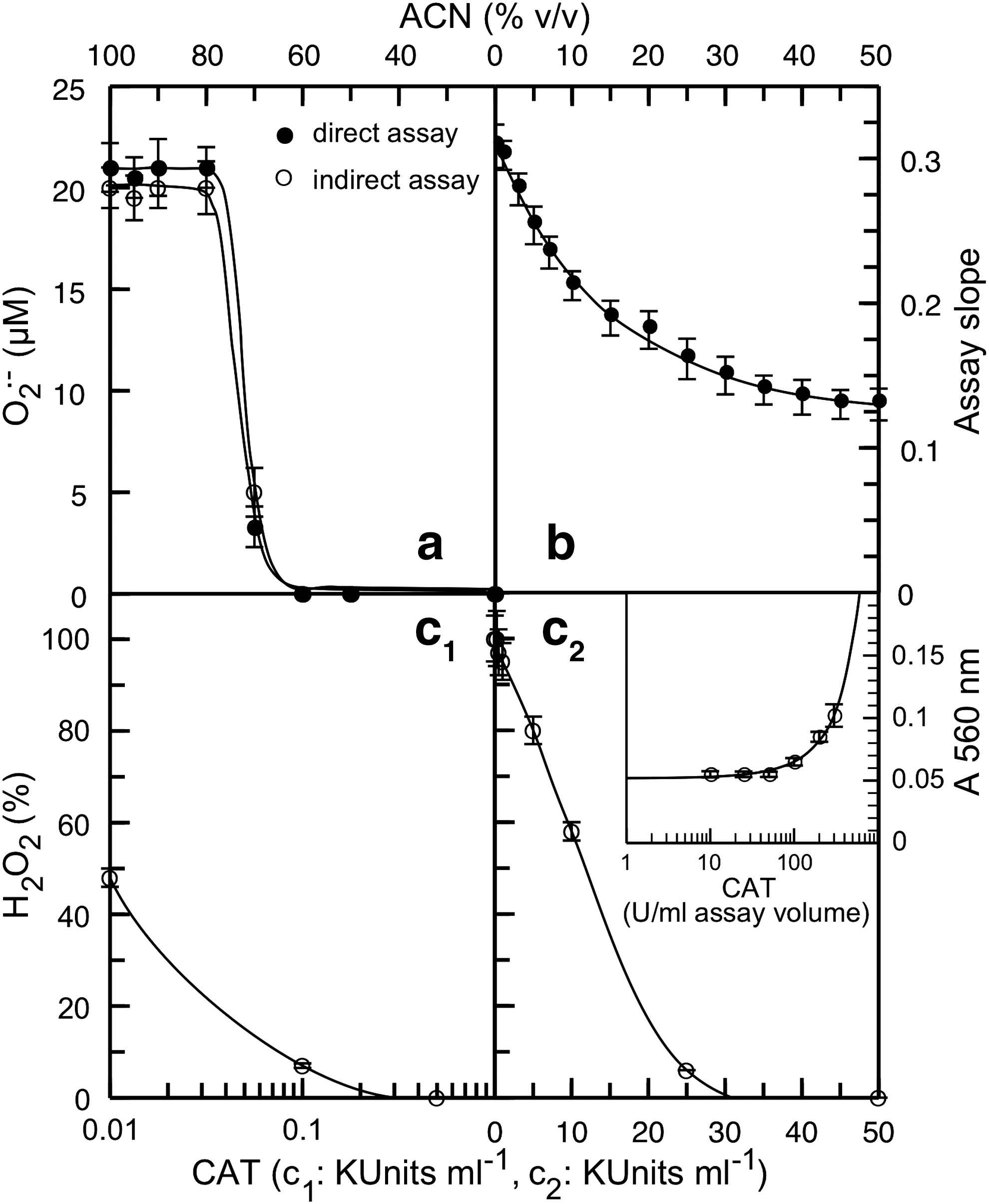
Parameters of the inorganic origin O2
•−/H2O2 assay: (
The effect of ACN-CE concentration on the superoxide-peroxide assay standard curve (0–2 μ M H2O2) was tested to determine the optimum assay sensitivity (i.e., the maximum standard curve slope for different ACNalk-CE extract concentrations). The slope is an exponential function of % ACN (Fig. 1b), with CE concentration not affecting the slope (tested to 8 mM). Based on the exponential function, the maximum slope to sample dilution factor ratio (0.13/2) is achieved at 50%. (For example, at 20% the slope to sample dilution factor is 0.17/5. Therefore, the optimum ACN concentration was chosen at 50% for performing the assay.)
The CAT activity in various concentrations of ACN was examined to verify its efficiency to decompose H2O2 over a range of incubation intervals (up to 10 min) and H2O2 concentrations (up to 2 mM). The results of this test verified that co-extracted O2 2- is removed from sample fraction 1, without loss of O2 •− (Fig. 1c 1). Since CAT heme iron may interfere with the assay, the optimum CAT units for the decomposition of H2O2 (at assay final 50% ACN, containing 10 mM phosphate buffer, pH 7.5) were determined. As control, CAT interference (at 50% ACN) was measured (as absorbance at 560 nm) in the absence of H2O2. Based on these results to minimize its heme iron interference, a maximum 30 units CAT (per milliliter assay mixture) was used in the assay (Fig. 1c 2).
Assay sensitivity was determined to be ∼70 pmol O2 •− and 35 pmol H2O2 co-extracted in 100% ACN (and determined at 50% ACN) and 14 pmol H2O2 when the assay is used only for H2O2 determination in H2O extracts of solid samples. The details of assay protocol used for peroxide and superoxide determinations are given in the Supplementary Materials.
2.4. Hydroxyl radical assay
Quantification of •OH is performed by a modification of a previous method (Georgiou et al., 2015). The method is based on the specific reaction of •OH with TPA in Na-borate buffer, pH 9, and the formation of the fluorescent product 2-hydroxy terephthalic acid (2HTPA) measured at 423 nm (311 nm excitation). Net peak emission fluorescence is obtained against the controls Na-borate-TPA and Na-borate-sample (at the highest tested concentration). Identification of •OH is performed by the inhibition of 2HTPA formation with the presence in a Na-borate-TPA assay solution of 100 mM DMSO, a well-known scavenger of •OH. The net fluorescence units (FU) of 2HTPA are converted to nanomoles of •OH by a standard curve (see the Supplementary Materials).
2.5. Effect of ClO2 − and ClO− on •OH standard curve
Since production levels of •OH are assessed indirectly by the production levels of 2HTPA, its quantification by the •OH assay may be underestimated due to its fluorescence quenching by the presence of possible oxidants such as ClO− and ClO2 −. These are well-known products of the radiolysis of metal perchlorate (Prince and Johnson, 1965; Paviet-Hartmann et al., 2001; Quinn et al., 2013); thus their possible presence in radiolyzed Mg(ClO4)2 alone/mixed with the Mars Phoenix site salt analogue may underestimate 2HTPA (thus •OH) production levels. The same 2HTPA oxidation issue will arise when assessing photolyzed ClO− and ClO2 − as potential sources of •OH. Another consideration arises from the fact that the actual molar ratio 2HTPA/•OH (the theoretical is 1:1) must be determined under the conditions of the •OH assay in order to estimate accurately the production levels of •OH. This is established by the construction of a standard curve of 2HTPA FU versus •OH under the same conditions for the •OH assay. Details of these tests are given in the Supplementary Materials.
2.6. NaClO solidification and heating: recovery
For investigating ClO− as generator of H2O2 and •OH (Table 3 and Fig. 4, respectively) in the solid form, as produced in radiolyzed Mg(ClO4)2, “solid” ClO− was formed by drying (evaporating) NaClO mixed with fumed silica. Recovery was determined after solidification and heating at 160°C for 3 h. It should be noted that NaClO solution upon drying produces—stable at ∼20°C to ∼50°C—the hydrated forms NaClO·5H2O and NaClO·2.5H2O (Elsenousy and Chevrier, 2014). Details of these tests are given in the Supplementary Materials.
2.7. Products from UVC-photolyzed ClO− and ClO2 −
ClO− and ClO2 − were photolyzed by UVC in order to study, under simulated martian topsoil UV exposure conditions, their conversion to Cl-based products, which could act as photolysis-induced generators of •OH (see subsequent experiment and Fig. 4). Experimental details are given in the Supplementary Materials.
2.8. Generation of •OH by radiolyzed Mg(ClO4)2 and the Mars Phoenix site salt analogue, and by metal peroxide analogues
Mg(ClO4)2, the Mars Phoenix salt analogue (with and without perchlorate; radiolyzed and nonradiolyzed), and commercial MgO2, CaO2, and Na2O2 were tested for •OH production (Tables 1 and 2), following the procedure of the aforementioned •OH assay.
2.9. •OH generation by UVA photolysis of ClO− and ClO2 −
Due to the very fast UVC photolysis of NaClO and NaClO2 (Fig. 3), ClO− and ClO2 − were investigated as potential sources of •OH under time-controlled UVA exposure (Fig. 4). Experimental details are provided in the Supplementary Materials.
2.10. Statistical analysis
All data are reported as mean ± standard error of at least three independent experiments and were analyzed with the SPSS statistical package (SPSS Inc., 2001, Release 11.0.0, USA). Whenever appropriate, the significance was determined for Student's unpaired t test or ANOVA. A value of P < 0.05 was considered to be significant.
3. Results
3.1. Superoxide and peroxide production by radiolysis of Mg(ClO4)2 and Phoenix salt analogue
Generation of O2 •− and H2O2 by radiolysis of Mg(ClO4)2 and the Phoenix salt analogues is shown in Table 1. O2 •− was detected only in the perchlorate-containing salt analogue at 1 nmol per 80 mg of analog sample (80 mg of salt sample corresponds to the measured salt content in 1 cc of regolith at the Phoenix site and contains 58.3 μmol ClO4 −). The same sample produced ∼2 nmol of H2O2. No O2 •− and 3.3-fold less H2O2 were measured in the sample after heating at 160°C for 3 h. H2O2 was also produced, at a level of ∼6 nmol per 58.3 μmol ClO4 −, by radiolyzing the pure Mg(ClO4)2, and was reduced by 61-fold by heating the sample. No H2O2 or O2 •− was measured in the radiolyzed salt mixture that did not contain perchlorate. In addition, no H2O2 or O2 •− production was measured in any of the three sample types if they were not irradiated (control samples).
Control experiments were run on metal peroxides MgO2, CaO2, and Na2O2 to verify the ability of the assay to quantify O2 •− and H2O2 and to determine whether they may be sources of H2O2 via hydrolysis (Table 2) if they are generated during radiolysis of Mg(ClO4)2 and/or the Phoenix site salt analogue (with and without perchlorate). Additionally, NaClO and NaClO2 were tested using the assay to determine whether they generate H2O2 (Table 3) because hypochlorite (ClO−) and chlorite (ClO2 −) are produced by radiolyzed perchlorate (Prince and Johnson, 1965; Paviet-Hartmann et al., 2001; Quinn et al., 2013).
H2O2 was measured in MgO2 and Na2O2 (unheated) ACNalk-CE extracts at levels of 0.029 and 0.064 mol %, respectively, which are comparable to the levels measured with radiolyzed Mg(ClO4)2 (0.011 mol %). H2O2 levels measured in CaO2 (unheated) ACNalk-CE extracts were 2.5- and 5.5-fold higher than those measured for Na2O2 and MgO2, respectively. H2O2 generation by MgO2, CaO2, and Na2O2 was decreased by heating them (at 160°C for 3 h) by 1.8-fold on average, while heating decreased H2O2 generation by radiolyzed Mg(ClO4)2 by 61-fold (Tables 1 and 2). The ACN-insoluble fractions of unheated and heated MgO2, CaO2, and Na2O2 produced much higher levels of H2O2 upon solubilization in ddH2O than the soluble fractions, with ddH2O-dissolved MgO2 producing the lowest levels (0.14 and 0.056 mol % unheated and heated, respectively; Table 2).
On the other hand, the ACNalk-CE-extracted unheated and heated (at 160°C for 3 h) controls NaClO2 and NaClO produced ∼80- and ∼150-fold higher H2O2 concentration levels (0.9 and 1.7% mol) than ACNalk-CE-extracted unheated radiolyzed Mg(ClO4)2, respectively (Tables 3 and 1). This is consistent with the fact that the levels of ClO2 − and ClO− in the radiolyzed Mg(ClO4)2 are only a small mole fraction of the sample. The concentration (% mol) of H2O2 as the sum of the ACN- and ACN/H2O-solid extract fractions for the unheated and heated NaClO (∼3) is almost 40% of that for the non-ACN-fractionated “liquid unheated,” “dry unheated,” or “dry heated” controls (Table 3), which suggests a less than 100% recovery during the ACN fractionation procedure.
The concentration of H2O2 produced by heating NaClO was determined in comparison to the fraction that was retained after heating. NaClO was solidified in fumed silica, and its recovery was measured after heating to test it as a solid-state generator of •OH upon UV exposure. Liquid NaClO was solidified in fumed silica by vacuum evaporation as described in Materials and Methods and in Fig. 4a 1. Recovery of ClO− by the solidification process (water removal at <50°C) was 55.6%, while after heating (for 3 h at 160°C) recovery was ∼3%. NaClO2 was heat stable.
3.2. •OH generated by radiolyzed Mg(ClO4)2 and Mars Phoenix site salt analogue: •OH assay and control experiments
Radiolyzed Mg(ClO4)2 produced ∼1 nmol •OH (0.0017 mol %) per 58.3 μmol ClO4 − when unheated. Interestingly, ∼7-fold higher levels were measured in the radiolyzed samples after they were heated. More importantly, both unheated complete and incomplete salt analogues produced a ∼150-fold higher concentration of •OH (149 and 147 nmol per 80 and 73.5 mg, respectively, corresponding to 1 cc martian soil). •OH production by the complete and the incomplete analogues decreased by an average of ∼2.5-fold when heated (Table 1). However, •OH production by the heated complete salt analogue (75 nmol; Table 1) was 33% higher than by the heated incomplete. The nonradiolyzed controls of all these samples did not produce •OH.
Hypochlorite (ClO−) and chlorite (ClO2 −) were investigated as possible sources of •OH in radiolyzed Mg(ClO4)2 and Mars Phoenix site salt analogue because they have been identified in the main radiolysis products of radiolyzed metal perchlorate [and Mg(ClO4)2] (Prince and Johnson, 1965). These were studied by using their corresponding analogues NaClO and NaClO2 in an extensive array of experiments designed to test the following: (i) whether NaClO and NaClO2 oxidize the fluorescent 2HTPA (Fig. 2) by which •OH is indirectly quantified, resulting in underestimation of •OH concentration; (ii) UV photolysis of NaClO and NaClO2 with the intent to study them as possible sources of Cl-based by-products (Fig. 3) under simulated martian UVC exposure conditions; and (iii) subsequently NaClO and NaClO2 as generators of •OH by a more time-controlled UV exposure (using the less energetic UVA) (Fig. 4).
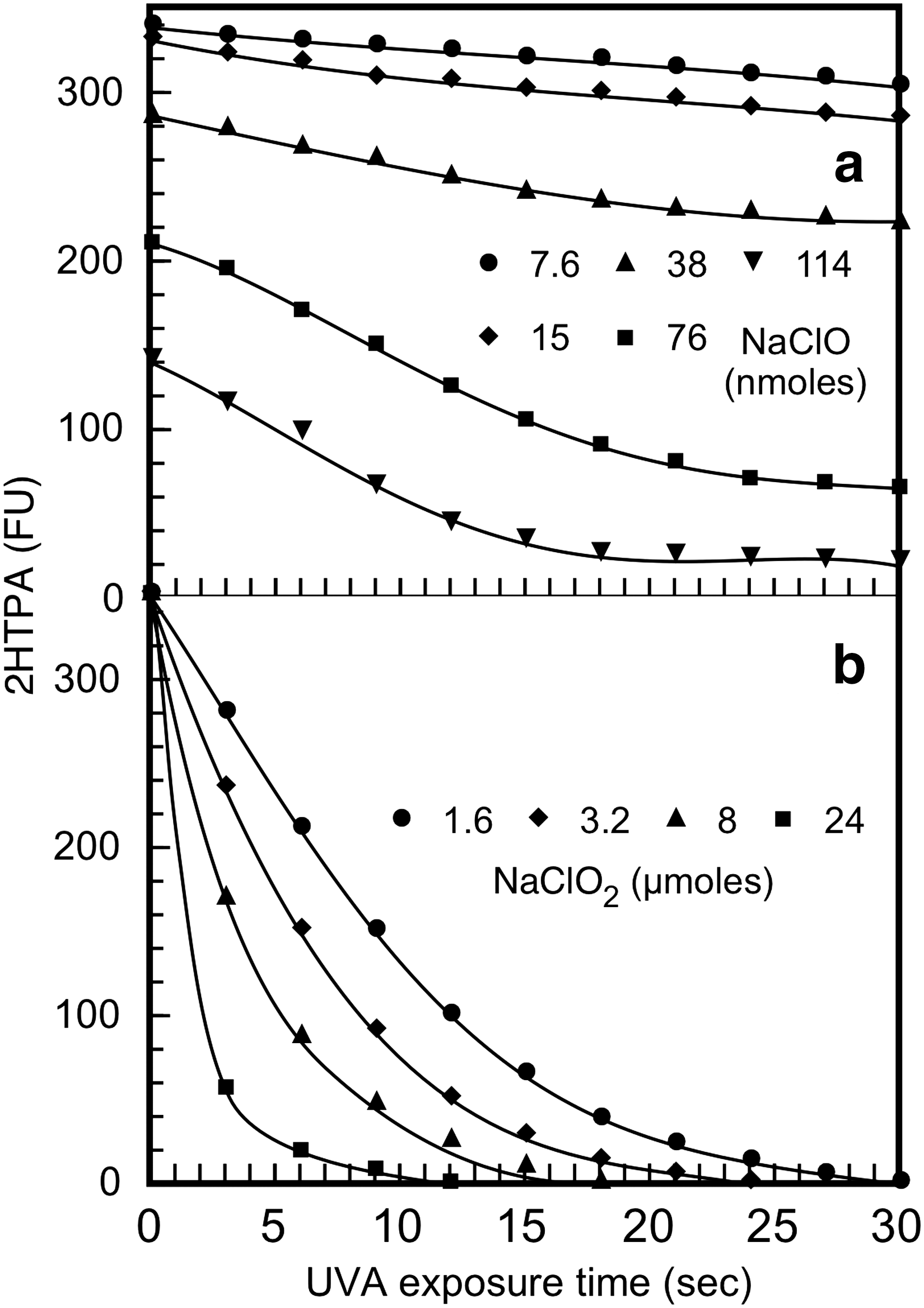
Effect of ClO− and ClO2
− on the •OH assay standard curve: The effect of NaClO (
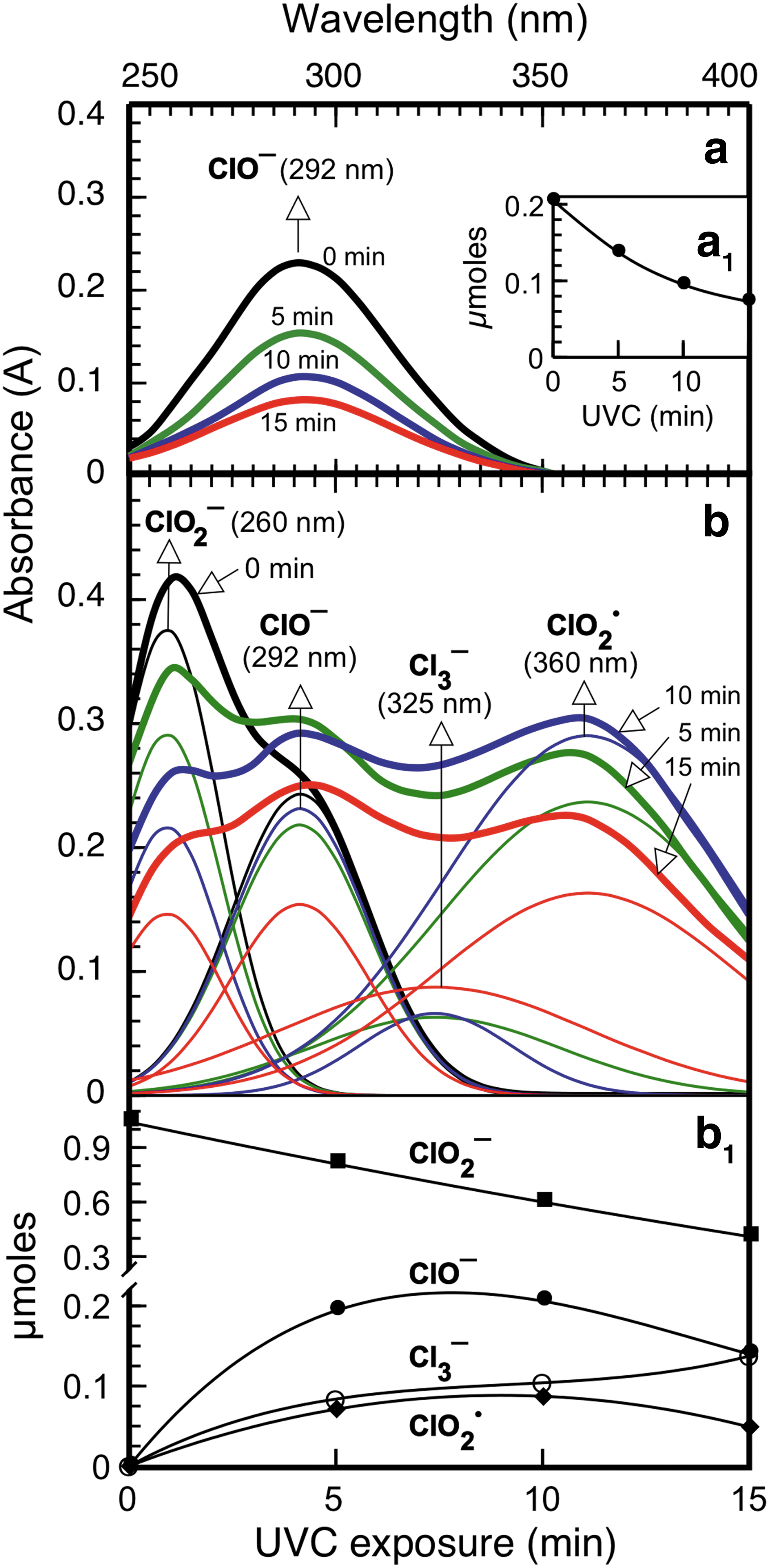
UVC photolysis products of NaClO and NaClO2: (
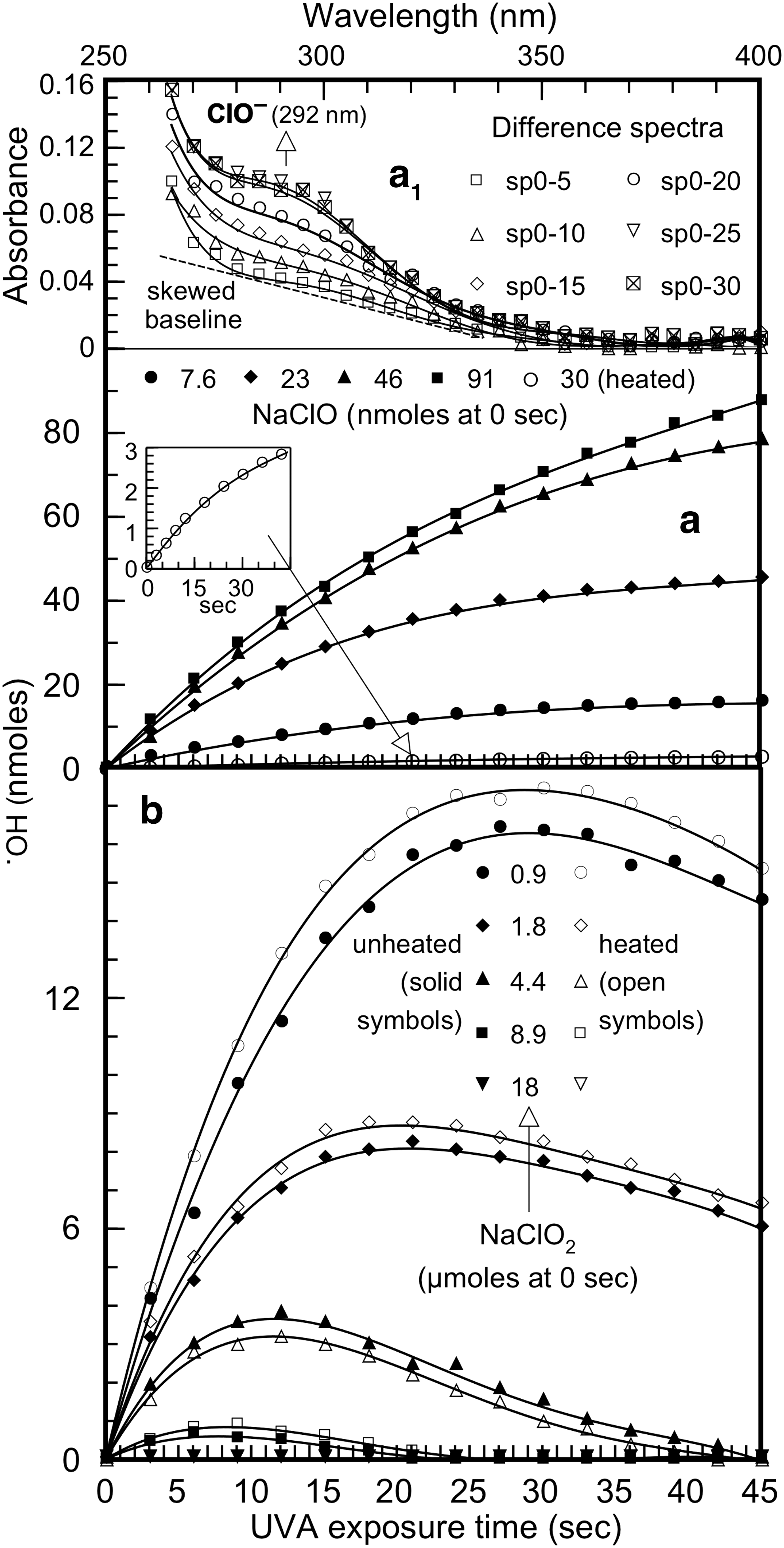
Hydroxyl radical generation by UVA photolysis of ClO− and ClO2
−: •OH is shown to be generated by their commercial analogues NaClO (
(i) It was found that both NaClO and NaClO2 oxidize 2HTPA. At 0 s UVA exposure, 7.5 and 38 nmol NaClO oxidize 2HTPA moderately. Higher concentrations oxidized to a much greater degree, resulting in an underestimation of •OH concentration by the employed assay. For example, 114 nmol NaClO decreased the initial 350 FU of 2HTPA to 150 FU (Fig. 2a). On the other hand, NaClO2 did not oxidize 2HTPA even at 1000-fold higher quantities (1.6 to 24 μmol), and is shown by the extrapolation of the UVA exposure 2HTPA FU curves, which cross the y axis at the initial 350 FU (Fig. 2b). However, the oxidative destruction of the HTPA FU by NaClO2 is evident as a function of UVA photolysis time. This is possibly due to the UVA-induced release of NaClO by photolyzed NaClO2 as is seen in UVC photolysis (Fig. 3b), and the concomitant production of •OH followed by its 2HTPA oxidizing effect (Fig. 4b and unpublished experimental observation). This is also supported by the increasing destruction of the initial FU of 2HTPA (at 0 s UVA exposure) by NaClO, as the concentration of the latter increases from 7.6 to 114 nmol (Fig. 2a). On the other hand, the destruction of 2HTPA FU by the UVA photolysis of NaClO becomes more profound at high NaClO concentrations (Fig. 2a) and is possibly due to the oxidation of 2HTPA by •OH (as it is shown to be produced at higher rates; Fig. 4a).
(ii) Possible UVC photolysis products of NaClO and NaClO2 were investigated spectrally under simulated martian UV exposure conditions (Fig. 3). It was found that NaClO decreased in concentration without producing any spectrally identified Cl-based species (Fig. 3a, 3a 1). On the other hand, NaClO2 was photolyzed to the Cl-based oxidants ClO− (292 nm), Cl3 − (325 nm), and ClO2 • (360 nm). The concentration changes of these species versus exposure time were determined by their known molar extinction coefficients (Paviet-Hartmann et al., 2001). The individual spectral peaks were resolved by the spectral peak deconvolution of the composite spectra, obtained at various UVC exposure-time intervals (5, 10, 15 min).
(iii) After investigations i and ii as described above, NaClO and NaClO2 were then tested for •OH generation under simulated martian soil UV exposure conditions. The aim was to uncover a possible mechanism of •OH generation based on the UVA photolysis of the radiolysis products of Mg(ClO4)2 (Fig. 4), which would complement its radiolysis mechanism for •OH production (shown in Table 1). Unheated and heated NaClO (i.e., solidified) and NaClO2 both produced •OH only upon photolysis by UVA (311 nm) at an increasing rate as a hyperbolic function of exposure time, which became horizontal to the x axis for NaClO at low concentrations (Fig. 4a). The fact that 30 nmol of heated NaClO produced •OH at a 25-fold lower initial concentration rate than the average concentration of the 23 and 46 nmol unheated NaClO may be attributed to the fact that the heated sample contained NaCl in an approximate concentration 4 M in the •OH assay 0.3 mL solution (for explanation, see the Supplementary Materials). Such high Cl− anion concentration is known to scavenge •OH (Liao et al., 2001). On the other hand, the rate curves for NaClO2 peaked and then declined over extended time exposure. This could be due to the possible production of the photolysis product NaClO (Fig. 3a), which oxidizes 2HTPA (Fig. 2).
4. Discussion
4.1. Methodological justification of the inorganic-origin superoxide/peroxide assay
Radiolyzed Mg(ClO4)2 and complete and incomplete Mars Phoenix site salt analogue were analyzed for generation of H2O2, O2 •−, and •OH (Table 1) and compared (i) to peroxide analogues based on the metal ions present the salt analogues and (ii) known perchlorate radiolysis product analogues. The assay used for analysis extracts both O2 •− and H2O2 from samples in an anhydrous alkaline ACNalk-CE (or ACNalk) solvent, which is then split into two fractions. Each fraction is then subjected to different reaction treatments in order to identify and quantify stable O2 •− and H2O2. The first fraction contains O2 •− that may be present in the sample as metal superoxides (extracted by metal cation dissociation using CE, and at the same time stabilized in the ACNalk solvent) or trapped inside mineral lattices, which is quantified as H2O2 upon dismutation. In the same fraction, the assay also determines sample peroxides (free or as metal peroxides). Although H2O2 is normally unstable at high alkaline pH, it remains stable at the ACNalk-CE solvent's mild alkaline pH (∼8) (Georgiou et al., 2016). Subsequent CAT treatment steps discriminate the H2O2 fraction attributed to O2 •− from that attributed to peroxides. The second ACNalk-CE solvent fraction also contains ACNalk-CE-soluble metal peroxides and superoxides, which are detected as H2O2 after hydrolysis and dismutation (in H2O), respectively. The ACNalk-CE fractionation step of the present assay proved to be advantageous for the Mg(ClO4)2 component because it is completely solubilized in the ACN solvent, which is crucial for the identification of the possible sources of O2 •− and H2O2.
4.2. Generation of H2O2 and O2 •− in radiolyzed Mg(ClO4)2 and the Mars Phoenix salt analogue
We find that the amount of H2O2 measured in radiolyzed Mg(ClO4)2 extracted with ACNalk-CE solvent is 3.3-fold higher (0.011%) compared to the ACN-extracted complete salt analogue (0.0033% H2O2). This suggests that in the salt analogue that contained Mg(ClO4)2, the O2 •− that forms may be stabilized by the Na+, K+, and Ca2+ that are present in the analogue. Supporting evidence for this O2 •− stabilization pathway comes from the low levels of H2O2 that are detected in the H2O extracts of the complete and the incomplete salt analogues (0.63 and 0.57 nmol, respectively) compared to Mg(ClO4)2 alone (6.27 nmol). It should be noted that no H2O2 was detected in the ACN extract of the radiolyzed salt analogue that did not contain perchlorate. This suggests that, if metal peroxides and/or superoxides originate from oxygen that may be released by the radiolysis of ClO4 − or SO4 2− in the analogue, they are not associated with the analogue ions Na+, Ca2+, and Mg2+ because MgO2, CaO2, and Na2O2 were shown to be partly soluble in ACN (Table 2). The CO3 2− component of the complete salt analogue may not play a role in the generation of metal peroxides and superoxides, since radiolysis of CO3 2− has been associated with the formation of the carbonate radical (•CO3 −) after CO3 2− (or HCO3 −) reaction with •OH radicals (Haygarth et al., 2010). On the other hand, H2O2 detected in the ACN extract of radiolyzed Mg(ClO4)2 could have resulted from the hydrolysis of MgO2 due to the fact that its concentration also decreases upon heating (Table 2).
H2O2 cannot be generated directly from irradiated Mg(ClO4)2 simply because it lacks protons, although, if present, trace water could be a source of protons. However, H2O2 is produced during aqueous radiolysis of perchlorate (Konstantatos and Katakis, 1967), most likely from the dismutation of free O2 •− and not through the hydrolysis of metal peroxides, because they (e.g., MgO2) do not form under aqueous conditions without preexistence of H2O2. H2O2 produced by radiolyzed Mg(ClO4)2 and the complete salt analogue may not have derived solely from the radiolysis products ClO2 − and ClO−, because controls NaClO2 and NaClO produce ∼80- and ∼150-fold higher concentration levels of ACNalk-CE-extracted H2O2, respectively, than unheated radiolyzed Mg(ClO4)2 (Table 3). On the other hand, the high levels of H2O2 produced by control NaClO as compared to those produced by radiolyzed Mg(ClO4)2 suggest that the minor fraction of the initial ClO− that survived heating in radiolyzed Mg(ClO4)2 may explain the low levels of H2O2. Assuming that radiolyzed Mg(ClO4)2 produces ClO− at same concentration as Ca(ClO4)2, which is a reasonable assumption given they have the same G° value for ClO− (0.03) (Prince and Johnson, 1965; Quinn et al., 2013), the ClO− in radiolyzed Mg(ClO4)2 that survived heating corresponds to 0.43 nmol. Based on the 1.7 mol % H2O2 produced by NaClO (Table 3), 0.43 nmol of ClO− would be expected to produce 0.007 nmol H2O2, which is 14-fold lower than the experimentally measured value (0.1 nmol; Table 1). This difference in H2O2 production by radiolyzed Mg(ClO4)2 may be attributed to contribution by ClO2 −, which is thermally stable. Given that the Mg(ClO4)2 G° value for ClO2 − production is 0.14 (Prince and Johnson, 1965), this would correspond to the production of ∼80 nmol ClO2 − in the analogue; and considering the production of 9 nmol H2O2 per 1 μmol NaClO2 (Table 3), the assumed 80 nmol ClO2 − in heated radiolyzed Mg(ClO4)2 will produce ∼0.7 nmol H2O2, which is 7-fold higher than the experimentally measured value (0.1 nmol; Table 1).
Considering that 6.27 nmol H2O2 was produced by 6.5 mg radiolyzed Mg(ClO4)2, the actual 82 mg sample that was dissolved in 1.6 mL ACNalk-CE to determine experimentally this value corresponds to 50 μ M H2O2. On the other hand, the maximum concentration of commercial MgO2 dissolved in ACNalk-CE was 5.6 μ M (data not shown); thus, the same concentration of H2O2 would have been produced from its hydrolysis reaction [MgO2 + 2H2O → Mg(OH)2 + H2O2]. The ∼9-fold higher concentration of H2O2 being produced by radiolyzed Mg(ClO4)2 may suggest the following: (i) either the radiolysis-generated MgO2 is more readily dissolved if present in the crystal lattice of radiolyzed Mg(ClO4)2 (which was found to be readily dissolved in ACN) or (ii) H2O2 comes from a Mg-superoxide form such as Mg(O2)2 [its crystal structure has been identified (Bakulina et al., 1970)], which may also be equally ACN soluble, or (iii) both.
It has been suggested that radiolyzed ClO4 − decomposes mainly to chlorate ions (ClO3 −) and O atoms either as aqueous solution (Katakis and Allen, 1964) or in solid form (Prince and Johnson, 1965). During the radiolysis of ClO4 −, production of ClO3 − and ClO2 − appears to involve oxidation of hypochlorous acid (HOCl) or chlorous acid (HClO2) via direct electron transfer, followed by reaction of the resulting chlorine monoxide (ClO•) or chloroperoxy radical (ClOO•) with •OH (Hubler et al., 2014). Moreover, ClO2 − acts as redox couple with the other radiolysis product ClO2 •, via 1 e− reduction (Stanbury and Lednicky, 1984) by, for example, •OH [ClO2 − + •OH → ClO2 • + OH− (Klaning et al., 1985)] or O2 •− [ClO2 • + O2 •− → ClO2 − + O2 (Huie and Neta, 1986)].
The source of residual O produced by radiolyzed perchlorate has been thought to be initially associated with ClO2 in the ClO4 − ion and is not all available as gaseous O2. Considerations of electrical neutrality would favor the simultaneous formation of a metal superoxide [thus O2 •−, being in the form of, e.g., Mg(O2)2 (Bakulina et al., 1970)], peroxide (e.g., as MgO2), or oxide (e.g., as MgO) by the oxygen of ClO2 (Prince and Johnson, 1965). HO2 • and H2O2 generated by O atoms detached from radiolyzed aqueous ClO4 − (resulting in the formation of ClO3 −), presumably reduced via H attack, have been indirectly identified (using ions of iron, cerium, and thallium as scavengers) (Katakis and Allen, 1964; Katakis and Konstantatos, 1968). Another route for O2 •− formation may be initiated by photoisomerization of ClO2 • and its conversion to chloroperoxyl radicals (ClOO•) (Arkell and Schwager, 1967; Raghunathan and Sur, 1984). These upon reaction with Cl• can be converted to chlorine monoxide radical (ClO•, via the reaction ClO2 • + Cl• → 2ClO•) (Enami et al., 2006), which, in turn, can react with •OH and generate protonated superoxide radicals via the reaction ClO• + •OH → HO2 • + Cl• (Chang et al., 2004), and recycle Cl• for further production of O2 •−. Moreover, H2O2 can react with •OH and generate protonated superoxide radicals via the reaction H2O2 + •OH → HO2 • + H2O (Christensen et al., 1982; Wang et al., 2012). Other indirect mechanisms for H2O2 production could involve •OH and O2 •−, both shown to be produced by radiolyzed ClO4 − (Table 1), by •OH fusion [•OH + •OH → H2O2 (Lutze et al., 2015)], and by dismutation of O2 •−, protonated or not [2HO2• → 2H2O2 + O2 (Kurylo et al., 1986) or 2O2 •− + 2H2O → 2OH− + H2O2 + O2 (Georgiou et al., 2015)].
Given that H2O2 was produced by both controls NaClO2 and NaClO (Table 3), there could also be indirect sources of H2O2 that may produce it upon reaction with the various Cl-based products of perchlorate radiolysis such as ClO2 − and ClO−, free or both complexed with Mg [Mg(ClO2)2·6H2O (Villars et al., 2011) and MgClO (since thermally stable Mg+ compounds are possible (Green et al., 2007)), respectively].
Another possible source of O could have been either the radiolyzed CO2 (CO2 → CO + O) (Lind and Bardwell, 1925; Harteck and Dondes, 1955; Watanabe et al., 2007) that is present in the glass ampule of the radiolyzed samples, or the SiO2 of the glass ampule itself. However, neither of these sources produced O that could react with the radiolyzed incomplete salt analogue and produce traceable ROS, because this salt analogue did not generate O2 •− or H2O2 (Table 1). Moreover, the positive holes created in silica by γ radiation are irreversibly neutralized by H2 (giving its characteristic color as they absorb at 320 and 530 nm) (Ogura et al., 1974).
4.3. •OH generation by radiolyzed Mg(ClO4)2 and Phoenix site salt analogue
Another important finding of the present study is that the Phoenix site salt analogue acts as a source of •OH only upon γ radiolysis. Interestingly, •OH is produced at quite high and near equal levels in the absence and presence of ClO4 −, and it is still produced upon heating in both cases, although decreased by an average 2.5-fold (Table 1). On the other hand, the 6.9-fold increase in •OH production by heated radiolyzed Mg(ClO4)2 compared to an unheated one suggests the generation in radiolyzed Mg(ClO4)2 of certain products that may act as scavengers of •OH. These products may be destroyed/modified and neutralized from reacting with •OH (as they may do in the unheated sample, thereby decreasing its generated •OH levels). Considering the possible sources of •OH produced by the complete and the incomplete salt analogue, its ∼150-fold-high levels when compared to the 1 nmol •OH produced by radiolyzed Mg(ClO4)2 suggest a minor contribution (∼0.7%) by the ClO4 − portion in the complete salt analogue in the production of •OH. It is proposed that the production of almost all •OH by the salt analogue (±ClO4 −) is likely to be associated with the possible radiolysis of its SO4 2− component. A possible mechanism may involve the production of sulfites (SO3 2; together with elemental sulfur and sulfides), which can derive from SO4 2− either in the presence of water ice [e.g., in Europa (Carlson et al., 2002)] or being in solid form [e.g., Li2SO4 (Sasaki et al., 1978)]. Sulfites could then generate •OH (i) via oxidation by H2O2 (Shi, 1994; Shi et al., 1994) detected in the present study [and also present on Mars (Encrenaz et al., 2012)] or (ii) by autoxidation (together with sulfur trioxide anion radical, SO3 •−, generation) (Huie, 1986) in the presence of O2 and H2O [both also present on Mars, the first being possibly produced by radiolysis of perchlorate (Prince and Johnson, 1965; Quinn et al., 2013)]. Given the presence of SO4 2− at 134 nmol in 80 mg complete salt analogue (Quinn et al., 2011), this concentration is comparable to the 149 nmol •OH it generates upon radiolysis (Table 1). The other prone to radiolysis salt analogue component CO3 2− is an unlikely source of •OH because they react with each other to generate •CO3 − radicals (Haygarth et al., 2010).
On the other hand, the minor contribution (0.7%) of •OH due to the presence of ClO4 − in the complete salt analogue could have originated from the reaction of O2 •− with H2O2 [O2 •− + H2O2 → •OH + OH− + O2 (Georgiou et al., 2015)], both shown to be products of the radiolyzed complete salt analogue. This reaction may contribute to the release of O2 by the H2O-wetted radiolyzed perchlorate (Prince and Johnson, 1965; Quinn et al., 2013). Although O2 •− was not detected to be produced by radiolyzed Mg(ClO4)2 (but H2O2 was detected), its generation cannot be excluded because, as already mentioned, the generation of metal superoxides from γ-irradiated alkali and alkaline Earth perchlorate [and Mg(ClO4)2] has been predicted (Prince and Johnson, 1965). Therefore, these metal peroxidants upon H2O wetting (thus dismutation) can become the source of the detected H2O2 (Table 1). Production of •OH by the reaction between ClO− and H2O2 at alkaline conditions (ClO− + H2O2 → ClO• + •OH + OH−) has also been suggested (Castagna et al., 2008), but it does not seem to be the main mechanism because we were unable to demonstrate this using NaClO and H2O2.
Given the oxidizing effect of NaClO2 and NaClO on 2HTPA (Fig. 2), the indirect quantifier (and trap) of •OH, the question arises whether ClO2 − and ClO− [expected radiolysis products of ClO4 − (Prince and Johnson, 1965)] will affect the quantification of •OH produced by the radiolyzed Mg(ClO4)2 and the complete salt analogue. Assuming that the radiolysis of 58.3 μmol ClO4 − [as Mg(ClO4)2] generates ClO2 −, ClO−, and ClO2 • at mol % concentration levels near equal to their G° values [0.14, 0.03, and 0.07, respectively (Prince and Johnson, 1965)], these would correspond to approximately 80, 17, and 40 nmol, respectively, per 6.5 mg radiolyzed Mg(ClO4)2. Since •OH production by the radiolyzed Mg(ClO4)2 alone and by the radiolyzed complete salt analogue was determined by the present study in these samples at a 1–10 mg quantity range, their corresponding concentration in ClO2 − and ClO− would not have oxidized 2HTPA substantially (Fig. 2) enough to have caused an underestimation of the actual concentration of •OH. The oxidizing effect of ClO2 • (the other presumed radiolysis product of ClO4 −) on 2HTPA cannot be quantitatively assessed in the radiolyzed samples by commercial control analogues. However, it can be assumed to be minor due to the low (0.07) G° value of ClO2 •.
4.4. Photolyzed ClO− and ClO2 − as potential sources of •OH, and its main generation mechanisms
Having established that •OH is generated at high levels by radiolyzed Mars Phoenix site salt analogue (with and without perchlorate), the present study investigated a possible photogeneration mechanism for •OH production by the ClO4 − radiolysis products ClO− and ClO2 under simulated martian soil UV exposure conditions. Generation of •OH was studied on NaClO and NaClO2 by exposing them to low-UV-energy (thus time-controlled) photons (using UVA at flux density of 20 μW cm−2 up to 0.75 min exposure; Fig. 4), after having uncovered their oxychlorine products by UVC exposure at 1575 W m−2 up to 5 min exposure (Fig. 3). These doses are ∼200-fold lower and 120-fold higher than the corresponding ones (41.5 and 13.2 W m−2) that reach the surface of Mars at zenith angle 0° (Cockell et al., 2000). Both NaClO and NaClO2 produced •OH at rates dependent on their concentration and UVA-photolysis exposure time period (Fig. 4). Production of •OH by NaClO2 is attributed to photolysis of UV-generated ClO− (Fig. 3).
In hypothesizing the possible mechanisms of •OH generation by ClO4 −-oxychlorine radiolysis products, the accuracy of measured •OH was evaluated in relation to possible interfering factors. One factor is the possible oxidative effect of NaClO2 and NaClO on 2HTPA fluorescence by which •OH is indirectly quantified. It was concluded that this effect is insignificant at the low concentration levels of NaClO2 and NaClO and short UVA exposure times studied (Fig. 2). Another possible factor affecting the actual production of •OH by UV-photolyzed NaClO2 could be the direct involvement of •OH in the production of Cl3 − (a UVC photolysis product of NaClO2; Fig. 3) shown in Table 4. Another important factor is the accuracy of the 2HTPA-based •OH standard curve used by the assay.
The involvement of the UV-photolyzed radiolysis products of perchlorate [at decreasing concentration sequence ClO3
−, O2, Cl−, ClO2
−, ClO−, and ClO2
• (Prince and Johnson, 1965)] in the production of •OH requires an understanding of the photolysis and interconversion reactions involved, some of which release •OH and others O2 (Table 4). However, the most probable photolysis-induced •OH production mechanism involves HOCl or ClO− (Reactions 1a or 1b, the latter via the formation of an atomic oxygen radical anion, O•−, intermediate) (Wang et al., 2012), and/or ClO3
− (Reaction 2) (Osiewała et al., 2013), as shown by the following corresponding reaction pathways:
The stoichiometry of the above reaction pathways predicts generation of 1 mol •OH by 1 mol photolyzed ClO−. However, our experiments with photolyzed NaClO showed that 7.6 and 23 nmol produced •OH concentration plateaus at 16 and 45 nmol, respectively, which corresponds to a ClO−/•OH 1/2 molar stoichiometry (Fig. 4a). This finding can be explained by involving the reactions of the other photolysis product •Cl (Cl atom) with H2O or OH− (Reaction 3a or 3b) (Lutze et al., 2015), and HO2
• (Reaction 4) (Chang et al., 2004), which will produce the second mole of •OH required for the ClO−/•OH molar ratio 1/2:
In turn, Cl• and •OH may be involved in reactions with the radiolysis products of perchlorate (Table 4).
4.5. Soil ROS on Mars
The present study suggests that martian topsoil is a continuous source of ROS generated by cosmic radiolysis and by a parallel UVA/C photolysis of ClO2 − and ClO−, both products of the cosmic radiolysis of ClO4 −. The ClO4 − radiolysis-H2O-wetting-induced ROS generation mechanism (Fig. 5) originates from a Mars soil salt analogue (Phoenix site). This phenomenon may take place in parallel with another independent generation mechanism of soil ROS (O2 •−, H2O2, and secondarily •OH), by UV-induced electron ejection from soil mineral oxides and its subsequent trapping by O2 as O2 •− (Georgiou et al., 2015), which is either released directly by radiolyzed ClO4 − (Quinn et al., 2013) or produced indirectly by the dismutation of O2 •− that is also generated by radiolyzed ClO4 − (Fig. 5).
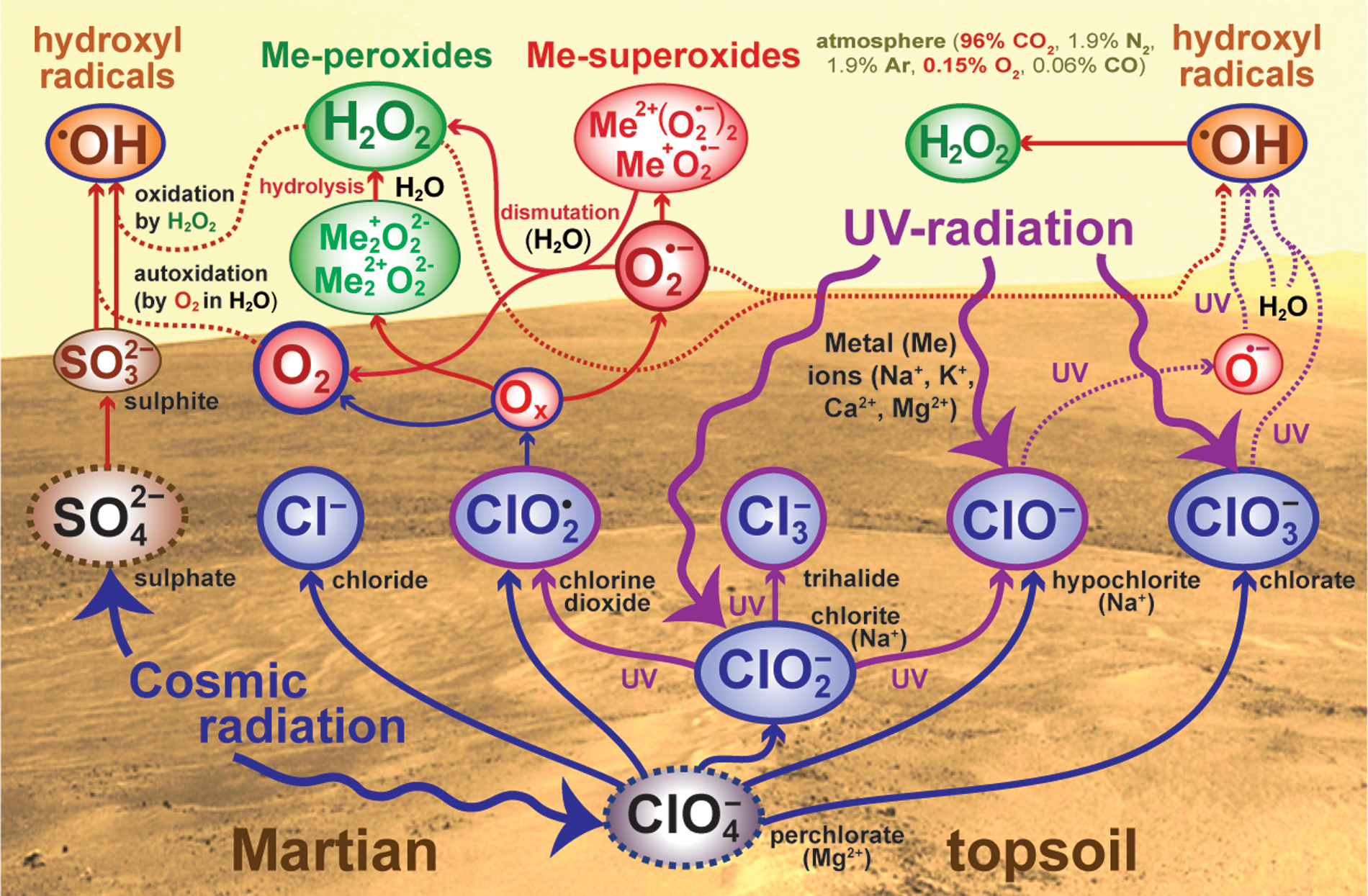
Mechanisms of ROS generation by perchlorate and Mars Phoenix site salt analogue exposed to cosmic/UV radiation. Cosmic (γ) radiation decomposes perchlorate to ClO3 −, O2, Cl−, ClO2 −, ClO−, and ClO2 • (in a G° value decreasing sequence) (Prince and Johnson, 1965), shown by solid arrows. Part of released residual O x , associated with ClO2 in the ClO4 −, is matrix-trapped as gaseous O2, while the other part is converted to O2 •− (shown to be generated by the radiolyzed Mars Phoenix site complete salt analogue; Table 1), which in the presence of martian salt metal ions (Me) would favor the simultaneous formation of metal superoxides and peroxides (Katakis and Allen, 1964; Prince and Johnson, 1965; Katakis and Konstantatos, 1968). O2 •− (free and present in metal superoxides) could dismutate to O2 (an additional source of oxygen) and H2O2 (that could be also released by the hydrolysis of metal peroxides), which could then react with each other to generate •OH (Georgiou et al., 2015). Cosmic radiation could also radiolyze the salt analog component SO4 2− to the intermediate sulfite, SO3 2−, which upon oxidation by H2O2 (Shi, 1994; Shi et al., 1994) or autoxidation (Huie, 1986) in the presence of H2O and O2 (released, e.g., by radiolyzed ClO4 −) will generate •OH (as shown with the incomplete salt analogue, Table 1). Simultaneous UV photolysis of the ClO4 − radiolysis product ClO2 − produces additional ClO− and ClO2 •, and also Cl3 − (Fig. 3) as shown with dotted arrows. Then, upon UV photolysis, ClO− (and ClO2 − via ClO−; Fig. 4) as well as ClO3 − in the presence of H2O will generate •OH (ClO− via the intermediate atomic oxygen radical anion, O•−), 2 mol of which can combine to produce 1 mol of H2O2.
The production of •OH and H2O2 by radiolyzed ClO4 − may contribute to the oxidative alteration of organics present in martian surface material. CO2 can be produced by the reaction of organics with either H2O2 or •OH. H2O2 can decompose carbohydrates to formic acid and ultimately to CO2 (Payne and Foster, 1945), while •OH can produce CO2 through various oxidation reactions with organics [e.g., with methanol (Gehringer et al., 1988; Munter, 2001) and with the products of oxidized organics carboxylic acids such as fumaric acid (Shi et al., 2012)].
Considering the seasonality of the hydrated perchlorate-associated recurring slope lineae phenomenon (Ojha et al., 2015) and the consequent periodic hydration of the ROS generating γ-radiolyzed/UV-photolyzed oxychlorine compounds and UV-radiated soil mineral oxides over short timescales, this raises the question of the potential lifetime of these ROS when wet. In such a case, ROS lifetime may be short and may not be an issue for habitability. On the other hand, surface water flows would also be exposed to UV when wet, which should generate ROS, perhaps indicating poor preservation potential. Analyses of the martian surface performed with the SAM instrument on the Mars Science Laboratory have established the presence of significant quantities of organic matter (Ming et al., 2014; Freissinet et al., 2015). However, the chemical identities of the parent organic compounds present in the tested samples are obscured due to a thermal decomposition process induced by the presence of perchlorate (Ming et al., 2014; Freissinet et al., 2015). This points to the need for consideration of sample analysis methods in future missions. Although levels of ROS are expected to be low in comparison to perchlorate, sample cleanup processes (e.g., solid phase extraction) or non-aqueous chemical derivatization may be required in the future prior to implementation of thermal or aqueous-based analysis methods. Additionally, analytical methods planned as part of the Mars Organic Molecule Analyzer (MOMA) on the upcoming ESA ExoMars mission include laser desorption mass spectroscopy (LDMS), which has been shown to be capable of the detection of trace organics in perchlorate-containing Mars analogues (Li et al., 2015) and likewise should be compatible with the detection of organics in the presence of ROS-containing martian soils. The other instrument suitable for detection of organics, planned for the NASA Mars 2020 mission, is the Scanning Habitable Environments with Raman and Luminescence for Organics (SHERLOC) (Beegle et al., 2014). SHERLOC uses a deep UV resonance Raman and fluorescence spectrometer utilizing a 248.6 nm deep UV laser for noncontact sample analysis. The technique may modify organics by inducing reactions with oxychlorine species (Beegle et al., 2014). In light of the present study, modification of organics by ROS generated by UV irradiation of oxychlorine products may not be excluded. Moreover, UV bleaching may also be of concern.
The present study could partly explain the finding by the Curiosity rover of high Mn abundances (>25 wt % MnO) in fracture-filling materials that crosscut sandstones in the Kimberley region of Gale Crater of Mars (Lanza et al., 2016), because their proposed accumulation as Mn-oxide deposits on Earth environments requires water and highly oxidizing conditions. The latter can be provided on Mars by the radiation-driven formation of ROS in the oxychlorine compounds of topsoil. Another possible source of ROS could be provided by the soil superoxides/peroxides that are possibly generated on Mars by the UV-irradiated topsoil, as they can be generated on Earth by UV-exposed arid desert soils (Georgiou et al., 2015). The latter alternative ROS source and the fact that not all radiated oxychlorine products could produce ROS (Fig. 5) can explain the reported lack of correlation between Mn and the element Cl (Lanza et al., 2016).
The impacts and distributions of ROS on the surface of Mars can be addressed in more specific terms by field instrumentation for the in situ detection and quantification of the metal superoxides (O2 •−) and peroxides (H2O2) present in martian topsoil. A methodology for the development of such an instrument is already available and is based on the enzymic/non-enzymic conversion of O2 •− and H2O2 to stoichiometric O2 (g) and, thus, their quantification by an O2 electrode (Georgiou et al., 2016).
To more faithfully recreate the cosmic ray particle bombardment onto the martian surface and near subsurface, similar irradiation experiments are planned using electron and proton bombardment combined with X-ray photoelectron spectroscopy analysis. For a more accurate simulation of martian soil, the Phoenix site salt analogue could be mixed with iron oxides, other oxides, and other expected soil components (e.g., clays), which would likely affect the production (and chemistry) of the oxychlorine radiation-generated ROS. This is supported by the ∼6-fold decreased rate of •OH generation by H2O extracts of desert soil compared to its absence (Georgiou et al., 2015), possibly due to the scavenging action of metal (Me) ions [•OH + Me n+H2O → Me n+OH → Me(n+1)+ + OH− (Buxton et al., 1988)].
4.6. Relationships to the Viking LR and GEx experiments
Our results show that radiolysis of Mg(ClO4)2 in a 7 torr CO2 atmosphere produces peroxide, but not superoxide. •OH is also produced presumably due to trace amounts of water associated with the Mg(ClO4)2 sample. Heat treatment of the sample prior to analysis resulted in a >98% decrease in peroxide concentration and a corresponding increase (number of moles) in •OH. In the Viking GEx experiments, the production of 70–700 nmol of O2 (g) was measured when martian surface samples were humidified or wetted (Oyama and Berdahl, 1977). The total quantity of ROS sum (O2 2−, O2 •−, and •OH) measured in the irradiated (500 kGy) Mg(ClO4)2 (without Phoenix salt analogue) in this study totaled ∼7 nmol. However, the 1 nmol of •OH measured is not an accurate representation of the •OH content. The reason for this is that •OH is indirectly quantified (via scavenging by TPA). Therefore, we estimate (data not shown) that the level of •OH in the sample is ∼30 nmol and that the total quantity of ROS in the sample is closer to the lower end of the range of O2 (g) levels observed in the Viking GEx experiment (70–700 nmol), assuming similar levels of perchlorate at both the Viking and Phoenix sites. Importantly, the amount of ROS (primarily •OH) measured in the Phoenix salt (without perchlorate) analogue was within the range of O2 (g) levels. Along with the observed thermal stability, this points to the likely extensive formation of ROS on the surface of Mars across diverse mineral matrices, which suggests that there may be additional sources of oxygen [e.g., SO4 2−, soil mineral oxides (Georgiou et al., 2015)] that may have contributed to the GEx O2 (g) releases. It should be noted, though, that the kinetics of O2 (g) formation from •OH humidification or wetting was not examined in the present study. Additionally, the amount of ROS measured in our experiments represents only a small fraction of the total free oxygen produced by perchlorate radiolysis. The ROS mol % fraction measured relative to total Mg(ClO4)2 in the current study was 0.01. In contrast, Quinn et al. (2013) measured a 1 mol % fraction of O2 (g) released from irradiated (500 kGy) Ca(ClO4)2 upon sample wetting. The expected total amount of free oxygen produced in the γ-irradiated Mg(ClO4)2 examined in this study is ∼2 μmol, based on a G° value of 2.62 (Prince and Johnson, 1965), which correlates to a measured ROS mol % fraction of 0.4 (relative to the expected total oxygen production measured as O2). While this may imply that ultimately the majority of oxygen produced by perchlorate radiolysis is stabilized and trapped in, or released from, the perchlorate as O2 (g), our results suggest that radiolysis pathways dictate that the formation of O2 (g) occurs via ROS metastable intermediates, which ultimately form, and coexist, with trapped O2 (g). The significance of this is that the ROS formed during radiolysis of martian surface materials may not only serve as the soil O2 precursor that ultimately was measured as O2 (g) in the Viking GEx experiment, but also, due to their high reactivity, likely act to chemically alter both the mineral and organic fractions of martian surface materials in situ.
In the Viking LR experiments, when 0.5 cc of surface soil material was wetted with an aqueous nutrient media that contained 14C-labeled organics, ∼30 nmol of 14C-labeled gas (presumably 14CO2) was released into the LR test cell headspace (Levin and Straat, 1977). Table 1 shows that the levels of H2O2 and O2 •− produced in our experiments were lower than the ∼30 nmol 14C-release observed in the Viking LR, but more importantly these samples were not tested to demonstrate that they reproduced the kinetics of the LR 14C-gas release. Production of •OH in the irradiated Phoenix salt analogues (both with or without perchlorate) can be discounted as a possible explanation of the LR experiment due to its thermal stability. However, assuming that production of low levels of H2O2 by heated radiolyzed Ca(ClO4)2 is similar to those produced by heated radiolyzed Mg(ClO4)2 (61-fold decreased H2O2 production of heated over unheated; Table 1), these very low H2O2 levels (and possibly low levels of •OH) may contribute to CO2 production, although not at levels seen in the Ca(ClO4)2 radiolysis study (Quinn et al., 2013) that resulted from the formation and spontaneous decomposition of chloroaniline.
An important finding of the current study is the reduced recovery (55.6%) of ClO− after heating NaClO (water removal at 20–50°C) and a 97% reduction in ClO− recovery after heating NaClO for 3 h at 160°C). Levin and Straat (2016) pointed out that Quinn et al. (2013) did not attempt to demonstrate that hypochlorite matches the observed thermal stability profile of the LR oxidant. In the Viking LR experiment, the magnitude of the 14CO2 release was reduced by ∼70% when heated to 46°C for 3 h and was nearly completely eliminated when heated to 51°C for 3 h. Although the current results do not offer a perfect match to the Viking LR, these experiments were not designed to be a rigorous test of LR results. The results do show, however, that the thermal stability profile of NaClO is in the range of what was observed in the LR experiment. Further experiments are planned to characterize the thermal stability of hypochlorite and other oxychlorine species in the context of the LR experiments.
5. Conclusions
The present study shows that γ-radiolyzed Mg(ClO4)2 alone generates H2O2 and hydroxyl radicals (•OH) upon H2O wetting. On the other hand, the γ-radiolyzed complete Mars Phoenix site salt analogue [containing Mg(ClO4)2] generates O2 •−, H2O2, and •OH, the latter at 150-fold higher concentration than that generated by Mg(ClO4)2 alone. Radiolyzed Mars Phoenix site salt analogue depleted of Mg(ClO4)2 generates only •OH, at 150-fold higher concentration than by Mg(ClO4)2 alone, and at equal concentration with the complete Mars Phoenix site salt analogue, suggesting the radiolyzed salt analog component SO4 2− as the most probable source of •OH. Perchlorate γ-radiolysis product chlorite (ClO2 −) under UV exposure and upon H2O wetting generates the oxychlorine products trihalide (Cl3 −), chlorine dioxide radical (ClO2 •), and hypochlorite (ClO−), with the latter acting as •OH source when UV photolyzed and upon H2O wetting.
Footnotes
Acknowledgments
The Greek Ministry of Education financially supported this work. R.Q. acknowledges the support of the NASA Astrobiology Institute.
Author Disclosure Statement
No competing financial interests exist.
Abbreviations Used
References
Supplementary Material
Please find the following supplemental material available below.
For Open Access articles published under a Creative Commons License, all supplemental material carries the same license as the article it is associated with.
For non-Open Access articles published, all supplemental material carries a non-exclusive license, and permission requests for re-use of supplemental material or any part of supplemental material shall be sent directly to the copyright owner as specified in the copyright notice associated with the article.
