




Abstract
Since Earth's biochemistry is carbon-based and water-borne, the main strategies for searching for life elsewhere are “follow the carbon” and “follow the water.” Recently, however, there is a growing focus on the prospect that putative exotic life on other planets could rely on unearthly biochemistries. Here, we hypothesize a novel oxygen-free organic chemistry for supporting potential exotic biosystems, which is named CHN biochemistry. This oxygen-free CHN biochemistry starts from simple oxygen-free species (including hydrocarbons, hydrogen cyanide, and nitriles) and produces a range of functional macromolecules that may function in similar ways to terran macromolecules, such as sugars (cyanosugars), acids (cyanoacids), amino acids (amino cyanoacids), and nucleobases (cyanonucleobases). These CHN macromolecules could further interact with each other to generate higher “cyanoester” and “cyanoprotein” systems. In addition, theoretical calculations indicate that the energy changes of some reactions are consistent with their counterparts in Earth's biochemistry. The CHN biochemistry-based life would be applicable in habitats with a low bioavailability of oxygen, such as the alkane lakes of Titan and non-aquatic liquids on extrasolar bodies. Key Words: Oxygen-free biochemistry—Titan—Hydrocarbons—Hydrogen cyanide—Nitriles. Astrobiology 17, 1173–1181.
1. Introduction
T
Hydrogen cyanide (HCN) has long drawn much attention from chemists because of its importance in the synthesis of organic compounds (Mizutani et al., 1975; Matthews, 2000). The significance of HCN as a key compound of prebiotic chemistry began when Miller (1957) reported that HCN is a precursor of several amino acids when a mixture of H2, CH4, NH3, and H2O is subjected to electric discharge. In fact, HCN chemistry, as it might have occurred in Earth's early atmosphere, may conceivably contribute to a possible solution to the faint young Sun problem (Sagan and Mullen, 1972), and hydrogen cyanide polymers may have been among the earliest naturally occurring macromolecules on Earth (Matthews, 2000). Beyond its existence on Earth, HCN has a wide distribution in stars (Gao et al., 2007) as well as interstellar space (Penzias, 1979). In organic chemical reactions, the triple bond of the cyano group (–C≡N) is a preferable target for addition reactions and often generates products with conjugated >C═N– bonds.
Inspired by complex prebiotic reactions induced by HCN and considering that nitrile groups (-CN) and amino groups (-NH2, -NH-, and –N<) are similar to the oxygen-contained functional groups (-OH and -O-) to some extent, we hypothesize a CHN biochemistry scenario as a potential exotic biochemistry in worlds without an adequate source of biologically available oxygen. In CHN biochemistry, a range of functional macromolecules (cyanosugar, cyanoacid, amino cyanoacid, and cyanonucleobase) are proposed, which may function in similar ways to terran macromolecules (similar to sugar, carboxyl acid, amino acid, and nucleobase, respectively). These macromolecules could be produced from reactions of simple oxygen-free species (including hydrocarbons, HCN, and nitriles) and would further interact with each other to generate higher “cyanoester” and “cyanoprotein” systems. We also calculate the thermodynamic energy of the compounds as well as the energy changes of the reactions. At last, the possible application of CHN biochemistry on potential habitats, which include the alkane lakes of Titan and extrasolar bodies dominated by oxygen-free non-aquatic liquids, is discussed.
2. Methods
Molecular calculations were performed within the Gaussian 09 suite of programs (Frisch et al., 2009). The geometries of the monomers were optimized at the B3LYP level of the density functional theory by using the 6-311G(d,p) basis. The thermodynamic parameters (e.g., Gibbs free energy) of the monomers are calculated under chemical standard conditions (e.g., temperature is 298 K). The energy change of the reactions involved is obtained by subtracting the total energy of reactants from the total energy of products.
3. Oxygen-Free Biochemistry (Cyano-Biochemistry)
It is undoubtedly true that any life, whether terrestrial or extraterrestrial, is composed of chemical substances and relies on chemical reactions for metabolism. On Earth, the building substances for biological systems are mainly carbon-based organic molecules, such as sugars, esters, and proteins. In these compounds, carbon acts as a scaffolding element, and hydrogen usually terminates C-C chains, while heteroatoms (atoms that are neither carbon nor hydrogen, including N, O, P, S, etc.) determine the reactivity of organic molecules in forms of diverse functional groups.
For life on Earth, elemental oxygen is important for composing both essential biological molecules (e.g., hydroxyl and aldehyde groups in sugars, proteins, and lipids) and life-supporting liquid water. In the evolutionary history of life, the emergence of atmospheric oxygen (Bekker et al., 2004) subsequently led to the evolution of aerobic respiration and significantly improved the efficiency of energy-yielding reactions. However, it has been suggested that the role of oxygen in biochemistry is replaceable (Brack and Spach, 1987; Benner et al., 2004). Elemental nitrogen is one of the promising alternatives because both oxygen and nitrogen are multiple-valence elements with strong electron-absorbing capacities (Raulin et al., 1995). In fact, nitrogen can take part in reduction/oxidation reactions by efficiently exchanging electrons and thus replace the role normally reserved for oxygen in redox reactions within organic chemistry. In some cases, the replacement of oxygen atoms by nitrogen atoms in a molecule could result in a monomer with similar physical and chemical properties. One example is alcohol (R-OH) and amine (R-NH2), where they usually share comparable physical (e.g., melting/boiling point and polarity) and chemical (e.g., react with metal and release hydrogen) properties. The oxygen atoms in the backbone of organic compounds (usually in forms of –O–, e.g., RNA and DNA) could also be replaced by nitrogen (in forms of –NH–). This replacement would be a reasonable choice for building polymers and larger functionalized biomolecules because of the similar bond strength between a carbon-oxygen bond and carbon-nitrogen bond.
Functionalized macromolecules are produced from biochemical reactions/polymerization of small biomolecules. In terran biochemistry, sugars, fatty acids, and amino acids are small biomolecules, while cellulose, lipids, and proteins are functionalized macromolecules. In CHN biochemistry, there are also small biomolecules and related specialized macromolecules that would be useful to life, though they are constructed without the presence of oxygen.
3.1. Cyanosugar
We hypothesize methyleneamine polymers (in formula of (CH3N)n and named as cyanosugar) to be oxygen-free analogues to sugar molecules in terran biological systems (Table 1). The carbon skeleton of sugar molecules is simple since no heteroatom is involved, so cyanosugar could be constructed with the exact same carbon skeleton. Also, both cyanosugar and Earth's sugar can be formed by polymerization reactions, while keeping only one unsaturated double bond (e.g., C≐NH in cyanosugar and C≐O in sugar) on the end of their carbon skeleton.
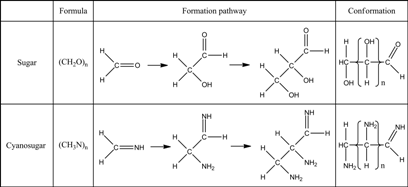
The two significant functions of sugars in biological systems are the storage of chemical energy (e.g., glucose) and constituents of genetic materials (e.g., ribose/deoxyribose in RNA/DNA). It is well known that atmospheric hydrogen is an efficient energy source and the release of the chemical energy of sugar is mainly achieved by the generation of high energetic free H (e.g., the citric acid cycle). Stoichiometrically, one methyleneamine (CH2≐NH) molecule can be separated as one H2 and one HCN. In this respect, cyanosugar, the methyleneamine polymers, can act as hydrogen storage and provide energy through the oxidation reaction. In oxygen-free environments, a potential energy-yielding reaction that could be used for exotic biological systems is the oxidation of H2 by C2H2 (Reaction h in Fig. 1a) (McKay and Smith, 2005; Schulze-Makuch and Grinspoon, 2005), where H2 is regarded as the energy storage and C2H2 is the oxidant. Here, we present another potential energy-yielding redox reaction between cyanosugar and C2H2 (Reaction i in Fig. 1b). Based on our thermodynamic calculations, the energy release of Reactions h and i is 336.59 and 395.60 kJ/mol, while the energy release per electron transformed in Reactions h and i is 56.10 and 32.97 kJ/mol, respectively.
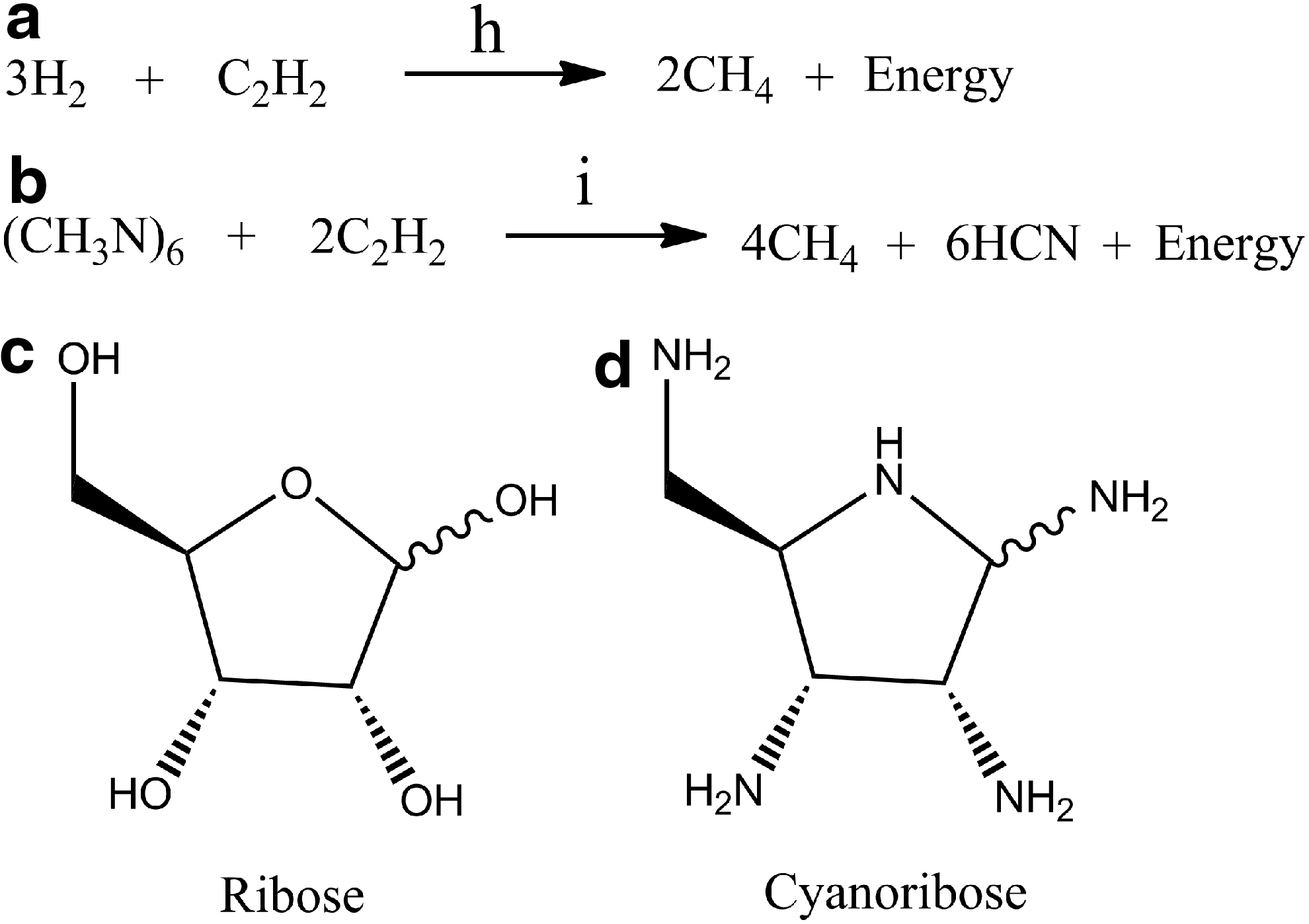
Two biological functions of sugar. (
As a component of genetic materials, sugar molecules usually form ring structures to limit the rotation of the skeleton (Fig. 1c). This ring structure formation is achieved by the intramolecular additional reaction induced by the unsaturated double C≐O bond. Similarly, the unsaturated C≐NH bond of cyanosugar could also induce the formation of a ring structure (Fig. 1d).
3.2. Cyanoacid and ester system
We propose that the cyanoacid group –C(CN)≐NH is analogous to carboxyl (–COOH) in Earth's biochemistry, and organic compounds in forms of R–C(CN)≐NH are named cyanoacids. Table 2 presents some structural and reactivity similarities between carboxylic acid and cyanoacid. For example, both the cyanoacid and carboxylic acid have only one active hydrogen atom on their functional groups. Both cyanoacid and carboxylic acid could form hydrogen bonding (in forms of≐NH···N and≐O···H, respectively) and therefore generate bipolymers. It is well known that oxygen-contained acids can be polymerized with the elimination of water, while a similar polymerization could be conducted on cyanoacid with the elimination of HCN. In biological systems, carboxylic acids (R-COOH) are important since their –OH group has the ability to react with active-H-contained biomolecules (e.g., reacts with R-OH to produce esters) and thus can induce various types of substitution reactions as well as polymerizations. With respect to cyanoacid, a similar reactivity with active-H-contained compounds seems to be applicable since its –CN groups could react with active H atoms to eliminate HCN molecules.
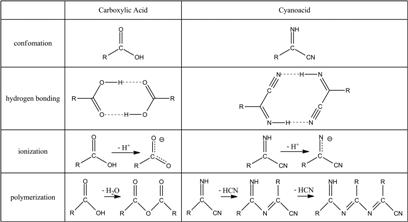
The esterification reaction is defined as a type of substitution reaction between one carboxylic acid (R1–COOH) and one alcohol (R2–OH), which generates an ester molecule with a longer skeleton (R1–COO–R2) while eliminating one H2O. It can be seen in Table 3 that cyanide and amine share some similarities with alcohol in terms of conformation and reactions. More interestingly, both cyanide and amine can induce an equivalent reaction to esterification by reacting with cyanoacid. The Gibbs energy changes of the three types of esterification reactions under same conditions (temperature at 298 K) are calculated to be −1.63, 56.79, and −0.60 kJ/mol for Reactions j, k, and l, respectively (both group R1 and R2 are set as methyl). Reaction l shares more similarities with Earth's esterification reaction (Reaction j) than Reaction k in terms of energy release as well as product structure. For example, in the products of Reactions j and l the unsaturated bonds are side groups, while in the product of Reaction k the unsaturated bond is part of the structure's skeleton.

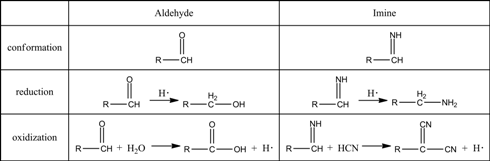
In water, a C = NH unit is rapidly hydrolyzed to generate an amine and a carbonyl-containing product with a C≐O unit at the corresponding position. We hypothesize that, in a non-aquatic solvent (e.g., CH4 and C2H6), the imine (R–CH≐NH) could possess similar reactivities as aldehyde (R–CHO) (shown in Table 4). The characteristic reactions of aldehyde include its oxidization, which generates carboxyl acid, and its reduction, which generates alcohol. Similarly, oxidizing imine by using HCN could generate cyanoacid, while the reduction product could be amine (R–NH2), which is analogous to alcohol.
3.3. Amino cyanoacid and protein system
According to the definition of the above-mentioned cyanoacid, amino cyanoacid is hypothesized to be analogous to the amino acids of Earth's biochemistry (Table 5). The most important biological function of amino acids is that their amino group and carboxyl group can undergo peptide reactions that result in the formation of proteins. Another important chemical property of amino acid is that it can easily absorb/release an H+ ion to take on a positive/negative charge. This property is responsible for the formation of various functionalized proteins since amino acids with different charges lead to diverse folding types. Although folding will not work in the exact same way in nonpolar solvents, it is suggested that attraction-repulsion between amino cyanoacid charges could facilitate folding and forces between the solvent and cyanoproteins, which would depend upon the properties of the solvent. Table 5 presents the comparisons between amino acid and amino cyanoacid. Amino cyanoacid has a number of characteristics that are similar to those of amino acid; for example, it can be positively or negatively charged and, more impressively, form a –C(NH)–NH– bond that resembles peptide bonding and forms macromolecules/polymers with a structure similar to peptides.

Terrestrial life is homochiral, which may have evolved from a racemic environment due to autocatalytic processes being catalyzed by asymmetric products (Soai et al., 1995; Blackmond, 2004). Therefore, chiral molecules have been suggested as a biosignature for the search for life (Brack and Spach, 1987; MacDermott and Tranter, 1995; Rodier et al. 2002). It is worth noting that, similar to amino acids of terran biological systems that have chiral carbon atoms in their structure (marked in blue in Table 5), the amino cyanoacids could also contain chiral carbon atoms (marked in red in Table 5). Therefore, it is plausible for homochirality to have evolved as well in biota based on CHN biochemistry.
3.4 Cyanonucleobases
The storage of genetic information in terran biological systems is achieved by the ordering of two couples of nucleobases, A-T and G-C. Here, we propose two cyanonucleobases, adenine (shortly named as B) and 2,4-diamino-1,3,5-triazine (shortly named as D), and two types of coupling, D-D (Fig. 2a) and B-B (Fig. 2b), both of which could be used to store and replicate genetic information. In each coupling type, the two cyanonucleobases are connected by hydrogen bonding (e.g., the >NH···N< bonding in B-B coupling and the –NH2···N< in D-D coupling). Although both types of coupling (D-D and B-B) are connected by two hydrogen bonds, it is suggested that one D and one B cannot be paired for at least two reasons. The angles ∠N1N3N4 are different (the ∠N1N3N4 of D is 88.6° and B is 83.9°), and the distances between N3 and N4 are unequal (the N3N4 of D is 2.30 Å and of B is 2.44 Å). Thus, D-D and B-B are the reasonable couplings that could work together and act as bridges in construction of a double helix structure. This D-D and B-B coupling could function such that information is retained in a manner similar to computer binary storage rather than by way of the more complex terrestrial genetic systems.
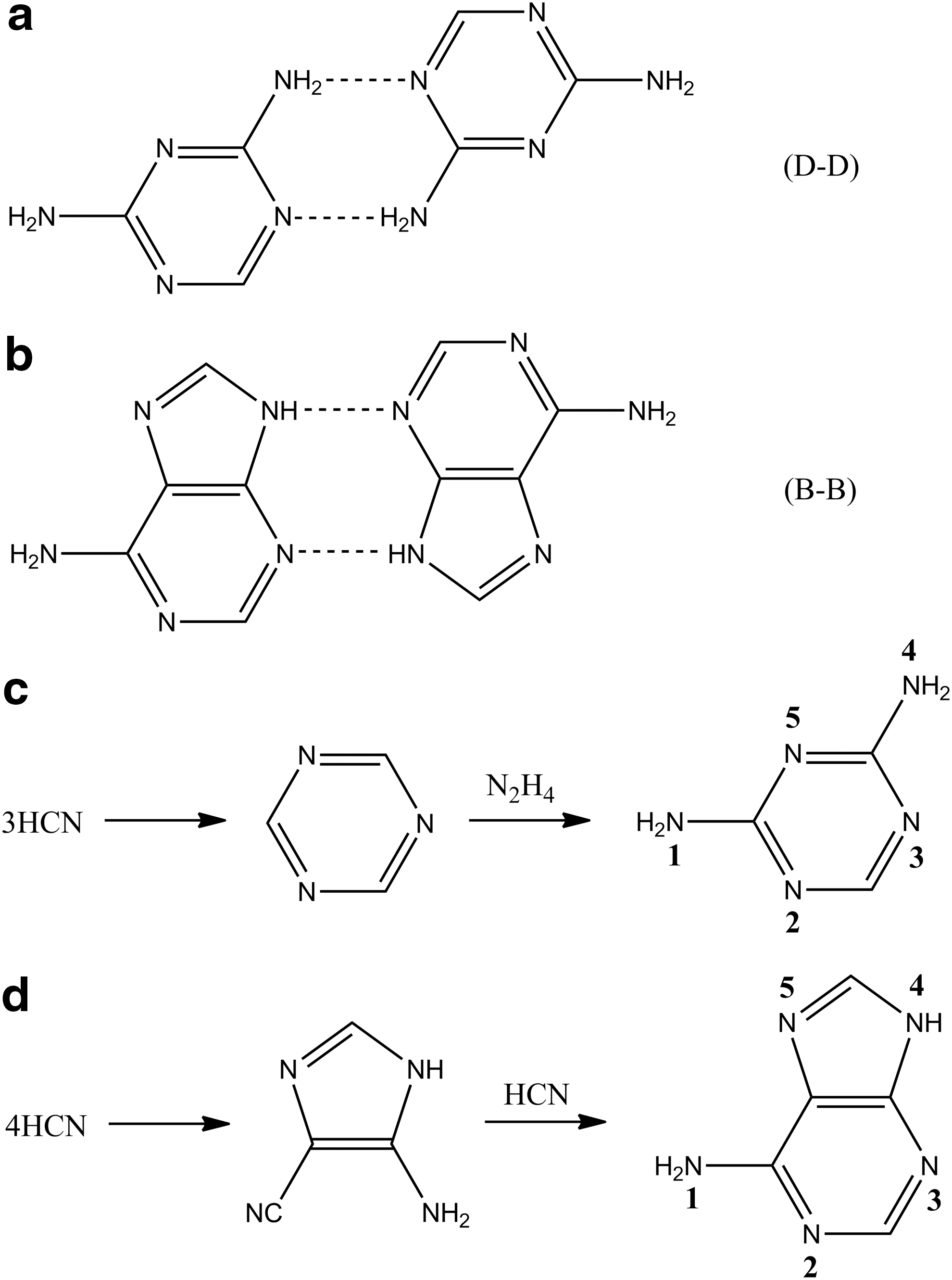
Two cyanonucleobases: adenine (shortly named as B) and 2,4-diamino-1,3,5-triazine (shortly named as D). Two types of coupling: D-D (
The hypothetical synthetic pathways of D and B are shown as Fig. 2c and 2d, respectively. The synthesis of D (in formula of C3H5N5) should involve hydrazine as the reductant, which is responsible for the attachment of amino groups onto the triazine ring formed by three HCN molecules. The prebiotic synthesis of B (in formula of C5H5N5) from HCN has already been reported (Voet and Schwartz, 1983; Ferris and Hagan, 1984).
4. Discussion
4.1. Application to surficial biota on Titan
Titan has an atmosphere with a 50% greater surface pressure than that of Earth, which is composed of nitrogen with a few percent of methane and 0.1% of hydrogen (e.g., Lellouch et al., 1989). Photochemical processes in the upper atmosphere generate rich organic chemistries of hydrocarbons and nitriles as observed by Voyager and the Cassini-Huygens mission (Hanel et al., 1981; Kunde et al., 1981; Maguire et al., 1981; Lavvas et al., 2008). These organics are the major constituent of Titan's optically thick haze (e.g., McKay et al., 2001), and the photochemical products represent a disequilibrium state that is a potential source of chemical energy (Raulin, 2008).
Some studies suggest that oxygen-bearing species such as amino acids and nucleotide bases may be formed in Titan's upper atmosphere (e.g., Hörst et al., 2008) or during episodes of surficial liquid water (from such events as cryovolcanism or impacts) interacting with the substantial quantities of surficial organics (e.g., Thompson and Sagan, 1992; Cleaves et al., 2014). Also, polyethers are an oxygen-bearing species that has an appropriate solubility in hydrocarbons to be a putative genetic backbone for alkane-based biota on “warm” Titans (McLendon et al., 2015). However, oxygen-bearing organics remain a rare commodity on Titan compared to the higher quantity of oxygen-free organic species. There are liquid sources on Titan in the form of a subsurface aqueous ocean and surface alkane lakes. However, due to the low surface temperature (∼94 K), bioavailable oxygen on the surface in the form of aqueous solutions is limited to sporadic episodes of cryovolcanic lavas and impact melts.
In contrast, nitrogen-bearing organics are likely to be common in Titan's surface environment due to nitrogen incorporation into tholins (simulated Titan aerosols) in Titan's atmosphere (Somogyi et al., 2005). These tholins have been shown to contain a wide range of species including hydrocarbons, nitriles, pyrroles, benzenes, and polycyclic aromatic hydrocarbons (PAHs) (McGuigan et al., 2006). Titan's atmospheric conditions and tholin production have been simulated in numerous studies, and the amount of nitrogen in these tholins is consistently high (McKay, 1996). Galactic cosmic rays or plasma from Saturn's magnetosphere may excite molecular nitrogen and assist in overcoming the reaction barriers to form nitrogenated organics, such as the highly reactive molecule cyanomethylidyne (CCN) (Melton, 2015). The Huygens probe was limited to measuring organics up to seven carbons in size; however, heavier negative ions (up to 13,800 amu q −1) have been detected in the atmosphere by the Cassini Plasma Spectrometer (CAPS) (Coates et al., 2007, 2010). In a modeling study of Titan's ionosphere, Vuitton et al. (2009) also indicated that most of these larger ions were formed from dissociative electron attachment to HCN and that the three main spectral peaks found by CAPS were associated with CN-, C3N-, and C5N-. These three nitrogenated species are believed to be the first intermediates toward building the larger negative ions found by CAPS. It has also been theorized that nitrogenated polyaromatic species are formed within tholins by incorporating HCN into PAHs, facilitated by the vibrational energy of aromatic molecules (Ricca et al., 2001). Energy barrier–free pathways via CCN reactions with acetylene and methane have also been theorized to form large nitrogenated species on Titan (Melton, 2015). Experimental results have also shown that cyanobenzene (C6H5CN) can be produced by the reaction of benzene and cyano (CN) at low temperatures (Woon, 2006).
In fact, given the relatively high temperature and energy provided by UV radiation, the haze could harbor a diversity of radical reactions and thus produce a series of complex organic molecules, including cyanide, imine, cyanoacid, and amino cyanoacid (Fig. 3). These small biomolecules could follow the methane cycle on Titan and accumulate in the hydrocarbon lakes, where further biotic or prebiotic complex interactions and polymerizations could produce functionalized macromolecules such as the proposed cyanosugars, cyanolipids, and cyanoproteins. Recently, the polymorphism and electronic structure of polyimine have also been investigated and suggested to play a significant role in potential prebiotic chemistry on Titan (Rahm et al., 2016).
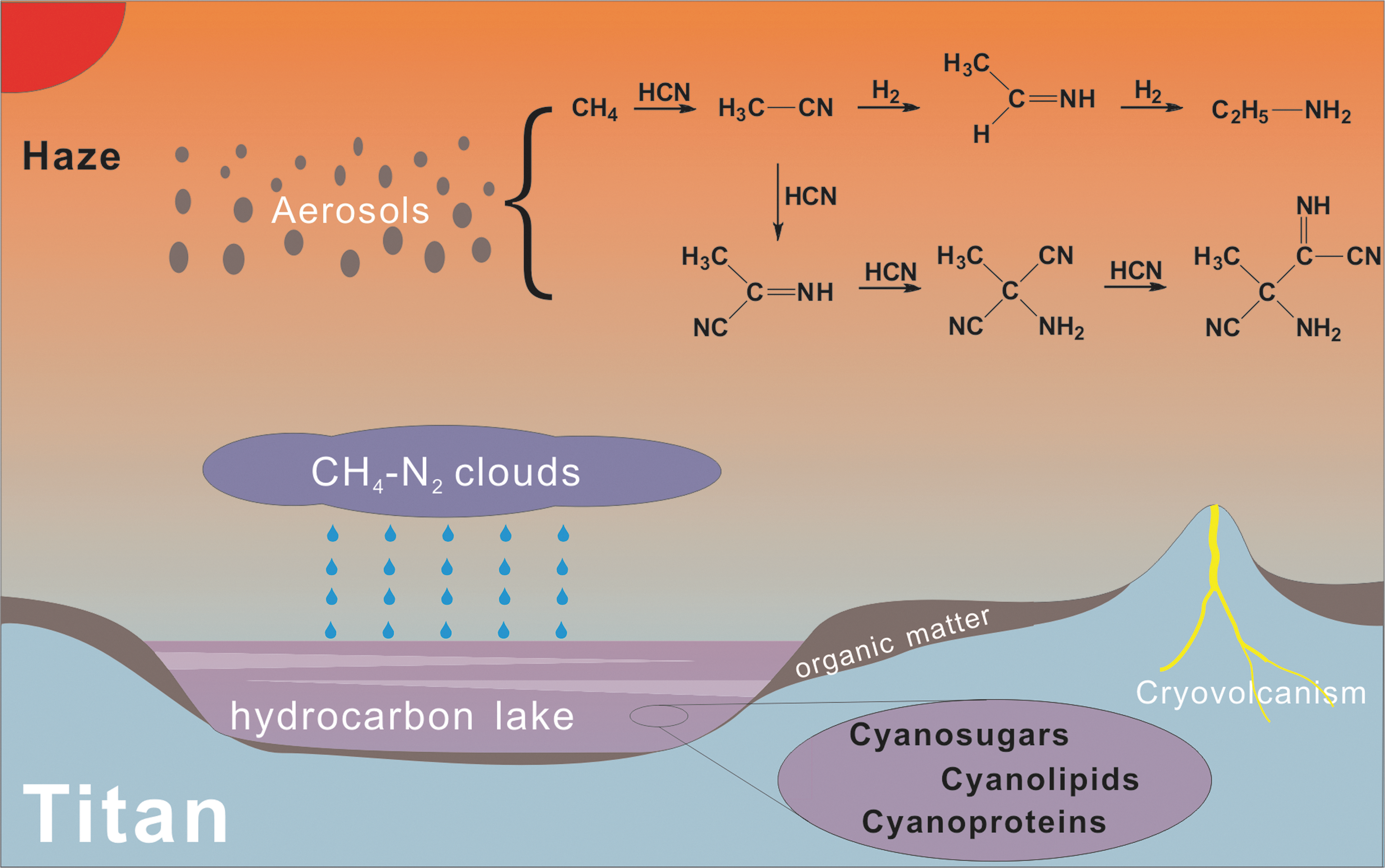
The oxygen-free chemical environment on Titan. The upper haze produces small organic molecules through a series of radical reactions. Those molecules (including cyanide, imine, cyanoacid, and amino cyanoacid) follow the methane cycle and concentrate in the hydrocarbon lake, where they further interact to produce functionalized macromolecules such as cyanosugars, cyanolipids, and cyanoproteins.
Folding of terrestrial proteins is facilitated by hydrogen bonding with water. However, folding of cyanoproteins on Titan is expected to be facilitated by van der Waals interactions between the alkane solvent and the carbon backbone, which is a strong force at these low temperatures, and by the solvent phobic repulsion of the charged moieties. The low temperatures of Titan's surface may slow some chemical reactions, but we expect any putative exotic biota to catalyze such reactions to functionally appropriate rates. Hydrogen bonding is stronger at lower temperatures; therefore, the required breaking of these bonds during such processes as cyano DNA replication would require a catalyst similar in function to a terrestrial DNA helicase. In consideration of the environment and generally oxygen-free organic chemistry available to any putative biota on Titan's surface, it is reasonable to suggest that CHN biochemistry would be a useful and readily used strategy for building organisms.
4.2. Application to biota in other extraterrestrial environments
In other extraterrestrial habitats dominated by oxygen-free non-aquatic liquids, the CHN biochemistry may be more useful than Earth's biochemistry. Many oxygen-free non-aquatic solvents are proposed to have the potential to act as life-supporting liquid, including nonpolar hydrocarbons such as methane and ethane (Benner et al., 2004) and nitrogen (Bains, 2004), hydrazine, ammonia, HCN, and HF (Schulze-Makuch and Irwin, 2006). A hydrocarbon solvent is more beneficial to organic synthesis reactions than water since it would not destroy hydrolytically unstable organic species (e.g., such as nucleobases, Benner et al., 2004), and it usually acts as a reactant that could be added on the unsaturated bonds of biomolecules. Hydrogen cyanide is undoubtedly an effective supporting solvent for the CHN biochemistry, where HCN is one of the key compounds that is responsible for adding –CN groups on hydrocarbons and in some cases acts as the eliminating molecule to induce the synthesis of macromolecules/polymers. Furthermore, the physical properties (e.g., density, melting point, and boiling point) of HCN are close to those of water, and polar organic molecules would have higher solubility in HCN compared to many other non-aqueous liquids. The temperature range in which HCN remains in a liquid state (−13°C to 26°C at 1 bar) would also assist biochemical reactions to proceed at a reasonable pace in any HCN liquid habitats. Ammonia has a structure comparable to water with a lower dipole moment. It is thus less efficient at dissolving polarized compounds but can dissolve many organic molecules. Moreover, since the key structures of cyanoprotein and cyanonucleobases are cyano peptide bonding (in forms of –C(≐NH)–NH–) and amino groups, liquid ammonia as the solvent could greatly enhance the formation and reactivity of those macromolecules that contain amino groups.
5. Conclusion
The possible presence of exotic life that could rely on an unearthly biochemistry has become a reasonable consideration in the area of astrobiology. Considering the diversity of extraterrestrial habitats that can be oxygen-free and dominated by non-aquatic liquids, the oxygen-free CHN biochemistry we have presented could be highly applicable. We have shown that the biological functions of exotic biota could use a CHN biochemistry scenario. For example, cyanosugars could provide energy by reacting with C2H2, polymeric reactions could be used to build macromolecules (such as cyanoproteins and cyanolipids) with diverse functions, and cyanonucleobases along with their coupling styles could provide a method for genetic information storage. Potential habitats where CHN biochemistry could be applied include the alkane lakes of Titan and extrasolar bodies dominated by a range of oxygen-free non-aquatic liquids such as hydrocarbons, hydrogen cyanide, and ammonia.
Footnotes
Acknowledgment
This study was supported by Research Grants Council of Hong Kong (HKU702913P).
Author Disclosure Statement
No competing financial interests exist.