




Abstract
In a previous study, we have showed that the elongation of an alanine oligopeptide [L-alanyl-L-alanyl-L-alanyl-L-alanine ((Ala)4)] to higher oligopeptides is enhanced by calcite and dolomite at 275°C, using a mineral-mediated hydrothermal flow reactor system. However, a problem during the use of hydrothermal flow reactor system was that some of the minerals, such as clay, could not be tested due to their clogging in the reactor. In this article, we attempted to analyze the scope of enhancement for the formation of L-alanyl-L-alanyl-L-alanyl-L-alanyl-L-alanine ((Ala)5) and higher oligopeptides with different minerals including clay minerals for the elongation of alanine oligopeptide at 175°C. First, carbonate minerals and some clay minerals showed an enhancement of the formation of (Ala)5 from (Ala)4. On the contrary, volcanic products showed strong inhibitory activities. According to the pH dependence on the (Ala)4 elongations, we confirmed that most enhancement and inhibitory activities are due to the pH influence on the elongation of (Ala)4. However, the enhancement of montmorillonite (Tsukinuno), sphalerite, apatite, tourmaline, calcite (Nitto Funka), and the inhibitory activities by volcanic ash (Shinmoedake), volcanic ash (Sakurajima), dickite, and pyrophillite are not simply due to the pH change in the presence of these minerals. The difference found between the previous and present studies suggests that the interaction kinetics of the aqueous phase with the mineral phase is also an important factor for the elongation of (Ala)4. These data imply that the environments with pH near neutral to weak alkaline and with minerals might have been useful for the accumulation of oligopeptides in hydrothermal conditions.
1. Introduction
T
Conventional batch reactions had been primarily used for the evaluation of such hydrothermal reactions >20 years ago (White, 1984; Larralde et al., 1995; Levy and Miller, 1998). However, such experiments have limitations for running reactions at high temperatures for relatively slow reactions to the minute timescale, since the batch reactor approach requires somewhat long time for heating of the reactor itself. To solve this limitation, hydrothermal flow reactors, as powerful research tools, have been developed in different groups for the evaluation of chemical evolution reactions under the Hadean Earth environments (Kawamura, 1998, 1999, 2000, 2002; Imai et al., 1999; Islam et al., 2003; Holm and Andersson, 2005; Cleaves et al., 2009; Kawamura et al., 2010, 2011).
For realistic simulation of hydrothermal vent systems, we proposed a new type of mineral-mediated hydrothermal flow reactor system, which enables monitoring hydrothermal reactions in the presence of micrometer-sized mineral particles (Kawamura et al., 2011). Such experimental approaches demonstrated enhancement and inhibitory activities of naturally occurring minerals for alanine oligopeptides, such as L-alanyl-L-alanyl-L-alanyl-L-alanine [(Ala)4] and L-alanyl-L-alanyl-L-alanyl-L-alanine-L-alanine [(Ala)5]. Our flow reactor showed that some carbonate minerals, such as calcite and dolomite, enhanced the oligopeptide elongation. Nevertheless, the activities of some minerals, such as montmorillonite clay minerals, were not in a position to follow up since clogging of flowing tubing lines occurs during measurements owing to the swelling of clay. Thus, in this study, we try to assess the influence of such clay minerals, using a batch reactor in as high as possible temperatures, which can be still realized as hydrothermal conditions. This study would support our finding on the elongation behaviors of (Ala)4 catalyzed by carbonate minerals evaluated by using a hydrothermal flow reactor at 275°C. At the same time, we are also interested in determining whether elongation proceeds at lower temperatures. Inspections with other minerals for enhancement of oligopeptide elongation were carried out at 175°C.
2. Materials and Methods
2.1. Chemicals
Minerals used in this study involve the same source and treatment method as those in our previous article (Kawamura et al., 2011). Naturally occurring minerals were obtained and treated as follows. Pyrite, sphalerite, aragonite, and bentonite sodium forms were purchased from Alfer Aesar (Johnson Matthey Company, Japan); sphalerite and aragonite were crushed and sieved to obtain a fraction sphalerite (150–250 μm) and aragonite (75–150 μm). Calcite (Nitto Funka) and zeolite were gifts from NFK (Nitto Funka Kogyo K.K.) Co. Ltd. Japan, having been sieved in advance with 70 mesh (ca. 212 μm), these were utilized without further treatment. Calcite (Musashino) (Musashino, Japan) and dolomite (Cebu, Philippines) were gifts from JFE mineral Co. Ltd. Japan, and these were sieved (150–250 μm and 75–150 μm), respectively. Mica (C-83) and mica (CS-060DC) were gifts from Yamaguchi Mica Co. Ltd. Japan, and these were sieved to obtain a fraction (150–250 μm). Barite was gifted from Taiheiyo Cement Co. (Japan). This was crushed and sieved (75–150 μm). Pumice stone (Harunasan) with porous size of <8 mm, a kind of andesite, which is assured one of the volcanic products erupted at sixth century at Harunasan, was gifted from Saito Shoten, Ltd. (Komochi Co., Shibukawa, Japan). The pumice stone was used without further treatment to keep narrow pores. Tourmaline (Brazil) and apatite (Brazil) were purchased from Chie Co. Ltd. (Japan). Tourmaline, which was sieved in advance at 325 mesh (44 μm), was used without further treatment. Apatite was grained and sieved to obtain a fraction (150–250 μm). Quartz sand was purchased from Wako Chemical Co. Ltd. (Japan) and sieved to obtain a fraction (150–250 μm). Powdered dickite, kaolinite, montmorillonite (Tsukinuno), montmorillonite (Mikawa), pyrophillite, and sericite were purchased from the Clay Science Society of Japan, and these were used without further treatment. Volcanic ash (Shinmoedake), volcanic ash (Sakurajima), and lava (Daikonjima) were purchased from Kenis, Ltd. (Japan). Alanine oligopeptides including (Ala)4 were purchased from BACHEM. All other reagents used were of analytical grade.
Typical chemical formula of the minerals is displayed as follows, whereas the naturally occurring minerals frequently involve minor components. Apatite: Ca5(PO4)3(F,Cl,OH), aragonite: CaCO3, barite: BaSO4, calcite: CaCO3, dolomite: CaMg(CO3)2, dickite: Al2Si2O5(OH)4, kaolinite: Al4Si4O10(OH)8, mica: KAl2(Si3Al)O10(OH,F)2, montmorillonite: (Na,Ca)0.3(Al,Mg)2Si4O10(OH)2·nH2O, pyrophillite: Al2Si4O10(OH)2, quartz: SiO2, sericite: KAl2AlSi3O10(OH)2, sphalerite: ZnS, tourmaline: Na(Mg,Fe,Mn,Li,Al)3Al6(BO3)3Si6O18(OH,F)4, zeolite (Mordenite): (Ca,Na2,K2)Al2Si10O24·7H2O. These minerals are normally deemed to form under moderate-to-high temperature hydrothermal conditions (Bunno and Aoki, 1996).
2.2. Sample preparation and analysis
Reaction behaviors were investigated by using a high temperature and pressure resistant reactor with a Teflon inner vessel (HU-25, Sanai Kagaku, Japan). To the reaction vessel were added 0.5 g of mineral particles and a 10 mL aqueous solution “stock solution of (Ala)4,” which contains NaCl, MgCl2, and (Ala)4, the pH of solution was adjusted at pH 7. The reaction vessel was tightly closed for high temperature reaction and the sample was withdrawn after the quick quenching of the reaction vessel to stop the reaction. To investigate the influence of calcite, 0.005–20 g of calcite was added to 10 mL of the stock solution of (Ala)4. The pH of sample solutions in the presence of minerals was measured after reaction. Heating of the high temperature and pressure-resistant reactor was carried out by using a forced convection constant temperature oven (DKM300; Yamato Scientific Co. LTD, Japan). The reaction was mostly carried out at 175°C and the reaction time was 90 min. In addition, the reaction of (Ala)5 in the absence and presence of volcanic ash was investigated at 175°C and the reaction times were 30, 90, and 240 min. Each reaction was performed once unless otherwise indicated, since our previous study showed that the accuracy of the elongation reactions is sufficient (Kawamura et al., 2011).
The reaction products were analyzed by high-performance liquid chromatography (HPLC), as shown in our previous publications (Kawamura et al., 2005, 2011). Reaction samples containing mineral particles were centrifuged and the supernatant was withdrawn for HPLC analysis. HPLC analysis was carried out by a LC10A system (Shimadzu, Japan) with a reversed-phase column (2.0 mm inner diameter × 10 cm length, CAPCELLPAK C18 UG120; Shiseido, Japan) with a guard column (2.0 mm inner diameter × 3.5 cm length, CAPCELLPAK C18 UG120; Shiseido). The employed eluents were (A) 5 mM NaH2PO4 and 3.6 mM CH3(CH2)5SO3Na at pH 2.65; (B) 10 mM NaH2PO4 and 7.2 mM CH3(CH2)5SO3Na in 50% ethanol at pH 2.70. A linear gradient of B from 5% (0 min), 40% (15 min), 40% (25 min) was used for the analysis, with a flow rate of 0.2 mL/min at 35°C. All the detection was performed at 220 nm, on the basis of the sensitivity and the low background.
3. Results
3.1. Detection of mineral influences on spontaneous elongation of (Ala)4
Using a hydrothermal flow reactor, we have previously showed that the elongation of (Ala)4 to (Ala)5 and higher oligopeptides proceeds under the hydrothermal conditions at 275°C, where an enhancement by carbonate minerals was observed. Here, we measured possible enhancement and inhibitory activities of minerals for the elongations of these oligopeptides using batch reactors at 175°C. This temperature would be regarded as somewhat low compared with the previous hydrothermal flow reactor experiments, which simulate the chemical reactions observed in submarine hydrothermal vent systems (Russell et al., 2005; Tivey, 2007). However, such hot springs at relatively lower temperatures are frequently located on the ground, in the deep sea, and in Earth's crust. We selected a reaction time of 90 min since the yields for the reaction of (Ala)4 at 175°C to form (Ala)5 were comparable with those obtained at 275°C with a reaction time of 10–30 s using hydrothermal flow reactions.
The pH of the stock solution of (Ala)4 containing NaCl, MgCl2, and peptide was adjusted at 7.0 just before being used for experiments, then the solution was added to minerals. The analysis of the reaction products clearly showed different influences, that is enhancement and inhibitory activities, in the elongation of (Ala)4. Influences of minerals are shown in Figure 1 and Supplementary Figure S1 (Supplementary Data are available online at
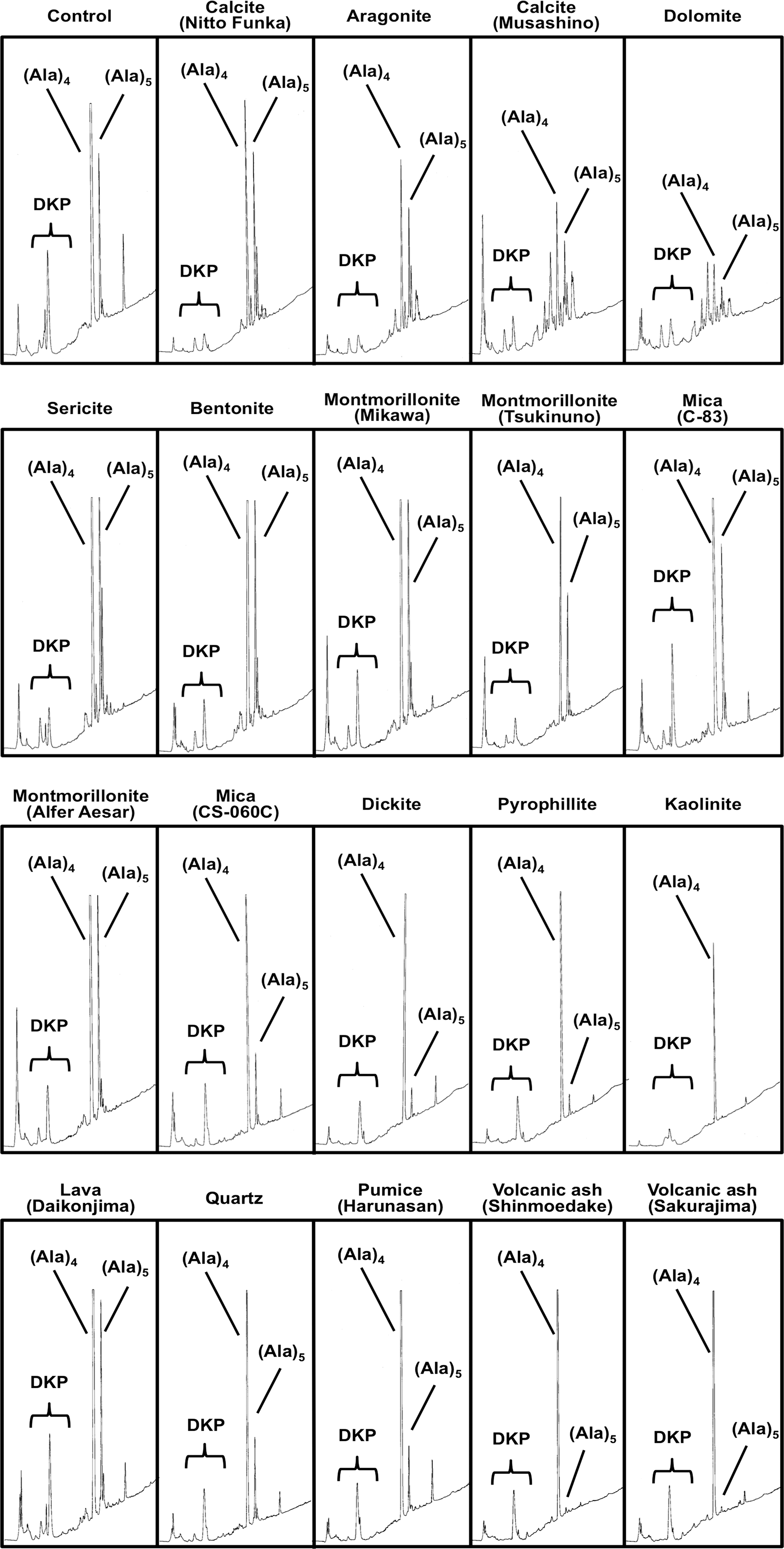
HPLC chromatograms for the elongation of (Ala)4 under the hydrothermal conditions in the presence of minerals. Reaction conditions: [(Ala)4] = 1 mM, [NaCl] = 0.1 M, [MgCl2] = 0.05 M, pH = 7.0, 175°C, 90 min. Amount of mineral: 0.5 mg, volume of the aqueous phase: 10 mL. The control reaction does not contain minerals. (Ala)4, L-alanyl-L-alanyl-L-alanyl-L-alanine; (Ala)5, L-alanyl-L-alanyl-L-alanyl-L-alanyl-L-alanine; DKP, diketopiperazine; HPLC; high-performance liquid chromatography.

Peak area ratio of (Ala)4, (Ala)5, and DKP by the hydrothermal reaction of (Ala)4, also the measured pH after the reaction is indicated. Bars: black: (Ala)5, gray: (Ala)4, white: DKP. All other reaction conditions are the same as shown in Figure 1.
Calcite (Nitto Funka), sericite, and tourmaline showed somewhat strong enhancement activities, and different minerals, for example, apatite, aragonite, and montmorillonite, showed weak enhancement; in those cases the yields of (Ala)5 are greater than that in the absence of minerals. The yield of (Ala)5 isomers reaches >25%, which is comparable with the highest yield obtained at 275°C. In contrast, pumice, zeolite, dickite, pyrophillite, volcanic ashes, and kaolinite showed strong inhibitory activities.
The elongation of (Ala)5 to higher oligopeptide was briefly mentioned in our previous study at 275°C (Kawamura et al., 2005, 2011) (Supplementary Fig. S2). The elongation to higher oligopeptides was also observed at 175°C, whereas the detailed characterizations of higher oligopeptides were not yet carried out (Kawamura et al., 2005). HPLC charts indicate that there are higher products formed from (Ala)5 at the reaction time 240 min in the absence of a mineral. In addition, there is a peak corresponding to the same retention time for (Ala)4. This contrasts to the fact that (Ala)3 is not observed during the elongation of (Ala)4 since the conversion of (Ala)3 to DKP is relatively fast compared with the elongation of (Ala)4 (Kawamura et al., 2005). Comparative kinetics of peptides with different length should be very helpful for the elongation model of oligopeptides under the primitive Earth environments. In contrast, the HPLC charts clearly indicate that the elongation of (Ala)5 to higher oligopeptides was inhibited in the presence of volcanic ashes both from Shinmoedake and Sakurajima. This fact supports that these minerals possess inhibitory activities in general for the elongations of both (Ala)4 and (Ala)5 to higher oligopeptides.
Some minerals investigated at 175°C, except for tourmaline and dolomite, showed a similar trend for the enhancement activities observed at 275°C using the hydrothermal flow reactor. That is to say, there is a relationship between the present data at 175°C and the previous data acquired by using the flow reactor at 275°C. For dolomite, the overall reaction seems to proceed quickly as compared with other cases, so that higher oligopeptides disappeared at reaction time of 90 min, where some by-products are observed close to (Ala)4 and (Ala)5 (Fig. 1, dolomite). The retention time of these by-products corresponds those for (Ala)3 and higher oligopeptides around (Ala)4 and (Ala)5. A similar trend was observed for the reaction of calcite (Musashino) (Fig. 1, calcite (Musashino)). Here, the influence of clay minerals on the elongation of (Ala)4 was observed for the first time; sericite and montmorillonite showed an enhancement activity, oppositely kaolinite and dickite showed inhibitory activity for the enhancement of (Ala)4 elongation, although some of these clay minerals could not be measured due to their clogging in the hydrothermal flow reactor.
Some minerals, such as kaolinite, show relatively smaller peaks as a total amount of (Ala)4, (Ala)5, and other products. The variation of the total area of HPLC peaks may reflect both the influences of the yield of reaction products and the molar absorption coefficient of the products.
3.2. Influence of the increase of calcite concentration on the elongation of (Ala)4
The ratio between the mineral amount to the aqueous phase volume is an important factor for the evaluation of the reaction mechanism. In the hydrothermal flow reactor, it is not possible to change the ratio between the mineral amount and the aqueous phase volume for the elongation of (Ala)4 peptide, since it is only possible to fill the flow reactor column completely with mineral particles. At the present time, it is not possible to measure the isotherm curve at 175°C. Thus, we decided to evaluate the influence of amount of carbonate minerals on the yield of (Ala)5 from (Ala)4 by changing the carbonate mineral at constant volume of aqueous phase (10 mL). Here, we selected calcite (Nitto Funka) due to the largest influence among carbonate minerals tested in this study. Since it is expected that the adsorption process of (Ala)4 on calcite is a chemical process in the elongation pathway, the amount of calcite (Nitto Funka) would affect the yield of (Ala)5, which should reflect in a regular isotherm curve. The influence of the amount of calcite on the elongation of (Ala)4 at 175°C is shown in Figure 3.

Influence of the amount of calcite on the elongation of (Ala)4 under hydrothermal conditions. Reaction conditions are the same as shown in Figure 1. The amount of calcite (Nitto Funka) was varied from 0.005 to 20 g for 10 mL sample solution containing (Ala)4, NaCl, and MgCl2.
It was unexpected that the enhancement with calcite seems to be less dependent on the calcite amount at the range of 0.005–20 g calcite in the 10 mL aqueous solution phase. It is to say that the peak area ratio of (Ala)5 slightly decreases while increasing the mineral amount. This is not readily understood according to the regular binding isotherm behavior, since the adsorption of oligoalanines, (Ala)4, (Ala)5, and DKP was not observed. At the same time, there seems to be a weak trend that different by-products are associated with the presence of a higher amount of calcite (Supplementary Fig. S3).
In contrast, the loss of the oligopeptides in the supernatant by adsorption on calcite was not indeed detected after centrifugation of mixture of the reaction products. This fact indicates that strong adsorption of oligoalanines including (Ala)4, (Ala)5 isomers, and DKP does not occur at least at room temperature; the adsorption of (Ala)4 on calcite could not be measured directly at 175°C at the present time. This is consistent with our previous study, for which we used the flow reactor, where there was no evidence of the adsorption of (Ala)4 on calcite during the flow reactor experiments, on the basis of HPLC measurements. The trend shown in this study suggests that the adsorption of (Ala)4 on minerals may not be involved as a main factor for the enhancement of (Ala)4.
3.3. Influence of pH on the elongation of (Ala)4
Our previous study indicated that the enhancement by calcite was not mainly due to a pH change in the presence of the mineral. The reaction conditions, such as temperature and reaction time, are different between the flow reactor in the previous study and the batch reactor in this study. Thus, the influence of pH on the sample solutions in the presence and absence of minerals was investigated.
First, the pH dependence on the elongation behavior of (Ala)4 was measured as a background pH profile in the absence of minerals. The data would be compared with the enhancement of (Ala)5 formations in the presence of minerals to determine the net influence of minerals. The peak area ratios of (Ala)4, (Ala)5, and DKP under the hydrothermal reaction in the absence of mineral at 175°C for 90 min at the pH range 2–9 are shown in Figure 4. The peak area ratio of (Ala)5 increases with increasing pH at pH 7–9, which is consistent with the trend of the pH dependence at 275°C. Besides, the peak area ratio of (Ala)4 was large at pH 4.29 and the yield of (Ala)5 increases with increasing pH. This fact suggests that the rate of disappearance of (Ala)4 is minimum at around pH 4.29 due to the formation of (Ala)5. The yield of DKP is almost constant at pH 2–8. These trends seem to be different for the tendency that indicates that the apparent rate constants for the disappearance of (Ala)4 decrease with increasing pH at pH 2–12 shown in our previous study (Kawamura et al., 2011). According to these behaviors, the increase of the peak area ratio of (Ala)5 at pH 7–9 is probably due to an increase of (Ala)4 − form with increase in pH at 175°C, the anionic species would be active for the elongation of (Ala)4. This assumption is consistent with the estimation deduced at 275°C since the elongation of (Ala)4 at 275°C was enhanced at higher pH.
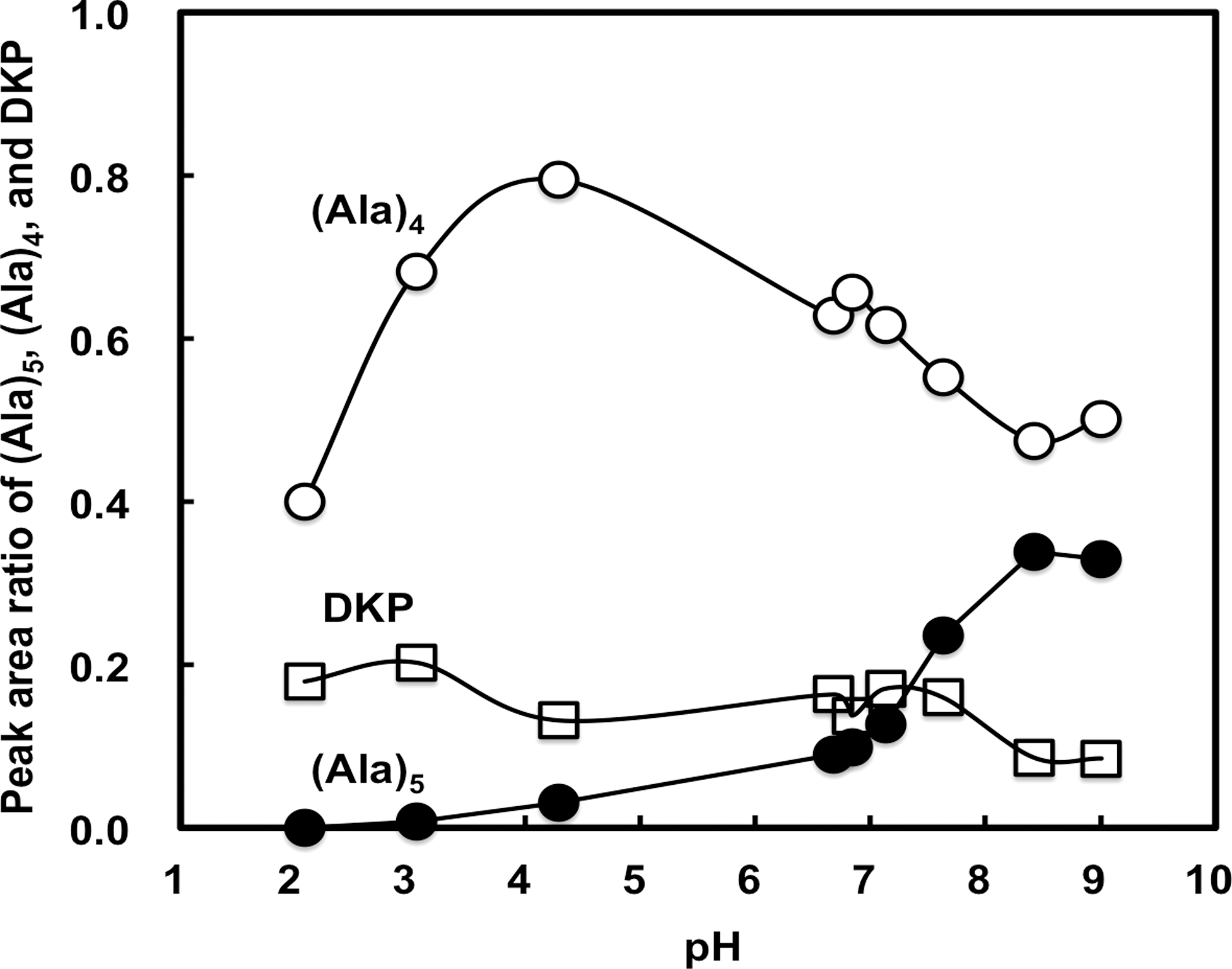
Influence of pH on the peak area ratio of (Ala)4, (Ala)5, and DKP by the elongation reaction of (Ala)4 under the hydrothermal conditions in the absence of mineral. Reaction conditions are the same as shown in Figure 1.
In contrast, the pH values for the reactions in the presence of minerals were measured after the reactions (Fig. 5, open circles) to compare the influence of pH on experiments without minerals. Figure 4 shows the experimental data on the influence of pH in both the absence (open circles) and presence (triangles) of minerals. In this study, the aqueous sample solution containing (Ala)4, NaCl, and MgCl2 was adjusted to pH 7.0 at 25°C before the hydrothermal experiments, and then the mixture was added to minerals for hydrothermal reactions. From the comparison of the pH dependence on the formation of (Ala)5 with and without minerals (Fig. 5), the net influence of minerals on the formation of (Ala)5 is deduced. Volcanic ash (Shinmoedake), volcanic ash (Sakurajima), dickite, and pyrophillite showed lower pH after reaction, wherein the yields of (Ala)5 were small. This is consistent with the fact that the elongation of (Ala)4 decreases with decrease in pH in the absence of minerals. Thus, low yields of (Ala)5 in the presence of kaolinite, volcanic ash (Shinmoedake), volcanic ash (Sakurajima), dickite, and pyrophillite are probably due to the increase of acidity in hydrothermal solutions. By the way, the value of pH of the sample solution measured just after the addition of aqueous mixture containing (Ala)4, NaCl, and MgCl2 to mineral was not very acidic (see Table 1). For instance, pH values were 6.63 for volcanic ash (Shinmoedake), 6.68 for volcanic ash (Sakurajima), 6.85 for dickite, and 6.86 for pyrophillite given in Table 1. The pH of all these samples changed to more acidic after the hydrothermal reactions at 175°C under the hydrothermal conditions.
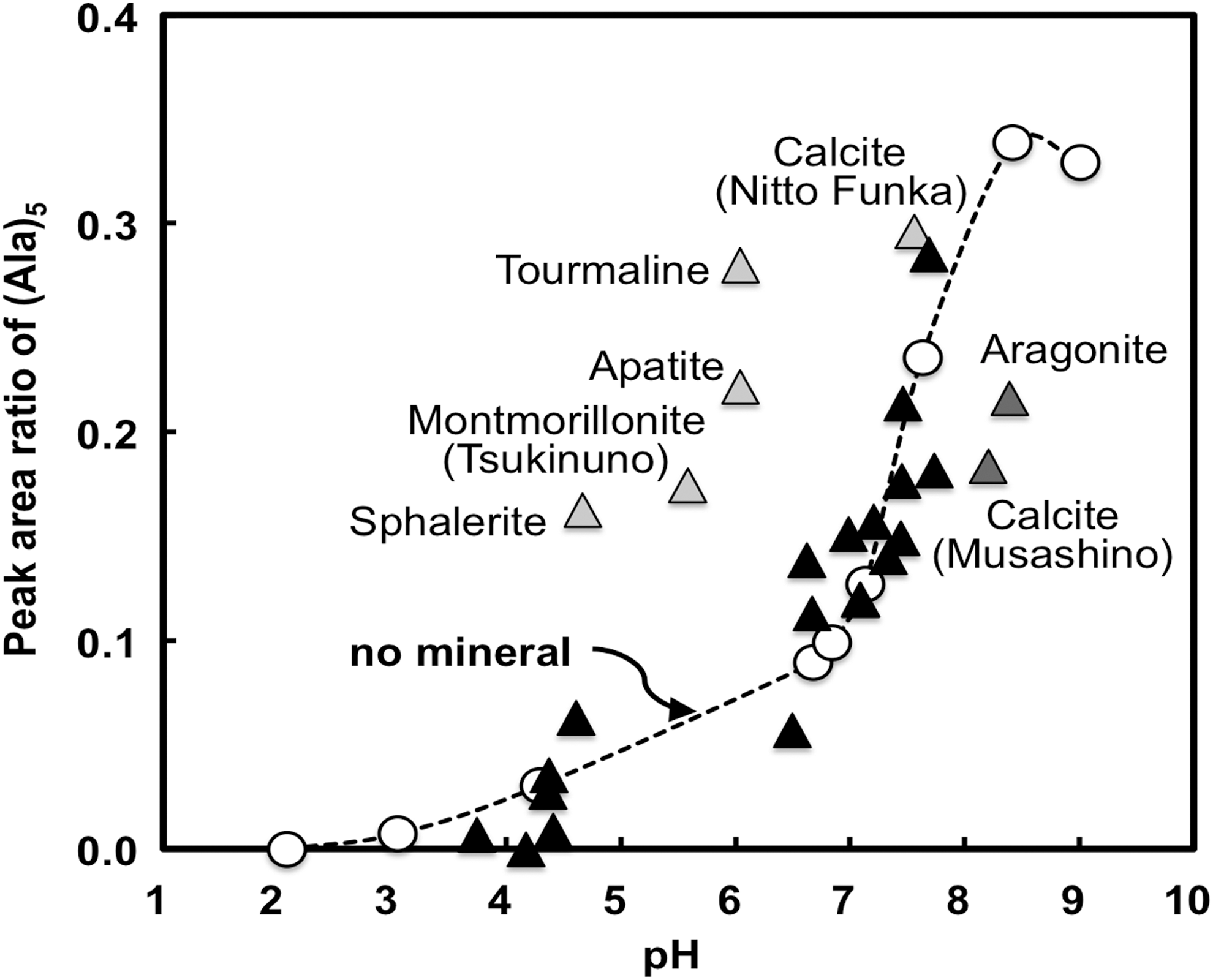
Influence of pH on the peak area ratio of (Ala)5 by the elongation reaction of (Ala)4 under the hydrothermal conditions in the presence of minerals. All other reaction conditions are the same as shown in Figure 1. Circles: pH dependence in the absence of minerals shown in Figure 4. Triangles: pH dependence in the presence of minerals, where some of data are labeled with the name of minerals.
pH was measured just after the addition of the “stock solution of (Ala)4” containing (Ala)4, NaCl, and MgCl2 at pH 7.0 to minerals. Reaction conditions: [(Ala)4] = 1 mM, [NaCl] = 0.1 M, [MgCl2] = 0.05 M, pH = 7.0, 175°C, 90 min.
pH was measured after the hydrothermal reactions for 90 min at 175°C.
(Ala)4, L-alanyl-L-alanyl-L-alanyl-L-alanine; (Ala)5, L-alanyl-L-alanyl-L-alanyl-L-alanyl-L-alanine.
On the contrary, the pH values of sample solutions of aragonite and calcite (Musashino) changed to weakly alkaline at 8.40 for aragonite and at 8.21 for calcite (Musashino). Thus, in general, these facts indicate that the pH change occurs by dissolution of acidic or alkaline species from these minerals during the hydrothermal exposure in the presence of minerals. Naturally, the pH change profile could not be followed at high temperatures at the present time, so the details of the influence of pH change are not readily evaluated. In addition, the pH buffer capacity would be an important factor for evaluation of actual hydrothermal environments in the presence of minerals.
In general, these data show that the influence of minerals would be primarily understood as the pH change in the environment, by the presence of the minerals. At the same time, the data shown in Figure 5 also suggest that the enhancement by minerals is not simply due to the change in pH. For instance, the yields of (Ala)5 in the presence of montmorillonite (Tsukinuno), sphalerite, apatite, tourmaline, calcite (Nitto Funka), and quartz are higher than the line for the pH dependence in the absence of minerals, where the difference between the elongation with and without the minerals indicates the magnitude of enhancement by the minerals.
4. Discussion
4.1. Reaction behavior in the presence of minerals
Even though it is not possible to measure the pH values during experiments, thermodynamic calculations are helpful for the estimation of active chemical species. The pH value in the absence of mineral at high temperatures can be estimated from the thermodynamic calculation on the basis of the temperature dependence on the dissociation constant of water (K w) and an estimated temperature dependence on the dissociation constant of (Ala)4 (Perrin, 1965; Helgeson, 1967; Sillen and Martell, 1971; Serjeant and Dempsey, 1979; Kawamura et al., 2005, 2011). The calculation indicates that the pH value of the prepared solution without minerals changes to 4.64 at 175°C, and to 4.06 at 275°C from 7.00 at 25°C. The distribution of (Ala)4 species, (Ala)4 + (cationic form), (Ala)4 ± (zwitterion form), and (Ala)4 − (anionic form) as a function of pH, is estimated as shown in Supplementary Data. The ratios of these ion forms are (Ala)4 + (3.3%), (Ala)4 ± (80.9%), and (Ala)4 − (15.8%) at 175°C, (Ala)4 + (8.7%), (Ala)4 ± (63.4%), and (Ala)4 − (27.8%) at 275°C, and (Ala)4 + (0%), (Ala)4 ± (89.7%), and (Ala)4 − (10.3%) at 25°C. The estimated distribution of these species, as shown in Figure 6 and Supplementary Figure S4, suggests that an active species for the elongation of (Ala)4 to (Ala)5 would be the negatively charged species (Ala)4 −. In addition, the coincidence of the distribution of (Ala)4 ± and the peak area ratio of (Ala)4 as a function of pH would reflect that (Ala)4 ± is a more stable species than (Ala)4 + and (Ala)4 −. The coincidence of distribution of (Ala)4 − and the pH profile of the peak area ratio of (Ala)5 supports that the active species is (Ala)4 −. For instance, the difference of the influence with montmorillonite clay minerals should be primarily due to the pH change in the presence of these minerals after 90 min reactions at 175°C. The difference between these montmorillonite clays would be verified on the basis of mineral compositions in future (Sugita et al., 2005), although there is less correlation between the specific surface area based on Brunaure-Emmett-Teller theory and the adsorption of fluoride ions on these two clays. At the present time, it is regarded that montmorillonite (Tsukiuno) possesses the capability to change pH of the solution as compared with montmorillonite (Mikawa).
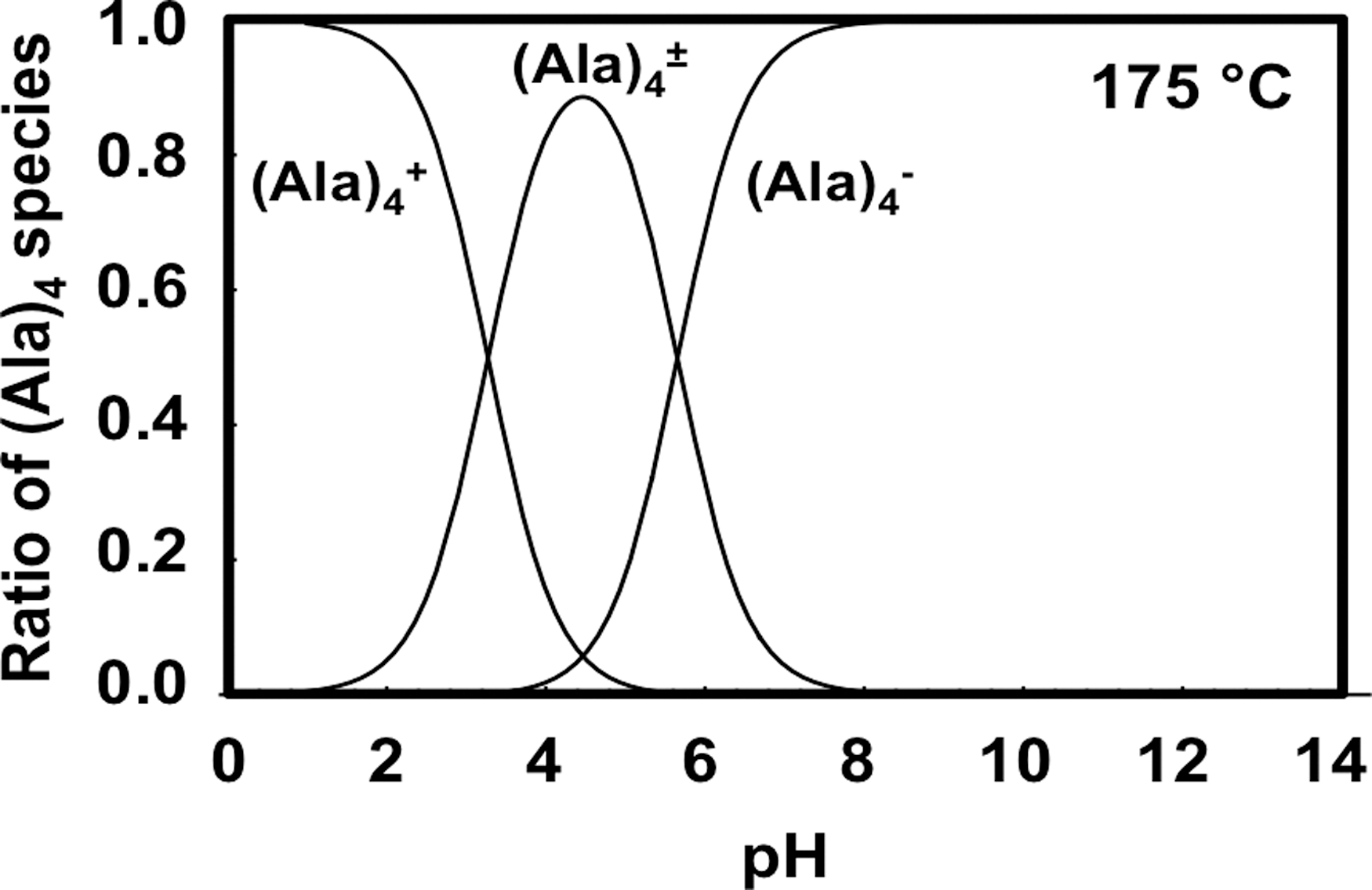
Estimated distribution of (Ala)4 species at 175°C on the basis of the estimated dissociation constants, pK a1 and pK a2, for the (Ala)4, and the dissociation constant of water, pK w, as a function of pH. The values of pK w were estimated on the basis of Helgeson (1967) and the values of pK a1 and pK a2 were estimated on the basis of that shown in Kawamura et al. (2011). Supplementary Data involve the results at 275°C and 25°C. The estimated values of pK w used are 11.4255 at 175°C and 11.1936 at 275°C. The estimated values of pK a1 and pK a2 for (Ala)4 used for the calculations are 3.254 and 5.352 at 175°C, and 3.194 and 4.413 at 275°C. The values of pK a1 and pK a2, 3.42 and 7.94, at 25°C are used from Perrin (1965).
However, it seems difficult that the influence of pH on the elongation of (Ala)4, in the presence of mineral, is only due to the pH change, since the peak area ratio of (Ala)5 in the presence of some types of minerals does not coincide with the pH profile in the absence of mineral. There are unknown factors, which would take into account the mineral influence. These factors include the dissolution kinetics of ionic species from minerals and the adsorption kinetics of peptides and amino acids on the minerals. The yields of (Ala)5 in the presence of minerals, such as montmorillonite (Tsukinuno), sphalerite, apatite, tourmaline, calcite (Nitto Funka), and quartz, showed extra enhancement beyond the pH influence on the (Ala)4 elongation. Thus, the influence involves different effects on minerals other than the pH influence. Presumably, if the assumption that the enhancement of (Ala)5 formation is due to the negatively charged active species (Ala)4 − is generally correct, (Ala)4 − would form likely on the surface of these minerals, at which the local environment of the mineral surface might be more acidic than the bulk acidity. In contrast, the adsorption of amino acids has been investigated in the presence of clay minerals. These studies showed that the adsorption of alanine on bentonite and kaolinite (Benetoli et al., 2007), for instance, higher adsorption degree in acidic or alkaline solution compared with neutral pH. This is probably due to the fact that the betaine species possess higher solubility of alanine at neutral pH. Since both Ala and (Ala)4 possess only a carboxylic group and an amino group, the binding of (Ala)4 would be weak at neutral pH. In addition, we have found that the binding of biomolecules, such as nucleotides, is dependent on the presence of divalent ions, such as Mg2+, at which nucleotides bind strongly on montmorillonite through complex formation of phosphate group with Mg2+ (Kawamura and Ferris, 1994). Relationship between the binding of peptides and the reactivity on minerals will be important, whereas the binding study at high temperatures is not easily carried out at present.
Our previous study showed that the size of calcite particles did not affect the peak area ratio of (Ala)5. However, strong adsorption was not observed either in this or in previous studies on the basis of analysis of (Ala)4 and products in the supernatant with these minerals. The total amount of peptides is not much different when compared with the solution without minerals. Furthermore, the pH value in the presence of minerals (adjusted at pH 7 before the reactions) changed after the hydrothermal reactions. This fact indicates that the adsorption behavior of (Ala)4 on the mineral surfaces does not straightforwardly contribute to the enhancement of the elongation of (Ala)4, but also remarks the importance of the dissolution kinetics of acid or alkaline species from minerals into the aqueous phase.
Here, there is a difference between the previous and present studies with the flow reactor at 275°C and with the batch reactor at 175°C. The difference would be also understood on the basis of the kinetics of acidification or weak alkalization with minerals; the pH changed before and after the reaction as shown in Table 1. The pH change due to the hydrothermal reactions at 175°C may not be so rapid since the pH just measured after the sample preparations was not changed from the pH value of the stock solution of (Ala)4. Thus, the kinetics of pH change during hydrothermal reactions would be an important factor, which determines the elongation behaviors. First, the contact time of the aqueous phase to the solid phase in this study should be different from that in the previous study. The reaction time when using the flow reactor, where the sample solution passes through the flow reactor, was only in the reaction time range of 3–210 s. In contrast, the reaction time when using a batch reactor in this study is in the range of 30–240 min. Second, the adsorption kinetics of chemical species regarding (Ala)4 elongations should be different between the experimental conditions in the previous and present studies at different temperatures. Conclusively, it means that the difference between this and previous studies indicates the importance of contact time of the aqueous phase with the mineral phase.
According to our previous study on the kinetic simulations for the (Ala)4 elongation (Kawamura et al., 2011), the enhancement of (Ala)5 formation at higher pH is probably because the rate constant of the degradation of (Ala)4 becomes relatively small as compared with the elongation of (Ala)4 to (Ala)5 with increasing pH. This study showed a similar trend on the pH dependence of the efficiency on (Ala)4 elongations as already mentioned. The reason that the influence of pH change was not readily understood is because the contact time of the aqueous phase with the mineral phase was very short for the reactions when using the hydrothermal flow reactor. The equilibrium between adsorption of (Ala)4 and dissolution of minerals into the aqueous phase would not be completed when using the flow reactor, since the residence time is in the second timescale. Furthermore, it was not possible to deduce isotherm behavior from the dependence of (Ala)4 reactions with different amounts of calcite. This supports the idea that this phenomenon is also related to the kinetics of dissolution of calcite rather than to the binding of (Ala)4 on calcite.
Reaction mechanism of the enhancements should be investigated in detail as a future goal. However, it is pointed out that there is no suitable research tool for the in situ measurement of pH and the measurement of adsorption behaviors for the liquid–solid two-phase systems at high temperatures. These difficulties would be resolved by utilizing the principle of our in situ measurements, using the hydrothermal reactor system with improvement for the measurement of binding behaviors.
4.2. The role of minerals for chemical evolution of peptides
Different minerals tested in this study showed enhancement or inhibitory activities for the elongation of (Ala)4 peptide. The inhibitory activity is due primarily to the decrease in pH in the presence of minerals. At the same time, it was assumed that this effect is a function of the contact time of the aqueous phase with the mineral phase. This fact suggests that hydrosphere in the presence of acidic minerals, such as volcanic ash, would have not been suitable for the accumulation of oligopeptides through the elongation of (Ala)4 to higher oligopeptides. Although lava is also a volcanic product, it did not show notable influence on the elongation since the pH of samples was around 7. It was confirmed that the pH values in the presence of volcanic ash were not very low, that is, around 3 to 4, and the aqueous phase contacted only for 90 min at 175°C. On the contrary, this study would suggest that the hydrothermal vent systems would be likely as a suitable environment for the elongation of peptides through this type of peptide elongations (Sojo et al., 2016). On the contrary, according to our previous study (Kawamura and Shimahashi, 2008), such acidic environments at around pH 3 to 4 might have been suitable for the relatively efficient formation of protein-like molecules from amino acid mixtures containing glutamic acid and aspartic acid.
Investigations on very early Earth environments suggest that the ocean would have been acidified with volcanic products, which can be found in modern hydrothermal fields, and gradually neutralized by Earth's crust (Maruyama et al., 2013). In addition, equilibrium of the primordial ocean with a thick carbon dioxide atmosphere kept the ocean as a weak acidic medium (Walker, 1985; Grotzinger and Kasting, 1993; Kasting, 1993; Morse and Mackenzie, 1998). These factors should have determined the pH of the primitive ocean, and the presence of carbonate would have risen it up at around 5 to 6. Thus, it is assumed that different types of peptides could have occurred separately at different pH conditions, and these products could have been mixed by a peculiar geological event, such as the late heavy bombardment (Kawamura and Maurel, 2017).
5. Conclusions
This study showed the mineral enhancement and inhibitory activities in the elongation of (Ala)4 to higher oligopeptides at 175°C. These mineral activities are primarily due to the pH change originated by the presence of minerals. This conclusion does not seem to be straightforwardly consistent with our previous study using a hydrothermal flow reactor at 275°C, where the enhancement by carbonate minerals is not promoted by the pH change with the minerals. The difference between the previous and present studies implies that the influence of minerals also involves the interaction kinetics of the aqueous phase with the mineral phase. In addition, neutral to alkaline hydrothermal conditions might have been suitable for the elongation of (Ala)4 instead of acidic hydrothermal systems. This study demonstrated the importance of dissolution and adsorption kinetics regarding the peptide formation simulations in the presence of minerals, as well as the influence of minerals on the pH change under hydrothermal conditions; it is expected that the measurement of adsorption behavior of biomolecules on minerals surfaces should be improved when using our hydrothermal flow reactor technology.
Footnotes
Acknowledgments
This study was supported by the Hiroshima Shudo University grant at 2014, Aoba Foundation for the Promotion of Engineering, the JSPS KAKENHI Grant JP15H01069 in 2015–2017, and the JSPS KAKENHI Grant JP15K12144 in 2015–2017. We thank Nitto Funka Kogyo Co. Ltd. Japan, JFE mineral Co. Ltd. Japan, Saito Shoten Ltd. Japan, Taiheiyo Cement Co. Japan, and Yamaguchi Mica Co. Ltd. Japan for the gift of minerals.
Author Disclosure Statement
No competing financial interests exist.
Abbreviations Used
References
Supplementary Material
Please find the following supplemental material available below.
For Open Access articles published under a Creative Commons License, all supplemental material carries the same license as the article it is associated with.
For non-Open Access articles published, all supplemental material carries a non-exclusive license, and permission requests for re-use of supplemental material or any part of supplemental material shall be sent directly to the copyright owner as specified in the copyright notice associated with the article.
