




Abstract
Saturn's moon Titan has all the ingredients needed to produce “life as we know it.” When exposed to liquid water, organic molecules analogous to those found on Titan produce a range of biomolecules such as amino acids. Titan thus provides a natural laboratory for studying the products of prebiotic chemistry. In this work, we examine the ideal locales to search for evidence of, or progression toward, life on Titan. We determine that the best sites to identify biological molecules are deposits of impact melt on the floors of large, fresh impact craters, specifically Sinlap, Selk, and Menrva craters. We find that it is not possible to identify biomolecules on Titan through remote sensing, but rather through in situ measurements capable of identifying a wide range of biological molecules. Given the nonuniformity of impact melt exposures on the floor of a weathered impact crater, the ideal lander would be capable of precision targeting. This would allow it to identify the locations of fresh impact melt deposits, and/or sites where the melt deposits have been exposed through erosion or mass wasting. Determining the extent of prebiotic chemistry within these melt deposits would help us to understand how life could originate on a world very different from Earth. Key Words: Titan—Prebiotic chemistry—Solar system exploration—Impact processes—Volcanism. Astrobiology 18, 571–585.
1. Introduction
S
Once on the surface, the products of Titan's photochemistry may react with liquid water in certain circumstances. Titan's surface is on average too cold for liquid water (∼94 K; Fulchignoni et al., 2005), but transient liquid water environments may be found in impact melts and cryolavas (Thompson and Sagan, 1992; O'Brien et al., 2005; Neish et al., 2006). When organic molecules found on Titan's surface are exposed to liquid water, they quickly incorporate oxygen (Neish et al., 2008, 2009) to produce a range of biomolecules that include amino acids and possibly nucleobases (Neish et al., 2010; Poch et al., 2012; Cleaves et al., 2014). Impact melts and cryolavas of different volumes—and hence, different freezing timescales (O'Brien et al., 2005; Davies et al., 2010)—give us a unique window into the extent to which prebiotic chemistry can proceed over different timescales.
Thus, Titan provides a natural laboratory for studying the products of prebiotic chemistry. These products provide crucial insight into what may be the first steps toward life in an environment that is rich in carbon and nitrogen, as well as water. It is even possible that life arose on Titan and survived for a short interval before its habitat froze. Alternatively, life may have developed in Titan's subsurface ocean, and evidence of this life could be brought to the surface through geophysical processes such as volcanism (Fortes, 2000). A new exploration strategy is required to collect the results of these natural experiments; such measurements are not possible with the currently available data from the Voyager and Cassini-Huygens missions.
Even before Cassini reached the outer solar system, it was recognized that a post-Cassini scientific priority, especially for astrobiology, would be to access surface material for detailed investigation (Chyba et al., 1999; Lorenz, 2000). More recently, identifying “Planetary Habitats” was included as one of the three crosscutting themes of the National Research Council's “Visions and Voyages for Planetary Science in the Decade 2013–2022” (Space Studies Board, 2012). In addition, Titan is currently listed as one of six potential mission themes for NASA's next New Frontiers mission. † Such a mission could be specifically designed to identify the products of prebiotic chemistry on Titan's surface.
In this work, we determine the ideal locales to search for biomolecules on Titan, and suggest mission scenarios to test the hypothesis that the first steps toward life have already occurred there. In this scenario, we would consider a substantial presence of biomolecules (i.e., compounds that are essential to life as we know it) as either a compelling indicator of an advanced prebiotic environment or as a possible sign of extinct (or more speculatively, extant) life.
2. Geological Settings for Aqueous Chemistry on Titan
Liquid water is both a crucial source of oxygen and a useful solvent for the generation of biomolecules on Titan's surface. Thus, if we wish to identify molecular indicators of prebiotic chemistry on Titan, we need to determine where liquid water is most likely to have persisted. Although Titan's average surface temperature of ∼94 K precludes the existence of bodies of liquid water over geological timescales (unless there is an active hotspot; see Schulze-Makuch and Grinspoon, 2005), it does not rule out the presence of water on the surface for short periods of time. We are likely to find transient liquid water environments on the surface of Titan in two distinct geological settings: (1) cryovolcanic lavas and (2) melt in impact craters. In addition, Titan's deep interior has a liquid water layer, perhaps hundreds of kilometers thick, which may also contain biomolecules (Fortes, 2000; Iess et al., 2012). Samples of this ocean may be transported to the surface through cryovolcanic processes before eventually freezing. Thus, if we wish to find biomolecules on the surface of Titan, we should focus our search in and around cryovolcanoes and impact craters.
2.1. Cryovolcanoes
On Titan, lavas are generally referred to as cryolavas, since they involve the eruption of substances that are considered volatiles on the surface of Earth (water, water–ammonia mixtures, etc.). Features suggested to be caused by cryovolcanism were first discovered on the icy satellites during the Voyager missions (e.g., Jankowski and Squyres, 1988; Showman et al., 2004). More recent observations point to the existence of present day activity on Enceladus (Porco et al., 2006) and Europa (Roth et al., 2014; Sparks et al., 2017).
Two conditions must be met for cryovolcanic flows to be present on a surface: liquids must be present in the interior and those liquids must then migrate to the surface. Theoretical models of Titan's formation and evolution predict that a substantial liquid water layer must still exist in its interior, provided a sufficient amount of ammonia is present in the ocean (Tobie et al., 2005). Observations by the Cassini mission have confirmed the presence of a liquid water subsurface ocean. Measurements of the tidal Love number by the Radio Science experiment require that Titan's interior is deformable over its orbital period, consistent with a global ocean at depth (Iess et al., 2012). In addition, the permittivity, wave, and altimetry instrument on ESA's Huygens probe detected a electric current in Titan's ionosphere, consistent with a Schumann resonance between two conductive layers. The lower layer was estimated to lie 55–80 km below the surface, suggestive of a salty, subsurface ocean (Béghin et al., 2012). Other analyses of Titan's overall shape, topography, and gravity field are consistent with an ice shell of this thickness overlying a relatively dense subsurface ocean (Nimmo and Bills, 2010; Mitri et al., 2014).
The second requirement for cryovolcanism is for liquid to be transported from the interior to the surface. One plausible way to transport lava is through fluid-filled cracks. Mitri et al. (2008) proposed a model in which ammonia–water pockets are formed through cracking at the base of the ice-I shell. As these ammonia–water pockets undergo partial freezing, the ammonia concentration in the pockets would increase, decreasing the negative buoyancy of the ammonia–water mixture. Unlike pure liquid water, a liquid ammonia–water mixture of peritectic composition (ρ = 946 kg/m3) is near-neutral buoyancy in ice (ρ = 917 kg/m3) (Croft et al., 1988). Although these pockets could not easily become buoyant on their own (given the difference in density of ∼20–30 kg/m3), they are sufficiently close to the neutral buoyancy point that large-scale tectonic stress patterns (tides, nonsynchronous rotation, satellite volume changes, solid state convection, or subsurface pressure gradients associated with topography) could enable the ammonia–water to erupt effusively onto the surface. Evidence of such stress patterns is observed on Titan (Cook-Hallett et al., 2015; Liu et al., 2016). Any lava extruded in this way would likely have a peritectic composition near that of pure ammonia dihydrate (33 wt % ammonia).
We can test the hypothesis that cryolavas have erupted onto Titan's surface by looking for morphological constructs on the surface consistent with volcanism. The Cassini RADAR instrument has imaged approximately two-thirds of the surface of Titan, producing views of the landscape with resolutions as good as 350 m. Although it is difficult to conclusively identify cryovolcanic constructs at these resolutions (Moore and Pappalardo, 2011), several features remain difficult to explain through any other geological process (Lopes et al., 2013). The most intriguing of these features is Sotra Patera (part of a region formerly known as Sotra Facula). This region includes the deepest pit and some of the highest mountains on Titan, as well as the associated flow-like features of Mohini Fluctus, a 200 km feature extending from Sotra Patera with a lobate edge (Fig. 1). If Sotra Patera is indeed a volcanic construct, the lava flows there would be an interesting location for studying the interaction of liquid water with organic molecules on Titan's surface.
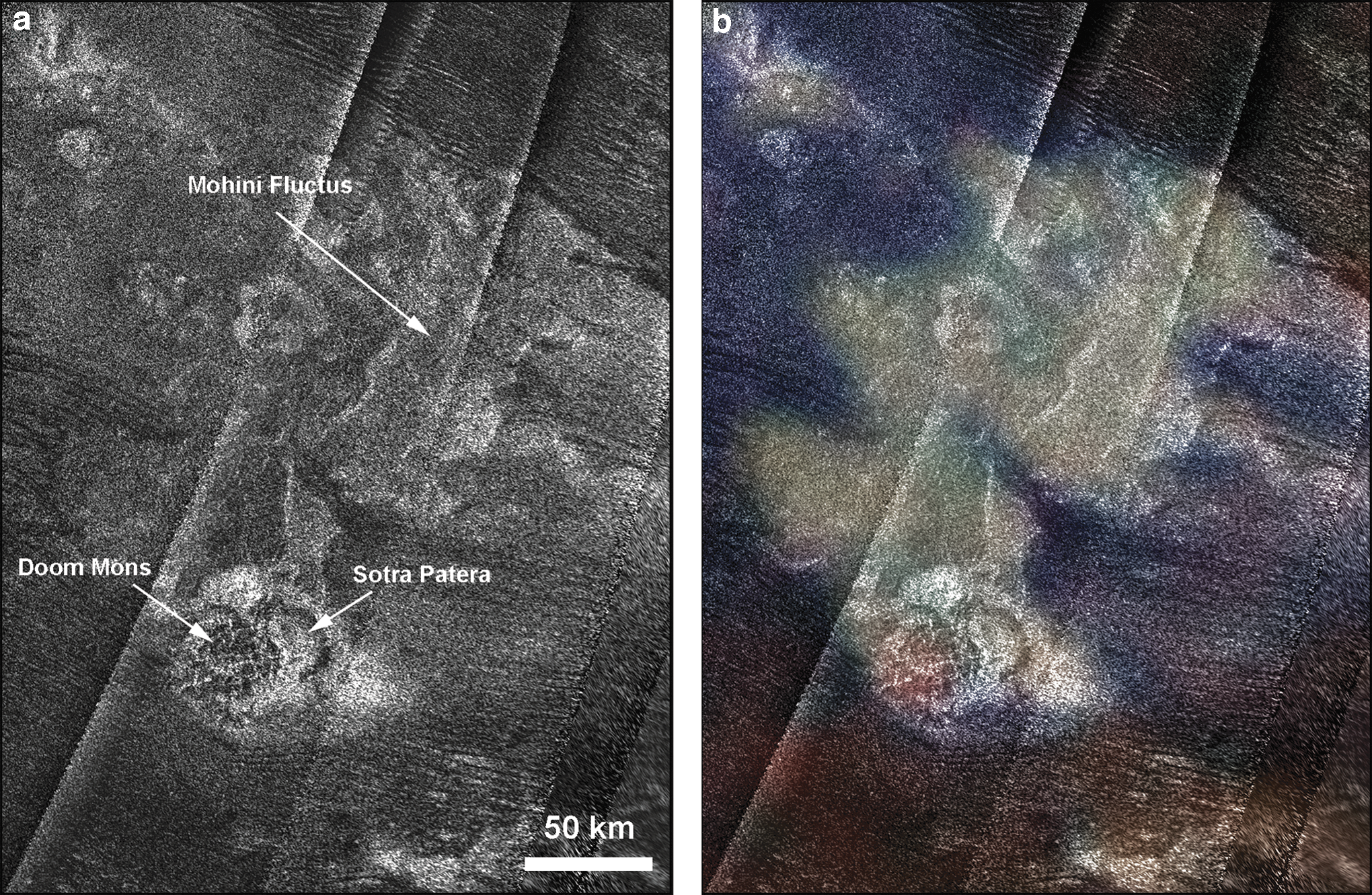
However, unless this region represents a persistent hot spot, it is unlikely that the lava will remain liquid long enough for aqueous chemistry to produce complex, biological molecules. (Thus far, no evidence of hot spots has been observed on Titan; Lopes et al., 2013.) Flow lobes tens of meters thick in Mohini Fluctus (Lopes et al., 2013) would likely cool over relatively short timescales: if heat is lost only by conduction, the one-dimensional thermal conduction equation predicts that it should take only 1 year for a 10-meter-thick flow of water or ammonia dihydrate to completely freeze. Even a 200 m high cryovolcanic dome that is 90 km in radius is expected to take only several hundred years to freeze completely (Neish et al., 2006).
In addition, if these lavas have a peritectic composition close to that of pure ammonia dihydrate, they would erupt close to a temperature of 176 K. This would significantly affect reaction rates. In a 13 wt % ammonia solution at 253 K, reactions between Titan haze analogues and ammonia–water have half-lives of a few days (Neish et al., 2009). According to the Arrhenius equation, a reaction at 253 K with an activation energy of 50 kJ/mol would take 3 × 10⁴ times longer in a peritectic melt at 176 K. Thus, a reaction that took a few days to complete at the higher temperature would take a few hundred years to complete at the lower temperature. The aqueous chemistry in cryolavas may not have sufficient time or energy to produce more complicated prebiotic molecules.
More speculatively, Titan's subsurface ocean may contain biomolecules, or even simple life forms (Fortes, 2000). Evidence of such biology could be found frozen in the cryovolcanic lavas on the surface of Titan. However, given the uncertain presence of biomolecules in the subsurface ocean, and the challenges inherent in transporting material to the surface, we judge the priority for exploration should focus on another geological setting where biomolecules are more likely to be present: impact melt deposits.
2.2. Impact craters
When a comet or asteroid impacts a planet, energy becomes available to melt its surface. Ponds and flows of melted crustal rock are observed in and around impact craters on terrestrial planets (e.g., Hawke and Head, 1977). Models suggest that melt should be produced on icy satellites as well (Pierazzo et al., 1997; Artemieva and Lunine, 2003; Kraus et al., 2011), and smooth regions at the center of the largest craters on Ganymede have been interpreted to be solidified impact melt (Jones et al., 2003; Bray et al., 2012).
Titan's atmosphere is capable of shielding the surface from smaller impactors (Ivanov et al., 1997; Artemieva and Lunine, 2005; Korycansky and Zahnle, 2005), so any projectile that does strike the surface must necessarily be large. Such impactors would melt a substantial amount of Titan's crust. Artemieva and Lunine (2003) conducted three-dimensional hydrodynamical simulations of impacts into Titan's crust, and found that a 2 km icy projectile entering the atmosphere at an oblique angle with a velocity of 7 km/s would generate 2–5% melt by volume within a transient crater 10–25 km in diameter. The amount of melt increases with impact energy, so larger craters would contain a larger percentage of melt by volume (Grieve and Cintala, 1992; Cintala and Grieve, 1998; Elder et al., 2012).
This melt could collect in the lowest parts of the crater, forming a sheet several hundred meters thick. Given the higher density of liquid water compared with the density of ice-I, some melt could also drain into fractures in the crater floor before freezing, forming the central pit features seen in craters on many icy satellites (Elder et al., 2012). Using fracture volumes estimated from the gravity anomalies observed over terrestrial impact craters, and assuming flow through plane parallel fractures, Elder et al. (2012) estimated that melt will be retained for Titan craters with diameters greater than ∼90 km. However, this is a somewhat idealized situation; in reality, fractures in the brecciated floor of an impact crater are much more sinuous, with variable direction and width. If the fractures have a tortuosity of 2, only approximately one-third as much melt would drain (Elder et al., 2012). (Tortuosity is the ratio of the length of the fracture to the depth of the fractured region.) In addition, it is likely that fractures do not have a constant width, which would cause the flow to slow through narrower passages, reducing the total amount of melt volume drained. Since larger craters produce a larger fraction of melt by volume than smaller craters (Grieve and Cintala, 1992), a reduced drainage efficiency means that melt could also be retained for somewhat smaller impact craters on Titan (larger craters would simply retain more melt than they would if there was more efficient drainage).
The organics found on Titan's surface could then react with melt present on the crater floor, in its ejecta blanket, or perhaps mixed with melt that drains into fractures. Artemieva and Lunine (2003) found that a significant fraction (10%) of Titan's organic surface layer would be only lightly shocked in an impact. As a result, these organic molecules would be only partially altered, providing reactants for any subsequent aqueous chemistry. In impact craters on Earth, impact melt often incorporates large amounts of clastic material from nonmelted, but shocked target rocks (Osinski et al., 2018), suggesting that there would be efficient mixing between liquid water and organic clasts on Titan. In this way, impact melts could provide “oases” for prebiotic chemistry to occur on Titan's surface.
Once melted by the impact, any liquid water generated would begin to cool to the ambient temperature of ∼94 K. Thompson and Sagan (1992) were the first to estimate the lifetime of melt pools generated in impacts on Titan. They approximated the melt as a buried sphere of water freezing inward, and found lifetimes of ∼104 years for a 10 km diameter crater, and ∼106 years for a 100 km diameter crater. O'Brien et al. (2005) refined the calculation using a thermal conduction code, including more realistic geometries (such as sheets of melt several hundreds of meters thick) and the possibility of water–ammonia melt mixtures. With the melt fraction calculated by Artemieva and Lunine (2003), they found somewhat shorter lifetimes of ∼102–103 years for a 15 km diameter crater, and ∼103–104 years for a 150 km diameter crater. These lifetimes are considerably longer than those for lava flows tens of meters thick, allowing more time for aqueous chemistry to proceed. (Lifetimes could be reduced if a significant proportion of the melt was to drain into the bottom of the crater, as already discussed.)
Impact melts would provide an excellent medium for aqueous chemistry on Titan. In addition to having longer freezing timescales than cryovolcanic flows, they are also likely to be emplaced at much higher temperatures. Melted crustal rock (as opposed to water extruded from depth) is more likely to yield a water-rich composition, with temperatures near the water liquidus (273 K), not the ammonia–water peritectic (176 K). Temperatures may even exceed the liquidus initially, given the large amounts of energy available from an impact. For example, there is evidence for super-heating of several hundred Kelvins in impact melts on Earth (El Goresy, 1965; Hörz, 1965) and the Moon (Simonds et al., 1976). This could increase the temperature of the melt above the liquidus, accelerating the chemistry occurring in the melt ponds. Reactions between Titan haze analogues and liquid water were roughly 20 times faster at 40°C than at 0°C (Neish et al., 2008).
How many craters are available for such chemistry on Titan? We expect impact cratering to be an important process in the Saturnian system, whose satellites retain thousands of scars from past impacts (e.g., Kirchoff and Schenk, 2010). Before Cassini arrived at Saturn, the cratering history on Titan was unknown from direct observations, so estimates of the cratering rate were made by extrapolating the crater distributions observed on other Saturnian satellites, or by predicting impact rates by comet populations. Such estimates suggested that at least several hundred craters larger than 20 km in diameter should be present on Titan (Zahnle et al., 2003). Now that Cassini RADAR has been able to observe Titan's surface, an extreme paucity of craters is observed. Only 23 certain or nearly certain craters and ∼10 probable craters have been observed on Titan in this size range, with a handful of smaller crater candidates (Wood et al., 2010; Neish and Lorenz, 2012; Neish et al., 2016). This population has crater depths consistently shallower than similarly sized fresh craters on Ganymede, suggestive of extensive modification by erosion and burial (Neish et al., 2013). Although aeolian infilling appears to be the dominant modification process on Titan, fluvial erosion seems to play an important secondary role (Neish et al., 2016). In addition, there is an almost complete absence of craters near Titan's poles, which may be indicative of marine impacts into a former ocean in these regions (Neish and Lorenz, 2014) or an increased rate of fluvial erosion (Neish et al., 2016).
We, therefore, judge that the best targets for observing the products of aqueous—and possibly biological—chemistry on Titan are the floors of large, relatively fresh impact craters. Fresh impact craters on Titan are subject to a minimal amount of fluvial incision (which would expose the core of any impact melt sheet), but little to no burial by sand or sediments (Neish et al., 2016). These structures will contain the largest amount of impact melt, and that melt will be easier to access with a spacecraft than the melt in more degraded craters (where it is likely buried under a thick deposit of sediment).
To determine the best candidates for such studies, we consider the relative degradation states of all “certain” or “nearly certain” craters on Titan with diameters >75 km (i.e., those craters most likely to retain impact melt). As in Neish et al. (2013), we quantify the degradation state of a crater by considering the relative depth of a Titan crater compared with a fresh, unmodified crater on Ganymede with a similar diameter. The relative depth, R, is given by R(D) = 1 − d t(D)/d g(D), where d t(D) is the depth of a crater with diameter D on Titan and d g(D) is the depth of a crater with diameter D on Ganymede. A relative depth of 0 indicates the crater has the same depth as a crater on Ganymede and is thus unmodified by erosion; a relative depth of 1 indicates the crater is completely flat.
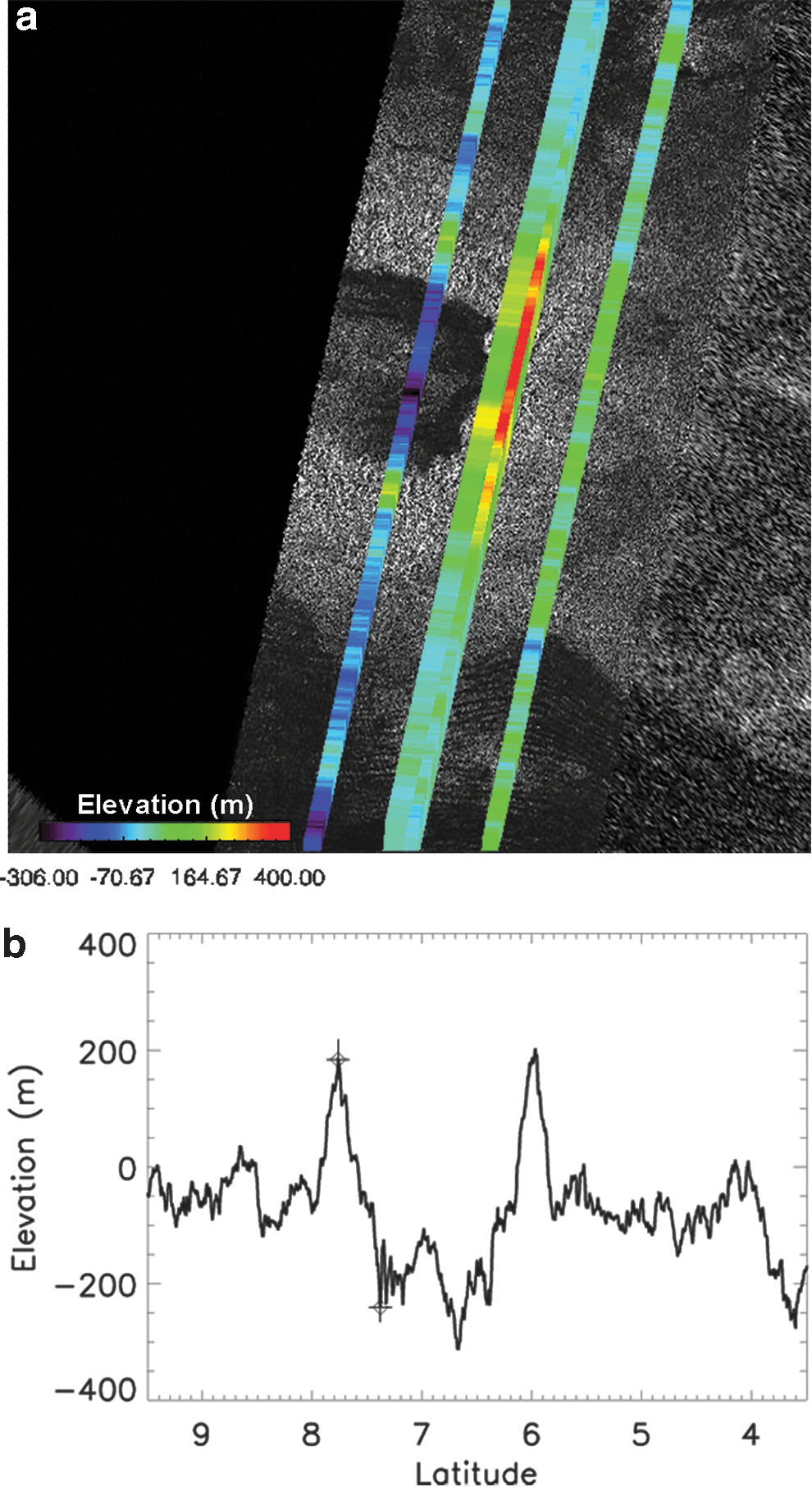
There is topography data for seven craters on Titan with D > 75 km. The relative depths of five of these craters were previously reported in Neish et al. (2013) and Neish et al. (2015). Topography data for the sixth crater—the ∼80 km diameter Selk crater—were obtained during Cassini's T95 pass of Titan on October 14, 2013 (Fig. 2a). A topographic profile was acquired through the center of the crater by using the SARTopo technique (Stiles et al., 2009). We calculated depth, d = h 1–h 2, by taking the difference between the highest point on the crater rim and the lowest point on the crater floor, on both sides of the crater, d 1 and d 2 (Fig. 2b). Systematic errors in height, dhi , were propagated throughout the analysis. These errors were determined from radar instrument noise and viewing geometry (Stiles et al., 2009). Using this technique, the depth of Selk is 470 ± 90 m.
Topography data for the seventh crater—the ∼140 km diameter Forseti—were generated from stereo topography produced from overlapping radar images from the T23 and T84 passes of Titan. Unfortunately, the stereo pair only covers the northeast corner of the crater, so our depth estimate is based solely on the rim heights and floor depths observed in this quadrant (Fig. 3a). The floor elevation is −2144 ± 35 m and the rim elevation is −1963 ± 54 m, for an average depth of 180 ± 60 m. In addition, there is a SARTopo profile through the northeast portion of the crater, generated by using data from Cassini's T23 pass (Fig. 3b). Unfortunately, there is a data gap present on the crater floor, so we are only able to calculate a minimum crater depth using this data set (Fig. 3c). Using the same technique as described for Selk, we found a minimum crater depth of 410 ± 50 m. This differs significantly from the depth derived from the stereo pair.
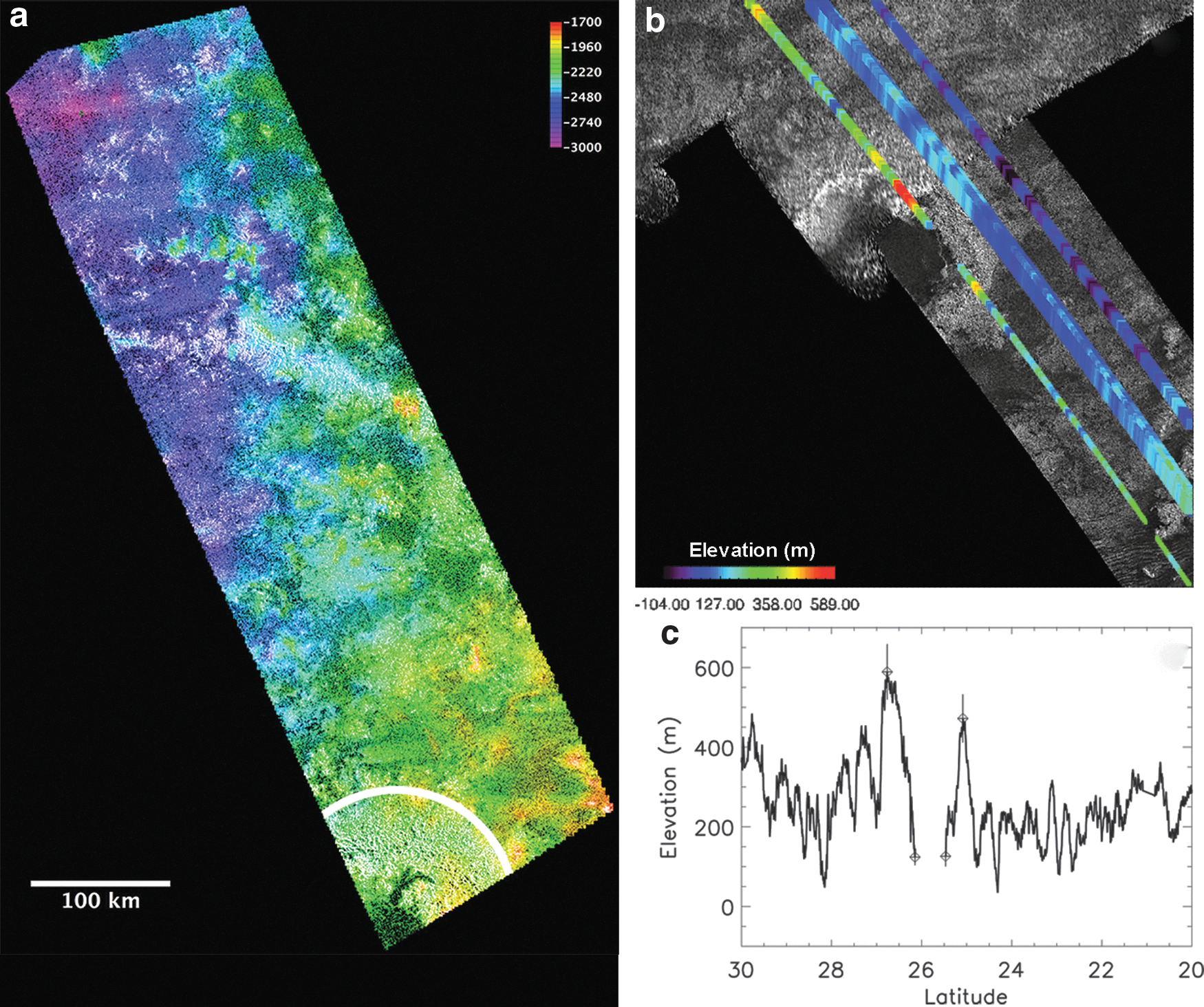
There are several possible reasons for this discrepancy. The crater floor may appear to be level with the crater rim in the stereo pair due to a lack of features on the floor. Identifiable features present in both images are necessary to make stereo measurements. This situation could cause elevations on the crater floor to be interpolated from the nearest rim points, artificially raising points on the crater floor in the stereo data. In addition, impact craters often have large variations in rim height (see, e.g., Neish et al., 2017). By only measuring one quadrant of the crater rim, we may not be getting a representative sample of the rim height, thus biasing our result by using a lower than average portion of the crater rim for depth measurements.
Updated topography data are also available for the ∼100 km diameter Hano crater. The data were generated from stereo topography produced from overlapping radar images from Cassini's T16 and T84 passes of Titan, and cover more than half of the crater from the southwest quadrant to the northeast quadrant. The result shows a crater with little noticeable topography (Fig. 4a). In fact, the average heights in the rim region (−1500 ± 170 m) and the average heights in the floor region (−1510 ± 140 m) are nearly identical, suggesting that Hano crater is essentially flat (R ∼ 1). The initial depth estimate (d = 525 ± 100 m) by Neish et al. (2013) using SARTopo only took into consideration one profile across the southernmost rim of the crater, so it is possible that that profile was not representative of the crater as a whole. An updated SARTopo profile is now available, covering both the northern and southern rims of Hano crater (Fig. 4b). Using the same technique as described for Selk, we found a new crater depth of 420 ± 40 m (Fig. 4c). As with Forseti, the stereo and SARTopo values differ considerably for Hano crater, possibly for the same reasons already outlined. However, both of the newly derived depths are lower than the initial estimate from Neish et al. (2013). Thus, Hano appears to be more degraded than originally suggested, which is consistent with its observed morphology in the RADAR data (Wood et al., 2010).

We summarize the relative depths of the seven craters in Table 1. Of these, only two have relative depths <0.6 for all current topography measurements: Sinlap and Selk. We judge these to be the least degraded craters in this size range. In terms of relative depth, Sinlap would be considered the “freshest” crater on Titan, with R = 0.4 ± 0.2. It is difficult to assess the relative depth of the largest crater on Titan, Menrva, since craters of this size range (D > 150 km) on icy satellites are associated with a sharp reduction in crater depth and anomalous impact morphologies (Schenk, 2002). However, given the large amount of impact melt expected in such a large crater, it remains a high priority target for future exploration. The craters of interest are shown in Fig. 5.
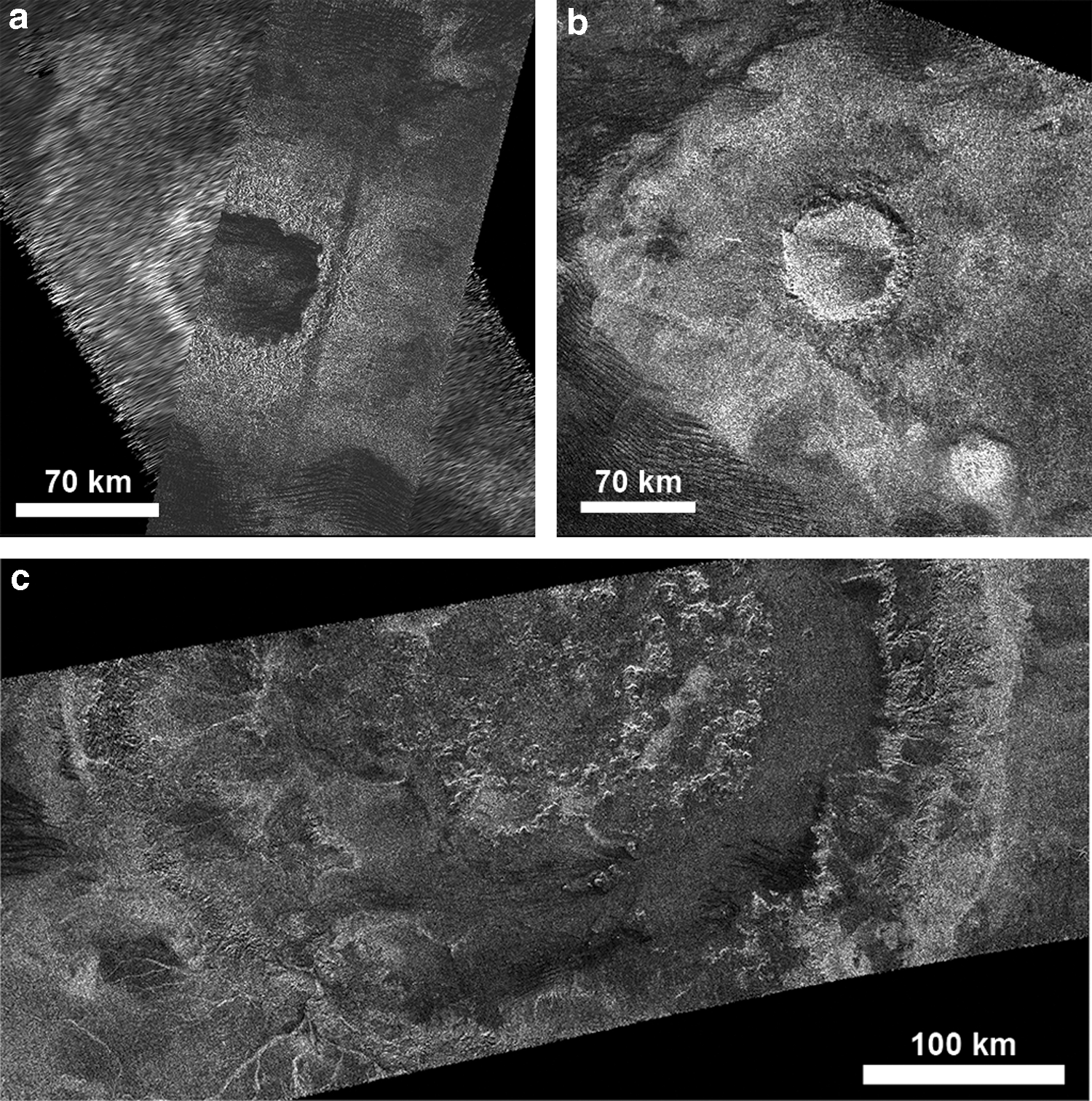
These three large, relatively unmodified impact craters on Titan would be the best locations to identify biological molecules on its surface:
Ganymede crater depths from Table 4 in Bray et al. (2012).
Assumed to have the same depth as a D = 100 km crater.
3. Identifying Biological Molecules on Titan
To identify biological molecules on Titan, it will be necessary to obtain more detailed data than are currently available from past ground- and space-based observations. As we describe hereunder, the remote sensing data sets lack the spatial and spectral resolution to make definitive conclusions about the composition of Titan's surface. Compositional information regarding the potential presence of biological molecules could be obtained from in situ observations, but only if (a) the associated instrumentation is designed for such a task and (b) the surface material can be obtained from the targeted regions described in Section 2. In this section, we describe the difficulties in assessing surface composition remotely, and describe possible approaches for in situ detection of biological molecules.
3.1. Detection by remote sensing?
To date, Titan has been a focus of a number of spacecraft missions, as well as numerous Earth-based telescopic observations. The collected data have provided global observations of Titan's atmosphere and surface at a range of spatial and spectral resolutions. However, it has remained a difficult challenge to determine the composition of Titan's surface from remote observations (Hörst, 2017), for reasons we expand upon hereunder.
Pioneer 11 was the first spacecraft to encounter Saturn, and acquired the first near range images of Titan in 1979 (Tomasko, 1980). This set the stage for the Voyager missions, which flew by Saturn and Titan in 1980 (Voyager 1) and 1981 (Voyager 2), respectively (Stone, 1977). The Voyager missions returned important information about Titan's atmospheric chemistry (e.g., Hanel et al., 1981; Kunde et al., 1981; Maguire et al., 1981; Yung et al., 1984), but the cameras on Voyager were unable to resolve any of the fine details of the surface (Richardson et al., 2004). Such images were not obtained until the Cassini-Huygens mission entered orbit around Saturn in 2004. For the past 13 years, the Cassini RADAR, Visual and Infrared Mapping Spectrometer (VIMS), and Imaging Science Subsystem (ISS) instruments have provided our first detailed looks at the surface of Titan (Barnes et al., 2005; Elachi et al., 2005; Porco et al., 2005), with the RADAR instrument providing the highest resolution views. However, only approximately two-thirds of Titan's surface was imaged by the RADAR instrument by the end of the Cassini mission, at resolutions of 350–2000 m. This limited spatial resolution impacts our ability to differentiate surface units on Titan, and hence, determine their differing compositions.
In addition to the limited spatial resolution available for Titan, there is limited spectral resolution available for compositional analysis. Owing to the presence of Titan's thick nitrogen–methane atmosphere, remote spectroscopic measurements are restricted to a discrete number of atmospheric “windows,” where scattering and/or absorption are reduced (Lorenz and Mitton, 2002). For example, the VIMS instrument on Cassini has only been able to image the surface of Titan at seven atmospheric windows at wavelengths ranging between 0.94 and 5 μm (Brown et al., 2004).
High spectral resolution is crucial for the remote identification of surface materials. The observation of key spectral features has provided essential information about the composition of many planetary bodies, including the identification of water ice on the Galilean satellites (Pilcher et al., 1972), carbonates on Mars (Ehlmann et al., 2008), and hydroxyl on the Moon (Clark, 2009; Pieters et al., 2009; Sunshine et al., 2009). With only a handful of wavelengths available for surface analysis, similar identifications may be impossible on Titan. The observations are further complicated by residual absorption and scattering within Titan's atmospheric windows. For example, Hayne et al. (2014) found strong atmospheric attenuation in the 2.7 μm window compared with the 2.8 μm window, resulting in a reversal of the spectral slope expected for water ice.
These limitations are present for both orbital and aerial platforms (such as a balloon or aircraft). This is true even though the amount of atmospheric absorption between an aerial platform and the surface is much less than that encountered by an orbiter. For example, the Huygens probe was able to image Titan's surface at the meter scale from an altitude of 10 km (Tomasko et al., 2005), but surface spectra could not be obtained outside of a few specific spectroscopic windows (Tomasko et al., 2005). This is because at these altitudes, there is little solar illumination for the surface to reflect, since much of the sunlight has been absorbed or scattered by the overlying atmosphere (Tomasko et al., 2005). McDonald et al. (2015) modeled the effect of methane absorption with altitude, and found a slight widening of the spectral windows at altitudes closer to the surface. However, they neglected to include the effects of atmospheric scattering, and thus judge that the broadening they observe is at best an upper limit. As a result, an airplane or balloon would provide little if any improvement in the wavelengths available for spectroscopy over an orbiter. Given these constraints, it would be difficult for a remote spectrometer to identify spectral features associated with common biological molecules on Titan.
To test this hypothesis, we obtained reflectance spectra of several molecules of biological interest in the laboratory. These include a pure powdered sample of the amino acid glycine, a pure powdered sample of the amino acid alanine, as well as a reflectance spectrum of a sample of glycine that had been dissolved in water, frozen, and desiccated under vacuum (Fig. 6a). We used an ultra-high vacuum system that is able to obtain bidirectional reflectance spectra (i = 0°, e = 30°) with a Bruker FTIR spectrometer. The spectrometer has a typical resolution of 4 cm−1 (or ∼10 nm at 5 μm, more than two times higher resolution than VIMS), and a wavelength range limited to ∼1.8–5.5 μm (Hibbitts and Szanyi, 2007).

When we compare the brightness of the laboratory spectra in the 2, 2.7, 2.8, and 5 μm atmospheric windows, we find they are almost indistinguishable from each other. They are also rather featureless, unlike water ice, which shows a prominent absorption band at 2.8 μm (Fig. 6b). Moreover, given the purity of these samples, the spectra presented here represent the absolute best-case scenario for identifying biological molecules remotely. The concentration of biomolecules in cryolavas and impact melts on Titan is likely to be much lower than the concentrations measured in the laboratory. For example, hydrogen cyanide (HCN), one biomolecule precursor (Ferris et al., 1978), is produced in Titan's atmosphere at a rate of ∼1.2 × 10⁸ molecules/(cm2·s) (Willacy et al., 2016). If Titan's surface is ∼1 Ga old (the upper limit estimated by Neish and Lorenz, 2012), we would expect ∼1011 moles of HCN/km2. For a 1 km2 region of lava or impact melt, this gives a HCN concentration of 1–10 M (for 10–100 m thick layers of water). If the yield of glycine in such a solution is ∼1% (Ferris et al., 1978), we would expect glycine concentrations of only 0.01–0.1 M in the lava or impact melt. Furthermore, the unique identification of particular molecules within a complex mixture of organics is extremely challenging even with high sensitivity, given multiple overlapping spectral features (see, e.g., Clark et al., 2009).
Thus, remotely identifying biomolecules on Titan's surface from above or within Titan's atmosphere would be difficult, even with an infrared camera that has finer spatial and spectral resolution and wider spectral range than VIMS.
3.2. Detection by in situ sampling?
Another approach for detecting biological molecules on Titan would be to sample the surface in situ. This approach would require specific measurement strategies. To date, only one spacecraft has acquired in situ information about Titan's surface. In January 2005, the Huygens probe became the first (and only) spacecraft to descend through Titan's atmosphere and land on its surface (Lebreton et al., 2005). It provided detailed information about Titan's atmospheric profile and chemistry (Fulchignoni et al., 2005; Niemann et al., 2005), as well as information about Titan's surface properties (Niemann et al., 2005; Tomasko et al., 2005; Zarnecki et al., 2005). The Huygens probe firmly identified methane and ethane, and tentatively identified cyanogen (C2N2), benzene (C6H6), and carbon dioxide (CO2) on the surface of Titan (Niemann et al., 2010).
However, there has been as yet no identification of biological molecules on the surface of Titan, and it is unlikely that such identifications will be possible using the currently available data set. The Huygens probe was designed with essentially no information about Titan's surface and was not guaranteed to survive impact. As a result, it was not capable of precision landing near a site of astrobiological interest, such as an impact crater or cryovolcano. Even if it had landed in such an area, the mass resolution (1 amu) and mass range (1–140 amu) of the Huygens gas chromatograph mass spectrometer (GCMS) were not suited to the identification of biological molecules. Oxygenated organic molecules (e.g., CvHxNyOz) have mass differences much less than 1 amu compared with nonoxygenated molecules of similar molecular weight (e.g., Cv+1Hx+4Ny). Distinguishing between these products requires higher resolution mass spectrometers (Neish et al., 2008, 2009; Hörst et al., 2012; Hörst, 2017) and/or a mechanism for separating different molecules with the same unit mass (Neish et al., 2010; Cleaves et al., 2014). In addition, many amino acids and nucleobases have masses in excess of 140 amu. Glutamine and glutamic acid fall into this mass range, and they represent half of the amino acids identified in one hydrolyzed sample of Titan haze analogues (Neish et al., 2010). Finally, and perhaps most importantly, the surface material sampled by GCMS did not encounter temperatures of more than ∼150 K. As a result, no large complex molecules were volatilized and ingested into the instrument (Lorenz et al., 2006). The measurement of complex organics from a surface requires careful sample handling and processing to enable analysis of these molecules without degradation or conversion that obscures the chemical nature of the original material. The Huygens probe was not designed to perform this type of measurement.
Identification of biological molecules on Titan would require a spacecraft capable of precision landing, equipped with a payload that is designed to identify the composition and distribution of the organic molecules present within the water–ice matrix. Existing or proposed spaceflight instrumentation could be used to accomplish the in situ detection of complex organics and potential biomolecules in the Titan surface environment. Since the deployment of the Huygens probe, two GCMSs have been flown that exploit a solid sample acquisition and processing capability to pyrolyze samples and measure a wide range of biological molecules (Goesmann et al., 2007; Mahaffy et al., 2012). Both the Rosetta COSAC and Mars Science Laboratory SAM instruments included chiral columns and derivatization agents to allow for the volatilization of key functional groups in biologically interesting molecules, such as amino acids, that would normally degrade or resist transport through the gas chromatography columns (Freissinet et al., 2010). This analysis technique has been demonstrated to successfully detect biomolecules in laboratory-based Titan organic analogues that have undergone hydrolysis (Hörst et al., 2012; Poch et al., 2012). The ExoMars MOMA instrument includes an additional capability of laser-desorption mass spectrometry, which may have clear advantages in diverse surface environments and for the measurement of large refractory organic molecules (Siljestrom et al., 2014; Li et al., 2015; Goesmann et al., 2017).
Sampling and measurement in organic-laden ices, as proposed here, have recently been discussed in the context of a science feasibility study of a landed Europa mission (Hand et al., 2017). With the goal of searching for signs of life, the lander's model payload includes an organic compositional analyzer, baselined to be a GCMS for the detection and identification of molecular biosignatures, similar to those proposed as targets for Titan exploration. The sampling and measurement approach discussed for Europa is highly applicable to the Titan surface; in fact, the much-reduced radiation environment and anticipated high density of organic molecules ease the requirements for chemical characterization on Titan. Additional measurement approaches and sampling implementations have been discussed with respect to the challenges that are unique to cryogenic surfaces (Castillo et al., 2016).
In Section 2, we identified the highest priority targets for exploration by in situ sampling systems: the floors of large relatively unmodified impact craters (specifically, Sinlap, Selk, and Menrva craters). Where, then, would be an ideal place to sample within these craters? Much of Titan is covered in a thick layer of organic molecules (Janssen et al., 2016), so not all impact melt deposits may be accessible on a crater floor or in its ejecta blanket. We need to identify locations where impact melt deposits have been recently exposed through erosion and/or mass wasting.
To identify an appropriate sampling site, we consider a relevant terrestrial analogue: Haughton crater in the Canadian Arctic. The 39 Ma Haughton impact structure is a well-preserved 23 km diameter crater in a polar desert, with little to no obscuring vegetation (Osinski et al., 2005; Tornabene et al., 2005). Thus, it is an excellent analogue for the study of craters on worlds that have experienced moderate amounts of erosion, such as Mars or Titan. We note that the geomorphology of the crater is what makes it a good analogue; the composition of the substrate and chemical weathering experienced by the primarily carbonate rocks at Haughton would be quite different from that experienced by a water–ice–organic bedrock exposed to liquid hydrocarbons on Titan (Lorenz and Lunine, 1996). In addition, the periglacial processes that dominate the landscape in the Canadian Arctic would not be found on Titan, where the temperatures are never low enough for liquid hydrocarbons to freeze (Hanley et al., 2017).
Mapping in the interior of Haughton has revealed a large deposit of impact melt breccia in the crater floor (the light-toned materials shown in Fig. 7a). Using geological maps from Osinski et al. (2005), we estimate that this deposit represents ∼65% of the total area of the crater floor within 5 km of the crater center (roughly half the radius, R, of the crater), and ∼20% of the crater floor within 10 km of the crater center (roughly one crater radius). Thus, a lander would have a high probability of encountering impact melt if it were to land within 0.5 R of the crater center.

Notably, this melt deposit has been incised by multiple river channels (Fig. 7b), exposing fresh melt surfaces. Additional fluvial erosion and/or mass wasting then brings samples of melt to the flat, smooth, alluvial plain at the bottom of the crater (Fig. 7c), where they would be easily accessible by a lander. The benefit to accessing melt deposits at the bottom of river valleys is that no drilling would be needed to reach an unaltered melt sample. Since liquid hydrocarbons do not react chemically with water ice (Lorenz and Lunine, 1996), even samples exposed to erosion and weathering in the Titan environment would remain relatively pristine. We would also not expect any major alteration due to high-energy electromagnetic radiation and/or charged particles, since ultraviolet radiation and galactic cosmic rays do not penetrate all the way to the surface of Titan (Hörst, 2017). Thus, any biological molecules present would be trapped inside the chemically inert water ice, and so should be accessible when the sample is ingested into a lander. Therefore, if we can identify river valleys on the floors of Sinlap, Selk, and Menrva impact craters, these would be ideal landing sites.
The present resolution offered by the Cassini RADAR instrument is insufficient to observe anything but the largest river channels; the Huygens probe saw many more channels near its eventual landing site than are resolved in the corresponding SAR images (e.g., Keller et al., 2008). Still, there is evidence for fluvial erosion in many of Titan's craters; for example, there is evidence for large river channels in the ejecta blankets of both Selk (Soderblom et al., 2010) and Sinlap (Neish et al., 2015). Menrva is also characterized by many large fluvial networks (Lorenz et al., 2008; Wood et al., 2010; Williams et al., 2011), which likely expose impact melt deposits in the channel walls and as riverbed sediments. Imaging from a mobile aerial platform, or perhaps from an orbiter designed to perform such measurements, could help to identify where the deposits of interest are most accessibly exposed.
In this work, we have remained agnostic as to the origin of the biological molecules we seek to find in Titan's impact craters. However, future mission planners may wish to differentiate between those biomolecules formed by abiotic processes and those formed by biotic processes. There are several indicators that may be able to differentiate between biomolecules of biotic origins from those of abiotic origins. For example, one may use isotopic signatures to differentiate between the two; life on Earth preferentially utilizes the lighter isotope of carbon, 12C, over the heavier isotope, 13C (Cockell, 2015). One may also look for an abundance of molecules with a single chirality; life on Earth uses only the
4. Conclusions
Biomolecules similar to those found on Earth are likely present on Titan. To identify and characterize them would require in situ measurements of Titan's surface material, obtained through precision targeting of a lander, equipped with instrumentation capable of measuring a wide range of biological molecules. The ideal landing sites would be the floors of Titan's largest freshest impact craters, where mass wasting and fluvial erosion expose fresh deposits of impact melt for sampling. Impact craters are preferred over cryovolcanoes for a number of reasons. Chief among them is the temperature of the aqueous medium: higher temperatures at impact craters will increase reaction rates exponentially, increasing the likelihood of forming complex biomolecules. Determining the extent of prebiotic chemistry within these melt deposits would help us to understand how life could originate on a world very different from Earth, and shed light on prebiotic synthesis more generally.
Footnotes
Acknowledgments
We wish to thank the Cassini RADAR team for acquiring and processing the data presented here. We also wish to thank two anonymous reviewers whose comments helped to improve the article. The research was supported, in part, by the Cassini-Huygens mission, a cooperative endeavor of NASA, ESA, and ASI managed by JPL/Caltech under a contract with NASA. C.D.N. also thanks the Canadian Space Agency and the Natural Sciences and Engineering Research Council of Canada for funds that supported field work at the Haughton impact structure. R.D.L. acknowledges the support of NASA PDART grant NNX15AM23G.
Author Disclosure Statement
No competing financial interests exist.