




Abstract
The last time NASA envisioned a sample return mission from Mars, the development of a protocol to support the analysis of the samples in a containment facility resulted in a “Draft Test Protocol” that outlined required preparations “for the safe receiving, handling, testing, distributing, and archiving of martian materials here on Earth” (Rummel et al., 2002). This document comprised a specific protocol to be used to conduct a biohazard test for a returned martian sample, following the recommendations of the Space Studies Board of the US National Academy of Sciences. Given the planned launch of a sample-collecting and sample-caching rover (Mars 2020) in 2 years' time, and with a sample return planned for the end of the next decade, it is time to revisit the Draft Test Protocol to develop a sample analysis and biohazard test plan to meet the needs of these future missions. Key Words: Biohazard detection—Mars sample analysis—Sample receiving facility—Protocol—New analytical techniques—Robotic sample handling. Astrobiology 18, 377–380.
1. Background
I
For Mars sample return missions, NASA has long been committed to following the recommendations of the Space Studies Board (SSB) of the US National Academies in its reports on sample handling and testing (Space Studies Board, 1997, 2009). In particular, the 1997 SSB study Mars Sample Return: Issues and Recommendations recommended that (1) “samples returned from Mars by spacecraft should be contained and treated as potentially hazardous until proven otherwise” and (2) “rigorous physical, chemical, and biological analyses [should] confirm that there is no indication of the presence of any exogenous biological entity.” These same requirements are reflected in both the COSPAR Planetary Protection Policy (Kminek et al., 2017) and in that of the European Space Agency (2007), as well as in the requirements of other potential international partners.
The first Mars Sample Handling Protocol (MSHP) Workshop was held in March 2000, and the five-workshop series was completed in June 2001. The overall objective of the series, supplemented by other inputs from the Space Studies Board (2002) and elsewhere, was to produce the DTP. The expectation was that a top-level plan by which martian samples could be assessed for biological hazards and examined for evidence of life (extant or extinct), while safeguarding the samples from possible terrestrial contamination, would be developed. The participants in the series included US and international participants invited by NASA, with significant participation and support by French space scientists and biomedical investigators who participated through the partnership arrangement with CNES. Subsequent to the completion of the initial version of the DTP, a stringent review and revision process took place, with a blue-ribbon review (chaired by Joshua Lederberg of Rockefeller University and Lynn Goldman of Johns Hopkins University) on November 11, 2001. Subsequent to the review and further revisions, the “Final” version of the DTP was published on October 31, 2002, representing a consensus understanding of what is required to meet planetary protection requirements for a Mars sample return mission.
Overall, the analyses noted in the DTP were anticipated to comprise not only a series of tests to detect a possible living entity (“life detection”) but also tests to look for biological activity, even if a living entity were not detected (“biohazard testing”). The DTP also involved physical-chemical analyses, and curation considerations for untested portions of the samples, to ensure that controlled distribution of the samples outside of containment could be accomplished after the requirements of the DTP were met. In this regard, the DTP was designed to comprise a top-level protocol that would rigorously analyze returned martian samples to determine that they are free from biohazards and/or extraterrestrial life-forms, and thus would be safe to be released from containment for further scientific research without further alteration—but the DTP did not envision doing all the work of sample analysis within containment.
2. Why Now?
Given the planned launch by NASA of a sample-caching rover in 2020, and with serious discussions of completing the first sample return campaign in subsequent launch opportunities (see Fig. 1), it is time to review and replace the DTP. Not only have there been numerous improvements and updates to the study of biology and extraterrestrial samples in the 15 years since it was published, there have been several focused activities and studies that have occurred since the DTP was published. In particular, there has been a realization that in many cases a broad commonality exists between the analyses required to complete a biohazard and life-detection protocol and those necessary for the scientific investigation of returned martian samples. This has the potential to conserve a larger proportion of martian material than would be possible if the two activities were not linked.

The Mars sample return architectures considered by iMARS II (Smith et al., 2016).
Coupled with an appreciation of the importance of a hypothesis-based approach to life-detection and biohazard testing (see, in particular, the report of a 2012 conference and associated workshop on life detection [Allwood et al., 2013; Kminek et al., 2014]), some of the critical thinking behind the original DTP has already been updated and refined in a way that is even more important than the emergence of new techniques and instruments since 2002. For example, in Allwood et al. (2013), one of the central lessons was that “employing a hypothesis-driven approach in the development of life-detection investigation strategies and measurements for science (null hypothesis) and planetary protection (positive hypothesis) provides a sound framework to the problem. This would feed into the development of a science and planetary protection test protocol.” Figure 2 points to this sort of thinking within the scope of the upcoming iMARS II report (Haltigin and Smith, 2014).
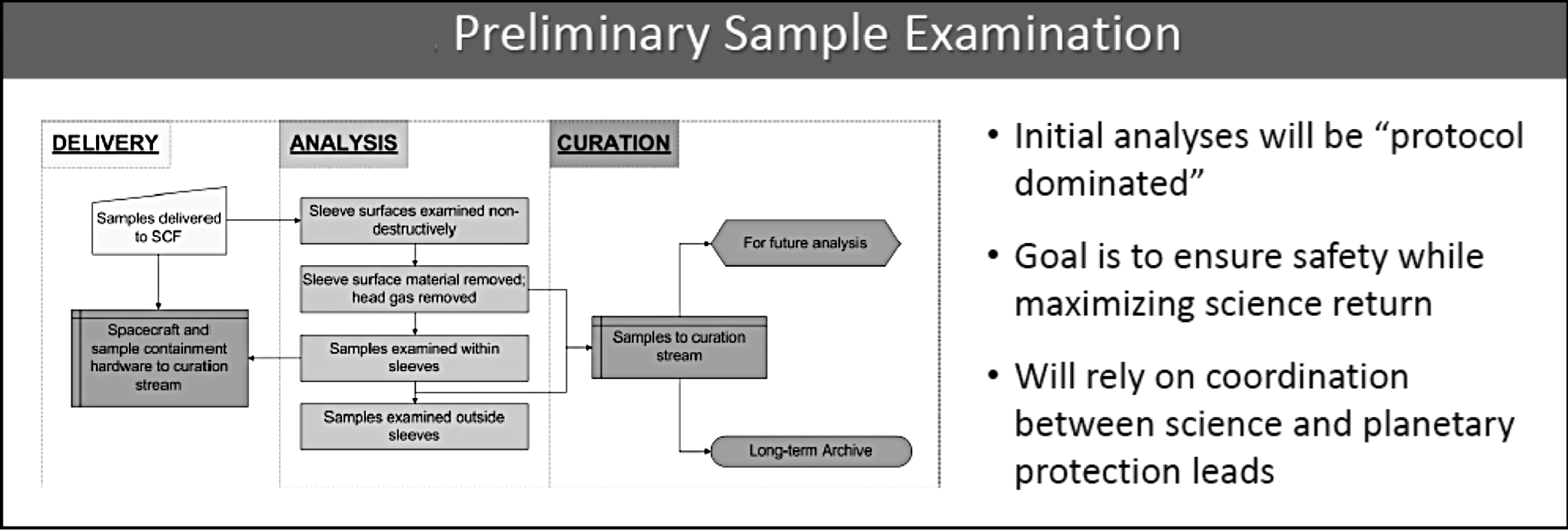
Initial steps in sample examination as envisioned by the iMARS Phase II report (Haltigin and Smith, 2014).
The current notional timeline discussed by NASA for a Mars sample return mission could bring a sample back to Earth as early as 2029 (Zurbuchen, 2017). Based on the recommendations of the DTP, the planning for a Mars sample receiving facility should therefore be started in 2018 (Fig. 3). Similarly, subsequent to the publication of the DTP, the SSB's second report on recommendations regarding planetary protection requirements for a Mars sample return mission (Space Studies Board, 2009) included the following:
Because of the lengthy time needed for the complex development of a sample-receiving facility (SRF) and its associated biohazard-test protocol, instrumentation, and operations, planning for an SRF should be included in the earliest phases of the Mars sample return mission. (p 68)
and
Construction and commissioning of a sample-receiving facility should be completed and fully operational at least 2 years prior to the return of samples to Earth, in order to allow ample time for integrated testing of the facility, the overall test protocol, and instrumentation well in advance of receiving returned martian materials. (p 68)
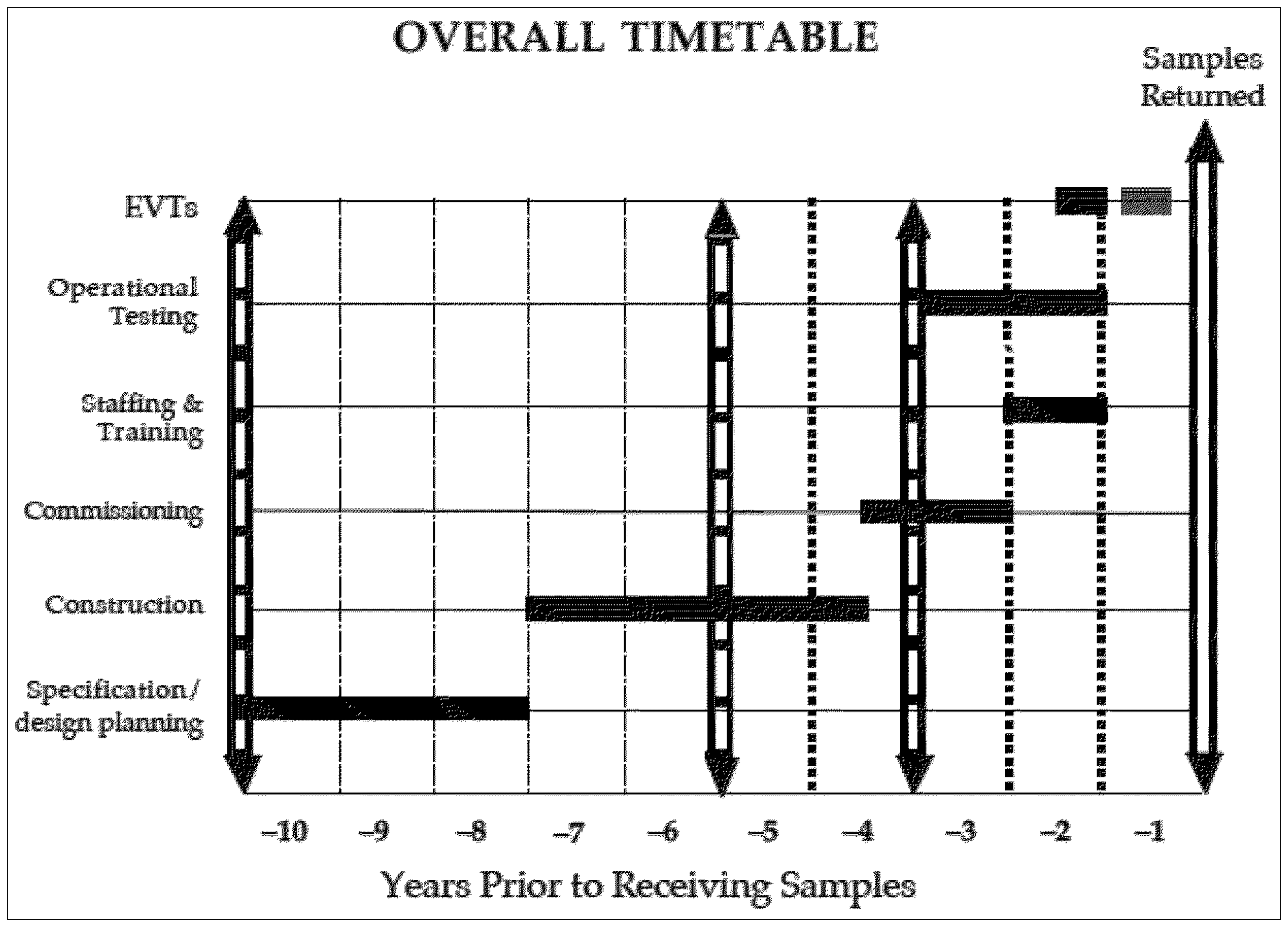
The DTP schedule for various activities associated with the design, construction, and operational readiness of a Mars sample receiving facility (adapted from Rummel et al., 2002).
The assumption and recommendation in the report was that the sample receiving facility would be built to allow for planetary protection testing and scientific study of the samples prior to controlled distribution, as stated on page 55 of that report:
Detailed protocols for sample containment, handling, and testing, including criteria for release from a sample-receiving facility (SRF), should be clearly articulated in advance of Mars sample return. The protocols should be reviewed periodically as part of the ongoing SRF oversight process that will incorporate new laboratory findings and advances in analytical methods and containment technologies. International partners involved with the implementation of a Mars sample return mission should be a party to all necessary consultations, deliberations, and reviews.
3. Other Considerations and Summary
Under the currently envisioned scenario for a sample return campaign from Mars, several additional considerations regarding a new test protocol should be registered, and implemented by NASA and its international partners. These include
• A Planetary Protection Test Protocol should be data driven, that is, responsive to the results of the individual or combined measurements. As a consequence, the sequence of experimental investigations and the application of preselected experimental techniques must allow some flexibility (Kminek et al., 2014).
• The same types of scientific measurements would inform the science and planetary protection elements (Kminek et al., 2014).
• A clear decision-making framework with well-identified decision points is necessary to ensure the Earth safety aspect of planetary protection (Kminek et al., 2014).
• Include both the effective use of robotic techniques and teleoperations in the re-evaluation of the protocol, understanding both general concerns about contamination and specific concerns about sample handling and instrument access to the samples (Rummel and Allen, 2011).
• Provide for new technique development and community readiness for working in containment, with specific training for operators in sufficient time to fine-tune the activities planned for the SRF and the methods to be used to maintain the SRF without the introduction of terrestrial contamination (see Space Studies Board, 2017).
With these considerations and those previously recommended by the SSB and the European Science Foundation (e.g., Ammann et al., 2012)—and with the overall timeline in mind—the detailed protocols that will need to be developed and maintained during the life of the sample receiving facility should be responsive to an “overall test protocol” that will incorporate an overall strategy for the analysis of martian samples, as did the DTP in 2002. That test protocol, and the commitment of NASA, ESA, and other international partners to a Mars sample return campaign, needs to be developed as part of the specification and design of that mission.
Now is the time, again, to begin the development of that overall sample analysis protocol.
Additionally, it must be assumed that the first Mars sample return campaign might not be the last. A sample receiving facility capable of dealing with martian samples within containment could have a future use focused on Mars but would also be useful as the basis of a facility that could deal with possibly “live” samples returned from elsewhere in the Solar System.
Footnotes
Acknowledgments
Thanks to those who participated in the original Draft Test Protocol development process and to Catharine Conley of NASA for keeping the issues regarding back contamination control in front of sample scientists, mission planners, and numerous regulatory agencies.