




Abstract
Liquid crystals have certain physical properties that promote chemical reactions which cannot occur in bulk phase media. These properties are displayed, among other molecules, by amphiphilic compounds which assemble into membrane structures then concentrate and organize biologically relevant monomers within their confined spaces. When mixtures of lipids and nucleotides are cycled multiple times between hydrated and anhydrous conditions, the monomers polymerize in the dry phase into oligonucleotides. Upon rehydration, mixtures of the polymers are encapsulated in lipid-bounded compartments called protocells. Reactions in liquid crystalline organizing matrices represent a promising approach for future research on how primitive cells could emerge on the early Earth and other habitable planets.
1. Introduction
T
How could such complex mixtures of organic compounds assemble into living systems? One clue comes from the unique properties of liquid crystals, the focus of this review.
2. Liquid Crystals as Organizing Matrices
Electro-optical properties of nematic and cholesteric liquid crystalline phases first attracted attention in the 1960s due to the prospects for technological applications. Investigations primarily performed in the 1980s and reviewed in the mid-1990s (Paleos, 1994) established that amphiphilic molecules can form thermotropic liquid crystals in the melted phase while the same amphiphiles assemble and organize in water to form micelles, bilayer membranes, and various lyotropic liquid crystal phases. Other studies reported polymerization of “rigid-rod” liquid crystalline monomers forming in melted nematic, smectic, or cholesteric liquid crystalline phases (Barrall and Johnson, 1979; Paleos, 1985). These investigations primarily concerned the effect of organization and mobility of monomers on polymerization kinetics and polymer morphology.
Conflicting results were initially published on liquid crystalline polymerization of selected mesogenic monomers, because certain polymers exhibited liquid crystalline phases while others lacked such properties. Liquid crystallinity was exhibited by polymers for which the movement of the attached mesogenic moieties was decoupled from that of the main chain (Barrall and Johnson, 1979; Paleos, 1985). The complexity of polymerization coupled with the experimental difficulties encountered when polymerization is conducted in the melt probably contributed to the limited number of investigations performed in liquid crystalline media. The only thorough treatment of reactions and interactions in liquid crystalline media appeared in the early 1990s by Percec et al. (1992).
Following the initial reports on polymerization of “rigid-rod” liquid crystals, it became apparent that biological amphiphilic molecules can assemble into a diversity of liquid crystalline phases. Furthermore, such structures can serve as organizing matrices for polymerization reactions related to the origin of life. The rest of this review will discuss such reactions and their potential for elucidating the initial stages of chemical evolution related to the emergence of cellular life 4 billion years ago.
3. Self-Assembly Processes Related to the Origin of Life
Two hypotheses are related to the topic of this review. The first is referred to as the RNA World (Bernhardt, 2012; Robertson and Joyce, 2012; Mallik and Kundu, 2013). A major gap in understanding how an RNA World might emerge is how nucleic acids could be synthesized in prebiotic conditions by non-enzymatic reactions. In order to answer this question, research led by Hud (Cafferty et al., 2016) reported that melamine and barbituric acid spontaneously react with the sugar ribose-5-phosphate to form nucleotide analogs. Furthermore, the resulting polymers assemble into long rodlike structures resembling strands of nucleic acids. Results from the same laboratory (Fialho et al., 2018) suggest that formation of prebiotic nucleosides would not have been limited to ribose if a model proto-RNA (ancestral) used TAP (2,4,6-triaminopyrimidine) or other proto-nucleobases showed similar reactivities.
Despite these promising results, the RNA World hypothesis remains an open issue that requires further discussion and testing. For instance, how can RNA strands be synthesized that are long enough to fold into ribozymes? Furthermore, even if RNA synthesis was achieved, it would be prone to hydrolytic cleavage because of its polyester backbone and the chemical and physical stresses of the prebiotic environment.
An intriguing alternative to the RNA World is the Lipid World proposed by Segré et al. (2001a). The Lipid World hypothesis proposes that vesicles formed spontaneously from lipid amphiphiles may exhibit a compositional genome. Such a genome does not depend on the information contained in monomer sequences of polymers like nucleic acids, but instead prebiotic information would be present in mutually catalytic noncovalent assemblies. This information can be inherited by “daughter” vesicles formed by fission (Menger and Gabrielson, 1995) or through fusion interactions that generate multicompartment vesicles (Paleos et al., 2001, 2004, 2011, 2012; Paleos and Tsiourvas, 2006; Paleos and Pantos, 2014).
To address the question of how mutually catalytic amphiphilic networks could transfer chemical information and undergo selection and evolution, Lancet's group developed computer simulations referred to as the
We will now describe the properties of lipids in further detail and discuss how they are related to the origin of life.
4. Bilayer Membranes Assemble from Amphiphilic Compounds
Bilayer membranes of contemporary cells primarily consist of lipid amphiphiles such as phospholipids, glycolipids, and cholesterol. These membranes act as boundaries separating the cytosol from the external environment as well as from the interior of organelles. Bilayer membranes are also decorated with functionalities such as in photosynthesis by incorporating pigments, electron transport enzymes that maintain proton gradients or enzymes that use ATP to maintain the ion gradients essential for life.
The crucial structural feature of amphiphilic molecules is the segregation of their polar and nonpolar segments, which supports the assembly of bilayer membranes by avoiding the unfavorable contact of water with aliphatic chains. This property leads to the formation of closed vesicles, both in nature and in laboratory conditions (Fernandez-Trillo et al., 2017).
Vesicles are highly significant in origins-of-life research because they are precursors of protocells (Chen and Walde, 2010). However, the question arises whether they could form in prebiotic conditions and be stable enough to survive. This question first attracted attention when Bangham and coworkers (1965) demonstrated that phospholipids spontaneously assembled into microscopic compartments called liposomes. Hargreaves et al. (1977) reported that a simple phospholipid could be synthesized in simulated prebiotic conditions, and this was soon followed by other experiments dealing with prebiotic membranes (Oró and Lazcano, 1984; Deamer et al., 2004; Pohorille and Deamer, 2009; Deamer, 2012, 2016; Lombard et al., 2012). The presence of amphiphilic molecules was reported in the Murchison meteorite (Deamer, 1985; Deamer and Pashley, 1989), and later work showed that even amphiphiles as simple as decanoic acid can assemble into vesicles at a pH where the ionized and neutral moieties have the same concentration (Apel et al., 2002).
The fact that vesicles form so readily led Luisi (2006) and his collaborators Walde et al. (1994) and Oberholzer (and Luisi, 2002) to construct cell-like systems of amphiphilic compartments that encapsulated macromolecules such as RNA and polymerase enzymes. These exhibited basic functions of living cells including protein synthesis, growth, and self-reproduction. The first critical steps toward the origin of life have therefore been addressed.
Systematic studies on the kinetics of growth and division of fatty acid vesicles were conducted by Chen and Szostak (2004), who used transitions of pH from alkaline to acidic ranges to investigate transformation of micelles into vesicles. In a more recent study, Zhu and Szostak (2009) extended these results to growth of vesicles and their subsequent division to smaller vesicles. They observed that the small vesicles started growing again and competed for available resources. Furthermore, upon addition of micelles, large multilamellar fatty acid vesicles transformed into long threadlike structures (Fig. 1). Shear forces then caused the threadlike vesicles to divide into multiple small daughter vesicles without leakage of the encapsulated RNA.
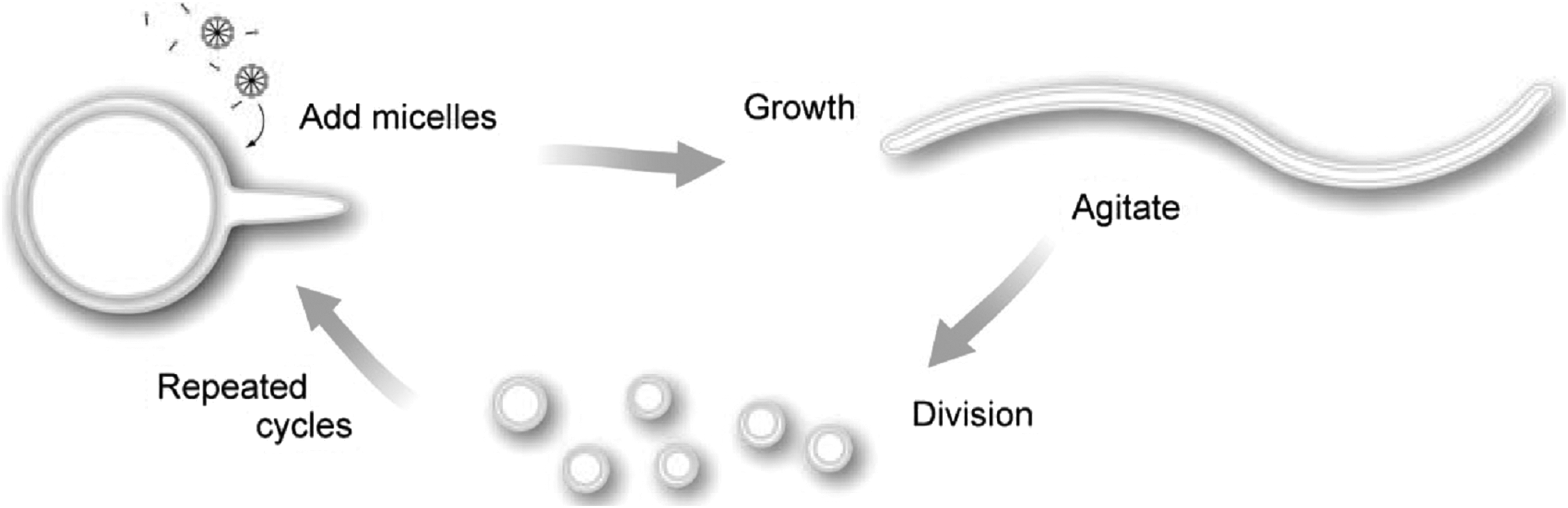
Schematic diagram depicting cyclic multilamellar vesicle growth and division. The depicted vesicles are multilamellar, although only two lamellae are shown for simplicity. Adapted from Zhu and Szostak (2009).
In summary, growth and division of vesicles containing encapsulated RNA molecules provide a laboratory model of a potentially self-replicating genetic polymer and a self-replicating membranous compartment. This simple model suggests that similar processes might have taken place under the prebiotic conditions of the early Earth.
5. Polymerization of Mononucleotides Is Promoted by Compartmentalization and Organization in a Liquid Crystalline Matrix
Given that the organic compounds available on the early Earth included monomers and amphiphilic molecules, we can ask whether combinations of the compounds exhibit properties beyond those of the individual molecules. For instance, was there a plausible process by which amphiphilic structures could encapsulate polymers as a first step toward cellular life? This was first addressed by Deamer and Barchfeld (1982), who showed that a single cycle of dehydration by evaporation that would commonly occur in the prebiotic environment readily encapsulated small dye molecules as well as larger proteins and nucleic acids. A mechanism by which this could occur was established by Toppozini et al. (2013), who used X-ray diffraction technique to show that solutes like mononucleotides were captured within multilamellar structures produced when lipid vesicles were dried (Fig. 2). Himbert et al. (2016) later used X-ray diffraction to establish that a mixture of AMP and uridine monophosphate (UMP) formed stacks referred to as pre-polymers within the lipid matrix.
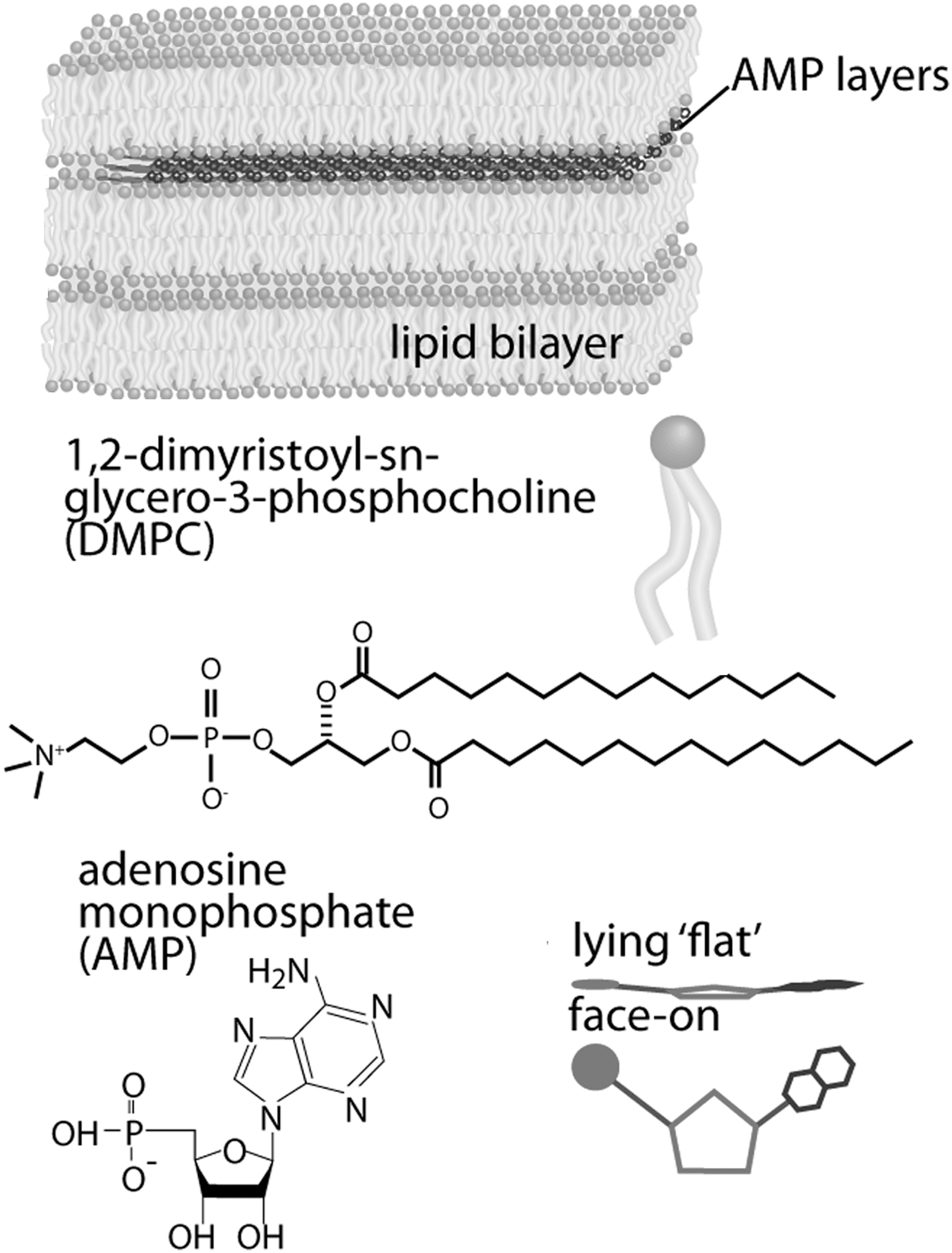
Dimyristoylphosphocholine (DMPC) lipid vesicles form a multilamellar structure when dried in the presence of adenosine monophosphate (AMP). The AMP is concentrated and organized between the bilayers. Adapted from the work of Toppozini et al. (2013).
The fact that potential monomers like AMP and UMP could be concentrated and organized within multilamellar liquid crystals inspired a series of studies which had the goal of determining whether polymerization of mononucleotides could occur within the lipid matrix. In fact, oligomers ranging from 20 to >100 nucleotides in length accumulated after multiple wet-dry cycles, with properties resembling RNA in a number of ways. For instance, they were recognized by enzymes used to label end groups of RNA with radioactive phosphate and could then be viewed by gel electrophoresis (Rajamani et al., 2008). They were also stained by ethidium bromide in gels, and exhibited hyperchromicity if prepared from a mixture of AMP and UMP (DeGuzman et al., 2014). This was consistent with the expectation that the two bases could form duplex hairpin structures stabilized by hydrogen bonds. Most significant is that the polymers produced ionic current blockades when analyzed by nanopore techniques (DeGuzman et al., 2014), which clearly established that single-stranded polymers were present in the products.
6. Concluding Remarks and Outlook
In summary, these studies demonstrate that condensation of mononucleotides into RNA-like polymers occurs when the monomers are constrained in compartments between lipid bilayers in liquid crystalline media. This reaction can be considered to be a decisive step toward the origin of cellular life because the synthesis of RNA-like polymers did not depend on enzymatic catalysts and the products are encapsulated in membranous compartments (Paleos, 2015). The energy source was the concentrating effect of hydration-dehydration cycles that would commonly occur when volcanic land masses emerged from the ocean, in analogy with those seen today in Hawaii and Iceland. Precipitation would form hydrothermal fields in which small aqueous pools undergo evaporation and refilling at elevated temperatures.
The scenario described here combines the Lipid World and the RNA World concepts. The presence of vesicles defined by boundaries of bilayer membranes is required for several reasons. First, the organizing matrix of multilamellar structures promotes polymerization of mononucleotides, and during the rehydration step, RNA-like molecules are encapsulated in vesicles characterized as protocells. Each protocell can be considered to be a natural experiment in which a few will happen to contain functional polymers that tend to promote survival when exposed to environmental stresses, the first step in evolution (Damer and Deamer, 2015). This is a testable prediction and will be a fruitful area for future research into the origin of cellular life (Fiore and Strazewski, 2016).
Footnotes
Acknowledgment
The editorial assistance and valuable suggestions provided by Prof. David Deamer are greatly appreciated by the author of this review.
Author Disclosure Statement
The author declares that no competing financial interests exist.
Associate Editor: David Deamer