




Abstract
The search for an inhabited planet, beyond our own, is a driver of planetary exploration in our solar system and beyond. Using information from our own planet to inform search strategies allows for a targeted search. It is, however, worth considering some span in the strategy and in a priori expectation. An inhabited, Earth-like planet is one that would be similar to Earth in ways that extend beyond having biota. To facilitate a comparative cost/risk/benefit analysis of different potential search strategies, we use a metric akin to the Earth-similarity index. The metric extends from zero, for an inhabited planet that is like Earth in all other regards (i.e., zero differences), toward end-member values for planets that differ from Earth but maintain life potential. The analysis shows how finding inhabited planets that do not share other Earth characteristics could improve our ability to assess galactic life potential without a large increase in time-commitment costs. Search strategies that acknowledge the possibility of such planets can minimize the potential of exploration losses (e.g., searching for long durations to reach conclusions that are biased). Discovering such planets could additionally provide a test of the Gaia hypothesis—a test that has proven difficult when using only Earth as a laboratory. Finally, we discuss how an Earth2.0 narrative that has been presented to the public as a search strategy comes with nostalgia-laden baggage that does not best serve exploration.
1. Introduction
The idea of a second Earth has a long history (Couprie, 2011). Recently, NASA has entered into second Earth thinking: (1) “This discovery gives us a hint that finding a Second Earth is not a matter of if but when.”—Thomas Zurbuchen, Assoc. Admin., Science Mission Directorate at NASA, 2017; (2) “This exciting result brings us one step closer to finding an Earth 2.0.”—John Grunsfeld, Assoc. Admin., Science Mission Directorate at NASA, 2015. The quotes come from press conferences that announced discoveries regarding planets orbiting stars other than our own (exoplanets). A motivator behind the statements, and the exploration of exoplanets, is the search for life beyond Earth.
Debates about life beyond Earth have a long history [Ward and Brownlee (2000), Kasting (2010) and Cirkovic (2018) provide entry points to research the history of the debates]. End-member views regarding galactic life are “rare Earth” and “plenitude.” Under a rare Earth view, life requires specific environmental conditions, of the kind that exists on Earth. Under a plentitude view, life can thrive in a range of conditions that might exist across planets within our galaxy. To be clear (and avoid straw men), (1) rare does not mean singular; (2) plentitude does not mean all things are possible; and (3) nature need not adhere strictly to end-members. In regard to point 1: a rare Earth view does not exclude life beyond Earth—it posits that in order for a planet to have life, particularly complex life, it must share certain essential features with Earth, beyond having life, that make Earth the planet it is and, it argues, that the combination of such features is rare for planets in our galaxy. In regard to point 2: a plentitude view acknowledges that there will be galactic bodies with conditions that do not allow for life. In regard to point 3: there is the possibility that aspects of a rare Earth view may prove correct (or may be accepted by the community) while others may be incorrect (or may not be accepted). For example, conditions that make Earth Earth, beyond having life, may not be rare in the galaxy such that there are many Earth analogues. Life, in particular higher life, may only exist on such planets. This would not support a plentitude view nor would it support the idea that Earth conditions are rare. However, it would support a foundational premise of the rare Earth argument, that is, the premise that Earth conditions are required for life.
We are at the stage of exoplanet research where missions are being designed to detect remote signatures of life (e.g., Schwieterman et al., 2018). This is a new phase of exploration. It generates a level of excitement that motivated the press release statements quoted above. It brings the potential that observational data can be brought to bear on long-standing debates about galactic life. It also brings an equally old question: how will we choose to look? This is a decision problem. It is decision-making under uncertainty. Any exploration comes with risk. Uncertainty adds to risk. Acknowledging uncertainty and risk does not damp excitement. However, the fact that a particular search strategy is gaining traction, one centered on Earth analogues, without being weighed against alternatives in light of uncertainty and risk, does motivate the step back and rethink that constitutes the core of this article. [added in revision: over the time that this article was in review, we became aware that we are not the first to suggest a rethink regarding search strategy (Bean et al., 2017; Kite et al., 2018; Lingam and Loeb, 2018)].
Our thesis is that a search strategy that allows for deviations from Earth analogues can bring more information and less risk at moderately higher cost. Fleshing out this statement forms the bulk of this article.
There is an added reason why we argue for a break from an Earth-centered view. Wanting to know if life exists beyond Earth, and what that implies for galactic life, is not driven by scientific motivations alone. The humanistic implications of the search, and the cultural factors that feed into it, should be acknowledged. More specifically, the desire to find a planet such as our own is driven by factors that extend beyond scientific curiosity (Messeri, 2016). Our intent is not to argue that humanistic/cultural aspects be removed from the discussion. Rather, we want to layout how finding inhabited planets that do not look like home to us could carry broader scientific and humanistic implications than finding an Earth2.0.
This article is structured as follows: (1) Introduction (section 1). (2) Connections between search goals and strategies are overviewed (section 2, lead in). (3) The idea that nonEarth-like planets allow for life is presented (section 2.1). (4) A cost/benefit/risk analysis is presented for variable search strategies (section 2.2). (5) An analysis of how different assumptions, regarding galactic unknowns, respond to new observations is presented (section 2.3). (6) Results are overviewed (section 3, lead in). (7) A discussion of inhabited nonEarth-like planets and information content is offered (section 3.1). (8) A discussion of how narrative framings feed into the search for life is offered together with related humanistic issues (section 3.2).
This article allows for multiple reading options (e.g., Cortazar, 1966). Using the numbering system above, a reader interested in humanistic issues can do a book-end reading, 1 to 8, or 1–2–6–8 for an added analysis overview; those not as interested in that aspect can skip 8 and still leave with conclusions. Readers who agree that nonEarth-like planets have life potential can skip 3. Readers who want risk analysis can read 4 and skip 5. Readers more interested in how different assumptions about unkowns can lead to search strategies with different levels of responsiveness can skip 4 and move to 5. A short reading that focuses on cost/risk/benefit would be 1–4–7.
2. NonEarthness, Planetary Life Potential, and Search Strategies
Exploration goal(s) determine search strategies. The goal(s) of exoplanet exploration, as related to galactic life, can be expressed as a single question or intertwined questions. There is an existence question: “Does life exist beyond Earth?” If this is the only motivating question, then the search endeavor could be of the “find one and done” type. We suspect that most of our colleagues do not subscribe to this. Thus, there must be a broader goal. We would argue that addressing the issue of galactic life potential is that broader goal. That introduces the intertwined questions as follows: “What conditions allow for and/or maximize life potential (i.e., the probability that life exists on a planet)” and “what percentage of planets in our galaxy are inhabited?” For what follows we, unless noted, assume all of these questions are motivators and, as such, all should feed into search strategies.
We now pose an added question: “Would finding inhabited planets that share Earth attributes or finding inhabited planets that differ from Earth better help us to address the question of galactic life potential and should this consideration be fed into search strategies?” We argue that it should. This leads to a practical issue: an overly broad search is not viable. Given that, we would like constraints on how different a planet could be from Earth and maintain life potential. This motivates the first subsection below.
2.1. How different can different be and maintain life potential
The term “Earth-like” is often used in a qualitative way. A quantitative metric can be defined as per the Earth-similarity index of Schulze-Makuch et al. (2011). We are interested in how different a planet can be from Earth and still allow for life. We can use the Earth-similarity index and define a subrange over which a planet can maintain life potential. Since our interest is on how different a galactic body can be from Earth and allow for life, it will be useful to center the metric on zero (i.e., no differences). A next step is to ask: What are the extreme values the metric can take while maintaining a non-negligible probability for life?
We start with an agreed upon criterion: life requires energy. The energy sources for a biosphere are energy from the star a planet orbits and internal energy from the decay of radioactive isotopes within its interior, heat retained from formation, and/or tidal heating.
Figure 1a is a schematic of how energy sources affect life. Solar and internal energy can be used to power photosynthesis or chemosynthesis. The energy sources also drive cycles that influence environmental conditions. If there are a limited range of conditions under which a biosphere can exist, then energy sources can affect planetary life by maintaining livable conditions. For life as we know it, liquid water is crucial. The classic idea of a “Habitable Zone” delineates conditions that allow a planet to maintain liquid water over evolutionary timescales (Kasting et al., 1993).

For Earth, the buffering of environmental conditions is considered to rely on hydrological and geophysical/geochemical cycles. Internal energy drives volcanic and tectonic activity that transfers volatiles (CO2, H2O) between a planet's surface envelopes (atmosphere, hydrosphere, and biosphere) and its rocky interior (crust, lithosphere, and mantle). Volcanism cycles greenhouse gasses into the atmosphere. Tectonics creates weatherable topography, and weathering reactions draw greenhouse gasses out of the atmosphere. Weathering depends on hydrology. This means that surface and deep planet cycles are linked in so far as discussions of buffering Earth's climate are concerned (Kump et al., 2000). Life also links in as it has the ability to effect the cycles that maintain environmental conditions suitable for its existence (Lovelock and Margulis, 1974). Over geologic timescales, atmospheric CO2 content is influenced by the balance between volcanic degassing and weathering (Berner et al., 1983). Weathering depends on processes governed partly by temperature, which allows for the potential that a planet can buffer climate and surface conditions in a manner that allows liquid water to exist over geological time (Walker et al., 1981).
The silicate-weathering feedback, outlined above, is the preferred hypothesis for how Earth's climate has been regulated so as not to enter a prolonged hard snowball state or a runaway greenhouse. This has influenced ideas about how to search for inhabited planets beyond our solar system (e.g., Kasting, 2010). As formulated for Earth climate stabilization, the feedback relies on solar and internal energy. Removing one of the two energy sources thus affects direct energy sources for life and also a mechanism for maintaining environmental conditions conducive to life. This stresses how a planet or moon that lacks one of the two energy sources would be distinctly nonEarth like.
The idea that a planetary body can have life if solar energy is negligible (Fig. 1b) is driving exploration of icy moons within our solar system (Schulze-Makuch and Irwin, 2001; Wenz, 2017) and has been suggested for planets that do not orbit stars (Abbot and Switzer, 2011). For planets that do not orbit stars, the difficulty of remote detection is extreme. For planets that do orbit a star, there is the potential that life on such bodies would not interact with an atmosphere so as to create detectable biosignatures (Schwieterman et al., 2018). However, life may be able create biosignatures that are not connected to atmospheric chemistry (Lingam and Loeb, 2019). Detectability cannot be ignored, but at this stage we are concerned with limits. What is key is that an inhabited planet that lacks solar energy affecting life directly or indirectly remains a possibility.
An inhabited planet that lacks internal energy sources (Fig. 1c) would imply that geophysical/geochemical cycles are not required to maintain conditions conducive to life. Habitable conditions can be maintained on waterworlds (planets with water masses 10–1000 times that of Earth) as a result of stochastic variations in formation conditions with no need for geocycling (Kite and Ford, 2018). Habitable conditions can be maintained on nonwaterworlds, without geocycling, if the operation of life maintains them. This is the core of Gaia theory (Lovelock and Margulis, 1974; Lovelock, 1979; 1995; Watson and Lovelock, 1983). Different levels of Gaia have been proposed (Kirchner, 1989; 2003). Soft Gaia considers life to influence the geocycles that modulate Earth's surface environment. Strong Gaia considers life to be critical to modulating surface conditions at livable levels (Barlow, 1991; Schneider et al., 2008). Under a strong Gaia view, life could exist on a planet that has tapped all of its internal energy (a strong Gaia could create or extend buffering cycles beyond their life-independent due dates). Akin with the previous paragraph, the key is that an inhabited planet that lacks internal energy affecting life directly or indirectly remains a possibility.
The scenarios of Fig. 1b and c are energetic extremes. Between them sits the potential of livable planets that differ from Earth in other ways. Some examples are as follows. Planets without oceans allow for habitable conditions (Abe et al., 2011). Ocean worlds allow for life (Kaltenegger and Sasselov, 2011). Planets with internal energy principally driven by tidal heating (a minor factor for Earth) can be habitable (Barnes et al., 2009). Planets without plate tectonics allow for habitable conditions (Lenardic et al., 2016b; Foley and Smye, 2018).
2.2. Galactic potentialities, cost, gain, and risk: statistical thought experiments
In this subsection, we explore the degree to which different search strategies can alter our ability to address questions of galactic life. The analysis is in the form of double “what if” thought experiments. The distribution of life in the galaxy is unknown, but different potentialities can be considered (the first “what if”) to evaluate how different search strategies (the second “what if”) perform under variable possibility space. The idea behind the first “what if” is, arguably, as old as modern science: entertain multiple working hypotheses until the preponderance of evidence warrants otherwise (Bacon, 1620; Chamberlin, 1897). In this case, multiple working hypotheses regarding galactic life potential. The second “what if” comes from risk analysis (e.g., Lyoyds, 2017): consider different “future” results if variable search strategies are adopted subject to a variable potentiality space. The mathematical details can be found in the Appendix. Below we lay out the conceptual approach.
We assume that conditions describing a galactic body can be expressed as an index. The difference between the index values for any galactic body and Earth defines an Earth-difference metric,
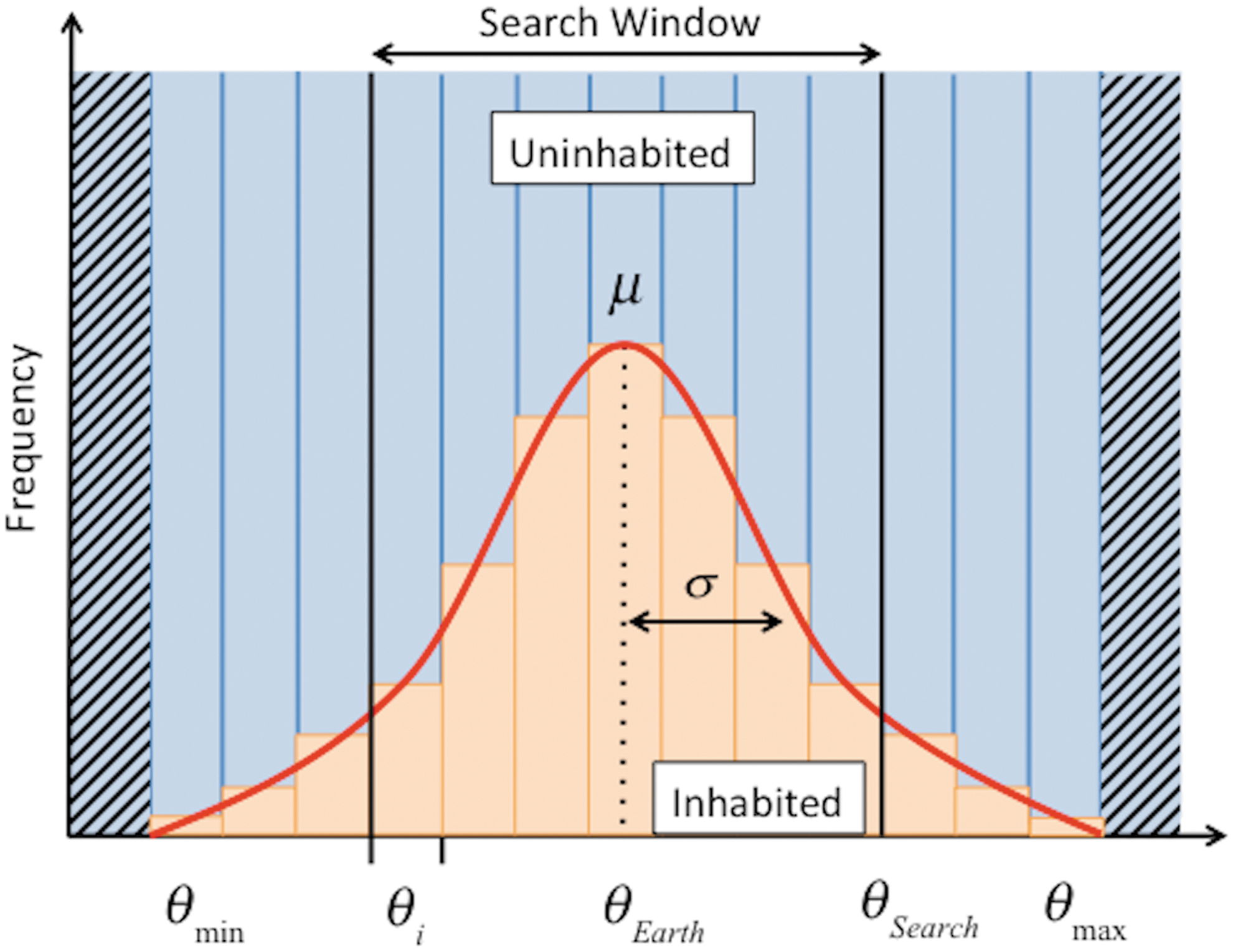
Future observations, limited by a window of potential habitability
The procedure above allows a large number of distributions to be generated. As a starting point, we choose a normal distribution to model the frequency of inhabited planets based on their specified conditions. We then vary
Variable synthetic distributions, constructed as per above, represent different galactic potentials. The number of observations we have to date does not allow for discrimination between different potentials. For our experiments, we assume that future observations can be used toward this end and we ask how different search strategies can achieve it. A search strategy is defined in terms of a search window centered about
We constructed different galactic life distributions and considered different search strategies for each. For any distribution, we drew from it at random, subject to a specific search window, observing what conditions defined each object and whether it was inhabited or not. The number of observations needed to find a fixed number of inhabited objects was tracked. If the goal is to provide constraints on galactic life distribution, then more than a single find would be required. As a starting point, we settled on 30 inhabited objects—this is a “rule of thumb” for the minimum number of observations needed to potentially constrain a distribution (Hogg and Tanis, 1997). Once this number of observations was obtained, the conditions that maximize life were estimated for varying search window widths (differences in the estimates could then be compared with actual distributions). This process was performed a number of times, tracking the number of observations and life potential maximizing conditions that were arrived at. We then assessed the accuracy and cost of each search strategy. Accuracy was defined as the percent error between the conditions predicted by each search strategy and the true solution. Cost is related to the number of observations. A function could be devised to approximate how this cost translates to time and resources. Here we assume that the number of observations provides a useful starting point in considering relative costs (we appreciate that the scaling between number of observations and monetary cost will be nonlinear).
For the initial suites of experiments, the probability of life among galactic bodies at the distribution peak was set to 20%. The probability then dropped toward zero as conditions moved away from the peak toward the most extreme cases that maintained life potential (Fig. 2). This equated to assuming that roughly 5% of galactic objects that reside within the window of planetary conditions that allow for life would be inhabited. That number can and will be varied extending to 25% and less than 1%.
The first scenario considered was one under which life maximizing conditions are Earth-centered. In this case, a focused search (i.e., a narrow search window) is ideal for finding a minimum number of inhabited planets in a cost efficient way (Fig. 3a). It can underpredict how prevalent life is in the galaxy by about a third (Fig. 3b). Doubling the search window can bring the estimate of galactic life down to the lowest possible error at about twice the cost.

If the conditions that maximize life potential are different from Earth, then the accuracy and efficiency of different search windows change (Fig. 3). When the optimal conditions are similar to Earth (
If conditions that maximize life potential deviate further from Earth (
Thus far, we have focused on the contrast between narrow and intermediate search strategies. Extending the search to observe everything that we think is capable of harboring life increases accuracy over all potentialities. This comes with increased cost. Over most of the potentiality space we explored, the increased cost did not come with a significant increase in accuracy. For the most extreme cases tested, there is a significant increase in accuracy. For those cases, the accuracy increase for a wide relative to an intermediate search is a factor of 4 with a factor of 1.25 cost increase. The principal gain in going from an intermediate to a wide search is that the risk, in terms of misrepresenting galactic life, for a “worst-case” situation is minimized.
The absolute number of observations needed to find a fixed number of inhabited planets, for any search strategy, depends on the assumed percentage of inhabited galactic bodies. Figure 4 shows results from experimental suites that vary that value under the goal of finding a single inhabited planet (Fig. 4a) or 30 inhabited planets (Fig. 4b). For the experiments of Fig. 4b, accuracy follows the same trends as in Fig. 3b. The relative difference between search strategies remains robust for different assumptions as to the total number of inhabited planets. The exception is that as the total number becomes very low, the potential advantage of a wide search becomes weaker (Fig. 4b, lower right corner). If the total number of inhabited planets is very low, then the number of planets that must be assessed to find more than a single inhabited planet becomes large under all search strategies. In that case, we are at the limit of statistical analysis being justified.

The number of observations needed to find a single inhabited planet
We have assumed that finding a single inhabited planet is not the sole goal. Nonetheless, it is useful to consider time commitment toward the first milestone. The results of Fig. 4a can be viewed this way. They also have utility if the total number of inhabited planets in the galaxy is so low that efforts to determine a “life potential distribution” will be doomed from the start. If finding a single inhabited planet is the sole goal and/or if it turns out that a very large number of planets need to be assessed before we find any signs of life, then Fig. 4a is pertinent, while issues of accuracy as per Fig. 3b are less pertinent. There are some differences between a single planet and multiplanet goal, particularly if the total number of inhabited galactic bodies is low. However, a main trend remains robust: a narrow search can be more efficient under some galactic life potentials, but it comes with greater risk when evaluated over a broad range of potentials that extend beyond the assumption that Earth conditions maximize life potential.
2.3. Changing minds
Different ideas about life in our galaxy can be viewed as competing hypotheses or, in a probabilistic framework, different a priori assumptions. Each end-member idea (rare versus plentitude) is a viable hypothesis. Each is testable. That is, each is a scientific prior. Any scientific prior will adjust to new observations and, given a large number of observations, all such priors should converge toward the hypothesis that is most consistent with observations. In principle, it does not matter what prior a search strategy is based on—the observations will decide in the end. In practice, we need to consider that the observations we will make over the next wave of missions will be discrete. Using the Earth-likeness metric of the previous subsection, we can ask which hypothesis is more responsive to discrete new observations.
One can imagine that a scientist who favors a rare Earth, or Earth-centered, view would opt for a narrow search window. A scientist who holds to the view that a wide range of conditions can allow for planetary life might argue against a narrow search. We can pose the question of how many discoveries of inhabited planets would be required to change either scientist's mind if their hypothesis is incorrect.
The question above may seem too subjective. However, asking the question of how a priori ideas adjust to new observations lends itself to a Bayesian analysis (Appendix), which can provide quantitative insight. For an Earth-centered prior, initial confidence is tightly peaked around
Figure 5 shows how long it takes each end-member hypothesis to converge for different galactic life distributions. If life potential is Earth centered, it would not take long to alter either a priori view. If it is not Earth centered, it takes more observations for both priors to converge to the true solution. This increase occurs because our first data point is always Earth. If conditions maximizing life potential are far different from Earth, then our planet introduces an initial bias. A plentitude view adjusts quickly, regardless of our planet's galactic status. An Earth-centered prior adjusts slower in light of new observations, that is, it is more resistant. If galactic life potential is not Earth centered, then going in with the assumption that it is will lead to approximately six times more observations being required to remove the shadow of the a priori assumption (Fig. 5 assumed that single search strategies are maintained but the results do also show the value of being open to adjusting strategies over time and/or adopting bar-bell search investment strategies, e.g., 70% percent of resources to targeted search efforts and 30% to wider search efforts).
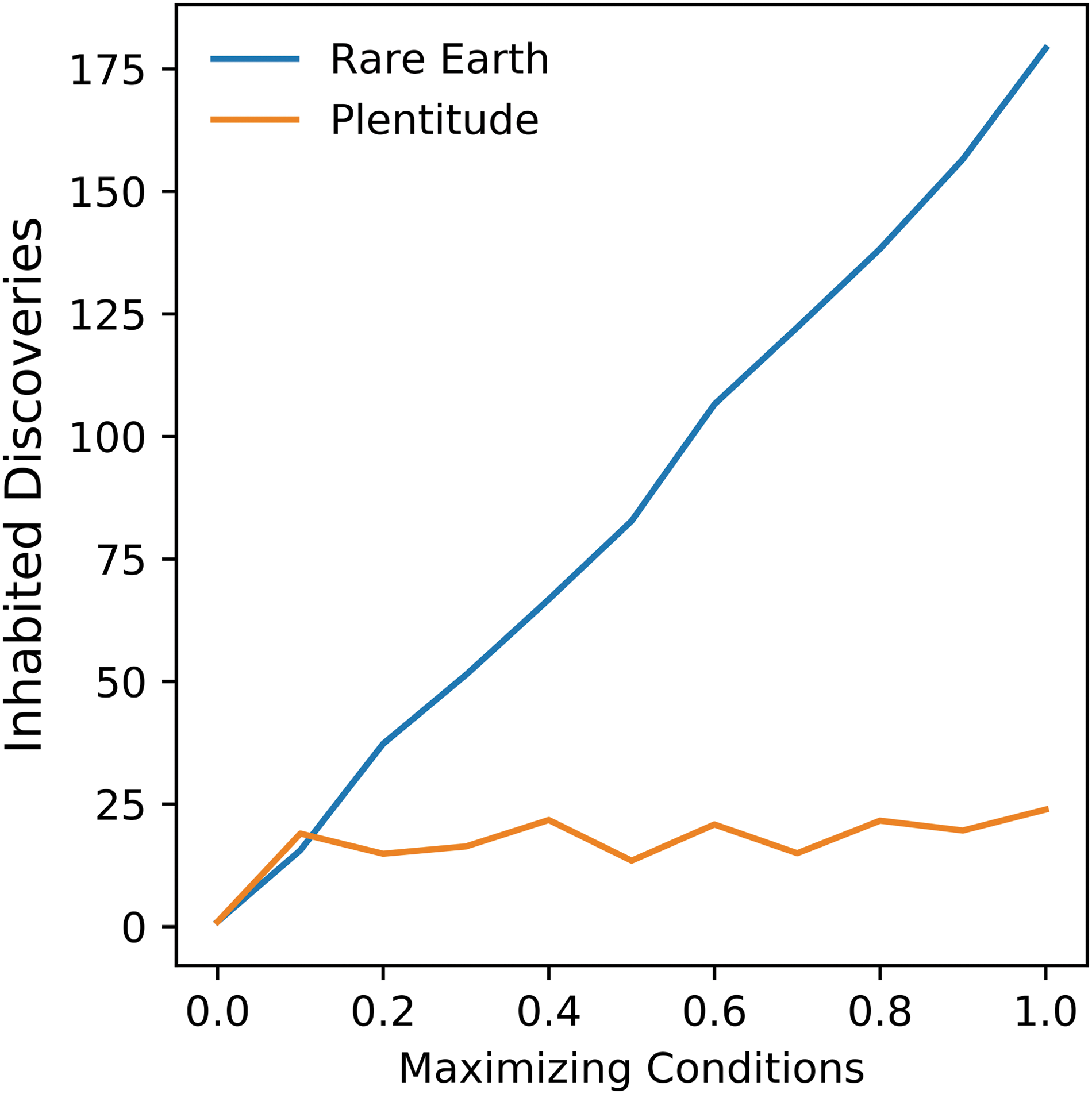
The number of inhabited planet observations it takes to converge to the attributes that maximize inhabitance for different priors, rare Earth, or plentitude. Different galactic life probability potentials are grouped in terms of how different the peak of the distribution is from Earth, that is, the distributions are grouped by
3. Discussion
In the previous section, we used an Earth-likeness (equivalently a nonEarthness) metric to evaluate the cost, accuracy, and risk associated with different search strategies and the more subjective cost associated with competing a priori hypothesis regarding galactic life. We used a generic nonEarthness metric. The results of our statistical thought experiments were dependent on the metric to variable degrees—in some scenarios, which cannot be observationally ruled out, the degree of dependence was large. This suggests that there is value in developing, as a community, a more tightly defined metric. This could provide some nonEarth1.0 balance to Earth2.0 thinking. The balance could have scientific and humanistic implications. In the following subsections, we wade into these topics, not as a final say, but as a starting point.
3.1. Different is more
What is the value of considering nonEarth-like planets in the search for life? What is the value of finding an inhabited nonEarth-like planet? The first question is at the core of the previous section. An implication was related to risk minimization, which we expand on below. We then move to the second question. We focus on how it could provide a Gaia test bed that extends beyond Earth.
Search strategies should be able to achieve goals in cost efficient ways that minimize risk in the face of worst-case scenarios. What is the worst-case scenario for investing resources to assess galactic life potential? Is it finding no signs of life beyond Earth? That is a worst case if one believes that it is a negative conclusion. If the goal is to reach a conclusion we can be as confident of as we can be, then no conclusion is negative if it follows from the preponderance of unbiased evidence. We would argue that a worst case would be spending a large amount of resources to reach the wrong conclusion. Figure 3 indicates that a narrow search can open us to that risk.
The above can be viewed as overly “formalized.” Exploration depends on public interest, which does not fit as easily into formalized analysis. From that angle, a worst-case scenario could be seen as one that tries public patience (although we would argue that misinforming the public is on par). This could motivate the idea that we need to find signs of exo-life as soon as we can. This, in turn, could be used to argue for an Earth-centered search based on the idea that it would minimize time commitment. The difficulty is that we would then be making a time investment decision based on assuming we know the answer to a critical question before we put the investment strategy into practice. This again opens us to risk as a narrow search could come with a higher time cost if we are wrong in terms of our a priori assumption (Fig. 4b).
In regard to assumptions, all of our results required assumptions regarding galactic life. This is an overarching point of the analysis to begin with. The tighter a search focuses around Earth2.0, the more the hypothesis that life potential peaks at Earth is being assumed to be valid. One could argue that models of planetary habitability and observations from our solar system lend support to this assumption. Fair enough but it remains an assumption. It may prove correct, but if it is used to justify a search strategy, then the strategy is designed, effectively, to test one hypothesis. Rather than arguing for one hypothesis over another [e.g., life potential peaking near or away from Earth (e.g., Heller and Armstrong, 2014)], we could assume that a range of hypotheses are viable and seek to minimize risk in the face of the various potentialities. This is the view we have argued for. Considering the potential of inhabited nonEarth-like planets can minimize risk at an increased cost that is not excessive (Figs. 3 and 4). It also allows for discriminating between different hypotheses regarding galactic life (Fig. 5).
We turn to the question “What is the value of finding an inhabited planet that is not Earth-like in other regards?” The classic concept of a “Habitable Zone” assumes that delineating planetary conditions that allow for life can proceed without considering life's role (Kasting et al., 1993). In effect, it is assumed that habitability can be determined without explicitly considering inhabitance. This assumption has been challenged, and the degree to which removing it from exoplanet discussions could influence our thinking about life in our galaxy is significant (Goldblatt, 2016). The difficulty has been and remains that observations from this planet cannot unravel the degree to which life influences cycles that regulate environmental conditions [Earth has life and remains geologically active—which of these is more critical to Earth being habitable is difficult to unravel as life has entwined itself in geocycles (Goldblatt, 2016)].
We can push Gaia to a limit. If a strong form of Gaia can operate, then planetary regulation could occur without abiotic cycles (Fig. 1c). That is, life could do the heavy lifting. The implication is that although planetary internal energy plays a role for Earth's inhabitance, it is not critical for planetary bodies in general. The internal energy of a planet will depend on its age and composition. Determining composition and age for exoplanets could be within reach for next-generation observations. If a planet is found to have low potential of being geologically active and shows biosignatures, this would provide a step toward confirming Gaia (internal energy may still have been crucial for the origin of life (Baross and Hoffman, 1985) and for maintaining habitable conditions early in the planets' lifetime, but the extension of habitable conditions past the geologic lifetime of the planet would be due to life itself). At present, search strategies are focused on planets that are likely to be geologically active with the thought that this is critical for life (Ward and Brownlee, 2000; Kasting, 2010). That remains an assumption. It is an assumption that has the potential to be refuted if a single strong Gaia1.0 is found (a greater number of Earth2.0s would be required to confirm the assumption at a statistical level).
Finding strong Gaia1.0 would change our views about planetary habitability (finding Earth2.0 would be a confirmation of a prevalent idea). The degree of rethinking can be hinted at by posing a question: Is habitability a characteristic of a planet, such as temperature, or is it something that flows through it, such as heat? Stated another way: Is it a state or a process variable? The classic “Habitable Zone” concept assumes it can be treated as a state variable. From that, follows the assumption that its limits can be determined so as to make a phase diagram that delineates regions that allow for life. On a strong Gaia, the origin and evolution of life are dominant for habitability, and multiple temporal paths could lead to variable end-states of inhabitance (Walker et al., 2018). This is a process variable view (Bridgman, 1943) under which multiple equilibrium states are possible and path dependence cannot be ignored (Dyke and Weaver, 2013; Weaver, 2015; Lenardic et al., 2016a). This brings in layers of potentiality associated with evolution and historical contingency [a contingent process is not the same as a random process (e.g., Bohm, 1957)]. The approach to planetary life research would, as a result, need to move toward one that is more statistical/probabilistic than it is at present (Walker et al., 2018).
The issue of evolution leads to a final point. Rare Earth ideas acknowledge that planets different from Earth could have simple (microbial) life but argue that higher life (plants and animals) requires Earth-like conditions (Ward and Brownlee, 2000). Life can respond to environmental changes. Many of the changes, considered critical to the development of higher life on Earth, are ascribed to internal energy sources driving changes in surface conditions such that if a planet lacked the geological changes that occurred on Earth, it could have microbial life, but it would not have developed higher life (Ward and Brownlee, 2000; Stern, 2016). The idea that evolution requires environmental changes is not agreed upon for the evolution of life on Earth (McKee, 2000; McShea and Brandon, 2010) and extending it to planetary bodies is an a priori assumption. Exoplanet biosignatures might be of the kind that prevailed on early Earth, before the rise of complex life, or of the kind associated with higher life (Schwieterman et al., 2018). Finding signs of higher life on a geologically inactive planet could provide a new layer of evidence that evolution can proceed in an autocatalytic mode, with no need for externally driven environmental changes (Kauffman, 1993; Cazzolla Gatti, 2011).
Finding signs of life on another planet, be it such as our own or different, would be a major discovery. The implications of that discovery could be further reaching for planets that are different. In that sense, different is more—it could bring more information content about life potential in our galaxy.
3.2. Narratives
The search for life beyond Earth is no small undertaking. It can benefit from efforts to engage the public. The engagement is often framed as a narrative. Narratives can go beyond public relations. A narrative can frame a problem in a way that favors one decision/conclusion over alternatives that are just as rational as the frame-favored decision (Tversky and Kahneman, 1981). For the issue at hand, there is a feedback as public opinion can influence exploration strategies. Whether it is intended or not, building a narrative around a problem will influence the way humans think about the problem and, in keeping with the cultural/humanistic connections of this subsection, “what we think changes how we act” (c.f., Gang of Four, Solid Gold, EMI/Warner Bros., 1981). This encapsulates the value of reframing problems and considering multiple frames when addressing decisions involving uncertainty (Tversky and Kahneman, 1986).
An Earth2.0 narrative that is being used to frame exoplanet exploration reinforces the idea that Earth conditions are the ideal ones for habitability [a variant of a rare Earth narrative (Ward and Brownlee, 2000)]. We would argue that we do not have the observations needed to discriminate between different assumptions regarding galactic life potential at this stage of our exploration and it is not in the best interest of the search to send messages, explicit or implicit, that we do. An Earth2.0 narrative, as it is being presented, walks the line of promising specific returns. The dangers of that for science, in the public realm, should be kept in mind (e.g., Riordan et al., 2015).
Beyond sending messages that do not reflect the state of our knowledge, an Earth2.0 narrative comes with philosophical and cultural baggage that may not best serve its intended purpose. An Earth2.0 narrative is nostalgia heavy. There have been many words put forward in the service of an Earth2.0 narrative, but images, arguably, can give a better sense of the message this narrative carries. Artwork depicting travel posters to exoplanets with white picket fences [
We are not implying that the cultural value of nostalgia in general, or specifically for developing public narratives, can be broken down to 1s and 0s. It is not as simple as it is always good or always bad. It depends on context (e.g., Bonnett, 2010). Within the context of space exploration, a narrative built on finding a second Earth is intertwined with the idea of finding a second home (Messeri, 2016). Home is something we know, something comfortable, and ideas of home can lead to thoughts of “better times.” This can send the message that our goals are to recapture something. It invokes a sense of looking toward the past, which runs counter to the idea of exploration. When pushed to limits, such nostalgic messages are associated with populist movements. From our perspective, this also runs counter to the idea of space exploration, which is a global endeavor (i.e., an internationalist as opposed to a national endeavor).
An alternate narrative, compared with searching for an Earth2.0, is one of galactic diversity in terms of livable and living planets. In this alternative narrative, the future becomes more prominent with all the lack of certainty, immediate comfort, and familiarity that a future holds. Planets with life beyond Earth may be something foreign to us. They may be uncomfortable for us to live on at first. To know them we need to find them, as opposed to starting our exploration on the premise we already know them [we are not the first to remark on the dangers of assuming we know the answer before hand when it comes to planetary exploration (Moore et al., 2017; Tasker et al., 2017)]. The alternate framework we are proposing will also not resonate across all of humanity as a public engagement narrative, but which of the two, diversity of living planets versus finding a second Earth, better represents the sense of exploration that got us, as human beings, to begin exploring space in the first place?
Footnotes
Author Disclosure Statement
No competing financial interests exist.
Associate Editor: Norman Sleep