




Abstract
The detection of chlorinated hydrocarbons by Curiosity on Mars has been attributed to the presence of unidentified indigenous organic matter. Similarly, oxychlorines on Earth have been proposed to be responsible for the apparent lack of organics in the Atacama Desert. The presence of perchlorate (ClO4 −) poses a unique challenge to the measurement of organic matter due to the oxidizing power of oxychlorines during commonly used pyrolysis–gas chromatography–mass spectrometry (py-GC-MS) methods. Here, we show that perchlorates and other oxyanion salts inhibit the detection of organic compounds but that removing these problematic species prior to pyrolysis by using an optimal sample extraction duration and suitable ratios of water to sample mass enables analysis. We have characterized leached and unleached samples containing perchlorates from the Atacama Desert and have found that after leaching, the py-GC-MS chromatograms of the dried mineral residues show identifiable biomarkers associated with indigenous cyanobacteria. Samples which were pyrolyzed without leaching showed no detectable organic matter other than background siloxane and very weak or no trace of detectable polychlorinated benzenes. Dried sample residues remaining after leaching, the mineral matrix and water-insoluble organic matter, showed a strong organic response in all cases when analyzed by py-GC-MS. These residues are most likely the product of the pyrolysis of water-insoluble organics originally present in the samples. In addition, our results imply that previous soil analyses which contained high levels of oxyanions and concluded that organics were either not present or were present at extremely low levels should be reexamined.
1. Introduction
Organic compounds should be present on Mars, if for no other reason than ongoing chondritic infall (Flynn, 1996). Several were detected during the first attempt in the mid-1970s by the two Viking landers, but they were all attributed to terrestrial contamination (Biemann et al., 1977). Subsequently, the martian surface was viewed for several decades as containing one or more unidentified oxidants that destroyed organics (Zent and McKay, 1994). In 2008, the Phoenix Mars lander analyzed the martian soil at its northern latitude landing site. The Thermal and Evolved Gas Analyzer (TEGA), a thermal desorption system feeding a mass spectrometer, detected only CO2 released from carbonates and no organic molecules (Boynton et al., 2009). The Wet Chemistry Laboratory (WCL) (Kounaves et al., 2009) performed the first wet chemical analyses of three martian soil samples, one from the surface and two from 5 cm depth. For all samples, the soil/water mixture was found to be slightly alkaline (pH ≈7.7), with an average electrical conductivity ≈1.4 mS/cm, and containing several salt species, Ca2+, Mg2+, Na+, K+, Cl−, and SO4 2− (Kounaves et al., 2010a, 2010b). However, the most significant finding was that the dominant soluble form of chlorine at the Phoenix site was perchlorate (ClO4 −), at a concentration of ∼0.6 wt % ClO4 − in the soil (Hecht et al., 2009; Kounaves et al., 2010a) and most likely present as a 60% Ca(ClO4)2, 40% Mg(ClO4)2 mixture (Kounaves et al., 2014b). Evidence for ClO4 − at similar levels was subsequently also reported in the Rocknest aeolian deposit by the Sample Analysis at Mars (SAM) instrument on the Mars Science Laboratory (MSL) rover Curiosity (Glavin et al., 2013; Leshin et al., 2013) and in the martian meteorite EETA 79001 (Kounaves et al., 2014a).
In addition to the ClO4 −, the SAM instrument has also detected chloro-, dichloro-, and trichloro-methane (CH3Cl x , x = 1–3) (Ming et al., 2014), chlorobenzene (C6H5Cl) and C2–C4 dichloroalkanes (Glavin et al., 2013; Freissinet et al., 2015), and more recently naphthalene, which was suggested to be indicative of complex macromolecular organic matter (Eigenbrode et al., 2018).
Interestingly, the Viking lander's pyrolysis–gas chromatograph–mass spectrometer (py-GC-MS) had also detected traces of CH3Cl and CH2Cl2. This detection had led to the recent suggestion that this may have been a result of ClO4 − in the soil chlorinating either terrestrial organic contaminants or, if present, indigenous organics (Navarro-González et al., 2010).
Laboratory experiments under simulated martian conditions have shown that oxychlorines (including ClO4 − and ClO3 −) can be produced on Cl-bearing mineral surfaces via UV-driven oxidation (Carrier and Kounaves, 2015). This supports the hypothesis that not only ClO4 − but also ClO3 − is very likely ubiquitous on Mars. Recently, ClO4 − was detected and quantified in regolith and rock samples from the Moon, and two chondrite meteorites (Jackson et al., 2015). Although present at orders of magnitude less than Mars, these findings suggest its ubiquitous presence in the Solar System. Thus, analyses of organic compounds on Mars and elsewhere in the Solar System must consider the possible presence of oxychlorines, especially ClO3 − and ClO4 −.
Although perchlorate is stable under ambient terrestrial and martian conditions, it becomes a powerful oxidant when heated to temperatures higher than about 150°C. Onset of O2 evolution from oxychlorine decomposition in the John Klein mudstone in Gale Crater was ∼150°C (Ming et al., 2014). Thus, the pyrolysis heating used prior to gas chromatography–mass spectrometry (or any other analytical combination using similarly high temperatures) could destroy or transform a large fraction of the organics via combustion by oxychlorines and prevent direct identification of indigenous organic molecules, including potential biomarkers. One exception to this would be organics trapped inside minerals or refractory materials stable at temperatures above 600°C that may not be affected by the presence of oxychlorine compounds that decompose at lower temperatures. For analyses in the temperature range of 150–600°C, this process would have thwarted the detection of organics during the thermal-based analyses on Viking and Phoenix; thus the previous interpretation of these results as an absence of organics is not definitive. The MSL-SAM instrument also detected chlorinated hydrocarbons, specifically chlorobenzene and C2 to C4 dichloroalkanes. However, it is not clear whether these may have been the reaction products of martian chlorine and terrestrial contaminants, or indigenous organic molecules either already chlorinated or thermally decomposed in the presence of these oxychlorine compounds (Freissinet et al., 2015). It has also been shown that even though organics trapped in magnesium sulfate may undergo some oxidation and sulfuration during py-GC-MS, they also protect organics from oxidation by calcium perchlorate (François et al., 2016).
Terrestrial-based analyses of organics prior to the recognition of the effects of perchlorate on organics may have also been misinterpreted. For example, in the core of the Atacama Desert (Chile), one of the driest places on Earth, organic carbon content and biomass fall to the lowest levels found anywhere on Earth (ca. 103 to 105 cells/g of soil), concurrent with an increase in mean residence time of soil organic carbon to tens of thousands of years (Ewing et al., 2008). At the same time, salt crusts formed by deliquescence provide a minimalistic habitat for survival under extremely dry conditions, colonized by communities composed of extremely resistant Chroococcidiopsis morphospecies of cyanobacteria and associated heterotrophic bacteria (Wierzchos et al., 2012).
The Atacama Desert represents a reasonable martian analog because, as may also be the case for Mars, these salt-rich crusts and soils are the only remaining habitat available for life (Davila and Schulze-Makuch, 2016). Thus, when searching for biomarkers on Mars, one objective should be to analyze the evaporitic, chloride-bearing rocks that may have provided (or still provide) a suitable habitat enabling photosynthetic activity and adaptation to a harsh UV and hyperarid environment (Vitek et al., 2010). Since these regions on the martian surface will most likely also contain high levels of perchlorates (Clark and Kounaves, 2016) and sulfates (Gaillard et al., 2013), the methodology to detect organic compounds on Mars has to be adjusted for their presence, and existing analyses may need reconsideration in the same way as the Atacama results, taking the hydrologic and atmospheric history of Mars into account.
It is now clear that the use of py-GC-MS in the presence of oxychlorines poses an enormous challenge and requires the development of methodologies that can mitigate the effect of oxychlorines and other oxyanions during pyrolysis. Recent suggestions have included the use of sacrificial molecules (Kenig et al., 2016), supercritical-CO2 extraction (McCaig et al., 2016), laser desorption-mass spectrometry, which is currently part of Mars Organic Molecule Analyser (MOMA) on the ESA/ExoMars 2020 mission (Li et al., 2015), a polymeric anion exchange resin (von Kiparski et al., 2013), and interpretation via gases produced during whole rock pyrolysis (Sephton et al., 2014). More comprehensive development is possible for future missions, as currently these techniques have either not been successfully demonstrated or introduce high risk for planetary missions.
Here, we demonstrate the utility of removing these problematic species prior to pyrolysis by using an optimal sample extraction duration and suitable ratios of water to sample mass. We have characterized leached and unleached samples containing perchlorates and sulfates from the Atacama Desert. We have found that after leaching, the py-GC-MS chromatograms of the dried mineral residues show identifiable biomarkers associated with cyanobacteria present in this environment (Biller et al., 2015).
2. Site and Sample Description
2.1. Site description
The samples used in this study were collected from the Antofagasta Region of the Atacama Desert (Chile) and have already been extensively characterized in terms of soil habitability, biomolecules indicative of potentially active cells, in situ replication rates of genomes, and microbial community patterns specific to soil parameters and depths (Schulze-Makuch et al., 2018). The Atacama's arid to hyperarid environment renders it inhospitable to macroscopic primary producers and limits the few microbial photosynthetic communities found there (Warren-Rhodes et al., 2006), mainly specialized endolithic cyanobacteria in salt outcrops (Wierzchos et al., 2006) and subsurface microbial communities (Fletcher et al., 2011). More importantly, in addition to widespread areas covered with evaporitic halite, these arid soils contain high levels of oxyanions, especially perchlorates, sulfates, and nitrates (Perez-Fodich et al., 2014). The Atacama Desert is considered to be a good analog site for Mars' environment during its late Hesperian and early Amazonian epochs (Fairen et al., 2010).
The soil and rock samples were collected from three sites, all approximately 55–85 km east of Antofagasta: (1) Red Sands (RS: 24°6.041'S, 70°7.733'W); (2) Lomas Bayas (LB: 23°23.596'S, 69°36.237'W); and (3) Yungay (YU: 24°5.296'S, 69°59.673'W). The LB and YU sites are considered to be part of the hyperarid core of the Atacama Desert, while RS is part of the arid region. A map and images of the sampling sites are available as supplementary information to the work of Schulze-Makuch et al. (2018).
2.2. Sample collection descriptions
At the RS and LB sites, the top layer of desert pavement rocks was removed, and a surface sample was taken from 0–5 cm depth. At the YU site, samples were collected from two faces of the pit. One set of samples was collected every 5 cm to a depth of 100 cm to be used for the leaching ratio analysis. A subset of these high-resolution samples collected at depths of 25, 60, 75, and 85 cm was for the efficiency analyses. The other set of samples from an adjacent face was collected at depths of 0–5, 20–30, 50, and 100 cm to be used for the organic compound analyses. The RS, LB, and YU (50 cm depth) samples were selected to represent “salt poor,” “sulfate rich,” and “oxyanion/salt rich” environments, respectively, all appearing to contain low levels of organics when studied using standard py-GC-MS of raw samples, consistent with previous work in this area (Ewing et al., 2008).
A rock sample was collected from the surface ∼2 km from the YU site. Its exposed surfaces contained partially visible grayish-green streaks. A sample of the relatively pure endolithic cyanobacteria was physically removed from a layer on the rock for analysis. Previous analyses have shown these layers to be composed of endolithic photosynthetic bacteria belonging to the genus Chroococcidiopsis, an extremely resistant morphospecies of cyanobacteria (Wierzchos et al., 2006). The cyanobacteria sample was analyzed based on the assumption that organics in the other Atacama soil samples may have significant contributions from the growth and death of such endolithic organisms.
3. Methods
The soil was sieved to remove pebbles <2 mm and homogenized with a mortar and pestle to <75 μm. For each sample, 1.0 g of homogenized soil was leached with Nanopure 18.2 MΩ-cm water for 1 h with gentle stirring. The leachate was then removed and filtered with a 0.2 μm PTFE filter. Samples prepared for ClO4 − leaching ratio analysis were leached at a 1:5, 1:10, and 1:25 (w/v) ratio. Based on the homogeneity of the leaching ratio analyses, the samples for the ClO4 − leaching efficacy and the inorganic anion and cation analyses were only leached at a 1:10 (w/v) ratio and diluted to a conductivity of ∼50 μS/cm. The air-dried residue from the 1:10 leached soil was then used for further analyses by py-GC-MS for organic content. The time between leaching and py-GC-MS was about 2 days. Samples were stored in clean vials in light-proof boxes in the climate-controlled lab. It was assumed there would be contamination from the various plastic storage containers, but none was ever observed either because there was not sufficient transfer or the perchlorate destroyed all of it.
Each single leach was analyzed in triplicate for soluble inorganic content by ion chromatography (IC) using a Dionex ICS-2000 Reagent Free IC system equipped with suppressed electrical conductivity detection. For separation and detection of perchlorate, we used a 100 μL injection volume, a Dionex AS16 Ionpac analytical column with 35 mM potassium hydroxide (KOH) eluent at a flow rate of 1.25 mL/min, and a suppressor current of 100 μS. For anions, we used a 25 μL injection volume, an AS18 column with 20 mM KOH at a flow rate of 1.0 mL/min, and a suppressor current of 75 μS. For cations, we used a 25 μL injection volume, a CS12 column with 23 mM methyl sulfonic acid at 1.0 mL/min, and a suppressor current of 59 μS.
3.1. Organic compound analysis by py-GC-MS
Organic compound analyses by py-GC-MS were performed by placing a ∼10 mg powdered sample in quartz pyrolysis tubes held in place by quartz wool. The pyrolysis tubes were placed inside the platinum coil of a CDS 5200 pyroprobe under helium and heated at a rate of 20°C ms−1 to the target temperature of 650°C, where it was held for 15 s. Although these conditions were different from those used with the MSL-SAM instrument on Mars (35°C/min up to 835°C under 30 mbar He), the overall results should be similar. The pyrolysis unit was coupled to an Agilent Technologies 6890 gas chromatograph using split injection at a 10:1 split ratio and an inlet temperature of 250°C. Separation was performed on a 30 m J&W Scientific DB-5MS Ultra Inert column. The gas chromatograph–mass spectrometer oven temperature program comprised a start temperature of 40°C held for 2 min, followed by a ramp of 7.5°C min−1 to 310°C where the temperature was held for 10 min. Helium column flow was 1.1 mL min−1. Post-separation compound identification took place using an Agilent 5973 inert mass selective detector, which collected data over a scan range of m/z = 50 to 550. Assignments are made by considering the elution order against published work and comparing mass spectra against a standard library (NIST08).
In addition to instrumental blanks, we also pyrolyzed procedural blanks from the IC consisting of an aliquot of clean quartz sand and an aliquot of quartz sand after it had been subjected to the leaching procedure.
4. Results
4.1. Effects of leaching ratio on perchlorate concentration
The ClO4 − ion salts are highly soluble and thus can easily be leached from most samples. The samples collected every 5 cm to a depth of 100 cm were used to understand the effects of the leaching ratio. The results, shown in Fig. 1, indicate that there was no significant difference in the concentration of recovered ClO4 − between the 1:5, 1:10, and 1:25 leaching ratios. Minor differences are likely due to sample composition rather than leaching ratio.
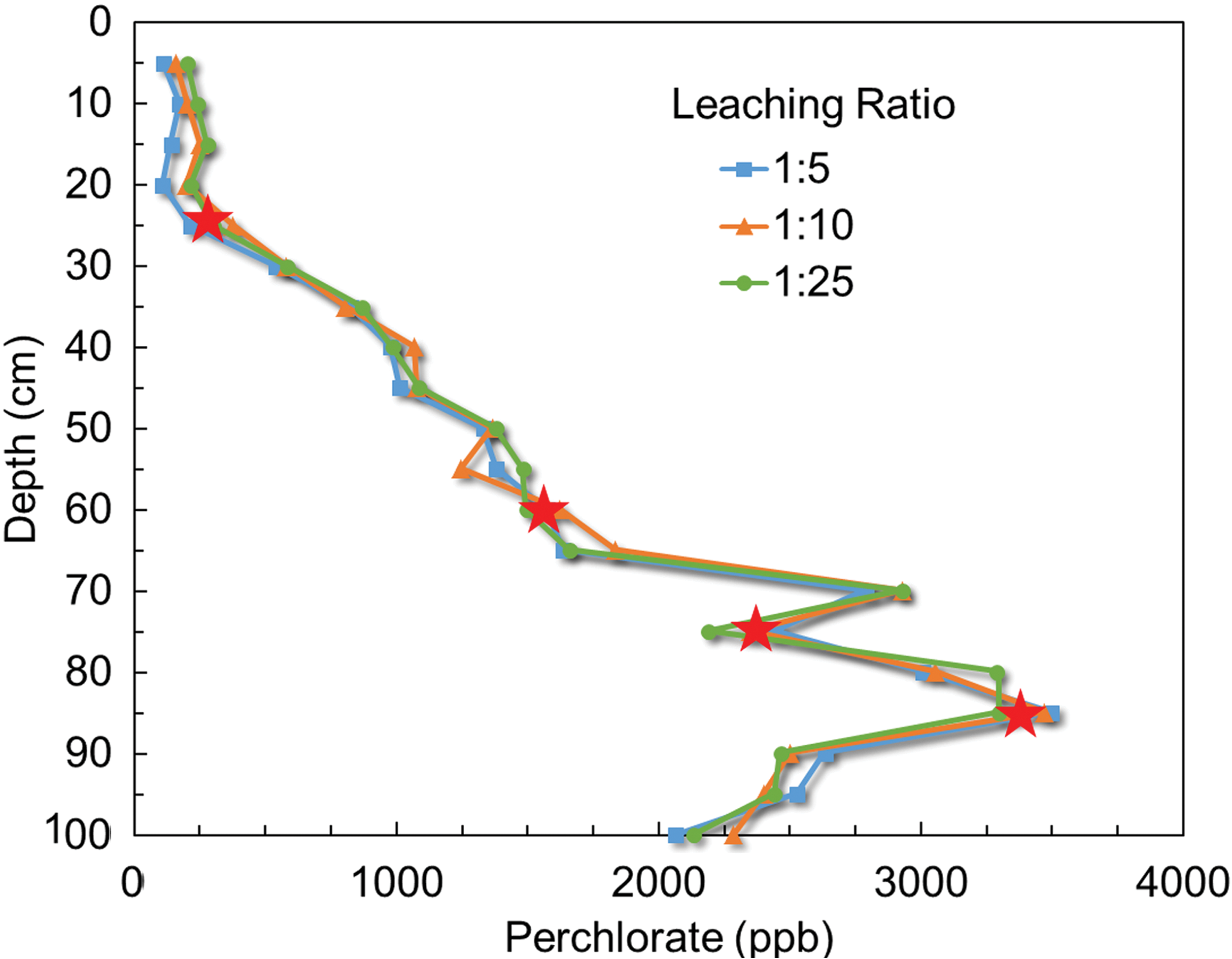
Concentration of perchlorate in soil taken from 20 depths and analyzed using three different leaching ratios: 1:5, 1:10, and 1:25 all leached for 1 h. The % difference does not vary significantly with leaching ratio, and minor differences in concentration are likely due to differences in sample composition rather than leaching ratio. The samples taken at 25, 60, 75, and 85 cm (starred) were then used for further leaching efficacy testing.
4.2. Efficacy of perchlorate leaching
To confirm the efficacy of the leaching method for the ClO4 − in the samples, a set of leaching efficacy analyses was performed by using a subset of representative YU pit samples collected at depths of 25, 60, 75, and 85 cm. Two samples from each depth were used to provide an indication for the homogeneity of the sample sizes used. The samples were leached at soil:water ratios of 1:10 and the concentration of ClO4 − in each measured with IC. The air-dried residues from the 1:10 leach were leached a second time, and the remaining concentrations measured. The results (Fig. 2 and Table 1) show that 7–10% of the initial perchlorate remained in the samples after the first leaching. This corresponds to the volume of leachate that remained in the sample after filtration and thus provided the basis for estimating the residual perchlorate remaining in the samples that were analyzed by py-GC-MS for organic compounds.

Leaching efficiency for ClO4 − for eight soil samples. Two samples were taken from each of four depths, selected to cover a broad range of concentrations. Detailed data used in this figure is provided in Table 1. Solid orange bars represent the concentration of ClO4 − after the first leaching, and green hatched bars after the second leaching. Error bars are the sum of the propagated uncertainty from the volume and concentration of the recovered leach and the standard deviation of three measurements. Dashed line denotes the limit of quantification for the ClO4 − (2.5 ppb). Additional data for the other Yungay depths is shown in Fig. S1 in the Supplementary Information.
Sample Preparation Data for Leaching Efficiency Experiments
Initial leaching volume was 10 mL. Recovered volume from Leach-1 was used to calculate the expected concentration remaining in Leach-2.
4.3. IC analysis of all salts present
The IC analyses of the leachate from the three soil samples showed similarities in the patterns of salts present but with order-of-magnitude differences in concentrations. As can be seen in Fig. 3 and Table 2, the dominant anion in all samples is sulfate (SO4 2−), but it is ∼100 times greater in both the hyperarid LB and YU samples than in the RS sample. The same is also true for the apparent SO4 2− parent salts, with the LB and YU soils potentially containing ∼100 times more CaSO4 than the RS soils. However, in the LB soil the CaSO4 also dominates all other salts by 2 orders of magnitude.
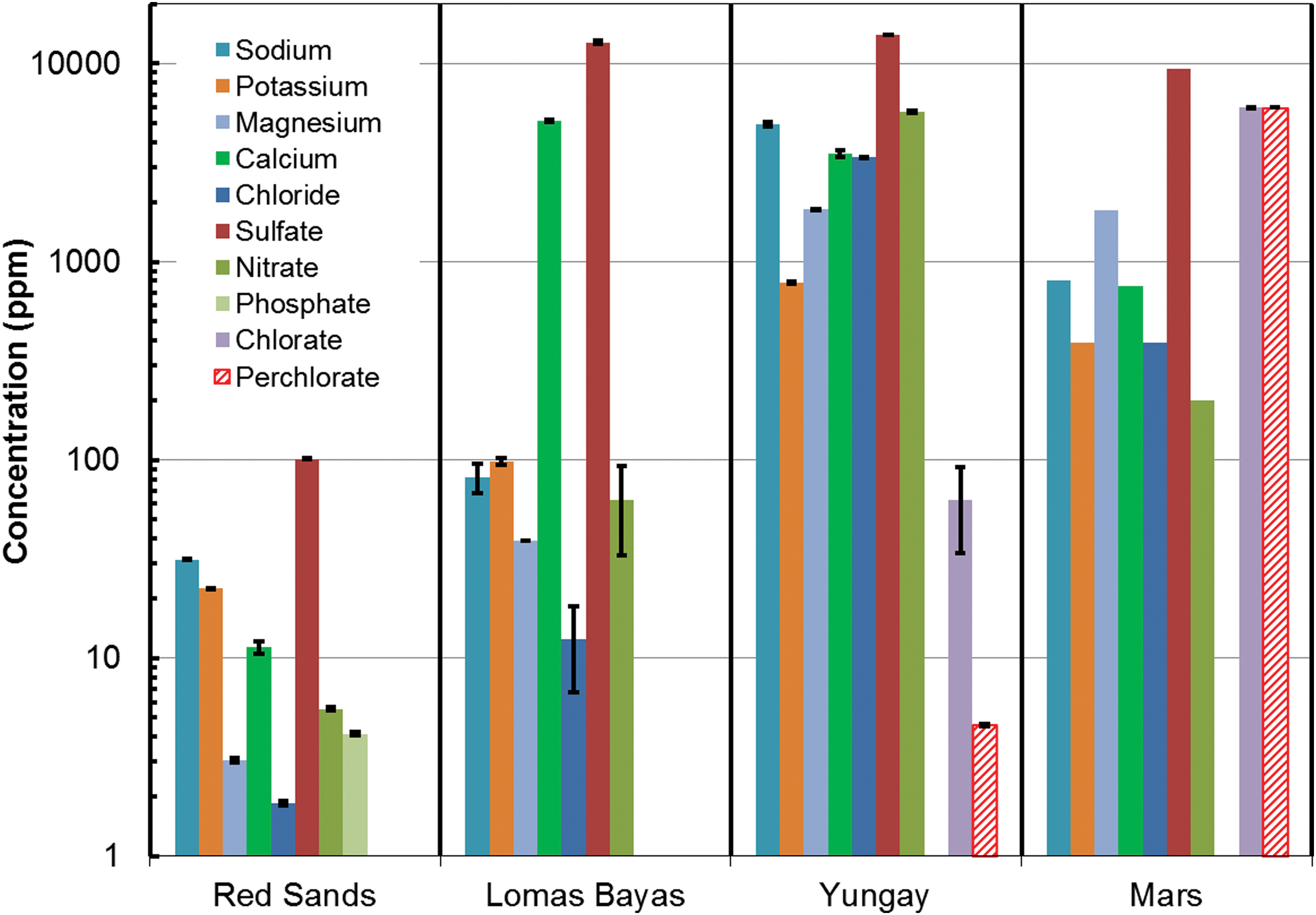
Average (n = 3) concentration of anions and cations in the Atacama RS, LB, and YU soil samples as determined by IC, compared with those measured by the Phoenix-WCL and MSL-SAM instruments. The RS and LB samples were taken from 0–5 cm depth and the YU samples from 50 cm depth. Based on these results, we have designated the RS sample as “salt poor” (∼180 ppm total salts), the LB sample as “sulfate rich” (∼13,000 ppm SO4 2-), and the YU sample as “oxychlorine rich” (∼68 ppm total ClO4 − + ClO3 −). However, YU is also clearly “salt rich” (36,000 ppm total salts) and also “oxyanion rich” with ∼14,000 ppm SO4 2- and 6,000 ppm NO3 −. For Mars, the concentrations for all ions, except NO3 − and ClO3 −, are from the Phoenix-WCL (Kounaves et al., 2010a, 2010b). The data for NO3 − and ClO3 − are estimates from the Phoenix-WCL, the Mars EETA79001 meteorite (Kounaves et al., 2014a), and the MSL-SAM (Stern et al., 2015, 2017).
Inorganic Composition of the Atacama Samples as Determined by Ion Chromatography
The RS and LB samples were taken from 0–5 cm depth and the YU samples from 50 cm depth. These samples were selected to represent “salt poor,” “sulfate rich,” and “oxyanion/salt rich” environments, respectively. Average (n = 3) concentration of detectable species in soil reported as mg/kg. Additional data for the other Yungay depths is shown in Table S1 in the Supplementary Information.
4.4 Organic compound analysis by py-GC-MS
Samples that were pyrolyzed without leaching showed no detectable organic matter other than background siloxane (Fig. 4a–4d) and very weak (YU) or no trace of detectable polychlorinated benzenes (Fig. 5a–5b). The significant excess in column bleed (siloxane) with the YU sample is likely due to the interaction of the pyrolyzed perchlorate with the column, rather than the column itself.
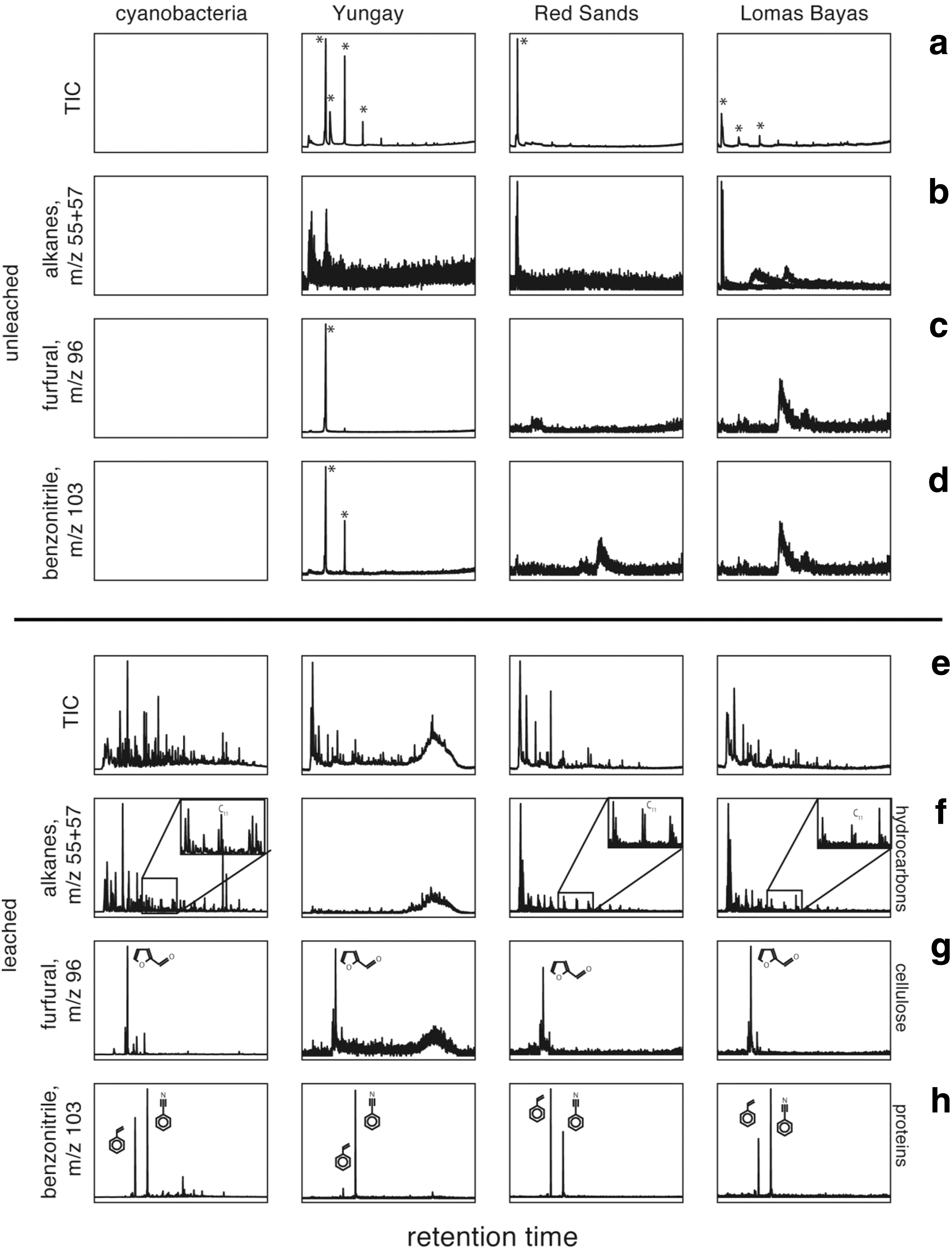
Total ionic current (TIC) chromatograms showing qualitative data for unleached (a–d) and leached (e–h) 50 cm depth soil and rock cyanobacteria samples. The TIC of the unleached samples contains only analytical artifacts (siloxanes; indicated with *), where the TIC of the leached samples contains numerous peaks. Extracted-ion chromatograms (XIC) included (b, f) alkanes and alkenes (m/z = 57 and 55, respectively; alkanes are indicated by carbon number, e.g., C17), which are a common component of biopolymers; (c, g) furfural (m/z = 96), which represent carbohydrates; and (d, h) benzonitriles (m/z = 103), which are a product of protein breakdown, where N = tetradecene. The unleached cyanobacteria sample was not amenable to analysis.
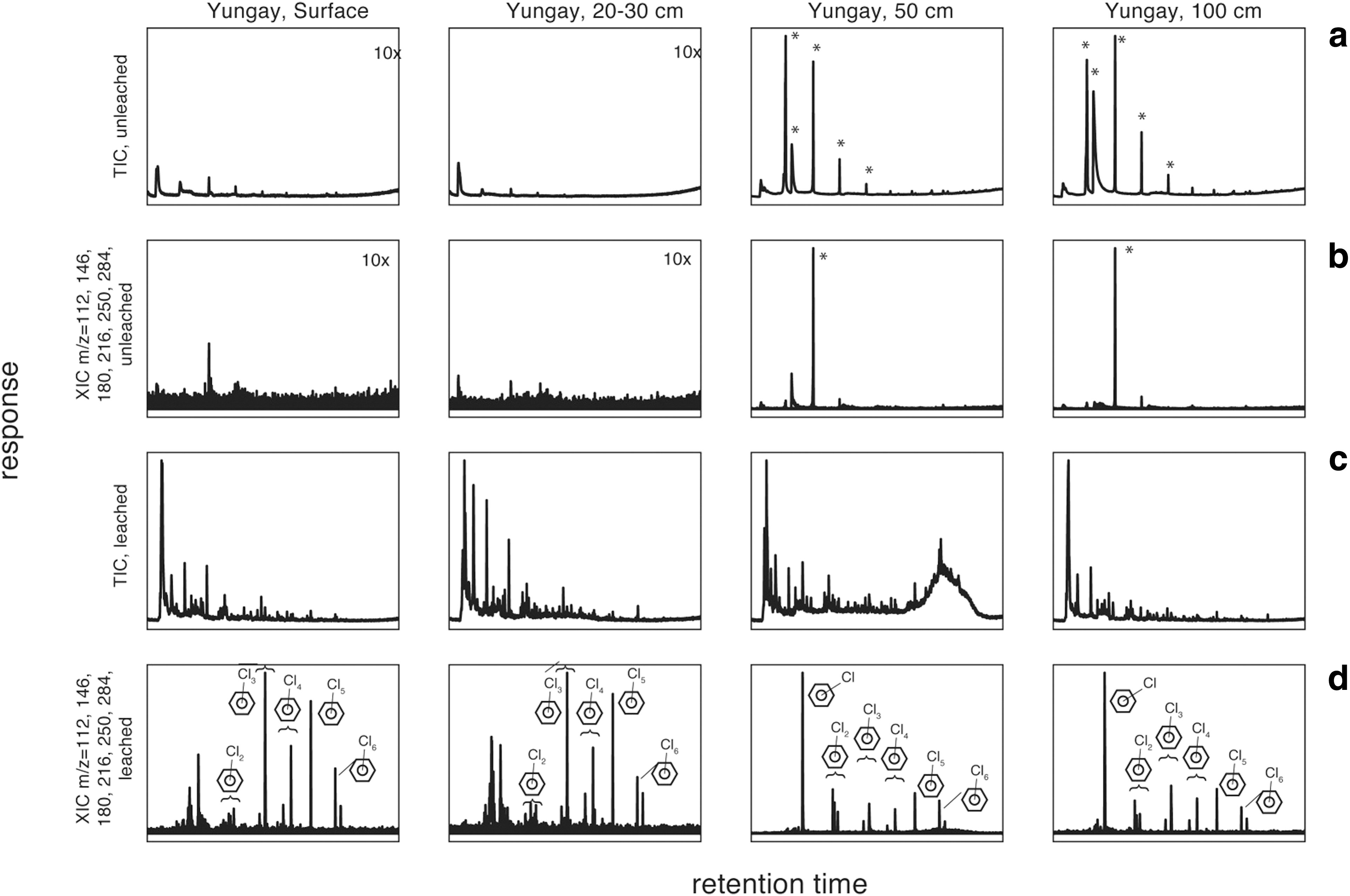
TIC and XIC highlighting the detection of chlorobenzenes in the (a, b) unleached and (c, d) leached samples from the Atacama Desert. Cl1- to Cl6-benzenes were detected in the leached samples using m/z = 112, 146, 180, 216, 250, and 284 (* = column bleed [siloxanes, contaminants from sampling]).
Dried sample residues left over after leaching for IC analysis (i.e., the mineral matrix and water-insoluble organic material) were pyrolyzed and showed a strong organic response in all cases (Figs. 4e–4h, 5c–5d). These residues are most likely the product of the pyrolysis of water-insoluble organics originally present in the samples. For purposes of comparison, Fig. 4 also shows the results for a sample containing endolithic cyanobacteria from the Atacama Desert that was pyrolyzed after leaching. The unleached sample was not analyzed due to methodological difficulties. Alkanes, alkenes, furfural, and benzonitrile were present in the cyanobacteria sample in similar distributions, although the signal was stronger as would be expected. No organics were detected from the procedural blank from leaching and the quartz sand source material (data not shown). The total ionic current (TIC) chromatograms were analyzed for three categories of organic molecules relating to biomarkers, all of which were detected in the leached samples, none of which were detected in the sample prior to leaching. The extracted-ion chromatograms (XIC) showed alkenes (m/z = 55) and alkanes (m/z = 57) which are indicative of fragmentation of a biopolymer, possibly from the cell wall or polymerized fatty acids (Fig. 4b, 4f); furfural (m/z = 96) and aldehydes (m/z = 105, not shown) are indicators of carbohydrates (Fig. 4c, 4g); and benzonitrile (m/z = 103), which is a product of protein breakdown (Fig. 4d, 4h).
The XIC (Fig. 5b, 5d) show Cll- to Cl6-benzenes (m/z = 112, 146, 180, 216, 250, 284) detected in the post-leaching sample residues. Since the perchlorates and other highly soluble salts were extracted prior to pyrolysis, these chlorobenzenes were most likely indigenous to the samples, as either atmospherically deposited polychlorinated benzene contaminates or products formed during possible reactions of indigenous organics with intermediaries formed during UV production of perchlorate (Carrier and Kounaves, 2015). These results are in contrast to the MSL results, where it was argued that chlorobenzenes were formed as a reaction product between perchlorates and benzene carboxylates during pyrolysis (Freissinet et al., 2015).
Biogenic organic matter is known to be composed predominantly of macromolecules which are insoluble in water (Tissot and Welte, 1984; Killops and Killops, 2005). Given the low amount of organic material in the original samples and the small uptake expected, the organic content of the leachate is likely to be below the detection limits of py-GC-MS. Leaching the samples a second time and analyzing the leachate with UV-fluorescence also showed no signal at the 1 ppm level when using humic acid as a standard.
5. Discussion
Experiments that tested the efficacy of the leaching procedure showed that this method does not necessarily remove all the inorganic ions from a sample (Supplementary Fig. S1 is available online at
Total Organic Carbon (TOC):Total Cl, N Oxyanion (Ox)-Salt Ratios Calculated Using Ion Chromatography and TOC Data (Schulze-Makuch et al., 2018), Before and After Leaching
The RS and LB samples were taken from 0–5 cm depth and the YU samples from 0–5, 20–30, 50, and 100 cm depths. Three of the samples were selected to represent “salt poor” (RS), “sulfate rich” (LB), and “oxyanion/salt rich” (YU 50 cm) environments, respectively.
Recent work to establish the minimum mass ratio of organic carbon to perchlorate for incomplete combustion during thermal decomposition indicates that there needs to be at least 3–6 × as much organic carbon as ClO4 − by weight or 46–95 mol of carbon for each mole of ClO4 − (Royle et al., 2018). This generally agrees with the results of this study. The ratios for our samples, which were determined with IC for the oxyanions and total organic carbon for the organic carbon, were below this cutoff range (Table 3). Post-leaching, it would be expected that (with extraction efficiency ≈ 7%) the LB and RS samples would yield detectable organic molecules but YU would not, since its ratio still falls below that necessary for detection, 18.5, 540, and 2.4, respectively. However, all three samples yielded detectable organics post-leaching. This may be due to sample heterogeneity or to the fact that the natural sample contains a mixture of salts and other oxidizing materials which decreases the minimum mass ratio for organic carbon.
Figure 3 shows the challenges that will be faced measuring organic compounds in martian soil. In comparing the levels of salts between the Atacama and the Mars Phoenix sites, it is clear that even though most of the cations and anions in the martian soil are similar to those in the Yungay, there is one glaring difference. For Mars the concentration of NO3 − is an order of magnitude lower, and the ClO4 − and ClO3 − are almost 3 orders of magnitude higher. With ClO4 − being the dominant species of the oxidizing anions on Mars, this implies that the level of organic compounds will need to be at least ∼3–6 times that of the perchlorate, or ∼1800–3600 ppm to allow for a typical py-GC-MS detection.
Despite there being no measurable ClO4 − present at either the RS or LB samples, no organics were detected before leaching. This shows that the other oxyanion salts present (i.e., sulfates, nitrates, chlorates, phosphates) may also have oxidative effects and can obfuscate organic molecule detection during thermal decomposition. While it would not normally be expected that the sulfate and phosphate salts would break down and contribute oxygen at the pyrolysis temperatures used, it is otherwise problematic to explain the nondetection of organic species in the unleached samples. When mixed with other phases, the onset of thermal decomposition temperature of a number of sulfates has been shown to drop to well below the temperatures used in this study (Mu and Perlmutter, 1981; McAdam et al., 2014; Sutter et al., 2017). In these natural soil samples there is likely a mixture of phases, such as metal oxides and carbon, which have this known catalytic effect on the sulfates (Mu and Perlmutter, 1981), and a similar effect may be expected on the other salts present. Thus, the amount of oxygen available for combustion of organic carbon increases, even in samples low in perchlorates. Other than perchlorates, only sulfates have so far been examined in any detail (Lewis et al., 2015, 2018).
Considering these findings and the solubility of perchlorate salts in water, future missions to detect organic matter on Mars must aim for sites with evidence of water activity. Since ClO4 − (and NO3 −) is highly soluble and thus a marker of liquid water, this may be an indication that the area may have been subjected to “recent” water flow. At the same time, ancient surface or near-surface water flow may have concentrated organic compounds downslope while simultaneously leaching away the perchlorate and other soluble oxyanion salts; thus efforts should focus on analyzing fluvial/lacustrine sediments and especially those sites where there is evidence for postdepositional aqueous activity such as the lower Murray mudstone (Yen et al., 2017). This is the one locality where complex, nonchlorinated organic molecules have been detected on Mars (Eigenbrode et al., 2018), and these sediments have also yielded some of the lowest concentrations of perchlorate yet measured in the martian near-surface sediments (Sutter et al., 2017). It is thus hypothesized that aqueous flow through the Murray mudstone has leached the soluble perchlorate out of the sediments, making the organic matter preserved within this unit more amenable to detection via the thermal decomposition technique used by SAM. This is in contrast to the other unit in which “indigenous” organic molecules have been detected on Mars by SAM, the Sheepbed mudstone. In the Sheepbed mudstone, only simple chlorinated organic molecules have been reported, suggesting oxychlorines are having a deleterious and obfuscatory effect on the detection of organic matter (Freissinet et al., 2015). The Sheepbed mudstone appears to have a similar depositional setting to the Murray (at least superficially); however, it does not show the same level of evidence for extensive late-stage fluid flow and aqueous alteration as the Murray and consequently contains perchlorate levels approximately 10× higher. Areas of recent subsurface or surface water, such as above near-surface aquifers, near-exposed water-ice, and downslope of recurring slope lineae (if they are in fact deliquescing-brine-induced [McEwen et al., 2011; Chevrier and Rivera-Valentin, 2012; Dundas and McEwen, 2015]), could also be attractive targets in the search for organic molecules. However, these current or recent “hydrous” areas are the most likely to be capable of supporting Earth-like microbial life and are thus designated “Special Regions,” presenting stringent planetary protection issues if they are to be explored (Rummel et al., 2014; Kminek and Rummel, 2015).
6. Conclusions
Our findings demonstrate that by reducing the salt content of the sample with water, we counter the effects of pyrolyzing in the presence of oxychlorines; thus biologically derived organic material is readily identifiable. Since py-GC-MS is a standard analytical technique for detecting and identifying organic compounds and biomarkers on Mars and Earth, it is clear that its use in the presence of oxyanions, and especially perchlorates, will pose enormous challenges unless their oxidizing effects can be mitigated. We have shown that simple removal of perchlorate prior to pyrolysis using an aqueous extraction method allows for the identification of organic compounds reflective of biological activity. In addition, our results have shown that previous soil analyses which contained high levels of oxyanions and concluded that organics were either not present or were present at extremely low levels should be reexamined.
Footnotes
Acknowledgments
This project was partially funded by the European Research Council Advanced Grant “Habitability of Martian Environments” (HOME, # 339231) to the Technical University of Berlin (D.S.M.) and the UK Space Agency Grant (ST/N000560/1) to Imperial College London (M.A.S. and S.P.K.). All numerical data for this paper is provided in the figures and tables and is also available in tabular form from the authors upon request.
Author Disclosure Statement
No competing financial interests exist for any of the authors.
Associate Editor: Christopher McKay
Abbreviations Used
References
Supplementary Material
Please find the following supplemental material available below.
For Open Access articles published under a Creative Commons License, all supplemental material carries the same license as the article it is associated with.
For non-Open Access articles published, all supplemental material carries a non-exclusive license, and permission requests for re-use of supplemental material or any part of supplemental material shall be sent directly to the copyright owner as specified in the copyright notice associated with the article.
