




Abstract
Carbon-enriched rocky exoplanets have been proposed to occur around dwarf stars as well as binary stars, white dwarfs, and pulsars. However, the mineralogical make up of such planets is poorly constrained. We performed high-pressure high-temperature laboratory experiments (P = 1–2 GPa, T = 1523–1823 K) on chemical mixtures representative of C-enriched rocky exoplanets based on calculations of protoplanetary disk compositions. These P-T conditions correspond to the deep interiors of Pluto- to Mars-sized planets and the upper mantles of larger planets. Our results show that these exoplanets, when fully differentiated, comprise a metallic core, a silicate mantle, and a graphite layer on top of the silicate mantle. Graphite is the dominant carbon-bearing phase at the conditions of our experiments with no traces of silicon carbide or carbonates. The silicate mineralogy comprises olivine, orthopyroxene, clinopyroxene, and spinel, which is similar to the mineralogy of the mantles of carbon-poor planets such as the Earth and largely unaffected by the amount of carbon. Metals are either two immiscible iron-rich alloys (S-rich and S-poor) or a single iron-rich alloy in the Fe-C-S system with immiscibility depending on the S/Fe ratio and core pressure. We show that, for our C-enriched compositions, the minimum carbon abundance needed for C-saturation is 0.05–0.7 wt% (molar C/O ∼0.002–0.03). Fully differentiated rocky exoplanets with C/O ratios more than that needed for C-saturation would contain graphite as an additional layer on top of the silicate mantle. For a thick enough graphite layer, diamonds would form at the bottom of this layer due to high pressures. We model the interior structure of Kepler-37b and show that a mere 10 wt% graphite layer would decrease its derived mass by 7%, which suggests that future space missions that determine both radius and mass of rocky exoplanets with insignificant gaseous envelopes could provide quantitative limits on their carbon content. Future observations of rocky exoplanets with graphite-rich surfaces would show low albedos due to the low reflectance of graphite. The absence of life-bearing elements other than carbon on the surface likely makes them uninhabitable.
1. Introduction
Since the discovery of the first rocky exoplanet, CoRoT-7b (Léger et al., 2009), more than 1000 such planets have been found. The scatter in the mass-radius diagram of rocky exoplanets reveals a great diversity in their bulk composition and interior structure (e.g., Valencia et al., 2006; Seager et al., 2007; Wagner et al., 2011; Hakim et al., 2018a). Water/ices (e.g., GJ 876d, Valencia et al., 2007), thick atmospheres (e.g., GJ 1132b, Southworth et al., 2017), as well as carbon-bearing minerals, including graphite and silicon carbide (e.g., 55 Cancri e, Madhusudhan et al., 2012), have been suggested as dominant phases in these exoplanets, in addition to silicate minerals and iron alloys. Besides dwarf stars, carbon-enriched rocky exoplanets have been proposed around binary stars (e.g., Whitehouse et al., 2018) as well as pulsars and white dwarf stars (e.g., Kuchner and Seager, 2005).
Although life as we know it is largely based on carbon, the Earth contains less than 0.01 wt% carbon (e.g., Javoy et al., 2010). This is to some extent surprising, since many weakly processed planetary building blocks in the solar system contain significant amounts of carbon in the form of organics (e.g., carbonaceous chondrites, Marty et al., 2013), and some larger, more evolved bodies such as the ureilite parent body contain significant amounts of refractory carbon (Nabiei et al., 2018). To explain the extremely low abundance of carbon in the Earth, carbon needs to be burned (oxidized and turned into CO/CO2) or photolyzed away (broken out of the organic compounds by energetic photons) while the solid material is still present in the form of small grains with large surface-to-mass ratio (Lee et al., 2010; Anderson et al., 2017).
An alternative explanation is that planetesimal-sized parent bodies need to be subjected to igneous processing to degas carbon (Hashizume and Sugiura, 1998), which is tied to the presence of radioactive elements such as 26Al in the early solar nebula (Hevey and Sanders, 2006). Both these processes do not seem inevitable. Oxidation and photoprocessing may be quenched by effects of dust growth and transport in disks (Klarmann et al., 2018). The presence of short-lived radioactive isotopes in significant amounts requires the fast (within a Myr) addition of the ejecta of a nearby supernova explosion or stellar wind material into the collapsing protosolar cloud, followed by rapid formation of planetesimals (Bizzarro et al., 2005). It is therefore likely that the conditions needed to decarbonize solids are absent in many planet-forming systems, and that rocky planets in such systems may contain significant levels of carbon up to 10 mass percent.
Even larger carbon abundance could be obtained in systems where the carbon-to-oxygen abundance ratio is higher than in the solar system. Modeling of the protoplanetary disk chemistry for planet-hosting stars with molar photospheric C/O >0.65 (Moriarty et al., 2014) and C/O >0.8 (Bond et al., 2010; Carter-Bond et al., 2012b) (cf. C/OSun ∼0.54) suggests that carbon acts as a refractory element mainly in the form of graphite and silicon carbide in the inner regions of such disks. Delgado Mena et al. (2010) and Petigura and Marcy (2011) reported spectroscopic observations of stars with photospheric C/O ratios greater than unity. However, Nakajima and Sorahana (2016) and Brewer et al. (2016) claimed that the stars in solar neighborhood have largely solar-like C/O ratios. Although the debate over photospheric C/O ratios is not settled, the possibility of a substantial fraction of stars with C/O >0.65 cannot be excluded.
Refractory elements in protoplanetary disks are the major building blocks of rocky planets. Bond et al. (2010) found that the C/O ratio of the refractory material in inner disks of stars with C/O >0.8 varies from 0 to greater than 100 as a function of distance from the star. Moriarty et al. (2014) found that for high C/O stars, the extent of refractory carbon in the planetesimal disk increases when using a sequential condensation model instead of a simple equilibrium condensation model. Thiabaud et al. (2015) showed that C/O ratios of rocky planets do not necessarily show a one-to-one correlation with the stellar photospheric C/O ratios. N-body simulations by Bond et al. (2010) produce rocky exoplanets containing as high as 70 wt% carbon. The amount and nature of carbon-bearing minerals in carbon-enriched rocky exoplanets may directly impact geodynamical processes, carbon and water cycles, and in turn planetary habitability (Unterborn et al., 2014).
During the early stages of planet formation, refractory material in protoplanetary disks condenses out from the chemical reactions between gas molecules. Coagulation of refractory material leads to the formation of pebbles, which grow into sub-Ceres-sized to Pluto-sized planetesimals and later on form planets (Johansen et al., 2007; Schäfer et al., 2017). Such planetesimals are large enough to undergo large-scale differentiation at high-pressure high-temperature conditions during the process of planet formation. Modeling studies such as those of Bond et al. (2010) and Moriarty et al. (2014) derive proportions of chemical compounds condensing out from gas chemistry and perform N-body simulations on planetesimals to track the likely chemical composition of resulting planets. Since the pressures in the interiors of planetesimals and planets are several orders of magnitude higher than the disk pressures, high-pressure high-temperature reactions are expected to reprocess their chemical composition and kick off large-scale differentiation processes in their interiors, which lead to metal segregation and core formation (Kruijer et al., 2013). Current understanding of the mineralogy of exoplanets is based on extrapolation of the knowledge of rocky bodies in our solar system and lacks experimental evidence. There is a need to investigate the mineralogy and phase relationships between carbon-rich planetesimals and exoplanets, which have no Solar system analogues, in multicomponent systems, and high-pressure high-temperature experiments make it possible (e.g., Valencia et al., 2009; Nisr et al., 2017).
C-enriched rocky exoplanets are speculated to contain large amounts of C-bearing minerals, including silicon carbide and graphite (e.g., Bond et al., 2010; Madhusudhan et al., 2012). Over the past decades, several laboratory studies have investigated the mineralogy of rocky planets in C-poor Earth-like conditions, but only a few studies are applicable to conditions relevant to C-enriched exoplanetary interiors. Corgne et al. (2008) used a CI-chondrite-like composition to probe early planetesimal differentiation in carbon- and sulfur-enhanced environments and observed liquid metal immiscibility leading to the formation of C-rich and S-rich metals. The extent of liquid metal immiscibility has been explored in the simple Fe-C-S (e.g., Dasgupta et al., 2009), Fe-S-O (e.g., Tsuno et al., 2007), and Fe-S-Si (e.g., Morard and Katsura, 2010) systems. The solubility of carbon in iron alloys (e.g., Lord et al., 2009; Tsuno and Dasgupta, 2015) and silicate melts (e.g., Duncan et al., 2017), the partitioning of carbon between silicate melt and iron alloys (e.g., Chi et al., 2014; Li et al., 2015, 2016), and the stability of reduced versus oxidized carbon in the Earth's mantle (e.g., Rohrbach and Schmidt, 2011) have also been investigated. Phase relationships have been studied in the carbon-saturated Fe-Mg-Si-C-O (FMS+CO) system with bulk compositions depleted in oxygen (Takahashi et al., 2013). The study by Takahashi et al. (2013) covers a range of oxygen fugacities resembling highly reducing conditions; however, they did not consider the presence of S, which can be a major component in the Fe-rich cores of rocky bodies (e.g., Stewart et al., 2007; Rai and van Westrenen, 2013; Steenstra et al., 2016). Moreover, they lack a discussion about the diversification of silicate minerals due to the absence of Al and Ca in their experiments. Finally, to our knowledge, no experimental studies have used C-enriched starting compositions calculated by modeling planet formation chemistry around stars other than our Sun, which is key for future exoplanetary exploration.
Here we probe the mineralogy and structure of small C-enriched rocky exoplanets by performing high-pressure high-temperature laboratory experiments on chemical mixtures in the Fe-Ca-Mg-Al-Si-C-S-O (FCMAS+CSO) system, resembling the bulk compositions of C-enriched planetesimals from the models of Moriarty et al. (2014). In Section 2, we give our experimental and analytical methods. Phase relationships and compositions of our experimental run products are given in Section 3. The mineralogy and structure of C-enriched rocky exoplanets and their dependence on several factors are discussed in Section 4. To illustrate the application of our findings, we discuss the implications of assuming a C-enriched interior on the derived mass, future observations, and habitability of Kepler-37b, the smallest known exoplanet till date, in Section 5. Finally, we summarize our findings and conclusions in Section 6.
2. Methods
2.1. Choice of bulk compositions
To prepare starting materials for our experiments, we used relative elemental abundances of C-enriched planetesimals at 1 AU and 0.15 Myr after disk formation in the HD19994 planetary system calculated by Moriarty et al. (2014) for their equilibrium chemistry (EC) and sequential condensation chemistry (SC) cases. Two end-member compositions (SC and EC) were prepared by using elemental proportions given in Table 1. The C/O ratios of the SC and EC compositions are 0.35 and 1.38, respectively, about two-three orders of magnitude higher than that of the Earth, and they give an appropriate range of carbon-enriched compositions based on the calculations of Moriarty et al. (2014). Since our experiments were performed in carbon-saturated conditions by enclosing samples in graphite capsules (See Appendix 1), there is no upper limit on the amount of carbon in the resulting experiments, and hence, these C/O ratios merely signify lower limits. We also chose a third bulk composition (hereafter, TC) resembling solar system terrestrial planetesimals at 1 AU and 0.15 Myr after disk formation from the EC model of Moriarty et al. (2014). The TC composition is also saturated with carbon.
Planetesimal Bulk Compositions and Starting Materials
CaO and FeO are obtained from CaCO3 and Fe2O3 after decarbonation and reduction.
SC = sequential condensation chemistry, EC = equilibrium chemistry, TC = third bulk composition based on equilibrium chemistry.
2.2. Starting materials
Starting materials were mixed in proportions shown in Table 1. In the first step, SiO2 (99.9% SiO2 powder from Alfa-Aesar), MgO (99.95% MgO powder from Alfa-Aesar), Al2O3 (99.95% min alpha Al2O3 powder from Alfa-Aesar), CaCO3 (99.95–100.05% ACS chelometric standard CaCO3 powder from Alfa-Aesar), and Fe2O3 (99.9% Fe2O3 powder from Alfa-Aesar) were homogenized in an agate mortar under ethanol. The oxide/carbonate mixture was decarbonated and reduced in a box furnace by first gradually increasing the temperature from 873 to 1273 K in 6 h. The decarbonated mixture, placed in a platinum crucible, was then heated to 1823 K in a box furnace for 30 min and then quenched to room temperature by immersing the bottom of the platinum crucible in water, leading to the formation of glassy material. It was then ground to a homogeneous powder with an agate mortar under ethanol. Fe (99.95% Fe powder, spherical, <10 micron from Alfa-Aesar), FeS (99.9% FeS powder from Alfa-Aesar), C (99.9995% ultra F purity graphite from Alfa-Aesar), and SiC (≥97.5% SiC powder from Sigma-Aldrich) were added to the powder. The final mixture was again homogenized by grinding in an agate mortar and stored in an oven at 383 K until use.
2.3. High-pressure high-temperature experiments
Experiments summarized in Table 2 were conducted in an end-loaded piston-cylinder apparatus at Vrije Universiteit Amsterdam in a 12.7-mm (half-inch)-diameter cylindrical sample assembly. Details on sample assembly preparation are given in Appendix 1 and Appendix Fig. A1. Pressure and temperature conditions of 1–2 GPa and 1523–1823 K were chosen to represent the interior conditions of Pluto-mass planetesimals and planets. To reduce the porosity of the graphite capsules, the sample assembly was sintered at 1073 K and 1 GPa for 1 h before further heating and pressurization. During heating to the run temperature, the pressure was increased continuously with the hot-piston-in technique (McDade et al., 2002). The temperature was increased at a rate of 100 K/min. The experiments were run for the duration of 3.5–100 h (Table 2). All experiments were quenched to <450 K within ∼15 s by switching off the electric power to the heater.
Experimental Conditions and Run Product Phases
Oxygen fugacity is calculated assuming a nonideal solution behavior of S-rich Fe alloy and silicate melt (see Appendix 2 for details). Oxygen fugacities in italics are calculated by using olivine instead of silicate melt.
Silicate melt was present in small quantities that could not be measured using EPMA.
CPx = clinopyroxene; EPMA = Electron Probe Micro-Analyzer; FeS = Fe-S solid (single alloy); IW = iron-wüstite; Olv = olivine; OPx = orthopyroxene; SiL = silicate melt; Spi = spinel; SpFeL = S-poor Fe melt; SrFeL = S-rich Fe melt; SrFeL2 = S-rich Fe melt (single alloy).
2.4. Analytical procedure
The recovered samples were mounted in one-inch-diameter mounts with petropoxy resin, cut longitudinally, polished with grit-paper, and fine-polished down to a 1/4 μm finish. The polished samples were carbon coated to ensure electrical conductivity of the surface during electron probe microanalysis. Major element contents of the experimental charges were determined with wavelength dispersive spectroscopy on the 5-spectrometer JEOL JXA-8530F Hyperprobe Electron Probe Micro-Analyzer (EPMA) at The Netherlands National Geological Facility, Utrecht University. We used a series of silicate, oxide, and metal standards and conditions of 15 nA beam current and 15 kV accelerating voltage. Analyses were made with a defocused beam to obtain the compositions of metal (2–10 μm diameter) and silicate (5–20 μm diameter) phases. Standards for the quantitative analysis of Mg, Fe, Si, Al, and Ca in silicate minerals were forsterite, hematite, forsterite, corundum, and diopside, respectively, and the standard for Fe in iron alloys was Fe-metal. Counting times were 30 s for Fe (hematite and Fe-metal), Si, Mg, and Al, and 20 s for Ca and S. Quantitative analysis of Pt, with the help of a Pt-metal standard, was also performed to assess contamination from the Pt capsule. To measure light element abundances in iron alloys, the carbon coating was removed and the samples and standards (natural troilite for S, pure Si metal for Si, magnetite for O, and experimentally synthesized Fe3C for C) were Al coated together for each run to keep the X-ray absorption uniform. These analyses were performed with a JEOL JXA 8530F Hyperprobe at Rice University, Houston, following the analytical protocol of Dasgupta and Walker (2008). Detection limits (3σ) of all elements are less than 0.03 wt% except for Pt (0.07 wt%). Data reduction was performed using the Φ(rZ) correction (Armstrong, 1995). Instrument calibrations were deemed successful when the composition of secondary standards was reproduced within the error margins defined by the counting statistics.
3. Experimental Observations
3.1. Phase assemblages and texture
Run product phases are listed in Table 2. A clear segregation into silicate and iron-rich phases can be seen in all three series of run products (Fig. 1). Resulting phase diagrams for experiments with SC, EC, and TC compositions are compared with each other in Fig. 2. Oxygen fugacities of EC runs are lower than those of SC runs by an average value of 0.6 log units (Table 2) since sequential condensation models of Moriarty et al. (2014) are richer in oxygen than EC models. The oxygen fugacities of carbon-saturated experiments with EC and TC compositions are similar because the relative elemental abundances of EC models, excluding carbon, for HD19994 and the Sun are largely the same (Table 1). Mass balance calculations on iron alloys and silicate phases, excluding graphite, result in 10–18 wt% of iron alloys in SC runs and 23–27 wt% of iron alloys in EC/TC runs.

False-color backscattered electron images of six representative run products (a–f) illustrating different phases and textural types. See text for detailed explanation. Phases can be broadly categorized into graphite, iron alloys, and silicate phases. Silicate melts show a typical dendritic quench texture. Iron alloys show a fine-grained quench texture.
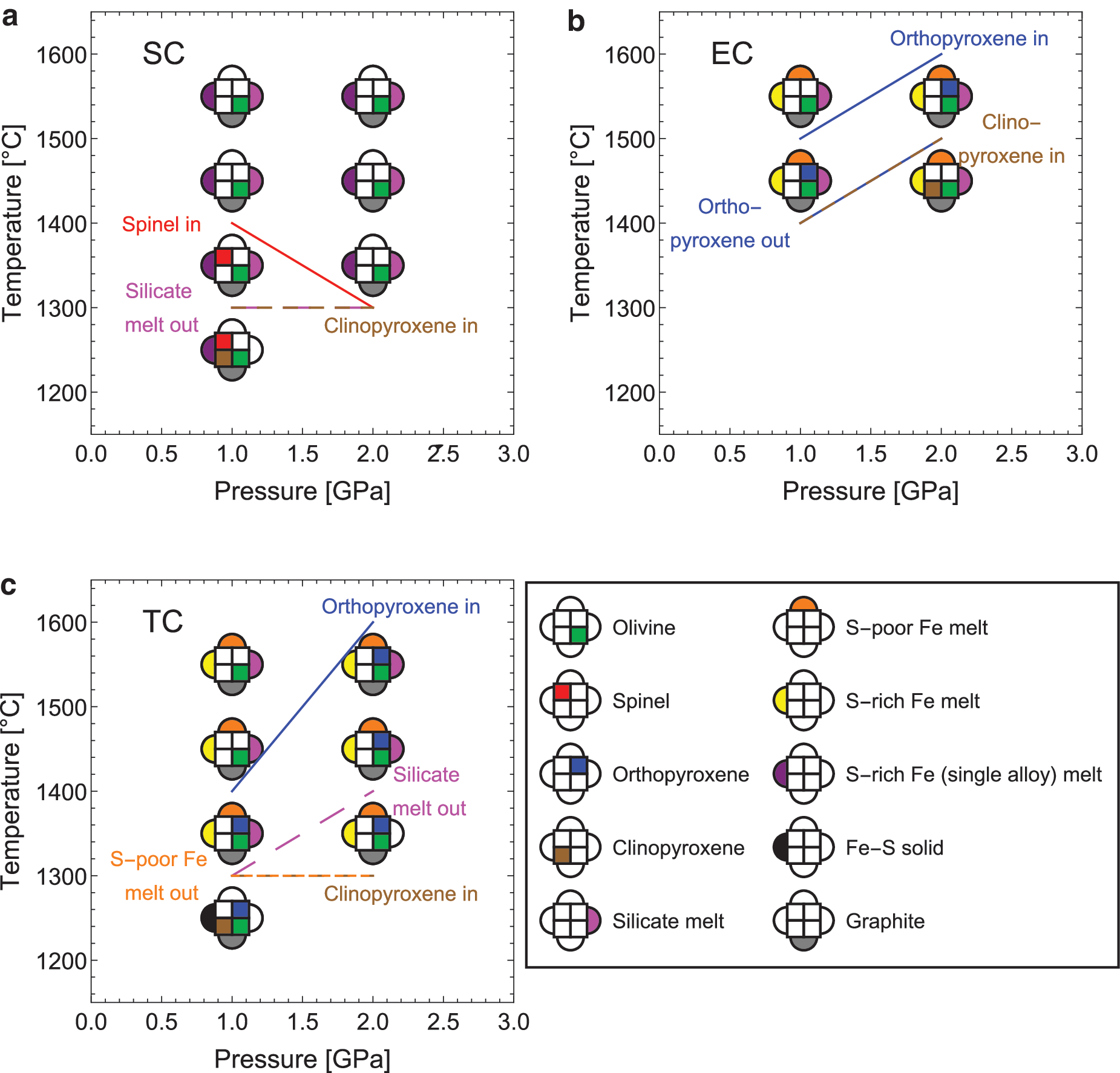
Phase diagrams of SC
In our run products, graphite grains <1–100 μm in diameter (Fig. 1a, b, d) were identified with energy dispersive X-ray spectroscopy analyses showing a clear peak of carbon with no other elements. In EC runs with 5 wt% SiC in their starting material, we did not find any SiC grains, suggesting the formation of graphite via the oxidation of silicon in SiC (see Hakim et al., 2018b). Since our experiments were conducted in graphite capsules, all our run products are graphite saturated, and hence, graphite is a stable phase in all runs.
Olivine crystals are present in all runs. Orthopyroxene is present in all EC runs except the run at 1 GPa and 1823 K, and in all TC runs except the runs at 1 GPa and 1723–1823 K. The absence of orthopyroxene in SC runs is due to their higher oxygen fugacities and the corresponding higher FeO content. Clinopyroxene is present only at 1 GPa and the lowest temperature in all three series. In SC runs at 1 GPa and 1545–1623 K, spinel is also identified. Silicate melts and iron alloys are usually concentrated between the boundaries of silicate crystals and at the top or edges of capsules. The proportion of silicate melt increases with temperature and decreases with pressure. The solidus of silicate melt in SC runs is lower than in EC/TC runs due to higher oxygen fugacities and the corresponding higher FeO content.
Iron alloys are present in all runs. In all EC/TC runs except the TC run at 1 GPa and 1523 K containing solid Fe-S, two immiscible iron-rich melts (S-rich Fe melt and S-poor Fe melt) are identified. S-poor Fe melt is observed as almost spherical blebs usually surrounded by S-rich Fe melt (Fig. 1b, c, f). This immiscibility is attributed to the chemical interactions between carbon and sulfur. Such liquid metal immiscibility in Fe-C-S systems has been observed for a range of S/Fe ratios in previous studies (e.g., Wang et al., 1991; Corgne et al., 2008; Dasgupta et al., 2009). The S/Fe ratio in iron-rich melts of our EC/TC runs is within this range (Section 3.2). In contrast, SC runs do not exhibit liquid metal immiscibility and contain a single alloy of S-rich Fe melt, since the S/Fe ratio in this series is beyond the range where immiscibility exists (see Section 3.2).
As a result of quenching, the silicate melt exhibits a dendritic texture as shown in Fig. 1a, b, e, and f. Dendrites in SC runs (e.g., Fig. 1a, e) are 5–10 times larger than in EC/TC runs (e.g., Fig. 1b, f). Quenching also results in the growth of thin rims at the boundaries of silicate crystals (e.g., Fig. 1a). These thin rims sometimes have a saw-toothed edge and are thicker in SC runs than in EC/TC runs, perhaps due to different viscosities and consequently the transport properties of the melts involved owing to different oxygen fugacities (e.g., Giordano et al., 2008). These textures are observed in melt regions because quenching is a non-instantaneous process leading to rapid exsolution and crystallization of melt. The silicate melt also contains Fe-S micro-inclusions resulting from the exsolution of the original melt on quenching (Fig. 1e), similar to observations made in the study of Boujibar et al. (2014).
The iron-rich melts show a fine-grained quench texture supporting the interpretation of a liquid state during the experiments. In EC/TC runs, the immiscibility of S-poor and S-rich Fe melts is evident from the sharp boundaries between them (Fig. 1a, c, f). Submicron-sized iron-rich specks seen in S-rich Fe melt, surrounding the S-poor Fe blebs, are likely a result of unmixing on quenching.
3.2. Phase compositions
Tables 3 and 4 list the compositions of silicate and iron-rich phases, respectively. The lithophile elements, Mg, Si, Al, and Ca, are bonded to oxygen in silicate phases. O is largely present in silicate phases and to a smaller extent in iron-rich melts. S mainly partitions into iron-rich phases with smaller amounts present in silicate melts. Fe is distributed among silicate and iron-rich phases. Most of the carbon is present as graphite and a smaller amount is present in iron alloys.
Composition of Silicate Phases Formed in Experimental Run Products
All compositions are in wt% with 1σ error given in parentheses. Sulfur in silicate melts is reported as S since oxygen fugacities are much lower than needed to form sulfates (Jugo et al., 2005; Jugo et al., 2010). Runs marked a contain silicate melt in small quantities but could not be measured using EPMA. n is the number of analytical points. DL: detection limit. Pt is <DL in all silicate phases. K D is the olivine/silicate melt FeO-MgO exchange coefficient and K′ D is the corrected exchange coefficient from Toplis (2005) (see Appendix 3 for mineral/melt equilibrium calculations).
Composition of Iron-Rich Phases Formed in Experimental Run Products
All compositions are in wt% with 1σ error given in parentheses. n is the number of analytical points for Fe and Pt, and m is the number of analytical points for other elements. DL: detection limit. Mg, Ca, and Al are <DL in all iron-rich phases. The Pt contamination is 0–2.2 mol% in S-poor Fe melt, negligible in S-rich Fe melt, and 0–0.4 mol% in S-rich Fe melt (single alloy). The numbers marked with a were not measured for that phase and have been taken from the same phase of another run product at similar conditions.
Olivine crystals and silicate melts in EC/TC runs are richer in MgO and poorer in FeO than in SC runs. The Mg# or Mg/(Mg+Fe) mol% of olivine in EC/TC and SC runs is between 75–87 and 55–75, respectively. Similarly, the Mg# of silicate melt in EC/TC and SC runs is between 60–65 and 25–50, respectively. Orthopyroxene, found only in certain EC/TC runs, has Mg# between 80 and 87. The SiO2 content of silicate melt in EC/TC runs (44–50 wt%) is higher than in SC runs (33–41 wt%). These differences between EC/TC and SC runs are a direct consequence of lower oxygen fugacities of EC/TC runs (
Since olivines do not accommodate significant amounts of the oxides of Ca and Al, they are present only in silicate melt and/or pyroxenes. Orthopyroxenes and clinopyroxenes contain a combined 2–5 and 10–25 wt% of CaO and Al2O3, respectively. The similarity in CaO and Al2O3 contents of clinopyroxenes between SC and EC runs and their differences from TC runs are due to the differences in starting Ca/Si and Al/Si ratios. Silicate melts contain 0.1–0.8 wt% S, with higher values of S seen mainly in SC runs, which is likely due to their higher FeO contents than in the EC/TC runs (e.g., Smythe et al., 2017). The formation of spinel in the SC run at 1 GPa and 1545–1623 K and its absence in TC runs is likely due to a higher Al/Si ratio of the SC composition.
Across EC/TC runs exhibiting liquid metal immiscibility, the S-poor Fe melt contains 86–94 wt% Fe, 3.9 ± 0.9 wt% C, 1.3 ± 0.3 wt% S, and 0.3 ± 0.1 wt% O. The variable Fe content is a result of the variable Pt contamination of 0–8 wt% (0–2 mol%) from the outer Pt capsules surrounding the inner graphite capsules. The S-rich Fe melt contains 69.2 ± 0.5 wt% Fe, 0.8 ± 0.5 wt% C, 29.5 ± 1.1 wt% S, and 1.0 ± 0.3 wt% O. The S-rich Fe melt (single alloy) in SC runs contains 62.7 ± 0.9 wt% Fe, 0.4 ± 0.1 wt% C, 29–37 wt% S, and 1–7 wt% O (∼36 wt% S+O, equivalent to sulfur's composition in iron sulfide). The higher amount of oxygen in SC iron alloys is likely due to their higher oxygen fugacity with respect to EC/TC iron alloys.
Figure 3 illustrates that our measurements of S-rich and S-poor Fe melts exhibiting immiscibility are in excellent agreement with the studies of Corgne et al. (2008) and Dasgupta et al. (2009). The single alloys from our SC runs are clustered together in the lower left corner of Fig. 3 and their composition is a reflection of the starting composition, as is the case for single alloys reported in the work of Corgne et al. (2008) and Dasgupta et al. (2009). The molar S/Fe ratio in bulk iron-rich melts of our SC runs is ∼0.85, which is higher than that of our EC and TC runs having ∼0.4 and ∼0.25, respectively. Up to pressures of 4–6 GPa, Dasgupta et al. (2009) observed immiscibility for S/Fe ratios of ∼0.1 and ∼0.33 and miscibility for S/Fe ratios of 0.02 and 0.06. Corgne et al. (2008) also found immiscibility at S/Fe ∼0.15. Since the miscibility gap closes above 4–6 GPa, some runs contain single alloys despite having characteristic S/Fe ratios. Combined with our results, this implies that immiscibility is observed in the Fe-C-S system for moderate S/Fe ratios between ∼0.1 and 0.8 up to pressures of 4–6 GPa. For lower or higher S/Fe ratios, a single iron-rich melt is expected.
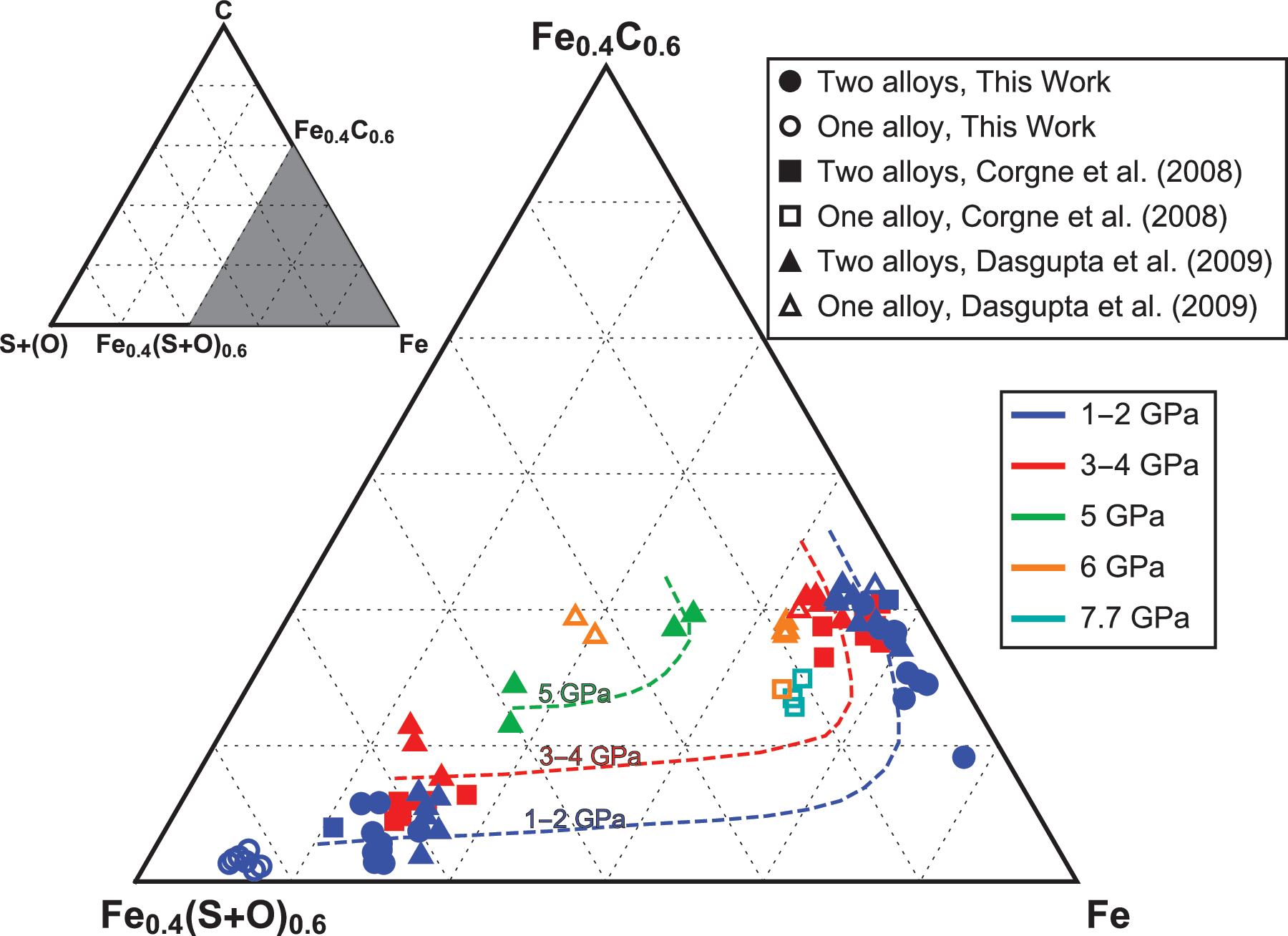
Liquid metal immiscibility in the Fe-C-S system compared with results from previous studies. For all studies, O measurements are added to S. For Corgne et al. (2008), Ni measurements are added to Fe. The hand-drawn dashed lines based on the experiments considered here represent the compositional variation of immiscible S-poor and S-rich Fe melts with pressure.
4. Mineralogy and Structure of C-Enriched Rocky Exoplanets
4.1. Mineralogy
Although our experimental conditions are valid for the interior of Pluto-mass planets as the shallow upper mantles of larger planets, here we discuss mineralogy in the context of both smaller and larger planets. Our experiments show that silicate minerals, iron-rich alloys, and graphite dominate the mineralogy in differentiated C-enriched planetary interiors. In addition to the C/O ratio, the oxygen fugacity and the Mg/Si, Al/Si, Ca/Si, and S/Fe ratios play an important role in determining the mineralogy in carbon-rich conditions. Our oxygen fugacity conditions (
At
Takahashi et al. (2013) found olivine to be a dominant silicate mineral in the FMS+CO system at
We do not observe any carbonates in our runs since magnesite and calcite are stable only at very oxidizing conditions,
Carbon solubility in the interior of the Earth is key in driving the terrestrial carbon cycle (Dasgupta, 2013). Similarly, carbon solubility is expected to impact the carbon cycles and habitability on C-enriched rocky exoplanets (Unterborn et al., 2014). Although we do not measure the carbon abundance in silicate melts of our experiments, Li et al. (2015, 2016) gave an upper limit of ∼200 ppm C in silicate melts at oxygen fugacity conditions similar to our experiments. The C-solubility in S-poor Fe melts is 3–9 wt% (Boujibar et al., 2014; Rohrbach et al., 2014; Li et al., 2015, 2016, and this study), which is more than two orders of magnitude larger than the C-solubility in silicates.
In Fig. 4, we plot the C-solubility in the mantle and core against core mass percent (excluding graphite) for our experiments and those from the works of Corgne et al. (2008) and Takahashi et al. (2013). Since all experiments are carbon saturated, this figure essentially gives the minimum amount of carbon in a planet that is necessary to achieve carbon saturation in the planet during its magma ocean stage. For a C-enriched exoplanet with an EC/TC-like composition and 25% of its mass in the core, ∼0.7 wt% C (molar C/O ∼0.03) is sufficient for carbon saturation. For a C-enriched exoplanet with an SC-like composition and 10% of its mass in the core, ∼0.05 wt% C (C/O ∼0.002) is sufficient for carbon saturation. For an extreme case with a core mass of 0, the minimum amount of carbon needed for carbon saturation is 200 ppm (C/O ∼0.001). In contrast, if the core mass percent is Mercury like (70%), assuming 9 wt% C in the core, 6 wt% C (C/O ∼0.5) is needed for carbon saturation. Once carbon saturation is achieved, an increase in C/O ratio increases only the amount of graphite produced, and this has a negligible impact on the mineralogy of silicates or iron alloys. The solubilities of carbon for the experiments considered in Fig. 4 are lower than the 9 wt% C-solubility from the work of Boujibar et al. (2014) because of the difference in oxygen fugacities and/or the presence of two Fe alloys where S-rich Fe melts have lower C-solubility than S-poor Fe melts, which decreases the net C-solubility in the iron-rich core. The C-solubility in the core is more or less the same for

Experimental measurements of carbon solubility in iron alloys are plotted against the core mass percent. Solid lines give upper bounds on carbon solubility in a molten iron-rich core and a molten silicate mantle.
4.2. Interior structure
High temperatures during planet formation enable melting and chemical segregation of several minerals (Elkins-Tanton, 2012). These minerals eventually undergo gravitational stratification. For C-enriched rocky exoplanets, iron alloys, silicates, and graphite are the main categories of minerals based on densities. Due to density contrasts of more than 40% between graphite and silicates and more than 50% between silicates and iron alloys, three major gravitationally stable layers are expected to form in these exoplanets: an iron-rich core, a silicate mantle, and a graphite layer on top of the silicate mantle.
For smaller C-enriched rocky exoplanets (with interior pressures <4 GPa) showing Fe-C-S liquid metal immiscibility, S-poor Fe alloy will form the inner core and S-rich Fe alloy will form the outer core because of the density contrast between the two alloys. Our mass-balance calculations show that the core/mantle mass ratio would be ∼0.33 for planets with EC/TC compositions and ∼0.15 for planets with SC composition. Even though the core/mantle ratio is similar for EC and TC compositions, the S-poor Fe inner-core to the S-rich Fe outer-core mass ratio would be about 0.7 for TC planets and about 1.6 for EC planets owing to a difference in the S/Fe ratio. For C-enriched exoplanets with core pressures larger than 6 GPa, there would be no stratification in the core because of the closure of the miscibility gap. For planets with extremely reducing cores showing Fe-S-Si immiscibility, again an inner and an outer core would exist (e.g., Morard and Katsura, 2010). Depending on composition, pressure, temperature, and
Even though C-enriched rocky exoplanets are expected to contain large amounts of carbon, olivine and pyroxenes would be the common mantle minerals, similar to C-poor rocky planets. In addition, minerals such as spinel and garnet may be abundant in the upper mantle for planets depending on Al/Si and Ca/Si ratios, which might also vary as shown by the models of Carter-Bond et al. (2012a). For larger C-enriched rocky exoplanets, high-pressure phases of these minerals, ferropericlase and perovskite and/or postperovskite, would be the most abundant minerals in the lower mantle.
Graphite will likely form a flotation layer on top of the magma ocean or silicates such as olivine because of its lower density. Graphite is expected to be in its solid state because the melting temperature of the graphite/diamond system exceeds 4000 K for all pressures in a planetary interior (Ghiringhelli et al., 2005). If the graphite layer extends deep into the planet exceeding pressures of 2–15 GPa and depending on the temperature, diamond would form beneath graphite. Since diamond is denser than graphite with a density comparable with some silicate minerals, convection, if it exists, in the mantle may strip off diamonds from beneath the graphite layer. This may result in a diamond/silicate mantle similar to the mantle discussed by Unterborn et al. (2014). In addition, the possible presence of metastable states in the carbon system, at conditions near the equilibrium graphite-diamond transition, may have interesting consequences for planetary evolution because of their substantially different physical properties compared with those of graphite and diamond (e.g., Shabalin (2014)). However, the discussion of these metastable states is beyond the scope of this study.
5. A C-Enriched Interior for Kepler-37b
5.1. Effect of a graphite layer on the derived mass
Transit photometry is used to measure the radius of exoplanets (Batalha, 2014). Follow-up stellar radial velocity measurements help to put constraints on their masses, but for most of the rocky exoplanets, masses are currently unknown. Due to graphite's significantly lower density compared with silicate minerals and iron-rich alloys, the mass of an exoplanet in the presence of significant amounts of graphite would be lower than expected for a given radius. To quantify the effect of graphite on a planet's mass, we compute the interior structure and mass of the smallest known exoplanet till date, Kepler-37b with radius of 0.34 R⊕ (Stassun et al., 2017), by following the isothermal recipe to solve the hydrostatic and Poisson's gravitational gradient equations and keeping the radius fixed (e.g., Unterborn et al., 2016). We implement the third-order Birch-Murnaghan equation of state to provide a relationship between density and pressure (Birch, 1947). Since we are interested in the effect of graphite on its total mass, we assume Kepler-37b is fully differentiated with a pure iron or an iron sulfide core, an enstatite mantle, and a graphite layer. To model the equations of state, we use the thermoelastic data of graphite (Colonna et al., 2011), enstatite (Stixrude and Lithgow-Bertelloni, 2005), iron (Fei et al., 2016), and iron sulfide (Sata et al., 2010).
Applying a core/mantle mass ratio of 0.33, similar to our EC/TC results, and assuming a pure Fe core and an enstatite mantle to the interior structure model of Kepler-37b, the derived mass is 0.26 times the martian mass (0.26 M♂). When a 33.3 wt% graphite layer is assumed on top of its mantle keeping the core/mantle mass ratio at 0.33, the total mass becomes 0.21 M♂ (about 19% less). In fact, a graphite layer of 10 wt% of the planet's total mass is sufficient to decrease the derived mass of Kepler-37b by 7% (Fig. 5). Assuming a hypothetical 100 wt%, graphite-only planet gives a mass of 0.16 M♂ (about 40% less). For models with an FeS core instead of pure Fe, a similar trend can be seen (Fig. 5).
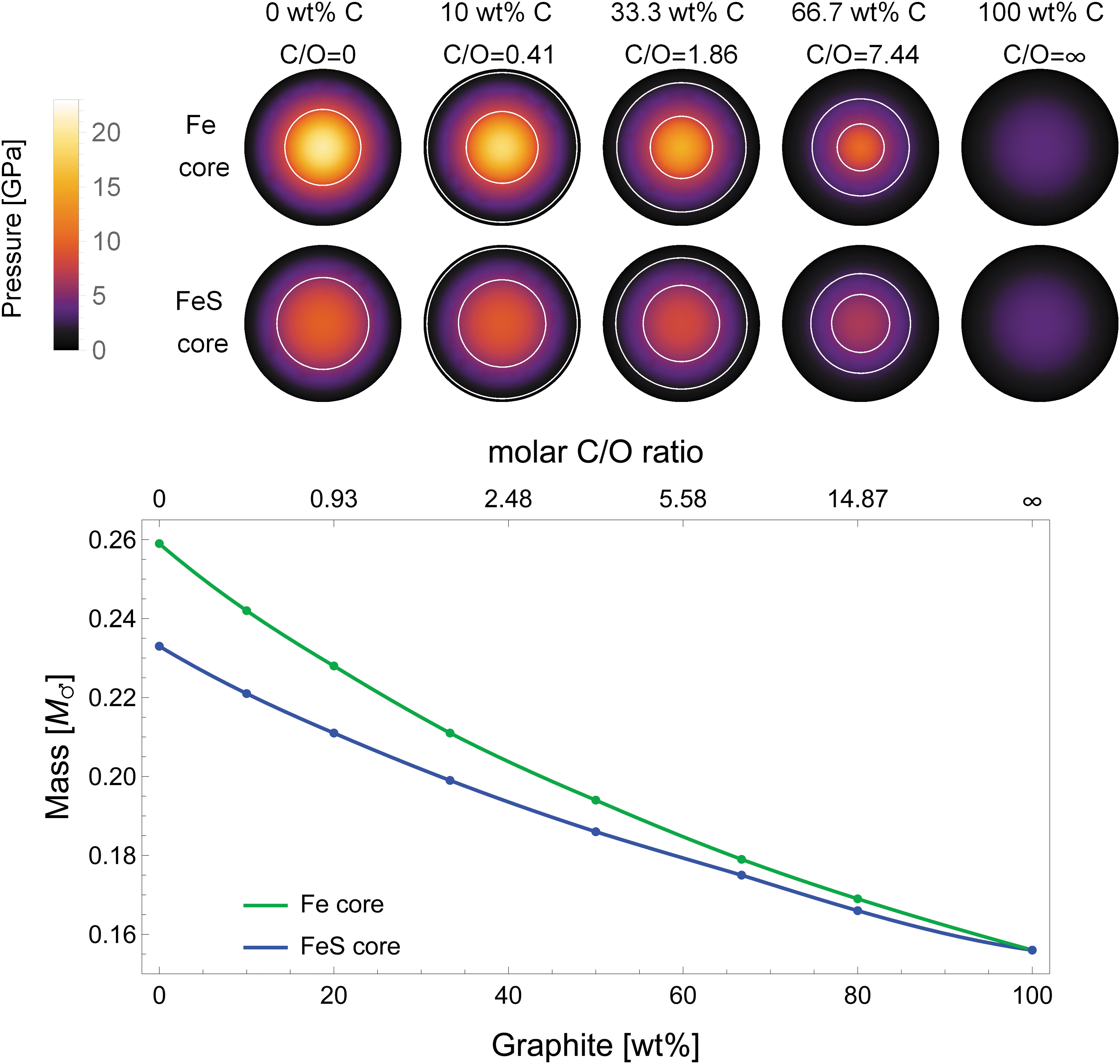
(Bottom) Solid lines represent the derived mass of Kepler-37b assuming a pure iron or an iron sulfide core, an enstatite mantle, and a graphite crust with a core/mantle mass ratio of 0.33 and different mass fractions of graphite for a fixed planet's radius of 0.34 RC (Stassun et al., 2017). (Top) The internal pressure distribution of Kepler-37b is also shown for five cases where white contours represent the core/mantle and mantle/crust boundaries.
With current and future missions such as TESS (Ricker et al., 2014), CHEOPS (Fortier et al., 2014), and PLATO (Ragazzoni et al., 2016), the masses and radii of rocky exoplanets will be measured with higher accuracy. Along with improved knowledge of stellar chemistry, tighter constraints on planetary bulk compositions will also be feasible (Dorn et al., 2015; Santos et al., 2017). This in turn will enable better constraints on the presence of low-density minerals such as graphite in the interior of rocky exoplanets.
We also show the internal pressure distribution of Kepler-37b in Fig. 5 for the cases of 0, 10, 33.3, 66.7, and 100 wt% graphite. The central pressure of Kepler-37b decreases with the amount of graphite. For our models of Kepler-37b, pressures at the bottom of graphite layers are <4 GPa, making phase transformation to diamond impossible at temperatures above 1000 K (Ghiringhelli et al., 2005). C-enriched rocky exoplanets larger than Kepler-37b with thick graphite layers are likely to form diamonds beneath these graphite layers. If the amount of diamond is significantly larger than that of graphite, the effect on the derived mass of the planet would be smaller since the density of diamond is higher than graphite and comparable with silicates.
5.2. Observations and habitability
The abundance of graphite on the planetary surface will have major consequences for planetary thermal evolution, volatile cycles and atmospheric composition, surface geochemistry and habitability. Identification of such a planet by future observations would be of great significance. Graphite has a very low reflectance compared to the usual silicate-rich minerals forming the surface of terrestrial planets such as Mars. If the Earth or an exoplanet is covered with a graphite layer, the planet's surface would likely appear to be dark with an albedo much lower than expected for a C-poor planet. Similarly, a darkening agent discovered on Mercury's surface has been speculated to be graphite (Peplowski et al., 2016).
Small C-enriched exoplanets are unlikely to retain a primary atmosphere. Secondary atmospheres of graphite-layered planets might be nonexistent if the graphite layers are able to completely isolate the silicate mantles. For planets with relatively thin graphite layers, outgassing processes from the silicate mantle may allow for an atmosphere to exist. Atmospheres of C-enriched rocky exoplanets are believed to be devoid of oxygen-rich gases (e.g., Kuchner and Seager, 2005). Carbon is dissolved in silicate melts mainly as CO2 at
If the graphite layer is several hundreds of kilometers thick, it might not allow direct recycling of the mantle material to the surface. Such a graphite surface without essential life-bearing elements other than carbon will make the planet potentially uninhabitable. However, deep silicate volcanism, along with the presence of water, could still alter the surface composition of a C-enriched rocky exoplanet during the course of its evolution if penetration of material through the graphite is possible. To further assess these scenarios, detailed studies of the thermal and mechanical behavior of graphite/diamond crusts are required.
6. Summary and Conclusions
We performed the first high-pressure high-temperature experiments on chemical mixtures representing bulk compositions of small C-enriched rocky exoplanets at 1 AU from their host star based on the calculations of a study modeling the chemistry in the protoplanetary disk of a high C/O star. Our results show that fully differentiated C-enriched rocky exoplanets consist of three major types of phases that form an iron-rich core, a silicate mantle, and a graphite (and diamond) layer on top of the silicate mantle. Their mineralogy depends on oxygen fugacity and Mg/Si, Al/Si, Ca/Si, S/Fe, and C/O ratios.
For S/Fe ratios in iron alloys between 0.1 and 0.8 and at pressures below ∼4–6 GPa, the core stratifies into an S-poor Fe inner core surrounded by an S-rich Fe outer core. The variety in mantle silicate minerals is largely independent of the C/O ratio. The sequential condensation model from the work of Moriarty et al. (2014) at 1 AU from the host star results in C-enriched rocky exoplanets with higher oxygen fugacity conditions compared with the equilibrium condensation model. High C/O ratios in planet-forming refractory material do not necessarily imply reducing conditions as the amount of C has no direct impact on the oxygen fugacity. Extremely reducing (<IW–6) or oxidizing conditions (>IW + 1) would be needed to stabilize silicon carbide or carbonates such as calcite and magnesite, respectively, in C-enriched planetary interiors. The minimum amount of carbon needed for carbon saturation in the type of C-enriched rocky exoplanets considered in this study is 0.05–0.7 wt% (molar C/O ∼0.002–0.03), which lies between the upper bounds of 200 ppm and 9 wt% for mantle-only and core-only planets, respectively.
Any amount of carbon exceeding the carbon-saturation limit would be in the form of graphite. If the graphite layer is deep enough to exceed pressures of 2–15 GPa, depending on the temperature profile, a diamond layer would exist beneath the graphite layer. Carbon in the form of graphite can significantly affect the mass of an exoplanet for a fixed radius. For example, only a 10 wt% graphite crust is sufficient to decrease the derived mass of Kepler-37b by 7%, a difference detectable by future space missions focusing on determinations of both mass and radius of rocky exoplanets with insignificant gaseous envelopes. Rocky exoplanets with graphite-rich surfaces would appear dark in future observations because of low albedos due to graphite. Atmospheres of such planets are likely thin or nonexistent, and the detection of CO/CO2 or CH4 on its own cannot confirm the presence or absence of a graphite-rich surface. Surfaces of such planets are less likely to be hospitable for life because of the lack of life-bearing elements other than carbon.
Footnotes
Acknowledgments
We thank three anonymous reviewers for their constructive comments in improving this article. This work is part of the Planetary and Exoplanetary Science Network (PEPSci), funded by the Netherlands Organization for Scientific Research (NWO, Project no. 648.001.005). We are grateful to Sergei Matveev and Tilly Bouten from Utrecht University for their technical assistance during EPMA measurements at Utrecht University. We thank Rajdeep Dasgupta for facilitating analyses of light elements in metals in the EPMA Laboratory at Rice University. We are also thankful to Jack Moriarty for providing data from the Moriarty et al. ( ) study.
Author Disclosure Statement
No competing financial interests exist.
Abbreviations Used
Appendix 1. Experimental Sample Assembly
Sample powder was inserted in a 1.6-mm-wide graphite capsule with a graphite lid (Appendix Fig. A1). This graphite capsule was put into a 2-mm-wide Pt capsule that was sealed and arc-welded on both ends with a Lampert PUK 3 welder. The Pt capsule was placed in an MgO rod sealed with MgO cement. The MgO rod was introduced in a graphite furnace, thermally insulated by surrounding it with an inner Pyrex sleeve and an outer talc sleeve. A four-bore Al2O3 rod, through which thermocouple wires were threaded, was placed on top of the MgO rod. Pressure calibration of the assembly was performed by bracketing the albite to jadeite plus quartz and fayalite to ferrosilite plus quartz transitions (van Kan Parker et al., 2011). The resulting pressure correction of 3% is consistent with literature data (McDade et al., 2002). On top of the talc/Pyrex assembly, a hardened silver steel plug with a pyrophyllite ring and a hole for thermocouple was placed. A W97Re3/W75Re25 (type D) thermocouple was placed in the thermocouple hole directly above the Pt capsule. The distance of 1–3.5 mm between the thermocouple tip and the sample produced a temperature difference of 10 K (Watson et al., 2002).
Appendix 2. Oxygen Fugacity Calculations
We computed oxygen fugacity (
where
where
Appendix 3. Mineral/Melt Equilibrium
To assess mineral/melt equilibrium, we calculated olivine/melt and orthopyroxene/melt Fe-Mg exchange coefficients,
where