




Abstract
Lower heating of our planet by the young Sun was compensated by higher warming from factors such as greater greenhouse gas concentrations or reduced albedo. Earth's climate history has therefore been one of increasing solar forcing through time roughly cancelled by decreasing forcing due to geological and biological processes. The current generation of coupled carbon-cycle/climate models suggests that decreasing geological forcing—due to falling rates of outgassing, continent growth, and plate spreading—can account for much of Earth's climate history. If Earth-like planets orbiting in the habitable zone of red dwarfs experience a similar history of decreasing geological forcing, their climates will cool at a faster rate than is compensated for by the relatively slow evolution of their smaller stars. As a result, they will become globally glaciated within a few billion years. The results of this paper therefore suggest that coupled carbon-cycle/climate models account, parsimoniously, for both the faint young Sun paradox and the puzzle of why Earth orbits a relatively rare and short-lived star-type.
1. Introduction
This paper proposes that gradual climate cooling, driven by geology and/or biology, is an inherent process on Earth-like planets and that this proceeds at a rate with the same order of magnitude on all such worlds. For definiteness an Earth-like planet is defined, in this paper, as a rocky world that is partially covered by a surface ocean.
The idea that biological and geological processes have changed Earth's atmosphere and reflectivity—hence keeping the climate cool despite slowly increasing solar insolation—is not novel (e.g., Lovelock and Margulis, 1974; Walker et al., 1981; Berner et al., 1983; Berner and Berner, 1997; Schwartzman, 2002; Lenton and Watson, 2011), but the consequences of assuming that a similar rate of geobiological cooling is common to all Earth-like worlds have not been previously explored. The justification for this proposal is that it links two independent mysteries concerning astrobiology and the habitability of Earth. These are as follows: The faint young Sun paradox (see review by Feulner, 2012). There has been a substantial increase in solar luminosity over the last 4.5 Gy, but there is no evidence for an early Earth that was significantly cooler than today. The red dwarf puzzle (see recent analysis by Waltham, 2017). Red dwarfs are more common and longer lived than Sun-sized stars, so it is surprising that we find ourselves orbiting a significantly rarer and shorter-lived type of star.
This paper links these because the rate of geobiological cooling required to resolve the faint young Sun paradox would, if repeated on other worlds, cause planets orbiting red dwarfs to cool faster than they are warmed by their slowly evolving stars. As a result, initially habitable planets would become too cold for life within a timescale much shorter than that of their traditional habitable lifetime (i.e., one based upon the time until planetary overheating).
This paper begins by quantifying the climate forcing required to avoid a frozen young Earth. This analysis does not in itself reveal anything new; but, in the following section, a similar analysis is applied to habitable-zone (HZ) planets orbiting smaller stars to show that—if there really is a roughly constant rate of cooling—it leads to glaciation. These results do not, in themselves, demonstrate that a constant cooling hypothesis is correct; they merely demonstrate that the hypothesis has dramatic consequences if it happens to be true. A discussion therefore follows on whether the constant cooling assumption is reasonable and on the further research needed to strengthen or refute the hypothesis.
2. The Faint Young Sun Paradox
Our Sun's luminosity, L ⊙, was only 68% of the current luminosity, L 0, when it entered the main sequence ∼4.57 Gy ago (see Fig. 1, and note that, for consistency with published stellar evolution models, all times in this paper run forward from the moment a star reaches the main sequence—ZAMS; zero-age main sequence—rather than backward from the present day). The gradually increasing solar luminosity should have made modern Earth much warmer than early Earth; hence, the global mean temperature should have been well below freezing in the distant past (Donn et al., 1965; Sagan and Mullen, 1972; Walker, 1982; Jenkins, 1993; Feulner, 2012; Kienert et al., 2012; Charnay et al., 2013). This is contradicted by geological data (e.g., evidence of liquid water), which suggests that temperatures were similar to or, perhaps, significantly higher in the distant past (Walker, 1982; Schwartzman, 2002; Valley et al., 2002; Knauth and Lowe, 2003; Sleep and Hessler, 2006; Hren et al., 2009; Blake et al., 2010). A range of explanations have been proposed for resolving this dilemma.
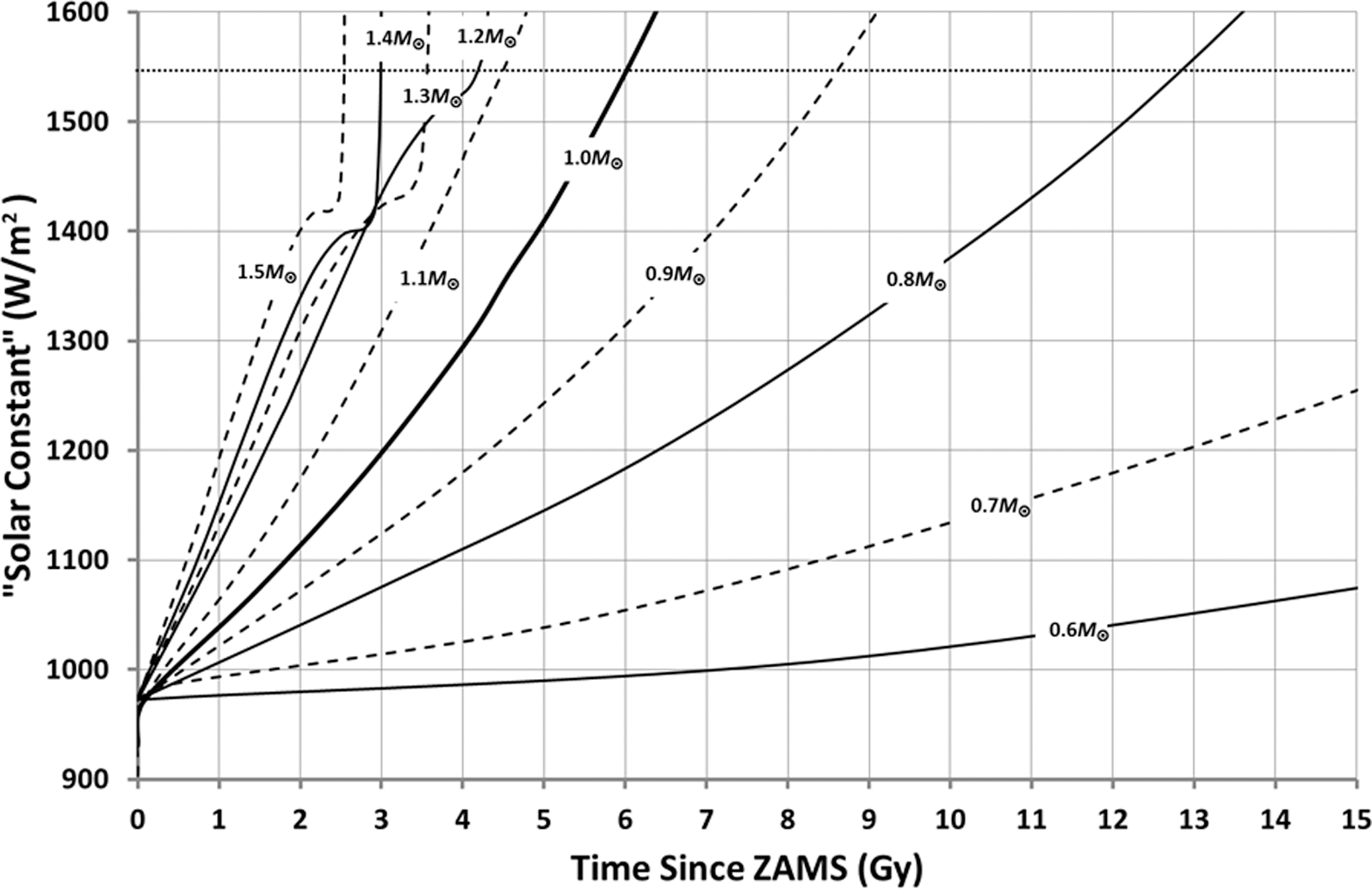
Insolation histories for HZ planets orbiting stars with a range of masses. Trajectories are based upon the stellar evolution models of Girardi et al. (2000) together with the assumption that the planets all have the same insolation at the start of their main sequence evolution with a value chosen to give the present-day solar constant at 4.5 Gy for a solar-mass star. Note that the gradients of these trajectories increase with stellar mass (see Fig. 2). The horizontal dotted line shows the insolation reached for the solar-mass case after 6 Gy, and this is taken as determining habitable lifetimes assuming habitability is truncated by stellar warming. The resultant habitable lifetimes are shown in Fig. 3 as the “Overheating” curve.
Firstly, on sufficiently long timescales there may be negative feedback mechanisms which act to stabilize temperatures. In particular, silicate weathering feedback (Walker et al., 1981) is widely accepted as important for Earth habitability and is expected to buffer the climate of other Earth-like worlds, too. The question of whether it is sufficiently strong to undermine the hypothesis of this paper will be central to much of what follows. Silicate weathering involves dissolution of silicate rocks, by CO2 dissolved in rainwater, to produce bicarbonate ions that are eventually incorporated into calcium carbonate on the seafloor. The overall effect is to lock up carbon from the atmosphere into Earth's crust from where it is slowly liberated by rainfall dissolution of uplifted carbonate or through volcanic emission of CO2 following carbonate subduction into the mantle. The dissolution of silicate rocks by acid rain (i.e., the first step in this cycle) is climate dependent (it is faster when the world is warmer and wetter), so carbon dioxide is preferentially removed from the atmosphere when climate is warm. In the distant past, when solar warming was smaller, the cooler climate would have reduced the rate of removal of CO2 from the air, and the resulting enhanced greenhouse warming helped prevent global freezing.
An additional possibility is that Earth's climate system has been significantly altered by biological factors. The evolution of lichens, and then vascular land plants, may have accelerated continental weathering, hence enhancing carbon dioxide drawdown by silicate weathering (Berner and Berner, 1997; Moulton et al., 2000; Schwartzman, 2002; Taylor et al., 2011; Lenton et al., 2012; Boyce and Lee, 2017). This would have led to a decline in CO2 levels as the biosphere developed. The existence of methanogens may also have played a major role in enhancing methane levels in the early atmosphere and, hence, the strength of the greenhouse effect (Kasting, 2005; Ozaki et al., 2018). Furthermore, the later evolution of oxygenic photosynthesis and the subsequent appearance of free oxygen in the atmosphere (Lyons et al., 2014) probably led to chemical scrubbing of this methane from the atmosphere and a fall in greenhouse warming (Pavlov et al., 2000). Indeed, rapid rise of oxygen in the atmosphere has been implicated in the major glaciations of the early Proterozoic and may also have played a role in Neoproterozoic glaciations (Och and Shields-Zhou, 2012). Another relevant biological process is burial of carbon, in the form of fossil-fuel deposits, leading to its extraction from the atmosphere and climate cooling (Berner, 2003; Feulner, 2017).
Given these plausible mechanisms, it is widely accepted that biosphere evolution played a significant role in climate evolution. Some researchers have gone further and proposed that biospheres necessarily stabilize their climates (i.e., the Gaia hypothesis [Lovelock and Margulis, 1974]); but, while progress has been made in finding a theoretical basis for the Gaia hypothesis (e.g., see Lenton et al., 2018), it remains highly contentious (e.g., see Tyrrell, 2013).
Finally, geological evolution, too, has contributed to the climate history of our planet. In particular, arc volcanism has slowly added continental lithosphere so that the amount of land surface available for silicate weathering has increased through time. However, the few studies undertaken on the effect of land area on climate indicated either that habitability is monotonically reduced as land area increases (Franck et al., 2003) or—in direct contradiction—that it monotonically rises as land area increases (Abe et al., 2011). Abbot et al. (2012), on the other hand, concluded that the effect is minimal unless there is no land at all. Thus there is no consensus on the effect that increasing land area had (but note that it must also have altered planetary albedo).
An additional, relevant geological process is that secular cooling of Earth's interior has resulted in less volcanic outgassing and, hence, less input of CO2 into the atmosphere (Kadoya and Tajika, 2015). Carbon dioxide is also removed from ocean water by carbonatization of basalt in hydrothermal systems close to spreading ridges (Sleep and Zahnle, 2001); this will have occurred at a rate that may have dropped if ocean spreading slowed over time.
When incorporated into a combined carbon cycle and climate simulation, these time-dependent geological processes predict climate evolution that, in some models at least, agrees with the available data on Earth's temperature (Kadoya and Tajika, 2015) as well as with data on CO2 concentration, seafloor weathering, and ocean pH (Krissansen-Totton et al., 2018).
Hence, many mechanisms may have combined to yield the relatively stable temperature history of Earth, although the details remain contentious and there is no consensus on whether the dominant cause was negative feedback or intrinsic changes due to biology or geology. Nevertheless, the changes required can be quantified by using the definition of climate sensitivity, λ, that
where ΔT earth is the change in mean temperature at Earth's surface produced by a change, ΔF, in heating at the top of the atmosphere (e.g., see Rohling et al., 2012). Unless stated otherwise, all differences in this paper are relative to the present-day Earth (e.g., ΔT earth will be taken from here on as the difference in temperature from the present-day global mean of ∼15°C). Note that, in some references, λ is defined as the inverse of the definition above (i.e., λ = ΔF/ΔT earth).
Changes in forcing can be produced by changes in solar output but also by changes in Earth's albedo or in the atmospheric concentration of greenhouse gasses. In the latter two cases, ΔF is the change in heating at the top of the atmosphere that would produce the same effect as the change in albedo or greenhouse gas concentration. An accessible discussion of the forcing concept is given in Stocker et al. (2013).
A reasonable objection to the use of Equation 1 is that it is a linear approximation that will not be appropriate when there are large changes in forcing. However, the whole point of the faint young Sun paradox is that there must be some additional forcing that, at least partially, cancels solar changes. Hence, the total change in forcing is (by hypothesis) small, and a linear approximation should remain reasonably accurate. For example, if temperature changes are of order 10 K and λ is of order 1 K W−1 m2 (see below), the change in total forcing is of order 10 W m−2, which is less than 3% of the solar forcing.
Another issue is that λ will have changed as Earth's atmosphere, biosphere, hydrosphere, and lithosphere have evolved. This can be handled by using a suitably averaged climate sensitivity of the form
where the forcing has changed from F 0 to F 1 over the period being modelled and integration is along a (possibly complicated) path in the λ-F plane. All climate sensitivities discussed subsequently should be understood as being averages in this sense. Note that, for the simple case of forcing changes in the form F(t) = F 0 + αt, Equation 2 just gives the time-averaged sensitivity.
Climate sensitivity estimates are subject to the measurement uncertainties of all empirical data and, in addition, vary depending upon (i) their precise definition, (ii) the timescale of the measurement, (iii) the methodology used (Rohling et al., 2012). Sensitivity is also likely to have changed through time (Caballero and Huber, 2013) and may have been significantly different in the distant past. These difficulties lead to a wide diversity of reported values for climate sensitivity, but most long-term estimates fall in the range 1.1 ± 0.8 K W−1 m2 (Covey et al., 1996; Borzenkova, 2003; Bijl et al., 2010; Park and Royer, 2011; van de Wal et al., 2011; Rohling et al., 2012; Royer et al., 2012). This range of sensitivities implies that total feedback is positive since a value of 0.3 K W−1 m2 corresponds to the, so-called, Planck sensitivity (the sensitivity expected if there are no feedbacks other than an increase in thermal radiation with temperature, see Bony et al. [2006] and Soden and Held [2006]).
However, a key consideration in the current paper is that it is widely accepted that the silicate weathering cycle has played a major role in maintaining Earth's climate stability over the extremely long timescales relevant to discussion of the faint young Sun paradox. It is therefore important to highlight the climate sensitivity associated with this process in particular. An estimate can be derived from the work of Abbot et al. (2012), whose Fig. 3 implies
where λ 0 is the climate sensitivity in the absence of silicate weathering. For Abbot and coauthors' (2012) typical parameter values, λ 0 ∼ 0.9 K W−1 m2; hence their climate sensitivity, when silicate weathering is included, can go as low as 0.27 K W−1 m2.
In summary, climate sensitivity estimates are generally of order 1 K W−1 m2, but models of silicate-weathering can push this below the Planck value of 0.3 K W−1 m2, thus allowing weak negative feedback. To be maximally conservative, this paper will investigate the effects of sensitivities as low as 0.2 K W−1 m2. Specifically, this paper will investigate climate sensitivities varying over one order of magnitude from 0.2 to 2.0 K W−1 m2.
The next step is to split the forcing term of Equation 1 into extrinsic (to Earth) and intrinsic components, that is,
where ΔF
⊙ is the change in extrinsic forcing due to solar evolution and ΔF
earth is the change in intrinsic forcing due to biological and/or geological evolution of Earth. Equations 1 and 4 combine to yield
with changes in solar forcing given by
where S 0 is the present-day solar constant of 1360.8 ± 0.5 W m−2 (Kopp and Lean, 2011) and apd is modern Bond albedo (0.31).
Equation 5 allows the strength of intrinsic warming, required to counter the faint young Sun, to be estimated, but the results do not lead to novel conclusions. However, an extension of this analysis, to include habitable planets orbiting low-mass stars, leads to the conclusion that such worlds will tend to cool substantially as they age and, as a consequence, are highly likely to enter a “snowball” state. It is therefore now time to look at the second astrobiological mystery that this paper considers: the surprisingly large size of our star.
3. The Red Dwarf Puzzle
Imagine spending a randomly chosen minute on a randomly chosen habitable planet. Such a “habitable moment” is far more likely to be associated with a small star than a large one because small stars are more common and, conventionally, HZ planets orbiting such stars have many more habitable moments (i.e., they have longer habitable lifetimes [Kasting et al., 1993]). Our own existence as individuals can be thought of as occupying a “habitable moment,” so we should similarly expect to look up at a small red star rather than a large yellow one.
In more detail, the number of stars of a given mass is expressed by the initial mass function (IMF). The precise form of the IMF, and whether it remains constant with time, is controversial (Kroupa, 2001), but the debates concern details that do not greatly affect the key result that our Sun is a relatively large star. For example, the Miller and Scalo (1979) IMF implies that 87% of all stars are smaller than the Sun, while the Chabrier (2005) IMF gives 86%. Furthermore, small stars consume their nuclear fuel more slowly than large stars, implying that planets orbiting small stars will remain habitable for significantly longer than larger ones. For example, Kasting et al. (1993) estimated that Earth will remain habitable about 3 times longer than an HZ planet orbiting a 1.5 solar mass star. Recent statistical modelling (Waltham, 2017) indicates that the combination of more stars and more time leads to very large increases in the probability of observers. This results from a model—due to Carter and McCrea (1983)—that the probability of observers increases with tn where t is time available and n is around 3; hence a red dwarf with a main sequence lifetime 100 times greater than the Sun is one million times more likely to produce observers. The implication, of the observation that despite this we orbit a relatively large star, is that there must be something wrong with red dwarfs—some reason why planets orbiting small stars are poor habitats (or, at least, not significantly longer-lived habitats than planets orbiting solar-mass stars).
There is no shortage of proposals. Red dwarfs may be unfavorable because of their flare activity (Scalo et al., 2007), their early high luminosity (Luger and Barnes, 2015), or because tidal drag slows the spin rates of HZ planets orbiting small stars (Lammer et al., 2009); but several papers have argued that none of these problems are insurmountable (Heath et al., 1999; Tarter et al., 2007; Yang et al., 2013).
It has also been suggested that planets orbiting small stars will receive less photosynthetically active radiation (PAR) (Pollard, 1979), and it is certainly plausible that the absence of photosynthesis would make the appearance of observers less likely. Heath et al. (1999) calculated that PAR could be reduced by an order of magnitude on planets orbiting small stars but, nevertheless, concluded that there would still be sufficient light to support photosynthesis. They justified this by the observations that land plants on Earth are frequently saturated (i.e., get more light than they can use) and that the photic zone in our oceans extends down to depths where solar radiation is only about 1% that at the surface. Similar conclusions have been drawn by other authors (e.g., McKay, 2014; Gale and Wandel, 2017). However, recent work has suggested that a reduced incidence of PAR is likely to result in oxygen sinks outweighing oxygen production; hence, such planets will not have oxygen-rich atmospheres (Lehmer et al., 2018).
It therefore remains unclear what the problem is, if any, with small stars, so there is a need to investigate other possible habitability issues. The hypothesis of this paper—that all Earth-like planets exhibit a similar intrinsic climate-cooling history—provides a new explanation: the warming of slowly evolving, smaller stars is too slow to counter planetary cooling, so initially habitable planets become too cold for life on a timescale that is much shorter than their traditional habitable lifetime.
The consequences of assuming this idea can be quantitatively investigated by using Equation 6, together with the assumption that all Earth-like planets have similar intrinsic cooling histories (i.e., that intrinsic planetary cooling ΔF
p(t) = ΔF
earth(t)), leads to
where ΔT
p is the temperature history of an Earth-like world with insolation history ΔF
*
. A simple rearrangement now produces
where ΔT is the temperature difference between the planet and Earth at the same age. This expression models the difference in climate history between Earth and another Earth-like planet in terms of their different insolation histories (modelled by ΔF * - ΔF ⊙), assuming that they experience identical intrinsic changes in greenhouse gas concentrations and albedo (modelled by setting ΔF p(t) = ΔF earth(t)) but with additional changes in greenhouse gasses and albedo due to feedback responses (modelled by λ).
Equation 8 implicitly assumes that Earth-like planets are sufficiently similar to Earth that they have approximately the same average climate sensitivity (i.e., after averaging via Eq. 2). The error, ɛ, introduced by this assumption is
the magnitude of which will be less than ΔT earth (which is of order 10 K) unless λ p > 2λ earth. The effect of a 10 K error, on the analysis, will be discussed with the results later.
Now, let the planet orbit at the distance from its star such that it starts with the same insolation as the early Earth. This is ensured if
where β = L ⊙/L * at zero time. Note that the (1 - apd ) term appears because Equation 10 expresses the difference in stellar forcing between the planet (at any time) and Earth (at the present day). Its appearance in the equation is therefore just a normalization factor and does not imply that apd applies to other planets or to other times.
The resulting evolution of the “Solar Constant,” for HZ planets orbiting stars of different mass, is shown in Fig. 1 using data taken from Girardi et al. (2000). Unfortunately, the stellar mass range provided by Girardi et al. (2000) only extends down to 0.6 solar masses, but this is sufficient to demonstrate the effects discussed here.
Figure 1 clearly shows that the insolation evolution for an HZ planet is strongly affected by stellar mass. In particular the rate of insolation increase with time goes up with mass (see Fig. 2). Furthermore, the time at which insolation becomes so strong that a planet becomes uninhabitably warm (approximated here by taking Earth's insolation at 6 Gy) decreases sharply with increasing mass (see Fig. 3). From this paper's point of view, the key result is that small stars are usually considered to have much longer habitable lifetimes than stars of solar mass because they take longer to cause overheating. However, as shown below, it is also possible for planets to become uninhabitable due to overcooling, and this dramatically reduces the habitable lifetimes of planets orbiting smaller stars.

The dependence of initial stellar heating increase rate on stellar mass (i.e., a plot of the initial gradients from Fig. 1). Small-mass stars warm much more slowly than high-mass stars.
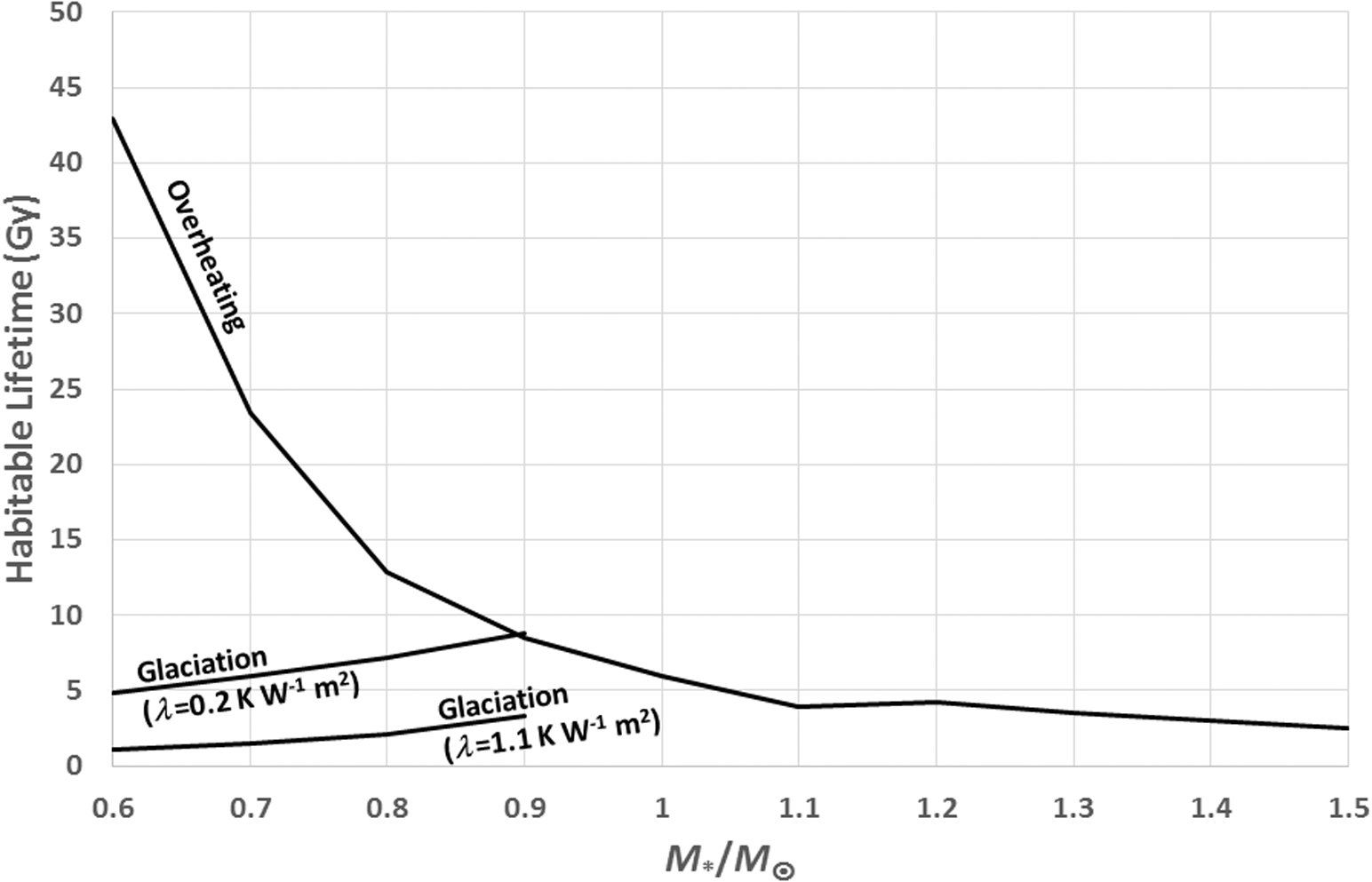
Habitable lifetimes as a function of stellar mass. The overheating curve is derived as discussed in the caption to Fig. 1. The glaciation curves are derived from plots such as Fig. 4 by finding the times where the trajectories cross a temperature difference of −20 K. Note that, for stars smaller than the Sun, habitability is truncated by glaciation rather than overheating and that, as a consequence, the habitable lifetimes of small stars are much less than usually assumed.
To calculate the rate of such cooling, Equations 6, 8, and 10 can be combined to give
Figure 4 shows this evaluated for planets orbiting a star of mass 0.6M ⊙ and for climate sensitivities in the range 0.2 < λ < 2.0 K W−1 m2. For all cases the planet cools compared to Earth, as the planet ages, with the size of this effect depending upon the assumed climate sensitivity.
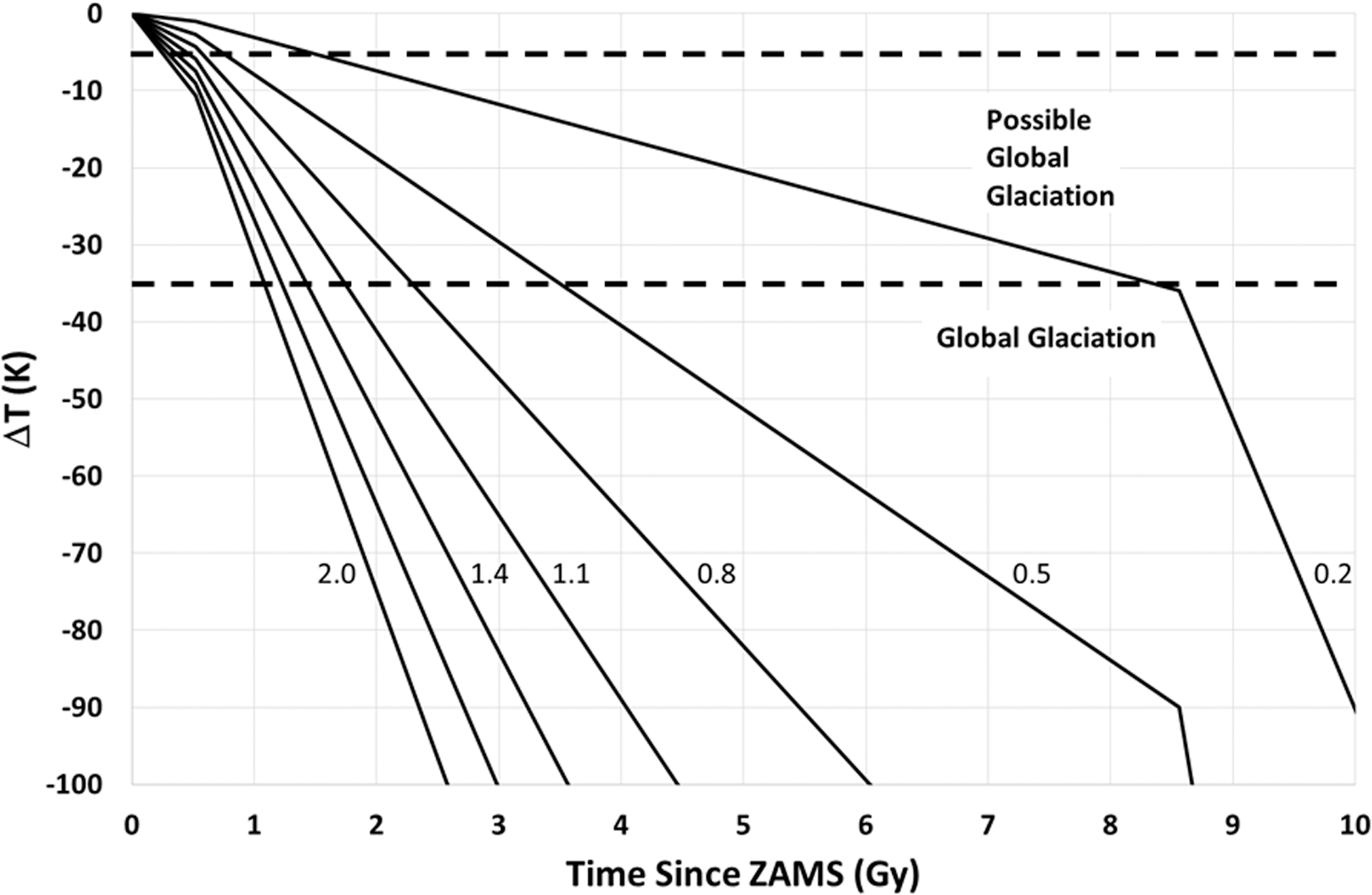
Predicted temperature history of an HZ planet orbiting a 0.6 solar-mass star. The different curves correspond to different assumed climate sensitivities with values in K W−1 m2. The vertical axis corresponds to the temperature difference of the modelled planet from the Earth at the same age. The horizontal dashed lines indicate the temperature differences where global glaciation is likely to commence (i.e., it is possible by ΔT = −5 K and highly likely by ΔT = −35 K).
To assess the effect of this cooling on habitability, we require an estimate of the temperature difference required to produce global glaciation. North et al. (1981) predict Snowball-Earth states when mean temperatures fall below −5°C, and other authors obtain similar results (−3°C to −5°C in Kienert et al. [2012]; −5°C to −7°C in Feulner and Kienert [2014]; −9°C in Feulner [2017]). In contrast, Charney and coauthors' (2013) GCM model can maintain an equatorial water-belt down to a global mean temperature of −25°C, but this is probably an artifact resulting from the absence of sea-ice dynamics (Voigt and Abbot, 2012). The current paper therefore assumes that glaciation will occur if global mean temperature falls below −5°C ± 5°C.
Further assuming that, for most of its history, Earth has maintained a temperature of roughly 15°C ± 10°C then implies that glaciations will be triggered when the temperature difference between Earth and the modelled planet drops below −20 ± 15 K. This range is indicated on Fig. 4 (as “Possible Global Glaciation”); and it shows that, for all sensitivities modelled, global glaciation is possible before the planet reaches Earth's present age (4.567 Gy) even if the error (given by Eq. 9) is as much as 10 K. Even in the most optimistic case (λ = 0.2 K W−1 m2 and no glaciation until ΔT = −35°C), habitability ceases after 8.5 Gy, that is, significantly less than the 43 Gy lifetime before overheating shown on Fig. 3.
Two specific cases will now be used for the purpose of comparing glaciation timescales for stars of different masses. Taking the Earth-to-planet temperature difference required for glaciation as −20°C, glaciation occurs, with the 0.6M ⊙ star, just before 5 Gy for λ = 0.2 K W−1 m2 and well before 1.5 Gy if λ = 1.1 K W−1 m2. Repeating this analysis for the range 0.6M ⊙ ≤ M ≤ 0.9M ⊙ produces the “Glaciation” lines in Fig. 3. The key result is that habitable lifetimes for stars smaller than the Sun are substantially reduced, as a result of glaciation, compared to their traditional habitable lifetimes based upon overheating. Note that this remains true even when a very low climate sensitivity is assumed in order to simulate the effects of negative feedback from silicate weathering (i.e., for λ = 0.2 K W−1 m2). Thus, HZ planets orbiting stars smaller than the Sun do not have substantially longer habitable lifetimes than Earth, so, if the hypothesis of approximately constant intrinsic cooling is correct, it resolves the puzzle of why we do not orbit a red dwarf.
4. Complications
The foregoing analysis assumed that the modelled planets were at the right distance from their star to ensure that their initial insolation was identical to that of the early Earth. Furthermore, there was an implicit assumption that, at any given stage of planetary evolution, equal insolation implies equal temperature; this is not quite correct, since the redward shift of starlight for smaller stars results in great IR absorption, and, hence, temperatures are higher for the same insolation (this produces the outward shift of the HZ boundaries with decreasing stellar mass shown in the work of Kopparapu et al. [2014]). The importance of these effects can be evaluated by increasing the initial insolation of the modelled planets to simulate the consequences of either being closer to the star or of increased absorption of IR radiation.
Figure 5 is identical to Fig. 4 except that the initial insolation has been increased by 100% (i.e., the planet has been moved a factor 1/√2 closer to the star), and, to be maximally conservative, it only shows the low climate sensitivity case (i.e., 0.2 K W−1 m2). The planet then starts with a temperature 33 K above Earth's initial temperature and steadily cools until it becomes glaciated after 9–10 Gy on the main sequence. Comparison with Fig. 4 shows that this has only extended the planet's habitable lifetime by 1 Gy. Hence, a warm-start/greater-IR-absorption does not significantly affect the conclusion that intrinsic cooling will render planets of small stars uninhabitable much faster than their traditional habitable lifetime.

Predicted temperature history of an HZ planet orbiting a 0.6 solar-mass star, assuming that the planet orbited at the right distance to give twice the initial insolation experienced by the early Earth. For simplicity, this is only shown for the lowest climate sensitivity of 0.2 K W−1 m2. Note that, even for this extreme case, the lifetime before glaciation is not much greater than that shown in Fig. 4.
5. Discussion
It must be emphasized that the modelling shown in Figs. 2, 3, 4, and 5 is not evidence supporting the hypothesis of this paper; that would be circular reasoning, because the figures were produced assuming the hypothesis to be correct. What the modelling does show is that, if the hypothesis is correct, planets orbiting small stars do not have significantly longer habitable lifetimes than those orbiting solar-mass stars. It also shows that, even if the hypothesis is incorrect, intrinsic climate cooling must closely match extrinsic stellar warming if a planet is to have a long habitable lifetime.
However, if this mechanism is to be a plausible explanation for the red dwarf puzzle, intrinsic climate cooling rates do need to be roughly constant across Earth-like planets. The next step, therefore, is to produce evidence supporting that possibility. Coupled carbon-cycle and climate models are one way this might be achieved, and some progress has already been made. The models of Krissansen-Totton and Catling (2017) and Krissansen-Totton et al. (2018) produce temperature, atmospheric-CO2 and ocean-pH histories that are consistent with observational constraints. Critically, their studies show that the decreasing intrinsic warming through time results from roughly equal contributions due to continental growth, decreasing heat flow, and biological evolution; that is, two-thirds of the effect is due to purely geological processes that might be approximately reproduced on another Earth-like planet.
It is, however, possible that plate tectonics operates very differently on other planets with different compositions and masses and that, therefore, cooling histories and outgassing histories may also be very different. At present it is difficult to investigate this in detail since there is little agreement even about the factors needed to allow plate tectonics to occur at all. In many studies (Valencia et al., 2007; Valencia and O'Connell, 2009; van Heck and Tackley, 2011; Foley et al., 2012), plate tectonics is predicted to be more likely for larger planets, but other models predict the opposite (O'Neill and Lenardic, 2007; Noack and Breuer, 2014; Stamenković and Breuer, 2014). It has also been claimed that size is relatively unimportant compared to other issues such as the presence or absence of water (Korenaga, 2010). These disparate conclusions occur because of different assumptions concerning mantle rheology, lithosphere weakening, internal temperatures, and plate initiation. Stamenković and Breuer (2014) concluded that the key factor was whether these different assumptions led to plate yielding that was more likely, or less likely, for planets with warmer interiors. In contrast, Weller and Lenardic (2016) argued that the key difference concerned whether the mantle was primarily warmed from below or by internal radioactivity. Hence, the current situation is that we do not have a good understanding of which factors are important for plate tectonics and, therefore, of whether plate tectonics can operate at very different rates to those seen on Earth.
However, the geological parameters of interest (i.e., the rate of fall in the outgassing, plate-spreading, and continent-growth rates) are ultimately controlled by secular cooling of Earth's interior; and, while the precise details of this secular cooling remain contentious, a major factor must be the surface-area-to-volume ratio (heat losses depend on surface area, and heat sources depend upon volume). Thus it is possible that rates of geological evolution will, to a first approximation, be inversely proportional to planetary radius. Rocky planets only exist up to about 10 Earth masses, which corresponds to roughly a factor of 2 change in radius. Hence, a large super-Earth might see intrinsic climate forcing falling at half the rate of Earth. The implication, that geological rates might only vary by a factor of a few between planets, is partially supported by the model of Kadoya and Tajika (2015), which shows that changes in planetary mass from 1/5 of Earth to 5 times Earth (i.e., a change by a factor of 25) produce less than a factor of 2 change in the effective rate of CO2 outgassing. On the other hand, it is also possible that the increased uplift/erosion rates associated with increased plate tectonic speeds have the effect of cancelling the effects of increased outgassing/ingassing (Sleep, personal communication), in which case intrinsic cooling will not change much with planet radius.
However, taking the conservative position that intrinsic cooling does depend upon planet size, the effect of the resulting small changes in intrinsic climate cooling rate can be gauged from Fig. 2. Figure 2 shows how the rate of initial stellar forcing changes with stellar mass, and it demonstrates that a factor of 2 change in the rate of intrinsic cooling would change the optimum stellar mass by about 0.2M ⊙. For example, assume a planet orbiting a solar-mass star maintains a balance between stellar warming and intrinsic cooling. This optimum therefore occurs when the solar constant is changing at a rate of 72 W m−2 Gy−1. However, this rate drops by half (to 34 W m−2 Gy−1) for a 0.8M ⊙ star and doubles, for a 1.2M ⊙ star, to 141 W m−2 Gy−1. Hence, plausible changes in planetary evolution rate may alter the optimum stellar mass slightly but will not do so sufficiently to change the conclusion of this paper (that planets orbiting small stars have reduced habitability lifetimes as a consequence of glaciation).
Rates of biological evolution should also be considered. It is possible that biospheres on different planets evolve at similar rates so that all three contributions to intrinsic forcing would be the same on another inhabited Earth-like world. However, that proposal lacks supporting evidence. An interesting alternative interpretation is that biological development occurs at a range of rates so that planets with slower bio-evolution would be favored when orbiting smaller stars (i.e., the balance between extrinsic warming and intrinsic cooling would occur for smaller stars if the biological component of cooling progresses more slowly). The effect would be small, however, since the rate of increase in stellar warming drops off quickly with star mass. This can also be seen from Fig. 2 since, even for a very low rate of biological evolution, the optimum stellar mass only falls slightly (i.e., it is 2/3 of the solar rate, implying no biological evolution at all, for a stellar mass of 0.9M ⊙).
Further progress, on confirming/refuting the hypothesis of this paper, requires development of more sophisticated coupled modelling of geodynamics, carbon cycles, and climate. Hypothesis verification would also be significantly aided by better estimates of Earth's ancient, global, mean temperatures.
6. Conclusion
If the processes which have maintained Earth's temperate climate are common to all Earth-like worlds, then HZ planets orbiting small stars will tend to suffer global glaciation within a timeframe much shorter than their traditional habitable lifetimes. Hence, resolving the faint young Sun paradox may, parsimoniously, also resolve the mystery of why Earth orbits a relatively rare and short-lived type of star. Confirming this hypothesis requires development of sophisticated models of Earth's evolution which couple secular cooling of the interior, plate tectonics, the carbon cycle, and climate.