




Abstract
This article presents a thermodynamic predictive scheme for amino acid polymerization in the presence of minerals as a function of various environmental parameters (pH, ionic strength, amino acid concentration, and the solid/water ratio) using
1. Introduction
Since the first detection of an extrasolar planet orbiting a Sun-like star (Mayor and Queloz, 1995), thousands of exoplanetary systems have been discovered (Winn and Fabrycky, 2015), among which two systems were identified to host Earth-size rocky planets that potentially maintain liquid water on their surfaces (Anglada-Escude et al., 2016; Gillon et al., 2017). The number of recognized habitable planets will increase greatly by ongoing and upcoming ground- and space-based observations (Fujii et al., 2018) because Earth-size planets with surface liquid water are likely prevalent in the Universe (Cassan et al., 2012; Petigura et al., 2013). Are these planets capable of sustaining life? If so, what life architectures are expected? To predict planetary habitability and the presence of extraterrestrial life, the availability and reactivity of potential building blocks for life must be understood under a full range of environmental conditions that potentially exist on a planetary surface.
Amino acids are components of proteins, which are fundamental to Earth's life. Because of their simpler structures than other biomolecules (e.g., nucleotides, phospholipids), amino acids have been synthesized through widely various abiotic processes (Kitadai and Maruyama, 2018) and have been observed in carbonaceous chondrites and comets as representative of soluble organic matter (Pizzarello et al., 2006; Glavin et al., 2011; Burton et al., 2012). Even short peptides and monomers, in some cases, serve as catalysts for organic and inorganic reactions (Pizzarello and Weber, 2004; Milner-White and Russell, 2005; Zhang et al., 2013). Thus, amino acids are possibly common organic species in the Universe, serving as catalysts and/or building blocks for the emergence of life.
Mineral surfaces have long been suggested to have played crucial roles in the prebiotic peptide formation on Hadean Earth (Lambert, 2008; Cleaves et al., 2012). Nevertheless, mineral–amino acid interactions have not yet been parameterized sufficiently in a manner applicable to geo- and astro-chemical modeling (e.g., thermodynamics and kinetics) because studies have typically focused either on a description of the yield and length of peptides produced under specific reaction conditions (Kitadai et al., 2017b) or on the spectroscopic and computational characterizations of interfacial processes (Rimola et al., 2013).
We recently introduced a methodology, using
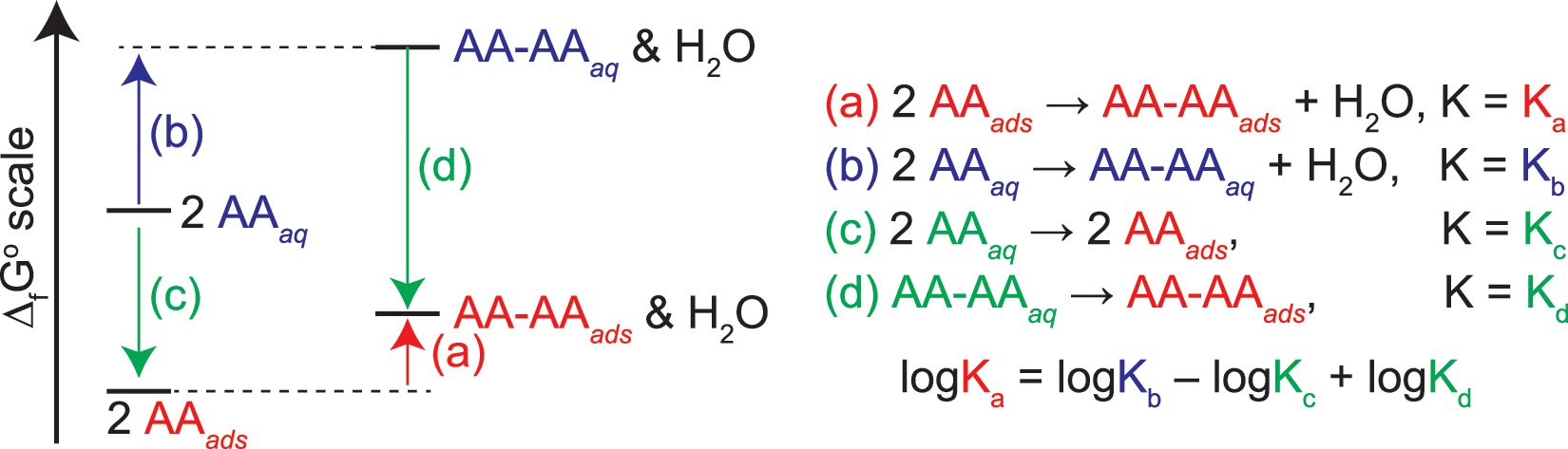
Thermodynamic predictive scheme for amino acid dimerization in the presence of a mineral (a). The thermodynamically attainable dimer concentration in reaction (a) can be estimated from the corresponding dimerization equilibrium in water (b) that is calculable using the thermodynamic data set reported in the literature (Kitadai, 2014, 2015, 2016), by combination with the experimentally determined adsorption equilibrium constants of monomer (c) and dimer (d) on the mineral. AA and AA-AA signify an amino acid and its dimer, respectively. “ads” and “aq” denote the states of adsorption and dissolution, respectively. Color images are available online.
Here, we apply this methodology (Kitadai et al., 2018b) to the
Our study starts with the parameterization of Asp and Asp dipeptide (
Based on the thermodynamic prediction, we tackled two long-standing issues regarding the role of minerals in prebiotic peptide bond formation: (a) were α-amino acid concentrations in early aquatic environments so dilute that adsorption alone was insufficient for their accumulation and subsequent spontaneous polymerization (Lahav and Chang, 1976)? and (b) because the adsorption-induced shift of monomer–polymer equilibrium toward the polymer side requires the increase in surface affinity of polymer with increment of the peptide length, does the adsorption eventually become irreversible for sufficiently long oligomers (de Duve and Miller, 1991)? It will be shown below that the Asp–goethite system can circumvent the problems owing to its strong dependence on pH and ionic strength; at a slightly acidic fresh water condition (pH 4–5, 0.1 mM NaCl), a dipeptide-to-monomer ratio as high as 20% was calculated on goethite (10 m2 L−1) even from 0.1 mM Asp, while almost all surface-bound AspAsp desorbed at slightly alkaline pH (≥8.5). Thus, our approach shed a new light on the versatility of mineral surfaces for the concentration, polymerization, and detachment of amino acids and peptides originating from the high sensitivity of mineral–water–adsorbate interaction to environmental fluctuation that must have been crucial for the chemical evolution of life.
The present study aims to present a thermodynamic predictive scheme for amino acid polymerization on minerals, rather than to propose a new hypothesis. This quantitative characterization would greatly facilitate the evaluation of previously suggested hypotheses, and the development of an advanced one, for a better understanding of the life's origin on Earth and other rocky planets.
2. Materials and Methods
2.1. Materials
Asp (≥99.9% purity) was purchased from Peptide Institute, and AspAsp and AspGly were obtained from BACHEM (Catalog No. G-1565 and G-1580, respectively). 18.2 MΩ Milli-Q water was used as the solvent. Goethite was prepared in accordance with the procedure reported by Hiemstra and co-workers (Hiemstra et al., 1989; Venema et al., 1996). Briefly, 2 mol L−1 of NaOH reagent solution (Wako) was added into 0.5 mol L−1 of FeCl3 aqueous solution (1 L) under vigorous stirring with a rate of 1 mL min−1 until the pH increased to 12. The solid precipitate was incubated at 60°C for 3 days and was subsequently washed through repeated rounds of centrifugation and replacement of the supernatant solution with Milli-Q water. After the Na+ and Cl− concentrations in the supernatant decreased to less than 0.1 mmol L−1 (monitored by an ion chromatograph), the solid was dried under a vacuum and stored in a desiccator. The obtained particles were identified as goethite by X-ray powder diffraction measurement (Supplementary Fig. S1). The specific surface area, which was determined by the multipoint N2-BET method (BELSORB mini II; MicrotracBEL) after drying at 150°C for 1 h under vacuum, was 85.9 m2 g−1.
2.2. Acid–base titration
Potentiometric titration was conducted in a closed perfluoroalkoxy alkane vessel at room temperature (21–23°C) using a portable pH meter (Seven2Go Pro; Mettler Toledo) equipped with an electrode (InLab Expert go; Mettler Toledo). The temperature was monitored by a thermometer attached to the electrode. The sample suspension was prepared by mixing 0.5 g of goethite powder with 100 mL of 10, 50, or 100 mM NaCl solution and was stirred at least 1 h before each experiment under a flow of N2 gas (99.99995% purity; Kayama Oxygen) at a rate of 100 mL min−1. While maintaining the N2 gas flow, acid and base titrations were performed using 0.01, 0.1, or 1 M HCl and NaOH reagent solutions, respectively. A change of less than 0.01 pH units over 3 min was used as the criterion for equilibrium. The surface charge, σ0 (C mol−1), was calculated from titration data using the following equation:
In this equation, F represents the Faraday constant (96,485 C mol−1), As is the specific surface area (85.9 m2 g−1), Cs denotes the solid/water ratio (5 g L−1), and CA and CB signify the net concentration of acid or base added to the solution, respectively. [H+] and [OH−] represent the proton and hydroxyl ion concentrations in the bulk solution, respectively, as calculated from the measured pH using the Davies equation (Drever, 1997).
2.3. Adsorption experiments
All adsorption experiments were conducted in a glove box filled with N2 gas of >99.99995% purity at room temperature. The sample suspensions were prepared by mixing 10 or 20 mg of goethite with 4 mL of aqueous solutions having various pH levels, ionic strength adjusted by 10 or 100 mM NaCl, and organic adsorbate (Asp, AspAsp, or AspGly) in a 15 mL polypropylene centrifuge tube. The tubes were rotated at 25 rpm for 1 h to adequately attain equilibrium. The samples were then measured for pH, centrifuged at 8000 rpm for 10 min, and filtered with a polytetrafluoroethylene membrane filter. The residual Asp, AspAsp, or AspGly in filtrates were quantified by a high-performance liquid chromatograph (HPLC) equipped with a postcolumn derivatization system with o-phthalaldehyde and a fluorescence detector operated at 345 nm for excitation and at 455 nm for emission (JASCO HPLC system). Five citrate buffer solutions with different citrate concentrations and pH were used as eluents in a stepwise condition. A cation-exchange column (AApak Na II-S2; JASCO) was used at 50°C. The overall reproducibility of the adsorption data was within ±5%, which was evaluated by multiple independent experiments under several sets of reaction conditions.
The AspAsp and AspGly samples showed small chromatographic signals of monomers (i.e., Asp and Gly) due to the peptide bond hydrolysis during the adsorption experiments. The quantified monomer concentrations were, in most cases, lower than 0.5% of the initial concentration of dipeptides, whereas a few samples prepared at the highest goethite-to-dipeptide ratio (5 g L−1 goethite vs. 0.09 mM dipeptide) exhibited percentages higher than 1%. The maximum ranges of AspAsp and AspGly hydrolysis estimated from the chromatographic data were 0.8% and 1.2%, respectively. These values may underestimate the actual dipeptide hydrolysis because the resultant monomers can also adsorb onto goethite. We did not consider them in the following ETLM analysis because the resultant uncertainties in the dipeptide adsorption constants are likely smaller than those arising from the reproducibility of experimental data (±5%) and from the ETLM regression calculation.
2.4. Thermodynamic calculation
All equilibrium calculations were conducted using Visual MINTEQ (ver. 3.0; Royal Institute of Technology, Department of Land and Water Resources Engineering;

Distributions of aqueous-phase species of
3. Obtaining the ETLM Parameters
The ETLM calculation for solute–surface interaction requires parameters for surface species and surface charge property in aqueous solution. Specifically, it requires the specific surface area (As), the surface site density (Ns), the inner- and outer-layer capacitances (C1 and C2), the surface protonation constants (K1 and K2), the electrolyte adsorption constants (KNa+ and KCl−), and, in our case, the equilibrium constants for Asp, AspAsp, and AspGly adsorptions onto goethite. The value of As is 85.9 m2 g−1. The value of Ns was calculated from an empirical correlation between Ns and As for goethite (Ns = −0.0321 × As + 5.38) (Fukushi and Sverjensky, 2007), and the values of C1, C2, K1, K2, KNa+, and KCl− were estimated by the ETLM fit of the goethite surface charge data (Fig. 3) setting C2 = C1 (Sverjensky, 2005; Kitadai et al., 2018c). The obtained capacitances and constants (Table 1) are consistent with the corresponding parameters for goethite reported in the literature (Sverjensky, 2005; Kitadai et al., 2018c). The adsorption stoichiometries and the equilibrium constants for the organic adsorbates (Asp, AspAsp, and AspGly) were determined as described below.
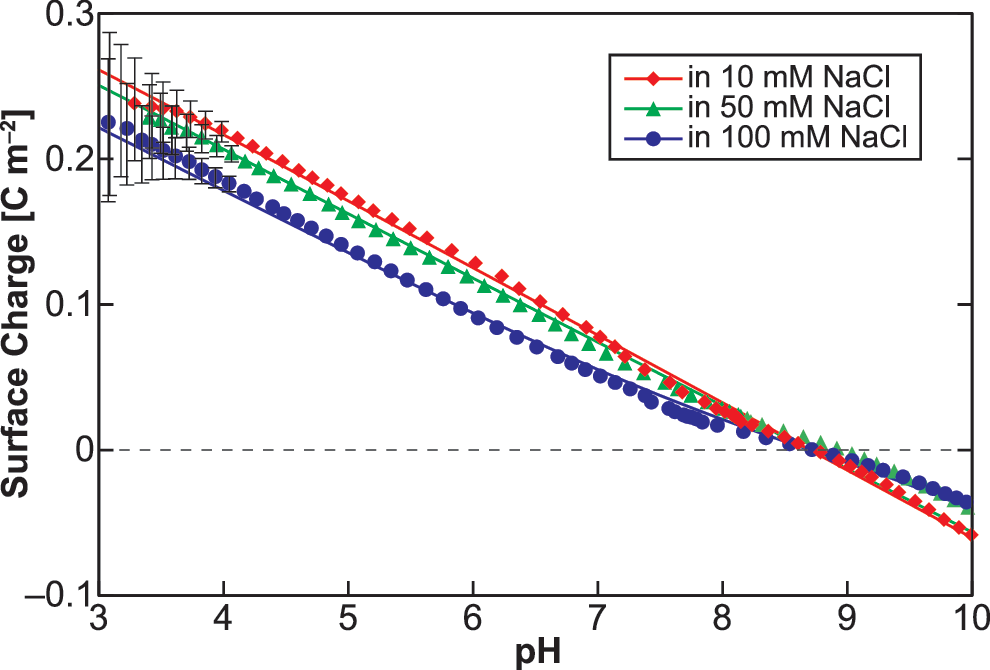
Surface charge density of goethite as a function of pH in 10, 50, and 100 mM NaCl aqueous solutions. Symbols denote the experimental acid–base titration data, whereas solid lines represent the ETLM calculation with the parameters presented in Table 1. Errors are estimated from the measurement error of pH (±0.1). ETLM, extended triple layer model. Color images are available online.
Reaction Stoichiometries and Equilibrium Constants for the Adsorptions of Proton, Electrolytes (Na+ and Cl−), and Organic Compounds (Asp, AspAsp, and AspGly) on Goethite
Electrostatic factors associated with the reactions (ψ) are also listed in this table. Inner- and outer-layer capacitances were set at 0.90 F m−2.
Molar concentration-based equilibrium constants corresponding to the site density (Ns = 2.6 sites nm−2), the specific surface area (As = 85.9 m2 g−1), and the solid/water ratio (Cs = 5 g L−1). Note that the values for bidentate surface complexation depend on the solid/water ratio.
Site occupancy-based equilibrium constants (Sverjensky, 2003).
Mole fraction-based equilibrium constants as input in Visual MINTEQ (Wang and Giammar, 2013). See Appendix Table A3 for the correlations among different thermodynamic expressions for surface complexation reaction.
Asp =
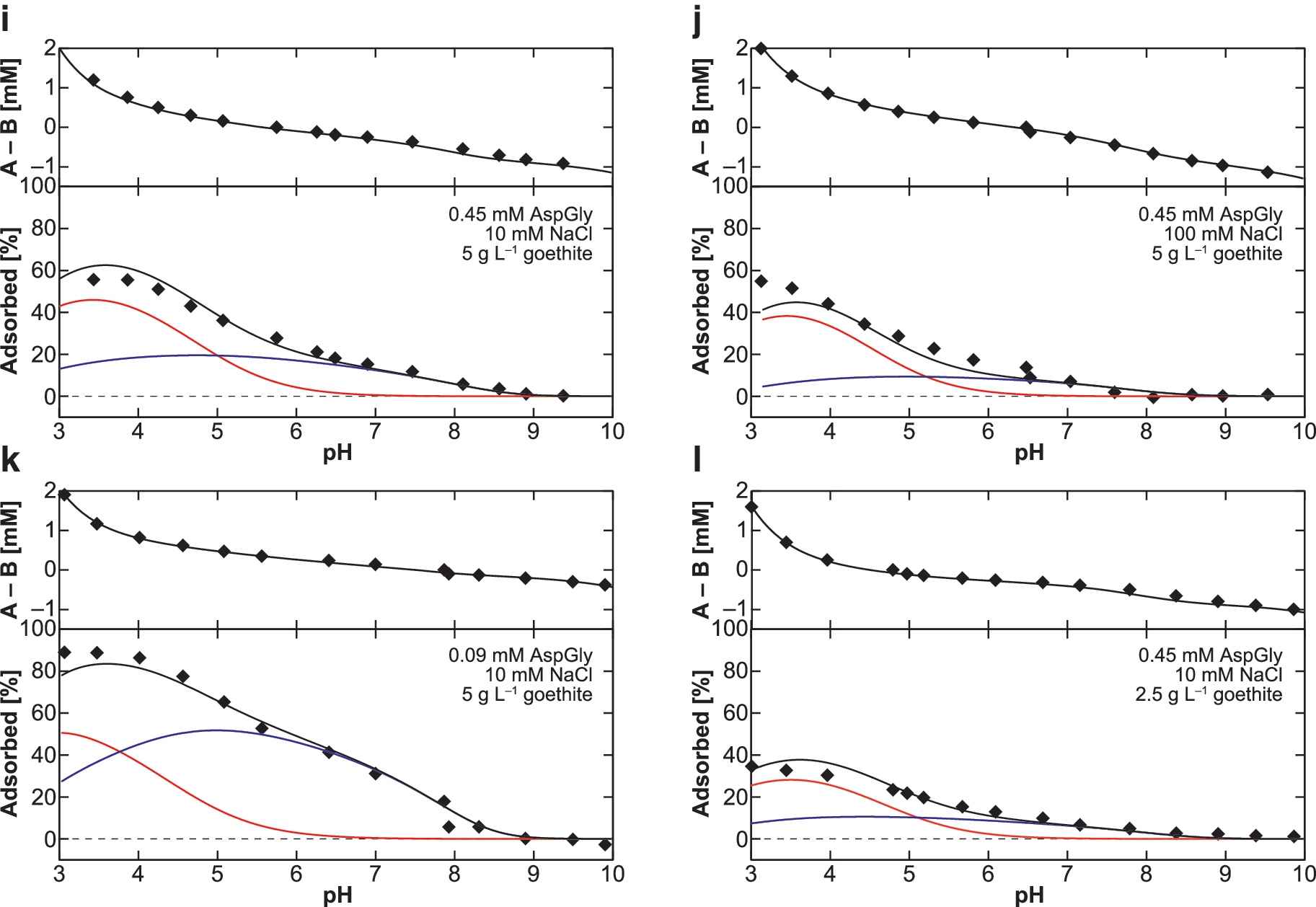
Figure 4 presents the percentages of adsorbed Asp, AspAsp, and AspGly on goethite and the responses of pH to the addition of an acid or base into the sample suspensions. All adsorbates showed preferences for acidic pH and lower NaCl concentration for the surface bindings, although the sensitivities to the latter parameter were minor. Considering the development of positive surface charge on goethite at lower pH (Fig. 3) and the predominance of negatively charged species of Asp, AspAsp, and AspGly in neutral to acidic pH condition (Fig. 2), electrostatic interaction is the most likely mechanism governing the observed adsorption trends.
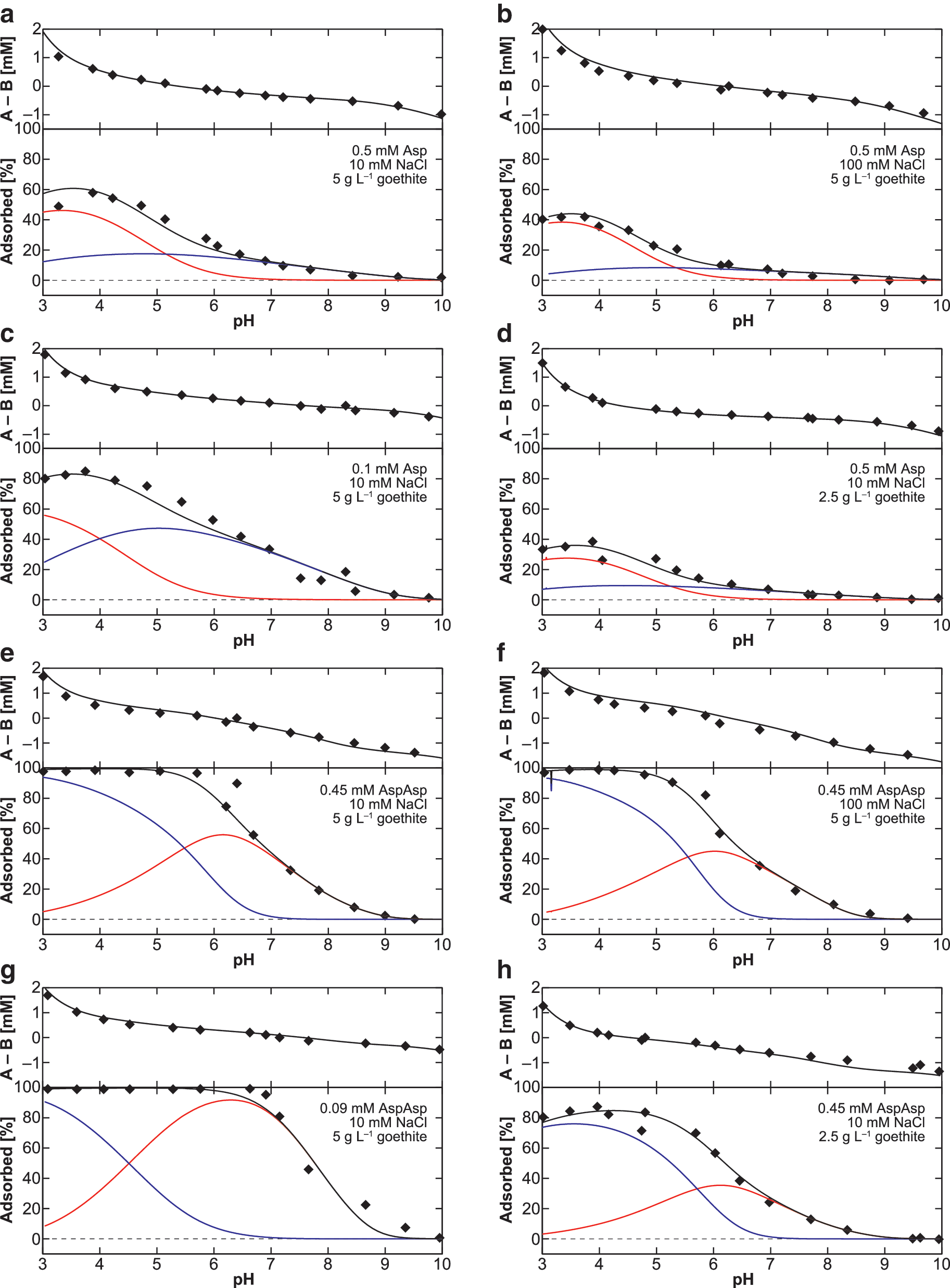
Percentages of adsorbed Asp
Of the two COO− groups in the Asp structure, contribution from the αCOO− group to Asp adsorption would be smaller or negligible because of its proximity to the αNH3 + group (Kitadai et al., 2010, 2018b). In fact, no appreciable adsorptions of glycine or glycylglycine on goethite were observed under any set of reaction conditions (data not shown). This observation is consistent with the report by Marshall-Bowman et al. (2010), where calcite, hematite, montmorillonite, pyrite, rutile, and amorphous silica caused no detectable decreases of the aqueous-phase concentrations of glycine and glycine peptides. We assumed the following two equations for Asp adsorption (Fig. 5a):

Structures of predicted surface species of
and determined their equilibrium constants by the ETLM regression calculation of the experimental data (Table 1).
Our proposed inner-sphere binding mode (Eq. 2) is not consistent with the one inferred from the ATR-IR spectroscopic measurement by Yang et al. (2016), where bidentate coordination involving both α- and β-COO− groups was suggested to dominate at pH 3, whereas an outer-sphere complex, as described in Equation 3, increased the proportion at pH 6. However, because adsorbed Asp showed broad spectral profiles that include the contributions from inner- and outer-sphere surface species, the reported interpretation may not be fully conclusive, particularly for the assignments of the α- and β-COO− signals that strongly overlap with each other. The spectral distortion associated with the ATR technique (Kitadai et al., 2014) also increases the difficulty in data interpretation. Our ETLM calculation, setting the adsorption stoichiometries in accordance with the model by Yang et al. (2016) [inner; 2 > FeOH + Asp2− + H+ → (FeO)2Asp− + 2H2O, outer; Eq. 3], resulted in poor representations of the experimental data (Supplementary Fig. S2). The binding form pointing both the α- and β-COO− groups to the surface is also inconsistent with the observed similar adsorption behaviors of Asp and AspGly on goethite (Fig. 4a–d vs. i–l) because such a “lying” structure would lead to a large difference in the surface coverage per one molecule of adsorbate between Asp and AspGly because of their different molecular size. The “standing” structure as expressed in Equation 2 and depicted in Fig. 5a and c can more reasonably explain the adsorption results. Actually, the use of Equations 2 and 3, replacing “Asp2−” with “AspGly2−,” enabled us to adequately reproduce the experimental AspGly adsorption data with the ETLM (Fig. 4i–l). These observations suggest that the peptide bond moiety (-CONH-) does not work as an important anchor to the surface. The same conclusion was previously made for the Lys adsorption on amorphous silica (Kitadai et al., 2018b).
It should be noted that a lot of possible stoichiometries can be considered for Asp adsorption on goethite in addition to Equations 2 and 3 (Supplementary Fig. S3). However, the rejected models in many cases overestimated the adsorption amount at neutral to alkaline pH. Although the models (≥FeOH ± Asp2− ± 2H± → ≥FeOAsp ± H2O) and (≥FeOH ± Asp2− ± 2H± → ≥FeOH2 ±_Asp−) exhibited similar profiles as a function of pH as the models (Eqs. 2 and 3, respectively), their dependences on Asp concentration were so weak that they could not adequately and simultaneously represent the experimental data at 0.5 mM Asp and 0.1 mM Asp. Because of the fitness, together with the chemical reasons described above, we selected the two (Eqs. 2 and 3) to describe Asp adsorption.
For the AspAsp–goethite system, both βCOO− groups in the first and second Asp residues likely contribute to the adsorption. The second βCOO− group would bind to the surface more tightly compared with the first one because the former is close to the αCOO− group in the AspAsp structure, whereas the latter is close to the αNH3 + group (Fig. 2). Adsorption via the second βCOO− group would be possible in both cases where the first βCOO− group is protonated and deprotonated. Alternatively, because the first βCOO− group has a slightly lower protonation constant than the second one (3.37 vs. 4.39) (Kalley et al., 2005), the first βCOO− group–surface interaction may occur preferentially in an acidic pH region where the second βCOO− group is protonated while the first one remains in a deprotonated state (Fig. 5b).
Thus, we applied the following two inner-sphere surface complexations to describe the AspAsp adsorption (Fig. 5):
and obtained the corresponding equilibrium constants from the ETLM fits of the experimental data (Table 1). Note that Equation 5 represents two adsorption modes; one is via the first βCOO− group, whereas the other is via the second one with the remaining β-carboxyl group protonated (Fig. 5). The α-amino groups of the adsorbed species were assumed to be protonated because this charged state is stable in water in a wide pH range (less than ∼8) (Fig. 2). To simplify the model calculation, the presence of an outer-sphere surface species was not considered, although a small amount of one might form. The validity of our interpretation must be evaluated by future spectroscopic and theoretical investigations. However, it is noteworthy that we conducted regression calculations with many possible adsorption stoichiometries, but no better fit with the experimental data was obtained than those shown in Fig. 4e–h. The two species (Eqs. 4 and 5) are the sole combination that enabled us to achieve good agreements between the experimental plots and predicted curves.
Another limitation of our analysis is that the ETLM is a single-site model; all goethite surface sites were supposed to be equivalent, although goethite may have different affinity for organic adsorbates for each crystal face (Hiemstra and van Riemsdijk, 1996; Venema et al., 1996). This possibility must be examined by the combination of the quantitative adsorption data with microscopic characterization of surface–adsorbates interaction.
4. Thermodynamic Prediction of Asp Dimerization on Goethite
Is goethite capable of promoting Asp dimerization? If so, what is the optimal environmental setting for this reaction? Here, we calculate the monomer–dipeptide equilibrium of Asp (0.1 mM) in the presence of goethite (10 m2 L−1) under various pH (3–10) and NaCl concentrations (0.1, 3, and 100 mM) using the ETLM parameters obtained in this study (Table 1) in combination with the mean logK value for the peptide bond formation between the αCOO− and αNH3 + groups of Zwitterionic α-amino acid (logK = −3.0 at 25°C and 1 bar) (Kitadai, 2014). The reaction equations and equilibrium constants used in this calculation are listed in Appendix Table A2. The examined pH and NaCl concentrations cover most ranges of pH and ionic strengths of natural water in river, soil, terrestrial springs, and rainfall (Drever, 1997; Morrill et al., 2013; Schrenk et al., 2013; Suda et al., 2014). 10 m2 L−1 of goethite corresponds to interstitial water in goethite-coated sediment with an average pore diameter of 400 μm. The Asp concentration of 0.1 mM was arbitrarily chosen because there is no definitive constraint on the abundance and distribution of α-amino acids in Hadean Earth. Calculations with a different Asp concentration (1 mM) and a surface-to-volume ratio (100 m2 L−1) are presented in Supplementary Fig. S4. The predicted dependences of Asp dimerization on pH and NaCl concentration (Supplementary Fig. S4) are similar to the corresponding ones shown in Thermodynamic Prediction of Asp Dimerization on Goethite section.
Note that the modeling program Visual MINTEQ has adopted the mole-fraction-based standard state for surface species (Wang and Giammar, 2013), in which adsorption equilibrium constants are independent of the solid surface area and the amount of solid. As a result, all the calculations satisfy the species distributions of Asp and AspAsp specified by the logKMF values listed in Table 1 and Appendix Table A2.
The equilibrium amount of AspAsp was calculated in terms of (a) the total concentration (dissolved + adsorbed; nmol L−1), (b) the percentage of adsorption (%), (c) the adsorbed surface density (nm−2), and (d) the AspAsp/Asp molecular ratio in the adsorbed state (%) (Fig. 6). In the absence of goethite (black line in Fig. 6a), AspAsp concentration showed no significant pH dependence except for a small increase at alkaline pH (∼9.5), which is representative of the pH dependence of α-amino acid polymerization in water (Kitadai, 2017). When 10 m2 L−1 of goethite was added into the system, the total AspAsp concentration increased drastically in the neutral to acidic pH region. The largest enhancement of the order of 105 was observed at pH 4–5 and the lowest NaCl concentration (0.1 mM) (Fig. 6a). At the optimum condition, the AspAsp surface density approximated 0.1 molecule per nm2 of goethite surface area (Fig. 6c), and the dipeptide-to-monomer ratio in the adsorbed state reached 20% (Fig. 6d). These values decreased with increasing NaCl concentration from 0.1 to 100 mM, but even at the saltiest condition, AspAsp concentration more than 100-fold larger was calculated in the presence of goethite compared with that in its absence at acidic pH (3–4) (Fig. 6a).
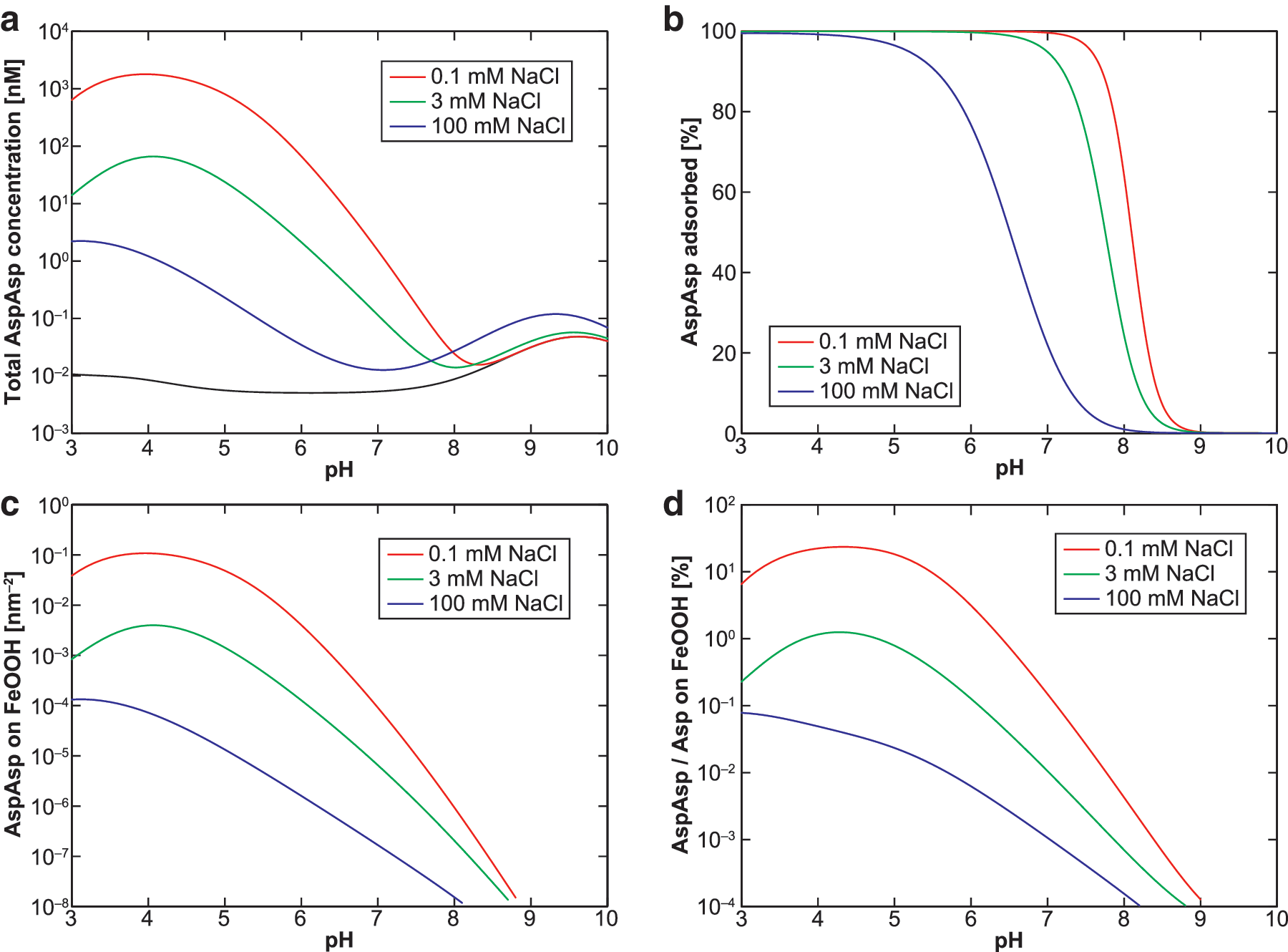
Thermodynamic prediction of Asp (0.1 mM) dimerization in the presence of goethite (10 m2 L−1) under various pH (3–10) and NaCl concentration (0.1, 3, and 100 mM). The equilibrium amounts of AspAsp are presented in terms of
The thermodynamic prediction shown in Fig. 6 gives important insights into at least two long-standing debates regarding the role of minerals in prebiotic peptide bond formation. It has been argued that α-amino acid concentrations in early aquatic environments were so dilute that surface adsorption alone was insufficient for their accumulation up to a critical density for spontaneous condensation and polymerization (Lahav and Chang, 1976). Our calculation predicted that a dipeptide-to-monomer ratio as high as 20% is attainable on goethite, even from 0.1 mM Asp, because of the higher adsorptivity of dipeptide compared with monomer (Fig. 6d). This percentage is not achievable in water, even at the saturated Asp concentration (0.499 mol kg−1 at pH 5 and 25°C) (Amend and Helgeson, 1997). Even greater amounts of AspAsp formation are expected on other minerals having higher affinities for negatively charged adsorbates than goethite, such as ferrihydrite, magnetite, and rutile (Sverjensky, 2005). The adsorption-induced shift of monomer–dipeptide equilibrium works efficiently in freshwater conditions, but its capability is diminished at higher ionic strength. Thus, peptide syntheses in seawater may require other means of promotion, such as the use of carbonyl sulfide as a dehydration agent (Huber and Wächtershäuser, 1998; Leman et al., 2004) and the transport and accumulation of materials in hydrothermal pore systems (Baaske et al., 2007). Nevertheless, it remains clear that adsorption is a crucial process controlling the thermodynamics of α-amino acid polymerization at the mineral–water interface.
The second issue regarding the role of mineral surfaces was pointed out by de Duve and Miller (1991) in their discussion on the plausibility of Wächtershäuser's iron–sulfur world hypothesis (Wächtershäuser, 1988). For peptide chain growth to occur favorably in the adsorbed state, the increment in adsorption energy for each added amino acid in the peptide must be higher than the binding energy of the amino acid to the surface. The longer a polymer becomes, the tighter it is adsorbed to the surface. Then, higher polymers would essentially be irreversibly adsorbed (Lambert, 2008). This principle was previously demonstrated by Rimola et al. (2009) in their quantum chemical calculation of glycine polymerization on a feldspar surface, where desorptions of glycine and triglycine by two H2O molecules were computed to need 3.5 and 12.5 kcal mol−1, respectively. In accordance with this result, our calculations predicted that AspAsp adsorbs onto goethite nearly completely at neutral to acidic pH, where Asp dimerization is greatly promoted (Fig. 6a, b). However, a pH increase to slightly alkaline releases almost all adsorbed AspAsp to water (Fig. 6b). The fluctuation in pH between slightly acidic and slightly alkaline is a naturally occurring common process, particularly in terrestrial and oceanic spring systems, and was probably so in primitive systems as well (Mulkidjanian et al., 2012; Shibuya et al., 2016). This natural process can prevent polymerization from evolving into a dead end and maintain the surface available for newly adsorbed species.
The thermodynamic impact of the goethite surface on Asp dimerization (Fig. 6) is far superior to that of the amorphous silica surface on Lys dimerization reported by Kitadai et al. (2018b). In the previous system, amorphous silica expanded the thermodynamically attainable LysLys concentration to, at most, 50 times larger at the best reaction condition, whereas an enhancement of as much as 105 times was predicted in the present calculation. The Lys ɛNH3 + group interacts with the silica surface forming outer-sphere complexes (Kitadai et al., 2009, 2018b), whereas the Asp βCOO− group binds to the goethite surface with both outer- and inner-sphere structures (Fig. 5). The βCOO− group is closer to the α-carbon in the Asp structure compared with the intramolecular distance in Lys between the ɛNH3 + group and the α-carbon. Thus, the peptide bond formation and the resultant disappearance of an oppositely charged α-functional group (the αNH3 + group in the case of Asp) should have a greater influence on the surface binding capability of the Asp βCOO− group than the Lys ɛNH3 + group. This positional characteristic of the βCOO− group in the Asp structure, together with its flexibility for forming multiple surface binding modes, would be a major factor generating a large difference in adsorptivity onto goethite between Asp and AspAsp and leading to a strong shift in the monomer–dipeptide equilibrium toward the dipeptide side.
For pH dependence, acidic pH was predicted to be favorable for the Asp dimerization on goethite (Fig. 6), whereas alkaline pH was predicted for the Lys dimerization on amorphous silica (Kitadai et al., 2018b), reflecting the strength of electrostatic interactions between the mineral surfaces and the charged monomers/ dipeptides. Acidic pH would also favor the polymerization of other acidic α-amino acids such as glutamate on positively charged minerals (e.g., hematite, corundum) (Sverjensky, 2005), whereas alkaline pH favors the polymerization of basic α-amino acids such as arginine and histidine on negatively charged minerals (e.g., quartz, sulfides) (Bebie et al., 1998; Xu and Schoonen, 2000; Sverjensky, 2005). In contrast, peptide bonding with neutral α-amino acids may not be facilitated on minerals in either of the pH conditions because AspGly and LysGly showed no significant difference in adsorption amount and its pH dependence from the corresponding charged monomers (Fig. 6) (Kitadai et al., 2018b). Thus, the formation of peptides comprising acidic, basic, and neutral α-amino acids would be difficult to occur on single mineral species and require repeated cycles of adsorption, polymerization, and desorption involving multiple types of minerals with different surface charges and/or combination with other dynamic processes, such as solid-state condensation (Kitadai et al., 2011, 2017b; Rodriguez-Garcia et al., 2015) and dry–wet cycling (Forsythe et al., 2017). Nevertheless, the capability of mineral surfaces to facilitate homopeptide formations should have played positive roles in prebiotic chemistry because peptides of a single α-amino acid can work as good catalysts for various organic reactions (Weber and Pizzarello, 2006; Tagami et al., 2017).
5. Summary and Future Perspectives
To date, a great number of efforts have been done, particularly with the case-by-case investigation of specific mineral–amino acid combinations, to elucidate the role of minerals in prebiotic peptide bond formation (Kitadai et al., 2017b). However, because experimental reproduction of all possible environmental conditions on the early Earth is almost impossible, laboratory simulation alone may be insufficient to reach a comprehensive understanding of this abiotic process. A problem also arises from the fact that polymerization has typically been examined using unrealistically high concentrations of amino acids (e.g., 100 mM) at elevated temperatures (e.g., 100°C); proper extrapolation of thereby obtained results to the ones at naturally relevant conditions is always difficult owing to the complexity in kinetics of mineral–water–solutes interaction (Schoonen et al., 2004).
Here, we presented a thermodynamic approach to circumvent the problems using the Asp–goethite system as an example. By the combination of the experimentally determined adsorption equilibrium constants with the thermodynamic data of Asp and AspAsp in water (Appendix Table A2), the thermodynamic impact of goethite surface on Asp dimerization was calculated over a wide range of pH, ionic strength, Asp concentration, and the solid/water ratio (Fig. 6 and Appendix Table A3). This approach enables us to screen many environmental situations in terms of the favorability for amino acid polymerization from a thermodynamic point of view. This process can significantly constrain the parameter space to be evaluated in-depth by laboratory simulations for determination of the best geological setting.
An important next step would be a comparison of the goethite-induced monomer–dipeptide equilibrium shift with those by other minerals. A survey of sulfide minerals (e.g., FeS) is particularly meaningful because sulfide-rich hydrothermal systems are among the most plausible settings for the origin of life on Earth and other rocky planets (Russell et al., 1994, 2010, 2014; Wächtershäuser, 2006; Mulkidjanian et al., 2012; Kitadai et al., 2017a, 2018a). For oxide minerals, a predictive scheme has been established (Sverjensky, 1993, 2005), by which adsorption equilibrium constants for an adsorbate on all oxides can be estimated from a set of equilibrium constants for several adsorbate–oxide systems. Application of this methodology to Asp and Asp peptides will enable the prediction of the best mineral species, as well as the best aqueous conditions, for the abiotic formation of Asp peptide in aquatic environments. For a more realistic computation, inorganic ions other than Na+ and Cl− must be evaluated for their competitive and cooperative influences on Asp adsorption. Ca2+ has been shown to promote adsorption of glutamate on rutile at alkaline pH (Lee et al., 2014). Mg2+ as well as Ca2+ are the most important cations in this respect because of their abundances in many natural waters.
Likewise, evaluations for the other protein α-amino acids await, although all 20 compounds do not necessarily need to be studied because some pairs of amino acids (e.g., aspartate vs. glutamate, asparagine vs. glutamine) are expected to show similar adsorption behaviors onto mineral surfaces. Future studies with this approach should provide a quantitative constraint on the favorable geochemical settings for chemical evolution on Earth. This approach will also bring important clues for the strategy of future exploration of extraterrestrial life.
Funding Information
This research was supported by JSPS KAKENHI (Grant Nos. 16H04074, 16K13906, and 18H04456) and the Astrobiology Center Program of NINS (Grant No. AB292004).
Supplementary Material
Supplementary Figure S1
Supplementary Figure S2
Supplementary Figure S3
Supplementary Figure S4
Footnotes
Abbreviations Used
Appendix
Correlations in Equilibrium Constant Among the Hypothetical 1.0 Molar Standard State, the Site-Occupancy Standard States, and the Mole-Fraction-Based Standard State (Indicated by the Superscript “0,” “Θ,” and “MF,” Respectively)
| Reaction | Equilibrium constant a |
|---|---|
| >FeOH + H+ → >FeOH2 + |
|
| >FeOH → >FeO− + H+ |
|
| >FeOH + Na+ → >FeO−_Na+ + H+ |
|
| >FeOH + Cl− + H+ → >FeOH2 +_Cl− |
|
| 2 > FeOH + Asp2− + 2H+ → (>FeO)2Asp± + 2H2O |
|
| 2 > FeOH + Asp2− + 3H+ → (>FeOH2 +)2_Asp− |
|
| 2 > FeOH + AspAsp3− + 2H+ → (>FeO)2AspAsp− + 2H2O |
|
| 2 > FeOH + AspAsp3− + 3H+ → (>FeO)2AspAsp± + 2H2O |
|
| 2 > FeOH + AspGly2− + 2H+ → (>FeO)2AspGly± + 2H2O |
|
| 2 > FeOH + AspGly2− + 3H+ → (>FeOH2 +)2_AspGly− |
|
N ‡ = the standard state sorbate species site density (10 sites nm−2), A ‡ = the standard state-specific surface area (10 m2 g−1), and NA = Avogadro's number (6.022 × 10²³ sites mol−1).
References
Supplementary Material
Please find the following supplemental material available below.
For Open Access articles published under a Creative Commons License, all supplemental material carries the same license as the article it is associated with.
For non-Open Access articles published, all supplemental material carries a non-exclusive license, and permission requests for re-use of supplemental material or any part of supplemental material shall be sent directly to the copyright owner as specified in the copyright notice associated with the article.
