




Abstract
The Mars Organic Molecule Analyzer (MOMA) instrument on board ESA's ExoMars 2020 rover will be essential in the search for organic matter. MOMA applies gas chromatography–mass spectrometry (GC-MS) techniques that rely on thermal volatilization. Problematically, perchlorates and chlorates in martian soils and rocks become highly reactive during heating (>200°C) and can lead to oxidation and chlorination of organic compounds, potentially rendering them unidentifiable. Here, we analyzed a synthetic sample (alkanols and alkanoic acids on silica gel) and a Silurian chert with and without Mg-perchlorate to evaluate the applicability of MOMA-like GC-MS techniques to different sample types and assess the impact of perchlorate. We used a MOMA flight analog system coupled to a commercial GC-MS to perform MOMA-like pyrolysis, in situ derivatization, and in situ thermochemolysis. We show that pyrolysis can provide a sufficient overview of the organic inventory but is strongly affected by the presence of perchlorates. In situ derivatization facilitates the identification of functionalized organics but showed low efficiency for n-alkanoic acids. Thermochemolysis is shown to be an effective technique for the identification of both refractory and functional compounds. Most importantly, this technique was barely affected by perchlorates. Therefore, MOMA GC-MS analyses of martian surface/subsurface material may be less affected by perchlorates than commonly thought, in particular when applying the full range of available MOMA GC-MS techniques.
1. Introduction
After four decades of Mars exploration, beginning with the Viking Landers in 1976 (Biemann et al., 1977; ten Kate, 2010; Goetz et al., 2016; Levin and Straat, 2016), the search for biosignatures indicating past or present life is still a key objective for future robotic missions to the martian surface (Westall et al., 2015; Vago et al., 2017). One of the next missions is ESA's ExoMars rover Rosalind Franklin that will be launched in 2020. A variety of onboard optical and analytical instruments will perform a broad search for morphological and chemical biosignatures and analyze geological context information on the surface and in the near subsurface of Mars (2 m depth, with the help of a drilling device; Vago et al., 2017). The Mars Organic Molecule Analyzer (MOMA; Goesmann et al., 2017) is the largest instrument on the rover and the key instrument to detect molecular biosignatures. Together with an infrared spectrometer (MicrOmega; Bibring et al., 2017) and a Raman Laser Spectrometer (RLS; Rull et al., 2017), it makes up the rover's analytical laboratory for a detailed investigation of martian sediments (Vago et al., 2017).
MOMA will examine martian samples by laser desorption/ionization mass spectrometry (LDMS) or gas chromatography–mass spectrometry (GC-MS) (Goesmann et al., 2017; Li et al., 2017). GC-MS provides the opportunity to separate and identify organics with high sensitivity and is therefore well suited to search for molecular biosignatures in extraterrestrial samples (Summons et al., 2008). Lately, the SAM (Sample Analysis at Mars) instrument on board the Curiosity rover demonstrated that GC-MS is a powerful tool to detect low-molecular-weight organics in martian surface sediments (Mahaffy et al., 2012; Freissinet et al., 2015; Eigenbrode et al., 2018). MOMA GC-MS has three different operational modes, that of pyrolysis (thermal volatilization), in situ derivatization, and in situ thermochemolysis (on-line methylation). The latter operational modes are completed by thermal desorption of the derivatized organics from crushed sample material. These techniques are designed to facilitate the analysis of polar compounds (e.g., alkanols, fatty acids, amino acids) in GC-MS and, in the case of thermochemolysis, to limit destruction of refractory organics at higher temperatures (Challinor, 2001; Rodier et al., 2005; Buch et al., 2006; Geffroy-Rodier et al., 2009; Zaikin and Halket, 2009). A detailed description of the MOMA GC-MS system and its operational modes is given in the work of Goesmann et al. (2017).
Organic signatures in martian sediments can potentially derive from biological (i.e., past or present life) or from abiotic sources, as for example meteorites or in situ abiotic synthesis (Flynn, 1996; Shock and Schulte, 1998; Botta and Bada, 2002; McCollom and Seewald, 2007; Summons et al., 2011; Konn et al., 2015; Westall et al., 2015). Therefore, it is crucial to determine whether any organic molecules found on Mars derive from abiotic or biological sources, for example by looking for specific distribution patterns of organic compounds, stable isotope patterns, or enantiomeric excess (Meierhenrich, 2008; Summons et al., 2008; Cady and Noffke, 2009; Westall et al., 2015; Vago et al., 2017). Especially lipid biomarkers have the potential to be preserved over geological timescales (Brocks and Summons, 2004; Summons, 2014). However, discrimination between abiotic and biologically derived organics can be hampered by degradation of organic molecules, for example via thermal alteration or radiation (Oró and Holzer, 1979; Brocks and Summons, 2004; Peters et al., 2005; Kminek and Bada, 2006; Pavlov et al., 2012; Mißbach et al., 2016). On the martian surface and in the near subsurface, organic compounds are degraded by solar and galactic cosmic rays. These processes encompass primary (i.e., impact fragmentation) or secondary effects (oxidation by O or HO radicals generated from particle impacts with the mineral matrix; Pavlov et al., 2012).
The ExoMars rover's capability to collect samples from 2 m depth allows obtaining martian sediments that were protected from radiation and thus, potentially, preserved organic matter (Westall et al., 2015; Goetz et al., 2016; Vago et al., 2017). However, analysis of these potential organics can be further complicated by the presence of oxychlorine compounds (e.g., Ca- and Mg-perchlorates and chlorates, hereafter focusing mainly on perchlorates) in martian sediments whose presence was revealed by the Phoenix Mars lander and the Mars Science Laboratory (MSL) rover (Hecht et al., 2009; Kounaves et al., 2010, 2014; Glavin et al., 2013; Sutter et al., 2017a). Reevaluation of Viking results (Biemann et al., 1976, 1977) suggested that perchlorates were also present at Viking landing sites, although these results were questioned and intensively discussed (Navarro-González et al., 2010, 2011; Biemann and Bada, 2011; Navarro-González and McKay, 2011; Guzman et al., 2018). The interference of perchlorates in pyrolysis measurements of martian sediments is known from SAM analysis (Glavin et al., 2013; Freissinet et al., 2015). Perchlorates are relatively inactive at low temperatures (i.e., martian surface temperatures) and thus, for example, remain unreacted in soils (Brown and Gu, 2006; Catling et al., 2010). However, they become reactive during heating, as the perchlorate molecule decomposes in the temperature range of 200–600°C, forming products likely leading to oxidation and chlorination of organic compounds (Navarro-González et al., 2010, 2011; Steininger et al., 2012; Sephton et al., 2014). Potential biosignatures may therefore be destroyed in the presence of perchlorates, either by chemical alteration or complete combustion (i.e., transformation into CO2; Steininger et al., 2012).
Analog studies are necessary to determine analytical limits and pitfalls; hence, they are an essential prerequisite to support data interpretation for upcoming missions. In this study, we analyzed two different samples (a synthetic standard mix with alkanols and alkanoic acids on silica gel and a Silurian chert) with addition of different amounts of perchlorate. We used a MOMA flight analog system (FAS) coupled to a commercial GC-MS and MOMA-like pyrolysis and in situ derivatization/thermochemolysis techniques. The study aims at (i) evaluating the applicability of MOMA-like GC-MS techniques on different sample types, (ii) assessing the impact of Mg-perchlorates on organics during heating, and (iii) providing reference data for interpretation of MOMA data to be acquired during surface operations. Our results demonstrate that especially thermochemolysis with tetramethylammonium hydroxide (TMAH) is a powerful technique to determine different organics in perchlorate-rich samples.
2. Materials and Methods
2.1. Samples
Two samples were used in this study. The first sample was a standard mixture consisting of
primary alkanols (n-C11–n-C13 alkan-1-ols)
alkanoic acids (n-C11–n-C13)
secondary alkanols (n-C11 and n-C12 alkan-2-ols)
in decreasing molar abundances (Table S.1; Supplementary Material is available online at
The second sample was a silica-rich Silurian black chert from the Holy Cross Mountains in central Poland (for details see Kremer, 2005; Kremer and Kazmierczak, 2005), containing ∼0.5 wt % total organic carbon. This sample was also used in earlier work (Goesmann et al., 2017, their Chapter 7.5) and is included in our study as a natural reference. The selection of silica-rich samples for this study was motivated by the detection of silica phases in Oxia Planum, the ExoMars 2020 landing site (Carter et al., 2016; Bridges et al., 2017). Organic matter trapped in opaline silica has a high preservation potential (as e.g., shown for Archean cherts) and is thus a high-priority astrobiology target for the ExoMars 2020 mission (Marshall et al., 2007; Westall et al., 2015; Duda et al., 2016, 2018). Before analysis, the rock pieces were manually powdered with a mortar that had been intensively rinsed with isopropanol and dried prior to use. A higher organic content of the samples compared to martian sediments (mg/g vs. ng/g, respectively) has been used in our experiment to ensure a clear distinction between signals from the samples and background/contamination.
For this study, magnesium perchlorate (Mg-perchlorate) was used to test the effects of perchlorates on MOMA-like GC-MS techniques. Mg-perchlorate concentrations were adjusted to circa 1 wt % and circa 10 wt %, the former representing concentrations close to those detected on Mars (Hecht et al., 2009; Glavin et al., 2013), the latter being a worst-case scenario. Perchlorates are highly mobile in water (Brown and Gu, 2006). Therefore, local enrichment of perchlorates via formation of salt brines in subsurface areas is possible (Cull et al., 2010; Martín-Torres et al., 2015). Depending on the desired concentration, perchlorate was added to the sample in different ways. For samples with 1 wt % perchlorate content, the perchlorate was first mixed with precleaned (550°C for >3 h) and powdered (pebble mill) sea sand and afterward mixed with the sample in the correct ratio. This step enables an easier and more exact handling of small amounts of perchlorate. Pure Mg-perchlorate was mixed with the samples to reach 10 wt % perchlorate content.
2.2. MOMA FAS and experimental procedure
The experiments were performed with a MOMA FAS connected to a commercial GC-MS (Section 2.3; see also Goesmann et al., 2017). The FAS consists of a MOMA oven, an adsorption trap (filled with Tenax® GR; see Goesmann et al., 2017, for details), and a tapping station including all the tubing to connect the different parts with the GC-MS (Fig. 1). All transfer lines were heated to circa 110°C.
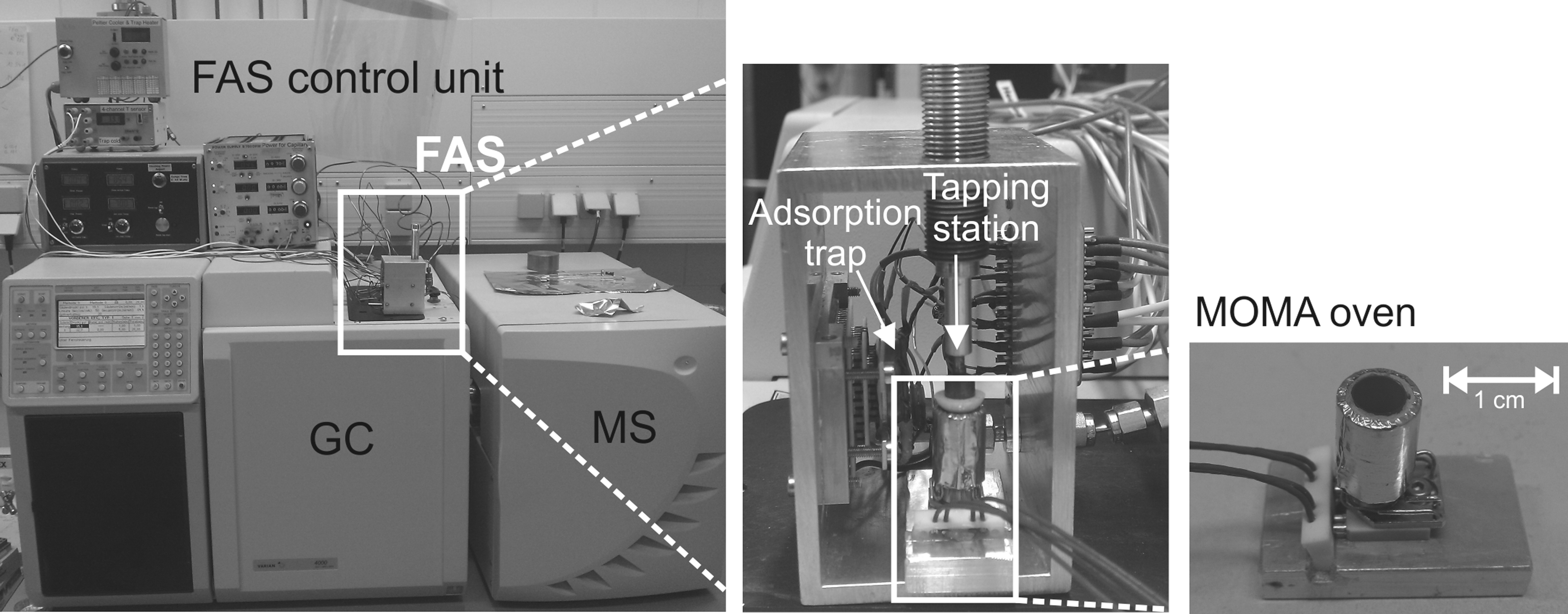
The flight analog system (FAS) mounted on the gas chromatograph (GC; left), view inside the FAS with adsorption trap and tapping station that seals the oven (center), and the oven separated from the tapping station (right). MS = mass spectrometer.
The analyses in this study were performed as close as possible to MOMA conditions. However, there are differences to the MOMA flight GC-MS instrument and the basic procedures, as they had to be transferred to a laboratory configuration. The major differences are as follows. (i) The maximum temperatures of the transfer lines and the adsorption trap are lower in the FAS compared to those planned for the MOMA flight instrument (transfer lines: 110°C vs. 135°C, trap: 160°C vs. max. 300°C, respectively). These lower temperatures most certainly hamper the transfer of compounds with higher boiling points to the GC-MS. (ii) The adsorption trap in the FAS does not support flow inversion, so that volatiles have to pass through the whole trap on their way to the GC. This increases the chance of cross contamination between samples. (iii) Less derivatization agent was used (3.5 μL vs. 15 μL in MOMA), and it was added to the cold sample before heating, instead of being released from derivatization capsules at elevated temperatures. A detailed discussion on this matter and the exact MOMA GC-MS conditions are given in the work of Goesmann et al. (2017).
For every analysis, between 3.5 and 4 mg of sample was used. If applicable, the sample was mixed with circa 1 mg perchlorate mix (Section 2.1) or circa 0.5 mg pure perchlorate (aiming for 1 wt % or 10 wt % Mg-perchlorate, respectively). After transferring the sample to the oven, it was dried at 80°C for 10 min, leaving the oven unconnected to the tapping station. For in situ derivatization and thermochemolysis, 3.5 μL of the respective reagent was added to the dry sample. According to Goesmann et al. (2017), the following reagents were used:
N,N-methyl-tert-butyl-dimethylsilyltrifluoroacetamide (MTBSTFA; >97%, Sigma-Aldrich) with N,N-dimethylformamide (DMF; >99.5%, Thermo Scientific) in a 3:1 (v:v) mixture, while DMF is added to increase derivatization efficiency (Buch et al., 2006)
N,N-dimethylformamide dimethyl acetal (DMF-DMA; Sigma-Aldrich) Tetramethylammonium hydroxide (TMAH, 25 wt % in methanol; Sigma-Aldrich)
MTBSTFA/DMF and DMF-DMA were used for in situ derivatization; TMAH was used for in situ thermochemolysis. All three reagents will be available in the MOMA instrument. MTBSTFA and TMAH are also available in the SAM instrument on board the Curiosity rover (Mahaffy et al., 2012).
After connecting the oven to the tapping station, the adsorption trap was cooled to 0°C by a Peltier element. Pyrolysis was performed directly as a single heating step to 700°C for 10 s. The heating rate of the oven was circa 300°C/min. Reaction temperatures and times for in situ derivatization/thermochemolysis with MTBSTFA/DMF, DMF-DMA, and TMAH were the following: 250°C for 10 min, 140°C for 4 min, and 600°C for 40 s, respectively. Flash heating of the adsorption trap to 160°C (circa 200°C/min) was initiated immediately afterward to release volatiles into the GC-MS, which was started in parallel. Slight fluctuations of the heating rate of the adsorption trap and temperature of transfer lines between the runs influenced the release of compounds from the adsorption trap and led to variations in the retention times of compounds in the range of 0.1–0.3 min.
Each analysis using a given sample and set of parameters was carried out at least twice to validate reproducibility. Multiple cleaning runs and system blank analyses were carried out between the sample runs to control cross contamination. Furthermore, blank analyses of Mg-perchlorate and all wet chemistry reagents were conducted. All blank analyses were carried out in pyrolysis mode.
2.3. GC-MS parameters
A Varian 3800 GC (gas chromatograph) coupled to a Varian 240-MS (mass spectrometer) was used for this study. The GC was equipped with a capillary column (Agilent J&W VF-5ms; 30 m length, 0.25 mm inner diameter, 0.25 μm film thickness). This column has similar properties as the Restek MXT-5 used in the MOMA instrument (Goesmann et al., 2017). The carrier gas (helium) flow was set to 2 mL/min. The injector temperature was 250°C, and the split ratio was set to 30. The GC oven was heated from 30°C (isotherm for 1 min) to 250°C (isotherm for 5 min) with 10°C/min. The (solvent) delay for acquisition of mass spectra was 1 min for pyrolysis, 10 min for MTBSTFA/DMF, 8 min for DMF-DMA, and 7 min for TMAH. Recording of full scan mass spectra proceeded in fast scan mode with a scan time of 0.58 s and a mass range from m/z 35 to 1000. Compounds were determined by comparison to reference spectra (NIST mass spectral library). n-Alkenes were also identified by their elution order (Nierop and van Bergen, 2002).
3. Results
3.1. Blanks
The system blanks showed traces of contamination, mostly in the form of siloxanes (e.g., column degradation), phthalates (e.g., from plasticizers from transport boxes, vial caps), silanes and DMF (carryover from previous runs with derivatization agents, Fig. S.1a). Additionally, traces of cross contamination in varying composition from earlier analyses of different samples were detected in some of the runs (e.g., chloroalkanes and sulfur).
The perchlorate blank showed a variety of chlorinated organics, including chloroethene, carbon tetrachloride, pentachlorobenzene, and hexachlorobenzene (Fig. S.1b; Table 1). Furthermore, compounds bearing both nitrogen and chlorine were detected. Formation of these compounds might be explained by the reaction of chlorine with N-bearing compounds (e.g., DMF carryover, see above and Fig. S.1a).
Aromatic Hydrocarbons, Chlorinated and Nitrogen-Bearing Compounds Originating from MOMA-like Pyrolysis and In Situ Thermochemolysis
3.2. Pyrolysis
Pyrolysis of the standard mixture (see Section 2.1) in the FAS yielded n-alkenes (including n-alk-1-enes, n-alk-2-enes, and midchain alkenes) and n-alkanals, with C11–C13 n-alk-1-enes being the main compounds (Fig. 2a). Furthermore, small relative amounts of n-alkanones and benzene were detected. None of the functionalized compounds initially present in the standard mix were observed. Addition of 1 wt % of Mg-perchlorate to the standard mixture led to the same distribution of compounds (Fig. 2b). However, considerably lower amounts of n-alk-1-enes were detected (note different y-axis ranges in Fig. 2a–2c), whereas other n-alkene moieties and n-alkanals increased in their relative abundance. In addition, the formation of minor chloroalkanes was observed. Addition of 10 wt % Mg-perchlorate to the standard mixture resulted in a further substantial decrease in n-alkenes, whereas n-alkanals increased in their relative abundance. Additionally, n-alkynes were observed. A major feature is the dominant appearance of chlorinated compounds such as chloroalkanes, dichloroalkanes, dichloromethane, and chlorobenzene (Fig. 2c).
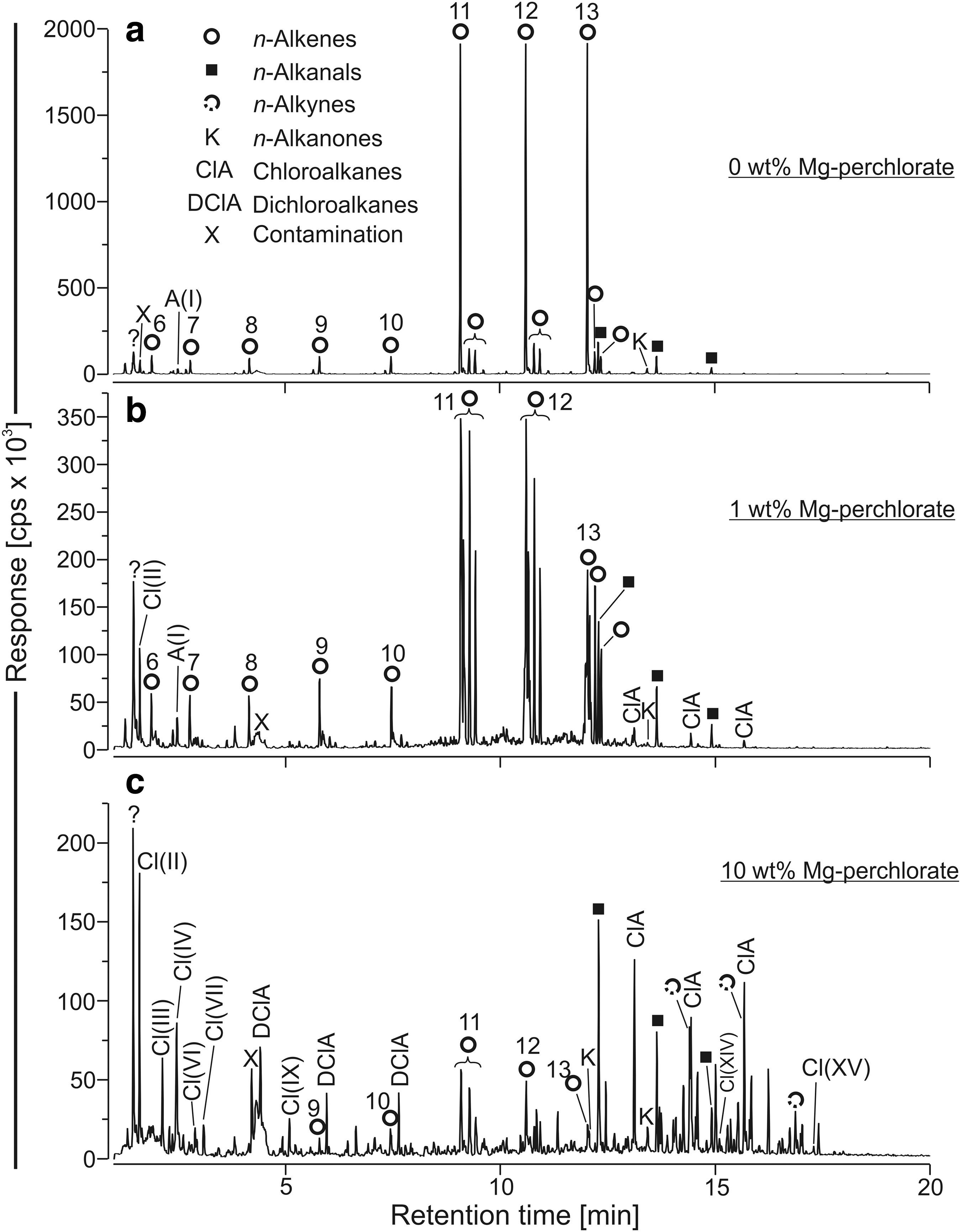
GC-MS chromatograms (total ion current) of the pyrolysates obtained from the standard mixture: (
Pyrolysis of the black chert revealed n-alkenes (C5–C20), n-alkanes (C7–C21), and a variety of aromatic hydrocarbons (e.g., benzene, toluene, xylenes, naphthalene, phenanthrene; Fig. 3a). Analysis of the sample with 1 wt % of Mg-perchlorate resulted in a roughly similar compound distribution. Nevertheless, a lower overall abundance of aliphatic versus aromatic hydrocarbons and a shorter range of n-alkenes (C5–C16) were clearly observed (Fig. 3b). The pyrolysis experiment of the black chert with 10 wt % Mg-perchlorate mostly led to chlorinated compounds (e.g., carbon tetrachloride, chloral hydrate, chlorobenzenes; Fig. 3c). The only aromatic hydrocarbon observed was toluene. No aliphatic hydrocarbons were detected. Some of the chlorinated compounds identified in this run were also detected in the perchlorate blank but in much lower amounts (Fig. S.1b).

GC-MS chromatograms (total ion current) of the black chert pyrolysates: (
3.3. Derivatization with MTBSTFA/DMF and DMF-DMA
In situ derivatization of n-alkanols and n-alkanoic acids from the standard mixture with MTBSTFA/DMF resulted in tert-butyldimethylsilyl ethers and esters, respectively (Fig. S.2a). However, only the n-alkanols showed a satisfactory derivatization, whereas n-alkanoic acid derivatives were nearly absent (Fig. S.2a). Beside the standard mixture compounds, major contamination introduced from the derivatization reagent was observed. The analysis with 1 wt % of Mg-perchlorate yielded the same compounds with almost the same response (Fig. S.2b). Analyses with higher amounts of perchlorate were not carried out (discussed in Section 4.2.2).
After in situ derivatization with DMF-DMA, only contamination from the derivatization agent and the system was identified. None of the expected derivatized compounds (e.g., fatty acid methyl esters) have been detected.
3.4. Thermochemolysis with TMAH
All eight compounds from the standard mixture were observed in the expected abundances after in situ thermochemolysis (as their corresponding methyl ethers and methyl esters, Fig. 4a). Additionally, high abundances of n-C11 to n-C13 alkenes as well as lower amounts of shorter n-alkenes, n-alk-2-enes, midchain alkenes and n-alkanals were observed (Fig. 4a). The same compounds were present after addition of 1 wt % Mg-perchlorate (Fig. 4b). n-Alkan-1-ols show the same abundance, whereas most n-alkanoic acids, n-alkenes, and n-alkanals had lower intensities compared to the perchlorate-free analysis (compare Fig. 4a, 4b). Furthermore, chloroalkanes were observed (also present in lower amounts in previous blanks). Thermochemolysis of the standard mixture with 10 wt % Mg-perchlorate revealed the same compounds as for the measurements with 1 wt % Mg-perchlorate, also at similar abundances. Additionally, a variety of nitrogen-bearing compounds were detected, including high amounts of 1,5-dicyano-2,4-dimethyl-2,4-diazapentane (Fig. 4c; Morisson, 2017; NIST mass spectral library).
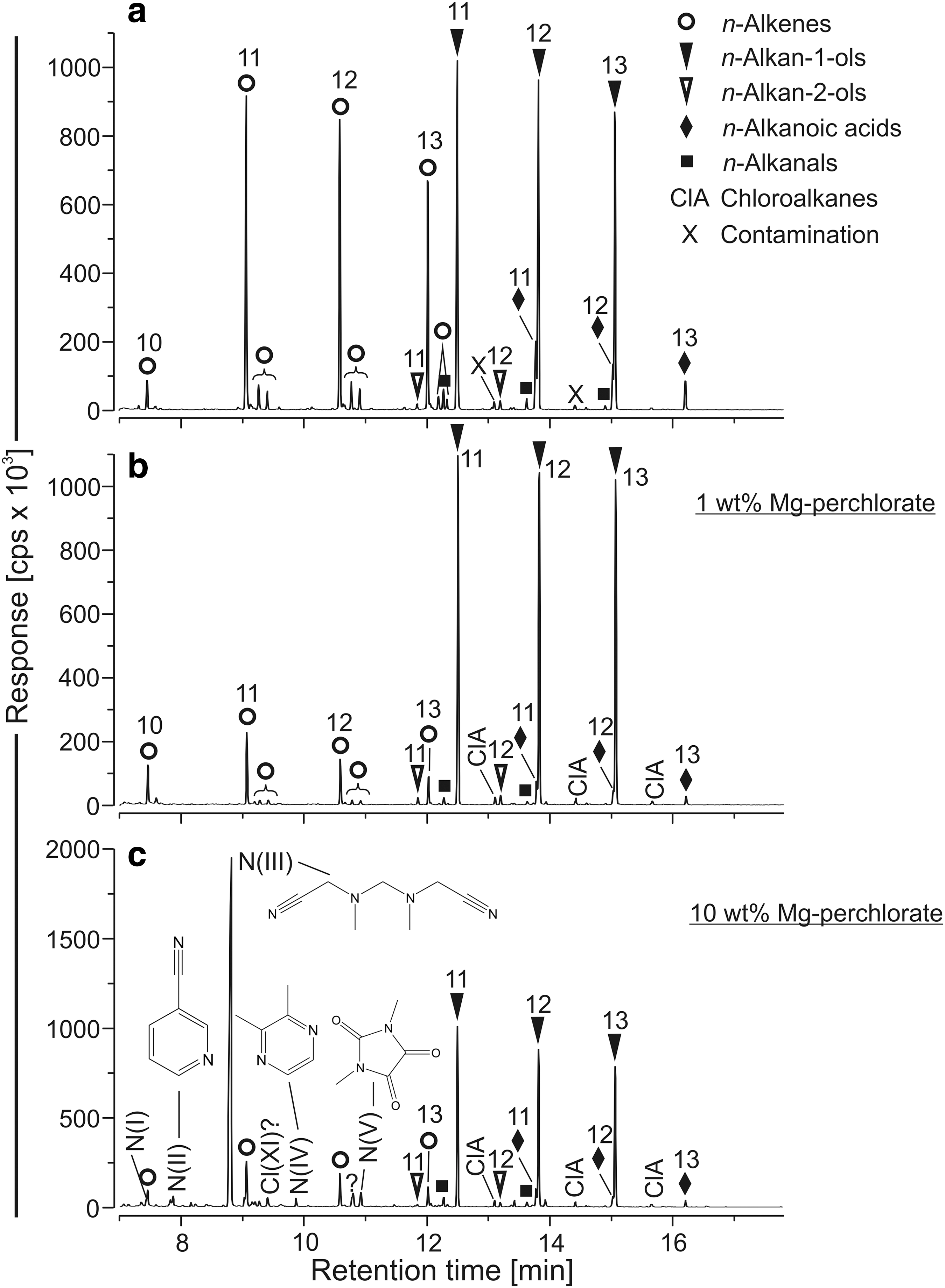
GC-MS chromatograms (total ion current) of the in situ thermochemolysis with TMAH of the standard mixture with (
The chromatogram obtained from the black chert after in situ thermochemolysis is similar to the pyrolysis run. The same compounds were detected, albeit with a lower abundance of some aromatics relative to aliphatic hydrocarbons. Additionally, n-C8 to n-C14 alkanoic acids were detected as their methyl esters (Fig. 5a). Thermochemolysis of the black chert with 10 wt % Mg-perchlorate led to the same array of aliphatic and aromatic hydrocarbons, compared to the analysis without perchlorate (Fig. 5b). However, some aromatic compounds show higher abundance relative to neighboring aliphatic hydrocarbons (e.g., n-alkenes) as, for example, 1-propynyl-benzene (tentatively identified) and naphthalene. Acenaphtylene was identified as a dominant compound that has not been observed in other runs. Identical nitrogen-bearing compounds as observed for the thermochemolysis of the standard mixture with 10 wt % Mg-perchlorate (e.g., benzonitrile, 1,5-dicyano-2,4-dimethyl-2,4-diazapentane) were detected in the analysis of the black chert, although at different relative abundances (Fig. 5b; see also Fig. 4c).
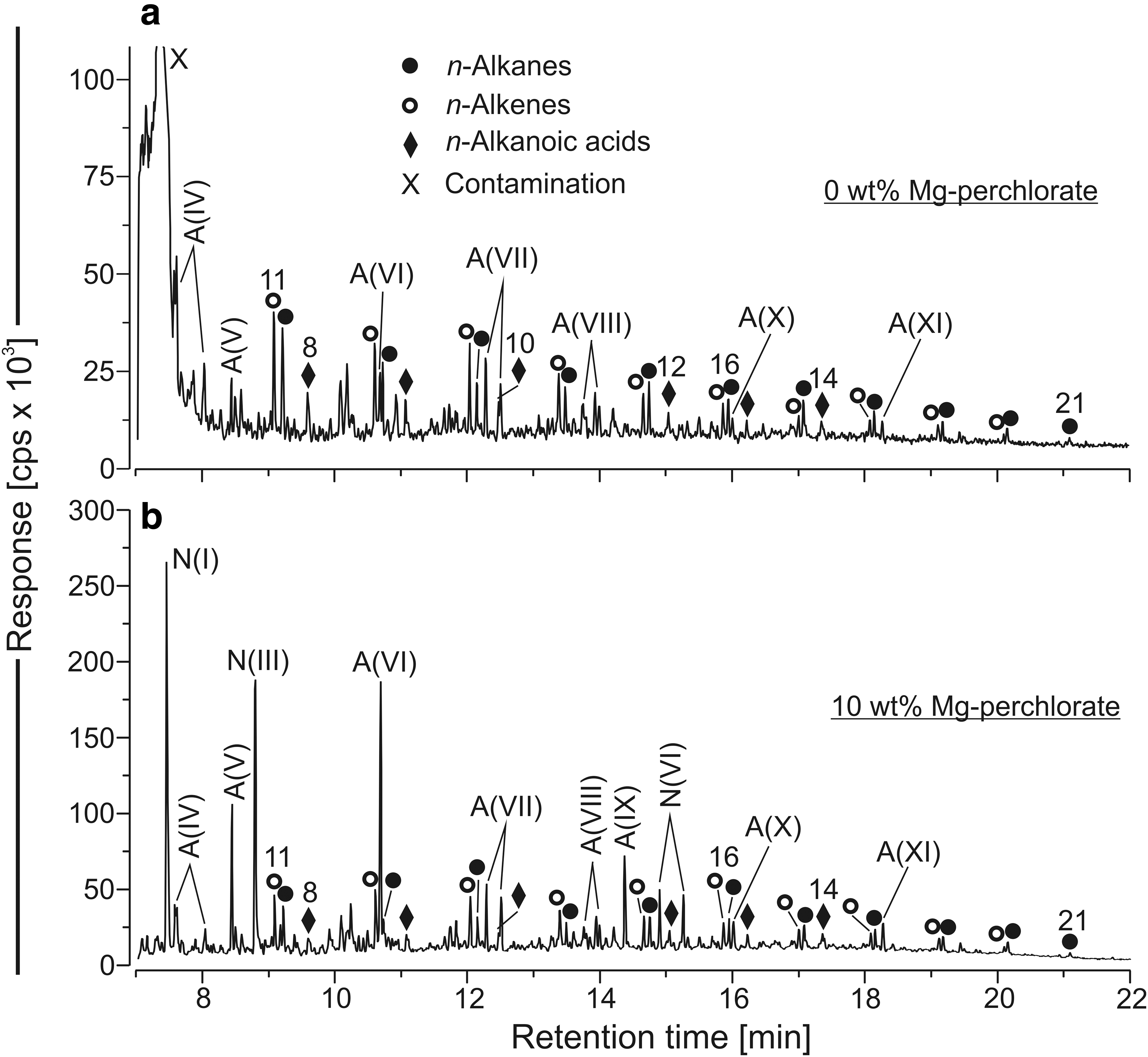
GC-MS chromatograms (total ion current) of the in situ thermochemolysis with TMAH of the black chert: (
4. Discussion
4.1. Thermal decomposition and possible by-products
Pyrolysis can transform organic compounds via cracking of chemical bonds. The products formed depend on the initial chemical structure but are further controlled by temperature, surrounding gas (or gases), pressure, presence or absence of catalysts, and reaction time (Moldoveanu, 2010).
The virtual absence of the (initially added) functionalized compounds (n-alkan-1-ols, n-alkan-2-ols, n-alkanoic acids) from the pyrolysis products of the standard mixture (Fig. 2a) are results of thermal decomposition. Pyrolysis of an n-alkan-1-ol usually leads to the formation of the corresponding n-alk-1-ene and n-alkanal via dehydration and dehydrogenation, respectively (Moldoveanu, 2010). Furthermore, rearrangement and hydrogen shift accompanying the dehydration reaction can lead to the corresponding n-alk-2-ene and various midchain n-alkenes. Shorter n-alkene moieties are also common products resulting from further fragmentation (Boss and Hazlett, 1976; Nierop and van Bergen, 2002; Moldoveanu, 2010). Secondary alkanols (e.g., alkan-2-ols) principally undergo the same main reactions during pyrolysis, generating n-alkenes and n-alkanones (Boss and Hazlett, 1976; Moldoveanu, 2010). Pyrolysis products of n-alkanoic acids can include n-alkanes and n-alkenes, mainly due to decarboxylation and dehydration reactions (Nierop and van Bergen, 2002; Moldoveanu, 2010). n-Alkenes and n-alkanals observed after in situ thermochemolysis of the standard mixture are also products of the reactions described above (Fig. 4a).
Dominant aromatic hydrocarbons and n-alkene/n-alkane doublets were observed after pyrolysis of the black chert (Fig. 3a). The aromatic hydrocarbons potentially derive from the kerogen as a result of cleavage from the macromolecule upon pyrolysis. However, aromatic hydrocarbons can also be formed via cyclization and aromatization reactions of aliphatic hydrocarbons and/or functionalized compounds during pyrolysis (Lockhart et al., 1981; Hartgers et al., 1994, 1995; Moldoveanu, 2010). Hereby, higher temperatures can cause a greater variety of aromatic compounds and thus, potentially, hamper the identification of parent molecules (Moldoveanu, 2010; Morisson, 2017). Furthermore, n-alkenes are frequently observed as pyrolysis products from kerogens, leading to typical n-alkene/n-alkane doublets (Lewan et al., 1979; Burnham et al., 1982; Huizinga et al., 1988). Thus, some of the compounds observed in the pyrolysis and thermochemolysis runs of the black chert might be by-products from high-temperature thermal decomposition (e.g., benzene, toluene, naphthalene, fluorene; Figs. 3a and 5a). In comparison, only one aromatic compound was observed in the pyrolysis of the standard mixture (i.e., benzene; Fig. 2a).
By-products from decomposition of the Tenax trap are also a potential source for hydrocarbon contamination, for example, benzene, toluene, xylene, and naphthalene, as detected in the SAM instrument (Freissinet et al., 2015). A clear distinction between pyrolysis products of the black chert and these contaminants is hardly possible. However, blank runs never showed these by-products (Fig. S.1), and also runs with the standard mixture only revealed traces of these compounds. Hence, most of the aromatic hydrocarbons observed probably derive from kerogen and/or thermal decomposition and aromatization of aliphatic parent organics in the black chert.
4.2. Applicability of different techniques and impact of perchlorate
4.2.1. Pyrolysis
This technique is a simple way to search for organics in soils and surface rocks and has been applied during previous landed missions to Mars (Biemann et al., 1976, 1977; Sutter et al., 2012; Glavin et al., 2013; Freissinet et al., 2015). Furthermore, it is widely applied to study refractory organics that are bound to kerogen (Vandenbroucke and Largeau, 2007; Hallmann et al., 2011). However, an identification of (intact) functional compounds through pyrolysis with the given setup and parameters was not possible, as demonstrated by the experiments using the standard mixture (Fig. 2a). Thus, this approach is not ideally suited for the analysis of functional compounds but rather for more complex macromolecular materials (see below).
Pyrolysis of the black chert without Mg-perchlorate seems to give a sufficient overview of the organic inventory of the sample. However, high-temperature pyrolysis of the black chert produced aromatic and unsaturated hydrocarbons that do not necessarily reflect the true inventory of organic compounds in the sample (see discussion in Section 4.1). Here, overall lower pyrolysis temperatures or a stepwise approach (presented in Goesmann et al., 2017) might be possibilities to minimize analytical by-products.
While all compounds were still clearly identifiable in pyrolysis mode after the addition of 1 wt % Mg-perchlorate, the addition of 10 wt % Mg-perchlorate led to degradation of existing organics and formation of major amounts of chlorinated hydrocarbons (Figs. 2b, 2c and 3b, 3c). This is well in line with earlier observations (Steininger et al., 2012). Decomposition of Mg-perchlorate leads to formation of MgO and MgCl2 as well as O2 and Cl2, or their associated radicals (Manelis et al., 2003; Navarro-González et al., 2010, 2011; Steininger et al., 2012). O and Cl radicals further lead to the formation of CO2 from organic matter and chlorinated organic compounds via oxidation and chlorination, respectively (Sephton et al., 2014). A determination of exact parent molecules of chlorinated compounds observed in our study is difficult, if not impossible. Nevertheless, most of these species probably derived from the samples and not from background or cross contamination, given their much higher abundance as compared to the blank runs. Our results further illustrate that the ratio of organic content to perchlorate controls the degree of thermal degradation during the analyses. As expected, degradation (including chlorination) of organic material increases with the amount of admixed perchlorate (e.g., Fig. 2b, 2c).
4.2.2. In situ derivatization
Derivatization with MTBSTFA/DMF (i.e., silylation) can be used for a variety of functional molecules (e.g., acids, alcohols, amines) and is usually producing high analytical responses (Schummer et al., 2009). Indeed, most functional compounds in the standard mixture were successfully silylated via in situ derivatization with MTBSTFA/DMF leading to a good GC-MS response. Characteristic key ions (m/z 73, 75, M-57, where M denotes the mass of the molecular ion; Schummer et al., 2009) simplified the identification of specific molecules. The lower response of n-alkanoic acids (especially n-tridecanoic acid) compared to n-alkan-2-ols (Fig. S.2) is due to a lower reactivity of n-alkanoic acids toward silylation compared to n-alkanols (Villas-Bôas et al., 2005, 2007).
In situ DMF-DMA derivatization was developed for use in the COSAC (Cometary Sampling and Composition Experiment) instrument on board the Rosetta lander Philae and is designed for derivatization of alkanoic acids, primary amines and amino acids via methylation (Meierhenrich et al., 2001). However, this technique was unsuccessful for derivatization of n-alkanoic acids in our standard mixture. This might be explained by a lower derivatization efficiency of DMF-DMA as compared to MTBSTFA/DMF (Rodier et al., 2001; Meunier et al., 2007; Goesmann et al., 2017), with the latter already giving low responses for n-alkanoic acids (see Section 3.3, Fig. S.2a). However, the strength of DMF-DMA lies in its suitability for the analysis of chiral functional molecules (e.g., amino acids), when using it together with an enantioselective column (Freissinet et al., 2010) which was not part of this study.
Earlier analyses revealed that the derivatization techniques are not suited for a sufficient specification of the black chert's organic inventory. This matter is discussed in the work of Goesmann et al. (2017; their Chapter 7.5).
Both techniques, MTBSTFA/DMF and DMF-DMA, were not affected by addition of 1 wt % Mg-perchlorates (e.g., Fig. S.2b). Earlier test experiments (not described here) showed that even high amounts of Mg-perchlorate do not have a major detrimental effect on these analyses. This might be explained by the fact that the reaction temperatures of these techniques (250°C and 140°C, respectively) are below the main decomposition temperature of Mg-perchlorate (i.e., release of high amounts of oxygen and chlorine >300°C; Navarro-González et al., 2010, 2011; Sephton et al., 2014). However, potential catalytic effects reducing perchlorate decomposition temperatures have to be considered here (e.g., caused by presence of iron or other metal oxides; Rudloff and Freeman, 1970; Bruck et al., 2014), whose study is beyond the scope of this work. Main decomposition temperatures of other perchlorates likely present on Mars (Ca-, Na-, and K-perchlorate; >390°C, >480°C, and >500°C, respectively) are well above derivatization reaction temperatures (Marvin and Woolaver, 1945; Bircumshaw and Phillips, 1953; Bruck et al., 2014; Kounaves et al., 2014; Sutter et al., 2017b). Hence, it can be assumed that these perchlorates will not affect the analysis of organic compounds via MOMA derivatization techniques.
4.2.3. Thermochemolysis with TMAH: a perchlorate-resistant technique?
Thermochemolysis with TMAH combines derivatization and pyrolysis. It can be used for an extraction of organic compounds from mineral matrices and selective cracking of ester and ether bonds from macromolecular organic networks (i.e., kerogen) at elevated temperatures while simultaneously limiting thermal decomposition of organic compounds (Challinor, 2001; Geffroy-Rodier et al., 2009). Compounds from the standard mixture were successfully derivatized by using thermochemolysis (Fig. 4a). The technique revealed higher sensibility for n-alkanoic acids in the standard mixture compared to in situ derivatization with MTBSTFA/DMF (Fig. 4a; see also Fig. S.2a). However, high abundances of thermal decomposition products (e.g., n-alkenes; Fig. 4a) suggest that not all compounds were protected by methylation. One reason for this might be insufficient mixing of TMAH and the sample, so that functional compounds were decomposed at high temperatures before the protecting methylation took place. Additionally, this could have been enhanced by partial evaporation of TMAH at elevated temperatures.
For the black chert, thermochemolysis enabled the detection of n-alkanoic acids in addition to the products that were obtained during pyrolysis (Fig. 5a). It is likely that these n-alkanoic acids were cleaved from the kerogen and not introduced as contaminants, because they were not observed in pre- and post-analysis blanks.
While most organics in both the standard mix and the black chert were degraded during pyrolysis with up to 10 wt % Mg-perchlorate (Figs. 2c and 3c), they remained largely unaffected during thermochemolysis with TMAH (Figs. 4c and 5b). In the standard mixture, however, a lower abundance of n-alkenes and n-alkanals as compared to analysis without perchlorate (Fig. 4) might be caused by perchlorate-induced degradation to CO2 or by variations in the thermal decomposition behavior of parent molecules (see Section 4.1). Likewise, the lower abundance of n-alkanoic acids as methyl esters (Fig. 4c) may be explained by slight variations in the efficiency of the methylation reaction. Larger variety and higher abundance of (specific) aromatic hydrocarbons observed in the black chert are probably an effect of perchlorate addition (Fig. 5b).
Our results suggest that TMAH buffers the oxidation and chlorination reactions induced by perchlorate decomposition and thus “protects” the organic compounds contained in the samples. We hypothesize that the methyl groups of the tetramethylammonium ion react with the O and Cl radicals via substitution reactions and potentially form, for example, CO2, HCl, and low-molecular-weight chlorinated organics. As a by-product, this reaction might form dimethylamine, methylamine, or nitrogen radicals which have the potential to produce the abundant nitrogen-bearing organics observed (e.g., 1,5-dicyano-2,4-dimethyl-2,4-diazapentane, benzonitrile; Figs. 4c and 5b). More systematic studies are necessary to determine the exact mechanisms of these reactions.
4.3. Implications for current/future missions
Given the advantages and limits of the individual methods, a complementary use of several techniques seems necessary to obtain a comprehensive picture of the organics contained in a given sample. In this study, especially in situ derivatization of the standard mixture with MTBSTFA/DMF and in situ thermochemolysis with TMAH have demonstrated good potential for such a complementary analysis. While the former allowed a clear-cut identification of specific compounds (via key ions) without major formation of by-products, the latter revealed the full range of functionalized compounds in proper relative abundances. TMAH furthermore protects the derivatives of n-alkanols and n-alkanoic acids from thermal decomposition and from the destructive influence of Mg-perchlorates at high temperatures (TMAH buffer). These properties are critical for the search and detection of organic compounds in perchlorate-bearing martian surface material and can be of great use to the ongoing MSL Curiosity as well as the future ExoMars rover mission. Further systematic studies with different perchlorates (Mars-like mixtures) and flight-like derivatization capsules carried out under Mars-like conditions will be necessary to fully validate these results.
5. Summary
MOMA-like pyrolysis, in situ derivatization, and thermochemolysis GC-MS techniques were successfully applied on a synthetic sample (standard mix; n-alkan-1-ols, n-alkan-2-ols, n-alkanoic acids) and a natural sample (Silurian black chert). However, not every technique is equally suitable for analyzing different types of organic compounds.
The
Summarizing, we demonstrated that perchlorates in martian soils probably do not hinder MOMA-like GC-MS analyses if the effects are carefully considered, and analytical techniques are appropriately adapted for individual target compounds. In particular, we underline that the complementary use of different MOMA-like GC-MS techniques is advantageous to the detection of the full organic inventory of a given sample.
Footnotes
Acknowledgments
We thank Marcus Elvert, two anonymous reviewers, and the associate editor for their helpful comments on the manuscript. We also acknowledge Barbara Kremer and Jósef Kazmierczak (Institute of Paleobiology, Polish Academy of Science) for providing the black chert sample from Holy Cross Mountains, Poland. H.M. gratefully acknowledges his scholarship from the International Max Planck Research School (IMPRS) for Solar System Research, Göttingen. The MOMA project is supported by the Deutsche Zentrum für Luft- und Raumfahrt (DLR grant #50QX1401).
Abbreviations Used
References
Supplementary Material
Please find the following supplemental material available below.
For Open Access articles published under a Creative Commons License, all supplemental material carries the same license as the article it is associated with.
For non-Open Access articles published, all supplemental material carries a non-exclusive license, and permission requests for re-use of supplemental material or any part of supplemental material shall be sent directly to the copyright owner as specified in the copyright notice associated with the article.
