




Abstract
Ceres, the most water-rich body in the inner solar system after Earth, has recently been recognized to have astrobiological importance. Chemical and physical measurements obtained by the Dawn mission enabled the quantification of key parameters, which helped to constrain the habitability of the inner solar system's only dwarf planet. The surface chemistry and internal structure of Ceres testify to a protracted history of reactions between liquid water, rock, and likely organic compounds. We review the clues on chemical composition, temperature, and prospects for long-term occurrence of liquid and chemical gradients. Comparisons with giant planet satellites indicate similarities both from a chemical evolution standpoint and in the physical mechanisms driving Ceres' internal evolution.
1. Introduction
Large water-rich bodies, such as the icy moons, are believed to have hosted deep oceans for at least part of their histories and possibly until present (e.g., Consolmagno and Lewis, 1978). Their rock phase was predicted to be subject to extensive aqueous alteration leading to a hydrated mantle with carbonaceous chondrite-like composition (e.g., Ransford et al., 1981). The existence of oceans has been confirmed at many such moons, for example, Europa (Khurana et al., 2004), Ganymede (Kivelson et al., 2002), Enceladus (Iess et al., 2014), and Titan (Iess et al., 2012). Similarly, deep oceans have been proposed to occur in dwarf planets based on geophysical grounds (e.g., McCord and Sotin, 2005; Desch and Neveu, 2017).
Observations by recent missions (New Horizons for Pluto and Dawn for Ceres) support these geophysical models [e.g., Nimmo et al. (2016) for Pluto and references in this article for Ceres]. The prospect for long-lived oceans is a key component in the assessment of the habitability potential of these bodies, that is, their potential to produce and maintain an environment favorable to life. The purpose of this article is to assess Ceres' habitability potential along the same lines and use observational constraints returned by the Dawn mission and theoretical considerations.
Ceres comprises nearly one-third of the mass of the asteroid belt. Its mean radius and bulk density, respectively, 470 km and 2162 kg m−3 (Russell et al., 2016), are intermediate between Enceladus (252 km and 1611 kg m−3) and Europa (1560 km and 3014 kg m−3), and comparable with those of many other icy moons and icy dwarf planets in the solar system. Ceres shares spectral similarities with C-type asteroids, in particular with Hygiea (Rivkin et al., 2019) and 324 Bamberga (Takir and Emery, 2012). However, as per its outstanding properties, Ceres is more akin to icy satellites than to asteroids, in particular based on its large bulk water content and large size. McCord and Sotin (2005) pointed out that Ceres contains the right amount of both water and rock for sustained heating, resulting in the formation of a volatile-rich shell. This was supported by the early detection of hydrated materials on Ceres' surface (Lebofsky, 1978), suggesting pervasive aqueous alteration (Rivkin and Volquardsen, 2009).
While Ceres does not experience tidal heating, it is sufficiently close to the Sun and contains long-lived radioisotopes (∼73 wt % rock) to potentially preserve brines until present (Castillo-Rogez and McCord, 2010) and meet conditions favorable for brine volcanism (Kargel, 1991). The prospect for Ceres to maintain mild interior temperatures throughout its history is quantified by thermal modeling. Castillo-Rogez and McCord (2010) found that Ceres' ice-rich shell could host temperatures as warm as 240 K a few tens of kilometers deep for most of its history. This led Castillo-Rogez and Lunine (2012) to propose that Ceres could be of astrobiological interest. A brief review of the pre-Dawn state of knowledge pertaining to Ceres' geophysics and chemistry is summarized in Section 2.
Dawn was the first mission to perform near-global geological, chemical, and geophysical mapping of an ice-rich body via mapping with multispectral imager (Framing Camera, Sierks et al., 2011), visible and infrared spectrometer (VIR) (De Sanctis et al., 2011), gamma ray and neutron detector (GRaND) (Prettyman et al., 2011), radio science (Konopliv et al., 2011), and stereoimaging for topography mapping (Park et al., 2019). Observational campaigns for more than 3 years have made Ceres one of the best explored ice-rich bodies. These observations have revealed extensive chemical and geological activity, likely until very recent times, when the age of Occator's bright spots (called faculae) is considered. The data also suggest the presence of liquid inside Ceres through time, perhaps in the form of pore fluid in a silicate matrix or as a confined relict brine (or brine pockets).
Finally, Dawn revealed the presence of abundant carbon in Ceres' regolith (Prettyman et al., 2017; Marchi et al., 2018), as well as localized spots rich in organic matter (e.g., De Sanctis et al., 2017). Altogether, these observations not only confirm but also emphasize the astrobiological significance of Ceres. Key findings from the Dawn mission are summarized in Section 3. We assess the astrobiological implications of these observations and whether or not conditions within Ceres could have produced habitable environments and are amenable to advanced prebiotic chemistry in Section 4. We conclude that Ceres is a candidate ocean world according to the definition set forth in the Roadmap for Ocean Worlds (ROW) (Hendrix et al., 2019).
2. Pre-Dawn Assessment of Ceres' Geophysical State
In this section, we briefly review expectations on Ceres' internal evolution ahead of Dawn's arrival. Available physical properties indicated that Ceres would be an evolved, internally differentiated body with a high prospect for preserving liquid until present. This section is by no means exhaustive and a more detailed review on the topic can be found in McCord and Castillo-Rogez (2018).
Ceres' bulk density was long known to be ∼2100 kg m−3 (see review by McCord and Sotin, 2005), intermediate between the values for water ice and silicates. This corresponds to a bulk fraction of water much higher than terrestrial planets and most rocky asteroids (27 wt % free water, i.e., not bound to minerals, McCord and Sotin, 2005). This suggests Ceres is more akin to other icy moons and dwarf planets of the outer solar system. Ceres is likely not unique in the main belt: at least one body, 10 Hygiea, and shares similar spectral properties (e.g., Vernazza et al., 2017; Rivkin et al., 2019) and density (∼2000 g/cm3) (Vernazza et al., 2019).
Using the shape data of Carry et al. (2008), Zolotov (2009) concluded that Ceres has an undifferentiated porous interior structure. However, thermal evolution models of Ceres, using shape data derived from telescopic observations (e.g., Thomas et al., 2005; Carry et al., 2008; Drummond et al., 2014), indicate that, following accretion, the dwarf planet could have differentiated into a silicate core and a water-rich outer layer. These models suggest that Ceres could have harbored a global subsurface ocean for several hundred million years after its formation (e.g., McCord and Sotin, 2005; Castillo-Rogez and McCord, 2010). Even though these studies used reference average surface temperatures 180–200 K instead of the current best estimate of 155 K at the equator (Hayne and Aharonson, 2015), the prospect remains that salt eutectic temperatures could be attained at relatively shallow depths and persist for an extended period of time.
A major difference between Ceres and other large main belt asteroids is the absence of an asteroid family, which Rivkin et al. (2014) interpreted as potentially due to an ice-dominated shell whose ejecta would vanish as a result of ice sublimation. An ice-dominated shell was predicted by geophysical modeling. Conversely, the large families associated with 10 Hygiea and 24 Themis have been interpreted as evidence for the preservation of a thick undifferentiated ice/rock crust at these bodies (Rivkin et al., 2014).
Recent models with more elaborate physics explored a greater parameter space to address Ceres' potential for both hydrothermal activity and subsolidus convective transport in a thick ice shell (Neumann et al., 2015; Neveu et al., 2015; Travis et al., 2015; Bland and Travis, 2017). Some studies accounted for the presence of salts leached from accreted silicates following hydrothermal processing, the latter of which is inferred from Ceres' pervasively hydrated surface (Rivkin et al., 2006; Castillo-Rogez and Young, 2017). Thermal evolution models consistently yield temperatures in Ceres' shell that could remain above the eutectic temperature of relevant salts (>220 K, e.g., for chloride mixtures) until present. Therefore, modeling studies predict that pockets of concentrated brines could exist at the base of the crust today (>50 km deep in Castillo-Rogez and McCord, 2010; Castillo-Rogez and Lunine, 2012; Neumann et al., 2015; Neveu et al., 2015).
However, the extent of these pockets was poorly understood by lack of constraints on Ceres' composition and geophysical properties. Modeling of heat transfer in a “mud ball” even suggested that an ∼300-km radius ocean loaded with silicate fines (<10 s of microns) could remain until present (Neveu and Desch, 2015; Travis et al., 2015). Although not specific to Ceres, Kargel (1991) predicted that brines produced by aqueous alteration of the silicates could drive volcanic activity in large asteroids. It is remarkable that most pre-Dawn models of Ceres' thermal evolution predicted the long-term preservation of a liquid layer despite using different assumptions on the modalities of heat transfer.
3. Post-Dawn State of Knowledge of Ceres
In this section, we report observational evidence available from the Dawn observations for the abundance of volatiles (Section 3.1), evidence for an evolved interior (Section 3.2), rich chemical composition (Section 3.3), and hints for recent geological activity (Section 3.4) on Ceres. Salient lines of evidence for the habitability of Ceres from mineralogical, elemental, geological, and geophysical observations are shown in Fig. 1.
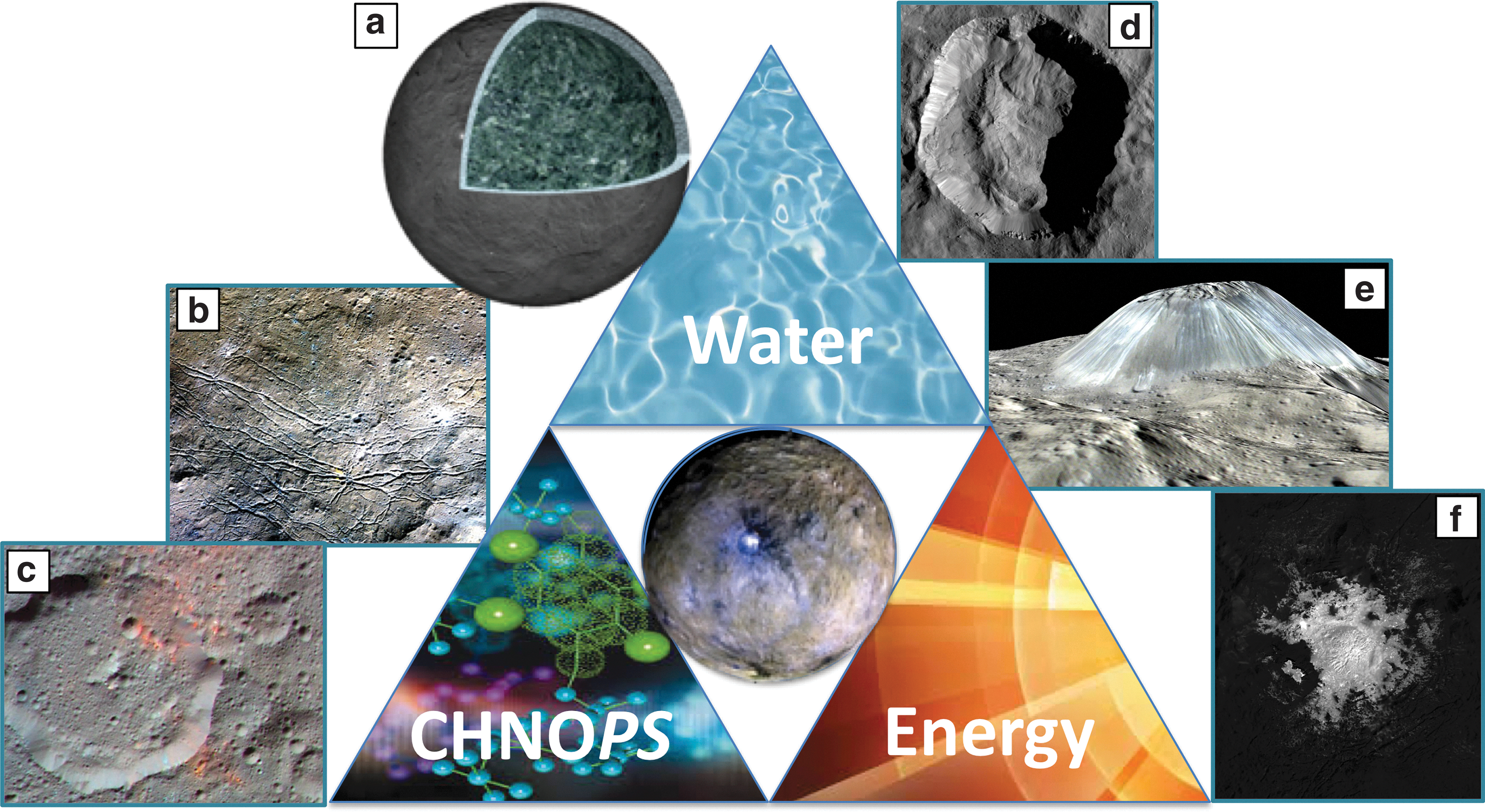
Summary of Dawn's observations of Ceres addressed in the text. Credit for individual images: NASA/JPL/Caltech/IAPS/MPS/DLR/INAF/ASI.
3.1. An ice-rich world
Measurements of hydrogen by GRaND indicate the presence of a global, subsurface water-ice table at depths less than a few decimeters at latitudes greater than 45° (Prettyman et al., 2017). The GRaND data indicate that the top meter of the regolith contains only about 10 wt % water ice (assuming 20% porosity), when averaged over broad spatial scales. Water ice is expressed in small-scale regions on Ceres' surface, in association with impact craters and mass wasting. Within Oxo crater, km-scale patches of water ice are associated with slumping regions that may have recently exposed ice from the near subsurface (Combe et al., 2019). Nine additional surface exposures of water ice (<7 km2 total) have also been discovered at latitudes >30° and in similar geologic contexts: they occur in fresh impact craters and are often associated with mass wasting features (Combe et al., 2019).
Since ice is not thermodynamically stable on Ceres' surface for appreciable geologic timescales, except in the polar regions (Hayne and Aharonson, 2015; Landis et al., 2017), these ice patches must represent relatively recent exposures. Permanently shadowed craters at Ceres' poles that display higher albedos than surrounding areas are likely surficial deposits of water ice (Platz et al., 2016; Schorghofer et al., 2016; Ermakov et al., 2017b).
Ceres' surface also shows a variety of morphologies that testify to abundant water ice in the uppermost ∼10 km of the crust (Sizemore et al., 2019). In particular, lobate flows analogous to water-ice flows on Earth, Mars, and possibly Titan, are also found on Ceres. These lobate flows are morphologically distinct from the predominantly dry mass-wasting processes observed on Vesta and are more numerous toward the cooler poles (Buczkowski et al., 2016; Schmidt et al., 2017; Scully et al., 2018; Chilton et al., 2019). Also, pitted terrains that share morphological characteristics with pitted terrain units on Mars and Vesta (Denevi et al., 2012; Tornabene et al., 2012) have been reported in seven impact craters on Ceres so far. The existence of these features has been interpreted as evidence that volatiles buried at shallow depths in Ceres' subsurface have undergone some degree of sublimation following impact-produced heating (Sizemore et al., 2017, 2019).
3.2. Ceres' interior structure and evidence for an early global ocean
The degree-2 gravity field and inferred moment of inertia from Dawn observations indicate partial internal differentiation and relaxation to almost full hydrostatic equilibrium (Park et al., 2016). Admittance analysis indicates that Ceres is differentiated into a low-density crust (∼1200–1300 kg/m3) and rocky mantle (2390–2450 kg/m3) (Ermakov et al., 2017a) (Fig. 2). The crustal thickness is about 40 km on average, but varies from ∼25 to 55 km (Ermakov et al., 2017a). The low crustal density implies a silicate volume fraction of less than 20% (Ermakov et al., 2017a). However, a crust dominated by water ice is inconsistent with observations of numerous impact craters, other morphological features on Ceres' surface, and ∼16 km of total topographic relief (Bland, 2013; Buczkowski et al., 2016).
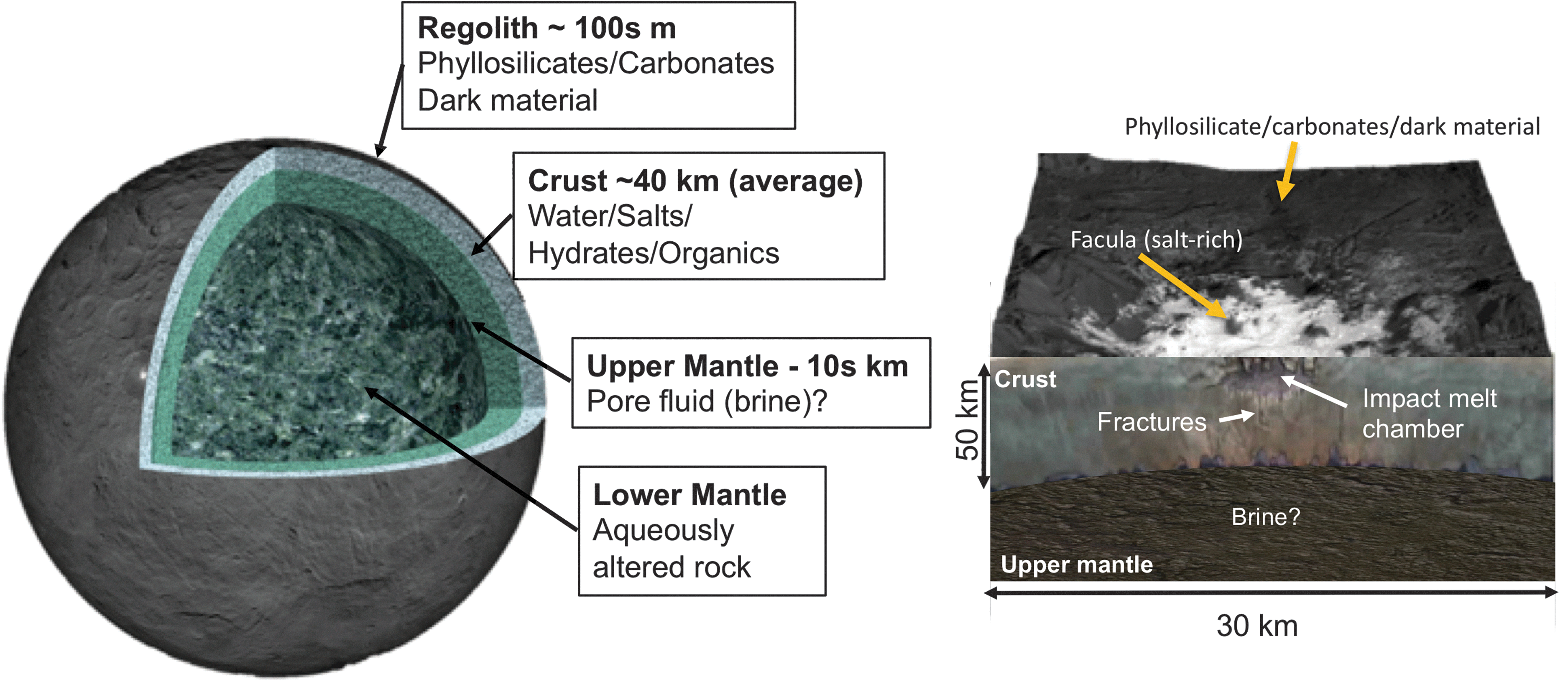
Left: Global interior structure for Ceres: a ∼40-km thick (average) strong crust is composed of rock+ice+salts+clathrates with no more than ∼40% ice (Bland et al., 2016; Ermakov et al., 2017a; Fu et al., 2017). It overlays a rocky mantle with a weak upper layer with brine-filled pore space that controls the global shape (Fu et al., 2017). Right: Possible structure of the crust inferred below Occator Crater's faculae, in a region where the crust is ∼50 km thick (Ermakov et al., 2017a). Impact craters could create transient melt chambers. Large impacts could also introduce or re-enact fractures allowing for the upwelling of deep brines. This rendition assumes that the impact melt reservoir was originally larger in extent but is mostly frozen at present, except for brines supplied from the deeper reservoir (Hesse and Castillo-Rogez, 2019). (Credit: NASA/JPL-Caltech/UCLA/MPS/DLR/IDA for the Occator image; crust rendition modified from Britney Schmidt/Dead Pixel FX/Univ. of Texas at Austin.).
This suggests that the outer layer is stiffer than previously thought and contains ≤40% water ice and void space by volume (Bland et al., 2016). Furthermore, the crust's high strength and low density have been interpreted as evidence for abundant salts and/or gas hydrates, hereafter referred to as “clathrates,” (Bland et al., 2016; Fu et al., 2017) starting a few kilometers below the surface (Sizemore et al., 2019). This is consistent with the outcome of geochemical simulations of the freezing of an early ocean (Castillo-Rogez et al., 2018).
Separation of a rocky mantle and ice-rich crust involves at least partial melting of Ceres' volatile phase on a global scale (McCord and Sotin, 2005). This event must have happened early in a body, whose sole internal heat source is radioisotope decay. Castillo-Rogez and McCord (2010) showed that long-lived radioisotopes alone cannot lead to the separation of a volatile-rich shell. They concluded that Ceres had to form early (a few My after the beginning of the solar system) to benefit from additional intense heat from the short-lived aluminum-26 radioisotope. Short-lived radioisotopes are recognized as being responsible for promoting early melting and aqueous alterations in the parent bodies of carbonaceous chondrites (e.g., Keil, 2000). Another compelling line of evidence for global, pervasive aqueous alteration early in Ceres' history is its hydrated surface of remarkably homogeneous composition (Ammannito et al., 2016) (see Section 3.3).
The low mantle density inferred by Ermakov et al. (2017a) indicates pervasive aqueous alteration. Fu et al. (2017) concluded that the low rocky mantle density indicates that temperatures remained low in the course of Ceres' history, less than the dehydration temperatures of phyllosilicates (>600°C). Beyond these findings, constraints are lacking on Ceres' internal evolution, particularly the period during which the dwarf planet hosted a global ocean. There are little data about this early period left in the present-day geomorphology. Thus, the range of possible ocean lifetimes is bounded by models: from a few hundred million years if the mantle was compact and lithified (e.g., Castillo-Rogez and McCord, 2010) to several billion years, and possibly until present, if the interior maintained a convecting “mudball” (Travis et al., 2018) or if insulating material in the crust impeded heat loss and helped preserve a liquid briny layer tens of km thick at the base of the crust (Castillo-Rogez et al., 2019a; Quick et al., 2019).
Overall, combined gravity and topography data indicate Ceres' density profile is akin to that of the icy moons of the outer Solar System, specifically the ocean-bearing Enceladus. Indeed, gravity data obtained at Enceladus with the Cassini mission also yielded a rocky mantle with a density of ∼2400 kg/m3 (Iess et al., 2014) and an ice-dominated shell.
3.3. Composition and availability of major elements essential for biology
Dawn observations have confirmed that Ceres' rocky material has been extensively processed by liquid water on a global scale (De Sanctis et al., 2015; Ammannito et al., 2016; Prettyman et al., 2017). Abundant mineral products of aqueous alteration are exposed on Ceres' surface, providing detailed insight into the chemistry of past and perhaps present liquid water environments. While this section follows this line of thought, one cannot rule out that Ceres' regolith could contain a significant fraction of infalls (Vernazza et al., 2017; Marchi et al., 2018). In the latter case, the information contained in the mineralogy of the low-albedo background material would only be marginally relevant to understanding Ceres' evolution, and only the bright material found at discrete sites would be the surface component that is truly representative of Ceres (Marchi et al., 2018), with potentially some deviation due to additional, local, impact-produced hydrothermal alteration.
Ceres' near-infrared spectrum, as observed by VIR, is best fit by a mixture of ammonium-bearing phyllosilicates, magnesium-bearing phyllosilicates, carbonates, and a dark, spectrally featureless component whose nature is unknown (De Sanctis et al., 2015). The surface mineralogy of Ceres can be reproduced qualitatively with geochemical models that include the interaction of liquid water containing carbon- and nitrogen-rich volatiles with silicates and organics of chondritic composition at temperatures below 50°C (Neveu et al., 2017), consistent with conditions expected in Ceres' early ocean (e.g., Travis et al., 2018), and a water to rock ratio >2 (Castillo-Rogez et al., 2018). Ceres' average surface spectral properties are similar as the Ivuna (CI) chemical group of carbonaceous chondrites (McSween et al., 2018) and it also shows major differences to CI chondrites, such as the presence of ammoniated clays and salts, and a greater variety of carbonates. This includes sodium carbonates, which have not been found in CI chondrites.
As illustrated in Fig. 3, sodium carbonate is also found in Enceladus' plumes (Postberg et al., 2011) and on Earth, where it is typical of alkaline aqueous environments (Zolotov, 2007; Marion et al., 2012). Additional sites displaying sodium carbonate are found with their hydrated form (Carrozzo et al., 2018) and exposed ice, mostly in association with impact craters and landslides (e.g., in Oxo crater). This suggests that abundant material of aqueous origin is present at shallow depths. Many additional bright spots of unknown nature are also found on crater rims (Stein et al., 2017).

Ceres' surface shows mineralogy found only on Earth and Enceladus, so far. More than 100 bright spots emerge from a globally homogeneous regolith. The most prominent are the faculae found in Occator crater, composed of sodium carbonate, a compound found so far only on Earth and in Enceladus' plumes.
As an outstanding example of “bright spots,” the Occator facula material (and potentially other faculae formed on crater floors) is thought to have originated in liquid brine reservoirs (De Sanctis et al., 2016; Vu et al., 2017; Quick et al., 2019; Thomas et al., 2019) or transient near-surface brines resulting from impact-induced heating (De Sanctis et al., 2016; Zolotov, 2017; Bowling et al., 2019; Hesse and Castillo-Rogez, 2019). The carbonate/ammonium/sodium composition of these brines is the same as the liquids that must have equilibrated with the minerals that blanket Ceres' surface (Neveu et al., 2017; Castillo-Rogez et al., 2018). Near the surface, these liquids subsequently underwent freezing and desiccation (Vu et al., 2017; Castillo-Rogez et al., 2018; Thomas et al., 2019). The compositional gradient observed across the dome in the central facula in Occator (called Cerealia Facula) (Raponi et al., 2019) indicates an evolution of the cryomagma source, consistent with modeling by Quick et al. (2019).
Thus, reduced nitrogen is abundant enough to be detected globally from orbit both in the average dark surface and in the bright deposits. Among other bioessential elements, sulfur has proved elusive. It is predicted to exist on Ceres in the form of sulfides (Castillo-Rogez et al., 2018), but these compounds do not have an obvious signature in the wavelength range of VIR. Sulfur-rich species have been suggested from ultraviolet observations with the Hubble Space Telescope (HST) (Hendrix et al., 2016). Bu et al. (2019) also pointed out that sulfates could be present but not detectable because of the impact of space weathering on their spectral signature.
Carbon has been found in the form of carbonates and organic compounds. Carbon dioxide and/or methane are also believed to be present in the form of clathrates in the crust (Fu et al., 2017; Castillo-Rogez et al., 2018). Aliphatic organics have been reported at specific locations, in particular the Ernutet crater (De Sanctis et al., 2017; Pieters et al., 2018; Fig. 3). Their intimate association with material of aqueous origin suggests these compounds formed in Ceres' interior. Impact simulations suggest that the large fraction of organics found at Ernutet is not compatible with the high temperatures involved in exogenic delivery (Bowling et al., 2020). Kaplan et al. (2018) found that the Ernutet organics cannot be fitted with typical organic matter from carbonaceous chondrites, unless abundances in excess of 45% are involved. Instead, De Sanctis et al. (2017, 2019) and Kaplan et al. (2018) suggest a better fit with terrestrial organics with a higher H/C ratio than the chondritic organics; kerogen was fit at a level of 5–15% on average, while terrestrial asphaltite was fit up to about 25% (De Sanctis et al., 2019).
Other types of organic compounds not detectable by VIR are also likely to be present. GRaND data indicate the presence of C in the global bulk regolith, perhaps in concentrations greater than the ∼3.5 wt % found in the CI chondrites (Prettyman et al., 2017). This study placed bounds on magnetite and troilite, leaving graphitized C, perhaps derived from the exposure of organics to ionizing radiation, as a plausible darkening agent. GRaND measurements of H and Fe can be fitted by carbonaceous materials, with C concentrations in excess of 10 wt % (Prettyman et al., 2019a). The addition of mineral constraints from VIR suggests that C concentrations could be as high as 20 wt % if much of the surficial C is graphitized (Marchi et al., 2018). Using HST observations, Hendrix et al. (2016) suggested that Ceres' dark component is graphitized carbon produced from the weathering of organics by charged particles.
Other elements of astrobiological importance that have low cosmochemical abundances (<1 wt %, e.g., Lodders, 2003), such as phosphorus, could be detected from the orbit.
3.4. Geological evolution
Ceres' surface testifies to a rich geological history. It is not the purpose of this article to review the many aspects of Ceres' geological evolution (see, e.g., Williams et al., 2018). To briefly summarize, Ceres' surface is relatively old with two regional geological units: the high Hanami Planum that is >2 Gy old (Frigeri et al., 2018), and the surrounding lowlands, which have been interpreted as basins (planitiae) created by large impacts (Marchi et al., 2016). The latter suggests regional resurfacing accompanied with the removal of 100-km large craters (Marchi et al., 2016). Most of the long-term evolution of Ceres has been driven by impacts with three types of consequences: (1) exposure of fresh material and local resurfacing with ejecta (e.g., Palomba et al., 2019); (2) gardening and mixing of the regolith with ice from the crust (Prettyman et al., 2019b); and (3) in the case of large impacts, input of heat into the crust that could drive local, short-lived activity (Bowling et al., 2019).
However, it was also suggested that the many domes (tholi, montes) found on Ceres' surface (Sizemore et al., 2019) could be formed from episodes of cryovolcanic activity that lasted for several billion years up until the present (Sori et al., 2018). The rest of this section focuses on available evidence for recent (<∼100 My) geological activity.
The Dawn observations have revealed ample evidence for a geology driven, in part, by an abundance of volatiles and salts (i.e., brines). The likely role of brines in driving cryovolcanism is indicated by features such as the Occator faculae as well as Ahuna Mons and more ancient features of potentially similar origin (Ruesch et al., 2016; Sori et al., 2017, 2018; Quick et al., 2019). Buczkowski et al. (2016) identified additional cryovolcanic features on the dwarf planet.
Ahuna Mons is an ∼4-km-high and ∼21-km-wide mountain that is interpreted as a viscous cryovolcanic dome formed by the ascent of cryomagma from the depth and subsequent eruption onto the surface in a manner akin to lava dome emplacement on Venus and Europa (Quick et al., 2014, 2016, 2017). This cryomagma is thought to consist of low-eutectic salt melt, ice, and silicate solid (Ruesch et al., 2016). Abundant sodium carbonate is found on the flanks of the mountain (Zambon et al., 2017; Carrozzo et al., 2018). Sori et al. (2018) interpreted multiple tholi as the expression of similar domes that have viscously relaxed; however, Ahuna Mons' unique large gravity anomaly suggests a low ice content (Ruesch et al., 2019a). Based on gravity data analysis, Ruesch et al. (2019a) connect the formation of Ahuna Mons to upwelling of a dense slurry from the mantle.
Other geological evidence for recent activity (<2 My) (Nathues et al., 2019) is expressed at the crater Occator, as shown in Fig. 4. The bright spots, or faculae observed in the 92-km-diameter crater, mainly consist of sodium carbonates, which may represent the residue of crystallized brines extruded onto the crater floor from depth (De Sanctis et al., 2016; Quick et al., 2019). The crater is dated at ∼22 My and the internal lobate deposits are contemporaneous within the error of the model ages, when using the lunar-derived chronology model (Neesemann et al., 2019). Facula ages are more difficult to constrain because of their small area. Their brightness suggests a recent emplacement since micrometeorites tend to darken surface material on timescales of a few My (see Stein et al., 2017; Thangjam et al., 2018). Quick et al. (2019) and Ruesch et al. (2019b) introduced models where at least some of the faculae are created by the venting of brines from a deep reservoir.
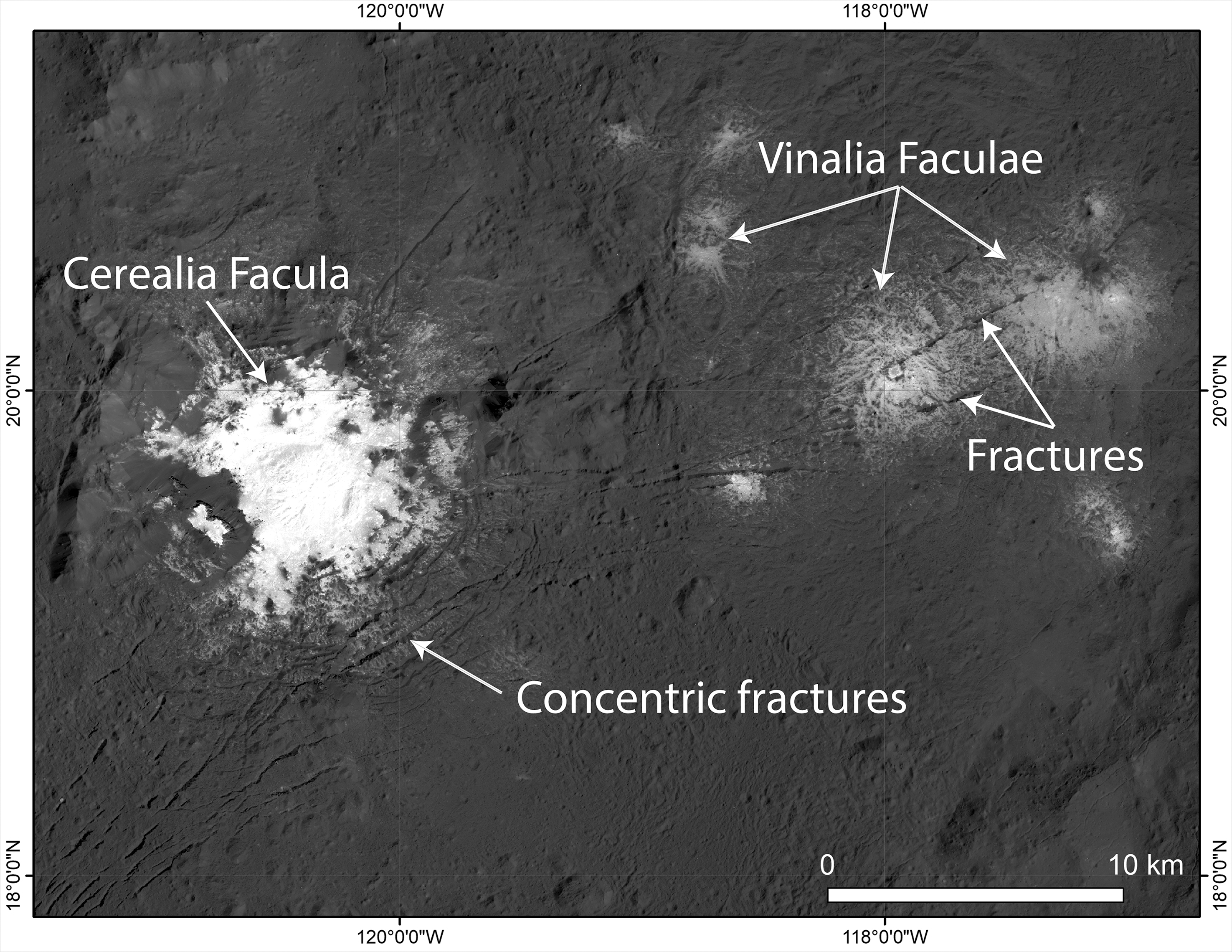
Geological context for the faculae found inside Occator crater. The brightness stretch is chosen to emphasize the network of fractures associated with the various faculae. The concentric fractures around the Cerealia Facula (left) are interpreted to form during the collapse of the central pit within which the Cerealia Facula is located (Buczkowski et al., 2019b). The Vinalia Faculae are created by vents associated with fractures (Ruesch et al., 2019). Credit: NASA/JPL/Caltech/IAPS/MPS/DLR.
In the Quick et al. (2019) model, the Occator faculae were created when brines originating from a cryomagma chamber beneath Occator's floor erupted onto Ceres' surface. Upon being emplaced in Ceres' zero-pressure surface environment, these brines would have subsequently boiled, launching vapor, ice, and salt particles on ballistic trajectories. The buildup of these salts could have formed the faculae. It is also possible that the faculae were formed when fractures containing salty liquids and <2 wt % of a volatile constituent such as water vapor, CH4, CO2, or NH3 intersected with Ceres' surface. Upon reaching the surface, volatiles in solution would have exsolved, causing eruptive boiling and resulting in salt particles being launched on ballistic trajectories that were wide enough to create the faculae (Quick et al., 2019). Similarly, Ruesch et al. (2019b) found that “brine fountaining” was the most plausible explanation for the formation of the faculae. During this process, briny liquid extruded onto the surface, followed by flash freezing of carbonate and ice particles, particle fallback, and finally, sublimation of any residual ice.
Diurnal variations of Occator's Cerealia Facula (the central bright deposit) were initially interpreted as a signature of haze (i.e., water vapor lifting small particles) (Thangjam et al., 2016); however, no evidence has been found in data from the VIR instrument for the presence of water ice within Occator (De Sanctis et al., 2016). The nature of these brightness variations is currently being studied.
4. Ceres' Astrobiological Potential Over Time and at Present
We assess the implications of observational results from the Dawn mission for Ceres' astrobiological significance: the prospect for the preservation of liquid until present (Section 4.1); possible active and passive mechanisms driving internal activity (Section 4.2); constraints on Ceres' early ocean composition (Section 4.3) and the prospect for the maintenance of chemical gradients until present (Section 4.4); and possible origins for the organics found on Ceres' surface as well as the prospect for life to arise on Ceres (Section 4.5). This information is used to assess the place of Ceres in the ROW and justify why it was identified as a “candidate” ocean world * (Hendrix et al., 2019). The current state of knowledge of Ceres in the ROW framework is summarized in Table 1.
Assessment of the Current State of Knowledge of Ceres with Respect to the Questions Defined in the Roadmap for Ocean Worlds (Hendrix et al., 2019)
N/A, Not applicable.
4.1. Existence and nature of liquid in Ceres at present
There are two lines of evidence for the existence of liquid in Ceres at present. First, the global relaxation of topographical features ≥250 km was interpreted by Fu et al. (2017) as evidence for the presence of a weak layer below the crust, that is, in the upper mantle. From the viscosity constraint <1021 Pa s, Fu et al. inferred that the weak layer should contain a small fraction of pore fluids in a matrix of phyllosilicates. Modeling cannot provide a more specific range about the thickness or viscosity of that inferred weak layer except that it extends at least 60 km into the mantle (Fu et al., 2017) (Fig. 2). Hence, these geophysical models are currently not efficient to distinguish between the interior models of Travis et al. (2018; “mudball” mantle † ) and Castillo-Rogez and McCord (2010; more compact mantle).
Second, the recent extrusion of brines at the Occator Crater and the formation of Ahuna Mons <150 My ago both require feeding from a deep brine reservoir (Quick et al., 2019; Ruesch et al., 2019a, 2019b; Scully et al., 2019; Raymond et al., 2020) (Fig. 2). The possibility for a small amount of brine in Ceres at present, at least on a regional scale, is viable from a geophysical standpoint for a 40-km-thick average crust that includes at least 40 vol.% hydrates (gas and salt) (Castillo-Rogez et al., 2019a). Clathrates have the same density as ice but their thermal conductivity is at least one order of magnitude less and their viscosity at least three orders of magnitude greater than ice at the same temperature. Hence, they are the most likely compound responsible for Ceres' low-density and high-strength crust (Section 3.2). Porosity can also contribute to decreasing thermal conductivity but tends to weaken the crust and is thus expected to be limited in extent and likely in the form of macroporosity (i.e., local), as indicated by the high number of polygonal craters (Otto et al., 2016).
While the porous medium suggested by Fu et al. (2017) does not meet the general definition of “ocean” as a vast layer of water, it could be a medium analogous (at least physically) to the pelagic environment of Earth's deep ocean in terms of pressure, but at colder temperatures. The temperature of that layer may be subzero, set by the eutectic temperature of remnant brines (Castillo-Rogez et al., 2019a) or much warmer owing to slow heat loss (Travis et al., 2018). The mantle porosity governs the extent of the interface at which liquid water and rock can interact, that is, where chemical gradients can arise and bioessential species may become concentrated. Porosity could also have developed due to fracturing of a cohesive mantle during evolution. Neveu et al. (2015) showed that thermal stresses due to cooling could lead to pervasive cracking down to the center of Ceres.
4.2. Recent active vs. passive geological activity
Evidence for recent geological activity has been most recently interpreted as resulting from three possible interior settings. In the setting described by Travis et al. (2018), thermal convection in a long-lived ocean triggers convective upwelling in the crust, which would be responsible for the observed domes. On Europa, the existence, spacing, and morphology of pits, spots, and domes have long been used to infer locations of enhanced local heating and the possibility of local liquid pockets in the ice shell (e.g., Pappalardo et al., 1998; Michaut and Manga, 2014). Recent work has also suggested that some of Europa's domes may have formed from eruptions of briny cryolava in areas of enhanced local heating (Quick et al., 2017).
Diapirism offers another possible mechanism for material extrusion. The resemblance of Occator to lunar floor-fractured craters and the fractured surfaces of the Cerealia Dome might suggest formation by ascending diapirs (Buczkowski et al., 2018a, 2018b; 2019). Ruesch et al. (2019b) considered several possible formation mechanisms for the faculae and concluded that brine extrusion from a vertical conduit, followed by flash freezing of ice, ejection of bright particles, and subsequent sublimation of any extruded liquids, was the most likely formation mechanism. Further modeling of the migration of briny fluids in vertical conduits, and the subsequent eruption of these fluids at Ceres' surface by Quick et al. (2019), confirmed that these processes were able to produce Occator's faculae. The emplacement of the large Ahuna Mons also seems to be best explained by the diapirism of a slurry of brine and silicate particles that Ruesch et al. (2019a) connect to the top of the mantle.
According to Ruiz et al. (2007), diapirs themselves could create transient habitable zones and/or reactivate dormant ones by warming the surrounding ice for hundreds of thousands of years. The same could be said for sills and fractures containing briny cryomagmas. However, more detailed investigation is needed to assess whether brine pockets could offer a propitious environment for halophiles (based on temperature and water activity, both of which are poorly constrained.) Neveu and Desch (2015) suggested that compressive stresses in a freezing brine reservoir could drive the upwelling of liquid/soft material in recent history. Recently, Quick et al. (2019) modeled this process and found it to be a viable means of transporting briny liquids to Occator's central region.
Finally, impact-produced heating could be responsible for producing local melt pool, as suggested below Occator's floor (Bowling et al., 2019). Hesse and Castillo-Rogez (2019) suggested that reservoir could last up to ∼10 My. Other large craters also display carbonates and other salts associated with fractures (e.g., Dantu crater; Stephan et al., 2018), suggesting that impact-produced melt was a common process on Ceres. Impact heating could also warm up the crust and drive solid-state convection arising from differential loading following impacts into a heterogeneous, icy crust (Bland et al., 2019).
In summary, even if Ceres' heat production from radioisotope decay at ∼2 mW/m2 is low, hydrates and low-eutectic compounds could help maintain brines that drive geological activity until present. Brine mobility could serve as an important exchange process on Ceres, promoting the transfer of volatiles and organics between the subsurface and surface, potentially throughout Ceres' history if helped by large impacts and/or via diapirism (Ruesch et al., 2019a). Impact mixing is another mechanism that could promote recycling of material in the first kilometers of Ceres' crust.
4.3. Evolution of ocean chemical and physical conditions until present
As noted above, the observed mineralogy implies that Ceres' material went through a phase of advanced aqueous alteration (De Sanctis et al., 2015). Conditions in Ceres' ocean that led to the currently observed mineralogy are addressed at length by Neveu et al. (2017) and Castillo-Rogez et al. (2018). These studies suggest that the aqueously altered material on Ceres' surface reached chemical equilibrium as a result of advanced alteration. Modeling by Vance et al. (2016) also suggests that majority of Ceres' rock could be serpentinized; in comparison, bigger icy bodies with a lower water to rock ratio (e.g., Europa) could preserve a fraction of their original bulk of anhydrous material over much longer timescales. Advanced aqueous alteration is also supported by the large occurrence of carbonates on Ceres in comparison with the Ivuna (CI) and Mighei (CM) chemical group of carbonaceous chondrites (McSween et al., 2018). This is reinforced by the presence of Mg-OH species rather than Fe-OH phyllosilicates on Ceres' surface (e.g., Ammannito et al., 2016).
The mixture of ammoniated clays, serpentine, and Mg/Ca carbonate is best explained by alteration in the presence of abundant water (water to rock ratio ≥2), a pH around 9–11, and a partial pressure of hydrogen log (PH2) > −6 (Castillo-Rogez et al., 2018). Experimental data indicate that the exchange of ammonium with cations (e.g., K+ and perhaps others such as Ca2+ and Na+) may be promoted at temperatures <50°C [see Neveu et al. (2017) for a review of the literature]. Those mild temperatures appear consistent with the recent hydrothermal evolution modeling of Ceres (Neveu and Desch, 2015; Travis et al., 2018). The high redox level and alkaline conditions are consistent with inferences at other large ice-rich bodies such as Europa (McKinnon and Zolensky, 2003; Zolotov and Shock, 2003) and Enceladus (Zolotov, 2007; Glein et al., 2015).
The comparison with Enceladus may be particularly informative of Ceres' past (and perhaps present) habitability. Enceladus' liquids are also expected to be dominated by Na-Cl-CO3 chemistry (Glein et al., 2015). At Enceladus, the bulk water to rock ratio is likely above 0.6, assuming a 10-km-thick global ocean above a 195 km rocky mantle with 25% water-filled porosity consistent with observations (Choblet et al., 2017; Neveu and Rhoden, 2019). This water to rock ratio is likely higher and closer to Ceres' water to rock ratio of ≥2 because Enceladus' ocean is thicker near the south pole (Iess et al., 2014; Thomas et al., 2016) and the mantle rock has not yet fully reacted with water (Waite et al., 2017).
The pH of Enceladus' ocean is also alkaline, having been variously constrained to 8.5–10.5 (Sekine et al., 2015), 11–12 (Glein et al., 2015), and most recently 9–11 (Waite et al., 2017; Glein et al., 2018), similar to the conditions of aqueous alteration at Ceres. Ceres' mineral assemblages indicate formation PH2 > 10−6 (Castillo-Rogez et al., 2018), suggesting potential overlap in redox conditions with Enceladus. Direct H2 mixing ratio measurements in Enceladus' plume indicate PH2 ∼ 10−2 (Waite et al., 2017). Inside both worlds, the rocky interiors of density ≈2400 kg/m3 (McKinnon, 2015; Beuthe et al., 2016; Ermakov et al., 2017a) seem to be hydrated and not fully differentiated from lower density ices. Based on radial density profiles, pressures of water/rock interaction are 9–60 MPa in Enceladus' mantle, compared with 17–300 MPa on Ceres.
Among key physicochemical conditions, only the temperature of interaction may be significantly higher for Enceladus, ≥90°C (Hsu et al., 2015) and possibly up to 150–200°C (Sekine et al., 2015), compared with ≤50°C on Ceres (Castillo-Rogez et al., 2018). Lower temperature zones likely exist on Enceladus where hot fluids of interaction mix with colder seawater, which is near freezing at the base of Enceladus' ice shell. Therefore, being of similar size and composition, and with related physicochemical conditions, Ceres could share similarities with Enceladus in its habitability and astrobiological potential, at least for part of its history.
In the conditions inferred for Ceres' early ocean, iron is predicted to be in the form of green rust and sulfide, both dosed with nickel (Russell et al., 2014; Tosca et al., 2016; Halevy et al., 2017; Branscomb and Russell, 2018). The counterpart residual liquid would be enriched in, among other things, chlorides, ammonium, and carbonate and bicarbonate ions. Metals would be scarce. Modeling of the freezing of Ceres' ocean (Zolotov, 2017; Castillo-Rogez et al., 2018) reproduces the sodium bicarbonate and ammonium salts and carbonates found at Occator crater and other sites (De Sanctis et al., 2016; Carrozzo et al., 2018), which is consistent with experimental work (Vu et al., 2017; Thomas et al., 2019).
Progressive freezing of Ceres' ocean would increase its salinity. The residual liquid would become enriched in ammonia and chlorides (NaCl and KCl) with a pH equal to 7.5 (Castillo-Rogez et al., 2018) and a eutectic temperature of 210 K. Thermal modeling shows that Ceres could preserve warmer temperatures at the base of the crust, >255 K until present day (Neveu et al., 2015; Travis et al., 2018; Castillo-Rogez et al., 2019a).
4.4. Prospect for Ceres to preserve redox gradients until present
The qualitative match between Ceres' homogeneous surface and facula compositions to aqueously altered chondritic material and the corresponding altering fluids, respectively, suggests that Ceres reached global chemical equilibrium. However, several processes could contribute to local disequilibrium. The first process is the creation of a melt reservoir. The creation of this reservoir, as a result of impact heating, could foster serpentinization of anhydrous, exogenic material embedded in the regolith (see Marchi et al., 2018). Any anhydrous, exogenic material embedded in the regolith (see Marchi et al., 2018) would then be subject to aqueous alteration. Similarly, impactor material would represent a major component of any impact-produced melt reservoir (Bowling et al., 2019). However, such events would be short lived, a few My at most (Fyfe, 1974).
A second mechanism is the possible creation or upsurge of liquid from the deep interior via fractures. This upwelled liquid may react with surface material, brought in by large impacts. The third mechanism is endogenic radiolysis: the radioactive decay of long-lived radioisotopes in the mantle can produce local redox gradients by affecting pore water (provided there is some porosity, due to fractures or incomplete compaction upon silicate sedimentation). In the rest of this section, we examine this last process more closely as it is a quantifiable, steady source of redox gradients.
This endogenic radiolysis of water can form multiple products (Le Caer, 2011) that can act as electron acceptors, including H2O2, and OH, as well as H2, which can be an electron donor. The radiation powering this process would originate mainly from isotopes of potassium, thorium, and uranium (40K, 232Th, 235U and 238U.) While some of the potassium (around 50% of the original value) would be leached away from the rocky mantle, the rest would participate in these gradient generating reactions. Following the method of Bouquet et al. (2017) and using experimental yields (Spinks and Woods, 1990) with ordinary chondrite concentrations for the radioisotopes, we calculate an expected contemporary production of 0.017 nanomoles/year of H2 per liter of water (which would be a modest but non-negligible addition to H2, potentially produced by serpentinization reactions), 0.02 nanomoles/year/L of H2O2, and 0.04 nanomoles/year/L of OH. The potassium leached from the rock and dissolved into the ocean could still have served as a source of oxidative power to a largely anaerobic ecosystem, as was proposed for Earth (Draganić et al., 1991).
Generally, throughout Earth's history, the production of redox gradients driven by radiolysis appears to be a small but significant source of energy for subsurface microbial life. In the deep fractured crust, ancient waters are isolated from Earth's surface processes (Holland et al., 2013), including cycling of photosynthetic carbon, photosynthetic oxygen, and other related oxidized nutrients such as sulfate and nitrate. Radiolysis is an important energy source in subsurface environments on Earth, as it maintains redox gradient availability to support microbial life. On early Ceres, radiolysis could augment other chemical redox available and could maintain habitability of such environment long after the initial chemical gradients would have been exhausted (Onstott et al., 1997; Pedersen, 2000; Lin et al., 2005; Onstott et al., 2019).
For example, presently, tens of billions of moles of hydrogen per year are produced globally via radiolysis in continental shield crust alone (Sherwood Lollar et al., 2014). Similarly, in oligotrophic marine sediments, labile organic material is oxidized near the top of the sediment column where it is consumed at the expense of oxygen, nitrate, and sulfate. In the deeper layers of marine sediments with very little organic material infall, microbial communities face a scarcity of viable energy sources, again leaving radiolysis as a significant contributor to those habitats (Blair et al., 2007; D'Hondt et al., 2009; Edwards et al., 2012; Kallmeyer et al., 2012; Parkes et al., 2014). Nevertheless, as remarked nearly 60 years ago by Albert Szent-Gyorgyi, life is molecular electronics—it only works if its spent electrons can find “a place to rest,” that is, an electron acceptor (Tien et al., 2012).
The three mechanisms described above (serpentinization in impact-produced melt, upwelling of liquid from the interior, and endogenic radiolysis of water) might have locally provided pairs of electron donor and acceptor species to the present day. In any case, such a hypothetical anaerobic ecosystem would be limited in energy supply (Hoehler and Jørgensen, 2013). Although intuitively this suggests a resulting limitation in the biomass of such possible ecosystems, there is significant variability in measured concentrations of cells (102 to 108 cells cm−3) sampled at kilometer depths in environments of analogous composition on Earth (Magnabosco et al., 2018; Onstott et al., 2019).
4.5. Origin of Ceres' organics
Marchi et al. (2018) hypothesized three possible explanations for the high concentration in organics found on Ceres' surface (see Section 3.3): (1) Ceres formed in an accretional environment different from the carbonaceous chondrites and richer in organics; (2) Ceres hosted conditions amenable to the production of organics from simple compounds expected in an accretional environment in the outer solar system (e.g., CO, CO2, CH2O, and HCN); and (3) the high abundance on the surface reflects concentration during Ceres' internal differentiation. This section addresses the fate of accreted organics and the prospect for production of organics inside Ceres. Mechanisms driving the concentration of organics in the crust will be addressed in follow-on studies (e.g., Castillo-Rogez et al., 2019b).
4.5.1. Processing of organics accreted from the protoplanetary disk
The parent bodies of carbonaceous chondrites were environments of organic synthesis and modification likely from interstellar precursors (e.g., Cronin et al., 1988; Kerridge, 1999; Herd et al., 2011; Alexander et al., 2017). Such extraterrestrial organic synthesis might have been important as a source of chemical precursors for the origin of life on Earth (e.g., Anders, 1989; Chyba et al., 1990; Jenniskens et al., 1998; Cooper et al., 2001). The wide range of organics preserved in meteorites, however, is indicative of abiotic reactions, that is, life did not arise on those meteorite parent bodies. However, comparison between carbonaceous chondrites showing increasing degrees of alteration indicates increased organic processing as well (Ehrenfreund et al., 2001; Callahan et al., 2011; Herd et al., 2011; Vinogradoff et al., 2017). Hence, it is plausible that larger water-rich planetesimals, such as Ceres that hosted settings favorable to planetary differentiation, advanced serpentinization, and an ocean could have had more advanced and extensive processing of accreted organics.
On the contrary, observations of carbonaceous chondrites subject to increasing aqueous alteration show the predominance of carbonates over organics (see McSween et al., 2018). This is interpreted as the oxidation of organic compounds to form carbonates. The intimate mixing of organics and carbonates and other products of aqueous alteration found in Ernutet (De Sanctis et al., 2017) may be the expression of this phenomenon. However, owing to Ceres' larger size, the partial pressure of hydrogen was higher. Thus, redox conditions may have differed from those experienced by the smaller carbonaceous chondrite parent bodies, which likely became more oxidized as a result of the easier escape on smaller bodies of any H2 resulting from water/rock reactions.
4.5.2. Prospect for production of organics inside Ceres
On a young Ceres, several prebiotic pathways are pertinent to an ocean rich in fine silicate particles, as suggested by Travis et al. (2018). These may be based on hydrogen cyanide (e.g., Matthews and Minard, 2006; Patel et al., 2015) and/or formaldehyde chemistry (e.g., Saladino et al., 2012), as well as surface-catalyzed syntheses on phyllosilicates (e.g., Ertem and Ferris, 1996; Pearson et al., 2002).
Water/rock interaction oxidizes iron-bearing rock, producing H2 (McCollom and Bach, 2009), which tends to reduce carbon species in neutral fluids. A simplified reaction describing this process is 18n (Mg)2SiO4 6 (Fe,Mg)2SiO4 + 26n H2O + n CO2 → 12 Mg3Si2O5(OH)4 + 4 Fe3O4 + CnHn+2 (adapted from Holm and Andersson, 1995; Sleep et al., 2004). However, complete reduction to CH4 is slow, and the production of a mixture of H2 and CH4 during serpentinization is a common result in natural settings. In fact, months-long, high-temperature experiments seeking to replicate the reactions between carbon-bearing aqueous fluid and (ultra)mafic silicate rock do not systematically achieve equilibrium between carbon species (Mottl and Holland, 1978; Seyfried and Mottl, 1982; McCollom and Seewald, 2001). Except in the presence of catalysts (Horita and Berndt, 1999; Foustoukos and Seyfried, 2004; Glein et al., 2015), equilibrium is also typically not reached in natural settings (Konn et al., 2009), even when screening out biological processes (McCollom and Seewald, 2007).
The extent to which CO2 and CH4 could be removed from the system via clathration (Castillo-Rogez et al., 2018) is also unconstrained, and whether this process could have played a major role in shifting the redox conditions of Ceres' early ocean is unknown. Along the path from CO2 to CH4, it is possible that reduction stalled at organic compounds of intermediate oxidation state between carbonate and methane (McCollom and Seewald, 2007). The competition for carbon among multiple processes needs to be further studied to confirm the prospect for an in situ origin of the aliphatic organics observed at Ceres' surface (De Sanctis et al., 2017).
4.5.3. Prospect for life to arise on Ceres
A long-term supply of (both endo- and exogenic) bioessential elements in liquid water in subsurface brines inferred from the Dawn observations suggests that Ceres may have been habitable at some point in its history. Terrestrial organisms can grow at temperatures ranging between 261 and 395 K and pressures in excess of 100 MPa (see Pikuta et al., 2007 for an overview of barophilic bacteria; Jones and Lineweaver, 2010; Harrison et al., 2013). Inside Ceres, these pressures are encountered in the outer 170–220 km. Thermal models indicate that at these depths, temperatures in the above range could have prevailed for much of Ceres' history. In these regions deprived of sunlight, the dominant energy sources are chemical. While serpentinization is geologically rapid (e.g., McCollom et al., 2016), it may have been episodically restarted by impact events. In addition, photo- and/or radiolysis may have prolonged subdued redox gradients to the present day (Section 4.4).
In light of a likely scarce long-term energy supply whether life could initiate and persist on Ceres remains uncertain. Recent studies have provocatively argued that life could have been present on Ceres (Houtkooper, 2011; Sleep, 2018), having emerged in situ and/or been transported throughout the inner solar system (e.g., Gladman et al., 2005; Warmflash and Weiss, 2005; Worth et al., 2013). In the latter case, however, by the time Earth had a thriving biosphere, Ceres's near-surface environments should have become less suitable for the implantation of transported organisms due to internal cooling. Likewise, the above considerations make it premature to conclude that life could have emerged on Ceres. Consequently, any relationship between Ceres and the emergence of life on Earth remains speculative.
If life was ever present on Ceres, signs of it might still be detectable today. Among potential biosignatures likeliest to survive to the present day, many lipid biomarkers are stable on billion-year timescales (Georgiou and Deamer, 2014). Others, such as particular biological amino acids (e.g., Dorn et al., 2003), are stable on shorter geologic timescales when frozen in ice (Kanavarioti and Mancinelli, 1990). Nucleic acid chains are recoverable only up to about 1 Ma from ice and permafrost (Willerslev et al., 2004). Because Ceres is airless, the lifetime of all potential chemical biosignatures in near-surface material could be significantly further shortened due to radiation (Pavlov et al., 2012).
5. Summary and Path Forward
The Dawn mission has revolutionized our understanding of Ceres in the same decade that has also seen the rise of ocean worlds as a research and exploration focus. Arguably, the most significant finding from the Dawn mission is unambiguous evidence for extensively, aqueously altered material on Ceres' surface, as well as features indicative of recent cryovolcanism. Furthermore, the globally homogeneous distribution of that material suggests production in an ocean, presumably early on in Ceres' history before internal differentiation (Ammannito et al., 2016; Park et al., 2016).
Dawn's observations confirmed earlier predictions for a volatile-rich crust encompassing the bulk of a former ocean, now frozen, and provide hints for a weak interior that may reflect the presence of a relict liquid layer or brine pockets. These observations led to Ceres' classification as a “candidate” ocean world in the ROW (Hendrix et al., 2019). Current knowledge indicates that Ceres once had water, organic building blocks for life, energy sources, and redox gradients, and perhaps still does today. Perhaps more importantly, Ceres' astrobiological value comes from its potential for continuous habitability, commencing directly after accretion with a global ocean in which advanced chemical differentiation developed.
This global ocean could have been maintained for billions of years (Travis et al., 2018). Most of Ceres' surface properties record the consequences of that early period, while contemporary activity is evident in a few places. However, as per its size and water abundance, Ceres belongs to a class of objects that could host a high fugacity of hydrogen, organic molecules, and alkaline conditions, as was suggested for Europa (e.g., McKinnon and Zolensky, 2003) and inferred from Cassini observations of Enceladus (Postberg et al., 2011; Marion et al., 2012).
Future exploration of Ceres would reveal the degree to which liquid water and other environmental factors may have combined to make Ceres a habitable world. Confirmation of the existence of liquid inside Ceres at present, and assessment of its extent, is the natural next step when following the ROW (Goal II, A.1, see Table 1 and Hendrix et al., 2019). Another key question for any coming mission is whether there exist oxidants at the surface to help the emergence of life or at least its habitability (Goal III, A.1). A favorable redox discovery would deepen the case for Ceres meeting our current definition of habitability. Another topic of major importance is about quantifying the abundance, sources and sinks, and chemical forms of CHNOPS elements (Goal III, B.2), assessing the inventory and determining the origin(s) of organic compounds beyond the limited observations of Dawn, and determining their origin(s) (Goal III, B.1).
In addition to future exploration, progress in our understanding of Ceres would also benefit from work on terrestrial and laboratory analogues. While the role of brines in driving activity on volatile-rich bodies was recognized early on, the experimental data on the thermophysical properties of brines, hydrated salts, ammonium salts, and clathrates currently available are inadequate to support precise modeling of these bodies. Emerging ideas in planetary science, such as the effect of radiolysis in the creation of redox gradients in ocean worlds, also require experimental research to be pursued in greater detail, for example, to understand the efficiency of this process in producing oxidants and creating local habitable zones.
Finally, Ceres could be a representative endmember for Ocean Worlds that are not tidally heated and that accreted ammonia as in Callisto and potentially also Pluto (Nimmo et al., 2016). The prospect for a body heated only by radioisotopes to retain liquid until present is not simply a function of size; it depends on the redistribution of radioisotopes upon geochemical transfers, as well as the types of salts generated in early hydrothermal environments or brought in by accreted planetesimals. Further exploration of Ceres to assess the state of remaining liquid (extent and composition) would in turn indicate which classes of bodies (physical properties and origin) are more likely to preserve relict oceans until present. Ceres is thus a key piece of the overall puzzle of ocean world evolution.
Footnotes
Acknowledgments
The authors are very grateful to the three reviewers who provided very thorough and helpful feedback: Bethany Ehlmann, Alfonso Davila, and Andrew Rivkin. Part of this work has been carried out at the Jet Propulsion Laboratory, California Institute of Technology, under a contract to NASA. Copyright 2018. All rights reserved.
The authors acknowledge discussions and feedback from Michael Russell (JPL) and the Roadmap for Ocean Worlds working group.
Author Disclosure Statement
No competing financial interests exist.
Funding Information
J.C.C., J.E.C.S., M.B., A.E., T.H.P., C.A.R., C.T.R. acknowledge support from NASA's Dawn Project. M.N. was supported by a NASA Postdoctoral Management Program Fellowship. C.H.H. was supported by NASA Exobiology grant NNX16AT71G and NSF Emerging Frontiers award 1724099. A.B. acknowledges support from CNES.