




Abstract
Certain martian hydrated silica deposits have been hypothesized to represent ancient hot spring environments, but many environments can produce hydrated silica on Earth. This study compares the mineral assemblages produced in terrestrial hot springs to those observed in silica-producing volcanic fumarolic environments to determine which diagnostic features of hot springs could be remotely sensed on Mars. We find that hot spring environments are more likely to produce geochemically mature silica (i.e., opal-CT and microcrystalline quartz) in addition to opal-A, whereas volcanic fumarolic environments tend to produce only opal-A, potentially reflecting differences in water-to-rock ratios. Neutral/alkaline hot springs contain few accessory minerals (typically calcite and Fe/Mg clays), while acidic hot springs commonly contain accessory kaolinite. By comparison, mineral assemblages at volcanic fumaroles contain protolith igneous minerals and a diversity of alteration minerals indicative of acidic conditions. Based on these terrestrial observations, the presence of opal-CT and/or microcrystalline quartz could be more diagnostic of a hot spring origin rather than a fumarolic origin, and accessory mineralogy could provide information on formation pH. On Mars, we observe that most orbital opal detections in outcrop are opal-A, sometimes accompanied by Fe/Mg clays, suggestive of neutral/alkaline conditions. However, these observations do not uniquely distinguish between hot springs and fumarolic environments, as opal-A can occur in both environments. Many martian silica detections occur in regionally extensive units, and sometimes in association with fluvial landforms suggesting a detrital or lower temperature authigenic origin. Thus, only a few martian opal detections may be mineralogically, spatially, and morphologically consistent with a hot spring origin. However, although it is difficult to unambiguously identify martian hot spring environments from orbital data sets, the orbital data are still valuable for identifying siliceous sites that are consistent with higher biosignature preservation potential, that is, sites with opal-A (not opal-CT), for future in situ investigations.
1. Introduction
Hot spring environments have long been considered compelling targets for astrobiological investigations based on their potential for habitable conditions and biosignature preservation (e.g., Walter and Des Marais, 1993; Farmer and Des Marais, 1999). Hot springs are typically associated with active volcanic settings and occur when geothermally heated water emerges at Earth's surface, often precipitating mineralized sinter deposits as the water cools (e.g., Farmer, 2000; Campbell et al., 2015). The availability of water, energy, and chemistry favors hot springs as potentially habitable environments, and the produced mineral precipitates can rapidly entomb and preserve evidence of any existing microorganisms. In particular, siliceous sinters composed of opaline silica (SiO2·nH2O) (e.g., Jones and Segnit, 1971) commonly precipitate from hot spring systems on Earth and are renowned for their ability to preserve microfossils and organic material (e.g., Walter and Des Marais, 1993; Cady and Farmer, 1996; Konhauser et al., 2003).
Hydrated silica-rich materials such as opaline silica have also been identified on Mars from rovers and orbiters (e.g., Bandfield, 2008; Milliken et al., 2008; Squyres et al., 2008; Skok et al., 2010; Ruff et al., 2011; Smith and Bandfield, 2012; Sun and Milliken, 2015, 2018; Morris et al., 2016; Ruff and Farmer, 2016; Rapin et al., 2018), raising the possibility that analogous hot spring systems, potentially capable of harboring and preserving evidence of life, may have also existed on Mars during the ancient past. Indeed, some of these hydrated silica detections have been hypothesized to represent ancient hot spring environments, for example, deposits identified from orbital data at Nili Patera (Skok et al., 2010) and nodular deposits of opaline silica identified by the Spirit rover at Gusev Crater (Ruff et al., 2011; Ruff and Farmer, 2016).
However, the origin of some martian silica deposits as ancient hot springs has been debated (e.g., the Home Plate deposits) (Ruff et al., 2011; Squyres et al., 2008) due to uncertainties of the diagnostic characteristics of hot spring environments and whether such features are observable at the resolution of presently available rover and orbital data sets. The presence of hydrated silica-rich deposits alone is not necessarily diagnostic of deposition in a hot spring system, as similar siliceous materials can be produced from a number of geologic processes relevant on a basaltic planet such as Mars.
Hydrated silica deposits can also be produced from aqueous alteration of basalt, for example, via chemical weathering (e.g., McLennan, 2003) at the surface or in the subsurface or by acid-sulfate fumarolic leaching (e.g., Tosca et al., 2004). Silica-rich deposits also form in lacustrine and marine settings on Earth (e.g., Siever, 1962), and the Curiosity rover has identified silica-rich mudstones in lacustrine deposits at Gale crater (Grotzinger et al., 2015; Morris et al., 2016; Hurowitz et al., 2017; Rampe et al., 2017). Hydrated silica may also form through glacial weathering processes and hypothesized to be relevant on Mars (Hallet, 1975; Rutledge et al., 2018).
Differentiating hot spring sinters from hydrated silica produced by other alteration processes therefore requires additional information beyond just the presence of siliceous deposits. The aforementioned hydrated silica-producing environments can vary in pH, temperature, chemical weathering, and diagenetic history, which may result in identifiable differences between the mineral assemblage and structural type of opal found in each environment. For example, acidic conditions such as those present in many fumarolic and some hot spring environments tend to manifest in the form of accessory minerals such as kaolinite, Fe3+-sulfates (e.g., jarosite), and Al-sulfates (e.g., alunite) in addition to opal (e.g., Rodgers et al., 2002; Jones and Renaut, 2003).
Fumarolic and hot spring environments also experience different availability, duration, and persistence of exposure to liquid water that can affect the type (degree of crystallinity) of opal that is associated with each environment. The initial Si precipitate in these siliceous environments is typically X-ray amorphous opal-A, which can convert into increasingly crystalline forms such as opal-CT, opal-C, and microcrystalline quartz upon subsequent exposure to liquid water, the extent of which may vary depending on the environment (e.g., Siever, 1962; Williams and Crerar, 1985; Tosca and Knoll, 2009).
These characteristics raise an important question. Are there distinct differences in opal type, chemistry, and accessory mineralogy that can be observed by orbital and/or in situ remote sensing techniques that might allow hot spring environments to be distinguished from other siliceous environments that may be present in volcanic terrains? Addressing this question also carries implications for assessing habitability and biosignature preservation potential for different hydrated silica deposits on Mars. Acidic conditions are generally not favorable to preservation of biosignatures (Summons et al., 2011), and environments characterized by low pH and/or low water activity pose challenges for most life (Tosca and Knoll, 2009). Environments subject to extensive diagenesis—indicated by the presence of geochemically mature opal phases such as opal-CT/C or microcrystalline quartz—may also be less favorable for biosignature preservation as subsequent aqueous alteration may overprint the original biologic textures and fabrics (e.g., Campbell et al., 2015).
In theory, it may be possible to distinguish hot spring sinters formed under neutral or alkaline conditions from other siliceous deposits, such as those formed from fumarolic acid-sulfate leaching, on the basis of their mineral assemblage and morphologic/textural properties. The latter has been discussed in detail by Ruff and Farmer (2016), and in this study, we assess the opal type, accessory mineralogy, and resulting visible-near infrared reflectance characteristics of silica-rich samples from terrestrial hot spring and fumarolic environments to determine if there are defining characteristics of hot spring environments that could be remotely sensed on Mars. We then apply these findings to Mars orbital data sets and analyze the siliceous deposits that have been identified on Mars to date. This analysis relies on near-infrared reflectance spectra, combined with high-resolution visible images, to evaluate the opal type, accessory mineralogy, and geologic context of these deposits to assess if any detections are most consistent with the remnants of ancient hot spring environments on Mars.
2. Materials and Methods
2.1. Sampling locations
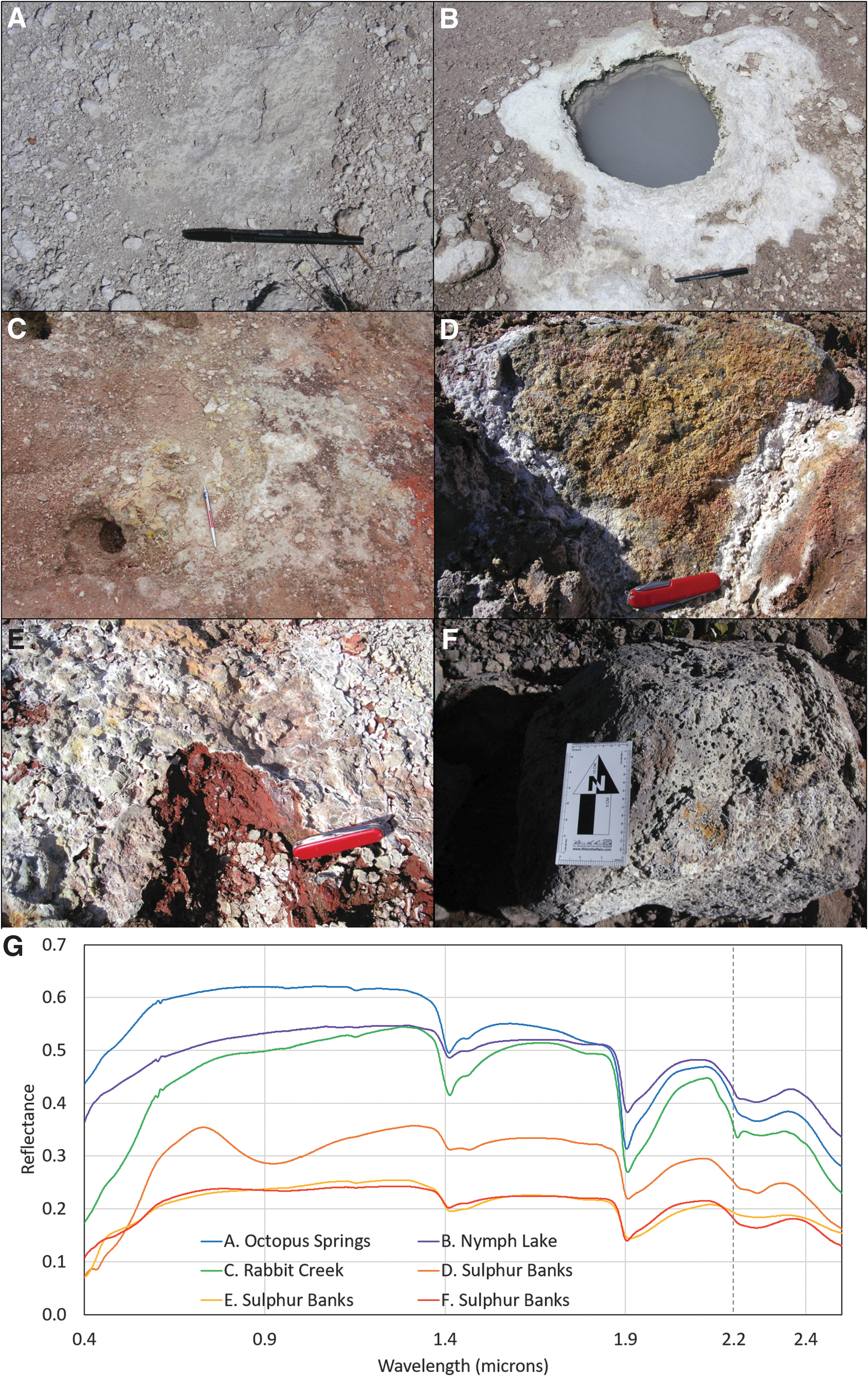
Samples examined for this study were collected at various sites from Yellowstone National Park, New Zealand, and Hawaii (Table 1). The Yellowstone and New Zealand sites represent hot springs (Fig. 1A–C) ranging from neutral-alkaline to acidic in pH; some of these settings have experienced subsequent acid-sulfate fumarolic alteration after sinter deposition. The pH conditions in which these particular sinters were deposited are well documented in the reported literature (Sections 2.1.1–2.1.3) and were confirmed in the field by measuring the pH of the spring waters at the sampling sites. Other spring sites have also been considered possible analogues for Mars, such as those in Chile (e.g., Ruff and Farmer, 2016) and Iceland (e.g., Cousins et al., 2013), but our field sites focus on locations within the Yellowstone National Park and New Zealand due to the extensive literature that exists on the presence and geologic context of opaline silica at these spring sites (Sections 2.1.1–2.1.3).
This Table Lists the Samples in This Study and Provides Information on Their Localities, and the Opal Type, Accessory Mineralogy, and X-Ray Powder Diffraction Full-Width at Half-Maximum Intensity Values for the Samples Studied
GPS coordinates are provided for the general field site locations and were not collected for each individual sampling location.
FWHM = full-width at half-maximum intensity; HI = Hawaii; KD = Ka'u Desert; ML = Mauna Loa; MU = Mauna Ulu; NL = Nymph Lake; OS = Octopus Spring; RCF = Rabbit Creek F; RCM = Rabbit Creek M; SB = Sulphur Banks; SC = Steep Cone; SI = Sinter Island; SM = Sentinel Meadow; SV = Steam Vents; TH = Tahunaatara; TK = Te Kopia; UM = Umukuri.
The Hawaii sites are modern acid-sulfate fumarolic environments in which basaltic protoliths are leached to produce opaline silica (Fig. 1D–F). As a silica-producing, Mars-relevant setting, these volcanic fumaroles provide a point of comparison for observations of the hot spring locations. We note that while sedimentary silica produced in lacustrine and other aqueous systems is also relevant for Mars (e.g., Hurowitz et al., 2017), these silica settings are not included in the scope of this study. Orbital detections of hydrated silica that are associated with sedimentary strata or morphologic indicators of alluvial, fluvial, and lacustrine activity could reasonably be interpreted to have a sedimentary origin (or be detrital). In contrast, hydrated silica detected in nonsedimentary contexts, and those in volcanic terrains in particular, may be more likely to have a hot spring and/or fumarolic origin whose geologic context is less clear from the orbit. In this study, we focus on whether or not these two formation environments can be differentiated from orbit, with an emphasis on mineralogy.
2.1.1. Yellowstone National Park
The Yellowstone National Park is home to a variety of acidic or alkaline hot spring environments that host abundant microbial life. Opal-rich sinter deposits commonly precipitate from hot spring waters that have dissolved rhyolitic bedrock and often encase and preserve microfossils (e.g., Walter and Des Marais, 1993; Cady and Farmer, 1996; Guidry and Chafetz, 2003). The country rock is predominantly composed of rhyolite as well as rhyolitic tuffs and volcanic breccias and glacial deposits at some sites (e.g., at Rabbit Creek) (Vitale et al., 2008).
Samples examined in this study come from alkali-chloride hot spring sites at Octopus Spring (OS), Rabbit Creek F (RCF), Sentinel Meadow (SM), and Steep Cone (SC), and from acidic hot spring sites at Rabbit Creek M (RCM) and Nymph Lake (NL). Note that samples were collected from two localities at Rabbit Creek, with the “M” and “F” modifiers corresponding to samples contributed by Ralph Milliken and Jack Farmer, respectively. OS is an alkali-chloride hot spring with pH ∼8 and temperatures in the 60–90°C range. The Rabbit Creek site is primarily alkaline with a pH of 9–10 and temperatures ranging from 70°C to 80°C, although some areas can reach more acidic pH of 3–5. Hot springs at SM and the nearby SC site range in pH from 7 to 9.5 and temperatures can exceed 80°C (Inagaki et al., 2001; Meyer-Dombard et al., 2005; Ball et al., 2008). NL is an acidic hot spring environment (pH ∼3) with a temperature of ∼25°C (Nordstrom et al., 2005; Ball et al., 2008).
2.1.2. New Zealand Taupo Volcanic Zone
New Zealand's Taupo Volcanic Zone (TVZ) is home to several geothermal fields with numerous hot springs, some of which later experience fumarolic alteration. Sinters precipitate from both alkali-chloride and acid-sulfate waters that have interacted with predominantly rhyolitic country rock (e.g., Wilson et al., 1995), and silica residue has formed at sites undergoing acidic steam condensate or fumarolic alteration. These processes have produced deposits spanning the full opal sequence from opal-A to microcrystalline quartz. Our samples originate from sites near the Orakei Korako geothermal field of the TVZ: Umukuri (UM), Sinter Island (SI), Tahunaatara (TH), and Te Kopia (TK).
The UM sinter is a late Pleistocene deposit (27,000–200,000 years old) that extends over an area of 0.8 km2 (Campbell et al., 2001). Opal-A is notably absent, with opal-CT in the upper horizons, opal-C in the middle layers, and microcrystalline quartz in the lowermost portions. The deposit has been uplifted by fault activity, which may have hindered alteration and resulted in a relative lack of accessory minerals (Campbell et al., 2001, 2015; Herdianita et al., 2000a; Lynne and Campbell, 2003). The TH sinter is ∼14,000–20,000 years old and originally covered an area of 1–2 km2. The present-day 90-m-long deposit has a well-exposed vertical profile dominated by opal-A and some opal-CT in the lower, older strata. Detrital plagioclase and quartz remain from fluvial, lacustrine, and volcaniclastic sediments, and kaolinite points to acidic steam condensate alteration in the sinter's history (Campbell et al., 2003; Rodgers et al., 2004).
SI is an ∼4-m-wide sinter deposit initially deposited from alkali-chloride waters and subsequently affected by acidic steam condensate processes. Despite its young age of 450 years, SI contains the full opal-A to quartz sequence, produced from rapid diagenesis facilitated by acidic conditions (Lynne et al., 2007; Campbell et al., 2015). The TK sinter is ∼3500 years old (Martin et al., 2000) and has undergone several alteration events as recorded in its diverse mineral assemblage. Sinters bearing opal-A were initially deposited from near-neutral alkali-chloride waters, which produced accessory chlorite calcite, pyrite, and illite, and incorporated detrital quartz, plagioclase, pyroxene, hornblende, and Fe/Ti-oxides. Present-day alteration is dominated by acid-sulfate and fumarolic processes, which have altered some opal-A to opal-CT and formed kaolinite, alunite, alunogen, hematite, and jarosite (Herdianita et al., 2000a; Rodgers et al., 2002; Lynne and Campbell, 2003, 2004).
2.1.3. Hawaii
Hawaii has long been favored as a Mars analog site by virtue of its basaltic composition, long history of volcanic activity, and water/rock interaction of mafic protoliths (e.g., Allen et al., 1981; Morris et al., 2000). Our sampling locations include the Ka'u Desert (KD), Mauna Loa (ML), Mauna Ulu (MU), as well as the Sulphur Banks (SB) and the Steam Vents (SV) locations within Hawaii National Park. Basaltic rocks at these sites experience fumarolic leaching processes at acidic pH, resulting in the formation of amorphous opaline silica as coatings and/or rinds on basaltic rocks (e.g., Minitti et al., 2007; Chemtob et al., 2010; Seelos et al., 2010).
Volcanic emissions of sulfuric gases near the ML, MU, and the young (<1000 years) KD sites enable acid-sulfate leaching of basalt, producing thin silica-rich coatings with accessory gypsum, Al-phases (e.g., allophane, imogolite, disordered gibbsite, and halloysite), and Fe/Ti-bearing minerals (e.g., anatase and rutile) (Farr and Adams, 1984; Curtiss et al., 1985; Schiffman et al., 2006; Minitti et al., 2007; Chemtob et al., 2010; Seelos et al., 2010; Chemtob and Rossman, 2014). The SB and SV sites are situated next to the Kilauea caldera and experience extensive acid-sulfate leaching and solfataric alteration (Payne and Mau, 1946). These processes produce a wealth of alteration products including opal, sulfur, sulfates (e.g., gypsum), Al-phases (e.g., kaolinite and halloysite), and Fe-oxides (e.g., hematite and goethite).
2.2. Laboratory methods
A total of 135 samples were obtained from the Hawaii, Yellowstone, and New Zealand sites (Table 1) to study the mineralogical and spectral characteristics of siliceous materials from hot spring and fumarolic environments. Sampling locations were selected in the field after assessments with an Analytical Spectral Devices (ASD) portable spectroradiometer (FieldSpec3); thus, the collected samples are meant to be representative of the outcrops in terms of texture and spectra (Fig. 1). For the broader scale geologic context of these areas, we refer the reader to the extensive literature on these sites (references in Section 2.1). Opal type and accessory mineralogy were determined from powder X-ray diffraction, which was the first technique used to classify the opal-A/CT/C types (Jones and Segnit, 1971). Visible near-infrared reflectance spectra of these samples were also acquired and spectral properties were correlated with opal type and mineralogy (Sun, 2017; Sun and Milliken, 2018).
Bulk rocks (hand samples) and chips (up to a few centimeters in dimension) were obtained for 43 samples from Hawaii, 16 from Yellowstone National Park, and 45 from New Zealand (in the form of small <0.5 g cores). An additional 27 Yellowstone samples were measured only as bulk powders. Chips and cores were ground by hand with a corundum mortar and pestle until all of the samples could be dry sieved to <45 μm. Separate powders for coatings, weathering rinds, and rock interiors were prepared when feasible. Our preparation resulted in powders for 47 Hawaii samples (including separates of three chips), 43 Yellowstone samples (including the 27 prepowdered samples), and 45 New Zealand samples. Sampling localities and GPS coordinates are provided in Table 1 and described in further detail in Sun (2017).
2.2.1. X-ray powder diffraction
All opal phases exhibit a primary X-ray powder diffraction (XRD) feature centered at a d-spacing of ∼4.1–4.0 Å (21.68–22.22° 2θ when using a CuKα source), but the breadth and shape of this feature vary for different opal types (Fig. 2) (Jones and Segnit, 1971; Graetsch et al., 1994; Guthrie et al., 1995; Elzea and Rice, 1996; Campbell et al., 2001). Due to its highly disordered and amorphous nature, opal-A is characterized by a single broad peak or hump centered at ∼4.0 Å and spanning 2.6–5.9 Å (or 15–35° 2θ). XRD patterns of opal-CT exhibit four narrow features, consisting of a primary peak at 4.13–4.06 Å (21.51–21.89° 2θ), less intense tridymite shoulders at 4.32 and 3.9 Å (20.56° and 22.80° 2θ), and a weaker reflection at 2.50 Å (35.92° 2θ). Patterns for opal-C exhibit an even sharper peak at ∼4.06–4.04 Å (21.89–22.00° 2θ), reflecting an increase in ordering and resembling the XRD pattern of α-cristobalite. Similarly, diffraction patterns of microcrystalline quartz appear much the same as those of quartz, with strong peaks at 4.26 and 3.34 Å (20.85° and 26.69° 2θ).
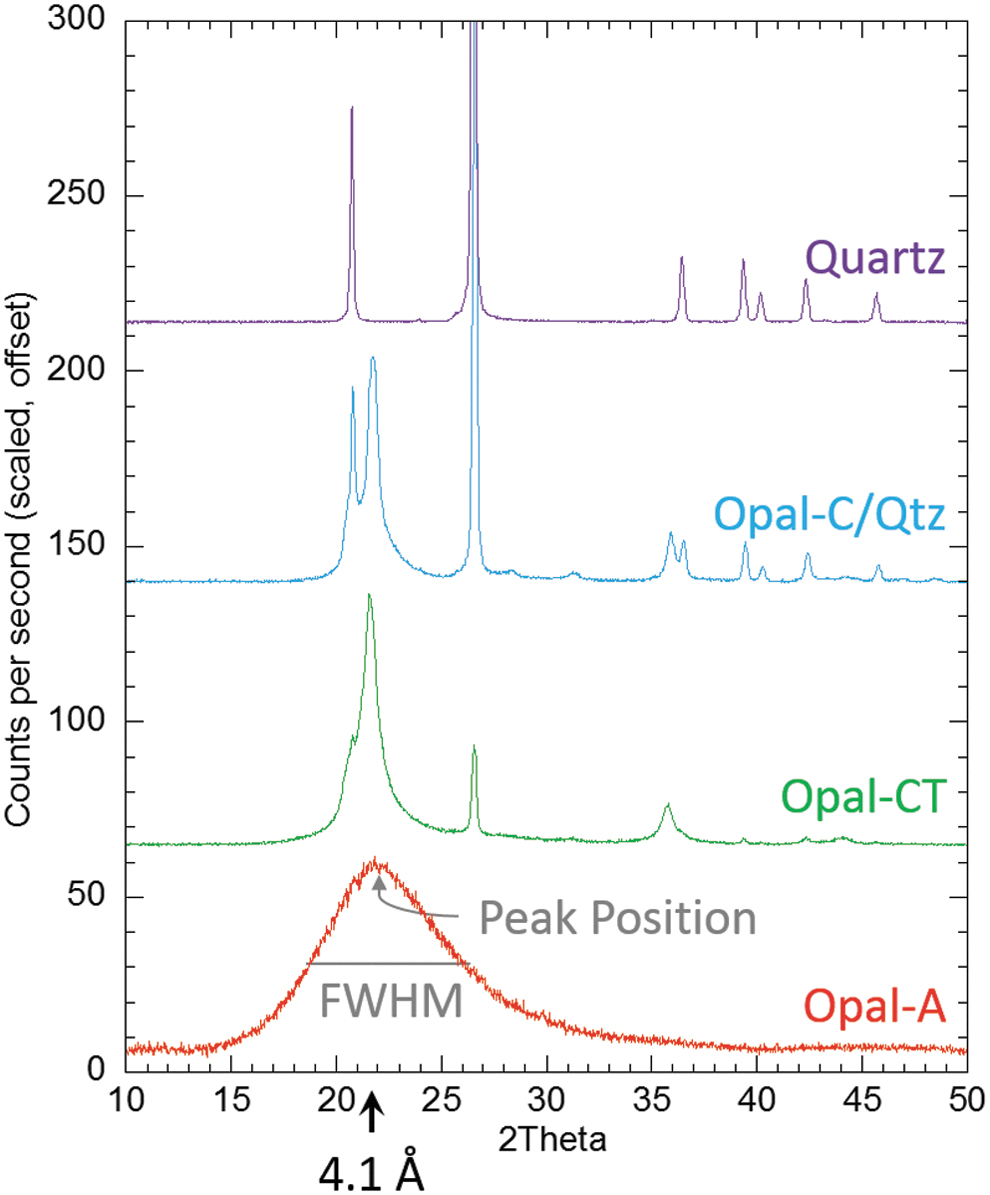
Representative XRD patterns of opal-A, opal-CT, opal-C with quartz, and quartz from the samples studied in this work. Annotations indicate the parameters that are related to opal crystallinity: the 4.1 Å FWHM and peak position. FWHM, full-width at half-maximum intensity; XRD, X-ray powder diffraction.
The opal phases exhibit a gradation of diffraction patterns that reflects the continuum of opal crystallinity. The most commonly used indicator of opal type is the width of the 4.1 Å feature, which can be parameterized by using the full-width at half-maximum (FWHM) intensity, with more ordered materials corresponding to smaller FWHM values. These values tend to be greater than 6.0° 2θ for opal-A and decrease sharply for opal-CT, which ranges between 0.5° and 1.7° 2θ, and opal-C, which ranges from 0.4° to 0.57° 2θ (Graetsch et al., 1994; Elzea and Rice, 1996; Herdianita et al., 2000a, 2000b). When multiple species are present in a sample, the FWHM values tend to be intermediate between the individual opal component values (Campbell et al., 2001).
XRD patterns of the powder samples were obtained by using a Bruker D2 Phaser fitted with a Cu Kα source. Samples were loaded onto a 2.5-cm-diameter PMMA polymer mount or a 1.0-cm-diameter zero-background plate for less abundant samples. Each sample was scanned from 10° to 70° 2θ at a 0.02° 2θ step size with a time step of up to ∼20–30 s per 0.02° 2θ. Samples loaded in the zero-background plates were scanned at longer time steps to compensate for the smaller surface area.
Crystalline phases were identified with the DIFFRAC.EVA software by comparison with the ICDD PDF2 and ICDD PDF4 libraries. The opal type in each sample was identified by calculating the FWHM of the amorphous XRD hump centered at 4.1 Å. The raw XRD data were first background-corrected in DIFFRAC.EVA to remove the low-angle background slope that is attributed to scattering from the sample mount. For purposes of the FWHM calculation for opal-A, the discrete peaks (e.g., of cristobalite or quartz) were removed from the background-corrected opal-A pattern to avoid overestimation of the 4.1 Å peak intensity.
2.2.2. Visible near-infrared reflectance spectroscopy
Reflectance spectroscopy at visible and near-infrared wavelengths provides mineralogic information that corroborates the XRD mineral identifications. Importantly, reflectance spectroscopy provides a rapid mechanism by which minerals in a sample can be identified remotely, and this technique has facilitated the majority of our knowledge of the distribution of hydrous minerals on the martian surface at a global scale (e.g., Bibring et al., 2006; Mustard et al., 2008; Murchie et al., 2009). Comparison with laboratory spectra of well-characterized terrestrial opal samples enables further interpretation of the orbital spectral data of Mars.
Reflectance spectra of both rock chips and powders were obtained from 0.4 to 2.5 μm on an ASD FieldSpec 3 spectroradiometer at a sampling resolution of 1 nm. Measurements were taken over ∼0.5-cm-diameter spot sizes for powders, with incidence and emergence angles of 30° and 0°, respectively. For rock chips, spectra were acquired over a spot size spanning the entire chip to reduce the effects of heterogeneously distributed minerals. The data were taken with respect to a Spectralon standard and later corrected for absolute reflectance by multiplication with a Spectralon spectrum obtained from the NASA Reflectance Experiment Laboratory (RELAB) bidirectional spectrometer. Spectra were then continuum-corrected following the methods of Clark and Roush (1984) to facilitate measurements of band positions. The band positions and shapes of absorption features were then used in conjunction with the XRD patterns to identify mineralogy (Section 2.4).
2.3. Compact Reconnaissance Imaging Spectrometer for Mars methods
Orbital visible near-infrared reflectance (VNIR) spectral data from the Compact Reconnaissance Imaging Spectrometer for Mars (CRISM; 18–36 m/pixel) instrument onboard the Mars Reconnaissance Orbiter (Murchie et al., 2007) were analyzed to determine mineral assemblages present on Mars. The CRISM scenes studied were selected from globally distributed scenes known to contain hydrated silica (Sun and Milliken, 2018 and references therein). CRISM data cubes were processed in the ENVI software package using the CRISM Analysis Toolkit v6.6 after applying standard photometric, atmospheric, and data spike corrections (Parente, 2008; McGuire et al., 2009). Parameter maps (Pelkey et al., 2007; Viviano-Beck et al., 2014) were used to highlight regions likely to contain minerals with VNIR absorption features, and spectra were manually inspected to confirm the presence of diagnostic absorption features (Section 2.4). The geologic contexts of hydrated silica and accessory minerals were then assessed in 25 cm/pixel and 50 cm/pixel High Resolution Imaging Science Experiment (HiRISE) images (McEwen et al., 2007) and ∼6 m/pixel Context Camera (CTX) (Malin et al., 2007) images.
2.4. Mineral identification
The hydrated minerals expected in hot spring and fumarolic environments can be identified in VNIR spectra by absorption features related to H2O and OH in the mineral structures (Fig. 3). Opal is identified by absorptions generally centered at 1.4, 1.9, and 2.2 μm, respectively, due to OH stretch overtones (from SiOH and H2O), a combination bend and stretch mode of H2O, and SiOH vibrations in the opal structure. Each of these features can be decomposed into two individual absorptions related to different populations of H2O and SiOH, where the longer wavelength absorptions (at 1.46, 1.96, and 2.26 μm) are attributed to H2O or SiOH that is H-bonded to H2O, and the shorter wavelength absorptions (at 1.41, 1.91, and 2.21 μm) are attributed to non-H-bonded H2O or SiOH (Langer and Florke, 1974).
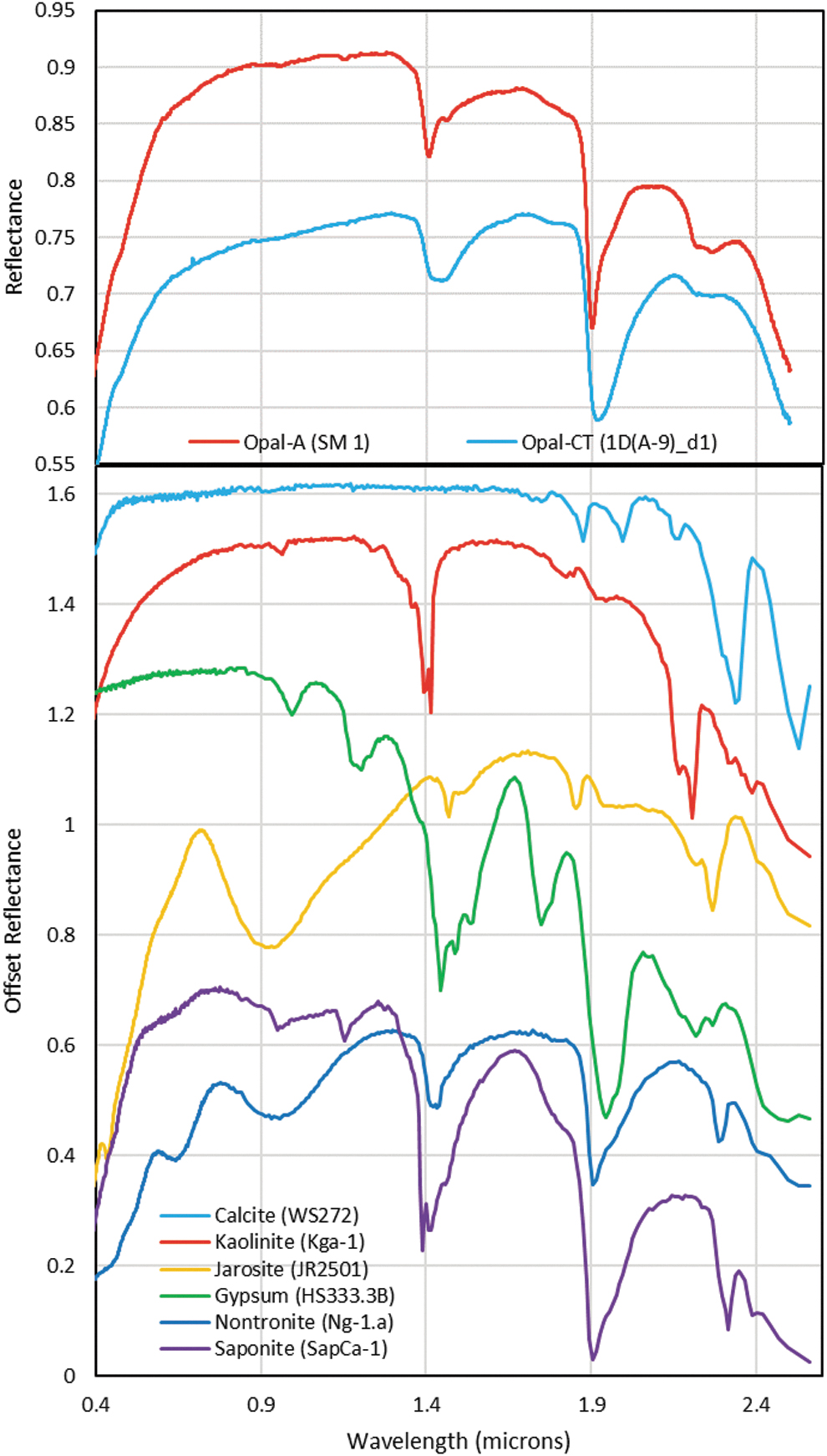
Laboratory spectra of (top) opal-A and opal-CT and (bottom) other hydrated minerals such as calcite, kaolinite, jarosite, gypsum, nontronite, and saponite from the USGS library.
Opal-A and opal-CT exhibit different proportions of H-bonded and non-H-bonded H2O and SiOH groups. This enables opal-A to be spectrally distinguished from more crystalline hydrated silica by the band position of the 1.4 μm feature, at both ambient terrestrial and Mars-like atmospheric conditions (Sun, 2017; Sun and Milliken, 2018). Specifically, opal-A is characterized by band positions short of 1.405 μm, whereas more crystalline hydrated silica exhibits band positions longer than 1.413 μm. Band positions between 1.405 and 1.413 μm may correspond to either opal-A with a “high” hydration state or crystalline hydrated silica with a “low” hydration state. These criteria have recently been applied to CRISM data to demonstrate the presence of both opal-A and more crystalline hydrated silica (e.g., opal-CT and microcrystalline quartz) across the martian surface (Sun and Milliken, 2018).
Other hydrated minerals that may accompany opal in hot spring or fumarolic environments may also be characterized by OH/H2O features at 1.4 and 1.9 μm, in addition to other diagnostic absorptions in the 2.0–2.6 μm wavelength range (Fig. 3). Fe/Mg smectites are commonly identified on Mars from orbital spectroscopy and are characterized by features at 1.4, 1.9, and 2.3 μm, the latter due to a combination of Mg/Fe-OH bend and stretch overtones (e.g., Clark et al., 1990). Fe-rich smectites such as nontronite exhibit band positions near 2.28–2.29 μm (e.g., Bishop et al., 2002), whereas Mg-rich smectites such as saponite have band positions at longer wavelengths closer to 2.31 or 2.32 μm (Clark et al., 1990). In contrast, kaolinite is characterized by a weak/absent 1.9 μm absorption and asymmetric “doublet” absorptions at 1.4 and 2.2 μm, the latter feature exhibiting two distinct reflectance minima at 2.16 and 2.21 μm due to Al-OH vibrations (Clark et al., 1990).
Reflectance spectra of anhydrous carbonates are not expected to exhibit 1.4 and 1.9 μm hydration features, but they do exhibit distinctive paired absorptions near 2.3 and 2.5 μm. The paired 2.3 and 2.5 μm features are the overtones of fundamental carbonate absorptions at longer wavelengths (Lane and Christensen, 1997) and their exact band positions indicate the cation (Mg, Ca, and Fe) paired to the carbonate anion (Hunt and Salisbury, 1971; Gaffey, 1987). Mg-carbonates (e.g., magnesite) have absorptions at 2.31 and 2.51 μm, whereas Fe-carbonates (e.g., siderite) absorb at 2.33 and 2.53 μm, and Ca-carbonates (e.g., calcite) at 2.34 and 2.54 μm.
Spectra of gypsum also exhibit hydration features at 1.4, 1.9, and 2.2 μm, which are each composed of at least three overlapping absorptions (Clark et al., 1990). Jarosite is a hydrated sulfate mineral that is typical of Fe-bearing acidic conditions, and its spectrum is characterized by an OH stretch overtone at 1.47 μm and an asymmetric absorption centered at 2.26 μm due to a combination OH stretch and Fe-OH bend.
3. Results
A summary of the opal type and accessory mineralogy in hot spring and fumarolic environments is presented in Table 2. We focus on identifying minerals that exhibit VNIR spectroscopic features that would enable their detection from orbital data sets of Mars, such as CRISM and OMEGA (Observatoire pour la Minéralogie, l'Eau, les Glaces et l'Activité) (Bibring et al., 2005). We note that certain crystalline silica minerals (e.g., quartz, cristobalite, and tridymite) and mafic minerals (e.g., pyroxene, plagioclase, olivine, and spinel) in the terrestrial samples may be attributed to incorporation of detrital igneous materials in the sinter deposits (e.g., Campbell et al., 2003; Bishop et al., 2004).
Summary of the Opaline and Crystalline Minerals in Our Sample Suites
The number of samples containing each phase is also indicated. “Pure” opal-A or opal-CT indicates that those samples contain no other accessory minerals.
NZ = New Zealand; YS = Yellowstone.
3.1. Opal type and accessory minerals in hot spring environments
3.1.1. Neutral/alkaline hot springs
Sinter samples from neutral to alkaline hot springs are characterized by very high opal content with few other accessory minerals. Hot springs with neutral to alkaline pH represented in our sample suite are the OS, SC, SM, and RCF sites in the Yellowstone National Park, and the UM, TH, and Orakei Korako sites from New Zealand.
The 28 neutral to alkaline Yellowstone samples all predominantly consist of opal-A, identified from their prominent amorphous humps in the XRD patterns and distinct Si-OH features in the reflectance spectra. Of these samples, only one, from the Rabbit Creek RCF group, showed evidence for incipient development of an opal-CT peak in the XRD pattern. Six samples from SC consist solely of opal-A with no other detectable accessory minerals. Few accessory minerals are present in the remaining samples; of the nondetrital minerals (plagioclase, quartz, and cristobalite), halite occurs in four samples, calcite in two samples, and kaolinite in one sample.
Other minor phases include Ti- and Zn-bearing minerals such as titanite, anatase, rutile, ilmenite, and sphalerite. Although not observed in our samples, Mg-Si clays are also common to neutral/alkaline hot springs (e.g., Jones and Renaut, 2003). These accessory minerals have been observed to commonly occur alongside opaline silica in hot spring deposits, and can occur in a variety of different settings within the spring system, including the proximal parts of the discharge apron, near vents, and along discharge channels (e.g., Jones and Renaut, 2003).
The New Zealand samples exhibit greater diversity in opal type, ranging from opal-A to opal-CT and quartz. The six TH samples all contain opal-A, although opal-CT has previously been documented in lower horizons of the outcrop (Rodgers et al., 2004). Few accessory minerals are identified in these samples but include hematite and Ti-bearing minerals (titanite and ilmenorutile). Previous studies have also identified kaolinite formed from acidic steam condensate alteration at TH (Campbell et al., 2003; Rodgers et al., 2004), although we do not observe this in our samples. Of the 16 UM sinter samples, 14 contain opal-CT with subordinate quartz and two are pure quartz. No other accessory minerals are present in these samples, consistent with halted alteration due to uplift of the sinter (Campbell et al., 2001). Four other samples come from the Orakei Korako Boardwalk region. These samples are primarily opal-A with minor quartz and titanite or opal-CT with quartz.
3.1.2. Acidic and fumarolic hot springs
Sinters from acidic hot springs—those that either precipitated from acidic waters or were subsequently affected by acidic fumarolic leaching—also tend to have mineral assemblages that are dominated by opal and often accompanied by kaolinite. Acidic hot springs are the NL and RCM sites in Yellowstone, and the SI and TK sites in New Zealand.
Similar to the neutral/alkaline Yellowstone samples, the 15 acidic Yellowstone samples also all consist of opal-A. However, all, but one of the seven RCM samples, additionally contain kaolinite. More minor accessory phases in the RCM suite include one occurrence of calcite and magnesite, as well as Ti-bearing minerals (titanite, anatase, and ilmenite). The NL samples exhibit comparatively shallower XRD amorphous humps, suggesting a lesser abundance of opal-A compared with the other Yellowstone samples regardless of pH. Accessory minerals in the NL suite include one occurrence of gypsum and two occurrences of kaolinite, in addition to several instances of Ti-bearing phases. Coincidentally, orthoclase is found only in samples from the NL site in our Yellowstone suite, and it is likely retained from the rhyolitic country rock. The presence of orthoclase, relative infrequency of kaolinite (which can form from weathering of orthoclase), and lack of significant opal-A at NL suggest that alteration processes at this site are relatively incipient.
Nineteen samples from SI and TK comprise the acidic hot spring settings represented in the New Zealand suite. The SI samples contain opal-A, opal-A/CT, and opal-CT and document the early stages of diagenesis, although the full diagenetic sequence up to quartz has been previously documented (Lynne et al., 2007). TK samples contain both opal-A and opal-CT. In all of the New Zealand samples, kaolinite is present in only the acidic SI and TK samples. Specifically, kaolinite is found only in the four opal-CT samples from TK and the three opal-A/CT samples from SI that show incipient conversion of opal-A to opal-CT, and it is not present in samples with only opal-A. This association of kaolinite with opal-CT may indicate acceleration of diagenesis by acidic alteration events (Lynne et al., 2007).
3.2. Opal type and accessory minerals in volcanic fumarolic environments
Opaline silica is also produced in volcanic fumarolic environments, such as those found on Hawaii, via acidic leaching of basaltic protoliths. However, in contrast to hot springs, these volcanic fumarolic environments produce relatively more complex mineral assemblages from the aqueous alteration of basalt. Almost half of the Hawaii samples lack a discernable amorphous or opaline component. Twenty-nine samples from the KD, ML, and MU sites lack a significant amorphous component and only exhibit a modest broad hump in their XRD pattern when opal-A is present. Aside from igneous minerals such as olivine, pyroxene, and plagioclase, few other accessory minerals are present in these samples but include hematite, gibbsite, gypsum, jarosite, and akaganeite.
The 18 samples from the SB and SV subgroup stand out as having a significantly higher opal content and diversity of other accessory minerals based on their XRD patterns. Almost all of these samples contain substantial opal-A as indicated by prominent XRD humps. The SB and SV samples also host a range of Ti-bearing phases (e.g., anatase, rutile, and ilmenite) and alteration minerals, including sulfates (jarosite, alunite, and gypsum), kaolinite, hematite, and sulfur. Measurements of rock coatings and bulk powders from two samples (HISB 1 and HISB 2) appear to show segregation of opal-A in the thick white coating and opal-CT in the bulk (red colored) powder. Overall, the samples in this subgroup tend to exhibit greater opal content and diversity of accessory minerals compared with the other subgroup, possibly indicating more advanced alteration and/or chemical leaching processes at these sites.
3.3. Comparison of mineral assemblages and detectability in VNIR spectra
The mineral assemblages produced in terrestrial siliceous hot springs are distinct from those produced via fumarolic weathering of basaltic rocks (Table 3). Samples from the hot spring sinters studied in this work are composed almost entirely of opaline silica phases that range from opal-A to opal-CT and quartz. The sinter samples contain few other detrital or accessory alteration minerals, most notably halite, calcite, and kaolinite (as well as Mg-clays) (Rodgers et al., 2002). The assemblages produced in volcanic fumarolic environments may also include opal, but primarily in the form of amorphous opal-A rather than more geochemically mature phases, perhaps reflecting the younger ages and lower water/rock ratios of the Hawaii sites. The fumarolic samples also contain abundant detrital minerals, including olivine, pyroxene, plagioclase, and spinel, as well as accessory alteration minerals such as hematite, kaolinite, gibbsite, gypsum, jarosite, and akaganeite.
Summary Table Describing the Opal Type and Accessory Minerals Present in Neutral/Alkaline and Acidic Hot Springs, with Those Produced in Volcanic Fumarolic Environments for Comparison
The defining spectral characteristics for each of these environments represent a highly generalized collection of phases that could be identified in VNIR spectral data and therefore applied to orbital Mars data such as CRISM and OMEGA reflectance spectra.
CRISM = Compact Reconnaissance Imaging Spectrometer for Mars; OMEGA = Observatoire pour la Minéralogie, l'Eau, les Glaces et l'Activité; VNIR = visible near-infrared reflectance.
Sinter samples also exhibit differences in mineral assemblage depending on whether they precipitated in neutral/alkaline pH or acidic pH conditions (or if they were subsequently exposed to a fumarolic environment). The main distinguishing factor between neutral/alkaline sinter samples and acidic sinter samples appears to be the preferential presence of kaolinite in acidic sinter samples. In almost all of our hot spring samples from Yellowstone and New Zealand, kaolinite occurs only in samples from acidic hot springs or those that experienced subsequent fumarolic alteration (cf. Livo et al., 2007). More specifically, kaolinite is most closely associated with acidic samples containing more crystalline opal (e.g., opal-CT), suggesting that kaolinite is more likely to form later in opal diagenesis in these acidic hot spring settings. This association is consistent with the hypotheses that acidic conditions, such as those that may produce kaolinite, may accelerate opal diagenesis (Lynne et al., 2007).
A number of the minerals identified in the hot spring and fumarolic samples are detectable at VNIR wavelengths (Section 2.4), which is the wavelength range most commonly used to identify high-resolution (i.e., ∼18 m/pixel) surface mineralogy on Mars. The detectable minerals characteristic of a neutral/alkaline hot spring environment are opaline silica, ranging from amorphous opal-A to opal-CT and quartz, and potentially calcite. The few other minerals we observe in the neutral/alkaline hot spring assemblages are relatively spectrally neutral at VNIR wavelengths. Acidic or fumarolic hot springs may also be spectrally identified as containing the full range of opal crystallinity (opal-A to -CT), in addition to accessory kaolinite and gypsum, where the kaolinite may preferentially occur with more crystalline opal phases.
We observe that the volcanic fumarolic environments may contain similar mineral assemblages as acidic hot springs, but samples from the former tend to have more mineralogical diversity and incorporate mafic mineralogy from the basaltic protolith. Another key distinction of volcanic fumarolic environments appears to be the presence of only amorphous opal-A and a relative lack of more crystalline opal compared with hot spring environments, possibly due to a longer history of water/rock interactions and a higher water/rock ratio in hot spring settings. This anticipated difference in opal type between hot spring and volcanic settings would be discernable in VNIR spectra (e.g., Sun and Milliken, 2018). The detectable phases in a volcanic fumarolic environment include opal-A, mafic minerals such as olivine, pyroxene, and plagioclase (some of which exhibit VNIR absorptions) (Wray et al., 2013; Carter and Poulet, 2013), and accessory hematite, kaolinite, gibbsite, gypsum, and jarosite.
4. Discussion: Implications for Hot Spring Identification on Mars
If highly generalized, observations based on the terrestrial examples suggest that it may be possible to identify potential hot spring environments on Mars by using orbital spectroscopic data and distinguish them from other silica-producing environments such as volcanic fumarolic settings. For example, a location bearing more crystalline opal (e.g., opal-CT rather than opal-A) may be more likely to indicate a hot spring environment rather than a fumarolic setting. More specifically, such a location that contains only opal, or opal with accessory calcite or Fe/Mg clays, may be representative of a neutral/alkaline hot spring.
Distinguishing acidic hot springs from volcanic fumarolic environments based on mineral assemblage alone is more challenging, as both can contain accessory kaolinite and gypsum in addition to opal. The distinguishing spectral factors between acidic hot springs and volcanic fumarolic environments may therefore be the presence of more crystalline opal (e.g., opal-CT) in acidic hot springs and the presence of other minerals such as jarosite, and olivine and pyroxene (from the parent basaltic photolith) in volcanic fumarolic settings.
In this section, we apply our terrestrial observations to orbital CRISM data in an initial exploration of siliceous sites on Mars. We synthesize characteristics such as opal type, accessory mineralogy, and geologic setting or host material to identify the locations that may be consistent with ancient hot spring settings versus other silica-producing environments. However, we also caution and discuss the caveats associated with interpreting formation environments from orbital data sets.
4.1. Application to Mars orbital data sets
A number of locations on Mars contain opaline silica, both alone and in the presence of other accessory minerals (Fig. 4). Of 190 globally distributed detections, both within craters (Sun and Milliken, 2015) and in intercrater regions (Sun and Milliken, 2018 and references therein), 40.5% of detections are of opal without accessory hydrous phases, and 42.6% are of opaline silica that occurs with Fe/Mg smectite in the same CRISM scene. These detections are possibly consistent with a neutral/alkaline hot spring on the basis of the monomineralic opal detection and/or the lack of acidic mineral assemblages. The other 16.8% of opaline silica detections are associated with minerals that may indicate more acidic conditions, including kaolinite and jarosite, which may be consistent with either acidic hot spring or volcanic fumarolic environments.

Distribution of opal detections on Mars compiled in Sun and Milliken (2018 and references therein), colored by the overall mineral assemblage. Monomineralic occurrences of opal are in orange, opal co-occurring with Fe/Mg clays are in green, and opal co-occurring with kaolinite or jarosite are in red. The locations of Figures 5 (Nili Patera) and 6 are annotated with the numbers “5,” “6AB,” “6C,” and “6D.” Major opal-bearing regions are also annotated: MV, Mawrth Vallis; NF, Nili Fossae; NL, Noctis Labyrinthus; TS, Terra Sirenum; VM, Valles Marineris.
Although opal crystallinity may be an additional distinguishing factor for hot spring environments, opal types on Mars appear to be closely correlated with the geologic context of the host material. Nearly all opal detections that are spectrally consistent with opal-A occur in lithified bedrock units, whereas many crystalline silica (e.g., opal-CT and hydrated quartz) occurrences on Mars are associated with unconsolidated or weakly indurated deposits (Sun and Milliken, 2018). The latter deposits may represent mobile sediment and are thus difficult to place in a geologic context, and hence, the original formation conditions of the more crystalline hydrated silica in these deposits are indeterminate. Effectively, the areas of Mars where opaline silica is preserved in situ in outcrop, enabling interpretations of formation environment, almost always consist of the opal-A variety. Unfortunately, the mere presence of opal-A is not diagnostic of a hot spring setting and could correspond to almost any silica-forming environment.
4.2. Monomineralic opaline silica detections and occurrences with Fe/Mg clays
4.2.1. Hypothesized hot spring settings
Despite the identification of widespread opaline silica on Mars, only a few orbital detections have been hypothesized as potentially representing hot spring settings. Perhaps the most compelling of these detections to date is the identification of opaline silica near the cone of Nili Patera (Skok et al., 2010). CRISM ratio spectra of the original detection of this hydrated silica exhibited an Si-OH overtone absorption centered at 1.38 μm, most consistent with the presence of opal-A (Fig. 5). CRISM spectra of other nearby opal occurrences at Nili and Meroe Patera, newly reported in Sun (2017) and this work, exhibit Si-OH features at slightly longer wavelengths of ∼1.4 μm and are consistent with slightly more crystalline opal-A (Fig. 5E).
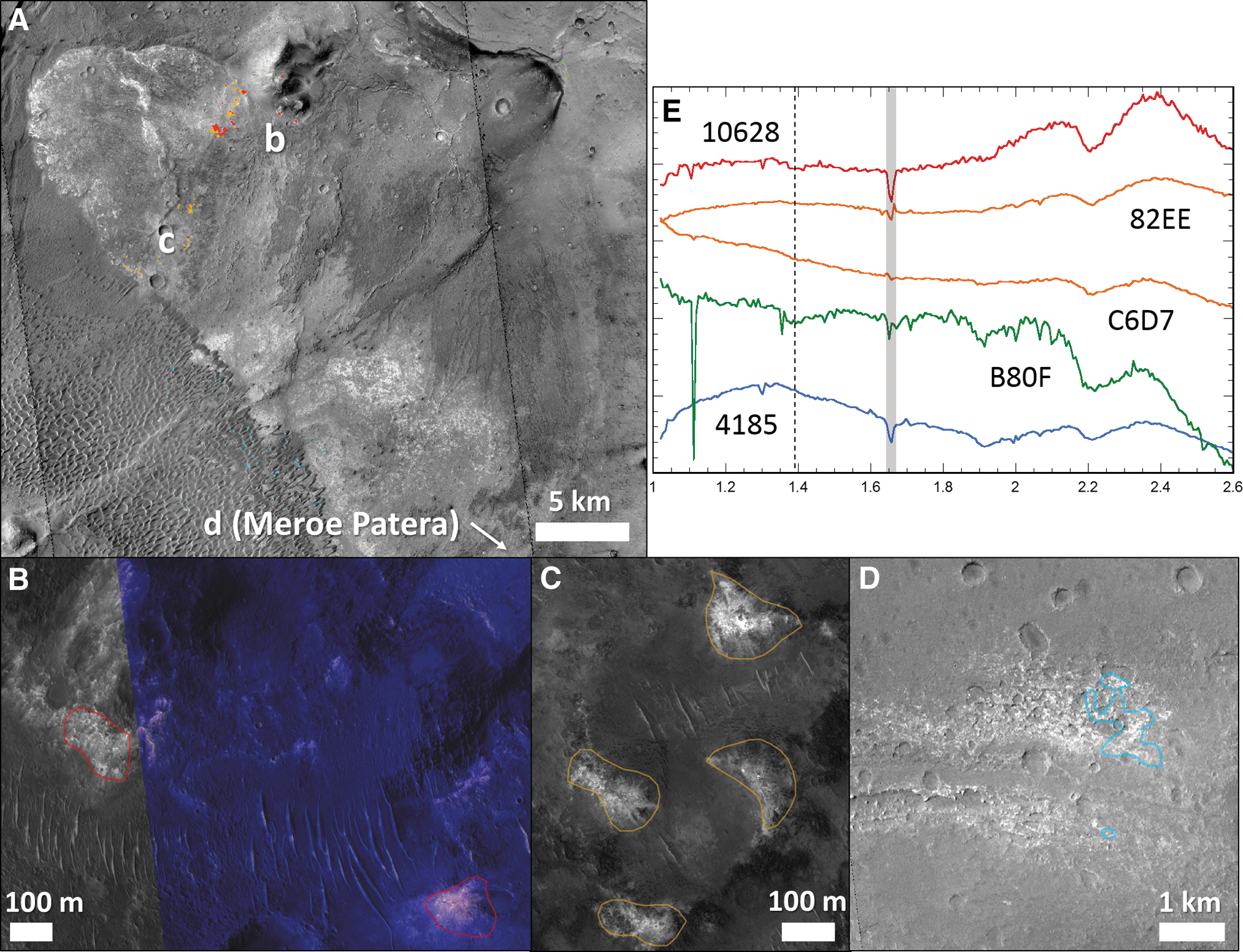
Opal-A detections, of variable crystallinity, in outcrops in the Nili Patera region.
Skok et al. (2010) interpreted the absence of hydrous accessory minerals, the highly localized occurrence of opal, and close association with a morphologic mound feature to represent formation in potential neutral/alkaline hot spring conditions as opposed to formation via acidic fumarolic leaching or alteration. Our results suggest that while the localized and apparent (Section 4.4) monomineralic occurrence of opal is more consistent with a hot spring origin, the identification of opal-A and the association with a mound feature are more ambiguous, as opal-A and volcanic vents occur in fumarolic environments as well. However, in comparison to other martian opal detections, these opal deposits at Nili Patera still remain among the most compelling candidates for a hot spring origin.
Aside from opal-bearing hydrated mineral assemblages associated with acidic minerals in Columbus and Cross craters (Wray et al., 2011; Ehlmann et al., 2016) (Section 4.3), few other siliceous deposits have been interpreted as possible hot spring environments.
Here we also report on opaline silica deposits in Arcadia Planitia that are associated with mound structures that have been proposed to be of volcanic origin (Farrand et al., 2011) (Fig. 6AB). At five locations in this region, we identify CRISM spectra of opaline silica with Si-OH features centered at 1.40–1.42 μm, consistent with relatively crystalline opal-A or perhaps even opal-CT. These detections occur in dark-toned, smooth-textured aprons that surround the mounds and in some cases occur on the flanks of the mound structures. These detections are similar to those at Nili Patera in that opaline silica is the sole hydrated phase detected in the CRISM data and occurs in localized deposits in association with mound features. However, as with the Nili Patera detections, we note that the association with a mound feature is not necessarily diagnostic of a hot spring origin.

Hydrated silica is also found in almost a quarter of crater central peak structures that contain spectral evidence of other hydrous minerals; many of these hydrated silica detections occur in bedrock materials and are spectrally consistent with opal-A (Sun and Milliken, 2015, 2018). Almost all of the opal detections in crater central peaks are monomineralic or associated with Fe/Mg smectite, suggesting formation at neutral/alkaline pH conditions. As these opal deposits are associated with central peaks, they may have formed at depth and been subsequently uplifted during the crater formation process, but the possibility that the opal formed from low-temperature surface alteration after the crater formed cannot be excluded. It is also possible that some of these opal-bearing deposits formed in an impact-induced hydrothermal or spring system, particularly in cases where the opaline silica is associated with units that superpose uplifted materials (Fig. 6). Although this is by no means a unique interpretation, the rather frequent occurrence of opaline silica in crater central peak structures on Mars and the ability of large impacts to establish hydrothermal systems in such structures make these occurrences intriguing possibilities for hot spring deposits.
4.2.2. Other potentially neutral/alkaline settings
Other occurrences of monomineralic opaline silica or opal in association with Fe/Mg clays primarily occur throughout the southern highlands and are interpreted as having formed from detrital or authigenic (but unrelated to hot springs) processes at neutral/alkaline conditions. Several detections occur in potentially fluvio-lacustrine settings, for example, in fan deposits within craters and along the bottom of fluvial channels such as Kasei and Mamers Valles (figure S3 in Sun and Milliken, 2018). Another location of note is Gale crater, the site of ongoing investigations by the Curiosity rover. Opaline silica has been detected from CRISM data (Seelos et al., 2014; Fraeman et al., 2016), and although those specific orbital detections have not been investigated in situ, the Curiosity rover payload has also enabled identification of opal-A and opal-CT in lacustrine mudstones (Morris et al., 2016; Hurowitz et al., 2017). This opal is hypothesized to represent either authigenic lacustrine precipitation or formed from subsequent diagenesis (e.g., Frydenvang et al., 2017).
Opaline silica is also associated with some periglacial deposits that exhibit a mantled, smooth appearance and lobate morphologies in visible imagery, particularly in the vicinity of Hellas basin (Bandfield, 2008; Bandfield et al., 2013). These silica occurrences are hypothesized to have formed authigenically (e.g., Hallet, 1975; Rutledge et al., 2018) through direct precipitation from nonacidic groundwater, although other mechanisms such as transportation and lag formation are also possible (Bandfield et al., 2013).
4.3. Opaline silica occurrences consistent with acidic conditions
Areas where opaline silica co-occurs with hydrous minerals consistent with lower pH conditions, that is, those containing kaolinite and jarosite, tend to be concentrated around Valles Marineris, Noctis Labyrinthus, Mawrth Vallis, Terra Sirenum, and Nili Fossae (Fig. 4). The most extensive of these opal-bearing deposits is at Valles Marineris, where opal is detected throughout the adjacent plains (e.g., Milliken et al., 2008). The Valles Marineris opal deposits are often accompanied by kaolinite and occasionally jarosite within the same CRISM scene (Milliken et al., 2008; Metz et al., 2009), although this spatial association does not necessarily indicate a genetic association. Montmorillonite and local kaolinite occur throughout this area as a regionally extensive unit and are inferred to have formed through pedogenic leaching (e.g., Le Deit et al., 2012).
The large spatial extent of these opal-bearing deposits, which can span tens of kilometers, argues against a hot spring origin, as hot spring deposits are more localized and are at most on the scale of hundreds of meters in extent (e.g., Campbell et al., 2015). The opaline silica may have formed alongside the aluminous clays during leaching or, alternatively, the fluvial landforms that have been observed in association with the silica deposits may indicate a subaqueous, diagenetic, or detrital origin for these opal detections (Milliken et al., 2008; Metz et al., 2009). Opaline silica is also colocated with Fe/Mg clays, Al clays, and jarosite in the Noctis Labyrinthus pits; the complex stratigraphic relationships between these different minerals may point to a complicated alteration history (Weitz et al., 2011, 2013).
Opaline silica is also identified alongside diverse mineral assemblages that include Fe/Mg smectite, chlorite and/or prehnite, kaolinite, zeolite, carbonate, and hematite, in the ancient Noachian Mawrth Vallis and Nili Fossae regions (e.g., Bishop et al., 2008; Wray et al., 2008; Ehlmann et al., 2009). These minerals are observed in a clear stratigraphic sequence, with kaolinite and opaline silica occurring in strata that overlie the Fe/Mg clay-bearing strata. This mineralogic sequence has also been inferred to represent a leaching profile, and thus, the opal-bearing materials here also are likely not representative of ancient hot spring environments. Silica is also found in close association with Fe/Mg smectite and jarosite in the knobby plains in Acidalia Planitia; the association of opal with jarosite and the stratigraphic position above the Fe/Mg smectite-bearing strata have also been interpreted as resulting from acidic leaching (Pan and Ehlmann, 2014).
Silica-bearing assemblages with kaolinite, jarosite, and alunite have also been identified in the Terra Sirenum region, particularly at Columbus crater (Wray et al., 2011) and Cross crater (Ehlmann et al., 2016). Given the more localized occurrences of these opal-bearing assemblages and their context within craters, an acidic hydrothermal spring origin has been suggested for these opal deposits, although other acidic formation mechanisms that include cementation by groundwater or precipitation in paleolakes have also been suggested and/or favored (Wray et al., 2011; Ehlmann et al., 2016).
4.4. Caveats in orbital analyses
It is clear from the results of the terrestrial samples and the inherent limitations of orbital data that a number of caveats must be considered when interpreting orbital data to determine depositional environment, including even the more compelling candidates for possible hot spring deposits (Section 4.2.1). Given the relatively coarse spatial resolution of orbital data sets (i.e., typically 25 cm/pixel for HiRISE and 18 m/pixel for CRISM), it is difficult to uniquely link the inferred mineralogy and morphology of most opal-rich deposits on Mars to determine their most likely mode of formation.
Even the apparent paucity or lack of accessory hydrous minerals in the orbital data is not definitive evidence of a neutral/alkaline hot spring environment because the ubiquitous presence of dust may obscure spectral signatures of other minerals, especially at the 18 m footprint scale of CRISM and if they occur in low abundance compared with opal. Although a single CRISM pixel will inevitably represent a combination of multiple minerals and grain sizes, in addition to mixtures of outcrop and unconsolidated material such as sand and dust, this work attempts to mitigate this complication by also analyzing bulk hand samples and field-acquired spectra (Fig. 1), which produce terrestrial spectra that are more analogous to the outcrop-scale measurements represented in CRISM data.
Orbital data sets allow us to identify candidate hot spring environments for future in situ exploration by landers or rovers, but higher resolution data sets that can only be achieved by rovers or landers are likely needed to resolve the local-scale features and microtextures that are truly diagnostic of an ancient hot spring environment. As an example, the most convincing case for an ancient hot spring deposit on Mars is likely the identification of siliceous deposits at Gusev crater, which relied on high-resolution observations from the Spirit rover to determine draping and stratigraphic relationships between the opaline silica deposit and adjacent units (e.g., Ruff et al., 2011; Ruff and Farmer, 2016). By comparison, the most promising hot spring candidates as identified from orbit, which include the apparently monomineralic and localized opal occurrences at Nili Patera (Skok et al., 2010) and Arcadia Planitia (Section 4.2.1), still have more ambiguous characteristics that are also found in volcanic fumarolic environments (e.g., the presence of opal-A and mound-like structures).
5. Conclusions
This study characterized the opal-rich mineral assemblages produced in several terrestrial hot springs and compared them with assemblages observed in silica-producing volcanic fumarolic environments with the objective to determine which, if any, diagnostic features of hot spring environments could be remotely sensed on Mars. We find that, in general, samples associated with the hot spring environments studied here produce the full suite of amorphous opal-A to more crystalline opal-CT and quartz, whereas samples from volcanic fumarolic environments in Hawaii tend to contain only opal-A due to the shorter duration of water/rock interaction and/or lower water/rock ratios.
Terrestrial hot springs with neutral-to-alkaline pH tend to produce opal-rich sinters with few accessory minerals, which, when present, are typically halite and calcite. Apart from opal type, samples from acidic hot spring and volcanic fumarolic environments may contain similar mineral assemblages, often containing both kaolinite and gypsum in addition to opal. Beyond this similarity, acidic hot springs contain few other hydrous accessory minerals. In contrast, samples from volcanic fumarolic environments may exhibit more complex mineral assemblages that include phases such as jarosite and protolith igneous minerals such as olivine, pyroxene, and plagioclase. Of all these phases, the opal type and certain accessory minerals, such as calcite, kaolinite, jarosite, gypsum, olivine, and pyroxene, can be identified in orbital VNIR spectroscopic data returned from Mars orbiters.
Globally distributed observations of opal-bearing deposits on Mars show that the majority of opal detections are either monomineralic or spatially associated with Fe/Mg clays, consistent with formation under neutral/alkaline conditions. A minority of opal detections are inferred to have formed under more acidic conditions due to associations with minerals such as jarosite and kaolinite; these detections typically occur in the Valles Marineris, Noctis Labyrinthus, Mawrth Vallis, Nili Fossae, and Terra Sirenum regions. However, only a handful of martian opal detections may be spatially and morphologically consistent with a hot spring origin (Section 4.2.1), an important aspect given that mineralogy alone is insufficient to claim a hot spring origin. Many opal detections occur in either spatially expansive deposits or in clear fluvio-lacustrine settings, suggesting transport and deposition or authigenic precipitation under relatively low-temperature (i.e., nonhydrothermal) conditions.
Despite the difficulties in unambiguously identifying martian hot spring environments from orbital data sets, these data are valuable in triaging potential hot spring environments for future in situ investigation by rovers and landers. Orbital spectral and imaging data can also be used to identify siliceous sites that are consistent with higher biosignature preservation potential, that is, sites with opal-A (not opal-CT) and sites that do not contain acidic mineral assemblages (e.g., Campbell et al., 2015).
Future work with orbital data sets should involve high-resolution geologic and mineralogic mapping of these opal-bearing deposits and determination of their spatial and stratigraphic relationship with respect to accessory minerals to determine if certain phases may be coeval and thus suggestive of particular formation conditions. The search for the most promising hot spring environments on Mars will likely focus on siliceous deposits that are either monomineralic (only opal-A) or lack evidence of acidic minerals (e.g., jarosite and alunite) and that are not hosted in a fluvio-lacustrine setting, although the latter is also a promising environment with a high biopreservation potential (McMahon et al., 2018 and references therein).
Footnotes
Acknowledgments
We are grateful to Kevin Robertson for assistance with sample preparation and measurements and to Jack Farmer for providing samples from the Yellowstone National Park and New Zealand for our analysis. We also thank J.R. Skok and an anonymous reviewer for constructive reviews that improved the clarity of this article. Part of the research was carried out at the Jet Propulsion Laboratory, California Institute of Technology, under a contract with the National Aeronautics and Space Administration. The laboratory and CRISM data used in this work are from Sun ( ) and publicly available at the Brown Digital Repository at
Author Disclosure Statement
No competing financial interests exist.
Funding Information
National Aeronautics and Space Administration (NASA) Mars Science Laboratory (MSL) Participating Scientist Program.