




Abstract
The InSight (Interior Exploration using Seismic Investigations, Geodesy and Heat Transport) Mars mission launched from Vandenberg Air Force Base on an Atlas V 401 rocket on May 5, 2018. Prior to launch, the InSight spacecraft, associated launch vehicle hardware, and ground support equipment were required to satisfy Planetary Protection requirements to comply with international treaty obligations and demonstrate compliance with National Aeronautics and Space Administration (NASA) levied bioburden requirements. InSight was the first bioburden-controlled mission to launch from Vandenberg Air Force Base and required mission-unique policies and procedures to ensure Planetary Protection requirements were satisfied.
All the launch vehicle hardware and associated ground support equipment with direct contact or line of sight to flight hardware were required to demonstrate a bioburden density of less than 1,000 spores/m2. Additionally, the environmental control system air ducts were required to demonstrate more stringent bioburden limits on internal duct surfaces (<100 spore/m2) and on air passing through the ducts (88 colony-forming units/m3).
Although conservative approaches were used with the data analysis and launch recontamination analysis, InSight, the launch vehicle hardware, and ground support equipment were able to demonstrate compliance with the Planetary Protection requirements needed for launch approval. Here we detail the biological practices implemented on the launch vehicle hardware and ground support equipment that resulted in biologically clean hardware and the satisfaction of Planetary Protection.
1. Introduction
InSight launched from Vandenberg Air Force Base aboard an Atlas V 401 rocket on May 5, 2018, as the first interplanetary launch and first bioburden-controlled mission from the West Coast of the United States. After a ∼7-month transit, InSight successfully landed in the Elysium Planitia region of Mars on November 26, 2018, utilizing a Phoenix-based entry, descent, and landing procedure (Shotwell, 2005).
InSight does not contain any life-detection experiments but instead contains hardware designed to study the interior structure and processes of Mars with a Heat Flow and Physical Properties Probe and Seismic Experiment for Interior Structure seismometer. InSight was designated as a Planetary Protection (PP) Category IVa mission, which required the mission to demonstrate specific bioburden compliance prior to launch (NASA, 2011). To demonstrate compliance with Article IX of the 1967 United Nations Outer Space Treaty, the National Aeronautics and Space Administration (NASA) adopts PP requirements developed by the Committee on Space Research and levies them on United States missions based on their PP categorization (United Nations, 1967). InSight is a robotic lander that was designed by Lockheed Martin Space and the Jet Propulsion Laboratory to study the interior of Mars. The flight system of the mission was designed by using the heritage architecture of the 2007 Phoenix lander (Shotwell, 2005).
To meet PP requirements, the entire spacecraft surfaces should not exceed a total bioburden of less than 5 × 10⁵ bacterial spores (NASA, 2011; Kminek et al., 2017). The landed system was required to have less than 3 × 10⁵ spores and a maximum bioburden density of 300 spores/m2 on all accountable surfaces. Additionally, a bioburden density requirement of 1,000 spores/m2 was placed on internal surfaces located behind a high-efficiency particulate arrestance (HEPA) filter or tortuous path (NASA, 2011). While the majority of the construction of InSight occurred at Lockheed Martin Space facility, all launch operations occurred at Vandenberg Air Force Base. To help maintain cleanliness of InSight hardware while at the launch site, PP protocols were implemented on ground support equipment and launch vehicle hardware.
The launch vehicle hardware and ground support equipment were used during launch processing to integrate the spacecraft to the launch system. The launch vehicle and ground support equipment hardware that required mission-specific biological cleanliness included any items that posed a plausible recontamination risk for flight hardware by either having a direct line of sight or by making direct contact with the flight hardware. Launch vehicle hardware and ground support equipment were cleaned with 70% isopropyl alcohol and sampled by using the NASA Standard Assay (NSA) to verify biological cleanliness (NASA, 2010). Although InSight had no specific NASA requirements for launch vehicle hardware biological cleanliness, previous missions have shown that a limit of 2,000 spores/m2 is sufficient to minimizing recontamination risk while still allowing the flight hardware to meet PP requirements (Benardini et al., 2014b). The project decided to implement conservative, self-imposed requirements for relevant launch vehicle hardware and ground support equipment to not exceed an average of 1,000 spores/m2 (ex: 4 m payload fairing).
Aside from the general risk of cross contamination from launch vehicle hardware to flight hardware, the environmental control system (ECS), used to provide air directly to the flight system, was viewed as a potential contamination vector. The ECS was given separate, more stringent requirements for the internal surfaces of the ECS ducts, as well as the air passing through the ducts during use. The ECS surface cleanliness bioburden requirement of <100 spores/m2 was determined by the project PP engineer by utilizing the maximum ECS spore allocation and the total ECS ducting surface area. The air biological cleanliness requirement, <88 colony-forming units (CFU)/m3, was determined by referencing microbial air cleanliness standards detailed by the International Organization for Standardization and United States Food and Drug Administration (FDA, 2004; ISO, 2015) to be <100 CFU/m3 and applying engineering margin as per the Mars Science Laboratory observed values (Benardini et al., 2014b) and proposed values from the Deutsche Gesellschaft Für Regulatory Affairs (Greger, 2004). The ECS ducts were thoroughly sampled prior to their use to verify compliance. The resulting ECS bioburden was included in a launch recontamination analysis.
A launch recontamination analysis was performed to estimate the potential additional bioburden redistributed onto the flight system from launch vehicle hardware during launch and stow that the flight hardware still satisfied bioburden requirements. Similar to previous missions, InSight's launch recontamination analysis included all exposed launch vehicle hardware surfaces inside the payload fairing (PLF) environment that houses the spacecraft. These surfaces could act as a source of cross contamination onto flight hardware due to the vibration and depressurization effects during launch. InSight utilized this same analysis but included the estimated bioburden from the ECS for additional conservatism.
In this research communication, the PP requirements, protocols, and verification procedures that were successfully implemented on launch vehicle hardware and ground support equipment used for InSight's launch operations, and essential to ensuring InSight satisfied PP requirements prior to launch, are presented.
2. Materials and Methods
2.1. Ground support facilities and systems
2.1.1. Atlas V rocket configuration
InSight launched on a two-stage Atlas V rocket using a 401 configuration. The 401 describes a PLF with a 4 m diameter, zero solid rocket boosters, and a single upper-stage engine. The Atlas V is a single-use launch vehicle developed by the United Launch Alliance, a joint co-venture between Boeing and Lockheed Martin Space. Variations of the Atlas V rocket have previously been used to launch various missions to Mars, including Mars Reconnaissance Orbiter, Mars Science Laboratory, and Mars Atmosphere and Volatile Evolution. The Atlas V first stage uses a RD-180 engine with a kerosene/liquid oxygen mix to provide up to 850,000 pounds (3.8 million newtons) of thrust with guidance and sequencing functions controlled by an avionics computer system. The Centaur upper stage uses a RL-10C-1 engine that can provide the upper stage with 22,890 pounds (101,820 newtons) of thrust and uses its own flight computer to control orientation and release the payload at the optimal attitude and spin rate. With the PLF attached, the Atlas V stands approximately 188 ft (57.3 m) tall. The launch vehicle overview is shown in Fig. 1.

Atlas V 401 launch vehicle overview. Color images are available online.
2.1.2. Payload fairing
The PLF used for InSight was 40 ft (12.2 m) long, with a diameter of 13.8 ft (4.2 m) at the widest part, tapering to the top of the cone. Once the spacecraft was in launch configuration, it was encapsulated in the PLF at the Astrotech cleanroom facility. The encapsulated spacecraft traveled from the Astrotech cleanroom to the Space Launch Complex 3 East (SLC-3E) launch site on a PLF transporter with its own ECS (Section 2.1.4). The PLF was then switched to the launch complex air system once it arrived on the complex. Positive pressure was maintained inside the PLF throughout transit and during all launch vehicle integration operations prior to launch. The positive pressure maintained throughout transport, lift, and pad operations helped prevent airborne biological contamination from being deposited onto the hardware.
The PLF continued to encapsulate the flight system until after launch, when it was successfully jettisoned from the launch vehicle's upper stage following upper stage separation.
2.1.3. Astrotech space operations cleanroom
The Astrotech cleanroom facility was used by InSight for the final closeouts and testing before encapsulation inside the PLF and transportation to the launch complex. The InSight project utilized three cleanrooms in the Astrotech facility: the airlock (ISO Class 8), the west high bay (ISO Class 8), and the east high bay (ISO Class 7).
Prior to storing any hardware or ground support equipment, the three cleanrooms were thoroughly cleaned and certified as ISO standard cleanrooms. These rooms were subsequently sampled by Planetary Protection to verify biological cleanliness via wipe and air sampling. The three rooms were maintained daily with an early morning cleaning with a standard cleanroom cleaning detergent. Additionally, the facility helped maintain biological cleanliness by requiring all personnel to review an InSight specific PP training package, along with general facility trainings, before being granted access to the facility. From the initial facility certification and throughout operations, all three facilities maintained active particle counting, temperature, and humidity controls. Personnel were also required to follow strict gowning protocols which included a cleanroom hood, face cover, cleanroom suit, cleanroom boots, and gloves taped to cleanroom suit sleeves prior to gaining access to the cleanrooms. The taped gloves helped prevent gapping between the cleanroom sleeve and gloves that could allow for biological contamination release onto the hardware.
All hardware was protected inside double-bagging of approved material during transportation, and arrived at the facility by first entering the airlock. The airlock door to the outside was then closed, and personnel waited to continue operations until the room returned to operating specifications. Once the room equilibrated, the outer bagging material used during transport was removed from the hardware in the airlock, leaving the internal bagging layer. This inner bagging material was cleaned prior to hardware entry into the east and west cleanrooms, where the hardware could then be safely removed from the remaining bagging material. All applicable launch vehicle hardware was sampled to verify bioburden compliance. The number of samples collected on each piece of applicable launch vehicle hardware corresponded to approximately 10% of the overall surface area. To help minimize recontamination risk, ground support equipment was also thoroughly cleaned prior to being brought into the cleanroom. To verify cleanliness, random ground support equipment was chosen for wipe sampling. No minimum sampling surface area was used on ground support equipment due to the large surface area and shear amount of equipment.
2.1.4. Payload transporter
A custom flat-bed truck, designed to transport encapsulated spacecraft, was used to transport the PLF encapsulating the InSight spacecraft to the launch site. After the spacecraft was encapsulated inside the PLF, it was moved into the west cleanroom. The transporter was then brought through the airlock into the west cleanroom where spacecraft inside the fairing was integrated on the transporter and hooked up to the transporter ECS. The transporter then carried InSight across Vandenberg Air Force Base to the launch site, while constantly monitoring temperature and humidity inside the PLF. Once at the launch site, the encapsulated spacecraft was connected to the launch complex ECS. The active monitoring in transit verified that no anomalies were detected during transit.
2.1.5. Space Launch Complex 3 East
The Space Launch Complex 3 East housed the Atlas V 401 rocket used to launch the PLF encapsulated InSight spacecraft. This was the first time this facility had been used for a PP-sensitive mission; therefore, strict procedures were implemented to ensure PP compliance and to minimize biological contamination risk. This involved the verification of cleanliness for the ECS. SLC-3E consisted of lower Pad Deck and upper ECS systems. The lower Pad Deck ECS was used to transfer the ECS of the PLF over from the transporter prior to the PLF lift. During lift, a gaseous nitrogen purge was used to maintain positive pressure inside the PLF. After the PLF was lifted into the upper Mobile Service Tower, the upper ECS ducting of the launch pad was connected prior to mate to the Atlas V (Fig. 2). The mate to the Atlas V was accomplished with the ECS flowing into the PLF. Implementation of PP protocols inside SLC-3E began after the PLF was installed onto the Atlas V and prior to any work occurring inside the PLF.
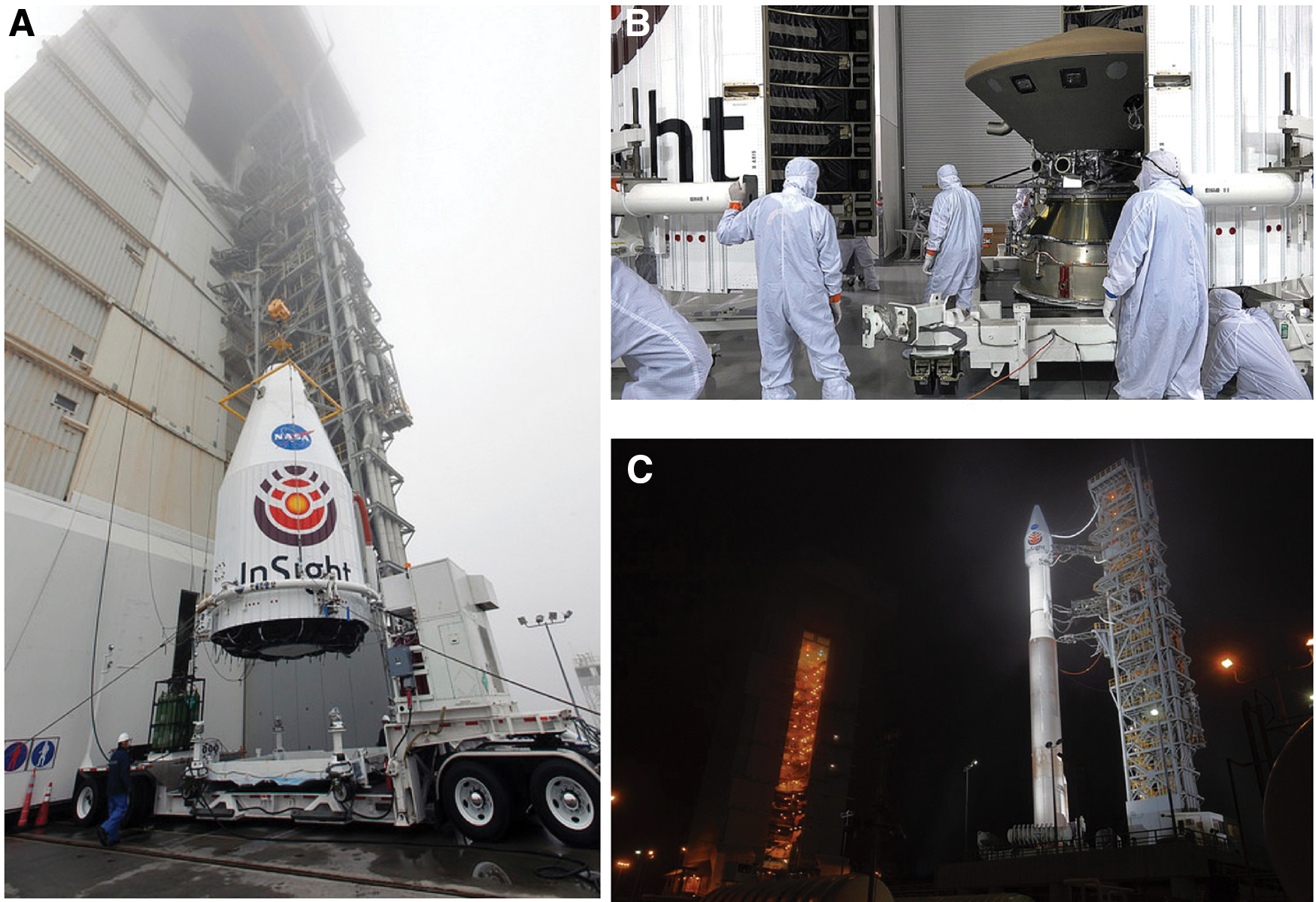
InSight flight and launch vehicle hardware. Payload fairing encapsulating the InSight flight system during the lift at the launch complex for installation on the Atlas V rocket (
This involved a thorough, PP-based cleaning procedure in the garment change room, payload-controlled area (PCA), and inside cleanroom tents installed at all five entry points into the PLF. The upper ECS system had two separate facility systems with their own ducting providing ISO Class 6.7 air to the clean enclosures and into the PLF containing the spacecraft. Both systems utilized an ultra-low particle air (ULPA) filter, which is capable of filtering particles larger than 0.1 μm with 99.999% efficiency.
After the tents were installed and the cleaning was completed, an in-depth PP sampling campaign of wipe and air samples in the garment change-out room, PCA, and clean tents was completed to baseline biological cleanliness of the facility. The facility was subsequently cleaned daily by using mission-specific biological cleaning protocols and sampled by the PP team daily until last physical access was permitted.
After the initial cleaning of the facility was completed, PP-specific garmenting protocols were enacted. This included a cleanroom hood, face mask, cleanroom suit, cleanroom boots, and gloves for any personnel working in the PCA. For any personnel entering into the PLF, additional garmenting was required due to an increased potential for direct recontamination of the spacecraft and internal launch vehicle hardware because the gowning room and cleanroom tents were not directly connected and personnel were required to walk through a non-cleanroom environment after gowning to reach the cleanroom tents. The additional garmenting consisted of a disposable smock on top of the cleanroom garments and disposable shoe covers over the cleanroom boots. Similar to hardware cleanroom ingress/egress double-bagging procedures, these disposable items were only worn by personnel in transit to a cleanroom tent through the PCA. Once outside the tent, these disposable items were removed, the tent was unzipped (exposing the positive pressure from inside the tent), and the engineer stepped into the tent and then zipped the tent behind them. When leaving a tent to transverse to another tent, new disposable items were donned by the engineer inside the clean tent prior to exiting.
2.1.6. Launch pad and payload transporter environmental control system ducts
Due to the large internal surface area of the ECS ducts (∼208 m2), a surface bioburden density requirement of <100 spores/m2 and a requirement on biological air cleanliness of <88 CFU/m3 were imposed on the air passing through the ducts during operational use. The ducts were identified as a possible recontamination source, and an emphasis was placed on sampling all the available ducts given that each individual duct could have a different manufacturing, storage, and pre-mission usage pedigree. These ducts provided air to the flight hardware for about 2 weeks between the ducting on the transporter and the duct system at the launch pad, so any contaminated duct could put the flight hardware's biological cleanliness at risk.
All ECS duct segments for the launch pad and transporter were initially cleaned to a particulate matter contamination level 500 as per KSC-C-123, wipe sampled on both ends, and processed by using the NSA to verify the <100 spores/m2 surface cleanliness requirement (NASA, 2009). Any ducts demonstrating a bioburden density of >100 spores/m2 were thoroughly recleaned and resampled until the bioburden requirement was satisfied. Once a given duct segment successfully demonstrated bioburden compliance, it was sealed with double bagging on both ends and stored until its use.
To satisfy the air bioburden density requirement of <88 CFU/m3, air samples were taken at the terminal end of each duct segment once it was connected to the corresponding launch pad air system. Following an initial 30 min blowdown, 1.5 m3 air samples were collected in triplicate. After sample collection, the ducts were left connected, and each terminal duct was bagged with a low-flow positive pressure until use. Prior to use, each duct system was unbagged, and the air flow was elevated and purged for 30 min prior to hookup to any flight or launch vehicle hardware.
2.2. Collection, processing, and analysis of bioassay samples
2.2.1. Surface samples: NASA Standard Assay
Surface samples were collected on ground support equipment, launch vehicle hardware, and facilities to verify biological cleanliness with sterile, pre-moistened polyester wipes (Fig. 3). Samples were prepared, collected, and processed by using NSA procedures (NASA, 2010) previously used in several studies and past PP-sensitive missions (La Duc et al., 2007; Cooper et al., 2011; Benardini et al., 2014a, 2014b).
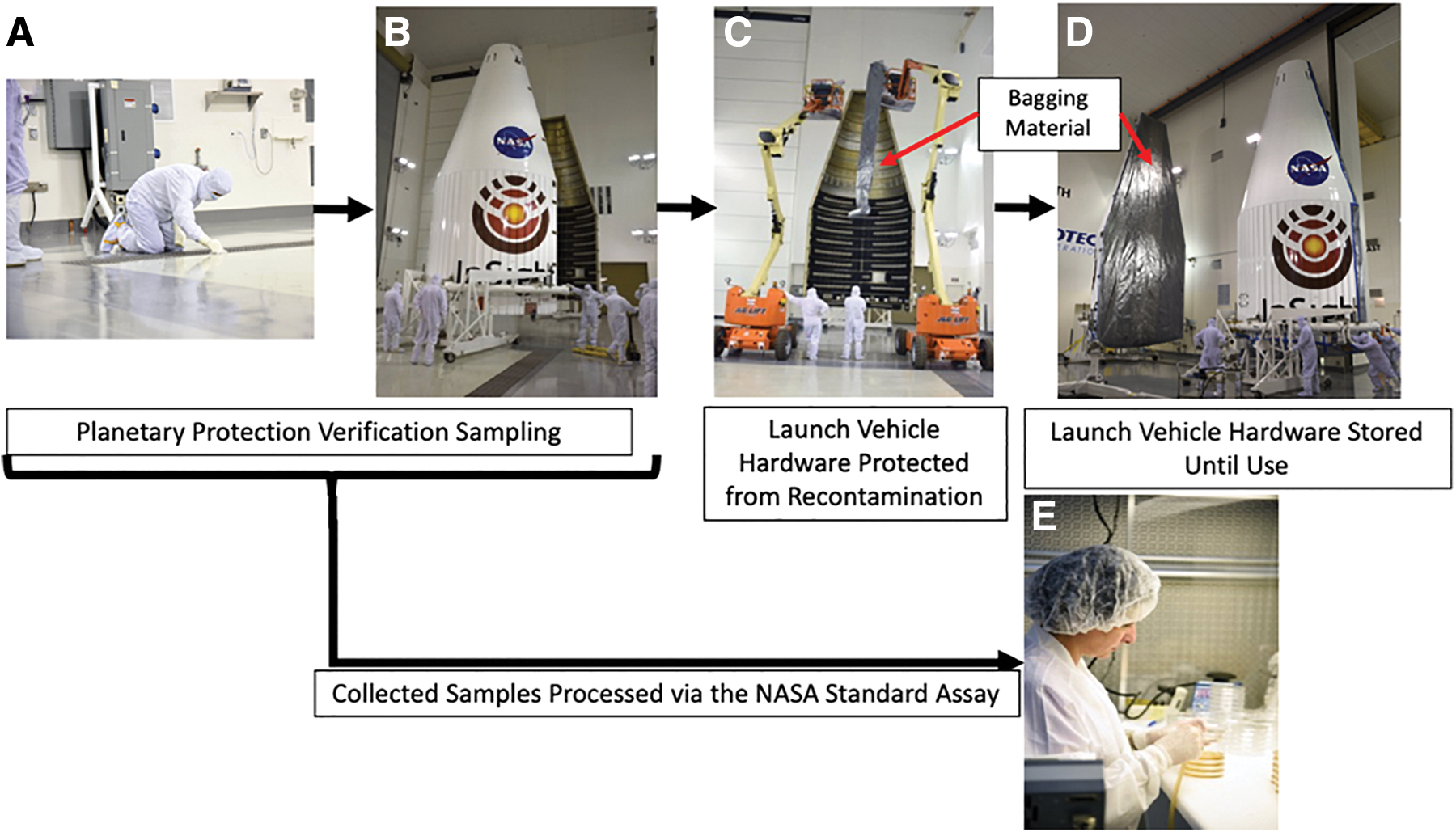
The Planetary Protection implementation flow on launch vehicle hardware is summarized using the PLF as an example. Before receiving launch flight hardware, the Astrotech cleanroom facility was initially cleaned, and a biological cleanliness check was performed (
During the process, a sterile wipe was aseptically removed from its 50 mL conical tube with the use of sterile gloves. This was typically accomplished by two people, one to handle the conical tube and the other to receive the wipe and conduct the sampling while donning sterile gloves. A new pair of sterile gloves was used for each wipe sample collected. The sample was collected with a ¼ folded wipe with a unidirectional wiping motion (horizontal) until the complete area to be sampled had been covered. The wipe was then folded to expose an unused surface, and the sample area was wiped in a different unidirectional direction (vertical). This occurred one last time in a diagonal direction. After the area had been sampled with the same wipe in three different directions, the wipe was rolled and placed into a dry, sterile 500 mL Corning bottle, and an estimate of the surface area sampled was recorded.
Samples were then transported to the laboratory and processed within 24 h of collection. When samples were not immediately processed, they were stored at 4°C for a maximum of 24 h before processing. For processing, samples were sonicated in a potassium phosphate buffered 0.02% v/v Tween 80 solution, followed by a heat shock treatment (80°C for 15 min) to eliminate heat-intolerant vegetative cells and select for heat shock–tolerant organisms and spore formers for enumeration. Heat-shocked samples were then plated onto tryptic soy agar and incubated at 32°C for 72 h. The CFU counts were recorded at 24, 48, and 72 h after samples were processed. Negative, positive, and handling controls were included in each sampling event. Independent verification of the mission sampling and sample processing was also conducted by the NASA Planetary Protection Office.
2.2.2. Air sampling
Air samples were collected by an impingement-based Coriolis μ (Bertin Technologies, France) air sampling instrument. For each sampling location, three replicate 5 min (1.5 m3 air each) samples were collected at a rate of 0.3 m3/min in sterile cones (manufacturer provided) containing 15 mL of phosphate-buffered saline solution. To maintain biological cleanliness of the device, the inlet of the Coriolis μ was disinfected and cleaned with a sterile wiper premoistened with 70–100% isopropyl alcohol prior to each sample collection.
Collected samples were processed within 24 h of collection by using a NSA-like approach, except they were not sonicated or heat shocked (NASA, 2010). The resulting CFU were counted at 24, 48, and 72 h. This culture-based methodology detects both spore-formers and non-spore-formers. In addition to processing controls, positive and negative air samples were collected from the ISO Class 5 cleanroom bench air and external uncontrolled air, respectively.
2.2.3. Bioburden accounting and statistical treatment of data
Sampling metadata on all launch vehicle hardware and ground support equipment samples was stored in a Microsoft Access database. This metadata included sample date, facility, environment class, hardware support engineer, samplers, surface area, sampling method (wipe or air), and sampling notes. Raw sample results were converted to a bioburden density after factoring in the wipe or air efficiency, the pour fraction of the sampling method, and the area sampled. These bioburden densities were recorded in the Planetary Protection Equipment List, a document used to record various hardware surfaces, surface areas, and bioburden estimates.
The statistical approach on InSight did not utilize a 3-sigma approach used for Mars Science Laboratory Planetary Protection data analysis (Benardini et al., 2014a, 2014b). Instead it utilized a sum of the means approach, like Viking, where recovery efficiencies were utilized and CFU were conservatively converted from zero to one for hardware groupings (Benardini et al., 2020). Essentially, individual samples were initially assigned to a given hardware item (i.e., PLF, etc.) after a sampling event. If the sampling of the hardware showed zero CFU after 72 h, a single colony-forming unit was conservatively assumed for that given area. Although this approach has a greater effect on smaller-surface-area items (i.e., ECS couplers), the overall bioburden of launch vehicle hardware and ground support equipment was still within bioburden requirements.
2.2.4. Launch recontamination analysis
To determine the level of launch recontamination and verify that the spacecraft was not excessively recontaminated during launch, a conservative launch recontamination analysis was performed. The bioburden densities of hardware (launch vehicle and flight) exposed inside the PLF environment were used for the analysis. This included obtaining the bioburden densities of the external spacecraft, ground support equipment, and launch vehicle hardware, specifically the heat shield, backshell, backshell interface plate, parachute thrust cone, cruise stage, Centaur electronics module avionics, launch vehicle adapter, fairing aluminum structure, fairing blankets, boattail, isolation diaphragm, and all the ECS flex ducts. The bioburden data from these hardware components was converted into a surface particle distribution by using contamination control surface particle measurements based on MIL-STD 1246 level for 1–50+ μm particles and Bareiss et al. for particles >50 mm (1246, 1994; Bareiss et al., 1986). The launch recontamination analysis conservatively assumed that all particles were released from these surfaces due to the forces experienced during the maximum launch environment. These forces included dynamic pressure, shock from pyrotechnic devices, acoustic vibrations, gravity, and static vibrations. The specific launch vehicle specifications for these forces were used as inputs to the launch recontamination analysis and helped establish the particle removal fraction based on the particles' adhesion forces (Barengoltz, 1989).
All the biological particles on the surfaces used in this analysis were assumed to become dislodged during launch and redeposited exclusively onto spacecraft surfaces where the contaminant was assumed to remain permanently attached. The three pieces of flight hardware were the backshell, the backshell interface plate, and the parachute thrust cone. Results from the launch recontamination analysis are shown in Section 3.3.
3. Results
3.1. NASA Standard Assay surface sampling
The NSA was used to sample launch vehicle hardware and ground support equipment to demonstrate a biological cleanliness of less than 1,000 spores/m2. Overall, the PP cleaning procedures used on launch vehicle hardware, ground support equipment, ECS ducts, and facilities were shown to be very effective at keeping launch vehicle hardware and ground support equipment biologically clean and minimizing the cross-contamination risk to the flight hardware, which did not demonstrate significant bioburden changes during launch operations. Launch vehicle hardware, ground support equipment, and facility samples consistently demonstrated bioburden densities below the requirement limit of 1,000 spores/m2. Additionally, the air flex ducts were shown to be biologically clean, with all flex duct segments and couplers averaging 65 spores/m2. The descriptions, number of collected samples, and calculated bioburden densities of individual surface samples of launch vehicle hardware, ground support equipment, ECS ducts, and facilities are shown in Table 1.
Bioburden Associated with Launch Vehicle Hardware, Ground Support Equipment, Environmental Control Systems, and Facilities
ECS = environmental control system.
3.2. Environmental control system airborne particle sampling
To satisfy the 88 CFU/m3 duct air requirement, air samples were collected using the Coriolis sampler. Samples were collected at the terminal end of each duct line once they were connected for use. This could mean that multiple flex ducts that were individually wipe-sampled were represented by one air sampling. Each duct end was sampled in triplicate pulling 0.3 m3/min over a 5 min run for each replicate. In total, 4.5 m3 was sampled for each duct line. Samples were processed using a modified NSA procedure, which did not include a sonication or 80°C heat-shock step. All duct air was shown to be less than 4 CFU/m3, well below the 88 CFU/m3 requirement. The source, descriptions, number of collected samples, total CFU, and calculated bioburden of air samples are shown in Table 2.
Air Sampling of Environmental Control Systems
CFU = colony-forming units. ECS = environmental control system.
3.3. Launch recontamination
InSight's launch recontamination analysis estimated that 30,230 spores were present on the exposed surfaces inside the PLF environment. Even with the conservative assumption that 100% of these particles redeposited onto the landed flight hardware, InSight still satisfied all PP requirements. Even with the launch recontamination analysis included, the overall landed flight system bioburden was 1.35 × 10⁵ spores, which was 55% below the requirement of 3.00 × 10⁵ spores. Detailed descriptions of area, bioburden, and spore contribution are shown in Table 3.
InSight Launch Recontamination Analysis
Hardware includes the bioburden of the entire environmental control system.
4. Discussion
InSight was the first PP-sensitive mission to utilize the facilities (Astrotech and SLC-3E) at Vandenberg Air Force Base, posing a unique challenge to the PP team. To protect the biological cleanliness of InSight, PP protocols were enacted in the facilities and on the launch vehicle hardware and ground support equipment. The InSight flight system, consisting of the heat shield, lander, backshell, and cruise stage, was required to satisfy a 5 × 10⁵ total bioburden and <300 spores/m2 requirement prior to launch. Planetary Protection engineering was actively involved in all stages of the project and utilized lessons learned from previous missions to successfully implement PP protocols (Bionetics Corporation, 1988; Pillinger et al., 2006). The mating of the flight hardware of InSight to the payload adapter and encapsulation into the PLF occurred in an ISO Class 100,000 Astrotech cleanroom prior to transport to the launch pad. Similar to flight hardware, the launch vehicle hardware and ground support equipment were cleaned by using the same procedures, sampled to demonstrate bioburden compliance, and covered to prevent recontamination.
Once encapsulation was complete, InSight remained protected inside the aeroshell and encapsulated within the PLF through launch. Positive pressure was maintained within the PLF by using HEPA or ULPA filtered air, which was also implemented during transit of the PLF and during launch pad operations. As an additional precaution, clean tents were used at all five access points to the PLF at the launch pad. Each clean tent was cleaned and sampled upon installation and acted as a physical and closeable barrier to the uncontrolled PCA environment. Air flowing into the PLF and clean tents was sampled prior to use and demonstrated minimal recontamination risks and helped maintain positive pressure to the surrounding PCA environment throughout operations at the launch pad. Surface and ECS tent air was sampled every shift to monitor the recontamination potential.
All other launch vehicle and ground support equipment hardware was thoroughly cleaned by United Launch Alliance and subsequently sampled by the PP team to demonstrate their biological cleanliness and satisfaction of the <1,000 spores/m2 requirement. The air flex ducts were thoroughly sampled via wipe and air samples, prior to their use, to demonstrate compliance with bioburden requirements that were much stricter than the actual flight hardware requirements (100 spores/m2 for surfaces and 88 CFU/m3 for air).
Most launch vehicle hardware and ground support equipment was strategically sampled, following 70% isopropyl alcohol/30% deionized water cleaning, much earlier than its need-by date. The sampled hardware was then double bagged and stored to reduce the risk of recontamination. This early sampling strategy was based on previous lessons learned and allowed the hardware engineer additional time to reclean and resample if bioburden numbers were higher than requirements.
To account for bioburden distribution during launch, a conservative launch recontamination analysis was performed. This analysis used all of the bioburden on exposed surfaces within the PLF, both flight hardware (heat shield, backshell, backshell interface plate, parachute thrust cone) and the launch vehicle hardware (Centaur electronics module avionics, launch vehicle adapter, fairing, boattail, isolation diaphragm, ECS). The bioburden on these surfaces was assumed to be completely released during launch and redeposited directly onto the landed InSight hardware. This analysis showed that even in this extremely conservative scenario, InSight still achieved a total bioburden of 1.5 × 10⁵, representing a margin of 70% below the maximum bioburden of 5 × 10⁵.
The effective collaborative and communicative efforts between Jet Propulsion Laboratory PP, United Launch Alliance, InSight engineers (Jet Propulsion Laboratory and Lockheed Martin Space), Astrotech, NASA Launch Service Provider, and the NASA Planetary Protection Office ensured that PP implementation was integrated into all phases and facilities of the mission. The gowning, hardware cleaning, and recontamination procedures were shown to be effective in achieving bioburden well within the requirements. The dedication of the entire InSight team resulted in an extremely clean spacecraft satisfying all PP requirements.
5. Conclusion
The targeted launch vehicle and ground support equipment sampling focused on the hardware with direct line of sight to the spacecraft, as well as the large flex duct system used to provide clean air to the PLF and cleanroom tents. A conservative launch recontamination analysis verified that even if all bioburden released from inside the launch vehicle hardware surface inside the PLF, including the entire air handling system, and redeposited onto the landing hardware of InSight, it would still satisfy its launch requirements with large margins to spare. The biological cleanliness of InSight, the launch vehicle hardware, and ground support equipment was a direct result of the diligent enactment of PP protocols and recontamination prevention. Launch vehicle hardware and ground support equipment were consistently shown to be significantly cleaner than the maximum bioburden allocated. The InSight mission approach to launch operations, with expanded self-derived mission-specific requirements that incorporated lessons learned from the previous Mars Science Laboratory mission, demonstrated an end-to-end system engineering approach that could be utilized as a standard for future biological sensitive missions.
Footnotes
Acknowledgments
Part of the research described in this paper was carried out by the Jet Propulsion Laboratory (JPL), California Institute of Technology, under contract with NASA. The authors thank P. Bevins (Lockheed Martin Space [LMS]) and J. Witte (LMS), who provided significant support at LMS and Vandenberg Air Force Base (VAFB). The authors acknowledge the contributions of C. Conley, B. Pugel, and L. Pratt of the NASA Planetary Protection Office. The authors also acknowledge J. Moore (LMS), B. Clement (JPL), R. Ellyin (JPL), B. Shirey (JPL), M. Stricker (JPL), K. Stott (JPL), R. Park (JPL), C. Ly (JPL), F. Chen (JPL), P. Vaishampayan (JPL), L. Newlin (JPL), and M. La Duc (JPL), who provided significant sampling and processing contributions throughout both launch opportunities. We would like to thank the InSight Project Systems engineers D. Bernard (JPL) and J. Willis (JPL) and the InSight launch system engineer P. Darus (JPL) for their system management oversight. We extend thanks to J. Ehrsam (NASA Launch Service Provider [LSP]), B. Rasmison (NASA LSP), Mike Marasco (United Launch Alliance), and J. Amick (Astrotech) for support at Vandenberg Air Force Base (VAFB). The authors also thank M. Jones (JPL) and A. Avila (JPL) for managerial oversight.
Author Disclosure Statement
No competing financial interests exist.
Abbreviations Used
Associate Editor: John Rummel