




Abstract
The Mars Organic Molecule Analyzer (MOMA) onboard the ExoMars 2020 rover (to be landed in March 2021) utilizes pyrolysis gas chromatography–mass spectrometry (GC-MS) with the aim to detect organic molecules in martian (sub-) surface materials. Pyrolysis, however, may thermally destroy and transform organic matter depending on the temperature and nature of the molecules, thus altering the original molecular signatures. In this study, we tested MOMA flight-like pyrolysis GC-MS without the addition of perchlorates on well-characterized natural mineralogical analog samples for Oxia Planum, the designated ExoMars 2020 landing site. Experiments were performed on an iron-rich shale (that is rich in Fe-Mg-smectites) and an opaline chert, with known organic matter compositions, to test pyrolytic effects related to heating in the MOMA oven. Two hydrocarbon standards (n-octadecane and phytane) were also analyzed. The experiments show that during stepwise pyrolysis (300°C, 500°C, and 700°C), (1) low-molecular-weight hydrocarbon biomarkers (such as acyclic isoprenoids and aryl isoprenoids) can be analyzed intact, (2) discrimination between free and complex molecules (macromolecules) is principally possible, (3) secondary pyrolysis products and carryover may affect the 500°C and 700°C runs, and (4) the type of the organic matter (functionalized vs. defunctionalized) governs the pyrolysis outcome rather than the difference in mineralogy. Although pyrosynthesis reactions and carryover clearly have to be considered in data interpretation, our results demonstrate that pyrolysis GC-MS onboard MOMA operated under favorable conditions (e.g., no perchlorates) will be capable of providing important structural information on organic matter found on Mars, particularly when used in conjunction with other techniques on MOMA, including derivatization and thermochemolysis GC-MS and laser desorption/ionization–MS.
1. Introduction
The Rosalind Franklin rover that is part of the ExoMars 2020 mission has been designed to investigate the martian (sub-)surface for biosignatures of present or past life (Vago et al., 2017). The key instrument onboard that rover is the Mars Organic Molecule Analyzer (MOMA; Goetz et al., 2016; Goesmann et al., 2017). MOMA is capable of detecting organic molecules by performing pyrolysis and derivatization (including thermochemolysis) gas chromatography–mass spectrometry (GC-MS), as well as laser desorption/ionization–mass spectrometry (LDI–MS; Li et al., 2017). To assess potential molecular biosignatures in the subsurface, the rover will be drilling as deep as 2 m for sample material (Vago et al., 2017). This approach is necessary, as the surface of Mars is characterized by harsh conditions for the preservation of organic materials, especially caused by radiation (Pavlov et al., 2012; Hassler et al., 2014; Goetz et al., 2016).
The designated landing site for ExoMars 2020 is Oxia Planum, a potential fluvio-deltaic area at the eastern margin of Chryse Planitia (Carter et al., 2016; Quantin et al., 2016; Vago et al., 2017). The geology is characterized by Late to Middle Noachian (i.e., ca. 3.9 Ga old) deposits, mainly Fe/Mg phyllosilicates, such as Fe/Mg smectite (Carter et al., 2016; Quantin et al., 2016), as well as Al phyllosilicates and hydrated silica (opal) in minor abundances (Carter et al., 2016). Noachian deposits may be suitable targets to search for molecular biosignatures, as this time period may have been favorable for the emergence of life on Mars (Westall et al., 2015; Vago et al., 2017). However, younger volcanic deposits cover parts of the Oxia Planum landing ellipse (Carter et al., 2016; Quantin et al., 2016). In these areas, organic matter may have been altered as a result of enhanced paleotemperatures or thermal gradients. The search for biosignatures in Oxia Planum should therefore include energetically stabilized, that is, defunctionalized “molecular fossils,” such as hydrocarbons.
In Earth's oldest rocks, organic matter is present as graphite (Ueno et al., 2002; van Zuilen et al., 2003, 2005) or as geomacromolecules (Marshall et al., 2007; Duda et al., 2016, 2018; Hickman-Lewis et al., 2018). The latter have often been termed “kerogen,” that is, the immotile nonextractable fraction of organic matter (Durand, 1980), as opposed to “bitumen” (i.e., the motile, extractable fraction). Kerogen is commonly regarded as syngenetic to the host rock and may, to some extent, shield incorporated biologically derived organic moieties from thermal alteration, thus favoring preservation over large geological time scales (Brocks et al., 2003; Marshall et al., 2007; Love et al., 2008; Hallmann et al., 2011). Kerogen may also be present on the martian surface, for example, delivered by meteoritic infall (Flynn, 1996; Sephton, 2002; Steininger et al., 2012) or geological processes, such as diagenetic sulfurization (Eigenbrode et al., 2018), a process commonly involved in kerogen formation in anoxic environments on Earth (Sinninghe Damsté and de Leeuw, 1990; Wakeham et al., 1995).
A pyrolysis GC-MS device, such as the one implemented in the MOMA instrument, can analyze both free organic molecules and macromolecular organic matter (tested with other organic-bearing rocks; Goesmann et al., 2017; Mißbach et al., 2019). Pyrolysis, however, may decompose and transform organic matter (Hartgers et al., 1994a; Faure et al., 2006b; Moldoveanu, 2010), thus obliterating original organic signatures from samples. For instance, organosulfur compounds were detected by the Sample Analysis at Mars (SAM) instrument onboard the Curiosity rover after high temperature pyrolysis up to 820°C. These compounds, however, may derive from artificial secondary reactions of sulfur (from decomposition of sulfates) with organic radicals (Eigenbrode et al., 2018). Moreover, flash pyrolysis studies on terrestrial materials, especially in the presence of clay minerals, have shown that secondary reactions (e.g., aromatization) can occur during pyrolysis that strongly blurs original signals from the samples (Faure et al., 2006a, 2006b). It is therefore necessary to study pyrolytic effects that may occur during MOMA pyrolysis on complex organic matter in greater detail.
In our study, we investigated two well-characterized geological samples with a MOMA flight analog system (FAS; Goesmann et al., 2017; Mißbach et al., 2019, fig. 1 therein), an iron-rich shale (high smectite) and an opaline chert. Both are rich in minerals that have also been detected in the Oxia Planum landing ellipse (Carter et al., 2016; Quantin et al., 2016). The organic matter of both samples includes bitumen and kerogen and was extensively precharacterized by various organic geochemical techniques (Reinhardt et al., 2018, 2019). In addition, two hydrocarbon standards, n-octadecane and phytane, were analyzed with the FAS. The main questions addressed by our study are the following:
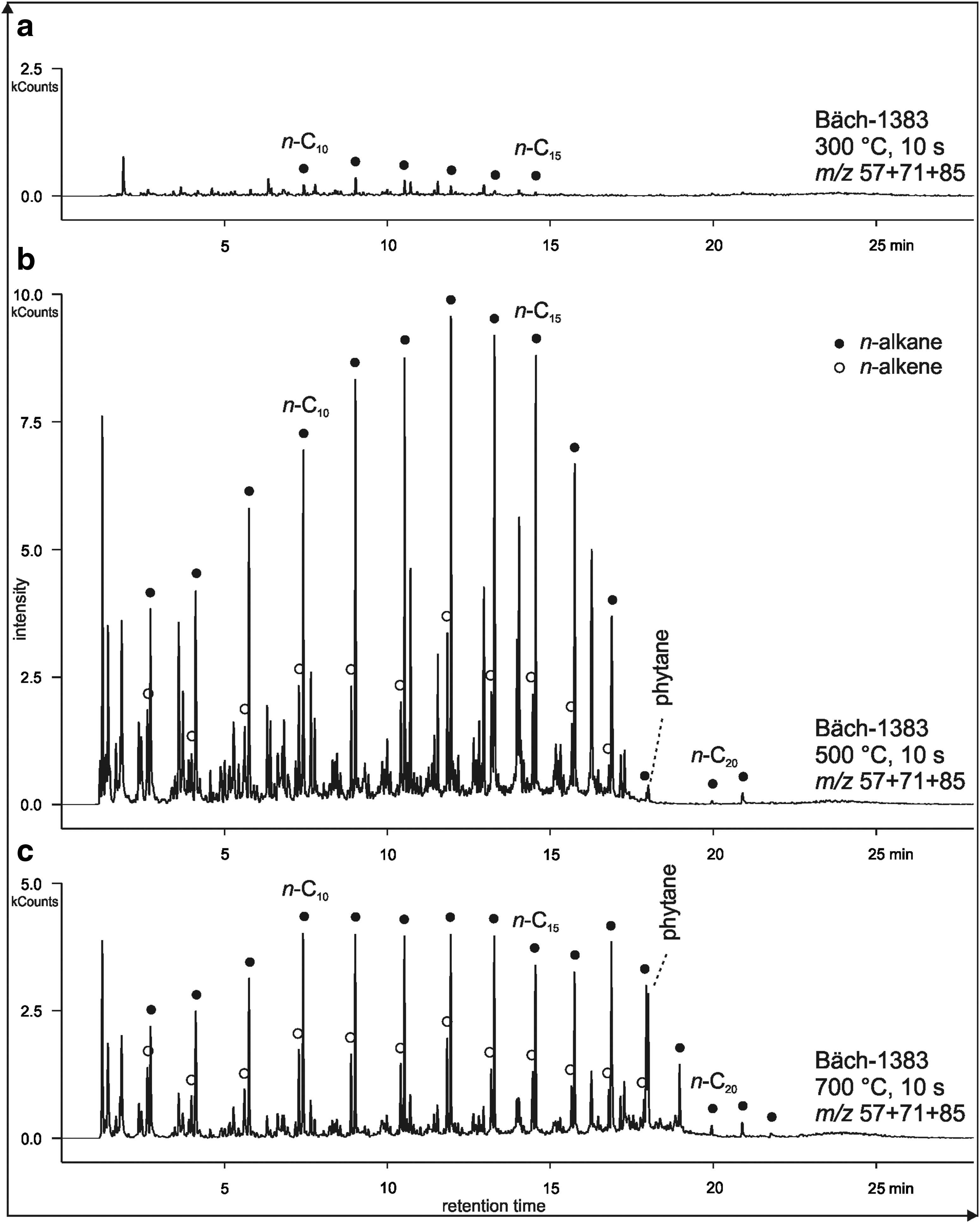
GC-MS ion chromatograms (m/z 57 + 71 + 85) from stepwise pyrolysis (300°C, 500°C, 700°C, held for 10 s, respectively;
Do potential molecular biomarkers stay intact during MOMA flight-like pyrolysis?
Does MOMA flight-like pyrolysis form ambiguous secondary products?
Is it possible to discriminate between bitumen- and kerogen-derived moieties?
Do differences in mineralogy influence the pyrolysis result?
The results of this study will inform the use of MOMA during operations in Oxia Planum and will also support interpretation of returned data. It should also be noted that our experiments were run without the addition of perchlorates to focus on organic transformations related to the MOMA pyrolysis device itself. Perchlorates and other oxychlorine compounds may be globally distributed in martian surface sediments at levels between 0.1 and 2 wt.% with strong variations over the scale of only few meters (Hecht et al., 2009; Glavin et al., 2013; Ming et al., 2014; Clark and Kounaves, 2016, Sutter et al., 2017). Their presence during pyrolysis may severely alter the organic signal of a sample (volatile fraction) by transformative (formation of chlorohydrocarbons) and/or destructive reactions (combustion of hydrocarbons to CO2), especially between 150°C and 500°C (Glavin et al., 2013; Ming et al., 2014; Freissinet et al., 2015; Mißbach et al., 2019). LDI-MS, however, can detect nonvolatile organics in the presence of 1 wt.% perchlorate salts without significant degradation or combustion (Li et al., 2015).
2. Materials and Methods
2.1. Sample material
Two Earth analog samples that are dominated by minerals also found in Oxia Planum were analyzed, a fossil iron-rich shale (Bäch-1383, Bächental, Austria, Lower Jurassic; total organic carbon (TOC) = 8.3 wt.%, Fetot = 4.0 wt.%, Fe-Mg-smectite = 10.0 wt.%; Reinhardt et al., 2018) and a modern opaline chert (LM-1693, Lake Magadi, Kenya, Pleistocene; TOC = 0.3 wt.%; Reinhardt et al., 2019). Their molecular organic inventories are detailed elsewhere (Reinhardt et al., 2018, 2019). In brief, Bäch-1383 mainly contains aliphatic and aromatic hydrocarbons, including abundant biomarkers, such as hopanes, steranes, acyclic isoprenoids, and derivatives of aromatic carotenoids (e.g., aryl isoprenoids; Reinhardt et al., 2018). LM-1693 is characterized by more polar compounds, such as alkanoic acids, alkanols, glycerol mono- and diethers, as well as aliphatic and aromatic components (e.g., n-alkanes and polycyclic aromatic hydrocarbons [PAHs]). Important biomarkers from LM-1693 are the glycerol mono- and diethers (e.g., archaeol and extended archaeol), as well as acyclic isoprenoids (phytane, 2,6,10,14,18-pentamethylicosane; Reinhardt et al., 2019).
For MOMA-like pyrolysis, GC-MS whole rock powders were used (grinded with a commercial Retsch MM 301 pebble mill; grain size ≥0.45 μm). Two hydrocarbon standards, namely n-octadecane (Sigma-Aldrich) and phytane (Dr. Ehrenstorfer GmbH), were pyrolyzed in addition. Perchlorates were intentionally not added to the samples to focus on pyrolytic processes related to heating in the MOMA oven. The effect of perchlorates on FAS pyrolysis of a natural sample has been investigated by Mißbach et al. (2019). Their study indicates that at 10 wt.% perchlorate the organic signal of a natural sample containing kerogen is nearly completely obliterated during FAS pyrolysis (single step heating to 700°C).
2.2. MOMA flight-like pyrolysis GC-MS
Pyrolysis experiments were conducted with a MOMA FAS (Goesmann et al., 2017; Mißbach et al., 2019, fig. 1 therein), an open pyrolysis unit (flushed with helium; flow rate ca. 2 mL/min) consisting of a reusable MOMA pyrolysis oven, a tapping station, and an adsorption trap filled with Tenax® GR. The FAS was coupled to a commercial Varian CP-3800 GC that in turn was connected to a Varian 240-MS/4000 MS. Up to now, the FAS is the most flight-analog pyrolysis unit available (until a MOMA flight-identical testbed will be ready for use; not before launch of ExoMars 2020). The major differences between FAS (plus the connected commercial GC-MS) and the MOMA flight system are listed in Table 1 (Goesmann et al., 2017; Mißbach et al., 2019). While the mechanism for hydrocarbon trapping is the same between FAS and flight unit (Peltier cooled trap with Tenax® GR as adsorbent), the lower maximum temperatures of the FAS trap and transfer lines reduce the analytical window, while the missing He-backflush option (no flow inversion; Table 1) results in a decreased recovery efficiency of trapped organic molecules.
Major Technical Differences Between the Mars Organic Molecule Analyzer Flight System and the Flight Analog System Connected to a Commercial Gas Chromatograph–Mass Spectrometer
Preliminary values, as MOMA is not operating on Mars yet.
Information taken from Goesmann et al. (2017).
FAS, flight analog system; GC, gas chromatograph; MOMA, Mars Organic Molecule Analyzer; MS, mass spectrometer.
To check for contamination and ensure constant measuring conditions, the FAS and GC-MS were cleaned by heating, and blanks were run regularly. Sample powders (19.32 mg for LM-1693, 0.33 mg for Bäch-1383; predried in the MOMA oven at 80°C for 10 min before pyrolysis; oven not connected to tapping station) were pyrolyzed by using stepwise pyrolysis (300°C, 10 s; 500°C, 10 s; 700°C, 10 s; Goesmann et al., 2017) as envisioned during surface operations on Mars (sample weights were optimized to obtain a strong signal-to-noise-ratio at the different TOC contents). The trap was cooled by a Peltier element to ca. 5°C and trap heating was initiated after 10 s (at the end of pyrolysis) to ca. 160°C (with 200°C/min). The GC-MS was started after an additional 45 s. To transfer compounds from the trap into the GC injector, the FAS transfer lines were heated to ca. 110°C.
Standard compounds (100 ng of n-octadecane and phytane, respectively) were deposited on ca. 20 mg of annealed silica gel (at 550°C) and pyrolyzed via stepwise (see section 2.2) and single-step pyrolysis (heating to 300°C [10 s], 500°C [10 s], and 700°C [10 s], respectively).
2.3. GC-MS configuration
GC-MS settings were selected according to previous investigations by Goesmann et al. (2017) and Mißbach et al. (2019). The GC (Varian CP-3800) was equipped with a Varian Factor Four VF-5ms column (length = 30 m, inner diameter = 0.25 mm, film thickness = 0.25 μm). The VF-5ms column is comparable to the MOMA Restek MXT 5 column (Goesmann et al., 2017). The carrier gas was He with a flow rate of 2 mL/min. The injector temperature was 250°C, and a split ratio of 30 was used. The GC temperature program started at 30°C (hold time = 1 min) and heated to 250°C with 10°C/min (hold time = 5 min).
The MS (Varian 240-MS/4000) operated in full-scan mode with a scan time of 0.58 s and a scan range of m/z 35–1000. Compounds were identified by comparison with the NIST mass spectral library and/or the retention times of standard compounds (n-octadecane, phytane).
3. Results
3.1. Iron-rich shale (Bäch-1383)
Stepwise pyrolysis of the iron-rich shale predominantly yields low-molecular-weight aliphatic and aromatic hydrocarbons, especially n-alkanes and n-alkenes, as well as mono- and polyaromatic compounds.
n-Alkanes appear in all temperature fractions. At 300°C, n-C10–15 are released (Fig. 1a; 1.2% of total n-alkanes with 9–17 carbons; Table 2). At 500°C, the n-alkane diversity increases significantly to n-C7–21 (Fig. 1b; 64.0% of total n-alkanes with 9–17 carbons and 34.8% of total n-alkanes with 18–22 carbons; Table 2). Additionally, the acyclic isoprenoid phytane appears (11.9% of total phytane; Table 2), and n-alkenes occur together with the corresponding alkanes (Fig. 1b; 55.6% of total n-alkenes; Table 2). At 700°C, n-alkanes up to n-C22 are visible, and for greater chain length (n-C18 to n-C22), the pyrolysis yields increase drastically compared with 500°C (89.8% of total n-alkanes with 18–22 carbons; Table 2). Phytane shows the same effect (88.1% of total phytane at 700°C; Table 2).
Relative Abundances of Selected Compounds ([%] of the Total) Released During Stepwise Pyrolysis of Bäch-1383
PAHs, polycyclic aromatic hydrocarbons.
The monoaromatic 2,6,10-trimethyl aryl isoprenoids appear in all temperature steps (C10–14 at 300°C, C10–16 at 500°C, C10–11 and C15–19 at 700°C; Fig. 2) with highest amounts at 500°C (82.8% of total aryl isoprenoids with 10–16 carbons; Table 2). C18–19 aryl isoprenoids only occur at 700°C. Other monoaromatic compounds are alkylbenzenes (mono-, di-, and trimethyl-; all temperature steps; Supplementary Fig. S1), and the heteroaromatic alkylthiophenes (mono- and dimethyl; at 500°C and 700°C; Supplementary Fig. S1). Again, the highest amounts were generated at 500°C (82.5% of total alkylthiophenes; Table 2). Furthermore, low-molecular-weight PAHs are represented in all temperature steps, including the two-ring PAHs naphthalene, alkylnaphthalenes (mono-, di-, and trimethyl), and the three-ring PAH phenanthrene. While the alkylnaphthalenes mainly appear at 500°C (60.6% of total alkylnaphthalenes; Table 2), naphthalene and phenanthrene show highest amounts at 700°C (55.3% and 52.6%, respectively; Table 2).
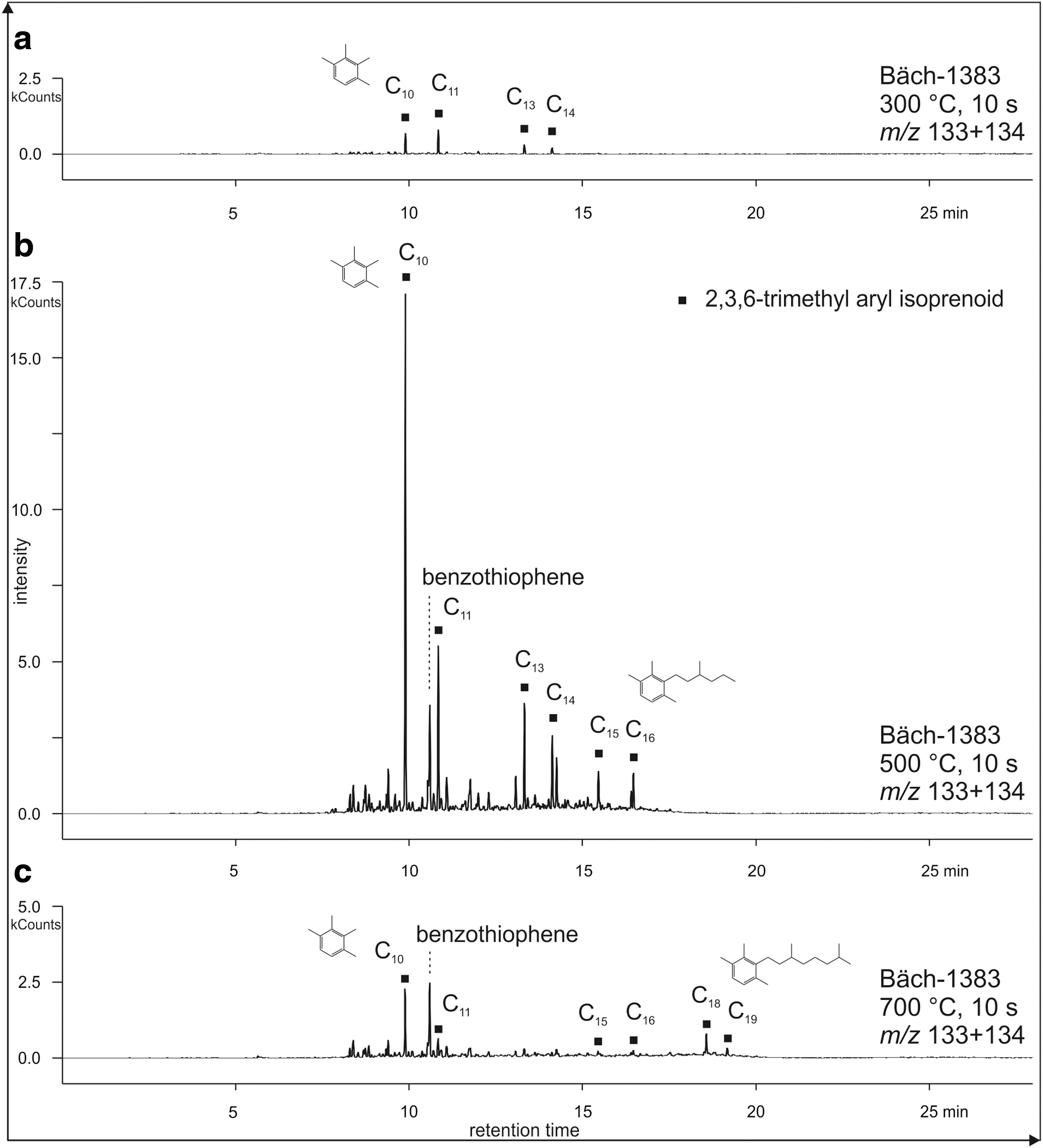
GC-MS ion chromatograms (m/z 133 + 134) from stepwise pyrolysis (300°C, 500°C, 700°C, held for 10 s, respectively;
3.2. Opaline chert (LM-1693)
Ketones are the main pyrolysis products of the opaline chert. At 300°C, furanones and a few n-alkan-2-ones (C7–12, C14–15) occur (Fig. 3a; Supplementary Fig. S2). n-Alkan-2-ones (C6–15) then dominate at 500°C and 700°C (Fig. 3b, c; Supplementary Fig. S2). At 500°C, the majority of C6–13 n-alkan-2-ones appear (62.3% of total C6–13 n-alkan-2-ones; Table 3), whereas at 700°C, C14–15 are most abundant (49.8% of total C14–15 n-alkan-2-ones; Table 3). Two structurally unidentified alkylfuranones (Fur1 and Fur2) show highest abundances at 500°C (63.5% of total Fur1 and Fur2; Table 3), whereas the structurally unidentified alkylfuranones Fur3 and Fur4 appear in higher amounts at 700°C (65.5% of total Fur3 and Fur4; Table 3).
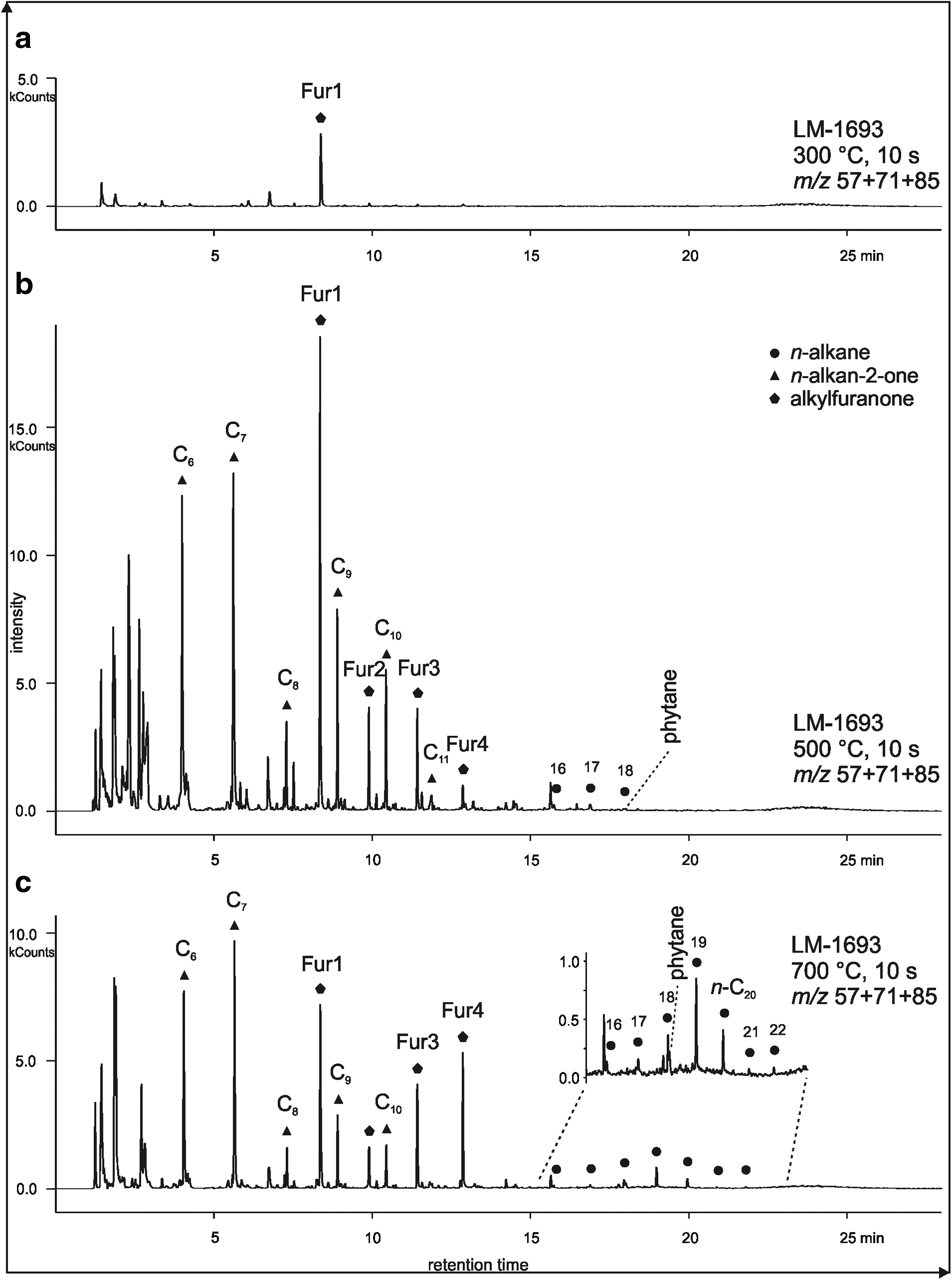
GC-MS ion chromatograms (m/z 57 + 71 + 85) from stepwise pyrolysis (300°C, 500°C, 700°C, held for 10 s, respectively;
Stepwise Pyrolysis of LM-1693 and the n-Octadecane Standard; Relative Abundances of Selected Compounds ([%] of the total)
The labels Fur1, Fur2, Fur3, and Fur4 denote structurally unidentified alkylfuranones.
A few n-alkanes (n-C16–22) and phytane occur at 500°C and 700°C (Fig. 3b, c). n-C16–17 are most abundant at 500°C (71.3% of total n-alkanes with 16 or 17 carbons), whereas n-C18–22 and phytane dominate at 700°C (88.7% of total n-alkanes with 18–22 carbons, and 76.1% of total phytane; Table 3).
Aromatic compounds, including (methyl-) benzene, (methyl-) naphthalenes, and dibenzofuran, only appear at 700°C in low abundances (Supplementary Fig. S2).
3.3. Hydrocarbon standards (n-octadecane and phytane)
n-Octadecane (n-C18) was subjected to stepwise and single step pyrolysis. During stepwise pyrolysis, the abundance of n-octadecane increases significantly from 300°C to 700°C (Fig. 4), with 69.9% of the total n-octadecane being transferred at 700°C (Table 3). No secondary pyrolysis products from potential fragmentation/destruction appear in both stepwise and single step pyrolysis runs. Phytane also remains intact after heating to 700°C and does not produce pyrolysis products detectable with this setup (Fig. 3).

TICs from a blank run (700°C, held for 10 s);
4. Discussion
4.1. Intact biomarkers in MOMA FAS pyrolysates
Pyrolysis leads to destruction and transformation (including pyrosynthesis) of organic matter via various mechanisms, including radical reactions (Moldoveanu, 2010). MOMA pyrolysis, however, is an open-system technique, where heating is achieved under a constant flow of inert helium (Goesmann et al., 2017) that quickly removes the pyrolysis products out of the reaction zone. Thermal destruction should therefore be limited to the pyrolysis oven, which increases the likeliness that organic moieties stay intact during the process. Pyrosynthesis reactions, instead, may continue downstream as long as free radicals produced during pyrolysis are available.
Stepwise pyrolysis of Bäch-1383 and LM-1693 revealed the acyclic isoprenoid phytane (Figs. 1b, c and 3b, c), a biomarker that derives, for example, from (1) the side chain of chlorophyll (Brooks et al., 1969; Didyk et al., 1978) or (2) archaeal membrane lipids, such as archaeol (Nishihara and Koga, 1995). Phytane did not decompose during heating up to 700°C (held for 10 s), as shown by the phytane standard test (see Section 3.3; Supplementary Fig. S3). Consequently, the amounts of phytane in the pyrolysates probably reflect a minimum amount of phytane in the samples. The amount of released phytane from LM-1693, however, is very low (Fig. 3 and Supplementary Fig. S2), corroborating precharacterization results (Reinhardt et al., 2019). It may therefore be indicated that no pyrolytic phytane [from decomposition of archaeol or extended archaeol that are abundant in LM-1693 (Reinhardt et al., 2019)] was generated during stepwise pyrolysis.
Additionally, 2,3,6-trimethyl aryl isoprenoids occur in all temperature steps during pyrolysis of Bäch-1383 (Fig. 3; Table 2). These compounds are diagenetic products of aromatic carotenoids, biomarkers for anoxygenic phototrophic bacteria, and are commonly found in ancient rocks on Earth (Summons and Powell, 1986; Koopmans et al., 1996a; Grice et al., 2005; Reinhardt et al., 2018). The observed aryl isoprenoid pattern detected in the pyrolysates, however, only comprises a fraction of the complete aryl isoprenoid inventory from bitumen in Bäch-1383 (up to C25; Reinhardt et al., 2018). Further abundant biomarkers known to be present in Bäch-1383 (intact aromatic carotenoids, steranes, hopanes) and LM-1693 (glycerol mono- and diethers, sterols, branched alkanoic acids, and alcohols) were also not detected. This analytical gap demonstrates the limits of MOMA pyrolysis GC-MS that is especially designed to detect low- to medium-molecular-weight compounds (up to C25; Goesmann et al., 2017). Most of the biomarkers in Bäch-1383 (Reinhardt et al., 2018) and LM-1693 (Reinhardt et al., 2019), including aryl isoprenoids with long side chains, however, possess higher molecular weights (>C25; e.g., hopanes, glycerol mono- and diethers) and are therefore out of the FAS analytical window. But even though the detection of intact compounds from Bäch-1383 and LM-1696 is limited due to technical constraints, the low-molecular-weight biomarkers detected with the FAS are still highly diagnostic for their diagenetic formation from the biological precursors.
4.2. Secondary pyrolysis products
Aryl isoprenoids may not only represent alteration products of aromatic carotenoids formed during geological alteration (diagenesis), they may potentially also be generated from breakdown of aromatic carotenoids or their molecular fossils during pyrolysis (Hartgers et al., 1994a, 1994b; Koopmans et al., 1996a, 1996b). For Bäch-1383, both scenarios are principally possible, as it contains diagenetically produced aryl isoprenoids as well as intact aromatic carotenoid biomarkers, such as isorenieratane (Reinhardt et al., 2018). The samples, however, revealed also other potential secondary pyrolysis products that are commonly observed in organic pyrolysates and may form by different reaction pathways:
PAHs, such as naphthalene and phenanthrene, especially occur in the 700°C fractions (see Section 3; Table 2), indicating pyrolytic formation. Dealkylated PAHs can form through pyrosynthesis from various educts, for example, n-alkanes, n-alkenes, or simple monoaromatics such as benzene (Appel et al., 2000; Moldoveanu, 2010). Phenanthrene may also derive from pyrolytic conversion of terpenes (abundant in Bäch-1383) via dealkylation of dimethylphenanthrenes (McCollom et al., 1999; Britt et al., 2004). Such dealkylation may also plausibly explain the decrease in abundance of alkylnaphthalenes from 500°C to 700°C that is accompanied by an increase in naphthalene concentration at 700°C (Table 2). A formation of naphthalene and phenanthrene from n-alkanes and n-alkenes, however, would require high temperatures or long heating time (Moldoveanu, 2010), which is not in line with MOMA pyrolysis conditions.
n-Alkenes may also be generated through pyrolytic decomposition reactions. Free n-alkanes may lose a carbon atom during pyrolysis and form radicals that eventually become n-alkenes (Moldoveanu, 2010). Such a process would additionally lead to the formation of alkadienes that were, however, not detected in the pyrolysates. Moreover, the n-octadecane standard did not show any destruction of the hydrocarbon chain even at 700°C (held for 10 s; Fig. 4). The n-alkenes may therefore not derive from decomposition of free n-alkanes. A further potential origin is discussed in Section 4.3.
Alkylbenzenes represent typical pyrolysis products that may derive from various potential organic precursors (Hartgers et al., 1994a; Moldoveanu, 2010). Together with naphthalene, they were also detected as contaminants from Tenax® heating in the SAM instrument onboard the Curiosity rover (Freissinet et al., 2015). It is therefore likely that alkyl benzenes as well as naphthalene may partly derive from Tenax® decomposition.
n-Alkan-2-ones may form via dehydrogenation of n-alkan-2-ols (Leif and Simoneit, 1995) that are abundant in LM-1693 (Reinhardt et al., 2019). Furthermore, n-alkan-2-ones may derive from the pyrolysis of carboxylic acids through radical formation and the loss of one carbon atom (Regtop et al., 1985). This mechanism seems likely here, as LM-1693 is known to contain abundant extractable alkanoic acids (Reinhardt et al., 2019). The odd-over-even chain length preference of n-alkan-2-ones in the pyrolysates from LM-1693 therefore may correspond to the even-over-odd preference of the precursor n-alkanoic acids.
Alkylfuranones were tentatively identified in pyrolysates from LM-1693 and may derive from pyrolysis of glucose or glucose-containing polymers, such as cellulose (Steinbeiss et al., 2006; Moldoveanu, 2010; Lv and Wu, 2012). A pyrolytic origin is further indicated by nondetection in the rock extracts with conventional GC-MS (Reinhardt et al., 2019).
The pyrolysis results show the difficulty to clearly identify secondary products in the pyrolysates and work out their corresponding formation pathways. Pyrolysis-induced radical chain reactions are complex and depend on (1) temperature, (2) residence time of the organic molecules in the reaction zone, and (3) the composition of the organic matter (Moldoveanu, 2010). For instance, 10% of n-dodecane is already converted into secondary products at ca. 680°C and a residence time in the heated zone of 0.2 s. Secondary products of this n-alkane include n-alkenes (that form in a first reaction stage) and naphthalene (that forms in a second reaction stage, requiring long heating times and/or high temperature; Moldoveanu, 2010). The MOMA oven heating rate is relatively low (ca. 200°C/min; Goesmann et al., 2017). Organic molecules heated to 700°C may therefore stay in the reaction zone for several minutes, depending on their volatilization behavior. Under these circumstances, transformation reactions such as aromatization are expected to be significant, complicating the identification of original organic signals from samples. However, MOMA LDI-MS will typically be performed before pyrolysis GC-MS on Mars (Goesmann et al., 2017). The combination of data from all analytical techniques available on MOMA, including also derivatization and thermochemolysis, can therefore help to corroborate results from MOMA pyrolysis.
4.3. Pyrolysis products from macromolecules
Pyrolysis can furthermore be used to investigate the composition of organic macromolecules such as biopolymers or kerogen (van de Meent et al., 1980; Horsfield, 1989; Eglinton et al., 1992; Reinhardt et al., 2018, 2019). Particularly, kerogen is of high interest for the reconstruction of paleo-ecosystems, as it is immotile after deposition and may enhance the preservation of biomarkers over large geological time scales by incorporating and shielding the components against mild thermal maturation (Brocks et al., 2003; Marshall et al., 2007; Love et al., 2008; Hallmann et al., 2011).
Whereas unbound moieties generally volatilize already at low temperatures (ca. 100–300°C), cracking of macromolecular networks (O–C, C–C bonds) under artificial pyrolytic conditions normally starts above 300°C (Scrima et al., 1974; Tissot and Welte, 1984; Huizinga et al., 1988). The n-alkanes released during the 300°C run of Bäch-1383 most likely represent free hydrocarbons from bitumen or were adsorbed, but not bound to macromolecules. Decomposition of macromolecules may then contribute significantly to the n-alkane pool of the 500°C and 700°C runs. Indeed, in addition to n-alkanes, n-alkenes appear at 500°C and 700°C (Fig. 1; Table 2). Such alkane/alkene pairs are commonly observed during kerogen maturation (Leif and Simoneit, 2000) and may be attributed to the degradation of ester-bound alkanoic acids or alkanols (van de Meent et al., 1980; Burnham et al., 1982; Huizinga et al., 1988).
However, it appears that after FAS pyrolysis not all free hydrocarbons may have been transferred initially from the trap into the GC. As trap and transfer line temperatures were only 160°C and 110°C, respectively (Table 1), higher molecular weight compounds (e.g., C18+ n-alkanes) may have condensed in the FAS tubing system and were transferred to the GC-injector only during subsequent heating pulses. Such “carryover” was indeed observed during stepwise pyrolysis of the n-octadecane standard (Fig. 4). During the 700°C step, 70% of total n-octadecane were detected. It is therefore very likely that the 500°C and even the 700°C runs contain significant amounts of free hydrocarbons that had already been volatilized at lower temperature. Thus, the predominance of long-chain n-alkanes (n-C18–22) in the 700°C fraction (89.9%, Table 2; 88.7%, Table 3) obviously results from a delayed transfer of unbound compounds into the GC injector after repeated heating of trap and transfer lines.
In this view, the high amount of aryl isoprenoids observed in the 500°C step may represent a mixture of free and macromolecule-bound compounds. Alkylthiophenes show similarly high relative abundances at 500°C (82.5%; Table 2) and do not occur at 300°C (despite boiling points way below 300°C, e.g., ca. 120°C for 2-methylthiophene; Katritzky et al., 1998). We explain this finding by preferential binding of the thiophenes to macromolecules, most likely via sulfur bonds (S–S, S–C). Some aryl isoprenoids and thiophenes were likely bound into the kerogen network through sulfurization (Sinninghe Damsté and de Leeuw, 1990; Hartgers et al., 1994b; Wakeham et al., 1995), a diagenetic process that was likely minimized but active in the Bächental environment (Reinhardt et al., 2018). Koopmans et al. (1996b) showed that sulfur-bound aromatic carotenoid biomarkers, such as aryl isoprenoids, are released early from macromolecules during pyrolysis. This would plausibly explain the higher relative amounts of aryl isoprenoids and alkyl thiophenes compared with n-alkanes in the 500°C fraction of Bäch-1383. Although the observed carryover effects call for caution in the interpretation of the high temperature pyrolysates produced during MOMA FAS pyrolysis, it may therefore still be possible to distinguish between free molecules (bitumen) and compounds bound to macromolecules (e.g., kerogen or polymers).
4.4. Effects of mineral matrix and organic matter type on pyrolysis
Mineral surfaces can retain organic molecules, preventing fast volatilization during pyrolysis. Especially under dry pyrolysis conditions (such as MOMA pyrolysis), clay minerals adsorb free molecules from the bituminous organic fraction of the sample in the reaction zone of the pyrolysis device (Huizinga et al., 1987). This may decrease pyrolysis yields and lead to enhanced thermocatalysis, as well as elevated aromaticity of pyrolysates already at low temperatures (Horsfield and Douglas, 1980; Huizinga et al., 1987; Faure et al., 2006b). The increase in aromaticity is linked to secondary product formation, that is, recombination reactions of radicals formed during pyrolysis that occur at electrostatically charged (clay) surfaces (Faure et al., 2006b). Oxygen-functionalized organic matter is especially prone to strong alteration in the presence of clay minerals during flash pyrolysis (Faure et al., 2006a).
Both Bäch-1383 (rich in clay minerals, e.g., smectite, and defunctionalized organic matter) and LM-1693 (poor in clay minerals; rich in oxygen-functionalized organic matter) contained n-alkanes, phytane, and low-molecular-weight PAHs. Specifically, the following features common to both materials were observed:
Majority of n-alkanes were released at 500°C (Figs. 1 and 3; Tables 2 and 3).
n-Alkanes with longer chains (C18–22) preferentially occur at higher temperatures (Figs. 1 and 3; Tables 2 and 3).
PAH release (naphthalene and phenanthrene) is highest at 700°C (Tables 2 and 3).
The preferential release of n-alkanes at 500°C in both samples can be connected to kerogen breakdown (see Section 4.3) and is independent of the mineral matrix. Also, the carryover of n-alkanes with 18–22 carbons seems not to be affected by the mineral composition of the sample.
In the presence of clay minerals, a preferential production of C1–9 hydrocarbons would indicate increased thermocatalysis (Tannenbaum and Kaplan, 1985), but this was not observed in the clay-rich sample Bäch-1383 (Fig. 1). Furthermore, elevated aromaticity at low temperatures (here 300°C and 500°C) can be used to trace retention of free molecules on mineral surfaces in the reaction zone, but in both samples, the significant increase of PAHs occurs at high pyrolysis temperature (700°C). It is therefore evident that aromatization is primarily a result of the high pyrolysis temperature, rather than an excessive residence time in the reaction zone of the oven due to mineral adsorption effects.
While the pyrolysis outcome from Bäch-1383 mainly reflects the original organic matter composition of the sample (Fig. 1 and Supplementary Fig. S1; Reinhardt et al., 2018), the FAS pyrolysate from LM-1693 is dominated by secondary pyrolysis products, such as furanones and n-alkan-2-ones (see Section 4.2; Fig. 3 and Supplementary Fig. S2; Reinhardt et al., 2019). It is therefore indicated that the type of the organic matter (functionalized vs. defunctionalized) is responsible for the major qualitative variations in FAS pyrolysates rather than the difference in mineralogy between the samples.
4.5. Implications for MOMA pyrolysis GC-MS on Mars
If organic matter can be detected in Oxia Planum samples, it will be of interest to assess (1) the source (meteoritic, in situ abiogenic, biogenic) and (2) the structural preservation (simple molecules vs. complex macromolecules) with the MOMA instrument. Especially, the presence of macromolecules in martian sediments should be investigated, as their protective networks may encase organic biomarkers and shield them from the harsh oxidative conditions on the surface of Mars (McDonald et al., 1998).
Organic sulfur compounds (e.g., thiophene) were recently detected by the SAM instrument onboard the Curiosity rover during pyrolysis >500°C. Their occurrence was interpreted as cracking from macromolecules that formed through diagenetic sulfurization (Eigenbrode et al., 2018). However, it cannot be excluded that the thiophenes and other organic sulfur compounds detected by SAM were artificially generated during the disproportionation of sulfur-bearing minerals that were likely present in the samples from Gale Crater (Hurowitz et al., 2017; Eigenbrode et al., 2018). The presence of macromolecules formed through sulfurization on Mars therefore is questionable. Our study shows that MOMA stepwise pyrolysis GC-MS is also capable to decipher such signals (if operated under favorable conditions, i.e., the absence of perchlorates). The assessment of sulfurization on Mars should consequently be re-addressed by MOMA onboard the ExoMars rover. Therefore, future test studies in which the MOMA testbed unit is used will need to include samples doped with sulfur-containing macromolecules (e.g., sulfur-rich kerogen).
While the distinction between bitumen and kerogen will be possible with MOMA pyrolysis to some extent, a source evaluation may be more difficult. Nevertheless, MOMA pyrolysis GC-MS will be able to detect low-molecular-weight aliphatic and aromatic hydrocarbons. Thus, the analytical window would encompass biomarkers as we know them from Earth, such as acyclic isoprenoids (from archaeal lipids) and 2,3,6-aryl isoprenoids (from pigments of anoxygenic phototrophs) without major decomposition and transformation (see Section 4.1). The origin of many molecules formed as secondary products during pyrolysis (see Section 4.2), such as PAHs, will be difficult to elucidate. These compounds are major constituents of carbonaceous chondrite organic matter (Sephton et al., 2004, 2005), appear in thermally altered rocks (Brocks et al., 2003; Marshall et al., 2007), and are furthermore likely formed during pyrosynthesis in the MOMA oven (our study). The combined use of all available MOMA techniques will therefore be necessary to properly interpret potential organic signatures from Oxia Planum.
5. Conclusions
MOMA flight-like pyrolysis GC-MS (including MOMA oven, tapping station, and trap) was tested on two organic-bearing samples with bulk mineral compositions relevant to Oxia Planum, Mars (smectite-rich shale, opaline chert), as well as two hydrocarbon standards (n-octadecane and phytane), to assess pyrolytic effects related to heating in the MOMA oven that may obliterate original organic signatures in the samples even without the presence of perchlorates. MOMA flight analog pyrolysis tests in the absence of perchlorates revealed that:
Low-molecular-weight hydrocarbon biomarkers (such as acyclic isoprenoids and aryl isoprenoids) are not decomposed during stepwise pyrolysis (300°C, 500°C, and 700°C) and stay highly diagnostic for their precursors.
A range of secondary pyrolysis products (such as PAHs) can hardly be discriminated from similar molecules produced by natural organic matter alteration (diagenesis), complicating their interpretation.
Carryover of compounds affects the 500°C and 700°C pyrolysis steps.
Discrimination between free bitumen and molecules released from macromolecular networks may be possible despite carryover between different temperature runs.
The difference in mineralogy did not significantly influence the organic composition of the pyrolysates. Compositional differences between the pyrolysates of the samples are mainly dictated by the type of organic matter (defunctionalized hydrocarbons vs. functionalized lipid remains).
Our study demonstrates that MOMA pyrolysis will benefit from precharacterization of potential organic matter on Oxia Planum by LDI-MS, as carryover effects and pyrosynthesis may lead to misinterpretations. The stepwise pyrolysis approach, however, is suitable to gain important data on structural organic matter characteristics, while keeping the extent of thermal decomposition low when executed under favorable conditions (i.e., absence of perchlorates).
Footnotes
Acknowledgments
We kindly thank Daniel P. Glavin, an anonymous reviewer, and the associate editor for their thoughtful comments that helped to improve the article. Fred Goesmann and Helge Mißbach are thanked for help with the MOMA flight analog pyrolysis unit at the Max Planck Institute for Solar System Research, Göttingen. We furthermore thank Melissa Guzman and Ryan Danell for providing GC-MS parameters of the flight unit.
Author Disclosure Statement
No competing financial interests exist.
Funding Information
This study was financially supported by the International Max Planck Research School (IMPRS) for Solar System Science and the Deutsche Zentrum für Luft- und Raumfahrt (grant no. 50QX1401).
Supplementary Material
Supplementary Figure S1
Supplementary Figure S2
Supplementary Figure S3
Abbreviations Used
References
Supplementary Material
Please find the following supplemental material available below.
For Open Access articles published under a Creative Commons License, all supplemental material carries the same license as the article it is associated with.
For non-Open Access articles published, all supplemental material carries a non-exclusive license, and permission requests for re-use of supplemental material or any part of supplemental material shall be sent directly to the copyright owner as specified in the copyright notice associated with the article.
