




Abstract
Delivery of water and organics by asteroid and comet impacts may have influenced prebiotic chemistry on the early Earth. Some recent prebiotic chemistry experiments emphasize hydrogen cyanide (HCN) as a feedstock molecule for the formation of sugars, ribonucleotides, amino acids, and lipid precursors. Here, we assess how much HCN originally contained in a comet would survive impact, using parametric temperature and pressure profiles together with a time-dependent chemistry model. We find that HCN survival mainly depends on whether the impact is hot enough to thermally decompose H2O into reactive radicals, and HCN is therefore rather insensitive to the details of the chemistry. In the most favorable impacts (low impact angle, low velocity, small radius), this temperature threshold is not reached, and intact delivery of HCN is possible. We estimate the global delivery of HCN during a period of Early and Late Heavy Bombardment of the early Earth, as well as local HCN concentrations achieved by individual impacts. In the latter case, comet impacts can provide prebiotically interesting HCN levels for thousands to millions of years, depending on properties of the impactor and of the local environment.
1. Introduction
The origin of life on Earth presumably requires an inventory of molecules (e.g., ribonucleotides and amino acids), which would either need to be synthesized on, or delivered to, the early Earth. Hydrogen cyanide (HCN) has been implicated in many theories of prebiotic synthesis due to its high-energy nitrile bond and its valuable nature as a simple source of carbon and nitrogen for building up more complex molecules.
HCN can polymerize to form molecules such as its pentamer adenine, a nucleobase used in RNA and DNA, first shown more than 50 years ago by Oró (1960). Subsequent studies have shown that HCN can participate in the prebiotically plausible synthesis of nucleobases and nucleotides, sugars, amino acids, and lipids (Ferus et al., 2015, 2017b; Saladino et al., 2015, 2016; Ŝponer et al., 2016; Sutherland, 2016; Civiš et al., 2017). More recently, Patel et al. (2015), Xu et al. (2017), and Xu et al. (2018) developed a cyanosulfidic protometabolism that uses HCN as the basic source of carbon and nitrogen toward making all four major groups of prebiotic building blocks of life (sugars, nucleotides, amino acids, and lipids).
Sources of HCN on the early Earth are still discussed in the scientific community. HCN can, for example, be generated by photochemical reactions (Zahnle, 1986; Tian et al., 2011), synthesized by lightning discharges (Chameides and Walker, 1981; Stribling and Miller, 1987), and also produced upon impacts (Sugita and Schultz, 2009; Parkos et al., 2016; Ferus et al., 2017a). However, the plausibility and effectivity of these sources are not precisely constrained and would depend on atmospheric composition of the young Earth (Rimmer and Rugheimer, 2019).
Alongside processes of endogenous synthesis mentioned above, an alternative source of HCN could be impact delivery. Exogenous delivery of extraterrestrial material to the inner solar system has previously been considered a potentially important source of the chemical building blocks of life (Chamberlin and Chamberlin, 1908; Oró, 1961; Chyba et al., 1990; Flynn, 1996; Pierazzo and Chyba, 2006) and recently re-emerged. The discovery of intact amino acids in meteorites on the Earth (Kvenvolden et al., 1970; Cronin and Moore, 1971) and the extraction of potentially membrane-forming lipids (Shimoyama et al., 1986, 1989; Naraoka et al., 1999) from meteorites show the possibility of transfer of quite complex chemical substances provided by atmospheric entry as well as impacts of interplanetary matter. Most work has focused on impacts of asteroid-type material, but comet impacts have also been proposed as plausible sources of prebiotic delivery, including amino acids (Pierazzo and Chyba, 1999). More recently, the discovery of rich chemical variety and complexity on Comet 67P, including hydrocarbons, oxygenated carbon species, and nitrogen-bearing compounds (Altwegg et al., 2017), indicates that comets are potentially capable of delivering part of Earth's organic inventory, including HCN.
Comet impacts may provide a robust and atmosphere-independent source of HCN, if substantial amounts of HCN survive the impact itself. Comets are known to contain fairly large amounts of HCN (Mumma and Charnley, 2011). We use a chemical kinetic network and existing impact temperature and pressure models (Section 2) to estimate HCN survival during comet impact. In Section 3, we present the HCN survival fractions for different types of impacts (Section 3.1) and use these calculations to estimate the total HCN delivery during a period of increased bombardment by impactors (Section 3.2). In Section 3.3, we assess under which circumstances impact-delivered HCN could persist locally at prebiotically interesting levels. Finally, we compare our estimated HCN levels with those used in laboratory experiments (Section 4.1), discuss our findings in light of other proposed sources of HCN (Section 4.2), and outline current limitations and future improvements to the model (Section 4.3).
2. Model
2.1. Pressure and temperature profiles during comet impacts
We use the results from the hydrocode models of Pierazzo and Chyba (1999), hereafter referred to as PC99, to estimate temperature and pressure profiles during impact. PC99 calculate the temperatures and pressures experienced by 100 test particles in a 1 km comet impacting the Earth at a 90° angle and show these profiles for four such particles at various radii between the comet surface and center. Particles closer to the surface tend to experience hotter overall temperature profiles. To construct our comet impact models, we interpolate between the coolest and hottest temperature profiles in PC99, which have
where A, b, and c are chosen to fit the PC99 tracks, and t is time in seconds. The PC99 tracks are well fit with
The pressure profiles are fit with a similar parametric equation:
where D, f, and g are constants and t is time in seconds. We use the following constants:
From the temperature and pressure profiles, we approximate the total concentration of molecules (
where
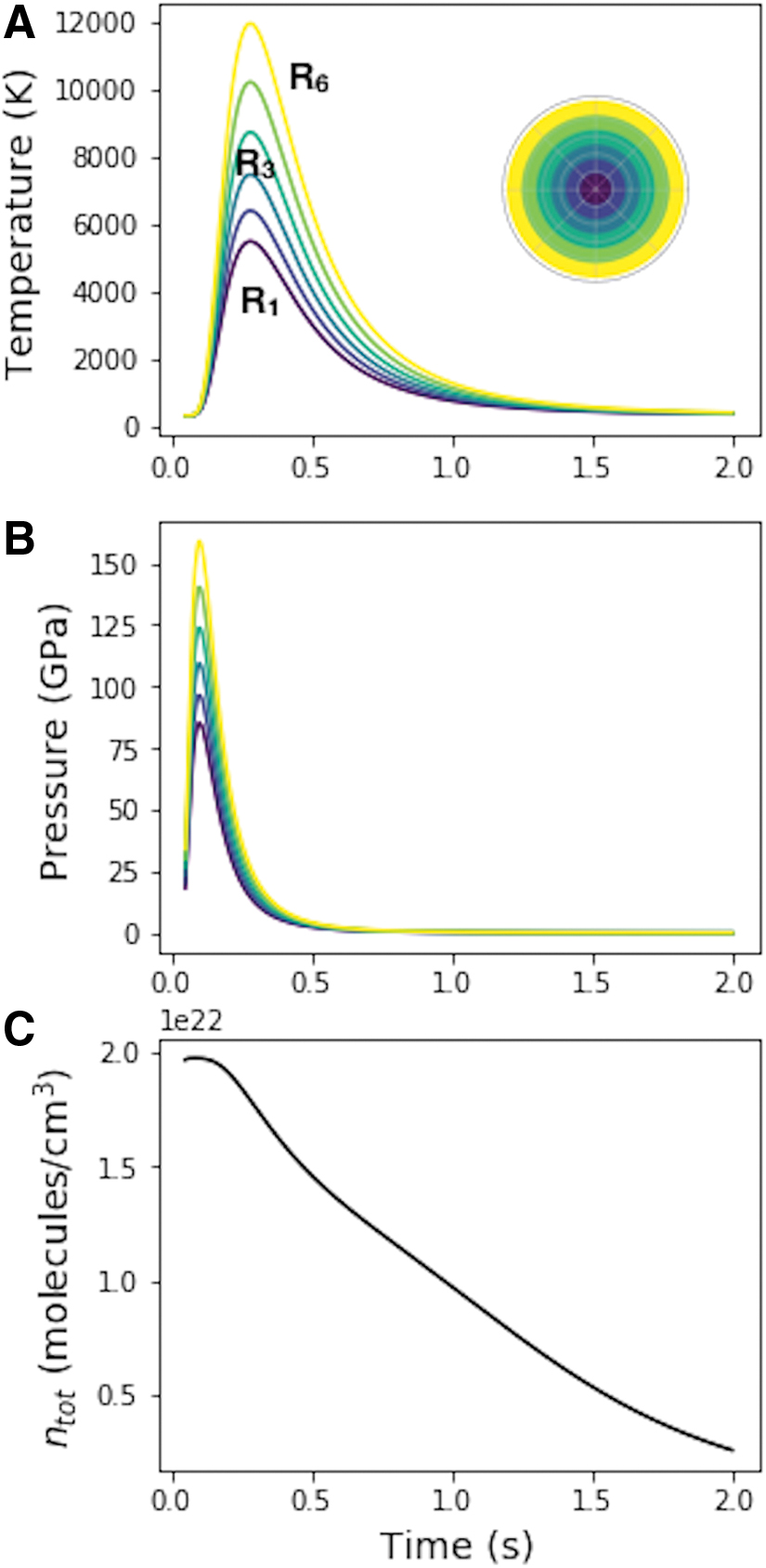
2.2. Impact chemistry model
We simulate the chemical evolution of the volatile component of impactors at six radii within the impacting comets, ranging from the comet core to the surface. Impactors initially contain
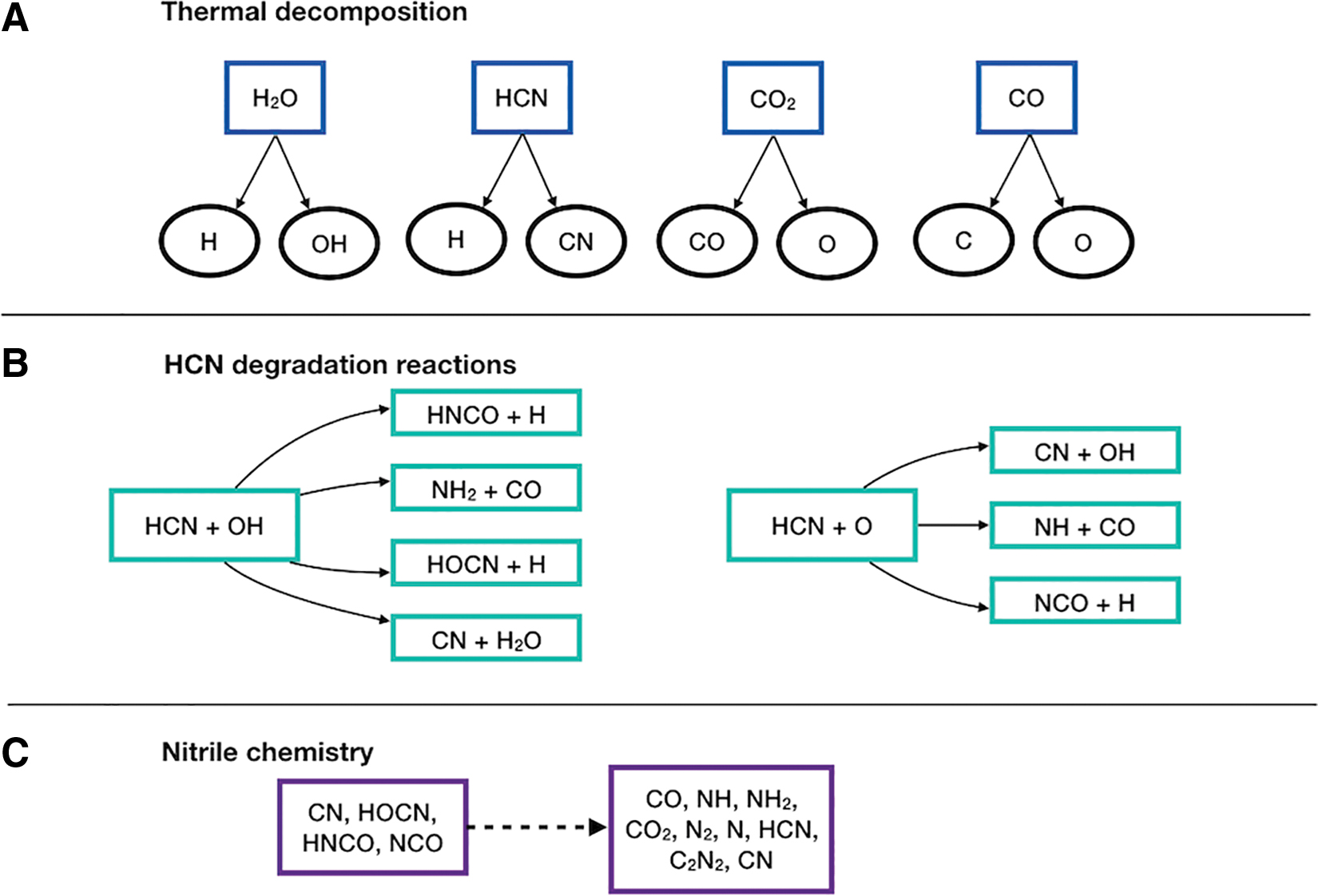
Summary of the architecture of the chemical network.
Temperature-dependent reaction rate constants (kn ) are determined for each time step and used to calculate the concentrations of each species (Ci ) during each temperature/pressure track. Concentrations are updated at each time step to account for the expanding volume during impact, following Fig. 1C.
In addition to our fiducial chemical network we also constructed a smaller one, which only considers water decomposition, and the OH-driven destruction of HCN, which we use to evaluate the importance of the detailed chemistry in Fig. 2B and C for nitrile survival.
3. Results
3.1. HCN survival in fiducial comet impact
We simulate the impact chemistry of a fiducial r = 1 km, v = 20 km/s spherical impactor, at six equally spaced radius shells, with impact angles between 0.5° and 90°, in 5° intervals. Impacts occur at all angles; the impact angle affects the overall temperature and pressure profiles in the impactor. More oblique impactors pass through more of the atmosphere and experience a larger drag force, leading to lower temperatures during impact and ultimately more chemical survival. The temperature during an oblique impact can be scaled as shown by Pierazzo and Melosh (2000a):

where T 0 is the temperature of a vertical (i.e., θ = 90°) impactor that is parameterized in Section 2.1.
For vertical impactors, we use the temperature and pressure profiles from Fig. 1 and evolve the chemical kinetic network to assess HCN survival. For nonvertical impactors, we scale the temperature profiles according to Equation (4) and allow the chemical kinetic network to run and determine total HCN survival. Figure 3 shows an example of the time-dependent chemistry for the case of the innermost (R 1) radius shell for 5° and 10° impactors using both the simplified and full models. At lower impact angles, the maximum temperatures are too low for substantial H2O thermal decomposition, leading to negligible amounts of HCN loss. At 10°, temperatures experienced are sufficient to degrade some H2O into OH and H radicals, initiating the HCN destruction chemistry and leading to negligible HCN survival in the simplified model and partial HCN survival in the full model.
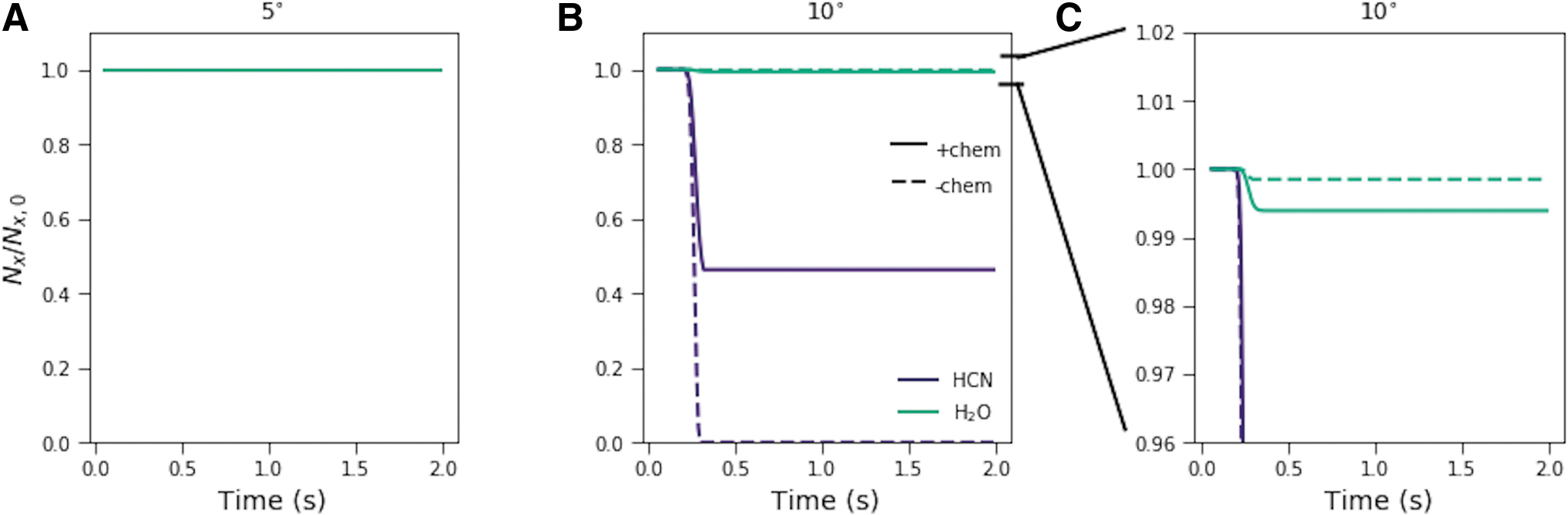
Abundance of selected species during the temperature evolution for 5° and 10° impactors in the innermost shell in the simplified (dashed) and full (solid) models. The species are scaled to their initial abundance and are presented on a linear scale.
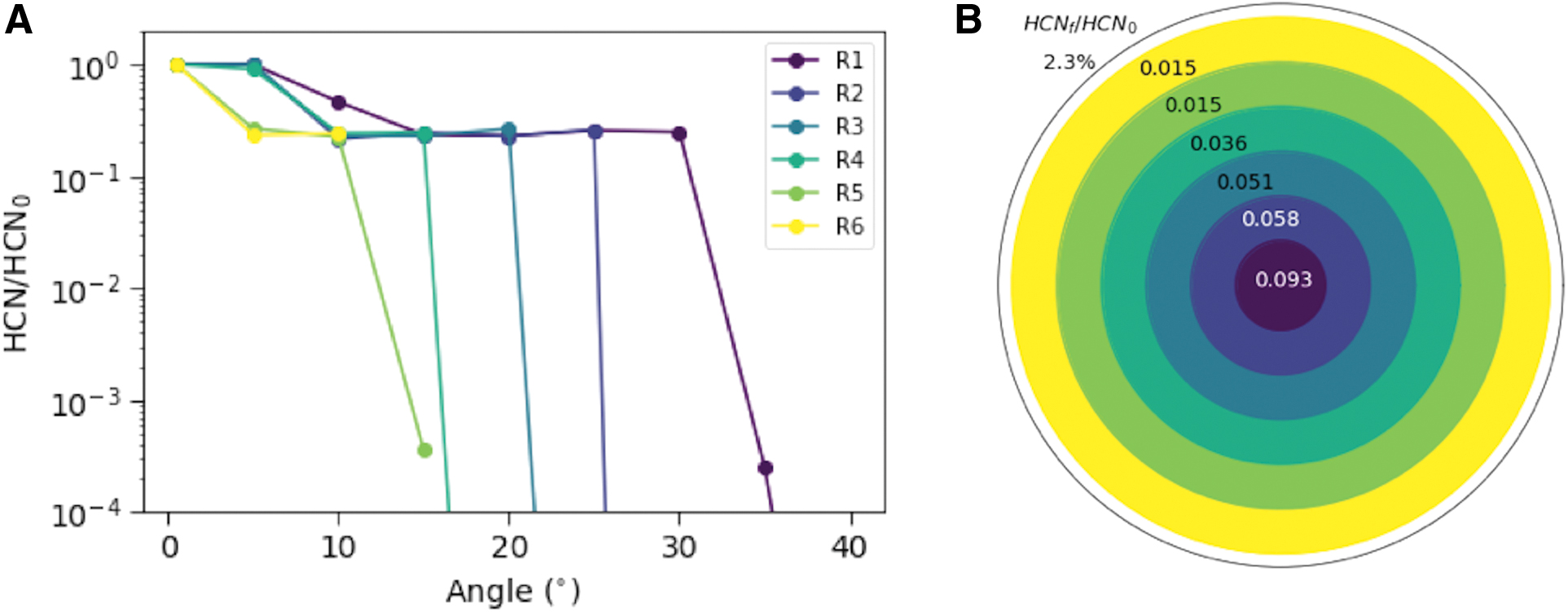
Figure 4 shows the abundances of the initial molecules contained in the comet as a function of impact angle at three different comet radii for simulations at the lower impact angles, where some HCN survival is possible. We find that HCN survives with virtually no destruction at all radii for θ < 10°, in the inner three shells for θ < 20°, and in the inner shell for θ < 30°. At θ > 30°, HCN survival is minimal throughout the comet, that is, <<0.01%.
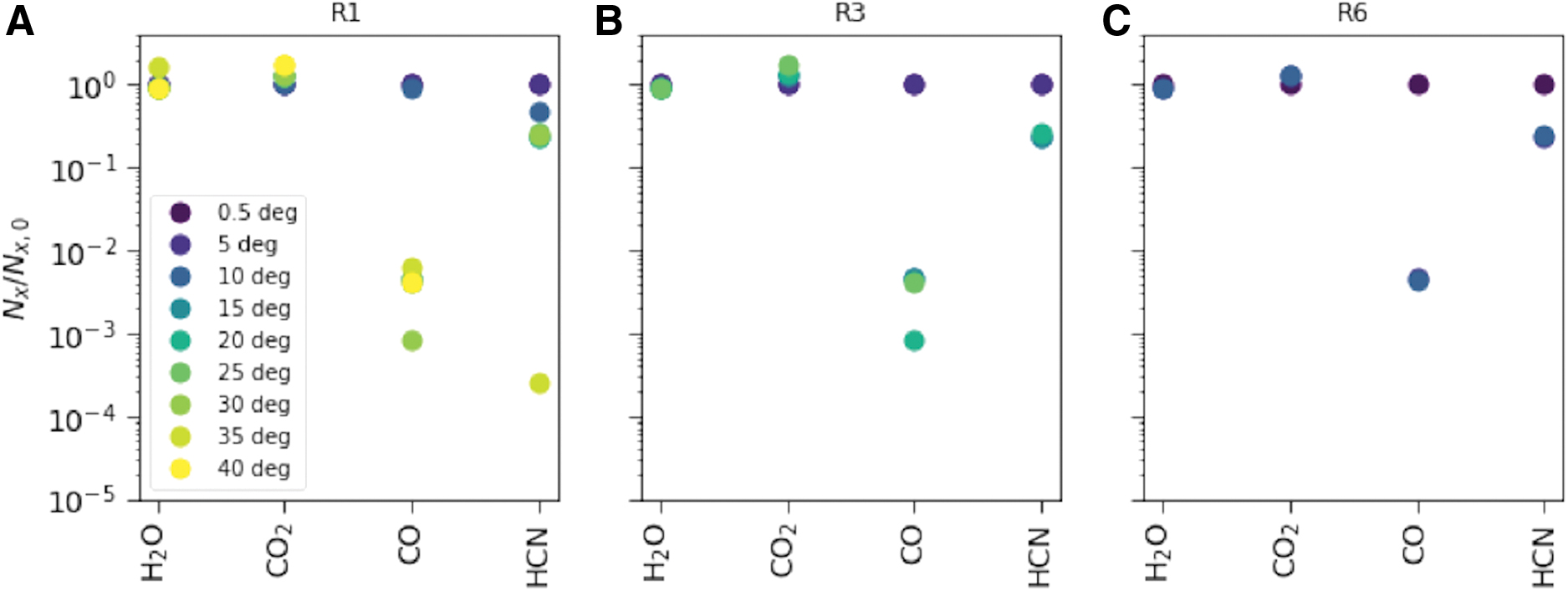
Abundances of H2O, CO2, CO, and HCN after thermal evolution for various impact angles in three radius shells. At lower impact angles, the initial molecular abundances remain fairly unchanged, but as the temperature profiles experienced increase (either from increased impact angles or more exterior radii), significant destruction of HCN is observed. Color images are available online.
After running the full chemical models to obtain the abundances of all species for each impact angle and radius shell, we determine a total survival percentage of HCN by considering the probability distribution function of impact angles. Pierazzo and Melosh (2000b) derive the probability, dP, of an impact occurring in the angle range
Approximately 18% of impacts will occur with θ < 25°, the approximate threshold for any HCN survival for our fiducial comet.
We calculate the HCN survival fraction as a function of impact angle and comet radius (Fig. 5A), then integrate over all angles to obtain the population-averaged survival percentage at six comet radii. We then integrate again over the volume of the comet to obtain the total survival fraction of HCN for a fiducial impactor, averaged over impact angle and volume. This gives 2.3% HCN survival over the entire volume of the impactor (Fig. 5B). The largest contributions to HCN delivery come from impacts at fairly oblique angles.
We assess the sensitivity of our model to the initial ratios of molecules by allowing the HCN fraction to vary from 0.007% to 0.7%, the typically observed range of HCN in comets. We find that the HCN survival fraction is rather insensitive to the initial composition.
For validation purposes, we test our simplified model (only including thermal destruction and OH-driven HCN destruction) and find that the impact angle threshold for HCN survival is within a factor of a few compared with the model that incorporates more chemistry. The total volume-integrated and impact-angle averaged HCN survival is 0.7% for the simplified model (compared with 2.3% for the full network, that is, roughly a factor of 3 lower). These similar results demonstrate that the order of magnitude of HCN survival during impact is not sensitive to the details of the chemical network, but that chemistry during impact results in some increased survival. We also note that HCN production during impact is likely, but this is beyond the scope of this study, which has no other source of N than HCN.
3.2. Cumulative HCN delivery
In the previous section, we calculated the fractional HCN survival during comet impact integrating over the comet volume and the distribution of impact angles, for our fiducial model. The HCN survival also depends on radius and velocity, and the net amount of HCN delivered also depends on the initial cometary abundance of HCN. We address these parameters, how they affect HCN survival and content, and their distributions among comets to determine the global delivery of HCN expected over a period of increased bombardment.
3.2.1. HCN survival
PC99 showed that molecular survival also depends on the radius and velocity of the impactor. At higher velocities, the impactor has more energy and reaches higher temperatures. Larger impactors require more time for a shock wave to propagate through, so material will stay in a shocked (and thus hotter) state for longer. So, we expect organic survival to decrease with both increased impactor velocity and radius. We adopt the findings of PC99, who found a roughly linear behavior on a semilog plot between amino acid survival and comet radius and between survival and impact velocity. We expect that HCN survival will behave similarly, since in both cases survival depends on thermal decomposition activated at similar temperatures; in their model they only consider the direct thermal decomposition of amino acids, while in our case, the relationship is indirect since HCN survival depends on thermal decomposition of H2O. We therefore use the average slope of log(survival) versus radius and versus velocity from PC99 to determine a parameterized survival function for HCN, where
where A is a constant calculated from the HCN survival during r = 1 km, v = 20 km/s impacts. The survival fraction from the full chemical network gives A = −0.299, and from the simplified chemical network A = −0.801. We show the HCN survival with varying r and v in Fig. 6 for both the full chemistry (Fig. 6A) and simplified (Fig. 6B) models.
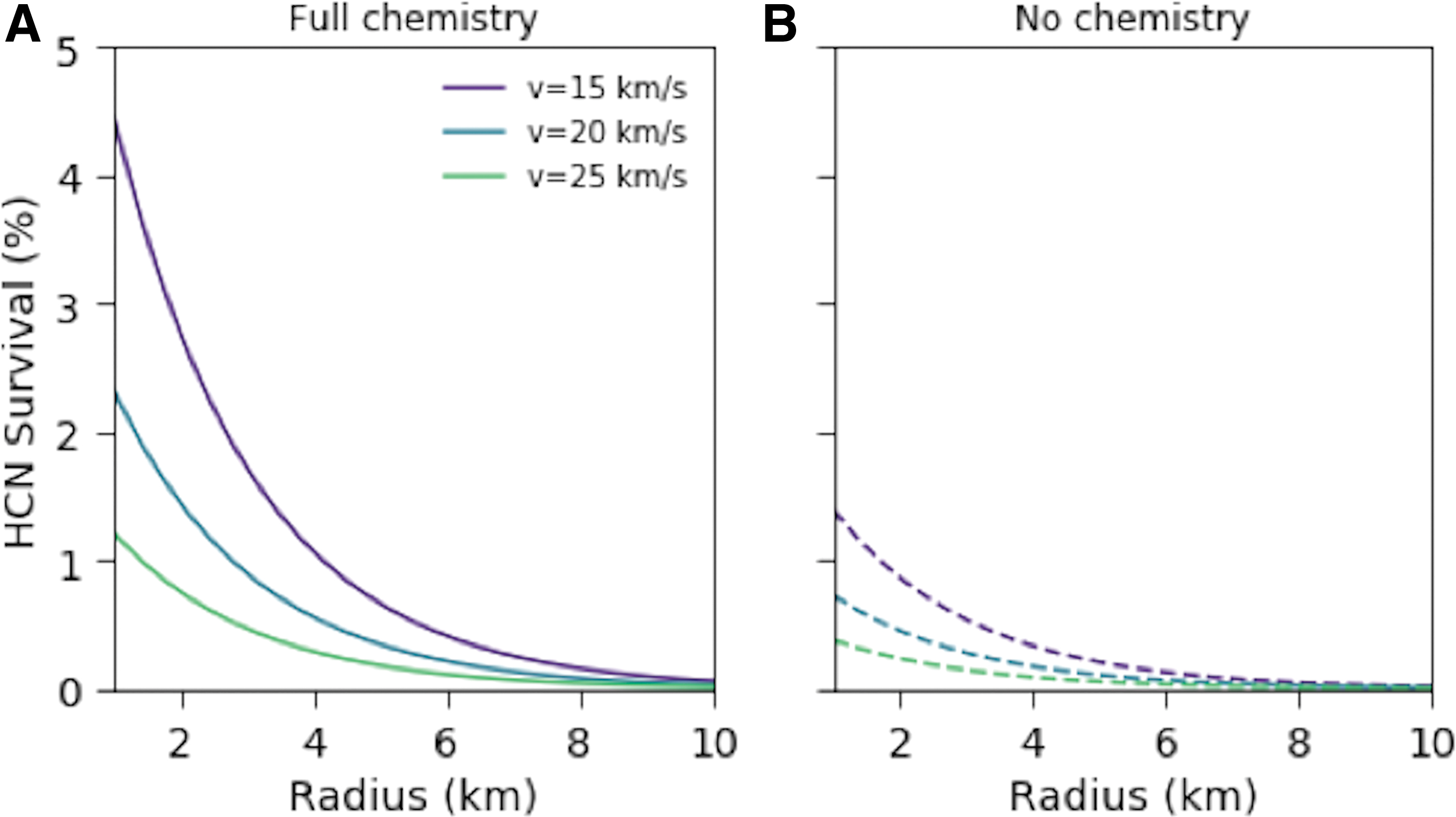
HCN survival for impactors of varying radii and velocities for the full chemical model
To estimate the total amount of HCN that could have been delivered to the Earth, we consider probability distributions of impactor radii and velocities suggested by the literature. The cumulative size distribution of impactor radii follows a power law, with a slope of
The distribution of impact velocities in the young solar system is unknown, and we instead rely on data from contemporary impacts; Hughes and Williams (2000) report a mean Earth impact velocity of
3.2.2. HCN concentration
The final parameter to consider is the initial HCN concentration in comets. Spectroscopic observations of comets (Mumma and Charnley, 2011) find that majority of comets lie in the 0.1–0.3% HCN/H2O range. These observations are consistent with results from ROSINA (Le Roy et al., 2015), which find an HCN abundance of 0.09 and 0.62 (in percent water content) in the summer and winter hemispheres, respectively. We allow the HCN/H2O ratio to follow a Gaussian centered at 0.15%, with a width of 0.1%, which is consistent with observations from comets.
3.2.3. Global delivery
We would like to determine the total amount and flux of HCN that could reasonably be delivered to the early Earth during a period of increased bombardment. We populate 10,000 impactors with initial HCN/H2O ratio, radius, and velocity according to the appropriate probability distributions, as described in the previous sections. The HCN survival for each body is determined by using the scaling relationship [Eq. (6)], and the initial HCN abundance and a water content randomly chosen between 30% and 50% (Fayolle et al., 2017) are used to determine the total amount of surviving HCN for each impactor. We sum the HCN and H2O over the population to get the total amounts of these molecules delivered per 10,000 impacts.
The precise amount of cometary material delivered to the Earth during such a period is not known, but geochemical and isotopic constraints exist. Morbidelli et al. (2000) used D/H ratios to suggest that <10% of Earth's ocean water was delivered by comets, while others suggested constraints are far more stringent, for example, Dauphas et al. (2000) suggested 0.1% water delivered by comets. Marty et al. (2016) determined that if comet 67P is a typical comet, <1% of Earth's water was contributed by comets. Due to the continued uncertainties in the amount of water delivered by comets, we consider three cases: 0.1%, 1%, and 10% of Earth's ocean water delivered by comets and we scale the surviving HCN amounts to correspond to these three cases. Figure 7 shows the cumulative delivery of HCN corresponding to these three cases of water delivery by comets over a fiducial timescale of 100 Myr. The solid lines represent the model with
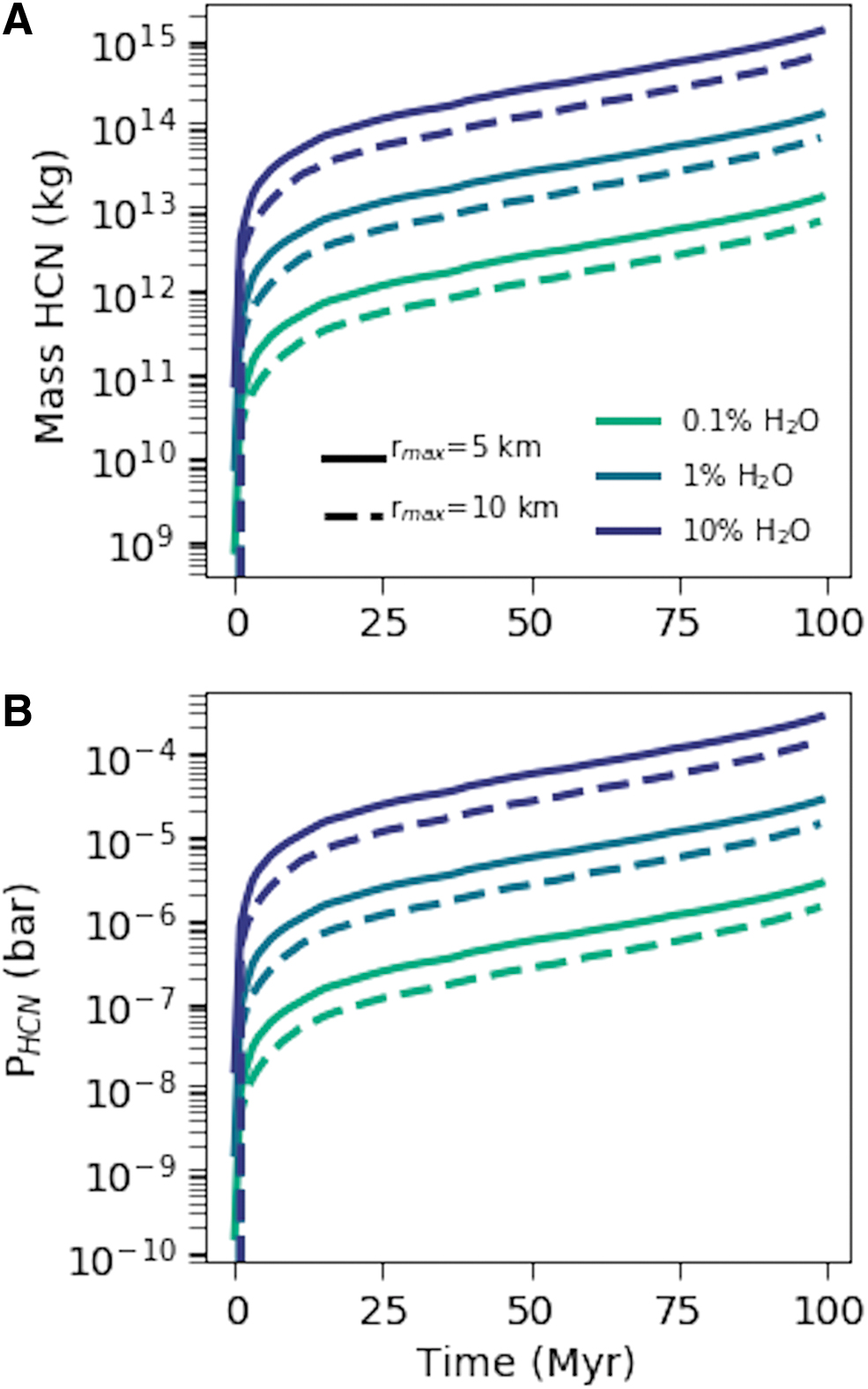
Total mass
3.3. Local HCN delivery and lifetimes
The above results show that HCN delivery from impacts is likely not important on a global scale, but it is possible that individual impactors could deliver significant levels of HCN on a local scale. We consider the local scenario, where impact-delivered HCN is only dissolved in water brought by the comet, as an extreme end member to determine the maximum HCN concentrations delivered from single favorable (i.e., low impact angle, low velocity, and small radius) impacts. This is an end-member case providing an upper limit on possible HCN concentrations; in reality, depending on the amount of water in the environment near the impact, HCN concentrations could be lower. HCN will ultimately degrade with time, but it may persist in relevant quantities for prebiotic chemistry for extended periods of time.
In an aqueous environment, the main HCN loss term is HCN hydrolyzes into formamide (HCONH2) and then to formic acid (HCOOH):
The hydrolysis of HCN can be catalyzed by either acid or base (Miyakawa et al., 2002), to give a modified rate of HCN loss of:
where
The acid- and base-catalyzed hydrolysis rates, from the work of Miyakawa et al. (2002), are as follows:
where
Figure 8 shows the degradation of HCN for a pH = 6 and T = 10°C following impact angles of 5°, 15°, and 25° and assuming that any HCN that survives the impact is dissolved locally in the comet-delivered water. Under these hydrolysis conditions, 5°, 15°, and 25° impactors with r = 1 km, v = 20 km/s would result in [HCN] > 1 mM for
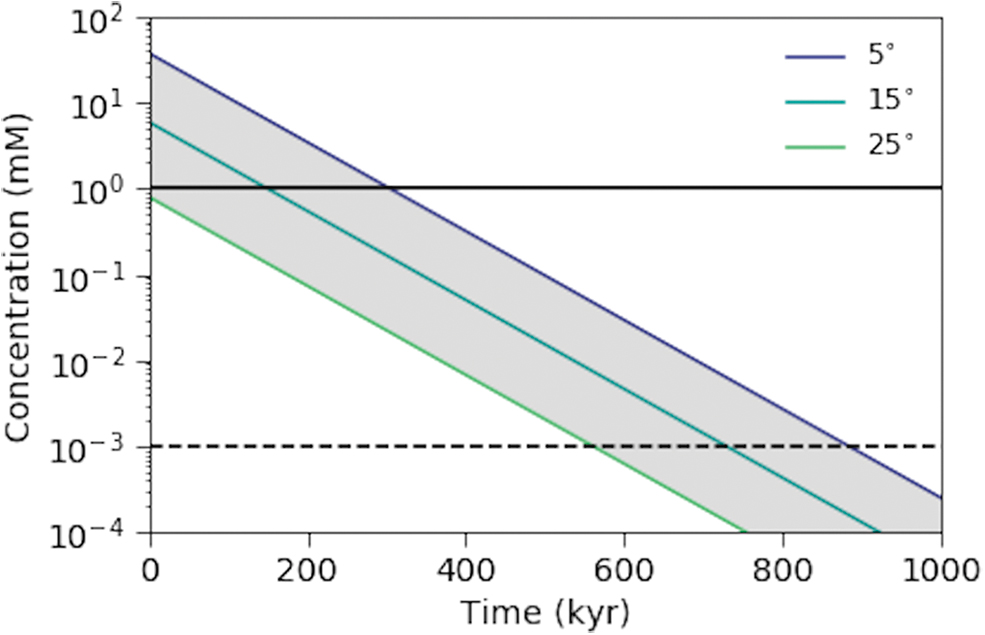
Concentration of HCN as a function of time in an aqueous environment with pH 6 and T = 10°C for an r = 1 km, v = 20 km/s impactor at three different impact angles. The solid line shows millimolar concentrations, which have been demonstrated to work in the laboratory. The dotted line shows micromolar concentrations, which is a rough hypothetical limit to potentially relevant concentrations. 18% of impacts should occur with θ < 25°, the estimated threshold for HCN survival. Color images are available online.
Using the same method as above, we determined the postimpact concentrations of HCN for a range of impact parameters and aqueous environments. Figure 9 shows the initial HCN concentrations from local delivery for r = 1 km impactors with angles of 5°–25° (represented by lines), along with the concentration of HCN after 100 kyr has elapsed (triangles). We find that moderately acidic (pH 4 and 6) and lower temperature conditions experience relatively slow HCN degradation over time, while basic and warmer environments lead to rapid loss of HCN. The most favorable impacts (i.e., lower impact angle and smaller radius) can have HCN concentrations in excess of millimolar levels for >100 kyr. In fact, under the most favorable conditions (pH 4, 5°C, low angle, low velocity, small radius), HCN can last for ≈3 Myr at >mM levels, and ≈8 Myr at >μM levels. At pH 6, 15°C, HCN can exist above micromolar levels for about 200–500 kyr, for an r = 1 km, v = 20 km/s impactor, depending on the impact angle. For larger impacts, the survival decreases by up to 60%, that is, for 5 and 10 km impactors the survival is 50–80% and 40–60%, respectively, compared with 1 km impactors. At a velocity of 15 km/s, HCN survival is enhanced by 110–140% over the v = 20 km/s impacts; at v = 25 km/s, survival is 60–90% that of v = 20 km/s.

Concentrations of HCN from local impacts with various parameters initially (lines) and after 100 kyr (triangles). The initial concentration is set by the HCN survival for a given impact angle (color), radius (held at r = 1 km here), and impact velocity (held constant at 20 km/s here). The concentration with time is determined by the aqueous hydrolysis of HCN, which depends on the pH (columns) and temperature (x axis) of the environment. Lower impact angles can initially have [HCN] > mM levels, which can persist above micromolar levels for longer than 100 kyr in moderately acidic (pH 4 and 6) environments for a range of temperatures, impact angles, and radii. More basic aqueous environments (e.g., pH 8) result in rapid hydrolysis of HCN, leaving none still present at 100 kyr. Color images are available online.
We can then ask how the time interval between impacts with favorable HCN survival outcomes compares with the lifetime of HCN as a result of such impact. If 1% of the Earth's ocean water is delivered by comets over the course of 100 Myr, impactors with θ < 5° occur on average every 9 kyr, which is much smaller than the lifetime of HCN after such an impact, provided that the aqueous environment is also favorable, that is, not too warm or basic. This implies that during a period of increased cometary bombardment, there could be multiple local impact environments with prebiotically relevant HCN levels at the same time.
4. Discussion
4.1. Estimated HCN levels versus laboratory experiments
In the previous section, we have shown that HCN can be delivered from comet impacts in significant levels and can persist in the local environment for prolonged periods of time under certain conditions. Under the most favorable circumstances, HCN survives at concentrations above millimolar levels for several Myr. Laboratory experiments that use HCN as a building block for prebiotic chemistry generally use from tens to hundreds of millimolar (Ritson and Sutherland, 2012; Yi et al., 2018), to submillimolar (Todd et al., 2018). The reactions in the work of Ritson and Sutherland (2012) lasted roughly 8 h; those in the work of Todd et al. (2018) proceeded in 4 h. Comparing these laboratory conditions to the timescales and concentrations we find possible in this study are encouraging: HCN can last for many times longer than such laboratory experiments take. Of course, laboratory experiments occur in the most favorable conditions and are often optimized to increase the efficiency or speed of the reaction. Nevertheless, having access to these prebiotically relevant concentrations of HCN for thousands to millions of years on the early Earth could provide the circumstances for prebiotic chemistry using HCN to be successful.
We present two extreme cases for HCN delivery: global and local. In the global case, when all delivered HCN is dissolved in the entire volume of the ocean, HCN concentrations become negligibly small. In the local case of HCN delivered purely in cometary-delivered water, favorable impacts can provide significant levels of HCN for extended periods of time. In reality most cases probably fall somewhere between the two end cases: delivered HCN will be dissolved in some combination of cometary-delivered water and water from the nearby environment. This will act to decrease the overall HCN concentration and lifetime from what we calculate in the local scenario, but depending on the amount of dilution, HCN may still be available in reasonable concentrations and timescales for prebiotic chemistry.
4.2. Comparison with different sources of HCN
In our model for global delivery, 1% ocean water delivered by comets over 100 Myr gives roughly
Atmospheric photochemistry can split molecular nitrogen into nitrogen atoms, which can then react with carbon-containing molecules in the atmosphere to make HCN (Zahnle, 1986). The efficiency of this process is largely dependent on the composition of the atmosphere, with more reducing atmospheres yielding higher production rates of HCN. The Zahnle (1986) results give
Overall, in reducing atmospheres, photochemical and lightning generation exceeds delivery in impacts, but the case may be different for more oxidizing atmospheres. Recent lines of evidence (e.g., igneous detrital zircons) (Trail et al., 2011) point toward a less reducing atmosphere on the early Earth than previously thought, although the oxidation state of Earth's early atmosphere is still quite unconstrained (Zahnle et al., 2010 and references therein, Kasting, 1993, and references therein).
Another potential source of HCN on the early Earth is synthesis in the atmosphere after impact (Sugita and Schultz, 2009; Parkos et al., 2016; Ferus et al., 2017a). Parkos et al. (2016) estimated
4.3. Model uncertainties and future directions
There are a number of uncertainties and assumptions incorporated into our model that may affect the overall results. Perhaps the largest uncertainty when calculating the total amount of HCN delivered by comets is the amount of cometary material actually impacting the early Earth during the era of abiogenesis. The postulated Late Heavy Bombardment is currently contested, and the precise amounts and fractions of cometary and asteroidal material delivered during the early history of the solar system are contested as well. We attempt to address this uncertainty by allowing for three different cases of total cometary delivery, corresponding to delivering 0.1%, 1%, and 10% of Earth's ocean water. An improved understanding of the impact history of comets in the early solar system would help constrain this parameter.
Another major source of uncertainty is the lack of modern simulations of comet impacts, and the temperature and pressure environments immediately following different kinds of impacts. Our current assumptions are based on simulations from 1999 (PC99), and may actually result in underestimates of how much material can survive comet impacts; Blank et al. (2008) used a 3D model and find significantly lower temperatures reached during impact than PC99, but a detailed publication is not available. New thermal models of impacts and specifically addressing how organic survival is affected would allow our model to no longer rely on such assumptions.
Furthermore, the model does not include various solid-state interactions occurring during the initial vaporization of the solid material. At the very high pressures experienced soon after impact, dissociation of molecules such as water and HCN into radicals could be inhibited somewhat due to Le Chatelier's principle. In this case, our results would be lower limits, since it is the initial dissociation of molecules that drives the destruction of HCN.
In addition to these uncertainties, we also made several simplified assumptions to what happens during and after impact. For example, we neglect impact generation of HCN, which has been suggested previously to be of importance (Sugita and Schultz, 2009; Ferus et al., 2017a). We also only consider hydrolysis as the dominant sink of HCN once it reaches an aqueous environment. Undoubtedly, other processes, including degassing and further chemical reactions, can act to change the HCN concentrations from our calculated values here. However, we also neglect potential storage mechanisms for HCN, including formation of metallocyanide complexes (e.g., ferrocyanides). As proposed by Xu et al. (2018) and Sutherland (2016), HCN can form these feedstock molecules and subsequently be released from them under certain circumstances. In such a case, the lifetime of HCN could be extended to arbitrarily longer timescales.
Despite these uncertainties and limitations to our model, we expect that the overall conclusions of this work will remain true: delivery of HCN from impacts on a global scale is not likely to be extremely relevant, but the occasional favorable impact could provide elevated and prebiotically relevant levels of HCN on local scales for significant periods of time. In future work, we hope to incorporate additional details, including impact generation and a wider range of volatiles contained in comets, to obtain a more complete picture of the chemical environment available after an impact.
5. Conclusions
Here, we have considered intact delivery of HCN from impacts of comets as a source of HCN on the early Earth. We used a stochastic Monte Carlo-like framework along with a chemical kinetic network to determine the amounts of HCN delivered by comets, using available literature models of comet impact physics and comet population characteristics. We find that comet delivery is unlikely to be relevant on a global scale (dissolution into the ocean brings the concentration of HCN to micromolar levels, assuming 1% water delivered by comets, and the steady-state concentration would be smaller due to HCN hydrolysis). However, individual impactors can provide elevated levels of HCN in the local environment, where surviving HCN is dissolved in only water brought by the comet. HCN survival is most favorable for low impact angle, low velocity, small radius impacts. The aqueous environmental conditions after the impact dictate how long HCN would be available above prebiotically relevant concentrations. Lower temperatures and moderately acidic pHs (pH 4) are most favorable, and could give [HCN] > mM levels for up to 3 Myr, and [HCN] > μM for up to 8 Myr. While this scenario only includes HCN hydrolysis as a sink, we also neglect entrapment of HCN in relatively stable metallocyanides that could act as a storage mechanism and occasionally release relevant amounts of HCN to an aqueous environment. We thus suggest that impacts with favorable characteristics could potentially provide enough HCN for long enough time periods to be relevant for origins-of-life chemistry and could provide an atmosphere-independent source of HCN.
Footnotes
Acknowledgments
We would like to thank E.C. Fayolle for insights regarding thermal models used and C. Giurgiu for discussions on the aqueous HCN chemistry. We would also like to thank D.D. Sasselov and S. Ranjan for helpful comments and insights. We are especially grateful to H.J. Melosh for helpful comments and suggestions during the review process. We would also like to acknowledge funding from the Harvard Origins of Life Initiative.
Author Disclosure Statement
No competing financial interests exist.
Funding Information
This work was supported by an award from the Simons Foundation (SCOL #321183, Karin I. Öberg).
Supplementary Material
Supplementary Appendix Table SA1
Supplementary Appendix Table SA2
Abbreviations Used
Appendix A1
References
Supplementary Material
Please find the following supplemental material available below.
For Open Access articles published under a Creative Commons License, all supplemental material carries the same license as the article it is associated with.
For non-Open Access articles published, all supplemental material carries a non-exclusive license, and permission requests for re-use of supplemental material or any part of supplemental material shall be sent directly to the copyright owner as specified in the copyright notice associated with the article.
