




Abstract
The martian meteorite ALH 84001 formed before ∼4.0 Ga, so it could have preserved information about habitability on early Mars and habitability since then. ALH 84001 is particularly important as it contains carbonate (and other) minerals that were deposited by liquid water, raising the chance that they may have formed in a habitable environment. Despite vigorous efforts from the scientific community, there is no accepted evidence that ALH 84001 contains traces or markers of ancient martian life—all the purported signs have been shown to be incorrect or ambiguous. However, the meteorite provides evidence for three distinct episodes of potentially habitable environments on early Mars. First is evidence that the meteorite's precursors interacted with clay-rich material, formed approximately at 4.2 Ga. Second is that igneous olivine crystals in ALH 84001 were partially dissolved and removed, presumably by liquid water. Third is, of course, the deposition of the carbonate globules, which occurred at ∼15–25°C and involved near-neutral to alkaline waters. The environments of olivine dissolution and carbonate deposition are not known precisely; hydrothermal and soil environments are current possibilities. By analogies with similar alteration minerals and sequences in the nakhlite martian meteorites and volcanic rocks from Spitzbergen (Norway), a hydrothermal environment is favored. As with the nakhlite alterations, those in ALH 84001 likely formed in a hydrothermal system related to a meteoroid impact event. Following deposition of the carbonates (at 3.95 Ga), ALH 84001 preserves no evidence of habitable environments, that is, interaction with water. The meteorite contains several materials (formed by impact shock at ∼3.9 Ga) that should have reacted readily with water to form hydrous silicates, but there is no evidence any formed.
1. Introduction and Review of ALH 84001 Habitation
One of NASA's major foci is detection and understanding of potentially habitable environments across the Solar System and in other stellar systems. Mars has played a central role in the search for habitable times and places, perhaps reaching back to Percival Lowell's idea of Mars as an abode of life (Lowell, 1910). Orbital and landed investigations of Mars have and will search for potentially habitable environments (Grotzinger et al., 2014; Williford et al., 2018). We do have samples of the martian crust in hand, as the martian meteorites (Treiman et al., 2000); two of them, ALH 84001 and NWA 7034 (and pairs) include material that date to Mars' earliest era, a time when the surface was warm and wet enough to support flowing water and standing lakes. Here, I review and synthesize literature data on the ALH 84001 meteorite for its implications on Mars' habitability (both in its early years and to the present). This work was first presented at the Lunar and Planetary Institute's Habitability Conference, part of its “First Billion Years” initiative (Treiman, 2019) 1 .
1.1. ALH 84001 and habitability
The Allan Hills (ALH) 84001 meteorite was found in Antarctica during the 1984–1985 season of the ANSMET program (Score and MacPherson, 1985). It was recognized on the ice as unusual and was tagged as among the first samples to be classified on return to Houston—hence the number 001. ALH 84001 is an orthopyroxenite with mineral compositions similar to those of diogenite meteorites (inferred to be from 4 Vesta) and so was classified as a diogenite. It was only recognized as martian when Mittlefehldt (1994) reported anomalies with respect to common diogenites: its relatively sodic plagioclase; the presence of ferric iron in its oxide minerals; the presence of pyrite; its relatively high rare earth element (REE) abundances and enrichment in light REEs (e.g., La, Ce, Sm); and the presence of pre-terrestrial carbonate mineral deposits. Determination of its oxygen isotopic composition sealed the case for a martian origin (Score et al., 1993).
Researchers in Dr. David McKay's group at Johnson Space Center began examining the carbonate materials in ALH84001 (Romanek et al., 1994) and thinking (in 1995) that they might be biogenic; see page 161 of Schopf (2019). Shortly thereafter, McKay et al. (1996) published their hypothesis that several features in ALH84001, associated with the carbonate globules, constituted evidence of ancient martian life. Of course, that inference would also have been proof of a habitable environment, though the concept was not widely cited at the time.
The scientific community's understanding of habitability for life as we know it has evolved significantly from when ALH 84001 was found and when McKay et al. (1996) proposed that it contained evidence of martian life (Farmer, 2018). The presence of liquid water is still considered a prerequisite for life as we know it, both as a solvent and a chemical food-stock, but other solvents are possible, including ammonia and hydrocarbons. The presence of liquid water alone does not prove that an environment is habitable. An environment with liquid water could be uninhabitable by being too saline (i.e., the activity of H2O was too low); being otherwise chemically inhospitable (e.g., too acid or alkaline); lacking bio-essential elements (major or trace); lacking energy sources, either physical (like light) or chemical; being physically inhospitable (too hot, too cold, exposed to too much ionizing radiation); or having many of these inhospitable conditions (Farmer, 2018). Here, evidence of the presence of liquid water is taken as evidence of potential habitability, and evidence of its absence is taken to imply an uninhabitable environment. For the most part, we lack evidence about the other constraints on the habitability of environments that were experienced by ALH 84001.
2. Environments/Events Recorded by ALH 84001
To understand the implications of ALH 84001 for potential habitability on Mars, one must follow its whole history, with its gaps and lacunae. The following is an outline of its history as I interpret it, an attempt to assimilate all relevant data but eliminating features of little relevance to Mars' habitability. This history relies primarily on events recorded in the rock's textures (Treiman, 1995, 1998), augmented especially by constraints from studies of stable and radiogenic isotope systems.
2.1. Ancient aqueous alteration
Rb-Sr and Sm-Nd radioisotope systematics of ALH 84001 suggest that some of its precursor materials experienced extensive aqueous alteration. Evidence for this event (or events) comes from the high 87Sr/86Sr ratios for some mineral aliquots (Wadhwa and Lugmair, 1996; Borg et al., 1999), from a high 87Sr/86Sr initial ratio for a mineral isochron (Beard et al., 2013), and from unreasonably old “ages” from some Rb-Sr “errorchrons” (Lapen et al., 2010).
Generation of these high 87Sr/86Sr ratios is inferred to pre-date formation of ALH 84001 itself, as the rock contains insufficient Rb to generate them internally. Hence, the high 87Sr/86Sr ratios are ascribed to an earlier source, one with a high Rb/Sr ratio for long enough to generate high 87Sr/86Sr; strontium from that source was then incorporated into the ALH 84001 magma or its alteration materials. The inferred high-Rb/Sr-source is interpreted as most likely being rich in clay minerals, and hence to represent an event of aqueous alteration (Beard et al., 2013).
In specific, silicate and oxide minerals associated with the carbonates give a Rb-Sr age of 3.95 Ga and an initial 87Sr/86Sr of 0.704 (Beard et al., 2013); this value is significantly higher than the initial ratio of 0.702 for other carbonate minerals (Borg et al., 1999) and apparent initial ratios of 0.701 and 0.698 from “isochrons” in igneous textured material (Nyquist et al., 1995; Beard et al., 2013). Beard et al. (2013) interpreted the high 87Sr/86Sr ratios to represent the addition of Sr from a high-Rb source (with the source's 87Rb producing the 87Sr). This high-Rb source was most likely rich in clay minerals, and Beard et al. (2013) estimated that the clay minerals formed sometime near 4.2 Ga.
2.2. Igneous origin
ALH 84001 was originally an igneous rock, an orthopyroxenite (Fig. 2), formed from basaltic magma inside Mars by the settling and accumulation of crystals of orthopyroxene, olivine, and chromite (Mittlefehldt, 1994). Its parent magma may have been compositionally akin to those of the shergottite meteorites (Lapen et al., 2010), although this inference is uncertain because we cannot tell how much of the rock was accumulated crystals and how much was intercumulus magma, and because subsolidus equilibration has changed the minerals' compositions (Treiman, 1996). Among the shergottite types, the parent magma for ALH 84001 could reasonably have been an olivine-phyric shergottite, which have orthopyroxene, olivine, and chromite as high-temperature phases. The shergottites, however, seem unrepresentative of typical basalts on Mars (McSween et al., 2006), and it is possible that the parent magma for ALH 84001 was unrelated to any known martian basalt.
The igneous formation age of ALH 84001 is also somewhat uncertain. The most likely igneous age is ∼4.09 ± 0.03 Ga, as defined by Lu-Hf and Pb-Pb mineral isochrons (Bouvier et al., 2009; Lapen et al., 2010). Given the chemical homogeneity of minerals in ALH 84001 (Mittlefehldt, 1994; Treiman, 1995), it seems likely that this age is formally of a metamorphic event, a chemical and isotopic equilibration of the minerals in ALH 84001. This metamorphism was likely to have been post-igneous cooling (as is expected for rocks in large igneous intrusions) but could conceivably have been a separate later event, that is, that the igneous origin of ALH 84001 was older than 4.09 Ga.
Other radioisotope chronometers, Rb-Sr and Sm-Nd, give “isochron” ages of ∼4.5 Ga or older (Jagoutz et al., 1994; Nyquist et al., 1995, 2001; Lapen et al., 2010; Nyquist and Shih, 2013). Such old ages are problematic in a planetary sense, in being nearly contemporaneous with, or older than, Mars' formation and late heavy bombardment (Lapen et al., 2010). Lapen et al. (2010) suggested that the Sm-Nd and Rb-Sr chronometers had been affected by chemical alteration of phosphates in ALH 84001, and that those Rb-Sr and Sm-Nd “ages” are from errorchrons that actually represent mixing or chemical redistribution.
2.3. Metamorphism
The igneous origin of ALH 84001 was followed by a metamorphic event that homogenized the major element chemistry of the rock's minerals. It is not clear if this metamorphism was post-igneous cooling or a separate event. Compositions of adjacent contemporaneous orthopyroxene and augite give a Ca-Mg-Fe exchange temperature of 875°C which is consistent with other mineral thermometers (Treiman, 1995). Effectively, all divalent cations in the rock's minerals were equilibrated in this event. This temperature could represent the peak of metamorphism, or the blocking temperature of Ca-Mg-Fe exchange in the pyroxenes. The distributions of trivalent and higher-valent cations is not clear. Abundances of rare earth elements in orthopyroxene may have been homogenized (Wadhwa and Crozaz, 1998) or not (Lapen et al., 2010); it is unclear if these results are comparable, as the textural settings of the analyzed points were not given.
2.4. Impact shock I
The cumulate igneous texture of ALH 84001 is cut by swaths and stripes of fine-grained, granular orthopyroxene and chromite, Fig. 1, the “granular bands” of Treiman (1995). In some spots, disaggregated chromite grains appear in convoluted trails, suggesting that the granular bands were foci of intense and complex shearing (Fig. 1b). Interestingly, the granular bands contain no olivine (Shearer et al., 1999). The granular bands are ascribed to a shock event, likely a meteoroid impact. Treiman (1998) noted that some granular bands cross-cut others, and that such features can arise from the complex processes in a single impact event.
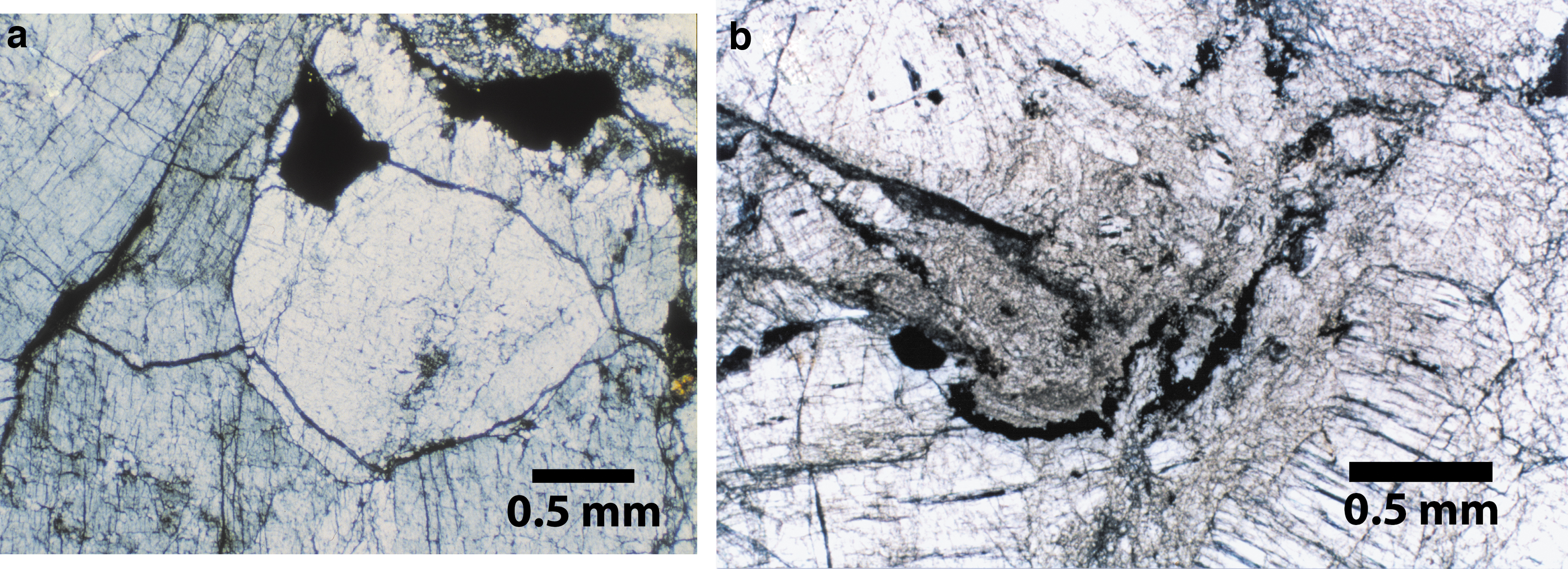
Textures of ALH 84001 silicates. (
The age of this impact event is uncertain but is likely to have been ∼3.86 ± 0.18 Ga, from an Rb-Sr mineral isochron of fine-grained silicate and oxide material, likely from a granular band (Beard et al., 2013), and a similar but less well documented Rb-Sr isochron (Wadhwa and Lugmair, 1996). This age is consistent with the age of carbonate deposition by Rb-Sr and Pb-Pb methods (see below), with U-Ph ages from phosphates (Terada et al., 2003; Koike et al., 2014), and with the majority of Ar-Ar ages for ALH 84001.
Argon-argon ages for ALH 84001 center around 3.9 Ga (Ash et al., 1996; Bogard and Garrison, 1997; Ilg et al., 1997; Turner et al., 1997; Cassata et al., 2010), but the most recent determination is older at 4.16 ± 0.04 Ga (Cassata et al., 2010). The younger ages likely date the formation of granular bands—the last major thermal event for ALH 84001. However, it is possible that these dates refer to the later impact which produced the maskelynite; see below (Turner et al., 1997; Weiss et al., 2002). It is possible that different aliquots of ALH 84001 have had different Ar loss histories. Argon-argon ages for martian materials require correction for presence of martian atmospheric gas, which is rich in 40Ar and is widely distributed in the minerals of martian meteorites (Ott et al., 2019). The Turner et al. (1997) age, 3.92 ± 0.08 Ga, and the Cassata et al. (2010) age, 4.16 ± 0.04 Ga, are both corrected for contemporaneous atmospheric contributions. Recognizing the ambiguities of the correction, the strongest constraint that Bogard and Garrison (1997) could establish was that the event that reset the Ar-Ar chronometer was longer ago than 3.81 Ga. It is unfortunate that much of this Ar-Ar data is in unreviewed abstracts.
2.5. Olivine dissolution
Following formation of the granular bands, the next recognizable event in ALH 84001 is dissolution of some of its olivine. This event is inferred indirectly, and by analogy with a terrestrial occurrence. Shearer et al. (1999) noted that olivine in ALH 84001 was spatially associated with carbonate globules. They noted that the granular bands contain no olivine, and inferred that the olivine formed after the granular bands, by dehydration of phyllosilicates that had formed along with the carbonate globules.
Treiman (2005b) interpreted these facts differently, and I follow that interpretation. Treiman et al. (2002) had studied a terrestrial analog for the ALH 84001 carbonate globules, in young basaltic rocks from Spitzbergen. These carbonate globules were commonly situated in void spaces shaped like olivine euhedra, and Treiman et al. inferred that crystalline olivine had been dissolved out of the rocks before deposition of the carbonates. Treiman (2005b) applied this model to ALH 84001 and inferred that much of the original olivine in the rock had been dissolved out before carbonate deposition. Much of the carbonate and its surroundings were deformed in the subsequent shock event (or events)—see below—but some globule masses seem undeformed and occupy regions of reasonable shapes for olivine in an igneous rock, for example, Fig. 2a. The absence of olivine in the granular bands can also be explained by dissolution. For instance, Fig. 1c of Treiman (2003) shows a portion of a carbonate globule filling space between two small subhedral grains of orthopyroxene; something else must have filled that space as the pyroxene crystals grew—if it had been open void, that is, the pyroxenes were vapor-deposited, they should have been euhedral.
ALH 84001 does not preserve evidence of the physical and chemical conditions of olivine dissolution (even the event itself is poorly preserved). No mineral deposits or transformations have been associated with it, and the other minerals in the rock (pyroxene, orthopyroxene, chromite) seem to have been unaffected.
2.6. Carbonate deposition
The carbonate mineral masses in ALH 84001 have been the focus of extensive study—mineralogical, geochemical, isotopic, and astrobiological; a critical review of all the studies is beyond this article's scope (Bridges et al., 2019). Instead, I provide a short review emphasizing what appears to be certain about the carbonate deposits.
2.6.1. Petrography
Areas rich in carbonate minerals are scattered irregularly throughout ALH 84001; some thin sections and fragments contain several percent of carbonate, and others contain nearly none. The physical appearance and settings of the carbonate masses have been described in detail by many researchers (Mittlefehldt, 1994; Treiman, 1995, 1998, 2003; Harvey and McSween, 1996; Gleason et al., 1997; Valley et al., 1997; Shearer et al., 1999; Greenwood and McSween, 2001; Eiler et al., 2002b; Barber and Scott, 2003; Corrigan and Harvey, 2004; Steele et al., 2007; Thomas-Keprta et al., 2009; Moyano-Cambero et al., 2017). The following descriptions are excerpted from them.
Masses of carbonate (and associated) minerals are present throughout ALH 84001 in several distinct settings: as discs along fractures (McKay et al., 1996), as spherical or hemispherical globules (Treiman, 1995; Valley et al., 1997), and as irregular fillings among grains of orthopyroxene (Eiler et al., 2002b; Treiman, 2003). Nearly all the carbonate masses are concentrically zoned (Fig. 2), with optically colorless centers of calcite, reddish interiors (Fe-bearing dolomite to magnesite), and rimmed by white and black zones of magnesite, and magnesite + magnetite respectively (Fig. 2). In some cases, the outer zones are repeated, and the whole layering sequence is surrounded by magnesite (Corrigan and Harvey, 2004).

Textures of ALH 84001 carbonates. Backscattered electron (BSE) images. Bright implies high average atomic number, i.e., Fe and Mg content. Brightest grains are chromite or pyrite. Brightest bands in globules are Fe-rich, now with abundant nanophase grains of magnetite (Treiman, 2003). (
2.6.2. Minerals and mineral compositions
The carbonate masses in ALH 84001 are almost entirely of carbonate minerals, and the small proportions of other minerals may have formed after the carbonates themselves. The carbonate areas show strong compositional zoning, ranging from calcite in their cores progressively but irregularly to a magnesite-siderite solid solution, and then to pure magnesite (Fig. 3a). The Ca and Mn contents of the carbonates vary together, as expected (Fig. 3b), and the high-Ca analyses have twice the Ca/Mn ratio as the magnesite-siderite analyses (Eiler et al., 2002b). The carbonates show a wide range of stable isotope ratios. The high-Mg (magnesite) carbonates have extremely high δ18O and δ13C, up to +25‰ and +65‰ respectively, while the low-Mg carbonates have values as low as δ18O = -10‰ and δ13C = +30‰ (Fig. 3c, 3d). In contrast, the most Ca-rich carbonates have δ18O near +20‰, Fig. 3c (Shaheen et al., 2015). All the carbonates have Δ17O values near +0.75‰, distinctly higher than those of silicates and phosphates in ALH 84001 (and other martian meteorites) which lie near +0.3‰ (Farquhar et al., 1998; Shaheen et al., 2015; Bellucci et al., 2020). These high Δ17O values indicate a source that experienced non-mass-dependent fractionations, likely from photochemistry in Mars' atmosphere (Farquhar et al., 1998; Shaheen et al., 2015).
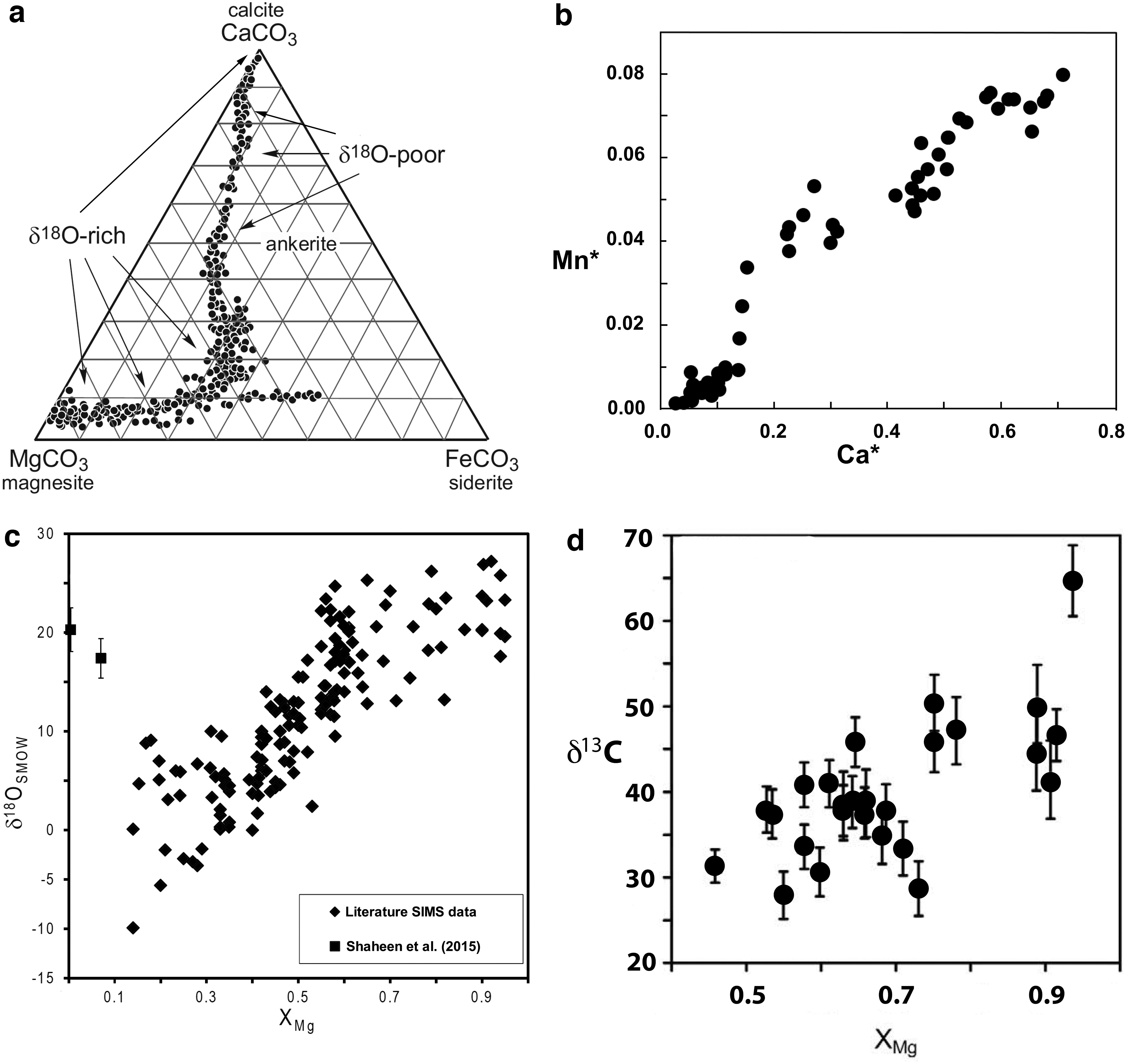
Chemical and isotopic compositions of ALH 84001 carbonates. (
The carbonate globules and masses contain other minerals, although in very small proportions. Silica is present, commonly as rounded grains and cross-cutting veinlets (Valley et al., 1997). The outer rims of the carbonate globules contain small grains of iron sulfide (McKay et al., 1996; Thomas-Keprta et al., 2009), which could be greigite, Fe3S4 (McKay et al., 1996). Pyrite is present as occasional large grains (Fig. 2b) associated with magnetite in the dark rinds on carbonate globules (Shearer et al., 1996; Greenwood et al., 2000). Some of the sulfide grains show nonzero values of Δ33S (Franz et al., 2014, 2019; Greenwood et al., 2000), indicating (as with the high Δ17O) a source that experienced photochemistry in Mars' atmosphere. The carbonate globules also contain reduced carbonaceous material, for example (McKay et al., 1996; Becker et al., 1999; Steele et al., 2007, 2012b, 2016), which contains nitrogen in a range of bonding environments (Koike et al., 2020).
Phyllosilicate minerals are present in vanishingly small proportions: “While there have been sporadic observations of smectites in ALH84001 (Thomas-Keprta et al., 2000), generally the most remarkable observation is how scarce they appear to be” (Thomas-Keprta et al., 2009). Other reports of phyllosilicates include those of Brearley (1998 and 2000) and Barker and Banfield (1999). The carbonate globules include distinct layers and crack margins rich in magnetite (McKay et al., 1996; Thomas-Keprta et al., 2009); these are interpreted as later products of shock metamorphism (Treiman and Essene, 2011); see below. Water-bearing carbonate minerals like nesquehonite (MgCO3·3H2O) or hydromagnesite (Mg5(CO3)4(OH)2·4H2O) may be present (Eiler et al., 2002a) but have not been confirmed.
2.6.3. Age
The carbonate masses were deposited at 3.95 ± 0.02 Ga, coincident within uncertainty of the shock event that formed the granular bands. Borg et al. (1999) derived this age from Rb-Sr and Pb-Pb systems on successive leaches of carbonate-bearing rock; the progressive leaches were inferred to sample distinct carbonate compositions. Beard et al. (2013) derived an identical age from Rb-Sr analyses of mineral separates and a leach/residue pair from a carbonate-rich rock fragment. A provisional Rb-Sr age of 1.39 Ga has not been confirmed (Wadhwa and Lugmair, 1996).
2.6.4. Temperature
The temperature at which the carbonates formed is low, 18 ± 4°C, as shown by clumped oxygen-carbon isotope thermometry (Halevy et al., 2011). A recent recalibration of the clumped isotope thermometer for magnesites suggests a slightly lower temperature of ∼10°C (del Real et al., 2016). Earlier estimates had ranged from 700°C and higher (Mittlefehldt, 1994; Scott et al., 1998) down to cryogenic temperatures (Socki et al., 1995; Niles et al., 2004). Low temperatures are consistent with the carbonates' chemical zoning at fine spatial scales, Fig. 3 (Valley et al., 1997; Kent et al., 2001; Treiman, 2003), and the wide range of isotopic compositions of their carbon and oxygen, Fig. 3 (Holland et al., 2005; Niles et al., 2005).
2.6.5. Water composition and geological setting
Once it was demonstrated that the ALH 84001 carbonates formed at low temperatures, many authors modeled and speculated about the physical and chemical conditions of their deposition. The critical issues through these works have been as follows: understanding what fluid composition or compositions could deposit carbonates of such varied chemical and isotopic characters; how those fluids might have originated; what physical or chemical processes induced the fluid (or fluids) to deposit carbonate globules; and in what settings those processes could have operated. To me, the sum of the evidence suggests that the ALH 84001 carbonates are products of progressive but irregular mixing of at least two distinct waters: one rich in Mg, with high δ18O and δ13C, and one rich in iron, with low δ18O and δ13C (Bridges et al., 2019). The earliest Ca-rich carbonates could reflect a third fluid, rich in Ca and with high δ18O (Shaheen et al., 2015). These fluids had identical Δ17O values within uncertainty (Shaheen et al., 2015). Mixing of these fluids could have been sufficient cause for carbonate precipitation, but differences in temperature could also have been significant.
2.6.5.1. Water compositions and origins
The problem of determining the compositions and origins of waters from which the ALH 84001 carbonates formed is massively underconstrained. Beyond temperature, we have only a range of carbonate minerals (and possibly Fe sulfide) and the absence of hydrated silicate minerals. The waters must have interacted strongly, at some point, with the martian atmosphere (see above about Δ17O and Δ33S) and clay minerals (see above about initial Sr isotope ratio), but beyond that nothing is known: “The nature of ALH 84001 as a meteorite precludes any knowledge of the geologic environment in which it existed when the carbonates were deposited” (Niles et al., 2009). Except that this problem is one of our few clues to the hydrochemistry of early Mars, no one would attempt to solve it without additional data. As such, one must consider the attempts to be “instructive possibilit[ies]” (Melwani Daswani et al., 2016).
The equilibrium thermochemical models of Catling (1999) and Niles et al. (2009) assumed that the ALH 84001 carbonates were deposited from a single water composition that had previously equilibrated with basaltic or ultramafic rock. The model of Catling (1999) is general, aimed at constraining the compositions of lake waters on early Mars. He found that, broadly, the properties of the ALH 84001 carbonates were consistent with evaporation of lake waters derived from ultramafic rock (like ALH 84001). Niles et al. (2009) calculated the compositions of waters in equilibrium with ALH 84001 silicates at wide ranges of temperatures, water-rock ratio, and CO2 pressures, and modelled their evaporation. For temperatures above 100°C, too much Fe and Mg were immobilized in serpentine and clay minerals to allow formation of Fe-Mg carbonates. van Berk et al. (2011) also applied a thermochemical equilibrium model, with a wide range of boundary conditions, to waters reacting with ultramafic rock. They found that the chemical zoning of the ALH 84001 carbonates is most consistent with isothermal progressive CO2 loss from the waters. Most recently, Melwani Daswani et al. (2016) studied a reactive transport model of waters passing through rock like ALH 84001, with results similar to those of Niles et al. (2009).
2.6.5.2. Geological settings and deposition triggers
Having generated waters suitable for deposition of carbonate minerals (i.e., enriched in Fe, Mg, and carbonate), something must trigger those waters to precipitate them. Possible triggering mechanisms vary according to geological setting.
The trigger mechanism could have been evaporation, concentrating the carbonate-rich solutions to the point of mineral precipitation (McSween and Harvey, 1998; Warren, 1998; Catling, 1999; Melwani Daswani et al., 2016). This mechanism would likely imply a saline lake environment, developed on a basaltic or ultramafic substrate. Terrestrial analogies here include Lake Salda, Turkey, where Mg-carbonates are being deposited from waters derived from a peridotite-serpentinite body (Russell et al., 1999; Kazanci et al., 2004). Martian versions of Lake Salda would precipitate iron-bearing carbonates because the ambient atmosphere would have been more reducing (Catling, 1999). In a cold environment, freezing out of the water could similarly concentrate the solutions. Warren (1998), recognizing the limited extent of alteration in ALH 84001 and the strong zoning of its carbonates, suggested that the lake system must have been transient.
The trigger mechanism could have been pressure release, specifically loss of CO2 from the solution with concomitant increase in pH (Niles et al., 2009; van Berk et al., 2011; Ozawa et al., 2017). This mechanism could imply carbonate formation associated with a spring deposit (hot or cold).
In the model of mixing waters, the trigger for carbonate deposition could have been chemical, the consequence of mixing itself (Bridges et al., 2019). Such mixing is invoked to cause the precipitation of Ca carbonate tufa mounds at Mono Lake, California (Bischoff et al., 1993; Council and Bennett, 1993), and Iceland (Buchardt et al., 2001), siderite in hydrothermal vein deposits (Burisch et al., 2018), and siderite in sediments (Moore et al., 1992).
The closest known terrestrial analogs for the ALH 84001 carbonates are globules and masses in basaltic tephra of the Bockfjorden volcanic complex, Spitsbergen Island, Norway (Treiman et al., 2002). Those globules are of comparable sizes and range from dolomitic cores to siderite-magnesite rims, and (in some places) outer deposits of magnesite ± huntite (CaMg3(CO3)4) ± nesquehonite (MgCO3·3H2O); see Amundsen et al. (2011) and Blake et al. (2011). The temperature at which the globules formed is not known; their O and C isotope compositions suggest formation during freezing (Amundsen et al., 2011); their localized presence in a volcanic construct (and the nearby presence of hot springs) suggests a hydrothermal origin; but “hydrothermal” in a high Arctic setting could mean only 10–20°C. Similar carbonate globules are found across Earth where basaltic rock has interacted with groundwater or hydrothermal waters (Treiman et al., 2002), and there is no obvious reason why a similar formation mechanism (or mechanisms) could not have operated on Mars.
Saline lake (freezing or evaporating) and volcanic-hydrothermal settings are not mutually exclusive on Mars—one can easily imagine an impact crater in basaltic crust, allowing formation of a transient lake. One could further imagine warm springs (by residual heat from the impact) injecting water into the lake (Osinski et al., 2013), waters rich in Mg and Fe from hydrothermal circulation through (and reaction with) basaltic or ultramafic rock. Decarbonation of the spring water, and/or mixing with ambient lake water, would then induce precipitation of carbonate minerals (van Berk et al., 2011).
2.7. Impact shock II
The next recognizable event that affected ALH 84001 was another impact shock. Evidence for this event includes broken and microfaulted carbonate globule (Mittlefehldt, 1994); presence of plagioclase-composition glass, some with flow-aligned bubbles; stringers of silica and orthopyroxene-composition glass, some vesicular (Barber and Scott, 2003); and extensive strain in orthopyroxene (Treiman, 1998; Barber and Scott, 2006). Also inferred in this event was the collapse of void spaces that had hosted the hemispherical carbonate globules (Treiman, 2005b). The peak shock pressure is not known—no high-pressure minerals like ringwoodite or coesite have been reported. The peak temperature was high enough to completely melt the plagioclase in ALH 84001, that is, above approximately 1400°C.
The shock effects attributed to this second event could not have been produced in the first impact shock. That first shock was followed by an extensive thermal event, in which the equigranular textures of the granular bands were established. If the zoned carbonate globules, broken or not, had been present before that thermal event, their compositional zoning would have diffused down to near nothing. If the plagioclase composition glass had been present before that thermal event, it would have devitrified back to crystalline plagioclase (Delaney, 1992).
The most important effect of this shock event was formation of tiny magnetite grains in the carbonate globules, by thermal decomposition of their Fe-bearing carbonate (Treiman and Essene, 2011). Macromolecular carbon and some graphite were produced along with magnetite (Steele et al., 2007, 2012a, 2012b, 2016).
2.8. “Recent” history
There is little evidence that anything had happened to ALH 84001 since 3.9 Ga, the time of the impact shock that melted its plagioclase and produced the tiny magnetite grains. There is no evidence that, since then, ALH 84001 experienced any duration of warm, wet, potentially habitable conditions. The only events discernable in the history of ALH 84001 since 3.9 Ga are three impact events and a bit of terrestrial alteration. The first of these impact events, at 1.16 Ga, is recognized via an Ar-Ar age plateau or limit in several fragments of the meteorite (Cassata et al., 2010), which could be the same as the 1.39 Ga Rb-Sr age of Wadhwa and Lugmair (1996). This age likely represents a meteorite impact near ALH 84001 on Mars, which heated the meteorite locally but not generally. The second impact event, at ∼0.014 Ga, is the departure of ALH 8400 from Mars, as recorded in its cosmic ray exposure age (Eugster et al., 1997). The final impact is of ALH 84001 onto Earth, in Antarctica, 13,000 years ago (Eugster et al., 1997). Finally, the carbonates in ALH 84001 were altered slightly in Antarctica (Kopp and Humayun, 2003).
Since 3.9 Ga (and before landing on Earth), ALH 84001 was never wet for significant durations. Following its last major shock event (above), ALH 84001 contained several materials that would have been thermochemically and kinetically unstable in low-temperature aqueous environments, and would have reacted and altered. Alteration of olivine is discussed above—the olivine remaining in ALH 84001 shows no evidence of aqueous alteration (e.g., serpentine or clay minerals). The meteorite contains glass of plagioclase composition—it could reasonably have dissolved and altered to phyllosilicates, but there is no evidence of either. And much of the orthopyroxene in ALH 84001 is severely strained, and some was melted (Treiman, 1998; Barber and Scott, 2006). Those materials should have reacted readily with water to form clay, chlorite, and/or serpentine minerals, but none have been reported (Barber and Scott, 2003, 2006; Thomas-Keprta et al., 2009). Thus, despite extensive study at large and small scales, there is no evidence that ALH 84001 was ever exposed to aqueous solutions in the last 3.9 Ga.
Since 3.9 Ga, ALH 84001 has never been warm (depending on one's definition); it apparently was never hotter than ∼25°C for significant durations; in effect, ALH 84001 gives evidence that Mars' climate since 3.9 Ga is essentially as it is now excepting possible brief excursions. Inferences of low temperatures come from 39Ar/40Ar thermochronology, modeling the effects of time-at-temperature on the distribution and loss of argon from the rock. From this modeling, Shuster and Weiss (2005) and Cassata et al. (2010) showed that ALH 84001 had not experienced temperatures above 30°C for “long durations” in the 3.9 Ga since maskelynite formation: “it could not have been warmer than -7 to +7°C for all but the briefest time period (1 million years)” (Shuster and Weiss, 2005).
3. Potentially Habitable Environments: The Record from ALH 84001
In its long history, the ALH 84001 meteorite records at least three distinct environments that could have been habitable, and a long period of uninhabitable environments. Evidence for the oldest episode of possible habitability is indirect, that some aliquots of ALH 84001 show high initial 87Sr/86Sr ratios (Beard et al., 2013). Beard et al. interpreted the high initial ratio to imply the existence of a reservoir with a high 87Rb/86Sr ratio, which they suggested was rich in clay minerals and which formed at ∼4.2 Ga. No additional constraints can be gained about this reservoir; it is tempting to correlate it with Mars' widespread ancient clay deposits (e.g., Bishop et al., 2013).
Evidence for the second episode of potential habitability is also indirect—the inference that igneous olivine had been dissolved out of ALH 84001 (Treiman, 2005b). Again, we have nearly no constraints on this event, except that there is no evidence that any phase besides olivine dissolved. ALH 84001 retained significant proportions of apatite, merrillite, and plagioclase (now glass), and there is no evidence that its orthopyroxene was affected. However, dissolution of olivine was not ubiquitous across ALH 84001, and it remains possible that these other phases were also affected locally. Olivine dissolves more readily than glass or pyroxene in waters of near-neutral pH (Hausrath et al., 2008), so one can imagine that the waters involved were near-neutral and strongly undersaturated in the components of olivine. These constraints might be consistent with fresh rainwater or melted ice, and seem inconsistent with groundwaters in basaltic or ultramafic systems, which tend toward high pH and saturation in mafic minerals (Russell et al., 1999; Kazanci et al., 2004).
The third, final, episode of potential habitability is the environment in which the carbonate globules were deposited. The temperature of deposition was clement for life, <25°C (Halevy et al., 2011), the pH of the depositing solution was near-neutral to alkaline (Niles et al., 2009; Melwani Daswani et al., 2016), and the solution was rich in carbon, divalent cations, and possibly sulfur. Such an environment would have been clement for some chemolithotrophic organisms, and outflow of such waters to the martian surface likely could have provided clement environments for others.
Finally, it is crucial to note that ALH 84001 provides absolutely no evidence of habitable environments in the last ∼3.9 Ga (Treiman, 1998, 2001, 2019). Since deposition of its carbonate globules, as described above, ALH 84001 experienced no recognizable aqueous interactions on Mars and no geological events other than impact shock and heating. What limited evidence there is for aqueous interactions can be ascribed to its residence time in Antarctica (Jull et al., 1998; Kopp and Humayun, 2003). Whatever one hypothesizes for Mars' Hesperian and Amazonian history, it must provide a place where ALH 84001 could have remained unexposed to liquid water for any significant time.
4. Analogous Potentially Habitable Environments
Without the context and environment one could gain from geological field studies, it is difficult to interpret the record of potential habitability in ALH 84001 (Niles et al., 2009). To gain that sense of context, we have to look at analog deposits and environments and speculate from them about what the martian setting of ALH 84001 might have been.
4.1. Terrestrial analogs
4.1.1. Spitsbergen
The best known and developed analog for the carbonate globules and other features of ALH 84001 is from Pleistocene subglacial volcanic constructs on Spitsbergen Island, Sweden, specifically Sverrefjellet and Sigurdsfjellet (Skjelkvåle et al., 1989; Treiman et al., 2002). In their basalts, basaltic tephra, and peridotite xenoliths, there are hemispherical globules of Mg-Fe-Ca carbonates, and masses of Mg carbonates (magnesite, huntite, and nesquehonite). In some samples, the globules were deposited in void spaces left by dissolution of olivine (Treiman et al., 2002); in others, the globules sit in vesicles in the basalts or on the edges of pyroclast fragments. In at least one sample, carbonate globules nucleated on zeolite crystals, likely chabazite (Fig. 2d of Treiman et al., 2002). In many samples (especially the xenoliths), carbonate globules are surrounded by hydrous silicate material, smectite clays and possibly amorphous material, and silica (Fig. 1b of Treiman et al., 2002). Table 1 shows the combined sequence of these events and deposits.
Aqueous Alteration Events: ALH 84001 and Analogs
X means that the event is clearly represented in sample(s) from that group.
(X) means that the event is represented, possibly, rarely, or minimally.
See text for references to original data for each group.
The formation temperature of the Spitsbergen carbonate globules is not known. Treiman et al. (2002) suggested a hydrothermal origin (i.e., super-ambient temperatures) based on their geological settings in a volcanic construct and the presence of crystalline magnesite rather than nesquehonite or hydromagnesite. On the other hand, Amundsen et al. (2011) suggested a cryogenic origin based on the oxygen isotope compositions of the carbonates and local waters. It is entirely possible that both are correct. For example, the globules' deposition was triggered by mixing of volcanic hydrothermal and local cryogenic waters.
4.1.2. Soil deposition
Several researchers have suggested that the carbonate globules in ALH 84001 were pedogenic, that is, that they formed in a soil or regolith environment (McSween and Harvey, 1998; Warren, 1998). Rounded masses rich in siderite, so-called sphaerosiderite, are present in many environments on Earth, including soils with basaltic material (Shannon, 1923; Benson, 1941) and in humid anoxic soils (Ludvigson et al., 2013). Pedogenic sphaerosiderites are commonly unzoned and nearly pure siderite (Baele, 2003), but they can be spectacularly zoned; see Fig. 8 of Weibel et al. (2016). Unfortunately, there appear to be no studies of strongly zoned pedogenic sphaerosiderites that might be compared to the carbonate globules in ALH 84001 (or those of the Spitsbergen Island volcanos).
4.2. Martian meteorite analog—the nakhlites
Besides ALH 84001, among the martian meteorites only the nakhlites and NWA 7034 (and pairs) show evidence for significant aqueous alteration (Treiman, 2005a; Velbel, 2012; McCubbin et al., 2016). The aqueous alteration of the nakhlites shows several similarities to that of ALH 84001, which could have significance for their formation processes.
The nakhlites are cumulate igneous rocks, rich in phenocrysts of augite pyroxene and olivine in a fine-grained, plagioclase-rich matrix or mesostasis (Treiman, 2005a). The nakhlites are much younger than ALH 84001, having crystallized from magmas at 1.32–1.42 Ga (Cohen et al., 2017). They were ejected from Mars at ∼0.0105 Ga (Eugster et al., 1997) and have fallen to Earth over the last tens of thousands of years (Cartwright et al., 2013).
Nearly all the nakhlites have complex assemblages of aqueous alteration minerals, concentrated in veinlets filling dissolution cracks in olivine and replacing mesostasis (Treiman, 2005a; Bridges et al., 2019). The age of the alterations is not known precisely but is likely 0.63–0.74 Ga (Swindle et al., 2000; Borg and Drake, 2005; Mark et al., 2019). In general, the sequence of alteration events in the nakhlites is as follows (Table 1): dissolution of olivine to yield saw-tooth margin cavities; filling the cavities with Ca-siderite ± halite ± gypsum ± chlorapatite (Bridges and Grady, 1999, 2000); replacement of the siderite by Fe-rich smectite and serpentine (Changela and Bridges, 2010; Hicks et al., 2014); and deposition of amorphous material of near-smectite compositions, in one or more events (Lee et al., 2018) 2 . The assemblage in each nakhlite is slightly different, and the proportion of alteration material varies widely among nakhlites and between spots in a single nakhlite. The aqueous alteration of the nakhlites has been ascribed to hydrothermal circulation, induced by the heat of an impact event (Changela and Bridges, 2010; Bridges and Schwenzer, 2012; Daly et al., 2019; see also Crumpler et al., 2020).
From the descriptions above and summary in Table 1, the aqueous alterations of ALH 84001, the nakhlites, and the Spitzbergen volcanic rocks are similar enough to suggest a common geological history. Following Bridges and Schwenzer (2012), that history is basically of a single hydrothermal alteration, with the sequence of events representing decreasing temperature and progressive change in water chemistry from dissolution of the host (or similar) rock. Bridges and Schwenzer (2012) infer that the heat driving the nakhlite hydrothermal system is from a nearby impact event; Daly et al. (2019) confirmed this inference by showing that shock deformation of nakhlite silicates was essentially contemporaneous with their alteration. One can easily extrapolate this scenario to ALH 84001—that its aqueous alteration was driven by heat from the impact event that produced the granular bands (their ages are identical within uncertainty). Of course, the Spitsbergen alteration materials are not associated with an impact event, but volcanos in which the alterations occur are a reasonable source of heat.
5. Conclusions
The ALH 84001 meteorite contains evidence for at least three potentially habitable environments on early Mars. These environments are represented by the clay-rich source of water that altered the meteorite (Beard et al., 2013), dissolution of olivine from the rock (Treiman, 2005b), and deposition of the carbonate globules themselves (Halevy et al., 2011). Given what is now known about Mars, that liquid water was abundant and widespread in its early history (the Noachian era), it is not a huge surprise that a rock from that time would show some evidence of potentially habitable environments.
Perhaps the most significant implication from ALH 84001 about Mars' potential habitability is the absolute lack of evidence for habitable environments after 3.95 Ga. Specifically, ALH 84001 retains several materials that would be highly reactive with water at low temperatures: strained orthopyroxene, olivine, and glasses of pyroxene and plagioclase compositions. Had these materials been in contact with water for any significant time, they would have altered to form low-temperature hydrous silicates, like clays, serpentines, zeolites, and so on. Here, the absence of evidence need not be evidence of the absence—that Mars has supported no near-surface habitable environments in its Hesperian and Amazonian eras. ALH 84001 does imply that any model of Mars' near-surface environment must include areas that were never exposed to a potentially habitable environment, that is, show evidence of liquid water. ALH 84001 does not imply that surface water was not present at some locations, for example, Jezero Crater or the outflow channels, but implies that much of the martian surface must have remained dry.
Footnotes
Acknowledgments
I am grateful to my many colleagues with whom I have agreed and disagreed about ALH 84001 over many years. I am particularly thankful to H. Amundsen, without whose cheerful presence I would never have worked on Spitsbergen. I am grateful to E. Rivera-Valentin for organizing the Habitability Workshop in 2019 for the Lunar and Planetary Institute/USRA, raising again the sordid history of work on ALH 84001, and for organizing this current special issue stemming from the workshop. Several of the images are from outside sources, and I thank C. Shearer for permission to replicate and redraft them. This manuscript benefitted from thoughtful reviews by C. McKay and an anonymous reviewer. The Lunar and Planetary Institute (LPI) is operated by Universities Space Research Association (USRA) under a cooperative agreement with the Science Mission Directorate of NASA. LPI Contribution # 2612.
Abbreviation Used
Associate Editor: Christopher McKay