




Abstract
Formaldehyde (FA) is an important precursor in the abiotic synthesis of major biomolecules including amino acids, sugars, and nucleobases. Thus, spontaneous formation of prebiotic FA must have been crucial for the chemical origin of life. The frequent impacts of meteorites and asteroids on Hadean Earth have been considered one of the abiotic synthetic processes of organic compounds. However, the impact-induced formation of FA from CO2 as the major atmospheric constituent has not been confirmed yet. This study investigated the formation of FA in impact-induced reactions among meteoritic minerals, bicarbonate, gaseous nitrogen, and water to simulate the abiotic process experimentally. Products were analyzed with ultra-high-performance liquid chromatography/tandem mass spectrometry and powder X-ray diffraction techniques. The results show the formation of FA and oxidation of metallic iron to siderite in the impact shock experiments. This indicates that this important prebiotic molecule was also synthesized by impacts of iron-bearing meteorites/asteroids on the Hadean oceans. The impact events might have generated spatially and temporally FA-enriched localized environments. Moreover, the impact-induced synthesis of FA may have also occurred on Noachian Mars given the presence of liquid water and a CO2-N2-rich atmosphere on the planet.
1. Introduction
Formaldehyde (FA) is an essential precursor in the abiotic synthesis of building blocks of life. For example, amino acids are formed by the reaction of FA, hydrogen cyanide, and ammonia in the Strecker synthesis (Harada, 1963) and by reacting FA and ammonia (Yanagawa et al., 1980). Sugars, including ribose and glucose, are formed by polymerization of FA in alkaline solutions (Breslow, 1959; Kim et al., 2011; Furukawa et al., 2019). Sugars also form by impact-induced reactions from FA (Civiš et al., 2016). Nucleobases form with formamide in impact-induced reactions from FA with molecular nitrogen (Ferus et al., 2019). These previous explorations usually began with FA either delivered from space or already synthesized in early environments (Pinto et al., 1980; Aponte et al., 2019). Therefore, an evaluation of the de novo sources and sinks of FA in the early Earth environment is essential for understanding the processes involved in the prebiotic synthesis of building blocks of life.
Although a detailed composition of the Hadean atmosphere remains unclear, several authors postulate that the environment of Hadean Earth was neutral (i.e., mostly CO2 and N2) or slightly reduced, that is, containing a small amount of H2 in addition to CO2 and N2 (Kasting, 1993; Tian et al., 2005). Under such conditions, CO2 might have been the major carbon source. This atmosphere might have been modified to more reduced compositions by the addition of reduced volatiles generated by impacts of extraterrestrial objects (Hashimoto et al., 2007; Schaefer and Fegley, 2010; Furukawa et al., 2014; Yang et al., 2014), although the effects by the impact-generated volatiles to the global atmospheric composition remain unclear.
Sources of FA on Hadean Earth may have included the following: (1) photochemical reactions between CO2 and H2O (Pinto et al., 1980; Holland, 1984); (2) formation during an electric discharge, for instance in CO- and CH4-rich atmospheres, or CO2-based atmospheres that were saturated with H2 (Miller, 1953); and (3) direct input from extraterrestrial sources (Aponte et al., 2019).
Based on the lunar crater records and the content of highly siderophile elements in Earth's mantle, the flux of extraterrestrial objects to Hadean Earth may have been significantly high (Hartmann et al., 2000; Valley et al., 2002; Day et al., 2016). Additionally, compared to other energy sources, such as ultraviolet radiation and lightning, the available energy due to impacts on Hadean Earth would have been significant (Chyba and Sagan, 1992). Many experimental and theoretical simulations have suggested an impact-induced formation of reduced species of inorganic compounds (Sugita and Schultz, 2003; Schaefer and Fegley, 2010; Kurosawa et al., 2013; Furukawa et al., 2014). Consequently, the formation of the building blocks of life from inorganic compounds by impacts of iron-bearing meteorites was proposed (Nakazawa et al., 2005; Nakazawa, 2018), and subsequent experimental simulations demonstrated the formation of various organic compounds including amino acids (Furukawa et al., 2009, 2015). Additionally, large impactors tend to contain higher amounts of metallic iron that potentially works as a reductant and a catalyst (Pasek and Lauretta, 2008). Catalytic behavior of minerals in carbonaceous chondrites in the synthesis of organic acids, nucleobases, and amino acids from formamide and water has been reported (Rotelli et al., 2016). Laboratory simulation studies of the hypervelocity impact of meteorites by using laser-pulse heating of an ordinary chondrite have reported the formation of various gaseous molecules including acetaldehyde (Mukhin et al., 1989). These studies suggest the formation of FA during hypervelocity impacts on CO2 and H2O that are regarded as the major C and H forms on Hadean Earth (Abe and Matsui, 1988; Kasting, 1990; Trail et al., 2011). Formation of RNA components from organic compounds including FA by impacts has also been discussed as the origin of RNA components (Ferus et al., 2015, 2017, 2019; Benner et al., 2020). However, synthesis of FA via impacts from CO2 remained unclear. The present study investigates the FA synthesis in impact-induced reactions that are considered to have occurred on Hadean Earth during impacts of chondritic asteroids/meteorites.
2. Experimental
2.1. Materials
Mg2SiO4, a natural forsterite from Myanmar, was used as the starting material after it was washed, crushed, and heated at 450°C in air for 6 h. Iron (99.9 % wt, powder <45 μm in diameter), nickel (99.95 % wt, sponge), and magnetite (>95%) were from Wako (Osaka, Japan). 13C-labeled amorphous carbon (97 wt %, 99% 13C, amorphous) was from Cambridge Isotope Laboratories (Tewksbury, USA). This carbon was further heated at 500°C for 6 h in air before use. 13C-labeled sodium bicarbonate (13C, 99%) was obtained from Cambridge Isotope Laboratories. Ammonia used in the experiment was from Aldrich (28% NH3 in double distilled water, PPB/PTFE grade). The absence of the contamination of glycine and alanine in this ammonia solution was confirmed with liquid chromatography/tandem mass spectrometry. Acetonitrile (LC-MS grade) that was used as a chromatography eluent was from Kanto (Tokyo, Japan). Commercial FA-2,4-DNPH from Sigma-Aldrich was used as the referential standard for mass spectrometry and chromatography. The water was purified with a Milli-Q Integral MT (TOC: <5 ppm, 18.2 MΩcm). The absence of FA in the purified water was confirmed by the same analysis as the samples. Pure nitrogen gas (>99.995%) was used to fill the open space of the sample cavity. All glassware was heated at 450°C in air for 6 h before use. The design of the shock-recovery experiments, including the sample container and flyer, was described in the work of Furukawa et al. (2007). The sample container was washed with purified water, methanol, and hexane (methanol and hexane, grade 5000 for pesticide residue and PCB analysis; Wako) and completely dried.
2.2. Methods
A series of shock-recovery experiments were conducted by using a single-stage propellant gun at the National Institute for Materials Science, Japan, to simulate the impact-induced reactions generated by impacts of different types of chondritic asteroids/meteorites on NH3-free and NH3-containing oceans covered by an N2-CO2 atmosphere (Sekine, 1997). The starting materials were composed of mixtures of minerals, fluids (water or ammonia water), and 13C-labeled sodium bicarbonate, and N2 gas was used to fill up the sample cavity (Table 1). When all the NaHCO3 decomposes into CO2, the atmosphere in the sample becomes very CO2-rich; molar mixing ratios of CO2/N2 are 118 or 176. The sample container and geometry were described in the work of Furukawa et al. (2007). Three types of mineral mixtures were used as analogs of chondritic asteroids/meteorites: an iron meteorite type (IM), an ordinary chondrite type (OC), and a carbonaceous chondrite type (CC). IM, OC, and CC analogs were prepared from a mixture of metallic iron and nickel; a mixture of forsterite (Mg2SiO4), metallic iron, and nickel; and a mixture of forsterite, magnetite (Fe3O4), amorphous carbon, metallic iron, and metallic nickel, respectively. The iron content in the meteorite analogs of IM, OC, and CC was 91, 32, and 14 wt %, respectively. These values are somewhat higher than the typical content of metallic iron in iron meteorite, ordinary chondrite (H chondrite), and carbonaceous chondrite (i.e., >80 wt %, 0–26 wt % [mostly more than 10 wt %], and 0–13 wt %, respectively) (Mittlefehldt et al., 1998; Kimura et al., 2018). The impacts were conducted at close to the same impact velocities, approximately 0.9 km/s. The impact generated a shockwave of approximately 7 GPa and an in-shock temperature of approximately 300°C for 0.7 μs. Post-shock temperature was estimated to be approximately 1500°C (Furukawa et al., 2011).

Static heating experiments were also conducted in tandem at 150°C for 6 h in an electric furnace for comparison. The design of the static heating experiments, including the sample container, reagents, and analytical methods, was analogous to that of the shock-recovery experiments except for the heat source. A control shock experiment that did not contain 13C-labeled sodium bicarbonate (No. 27) in the starting material was also conducted for comparison.
The sample container was trimmed and washed with purified water, methanol, and hexane. The container was then cooled with liquid nitrogen to freeze the volatile samples in the cavity. Then two extraction holes were made through the wall of the sample cavity. The sample container was soaked in pure water; then the product FA was extracted through the sample holes. Solid residues were collected from the sample container and dried under vacuum for powder X-ray diffraction (XRD) analysis.
The concentration of FA in the extracted solution was determined with ultra-high-performance liquid chromatography/tandem mass spectrometry (UHPLC/MSMS; Shimadzu LCMS-8040) after derivatization with 2,4-dinitrophenylhydrazine (DNPH). The DNPH derivatization was conducted for 20 min at room temperature (∼20°C) in a stirred mixture containing 20 μL of 17% phosphoric acid solution and 50 μL of 1 mg/mL DNPH in acetonitrile (99.9%; GL Science). UHPLC/MSMS was conducted with a reversed-phase column (Waters BEH C18; 2.1 mm I.D., 100 mm length, 1.7 μm particles) and an eluent (water-acetonitrile, 60/40 [v/v]). The column temperature and the flow rate were 35°C and 0.5 mL/min, respectively. The 12C-FA and 13C-FA were measured with multiple reaction monitoring (MRM) mode. In the MRM mode, the signal of a fragment ion (m/z: 151) that is produced by the fragmentation of a precursor ion (m/z: 209 for derivatized 12C-FA and 210 for derivatized 13C-FA) is monitored. Nebulizer flow, desolvation temperature, and heat block temperature were set at 2.8 L/min, 250°C, and 400°C, respectively. Powder XRD measurements by Philips PW3050 were conducted with reflection-free sample holders as described in the work of Furukawa et al. (2011).
3. Results
Figure 1 summarizes the results of the UHPLC/MSMS analysis. Both 12C-FA and 13C-FA were detected in all samples including those from the control experiment in which the 13C-labeled carbon source was not added initially (Fig. 1d). This observation is plausible when biogenic FA is contaminated in the process of analysis since 13C is present in biogenic FA at approximately 1:99 (wt/wt) of the amount of 12C (Fig. 1). The actual ratio of 13C-FA (m/z: 210 > 151) to 12C-FA (m/z: 209 > 151) was determined experimentally at 0.019 by using a derivatized control sample that did not contain any 13C-labeled carbon source (Table 1). As shown in Fig. 1, the 13C-FA/12C-FA ratios of experimental products are significantly higher than those from control samples and standards. The amounts of 13C-FA in products were determined via subtraction of the contaminant 13C-FA, which was calculated using the amount of 12C-FA and the referential ratio of 13C-FA/12C-FA of the 13C-free control experiment (Table 1; Fig. 2).
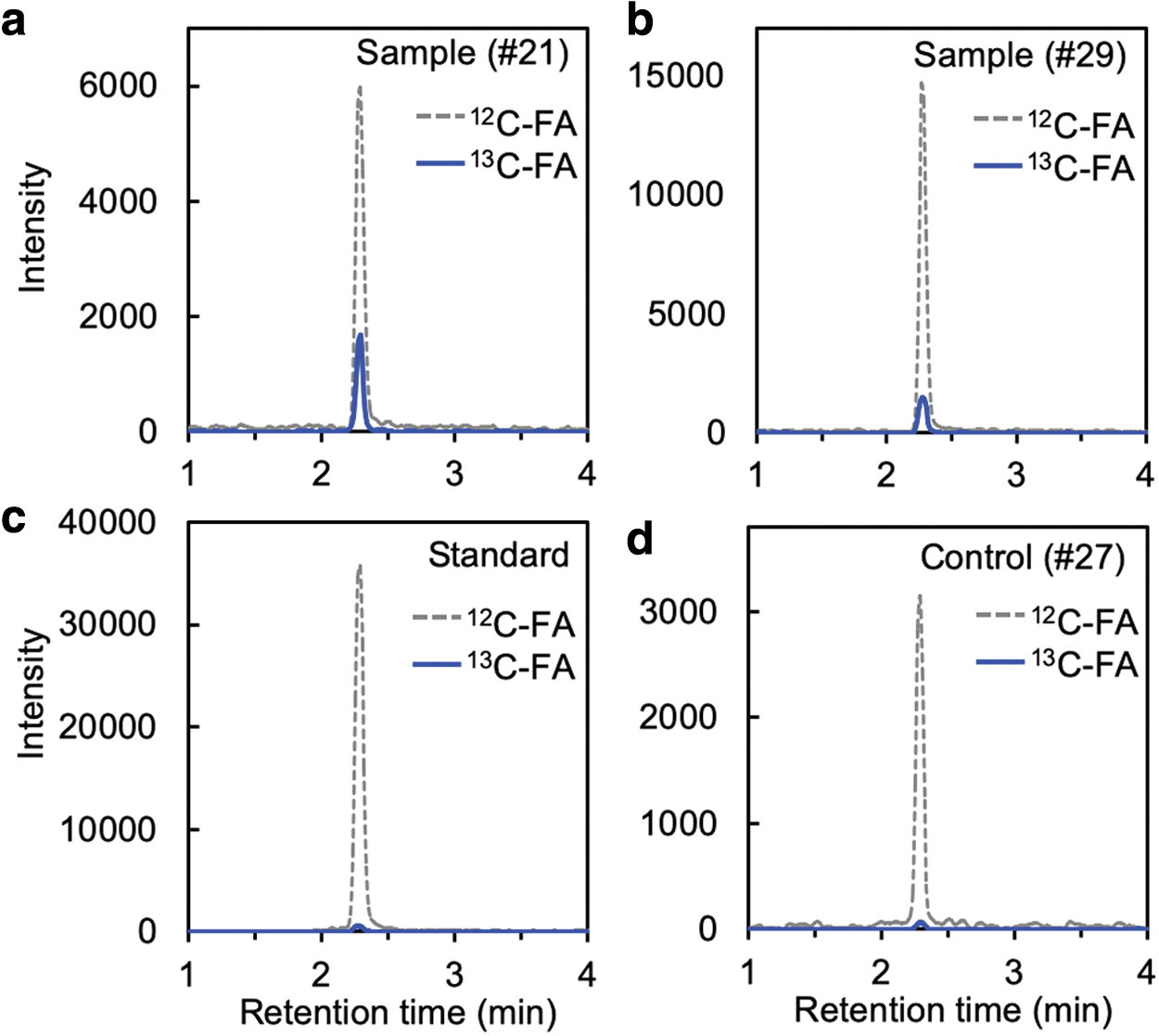
Mass chromatograms of FA in the products, the control sample, and a commercial FA-2,4-DNPH standard. Multiple reaction monitoring (MRM) chromatograms of m/z: 209 > 151 and m/z: 210 > 151 are shown as 12C-FA and 13C-FA, respectively. The control (#27), sample #21, and sample #29 are the experiment without NaH13CO3, the experiment using ordinary chondrite analog (OC), and the experiment using iron meteorite analog without ammonia (IM1), respectively. Color images are available online.

Amounts of product 13C-FA. The error bar in IM1 indicates 1σ for triplicate values while error bars in OC, CC, IM2, and IM_Sta experiments are a percent error of IM1. OC, CC, IM2, and IM_Sta represent experiments using analogous materials of ordinary chondrite, carbonaceous chondrite, iron meteorite, and iron meteorite with static heating, respectively. The details are listed in Table 1. Color images are available online.
The amounts of 13C-FA in the products clearly indicate the formation of FA in experiments that were subjected to a shock wave (IM1, IM2, OC, and CC in Fig. 2). The 13C-FA production was negligible in both static heating experiments conducted at 150°C in place of shock heating (IM_Sta in Fig. 2 and No. 43–46 in Table 1). The difference in the amounts of 13C-FA produced from experiments using different meteorite analogs was within the experimental reproducibility (Fig. 2; CC, OC, IM1, and IM2). The yield of FA per mole of carbon dioxide was 8.5 × 10⁻⁵ to 1.3 × 10⁻⁴ mol % (Table 1). The presence of ammonia had a negligible effect on FA yields.
The results of powder XRD analysis on product residues are shown in Fig. 3. In all the shock experiments, metallic iron was partially oxidized to form siderite (FeCO3) (Fig. 3a, 3b). In contrast, siderite and magnetite (Fe3O4) were formed in the static heating experiments, but FA was not formed (Figs. 2 and 3c). Ni remained in all experimental products. The effect of ammonia was negligible on the production of the post-shock minerals (Fig. 3a, 3b).
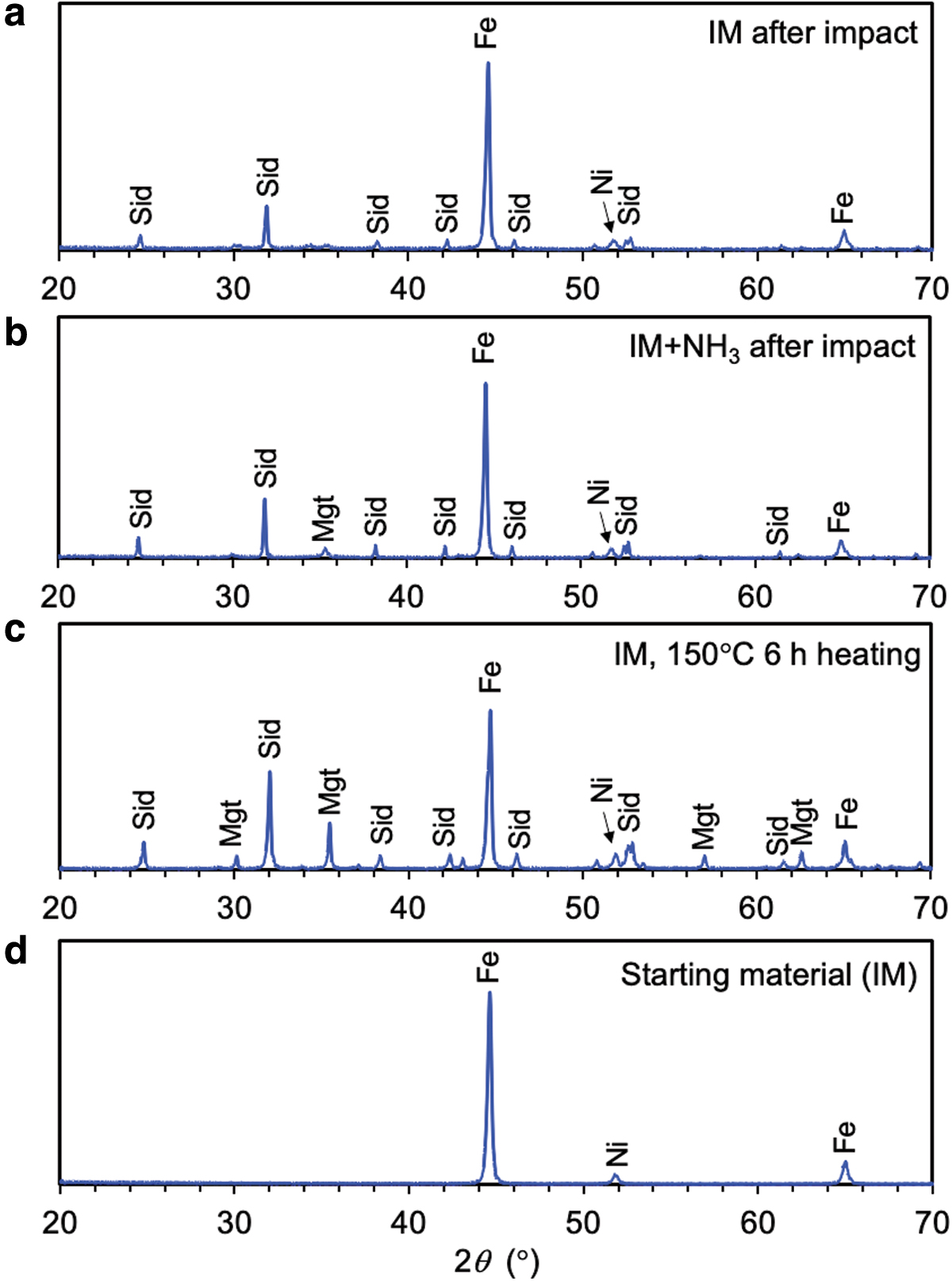
Powder XRD profiles of starting materials and product residues. Sid = siderite (FeCO3); Mgt = magnetite (Fe3O4). (
4. Discussion
4.1. FA formation in impact-induced reactions
Although NaHCO3 is highly soluble in water, the low water quantity (i.e., 130 mg) in the experimental setup ensured that, at most, 7% of NaHCO3 in the starting materials dissolved in water as Na+ and HCO3 -. The remaining NaHCO3 was thermally decomposed into CO2, H2O, and Na2CO3 during the shock and static heating.
Powder XRD results indicate that iron was partially oxidized to Fe2+ by both the shock and static heating procedures (Fig. 3b). The oxidation of iron by H2O generally indicates the formation of reductant, that is, H2. However, a theoretical study has suggested the formation of H atoms on the surface of iron during shock compression (Shimamura et al., 2016).
The formation of FA indicates that bicarbonate or CO2 was reduced during the experiment. Indeed, high-yield catalytic reduction of CO2 to FA and methanol has been reported in industrial applications (Idriss et al., 1996; Bontemps et al., 2014). In the present experiments, FA was strictly formed in the experiments with shock heating, although iron was oxidized in experiments with both shock and static heating. This indicates that CO2 or HCO3 - reduction followed different pathways in the shock and static heating procedures. An ab initio molecular dynamics study suggested that, within picoseconds and in the presence of CO2, H2O, and Fe, multistep reactions on the surface of Fe lead to the formation of formic acid (HCOOH) via CO and HCO3 - (Shimamura et al., 2019). This simulation also shows that HCOOH generation from HCO3 - depends on the shock pressure, which promotes the formation of H atoms on the Fe surface. This pressure effect could have resulted in the formation of FA exclusively in the shock experiments. It is also possible that, due to longer reaction durations in the present experiments than the numerical simulation, hydrogen atoms on the Fe surface further reduced formic acid or its precursor.
Oxidation of iron could be one of the steps in the formation of organic compounds, including FA, during impact. However, the amounts of consumed metallic Fe were not significantly different between the experiments probably due to the limited exposure duration to the shock heating. This similarity in the extent of Fe consumption may have caused a similarity in the extent of the reduction of HCO3 - to formic acid and FA in experiments with different meteorite analogs. Many reactions including the formation of amino acids, amines, and carboxylic acids may have proceeded simultaneously after the formation of FA. In previous studies, ammonia has been found to react with FA and result in the formation of various molecules such as amines and amino acids (Furukawa et al., 2015). However, the lower yields of amino acids found in a previous study suggest a negligible consumption of FA during the reaction (Takeuchi et al., 2020). The negligible differences in FA yields between the experiments with and without ammonia imply that the rates and extent of other FA-consuming reactions were low.
4.2. Implication to natural impacts
In natural meteorite/asteroid impacts, large projectiles more than 100 m in diameter collide with Earth at hypervelocities that exceed 10 km/s (Hills and Goda, 1993). Smaller-sized (less than 20 m) asteroids or meteorites have low impact velocities due to deceleration in the atmosphere (Hills and Goda, 1993). Impact velocities can vary from very low to 10 km/s for projectiles with an initial size of 20–100 m (Hills and Goda, 1993). Some of the conditions inherent in middle-sized natural projectile impacts correspond to the present experimental conditions. However, the duration of exposure to elevated temperature and pressure was significantly lower in the experiments. Furthermore, even during single impact, the pressure and temperature of fragments after the impact differ significantly depending on the location in the impact plume (Pierazzo and Chyba, 1999).
The presence of substantial relicts of metallic iron in the experimental products indicates that the reactions have significant potential for further FA production and were only limited by the extremely short duration (< 1 μs) of shock heating. In the natural hypervelocity impacts of asteroids/meteorites, shock durations are typically several orders of magnitude longer and shock compression and heating are more significant than in the present experimental conditions (e.g., more than 103 K, 100 GPa, and 0.1 s) (Hills and Goda, 1993; Pierazzo and Chyba, 1999; Pierazzo and Melosh, 2000). Therefore, higher FA yields are expected due to significant iron oxidation and hydrogen production by large projectiles with high impact velocities. A previous calculation also indicates the positive correlation between the impact velocity and formic acid yields (Shimamura et al., 2019).
The conversion rate of carbon to FA was at least 9 × 10⁻⁵ mol % in OC analog experiments. The production rate of FA from Fe was 1.3 × 10⁻⁴ mol %, assuming that 30% of iron was consumed during the experiments. Previous studies suggest that huge amounts of extraterrestrial objects, ∼4 × 10²³ g, accreted the Hadean Earth in the Late Heavy Bombardment (LHB) (Anders, 1989). Assuming that ordinary chondrite with typical 10 wt % metallic iron, that is, ∼4 × 10²² g Fe, accreted during the LHB period, then the yields from the present experiments and the iron flux predict the production of ∼9 × 10¹⁶ mol of FA during the LHB. However, this estimate may only be a baseline value since higher temperatures and pressures, as well as longer reaction durations, may provide much higher yields. The actual amount of FA that was produced by natural impacts on Hadean Earth is presently unclear because local time-dependent, pressure-temperature conditions in natural hypervelocity impacts have significant variations.
The yields of FA in the present experiments were approximately one order of magnitude higher than the yields of amino acids formed in similar impact conditions (Takeuchi et al., 2020). This suggests that FA may be a precursor in the formation of amino acids during impact-induced synthesis. Additionally, FA that was formed by impacts on Hadean Earth might have contributed in formation of the building blocks of life through other reactions such as sugar formation by the formose reaction (Breslow, 1959; Kim et al., 2011; Civiš et al., 2016; Furukawa et al., 2019).
Photochemical reaction is a traditional model that has been used to explain the source of Hadean FA. Pinto et al. (1980) estimated that the FA produced by photochemical reactions corresponds to a concentration of 10−3 M in oceans at the current volume with a N2-CO2-dominated atmosphere, given 107 years of accumulation. The total amount of FA produced during impacts does not exceed that generated in photochemical reactions since the concentration of FA in oceans, at the present water volume, is estimated by the baseline impact synthesis (i.e., ∼9 × 10¹⁶ mol) to be ∼7 × 10⁻⁵ M. Nevertheless, the impact-induced synthesis might have resulted in a spatially and temporally localized FA-enrichment that could have exceeded the global average concentration generated by photochemical reactions. High concentration of FA (e.g., 10−3 M) is one of the most important requirements for the formation of life's building molecules (Cleaves, 2008). Therefore, the impact-induced FA formation might have contributed to the chemical evolution of the ingredients of prebiotic molecules on Hadean Earth.
4.3. Potential FA formation on Noachian Mars
Formaldehyde was tentatively detected in the martian atmosphere more than 25 years ago (Korablev et al., 1993). It has sometimes been debated as the product of CH4 oxidation and thus regarded as a potential sign of martian life (Weiss et al., 2000; Summers et al., 2002). However, the actual presence of FA on ancient and present Mars remains unclear.
Significant crater density on the southern hemisphere of Mars indicates that impacts of meteorites/asteroids were frequent on Noachian Mars (Hartmann and Neukum, 2001; Carr and Head, 2010). A great deal of geological evidence, including the valley network found by a martian orbiter and sedimentary structures found by martian rovers, suggests the presence of liquid surface water on Noachian Mars (Head et al., 1999; Fairén et al., 2003; Squyres et al., 2004; Di Achille and Hynek, 2010). Furthermore, the presence of redox-sensitive minerals in martian meteorites suggests that degassed species produced by martian volcanic activity were composed of CO2 with small amounts of CO and CH4 (Schmidt et al., 2013). The atmosphere was also influenced by the degassed species escaping to space. The overall atmospheric composition of Noachian Mars remains unclear, but a numerical simulation suggests a CO2–N2-rich atmosphere with reduced species (Batalha et al., 2015). The presence of carbonates in Noachian sediments also supports a CO2-dominated atmosphere (Ehlmann et al., 2008).
The results of the present study suggest that impacts of Fe-bearing meteorite/asteroids on the Noachian ocean formed FA from CO2, which might have been a major, though rather unreactive, carbon source. Other FA formation processes on Noachian Mars remain unclear, but photochemically induced FA synthesis might have been possible. The ancient martian FA produced by impacts may have been utilized in many reactions and decomposition processes and potentially used in the synthesis of life's building blocks. Direct synthesis of amino acids by impact-induced reactions has also been recently suggested (Takeuchi et al., 2020). The organic compounds once formed by such events on Noachian Mars might have been oxidized in the subsequent environmental changes on the surface of Hesperian Mars (Benner et al., 2000).
5. Conclusion
We have shown by laboratory simulation that FA can be formed via impact-induced reactions between major meteorite minerals, water, and sodium bicarbonate in a laboratory simulation. The laboratory impact conditions correspond to a part of the terrestrial impacts on Hadean Earth that had oceans with CO2-N2-rich atmosphere, although the duration of the temperature and pressure are significantly limited in this study. Therefore, Fe-bearing asteroid/meteorite impacts on Hadean Earth might have provided locally enriched FA, which is important for the scenario of the abiotic synthesis of the building blocks of life. This type of FA synthesis might also have been possible on Noachian Mars, given the presence of a CO2-N2 atmosphere and an ocean.
Footnotes
Acknowledgments
The authors thank U. Takeuchi and N. Terada for the support in conducting experiments and in the discussion. This study was supported by funding from JSPS KAKENHI (T.K., 15H02144 and 18H03729), NINS Astrobiology Center satellite research (Y.F.), and the Tohoku University FRIS research program (T.K. and Y.F).
Abbreviations Used
Associate Editor: Nita Sahai