




Abstract
Mars was habitable in its early history, but the consensus is that it is quite inhospitable today, in particular because its modern climate cannot support stable liquid water at the surface. Here, we report the presence of magmatic Fe/Mg clay minerals within the mesostasis of the martian meteorite NWA 5790, an unaltered 1.3 Ga nakhlite archetypal of the martian crust. These magmatic clay minerals exhibit a vesicular texture that forms a network of microcavities or pockets, which could serve as microreactors and allow molecular crowding, a necessary step for the emergence of life. Because their formation does not depend on climate, such niches for emerging life may have been generated on Mars at many periods throughout its history, regardless of the stability or availability of liquid water at the surface.
1. Introduction
The concept of habitability is essentially tied to the presence of liquid water at (or near) the surface of a planetary body. The surface of Mars was habitable during the Noachian (4.1–3.7 Ga) because liquid water was then both stable and available, at least episodically. Environments likely existed on the Noachian Mars with liquid water and metabolic energy sources available for the development of life (Westall et al., 2013; Grotzinger et al., 2014; Kral et al., 2014; Hurowitz et al., 2017; McMahon et al., 2018). This view relies on the widespread occurrence of Noachian Fe/Mg clay minerals interpreted as products of the alteration of preexisting silicates by (sub)surface liquid water (Bibring et al., 2006; Ehlmann et al., 2011; Carter et al., 2013; Sun and Milliken, 2015; Viennet et al., 2019). However, this may not be the entire story. In fact, some clay minerals can directly precipitate from magmatic fluids (Meunier et al., 2008, 2012; Berger et al., 2014, 2018; Viennet et al., 2020). Because these minerals cannot be used as a proxy for the past presence of liquid water, it seems a priori difficult to consider such magmatic clay minerals as indicators of habitability. Still, as discussed here, magmatic clay minerals may offer fantastic opportunities for prebiotic reactions.
To date, the only occurrence of martian magmatic Fe/Mg clay minerals has been found in the evolved (alkali/felsic) mesostasis of Nakhla (Viennet et al., 2020), the martian meteorite eponym for nakhlites. Whether or not these minerals are more than anecdotal on Mars is difficult to determine, especially given the fierce debate over the exact fraction of the martian crust made up of evolved (alkali/felsic) rocks (Sautter et al., 2016; Udry et al., 2018; Bouley et al., 2020). Here, we report the presence of magmatic Fe/Mg clay minerals within the mesostasis of NWA 5790, an unaltered Amazonian nakhlite (∼1.3–1.4 Ga; Nyquist et al., 2001). In contrast to that of Nakhla, the mesostasis of NWA 5790 does not exhibit a high level of igneous differentiation, which makes this meteorite more archetypal of the martian crust (Udry et al., 2018).
2. Materials and Methods
2.1. Section of NWA 5790 investigated
The section of NWA 5790 investigated here is the section B described in the work of Jambon et al. (2016). This section was selected because it does not exhibit any trace of terrestrial alteration (Jambon et al., 2016) nor “desert varnish” nor “caliche,” that is, clay mineral sheets or calcite veins produced by alteration (Tomkinson et al., 2015; Balta et al., 2017). The augite and olivine grains of the section investigated do not display any iddingsite, amphibole, or smectite vein (see Supplementary Fig. S1).
2.2. Scanning and transmission electron microscopy
Scanning electron microscopy (SEM) was performed on a thin section of Nakhla with a SEM-FEG Ultra 55 Zeiss (IMPMC, Paris, France) microscope operating at a 15 kV accelerating voltage and a working distance of 7.5 mm for imaging with backscattered electrons and energy dispersive X-ray spectroscopy (EDXS) mapping. Transmission electron microscopy in scanning mode (STEM) was performed on focused ion beam foils with a Thermo Fisher Titan Themis 300 microscope operated at 300 keV (CCM, Lille, France). STEM–based hyperspectral EDXS data (see below) were obtained by using the super-X detector system that comprises four windowless silicon drift detectors of high sensitivity. The probe current was set at maximum 200 pA with a dwell time at 10 μs per pixel.
2.3. Focused ion beam preparations
Focused ion beam (FIB) ultrathin sections were extracted with an FEI Strata DB 235 (IEMN, Lille, France). Milling at low Ga-ion currents minimizes common artifacts, including local gallium implantation, mixing of components, creation of vacancies or interstitials, creation of amorphous layers, local compositional changes, or redeposition of the sputtered material on the sample surface (Wirth, 2009).
2.4. EDXS data processing
A key aspect of this work is the postprocessing of the collected EDXS hyperspectral data, performed by using the Hyperspy Python-based package (de La Pena et al., 2017). The signal was first denoized by using PCA and then fitted by a series of Gaussian functions. The integrated intensities of the Gaussian functions were used to quantify the spectra with the Cliff-Lorimer method, using experimentally determined k-factors. Special care was taken to correct for absorption effect within the sample, in particular for oxygen X-rays. Absorption correction depends on thickness density, which can be determined by comparing quantification made by Iron L-lines and Iron K-lines (Morris, 1980). Each pixel was quantified independently, and end-member phases were identified based on mixing diagrams.
2.5. Raman spectroscopy
Raman was performed by using a homemade time-resolved Raman spectrometer (Beyssac et al., 2017). The laser is a nanosecond-pulsed DPSS laser operating at 532 nm with a 1.2 ns duration (FWHM) for the pulse, 10 to 2000 Hz repetition rate, and up to 1 mJ output energy per pulse. The laser was focused at the sample surface through a microscope objective ( × 20, numerical aperture 0.42), and the Raman signal was collected in the backscattering geometry. A Notch filter was used to cut the Rayleigh scattering. The signal was collected in an optical fiber and sent into a modified Czerny-Turner spectrometer manufactured by Princeton Instruments to be measured with a PIMAX4 ICCD camera manufactured by Princeton Instruments.
3. Results
Like the other nakhlites, NWA 5790 is an unaltered cumulate rock that exhibits large euhedral or subhedral crystals of augite set in a crystalline mesostasis (Figs. 1 and S1). Consistent with previous reports (Tomkinson et al., 2015; Jambon et al., 2016; Balta et al., 2017), petrographic observations show that the mesostasis of NWA 5790 is made of Na/Ca-plagioclases and K-feldspars embedding skeletal Fe-rich Ti-oxides and Ti-rich magnetites that host ilmenite exsolutions (Fig. 1). In addition to augite grains, the investigated section contains an unaltered euhedral olivine (Fig. S1) and a zone of about the same size composed of fibrous minerals (Fig. 1). This zone exhibits a radial structure, with a central pore of about 200 μm in diameter, surrounded by Fe/Mg clay minerals intimately mixed with Fe-Si-Al-Ca nanograins, themselves surrounded by dendrites of maghemite and rather amorphous Fe-Si-Al-Ca materials in contact with augite grains and the mesostasis (Fig. 1 and Supplementary Materials). In contrast to the contact with augite grains, the transition with the mesostasis is not sharp; some Na/Ca plagioclases and skeletal equiaxed Fe-rich Ti oxides are distributed within the observed dendrites. These dendrites display a nearly paraboloidal fingerlike shape with side branches, that is, a columnar dendritic texture with trunks of a few to hundreds of microns in length (Fig. 2), typical of sudden cooling or quenching conditions.

SEM image (BSE mode) of the zone of NWA 5790 investigated (
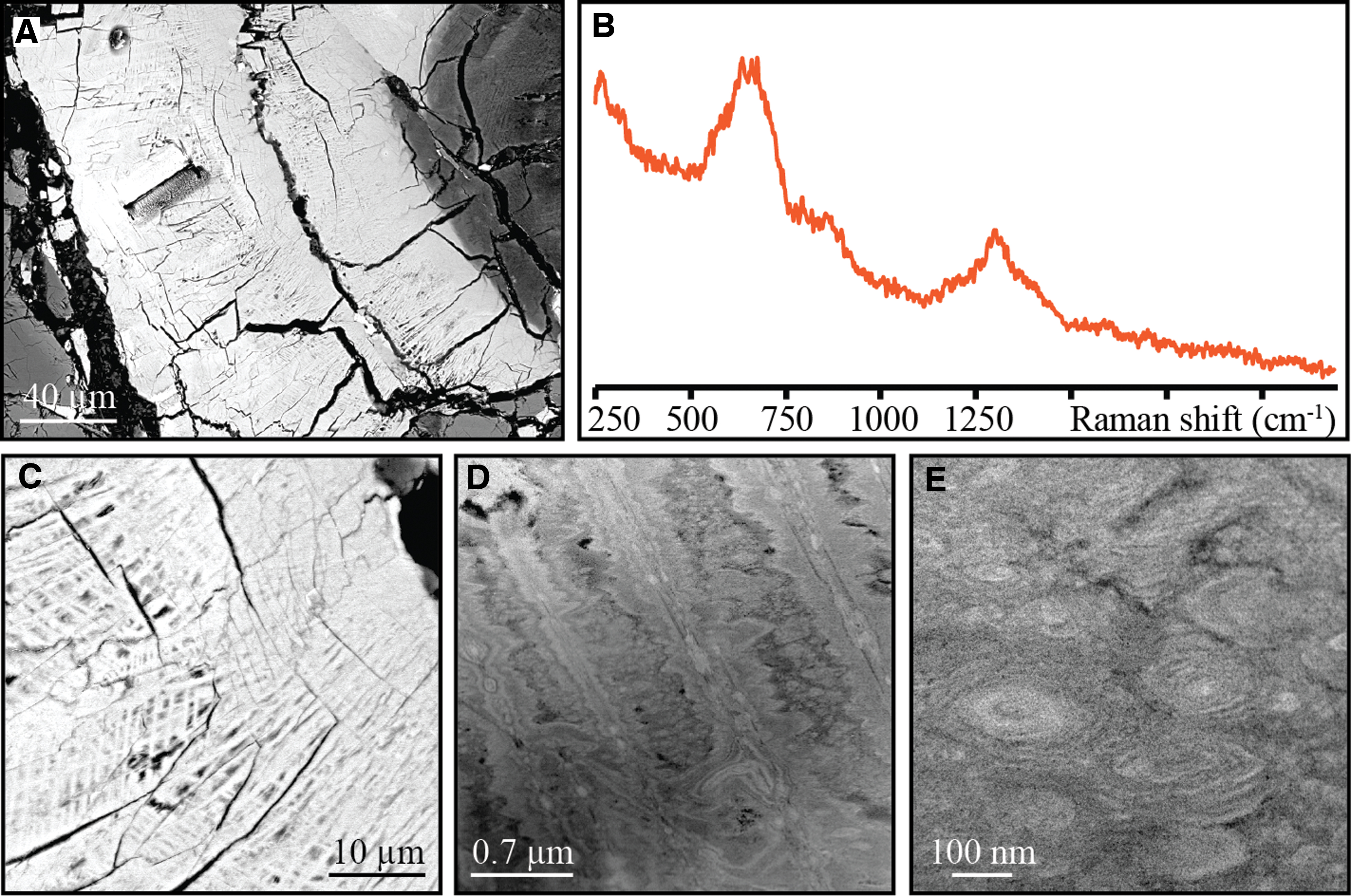
Dendritic structures. (
The Fe/Mg clay minerals display a typical structure of smectites (Fig. 3): they consist of layers of a few hundreds of nanometers in length stacked over a few tens of nanometers, with layer to layer distances of ∼11.8 Å. These Fe/Mg clay minerals are chemically heterogeneous, with a mean chemical composition falling between nontronite, celadonite, and saponite (Fig. 3). Most importantly, the observed anticorrelation between Mg and Cl (Fig. 3) attests to the presence of Cl within the structure of these Fe/Mg clay minerals according to the Mg-Cl crystallographic avoidance principle (Bailey, 1984). This assemblage of Cl-rich Fe/Mg clay minerals is highly porous and exhibits a network of microcavities or pockets, from tens of nanometers to several hundreds of nanometers in diameter (Fig. 4).
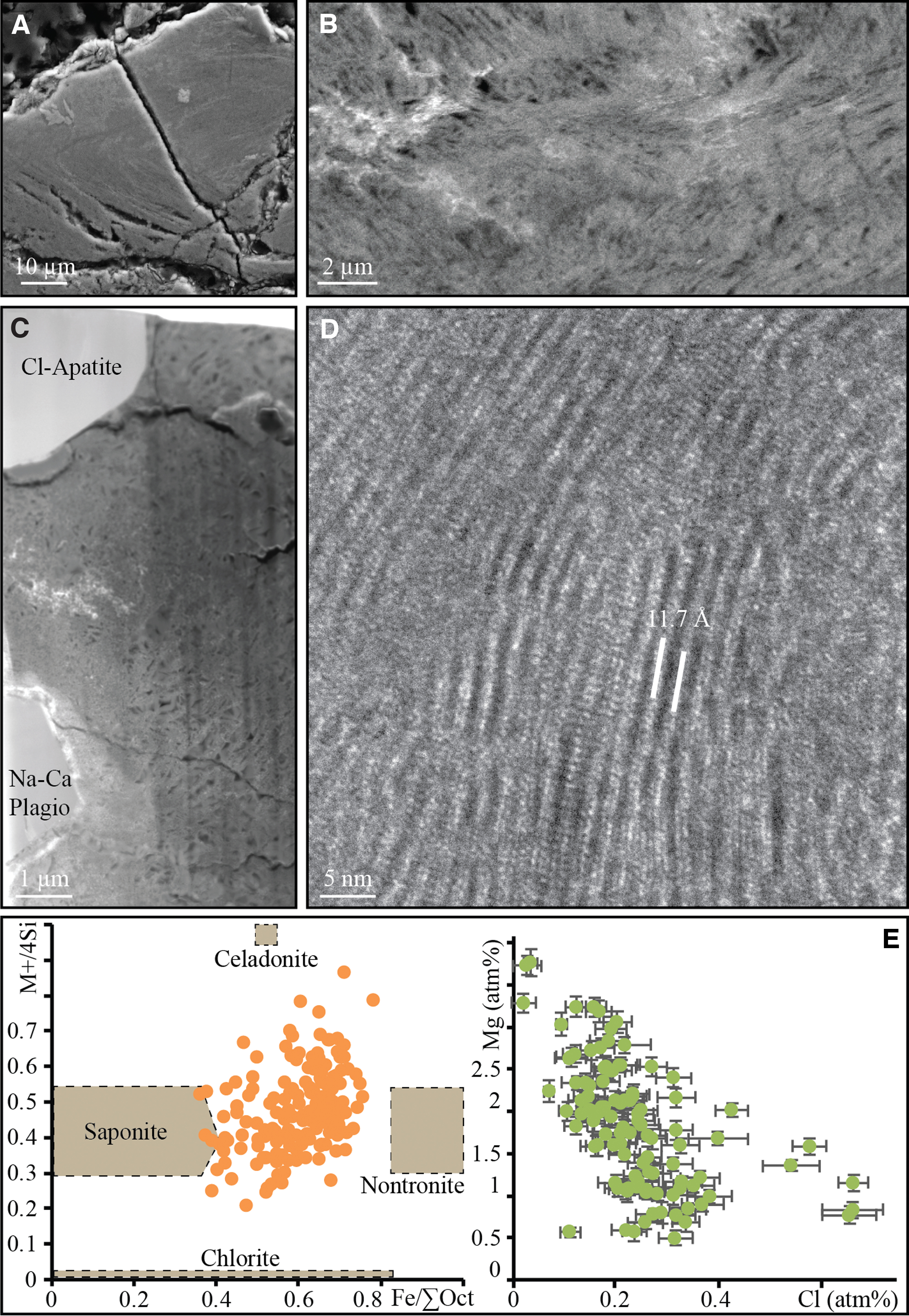
Magmatic Fe/Mg clay minerals. (

Magmatic Fe/Mg clay minerals. (
4. Discussion
These Fe/Mg clay minerals were clearly not produced via the aqueous alteration of preexisting silicates. In fact, the section of NWA 5790 investigated here has been recognized to be unaltered (Tomkinson et al., 2015; Jambon et al., 2016), and the alteration of the Ti-rich and Al-rich mesostasis (mainly made of feldspars) would have produced Ti-rich and Al-rich secondary minerals (Meunier and Velde, 2004). In contrast, the clay minerals described here display a low Al content (4 wt %) and do not contain any Ti. The Fe and Mg contents of these clay minerals could be consistent with the alteration of augite, but none of the augite grains of NWA 5790 display alteration textures such as retreating surfaces or pitch-like features resulting from dissolution. No contact with the Fe/Mg clay minerals could be observed as well. Also, the high Cl content of these Fe/Mg clay minerals is similar to that of Cl-rich magmatic apatites, scapolites, and amphiboles found in other nakhlites (Sautter et al., 2006; McCubbin et al., 2013; Giesting and Filiberto, 2016) and that of the magmatic Fe/Mg clay minerals found in Nakhla (Viennet et al., 2020).
The subhedral/euhedral nature of augite crystals is consistent with slow growth within a magmatic chamber (Treiman, 2005; Jambon et al., 2016; Udry and Day, 2018) or within a chilled margin of a lava flow or sill (Tomkinson et al., 2015). The crystallization and the accumulation of augite grains led to the entrapment of a residual liquid enriched in Cl, potentially as a result of contamination by an exogenous Cl-rich fluid (McCubbin et al., 2013; Udry and Day, 2018). With decreasing temperature, the Na/Ca plagioclases and the K-feldspars crystallized together with the skeletal equiaxed Fe-Ti oxides and the skeletal Ti-magnetites, eventually leading to the exsolution of a Cl/Fe-rich brine (Fig. 1). Here, the screw dislocations at the surface of the augite grains (together with the decrease of solubility of Fe III with decreasing temperature) potentially controlled the very fast precipitation of the observed dendrites, which explains their screw shapes and unidirectional solidification structures (Vernon, 2004). Masses of highly porous Cl-bearing Fe/Mg clay minerals then precipitated from the residual brine (together with, or right before, the Fe-Si-Al-Ca nanograins), that is, before reaching a high level of igneous differentiation in contrast to what occurred in Nakhla (Viennet et al., 2020).
The magmatic production of Fe/Mg clay minerals evidenced here in a martian meteorite archetypal of the martian crust portends that a possibly significant fraction of the Fe/Mg clay minerals detected on Mars so far may not be the products of the aqueous alteration of preexisting silicates by (sub)surface water, questioning a priori the past habitability of Mars. Yet the magmatic Fe/Mg clay minerals described here have chemical and physical properties that offer fantastic opportunities for (prebiotic) organic reactions (Russell and Martin, 2004; Duval et al., 2020). In fact, in addition to enabling electron transfer, their high Fe content may promote the synthesis and breakdown of universal metabolic precursors (Stucki, 2006), while their high Mg content may prompt both ribozyme-catalyzed and non-enzymatic RNA copying reactions (Adamala and Szostak, 2013).
Clay minerals have long been suggested as the perfect means of concentrating organic molecules onto their external surfaces and within their interlayer space so as to be available for prebiotic reactions (Bernal, 1951; Ferris and Ertem, 1992; Brack, 2013; Lagaly et al., 2013; Theng, 2018). The surface areas of the magmatic Fe/Mg clay minerals described here are very high; external and internal surface areas reach 30 μm2 and 670 μm2 per μm3, respectively (cf. Supplementary Materials). For smectites, this corresponds to 2.4 × 10¹⁴ external sites and 5.8 × 10¹⁴ internal sites of possible interactions with organic functional groups (cf. Supplementary Materials).
Most importantly, the vesicular texture of these magmatic Fe/Mg clay minerals forms a network of chemically heterogeneous microcavities or pockets that offer even more optimal conditions for (prebiotic) organic reactions. In fact, most scenarios of the origin of life require boundaries or membranes (either organic or inorganic) to isolate, concentrate, and protect organic compounds that could eventually interact or react with each other (Szostak et al., 2001; Hanczyc, 2003; Chen and Walde, 2010; Sun et al., 2016). Plus, a boundary is a privileged interface for the formation of gradients that can promote organic reactions and be exploited as an energetic source (Monnard and Walde, 2015; Branscomb et al., 2017; Branscomb and Russell, 2019). Here, more than 600 microcavities or pockets can be counted per μm2 of clay minerals, with surfaces ranging from 1 × 10⁻⁵ to 1.4 × 10⁻² μm2 (Fig. 4C), each of these microcavities potentially acting as a distinct microreactor for organic chemistry. The multiple connections between these microcavities or pockets may allow organic molecules to diffuse freely in and out of these microsystems, possibly leading to molecular crowding and, thereby, increasing the probability of achieving prebiotic chemical reactions.
5. Conclusion
The section of the martian nakhlite NWA 5790 investigated here contains a zone composed of magmatic Fe/Mg clay minerals mixed with Fe-Si-Al-Ca nanograins surrounded by dendritic maghemite. These magmatic Fe/Mg clay minerals exhibit a vesicular texture that forms a network of microcavities or pockets that could serve as microreactors for the emergence of life. The fact that the formation of such niches for emerging life can be achieved via the magmatic precipitation of Fe/Mg clay minerals should make these aggregates a focus for research into the origin of life, especially as such magmatic Fe/Mg clay minerals form within liquid-water-poor environments (prebiotic reactions are thermodynamically out of equilibrium in aqueous solution; Lambert, 2008). In fine, by evidencing the formation of niches for emerging life on Mars even during the Amazonian, the present study provides a strong rationale for the possible emergence of life on other planetary bodies, including rocky and/or icy ones (such as Ceres, Enceladus, or Europa) on which the production of clay minerals has recently been reported (Waite et al., 2017; Marchi et al., 2019).
Footnotes
Acknowledgments
We thank Elisabeth Malassis for administrative simplification, the Atelier and the Cellule Projet (IMPMC) for the construction of the time-resolved Raman instrument @ IMPMC, David Troadec (IEMN) for the extraction of FIB foils, Imène Esteve (IMPMC) for her expert support with the SEM @ IMPMC, and Jean Michel Guigner (IMPMC) for his expert support with the TEM @ IMPMC. The authors would like to thank the Sorbonne Université collection curated by the the Muséum National d'Histoire Naturelle for sharing the section of NWA 5790 (specimen #308). The authors wish to acknowledge the Editor Dr. S.L. Cady, the associate editor C. McKay, as well as two anonymous reviewers for their constructive comments that greatly improved the quality of this work.
Author Contributions
J.C.V. and S.B. designed the present study. J.C.V. and S.B. conducted the SEM experiments. J.C.V. and O.B. conducted the Raman experiments. J.C.V., S.B., and C.L.G. conducted the TEM experiments. J.C.V. and C.L.G. performed SEM and TEM data reduction. All authors contributed to the interpretation of the results. J.C.V. and S.B. wrote the manuscript, with critical input from all authors.
Author Disclosure Statement
No competing financial interests exist.
Funding Information
The SEM facility @ IMPMC is supported by Region Ile de France grant SESAME Number I-07-593/R, INSU-CNRS, INP-CNRS and UPMC-Paris 6, and by the Agence Nationale de la Recherche (ANR) grant number ANR-07-BLAN-0124-01. The TEM facility @ Lille University is supported by the Chevreul Institute, the European FEDER and Région Nord-Pas-de-Calais.
Abbreviations Used
Associate Editor: Christopher McKay
References
Supplementary Material
Please find the following supplemental material available below.
For Open Access articles published under a Creative Commons License, all supplemental material carries the same license as the article it is associated with.
For non-Open Access articles published, all supplemental material carries a non-exclusive license, and permission requests for re-use of supplemental material or any part of supplemental material shall be sent directly to the copyright owner as specified in the copyright notice associated with the article.
