




Abstract
Before the first humans depart for Mars in the next decade, hundreds of tons of martian water-ice must be harvested to produce propellant for the return vehicle, a process known as in situ resource utilization (ISRU). We describe here an instrument, the Agnostic Life Finder (ALF), that is an inexpensive life-detection add-on to ISRU. ALF exploits a well-supported view that informational genetic biopolymers in life in water must have two structural features: (1) Informational biopolymers must carry a repeating charge; they must be polyelectrolytes. (2) Their building blocks must fit into an aperiodic crystal structure; the building blocks must be size-shape regular. ALF exploits the first structural feature to extract polyelectrolytes from ∼10 cubic meters of mined martian water by applying a voltage gradient perpendicularly to the water's flow. This gradient diverts polyelectrolytes from the flow toward their respective electrodes (polyanions to the anode, polycations to the cathode), where they are captured in cartridges before they encounter the electrodes. There, they can later be released to analyze their building blocks, for example, by mass spectrometry or nanopore. Upstream, martian cells holding martian informational polyelectrolytes are disrupted by ultrasound. To manage the (unknown) conductivity of the water due to the presence of salts, the mined water is preconditioned by electrodialysis using porous membranes. ALF uses only resources and technology that must already be available for ISRU. Thus, life detection is easily and inexpensively integrated into SpaceX or NASA ISRU missions.
1. Introduction
Human missions to Mars are likely to be underway in the next two decades, launched by SpaceX, the China National Space Administration (CNSA), the US National Aeronautics and Space Administration (NASA), or another unexpected entity (Musk, 2017; Linck et al., 2019; Song, 2019; Normile, 2020). Once they arrive, humans will inevitably contaminate the martian surface, hindering subsequent searches for martian life. Further, the presence of life on Mars must be assessed beforehand to understand any potential of backward contamination as human crews return to Earth (Kminek et al., 2017; NASA Interim Directive, 2020).
Many have noted that space agencies are failing to act with the urgency appropriate to these facts. In the nearly half century since Viking, NASA still has not launched a life-detection mission to Mars, notwithstanding the fact that Viking produced three positive (one of which is arguably ambiguous) life-detection signals (Klein et al., 1976) and that the only results taken to preclude life on Mars (from a GC-MS) were incorrectly interpreted (Benner et al., 2000; Navarro-González et al., 2010; Biemann and Bada, 2011; Navarro-González and McKay, 2011).
Even today, the Curiosity rover, which has just detected benzoic acid on Mars (Millan et al., 2021) (as predicted 20 years ago by Benner et al. [2000]), was prevented from going to locales on Mars where martian life is most likely to be found, under the concern of forward contamination. In particular, the Curiosity rover was forbidden to sample recurring slope lineae regions on Mars with suspected contemporary water activity, the very places where extant life might be found (Witze, 2016). As a consequence, another multibillion-dollar mission must be sent to do what the Curiosity rover could have already done (Fairén et al., 2017).
One reason why “this incongruous situation has been stagnant” (Fairén et al., 2017) may be uncertainty in the community that we know how to seek alien life. Indeed, ever since the misinterpreted Viking 1976 life-detection results (Benner, 2009), much conventional thinking has denied the possibility of any single approach to detect life universally. Thus, many governmental space agencies today advocate for “life detection” mission concepts tasked with searching for individually unreliable signs of life (Hand et al., 2017; Neveu et al., 2018).
This uncertainty is not entirely illogical. After all, martian life may have originated by paths different from life on Earth (McKay, 2018; Benner et al., 2019). After it emerged, martian life almost certainly had a natural history different from life on Earth (National Research Council, 2007b). Therefore, martian molecular biology may not resemble Terran molecular biology; this possibility is underscored by the recent discovery of Terran life-forms that use a different set of DNA building blocks (Pezo et al., 2021; Sleiman et al., 2021; Zhou et al., 2021), as well as synthetic biology experiments that show the Darwinian capabilities of alternative genetic biopolymers (Zhang et al., 2016). This, in turn, means that standard strategies for life detection may not detect martian life at all.
For example, while amino acids might be widely used in biospheres universally, the specific amino acids used in Terran proteins need not, as many are contingent on natural history long after origins (Benner, 2017). Further, while homochirality is necessary in informational molecules (Schrödinger, 1943), it is well known not to be necessary in functional molecules (Wallace, 1986). Indeed, gramicidin peptides, a product of Terran life, are essentially a 50:50 mixture of
Further, structural regularities within sets of biomolecules might indicate an evolved metabolism (Klenner et al., 2020a, 2020b). However, the specific regularities in Terran metabolism are surely not universal. Even on Earth, the 2n lipids arising from acetyl CoA in eubacteria (Gueguen et al., 2000), which are commonly used to illustrate this approach (Benner, 2017), give signals that are confused by 5n terpenes common in archaea (Haagen-Smit, 1953). Further, terracentric “all of the above” life-detection strategies risk detecting traces of more familiar Terran bio-contamination before they detect a martian “shadow biosphere” (Davies et al., 2009).
Fortunately, synthetic biology offers a strategy to identify biosignatures that are entirely agnostic with respect to chemical origins or its subsequent natural history. Earth-based experiments have shown that many different polymers built from many different building blocks having many different structures can support Darwinian evolution (Hoshika et al., 2019; Hashimoto et al., 2021), presumably the core attribute of living systems. However, for life-forms living in water as a solvent, those biopolymers must all have two specific structural features (Benner, 2017) defined by two well-supported hypotheses:
Hypothesis 1: They must all carry a repeating charge; they must all be polyelectrolytes.
Hypothesis 2: Their building blocks must have structures sufficiently similar to be interchangeable without disrupting the “aperiodic crystal” structures needed for faithful replication. They must be size/shape interchangeable. The “aperiodic crystal” concept was introduced 80 years ago by physicist Erwin Schrödinger as necessary to allow the physics of phase transitions to enable the faithful replication of large amounts of information (Schrödinger, 1943).
Here, we describe an instrument that exploits these two hypotheses to yield a universal and agnostic life-detection concept that, when coupled with analytical tools such as mass spectrometry (Chou et al., 2021), may be used to find biosignatures on Mars. This Agnostic Life Finder (ALF) exploits Hypothesis 1, using the feature of genetic polyelectrolytes to be concentrated from extremely large (∼10 m3) samples of water, even at high dilution. On Mars, water in such amounts must be mined as part of in situ resource utilization (ISRU).
Further, ALF exploits the fact that ISRU rocket refueling must be done robotically before humans leave from Earth to fly to Mars; only this will ensure that the return vehicle is ready once humans arrive on Mars (Musk, 2018; Starr and Muscatello, 2020). Therefore, large amounts of water will be mined while Mars is still largely bio-pristine.
By laying out this universal life-detection instrument design, we hope to bring urgency to activities that integrate life detection with a mission preparing for human arrival on Mars.
2. ALF Instrument Design
To manage mined water, ALF comprises three stacked units built around a central vertical tube. A desalinator (the Mars Electrolyte Management Component, MELMAC) is followed by an ultrasound disruptor (Sample Pre-processing Instrument for Chemical Exploration, SPICE) in the middle. That is followed by a Polyelectrolyte Trapping System (PETS) at the bottom.
These units are separated and insulated by abrasion-resistant peristaltic pumps that regulate martian water flow rate. Material outputs from ALF (liquids and electrolytically evolved gasses) are fed back into the ISRU system for propellant generation. Part of the acidic and alkaline solutions produced as ALF operates are mixed to produce electrolyte solutions required for ALF.
2.1. Management of solids
Since martian life could be present as biofilms on solid surfaces (Westall et al., 2015), ALF will ingest solids along with water via a jaw crusher at its top inlet, pulverizing solids into a fine sand. Any physical filter used to process this polluted water would be rapidly clogged. Hence ALF is designed to allow unobstructed passage of sand and smaller particulates.
2.2. Mars Electrolyte Management Component (MELMAC)
The mined martian water has an uncertain composition with respect to salts, particulates, and other materials. Particulate matter passes unobstructed through ALF and does not affect its performance. However, water having high conductivity due to high salinity would generate joule overheating in PETS. Thus, water put into PETS must be pretreated with a module to adjust its conductivity to compatible levels. MELMAC is designed to do this using electrodialysis with porous membranes (EDPM) (Sun et al., 2020).
In MELMAC, the outer cation exchange membranes (CEM) and inner porous membranes (PM) split the flow into five compartments. The PM allow small ions to pass from the harvested martian water, while retaining genetic polyelectrolytes (and solids) in the stream headed into PETS. Clogging is avoided because of the lateral flow. EDPM does not involve phase changes (unlike distillation) or conversion of energy from electrical to mechanical (unlike reverse osmosis). In electrodialysis, ion transport is driven by an amperostatically regulated electric field. The inner porous membrane prevents adsorption of charged molecules on the surfaces of CEM (Fig. 1). PM pores are large enough to let small electrolytes pass, but not so large as to let polyelectrolytes leave the middle compartment in the stream for PETS (Fig. 2). PM also protect CEM from abrasion (Sun et al., 2020).
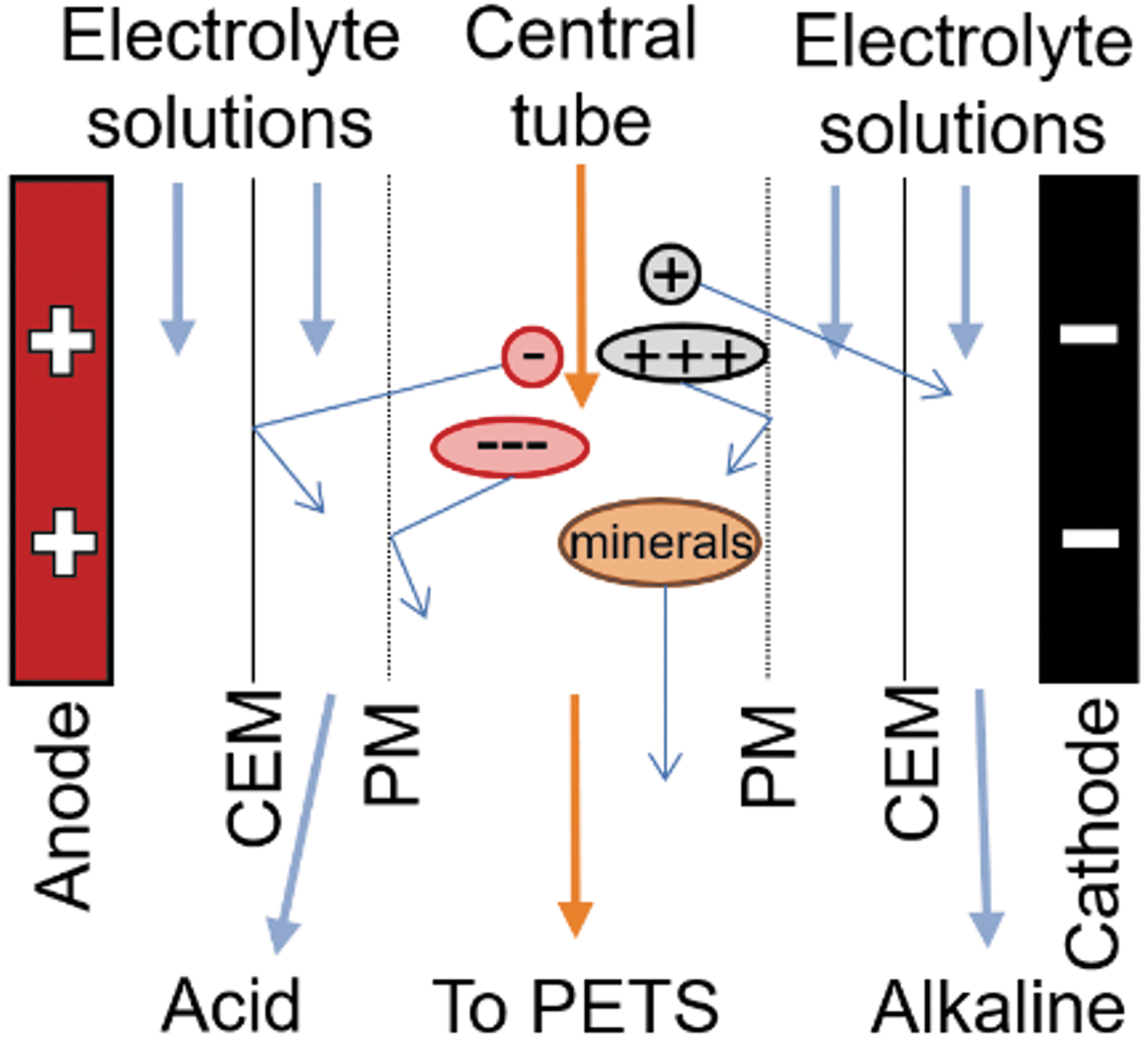
Schematic of cross section of MELMAC desalination/water conditioning system using electrodialysis with porous membranes (EDPM). Outer cation exchange membranes (CEM) and inner porous membranes (PM) split the flow into five compartments, connected through tubing to the rest of ALF. Martian water is incoming from the central tube; the side channels, separated by membranes, are fed electrolyte solutions. PM allow small ions to pass while retaining polyelectrolytes and undissolved pollutants in the stream headed into PETS.
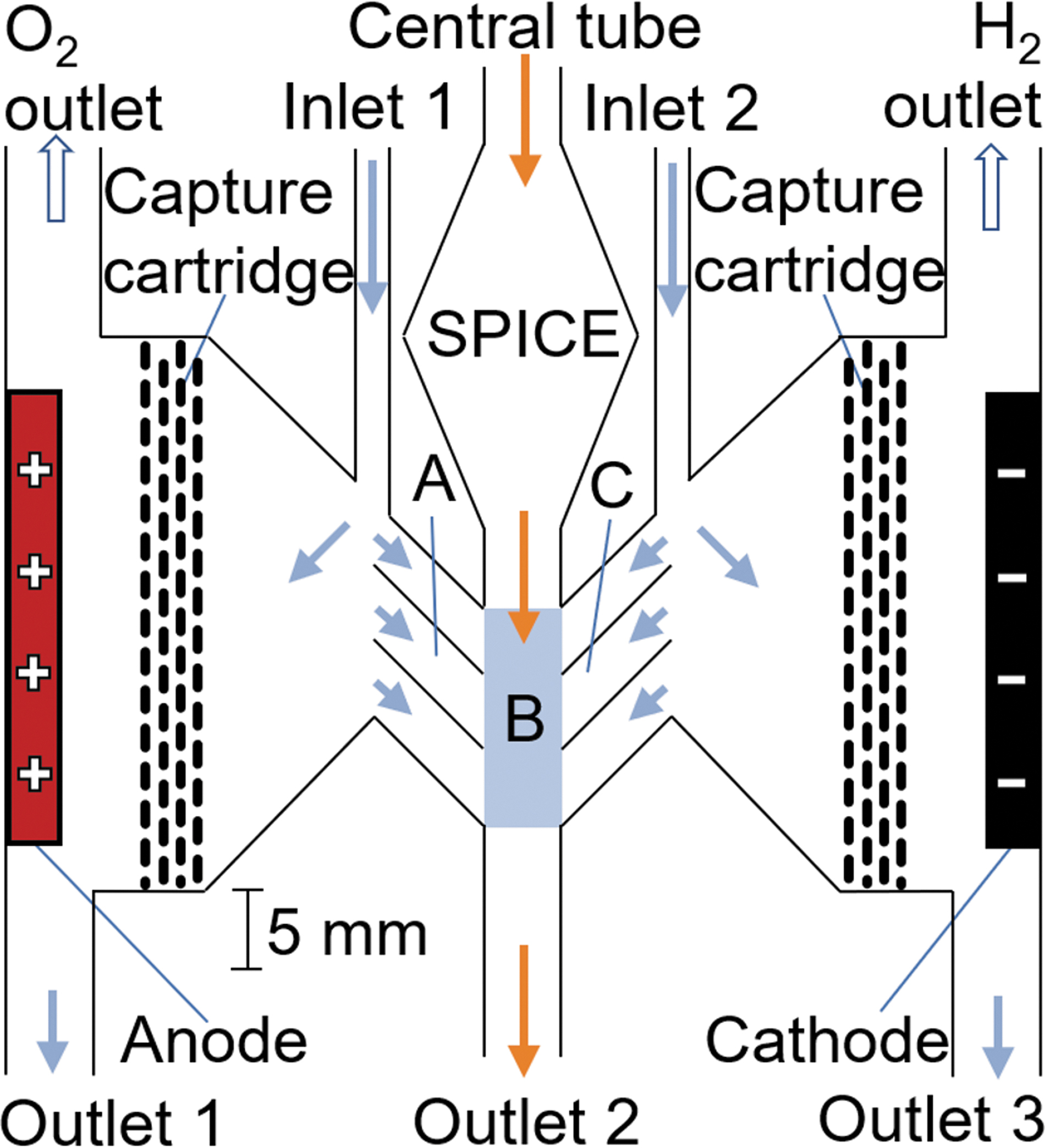
Polyelectrolyte Trapping System (PETS) of our Agnostic Life Finder (ALF). Martian water in the central tube harvested for ISRU flows through a Sample Pre-processing Instrument for Chemical Exploration (SPICE) module disrupting compartments and reaches region B, where it is exposed to a voltage gradient that is perpendicular to the flow. Ions are diverted left and right through “absolute filter” regions A and C, against flows from Inlets 1 and 2. Charged materials migrate toward electrodes only if their velocity is faster than that of the counterflow. Polyelectrolytes are captured in the cartridges, later examined if they meet criteria for genetic molecules. Small ions pass through the cartridges. Gases (H2, O2) are donated to ISRU streams via two top outlets. Liquids from Outlets 1–3 go to ISRU. The scale is given by the physical limitations specified in the text.
2.3. Sample Pre-processing Instrument for Chemical Exploration (SPICE)
On Earth, genetic polyelectrolytes are held within compartments that must be disrupted before they can be recovered by any method, including ALF. Cellular compartments holding martian life may be more robust than most Terran analogs, as near-surface martian polyextremophiles must live in extreme cold, desiccated, and oxidizing environments under low atmospheric pressure.
On Earth, heat and sonication disrupt even the most robust spores (Berger and Marr, 1960; Halaka, 2013; Wells, 2018). Thus, 99.9% of Bacillus spores are destroyed at 70°C with 80 W/mL power (Luisa Garcia et al., 1989). Ultrasound disruption of bacterial spores in a flow-through arrangement is an experimentally proven concept. It was shown to increase amplifiable DNA (Warner et al., 2009). Further disruption occurs with osmotic shock during desalination in MELMAC. Grit enhances bio-compartment disruption, even at low power ultrasound (Warner et al., 2009). This is convenient, as mineral particulates are likely inevitable in ISRU water.
Sonication to disrupt bio-compartments also solves another issue with the unknown martian polyelectrolytes: We do not know their length. Very long polyelectrolytes are hard to manage in any flow. However, most polymers are fragmented by mechanical sheer forces; single-stranded DNA is sheared to about 2000 base pairs by pipetting (Elsner and Lindblad, 1989). To support DNA sequencing, ultrasonication gives DNA of convenient length (∼100–1000 base pairs) (Basselet et al., 2008; Warner et al., 2009). This is (i) long enough to allow downstream analysis of recovered polyelectrolytes to determine whether its building blocks meet Schrödinger's aperiodic crystal structure criterion and (ii) more than able to disrupt the toughest spores known on Earth.
SPICE treats the sample stream which already passed through the jaw crusher and the MELMAC desalinator. SPICE is located adjacent to PETS (Fig. 2) to minimize occurrence of re-adhesion of organics to the suspended minerals. SPICE is currently being developed under a NASA Phase II SBIR grant at Leiden Measurement Technology to ultrasonicate minerals, and extracts organics adsorbed on mineral surfaces. It is now designed with 50–80 kHz at ∼60W, with a ∼10 mL “active” volume.
2.4. Polyelectrolyte Trapping System (PETS)
ALF exploits the universal polyelectrolyte feature of informational genetic biopolymers by using a PETS in its central module. Here, harvested martian water flows through PETS perpendicularly to a voltage gradient that diverts polyelectrolytes from the flow, where they are captured in cartridges before they encounter the anode (for anionic polyelectrolytes) or the cathode (for cationic polyelectrolytes) (Fig. 2).
The polyelectrolyte nature of universal genetic biopolymers makes possible inspection of large amounts of martian water. Indeed, electrophoresis is routinely used to move, separate, concentrate, and recover polyelectrolytic DNA and RNA, even in trace amounts in large volumes. Large-scale free flow electrophoresis (FFE) is routinely performed for protein and cell organelles separation (Islinger et al., 2018) and was even performed in space (Bauer et al., 1999).
FFE does not use stationary matrices, like the gels found in standard molecular biology laboratories. It is done in a flow cell, with anolyte, catholyte, and sample injected perpendicularly to the electric field, which causes lateral migration of electrolytes. As a major advantage, FFE supports continuous separation and preparative isolation of polyelectrolytes without clog-able barriers (Křivánková and Boček, 1998; Stastna, 2020).
Counter-current electrophoresis (CCE) is a form of FFE where analytes migrate in an electric field against a flow of a solvent. The two are balanced to allow some species to migrate against the flow toward an electrode, while species with lower electric mobility are ejected with the flow. CCE is typically used in capillary electrophoresis and for preparative separation of ion isotopes (Kishimoto et al., 2015). CCE is exquisitely effective. For example, CCE recovered all beryllium-7 from rainwater, where it is present in minuscule amounts (Wagener et al., 1971), managing a cubic meter per day using only 500 W—a scale on which ALF can operate.
PETS combines FFE (region B, Fig. 2) with two CCE “absolute filters” (regions A and C, Fig. 2) that allow passage of ions only if their velocity in a given electric field is higher than a threshold determined by the counter-flow velocity of the medium in A and C regions. All (poly)electrolytes with an electromobility higher than a selected threshold are extracted from the incoming flow. This absolute filter cannot be clogged by particulates, as it is not a physical barrier. Hence ALF intakes a large quantity of highly polluted water, from which it separates all free polyelectrolytes without getting clogged.
Flow in and out of ports (including electrolytically generated gases) is managed by peristaltic pumps. The software receives input from sensors that continuously measure pressure, current, temperature, and turbidity (to monitor how the absolute filters reject particulates) and in turn regulate voltage, peristaltic pump speeds, and flow rates in and out of the ports.
PETS is fitted with platinum disk electrodes driven by an adjustable power supply that supports up to 1000 volts across 10 cm distance. For reference, typical voltages for DNA electrophoresis in a molecular biology lab are 10 V/cm; ultrafast gels are run at 100–1000 V/cm with 1–5 mM electrolyte that has a conductivity of ∼1 mS/cm (Brody et al., 2004).
Ions with mobility high enough to exit the main stream of martian water and migrate against the counter current reach removable capture cartridges (Fig. 2). These hold ion matrices that selectively capture polyelectrolytes. These matrices are made of materials capable of polyelectrolyte capture, based either on (1) size exclusion (Janco et al., 2013) (large polyelectrolytes are captured, while small ions pass through them) or (2) ion exchange, where multiple charges on the polyelectrolyte allow it to displace simple electrolytes in competition for the poly-charged surfaces (Choi et al., 2013; Glushakova et al., 2017; Hilmer et al., 2017). Both size exclusion and polyelectrolyte capture matrices are mature technology offering many alternatives. The capture cartridge pair is periodically exchanged for a fresh pair to prevent degradation of the captured polyelectrolytes over time and to match captured polyelectrolytes with the sample location. The used cartridges are examined in situ for presence of polyelectrolytes and/or stored in a storage area cooled by the ISRU-produced liquid propellant, waiting for the sample return.
2.5. Integration into ISRU and electrolyte solution production
ALF is currently at Technical Readiness Level 2 (for more details, see Table 1). ALF is designed to be used with large-scale ISRU missions, where up to hundreds of metric tons of martian ice will be drilled, distilled, electrolyzed, and combined with CO2 harvested from air to produce cryogenic liquid O2 and CH4 rocket propellant (Starr and Muscatello, 2020). Kaethler et al. (2018) calculated that every hour ∼90 kg of ice will have to be converted to propellant for the duration of a 15-month-long SpaceX Starship refueling mission (Kaethler et al., 2018). The electrolysis of 90 kg of distilled water per hour alone would consume ∼500 kW. When accounting for other necessary steps in the propellant manufacturing, such as mining and distillation, an energy supply of several megawatts will be needed for this ISRU mission.
Technical Readiness Levels (TRL) of ALF
A single ALF unit with 1 L/h throughput extracts polyelectrolytes from 10 metric tons of martian ice during the 15-month Starship refueling. With this throughput, ALF, as described in this publication (with PETS dimensions indicated in Fig. 2), consumes ∼200 W of energy (this strongly depends on the unknown salinity of analyzed water). Consumption of 200 W is approximately 0.01% of the needed ISRU mission energy budget, and most of the energy and materials used for ALF are recycled within ALF or used for ISRU. Multiple ALF units might be employed for redundancy and increased capacity.
Materials from PETS and MELMAC outlets (liquids as well as electrolytically generated H2 and O2) are further used for ISRU. Heat generated by ALF, largely removed via Outlet 2, is used for follow-up water distillation or for ice mining in a Rodriguez well (Lunardini and Rand, 1995).
ALF requires only three inputs—locally mined “polluted” water, distilled water, and energy. Aside from these inputs, ALF uses electrolyte solutions. These are produced in situ by ALF. In the process of ALF's desalination using EDPM, acidic and alkaline solutions are made (Fig. 1) (Rathod et al., 2020; Sun et al., 2020). These solutions produced as by-products of martian water desalination are collected, mixed, and diluted in distilled water to create an electrolyte solution with controlled pH and conductivity. This electrolyte solution is fed back to Inlets 1 and 2 of PETS (Fig. 2) and the side channels of the EDPM desalinator (Fig. 1).
Exhaust from PETS proceeds to ISRU. As its heating and power requirements are derived from or used for ISRU, ALF is an inexpensive add-on to ISRU. Thus, life detection is easily and inexpensively integrated into a SpaceX or NASA ISRU architecture.
2.6. Integration into downstream analysis
ALF is a sample processing, polyelectrolyte concentration, and biosignature delivery system. But delivery to what? Polymers can certainly form abiologically, and these might even be polyelectrolytes. Therefore, once captured, martian polyelectrolytes must be analyzed to determine whether they meet the second structural feature required universally for informational Darwinian biopolymers: Schrödingerian regularity. The building blocks of the captured polyelectrolyte biopolymer must all have the same size and shape.
Mass spectrometry involving fragmentation (e.g., matrix-assisted laser desorption ionization mass spectrometry) is routinely used to analyze the building blocks of polymers. It is well known as a tool for DNA sequencing, now for a quarter century (Murray, 1996). Ultrahigh-resolution mass spectrometer (MS) instruments, such the miniaturized orbitrap MS under development for a mission to Europa (Willhite et al., 2021), can be used to distinguish polymeric patterns in unknown polymer samples (Chou et al., 2021). Regular mass fragments would indicate a limited inventory of building blocks, evidence for Schrödingerian regularity. This would serve as an additional control that captured molecules are polyelectrolyte polymers, as expected from the setup.
How much polyelectrolyte material would be required? This depends on the mass spectrometer, of course. For example, a vintage (ca. Year 2000) MS DNA sequencing service typically asked for ∼10−6 g of DNA to confirm sequence (simple detection is an order of magnitude lower). This corresponds to ∼3 × 10⁻⁹ mol of phosphate anion, or ∼3 × 10⁻¹¹ mol of a polyelectrolyte 100 units long. This corresponds to 10−15 mol of a small (∼106 nucleotides in length) bacterial genome. Thus, 109 bacterial cells will give a signal in a Year 2000 vintage MS sequence confirmation service.
How many liters of water must be processed by ALF to detect that biopolymer by this Year 2000 MS? That depends on the density of resources in that water able to support the growth of 109 bacterial cells. Exploiting Terran cryosphere analogs, the biomass of Arctic ice near Resolute in the Canadian Arctic has ∼1010 cells per liter (Smith et al., 1989), meaning that ALF using a vintage MS could detect polar life in a sample of 100 mL, assuming 100% capture efficiency.
Deep (∼3 km, ∼0.3 million-year-old) Antarctic glacier ice cores contain between 102 and 104 viable cells per milliliter, with even higher bacterial concentrations and diversities around dust inclusions (Miteva, 2008). To identify polyelectrolytes from cell density of 102 per milliliter (with the sensitivity of Year 2000 vintage mass spectrometry, and assumed 100% recovery rate), ALF, or any other MS-based analyzer, must recover polyelectrolytes from 104 L of water. For simple detection, ∼103 L would suffice.
The relevance of these Terran analogs to Mars is unknown, but martian permafrost with near-surface access seems unlikely to be much worse than ancient ice cores 3 km down. Martian conditions contain, from a Terran perspective, multiple stressors. However, Mars' inhabitants had several billion years of slow planetary drying and cooling to adapt to the psychrophilic multi-extremophilic conditions. Further, the “lasagna-like” ice-dust layered structure of the martian glaciers can be a source of nutrient gradients, which could provide energy to support biomass production. But note that on Earth the concentration of the ancient DNA in glaciers is a function of historic concentration of airborne microorganisms rather than function of available energy in deep glaciers. The detectable DNA in glaciers decays very slowly with a half-life of 1.1 million years (Bidle et al., 2007).
The presence and regularity of the polyelectrolyte building blocks could be analyzed with more sensitive detection methods, such as solid-state nanopore analysis (Niedzwiecki et al., 2020). Nanopore analysis could in theory provide higher sensitivity, but its universality is yet to be tested.
3. Discussion
A “Pandora's Box” of cheap reusable rockets has been opened by SpaceX, giving Earth-Mars planetary protection an imminent deadline. Deep space, which was until now open only for superpowers, will soon be accessible to smaller nations and to billionaires. The concept of reusable rockets is already being adopted and copied by others (e.g., LinkSpace, Long March 8, Rocket Lab). This competition and large-scale rocket production will further push down the price of space access. Many entities will race to put the first humans on Mars for science and prestige (Musk, 2018). At this point it might be impossible to delay human Mars missions until after the presence of martian life is assessed. Instead, we must move to determine inhabitation status of Mars now, before someone lands there. We must act now, as Fairén et al. (2017) noted.
We suggest that missions like Astrobiology Field Laboratory (AFL), Mars Sample Return, and other mission architectures that rely on correct locale sampling are inadequate (National Research Council, 2007a). Special Regions are places where Earth stowaway bacteria might survive (Rummel et al., 2014); Terracentric search strategies would preferentially detect these over indigenous life. Further, AFL may be wrong about martian ecology, or simply unlucky, especially if life is sparse, as extremophilic microhabitats are hypothesized to be “widely dispersed, difficult to detect, and millimeters away from virtually lifeless surroundings” (Warren-Rhodes et al., 2006). Hence, detection methods which are agnostic only about alien life chemistry (Fairén et al., 2020) might fail because they are not agnostic about the alien life ecology. Absence of evidence of life (even if not a false negative) in a small spot provides inadequate assurance of absence of life generally on Mars.
However, broader considerations suggest that ALF will have access to the martian biosphere no matter where water mining occurs on Mars. On Earth, the wind semi-randomly redistributes microorganisms over the planet's surface. Some microorganisms are deposited in ice, where they are overlayed by snow and conserved. Hence every glacier ice contains a microbial record—either viable or detectable—from the entire Earth surface (Priscu and Hall, 2003; Miteva, 2008; Malavin et al., 2018). Aside from geographical record, glaciers also contain record of Earth surface microbial history. Readable DNA is found in 8-million-year-old ice, the oldest known ice on Earth (Bidle et al., 2007). Metagenomic survey of large samples yields good analytical results (Miteva, 2008).
By analogy, if microbial life were anywhere on the near martian surface within the last ∼10 million years, it must have been “sampled” during global dust storms and deposited in the martian ice. Midlatitude martian ice is geologically young (105 years), deposited during the last martian high-obliquity wet period (Madeleine et al., 2014). Martian ice deposited during the high-obliquity winter in lower latitudes resists sublimation during the subsequent summer only if it is overlayed by dust. Hence the low-latitude and midlatitude glaciers are growing in a layered, “lasagna-like” fashion, with the ice-dust layer thickness 1–100 mm (Madeleine et al., 2014). On Earth, dust inclusions in the ice are correlated with higher concentrations of living microorganisms, as these provide nutrient gradients for psychrophilic bacteria (Priscu and Hall, 2003; Miteva, 2008).
Further, martian dust (Zurek and Martin, 1993) may protect airborne indigenous martian life against (presumably) lethal UV radiation. Interestingly, Curiosity's Sample Analysis at Mars has just detected benzoic acid in wind-blown martian dunes (Millan et al., 2021). Regardless of the origin of the benzoic acid, this discovery limits the amount of destruction of organics due to UV light. Therefore, it is reasonable to expect that every martian glacier contains historical record of most of Mars' surface, both infertile and fertile places. After listing numerous paths of extant life dispersal above and below Mars' surface, Nathalie Cabrol (2021) concluded “If life started on Mars… it is everywhere it can be.”
These considerations inspire ALF to reverse AFL's approach, both orthographically and strategically. Instead of seeking the “right place” to find biosignatures in high concentrations, ALF searches for a reliable agnostic biosignature that can be concentrated from a low-concentration sample that comprises the whole martian surface. This is, of course, the benefit of exploiting the “polyelectrolyte theory of the gene” (Benner and Hurter, 2002), rather than the classical palette of “biosignatures.” This satisfies both sides of the Special Region 1 debate: individuals who seek to prevent potential sources of contamination from approaching Special or Uncertain Regions (Rummel and Conley, 2018) and those who want to sample Special and Uncertain Regions, because these actually might contain life (Fairén et al., 2018).
The large-scale sampling offered by ALF presents a feature which “regular” sample sizes (microliter to liter) cannot. As the scanning progresses, the false-positive hits due to the forward contamination will diminish over months and tons of ice processed. The false-positive signals will trend toward zero, leaving the true positives only.
Finally, from the perspective of both forward and backward planetary protection, it is more important to know whether there is life surviving in or blown toward the future human landing area than whether there is life anywhere on Mars' surface. Scanning literally tons of ice in the location of a future human mission provides the highest degree of certainty about the existence of life in the most important martian spot.
The locations over the geologically young midlatitude subsurface ice (Dundas et al., 2018) are ideal spots for long-term human habitation. Sufficiently low latitude ensures enough solar irradiation during the martian year, and the abundant subsurface ice can be easily mined using Rodriguez wells (Lunardini and Rand, 1995).
The biggest challenge of this mission—the industrial-scale mining operation on Mars' surface, and transport of the samples back, will be done for the return mission anyway (Musk, 2018; Starr and Muscatello, 2020). ALF piggybacks on this infrastructure.
If they are not analyzed in situ by mass spectrometry of the type already on the martian surface, isolated genetic materials, after ISRU refueling, may hitch a free ride back to Earth to be analyzed here. In the case ALF detects indigenous life in situ using mass spectrometry analysis (Managadze et al., 2017), or nanopore (Niedzwiecki et al., 2020), other more sensitive but less agnostic methods might be deployed for further investigation (Fairén et al., 2020). If confirmed, viable samples not yet subjected to ALF's destructive analysis might be returned as well, provided backward planetary protection is taken into consideration. In case of a negative result, ALF can continue the search until an arbitrarily low upper bound on the alien life existence is met. Out of all known methods ALF can provide the highest confidence in determining alien life absence anywhere on the martian surface.
Both life and extraterrestrially refuellable rockets need water. Thus, ALF can be a low-cost add-on on any ISRU mission to any water-containing celestial bodies.
Footnotes
Acknowledgment
The material is based upon work supported by NASA under award No 80NSSC18K1278. Any opinions, findings, and conclusions or recommendations expressed in this material are those of the authors and do not necessarily reflect the views of the National Aeronautics and Space Administration. An up-to-date summary and status of the ALF project is at our blog primordialscoop.org/tag/alf
Author Disclosure Statement
No competing financial interests exist.
Abbreviations Used
Associate Editor: Norman Sleep