




Abstract
Samples of α-glycine (α-GLY; 230–350 nm) were irradiated in laboratory as a function of electron beam energies (0.25, 0.50, and 1.00 keV) at room temperature (293–295 K). The evolution of α-glycine irradiation process was monitored in real time by infrared spectroscopy (Fourier transform infrared - FTIR), through specific spectral bands: 2610, 2124, 1410, and 1333 cm−1. A phenomenological model is proposed to describe the column density decay when thick organic samples are processed by ionizing beams. The α-glycine radiolysis has exhibited transient and stationary modes in such thickness films. The first stage is mainly described by one exponential decay, whereas the latter foremost decays linearly; compaction processes have been neglected; glycine dissociation and sputtering processes are assumed to be responsible for the damage caused by the electron beam impact through the solid film. The second (stationary) stage is due to equilibrium between a partially shielded bulk radiolysis and sputtering of protective layers. The decay rates are measured for the transient and stationary modes and allow determining the processing velocity of the samples as a function of the electron beam energy. Finally, the model is applied to space weathering to find out the typical sputtering rate of organic compounds on the surface of astrophysical analogs with no protection layers attacked by solar wind (SW) electrons at ≈1 AU. Although the velocity of processing materials in SW has natural competing effects, such as regolith overturn by impacts of micro- and macrometeorites and downslope motion of material that is unstable due to changes in the geopotential of the airless bodies (e.g., asteroid 101955 Bennu), these competing processes are not included in the simulations presented here.
1. Introduction
Interplanetary charged particles in the Solar System (SS) have a great variability on kinetic energy and flux distributions; they came mostly from the Sun, but also from planetary magnetospheres (giant planets) and extragalactic sources (cosmic rays). The solar dynamics rules the energy distribution of electrons and ions constituents of the solar wind (SW). Regarding the SW component composed by the electrons, their kinetic energy ranges from tens of eV up to tens of keV (Wang et al., 2012) and the total energy flux varies from 6.7 × 10⁹ up to 1.0 × 10¹⁰ eV/(cm2·s) between solar minimum and maximum conditions (Bennett et al., 2013). Therefore, it is important to evaluate the effect of electron energy distribution on collisional phenomena occurring in the surface of astrophysical bodies devoid of atmosphere and/or intense magnetic fields from direct impact of charged particles, such as electrons with low (<100 eV) and high (≥1.0 keV) energies.
Whenever energetic cosmic radiation (ultraviolet [UV], X-rays, keV electrons, keV–MeV ions) impinges on solid surfaces in space, a few primary processes occur: secondary electron emission, fluorescence, sputtering of neutral and ionic species, radiolysis, and crystallographic transformations. Secondary processes follow, such as heating, sublimation, and particle diffusion (especially hydrogen). These phenomena are deeply connected with the so-called space weathering whose main effects on asteroids and the lunar surface are alteration of the spectral properties of the regolith (Cassidy and Hapke, 1975; Hapke et al., 1975; Pieters et al., 2000; Clark et al., 2002; Chapman, 2004).
Other studies have been interested in comprehending the evolution of organic material on Mars surface since these compounds (such as amino acids) are also exposed to ionizing radiations from space on martian soil (Kminek and Bada, 2006; Góbi et al., 2016), although Mars has a thin atmosphere and a weak magnetic field that eventually could interact with the SW particles attenuating radiolysis processes on its surface. Some research branches look for organics on airless asteroid surfaces. Recently, the OSIRIS-REx spacecraft have detected carbon-like materials on the surface of near-Earth asteroid 101955 Bennu (Simon et al., 2020). This finding stimulates the understanding of the asteroids' surface processing evolution in large scales.
The roles of the ionizing projectile species are quite distinct in the sense that they interact differently with solid (or condensed) matter. In particular, they transfer energy and momentum differently to the target atoms, which determine their range in materials and, consequently, the thickness of the processed region underneath the surface. Moreover, depending on how the irradiated region reacts to the ionizing radiation, the position, density, and velocity of processing change. If the sputtering yield is high (as for ion projectiles), erosion is intense and the surface material is refreshed staying similar to that in the bulk; if it is low (as for photons and electrons), volatile species desorb and a hard material (e.g., tholins) may be formed at the surface, blocking or slowing down the damage progress.
The scope of the current work is limited to the effect of keV electrons bombarding organic materials; glycine (GLY) is taken as a typical astrophysical prebiotic molecule (Elsila et al., 2009; Altwegg et al., 2016). The following articles discuss and compare the effects produced by distinct types of ionizing beams on organic compounds, particularly GLY.
Maté et al. (2014) analyzed the glycine radiolysis induced by 7.6 eV photons and by 2 keV electrons. They reported dehydrogenation by photons causing structural changes in the surface regions; electrons cause erosion with lesser changes. In addition, Maté et al. (2015) found that 90 nm of GLY film at 300 K was completely destroyed by 2 keV electrons; however, irradiation at 20–90 K creates a heating-resistant residue, which may be due to I, II, and III amide bands. The GLY destruction cross section at 300 K is measured to be 18 × 10−16 cm−2, twice higher than at 20–90 K; this suggests that the volatile products trapped in the bulk at low temperature inhibit, shield, or provide reformation of GLY. Souza-Corrêa et al. (2019) obtained qualitatively the same temperature dependence, degrading α-GLY with 1 keV electrons.
Pernet et al. (2013) used 400–550 eV photons to dissociate a 40 nm GLY film at 30 K. They found that, after a beam fluence correspondent to 3 years of solar irradiation at 1 AU, ≈70% of GLY initial concentrations were preserved, only if GLY were protected by icy layers or remain in the interior of interplanetary bodies.
Cruz-Diaz et al. (2019) irradiated isoviolanthrene (C34H18) at room temperature with 10.2 eV UV, 1.5 keV electrons, 1.5 MeV protons, and 1.5 MeV He+ particles. Fourier transform infrared (FTIR) analysis revealed similar results between observational and experimental data related to the degradation by ion projectiles as a function of energy dose. Degradation by electrons proceeds much slower: doses two orders of magnitude higher are necessary to destroy about 30% of the sample. A striking difference among the four infrared (IR) spectra of the irradiated sample is that H+ and He+ projectiles do not change the background, whereas photons and electrons raise the background in the 950–1250 cm−1 and 950–1650 cm−1 regions, respectively. Since, at these energies, the range of these two radiations is much shorter than the ion's ones, one may conclude that photons and electrons are inducing dehydrogenation in the polycyclic aromatic hydrocarbon (PAH) and creating an erosion-resistant film at the surface. This new material is very likely a cross-linking carbonic material, such as the polystyrene studied by Calcagno et al. (1995).
Moroz et al. (2004) irradiated natural complex hydrocarbons (asphaltite and kerite) with 15–400 keV H+, N+, Ar2+, and He+ ions. They measured their reflectance spectra in the range of 0.3–2.5 μm before and after each irradiation process. The results obtained indicated that considering red organic solids optically domain the surface of airless bodies, then space weathering would tend to neutralize their surface colors, which is an unusual space weathering trend.
Although electrons are minor component of cosmic rays (extragalactic sources), looking at the SW components, the electron population may have significant impact on the surface of SS bodies in comparison with UV radiation and ion bombardments. In this sense, important studies have been performed to understand the rule of the electron on radiolysis process of astrophysical ice analogs (Barnett et al., 2012) and amino acid compounds, particularly glycine (Pilling et al., 2014; Maté et al., 2015; Souza-Corrêa et al., 2019). Measuring and comparing the radiolysis and sputtering induced by MeV ions and keV electrons on glycine, for constant stopping power, the destruction cross sections for ion and electron beams are similar (da Costa et al., 2020, 2021).
In addition, the degree of the electron beam penetration depth is a parameter that plays with the material damage itself. According to the study by Barnett et al. (2012), there are differences between the penetration depth and what they called the damage depth. These authors define penetration depth as the average of the maximum particle track distance in the medium, whereas the damage depth is related to the stopping power of the projectile and of secondary electrons in the medium. These authors argue that the damage depth is quite deeper than the penetration depth (Barnett et al., 2012); the last one is usually calculated by software based on the Monte Carlo method. An example is the code known as CASINO (an acronym for monte CArlo SImulation of electroNs in sOlids), which is a powerful numerical tool to study electron penetration—given full electron trajectory—in solids (Drouin et al., 2007).
The sample temperature in the current experiment is ≈300 K, which simulates the usual surface temperature of cosmic bodies in the vicinity of Earth's orbit. Indeed, the solar radiation is able to heat objects in the space near Earth up to ≈390 K; of the sun influence, the object's temperatures became lower than ≈170 K. This is one of the reasons that the average surface temperature of materials around Earth's orbit is about 280 K. Moreover, the present study takes into account high fluence irradiations into thick samples, those having thickness larger than the damage depth: this is the usual case for astrophysical surfaces, such as comets and asteroids (Cataldo et al., 2011a, 2011b; Iglesias-Groth et al., 2011).
Herein the α-GLY samples were irradiated under 0.25, 0.50, and 1.00 keV due to the relevance of the 0.10–1.00 keV electron energy region in the SW. Solar electrons have their maximum flux around 0.10 keV; electrons with energy below 0.05 keV have a negligible ionization cross section; electrons in the 0.10–1.00 keV range are still very abundant in the SW. It is important to have a comprehension of the effects caused by impact on solids for the solar electron from halo (60 eV < E < 1.0 keV) and super-halo (E ≥ 1.0 keV) population. These two classes represent only 5% of the solar electron population but have an important energetic interaction with solids.
The main goal of this work is to study the dynamics of the protective material that is formed during the electron irradiation on the surface region of molecular materials, particularly of organic compounds (α-GLY); in particular, one discuss how to measure the processing velocity that causes damage in the bulk target during and after the protective layer formation. During this process, it is expected that the processing velocity be faster if the cross section for radiolysis is high; very likely, degrading complex molecules into products decelerates the decomposition rate up to the point that the damage process eventually stops.
In the SS, eV–keV electrons are most abundant component of the SW; for energies below 0.10 keV, their destruction cross sections drop very fast. Therefore, 0.10–1.00 keV electrons become the relevant projectiles. Amino acids are small molecules but complex enough to be used as targets in such experiments. A simple model described in Section 2 is proposed to treat quantitatively this process, which is expected to occur, in general, for any irradiated organic material; here, α-glycine is used as an example. The main results associated with the infrared analysis are shown in Section 3 and discussed in Section 4. Finally, in Section 5, dedicated to Astrophysical implications, one points out how the findings of the current work may contribute to the description of the complex phenomenon of erosion on astrophysical body surfaces by SW electrons.
2. Materials and Methods
2.1. Experimental setup
α-GLY films (thickness around 230 and 330 nm), deposited on KBr substrate (which has high infrared transparency), were irradiated as a function of electron beam energy (0.25, 0.50, and 1.0 keV) at room temperature (293–295 K) under high vacuum conditions (≈10−7 mbar) with a mean target beam current I ≈ 1.4 μA for all projectile energies. Since a circular metallic collimator (6.0 mm diameter) is placed in front of the irradiated sample, the electron flux (ϕ = 6.24 × 10¹⁸ I/area) is ∼3 × 10¹³ electrons cm−2·s−1 for each measurement performed in this work.
A schematic drawing of the main experimental setup applied on this work is shown in Fig. 1. The sample holder was designed to host three samples disposed vertically. In the upper position (1), a Faraday cup (FC) was introduced for determining the incident electron beam current by using a high precision picoammeter (Keithley 6485) attached to it. In the central position (2), a disk of pure KBr substrate was placed as a background reference for FTIR analysis. Finally, in the lower position (3), the sample of α-GLY film on KBr substrate was set. The sample holder position was adjusted through a set of triple-axis manipulator (x and y scales from 0 to 25 mm; z scale from 0 to 50 mm). No correction was made due to the secondary electron emission (da Costa et al., 2020); Monte Carlo simulations predict that about 10% of primary electrons are backscattered.
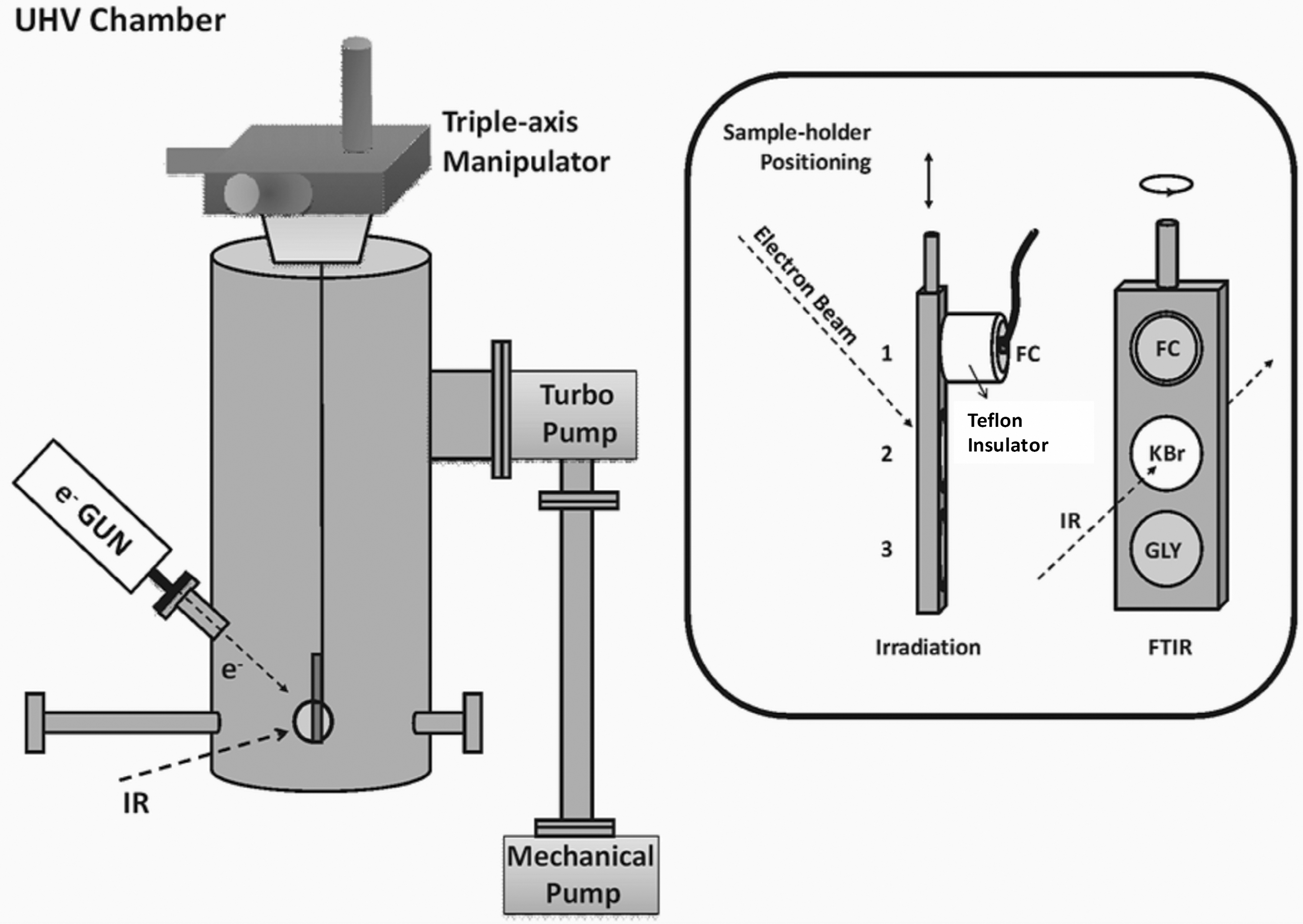
Depiction of the experimental setup, adapted from the study by Souza-Corrêa et al. (2019). Left: the main Ultra High Vacuum (UHV) chamber components are shown. Right: the target irradiation and analysis set positioning are highlighted. In irradiation mode, the electron beam impinges the sample holder, at 40° with respect to the horizontal, in three possible positions: (1) FC; (2) KBr substrate; (3) glycine on KBr substrate. For FTIR spectrometer analysis, the sample holder is rotated by 90° around the vertical axis. FC, Faraday cup.
Although the angle of the electron beam is not perpendicular to the sample (≈40° with respect to the normal direction), as it is indicated in Fig. 1, the trajectories of the electrons change quickly after they enter the material: this will ensure transversal homogeneity. It does not have longitudinal homogeneity, just as it would with the perpendicular beam. Briefly, after two or three collisions inside the sample, electron projectiles “forget” in a large extension, the incidence angle.
The evolution of α-GLY radiolysis, for each electron beam energy applied, was monitored in real time by infrared spectroscopy (JASCO FTIR-4100). For measuring the absorbance decay as a function of time, four molecular bands were selected: 2610, 2124, 1410, and 1333 cm−1. The A-values for these molecular bands were experimentally determined, based on a thickness calibration curve (both procedures of calibration curve and A-values determination are described in the Appendix). The A-value represents the band strength, that is, the numerical value used to specify the most stable orientation of atoms vibrating in a molecule and it is, therefore, associated with a specific oscillation frequency (molecular band). To have a good signal/noise ratio of the absorbance spectrum acquisitions, the following parameters were used: slit aperture of 3.5 mm, 2.0 cm−1 resolution, and 70 scans per spectrum.
More details about the vacuum chamber design, electron gun features, and the steps to prepare and identify the α-GLY films are described by Souza-Corrêa et al. (2019).
2.2. Modeling of column density evolution in time for organic material thick films
Here, the term “thin film” implies that the sample is completely traversed at least by a fraction (≈63%) of the incident electron beam projectiles; therefore, all the target material begins to be processed even at low fluencies. Damage depths can be predicted for the organic material irradiated with a given beam energy (Barnett et al., 2012). However, the term “thick film” means that for a given electron beam energy, the projectiles are not able to degrade the rear part of the film; it is necessary to use high or very high fluencies to degrade the precursor molecules completely.
During an energetic charged particle irradiation process, the exponential decay of the precursor column density is usually associated with molecular bond dissociations, whereas a linear decay is attributed to the material sputter. It is important to point out that both nonlinear and linear processes occur concomitantly. However, the nonlinear mode is dominant at low-mid fluences since the processed material is still mostly composed of precursor molecules in the processable region (defined by the projectile range). Herein, the region dominated by the exponential decay will correspond to the transient part of the irradiation process. Usually, “thin films” shall exhibit only this transient part.
Looking into the “thick films” irradiation process (Fig. 2), after the radiolysis transient region at the beginning of the treatment, as the fluence increases, the by-products (e.g., tholins) of the irradiation process are formed and their concentrations become comparable or even higher that of the precursor. While the precursor decomposition rate decreases, the residue concentration increases. At the end of the transient mode, defined roughly by the fluence FT , the residue concentration in the processable region is high enough to absorb most of the energy delivered by the beam and also scatter most of the beam. Under these conditions, the precursor decomposition rate is severely reduced after FT for two reasons: (1) in the frontal region, the precursor concentration became too low; (2) in the rear region, the projectile flux, strongly scattered by residues, is very low, although the precursor concentration is high.
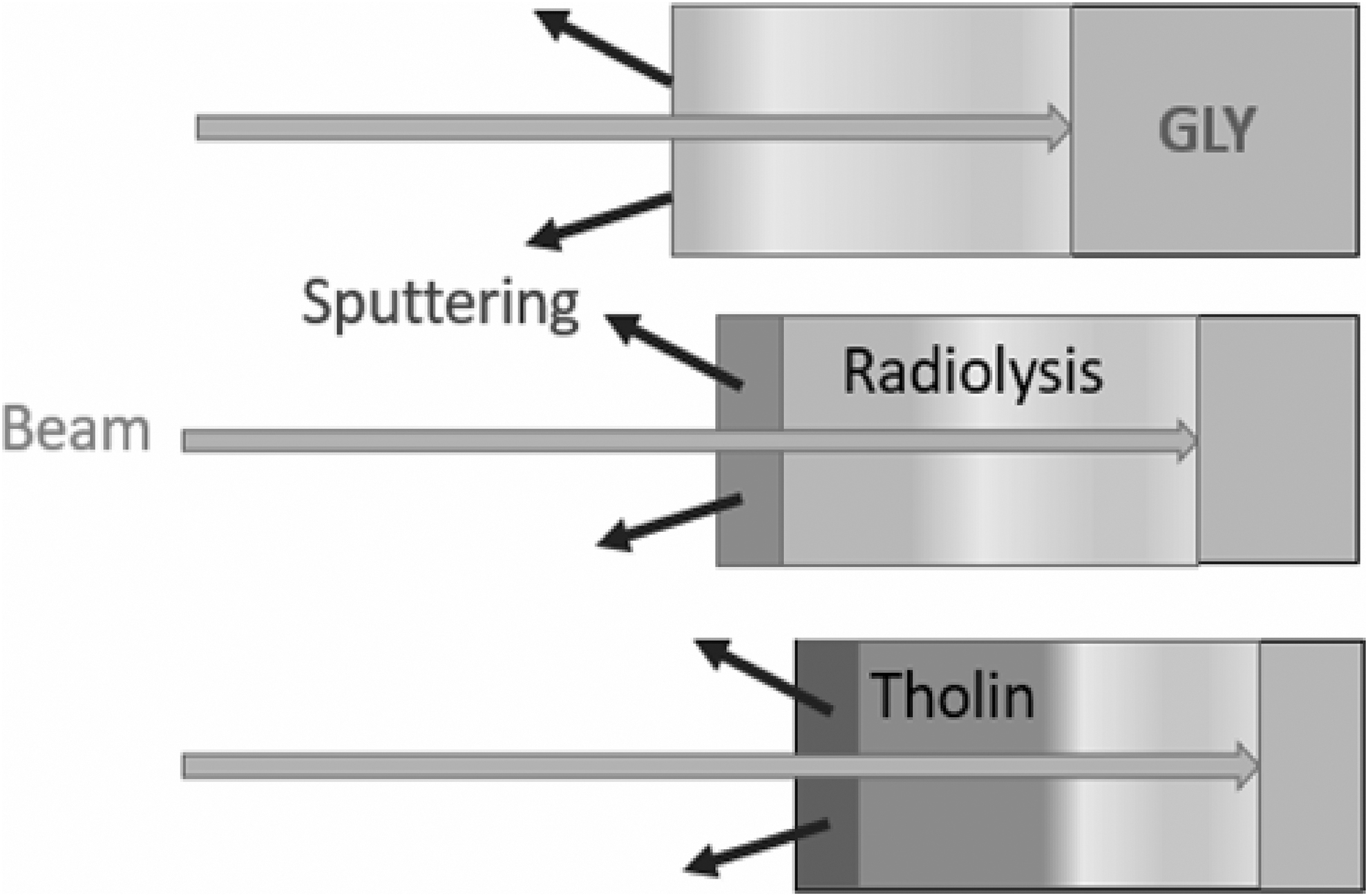
Schematic drawing of radiolysis and sputter processes for “thick films”. At the beginning of the irradiation, the rear part of the sample remains virgin (top); surface atoms/molecules are sputtered and the beam penetrates deeper (middle); hard-sputtered material is formed in the surface and the precursor destruction rate decreases (bottom).
As an effect, the irradiation process goes into a concentration stationary stage represented by the linear decay region of the film: the sputtering rate of precursors, not destroyed by radiolysis, plus their destruction rate in the processable region are balanced by the income rate of precursors in this region.
In this autoregulated mode, for each monolayer ejected from the sample surface, radiolysis begins in a virgin monolayer at the end of the processed region. Figure 2 illustrates the radiolysis/sputtering effects produced by electrons penetrating into a thick film.
To get an expression for the processing velocity, one considers a uniform target layer of thickness H
0 corresponding to the initial column density N
0. The time evolution of the column density N(t) of a target, related to the transient and stationary processes, is assumed to be ruled by:
Since F = ϕt, the column density depends on fluence as:
where α and β are the decay rates of the processed material; N 01 is the initial column density of the transient region; N 02 is the initial column density of the stationary region (the total sample thickness is N 0 = N 01 + N 02); ϕ is the electron flux of the impinging beam; σ 1 is the effective cross section of the transient region; and σ 2 is the effective cross section of the stationary region, such that: σ 1 = α/ϕ and σ 2 = β/ϕ. The column density is a function of the irradiation time.
If the infrared spectroscopy (FTIR) is used to monitor the column density N(t), the Beer–Lambert law establishes a linear connection between this quantity and absorbances of specific υ-bands, S υ(t):

Often, for the same target, the evolutions of distinct υ-bands are not exactly the same and their average yields the determination of the molecular column density (da Costa et al. 2020). In Eq. 3, A υ(t) is the A-value of the integrated absorbance for a given vibrational υ-band, a quantity that may change with fluence (therefore, with time) because the chemical environment around precursor molecules evolves; in general, A υ(t) is unknown, the reason why the average is useful. It is worth to highlight that N(t) depends directly on the precursor dissociation rate, not on the select υ-band used in the absorbance measurement to monitor the dissociation.
To describe the typical variation of the target thickness in time H(t), for a given electron beam energy, the following expression is used:
where M is the molar mass of the irradiated material; ρ 0 is the density of the irradiated material; N Av is the Avogadro number (6.02 × 10²³ molecules); and η = (M/ρ 0 N Av) is the precursor's molecular volume. For GLY: η = 7.9 × 10⁻²³ cm3.
Introducing Eqs. 2 and 3 into Eq. 4, H(t) can be expressed by:
where H 1 = η N 01 is the initial thickness for the transient mode; H 2 = η N 02 is the (extrapolated) initial thickness for the stationary mode; naturally, the initial total sample thickness is H 0 = H 1 + H 2.
2.3. Modeling of the precursor processing velocity in the organic thick film
The electron beam is able to process exponentially the target up to the damage depth H
1 < H
0. The radiolysis process breaks up molecular bonds leading to the dissociation of the precursors into more stable molecules (e.g., tholins), which fill progressively the damaged region; furthermore, the irradiation removes atoms and molecules by sputtering and by desorption of gaseous products. The budget is such that the sample film becomes thinner with time. From Eq. 5, defining V
0 = αH
1 as the initial processing velocity and V
st = H
2
β as the stationary processing velocity by electrons into the target, the precursor processing velocity by electrons is given by:
3. Results
3.1. Infrared spectra
Figure 3a–c shows the evolution of α-GLY IR spectra as a function of irradiation time for different electron beam energies. The samples were processed at room temperature (293–295 K). The main characteristic FTIR band assignments of α-GLY at several temperature conditions (40, 80, and 300 K) are found in the work of Souza-Corrêa et al. (2019). Initially, the absorbance diminishes quickly as the irradiation time increases and, at high fluences, the absorbance decreases slowly (Fig. 3a–c). As mentioned before, this behavior changing is attributed to: (1) at low fluences, the precursor concentration is the highest; inside the processable region of the sample, precursor molecules are fast dissociated into by-products; (2) at high fluences, a slow processing of a “harder material” starts when very stable by-products (tholins or polymers) become majority in the same region. This slow processing of the α-GLY product material is discussed in Section 4.
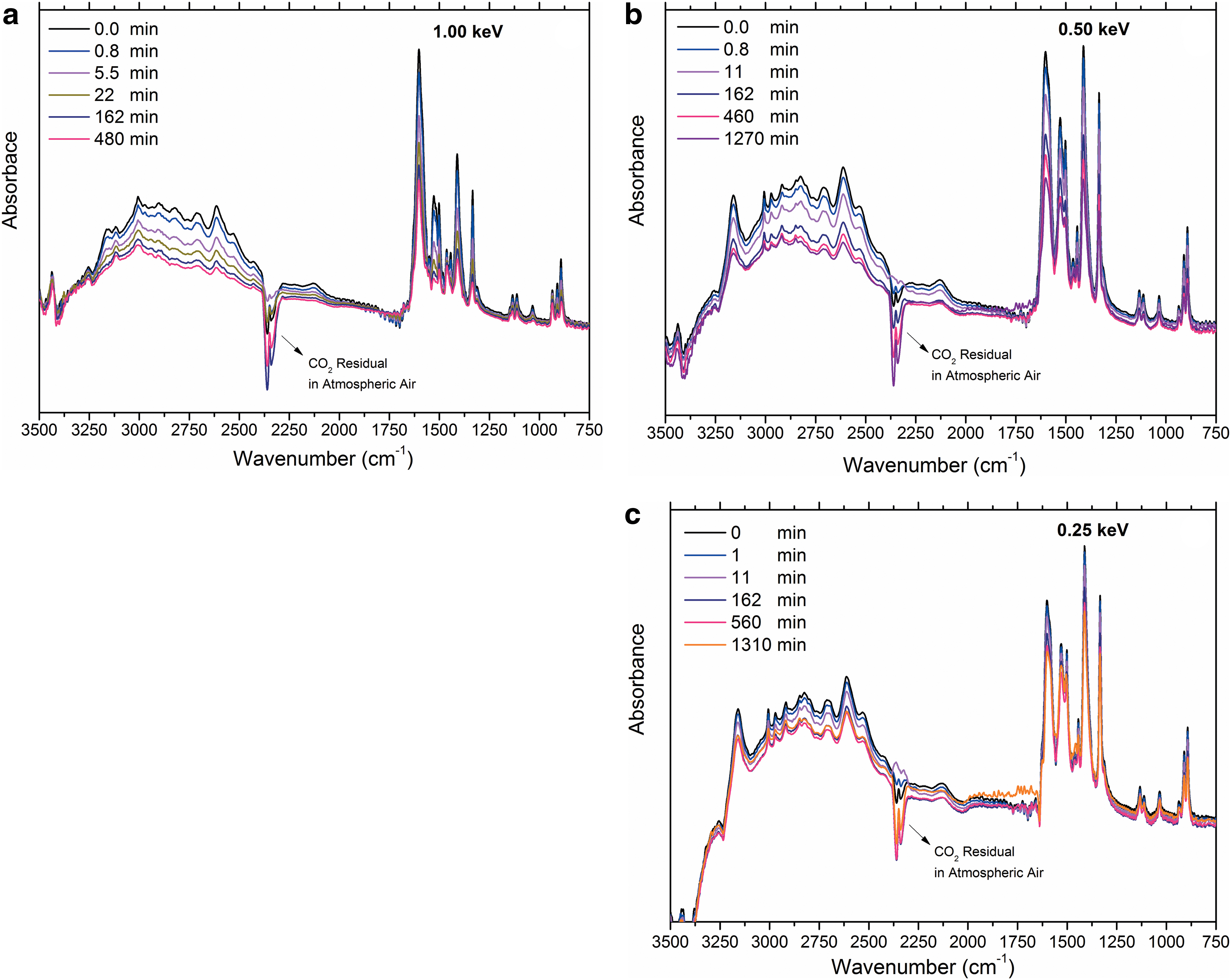
α-Glycine absorbance decay spectra for different electron energies:
3.2. Thickness evolution for α-glycine thick films
α-GLY samples were irradiated with different energies (1.0, 0.5, and 0.25 keV). The study of the absorbance decays (S υ) of the υ-bands 2610, 2124, 1410, and 1333 cm−1 allows to determine an average ratio <S υ/A υ> and, from Eq. 3, the density of the molecular column N(t), for each applied energy.
The initial thicknesses (H 0) are obtained by the absorbance spectral analysis of each target based on the calibration curve presented in Appendix A1. By using Eq. 4 for each beam energy, the evolution of the target thickness, H(t), is obtained (Fig. 4a–c). For all energies and according to Eq. 5, the behavior of the H(t) is initially dominated by an exponential decrease, and later, by a linear decrease. Equation 5 was used to adjust the experimental points of the graphs in Fig. 4; the obtained fitting parameters are displayed in Table 1.
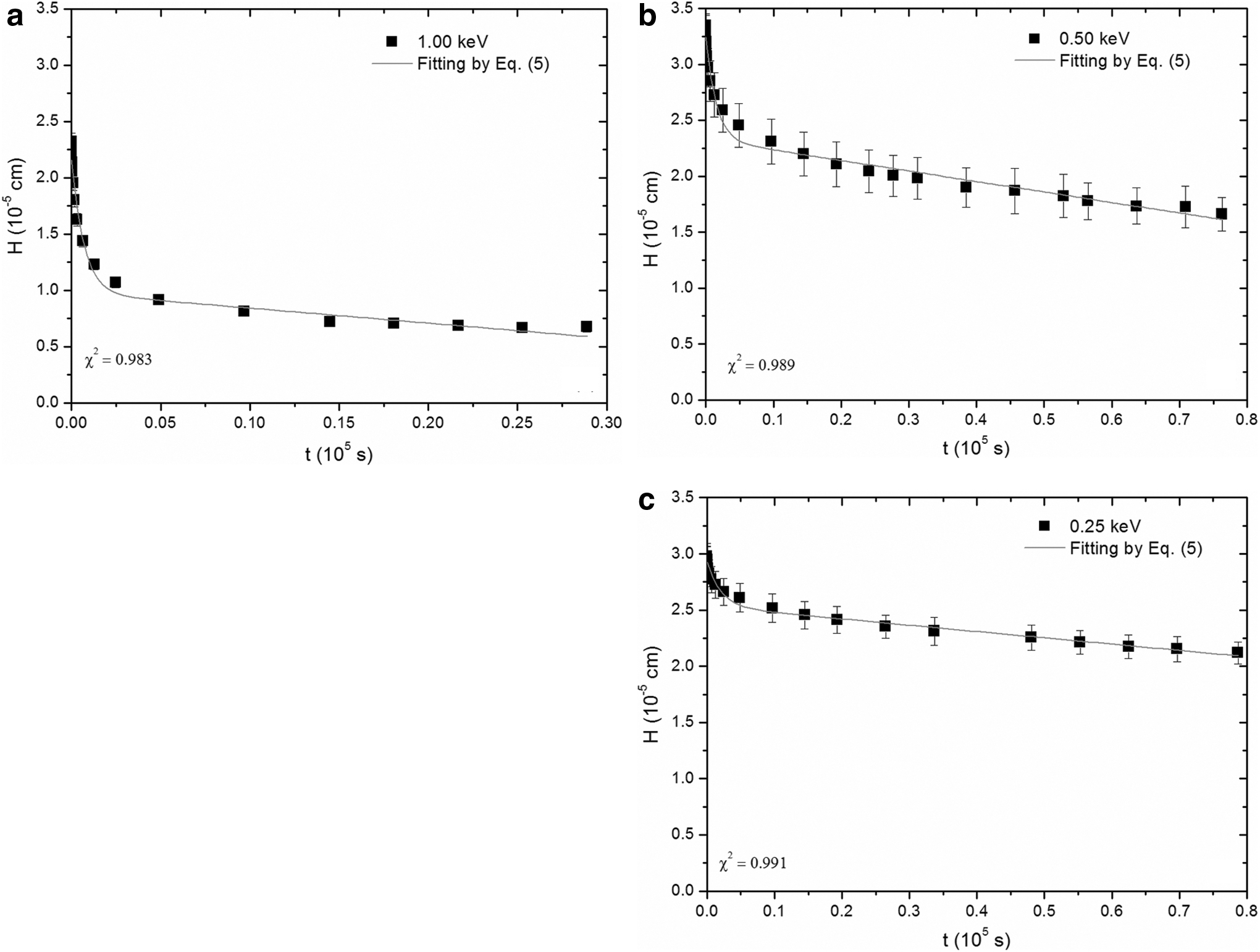
Thickness evolution in time for irradiation process with energy of:
Total Film Thickness (H 0), Initial Thickness for the Transient Mode (H 1), and Initial Thickness for the Stationary Mode (H 2), As Well As the Transient (α) and Stationary (β) Decay Rates
3.3. Processing velocities for α-glycine thick films
By calculating the derivative of the function H(t) in relation to time, and using the V 0 and V st parameters, the α-GLY processing velocity given by Eq. 6 is presented in Fig. 5 as a function of time for each studied energy. Figure 6 presents the dependence of V 0 and V st on projectile energy; it turns out that, for both, velocities are governed by Power laws, but not with the same exponents:
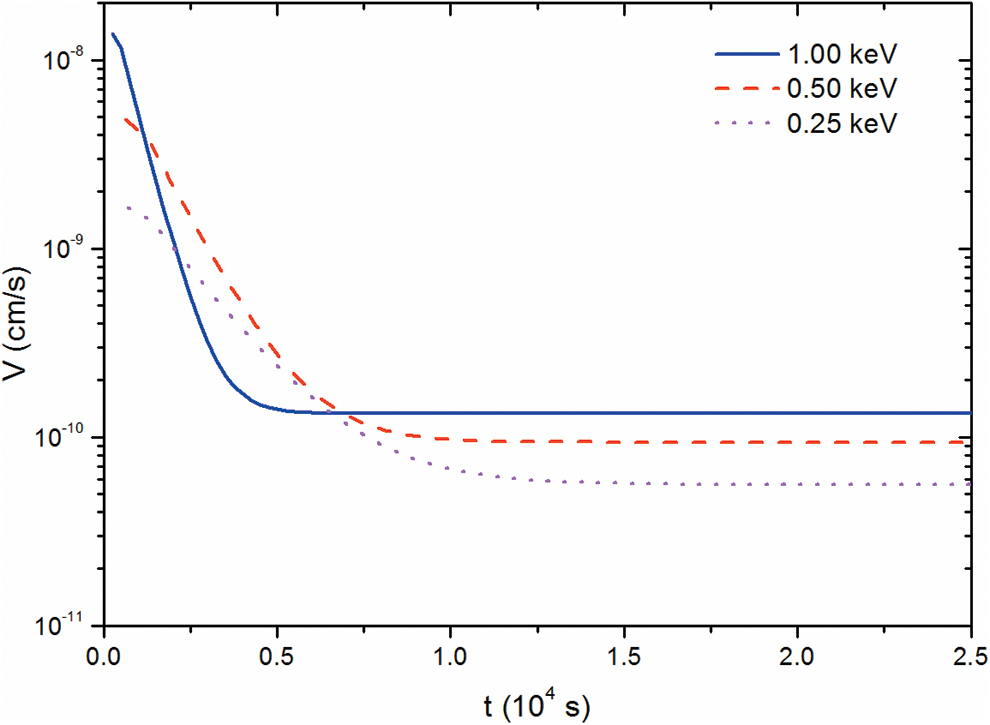
Processing velocities evolution in time during the irradiation process for energy of 1.0 keV (solid line); 0.5 keV (dash line); 0.25 keV (dot line). Color images are available online.

Initial and stationary velocities as a function of energy. Color images are available online.
Table 2 presents the V 0 and V st values obtained for each electron beam energy.
Initial (V 0) and Stationary (V st) Velocities for Each Electron Energy
3.4. Decay rates
The transient (α) and stationary (β) decay rates for each electron beam energy are shown in Table 1. From Figure 7, one observe that both decay rates as a function of electron energy also follow a Power Law:
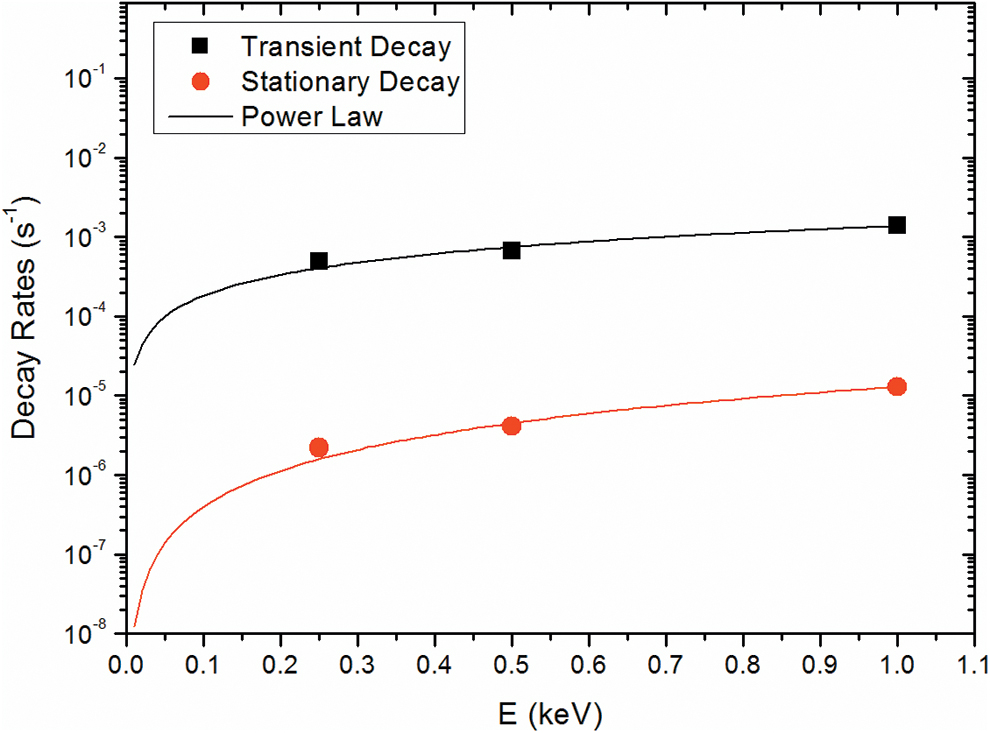
Transient and stationary decay rates as a function of energy. Color images are available online.
4. Discussion
The sample thicknesses evolution in time have presented an excellent agreement of theoretical fitting to the experimental points in all situations, as demonstrated by the χ 2-values pointed out in the respective graphics of Fig. 4. Note that H 0 ≈ H 1 + H 2 (Table 1). The discrepancy between the expected values of H0 and those provided by the sum of H 1 and H 2 (Table 1) varies from 3% to 5%, depending on the film analyzed. This result corroborates the agreement of the proposed model to the experimental data. Moreover, for the same procedure, it is verified that the higher is the electron beam energy, the deeper is the electron penetration at the same fluence, as expected.
Note that both the initial and the stationary processing velocities increase as the energy of the incident electrons increases; The maximum value of the processing velocity at the beginning of the irradiation has presented a dependence on energy as E 1.6. When the steady state is reached, the processing velocity starts responding with E 0.6. This is reflected in the order of magnitude of these two parameters. Observe that V st is about two orders of magnitude less than V 0.
Finally, related to the decay rates, both increase with beam energy, but, for the same energy, in the transient stage, radiolysis occurs more quickly than in the stationary phase. Although the parameter β responds more significantly as the beam energy increases, as it is proportional to E 1.5, whereas the parameter α follows E 0.9.
5. Astrophysical Implications
Erosion at atmospheric-less surfaces by SW is a complex phenomenon. The surface material varies according to the object (e.g., comets, asteroids, interplanetary grains, particle sizes), and the SW itself is constituted by electrons and different ionic species (in particular H+, He+, C+, O+, and Fe+), with energies from eV to MeV and with anisotropic fluxes varying in time and location (Bennett et al., 2013). Moreover, the surface material characteristics depend on several factors such as temperature, roughness, composition, and profile distribution; solar electromagnetic radiation, micrometeorite impact, and local process (e.g., volcanic and nuclear decay) also participate in space weathering and may compete with SW in altering the surface.
The scope here is to analyze the relevance of the erosion caused by eV–keV solar electrons associated with space weathering; for this, a description of the process is needed. Approximations are necessary for extracting the erosion rate order of magnitude from laboratory measurements. The restrictions on the sample material (irradiated in laboratory) are: organic compound (composed typically by H, C, N, and O) in solid phase, flat and uniform surface, with no material accretion process on the sample surface. To irradiate samples at low temperature (10–150 K) would preferable, in the sense that those are usually the interplanetary conditions; however, the current experiments were carried out at room temperature, condition found in surfaces of astrophysical bodies near Earth's orbit. The restrictions on the ionizing radiation are: constituted by eV–keV electrons (according to the SW energy density profile), oblique incidence, and constant flux.
To predict V st for SW electrons (at 1 AU) impinging on light organics exposed on solid surfaces, a simulation of a sample formed by a mixture of five common amino acids was performed; the relevant parameters of these constituents are displayed in Table 3. Considering a mixture having the same number of molecules of each amino acid, the average <M/ρ 0> = 86.8 cm3 and the average molecular volume <η> = <M/ρ 0> N A −1 = 1.44 × 10⁻²² cm3 are calculated.
Molecular Weights (M), Densities (ρ 0), and the Ratio M/ρ 0 for Five Amino Acids
The SW electron population is classified into four classes according to the typical electron energy distribution in SW (Louarn et al., 2009). The mean SW electron flux and the mean energy for each of these electron population energy intervals are given in Table 4. Based on Eqs. 7b and 8b, estimations for the β and V st values for each electron energy range in the SW (Table 4) are made. Furthermore, the average stationary velocity for solar electrons is determined by:
Energy Range According to the Solar Electron Population
The average of the energy (<E>), the average of electron flux (<ϕ(E)>), and the calculations for β(E) and V st(E) are listed.

For the SW electrons, the total mean flux <ϕ>total = Σ Γ <ϕ(E)> and the total mean energy <E>total = Σ Γ <E>, where Γ is the percentage of each electron population in the SW (Table 4). Through Eq. 9, the value for the average stationary velocity considering solar electrons is about <V st (SW)> ≈ 1.1 × 10⁻¹¹ cm/s = 3.5 μm/year. Similar result could be obtained by Eq. 7b applying E = <E>total = 16 eV (Table 4).
The processing caused by the SW degrades organic material on the surface of some interplanetary objects, such as grains, asteroids, or unprotected moons, creating a solid residue in their surfaces. As a consequence of these by-products, their albedo may change drastically (Chapman, 2004; Clark et al., 2002). To determine the electron SW sputtering yields of organic materials from the exposed surfaces of astrophysical bodies in the vicinity of Earth (≈1 AU), typical thicknesses processed by the solar electrons need to be estimated. Considering the proposed modeling in Section 2.2:
where H
1(SW) is the thickness of the transient stage and H
2(SW) of the stationary stage of the treated material by these solar electrons. They are determined by:
The values <V 0(SW)> = 3.8 × 10⁻¹¹ cm/s, <α(SW)> = 4 × 10⁻⁵ s−1, and <β(SW)> = 2.4 × 10⁻⁸ s−1 are obtained from Eqs. 7a, 8a, and 8b, respectively, assuming once again E = 16 eV (from Table 4). As a result, the average thickness penetrated by solar electrons in organic materials is estimated to be H 0(SW) = 5 μm. He ions with energy of 4 keV bombarding on lunar soil (basalt material) indicated that the erosion process is compatible with an average depth ≈20 μm for normal SW incidence (McDonnell and Flavill, 1974).
The sputtering process of the lunar soil by solar ions is predicted to have, as upper limit, the erosion rate of 3 × 10⁻² Å/year (Morrison and Zinner, 1977); furthermore, McDonnell and Flavill (1974) have indicated an average erosion rate of 4.3 × 10⁻² Å/year as a function of the lunar surface orientation related to the SW direction (0°–60°). Comparing both ion erosion rates of the lunar soil with 3.5 × 10⁴ Å/year predicted by the current calculation, they are 106 lower than the electron erosion rates for organic materials. Moreover, in addition to the fact that different materials have been treated, there is also an estimation that almost 50% of the pulverized material removed from the lunar soil is not able to escape from a crater, being redeposited locally (Carey and McDonnell, 1976; Robinson et al., 2001). Thus, the in loco accreted material (regolith) tends to diminish significantly the efficiency of the solar ion erosive process (Flavill et al., 1980).
The optical properties of asteroids are quite dependent on their surface sputter processes (Flavill et al., 1980; Chapman, 2004; Clark et al., 2002). Near-global normal albedo maps of asteroid (101955) Bennu were recently obtained from OSIRIS-Rex spacecraft database (Bennett et al., 2021; Golish et al., 2021). Asteroids are typically located at ≈2.8 AU; their erosion process by the SW strongly depends on the heliocentric distance and on their degree of rotation (Flavill et al., 1980). In this case, based on the lunar soil sputter results, the average ion erosion rate for asteroids was estimated to be 5 × 10⁻³ Å/year (Flavill et al., 1980), which is 107 orders of magnitude less in relation to the organic material case treated by the solar electrons directly, around 1 AU. The strong differences between these erosion rates could be related to both the asteroids' regolith sputter reprocessing and their SS placement.
Finally, since the erosion SW exposure ages of SS bodies is estimated to be 104–105 years (Morrison and Zinner, 1977), by considering the sputter rate of organic materials promoted by solar electrons, and taking into account that the mean column density of organic compounds could be obtained by the ratio of H 0(SW)/<η>, one can estimate that solar electrons eject about 6.4 × 10¹³ organic molecules per cm2 per year on a given solid surface devoid of any protection. However, by considering shielding layers of centimeter depths (or higher), the half-lives of organic compounds would increase significantly (Cooper et al., 2001; Kminek and Bada, 2006; Maté et al., 2015), and, consequently, the sputter rates of organic materials must slow down, in such cases.
6. Conclusions
The study of α-GLY depletion as a function electron beam energies in the range of 0.25 up to 1.0 keV shows that radiolysis/sputtering processes of α-GLY thick films by keV electrons are ruled by two mechanisms: transient and stationary processing modes. In the transient mode, the integrated absorbance decreasing on fluence is characterized by the exponential decay (radiolysis dominates on sputtering), whereas in the stationary one, a linear decreasing behavior is observed (sputter and radiolysis rates are equal).
The α-GLY processing velocities profile is predicted as a function of the electron energy, considering a beam flux of ≈3 × 10¹³ electrons cm−2·s−1. At the beginning of the radiolysis process, the α-GLY dissociative rate is high (≈10−8 cm/s for 1.00 keV; ≈10−9 cm/s for 0.50 and 0.25 keV); the decay velocity decreases until attaining a constant value, which is its stationary velocity. These constant stationary velocities (from ≈1.0 × 10⁻¹⁰ to ≈6 × 10⁻¹¹ cm/s, according to the projectile energy) have an E 0.6 dependence on electron energy.
The decay rate of the transient stage is greater than that observed at the stationary phase. The transient decay rate dependence is almost linear with energy (E 0.9), whereas the stationary decay rate varies with E 1.5.
Finally, as an astrophysical insight, the typical solar electron erosion rate for organic materials, with no surface protected layers in space, is estimated to be 3.5 μm/year at ≈1 AU. Further calculations, considering more realistic extraterrestrial samples, as for instance, glycine embedded in a silicate and recovered by an icy layer, may be carried out to follow the chemical evolution of the irradiated material. Moreover, since there are several natural phenomena on the airless bodies that compete directly with the processed materials by SW, and these competing effects are not included in the simulations, our model predictions are setting as an upper limit on what can happen with SW only.
Footnotes
Acknowledgments
We are grateful to the technical staff of the Van de Graaff Laboratory for the whole support given during the experiment procedures.
Author Disclosure Statement
No competing financial interests exist.
Funding Information
The study was partially funded by the following government agencies: Fundação de Amparo à Pesquisa do Estado do Rio de Janeiro - FAPERJ (E-26/201.769/2017); Conselho Nacional de Desenvolvimento Científico e Tecnológico - CNPq (PDS No. 118349/2017-1); and Coordenação de Aperfeiçoamento de Pessoal de Nível Superior – Brasil (CAPES) – Finance Code 001.
Abbreviations Used
Appendix
Associate Editor: Christopher McKay