




Abstract
The search for organic matter on Mars is one of the major objectives of Mars exploration. However, limited detection of organic signals by Mars rovers to date demands further investigation on this topic. The Curiosity rover recently discovered numerous nodules in Gale Crater on Mars. These nodules have been considered to precipitate in the neutral-to-alkaline and saline diagenetic fluids and could be beneficial for organic preservation. Here, we examine this possibility by studying the carbonate nodules in the western Qaidam Basin, NW China, one of the terrestrial analog sites for Mars. Fourier transform infrared spectra of the carbonate nodules reveal that the aliphatic and aromatic molecules can be readily preserved inside nodules in Mars-like environments. The chain-branching index of the Qaidam nodules suggests that the diagenetic fluids where nodules precipitated were able to support diverse microbial communities that could vary with the water salinity. Findings of this study provide new perspectives on the astrobiological significance of nodules in Gale Crater and the further detection of organic matter on Mars.
Introduction
The search for biosignatures on Mars is one of the principal objectives of Mars exploration. However, limited distribution of organic matter reported on martian surfaces makes it elusive (Leshin et al., 2013; Ming et al., 2014; Eigenbrode et al., 2018). It has been proposed that the extreme conditions at the martian surface, including oxidizing salts and strong UV radiation, could destroy any present organic matter even in an otherwise potentially habitable fluvio-lacustrine environment, such as that of Gale Crater (Ming et al., 2014). Notably, early-diagenetic nodules could provide better preservation for organic compounds as compared to the host rocks due to early lithification of the weather-resistant structures (McCoy, 2014; McCoy et al., 2015; Loyd, 2017; Grice et al., 2019). Until now, the diagenetic nodules have been identified on several martian terrains, such as Gale Crater, Endeavor Crater, and Meridiani Planum (McLennan et al., 2005; Grotzinger et al., 2014; Stack et al., 2014).
Although certain nodules (e.g., hematite at Meridiani Planum) indicative of past acid fluids are probably not beneficial for the preservation of organic matter (Sumner, 2004), those in Gale Crater formed in more neutral pore waters have a promising potential for organic matter preservation (Stack et al., 2014; Sun et al., 2018; Rapin et al., 2019). In particular, nodules at Yellowknife Bay have been proposed to originate from halogen-bearing alkaline-neutral pH pore waters; the mixing of syndepositional pore waters with different salinity could induce nodule precipitation and trigger the diagenetic cracks in the unconsolidated or consolidated Sheepbed mudstones under the process of surface desiccation (Grotzinger et al., 2014; Stack et al., 2014; Wiens et al., 2017). Elemental and mineralogical data suggest that the Sheepbed solid nodules probably contained evaporitic, Fe-bearing, and clay minerals (Grotzinger et al., 2014; McLennan et al., 2014; Vaniman et al., 2014). It has been recently revealed that up to 273 ppm of organic carbon was preserved in the Sheepbed lacustrine mudstones with abundant nodular textures, though the organic source remains under debate (Stern et al., 2022). Apart from the Sheepbed nodules, several nodule assemblages have also been found in younger strata such as that of the Murray formation in Gale Crater (Stein et al., 2018; Sun et al., 2018; Rapin et al., 2019; Bennett et al., 2021). These nodule assemblages are inferred to be related to diagenetic precipitation from neutral-to-alkaline and saline fluids in arid environments (Stein et al., 2018; Rapin et al., 2019), which were promising in regard to organic preservation.
Previous studies have reported nodules in marine settings or terrestrial freshwater systems on Earth, which suggests the involvement of biological processes during the formation of nodules and the entombment of organic remains therein (Freytet, 1973; Raiswell and Fisher, 2000; Alonso-Zarza and Wright, 2010; Loyd et al., 2012; Weber et al., 2012; Lengger et al., 2017; Grice et al., 2019; Plet et al., 2020). However, few studies have investigated nodules from saline lacustrine environments (Park, 1995; Yoshida et al., 2021); thus their biological activities and organic biosignatures remain largely unconstrained. Investigations on terrestrial playa nodules are thus of great interest and will help elucidate the astrobiological significance of nodules in Gale Crater on Mars.
The western Qaidam Basin, which is located in the north of Tibetan Plateau in NW China, is one of the world's largest and driest deserts with an average elevation of ∼2800 m (Fig. 1a) (Anglés and Li, 2017; Xiao et al., 2017). This region has been subjected to progressive aridification and irradiation since the Pleistocene during the uplift of the Tibetan Plateau and thus has developed various Mars-like geomorphologies, including dunes, yardangs, gullies, alluvial fans, playa deposits, and polygons. The western Qaidam Basin is suitable to simulate the Noachian-Hesperian transition episode on Mars (Liu et al., 2022; Shen et al., 2022), which is an intermediate state between early humid conditions and modern hyperarid environments. The salt deposits and desiccated geomorphological structures that formed at various evolutionary stages of aqueous shrinkage recorded key information of the climate transitions and biological processes (Dang et al., 2018; Lin et al., 2020).

Geological setting of studied area in the western Qaidam Basin. (
In the western Qaidam Basin, massive carbonate nodules were deposited in the foreland basin of Altun Mountain 153–251 kyr ago (Fig. 1b) (Han et al., 2014; Sun et al., 2021). These nodules were preserved in the mid-Pleistocene saline lacustrine sediments and are interpreted to have precipitated from saline diagenetic waters in the arid climate (Sun et al., 2021). As a result, the Qaidam nodules could be analogous to nodules in Gale Crater in several aspects that include (i) the early-diagenetic halogen-rich alkaline-neutral pH fluids that induced nodule precipitation, (ii) the arid climate that facilitated nodule growth, and (iii) the detrital and evaporitic minerals that constituted the nodules. A previous study suggested that neither biogenic carbonates nor microbial structures from the Qaidam nodules (Sun et al., 2021) were positively identified. Therefore, better constraints on organic biosignatures in Qaidam nodules could provide useful insights into the astrobiological significance of nodules in Gale Crater.
In the present study, we analyzed the elemental distributions of Qaidam nodules with micro X-ray fluorescence spectroscopy (μ-XRF) mapping and characterized the chemical characteristics of organic molecules and their spatial distributions in nodules using Fourier transform infrared spectroscopy (FTIR). Our results demonstrate the potential for carbonaceous biosignature preservation and biological processes during the Qaidam nodule growth in a Mars-like transitional environment. Findings of this study provide useful clues for biosignature detection on Mars and the potential for nodules as a target for martian sample return.
Sample description
Carbonate nodules were found within the mid-Pleistocene lacustrine strata in the western Qaidam Basin composed of mudstone, sandstone, and marlstone (Fig. 1b). The mid-Pleistocene saline lakes likely evolved into ephemeral playa lakes during the time of deposition of carbonate nodules, which could provide an early-diagenetic condition conductive to the nodule growth (Han et al., 2014). The evaporation of mid-Pleistocene playa lakes possibly formed cracks in the exposed sediments, with the saline water influx potentially supporting the nodule growth (Sun et al., 2021). It was inferred that continuous evaporation could also lead to a shift in mineral precipitation from carbonate to evaporite minerals during the nodule growth (Fig. 1c–1e). The carbonate nodules sampled in this study outcropped within the mid-Pleistocene strata in the road cuts (38°27'N, 92°9'E) (Fig. 1c, 1d). Regolith as eolian materials and weathering products of lacustrine sediments were also collected for comparison.
The morphology and mineralogy of nodules provide further information on their growth. The carbonate nodules are characterized by spherical or subangular shapes in different sizes that range from a few to a dozen centimeters (Fig. 1c–1e). The cross-sections of these nodules show that they are composed of the inner cores and outer concentric bands with varying colors and textures indicative of accretionary growth (Figs. 2 and 3) (Dana, 1863; Stack et al., 2014). 230Th dating of 153–251 kyr suggests that these nodules were also of mid-Pleistocene age, with a growth duration from 33 to 91 kyr (Sun et al., 2021). The cores and zoned structures were mainly composed of carbonate minerals with minor contributions from quartz, feldspar, and evaporite minerals. Bands with different colors and textures in the zoned structures were previously considered to reflect the variations in crystallinity and porosity (Figs. 2 and 3; Table 1). It has been suggested that there was covariation between the Mn distribution and porosity in the zoned structures, suggesting the fluctuation in salinity of diagenetic fluids (Sun et al., 2021).
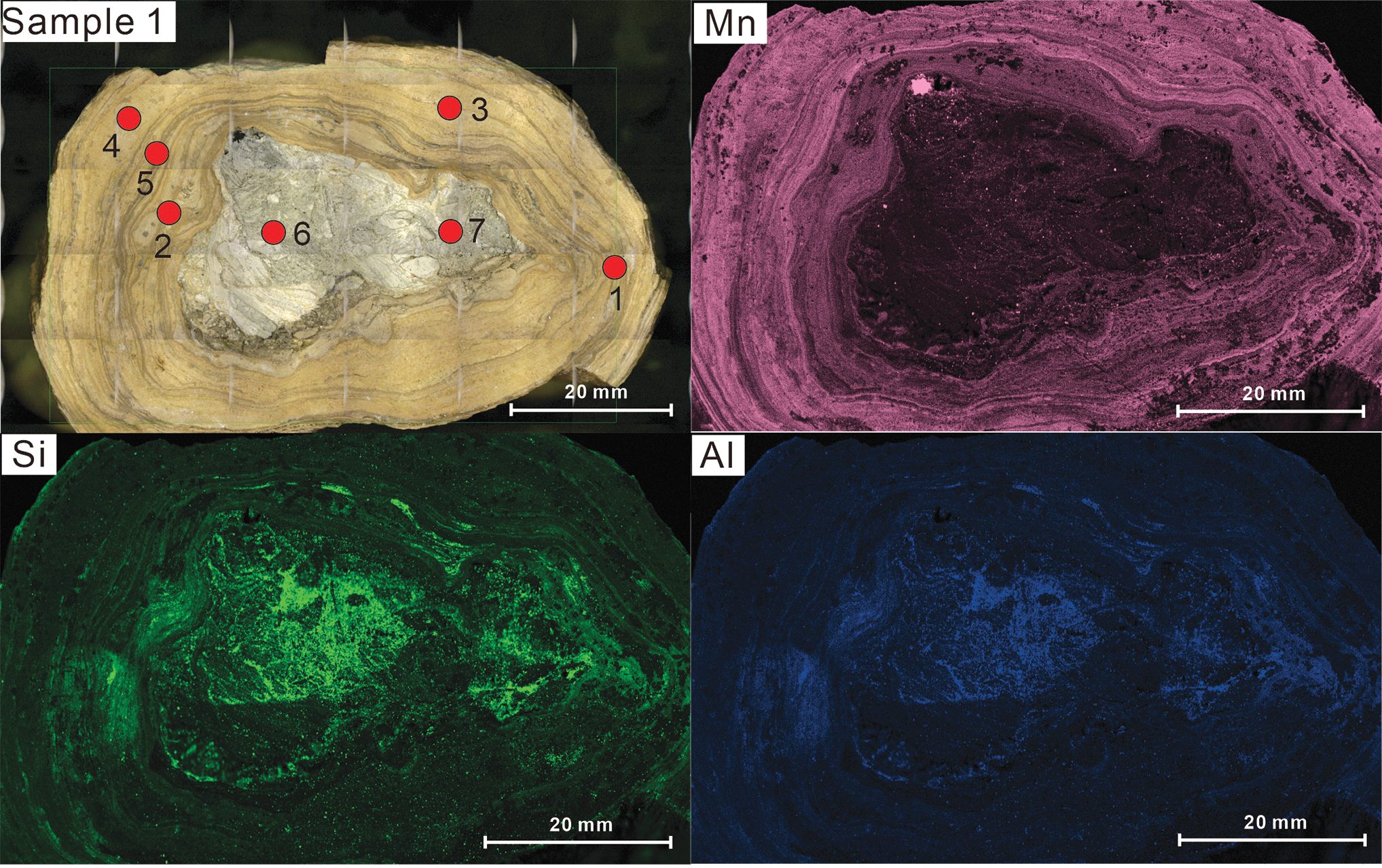
Cross-section of nodule Sample 1. Red dot labels indicate the localities of microdrilling powder samples for FTIR analyses. The samples were named S1-1 to S1-7 in accordance with their respective numbers 1–7 labeled on the cross-section. The mappings of Mn, Si, and Al contents for Sample 1 obtained by μ-XRF are shown alongside.
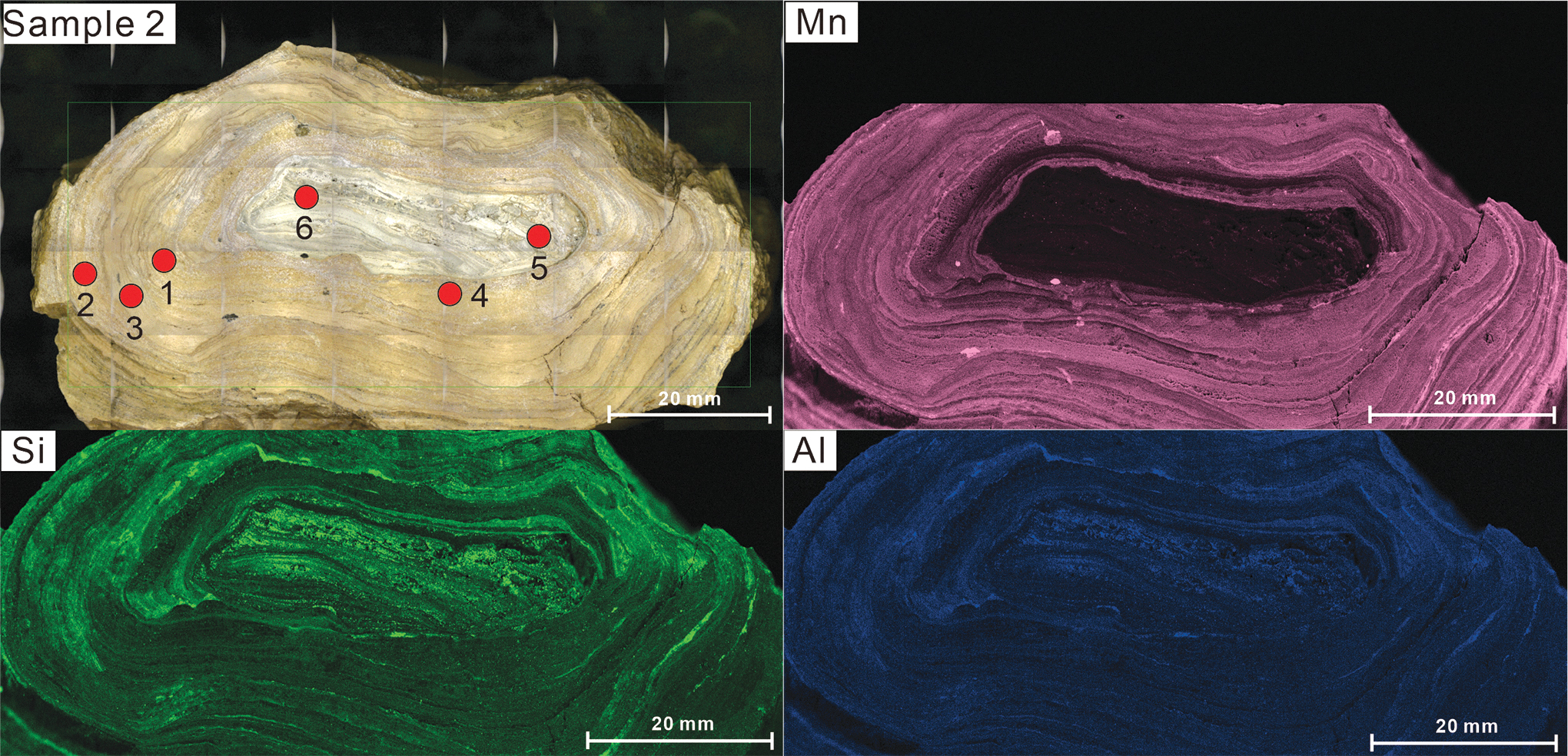
Cross-section of nodule Sample 2. Red dot labels indicate the localities of microdrilling powder samples for FTIR analyses. The samples were named S2-1 to S2-6 in accordance with their respective numbers 1–6 labeled on the cross-section. The mappings of Mn, Si, and Al contents for Sample 2 obtained by μ-XRF are shown alongside.
R3/2 Values, Texture, and Mn Contents of the Samples Obtained from Qaidam Nodules
The classification of bands is based on the Mn content and texture of zoned structures (from Sun et al., 2021). The “Core” and “Band” indicate the inner cores and peripheral bands, respectively, inside the nodules. The bands with compact texture and low Mn contents generally have higher R3/2 values than those with less compact texture and higher Mn contents.
All the experiments were performed at the Institute of Geology and Geophysics, Chinese Academy of Sciences, Beijing, China. To characterize the zoned structures and distributions of detrital minerals, the elemental distributions of cross-sections from two carbonate nodules were analyzed with a Bruker M4 TORNADO plus μ-XRF spectrometer equipped with a Rh X-ray source in the electron microscope laboratory (Figs. 2 and 3). Samples were measured in the chamber at 20 mbar, with a voltage of 50 kV and current of 600 μA. The size and time were 20 μm and 3 ms per pixel, respectively.
The distributions and chemical characteristics of organic matter in nodules were analyzed with a Bruker Vertex 70V FTIR spectrometer in transmission mode in the electron probe and scanning electron microscopy laboratory. Before FTIR analysis, sample powders from the cores and different bands based on the variations of color, texture, and Mn content in the zoned structures were obtained by micro-drilling and milling (Figs. 2 and 3; Table 1). The sample powders were then decarbonated with 3 M HCl overnight, rinsed until pH neutral using deionized water, and dried in an oven. Potassium bromide (KBr) used as a diluent in FTIR analysis was heated in an oven overnight at 110°C to remove the water. The dry KBr grains were then ground to fine powders and mixed with the decarbonated samples to prepare the KBr pellets. FTIR transmission spectra were obtained from the KBr pellets. FTIR spectra of mid-infrared region (wavenumber of 400–4000 cm−1) were collected by 64 scans per sample at the resolution of 4 cm−1.
Results
Micro X-ray fluorescence spectroscopy (μ-XRF) mappings illustrate Mn, Si, and Al distributions in the cores and zoned structures for both carbonate nodules (Figs. 2 and 3; Table 1). The brightness of color in μ-XRF mappings illustrates the abundance of corresponding element. Both nodules represent negligible concentrations of Mn in the cores but high contents of that in the zoned structures. Furthermore, the content of Mn exhibits zoned structures, with generally higher contents in porous bands than those in compact bands, which is consistent with the results from a previous mineralogical study of the nodules (Sun et al., 2021). The contents of Si and Al, however, do not show obvious zoned structures, with variations probably due to the porosity within zoned structures (Sun et al., 2021).
Fourier transform infrared spectroscopy (FTIR) has been commonly applied to trace carbonaceous materials and further distinguish chemical properties by identifying specific peaks in the IR spectral absorbance induced by various vibrational modes of functional groups in the organic molecules (e.g., Marshall et al., 2005; Igisu et al., 2009, 2012). All the FTIR spectra from nodules, except for the surface regolith, are characterized by the absorbance bands in the region of 2800–3000 cm−1 assigned to the stretching vibrations of aliphatic C − H bonds, and those at approximately 1600 cm−1 assigned to the stretching vibrations of unsaturated C = C bonds in aromatic bands (Fig. 4a). Apart from the aliphatic- and aromatic-induced bands, there are no explicit bands assigned to the vibrational modes of other organic functional groups in the FTIR spectra.
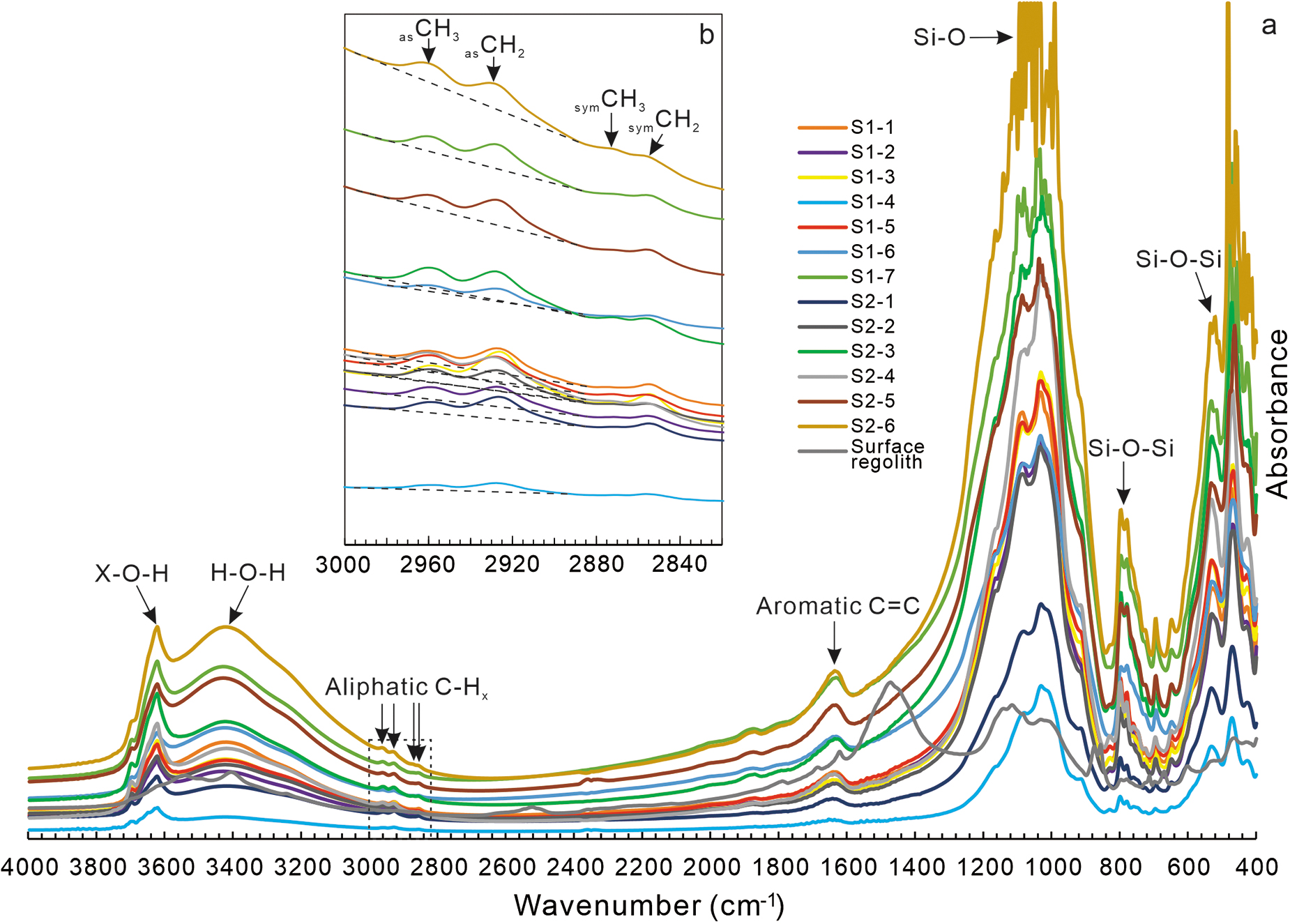
FTIR spectra of decarbonated Qaidam nodules and surface regolith. (
The specific peaks derived from aliphatic vibrations provide further details of chemical composition of carbonaceous materials (Figs. 4b and 5). The bands at 2850 and 2925 cm−1 are designated to symmetric and asymmetric C − H stretching vibrations, respectively, in aliphatic chain-methylene CH2, and those bands at 2870 and 2960 cm−1 are respectively assigned to symmetric and asymmetric C − H stretching vibrations in aliphatic end-methyl CH3 (Fig. 4b) (Bellamy, 1954; Igisu et al., 2009, 2012; Chen et al., 2015; Hickman-Lewis et al., 2020). All the spectra have been normalized by linear baseline in the region of 2890–3000 cm−1 to obtain the relative intensity of aliphatic bands (Fig. 4b). The intensity ratio of peak at 2960 cm−1 versus that at 2925 cm−1, hereafter denoted as R3/2, can be used to describe the branching index of carbon chains. The R3/2 is suggested to be an empirical parameter with its own range in different domains of life including archaea, bacteria, and eukaryotes (Marshall et al., 2005; Igisu et al., 2009, 2012; Qu et al., 2015, 2017).
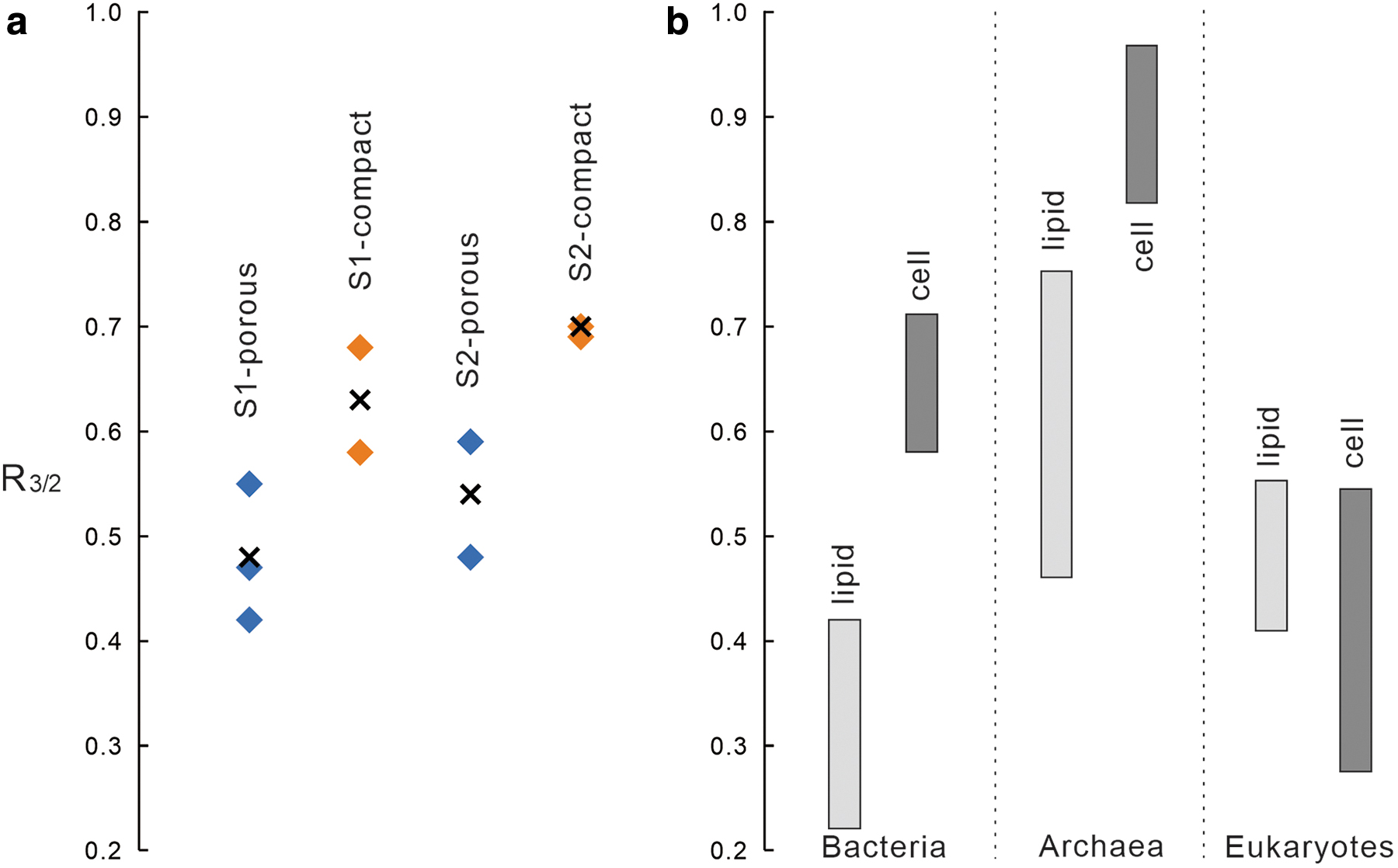
The R3/2 values of two carbonate nodule samples range 0.42–0.77, with similar mean values between their cores (average S1: 0.55, S2: 0.64) and zoned structures (average S1: 0.54, S2: 0.62). However, within the zoned structures of both nodules, the R3/2 values systematically increase from lower values (average S1: 0.48, S2: 0.54) in the porous Mn-rich bands to distinctively higher values (average S1: 0.63, S2: 0.70) in the compact Mn-depleted bands (Figs. 4 and 5; Table 1).
In addition to the organic signatures, the FTIR spectra also record the bond-vibrations of various functional groups from minerals (Fig. 4a). The distinct IR bands at 900–1200 cm−1 containing a group of subpeaks reveal vibrations of Al-O-Si bonds in the clay minerals and Si-O-Si bonds in the silicate minerals (Tanykova et al., 2021). Several distinct peaks at 430–800 cm−1 identified in all nodules are assigned to the vibrations of Si-O-Si bonds from siliceous minerals. The broad band at ∼3400 cm−1 is caused by the O-H stretching mode in the mineral matrix, while the sharp peak at ∼3600 cm−1 within the broad band derives from the O-H stretching vibration (Fig. 4a) (Aines and Rossman, 1984; Rehman and Bonfield, 1997; Elliott, 2002). The IR spectra from these nodules are consistent with a previous study (Sun et al., 2021), which revealed that the mineralogical components consisted of carbonate, quartz, feldspar, and clay minerals (including kaolinite, chlorite, and illite).
Origin of the carbonaceous materials in the Qaidam nodules
The prominent aliphatic stretching bands distributing at 2800–3000 cm−1 and aromatic ring stretching bands at ∼1600 cm−1 of all the decarbonated nodule samples suggest the preservation of organic matter throughout the Qaidam nodules (Fig. 4a). Similar absorbance bands in other IR spectra assigned to aliphatic and aromatic vibrational modes have been reported from other decarbonated sedimentary samples in previous studies (Chen et al., 2015; Tanykova et al., 2021), although the bands at ∼1400 cm−1 and ∼876 cm−1, respectively, could be overlapped by other bands in the range of 600–1200 cm−1, due to the coexisting clay and silicate minerals (Fig. 4a). The prominent aliphatic- and aromatic-induced bands imply the preservation of lipid and aromatic compounds in the sedimentary rocks possibly due to better resistance to the postdepositional alterations (Hayes et al., 1983; Fraser et al., 2014; Jardine et al., 2015). Consequently, the ability of quick screening the organic remains by identifying their specific spectra enables the FTIR spectrometer to be a prospective scientific instrument for astrobiological investigations.
Since the carbonate nodules are intact without visible veining (Figs. 2 and 3), the carbonaceous materials in the nodules were very likely derived from the original organic matter that accumulated during the nodule formation. Also, it is unlikely that the carbonaceous materials in the zoned structures were mainly sourced from the detrital organic matter, as the distributions of Si and Al contents indicative of detrital minerals do not show obvious zoned structures as that of R3/2 (Figs. 2, 3, and 5) (Sun et al., 2021). Besides, it is unlikely that the majority of carbonaceous materials are related to the organics from the primary lacustrine sediments, as the allochthonous source is difficult to coordinate with rhythmic R3/2 shifts in the Qaidam nodules (Figs. 1 and 5). In addition, abiotic sources are also unlikely because the nodule field was far from hydrothermal settings and meteorite impact craters where organic matter can be synthesized abiotically (Fig. 1b). Abiotic organic matter produced by hydrothermal Fischer-Tropsch-type reactions could have several orders of magnitude more long-chain hydrocarbons than short-chain hydrocarbons, which is inconsistent with the R3/2 values of the studied samples (Figs. 4 and 5) (McCollom and Seewald, 2006). Furthermore, the rhythmic variations of R3/2 ratios among different nodule bands rule out the possibility of abiotic stochastic processes such as meteorites (Fig. 5a; Table 1). Taken together, the organic matter preserved inside nodules was thus mainly sourced from in situ biogenic materials, that is, microorganisms inhabiting the diagenetic brines. The FTIR spectra suggest that the saline fluids where Qaidam nodules precipitated were habitable and that the aliphatic and aromatic moieties can be preserved inside the carbonate nodules during geological history in the hyperarid and strong-radiative environments (Fig. 4) (Ehlmann and Edwards, 2014; Grotzinger et al., 2014).
Biosignatures preserved in the Qaidam nodules
The R3/2 ratio yielded by FTIR has been advocated as an efficient parameter to distinguish biosignatures from different domains of life, since bacteria, archaea, and eukaryotes have dissimilar cyto-architectures with quite different compounds in their cellular organelles and membranes (Atlas, 1988; Albers and Meyer, 2011; Qu et al., 2018). The carbon chains of archaeal membrane lipids are more branched as described by notably higher R3/2 values than those of the bacterial membrane lipids (Fig. 5b) (Igisu et al., 2009, 2012). Also, the R3/2 ranges of the whole cells of Bacteria and Archaea domains represent positive correlations to those of their respective membrane lipids, although R3/2 values vary slightly among different cellular organelles (Fig. 5b) (Igisu et al., 2009, 2012). As for eukaryotic cells, the R3/2 values are relatively unascertained and could partly overlap with those of bacterial cells (Fig. 5b) (Igisu et al., 2009, 2012). In previous studies, carbonaceous biosignatures, described by the IR parameter R3/2, have been proved to be an overlapping of primary biological and secondary geological signals recording the molecular structural characteristics from precursor organisms that experienced preferential preservation during postdepositional processes, such as diagenesis and metamorphism (Lis et al., 2005; Igisu et al., 2009; Qu et al., 2019). In consequence, aliphatic chemistry in sedimentary rocks can be applied for taxonomic classification to some extent.
As shown in Fig. 5a, the wide range of R3/2 in the zoned structures possibly hints at the coexistence of different domains of microbial consortia. This is consistent with previous studies, which have revealed diverse microbial communities including archaea, bacteria, and eukaryotes inhabiting in brines or saline sediments (Gunde-Cimerman et al., 2009; Ghai et al., 2011; Fernández et al., 2014; Mani et al., 2020). Porous Mn-rich bands show systematic lower R3/2 values than those compact Mn-depleted bands in both carbonate nodules (Table 1). The R3/2 values in the range from 0.42 to 0.59 with an average of 0.5 from porous bands are likely caused by a symbiosis of archaeal and bacterial assemblages or probable eukaryotic precursors (Figs. 5 and 6). The R3/2 values ranging between 0.58 and 0.7 with an average of 0.66 from compact bands imply the coexistence of archaea and bacteria as well, but the generally higher R3/2 values with points concentrating around 0.7 suggest a probable higher proportion of archaeal membrane lipids (Figs. 5 and 6) (Igisu et al., 2009, 2012). Hence, the variation of R3/2 in the zoned structures reflects the fluctuation of microbial communities feeding back to pore water dynamics. The relative abundance of archaeal communities was higher in less salty diagenetic fluids than in salty diagenetic fluids (Figs. 5 and 6; Table 1) (Sun et al., 2021), which is consistent with the observation in other saline sediments (Mani et al., 2020). Besides, the R3/2 values of nodule cores ranging from 0.48 to 0.77 with an average of 0.59 suggest that archaea-involved microbial consortia once inhabited the mid-Pleistocene lacustrine environments (Figs. 4–6; Table 1).

Schematic diagrams of microbial consortia inhabiting the diagenetic fluids and the carbonaceous biosignature preserved in Qaidam nodules detected by FTIR spectrometer. The chemistry of pore waters is inferred from the mineralogy of Qaidam nodules indicated by a previous study (Sun et al., 2021). (
In sum, this study suggests that the saline fluids where Qaidam nodules precipitated were inhabitable to diverse microbial communities and that the microbial community structure alternated with the pore water salinity. The carbonaceous biosignatures, especially those relevant to the aliphatic and aromatic molecules, were well preserved inside the Qaidam nodules, even though the nodules were exposed to Mars-like conditions after their formation.
The nodules in Gale Crater precipitated from the ancient halogen-rich alkaline-neutral pH diagenetic fluids, similar to the formation of Qaidam nodules (Stack et al., 2014; Sun et al., 2018, 2021; Rapin et al., 2019). These nodules contain detrital and evaporite minerals analogous to Qaidam nodules, even though they could contain higher contents of iron-bearing minerals probably due to the alteration of martian basaltic detrital minerals (Grotzinger et al., 2014; Stack et al., 2014; Vaniman et al., 2014; Wiens et al., 2017; Sun et al., 2021). Our FTIR data of the Qaidam nodules suggest that the saline pore waters where nodules precipitated were habitable for microorganisms and that the resultant organic matter can be well preserved inside the weather-resistant nodules in Mars-like extreme environments. It is reasonable to speculate that the diagenetic fluids that formed the nodules in Gale Crater during the Early Hesperian epoch could have been habitable as well (Ehlmann and Edwards, 2014; Stack et al., 2014; Bishop, 2018). After precipitation, the nodules could have been subjected to extreme cold and dry climate, as well as intense radiation on the martian surface (Ehlmann and Edwards, 2014; Grotzinger et al., 2014). Although the martian surface is currently inhospitable, our results suggest that carbonaceous biosignatures (e.g., the aliphatic and aromatic moieties potentially formed on ancient Mars) could have been permineralized and preserved inside the early-diagenetic nodules in Gale Crater.
Bacteria and archaea are considered as the most adaptable martian life-forms, if life ever evolved on Mars (Oren, 2014). Though there is no explicit identification of life on Mars, indigenous martian organics were detected from the sedimentary mudstones in Gale Crater, including those laden with nodules (Ming et al., 2014; Freissinet et al., 2015; Eigenbrode et al., 2018; Stern et al., 2022). Methylated remnants of larger organic molecules (dichloroalkanes and chlorobenzene) and organic sulfur compounds (thiophenes) have been reported, yet their sources (nodule or original sediments, endogeneity or exogeneity, abiotic or biotic derivations) remained debated. FTIR can scrutinize aliphatic, aromatic, and sulfur-containing functional groups at different spatial scales (Tang et al., 2021; Tanykova et al., 2021); thus it can be used to characterize the content, distribution, and chemical composition of organic matter in soils and rocks, which would be significant for our understanding of the origin of organic molecules on Mars (Bosak et al., 2021). A FTIR miniaturized spectrometer has been developed (Saggin et al., 2007), and it is promising that such an implement will be loaded onto future Mars rovers with the intent to uncover more findings with regard to life detection on Mars (Anderson et al., 2005; Gordon and Sephton, 2016).
Conclusions
We investigated the chemical characteristics of organic matter and their spatial distributions that correspond to the sedimentary structures in the Qaidam nodules. FTIR analysis revealed the preservation of aliphatic and aromatic molecules inside nodules in Mars-analog environments. The chain-branching index of the Qaidam nodules suggests that diverse precursors of microbial communities coexisted in the diagenetic fluids and fed back to the perturbations of salinity. This study provides implications for the detection of carbonaceous biosignatures in the nodules of Gale Crater on Mars and the effective vibrational spectral analysis based on the in situ FTIR method.
Footnotes
Acknowledgments
We thank Wensi Zhang for his assistance in the fieldwork and Xiaoguang Li and Xu Tang for their help in the lab.
Authorship Contribution Statement
Yan Chen and Wei Lin conceived the project, designed the experiments, interpreted the data, and wrote the manuscript with contributions from all authors. Yan Chen and Li Liu performed sampling in the field and measurement in the lab. Yu Sun and Yuangao Qu contributed to the result interpretation. Jianxun Shen and Yongxin Pan contributed to data interpretation and manuscript proofreading. All authors read and approved the final manuscript.
Author Disclosure Statement
The authors declare that they have no conflict of interest.
Funding Information
This research was supported by the National Natural Science Foundation of China (NSFC) Grants 41621004 and 42102341, the Strategic Priority Research Program of Chinese Academy of Sciences (XDB41010403), the Key Research Program of the Chinese Academy of Sciences (ZDBS-SSW-TLC001), the Youth Innovation Promotion Association of the Chinese Academy of Sciences, and the Key Research Programs of the Institute of Geology and Geophysics, Chinese Academy of Sciences (IGGCAS-201904 and IGGCAS-202102).