




Abstract
Boron, as borate (or boric acid), is known as a mediator of the synthesis of ribose, ribonucleosides, and ribonucleotides (precursors of RNA) under plausible prebiotic conditions. With regard to these phenomena, the potential participation of this chemical element (as a constituent of minerals or hydrogels) for the emergence of prebiological homochirality is considered. This hypothesis is based on characteristics of crystalline surfaces as well as solubility of some minerals of boron in water or specific features of hydrogels with ester bonds from reaction of ribonucleosides and borate.
Introduction
Many proposals have been put forth on the origin of life such as Oparin–Haldane's hypothesis (Hartman, 1965), the Iron–Sulfur World (Wächtershäuser, 1992), and the RNA World hypothesis (Gilbert, 1986), which is currently the most widely accepted as an explanation for the origin of life (Bernhardt, 2012). The RNA World hypothesis, however, has a number of flaws about it. For example, an understanding of the abiotic synthesis of RNA has still not been achieved under assumed prebiological conditions (Kitadai and Maruyama, 2018). Furthermore, there is the yet unexplained topic with regard to the emergence of homochirality (Blackmond, 2010), given that high enantiomeric enrichment of relevant biological molecules (e.g., sugars, amino acids, and their derivatives) is associated with living organisms, although their chemical syntheses under usual conditions do not lead to the separation of homochiral products.
Recently, however, it has been suggested that boron inorganic species may have been associated with the prebiological synthesis of ribose (Ricardo et al., 2004), ribonucleosides (Becker et al., 2016, 2019; Okamura et al., 2019; Franco and Silva, 2021), and ribonucleotides (all building blocks of RNA, Fig. 1) (Furukawa et al., 2015; Kim et al., 2016; Becker et al., 2019; Franco et al., 2020; Franco and Silva, 2021). Borate forms esters with ribose (the chiral component of ribonucleosides/ribonucleotides, Fig. 1a) such that they are stabilized within a reasonable range of pH and temperature, thus impeding degradation (Amaral et al., 2008; Franco et al., 2019).
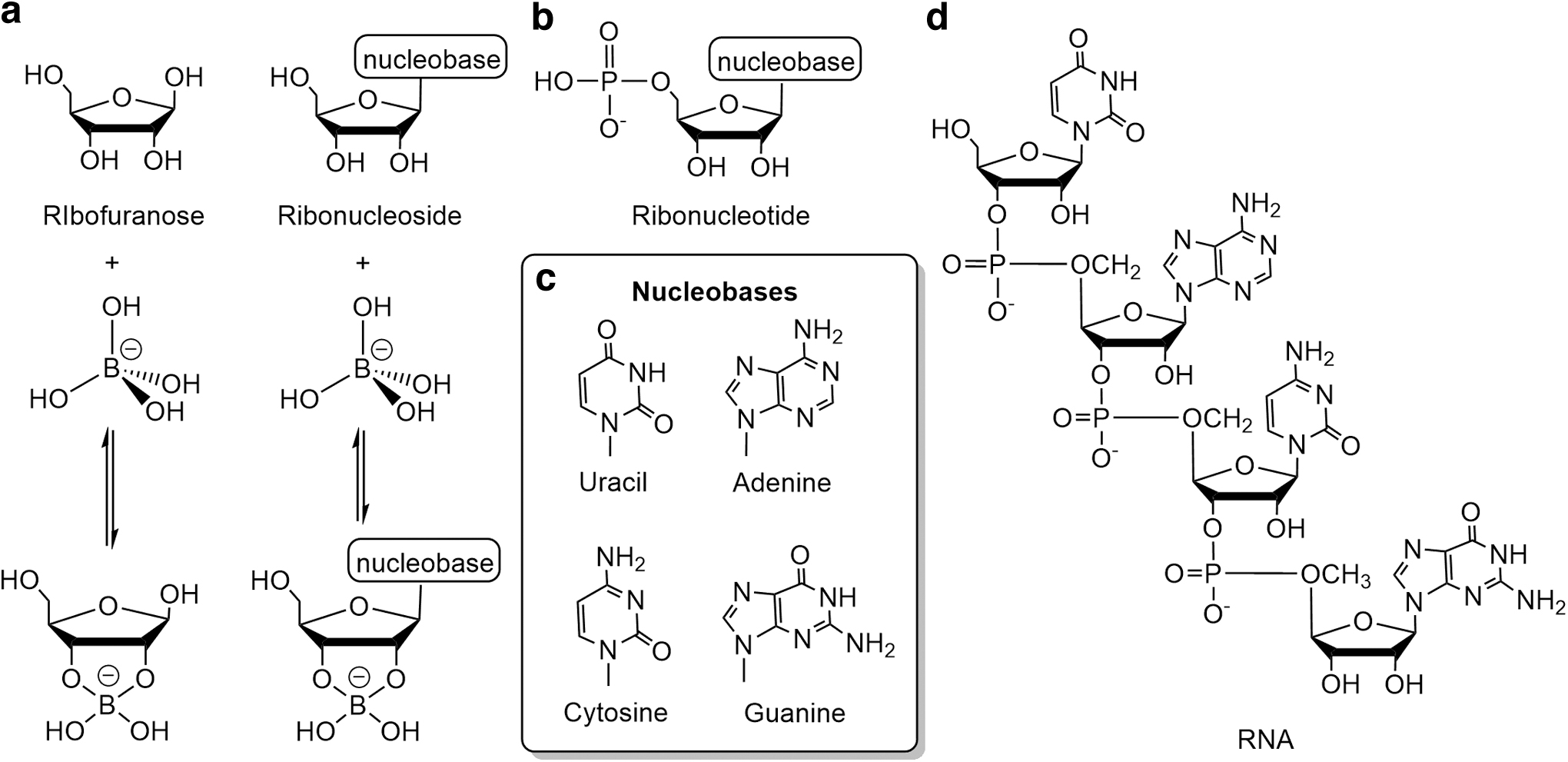
These esters induce ribose as furanose, a five-membered ring conformation present in biological derivatives (pyranose is the main conformation in aqueous solution) (Ortiz et al., 2005; Amaral et al., 2008; Franco et al., 2019). Additionally, borate protects certain hydroxyl groups of this pentose, preventing side reactions, an important condition for the prebiological synthesis of RNA (Amaral et al., 2008; Franco et al., 2019). The synthesis of ribofuranose mediated by boron minerals (kernite, ulexite, and colemanite), under prebiotic conditions, suggests that these crystal structures could have been plausible borate sources (Ricardo et al., 2004), and boron minerals could have mediated enantiomeric enrichment during prebiological evolution since ribose synthesis leads to a racemic mixture (i.e., an equal amount of its enantiomers) in the absence of specific environments.
Herein, the participation of boron minerals (or esters of boron with formal derivatives of ribose as hydrogels) is discussed as participants of prebiological enantiomeric enrichment.
An enantiomer is a molecule with at least a chiral center, that is, a molecule or ion that cannot be superimposed on its mirror image by any number of rotations, translations, or conformational changes (Blackmond, 2010); each one can be distinguished as left-handed or right-handed (Fig. 2) (Blackmond, 2010).
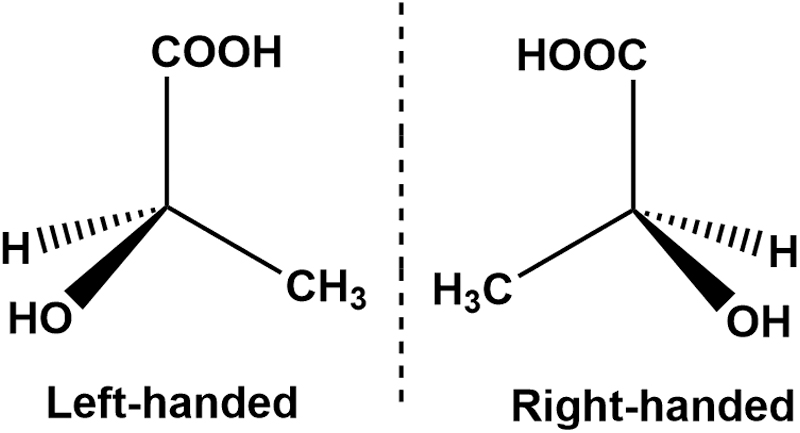
Example of left-handed and right-handed enantiomers.
Both enantiomers have the same chemical properties but may interact differently with other chiral molecules (Zaera, 2017).
The syntheses of molecules that exhibit chirality in the absence of a chiral reagent, solvent, or catalyst always yield equal amounts of all enantiomers (Miller and Sarpong, 2011). Therefore, prebiological ribonucleotides and their precursors should exist as a racemic mixture, in contrast with main biological molecules: amino acids in proteins are almost exclusively left-handed (or
In 1953, Frank proposed an autocatalytic mechanism that would lead to chiral amplification of molecules (Frank, 1953; Pavlov and Klabunovskii, 2014). More than 40 years later, Japanese chemist Kensō Soai showed that Frank's mechanism could yield enantiomeric enrichment (Pavlov and Klabunovskii, 2014). However, the Soai reaction cannot occur in the presence of water or air and forms complex secondary alcohols, which would have been unlikely conditions in prebiotic environments (Islas et al., 2005; Pavlov and Klabunovskii, 2014).
Alternatively, it was proposed that highly polarized ultraviolet (UV) radiation might have led to enantioselective formation of chiral molecules before they were delivered to Earth by meteorites (Pavlov and Klabunovskii, 2014). Recently, it has been proposed that homochirality could depend on inherent properties of duplex structures of oligonucleotides and on how they were formed (Ross and Dreamer, 2022). Regarding RNA precursors, ribonucleosides and ribonucleotides were synthetized in 2019. However, percentage yield was higher for alpha ribonucleosides and ribonucleotides, rather than the desired beta anomer (Becker et al., 2019). Additionally, it has been suggested that several reaction steps, including hydrolysis, dry processes, and UV radiation-induced reductions could lead to the formation of canonical ribonucleosides (Xu et al., 2020).
Spontaneous formation of crystalline conglomerates has also been suggested as a possible route to homochirality: a racemate can either crystallize into a racemic mixture or a conglomerate of a pure crystalline enantiomer (Fig. 3) (Pavlov and Klabunovskii, 2014). Consequently, molecules, ions, and crystals need to be chiral to promote enantiomeric enrichment.
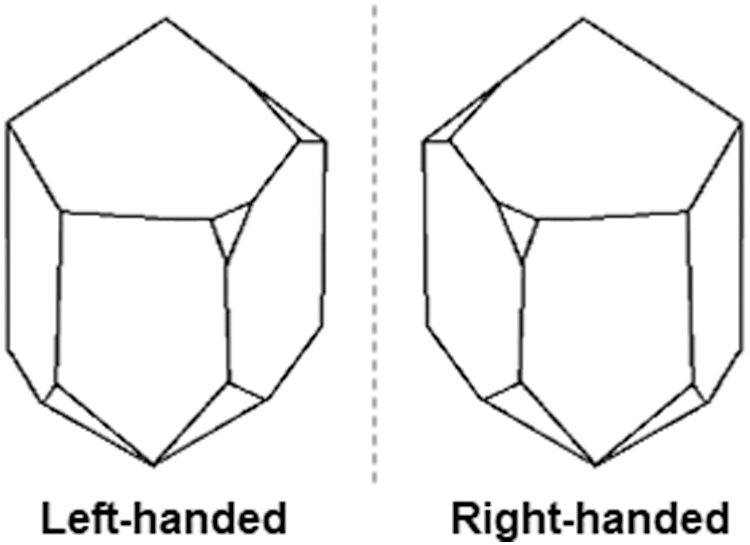
Example of left-handed and right-handed crystalline enantiomers as potential promoters of enantiomeric enrichment.
Chemical interactions on the interface between crystalline surfaces and aqueous solutions are crucial in several natural processes, for example, pH buffering or catalytic organic synthesis (Hazen and Sholl, 2003; Hazen and Sverjensky, 2010). Chiral crystalline surfaces are particularly interesting given that they tend to exhibit enantioselective adsorption (Weissbuch and Lahav, 2011), that is, left-handed and right-handed crystals selectively adsorb left-handed and right-handed molecules, respectively (Weissbuch and Lahav, 2011).
Chiral mineral surfaces are common in nature: quartz is a chiral mineral, and olivine, feldspar, calcite, pyrite, and gypsum are examples of achiral minerals with chiral surfaces (Hazen, 2006). Consequently, the enantioselective adsorption of chiral molecules on chiral mineral surfaces has been suggested as a relevant mechanism for the emergence of homochirality. It has been shown that the right-handed surfaces of gypsum and calcite (calcite was an abundant mineral in the Archean Eon) adsorb
In 2003, Flack published a comprehensive glossary of classification and nomenclature of chirality in crystal structures (Flack, 2003). A crystal structure belongs to 1 of 230 space group types (Flack, 2003), and chirality or achirality depends on its symmetry group. A crystal is chiral if its lattice structure has a well-defined handedness due to lack of inversion symmetry (the space group type of a chiral crystal contains symmetry operations of the first kind, that is, rotations and translations, but not rotoinversions) (Flack, 2003). However, chiral structures may also crystallize in achiral space group types if they only contain operations of the first kind. The 65 space group types where chiral structures may crystallize (Table 1) (Flack, 2003) are known as Sohncke space group types (Sohncke, 1879).
Sixty-Five Sohncke Space Groups (Hermann–Mauguin Notation) (Brener et al., 2008)
Additionally, some achiral crystals have chiral surfaces. Experimental data show this feature to be particularly common in crystal structures that belong to the triclinic (point group  ) or monoclinic (point group 2/m) systems, which are formed by pairs of homochiral surfaces (Table 2) (Weissbuch and Lahav, 2011). During crystal growth, if one of the faces of the crystal is blocked, the opposite one can selectively interact with surrounding molecules (Weissbuch and Lahav, 2011).
Triclinic and Monoclinic Space Groups (Hermann-Mauguin Notation) (Weissbuch and Lahav, 2011)
This approach emphasizes a plausible important role of minerals in the origin of homochirality. In particular, imperfections such as steps and kinks (created by deformation or during crystal growth) can lead to a lack of mirror symmetry in any mineral surface, potentially promoting the occurrence of chiral sites in a crystal (Hazen, 2006).
As discussed above, it is likely that borate may have had a crucial role in the prebiological stabilization of ribose (chiral
Despite growing evidence of boron as a prebiological chemical element, there is no evidence of minerals of this nonmetal having existed 4 billion years ago on prebiotic Earth (Grew et al., 2011). The oldest known boron minerals are primary metamorphic tourmalines, for example, dravite and schorl, which formed ca. 3.6 billion years ago (Grew et al., 2011). Nevertheless, there is no reason to dismiss the existence of earlier boron minerals (Grew et al., 2011).
Presently, with an average amount of less than 10 parts per million (μg/g), boron is a relatively less abundant element in the Earth's crust (Wedepohl, 1978). Except for a few other minerals, boron is bound to oxygen, that is, binding to three oxygen atoms in a trigonal planar geometry B(OH)3 or to four oxygen atoms, as a tetrahedron B(OH)4 − (Wedepohl, 1978). Boron minerals may contain other chemical groups and can be divided, accordingly, as fluorides, hydroxides, carbides, borides, borates, or silicates (Wedepohl, 1978). Supplementary Table A1 of the Supplementary Information lists every known boron mineral, according to the International Mineralogical Association—Commission on New Minerals, Nomenclature and Classification (IMA CNMNC) (Pasero, 2021).
Even though boron is not an abundant element, large quantities of boron can concentrate in secondary evaporite deposits of hydrated borate minerals under arid conditions in Earth's upper continental crust (Wedepohl, 1978). These evaporites are, in some cases, such as the Anatolia (Turkey), the result of boron leaching from volcanic rocks by geothermal waters and having collected and evaporated in playa lakes within extensional basins (Wedepohl, 1978; Helvachi, 2005), which are locations that have been proposed for prebiological reactions to occur (Longo and Damer, 2020).
Of every known boron mineral, 43 are organized in Sohncke space group types (Table 3). However, Table 4 lists every boron mineral whose crystal structures belong to the triclinic (point group
With the exception of oxy-foitite, all tourmaline minerals belong to space group type R3m (see Supplementary Table A1 in the Supplementary Information), which is not included in Sohncke space group types. Furthermore, tourmalines are very slightly soluble in water (Collins, 1969). Therefore, even though tourmalines are the oldest known boron minerals, it is unlikely that they played a part in the stabilization of ribose, the emergence of homochirality, or the formation of RNA. Some conditions that would have been required to achieve these steps are considered below: It has been shown that oscillations between aqueous and dry environments (wet/dry cycles) can improve the yield of prebiological reactions that involve condensation of functional groups (Becker et al., 2019; Franco et al., 2020). This type of reaction could have occurred in dry lakes, which are flat basins formed in arid or semiarid regions near coastlines that are periodically covered by water that could have slowly evaporated. Even though there is no firm evidence of this, it is possible that a continental crust could have already formed on prebiotic Earth, which would make this type of environment a likely scenario where these reactions might have occurred. Curiously, and as mentioned above, most known boron minerals originated in this type of environment (Wedepohl, 1978). Calcium is an abundant chemical element and the only cation that leads to the occurrence of ribofuranose (as mentioned previously, the conformation present in biological derivatives) in the solid state (Lu et al., 2003; Franco and Silva, 2021). However, magnesium cations bind to phosphate groups of RNA and stabilize it (Holm, 2012). This suggests that it would have been important that boron minerals to have had both or one of these cations to favor the formation of more complex prebiological structures. Boron minerals were likely to have had homochiral surfaces. Solubility in water would also have had to play another important factor: a highly soluble mineral would not have allowed chiral molecules to be adsorbed at its surface. Therefore, a slight or moderate solubility in aqueous solution would have allowed adsorption and stabilization of ribose or its derivatives. Boron minerals that contain chemical elements that are of very low abundance on Earth or are not associated with biological roles in current living organisms are excluded, given that we admit that they did not participate in prebiological evolution.
Many of the boron minerals listed in Tables 5 and 6 fill two or more of the requirements mentioned previously. This analysis is focused on a select few minerals that include ameghinite (space group type C2/c), aristarainite (P21/a), colemanite (P21/b), ezcurrite (P1), fabianite (P21/a), gowerite (P21/a), inderite (P21/a), pinnoite (P42), and pringleite (P1). These are listed on Table 5 along with their associated minerals (i.e., minerals that form in the same environment). Additionally, Table 6 summarizes their solubilities.
Selected Boron Minerals with Chiral Surfaces, Formed in Closed Basins and Under Arid Conditions, Containing Calcium or Magnesium or Associated Minerals with These Metals
Solubility of Selected Boron Minerals
Data from Tables 5 and 6 indicate that minerals such as ameghinite, ezcurrite, and their associated minerals are soluble in water, and hence, they are less likely to adsorb chiral molecules, although they are capable of stabilizing ribose in solution. However, inderite is insoluble in water and would likely have exhibited a similar chemical behavior as dravite, schorl, and other tourmalines. Inderite is associated with hydroboracite, which is partly soluble in warm water and contains magnesium. Both minerals should have had the capacity to adsorb chiral species, which would have led to enantiomeric enrichment. Furthermore, inderite could have stabilized ribose in the solid state, and above a certain temperature, hydroboracite could have as well (although ribose degrades rapidly in warm water, its degradation is hindered by the presence of borate) (Amaral et al., 2008).
The association between insoluble/slightly soluble and soluble minerals is common for boron species (Tables 5 and 6). For example, aristarainite a mineral that is slightly soluble in warm water, is associated with tincalconite, kernite, and borax, which are soluble in water. Like inderite and hydroboracite, aristarainite contains magnesium. As mentioned previously, magnesium stabilizes RNA (Holm, 2012). The presence of a phosphate source in a dry lake environment, such as lüneburgite (Kim et al., 2016) or other sources without boron, could have led to the formation of ribonucleotides (Franco and Silva, 2021).
Colemanite, fabianite, and gowerite are slightly soluble in water, contain calcium, and are associated with other minerals. As mentioned previously, calcium stabilizes ribose in the solid state (Lu et al., 2003). Colemanite and gowerite are particularly interesting. Colemanite is associated with meyerhofferite, hydroboracite, nobleite, and ulexite, whose solubilities range from insoluble to soluble (Table 6). This diversity in solubility could have assured ribose stabilization in solution and solid state (the latter could also be increased by the additional presence of calcium (see section 4. Boron Minerals and Enantiomeric Enrichment, page 4, 2nd column, line 4), and enantiomeric enrichment could have been favored. Similarly, this can be applied to gowerite, even though gowerite is only associated with slightly soluble minerals. Minerals of this type solubilize slowly over time. Hence, they could have acted as enantioselective adsorbents, and their ions could have gradually become available in solution. Additionally, their associated minerals would have exhibited similar chemical behavior.
With regard to pringleite, its associated minerals are metaborite (soluble in water) and ruitenbergite (no information is available about the solubility of this mineral). Pringleite is a chiral crystal, but metaborite has no chiral surfaces (Table 3). While metaborite, unlike ruitenbergite and pringleite, would not have contributed to the enantiomeric enrichment of chiral molecules, it could have been an important source of borate anions in solution.
In conclusion, boron minerals are formed in diverse and versatile combinations (regarding chirality, solubility, countercations), which makes them an important focus of study with regard to the RNA World hypothesis.
Recent studies have reported that the oldest deposits found to date of colemanite and ulexite are 330 million years old (Grew et al., 2011). In fact, known boron minerals of today appear to have been unavailable on early Earth (Hazen, 2013; Morrison et al., 2018) likely as a consequence of their significant solubility. However, as mentioned previously, there is no reason to dismiss the existence of earlier boron minerals. It is possible that a significant number of primitive boron minerals are yet unknown. Hazen et al. (2015) suggested that ∼25% of boron minerals remain to be discovered. Grew et al. (2017) purported that the rate of discovery of new minerals with this element was higher than at any previous 10-year period.
In the same year, boron was detected on Mars for the first time in Gale Crater: 10–100 mg/kg B in calcium sulfate veins (Gasda et al., 2016), which is comparable to the concentration present in terrestrial clay sediments (∼100 mg/kg). These evaporites, which are much older than the ancient evaporites found on Earth, along with evidence of primordial igneous rocks, suggest that boron-concentrating processes could have occurred on early Earth (Gasda et al., 2017). Even though these geological processes could have been different from today, if there was a continental crust, borate minerals would have been produced in arid lacustrine environments. Minerals similar to colemanite, gowerite, and their associated minerals with similar structures and properties could have interacted with chiral organic molecules, such as ribose, which might have enabled the emergence of homochirality.
Alternatively, Franco et al. (2020) suggested that guanosine borate hydrogels may have functioned as cradles for prebiological reactions. This type of structure could have been associated with homochirality.
Borate and guanosine (one of the ribonucleosides) esters can lead to the self-assembly of 3D structured hydrogels if potassium or sodium ions are present in solution (Peters et al., 2015).
Silva and Holm (2014) purported that hydrogels can form in nature in rocky watery environments, and they have previously been proposed as frameworks for prebiological reactions (Franco et al., 2020; Franco and Silva, 2021). Hydrogel external boundaries could have been advantageous for prebiological reactions, for example, by protection of early self-replicating molecules from high-energy radiation that occurred on early Earth, which would have prevented their degradation (Franco and Silva, 2021). It has been shown that guanosine borate hydrogels display great thermal resistance over a significant temperature range by regaining a hydrogel structure after being exposed to wet/dry cycles (Franco et al., 2020). They also favor the synthesis of ribonucleotides (Franco et al., 2020). More recently, it was demonstrated that
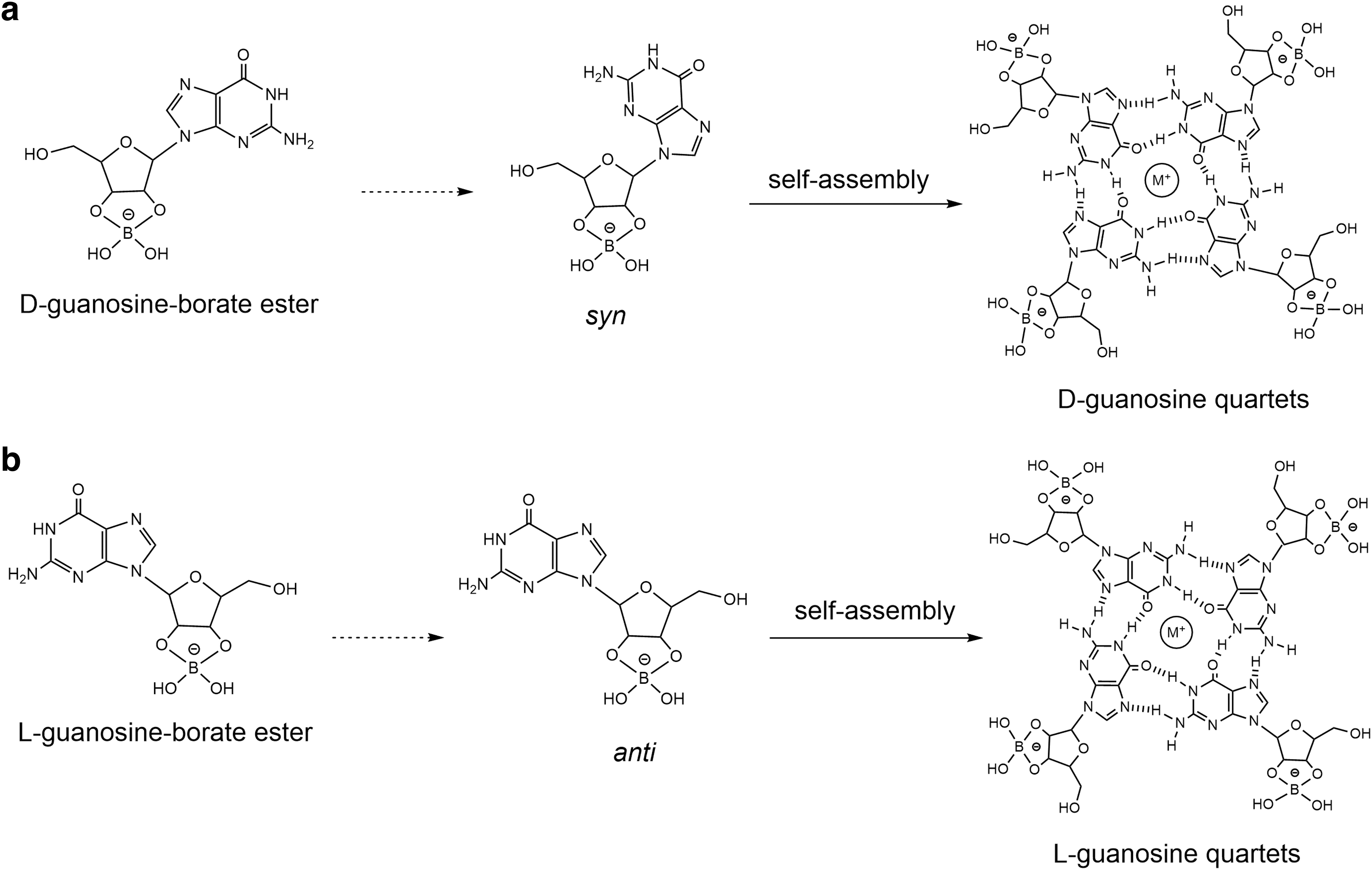
Guanosine borate esters self-assemble into quartets, leading to the formation of hydrogels.
Enantiomeric separation through the formation of hydrogels with a borate matrix can also be supported by the fact that other ribonucleosides, such as adenosine (Yokosawa et al., 2017), form this type of structure in the presence of this anion. Cytidine shows the same behavior, but it requires silver ions (Tang et al., 2019), which have not been proposed as a prebiotic participant. Moreover, other ribonucleosides can be incorporated into guanosine borate hydrogels (Franco et al., 2020). Consequently, these characteristics of nucleoside borate hydrogels could have been a plausible pathway for the prebiological enantiomeric enrichment.
Enantiomeric enrichment is a key point in the RNA World hypothesis as an explanation for the origin of life. The growing importance of boron as a relevant prebiological element suggests its participation in the prebiological enantiomeric enrichment by some minerals or prebiological hydrogels that contain this nonmetal. It should be stressed that right-handed and left-handed mineral surfaces are equally abundant on Earth (Hazen, 2006). Due to this fact, it has been suggested that homochirality could have emerged from a local event, dictated by chance, that is, one self-replicating chiral molecule, successfully formed on a right-handed or left-handed crystal surface, could have determined handedness (Hazen, 2006).
Considering the versatility and abundance of boron minerals, the participation of this nonmetal in enantiomeric enrichment is plausible, although there is no geological record of its minerals in the period of the emergence of life on Earth. This participation could have resulted from the simultaneous presence of more than one boron mineral (with different contributions related to their solubility, chirality, and type of counterions) in conditions commonly observed in nature.
Furthermore, hydrogels containing borate and prebiological molecules could have been relevant to the separation of
Clarification of these points will require further research.
Footnotes
Author Disclosure Statement
No competing financial interests exist.
Funding Information
This work has been carried out with financial aid of the Fundação para a Ciência e a Tecnologia (Portugal) (Projects No. UIDB/00100/2020, UIDP/00100/2020, and Institute of Molecular Sciences—LA/P/0056/2020).
Supplementary Material
Supplementary Information
Supplementary Table A1
Associate Editor: Norman Sleep.
Abbreviations Used
References
Supplementary Material
Please find the following supplemental material available below.
For Open Access articles published under a Creative Commons License, all supplemental material carries the same license as the article it is associated with.
For non-Open Access articles published, all supplemental material carries a non-exclusive license, and permission requests for re-use of supplemental material or any part of supplemental material shall be sent directly to the copyright owner as specified in the copyright notice associated with the article.
