




Abstract
The recent and still controversial claim of phosphine detection in the venusian atmosphere has reignited consideration of whether microbial life might reside in its cloud layers. If microbial life were to exist within Venus' cloud deck, these microorganisms would have to be multi-extremophiles enclosed within the cloud aerosol particles. The most straightforward approach for resolving the question of their existence is to obtain samples of the cloud particles and analyze their interior. While developing technology has made sophisticated in situ analysis possible, more detailed information could be obtained by examining samples with instrumentation in dedicated ground-based facilities. Ultimately, therefore, Venus Cloud-level Sample Return Missions will likely be required to resolve the question of whether living organisms exist in the clouds of Venus. Two multiphase mission concepts are currently under development for combining in situ analyses with a sample return component. The Venus Life Finder architecture proposes collection of cloud particles in a compartment suspended from a balloon that floats for weeks at the desired altitude, while the Novel solUtion for Venus explOration and Lunar Exploitation (NUVOLE) concept involves a glider that cruises within the cloud deck for 1200 km collecting cloud aerosol particles through the key regions of interest. Both architectures propose a rocket-driven ascent with the acquired samples transported to a high venusian orbit as a prelude to returning to Earth or the Moon. Both future conceptual missions with their combined phases will contribute valuable information relative to the habitability of the clouds at Venus, but their fulfillment is decades away. We suggest that, in the meantime, a simplification of a glider cloud-level sample collection scenario could be accomplished in a shorter development time at a lower cost. Even if the cloud particles are not organic and show no evidence of living organisms, they would reveal critical insights about the natural history and evolution of Venus.
Introduction
The possibility of life in the cloud layer of the venusian atmosphere is not a new idea and has been given serious scientific consideration for several decades (Morowitz and Sagan, 1967; Grinspoon, 1997; Cockell, 1999; Limaye et al., 2018, 2021; Schulze-Makuch and Irwin, 2002; Schulze-Makuch et al., 2004, 2013; Bains et al., 2021; Seager et al., 2021). This hypothesis has recently come to the forefront of astrobiological attention due to the claimed detection of the biomarker phosphine in the venusian atmosphere (Greaves et al., 2021a). The significance of the detection has been controversial as has been the detection itself (Snellen et al., 2020; Greaves et al., 2021b; Lincowski et al., 2021; Villanueva et al., 2021), including the notion that life can exist in the venusian cloud-level atmosphere at all (Kasting and Harman, 2021). Only new missions will provide clarity on whether the venusian clouds are habitable and could possibly host living organisms. Planned missions over the next decade will provide improved chemical context for refining future approaches associated with the hypothesis of cloud-level life.
Background
There are arguments both in favor and against possible life within the venusian clouds. Arguments that have been advanced in favor of life as we know it in the venusian clouds, which were summarized by Schulze-Makuch (2021), are that: (1) temperatures and pressures that allow the presence of liquid water are found in the lower cloud layer; (2) available energy is sufficient for life, especially for photosynthesis using the visible light frequencies as a viable metabolic strategy (Mogul et al., 2021); (3) microbial life could have adapted to the cloud environment by natural selection from an early surface aquatic habitat (Way and Del Genio, 2020); and (4) C, N, S, and even P (Milojevic et al., 2021)—elements critical for life on Earth—are thought to be available in the venusian atmosphere.
Arguments that have been advanced against possible life include: (1) the extremely low water activity, which appears to be a hard challenge for life as we know it (Hallsworth et al., 2021); (2) hyperacidic conditions that are likely too extreme for the survival of any life on Earth; and (3) the likely lack of hydrogen (Bains et al., 2021) and possible lack of trace metals. Given the uninhabitable venusian surface conditions at present for carbon-based terrestrial life, there is also a fourth consideration, which is the additional challenge that living cells within the venusian clouds would require a permanent airborne life cycle (Schulze-Makuch and Irwin, 2018). Metabolic pathways and possible adaptative traits for putative life in the cloud layer of the venusian atmosphere have been suggested by several authors (Table 1). We do not know whether a complete life cycle exists in the clouds on Earth at this time. However, an estimated total of 1024 cells are thought to exist in Earth's (non-permanent) aerial biosphere (Bryan et al., 2019), which compares to a total of about 1030 cells of total microbial biomass (Whitman et al., 1998).
Proposed Ideas and Models of Life in the Venusian Lower Atmosphere, Which Are Not Mutually Exclusive
Proposed Ideas and Models of Life in the Venusian Lower Atmosphere, Which Are Not Mutually Exclusive
UV = ultraviolet.
Limaye et al. (2021) suggested that mode 2 and mode 3 cloud particles within the Venus cloud deck could host microbial life, and if so, the total biomass of Venus could be as high as 2 × 10²¹ to 2 × 10²³ cells, which is about one 1-millionth of Earth's total microbial biomass. Krasnopolsky (1986) pointed out that the mode 3 particles are of special interest because they are enriched in the lower cloud layer and, with an average diameter of about 3.6 μm, are larger than the mode 2 particles. Nephelometric and photometric measurements from the Soviet-era Venera probes showed that the mode 3 particles are distinctly different in their properties from the other cloud particles (Krasnopolsky, 1986). However, there is still some controversy on the existence of a separate mode 3 of large particles as they could also be the tail end of mode 2 particles rather than a separate mode (Toon et al., 1984).
Grinspoon et al. (1993) pointed out that the mode 3 particles may be nonspherical, and while their composition is uncertain, the intriguing possibility exists that the mode 3 particles consist of a non-absorbing core that may be enveloped by a coating. This could imply that the core is a solid inclusion, but this cannot be confirmed given the current data. Simulations from a radiative transfer model employing coated particles are consistent with (but certainly no proof of) the existence of non-absorbing core material comprising up to 50% of the volume of the mode 3 particles in the lower clouds (Grinspoon et al., 1993). Schulze-Makuch et al. (2004) suggested that the coating material could include elemental sulfur in the form of S8, which would allow microbes encased by S8 to carry out photosynthesis. Seager et al. (2021) commented that the coating of the cells would also need to include hydrophilic filaments in addition to elemental sulfur because otherwise putative microorganisms would not be able to absorb critical liquids.
Any putative venusian microbe would have to be a multi-extremophile relative to habitable conditions for life on Earth. This would probably require biochemical pathways unknown on Earth. Current life in the venusian cloud layer also likely would have evolved from an early aquatic habitat on Venus in which microbes originated before their evolution of adaptations for perpetual life (i.e., sustained indefinitely through reproduction) in the clouds in response to the increasing heat and desiccation that occurred on the surface of Venus over its evolutionary history (Schulze-Makuch and Irwin, 2002; Irwin and Schulze-Makuch, 2011; Way and Del Genio, 2020).
The environmental conditions within the cloud deck of Venus are very extreme by any measure on Earth, based on current (although limited) data. The question is whether life could have evolved to overcome what appear to be such obstacles for life as we know it on Earth. Bains et al. (2021) suggested ammonia as a possible solution to hyperacidity, which could raise the pH in the cloud droplets to a value of about 1. Environmental conditions would still be very acidic, but they would fall within the range of habitats occupied by acidophilic organisms on Earth. Bains et al. (2021) also suggested that the ammonia could be biologically produced such that it would make the cloud droplets a favorable habitat, and they provided various examples in which microorganisms on Earth secrete ammonia to lower the acidity of their immediate environment (Song et al., 2011). Other suggestions have been made as well on how the presence of other chemicals could modify the pH value inside the venusian clouds (Mogul et al., 2021; Rimmer et al., 2021).
If these authors are correct, then one critical hurdle for microbial life at Venus may not be as daunting as it first appeared. However, other significant challenges remain. Foremost among them is the low water activity in the venusian clouds, emphasized most recently by Hallsworth et al. (2021). Bains et al. (2021) addressed the water activity issue by stating that in-cloud water vapor, abundances range widely (between 5 ppm and 0.2%), which suggests that local pockets of more benign conditions may exist within otherwise extreme dryness. Perhaps islands of habitability more conducive for support of living organisms are found within overall extremes of aridity and hyperacidity, somewhat analogous to microbial hot spots that are present within the hyperarid Atacama Desert on Earth (Schulze-Makuch et al., 2021).
In that type of environment, microbial life has demonstrated astonishing mechanisms by which to obtain water directly from the atmosphere via deliquescence (Davila and Schulze-Makuch, 2016; Maus et al., 2020). The need for investigating the chemical and environmental setting for a potential life-hosting abode was also emphasized in a report by the National Academy of Sciences, Engineering and Medicine (Sherwood-Lollar et al., 2018) and that conclusion certainly pertains to Venus. This chemical context for asking questions about life is a central element of NASA's recently selected DAVINCI mission to Venus, scheduled to launch in June 2029.
There is no good analog for the venusian environment on Earth, and the lack of microbial life to adapt to the environmental stresses as encountered in the venusian clouds may only mean that there was never enough pressure from natural selection on Earth to do so (Irwin and Schulze-Makuch, 2011). One major problem with assessing the precise environmental conditions in the venusian atmosphere is that we do not have sufficient in situ observational data, most of which derive from missions conducted at the end of the last century. Most of what we believe is based on models; sometimes one model is based on another one. This certainly impedes confidence on which to base our understanding of the venusian atmospheric environment. Future missions including DAVINCI and ESA's EnVision orbiter will at least partially remedy the problem of the lack of in situ data. For example, the NASA DAVINCI probe will measure pressure, temperature, and other environmental parameters as often as every 15 m within the Venus atmosphere, from ∼70 km to the surface to provide physical context for chemistry measurements (Garvin et al., 2022).
A number of future concepts have been advanced to remedy the lack of in situ data at Venus, within the cloud deck. For example, the Variable Air and Land Expedition: Novel Trail blazer for In situ Exploration (VALENTInE) mission proposes a variable altitude balloon that will passively float between 45 and 55 km altitude in the middle cloud deck. VALENTInE would acquire data on atmospheric composition and dynamics, and it would map surface geomorphology and mineralogy across multiple terrains (Arredondo et al., 2021). Two earlier proposed concepts for aerobot exploration include the Balloon Experiment at Venus (BEV) and the Venus Flyer Robot (VFR). The BEV was conceptualized to collect atmospheric data as well as image the surface.
The VFR, with its proposed ability to descend to the surface, would collect centimeter-to-meter scale visible and near-infrared images of the surface, collect compositional and dynamical data of the lower atmosphere, and measure the composition of the venusian surface (Gilmore et al., 2005). The Venus Atmospheric Maneuverable Platform envisions a hypersonic entry vehicle that would transition to a semibuoyant air vehicle that cruises for several months to a year at an altitude of 50–65 km collecting data on atmospheric isotopes and possibly other physicochemical information (Polidan et al., 2015). The Cupid's Arrow mission was a small satellite concept to measure noble gases in Venus' atmosphere (Sotin et al., 2018) above the homopause. These and many other equally enticing concepts offer next steps in the astrobiological investigation of the Venus cloud layer.
Three future missions to Venus have been approved for flight development: two by NASA (DAVINCI and VERITAS) and one by ESA (EnVision). These missions are targeted to acquire new measurements of the atmospheric and surface environment of Venus. These measurements are intended to provide more insight into the planetary evolutionary history of Venus and its atmosphere; for example, one geophysical question to be addressed is whether Venus ever had terrestrial-style plate tectonics. Another important question is does Venus still have active volcanoes releasing volatile compounds, as well as the possibility of past surface liquid water oceans. These would likely include water vapor, thus potentially affecting the habitability of the venusian cloud layers. However, none of these three upcoming missions aim to directly investigate the potential habitability of the cloud layer.
The planned trace gas and noble gas composition measurements by DAVINCI's mass spectrometer (VMS) and tunable laser spectrometer (VTLS) will directly contribute to this question, as they are expected to provide an inventory of available gaseous species, which will thus constrain their chemical availability for the cloud particles and the chemical and environmental context for any possible life.
The three currently approved missions described above could yield important information for gaining a better understanding of the venusian environment, without which we cannot hope to understand whether any life could thrive there. However, none of those missions have the capacity for life detection experiments and, therefore, will not directly address whether any form of life exists in the venusian atmosphere. In this article, however, we focus on future mission designs that explicitly address the possible presence of life in the venusian clouds.
There are two possible options for acquiring more direct results on the habitability of the venusian cloud layer and whether it potentially contains microbial life: an in situ investigation and an aerosol sample return mission. Both these could come after the next decade of missions (DAVINCI, EnVision, and VERITAS) described above.
Recent developments in instrumentation have increased the viability of an in situ approach for extant life detection within Venus' clouds. For example, the proposed Aerosol-Sampling Instrument Package, which includes a quadruple ion trap mass spectrometer that can detect aerosols over an atomic mass range from 2 to 300 AMU with a detection limit of <0.02 AMU (Baines et al., 2021), represents a promising approach for the venusian atmosphere in the mid-2030s. Alternatively, the ORIGIN laser desorption/laser ablation mass spectrometer designed to detect large nonvolatile molecules such as amino acids and lipids (Ligterink et al., 2022) has also laboratory-proven capabilities and appears suitable for detecting the possible presence of biomolecules in the venusian clouds on a future mission. Both instruments, however, pose the challenge that the payload would be more than 10 kg in mass (with high power), adding significantly to the cost of any in situ mission.
Fluorescence microscopy is a more direct approach for imaging cloud particles (Sasaki et al., 2022). However, it presents several challenges owing to the sulfuric acid composition and corrosive effects of the venusian atmosphere. Fluid Screen technology has also been suggested for capturing and detecting chemically diverse particles including microbes, based on the particles' dielectric properties (Weber et al., 2022). However, the development time of that technology would still add a significant amount of time to become ready for deep-space applications. The latter two experimental approaches have been suggested to be included in the commercial (Rocketlabs) Venus Life Finder (VLF) mission concept. VLF is a good example of how in situ and sample return approaches can be combined to gain more critical insights. The first two parts are conceptualized to be in situ investigations, which are planned to be launched before the sample return (Seager et al., 2022). In Section 4, we will focus our discussion on the third part of the VLF mission, sample return.
Part 1 of the VLF concept consists of a small probe with a ∼1 kg instrument package to be operational for about 3–5 min in the venusian clouds and to utilize ultraviolet (UV) irradiation on the cloud particles (French et al., 2022). If the cloud droplets contain organic molecules, they should fluoresce when exposed to the UV radiation, which will be detected with an autofluorescing nephelometer sensor system. The presence of organic compounds within the mode 3 particles within the clouds would not prove life (active biology) but would be evidence consistent with life, an important distinction given that false-positive life detections are always a possibility. The current best estimate for launch of the Rocketlabs/MIT/Breakthrough “Morning Star” mission is 2025 or thereafter, on the basis of remarks presented at international Venus meetings in 2023.
Part 2 of the conceptualized VLF mission is an instrumented balloon dropped into the venusian clouds to float at an altitude of about 50 km to analyze the potential habitability of that region while searching for further evidence of life via biosignatures (Seager and Petkowski, 2021). While Part 1 (“Morning Star” probe) is currently fully financed (Petkowski, pers. comm.); the other two parts of the commercial mission are not yet funded for flight development. The financial prospects of the later parts may depend on the success of the first part of the mission because justification for the additional costs of an aerosol sample return mission is questionable without prior indications of signs of life or the presence of organics in the targeted cloud layers.
Mission Concepts Relevant to Detecting Life in the Venusian Atmosphere Using a Sample Return Approach
Previous concepts
Various concepts for venusian atmospheric sample return missions have been offered for over 20 years. Cases for a surface sample return have also been made (Cutts et al., 1999; Greenwood and Anand, 2020), but these do not address whether the venusian cloud layer may contain microbial life. Thus, we focus discussion here on atmospheric sample return missions. Schulze-Makuch et al. (2002) and Sweetser et al. (2003) suggested atmospheric skimming missions that would collect samples by grazing the atmosphere at supersonic speeds. To counter the sample integrity issues of supersonic atmospheric collection, they also proposed concepts for low relative velocity collections. Sweetser et al. (2003) proposed a “touch-and-go” concept for collecting the atmospheric sample at ∼700 m/s relative velocity atop a four-stage rocket protected by a heat shield and slowed by a ballute. Once the sample was collected, the rocket would lift the sample to rendezvous with a spacecraft in orbit around Venus that would return it to Earth (Sweetser et al., 2003). Schulze-Makuch et al. (2002) proposed a balloon-based concept that would allow the sample container to loiter at the target altitude and drift with the upper venusian winds to collect multiple samples over an extended period. Then, similar to Sweetser's concept, a rocket would ferry the sample container to a mothership in venusian orbit for return to Earth. However, neither proposal discussed the details or near-future technical feasibility of using a rocket to deliver the sample container to the orbiter.
Schulze-Makuch et al. (2002) also proposed an ambitious rotating probe tether system (RPTS) as an alternative low-velocity sample collection strategy. The RPTS is a 3700-kg spacecraft consisting of a 300-kg probe and a sample return capsule, a 300-kg counterweight that would perform functions that are not required for sample collection but for return to earth by spooling out the tether and providing a heat shield. A total of 3100 kg would be allocated to the 500 km tether made of constant diameter Spectra 2000© fiber. The RPTS would be launched to Venus on a Hohmann trajectory and captured in the venusian orbit by aerobraking. The center of mass of the RPTS would be in a circular orbit at an altitude of 300 km. The system would have to rotate at a rate of 0.262 revolutions per minute to cancel the orbital velocity at an altitude of 50 km and to achieve a relative wind velocity of near zero. The probe would encounter a maximum dynamic pressure of 2 × 10⁶ N/m2. If the sample collection apparatus is constrained to operate in the near-0 dynamic pressure regime, then the collection arc would be about 2° based on a mode 3 particle density of 40/cm3 at 50 km. At this altitude, the total number of particles that could be collected with one pass is about 2.5 × 10⁹. Thus, the RPTS could collect nearly 1 g of mode 3 particles per day. Another feature of the RPTS is that the rotation rate is high enough to give the probe the energy it needs to escape Venus' gravity and return to the vicinity of Earth (Schulze-Makuch et al., 2002).
Current concepts (2023 and beyond)
At this time, two new and plausible dedicated atmospheric sample return mission architectures have been conceptualized. One is the Venus atmosphere sample return mission proposed by the MIT-led VLF team (Seager and Petkowski, 2021). The other is the ESA-sponsored atmospheric sample return system (SRS) of the Novel solUtion for Venus explOration and Lunar Exploitation (NUVOLE) initiative (Sindoni et al., 2021). The two mission architectures share many common elements, but there are also differences. In this study, we briefly describe the similarities and differences and comment on aspects that have a bearing on the scientific objectives of an atmospheric sample return.
Similar to the proposals from decades earlier as briefly described above, both conceptual architectures consist of an orbiter and sample return vehicle launched from Earth. The spacecraft enters venusian orbit, and the sample return vehicle separates from the orbiter, enters the atmosphere of Venus, collects samples, and a rocket lifts the sample to the orbiter. After rendezvous and sample transfer to the orbiter, the orbiter returns the sample for Earth-based (VLF) or a Moon-based (NUVOLE) laboratory study. The VLF sampling mission consists of three parts. The third part is the sample return component, which will deploy a variably inflatable balloon from which a sample capture compartment and a Venus ascent vehicle (VAV) are suspended. Once deployed into the atmosphere at a stable altitude and position, the balloon portion is inflated to bring the gondola to the altitude of interest and begin a projected 30-day floatation during which an estimated 1 L of gas and tens of grams of cloud particles will be collected. The details of the sample collection mechanism have not yet been defined but will be designed to capture intact organisms, if they exist, or to at least collect cloud particles as individual droplets. King et al. (2022) reported one concept currently in development. At the completion of sample collection, the balloon ascends to an altitude of ∼60 km and the VAV launches from the aerial platform into a low Venus orbit. An orbital transfer and subsequent phasing maneuvers proceed to rendezvous with the orbiter. The sample container will then be transferred to the Earth entry vehicle for return.
The NUVOLE SRS architecture envisions two spacecraft. One is the SRS, which has the role of collecting the atmospheric sample and returning it to orbit around Venus. The other craft is a retrieval orbiter, which recovers the sample apparatus from the SRS and returns it to the Moon. The two spacecraft travel from Earth to Venus mated together. The SRS consists of the sample retrieval apparatus, the glider wing, and an ascent vehicle, all contained in an aeroshell heat shield. Upon arrival at Venus, the SRS performs a propulsive maneuver to enter a ∼300 km parking orbit, where the influence of the atmosphere is negligible over the short duration of the sample collection and retrieval phases of the mission. Then, the SRS and orbiter separate, and the SRS enters the venusian atmosphere. At an altitude between 70 and 80 km, where the speed of the entry capsule is low enough to avoid the turbulence and the effects of the transition from supersonic to subsonic flow, the SRS glider is released from the aeroshell heat shield and begins its autonomous descent. Aerodynamic surfaces at the back of the rocket control attitude in pitch and yaw. Yaw inputs combine with the dihedral of the wing to induce rolling moments for limited three-axis control. At the target altitudes, the sampling apparatus opens its tubes on a preprogrammed schedule to collect the samples of air and cloud particles. When the sample collection schedule is complete, the sampling apparatus is sealed, the wing jettisoned, and the two-stage bi-propellant (monomethyl hydrazine and nitrogen tetroxide) rocket ignites to propel the SRS into a circular 300 km orbit.
While the SRS performs the sample collection mission, the retrieval orbiter remains in its 300 km orbit and awaits the return of the SRS (Fig. 1). When the two spacecraft are within 5 m, the orbiter recovers the sample apparatus from the SRS second stage. Then, the retrieval orbiter raises its orbit to 1000 km. The NUVOLE concept team estimated that one maneuver to raise the orbit to 1000 km will require less fuel than maintaining altitude at 300 km over the duration of up to 1.6 years while awaiting the next Earth return window. When the Venus and Earth positions are synchronized, the retrieval orbiter begins the journey to Earth using an electrical thruster to reduce overall mission mass. During the return, the samples remain sealed in the collection apparatus, but there is no active thermal control.
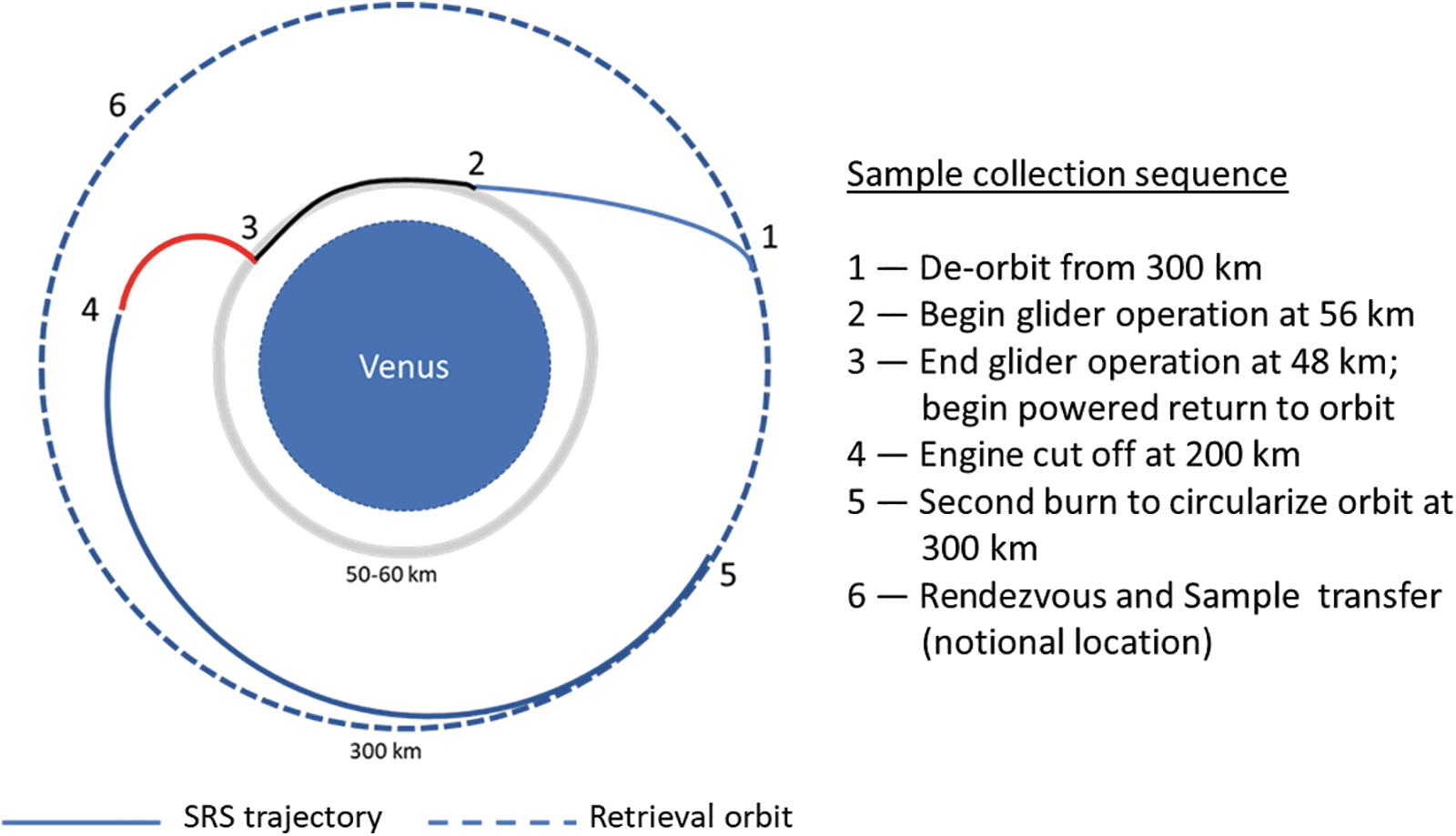
Sample return system sequence of events and trajectory.
The main difference between the VLF and NUVOLE approaches is how long the sampling systems spend on station and their mechanisms for doing so. The VLF approach is to inflate a balloon that drifts with the upper venusian atmosphere at the target altitude of interest for up to 30 days. This approach provides the opportunity to collect different samples at day and night and varying altitudes.
On the other hand, the NUVOLE SRS will collect samples while riding as the payload of a glider that will soar for up to 2 h in the venusian atmosphere at a target altitude of 56 km where the temperature is about 20°C and the pressure is ∼0.5 atm (Sindoni et al., 2021). When the glider no longer has the energy to sustain the target altitude, it jettisons the wing and ignites the rocket to return to orbit around Venus and rendezvous with the orbiter. Although the SRS collection time is only about 2 h compared with the VLF concept of 30 days of duration, its relative velocity of 135–195 m/s enables it to pass through a substantial volume of atmosphere estimated at ∼37 million liters. The collection time is constrained to ∼2 h by the amount of time the glider is predicted to be able to maintain altitude, the survivability of the SRS components in the harsh venusian atmospheric environment, and electrical power. An initial airspeed of 195 m/s was chosen for selecting an airfoil and defining wing geometrical properties. The resulting stall speed of the glider, which is a function of the airfoil, wing geometrical properties, glider mass, and Venus atmospheric density, is 135 m/s. Future detailed design will refine the operational envelope and wing architecture.
Another difference between the two concepts is that the NUVOLE SRS includes detail on the proposed sampling mechanism, while details of the sample collection system for the VLF mission are still in development. The NUVOLE SRS sample apparatus is a 20 cm radius spherical capsule based on a JPL concept for a Mars sample return (Perino et al., 2017). The capsule is mounted in the nose of the glider and contains (1) a set of tubes that can be opened and closed sequentially for capturing an estimated volume of 31 mL of cloud particle liquid and (2) aerogel cells to capture volatile atmospheric particles by adsorption.
The VLF and NUVOLE sample return architectures each have advantages. The VLF concept makes possible the collection of samples over an extended period and at different altitudes and planetary locations in a way that preserves the individuality of discrete particles. It also captures intact microorganisms if they exist. The NUVOLE concept is simpler and more streamlined, with a lower payload, and a requirement for less energy. It is also rated more highly in reliability than either the VLF architecture or a high velocity “touch-and-go” concept, according to a weighted criteria assessment by the NUVOLE team (Sindoni et al., 2021). Both concepts are subprojects of more expansive programs with long lead times. The VLF Sample Return mission is projected to launch in 2029 (Seager and Petkowski, 2021), while the launch of the NUVOLE SRS is not expected before 2045 (Sindoni et al., 2021).
Discussion and Conclusions
The technology for resolving whether microbial life exists in the venusian clouds is now much closer at hand. There are two options in principle to determine this as follows: an in situ life detection experiment and a Venus sample return mission. If there is detectable microbial life in the venusian atmosphere, it almost certainly resides within liquid droplets in the clouds (Irwin and Schulze-Makuch, 2011; Schulze-Makuch, 2021) and most likely within the mode 3 cloud particles. These aerosols are enriched in the lower cloud layer and about the size that would be expected for Earth microbes if covered by a layer of inorganic compounds, including elemental sulfur and hydrophilic filaments.
An ideal mission to resolve the question would be one that combines an in situ investigation with a sample return approach. Both the VLF and NUVOLE mission concepts provide good examples of how this can be accomplished after suitable technology development (and funding). Obviously, a single mission that could perform both in situ analysis and return a sample from the same place and time would be optimal, but the constraints of propulsion technology, payload, mission architectural complexity, and cost render such an integrated mission unfeasible in the near term. Alternatively, a series of stepwise missions which build on one another and lead to eventual return of atmospheric samples for detailed study with sophisticated analytical and microscopic instrumentation is a viable strategy. This is the approach proposed by the VLF and NUVOLE mission designs. When both missions are carried to completion, they could substantially resolve the question of habitability of the venusian atmosphere. Given the complexity of those missions, however, their completion may be decades away. Currently, funding only for the first part of the VLF project (“Morning Star”) is in place, and the projected launch of the sample return component of the NUVOLE program is over two decades away.
We suggest that a minimally viable mission could return an atmospheric sample capable of providing critical, if not definitive, information relevant to the possibility of life in the clouds of Venus in a shorter developmental timeline at a cost that might be affordable enough to attract funding by international space agencies or state–private enterprises. We envision a simplified glider mission concept along the lines of the NUVOLE architecture. A single circular collection interface, enlarged to a diameter of 40 cm, could sweep a path ∼1200 km long descending from an altitude of 56–48 km, through a volume of ∼150 million liters of atmosphere. Based on current understanding of the size and density of mode 2 and mode 3 droplets in the middle and lower cloud layers of Venus, this path would collect ∼100 mL of liquified mode 2 and mode 3 particles, or three times the amount envisioned by the NUVOLE SRS proposal. Cost savings would be realized by using a simpler, unitary collection surface for passive adsorption of cloud particles, without paraffin actuators for collecting gas samples, their heating elements, and added mechanical devices for opening and closing individual vials, with their added payload and developmental costs. The proposed VLF and NUVOLE SRS missions are compared in Table 2, with our suggested modifications to NUVOLE SRS provided in the last column of that table.
Comparison of Proposed Sample Return Missions
ISS = International Space Station; NUVOLE = Novel solUtion for Venus explOration and Lunar Exploitation; SRS = sample return system; VLF = Venus Life Finder.
If organic compounds are detected, a detailed analysis of the molecules and possible macromolecules can be conducted with the latest technologically advanced analytical instrumentation on Earth to determine whether the organic molecules are biological and, if so, whether the biochemical building blocks of venusian life differ from those of life on Earth. Examples of some of these novel techniques are Fourier transform ion cyclotron resonance mass spectrometry (Qi et al., 2020), the latest advances in fluorescence microscopy (Weber et al., 2022) for organic analysis, and using a microfluidic platform for single-cell sequencing analysis (Liu et al., 2022). Even if the particle interior is not organic, it would still be instructive to find out the interior elements and molecules of the cloud particles and what they might tell us about the planetary history of Venus. We might be able to link any solid components found and any detected trace gases to active volcanism. Isotope ratios, particularly the hydrogen isotope ratio, may reveal the history of water, which is critical to understanding the overall evolutionary history of Venus. When comparing just the sample return approach of VLF with NUVOLE SRS (Table 2), the conclusion of our analysis is that the sample return approach by NUVOLE SRS is slightly more advantageous, although both approaches are suitable for gaining new critical insights about the possibility of venusian life.
Footnotes
Authors' Contributions
D.S.-M.: Writing—original draft of the Abstract and Sections 1, 2, 3, and 5. T.I.: Writing—original draft of Section 4. L.N.I.: Critical editing of all sections for content, formatting, and style. All authors: Conceptualization, article structure, critical review of preliminary and final drafts of all sections, and final approval of entire article.
Author Disclosure Statement
No competing financial interests exist.
Funding Information
No funding was received for this article.
Abbreviations Used
Associate Editor: Christopher McKay