




Abstract
The early start to life naively suggests that abiogenesis is a rapid process on Earth-like planets. However, if evolution typically takes ∼4 Gyr to produce intelligent life-forms like us, then the limited lifespan of Earth’s biosphere (∼5–6 Gyr) necessitates an early (and possibly highly atypical) start to our emergence—an example of the weak anthropic principle. Our previously proposed objective Bayesian analysis of Earth’s chronology culminated in a formula for the minimum odds ratio between the fast and slow abiogenesis scenarios (relative to Earth’s lifespan). Timing from microfossils (3.7 Gya) yields 3:1 odds in favor of rapid abiogenesis, whereas evidence from carbon isotopes (4.1 Gya) gives 9:1, both below the canonical threshold of “strong evidence” (10:1). However, the recent result of a 4.2 Gya LUCA pushes the odds over the threshold for the first time (nominally 13:1). In fact, the odds ratio is >10:1 for all possible values of the biosphere’s ultimate lifespan and speculative hypotheses of ancient civilizations. For the first time, we formally have strong evidence that favors the hypothesis that life rapidly emerges in Earth-like conditions (although such environments may themselves be rare).
The Inference Hurdle Posed by the Weak Anthropic Principle
The earliest fossil evidence for life on Earth comes from 3.7 Gyr old metamorphosed sedimentary rocks in southwest Greenland, which contain 1–4 cm high stromatolites (Nutman et al., 2016). Earth plausibly became suitable for the emergence of life once the oceans formed (4.404 ± 0.008) Gya (Wilde et al., 2001), and thus life clearly began quickly (≤700 Myr). It is tempting to assume that this timescale would be typical on similar Earth-like exoplanets and therefore that “Life is not a fussy, reluctant and unlikely thing,” to quote a commentary article associated with the stromatolite discovery (Allwood, 2016).
Consider, however, the possibility that the timescale for evolution to run its course and produce self-aware organisms capable of statistics, geology, paleontology, and so on 1 is consistently long, say 3.7 Gyr, as occurred here. It has been estimated that Earth’s biosphere will collapse as a result of the Sun’s growing luminosity in approximately 0.9 Gyr (Caldeira and Kasting, 1992), which would mean that the latest epoch for life to start and still have time to lead to something like us would be 2.8 Gya. In this picture, life must start (3.6 ± 0.8) Gya—else we would not be here to talk about it. Hence, the observed value of 3.7 Gya is hardly surprising. This is an example of a selection effect influencing our bias, specifically a case of what has become known as the “weak anthropic principle” (Carter, 1974).
Bayesian statisticians have previously attempted to assess the case for a rapid abiogenesis, conditioned upon this chronology (Spiegel and Turner, 2012). However, that initial work did not allow both the abiogenesis and evolutionary timescales to be jointly inferred, which is critical given the covariance imparted by the weak anthropic principle. This author remedied this issue (Kipping, 2020) and reframed the problem in terms of hypothesis comparison (rather than posterior inference), which dissolves the influence of seemingly subjectively chosen priors on the emergence rates. The result is an expression for the minimum odds ratio between a fast and slow abiogenesis scenario, given by
A recent study (Moody et al., 2024) revises these numbers by dating the Last Universal Common Ancestor (LUCA) using divergence time analysis of pre-LUCA gene duplicates and calibration using microbial fossils and isotope records. Updating Equation (1) to account for LUCA living
One might contest two numbers used in Equation (1): T and t′
I
. Concerning T, it was recently argued (Graham et al., 2024) that the lifespan may be much greater than previously calculated (0.9 Gyr), out to 1.8 Gyr, and this adjusts the odds to
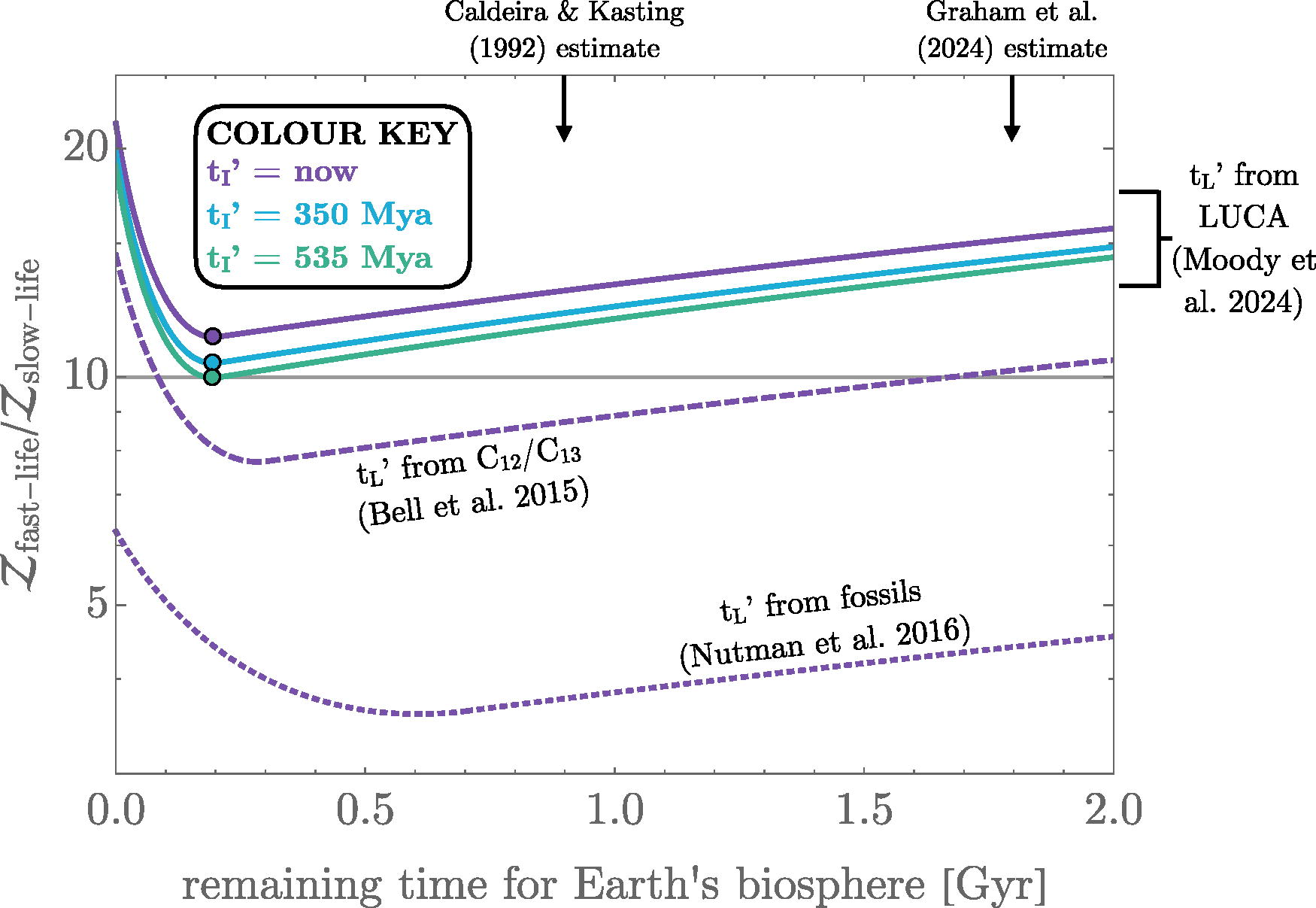
Odds ratio of the hypotheses that abiogenesis is a fast versus slow process. Each curve represents the odds ratio, computed using Equation 1, as a function of the biosphere’s ultimate lifespan, T—although we have subtracted off the modern epoch to yield remaining time on the x-axis. Previous estimates (Bell et al., 2015; Nutman et al., 2016) for the earliest evidence of life yield the dotted and dashed lines, but the new LUCA date of 4.2 Gya (Moody et al., 2024) greatly improves the odds factor. Indeed, the three solid lines show how the odds are always above 10:1 irrespective of how one chooses T or indeed fairly extreme choices (Carboniferious and Cambrian period) for the earliest civilization on Earth, t′ I —evident by the circles which denote the minima. LUCA, Last Universal Common Ancestor.
The result is even more robust than this, though. For one might also contest t′ I . The Silurian hypothesis suggests that a civilization could have emerged as early as the Carboniferous period (350 Mya), and we would have no record of its existence today (Schmidt and Frank, 2019). Figure 1 reveals that even this scenario leads to a minimum odds factor 2 of 10.4:1 for all possible T. Finally, perhaps the most extreme possibility is a civilization emerging during the Cambrian explosion (535 Mya), the very start of complex life on Earth. Yet even this scenario still has a minimum odds factor of 10.0:1. The LUCA date is so far back that its effect overwhelms the weak anthropic principle, as well as any plausible variations on the other parameters involved.
Our work assumes that life began on Earth rather than via panspermia. Consider instead that life began on Mars and then transferred to Earth. The cooling timescale is proportional to planetary radius, and thus if Earth cooled from the Moon-forming impact (4.48 Gya [Canup et al., 2023]) to oceans in ∼76 Myr (Wilde et al., 2001), then Mars could have cooled in 40 Myr and had oceans no earlier than 4.50 Gya. The latest (most pessimistic) abiogenesis date would be the LUCA value, giving
There are two caveats to the main result presented. First, the LUCA date is a recent result that may not stand up to scrutiny; our result is conditional in this sense. Second, our result does not establish that life is common, since Earth’s conditions could be incredibly rare (Ward and Brownlee, 2000). Our next task is clearly to look out and address this question: How common are conditions analogous to those of Earth?
Footnotes
Acknowledgments
D.K. thanks donors Douglas Daughaday, Elena West, Tristan Zajonc, Alex de Vaal, Mark Elliott, Stephen Lee, Zachary Danielson, Chad Souter, Marcus Gillette, Tina Jeffcoat, Jason Rockett, Tom Donkin, Andrew Schoen, Reza Ramezankhani, Steven Marks, Nicholas Gebben, Mike Hedlund, Leigh Deacon, Ryan Provost, Nicholas De Haan, Emerson Garland, Queen Rd Fnd Inc, Scott Thayer, Ieuan Williams, Xinyu Yao & Axel Nimmerjahn. He is also grateful to organizers of the inaugural “Astrobiology and the Future of Life Meeting” in Houston, from which talks and conversations inspired this article.
Code and Data Availability
No code was produced for this article.
Author Disclosure Statement
No competing financial interests exist.
Funding Information
No funding was received for this article.
Appendix
Associate Editor: Christopher P. McKay