




Abstract
Background:
Social communication difficulties are a clinical characteristic of autism, but social interactions are reciprocal in nature and autistic individuals' social abilities may not be the only factor influencing their social success. Nonautistic individuals' social perceptions and behavior also contribute to autistic individuals' social difficulties. Previous research has identified that nonautistic individuals' perception of autistic individuals is influenced by autism knowledge and the quantity and quality of exposure to autistic people. The current research aimed to examine how autistic adults are perceived by high school students, assess whether quality and quantity of autism contact predicts these perceptions, and explore whether these perceptions are malleable.
Methods:
One hundred fifty-one senior high school students (15–19 years old) completed the First Impression Scale after viewing video recordings of 20 autistic and 20 nonautistic adults in social situations, either before or after viewing a 50-minute educational presentation detailing the everyday experiences of autistic people and participating in a question-and-answer session. We assessed students' prior experiences with autistic people using the Quantity and Quality of Contact Scale and their own self-perceived social competence using the Multidimensional Social Competence Scale.
Results:
Consistent with previous studies, students rated autistic adults less favorably than nonautistic adults. However, the educational presentation produced modest but significant improvements on these ratings, with students who viewed the presentation rating autistic adults as more attractive and likable and reporting greater social interest in them compared to those who had not yet viewed the presentation. Furthermore, consistent with a double empathy framework, exploratory analyses indicated that self-reports of greater social competence among students was associated with greater bias against autistic adults, whereas reports of higher quality interactions with autistic people were associated with less bias.
Conclusion:
Previous research has demonstrated that nonautistic adults evaluate autistic people less favorably and report lower social interest in them relative to nonautistic controls. In this study, we extend these findings to adolescents but find these biases are somewhat malleable, with education about autism exerting some modest benefits. Changing nonautistic attitudes about autistic differences may provide an avenue for improving interactions for autistic individuals without putting the onus on autistic individuals to change or mask their behavior and identity.
Community brief
Why is this an important issue?
Nonautistic people often have negative views or biases about autistic differences. These biases contribute to the “Double Empathy Problem,” where the attitudes, misunderstandings, and behaviors of nonautistic people can add to the social challenges faced by autistic people. However, we do not know how and why these negative biases develop, and more research is needed to understand when they appear, what factors contribute to them, and whether they can be changed.
What was the purpose of this study?
We wanted to look at whether nonautistic teenagers at high school share the same biases toward autistic people that have previously been shown in adults. We then wanted to see if we could improve nonautistic teenagers' views of autistic people by teaching them about what being autistic means. We were also curious whether high school students who have spent more time with autistic people would view autistic people more positively. Finally, we were interested in whether nonautistic people's views of autistic people depend on how they viewed their own social skills.
What did the researchers do?
High school students (15–19 years old) viewed an educational presentation describing the everyday experiences of autistic people and took part in a question-and-answer session about autism. They also made judgments about 20 autistic and 20 nonautistic adults in videos, such as whether they thought the person in the video was likable or awkward, and if they would hang out with them or not. Half of the students made these judgments before viewing the presentation and the other half did this after viewing the presentation. This allowed us to see whether the educational presentation could change high school students' attitudes about autistic people. The high school students also filled out questionnaires about their experiences with autistic people and their own social skills, so we could assess whether these things were associated with attitudes about autistic people.
What were the results of this study?
Students viewing the educational presentation first rated autistic adults as more attractive, likable, and said they would be more interested in hanging out with them compared with the students who had not yet viewed the presentation. Students who reported higher quality experiences with autistic people in the past judged autistic people in the videos more positively, but those who thought they personally had strong social skills judged the autistic adults more negatively.
What do these findings add to what was already known?
We previously knew that nonautistic adults have negative attitudes toward autistic people. In this study, we show that nonautistic high school students also show negative attitudes toward autistic people. More importantly, we also find that these views can be improved somewhat by a presentation about autism. We also show that nonautistic adolescents who say they are the most socially skilled rate autistic people the most negatively. This may be because they are the most likely to value “typical” or “normative” social skills and be more judgmental about those who socialize in a different way.
What are the potential weaknesses in the study?
Students only rated autistic people from videos. We are not sure if the results would have been the same if the students were judging autistic people in real life or directly interacting with them. We also do not know if the judgments would be different if we had used different autistic adults or a more diverse sample. For instance, none of the autistic adults in the videos had an intellectual disability.
How will these findings help autistic adults now or in the future?
These findings suggest that educating about autistic lives and high-quality contact with autistic people may be tools for improving the attitudes of nonautistic adolescents. This stage in life may be particularly important for improving the acceptance and inclusion of autistic people, as late adolescence is when many autistic people are beginning the transition to adulthood and their well-being may be increasingly affected by their experiences with nonautistic people.
Introduction
Autism is clinically characterized by differences in social behavior and communication. 1 Autistic people often experience difficulty interacting and developing friendships with nonautistic peers 2 despite expressing strong desires to fit in and form social connections.3,4 Peers frequently view autistic differences negatively, 5 and autistic people are at high risk for social isolation, victimization, and bullying. 6 For example, the majority of autistic children experience bullying, 7 and autistic adolescents and adults experience mental health problems,8,9 including anxiety, depression, and suicidality.10,11
Autistic people's social difficulties have historically been attributed to autistic differences in social behavior and communication with treatment approaches focused on altering or normalizing these differences. 12 However, social interactions are bidirectional and recent evidence suggests that nonautistic people's biases can significantly impact the quantity and quality of social experiences for autistic people. 5
Nonautistic people hold strong negative perceptions of autistic individuals that are associated with a reluctance to interact with them.5,13–16 Autistic people may experience negative social experiences as a result of these biases, contributing to a decline in mental well-being. 17 For example, when both nonautistic children (aged 10–16 years) and adults viewed brief video clips of young autistic and nonautistic adults behaving in social situations, first impressions of the autistic individuals were far less favorable than impressions of the nonautistic people. 5
Autistic adults were rated as more awkward, less attractive, and less likable, and raters were less likely to want to hang out with, sit next to, or talk to them. This research suggests that nonautistic peers' social perceptions, judgments, and decisions may contribute to the social difficulties experienced by autistic individuals. 5 Given these findings, it is important to better understand the factors contributing to nonautistic peers' negative perceptions of autistic people and whether these perceptions are malleable. Such understanding may help develop strategies to improve these perceptions or mitigate their consequences for autistic people.
Both nonautistic individuals' quantity (i.e., frequency) and quality (i.e., positivity) of interactions with autistic individuals are associated with nonautistic individuals' acceptance and inclusion of autistic individuals.15,18–20 For example, in studies investigating college/university students' openness to peers with autistic characteristics, students with first-degree autistic relatives 18 and students with greater contact with autistic individuals 19 were more open to interacting with a hypothetical student with autistic characteristics.
Nonautistic individuals' attitudes toward autistic individuals16,20–22 have also been found to improve when informed of the persons' diagnostic status. 16 However, when nonautistic raters hold stigmatizing views toward autism, providing their diagnosis worsens their judgments of autistic people, 15 demonstrating that the evaluator's autism knowledge and familiarity influence the effect of disclosure.
Acceptance of autistic individuals has also been shown to be related to autism knowledge15,23 and to improve after autism knowledge 24 and acceptance 25 training. For example, college (university) students showed less stigmatized views of autism and increased autism knowledge after a training program providing information about the diagnostic criteria, prevalence, and etiology of autism and challenges experienced by autistic people. 24
Nonautistic peers' negative perceptions of autistic individuals may in part relate to nonautistic individuals' lack of awareness and understanding of social communication differences in autism. 19 Educating nonautistic people about autistic traits and increasing nonautistic individuals' quality contact with autistic individuals may increase understanding and acceptance of autistic differences. Thus, the quality and quantity of contact with autistic individuals, autism knowledge, and (under certain conditions) diagnostic disclosure all appear to be factors that contribute to and may help to improve perceptions of autistic individuals.
Previous research has examined how nonautistic peoples' experience with, and knowledge of, autistic people correspond to their perceptions of autistic people. However, little research has examined how the social characteristics of the perceiver relate to their attitudes toward autistic people. One factor, the self-perceived social abilities of the rater, might be particularly relevant. Traditional assumptions of social ability as an individual characteristic might predict that nonautistic people with higher levels of normative social competence would be more favorably inclined toward autistic people, as social competence often comprised “demonstrating empathetic concern” and social motivation. 26
This, however, is not always found in practice when examining interactions between autistic and nonautistic people. Individual performance on measures of social motivation, social skill, and social cognition have been shown to be largely unrelated to interaction outcomes. 27 A double empathy framework 28 emphasizes how disparities in experiences, expectations, and communication preferences between autistic and nonautistic people create a divide that hinders social connection and understanding. From this perspective, nonautistic people reporting higher levels of normative “social competence” (e.g., higher social motivation, social inferencing, and verbal and nonverbal communication skills) may perceive greater discrepancies between their own social behaviors and those of autistic people, thereby leading to an even greater “double empathy” gap and poorer evaluations.
To date, research on nonautistic peoples' perceptions of autistic people has mainly focused on adults.5,14–16 High school students who are typically between the ages of 15 and 19 years are approaching emerging adulthood. This is a developmental stage characterized by increased tolerance, acceptance, and openness to diversity, 29 suggesting their perceptions of autistic individuals may be highly malleable. Furthermore, many senior high school students are about to transition to university or college. An increasing number of young autistic adults are academically prepared for university or college, 30 but struggle with the transition 3 and often drop out 31 despite their cognitive and academic abilities.
Autistic students' lower success in higher education settings may in part relate to social exclusion and poor understanding and autism acceptance from other students. 24 Thus, it is of particular interest to investigate whether senior high school students' perceptions of autistic individuals might be malleable. If their perception is malleable, autism education may have the potential to influence the way high school students perceive autistic individuals. This may then have a positive impact on the higher education and/or work experience of autistic individuals.
The current research examines how autistic adults are perceived by high school students, it assesses whether quality and quantity of autism contact predict these perceptions and explores whether these perceptions are malleable. To assess malleability, this study provides a preliminary evaluation of the efficacy of an educational presentation about autism aiming to improve high school seniors' perceptions of autistic adults, as increased autism knowledge may be a mechanism by which perceptions of autistic people may be improved. In addition, we explore whether students' quantity and quality of experience with autistic people, as well as their own self-reported social competence, are associated with perceptions of autistic people.
Methods
Participants
One hundred and fifty-one senior high school students between the ages of 15 and 19 years (M = 17.27, standard deviation = 0.60; 102 females) participated (Table 1). Students volunteered to participate while visiting the university campus to learn more about psychology research and university life. Data were collected across four field trips between December 2017 and May 2019. Participants and their parents provided informed consent for their participation. All procedures were approved by Simon Fraser University's Research Ethics Board and were in accordance with the World Medical Association 2013 Declaration of Helsinki.
Descriptive Statistics and Participant Demographics
The quantity of contact score was based on the sum of “yes” responses to 12 questions that inquired as to possible exposure to autistic people.19,33 Quantity of contact scores can range from 0 (no exposure) to 12 (exposure in many contexts). The quality of contact score was based on the sum of six items inquiring as to the students' level of enjoyment when spending time with autistic people.19,34 Quality of contact scores can range from 9 (no enjoyment) to 54 (high enjoyment).
Quality of contact is based on 45 (60%) and 40 (53%) of students, respectively, who had more than passive contact with autistic individuals.
MSCS, Multidimensional Social Competence Scale; SD, standard deviation.
Procedure
Before each field trip, members of the research team visited the participants' high school. All attending students completed consent forms and demographic questionnaires. We assigned participants to the “Presentation First” or “Presentation Last” group based on the information provided on the quality and quantity of contact forms, in such a manner that the mean quality and quantity of contact with autistic individuals was approximately equal across the two experimental groups (Table 1). We matched every student with another student with similar exposure to autistic people, to ensure the experimental groups were comparable, and then randomly assigned each member of the pair to the presentation first or last group.
The research team met with the participants and assigned them to their experimental group upon their arrival to campus. We informed the participants that due to the large number of students attending the field trip, half would start with a presentation about research (presentation first group), whereas the other half would participate in a research study (presentation last group). They were also told that the groups would then switch locations so that each student would receive the opportunity to see the research presentation and participate in the research study. This procedure enabled us to examine the potential malleability of high school students' perceptions by comparing whether responses collected during the research component differed as a function of exposure to the educational presentation.
Participants sat in a classroom and watched the educational presentation (described hereunder). The presentation lasted ∼50 minutes, with an additional question-and-answer session held immediately afterward.
During the research study component of the experiment, participants completed the “Thin Slice” paradigm 5 followed by the Multidimensional Social Competence Scale 32 (MSCS) on a private desktop computer with headphones. We positioned participants in such a manner that they were unable to observe other students or their responses. After students completed both the presentation and research component of the study, we debriefed them about the purpose of the study.
Materials
Quantity of contact questionnaire
We assessed participants' contact with autistic people using the quantity of contact questionnaire, adapted by Gardiner and Iarocci 19 from Holmes et al., 33 which contains 12 items assessing the variety of contexts in which participants have contact with autistic people. Questions include items such as “My job includes providing services to persons with autism” and “I have a relative who has autism.” (Note: The person-first language used in the Quantity and Quality of Contact questionnaires are native to these measures and are quoted here verbatim to reflect how they were encountered by participants in the study). Participants provided “yes” or “no” answers to each statement.
The frequency of “yes” responses was tallied and used as the quantity of contact score, with higher scores indicating contact across a larger number of contexts. A subset of the questions are related to passive or no contact, including “I have watched a movie or television show in which a character depicted a person with autism,” “I have observed, in passing, a person I believe may have had autism,” “I have never observed a person that I was aware had autism,” and “I have watched a documentary about autism.” If a student only endorsed these passive contact questions, but none of the direct contact questions, they are classified as having no direct contact with autistic people.
Quality of contact questionnaire
We assessed participants' quality of previous contact with autistic people using the quality of contact questionnaire, adapted by Gardiner and Iarocci 19 using a questionnaire initially designed by McManus et al. 34 containing six items. Sample items include “I have enjoyed the experiences I have had with people with autism” and “I have had many positive experiences with individuals with autism.” Participants responded using a 9-point Likert scale ranging from strongly disagree (1) to strongly agree (9). Only students who indicated they had previous direct contact with autistic individuals received a quality of contact score. Higher scores indicate higher quality experiences. The reliability of this scale was good, with Cronbach's alpha = 0.855 for the current sample.
Autism education presentation
The senior author (G.I.) designed the educational presentation in collaboration with the first (N.E.S.) and second author (T.Q.B.) and other members of the research team, including two autistic research assistants. The presentation focused on verbal and nonverbal communication differences, sensory processing differences, repetitive behaviors, restricted interests, and cognitive and affective empathy differences commonly observed in autistic individuals. The topics addressed included information about how these differences might appear for autistic people with diverse support needs.
The presentation also included a discussion on neurodiversity, autistic strengths, bullying of autistic individuals, and difficulties autistic individuals have in educational settings. For each of these concepts, we emphasized how autistic differences might create challenges for autistic individuals who are trying to socialize and form friendships with nonautistic peers. Each section also included a component that addressed ways that nonautistic individuals can be more respectful and supportive of the needs of their autistic peers, using a universal design framework.
Three videos were shown of (1) an autistic male talking about what he does in his free time and how stimming behaviors are an important part of his everyday routine, (2) an autistic female speaking about the difficulties she experiences communicating with others, and (3) a nonautistic father speaking to his autistic son. These videos provided first-hand accounts of how being autistic can influence social behaviors and interactions. The video of the autistic male was created for this presentation. He consented for it to be included. The videos of the father and the autistic female were in the public domain and were accessed through a link to YouTube during the presentation.
The high school students' understanding of autistic behaviors that may appear odd to nonautistic individuals was the focus when designing the educational presentation. For example, the presentation explained that autistic individuals might wear noise-cancelling headphones, or similar clothing every day, to help with their sound and tactile sensitivities, respectively. Other examples included a discussion of stimming behaviors and how they may reduce sensory overload and anxiety, or how asking about an autistic individual's special interest(s) may provide a great way to engage in a conversation with them.
Given the presenters either had autistic sibling(s), had worked closely with autistic people, or both, the explanations provided in the presentation included many first-hand accounts of experiences the presenters had with autistic individuals. Thus, rather than listing off facts and statistics, the educational presentation provided insight into how autistic individuals may experience everyday environments differently, and how this might influence their social experiences.
Thin slice paradigm
High school students viewed the Thin Slice Paradigm, 5 which includes videos of autistic (20) and nonautistic (20) adults (“stimulus participants”) presented in a randomized order completing the “High-Risk Social Challenge” task. 35 Autistic and nonautistic adults in these videos were comparable on biological sex (17 males in each group), age (autistic mean = 24.5 years, nonautistic mean = 25.0; p = 0.786), and full-scale IQ (autistic mean = 106.4, nonautistic mean = 110.5; p = 0.293). Each video presents the first 10 seconds of social behavior (i.e., a “thin slice” 36 ) occurring after any content-free introduction (see Sasson et al. 5 for details regarding the stimulus participants, video creation, and paradigm validation). After each video, participants rated the stimulus participant using the First Impression Scale 5 (FIS).
The FIS consists of 10 items, 6 of which assess perceived traits of the stimulus participant (attractive, awkward, intelligent, likable, trustworthy, and dominant/submissive) and 4 assessing the rater's behavioral intentions and social interest toward the stimulus participant. Behavioral intentions included how willing the participant was to live near the stimulus participant, their likelihood of hanging out with the stimulus participant, their level of comfort sitting next to the stimulus participant, and their likelihood of starting a conversation with the stimulus participant. Participants rated items on a Likert scale ranging from 0 to 3, with higher scores indicative of more positive impressions of the stimulus participant, thus ratings for “awkward” and “dominant” were reverse-scored, as being less awkward and less dominant are associated with more positive impressions. 5
Multidimensional Social Competence Scale 32
The MSCS 32 is a psychometrically validated 26 77-item self-report questionnaire assessing the respondent's social competence across seven domains: social motivation, social inferencing, demonstrating empathic concern, social knowledge, emotion regulation, verbal conversation skills, and nonverbal sending skills. Participants answer each item using a 5-point rating scale (1 = Not True or Almost Never True, 5 = Very True or Almost Always True) with 32 reverse-scored items. In this study, higher total MSCS scores are presumed to reflect better overall social competence. In the current sample, the MSCS total score had good internal consistency indexed by a Cronbach's alpha of 0.931.
Statistical analyses
We used Multi-Level Modeling with Restricted Maximum Likelihood estimation to examine whether the autism education presentation influenced perceptions of autistic adults among high school students. Because each participant rated multiple stimulus participants, we used a cross-classified random-effects model appropriate for analyzing crossed and nonindependent data.
For each of the 10 trait or behavior ratings (dependent variables), we estimated the fixed effects of the experimental condition (presentation first and presentation last) and the diagnosis of the stimulus participant (autistic and not autistic), as well as the interaction between the experimental condition and the diagnosis of the stimulus participant. We initially included quality of contact, quantity of contact, and MSCS scores as fixed factors but later removed them from the model because they did not contribute to the best-fit model. The model treated student participant and stimulus participant as random effects.
To explore relations between First Impression Ratings and quantity of contact, quality of contact, and social competence for each participant, we calculated an autism bias score by taking each participant's mean rating of the 10 FIS items across the autistic stimulus participants and subtracting it from each participant's mean rating of the 10 FIS items across the nonautistic stimulus participants, with higher resultant values indicative of a larger negative bias toward autistic individuals. We then explored associations between the participants' autism bias scores and their mean scores on the quantity of contact, the quality of contact, and the MSCS questionnaires using Pearson's correlations.
Results
High school students' perceptions of autistic people
To investigate whether the high school students exhibited negative perceptions of the autistic relative to nonautistic stimulus participants, we examined the fixed effect of the diagnosis of the stimulus participant (autistic and not autistic) (Table 2). Overall, the high school students rated autistic people as more awkward (β = −0.80, p < 0.001), less attractive (β = −0.49, p < 0.001), less dominant (β = 0.29, p = 0.007), less likable (β = −0.24, p < 0.001), and less smart (β = −0.14, p = 0.019) than nonautistic people. The high school students also indicated that they had less desire to live near (β = −0.11, p = 0.009), hangout with (β = −0.38, p < 0.001), sit near (β = −0.16, p < 0.001), or have a conversation with (β = −0.34, p < 0.001) autistic stimulus participants than nonautistic stimulus participants.
Fixed Effects of Experimental Condition, Diagnosis of Stimulus Participant, and Their Interaction, on First Impression Ratings
Bold values indicate significance at p < 0.05.
The malleability of high school students' perceptions of autistic people
To investigate the potential for an autism presentation to influence high school students' perceptions of autistic people, we examined the fixed effect of experimental condition (presentation first and presentation last), as well as the interaction between experimental condition and the diagnosis of the stimulus participant (Table 2). The fixed effect of the experimental condition indicated that overall ratings of stimulus participants (combined across autistic and nonautistic stimulus participants) did not significantly differ between high school students who viewed the autism education presentation before or after providing their ratings.
However, the interaction between the experimental condition and the diagnosis of the stimulus participant was modestly significant for ratings of attractiveness (β = −0.05, p = 0.042), likability (β = −0.06, p = 0.029), willingness to hang out with (β = −0.06, p = 0.028), and willingness to sit near (β = −0.06, p = 0.026) the stimulus participant. Follow-up models investigated the significant interactions by comparing the ratings of the autistic and nonautistic stimulus participants separately across the experimental conditions.
However, we only identified nonsignificant trends that should be interpreted with caution: High school students who watched the autism education presentation before evaluating stimulus participants trended toward rating the autistic stimulus participants as slightly more attractive (β = −0.12, p = 0.073), and slightly more likable (β = −0.10, p = 0.075), and being slightly more willing to hang out with them (β = −0.11, p = 0.083), relative to the high school students who watched the autism education presentation after providing their ratings.
Exploratory analyses: factors related to high school students' perceptions of autistic people
Figure 1 depicts autism bias scores for the sample. Exploratory Pearson's correlations examined the relationship between these autism bias scores and the social competence of the high school students. Overall, total MSCS scores were positively correlated with autism bias, r(142) = 0.211, p = 0.011, indicating that students with higher social competence rated the autistic stimulus participants more negatively.
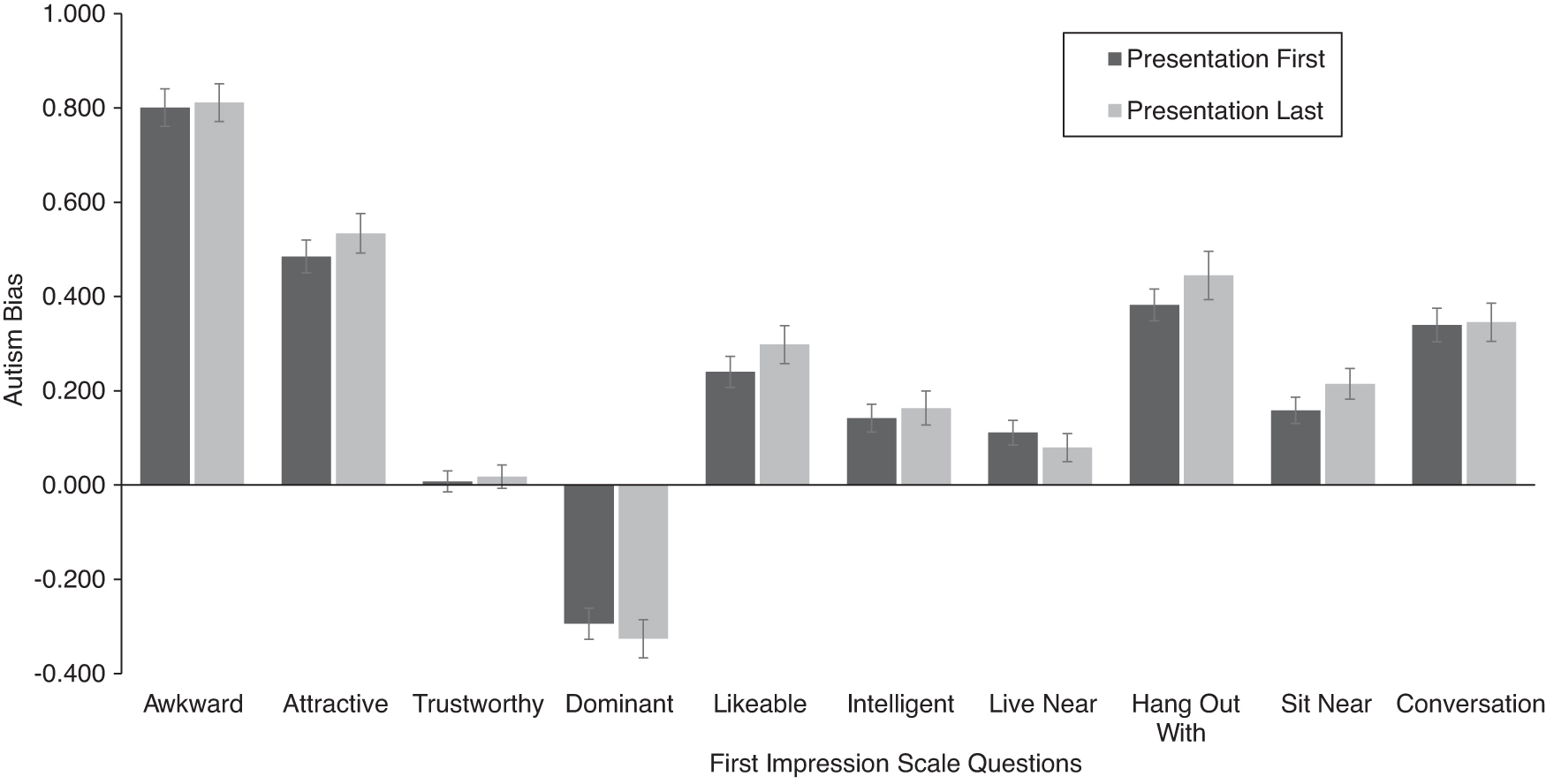
Autism bias scores across the First Impression Scale questions for high school students who viewed the presentation first (dark gray) or presentation last (light gray). Autism bias was calculated by subtracting the ratings of the videos of autistic adults from the ratings of the videos of nonautistic adults. Thus, positive autism bias scores are indicative of more positive ratings of nonautistic videos, whereas negative scores are indicative of more positive rating of autistic videos.
For quantity of contact, 1 student (0.7%) reported that they had never observed a person that they were aware was autistic, 65 students (43.1%) stated they had only watched a movie or TV show about autism or believed they had only observed an autistic person in passing. Of those with personal contact with autistic people, 53 students (35.1%) reported having an autistic family friend, 33 students (21.9%) worked with an autistic person, 17 students (11.3%) reported having an autistic relative, 2 students (1.3%) lived with an autistic person, and 1 student (0.7%) indicated they were autistic. Correlational analyses indicated that higher quality of contact ratings were associated with reduced autism bias, r(83) = −0.278, p = 0.010 (Fig. 2).

Scatterplots of autism bias scores. The relationship between MSCS, quality of contact, and quantity of contact and autism bias. Autism bias was calculated by subtracting the ratings of the videos of autistic adults from the ratings of the videos of nonautistic adults. Thus, positive autism bias scores are indicative of more positive ratings of nonautistic videos, whereas negative scores are indicative of more positive rating of autistic videos. Quality of contact scores were only included for students who indicated they had more than passive contact with autistic people (n = 85). MSCS, Multidimensional Social Competence Scale.
Discussion
Autism knowledge and the quantity and quality of exposure to autism are factors previously found to relate to more positive perceptions of autistic people. To explore the malleability of high school students' perceptions of autistic people, we developed an autism education presentation and found that it modestly improved high school students' perceptions of autistic adults.
Students exposed to an educational presentation about autism before completing the “thin slice” task provided slightly more favorable impressions of autistic adults across many items. They rated autistic adults slightly higher on attractiveness and likeability and expressed greater interest in hanging out with and being around them. However, these findings should be treated with caution. Overall, these students still rated autistic adults much less favorably than nonautistic ones regardless of the presentation. These findings replicate previous studies in adult samples and extend them into a high school sample.
Malleability of perceptions of autistic adults
Although effects of the education presentation were modest in size, they add to a growing body of evidence that autism education for nonautistic people can reduce stigma and negative perceptions of autistic individuals.15,23–25 Furthermore, these results suggest that nonautistic people's perceptions of autistic people are potentially malleable and may be improved through the mechanism of education about autistic people. Such benefits may even extend to in-person social interaction between autistic and nonautistic people, 37 but questions remain as to whether education produces sustained benefits over time or is sufficient for improving underlying implicit beliefs about autism. 25 Regardless, the findings reported in this study suggest that high school seniors' perceptions of autistic people are malleable and amenable to change.
High school students may be a particularly important group to target with autism education because they are at a developmental stage characterized by increased tolerance, acceptance, and openness to diversity. 29 Furthermore, many high school students are about to enroll in college, university, or enter the workforce. These transitions are particularly challenging for autistic people and some of their difficulties have been attributed to a lack of social support. 24 Thus, improving senior high school students' perceptions of autistic people may promote positive social relationships between autistic and nonautistic people and have downstream effects on autistic individuals' success in higher education and/or workplace settings.
However, high school students' perceptions were only modestly improved across our experimental conditions by the educational presentation and further research is required to better understand the most effective way to reduce autism bias. Given the aim of this study was to examine whether high school students' perceptions of autistic people are malleable, future research should aim to evaluate changes in autism knowledge after exposure to the presentation using a more structured intervention protocol to provide more causal support for the link between education and changes in perception. In addition, we are interested in exploring whether including autistic presenters may influence the impact of the information.
Given that psychosocial interventions designed to coach autistic adults into demonstrating more normative social behaviors have produced limited real-world benefits 38 and may even encourage masking behaviors that are associated with adverse psychological outcomes, 39 alternative approaches that shift the focus to increasing accommodation and acceptance of autistic differences may represent a more effective way for autistic individuals' social outcomes to be improved. Many “atypical” social behaviors shown by autistic people are often adaptive strategies implemented to cope with challenging environments given autistic individuals' neurobiological differences. 40
For example, stimming behaviors may help manage anxiety in sensory-rich environments, 41 and differences in social behavior such as reduced eye contact may be an adaptive response to sensory sensitivities. 42 Improving nonautistic individuals' understanding of these behaviors, whether indirectly through education about autism or directly through high-quality contact, may provide nonautistic people with explanations for social presentations perceived as “atypical” and help promote more positive perceptions and inclusive attitudes.16,20–22
Individual differences in perceptions of autistic adults
Among high school students, exploratory analyses highlighted several characteristics that were associated with perceptions of autistic adults. Those who self-reported higher social competence rated autistic adults more negatively. Such a finding at first glance may seem counterintuitive. Social competence, as measured in this study by the MSCS, 32 consists of domains such as empathetic concern, social motivation, and social inferencing, all of which might be expected to relate to greater social acceptance of autistic people.
However, conceptualizing oneself as high on social competence may be associated with a greater privileging of normative social skills, behaviors, and rules. 32 Given that autistic adults can differ in their social communication and behavior, the social presentation of the autistic adults in this study may have diverged from these students' social preferences and expectations. In a sense, students who report being more socially competent may perceive a larger discrepancy between themselves and the autistic people they are rating, leading to greater disapproval and reduced social interest.
The correlation found between self-reported social competence and judgments of autistic people can also be viewed from the other direction: high school students who rated their own social competence lower had more positive impressions about the autistic adults they rated. Such a finding is consistent with a double empathy framework 28 positing that social alignment between people is a greater predictor of understanding and connection than individual characteristics. For instance, autistic adults often communicate more effectively 43 and develop greater rapport with each other44,45 than with nonautistic people. The findings in this study provide additional evidence that impressions of autistic raters are not simply a product of their own social characteristics, but also those of the people evaluating them.14,15
Such an interpretation is further supported by findings indicating that high school students with a higher quality of contact with autistic people evaluated autistic adults more favorably. Almost half of the students in the sample had no known personal contact with autistic people, reporting that the extent of their exposure to autistic people was limited to depictions in television and movies, and/or seeing an autistic person in passing. Of the students who reported personal contact with autistic people, however, family friends, and coworkers/peers were the most common relationships.
Although quality of contact, which measures previous positive experiences with autistic people, predicted lower autism bias, the quantity of contact did not. This may have occurred in part because the scale used may have provided a poor index of the overall frequency of contact as it assessed the number of contexts in which the students were exposed to autistic people rather than the amount of contact. Nonetheless, this discrepancy suggests that type, rather than context, of autism contact, may be associated with more inclusive and favorable attitudes toward autistic differences.
Mere exposure to an autistic person may not be sufficient. Rather, the development of meaningful and positive connections to autistic people among nonautistic peers seems particularly important for diminishing autism bias. This finding highlights the importance of inclusion, acceptance, and the facilitation of high-quality interactions between autistic and nonautistic individuals to improve the social experiences of autistic people within predominantly nonautistic environments. Importantly, although these results suggest the social competence of the perceiver and higher quality contact with autistic people are related to perceptions of autistic adults, this aspect of the study was exploratory, and thus it is important that these findings are replicated by hypothesis-driven research.
Limitations
Several limitations should be considered when interpreting the results reported in this study. First, the thin-slice paradigm used in this study includes a relatively small sample of autistic adults (n = 20), who did not have additional intellectual disabilities and could communicate verbally. It is unclear whether these perceptions would generalize to other autistic individuals. This concern is reduced somewhat by similar findings in other studies of first impressions of autistic people that use distinct samples,46,47 but replication in larger and more diverse samples is encouraged.
Second, autism knowledge was not measured in this study, and it is possible that it differed across our experimental groups and influenced results. However, because the groups did not differ in their quality and quantity of contact with autistic people, and all participants attended the same high school and were in the same grade, it is unlikely autism knowledge would have differed between groups. Furthermore, since autism knowledge was not measured before and after the educational presentation, this limited our ability to examine changes in autism knowledge as the mechanism by which the students' perceptions were improved after the educational presentation.
Third, the quantity of contact with autistic people was relatively low in our sample, with 44% of the sample reporting only passive exposure to autistic individuals. This lack of exposure may have limited our ability to detect a relationship between the quantity of exposure and autism bias. In addition, the questionnaire used to measure the quantity of contact assessed the different contexts in which the students were exposed to autistic people, not how often exposure occurred within these contexts. Thus, the relationship between the quantity of contact and autism bias may be confounded and warrants further investigation.
Relatedly, despite the high school students' robust negative perceptions of the autistic adults in the videos in this study, it is unclear how these judgments would relate to these high school students' behaviors in real-life encounters with autistic adults and whether changes in perceptions as a result of the educational presentation would result in behavioral changes in a real-world context. Prior research suggests impressions formed during real-world interactions are similar to those formed from passive observation of video stimuli,37,48 but this was not tested with the current sample. Future study should continue to push for more ecological assessments of nonautistic peoples' biases and social interaction within real-world contexts. Given this study only contained high school students, the generalizability of the results to other populations is unclear.
In addition, it is also possible that the decrease in autism bias after the educational presentation may have been caused or influenced by methodological bias, including social desirability and/or detection bias. Students may have been motivated to appear more accepting of autistic differences after viewing the educational presentation even when underlying beliefs and attitudes had not changed. Indeed, a related study showing that educational programming reduces explicit but not implicit biases about autism 25 raises the possibility that social desirability does contribute to the reported effects. We attempted to minimize this by explicitly telling participants that their responses were deidentified and ensuring that they completed their responses privately, but this may not have completely removed social desirability pressures.
However, even if social desirability played no role in the reported effects, detection bias may have occurred in which effects were influenced by being in an education group rather than by the actual content of the education. Future studies should implement a comparison condition (e.g., an educational presentation unrelated to autism) to control for this possibility. Finally, effects reported in this study should be interpreted with caution because a traditional statistical correction for multiple comparisons was not applied.
Conclusion
The results of this study suggest that many nonautistic high school students demonstrate negative perceptions of autistic people, but these perceptions remain malleable and can be modestly improved using a brief educational presentation about autism. Furthermore, results also highlight that the self-perceived social competence of nonautistic people, and their quality of interactions with autistic people, are important factors related to the perception of autistic people.
Together, these results suggest that by improving nonautistic people's understanding of autistic social behaviors, whether through educational presentations or high-quality interactions, nonautistic people can revise their expectations of autistic social behavior. This change in nonautistic people's expectations may improve social interactions for autistic people, without putting the onus on autistic people to change their behaviors. These pressures have real consequences for the well-being of autistic people, and efforts that promote understanding and inclusion, or otherwise lessen these pressures, should continue to be a focus of research efforts.
Footnotes
Acknowledgments
We thank Dominic Trevisan, Madelaine Ressel, Ariel Cheng, Nicole Kauppi, and Spencer Angus, as well as the members of the Autism and Developmental Disabilities Lab who supported in the collection of these data. We also thank Desiree Jones and Dr. Robert Ackerman for their statistics consulting.
Author Disclosure Statement
No competing financial interests exist.
Funding Information
This work was supported by grants from the Fraser Health Network awarded to author Grace Iarocci, as well as a Natural Science and Engineering Research Council (NSERC) of Canada post-doctoral fellowship and a BrainsCAN Postdoctoral Fellowship at Western University, funded by the Canada First Research Excellence Fund (CFREF) awarded to Nichole Scheerer.