




Abstract
Background:
Previous research has often documented that friendship is an area of difficulty for autistic people, however this may be caused by a neurotypical understanding of friendship. The current study aimed at adopting a more inclusive account of friendship, involving an autistic participant group representing a range of genders and communication preferences while exploring the following question—What are autistic adults' perceptions of friendships?
Method:
Participants (n = 20) were interviewed using their preferred method of communication (speaking and non-speaking) during 2021–2022.
Results:
The results showed that three main themes emerged under an overarching theme of A Spectrum of Understanding: Identity with Others, Sharing Value, and Shared Presence. The inclusive approaches used in the current study allowed under-researched autistic groups such as non-speaking autistic people and autistic people who identify as non-binary to participate in meaningful research.
Conclusions:
The study offers a new perspective on the Double Empathy theory, suggesting it may be helpful to conceptualize it as a continuum of neuro-cultural learning rather than a distinctive binary centered on an autistic-allistic misunderstanding. Increased understanding of friendships in autistic groups will help to increase awareness of social belonging and support that can protect against poor mental health outcomes.
Community brief
Why is this an important issue?
For years, autistic perceptions of friendship have been viewed through a medicalized and neurotypical lens. Given the modern shifts away from a deficit-based medical model in autism research in response to the neurodiversity movement, it is important to understand autistic lived experiences as they are, rather than how neurotypical researchers think they ought to be.
What was the purpose of the study?
In this study, we are looking to better understand how autistic people themselves perceive and experience connections, such as friendship. Friendship is important for everyone, as it can provide a social support network and protect against poor mental health outcomes.
What did the researchers do?
The researchers interviewed 20 autistic people (including under-represented groups, such as trans, non-binary, and non-speaking autistic people) and asked about their perceptions of friendships.
What were the results of the study?
Three main themes emerged under an overarching theme of A Spectrum of Understanding. The three main themes are: (1) Identity with Others; (2) Sharing Value; and (3) Shared Presence. Identity with Others covers observations of friendships and being part of communities that value understanding while also encouraging learning to understand others. Sharing Value centers on how one feels within the friendship and how one values others. Finally, Shared Presence refers to the activities carried out within friendships that can help maintain these connections.
What do these findings add to what was already known?
The study offers a new perspective on the Double Empathy theory (Milton, 2012), which suggests that communication difficulties between autistic and allistic (i.e., non-autistic) are caused by mis-matched neurotypes. The current study extends this theory by considering neuro-cultural learning as part of a continuum, rather than a distinctive binary centered on an autistic-allistic misunderstanding.
What are potential weaknesses in the study?
Potential weaknesses in this study include the participant sample being from western countries; therefore, further research is needed to explore more intersectional facets, such as ethnicity and culture, in relationships and friendships. There was also a wide age range in the current sample, and future research may want to focus more on specific age groups to understand better how perceptions and experiences of friendships change across the lifespan.
How will these findings help autistic adults now or in the future?
The study offers a new perspective on the Double Empathy theory, highlighting the need to consider this as a continuum of understanding and learning and that misunderstandings can still take place in people of the same neurotype. The study also highlights how lockdowns during the COVID-19 pandemic have impacted relationships and that autistic people may need more support to tackle the adverse effects of isolation, given that friendships are valued by autistic people and protect against poor mental health outcomes. Overall, in contrast to a deficit-based perspective, this study shows that autistic individuals can have and maintain meaningful friendships with complex and nuanced conceptualizations, which ultimately center on the need to be/feel understood and to understand others. The researchers hope that this research will shed light on how friendships are perceived and experienced by autistic people, leading to increased awareness of social support needs, the importance of friendships for autistic individuals, and how further support is needed following the COVID-19 pandemic.
Introduction
Friendship has historically been viewed as an area of difficulty for autistic people due to the “social challenges” that are anchored within the clinical definition of autism. 1 Friendships are important for everyone, providing social and emotional support,2,3 which can protect against poor mental health outcomes.4,5 Friendship develops through interpersonal exchanges that begin at a superficial level during formation, with maintenance behaviors increasing intimacy and leading to close established friendships. 6
Maintenance behaviors (such as supportiveness and positivity) are particularly important when establishing the strength or quality of a friendship (e.g., best friends engage in increased levels of maintenance behaviors compared with those in close or casual friendships). 7
Research often reports that autistic people have fewer friendships, or friendships of lesser quality than their neurotypical peers.8,9 However, autistic people strive to create connections with others and have friendships.10–12 It is worth noting that the dominant friendship narrative is driven by neurotypical frameworks of friendship and understandings of “successful social interactions” 13 such as those friendship theories based on working models of attachment, 14 and socio-cognitive development. 15
This narrative is illustrated by the discrepancies in parent versus autistic child-reported friend numbers, with parents reporting lower numbers compared with their children.16,17 This discrepancy could potentially be explained by a mismatch of neurotypes' perceptions leading to differences in how friendships are perceived and quantified.
Neuronormative research's conceptualization of friendship and ways of communicating against neurotypical standards could be seen as problematic.18,19 Brownlow et al. 20 argue the need for neurodiverse conceptualizations of friendship, asserting that autistic individuals may have alternative ways of perceiving and experiencing friendship.
An autistic-centered and driven theoretical framework that can better conceptualize friendships in autistic people, known as the double empathy problem, has been proposed.21,22 Initial research supports this theory, showing that autistic people feel more comfortable and happier when interacting with other autistic stranger individuals than non-autistic stranger individuals,23,24 and autistic individuals transfer information more effectively with these other autistic partners than neurotypical partners. 25 This indicates that matched and mismatched neurotypes will impact how social interactions, friendships, and relationships are perceived and experienced.
In addition, research has shown gender influences on friendships in autistic groups similar to neurotypical patterns.16,26 In contrast to autistic girls reporting close friendships based on emotional sharing, talking, and time together, autistic boys state that their friendships are more activity-focused and practically supportive. 26 Moreover, another study found that autistic boys played with friends and autistic girls talked with theirs, allowing girls to maintain closer and more empathetic friendships. 16
This may also be influenced by increased levels of camouflaging reported in autistic girls and women,27,28 with gendered influences likely playing a role in how autistic girls develop friendships. 26 Research needs to engage intersectional frameworks and methodology further when exploring key issues such as relationships and friendships 29 to better understand social determinants of mental health and ultimately reduce mental health disparities. 30
This should include more autistic people who identify as trans and/or non-binary and/or gender fluid since gender influences seem to play a role in how friendships are perceived and experienced. By including underrepresented autistic groups in research, we can begin understanding more diverse experiences of autistic people.
Despite research that has shown that neurodivergent individuals spend more time online compared with neurotypicals,31,32 there is still a lack of research exploring online relationships in/for autistic people. Limited research to date has shown that neurodivergent individuals report better social interactions when online, as well as making friends.33–37 Further research is needed to explore whether friendships are perceived and experienced differently by autistic individuals, depending on whether they are online or in-person.
Most research exploring friendship in autism has focused on child and adolescent populations,17,26,38–40 binary gender influences, 26 or in-person friendships,41,42 meaning that intersectional perspectives of in-person and online friendships have to date been neglected. The current study aimed at adopting a more inclusive account of friendship, involving a participant group representing a more comprehensive range of genders and communication preferences while exploring their perspectives of online and in-person relationships with the primary research question—What are Autistic adults' perceptions of friendships?
Method
Inclusion/exclusion criteria
The researchers invited participants to take part in the study if they were an autistic adult (≥18 years old), proficient in English, and able to provide their own consent.
Participants
Four researchers (three neurotypical and one autistic researcher) carried out the Interviews. We interviewed the participants (n = 20) using their preferred method of communication (Table 1) during two waves of recruitment: we recruited 10 participants with 10 in Wave 1 (2020) and a further 10 participants in Wave 2 (2020/2021). The length of the interviews was between 20 and 60 minutes.
Participant Demographics
Note: names are pseudonyms.
HNC, higher national certificate; HS, high school; IF, identity first; NP, no preference.
The variation in communication preference (80% Verbal, 10% Textual and Verbal, 10% Textual) demonstrates a more accessible study design that accounts for autistic narratives, which are chronically underrepresented in qualitative research.43–45 For the first set of interviews conducted during Wave 1, researchers gathered a list of various autism charities to contact for recruitment purposes.
The researchers then emailed these charities with information and a link to the registration Qualtrics page requesting if they could share it with their members. Researchers also shared the link with information and a QR code on their own social media pages and different social media groups. For recruitment during Wave 2, researchers advertised the study on their own TikTok account (TikTok was used for the second wave of recruitment only). Participants' demographics are illustrated in Table 1. The researchers assigned pseudonyms to the participants that were not related to true identities.
Ethics
The researchers sought and obtained ethical approval from The University of Edinburgh before recruitment began. We took several ethical considerations into account, including extra care when wording participant information and consent forms. Also, to address the needs of participants who preferred to communicate via text, researchers asked participants to indicate any adjustment they might need to go through the interview.
The researchers also communicated participants' rights to withdraw their consent and delete all relevant data during the interview process and on the debrief form. All identifying forms underwent a de-identifying process where the researchers removed all identifiers and stored the forms in password-protected encrypted files on the university's secure servers.
Although we did not consider the subject to be distressing, there was still potential for participants to become distressed while discussing their personal lived experiences of friendship. Hence, the researcher conducted regular check-ins with the participant throughout the interview.
Procedure
Due to social distancing measures in response to COVID-19 restrictions, the researchers conducted interviews online via Skype and Microsoft Teams. Researchers recorded interviews using audio recorders, or the text was kept (from the text-only or combination interviews). We asked participants if they would like a copy of the interview questions beforehand and these were sent as requested (Supplemental_Interview Questions-Supplementary Data S1). We transcribed and formatted all textual and verbal data so that all transcriptions were in the same format before analysis.
We then thematically analyzed the transcripts following Braun and Clarke's 46 guide to conducting reflexive thematic analysis (Supplemental_Analysis-Supplementary Data S2). We took an inductive data-driven approach when generating the initial codes, as this fits with the exploratory nature of this study. The researcher used NVivo software to code transcripts and aggregate them into themes and subthemes.
Following initial exploration and theme reports, the researcher produced a developed thematic map using PyDot (Fig. 1), as the textual nature of developing maps with code aided in highlighting connections between potential themes and collapsing overlapping themes into one item. Ultimately, this process reviewed and accounted for reflection on initial themes; the researcher then reviewed transcripts to ensure themes reflected the participants' narrative(s).
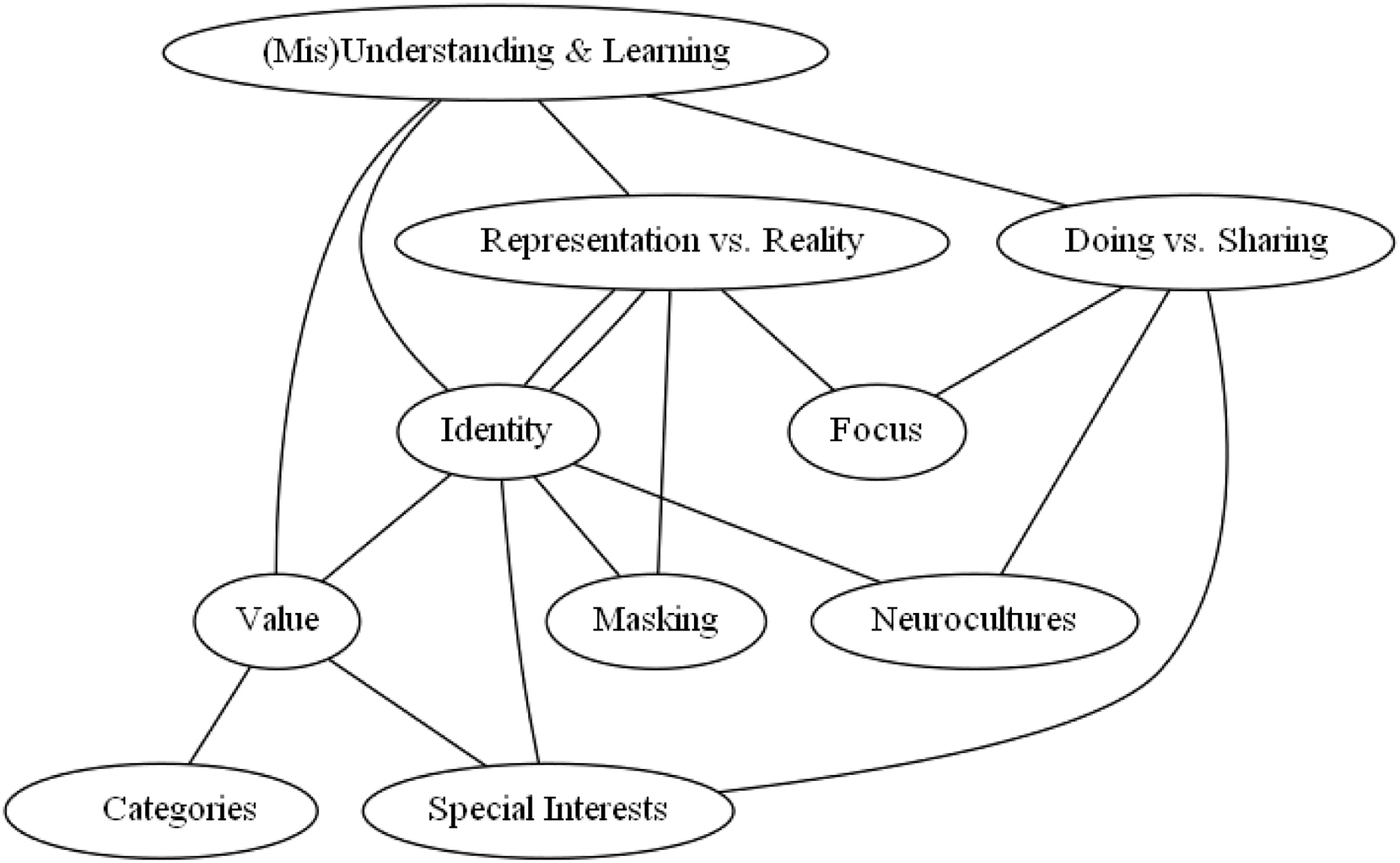
Thematic map.
Reflexivity
Drawing from disability studies 47 and the neurodiversity movement, 45 research ought to outline a sense of thereness, that is, to say it is important that research situates itself within the context it is operating. Yergeau 45 uses rhetorical tools to give an understanding of thereness as topographical and ecological, where the former is the basic structure and the latter a fluid set of (re)productive relations; however, they also, and important to the research context of this paper, propose an autistic thereness.
In this sense, the topography of this paper's analysis, in particular, is that of an autistic researcher relaying autistic individuals' experiences; the ecological context understands the relatability of those experiences and the relations that produced this paper, that the process of data collection was fundamentally collaborative between researchers and the participants.
Lastly, on autistic thereness, Yergeau 45 conceptualizes this as how autistic individuals establish thereness insofar as to write on autism despite being marginalized from discourse on their own experiences; taking from this, an acknowledgment of the neuroculturally sensitive approach to analysis is important to note, as it was conducted by an autistic researcher.
In this sense, the researcher's own reflexivity as an autistic individual who understands the importance of establishing autistic thereness in a space that often omits our narratives serves to guide an analysis that is geared more toward writing with the participants' own narratives, allowing their accounts to establish their own sense of thereness, rather than simply writing on what the participants said.
In addition, the non-autistic researchers involved in this paper are personally and professionally linked to autistic experiences (e.g., having autistic family members, working with autistic individuals in a clinical setting, etc.). Despite them never truly being able to understand the autistic experience (since they have a different neurotype), they strive to foster autistic thereness in research by remaining outwith the analysis, centering autistic voices. Ultimately, the participants' lived experiences, and an autistic understanding of them, guide this study.
Moreover, Kohl and McCutcheon 48 highlight that it is not simply enough to engage in individual practices of self-reflexivity, rather one must embody these practices through everyday talk to examine their positionalities through kitchen table reflexivity; this was established throughout the research process through weekly informal “hot beverage chats” between researchers during data collection, where we reflected and discussed how we personally related to the data.
These more informal conversations about how the researcher related to the data continued with their fellow researchers throughout analysis. Using everyday talk as a means of reflexivity, the researchers ultimately try to relay lived experiences while trying to understand not only their own positionalities, but also the countertransference that occurred during the interviews and their analysis of these data.49,50
Community involvement statement
An autistic researcher collected 40% of the data; the other three neurotypical researchers collected 10%, 20%, and 30%. The autistic researcher analyzed all the data to ensure that the findings were interpreted via a neurodivergent perspective. The autistic researcher is also a co-author and has contributed to the writing of the current manuscript.
Results
An overarching theme of a “spectrum of understanding” with three main themes were identified from the interview data: (1) Identity with Others, (2) Sharing Value, and (3) Shared Presence (Table 2). It is important to note that the quotations chosen are representative of the sample, or sub-sects therein. As such, quotations have been chosen that are thematically representative and the researchers have endeavored to do so in such a way that ensures diversity in representation of different participants' contributions.
Themes and Theme Definitions
Overarching theme: spectrum of understanding
Although distinct themes were constructed from participants' accounts, each of these is tied to an overarching theme of a Spectrum of Understanding. This theme centers not only on the importance of being and feeling understood, as well as of understanding the other, but also on how learning modifies understanding insofar as participants often sought to learn more about the concept of friendship and the strategies behind making friends to feel less misunderstood/misunderstanding. For example, Mary observed this through processes of learning from observation and experience to better understand social “rules”:
Mary: I've learnt some rules. I know how to mask. Like I know some rules especially in very formal situations which is why I do so well here at my job.
Moreover, other participants highlight this same social “learning curve” by other means, from learning new social scripts to formal education in psychology:
Kate: it's easier for me [now] because I have got a collection of scripts I can go through, and use depending on the situation, that I didn't have when I was younger.
Noelle: I did my Psychology degree to help me understand more of what was going on, not only in my head, but also in the heads of people around me.
In addition, despite attempts to learn, participants often observed profound feelings of misunderstanding:
Noelle: With NT [Neurotypical] friends, I constantly feel like I am playing a game without knowing the rules and I could get thrown out at any moment.
These experiences of both being and feeling misunderstood were often highlighted with a particular focus on neurocultural learning:
Kate: I still feel like an alien sent to study human behaviour but also find I feel and react exactly the same way as some NT and we connect on this. Maybe it's more like I'm half alien half human?!
The onus of learning to understand the other was generally observed as being on autistic individuals. However, the possibility for non-autistic learning is raised by Damian, highlighting that it is not just a rigid issue of double empathy, rather a spectrum of understanding exists where non-autistics can learn to better understand autistic social norms:
Damian: Boundaries are communicated and respected considerably more in neurodiverse friendships […] That's not to say that friendships with understanding NTs can't have this, but it often requires a lot more teaching rather than just an innate assumption/understanding.
Cristopher expands on this, giving the example of a spectrum of understanding in which even partial understanding and acceptance of non-neuronormative ways of being may facilitate friendship:
Cristopher: Some neurotypical people, they have found me obnoxious, but they have just kind of rolled with it and they were some of my best friends, you know, they just vibed with me, they could vibe on my level.
Moreover, cross-neurocultural learning was often cited, with there being greater understanding when autism is known about. This explicit understanding of autism was achieved either through a diagnosis itself or in sharing what one's own autism means at a personal level:
Michael: my sister introduced me to some of her friends and she said to her friends ‘[Michael] has autism and he finds this…social situation quite challenging’. So, I was fortunate to have met one friend … [and] every time I was on my own in a pub like…not sure how to mix, he would come up to [help] me.
A spectrum of understanding and processes of learning held within it, as Charlie notes in his cross-neurocultural account, are best understood analogously with a language continuum:
Charlie: I was living in a neurotypical world and didn't understand how to make friends there. It's like being in a foreign country, unable to speak the language fully, like enough to buy food and water and book a room in a hotel and all the things you'd need to get by, but not enough to make any connections.
In this sense, the spectrum of understanding (re)frames double empathy to be understood more as a continuum of neurocultural learning, rather than a distinctive binary centered on autistic-allistic misunderstanding, as is highlighted in Michael's eagerness to make neurotypical friends:
Michael: that's why I constantly mix with neurotypical people, to help me grow and to help me flourish and I just find going up to people is good.
Moreover, relationships with friends who bridge neurocultures (defined as cultures created by a collection of neurocognitive identities within a shared environment)
51
are centered on processes of learning and understanding that bleed and blend the autistic-allistic border conceptualized in double empathy:
Skye: A friend will introduce me to a group of people and one of those people I'll make friends with. Michael: My sister introduced me to her friends and by her introduc[ing] me to her friends it meant that they then helped me to socialise.
Others, often family, supporting introductions and friendship making were observed as a useful and common experience:
Peter: all my friends … tended to be people that my brothers or sisters used to meet and […] that's how I used to make my friendships.
Overall, much in the same way, language continua bridge different cultures and modes of discussing the world, participants' accounts of neurocultural learning/understanding (re)frame the concept of double empathy to sit on a continuum of neurocommunicative learning held between poles of understanding and misunderstanding. This spectrum of understanding simply exemplifies the notion that the more one learns about the other from the other, the closer the relationships may become, the greater the understanding of the other one will have, and the more one will be able to identify with the other.
Theme 1: identity with others
Identity with Others covers important observations about having friendships around communities that are centered on understanding and learning, as participants placed value on understanding and the active processes of learning to understand others; Sam highlights this in his videogame-orientated conceptualization of friendships:
Sam: If you just meet somebody you are on like the first level […] But, as you get [to] know them more […] they unlock higher and higher levels and […] a friend is somebody who has gone that distance, they've unlocked a fair amount of levels because to do that you have to find out who they are, they have to find out who you are.
This understanding is realized in structured communities, such as online games and forums, with great importance placed on special interests:
Charlie: I do just chat on discord a lot though too, like genuinely just chat online with friends, we infodump a lot about special interests to each other.
Moreover, this value placed on learning and understanding is also observed in social groups formed around aspects of the individual's identity where one may find relatability. Serena highlights this while describing shared experiences of marginalized identity fortifying her friendships, quoting Stephen King's The Outsider to convey how these experiences facilitate understanding:
Serena: one of the lead characters is talking about how her father always said, ‘a man knows a man’ and she said, ‘well, an outsider knows an outsider’.
Cristopher furthers this by noting that understanding may be found in the intersectionality of identities:
Cristopher: being trans and autistic, […] two marginalised communities to be part of, but because of that it's easier to make friends quicker I guess, with people who are similar because you can relate.
These experiences of sharing in identity are drawn from community on both local and larger scales, as Stephan sums up:
Stephan: [I make friends] at school, [through] my friends' friends, and online of course, as well. Usually in some kind of Discord server.
Participants noted these communities gravitated on certain identity characteristics; an example of this is raised by Charlie finding comfort in a particular intersection of identity online:
Charlie: Whenever I try to do [make friends] I fail, apart from online, there it just works, but only within queer and autistic communities, […] mostly ND queer folks
Although not observed by every participant, a small number expressed a preference for face-to-face relationships and expressed difficulty navigating parasocial relations:
Serena: If I have an online friend it doesn't feel real until we have like met in person and hung out and it feels like okay, it's not just like this parasocial relationship we have with each other online, it's a real friendship.
However, the majority of participants highlight that friendships online were not only easier to make and maintain, but also easier to understand and identify with:
Emily: being online i could hide when i needed to, talk when i wanted to, think through my words
Zoe: online, you could say something, and you can leave it there and go away like distance yourself for a bit, and then come back to it when you feel right and ready to talk about what you said while face-to-face you can't have conversation like that, you have to go for the conversation at once you can't go away.
Alice: I definitely feel that instant messages and texts are levelling the playing field for me and help form friendships.
Nevertheless, the complexity of the offline-online border raised issues with how identity and friendship are understood in terms of representation versus realisation; this was not just noted, as Michael highlights, on discussions around digital borders, but also on how masking affects the dynamics of friendships, as Charlie discussed:
Michael: Online, like on Facebook, when they chat to you on Messenger, they might seem nice and friendly until you meet them
Charlie: they kept asking more and more [of me] and i kept trying cause they liked me more when i masked more … turns out, if you like someone when they are masking, especially when you're making them do it, you don't really like the real them.
Overall, Identity with Others comes to understand the complex and meaningful conceptualizations of friendship(s) autistic individuals have and maintain. These friendships are ultimately recounted as being better understood, more meaningful, and producing a greater sense of value when there is relatability, a sense of identity with the other, and the sharing of interests, ideas, and value(s) is reciprocated.
Theme 2: sharing value
Sharing Value is an understanding of value as a mode of relating to the other (i.e., how one feels within the friendship), such as in the value Astrid places on learning as a mode of fostering connection:
Astrid: I learnt a lot and I feel like learning from your friends is quite important, so I think that was quite a good friendship for me.
Moreover, it is also an understanding of value as a mode of relating to the world (i.e., how one values others):
Alice: People just post all of their true views online at times and because I am quite a black and white person morally speaking it can be difficult for me to cope with seeing people having, you know, horrible opinions.
Mary, aligning both conceptualizations of value, raises the importance of authenticity to foster meaningful friendships:
Mary: That would be the main differences between the people that I really like and who I make friendships with because I can show them who I really am, and they are able to show me who they really are.
Moreover, Sharing Value is also based on the desire to be/feel valued by the other in a friendship insofar as “friends make life worth living”:
Cristopher: It's easy to feel like there's no hope in the world, […] but having friends […] shows that there is happiness in the world and there is joy that can be had and there are people that care about you.
In this sense, value in friendship is regarded as an active process, that which is shared with and given to/from the other, with participants highlighting the importance of reciprocity:
Hannah: the reciprocation is important, I think, to me to know that person cares about me and I need that in order to continue investing time in them and it doesn't have to be as much as I care about […] but it needs to be enough that I know … that they care about me.
Moreover, the sharing of value, as a mode of relating to the world, also centers on aspects of identity, (neuro)culture, and understanding in friendship, which participants generally observed finding in the autistic community:
Charlie: In the autistic community there is so much more understanding and meaning for me. Like there is value on and excitement for that which matters for others.
This form of autistic understanding ultimately comes with shared values, beliefs, and ways of being and engaging with the world; in particular, these values may be shared/expressed in the relatability of special interests:
Alice: It's easier if you're making friends around a shared interest because you naturally just have something that you are both interested in […] which suit[s] a lot of autistic people.
Overall, Sharing Value is observed by the participants as two complex processes running in parallel: the sense of being and feeling valued in the relationship, and the values shared across the relationship. These processes provide meaning, and purpose to the relationship, producing a space where there is a want for the other's presence insofar as to not only share in ideas, interests, and worldviews, but also to maintain social well-being and connection.
Theme 3: shared presence
Building on the connection and understanding that may be fostered in Sharing Value, the theme of Shared Presence centers on both maintenance and activities in friendship, as Amy notes in understanding friendship as presence and trust:
Amy: [Friends are] the people that you hang about with the most but also you can trust and who know you well and care about you.
Although some participants, such as Michael, preferred trying to make friends with neurotypicals, most participants often observed greater difficulty with making and maintaining friendships with neurotypicals:
Astrid: I don't find it easy to call people a friend who are neurotypical, I don't know why, I guess there is that level of comfort.
However, it is not just difficulty in terms of comfort; rather, this difficulty in making neurotypical friends was highlighted in misunderstandings:
Kate: Sometimes the way I will word something a neurotypical, will take it the wrong way but an autistic person they'll just get it.
Moreover, difficulty in maintaining relationships was also highlighted as being more pronounced in offline friendships, as participants often cited online friendships as “easier to understand”:
Zoe: the ones online it's easier to talk about myself because they don't… because they are not … they are kind of not there but they are there… it's easier to talk online.
However, one key issue of maintenance, which was especially pronounced when relationships traversed the online-offline border, was that of difficulty to frequently attend to the relationship itself:
Charlie: I need reminders to maintain friendships really cause it's easy to forget like they exist when they are not present.
Instances of forgetfulness, inattention, and difficulty navigating multiple relationships may be understood through the notion of monotropism,
52
as participants observed issues with focusing on maintaining friendships and object constancy in those relationships, often going long periods of time without talking to friends:
Stephan: Sometimes I just disappear, doing my own things.
In addition, these periods of time without actively engaging in the friendship were often observed as occurring when attention shifted away from the relationship and gravitated toward exploring special interests individually before returning to the friendship to share in the interest together. Consequently, participants noted that these periods of time away from friendships were better understood by other autistic individuals:
Noelle: We don't have the same rules to our friendships. We can be out of contact for months and then just pick up as if there hadn't been a break.
In this sense, the theme of Shared Presence in autistic-autistic friendships was often raised with an autistic understanding:
Serena: It's just, autistic people are the ones who get me more often than not.
Moreover, the theme of Shared Presence also highlights a difference in understanding between autistic individuals and neurotypicals in terms of activities used to maintain friendships, as participants raised the concept of doing vs. sharing:
Astrid: It is sharing ideas and interests that is kind of an activity we do a lot. And to compare that with neurotypical people, I think we do “things.”
In this sense, doing versus sharing is understood as autistic-autistic friendships focusing more on the sharing of interests, structured activities related to those interests, and/or simply the other's presence (i.e., “being there” in a very literal sense):
Noelle: With other autistics, it is a meeting of minds, a feeling of coming home, being able to use our own shorthand—which is probably similar to NTs with other NTs. But we also use it as a way of exploring ourselves, learning new things and expanding our horizons. It's not just to waste time, I have hobbies for that.
This understanding of autistic-autistic friendships was raised in contrast to friendships with neurotypicals, as these were seen to revolve around doing activities at a more “surface level”:
Emily: all my friends like that I have had very superficial relationships with are neurotypical and I have never been able to have like deep relationships with [them].
Overall, the theme of Shared Presence raises an understanding of both difficulties and differences in the ways in which autistic individuals may maintain relationships. Difficulties were often centered around the online-offline border and expectations from multiple friendships. A difficulty, or difference when met at a particular point in the overarching theme of a Spectrum of Understanding, came in an autistic monotropism, which often produced a sense of value and purpose in time spent away from the relationship.
Ultimately, an understanding of Shared Presence comes to know autistic-autistic friendships as centered on the sharing of ideas, interests, and presence, whereas relations with non-autistics were regarded as less structured, more active, and focused more on what one may do with the other, rather than what one may share with them.
Discussion
The current study aimed at using a more inclusive approach and exploring autistic adults' perceptions of friendships. The results show that friendships are of great importance and that most autistic participants aimed at making connections and bonds to facilitate feelings of belonging, similar to previous research.10–12 However, not all current participants felt like this, with some highlighting barriers to friendships and feeling that they could not navigate the complexities of such reciprocal relationships, although this may be due to the mismatching of neurotypes. 23
Critical differences between neurotypical friendships and neurodivergent friendships were outlined across all themes, with the autistic participants mentioning having to camouflage less around other neurodivergent friends, which is in line with the Double Empathy theory. 21 This is concerning, given that camouflaging and masking can lead to mental health problems. 53
This finding also aligns with Goffman's 54 understanding of stigma, as something that is an easily discernible discrediting attribute or an attribute that may be masked, but once revealed holds the same sense of devaluation and discredit. As such, differences in communication styles reported when interacting with neurotypicals vs. other autistic/neurodivergent individuals may be more emblematic of differences in social stigma and understanding than innate difference in communication: where one is more open with other neurodivergent individuals, as there is less stigma tied to, and more understanding of, their identities with other neurodivergent individuals.
Therefore the current findings potentially shed new light on the Double Empathy theory. 21 The overarching theme of spectrum of understanding potentially re-frames double empathy to be understood more as a continuum of neurocultural learning and understanding rather than a binary centered on an autistic-allistic misunderstanding. Further, it is postulated that the concept of double empathy may be better understood as a continuum of neuro-communicative and cultural learning held between the poles of misunderstanding and understanding, as indicated across the overarching theme and further highlighted in the value of relatability and understanding observed in Theme 2.
This indicates that a spectrum of understanding transcends neurotype; as such, both understandings and misunderstandings can occur inter- and intra-neurotype (e.g., mutual misunderstandings can occur between autistic individuals with different experiences of the world and different levels of social understanding, much in the same way the double empathy problem is often employed to describe mutual misunderstandings between autistic and non-autistic individuals). The exploration of the continuum of the Double Empathy theory is a potential area of future research.
Not only was a matching of minds outlined as important for friendships, as was highlighted in Theme 1, but also shared interests were discussed concerning making and maintaining friendships in Themes 2 and 3, for instance, in linking people together because of similar interests or intersectional identities, such as queer neurodivergent intersectionality observed in Theme 1. Autistic participants were aware of managing their interests, so they did not monopolize the conversation, in addition to managing their attentional resources to ensure that they checked in with their friends.
This is interesting given that another autistically driven theory—Monotropism, 52 explains how autistic people are more intensely focused or have intense interests, which underlie the subjective experience of autism. This interest-based account could explain how relationships are formed and maintained in autism and require further exploration.
Diagnosis and autistic identity seemed important in forming and maintaining friendships with autism. Most felt that late diagnosis meant that opportunities for friendships were lost and that once the diagnosis had been obtained, it allowed the autistic person to understand themselves better and relate to others. This is in line with the broader literature that shows that diagnosis can help form and strengthen their autistic identity, protecting against poor mental health outcomes.53,55,56
As observed in Themes 1 and 3, socializing online was viewed as positive. It helps form friendships and maintain them better, similar to other research that shows how online social interactions are of great value and benefit to autistic adolescents.33,34,57 The current study extends this research by showing that autistic adults perceive online socializing and friendships as positive and rewarding. For instance, online socializing facilitated communication and relationships through emojis. These were mentioned to help autistic people better communicate and understand the emotional tone of messages, similar to other published work in this area.58,59
COVID-19 was seen as both an advantage and a disadvantage by the current participants. Some, as observed in Themes 1 and 2, noted that moving all interactions online was incredibly beneficial, in contrast others reported that everything being online impacted some autistic people's abilities to make social connections leading to increased isolation levels. This contradictory perspective is similar to reports of the impact of the COVID-19 pandemic on autistic adolescents in a recent study, 60 suggesting that some autistic people may be at increased risk of poorer mental health outcomes as a result of isolation during lockdowns.
There are some limitations in the current study which may impact the interpretation of the results. First, this sample was recruited from western countries; therefore, more research is needed to explore more intersectional facets, such as ethnicity and culture, in relationships and friendships. There was also a wide age range in the current sample, and future research may want to focus more on specific age groups to understand better how perceptions and experiences of friendships change across the lifespan.
Further, despite researchers having worked collaboratively with participants to ensure interviews were done in an accessible way (e.g., providing participants with interview schedule before interview, options to carry out interview via speaking or non-speaking methods), it is important to acknowledge the limitations inherent within the spaces in which recruitment occurred.
Especially for the second wave of participants (where most were recruited via TikTok), such platforms are not always accessible for those who are non-speaking and/or have higher support needs, which may explain why only 10% of participants required textual interviews.
Despite these limitations, this study has a lot of strengths, given that the inclusive approaches allowed under-researched autistic groups, such as non-verbal autistic individuals and autistic people who identify as non-binary, to participate in meaningful research. The study offers a new perspective on the Double Empathy theory, suggesting it may be helpful to conceptualize it as a continuum of neurocultural learning rather than a distinctive binary centered on an autistic-allistic misunderstanding.
In addition, it highlights how the recent lockdown has impacted relationships and that autistic people may need more support to tackle the adverse effects of isolation, given that friendships are valued by autistic people and protect against poor mental health outcomes. Overall, this study highlights, in contrast to a deficit-based perspective, that autistic individuals can have and maintain meaningful friendships with complex and nuanced conceptualizations, which ultimately center on the need to be/feel understood and to understand others.
Footnotes
Acknowledgments
The researchers would like to thank all participants who gave up their time to help with this research. They would also like to thank Fergus Murray for very early conversations about the findings. They would also like to thank the MSc students who carried out some of the interviews as part of their MSc dissertations.
Authorship Confirmation Statement
Conceptualization: K.G.-S., A.A., H.P., and D.M. Data curation: A.P.A.M.. Formal Analysis: A.P.A.M. Funding Acquisition: N/A. Investigation: A.P.A.M. Methodology: K.G.-S., A.P.A.M., and D.M. Project Administration: K.G.-S., A.P.A.M., and D.M. Resources: A.P.A.M. Software: N/A. Supervision: K.G.-S., D.M., and H.P. Validation: A.P.A.M. and D.M. Visualization: A.P.A.M. Writing original draft: K.G.-S. Writing review/editing: K.G.-S., A.P.A.M., A.A., H.P., and D.M.
Author Disclosure Statement
No competing financial interests exist.
Funding Information
No funding was received for this article.

References
Supplementary Material
Please find the following supplemental material available below.
For Open Access articles published under a Creative Commons License, all supplemental material carries the same license as the article it is associated with.
For non-Open Access articles published, all supplemental material carries a non-exclusive license, and permission requests for re-use of supplemental material or any part of supplemental material shall be sent directly to the copyright owner as specified in the copyright notice associated with the article.
