




Abstract
Background:
The term “nonbinary” refers to all gender identities that are not exclusively male or female. Nonbinary identities are more common in autistic people than in nonautistic people. Yet research meaningfully exploring the unique intersection between autism and nonbinary identities is limited. Furthermore, little is known about how the experience of being nonbinary and autistic impacts access to autistic and queer communities; spaces that can protect against poor mental health outcomes.
Methods:
We examined: (1) how nonbinary autistic people make sense of gender and (2) how they negotiate community. A participatory approach was adopted, involving a consulting group of 18 nonbinary autistic people at every stage of the research process. A separate group of five nonbinary autistic adults from the United Kingdom took part in semistructured interviews about autism, gender, and community. We analyzed interviews using Interpretative Phenomenological Analysis.
Results:
Within an emergent framework (gender as two dimensional), we identified three themes: (1) Where do I belong? (2) (Re)framing difference. (3) Space to be (neuro)queer. Participants understood that being autistic and nonbinary problematized how they connected with “gender,” a self-defined concept of high significance. Crucially, the queer community was felt to facilitate positive identity development, but participants emphasized a continued struggle with being misunderstood, largely by their nonautistic peers.
Conclusion:
This study celebrates neuroqueer ways of being. We recommend that nonautistic people are given improved education on nonbinary autistic identities; supporting autistic people to understand their differences and facilitating positive identity development within queer spaces. Creating autistic-led community groups is furthermore key, due to the linguistic and embodied complexities of autistic gender identities.
Community brief
Why is this an important issue?
People who are nonbinary do not feel like men or women. They might feel like a mix of both, or like they have no gender at all. Autistic people are more likely than nonautistic people to be nonbinary, but we do not know much about the unique experiences of nonbinary autistic people. Much of the existing research on this topic tends to treat nonbinary autistic people as in need of “fixing” or “changing,” or proposes theories that suggest autistic people tend to think more like men than women.
What was the purpose of this study?
We wanted to learn two things about the experiences of nonbinary autistic people: (1) how they make sense of gender and (2) if/how they access autistic or queer communities. Queer is a term sometimes used to refer to people who are not exclusively attracted to the opposite sex or people who do not identify with their gender assigned at birth. Research has shown that access to autistic and queer communities can help to protect against poor mental health outcomes.
What did the researchers do?
The lead researcher, Mary Peachey (who is autistic and nonbinary), asked a group of 18 nonbinary autistic people about what the research should focus on. This group advised Mary throughout the whole study. Mary then completed interviews with five nonbinary autistic adults from the United Kingdom, to look at the following: (1) how they understand gender and (2) how they connect with other queer people. Data were analyzed using a method called Interpretative Phenomenological Analysis (IPA). In IPA, research participants are viewed as experts of their own experience. The researchers act as interpreters, looking for what participants understand to be important, as well as what was particular to their experience.
What were the results of the study?
We found that being nonbinary and autistic complicated how participants understood themselves and related to others. Connecting to other autistic and queer people, however, helped participants to accept their identities, often after years of hiding their true selves to survive.
What do the findings add to what was already known?
This is, as far as we are aware, the first study to look at how nonbinary autistic people make sense of their identities and find like-minded communities.
What are the potential weaknesses in the study?
None of the participants had a learning disability or were people of color. More research should be done in this area so we can learn about different intersecting identities.
How will these findings help autistic adults now or in the future?
This study celebrates queer autistic ways of being. We recommend that autistic people be supported with understanding their identity through encouraging interactions within the queer community. We also call for greater education on nonbinary autistic identities for nonautistic people.
For an easy read version of the whole research article, please visit: https://osf.io/ya45b/
Background
G
Autistic people have asserted their capacity for understanding gender identity, yet nonbinary autistic identities are routinely delegitimized. 13 First, the historic and inaccurate coding of autism as “male” 14 has been adopted to explain the gender nonconformity of autistic transgender men.15,16 However, this explanation fails to acknowledge nonbinary (and transfeminine) people, for whom implications of having a “male brain” may heighten dysphoria. 10 Second, the notion of a female autism phenotype 17 essentializes gendered understandings of autism and again ignores gender beyond the binary. Furthermore, references to the perceived deficits in social understanding5,6 and the “unusual preoccupation[s]” of autistic people18, p. 641 as an explanation for autistic gender nonconformity invalidate the identities of nonbinary autistic people, foreclosing them from “count[ing] as recognisably human.”19, p. 31 Consequently, gender identity services can fail to look beyond autism10,20 and nonbinary people are denied access to their community. 3
There is limited research meaningfully exploring the unique intersection between autism and nonbinary gender identities. Dewinter et al. 21 found that 22% of autistic “women” and 8% of autistic “men” were gender nonconforming. However, the authors' reliance upon binary gender categories ignored participant identification with different, gender-affirming labels. 21 Furthermore, one known case study 22 invalidated the participant's nonbinary identity, framing it as a “detransition” from a binary trans gender.
While recent qualitative studies have examined the experiences of transgender autistic people, most focus on gender dysphoria and subsume nonbinary experiences within a broader category of gender diversity.3,10,20,23–25 The lack of research into nonbinary autistic experiences is significant, as 15% of autistic people and 32% of transgender people with gender dysphoria attempt suicide. 10 Furthermore, nonbinary people are more likely to attempt suicide than binary trans people. 26
Belonging to multiple marginalized groups engenders a distinct experience that cannot be understood additively or attributed singularly to a divergent gender or neurotype.24,27,28 Nonbinary autistic people therefore experience gender uniquely, which impacts their access to autistic and queer (used here as an umbrella term referring to people who are not heterosexual or cisgender) communities: spaces that can protect against poor mental health outcomes.10,29 This experience is further important when identity is understood as being constructed through social interaction and communication. 30
Intersecting identities therefore complicate autistic access to the community, 3 but there has been limited focus on the experiences of nonbinary autistic people. Despite this, nonbinary people are more likely than other members of the queer community to deal with intracommunity exclusion, as the community is often organized around binary genders.31,32 Similarly, disability communities can often fail to acknowledge queerness (and vice versa), overlooking the multiple and intersectional identities beyond heteronormative and neuronormative ways of being. To assume that people have singular differences further works to delegitimize nonbinary autistic people. 33
To our knowledge, no studies have directly examined how nonbinary autistic people make sense of gender. It has, however, been suggested that autistic people have a unique experience of gender identity construction,34–36 impacting their involvement in queer spaces.3,10,24,37,38 To address autism research's historic neglect of intersectionality and the disregard for disability in queer studies, 39 we adopt an intersectional approach, acknowledging multiple intersecting power structures that construct subjective social realities.40, p. 2 Specifically, we used Interpretative Phenomenological Analysis (IPA),41,42 a methodology aligned with the study of intersectional identity construction, to examine the following research questions: (1) How do intersecting identities influence the construction of gender by nonbinary autistic adults? (2) How do these identities impact upon involvement in queer spaces?
Methods
Participants
We sought UK-based autistic adults (18+) who did not identify as exclusively male or female, including those with divergent identities beyond the focus of the study (e.g., ethnicity, co-occurring conditions, access to spoken language).
We circulated a poster detailing the study and eligibility criteria (see Supplementary Materials) on Facebook, Twitter, and Instagram, the three most commonly used social media sites/apps in the United Kingdom across all ages and socioeconomic statuses.43,44 We specifically targeted recruitment within autistic and transgender-focused groups, of which M.P. was already a member, in recognition of potential ethical issues associated with entering and/or joining online communities solely for the purposes of research recruitment. We considered ways to increase the diversity of our sample. For example, conscious that Facebook attracts those of an older demographic, we supplemented this with recruitment via Instagram and Twitter, which are more commonly used by those aged 16–24.43,44 We also targeted charities and groups with a focus on supporting Black and Asian autistic people, and autistic people with a learning disability (including A2ndVoice, Autism Voice, and Mencap).
Fifty-four potential participants expressed an interest in the study, from which we selected five participants based on the following: (1) the uniqueness of their demographic background and (2) the information offered relating to their gender identity on an initial registration form (see Supplementary Data). We prioritized self-identification as nonbinary (although other labels were sometimes used by participants) and autistic since our focus was on how individuals come to understand themselves through these terms, and given the barriers to diagnosis faced by minoritized groups.45,46
Participants' average age was 29 years (standard deviation = 4.60, range: 21–35). Four participants had formal autism diagnoses (three of whom were diagnosed in adulthood), while the other was in the process of accessing a formal assessment. Four participants had co-occurring conditions, including neurodevelopmental diagnoses (e.g., attention deficit hyperactivity disorder, Tourette's, Alice in Wonderland syndrome), mental health diagnoses (e.g., anxiety, depression, post traumatic stress disorder, obsessive compulsive disorder), and medical diagnoses (e.g., myalgic encephalomyelitis/chronic fatigue syndrome, fibromyalgia). All five used spoken language, with two describing this as being “most of the time,” and all five were White (three were British; one was Spanish; one described their ethnicity as “Other”).
Materials and Procedure
Community involvement
M.P. (who is autistic and nonbinary) collaborated with a consulting group of nonbinary autistic adults throughout the research process, to ensure meaningful participation in the study and to address the priorities of the researched-population.47,48 Those who self-referred to participate but were not selected as participants (n = 49) were invited to be in the consulting group (n = 18 agreed). As can be seen in Table 1, members of our consulting group were most commonly 35–44 years of age, were White, had co-occurring conditions, and reported using spoken language to communicate. As such, the demographics of the consulting group were broadly similar to those of our participant group.
Characteristics of Our Consulting Group (n = 18)
Before data collection, we asked consultants about the proposed research questions, methods, and procedures. They also reviewed a draft interview schedule and participant information sheet, and one took part in a pilot interview. Finally, consultants reviewed the findings, including theme names and descriptions, ensuring an accessible and sensitive write-up.
Data collection
M.P. sent the interview schedule (see Supplementary Data) to participants in advance of interviews and offered interviews in a variety of formats. 49 Three participants opted for video call, one for instant messaging chat, and one for email. On average, video interviews were 66.33 minutes (range: 56–83). We transcribed interviews verbatim and, after removing identifying information, sent these to participants for review before analysis. Text-based interviews contained an average of 3645 words and were also returned to participants following anonymization.
Interviews began by the interviewer (M.P.) introducing themselves and building rapport with participants by explaining their personal connection to the study. Interview schedules were used flexibly. Participants were encouraged to speak freely and the interviewer followed participants' thought processes by asking relevant prompts, summarizing their understanding of answers, and making space for participants to add to and clarify their comments.
Data analysis
During transcription, M.P. anonymized data and assigned participants pseudonyms, which they chose themselves if desired. Two participants selected their own and a random name generator was used to select pseudonyms for the three other participants, after which participants were asked if they were happy with their allocation. These pseudonyms are used throughout the article. In line with IPA's idiographic approach,41,42 M.P. read individual transcripts closely, making initial exploratory notes and then descriptive, linguistic, and conceptual codes. Codes were inductive, contributing to the depth and openness of the inquiry, 50 and identified experiential claims, concerns, and understandings, focusing on how participants made sense of experiencing gender as nonbinary autistic people.41,51 M.P. then reviewed and amalgamated codes to reflect participants' understandings, forming personal experiential statements, before clustering statements to form personal experiential themes.
This was an iterative rather than chronological process, during which M.P. coded data for a second and third time following the clustering of statements. This process allowed the data to be interpreted from multiple standpoints, in line with the hermeneutic circle. 41 Following this process, L.C. reviewed the findings and provided feedback.
M.P. formed themes through the grouping of statements with related and oppositional ideas, the subsuming of statements into each other, and by identifying claims that shared a particular function within the transcript. Throughout this process, statements and themes remained attached to quotes from the transcripts, ensuring that the interpretative process was grounded in the data. M.P. then relayed findings back to participants, who checked the interpretation spoke to their experience, creating an equality of voice between the researchers and participants. 52 Finally, M.P. reviewed tables of personal experiential themes across cases, in which group experiential themes were identified using a similar strategy. For example, M.P. looked for patterns of convergence and divergence between participants, and paid close attention to the different ways participants expressed their understandings. M.P. sent group themes back to consultants, who ensured that the findings were presented accessibly.
This project was inspired by the experiences of M.P. who is autistic and nonbinary. M.P. kept a reflective diary, allowing them to monitor thoughts, feelings, and preconceptions that may have influenced their interpretation. This process was particularly significant due to the double hermeneutic of IPA, through which as the participant makes sense of their experience, the researcher makes sense of their sense-making. 41 M.P. noted where they may have made connections based on their own experiences, rather than based on the data—any interpretation that was at risk of this bias was double-checked with the participants during the return of the findings.
Ethics
Ethical approval was granted via the Department of Psychology and Human Development at IOE, UCL's Faculty of Education and Society. M.P. sought informed consent before the interview, and reminded participants (at the beginning and midpoint of the interview) that they were free to stop participating and/or withdraw at any time, without needing to give a reason and without any negative consequences.
Results
We identified three group experiential themes following a cross-case analysis of the individual experiential themes (see Supplementary Data): (1) Where do I belong? (2) (Re)framing difference. (3) Space to be (neuro)queer, within an emergent framework defining gender from the perspective of the participants (gender as two-dimensional) (see Fig. 1). Participants and consultants endorsed all themes.

Thematic map showing the situation and interrelation of themes and subthemes within the emergent framework.
Gender as two-dimensional
Gender was simultaneously referred to as (1) an internal feeling, which is (2) expressed and related to others: “How people feel inside about themselves and [emphasis added] how they relate that to other people” (Robyn) (see Fig. 2). Three participants explicitly referred to the “biological” and “social” aspects of gender, while acknowledging that there was no absolute crossover between biological/social notions and the two dimensions.
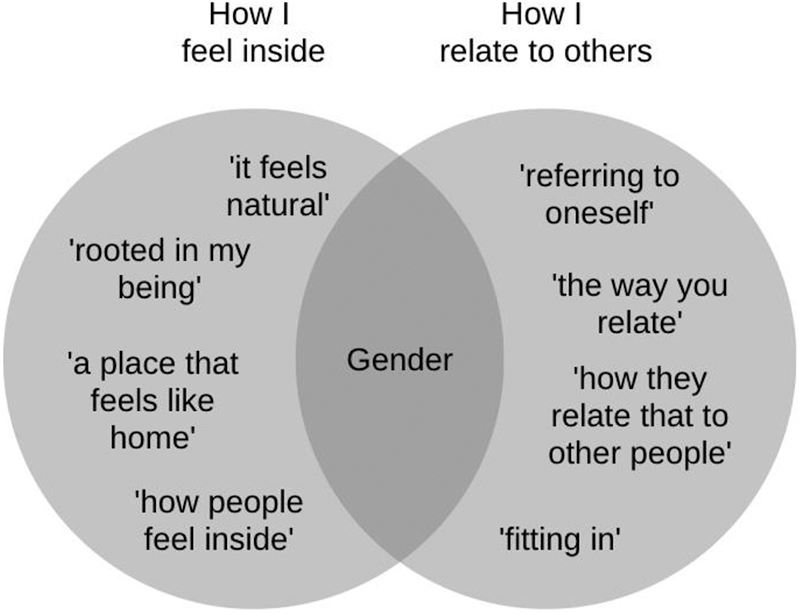
Interaction between the two dimensions of gender.
Not all participants related personally to this self-imposed definition but all used the framework to some extent. Elia repeatedly framed gender as a “feeling” while maintaining “[they] don't really feel like anything.” Ari defined gender as something used to “assign people based on their reproductive ability,” although they did not subscribe to such social constructs. Similarly, Sheepy acknowledged differences between “boys” and “girls”—gendered groups that can relate things to each other—but emphasized that society is “too hung up” on the gender binary. At the same time, Sheepy's sense of gender was “rooted deep in [their] being,” connecting to how their body felt “wrong.”
Participants could not separate the two dimensions: “Gender is a way of referring to oneself. That makes us feel a certain way; that allows us to express what we are in a way that feels the same as we are” (Elia). Elia's close connection of the first dimension, feeling gender, and the second, the relation of feelings to others through external presentation, is indicative of how without one or the other, gender could not be conceived of.
Theme 1: Where do I belong?
“Belonging” was perceived as fundamental to participant understandings of gender and had two subthemes: (1) Not a man, not a woman. (2) Accessing a language of belonging. This theme was connected to the second dimension of gender, revealing the difficulties that participants expressed in negotiating identity as nonbinary autistic people.
Subtheme 1: Not a man, not a woman
Participants described how rejecting the gender binary made it difficult for them to negotiate a sense of gendered belonging. A reported dislike of typically “male” activities led to Ari feeling there was something “wrong” with them: “I never felt like I was comfortable in my own skin. Because I always felt like I wasn't masculine enough.” As a trans-masculine person, Sheepy also explained that they “didn't feel right in [their] body.” Other participants explained how they confused themselves and others by feeling like “everything” and/or “nothing”: “Both [masculine and feminine presentations] fit me. Both feel natural. Both are me. It's just different” (Elia).
Not fitting in was commonly reported. While Robyn noted that their lack of gender did not feel wrong, they remained insistent in their comparison of this negative feeling with others who felt to belong to a binary gender. Elia also compared themselves to their binary trans friends: “I don't understand their sense of belonging.” As a native Spanish speaker, Elia described using all forms of gendered language in reference to themselves: “I would refer to myself as a male and as a female and as neutral at the same time,” separating themselves from friends who had it “crystal clear. Like, ‘I am a man’, or ‘I am a woman’. And I just do not.”
Identifying outside of the binary was felt to be alienating due to a limited awareness of nonbinary identities:
I always felt like I was just on the outskirts. It's like if you go to a building, and if you go into a room and you just suddenly realise you're in the wrong place. And everyone else notices and they're all like, ‘oh no, you're fine here.’ But it's like, I'm not meant to be here, this is the wrong place. (Robyn)
Ari's assumption that transgender identities were “very binary” led them to identify as cisgender, and although Francis knew that they were not a woman they explained how they struggled to understand what that meant: “I used to ‘pray’ that I would die and be reincarnated into a different body.”
Participants felt that being autistic made it difficult to explore gender presentations. Ari spoke about having “a very specific style” that they did not feel the need to change upon realizing they were nonbinary. However, they added that their gender presentation sometimes limited the connections they could make with others: “I had this big gender ‘coming out’ and nothing changed in terms of what someone would have seen.” Robyn also noted how they felt that their sensory issues limited gender exploration: “There's certain aesthetics that I'd like to try out. And that might include jewellery, and things like hats—but like I can't wear hats because it hurts my head.” Ultimately, many participants explained how they did not “really have the energy” to explore their gender in this way.
Francis added that this issue was complicated by their medical condition—myalgic encephalomyelitis/chronic fatigue syndrome—which left them without energy to investigate their feelings. Indeed, while they noted that binding their chest gave them their first moment of gender euphoria, they added that their condition “makes binding difficult.”
Subtheme 2: Accessing a language of belonging
Participants emphasized a negation in the claiming of their gender identity, discussing not being rather than being: “I don't really feel like anything in particular” (Elia). Francis connected this experience directly to their identity label: “I use the label nonbinary, not because anything particularly resonates with me but because I struggle to explain my gender.” They added that feeling like neither a man nor a woman complicated self-understanding and the extent of understanding from others.
The participants also described how being autistic further complicated the articulation of belonging: “Being autistic has probably made it much harder for me to understand not only my own experience of gender, but other people's experiences too” (Francis). This experience was felt to manifest itself in line with the two dimensions of gender—participants had difficulties understanding their own feelings, as well as the feelings of those around them. The severity of Robyn's dysphoria and its interaction with their autistic traits were perceived as preventing them from thinking concretely about gender. Indeed, there were many ways in which they described how they did not feel “right,” but added that it was hard to identify exactly what each feeling was: “I just knew I didn't fit in but I couldn't figure out why.”
Elia discussed how gender, from an autistic perspective, often could not be “explain[ed] with words.” Francis also discussed challenges with interpreting their gender dysphoria, using a number of analogies to find the words to do so:
It's like trying to view the bottom of a lake through muddy water… or like how water heats to a boil in a kettle. At first it's barely noticeable, but as the heat grows bubbles start to form and even the kettle starts to shake from all the steam. Except this was all happening in my subconscious. So it's like this intense feeling was slowly building over years, and at the same time I couldn't tell it was even there.
Francis added that they only made the connection to gender after becoming suicidal: “I knew I needed to finally address whatever was making me feel that way. That was when I realised that I was not the gender I was assigned at birth and only then did I start to really feel my gender dysphoria.”
Theme 2: (Re)framing difference
This theme explores how participants negotiated the first dimension of gender: from the masking of autistic traits and nonbinary identities toward an embrace of themselves as nonbinary and autistic. Subthemes were as follows. (1) Masking differences. (2) Realizing freedom.
Subtheme 1: Masking differences
Following diagnosis at age six, Ari discussed how they were taught to hide their autistic characteristics. Their mother's belief that autism was a vaccine-inducted “defect,” and the “humiliation” they experienced from teachers meant they hid their autistic identity from peers. Ari felt that stigma therefore prevented them from claiming a positive autistic identity as well as a positive queer identity: “I did it so well that I didn't just mask it from other people, I masked it from myself to the extent that I genuinely thought I was straight.” Having internalized the notion that being different was a negative, Ari's bisexuality and nonbinary identity were reported to be closed off as they forced themselves to fit within the expected masculine mold.
Similarly, late-diagnosed participants recounted how difficulties with self-acceptance led to masking. Robyn felt others “just thought [they were] a bit weird,” limiting their authenticity before and after diagnosis. Masking was also reported to limit Francis' mood and confidence, as they hid their differences in search of acceptance: “When I was younger I thought that I had to be ‘normal’ to be valued as a human being.” In addition, Francis spoke of how they learnt “neurotypical language” to facilitate communication with others, which made unmasked communication “a struggle” as they had “mostly learned how to interpret the nonautistic language but not any other language that other autistic people speak.”
Sheepy recounted how they were forced to mask as their family used their nonconformity as a target for abuse:
I've been accused of faking being autistic, told how my interests and the like are an embarrassment and that other autistics are better than me because they can do things I can't. Been accused of ‘trying to turn my brother gay’ by crossdressing and saying that it's okay to be different.
Sheepy added that they felt unable to live authentically with their family, which became so serious that they were forced into homelessness. This situation was further compounded by a series of abusive relationships in which Sheepy described never feeling accepted for who they were: “It's hard to know if they accepted me or just used me as an object. There was a lot of psychological and emotional abuse in them along with rape. My needs and feelings were definitely non-existent to them.” Robyn similarly noted that they hid their autistic and nonbinary identity for survival: “You never know when it's safe to show who you are.”
Subtheme 2: Realizing freedom
Despite the trauma of masking, participants spoke of how they grew to accept their differences by acknowledging the unique position that their identities as nonbinary autistic people afforded them. Participants considered how being autistic impacted how they thought about gender as a binary, through an increased propensity to question social norms. Ari defined gender as a “made-up thing,” used to divide people based upon reproductive ability; a concept that did not make sense to them:
I think it feels more natural, as an autistic person, to question. Why do we have the gender binary? Why do we have to fit in? I've even spoken to autistic people who do fit into it, who've said, ‘yeah, but I still question it and have come to the conclusion that, yes, actually I do fall into this’. Rather than just accepting, ‘oh well it's just how it is’.
Elia also considered how being autistic means they “see things from a different perspective. It makes sense that I question everything subconsciously.” They described being prone to engaging in conversations exploring identities, perceptions, and norms, as did Robyn, who felt that being autistic drove them toward the complicated discourses surrounding gender identity: “When I started realising, I learnt a lot more about it than maybe a nonautistic person might do. It's like, find all the information, read everything and learn as much as possible.”
Sheepy too rejected the gender binary as “something used by people typically to pigeonhole,” but did not connect this to being autistic. Instead, they recognized how as an unmasked nonbinary, autistic, pansexual, and polyamorous person they were “more open” and accepting of diverse identities: “The individual themselves is the most important part of each person and their identity.” Therefore, all participants found that accepting their own differences led to greater freedom, although in different ways.
Ari and Elia described their unmasked selves as marked by freedom: “Not letting expectations of what I should be dictate how I am” (Ari); “I do not think of myself within this very rigid, static box” (Elia). Francis also described the significance of embracing their authentic self, despite the restrictions of their illness:
Learning who I am and learning how to express myself have brought me so much joy…Day to day there isn't that much difference objectively, as I'm still quite ill. However, my mood, confidence, and outlook on life are much improved.
However, Francis added that their illness had the simultaneous effect of facilitating identity discovery. Francis reported that “a ‘normal’ lifestyle doesn't suit [them] regardless” as being removed from the pressure to mask meant they could address their dysphoria and sensory processing difficulties.
Often, participants spoke of how intersecting identities gave participants the language to understand themselves. Ari connected the masking of their autism and nonbinary identity, grouping together social norms such as eye contact and engaging in small talk with their rejection of the gender binary—things that people are “told we should do that just don't make sense if you think about them enough.” For Elia, the language of their focused interest (biological science) was described as the only way to understand themselves: “I really was just like an amoeba…they don't have a gender, they don't have sex, they don't have anything. They are just a thing that exists.”
Sexuality was also seen as a sense-making tool. Participants referred to being bisexual, pansexual, or asexual when explaining their nonbinary identities: “I sort of started feeling like my own attractions might be less binary and sort of more of a general blur. And that then influenced how I see myself as well” (Ari). Ari felt that it was through becoming more comfortable with being attracted to multiple genders that they then understood how their assigned gender at birth did not stop them from connecting to their bisexuality. Sheepy described how being pansexual and polyamorous made them more willing to accept gender differences. Moreover, comparisons were made between the spectrums of autism, sexuality, and gender: like the autistic spectrum, “I sort of saw the parallels with sexuality, like you don't say ‘I'm a bit bisexual’—if you're bisexual, you are bisexual, no matter where your attraction falls on a spectrum” (Ari).
Theme 3: Space to be (neuro)queer
The realization of freedom was not possible without connection to the queer community (which was not without challenges). This theme explored how participants negotiated the second dimension of gender. Subthemes were: (1) (Mis)understanding. (2) Connecting with community.
Subtheme 1: (Mis)understanding
Being understood and accepted by others were perceived as crucial for the validation of participants' identities: “Whenever I speak to a friend that understands me and accepts me, I just feel happy…I do not have to struggle or over-explain or pretend to be something I'm not” (Elia). When asked about feeling joy as a nonbinary autistic person, Ari also emphasized: “Having people accept it—so when I told close friends that I'm queer and I'm autistic they accepted it, but it wasn't a big deal. That they understood it. And that's always been validating.” In this way, Ari directly connected their joy to being accepted by others around them.
However, interactions with others were, more often than not, described as being plagued by misunderstanding. Robyn's autistic and queer identities were reported to be separately denied due to their “atypical” presentation, through which they diverged from how others expected them to look and act (“I had one person say that I couldn't be autistic because her son had a friend who was autistic and I'm nothing like him”; “I've had one person tell me I'm not asexual and then just list a load of reasons why”). Being expected to lead a “normal” lifestyle was also described as invalidating. Elia noted how their religious Nicaraguan mother enforced strict rules based on the gender binary, as did their father: “If you were dressing properly ‘for a girl’ then that was fine, but as soon as you started deviating, you were kind of a sinner and you were going to hell.”
Others described how they were forced to police their own identities to become more palatable, adopting mainstream labels rather than finding labels that resonated: “If you start going for micro labels, there's not that much understanding of them and you have to go into a big explanation when nonbinary itself is already enough explaining to do on a daily basis” (Ari). While Francis felt that the labels “demi-boy,” “agender,” and “gender-null” more accurately encapsulated their experience, they explained how they avoided using them when interacting with others for fear of misunderstanding: “I struggle to explain my gender in one or two words that other people can fairly easily understand. I do like that the term nonbinary is so vague though, it makes me less anxious that I'll be judged on the way I present.”
Participants also described feeling labored with bridging the understanding of those outside the queer community: “The worst thing, for me, is to try and explain that to close family and friends who do just not have the tools to understand it” (Elia). Elia connected this experience to their capacity for freedom, which was not possible without “acceptance of [their] own neurological pattern and my own gender identity”: “Before that acceptance happened, I didn't feel it was an advantage, I felt mostly the bad part, which was trying to discuss it with someone else and not being understood.” Ari added that they did not feel comfortable correcting people when they used the wrong pronouns: “I just have to…well not having to but choosing to ignore it and try and move on…even when you write them in your email signature they'll just carry on assuming and ignoring it anyway.”
However, this experience was described as painful and “uncomfortable” due to the lack of associated freedom in expression. Francis, as a result, avoided disclosing their identity: “I don't really talk about it that much.”
Subtheme 2: Connecting with community
Participants described gravitating toward queer and neurodivergent people, with whom they could be their most authentic selves: “Though it's not intentional. I just happen to know more people who are than aren't” (Sheepy). Contrasting interactions with (usually) nonautistic, nonqueer people, participants noted how understanding was facilitated by the sharing of similar experiences: “We can become mutually supportive of each other when we can empathise with some of each other's issues” (Ari). Acknowledgment of a shared understanding and sense of empathy was felt to make “coming out” to their partner a much easier process for Ari: “It made it quite easy to articulate it to her.”
Francis connected their experience to their intersectional identity, for which it was again hard to find the words to describe their gender without its connection to autism:
In general my experience of gender is so intertwined with my autism, and it can be difficult to explain autistic experiences with nonautistic vocabulary…Like if someone's identity is a unique colour, then each aspect of their identity is a colour that was mixed in to create this one unique colour. But if you only have the end colour, there's no way to separate the individual colours that were mixed to create it.
Elia also recognized how sharing “(neuro)queer” vocabulary with their best friend prevented overexplanation: “Because she's also having the same train of thought. She's also interpreting life in the same way that I'm interpreting it.” Conversely, nonautistic and “straight” people were described as “more difficult to talk to because they are not in the same mindset, they don't have the same experiences” (Elia). A sense of understanding and shared empathy was also reported to lead to more meaningful connections with neuroqueer people (used by participants to mean people who are both neurodivergent and queer), who were noted to have a “more interesting narrative and a bit of a more refreshing experience, in general” (Elia).
A common experience was the realizing of identity through others. Ari discussed how they deepened their understanding of the gender spectrum through their work with a bisexual group and first heard of the term “neuroqueer” (used as an identity label) in an online group for autistic and queer people. Elia learnt they were autistic from their close connection with two queer and autistic people, and Robyn described how they found their identity through the online queer community:
I was on some autism group and somebody mentioned nonbinary…And then, like a few months later in another autism group somebody mentioned, I think somebody mentioned gender non-conforming at first. I was like, oh, that might fit. Then later on somebody mentioned agender, and I was like, that's it. That's the one. (Robyn)
Ultimately, connecting with other queer people was perceived to aid self-acceptance. Participants observed a crossover between queer and autistic communities, through which it was safe to be autistic in queer spaces: “LGBTQ+ spaces [have] been very welcoming of both me and my autism” (Francis); “Letting people be themselves and ensuring people aren't at risk of being triggered where possible is the most important” (Sheepy). Ari described how embracing being different was tied to involvement in queer spaces: their partner was “loud and unapologetic about being bi,” helping them to find pride in their sexuality. Robyn commented on how their community offered them support, which they were able to offer in return: “I've been able to help them with their journeys. Because I have the information for my own journey.”
As participants socialized extensively online, there was an awareness that online spaces are “not necessarily reflective” (Francis) of conduct at in-person events. Robyn recounted their difficulties with queer spaces when they were younger: “With all the noise and the drinking and stuff, I couldn't understand anything that anybody was saying to me at all…There's no rules so it can be quite confusing.” Ari was aware that conventional spaces for queer events “might not be conducive to everyone” and emphasized how the queer community is too often centered around drinking. Similarly, Elia felt that the opportunities to interact with other queer people were very restrictive: “I think that forcing people to interact in the same way would be something that I would want to be different.”
Discussion
Building on previous research, we identified how two identified dimensions of gender were used by participants to understand themselves. In addition, participants explained what a “good” outcome was—“belonging,” in line with their own desires and expectations. Gender in two dimensions has been hinted at in other studies—highlighting the importance of community in the negotiation of identity 38 and the ways autism impacts internal feelings and the communication of this position. 37 Until now, however, it has not been connected to identity construction, remaining only a way for researchers to make sense of autistic ways of being. Separating out gender as an internal feeling and as something that is related to others exposed the fundamentality of “belonging” to the participants. Participants' comprehension of gender was not impaired, as has previously been suggested.5,6,15,18 However, their multiple identities made gender difficult to negotiate, impacting both their self-concept and their involvement with the queer community.
Previous research suggests that autistic people have an increased resistance to social conditioning leading to greater gender diversity.6,22 Our findings go beyond this to argue that gender is inherently complicated, more so for our nonbinary autistic participants who found such systems contradictory. In this way, it is the system of gender that fails, rather than the participants who reject such systems. As participants realized the freedom of being autistic and nonbinary, they transcended gender norms “to inhabit new identities of their own making.”28, p.6 Jackson-Perry 36 and Kristensen and Broome 53 similarly suggest that autistic people are more likely to be systematic in their consideration of theories, rejecting those that are imperfect and refusing to “participate in the socio-rhetorical system that produces (and often mandates) binary sex/gender roles.”35, p.9
Our findings support such claims, with participants neuroqueering—that is, disrupting and liberating theirselves from neuronormativity and heteronormativity at the same time—both gender and autism. 54 This is illustrative of how “neuroqueer” was conceived of by participants as both a verb and an adjective, to which they felt they had a propensity toward due to their experiences as nonbinary autistic people.
Again, failing to express the experience of being autistic and nonbinary in nonautistic terms is not really a failure. 55 The participants were aware of, and explored, how being both autistic and nonbinary were inseparable parts of theirselves and in some cases were “mutually constitutive,” 54 further indicating how their ways of being subverted the cultural conditioning they had been subjected to. The participants also expressed how being nonbinary “neuroqueered” their performance of autism and vice versa. While most participants focused on other queer autistic people as those who neuroqueer the world around them, one participant significantly noted how someone's gender, sexuality, or neurotype was not a barrier to neuroqueering, or being able to connect with them as a nonbinary autistic person. This is reflective of Walker's 54 note that someone with the label neuroqueer is someone who neuroqueers, rather than someone of a particular gender, sexuality, or neurotype. It was the space in which they were surrounded by people who respected their autistic and nonbinary ways of being that allowed them to be truly neuroqueer.
Participants had tumultuous journeys before embracing their nonbinary autistic selves, aligned with research on autistic identity construction.20,56 Coleman-Smith et al. 10 emphasized autism as a barrier to the enactment of authentic gender identities as their participants lacked the language and resilience to assert themselves. However, these arguments ignore how society obscures access to queer discourses. 35 As nonbinary identities define themselves against the binary rather than claiming a distinct space, participants in this study were prevented from accessing language that they could use to both understand their own feelings and relate them to others. Indeed, Hillary 33 writes how when autistic people identify in ways that are queer but do not fit within existing labels, they are left without language, unable to express themselves. These findings build on research into autistic queer people who report not having access to the language of their identity in the early stages of identity negotiation, 24 as well as research showing how having multiple identities complicates identity construction and self-acceptance. 57
In the current study, being autistic problematized how participants articulated their nonbinary identity. Strang et al. 37 explained this challenge with reference to autistic people's self-awareness and executive function difficulties, while Cooper et al. 20 attributed such struggles to social communication differences and alexithymia. Alongside these factors, our findings emphasized that when participants lacked the language to explain their experiences, it was often due to their limited opportunities for community connectedness. This finding aligns with that of McAuliffe et al., 3 who found that participants' confusion over gender identity was linked to limited representation. This interpretation is not to deny the experiences of those who struggle to identify their gender-related feelings, but rather to shift the labor too often done by nonbinary autistic people onto others who can support with the finding of words. Indeed, while Strang et al. 37 emphasized how improved self-advocacy is vital for autistic people to navigate gender-related support systems, our study encourages a reframing of their conclusion, as the onus should not only be placed on autistic people themselves.
While we acknowledge the limitations of existing queer spaces, our findings relating to community were more positive than in previous research. Queer autistic people do mask in community spaces, 58 but participants were, on the whole, energized through their connections to others in the queer community. This finding transcends the suggestion that autistic people merely develop improved self-acceptance through connections with others.57,59 Meanwhile, the key barrier to finding community among our participants was ignorance and misunderstandings by nonautistic people. Similarly, McAuliffe et al. 3 noted the ignorance of gatekeepers, sensory and social differences, as well as the overwhelming nature of “coming out” for neuroqueer people, as key barriers to accessing community. We therefore recommended that nonautistic people are further educated on autistic queer identities.
Limitations
Our participants were White and UK-based, leading to a lack of cultural and ethnic diversity; a particularly significant limitation as the gender binary is a cultural concept 60 and transgender people of color have unique experiences of gender, especially when intersecting with queerness and autism.61,62 It should also be recognized that the gender binary is not a universal concept, but a project of settler colonialism, 63 further limiting this study for its engagement only with White people from the United Kingdom. We also did not explore how gender is constructed by autistic people with a learning disability; an understudied group in autism research. 64 This is furthermore significant as the queer identities of autistic people with a learning disability are more likely to be dependent on the attitudes of their caregivers and support staff.33,65 Yet we do not claim for our results to be generalizable: IPA studies emphasize the particularities of individual experiences while acknowledging their specific context.58,66
It is also possible that participants had further identities that intersected with being autistic and nonbinary. We decided not to systematically collect further information on participants (e.g., their educational, financial, and class backgrounds) to prevent participation in this study becoming overly onerous and/or data collection becoming intrusive. Instead, participants were able to highlight the influence of other identities in their individual narratives, where they felt this was important. However, we were therefore unable to comprehensively assess how further identities intersect with being nonbinary and autistic.
A further limitation was recruiting via online spaces. Participants' discussion of online communities as spaces of self-discovery and support should therefore be interpreted with caution.
Conclusion
This is the first study examining how nonbinary autistic people make sense of gender when constructing their identities. It is also the first to move beyond the broader label of “queer” autistic people in relation to accessing the queer community. Participants emphasized how being autistic and nonbinary limited the extent of identification with, and connection between, the two dimensions of gender, a self-defined concept of high significance. Feeling like everything, or like nothing, alongside dealing with the stigma of being autistic and nonbinary, was difficult for participants to understand internally, as well as being difficult to relate to others. Therefore, our work aligns with other research positioning queer autistic identities as intersectional.
We recommend that autistic people are provided with support to better understand their differences and facilitate positive identity development. Support should be aligned with the two dimensions of gender, focusing on internal understanding and connecting with others. Creating autistic-led community groups is key, reflecting the linguistic and embodied complexities of autistic gender identities.
Footnotes
Authorship Confirmation Statement
M.P.: Conceptualization; methodology; formal analysis; investigation; writing—original draft; and writing—reviewing and editing. L.C.: Methodology; writing—reviewing and editing; and supervision.
Author Disclosure Statement
No competing financial interests exist.
Funding Information
There is no funding to report for this research.

References
Supplementary Material
Please find the following supplemental material available below.
For Open Access articles published under a Creative Commons License, all supplemental material carries the same license as the article it is associated with.
For non-Open Access articles published, all supplemental material carries a non-exclusive license, and permission requests for re-use of supplemental material or any part of supplemental material shall be sent directly to the copyright owner as specified in the copyright notice associated with the article.
