




Abstract
The practice of social camouflage, or the modification of one’s behaviors to be better perceived by others in one’s environment, is an old one. Recently, it has received much interest as it pertains to people on the autism spectrum. The autism literature includes explorations of how social camouflage should be defined, why it occurs (e.g., the societal pressures that give rise to it), and its impacts on quality of life and mental health. In this article we complement this work with a conceptual model focusing on reflective cognitive aspects, which provides a social analysis of how social camouflage takes place, with respect to personal costs and potential social gains. This model is informed both by autistic lived experience (M.G.) and current research findings. We hope that this model can serve as a tool to empower people on the autism spectrum when reflecting on every day social decision making and that it will spark further research to understand the details of autistic social camouflage, which can, in turn, be used to refine the model.
Community Brief
Why is this topic important?
Masking, or changing behavior to be better perceived by others in one’s environment, is a common experience in the autism community. In research masking has been called social camouflage, and recent work on autism has explored how to define it and why it happens. Researchers have found that masking has important impacts on quality of life and mental health.
What was the purpose of this article?
To complement what is known about social camouflage in autism, we wanted to understand the process that may lead an autistic person to decide to camouflage or not in a particular situation.
What do the authors present?
We propose a model of how the autistic social camouflage process takes place. We outline a decision-making process that takes into account both personal costs and potential social gains. We also discuss aspects of social camouflage and its impacts that may be shared with other minority groups versus unique to autism. We conclude by discussing possible practical uses of the model.
How will this model help autistic adults now and in the future?
By outlining the decision-making process involved, this model may help autistic people to know when to use social camouflage for positive impact and when not to in order to limit its negative impacts. The model can be personalized and further developed, making it a practical tool to support mental health. Making this complex process more transparent may also increase sensitivity in non-autistics about pressures to camouflage and ultimately lead to increased belonging.
There has been much interest in the practice of social camouflage among people on the autism spectrum. Autism (officially termed Autism Spectrum Disorder) is diagnosed on the basis of difficulties in social interaction, alongside restricted and repetitive behaviors and interests, that have an onset early in development and that significantly impair functioning. 1 When considering the more recent interest in social camouflage in autism, it is important to acknowledge the preexisting literature on concealment and disclosure and identity management in minority groups other than autism, such as sexual and gender minorities (see, e.g., Goffman, Larson, Meyer).2–6 The investigation of the phenomenon of camouflage within minority groups paved the way to understanding social camouflage as the product of relations between social groups, especially for groups that are minoritized, beyond interpreting them solely as the acts of an individual. This intellectual heritage contributed to the development of the minority stress theory, which explained mental health issues experienced by members of the LGBTQ2+ community through a framework about power relations between social groups.7–9 Botha and Frost 6 extended the minority stress theory to autism and found that minority stressors predicted poorer mental health in an autistic sample.
Prior work on social camouflage in autism has made it possible to assess it with relatively objective measures, to define the motivations and reasons for it, and to study the impacts stemming from social camouflage (see systematic review by Zhuang et al.). 10 However, to our knowledge, while prior work has examined the motivations to camouflage, no study has described how this takes place, that is, the elements involved in the decision-making process underlying social camouflage. What criteria does an autistic person use when deciding to engage in social camouflage? Why does an autistic person sometimes decide not to use social camouflage? Does consideration of personal cost or potential social gain play a role in this decision? Can we explain why social camouflage behaviors change over time?11,12
This article complements prior work by proposing a model of social camouflage decision making by the autistic person, with a focus on reflective cognitive processes or the more conscious aspects.1 In addition to analyzing social camouflage from a practical standpoint, this decisional model has the advantage of combining experiential knowledge (M.G.) with theoretical and research knowledge (M.G., A.N., I.C.) from different fields of expertise, namely autism research (M.G., A.N., I.C.), sociology (I.C.), and social communication (A.N.). M.G. identifies as an autistic person, White, gender fluid, a collaborator in research/researcher, and Francophone; I.C. identifies as a White cisgender woman, an allistic researcher, and Francophone; and A.N. identifies as a racialized cisgender woman with multiple immigrant experiences, as a non-autistic or allistic researcher, and multilingual. Before proposing our model, we recall the work of Goffman on impression management and complement it by demonstrating the existence of social camouflage in different minority groups. We continue with a summary of the positive and negative effects of social camouflage for the autistic person, themes that will become potential social gain and personal cost in our model, concepts also evoked by Ai et al. 13 Finally, we describe our decision-making model for social camouflage, with our hypothesis of unique features in autism, compared with other minority groups or non-autistic individuals.
Impression Management and “Saving Face” According to Goffman
The work of Erving Goffman marked the development of interactionist sociology and the psychosocial approaches derived from it. Social dramaturgy is the microsocial approach to the study of human behavior and the social rules that guide our daily interactions. Goffman proposes the analogy of the theatrical performance, as a scene of social life, where interactions take place in a dramaturgical framework, in which all are called upon to play roles in collaboration with others. Like theatrical actors, social actors are in a play: social life. Social actors have many “masks” (many social roles and ways of presenting themselves and behaving toward others) that they put on according to situations, contexts, circumstances, and people they interact with. For example, the actor on the theater’s stage (an analogy of the public sphere) does not act the same way as they would act if they left the stage and met another actor backstage (an analogy of the private sphere). In sum, as social actors, we have to know how to move “between scenes,” that is, between different social situations, and we act according to what we think it is expected of us. In The Presentation of Self in Everyday Life, 3 Goffman shows how the person, the social actor in the full sense of the term, presents himself to others (explicitly or indirectly - e.g., through nonverbal behavior) and by what means they try to control the impression they will have on them, mostly by trying to avoid negative and “devaluing” reactions (e.g., indifference, teasing, forming a detrimental impression, breakdown of interaction, rejection), hence “saving face.”
In addition, the people involved in an interaction must agree on what the situation is, which can be done implicitly (e.g., a conversation between colleagues in a work context; an exchange with the cashier at the supermarket) or explicitly (“Do I know you?” “Yes, you are my English professor”). When people are in the presence of other people, they seek to obtain information or mobilize information they already have about each other. This information contributes to understanding the situation and “fixing the frame” of the situation of interaction in which they are immersed and to anticipate what some actors expect from others, and, as a consequence, to adjust as needed, that is to say, to act in such a way to get the desired social response. 3 Even if the actor learns, from one social situation to another, everyday life inevitably imposes new social frames for which they are not completely prepared. In Goffman’s framework, the personal characteristics of each actor, such as age, skin color, way of speaking, facial expressions, mannerisms, and others, constitute their “personal façade”; these elements contribute to “fix” the frame of each actor’s perceived social situation, which will, in turn, influence the ways they will enter into and maintain, or not, the interaction. Cultural norms (e.g., making eye contact, demonstrating an attentive listening posture, not interrupting others) are added to these elements of the set and guide the actors to adjust their script accordingly. Thus, Goffman points out that “one tends to treat others according to the impression they give, in the moment, of their past and their future” (our English translation of the French, p. 236).
In this dramaturgical play, the actor composes and puts forward a “character” (a me) that presents himself advantageously according to the situation and the expectations of the people with whom they are interacting. In Interaction Ritual: Essay on Face-to-Face Interactions, 4 Goffman clarifies what has now become a hallmark: the actor, in his contacts with others, acts for the sake of saving face. However, they must do so according to the context in which the interactions take place and the information they know, infer, or will learn from the other people with whom they are engaged in the interaction. For Goffman, in this social dramaturgy, we try to present an idealized image when interacting with others because we are convinced that it is beneficial to hide parts of ourselves. For the same reason, we would hide the work it took to compose this act we play out in front of others.
The character, the self, is therefore the product of interactions and is therefore never 100% predictable. In sum, Goffman’s theatrical analogy leads us to see that camouflage, although initiated by an actor, is not a characteristic or a personal capacity or an individual act but the result of the particular interaction between actors, immersed in a situation of interaction, who perform their roles, both trying to succeed in the social situation and not to “lose face” in front of others.
Goffman put forward this notion of “acting” between people, regardless of their membership in particular social groups: “We are all just actors trying to control and manage our public image, we act based on how others might see us.” 2 All people mask when necessary to protect themselves from negative social repercussions (e.g., masking a controversial opinion or a discomfort), as has been previously highlighted by many autism researchers.11,13–15 Thus, social camouflage is used by all of us as a social strategy of affiliation with others 16 and is an inherently relational phenomenon.
Camouflaging Among Minority Groups?
Other concepts such as concealment, identity management, or disclosure have been developed to describe the social experiences of individuals belonging to marginalized groups. Although they do not refer to the same concepts, they overlap with others developed in the field of autism around camouflage and, in a broader perspective, impression management. If camouflaging is used by people who find themselves in a position of vulnerability with respect to their social environment, it should be expected that these processes are widely attested and observed among marginalized groups. Indeed, as discussed by Radulski, 17 similar phenomena have been described by various groups, each with their unique positionality and struggle, who are situated by society as a minority with respect to a culturally dominant majority group. 17 Camouflaging in racialized groups with respect to the White majority has been analyzed by many scholars, dating back further than Goffman’s work in sociology. Frantz Fanon, a French Afro-Caribbean psychiatrist and political philosopher, explored the situation of racialized Black individuals in colonial societies in his book Peau Noir, Masques Blanches, 18 where he discussed the psychological toll of masking to avoid stigma that arose if one violated colonial cultural norms.
In the LGBTQ community with respect to the heterosexual majority, the phenomenon of identity concealment has also been discussed. For example, Schmitz and Tyler (p. 216) 19 shared LGBTQ youth’s personal accounts of assessing “the potential risks of identity disclosure” and “masking their identities as a means of garnering social acceptance.” The risks of disclosure were particularly stark for youth living in situations of homelessness, for whom “LGBTQ identity concealment was a survival tactic that meant the difference between safety and victimization” [in the streets] (p. 217). 19
Masking one’s true self and one’s disability is also an experience shared by some disabled groups with respect to the able majority. Smith 20 shared the personal experiences of learning-disabled students, many of whose disabilities were not identified and who did not receive special education services. The lack of appropriate supports contributed to their adopting different types of “masks” or cover personas to avoid the feeling of being stupid in mainstream classrooms, including the “mask of super-competence,” “the mask of boredom,” and “the mask of the clown” (p. 20). 20 This type of masking of learning disability was described as requiring much energy and eventually making the person feel even worse about himself (p. 22). 20
Importantly, as Crenshaw21,22 brought to light in her seminal Intersectionality theory, our different identities (e.g., based on race, gender, sexual orientation, ability) overlap and intersect in unique ways with structures of power, entailing different experiences of discrimination and privilege. Some studies have reported that autistic women engage more in social camouflage than autistic men.23–26 Despite these results, our position is in line with Pearson and Rose: “We argue that although masking might contribute toward disparities in diagnosis, it is important that we do not impose gender norms and stereotypes by associating masking with a ‘female autism phenotype’” (abstract). 27
Yet we know very little about how intersectionalities of different kinds impact social camouflage. Indeed, a recent systematic review on camouflaging in autistic people reports that limitation of the literature up to 2023 is the “overrepresentation of White, female, and late-diagnosed autistic adults with sufficient cognitive and language abilities to self-report and reflect on their experiences” (Zhuang et al., p. 12). 10 As highlighted by other researchers (Pearson & Rose, Radulski, Franklin et al.),17,27,28 individuals with multiple marginalized identities have unique considerations and pressures when it comes to social camouflage, an issue we will return to when discussing the decision-making model.
Motivations and Impacts of Engaging in Social Camouflaging for Autistic People
In the field of autism research, Milton and Sims 29 paved the way to conceiving social camouflage (“living with the consequences of an ‘othered’ identity”) in relation to autistics’ well-being as well as Bargiela et al. 30 (“pretending to be normal”) for late diagnosed autistic women. Hull et al.31,32 proposed a detailed definition of social camouflage involving behaviors in three categories: compensation, masking, and assimilation.31,32 The terminology used in Hull’s model differs from that used in minority stress theory and its extension to autism (see, e.g., Botha & Frost). 6 Although in autism research camouflage is sometimes conceptualized with a focus on the individual and his or her behaviors (e.g., in psychiatry or psychology), it can also be conceptualized as a social phenomenon emerging from the relation between an individual and his or her environment, making camouflage the result of power relations between social groups. We ascribe to the latter view, through the lens of the work of Erving Goffman on impression management and the long-standing engagement with this phenomenon in the field of sociology. However, it remains open to debate how exactly the concepts of autistic social camouflage and impression management are related; these are complex phenomena and our understanding of them is evolving. Recently, multiple researchers have tried to bridge the gap between the phenomenon of social camouflage in autism and the history of work on how and why social contexts impact how people in general, and minority groups in particular, try to fit in with others.13,17,27
Autistic people camouflage their behaviors, as a minority, to correspond to the social expectations of them from the majority.11,23,31,33 This view has been elaborated by Frost’s 34 notion of social stigmatization and Botha’s 6 minority stress model. Cage et al. 35 identified two reasons why autistic people in their sample camouflaged, to different degrees: conventional reasons (to get by in formal settings like work or education) and relational reasons (to get by in relationships with others) (p. 1907). In addition, Hull et al. 32 reported that one’s level of autistic traits is linked to the frequency of camouflaging these traits. So, the level of camouflage is not associated with having the diagnosis or not but with the level of autistic traits.
Qualitative studies have investigated why autistic people engage in social camouflage. Their findings have highlighted the motivations of trying to be accepted by “acting normal,” reducing perceived stigma, and trying to increase feelings of belonging.11,31,36 In support of the notion of reducing perceived stigma, Perry and colleagues 33 reported a positive relationship between the perception of stigma and social camouflage in autism. Livingston and colleagues confirm that “external pressures to compensate were greater in participants who self-reported more autistic behaviours” (p. 7). 11 With respect to increasing feelings of belonging, they also reported that their autistic participants found that social camouflage was important, despite its negative impacts, “for increasing life opportunities, and thereby having a role in society” (p. 9). 11 Bradley and colleagues confirm these and other positive effects: “It gave participants access to the social world, facilitated relationships, careers, protected them from harm, and helped them build resiliency and overcome challenges” (p. 8). 36 It is important to note that the positive benefits of social camouflage do not come from camouflaging itself but rather from reducing stigma that would otherwise have been felt and/or increasing feelings of belonging.
Yet, there is little evidence of the ability of social camouflage to mitigate the negative impacts of stigma on well-being. Perry et al. 37 did not find a relationship between social camouflaging and well-being. These authors suggest that it is quite possible that there are direct effects of social stigma on quality of life that social camouflage cannot mitigate. Another possibility is that the effectiveness of social camouflage varies by individual, which would eliminate a significant effect at the group level. 27
Indeed, research suggests that social camouflaging negatively correlates with measures of well-being and mental health in autistics.6,35,38 For example, Cage and Troxell-Whitman 35 reported that autistic individuals who camouflaged less (who were under the median score in use of social camouflage in their sample) had lower stress and anxiety in comparison to those who engaged in social camouflage more often. Greater incidence of camouflaging behaviors was found to be correlated with greater anxiety, social anxiety, and depression in autistics.6,11,35,36 In fact, engaging in social camouflage was found to predict suicidality in autistics, even after controlling for other common predictors of suicidality. 38 Other negative impacts of social camouflage for autistics described in the literature can be summarized as physical impacts such as fatigue and impacts on self-concept such as poor self-esteem or loss of identity.31,36
Potential social gain
The motivations for social camouflaging of being accepted, reducing perceived stigma, or increasing feelings of belonging can be expressed as potential social gain. The analysis of potential social gain will depend on the possibility of camouflaging, the choice of strategy, and the context, as outlined below.
The possibility will depend on the characteristics of the person. First, there is the question of the feasibility of camouflaging a particular characteristic (e.g., one’s skin color is difficult to mask). Another aspect of characteristics may be the capacity of the person to engage in the camouflaging decision-making process and realize the social camouflage; however, currently we know very little about this, and the methods of investigation that we have provide limited access to the full spectrum of autistic experience. For example, co-occurring conditions, resilience, emotion regulation, intolerance of uncertainty, capacity for reflection, and so on may all play a role but have yet to be explored. Critically, the various political and social contexts autistics are immersed in also impact their capacity. The strategy selected reflects how best to socially camouflage, in the circumstances, according to the experience and knowledge of the autistic person. Both Hull et al.
31
and Ai et al.
13
described the two broad categories of masking and compensation.
32
Ai et al.
13
(Table 1) further identified specific camouflaging strategies. Masking refers to the regulation of existing behaviors or identity that could be stigmatizing and can take the form of concealment, suppression/holdback, or passive and superficial assimilation. Compensation involves the generation of new behaviors to minimize surface-level differences with the non-autistic majority and can be broken down into communication modeling/“cloning,” substituted perspective taking, social scripts, eye contact, and logical reasoning, memory, and experience. As Pearson and Rose pointed out, the potential list of strategies is determined by the social context. These possibilities are only an “illusion of choice.”
27
The analysis of potential social gain of social camouflage will depend on the context. Some contexts involve more scrutiny of a person’s behavior (e.g., a job interview) with greater consequences than others (e.g., going to a restaurant). Contextual expectations can also change over time; the expectation of physical contact during greetings (in some cultures, kisses on the cheek, or a handshake) was present before the Covid pandemic but decreased during and after it. In some contexts, the autistic person may perceive a potential gain, by diminishing a certain type of stigma that is likely to lead to better acceptance; however, the final reaction of the other person is independent, may not be aligned in focus on the same behavior, and may not necessarily lead to better acceptance. The quality of the camouflage will depend on the skill level of the person to use the strategies of masking and compensation. The quality or efficiency is judged by the other; where not efficient, the other can “see through” the masking and compensation.
11
Personal costs
When an autistic person engages in social camouflage, the negative impacts described above can be translated into a notion of “personal cost.” This is related to the use of social camouflage strategies and not their eventual success or lack thereof. The personal costs have impact at multiple levels, well-being and mental health, physical impacts, and impact on self-concept, and can be amplified by the frequency of camouflaging and number of different social camouflage strategies required in a situation. Just as the potential social gain may be context dependent, the personal cost may be weighed differently by different individuals.
An Analysis of Decision Making Surrounding Social Camouflage in Autism
Based on the autism literature just reviewed, there remains a gap with respect to the decision-making process leading to whether or not an autistic person engages in social camouflaging. Against the backdrop of social camouflage being a social phenomenon emerging from the relation between an individual and his or her environment, we propose a three-step decision-making process—first step: evaluation and decision to camouflage or not; second step: experience of the social situation; third step: reflection. Here we focus on intellectualized acts, in a reflective cognitive process; however, we recognize that other aspects of camouflage can and are performed without a reflective cognitive process (e.g., imitation, unconscious suppression of authentic self). Through this process, an autistic person evaluates the situation (hypothetical personal cost vs. potential social gain) and, based on this evaluation, decides to camouflage in this particular situation or not, experiences the consequences of the lived situation, observing the “true” social gain and personal cost, and finally analyses the outcome with increased knowledge with which to face future situations (see Fig. 1).
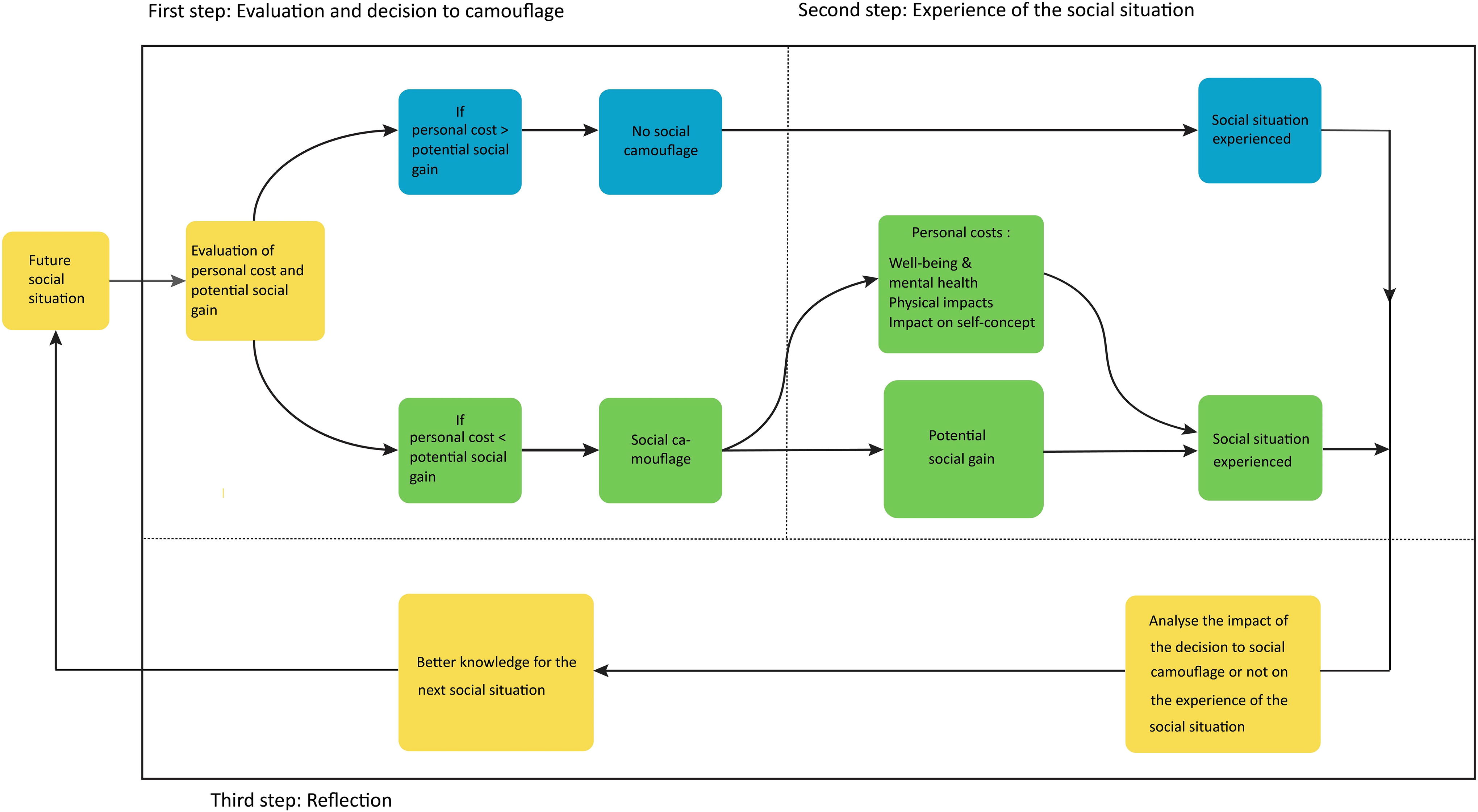
Social camouflaging decision making in autism.
When an autistic person is confronted with a situation, in the first step, they will evaluate the personal cost of camouflaging and the potential social gain. This represents her assessment of the total cost of the situation, based on her own analysis of her skills and the level of acceptance and stigma they expect to experience. This assessment is based on the person’s experience and knowledge of the situation. If the autistic person’s analysis of the personal cost is lower than the potential social gain, they will decide to engage in social camouflage. If, however, the personal cost is higher than the potential gain, the autistic person will not engage in social camouflage. Taking an intersectional lens, it is likely that those with multiple marginalized identities will likely face greater stigma in some contexts and/or different types of stigma related to their different identities in different communities that would impact, or limit, this decision-making process. For example, Black autistics are at heightened risk of having autistic mannerisms mistakenly perceived as aggressive and being subjected to police violence, 39 and many marginalized groups have highly consequential reasons to avoid contact with police or government agencies. 40 As a result, one may need to use camouflage for survival and not have the privilege of deciding whether or not to camouflage, particularly in such high-risk contexts (see Franklin et al.). 28
In the second step, once the decision has been made with regard to the application, or not, of social camouflage, the autistic person will experience the reaction of the other actors in the interactive situation, which will allow her to confirm or invalidate her assessment of the trade-off between personal cost and potential social gain. Therefore, the success of social camouflage in achieving potential social gain rests on the reaction of the other and how one interprets it, which leads to the third step.
In the third step, the autistic person analyzes their decision and reflects on the actual social gain, as observed through the reaction of the other, versus their personal cost. This reflection will enrich their knowledge and influence decision making in subsequent situations by fine-tuning the autistic person’s introspection about the choice to engage in social camouflage or not as well as their choice of strategies, and the evaluation of the personal cost versus potential social gain, in light of possible reactions on the part of the other.
Are Aspects of the Social Camouflage Decision-Making Process Unique to Autism?
As discussed in earlier sections, engaging in social camouflage is a form of impression management 8 that all people engage in and that minority groups in particular, given societal power structures, have many reasons to engage in social camouflage for potential social gain (e.g., reducing stigma and increasing belonging), as supported by the many reports of “masking” in different minority groups.18–20 In many groups such as sexual minorities, racialized minorities, and people with physical disabilities, the relationship between the experience of social stigma and negative physical and mental health outcomes is well established. 26 Two studies37,41 indicate an association between the experience of stigma and well-being in autistic people. To our knowledge, social camouflage behaviors have not been examined empirically in other groups as a primary mediator between stigma and negative mental health outcomes, as they have recently been studied in autism. 42 It is likely that the negative impacts, or personal costs of social camouflage, are also shared by other minority groups. For example, we know that engaging in social camouflage is a risk factor for suicidality in autistics, 38 whereas it is not in the general population. To our knowledge, there is no comparative study between autistic people and other minority groups regarding the impacts of social camouflage. However, engaging in social camouflage may also be associated with suicidality in other minority groups such as trans people.
Thus, what is unique to autism is not the practice of social camouflage or its impacts, positive (potential social gain) or negative (personal costs). What may be unique to autism is how the autistic individual engages in the decision-making process itself, in the first step—evaluation and making the decision to camouflage or not—and the third Step, reflection and updating, as well as, importantly, how other people perceive and react to autistics in the second step. The difference, at all three steps, can be tied to the core characteristics and diagnosis of autism, which is defined by difficulties in social interaction and communication, as well as restricted and repetitive behaviors and interests. 1 At the first step, the evaluation of elements of the potential social gain, for example, understanding the expectations in a particular social context, or how the selection of a particular strategy will be received, may differ between an autistic person and a non-autistic person. Similarly, at the third step, the interpretation of the reactions of others and the analysis of the actual social gain may differ from a non-autistic analysis, given reduced understanding and/or perceived importance of social conventions and reduced perception of another’s social intent.
In addition, engaging in the first step and the third step is likely more effortful and resource-demanding for autistics than for others, as reflected in the “Cognitively Taxing” subtheme documented by Livingston et al.’s thematic analysis of autistics’ experience with social compensatory strategies. 11 The second step highlights that the reaction of the other is central to actual social gain and the social situation the autistic person experiences. In this regard, research suggests that non-autistics have negative social perceptions of autistic people, even based on very brief 10 second exposure to a person speaking on video.43–45 It is possible that this is the case even when autistics attempt to social camouflage (e.g., the camouflage not being viewed as effective), although this has yet to be studied.
Contributions of the Model and Potential for Application to Practice
The model was directly inspired by the experiences of an autistic person (M.G.); it operationalizes multiple situations of his lived experience. Indeed, the model includes flexibility and adaptation to particular situations by taking into account a number of relevant considerations in the evaluation of potential social gain, related to both the individual (possibility, choice of strategy, quality, context) and society (stigmatization, acceptance) and while considering the decision making of each autistic person in relation to the use of social camouflage according to their experiences and knowledge (e.g., during the first step or the evaluation process).
By breaking down the decision-making process of social camouflage, the model makes it possible to adequately define the role of each component in order to integrate this notion into public health issues such as stigmatization or mental health. For example, a measure of perceived need for social camouflage by the autistic person could be used to measure the perceived stigma versus acceptance of the autistic person, as the use of social camouflage is correlated with perceived stigma. 27 The measure of perceived need for social camouflage could also be used to evaluate the efficacy of interventions to promote acceptance in non-autistic persons. Since traditional interventions promote behavioral change solely in the autistic person, 45 this should be reflected in an increase in social camouflage, whereas an intervention targeting the general population and promoting acceptance should result in a decrease in social camouflage practices. Given the established relationship between camouflaging and poor mental health in autistics,35,37,38 after careful consideration of whether it is safe for the individual to unmask in a particular context, reflecting on camouflaging practices could be one factor to modify to improve or protect mental health.
Finally, this model also makes it possible to identify new avenues for psychosocial interventions, in particular by supporting the autistic person in decision making with regard to social camouflage (choosing to do it or not) but also in increased knowledge gained by self-analysis of their own lived experiences. For example, disclosing one’s diagnosis to trusted individuals is generally associated with better accommodations and support. 12 Disclosing one’s diagnosis can also improve first impressions. 46 Thus, a combination of social camouflage and disclosure could reduce the impacts of stigma while also reducing the negative impacts of social camouflage for the autistic person. 44 Our model can help support decision making around such choices, for individuals, for practitioners working with autistics one-on-one, and also for peer support or peer mentoring programs.
Limitations and Questions for Further Work
This model is a preliminary proposal, and several aspects of the model require further development. Currently the model focuses on a global evaluation of personal costs and potential social gain, without specification of the influence of each proposed component. For example, what is the relationship between internal factors and the possibility of social camouflage? What are the most relevant internal factors that impact social camouflage use? How do interaction partners determine the quality of social camouflage? What are the criteria for “successful” social camouflage? Which personal costs (mental health, physical, self-concept) have the greatest negative impact? A critical area to explore in depth in future work is how intersectionality influences social camouflage 28 ; for instance, how is decision making impacted when you are autistic and belong to a particular racialized or ethnic group and/or identify as a gender or sexual minority? We agree with calls for the need to move autism research and practice in a more inclusive direction by applying an intersectional lens39,40,47–51 and hope this initial model can be elaborated to represent a diversity of lived experience.
Conclusion
In conclusion, this article aimed to present a first conceptual model of autistic decision making around social camouflage. The model describes an evaluation of personal costs versus potential social gain, which determines decisions to use social camouflage or not. Social camouflage is not specific to autistic people. The motivations for and impacts of social camouflage are likely similar for other minority groups except that, for autistic persons, there are unique elements involved in engaging in the decision-making and introspection processes involved in social camouflage, given the communication and relational difficulties associated with autism. Ultimately, the actual social gain largely depends on how others respond to social camouflage behaviors. Given negative biases in how non-autistic persons perceive and socially respond to autistics, this likely impacts the success of social camouflage or the social gain experienced. This may add a particular challenge for autistics, in terms of social camouflage, compared with other minority groups.
We hope this model can support autistic people in their decision making around engaging in social camouflage and that it helps professionals to understand this decision-making process and the support they can offer on this issue for autistic clients.
Footnotes

Authorship Confirmation Statement
M.G. originated the idea for this model and wrote an initial draft of the article. Through discussions with I.C. and A.N. about the model and other literature on this topic, ideas were fine-tuned and the model was elaborated on. I.C. and A.N. wrote additional sections of the article to contextualize the model. All three authors revised the initial submission, incorporated reviewer feedback, and accepted the final article. The article hasbeen submitted solely to Autism in Adulthood.
Author Disclosure Statement
The authors have no conflict of interest to declare.
Funding Information
No funding was received for this article.