




Abstract
Background:
Research suggests that autistic youth and young adults often experience barriers to sustained employment. Although there is an existing body of literature on the barriers and facilitators to employment, little of this literature focuses solely on the perspectives of autistic youth and young adults. To better support autistic youth and young adults at work, we aimed to determine which workplace supports and accommodations these individuals classify as key supports based on their lived experiences.
Methods:
We conducted semi-structured qualitative interviews with 12 autistic youth and young adults (ages 17–29 years old) about their workplace experiences and perspectives. We conducted interviews virtually and used a grounded theory approach to analyze and organize the transcribed interview data into themes.
Results:
Six themes of workplace supports emerged from the data. The resulting themes were as follows: (1) hands-on training methods with opportunities for practice, (2) employer-provided accommodations, (3) social support, (4) job-fit, (5) external supports, and (6) inclusive workplace culture and self-advocacy. Employer-provided accommodations included written and direct instruction, flexible scheduling, and supports for sensory needs and social-communication. Social support included support from managers, coworkers, and through proximity to others. Job-interest match, workload, level of social interaction, and a sense of routine all contributed to job-fit.
Conclusion:
The six identified themes provide a guide for the ways in which employers could better support autistic youth and young adults at work. Notably, many of the identified themes were cost-effective, easy to implement, and may benefit autistic and nonautistic employees alike. Practical implications for employers and vocational support practitioners are also discussed.
Community Brief
Why was this study done?
Autistic young people often talk about facing challenges at work. We wanted to learn from autistic young people about what kinds of things help them at work. Their views on this may give information on how employers can better support autistic people at work.
What was the purpose of this study?
The goal of this study was to find out what things autistic young people describe as being helpful for them at work.
What did the researchers do?
We talked to twelve autistic people, between the ages of 17 and 29, using Zoom. We asked them about their current or most recent job, and what they liked and did not like about it. We also asked them what things they found helpful at their job. We asked them how satisfied they were with these things, and if they wished they had more support at work. Then we converted their audio-recorded interviews into text and analyzed their answers. We grouped common answers together into main topics (or themes).
What were the results of this study?
We found six main themes in the participants’ responses about what they found helpful at their jobs. These were: (1) hands-on training, (2) “accommodations” or adjustments that employers can make to help them, (3) supportive managers and co-workers, (4) a good job fit, (5) help from outside programs like job training programs or job coaches, and (6) a workplace where people understood and accepted autism. For “accommodations,” they wanted employers to provide directions in a written and direct way, be flexible with job schedules, and help with sensory needs and communication. They told us that workload stress, social interaction, routine, and having a job that was interesting all related to job fit.
What do these findings add to what was already known?
These findings agree with other research about autistic people’s preferences at work but give us some new information about what autistic young people want at work. For example, we learned that autistic young people want to work remotely to help with sensory and communication needs. We also learned that some autistic young people like a lot of social interaction at work, even if they also have difficulty because of miscommunications. Also, autistic young people often had to self-advocate for the inclusivity that they wanted at work.
What are potential weaknesses in this study?
Most participants were White women with education after high school. Also, everyone in the study communicated vocally. This means that these 12 participants may not represent the whole autistic community. This study also was not done by autistic people.
How will these findings help autistic people now or in the future?
We hope this helps others learn about autistic young people’s views about what support they want at work. We also hope that the findings help to improve vocational rehabilitation programming and planning for the transition to adulthood. This may also help employers to better support and advocate for autistic people’s needs at work.
Background
During the transition to adulthood, many autistic youth and young adults experience substantial barriers to finding and maintaining competitive employment, with national statistics demonstrating lower rates of employment, fewer hours, and lower wages than their neurotypical peers.1,2 However, these statistics indicate that autistic young adults also experience poorer employment outcomes than their peers with different disabilities, such as those with intellectual disability, learning disabilities, emotional and behavioral disabilities, and speech and language impairments (although it is important to note that autistic individuals may also have these co-occurring disabilities). 2 This suggests that some employment barriers are potentially unique to the experiences of autistic individuals. Therefore, it is necessary to determine tailored workplace supports and accommodations that are similarly unique.
Researchers have identified many potential barriers to employment for autistic adults. Some barriers are related to autistic traits, such as hypersensitivity to workplace sensory environments, strict adherence to routine, and issues related to executive functioning or co-occurring mental or physical health conditions.3–5 Social communication differences are one of the most commonly reported workplace barriers for autistic individuals across existing literature. 3 Furthermore, when these miscommunications occur, they are more frequently attributed to the autistic individual than the employer, and often result in negative repercussions for the autistic individual (e.g., negative feelings, responsibility for resolving the situation). 6 This also speaks to the mental health challenges and burnout that autistic adults have reported experiencing at work due to ongoing discrimination, bullying, and overall unaccommodating work environments.4,7,8
Another significant barrier to employment is the interview aspect of the hiring process.8–10 Interviews present a challenge as they typically focus on evaluating one’s “soft skills” over their technical or job-specific skills and may present embedded social and sensory environmental barriers. 11 Interviews also present the “high stakes” issue of disclosure, which may help autistic individuals gain access to accommodations, but may also lead to increased stigma and discrimination. 8 For example, Romualdez et al. 12 found that among the 238 autistic adults surveyed in their study, less than half rated the impact of disclosing their diagnosis (40%) or the resulting adjustments (34%) positively. Ohl et al. 13 found that autistic adults were three times more likely to be employed if they disclosed their autism diagnosis, but Whelpley et al. 10 found that when autistic adults disclosed their diagnosis during job interviews, they were often faced with questions about their ability to perform the job, employers’ ignorance about autism, and a general fixation on their diagnosis rather than their personhood. It is attitudes such as these that are also a significant barrier to employment for autistic individuals.3,9,14–16
Despite the many significant barriers to employment, researchers have also identified facilitators. For example, providing workplace accommodations, such as visuals and written instructions, organizers, extended time lines, modified work allocation, consistent expectations and job tasks, structured routines, exemption from customer-facing tasks, and flexible hours can be important facilitators.3,17–19 Another important facilitator is modifications to the workplace environment to reduce sensory input, such as adjusting lighting conditions, permitting the use of headphones, changing the location of the employee’s desk, and managing noise levels, crowds, and the number of interruptions.17–18 Facilitators may also come in the form of external supports such as transportation, job coaches, or assistive technology or through providing training on both job-specific and soft skills.3,18 In addition, harnessing the strengths of autistic individuals, including autistic traits such as attention to detail, tolerance of repetitive tasks, and strong work ethic, 20 can help to establish a good job–person fit.14,21 Lastly, social support is one of the most commonly reported facilitators in the literature. 3 This can come in a variety of forms, such as through the use of a workplace mediator or mentor to assist with understanding workplace procedures, supervisors who provide clear instructions, feedback, and ongoing support, and in particular, employers and coworkers who demonstrate knowledge and acceptance of autism.10,14,19
Although the existing literature has provided a wealth of information on the potential barriers and facilitators to employment, many autistic individuals, and particularly autistic youth and young adults who are newly transitioning to and navigating the nuances of adulthood, continue to have challenges finding and maintaining employment. 2 Therefore, there is a need for additional focus on how employment systems can better address the known barriers and provide appropriate supports for autistic youth and young adults, who are uniquely affected by the employment gap. To gain further insight into this topic, we chose to use qualitative research methods to learn directly from the lived experiences of autistic youth and young adults across a variety of workplace settings. Because past research has demonstrated that autistic adults tend to have different perspectives on workplace supports and adult outcomes compared with other autism community stakeholders,14,22,23 we focused solely on the perspectives of autistic individuals to establish a clear theory grounded in the autistic lived experience. Therefore, the purpose of this study was to use in-depth qualitative interviews and a grounded theory approach to address the following research question: What do autistic youth and young adults, with a history of employment, characterize as key employment supports?
Method
Participants and recruitment
We recruited participants via online advertisements, shared through community and disability organizations, social media, and our personal and professional contacts. The advertisements included a link to screening and contact questionnaire, which established participants’ eligibility based on the following criteria: (a) having a self-reported diagnosis of autism, (b) being between the ages of 14–29 years old, (c) having a history of employment, and (d) at present living in the United States. A history of employment was defined as either presently or formerly working for pay from an employer. Given the employment gap uniquely experienced by autistic individuals who are newly transitioning from high school to adulthood, 2 we wanted to focus on individuals within this age range (i.e., “transition-age,” which is typically defined as 14–25 years old) 2 as well as those who had recently made this transition and could still speak to the barriers and facilitators experienced during this phase and young adulthood broadly (i.e., through age 29, which is typically defined as the end of “emerging adulthood”). 24 The Institutional Review Board (IRB) at the University of Maryland College Park reviewed and approved this study (IRB#1860876-1).
Twelve, 17- to 29-year-old (M = 23), autistic individuals participated in this study. Nine participants identified as women. Seven participants were presently employed at the time of their interview. Of those who were not presently employed, two were full-time students who worked seasonally, two were at present seeking employment, and one was not seeking employment due in part to co-occurring health issues. Eight participants worked part-time at their present or most recent employment. For some (n = 3), this was an explicit preference, but for others (n = 5), this was because they were full-time students. For demographic information, see Table 1.
Participant Demographics
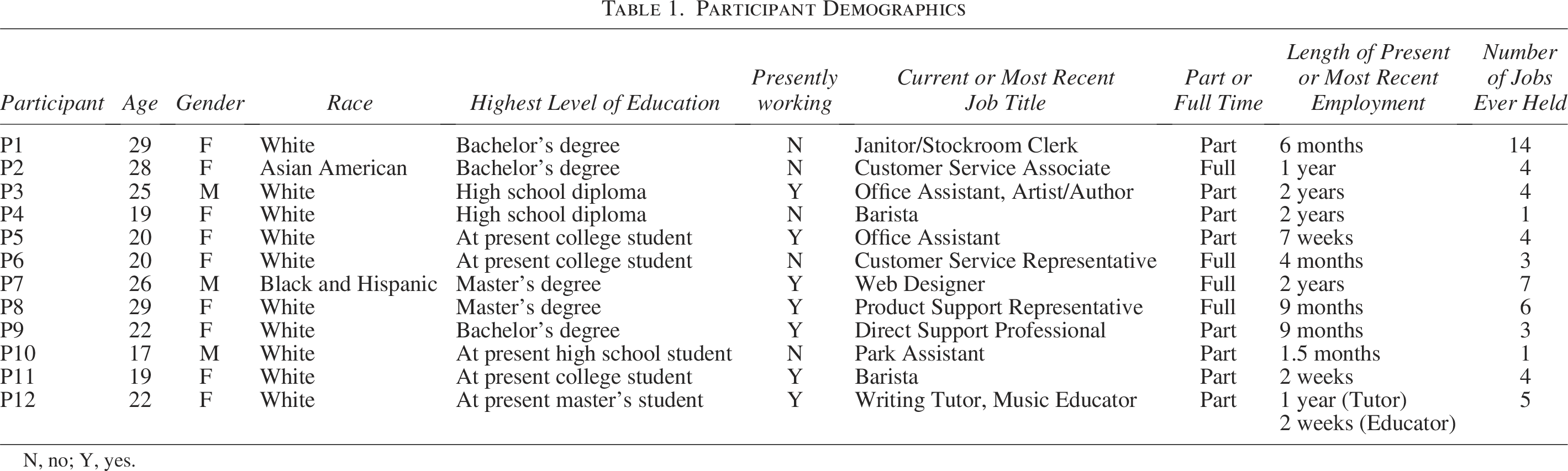
N, no; Y, yes.
Procedure
We contacted eligible participants via email to complete the consent process and schedule a time for the online interview. We also sent participants a short open-ended demographic questionnaire (i.e., gender, race, ethnicity, highest level of education, employment status, and number of jobs held) to complete. All questions were free response such that participants could self-identify rather than choose from a predetermined list. We gave participants the option to receive the interview questions ahead of time. Interviews took place virtually using a unique link to a secure, university Zoom account. Interviews included only the first author (i.e., interviewer) and the participant, with the exception of Participant 10 (P10), whose mother also attended the interview with his permission since he was younger than 18 years old. We recorded all interviews and transcribed them verbatim. Participants had the option of choosing to participate via video or audio-only. All but one participated via video. Interviews ranged from 14 to 75 minutes, with the average interview lasting 38 minutes. All participants received a $15 e-gift code as appreciation for their time.
The semi-structured interview consisted of eight questions with supplemental follow-up prompts, to further probe participants’ responses (see Supplementary Data). The interview questions asked participants about their present or most recent job, including basic information (e.g., job title, job duties, full- or part-time hours, how long they’d worked there), what they liked and didn’t like about their job, whether they received formal workplace accommodations, what about their job or workplace they considered to be beneficial or supportive, their level of satisfaction with the support they received at their job, and whether they wished they received more support or accommodations. The final question of the interview was “Is there anything else you’d like to share?” such that participants had space to voice anything else about the topic that had not yet been discussed. There were two versions of the interview guide: One in present-tense for those who were presently employed and another in past-tense for those who were formerly employed. Other than the verb-tense, the interview questions were identical. We asked participants questions in regard to their present or most recent employment to help focus the conversation, but participants often also discussed prior jobs, typically in contrast to supports or accommodations at their present or most recent employment.
We created the interview guide based on our research question and published interview guides from studies on similar topics.16,25,26 After we discussed and revised our guide, we asked a colleague with expertise in qualitative research to review the questions. She offered feedback regarding ways to make the questions less repetitive, and how to make the wording more succinct and direct. In addition, we also conducted an informal pilot interview with one additional colleague for the first and then final draft of the interview questions.
After initial coding, we sent participants a copy of the interview transcript to review. We then conducted member check interviews to verify our interpretations with the interviewees. During the member checks, the interviewer (first author) explained the purpose of the study and provided a summary of the workplace supports that we had identified during initial open coding. She asked participants to explain whether they felt the summary was accurate, and whether there was anything they would like to add or clarify. Nine participants completed member check interviews. Although no participants found the findings and interpretations to be inaccurate, seven participants added minor clarifications or further expanded upon the findings. We transcribed participants’ follow-up interviews and used their additional comments to refine the original coding.
Data Analysis
We chose to use a grounded theory approach of qualitative research because it is intended to be used when a researcher wants to develop “a theory that will explain a phenomenon in a specific context” when there is no existing theory, or the theory is too abstract to be tested. 27 Although there is existing research on workplace supports for autistic individuals, there is a limited amount of existing literature regarding workplace supports from the perspectives of autistic individuals who are transitioning to employment either immediately after high school or upon receiving postsecondary educational degrees (e.g., undergraduate and graduate degrees). Therefore, we felt that using a grounded theory approach would be appropriate to help develop a theory in this area. We used an inductive and constant comparative approach to coding. 28 As such, we did not create a preexisting codebook, but rather, derived all codes from the transcripts. This was done to ensure that coding was informed by the data, rather than our preconceived notions. For the first stage of coding, we reviewed each transcript line-by-line and coded each line with an open code. We conducted open coding concurrently with participant recruitment. We coded new data using an existing open code or created a new open code to better match the data. As such, we continuously compared open codes and refined them as new data from subsequent interviews were added. There were no new open codes for job supports by the 12th interview, so we determined that the data had reached saturation and stopped participant recruitment. Therefore, we determined that the interview findings from 12 participants would be appropriate from which to develop themes for this initial exploratory study.
The next phase of coding was axial coding. Using the constant comparative method, we compared open codes and grouped similar and reoccurring codes into broader axial codes. After discussing the emerging axial codes with the reliability coders, we further refined the axial codes, also revisiting the original transcripts to compare the emerging codes against each participant’s original comments. Last, we compared and grouped axial codes into overarching themes. We discussed the themes with the reliability coders and reached a consensus.
Reliability, trustworthiness, and positionality
To reduce bias that could be introduced by a sole coder, and due to the lack of participatory research design, we used investigator triangulation and member checks. Two independent coders conducted open and axial coding for three transcripts each, 29 and offered feedback on the theme development. The first author individually trained them on the coding process and study aims. We used member checks to further promote trustworthiness by verifying not only the interview transcript but also our interpretation of the interview. Despite these efforts, it is important to recognize positionality and the resulting biases that may affect how we interpreted the data. 30 We (the authors) and the reliability coders are all women who were doctoral students (first author, reliability coders) or a professor (second author) in special education at the time of the study. All have substantial experience working with autistic individuals and conducting research in this area. We firmly believe in the importance of neurodiversity, particularly as it relates to meaningful employment, and our work is heavily influenced by this lens. However, none of us are autistic. Furthermore, we did not utilize a participatory research design, include autistic researchers, nor seek input from autistic advocates or consultants.
Results
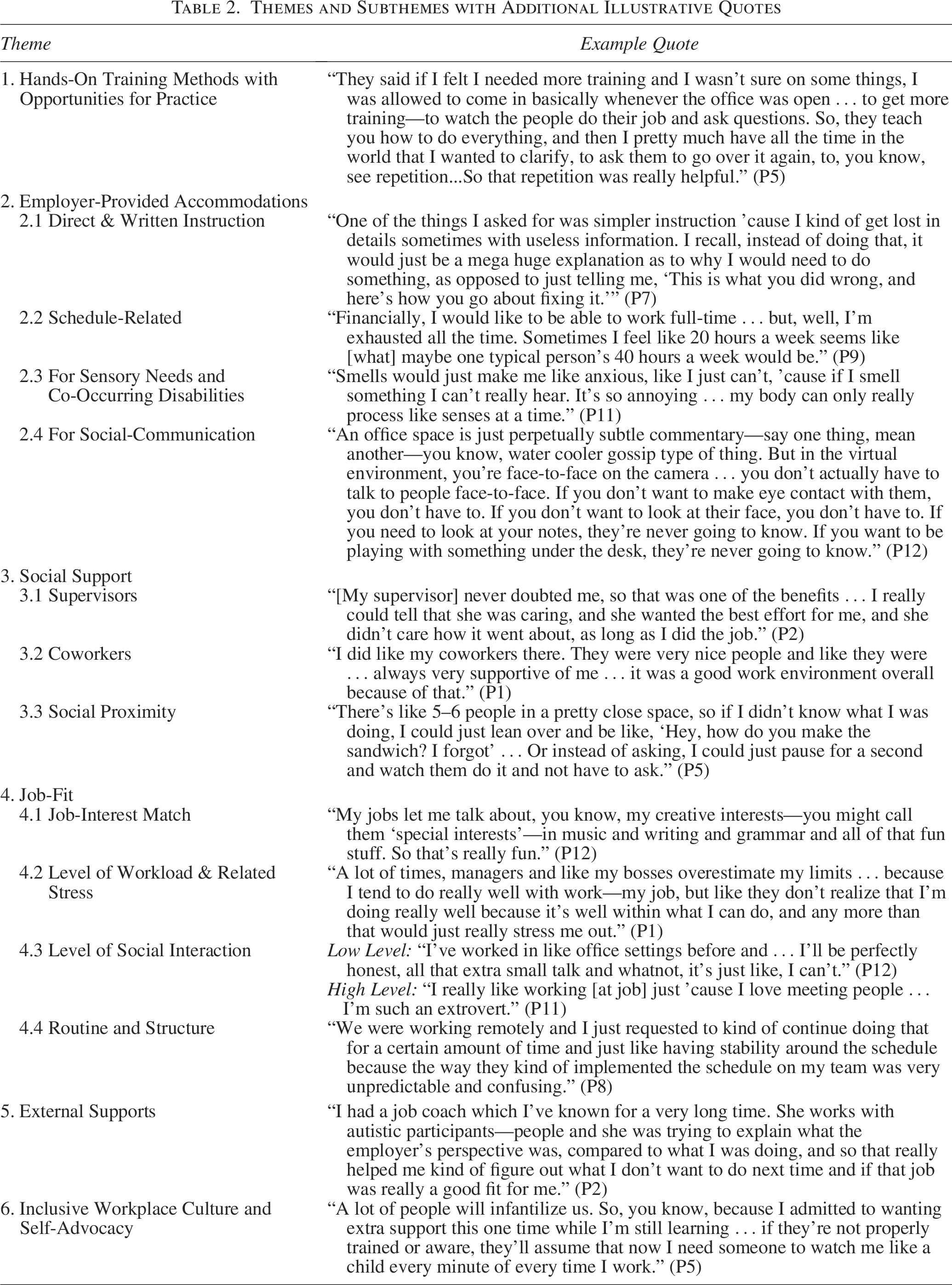
Six major themes in key workplace supports emerged, including the following: hands-on training methods with opportunities for practice, employer-provided accommodations, social support, job-fit, external supports, and inclusive workplace culture and self-advocacy. See Table 2 for a list of themes and additional illustrative quotes.
Themes and Subthemes with Additional Illustrative Quotes
Theme 1: Hands-on training methods with opportunities for practice
When starting a new job or learning new tasks at their present job, participants described the importance of training that utilized hands-on learning with repetition or multiple opportunities for practice. Participants expressed the sentiment that “you really have to do [the job] hands-on to understand it” and “just a few times doing a task doesn’t help me remember it” (P6). Others echoed this: “I think it’s helpful for me to … have some ability to be really hands on in training and learning, and really applying things before you really have to do them” (P8). Some, such as P5, did have this type of training and found it to be particularly beneficial (see Table 2). Others, such as P2, wished that they had had an opportunity to “observe the duties” and “keep on doing like the positive reinforcement of the role until I was comfortable to do it on my own.” In reference to a previous job from which she had been terminated, P2 further explained, “I realize that repetition was really important that I kind of did not do as much [at my previous job]. I was just kind of given all this information and then I never really got a chance to practice it.” This repetition was important for many participants, as it provided scaffolded support through opportunities to practice the job task before they were expected to do it independently.
Theme 2: Employer-provided accommodations
Participants identified several employer-provided accommodations as key supports. Specifically, they noted the importance of having accommodations for the format of instructions (i.e., written, concise language), and for scheduling, sensory, and social-communication needs.
Direct and written instruction
Participants described the importance of clear and concise instructions from their employers or managers, typically delivered in a written format. They described feeling “lost” (P2) without this type of instruction, specifically requesting it as an accommodation: “I actually asked them … to define what exactly they wanted me to do. That’s why I had them write an email to me every time after my shift because I would sometimes be lost” (P2). Participants also noted the importance of employer-provided lists for job tasks, such as the list of steps for opening or closing the store (P11) or for specific ingredients in food orders (P4). These lists were an important part of employer-provided accommodations for participants, who noted “it just makes things so much easier” (P11), and that “written is the best” (P9) especially for “multi-step directions” (P3). Participants also spoke to the use of employer-provided visual supports as an accommodation, such as a map of the workplace building (P3) and the use of wall calendars, physical planners, and checklists (P9).
Schedule-related accommodations
Participants stressed the importance of schedule-related accommodations. For some, it was necessary to have an employer who would allow them to work a part-time or modified schedule, without later increasing their expected weekly hours without warning, as experienced by P1. As she explained, “I don’t really have the mental stamina for working more than six hours. I tend to like lose focus and kind of peter out of it” (P1). Similarly, when asked about desired supports at a prior job, P6 explained, “Probably less hours would have been nice, but I was full-time there, so, accommodating within my needs for not working as much would have been good.” Others worked part-time hours for other reasons, but were grateful for the shortened hours so that they could use their free time to participate in activities they enjoyed more (P3, P10). Some participants noted a preference for working their hours during a particular time of day, such as P1, who preferred evening shifts since “I’m often so tired in the morning that even like with coffee, I don’t feel safe driving on the road.” Others described a preference for general flexibility in scheduling because “sometimes autistic people’s bodies are not dependable or if we are in sensory overload, we may not be able to work at all for the day” (P9). Schedule flexibility in terms of regular breaks was particularly common among those who worked in customer service jobs, since “you only get like a 30-minute break for everything, and that wasn’t really enough time to like, exist” (P6). For others, breaks were necessary for sensory regulation (P11, P12). Flexibility in deadlines to accommodate processing needs, by either allowing for additional time to complete tasks or receiving information ahead of time to “pre-think about it” was also desired (P2, P3, P9).
Accommodations for sensory needs and co-occurring disabilities
Participants described having sensitivity to lighting, sound, temperature, smell, and texture, which affected their work performance. Many noted being “distracted very easily by auditory stimuli” (P5), but not always having a way to manage due to workplace policies (e.g., no headphones allowed). Others commented on the importance of flexible policies for workplace attire to accommodate for texture sensitivities:
Being able to wear whatever clothing I can handle for the day is very important because some days my sensory system is in overload, and I can’t really tolerate fancy clothes … Employers should know that what an employee wears has nothing to do with their competence because if I am in uncomfortable clothing I can’t focus. (P9)
Other commonly requested accommodations included the following: nonfluorescent lighting, a quiet workspace, and the ability to take sensory breaks, move, and use stim toys or seating accommodations. Some participants also identified remote work as an accommodation for sensory needs because “at home, I can accommodate myself without even needing to really think about it” (P12). Participants also spoke on needing accommodations for co-occurring disabilities, including many supports already identified in other themes (e.g., environmental modifications, remote work accommodations, preferred instructional methods, and schedule accommodations), but also included the use of assistive technology (e.g., screen readers) or dietary accommodations.
Accommodations for social-communication
Many participants noted experiences of miscommunication at work and expressed the desire for accommodations to support social-communication needs. For some, remote work was helpful in preventing miscommunications and allowing one to focus without “forced interaction” (P7) and without “having to be physically with someone necessarily and feel anxious” (P8). P8 noted that she specifically sought a remote position because “I think especially with my experiences on the spectrum, I feel like being in a remote team and the ways like getting to communicate more remotely … I can feel that it’s just easier.” P12 also preferred working remotely for both sensory and social-communication reasons (see Table 2).
Several participants also noted the benefit of having an advocate to help with social-communication needs. P11 discussed the desire for a third-party, particularly during important meetings, to help prevent miscommunications because “I have a tendency to kind of like express immediately what I’m thinking or feeling, even though … I may not have perceived the situation right.” P2 had an external job coach who served this role to help “communicat[e] what the perspectives of the supervisors were.” P9 indicated interest in having a job coach to help “communicate with other staff because I sometimes struggle with social-communication invites,” but admitted that “another person, a different new personality” could further complicate things.
Theme 3: Social support
Participants discussed the benefits of social support at work. Social support came in different forms, including social support from supervisors, coworkers, and from being within proximity to others such that they could seek immediate support if needed.
Support from supervisors
Participants described having a supervisor who was “understanding,” “supportive,” “flexible,” “caring,” and with whom they had “open communication” and “feel very comfortable expressing discomfort” as a vital workplace support. Participants desired “A boss who’s flexible … not too much to be taken advantage of though, but like enough to be understanding and supportive” (P10). P3 described open communication with his supervisor through “biweekly meetings … to discuss my work performance.” Similarly, P5 noted, “They make it very clear that communication is open. We’re never bothering anybody if we ask for [help].”
Although many participants described these attributes of supportive supervisors based on positive workplace experiences, others decided to seek out supervisors with these characteristics after negative experiences. P7 contrasted his present and former supervisors: “With my new manager, I don’t feel, for lack of a better word, scared [to ask for clarification] … But at previous jobs I’ve had, it’ll be kind of a vague instruction, but there’s seven different ways of doing it, and then some people get kind of impatient with me.” P1 also had difficulty communicating with a supervisor when he increased her workload beyond what she was comfortable with because she felt that her supervisor was “dismissive,” and she feared being perceived as “lazy.” Despite these negative experiences, participants also expressed that they better know what they wanted in future jobs due to these experiences.
Support from coworkers
Having “helpful,” “respectful,” “nice,” and “supportive” coworkers was also commonly named as a support to employment. Many noted that coworkers played a vital role in one’s well-being and sense of belongingness in the workplace. P4 summarized this, stating:
That’s sort of like the big thing for me. Like I could have the best benefits in the world, but if the staff aren’t nice or if I don’t get along with people and they make it difficult on me like on an individual level, I’m not going to like it there. Whereas, if I work somewhere the benefits maybe aren’t as good, but people are really respectful and nice, I’d probably more prefer that.
Many described how positive coworker relationships provided support in and out of the workplace, such as P3: “They’re helpful whenever I need something. I can ask them, and they’ll understand … I’m also in a band, so they’ll come to like extracurricular activities outside of work.” P6 explained that at a former job, her co-workers were “super supportive of each other … it really felt like a family there.”
Social proximity
Participants also described the support of social proximity, or support from being in the same physical vicinity as others such that you can seek support immediately. P5 particularly emphasized this: “I would consider having someone physically close as kind of a necessity.” She explained, “sometimes with autism, it will be the smallest question in the world and I’m not going to get up and walk across an office to ask every single time.” P1 mentioned that she liked that she “could always find people” because “I didn’t know where everything is … so it was helpful that I could have someone that knew what they were doing.” Participants described how they had benefited from this “freedom of communication” with walkie talkies (P2, P11), or through having a job coach “on-call when I need her” (P3) to quickly access another person for help.
Theme 4: Job-fit
Participants touched on different aspects that contributed to having a good job-fit. This included having a job that matched their interests, a manageable level of stress or challenge, an appropriate level of required social interaction (depending on their personal preferences), and a sense of routine and structure.
Job-interest match
Participants noted the benefit of having a job that matched their interests. P1 explained that while she did not enjoy all of her job duties as a janitor at a craft store, “I like crafts, so it was kind of my dream to work at a craft store.” P10 similarly noted his excitement for an upcoming summer job at a video game store that closely matched his interests. Not all participants, however, had an opportunity to work at a job that matched their interests well, but many explained that they’d prefer that in future positions. For example, P2 desired a job that is “not just motor skills, I can use my creative brain as well.” Similarly, P3 noted, “I don’t like that I don’t use my art skills very often with this job. I mostly do spreadsheet work.” At the time of the interview, P2, P4, and P9 were searching for new jobs and noted prioritizing jobs that matched their interests.
Level of workload and related stress
Participants described job-fit also in terms of the level of workload and related stress. Some, such as P3 and P4, experienced a manageable workload and a notably “low-stress environment,” which both named as a support. P9 and P10 both described feeling dissatisfied with jobs where the workload was too low and “just kind of felt … like contrived” (P10) or “not intellectually stimulating at all” (P9). However, a more common experience, particularly among those in customer service jobs, was a workload that was too high, leading to high levels of stress. P1 explained that she left her job when her workload was increased beyond what she was comfortable with (see Table 2). Several participants also described stress from receiving harsh punishment for small mistakes: “I would have been a lot better off if my … manager had like been a little more forgiving because like there would be times where he’d get so pissed by even the tiniest mistake that he’d like start having a scream fest at you” (P6). To reduce these high levels of workplace stress, there was a desire for a “freedom to make mistakes.” P11 explained:
When I feel like I have the freedom to do that, I definitely am just in a better mind space and will probably do my job better than if I’ve constantly feeling like I only have one shot to get this right, and if I mess it up, everything’s over, everything’s screwed ‘cause of me.
P5 echoed this: “Letting people make mistakes, that aren’t like really bad mistakes, without fear of being harshly corrected, is very important.”
Level of social interaction
The level of expected social interaction was an important aspect of job-fit. Participants were split into two opposing viewpoints: those who preferred minimal social interaction and those who preferred high levels of social interaction. P7, P9, P10, and P12 each explicitly named having limited or structured social interaction as a beneficial workplace experience. P7 noted that “being expected to actively participate in unnecessary communication” like “those weird team building meetings” were distracting to his job duties. Others felt it was “socially draining to like, even have to talk to the people” (P9), preferring jobs that were either solitary or “a limited number of people … not none, but like less” (P10). Despite these findings, others (P2, P4, P6, P11) noted social interaction as a key benefit to their jobs. P2 enjoyed “really getting that customer satisfaction.” She explained, “I like to interact with people, even if like a customer was upset, I would ask for advice, like, how could I do this better?” Similarly, P6 explained, “If you were really nice, sometimes [customers] would be really excited—like you’d have a little bit of a connection.” Interestingly, participants identified social interaction as an important part of job-fit despite also reporting miscommunications and occasional confrontational interactions with customers.
Routine and structure
Knowing what to expect or having a sense of routine and consistency was crucial to job-fit. P6 explained, “I don’t really like not knowing when I’ll be working and what I’ll be doing … For me, it’s really helpful to be doing the exact same thing every day.” Similarly, P1 noted, “I think consistency is very important … and something with a set routine. I have a hard time with any sort of spontaneity or anything.” Others echoed these sentiments, noting the importance of “predictable” duties (P12), “stability around the schedule” (P8), and “universal understanding of what is expected and what isn’t” (P11).
Theme 5: External supports
Some participants reported receiving supports from programs or entities outside of their employer that ultimately benefited their workplace success. Three participants described the benefits of participating in external job fairs, shadowing, or training programs (P2, P3, P10). For example, P3 noted that he got his present job through participating in a national transition-age employment training program. Similarly, P10 explained that he found his upcoming summer job through a youth job fair sponsored by his city of residence. He also participated in a city-sponsored job shadowing program, which allowed him to shadow a job that aligned to his future career goals (IT department at a local university). He noted that it “offer[ed] a good view of how the IT industry works now” and stated that if given the opportunity to shadow a job in the future, he’d “definitely want to do that [because] it would give me an opportunity to see how the job was like before I actually started it.” P5 named her university’s disability services as an external job support because they “very promptly fixed” issues with access to appropriate accommodations at campus jobs. P1, who was recently approved for social security disability insurance (SSDI) while in between jobs due in part to health concerns, named this as a support because it “gives me a safety net, like in case I have to like quit” a future job due to these health issues. Two other participants described positive experiences with job coaches. P3 had a job coach who provided support remotely “every day that I work.” P2 had a private therapist “who took on the role of a job coach,” and also helped her get connected to “an actual job coach” provided by state vocational rehabilitation (VR) services.
Despite positive experiences with VR-sponsored job coaches, participants’ experiences with their state’s VR services were broadly mixed. P1 explained that VR had “helped me in the past, but I never really received a lot of any like specific accommodations.” She noted that they had closed her case “a bit prematurely” and she was hesitant to reopen her case “because I’d have to go through the process all over again and it’s really slow.” P9 also described her experience with a VR-sponsored employment counselor, who “just kind of edits [my resume] even changing some of my wording, which I do not like … you shouldn’t just do shit for people disabilities. You’re supposed to actually show them.” P9 did, however, have some interest in getting a job coach through state VR services.
Theme 6: Inclusive workplace culture and self-advocacy
Participants described an inclusive workplace culture where disclosure was comfortable and accommodations easy to access as a key support. Participants’ self-advocacy also played an important role in seeking out such workplaces. Some participants did not feel that they needed to disclose or request accommodations at their present position but did indicate that they were interested in doing so for future jobs with more complex demands. Others noted an interest but also a lack of knowledge about what “accommodations that are out there for me” (P6). Worse yet, several participants had requested accommodations that they did not receive. They described lengthy processes with human resources (HR), which resulted in “their version” of requested accommodations, with managers “doing the bare minimum to show compliance” (P7) or denying “what I was actually asking for but [saying] that they approved it” (P8). Participants also described fears of stigma if they disclosed their autism diagnosis to receive accommodations. P7 explained, “I was kind of scared to even let people know I needed [accommodations] ‘cause … it’s like a perception sometimes when you disclose you’re on the spectrum.” Many noted similar sentiments and explained needing to weigh the risks and benefits of disclosure (see Table 2). Notably, many stated that they were proud to be autistic, but feared the stigma that could result from a lack of training and understanding among others in the workplace.
Despite this, about half of the participants described positive experiences. Notably, most of these positive experiences resulted from participants’ own self-advocacy, and often after having challenges with this process at previous jobs. Some described openly identifying as autistic in their job search to actively seek out inclusive workplaces, or as summarized by P9, “I ain’t wasting my time or your time if you’re not gonna respect me.” Others did not specify being autistic to gain accommodations, but rather, “I just told them what the access need was” (P5). Some participants, however, noted that they knew they should advocate for themselves more, but struggled to do so out of fear of stigma or lack of knowledge. Last, many participants described the importance of workplaces that practiced more inclusive policies, such as having a clear process for requesting accommodations and accessing resources, flexible and inclusive policies, “proactive engagement” with employees with disabilities (P8), and better disability training and awareness among staff.
Discussion
We found that autistic youth and young adults desire hands-on training methods with opportunities for practice, employer-provided accommodations for direct and/or written instructions, scheduling, sensory needs, and social-communication, social support, a good job-fit, external supports, and an overall inclusive workplace culture. The six identified themes align well to the prior literature on workplace supports for autistic individuals, including the use of hands-on training with opportunities for practice and performance feedback,3,19,31 direct and written instruction or feedback,18,19,22 schedule accommodations,16,18,19 accommodations for sensory and co-occurring health needs,4,11,16,17,19 support for social-communication,6,19,22 routine and structure,3,11,16,19 social support,3,17,18,22 job-interest match,3,14,21,22 appropriate workload for reduced potential for burnout,4,8,17 external supports,3,18 and an inclusive workplace environment where disclosure is comfortable8,10–12,16 and employers have an understanding and acceptance of autism.3,10,14,16,18,19,22
We also found several identified supports that offered additional nuances to the existing literature. For example, the participants described the use of remote work as an accommodation for both social-communication and sensory needs. This aligns to emerging research on autistic people’s views on remote work, which has increased since the COVID-19 pandemic.32–33 Such research found that autistic employees felt that remote work helped to limit sensory overload and intensive face-to-face social interactions, while allowing for preferred electronic means of communication and flexible schedules.32–33 Prior studies have also established autistic individuals’ preference for written or virtual online communication, suggesting that this difference in communication may be a central aspect of autistic culture.34–35 This also aligns to the identified subtheme of social proximity, which found that autistic participants preferred social support in the form of immediate access to another person, such that one could receive help instantaneously, if needed. While this could be created by physical proximity, as noted by several participants, social proximity could also be created through the means of walkie-talkies, instant-messaging, or other forms of technology used remotely. In the years since the onset of the COVID-19 pandemic, employers are offering increased opportunities for remote work flexibility. 36 Therefore, this finding is encouraging, as remote work may be an increasingly available accommodation for autistic individuals.
Another finding among the schedule-related accommodations subtheme was participants’ preference for part-time hours or flexible hours. Much of the vocational research literature focuses on full-time employment as a desired outcome measure for autistic individuals, but our findings suggest that this may be a mismatch in goals between researchers and autistic individuals. Alternatively, this preference for part-time hours may instead point to the need for better support of autistic individuals in the workplace, thus preventing the self-described “autistic burnout” (P9), which has also been widely reported in the literature4,8 and was one of the identified employment research priorities of autistic adults in a recent qualitative study. 37 Therefore, more research and engagement with the autistic community are needed to further examine this finding.
Within job-fit, the subtheme of social interaction also offered some nuance to previous findings. Given the self-reported challenges with social-communication, some autistic adults prefer a reduction in social demands at work along with social-communication supports. 22 While some participants did similarly prefer reduced social interaction at work, just as many specified that having a job with opportunities for high levels of social interaction was an important aspect of fit. This was despite also reporting challenges with miscommunications at work. Although one might expect autistic and nonautistic individuals alike to naturally differ in their workplace social preferences, this finding that some autistic individuals simultaneously desire high levels of social interaction while also wanting support for reported social-communication challenges is a noteworthy contrast. Notably, each of the four participants who named high levels of social interaction as a benefit of their job was a woman (in comparison with two women and two men who explicitly desired low levels of interaction). Although this sample is too small to generalize these findings, this potentially may be a gender difference, given that autistic women typically display stronger social interaction and communication skills than autistic men 38 and have interest in social interaction despite co-occurring social challenges. 39 As noted by Whelpley et al. 10 who also found varying workplace social preferences among autistic people, employers should evaluate job-fit for autistic employees on an individual level and not automatically discount them from pursing customer service jobs or those with high levels of social interaction.
Participants’ experiences with external supports, such as job coaches and job training and shadowing programs, were primarily positive. Work-based training programs are often a focus during transition planning and widely regarded in the literature as an effective and recommended practice.40–41 Furthermore, analyses of VR data have demonstrated that autistic youth and young adults who receive on-the-job supports (which include job coaching) have higher odds of exiting VR with employment.42–44 Therefore, it is encouraging that the participants reported positive experiences and regarded such on-the-job supports favorably. Two participants, however, described mixed experiences with VR services, although notably, neither were in reference to on-the-job supports. While it is difficult to draw conclusions from such a small sample size, this further emphasizes the importance of specific VR supports, namely, on-the-job supports, for autistic youth and young adults, while also demonstrating the difficulty that autistic people experience while trying to gain access to such supports. 8
The sixth theme was perhaps the most important, given that an inclusive workplace culture heavily influences access to the other identified themes. Many participants credited employers’ lack of knowledge or understanding of autism as the reason for the resulting stigma and poor access to appropriate accommodations. Unfortunately, this finding is common, with much of the literature demonstrating that employers’ lack of understanding is a major barrier to employment among autistic individuals.3,10,14,16,18,19,22 These findings point to the importance of educating employers, which could lead to greater understanding and acceptance of autistic employees. 3 In addition, autistic individuals’ self-advocacy also played an important role in seeking out necessary accommodations and inclusive workplace environments. This underscores the importance of teaching self-advocacy skills, which is typically included in K-12 transition programming. However, self-advocacy skills should continue to be targeted for postsecondary autistic individuals as well (e.g., via college career counseling centers, university disability services, VR groups), given that some autistic individuals (including nearly half of the participants in the study) did not have a diagnosis nor receive transition supports or services in high school.
Limitations and Directions for Future Research
Most of the participants self-identified as White women with some postsecondary education and are therefore not representative of the greater autistic community. This is somewhat unsurprising, given that among participatory research, White women with postsecondary education tend to be most willing to participate in studies. 45 Furthermore, all participants communicated vocally and did not have parents who maintained legal guardianship into adulthood. This, again, may not be representative of the broader autistic community. However, it was important to gain insight firsthand from autistic individuals, rather than through parents, as is often done in research for those who communicate nonvocally or have a legal guardian in adulthood. This rather homogeneous sample may also be why we reached data saturation with 12 participants. However, this sample did represent a broad range of ages, U.S. states, and employment experiences. Future research should seek to build on these findings with larger and more diverse samples of autistic individuals, including those from outside the United States. In particular, future studies should aim to collect data through alternative forms of media, such as text, in an effort to include those who communicate nonvocally or prefer this method of communication. For a more holistic perspective, we also focused on those within traditional “transition-age” (i.e., 14–25) as well as those who were past this age, but still within the phase of “emerging adulthood” (i.e., 18–29) and transitioning to various aspects of postschool life. Future research could further focus on the perspectives of those strictly within transition-age or compare between these age groups. Last, we did not use a participatory research design. Notably, this creates the potential for bias in the interview questions and resulting findings. Future research should actively include autistic researchers and nonresearchers throughout the stages of design, data collection, and analysis of qualitative interviews. 46
Practical Implications and Conclusions
Based on our findings, we suggest a number of practical implications for employers as well as educators, vocational support professionals, and transition services providers (see Table 3). First, it is important to educate employers, supervisory staff, and HR professionals on autism and disability-inclusive workplace practices, which has been identified a key facilitator to employment by autistic adults and employers alike.22,47,48 Although research on specific effective neurodiversity or disability diversity training programs is still limited,49–50 there are workplace neurodiversity-inclusive frameworks 51 that provide a model for creating more inclusive workplace environments by having employers engage in particular recruitment, development and engagement, and equitable supervision practices, as well as emerging evidence that such practices correlate with greater hiring rates of autistic individuals. 52 Through adopting such practices, autistic individuals may be able to access appropriate accommodations more easily and free of stigma, as well as benefit from supervisors who can provide preferred on-the-job training, instructional techniques, and social support. Notably, this would likely not require expensive or monumental changes, as many of the participants’ reported that supports could easily be implemented in workplace settings to benefit autistic and nonautistic employees alike.
Practical Implications for Employers

For educators, transition specialists, or vocational training practitioners, we emphasize the importance of encouraging self-advocacy skills among transition-age individuals. Focusing on self-advocacy should remain a key aspect of K–12 transition planning, as well as be better implemented into postsecondary vocational support services. In addition, practitioners can use the identified themes to help autistic youth and young adults better know “what’s out there,” as P6 described. In addition, it may be helpful to encourage autistic jobseekers to consider the identified aspects of job-fit when looking for new employment opportunities.
Through engaging autistic youth and young adults, we identified key workplace supports for this chronically underemployed population. Although additional research with a larger and more diverse sample and participatory design is needed, our findings offer groundwork for the ways in which employment systems can better support autistic youth and young adults at work.
Author Note
This study was conducted as part of Briella Baer Chen’s dissertation in partial fulfillment of the requirements for the degree of Doctor of Philosophy at the University of Maryland, College Park. Briella Baer Chen was affiliated with the Department of Counseling, Higher Education, and Special Education at the University of Maryland, College Park at the time of this study.
Footnotes
Acknowledgments
The authors would like to sincerely thank Monerah Al-Dubayan and Melissa Defayette for their support of this project through assistance with reliability coding. The authors would also like to thank Dr. Jennifer Amilivia for her valuable feedback on this study, as well as Drs Seyma Intepe-Tingir, Ryan Kellems, Peter Steiner, and Jade Wexler for their ongoing review and support.
Author Disclosure Statement
The authors have no competing interests to disclose.
Funding Information
This project was supported by a Doctoral Candidate Award from the University of Maryland College of Education’s Support Program for Advancing Research and Collaboration (SPARC).
Author Contribution Statement
B.B.C. designed the study, collected and analyzed the data, and wrote the article as part of her doctoral dissertation. G.Y. oversaw the study, giving input on the study design, methodology, data analysis, and writing.
Human-Subjects Research
All procedures were reviewed and approved by the University of Maryland College Park Institutional Review Board (IRB#1860876-1) at the time of the study.