




Abstract
Background:
Autistic transition-age youths experienced unique psychosocial challenges in transitioning to postsecondary settings. These challenges may result from both the nature of autism and the developmental tasks associated with this unique developmental stage. Given the challenges and barriers faced by this population, understanding the relationship among factors in this transition period and developing relevant interventions are crucial. The purpose of the study was to examine the relationships between autism acceptance and coping strategies and understand how they impact the quality of life (QOL) of this population.
Method:
In total, 204 autistic youths aged 18–26 years recruited from Prolific and Amazon Mechanical Turk completed an online survey consisting of instruments measuring target variables. Two parallel mediation models were examined to explore the relationships between autism acceptance, coping, and QOL.
Results:
Both parallel mediation models showed good fit. In the first model, perceived acceptance had a significant direct effect on QOL (β = 0.512, p < 0.01) and a significant indirect effect through engagement coping (β = 0.059, p < 0.01). In the second model, the effects of self-acceptance on QOL were fully mediated by both engagement (β = 0.073, p < 0.01) and disengagement coping (β = 0.089, p < 0.01).
Conclusion:
Autism acceptance is a crucial psychosocial factor in impacting successful transition to postsecondary settings. Acceptance-based transition services should be developed for autistic youths to help them gain a comprehensive understanding of their relationship with self, others, and their autism.
Community Brief
Why is this an important issue?
Autistic youths, aged from 18 to 26 years, experience a lot of psychosocial challenges when transitioning to postsecondary education and employment. These challenges result from not only social interaction difficulties but also the overwhelming responsibilities to grow more independently at this developmental stage. Consequently, they often experience poor mental health and lower level of quality of life compared with their neurotypical peers. To help them achieve successful transition, it is imperative to help them better understand themselves as an autistic individual and their relationship with other people. Researchers have found that both autism acceptance and types of coping strategies used can predict better quality of life in separate studies. However, we don’t know whether autism acceptance can influence the selection of coping strategies or not.
What was the purpose of this study?
Our goal was to examine the relationship between autism acceptance, coping strategies, and quality of life. Specifically, we want to see in what ways autism acceptance and coping strategies interact with each other to impact quality of life of autistic transition-age youths.
What did the researchers do?
We asked 204 autistic youths living in the United States to complete online surveys. They answered questions about their level of autism acceptance. Autism acceptance has two aspects: (a) how they perceive other people to accept them as an autistic individual (perceived acceptance) and (b) how they accept themselves as an autistic individual (self-acceptance). They were also asked to report types of coping strategies they use and rate their quality of life. We hypothesized that autism acceptance affects quality of life not only in a direct manner but also indirectly through their selection of coping strategies.
What were the results of the study?
We found that when autistic youths feel more accepted by others, they report better quality of life. Also, if they have a higher level of perceived acceptance, they tend to use engagement coping strategies, such as self-advocacy, to deal with stress, leading to better quality of life. Furthermore, if autistic youths accept themselves more, they tend to use more engagement coping and less disengagement coping, such as concealment and camouflaging, leading to better quality of life.
What do these findings add to what was already known?
Our findings confirmed the importance of autism acceptance in helping autistic youths achieving better quality of life. Also, we showed, in a scientific way, how autism acceptance impact quality of life directly and indirectly through the selection of coping strategies.
What are potential weaknesses in the study?
Our study sample does not represent the entire autism spectrum and diverse ethnic backgrounds. Most of the participants were White with relatively high education levels. Also, the use of online platforms to collect data limits the representativeness.
How will these findings help autistic adults now or in the future?
These findings may help us better understand the role of autism acceptance in achieving better quality of life and inform the development of effective transition services for autistic youths.
Introduction
Autism Spectrum Disorder (ASD) is a neurodevelopmental disability characterized by challenges in social communication and interaction, accompanied by a set of restricted and repetitive behaviors and activities. 1 According to Zeidan et al., 2 a median global prevalence estimate of autism is 1 in 100 individuals within the world population. Autistic individuals experience difficulties in reciprocal social interaction, constraining or precluding their participation in various life activities, including employment, community involvement, and meaningful relationship with others.3–5 Consequently, autistic individuals frequently reported experiencing a diminished quality of life (QOL) compared with individuals with other types of disabilities or those without disability. 6
There is an increasing number of autistic youths entering emerging adulthood where they typically transition to either postsecondary education or employment. 7 It represents a unique life stage, offering opportunities for identity exploration and acquisition of skills necessary for taking on adult responsibilities. The distinctive characteristics of this developmental stage introduce further complexity to the difficulties encountered by autistic transition-age youths. On the one hand, social deficits due to the nature of autism can lead to failure in establishing a meaningful relationship and support system in the new environment.8–10 On the other hand, adjusting to the new environment can be stressful and demanding, given the developmental requirements of building and managing new identities as adults independently. 11 Hence, comprehending and making sense of their relationships with selves, others, and their autism emerge as crucial yet intricate developmental challenges for this population. Studies consistently indicated that autistic transition-age youths tend to report relatively lower QOL ratings in contrast to their typically developing peers.12,13
In the pursuit of improving the QOL for autistic youths, it is imperative to identify and understand the relationship among various influencing factors of QOL within a well-established theoretical framework. Drawn upon Wright’s “coping vs. succumbing” framework, 14 individuals who accept their disability as nondevaluing and are oriented to what they can do are often described as coping, which is associated with improved QOL. The critical role of acceptance and coping in enhancing QOL during the psychosocial adaptation process has been well recognized in studies on various types of disabilities.15–18 In the context of autism research, these two factors have also demonstrated significant correlations with QOL, as supported by findings from both quantitative and qualitative studies.19–22 Therefore, the primary objective of the present study was to use Wright’s framework in investigating the relationships between autism acceptance, coping strategies, and QOL among autistic transition-age youths.
Autism acceptance
The concept of autism acceptance has gained prominence in recent years to replace the old term “Autism Awareness,” which has been criticized by the autistic community for its association with a pessimistic perception of autism. 23 This shift aims to foster a perspective that autism is a valuable aspect of diversity rather than a hopeless medical condition. Existing literature, although limited, has identified this construct as a significant factor for autistic young adults to achieve positive well-being.20,21,24 Autism acceptance can be defined as an individual feeling accepted or appreciated as an autistic person, with autism positively recognized and accepted by others and the self as an integral part of that individual. 20 This perspective of autism acceptance encompasses two dimensions: (a) perceived acceptance, which pertains to how the individual perceives acceptance of autism from external sources (i.e., society, family, and friends), and (b) self-acceptance, which relates to how the individual accept themselves and their autism.
Perceived acceptance from various sources (i.e., society, family, and friends) plays a significant role in the psychosocial adaptation process. Research has consistently shown that it serves as a significant predictor of well-being and acts as a protective buffer to mitigate specific characteristics of autistic individuals.20,25 Specifically, autistic youths often encounter low level of perceived acceptance from society in the form of societal stigma. 24 The effort made to fit into an unaccepting society can exert a considerable mental toll, leading to poor psychosocial outcomes. 26 Moreover, parents who struggle to accept their child’s autism often exhibit a biased perception, resulting in detrimental influences on the child’s psychosocial adaptation and the development of the family.27,28 Similarly, negative social interactions with neurotypical peers with a lack of acceptance can hinder the thriving of autistic youths in postsecondary settings.29,30
Self-acceptance, as commonly portrayed in rehabilitation literature, is often conceptualized as an autistic identity. This concept reflects the incorporation of autism as part of self-concept as well as the identification with the autistic community. The majority of the autistic community prefers to use identity-first language over person-first language. The latter is seen as problematic because it fails to acknowledge that autism influences all aspects of an individual’s perception of the world and is an inseparable part of self. 31 Research has revealed a significant relationship between autistic identity and psychosocial outcomes. For example, Cooper et al. 32 found that autistic identity protects an individual from mental health issues by promoting self-esteem. Similarly, Kim 33 suggested that autistic identity is correlated with greater self-determination and better QOL. In fact, a positive autistic identity has been recognized as one of the key indicators when assessing QOL among autistic individuals.34,35 Given the importance of managing identities at this developmental stage, 11 achieving an improved self-acceptance becomes necessary for successful transition to postsecondary settings.
Coping
Martz and Livneh 36 provided a comprehensive definition of coping as a multifaceted construct that is influenced by situational factors and encompasses a wide range of cognitive, emotional, and behavioral strategies directed at both external and internal stressors. Coping strategies are best understood as moderators of psychosocial outcomes and as mediators between environmental or internal conditions and psychosocial end product. Wright’s “coping vs. succumbing” framework captures this conceptualization. According to Wright, 14 people who succumb to disability accentuate its adverse influences and strive to reach unattainable standards of “normal” performance. Conversely, people who focus on intrinsic assets and make efforts to cope with disability-related distress are more likely to experience improved well-being.
Han et al. 19 suggested that autistic youths commonly use specific coping strategies to manage stress, such as concealment and camouflaging, selective disclosure, self-advocacy, positive reframing, and reconstructing identity. The choice of coping strategies has a significant impact on psychosocial outcomes. For instance, Muniandy et al. 22 reported that an increased use of engagement coping and a decreased use of disengagement coping were associated with higher levels of resilience. In a similar vein, Khor et al. 37 also found that avoidance and disengagement coping strategies were related to increased emotional problems and internalizing negative traits in autistic youth.
For autistic transition-age youths, they often face negative societal attitudes and internalized stigma, resulting in low levels of both perceived and self-acceptance. The diminished level of autism acceptance often drives them toward maladaptive coping strategies to address stress related to their autism, leading to poor psychological well-being.19,20,38,39
Purpose of the study
Although prior research has identified autism acceptance and coping as important factors in the psychosocial adaptation process, the intricate interplay between these factors and their collective influence on QOL remains unclear. Therefore, the purpose of the study was to investigate the role of autism acceptance, which represents autistic individuals’ internal perceptions and understanding of the external environment and self, in the psychosocial adaptation process. Also, the study aimed to elucidate the relationship between autism acceptance, coping, and QOL based on Wright’s “coping vs. succumbing” framework. It was hypothesized that (a) both autism acceptance (i.e., perceived and self-acceptance) and coping (i.e., engagement and disengagement coping) significantly predict levels of QOL and (b) coping serves as a partial mediator in the relationship between autism acceptance and QOL. This investigation intended to provide practical implications that can inform the development of effective transition interventions.
Methods
Procedure
The present study obtained approval from the Institutional Review Board (IRB) of authors’ former institution. Eligible participants were recruited from two online crowdsourcing platforms: Prolific and Amazon Mechanical Turk (MTurk). Prolific, a relatively recent platform, is renowned for its capacity to yield high-quality data from a more general and diverse population in terms of different demographic variables. 40 MTurk is also an online platform to recruit participants for the completion of virtual tasks to inform research and product development. 41 In this study, CloudResearch was used in place of directly publishing on MTurk. Compared with publishing directly on MTurk, the MTurk Toolkit on CloudResearch provides a more convenient and user-friendly interface for the authors to distribute surveys and manage the data collection process. 42
To be eligible to participate in the study, a participant needed to meet the following criteria: (a) has an autism-related diagnosis (e.g., autistic disorder, Asperger’s disorder, pervasive developmental disorder, not otherwise specified); (b) is between 18 and 26 years of age; (c) resides in the United States; (d) is able to read English; and (e) is their own legal guardian. Screening surveys were distributed on Prolific and MTurk separately. On Prolific, participants were first filtered by Prolific’s prescreener for the three inclusion criteria of the study (i.e., has a diagnosis of ASD, ages 18–26, and resides in the United States). Then, the screening questionnaire was distributed to eligible participants to screen for the other inclusion criteria. On MTurk, the full screening questionnaire, which included questions related to all five inclusion criteria, was distributed to MTurk workers. In the screening process, participants were also asked to provide their Prolific or MTurk Worker ID in order to contact eligible participants for the full survey. Participants received 2 cents in reimbursement after completing the screening process on both Prolific and MTurk.
Following the screening process, eligible participants on both platforms received a brief description of the study, along with links to access the full survey. The full survey encompassed informed consent, measurements on study variables, and a list of national-level support resources. In addition, a six-digit completion code was provided to be entered into Prolific and MTurk as confirmation for completing the survey and making participants eligible for reimbursement. All participants received $6.00 of reimbursement after completing the full survey on both Prolific and MTurk. Through this process, a total of 213 participants completed the survey.
Participants
After eligibility check and raw data cleaning, the final sample comprised a total of 204 autistic transition-age youths. The average age was 23.07 (standard deviation [SD] = 2.25, range = 18–26). The participants were 71 (34.8%) females, 88 (43.1%) males, and 37 (18.1%) non-binary, and 8 (3.9%) chose to provide written text responses (e.g., “Agender,” “gender nonconforming,” and “Transgender Female, MTF (male-to-female)”). The majority, 140 (68.6%), identified as White, 21 (10.3%) as Hispanic or Latinx, 15 (7.4%) as multiracial, 12 (5.9%) as Asian/Pacific Islander, 9 (4.4%) as African American/Black, and 6 (2.9%) as Native American/American Indian, and 1 (0.5%) preferred not to respond; 199 (97.5%) participants received a formal autism-related diagnosis (e.g., ASD, Asperger’s syndrome, autistic disorder), and 5 (2.5%) self-diagnosed with ASD but never received a formal diagnosis from a professional. The average age of diagnosis was 13.70 (SD = 6.12). Most of the participants reported their highest level of education as some college but no degree (n = 65, 31.9%) or a bachelor’s degree (n = 62, 30.4%). In terms of employment status, the majority of the participants were employed (n = 125, 61.3%) with either a full-time or a part-time paid job. Detailed information about sociodemographic characteristics is provided in Table 1.
Descriptive Statistics of Sociodemographic Information of the Participants (n = 204)
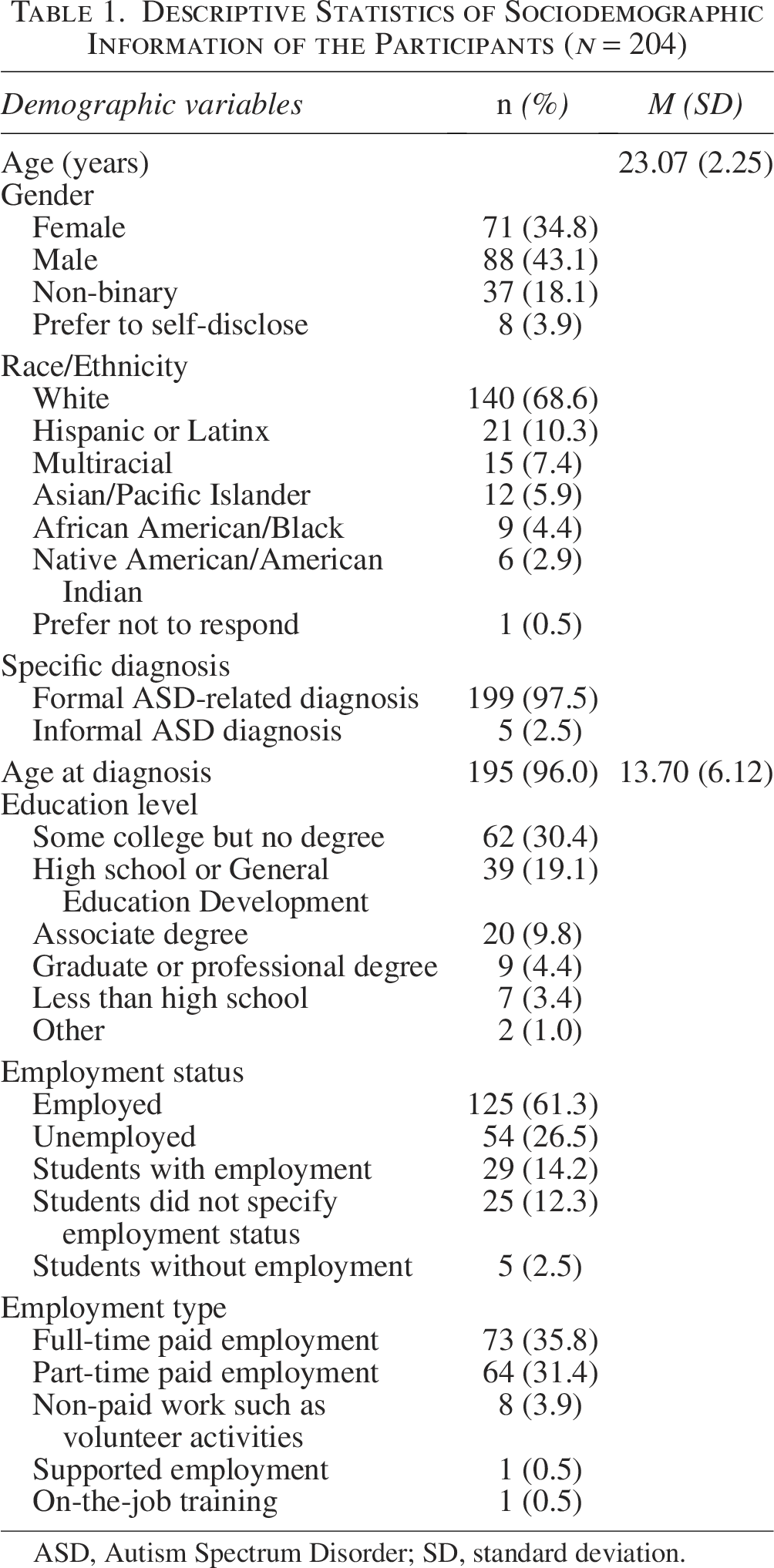
ASD, Autism Spectrum Disorder; SD, standard deviation.
Measures
Autism acceptance
The Autism Acceptance Questionnaire 20 is a five-item measure of autism acceptance. The first item is designed to seek categorical responses of acceptance (“yes,” “no,” “sometime,” and “prefer not to say” as response options) by asking whether participants felt that the society generally accepts them. The second item (i.e., “over the past week, I have felt accepted by society as an autistic person/person with autism”) was used to fit with another standardized scale used in Cage et al.’s original study. 20 The last three items are developed to measure participants’ perceptions of autism acceptance from different sources (i.e., perceived and self-acceptance) on a scale from 0 (not at all) to 10 (completely). Specifically, two items measure perceived acceptance from society, family, and friends (i.e., “How accepted by society do you feel as an autistic person?” “How accepted by your family and friends do you feel as an autistic person?”), whereas one item measures self-acceptance (i.e., “How much have you personally accepted yourself as an autistic person?”). Owing to the purpose of the study, only the last three items were used in the data analysis of this study. Higher scores indicate higher level of perceived and self-acceptance. In this study, the Cronbach’s alpha of the three items was 0.63, whereas the Cronbach’s alpha of the two items on perceived acceptance was 0.62.
Coping
The Brief COPE inventory 43 is a 28-item self-report measure of strategies used to cope with stress. Participants are asked to rate on a 4-point Likert-type scale ranging from 1 (I haven’t been doing this at all) to 4 (I’ve been doing this a lot). Higher scores indicate increased utilization of the specific coping strategies. Muniandy et al. 44 psychometrically validated this scale on the autistic population and retained a six-factor structure, including engagement, support-seeking, disengagement, substance-use, humor, and religious coping. In this study, a total of 13 items for the two higher-order factors, engagement (8) and disengagement (5) coping, were used to measure coping strategies used by autistic youths. The engagement coping subscale is defined by proactive efforts to manage a situation or associated emotions (i.e., “I’ve been trying to come up with a strategy about what to do”). On the contrary, the disengagement coping subscale is characterized by strategies aimed at avoiding or creating distance from the stressor or elicited emotions (e.g., “I’ve been giving up the attempt to cope”). In this study, the Cronbach’s alpha of engagement coping was 0.78, whereas the Cronbach’s alpha of disengagement coping was 0.83.
QOL
The World Health Organization Quality of Life-BREF (WHOQOL-BREF) survey is a short version of the larger WHOQOL survey and is a comprehensive self-report QOL measure. 45 It is a 26-item scale measuring four domains of QOL (i.e., physical health, psychological health, social relationship, and environment). Two extra items are used to measure overall perception of QOL and health. Participants rate their responses on a 5-point Likert scale, ranging from 1 (very dissatisfied) to 5 (very satisfied). Higher scores reflect higher QOL. The Cronbach’s alpha for the current study was calculated at 0.93. The Cronbach’s alpha for the subscales, physical, psychological, social, and environment were 0.80, 0.85, 0.77, and 0.83, respectively.
Data analysis
The Statistical Package for the Social Sciences (SPSS, version 28.0) were used to calculate descriptive statistics and bivariate correlations among study variables, whereas R version 4.1.1 was used to perform structural equation modeling (SEM) to investigate the mediating role of coping strategies in the relationship between autism acceptance and QOL. Compared with Baron and Kenny’s 46 traditional approach for mediation analysis, the SEM framework simplifies the testing procedure and allows researchers to examine more complicated mediation models with multiple mediators in a single analysis. 47 In terms of sample size, researchers argued that a large sample size with over 200 participants is required to provide enough statistical power to get meaningful and interpretable results in SEM analysis.48–50 Given the sample size of 204 in this study, the use of SEM is appropriate.
Statistical assumptions for SEM were checked before the SEM procedure in terms of missing data, multivariate outliers, and multivariate normality. The model fit was evaluated based on the chi-square goodness-of-fit and other recommended indices: (a) comparative fit index (CFI), (b) Tucker–Lewis index (TLI), and (c) root mean square error of approximation (RMSEA). In general, CFI and TLI over 0.90 and RMSEA less than 0.08 indicate a good fit.51,52
Results
Preliminary analysis
Several statistical assumptions were tested before the SEM procedure. First, Little’s missing completely at random test indicated that values were missing completely at random at both item- and scale-level with p = 0.25 and 0.43, respectively. Thus, the expectation-maximization algorithm was used in SPSS to impute values for those missing cases.53,54 Second, none of the observations showed a Cook’s D greater than 1.0 (ranging from 0 to 0.2), indicating no multivariate outliers. Last, a statistically significant Henze–Zirkler test value (HZ = 1.24, p < 0.01) indicated that the data lack multivariate normality. 55 Thus, robust maximum-likelihood estimation was used in the SEM procedures to address nonnormality.
The means, standard deviation, and bivariate correlations were calculated and presented in Table 2.
Means, Standard Deviations, and Correlations for All Study Variables (n = 204)
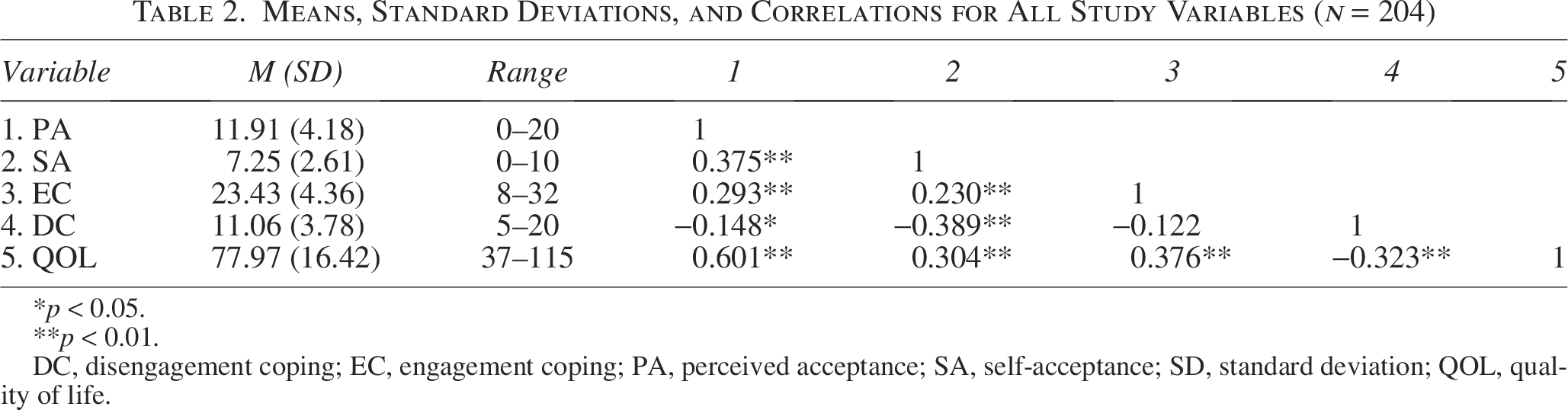
p < 0.05.
p < 0.01.
DC, disengagement coping; EC, engagement coping; PA, perceived acceptance; SA, self-acceptance; SD, standard deviation; QOL, quality of life.
Parallel mediation analysis
SEM, specifically path analysis, was conducted to investigate the mediating roles of both engagement and disengagement coping strategies in the relationship between perceived acceptance and QOL as well as self-acceptance and QOL. First, two parallel mediation models were specified, and their model fits were examined. Next, direct and indirect effects were analyzed.
Perceived acceptance, coping, and QOL
The first hypothesized model of the relationships between perceived acceptance, coping, and QOL is shown at the top of Figure 1. The model showed a nonsignificant likelihood ratio chi-square [χ2(1, n = 204) = 1.058, p = 0.304], indicating the model had a good fit to the data. Other fit indices, including CFI (0.998), TLI (0.991), and RMSEA (0.017), suggested an acceptable model fit.

Parallel mediation models of the relationship between (a) perceived acceptance, coping, and QOL (the top diagram) and (b) self-acceptance, coping, and QOL (the bottom diagram). A double-headed arrow from a variable to itself represents its variance. *p < 0.05, **p < 0.01. DC, disengagement coping; EC, engagement coping; PA, perceived acceptance; SA, self-acceptance; QOL, quality of life.
Direct, indirect, and total effects of the first model are listed in Table 3. Perceived acceptance had significant direct effects on QOL (β = 0.512, p < 0.01) and engagement coping (β = 0.293, p < 0.01) but a nonsignificant direct effect on disengagement coping (β = −0.148, p = 0.052). A significant indirect effect of perceived acceptance on QOL through engagement coping was also identified (β = 0.059, p < 0.01). The results indicated that engagement coping served as a partial mediator in the relationship between perceived acceptance and QOL, whereas disengagement coping did not have a mediating role in this relationship.
Direct, Indirect, and Total Effect for the Two Parallel Mediation Models (n = 204)
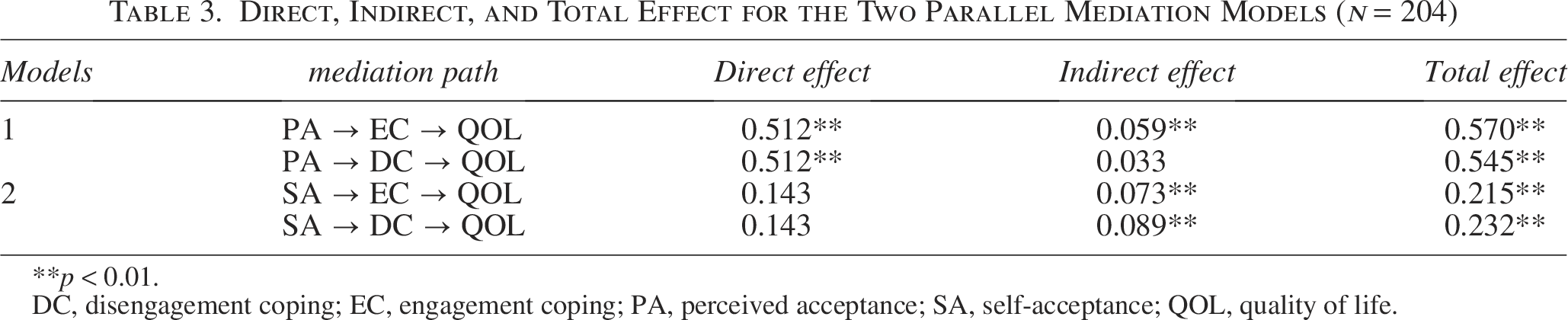
p < 0.01.
DC, disengagement coping; EC, engagement coping; PA, perceived acceptance; SA, self-acceptance; QOL, quality of life.
Self-acceptance, coping, and QOL
The second hypothesized model of the relationship between self-acceptance, coping, and QOL is shown at the bottom of Figure 1. The model revealed a nonsignificant likelihood ratio chi-square [χ2(1, n = 204) = 0.227, p = 0.634], indicating the model had a good fit to the data. Other fit indices also revealed an acceptable model fit indicated by (a) CFI = 1.000, (b) TLI = 1.056, and (c) RMSEA = 0.
Direct, indirect, and total effects of the second model are listed in Table 3. Self-acceptance had significant direct effects on both engagement (β = 0.230, p < 0.01) and disengagement coping (β = −0.389, p < 0.01) but a nonsignificant direct effect on QOL (β = 0.143, p = 0.062). However, self-acceptance showed significant indirect effects on QOL through both engagement (β = 0.073, p < 0.01) and disengagement coping (β = 0.089, p < 0.01). The results indicated that engagement and disengagement coping could potentially serve as full mediators in the relationship between self-acceptance and QOL. However, it is important to notice that the values of these effects were relatively small in spite of their statistical significance.
Discussion
The nature of autism and the unique transitional challenges during emerging adulthood exert significant pressure on autistic transition-age youths, leading to poor psychosocial outcomes.12,13 To facilitate successful completion of the developmental tasks related to independence and the assumption of adult roles, 56 it becomes imperative to help this population understand their relationship with self, others, and their autism. The primary purpose of the current study was to examine the relationships between autism acceptance (i.e., perceived and self-acceptance), coping (i.e., engagement and disengagement coping), and QOL using two parallel mediation analysis models. Our findings elucidated the differing roles of perceived and self-acceptance in the transition and psychosocial adaptation process, highlighting how each aspect of autism acceptance impacts QOL through distinct coping pathways.
For perceived acceptance, the results suggested that it was a significant predictor of QOL. In addition, perceived acceptance was also found to predict QOL partially through engagement coping, indicated by a significant indirect effect. If autistic youths feel more accepted by others (i.e., society, family, and friends), they might use more engagement coping strategies that lead to increased QOL. Our findings were consistent with prior autism literature, demonstrating that perceived acceptance and engagement coping predict well-being in a positive direction.20,22 Although there is no existing literature on the indirect effect of perceived acceptance on QOL, research on creating supportive environments for autistic youths can shed light on interpreting the result. Several studies have found that a supportive environment fosters feelings of security and connection, enabling increased participation and engagement.57,58 Therefore, a supportive environment provides the context for increased perceived acceptance, subsequently facilitating the increased use of engaging coping and ultimately leading to an improved QOL.
It is noteworthy that, in the first model, perceived acceptance was not found to be a significant predictor of disengagement coping. However, previous studies suggested that the use of disengagement coping strategies was predicted by autism-related societal stigma, which is a construct highly associated with perceived acceptance.19,20 In this particular sample, it seemed that disengagement coping strategies were used by autistic transition-age youths as their default approach, and it was independent from their perceptions of the surrounding environment. The literature on camouflaging may provide insight into interpreting this result. Schneid & Raz 59 found that some autistic individuals felt the use of camouflaging reinforced the stigma of being autistic since it implied that certain characteristics should be hidden because they were not “normal.” While camouflaging is an active strategy, it serves the same purpose as disengagement coping, allowing autistic individuals to avoid stress that was imposed by societal stigma of autism. From this perspective, the use of disengagement coping strategies reflects an autistic youth’s internalized stigma, indicating a lower level of self-acceptance. Hence, based on the findings of this study, it is plausible that self-acceptance, rather than perceived acceptance, is directly connected with disengagement coping. However, it is imperative to clarify that this interpretation does not seek to diminish the significant role of perceived acceptance. Rather, this interpretation serves to validate the adverse influences of societal stigma on the self-perceptions of autistic individuals. Negative experiences of societal stigma may lead to negative self-images and low levels of self-acceptance among autistic individuals, thereby precipitating the use of maladaptive coping strategies.
In terms of self-acceptance, the results showed that it did not serve as a significant direct predictor of QOL. Instead, self-acceptance had indirect effects on QOL fully through both engagement and disengagement coping. In other words, a higher level of self-acceptance led to an increased use of engagement coping and a decreased use of disengagement coping, resulting in an improved QOL. This finding emphasized the inseparable connections between autistic youths’ self-acceptance and selection of coping during the psychosocial adaptation process. Large & Serrano 60 argued that the ASD diagnosis and perceptions of it can impose threats in constructing identity, motivating the use of both engagement and disengagement coping to manage the threats. Specifically, if youths accept themselves more as an autistic person, they tend to use more engagement coping (e.g., self-advocacy) and less disengagement coping (e.g., concealment), resulting in better QOL.21,61,62
Our findings emphasize the need for a multifaceted approach to understanding autism acceptance, focusing on both the internal process of accepting one’s own disability and the external influences from the environment. Based on these insights, we can pave the way for more targeted and effective interventions that holistically address the needs of autistic transition-age youths and guide them toward successful transition to postsecondary settings.
Implications
Previous research has underscored the critical importance of acceptance within the autistic population.20,21,24 Building upon this, our study delved deeper into the distinct roles of perceived and self-acceptance, shedding light on their respective coping pathways that influence QOL throughout the transition and psychosocial adaptation process. Our findings emphasize the need for a multifaceted approach to grasp the concept of autism acceptance in both research and practical applications. This approach should consider both external and internal sources that can shape an autistic youth’s level of acceptance.
In this study, both perceived and self-acceptance have been identified as significant predictors of QOL and the selection of coping strategies among autistic transition-age youths. These findings emphasized the necessity to incorporate the concept of acceptance into transition services that can prepare autistic youths with necessary strategies to cope with adverse societal attitudes and develop positive self-images when entering postsecondary settings. Both perceived and self-acceptance should be integral components of the techniques and activities used in these services. Practitioners who embrace this holistic perspective could help autistic youths focus on not only addressing societal and familial barriers but also improving their self-acceptance to ultimately achieve better QOL. However, this does not necessarily mean that acceptance should be the exclusive focus of these interventions. Other factors, such as the understanding of the stressor, available resources, and social support, should also be taken into account when providing relevant services to this population. In addition, practitioners should also be mindful of the differing roles of perceived and self-acceptance in the transition process. Interventions should be tailored based on the specific goals and needs of the youth. By understanding the nuanced difference between these two aspects of autism acceptance, practitioners were able to take the most appropriate actions based on specific transition issues and increase effectiveness of services.
The findings of perceived acceptance in this study also emphasize the substantial influence of contextual and environmental factors on autistic transition-age youths. One contributing factor to perceived acceptance is the prevalence of stereotypes and misunderstandings surrounding this population within society. Long-lasting perceptions of autism as a medical disorder with universal characteristics and the tendency to rank autistic persons on a low-to-high functioning spectrum overlook the unique individual experiences of autistic transition-age youths. 63 These stereotypical perceptions from the external environment significantly impact various psychosocial outcomes of this population. Thus, it is imperative for professionals to examine their own biases and stereotypes first before working with this population. Provision of relevant trainings and interventions is essential to assist practitioners in ameliorating any derogatory understanding of autism. Practitioners should learn to echo the neurodiversity movement and advocate with this population for their deserved rights. Such advocacy efforts should extend beyond the confines of counseling rooms or offices. Instead, it is important to educate the public about the challenges and needs of autistic transition-age youths, fostering a more inclusive and friendly environment for this population.
The successful development of effective interventions requires a comprehensive understanding of involved variables. While prior research initiated the exploration of autism acceptance,20,21,24 it is evident that our current understanding of this construct is just a tip of the iceberg. For example, perceived acceptance from friends and peers may be significantly different from that of teachers and employers because of the levels of intimacy. Also, the conceptualization of self-acceptance as autistic identity may not capture the experience of individuals who accept their autistic traits or impacts of autism without identifying with the label of autism. In addition, the findings in this study also identified the differing role of perceived and self-acceptance in the selection of coping strategies among autistic transition-age youths. This highlights the need for researchers to explore a more sophisticated factor structure of autism acceptance, which can provide crucial practical implications for the development of effective transition interventions. In addition, researchers should also focus on developing psychometrically valid measurement of autism acceptance. The scale used in this study 20 relied on a small number of global items to assess perceived and self-acceptance, which may have led to the loss of valuable and nuanced information. A comprehensive measurement of autism acceptance, which could stress and differentiate the intra- and interpersonal aspects of this construct, should be developed and validated.
The examination of different aspects of autism acceptance and their distinctive roles can shed lights on the broader concept of disability acceptance. Traditionally, disability acceptance has been interpreted in the context of changes in an individual’s value system.14,64 It has long been considered as a purely intrapersonal psychological process of individuals with disabilities. While the influence of external entities, including society, peers, and family, has often been discussed in terms of stigma or social relationships, it has not been viewed as an integral part of disability acceptance in rehabilitation literature. The importance of perceived acceptance found in this study signifies that external sources of acceptance may be as influential as an individual’s internal value change process in predicting positive psychosocial outcomes. Thus, researchers can use this new approach to conceptualizing disability acceptance in future studies and explore how different aspects of acceptance can impact the psychosocial adaptation process of people with disabilities. Furthermore, the findings of this study underscore the subjective experience of autistic transition-age youths in the process of psychosocial adaptation. Future studies should further explore how this population’s perceptions and interpretations of the external environment influence their responses and engagement across various contexts.
Limitations and future research directions
Several limitations should be taken into consideration when interpreting and generalizing its findings. First, the research design was cross-sectional and correlational in nature, which limits the ability to draw casual conclusions about the relationships among study variables. Second, participants were recruited from two online crowdsourcing platforms (i.e., Prolific and MTurk). The combined approach did not allow for the screening of potential participants who may have accessed the study through both platforms, potentially impacting the interpretation of the findings. Third, our sample was predominantly White with relatively higher education levels. The male-to-female ratio was close to 1, and employment rate was around 60%. These sociodemographic characteristics deviated to varying degrees from national data.65,66 The representativeness of the sample was therefore impacted. Fourth, the self-report survey used in this study may be susceptible to response biases. Participants may have responded in a manner they perceived as socially desirable, or they might not have accurately recalled certain experiences. These biases could lead to potential inaccuracies in the data. Fifth, the Cronbach’s alpha for the Autism Acceptance Questionnaire is relatively low. This may be attributed to the limited number of items or a weak interitem correlation, potentially complicating the interpretation of the results. Lastly, the study identified statistically significant but small values of indirect effects in the second parallel mediation analysis. These findings need to be further validated in future studies using other statistical analyses, more psychometrically sound instruments, and a larger sample size. Future research should aim to address these limitations by recruiting a larger and more diverse sample through improved sampling platforms to achieve a more comprehensive understanding of autism acceptance.
Conclusion
Autistic transition-age youths encountered unique challenges as they navigate various postsecondary settings. To achieve successful transition, they need to gain a comprehensive understanding of their relationship with self, others, and their autism. This study revealed the important role of autism acceptance, both perceived and self-acceptance, in promoting QOL through different coping pathways. Researchers and practitioners should further explore the significance of autism acceptance and develop effective acceptance-based interventions to support autistic transition-age youths in their journey toward improved well-being.
Footnotes
Acknowledgments
Both authors would like to thank Dr. Norm and Barbara Berven and gratefully acknowledge that this research was made possible through their support of the Norman L. and Barbara M. Berven Professorship in Rehabilitation Psychology.
Author Disclosure Statement
The authors report no conflicts of interest.
Funding Information
The study was funded by the Norman L. and Barbara M. Berven Professorship in Rehabilitation Psychology from the Department of Rehabilitation Psychology and Special Education at University of Wisconsin–Madison.
Authorship Confirmation Statement
K.Z. conceptualized and designed the study. K.Z. recruited and tested participants. K.Z. and J.K. curated and analyzed data. K.Z wrote the original draft, which was edited by J.K. All authors reviewed the final article. The article has been submitted solely to Autism in Adulthood.