




Abstract
Background:
Autistic people often receive unfavorable first impressions from non-autistic people, likely because of stigma related to divergent social presentations and expressive behaviors. Although facial expressivity influences first impressions in the general population, no research has examined whether expressivity differences in autism relate to the formation of first impressions by non-autistic people. It is also unclear whether facial expressivity in autism varies depending upon contextual demands and whether this affects first impressions.
Methods:
We video-recorded 21 autistic and 21 non-autistic adults in two contexts, interviewing for their ideal job and discussing a personal interest, and quantified the percentage of video frames displaying positive, neutral, and negative facial affect using iMotions software. We also compared facial affect between the autistic and non-autistic groups within and between contexts. Later, 335 non-autistic undergraduates rated participants using the First Impression Scale to assess whether impressions were modulated by context and showed associations with facial expressivity.
Results:
Findings demonstrated that autistic and non-autistic adults differed in overall emotional expressivity, with non-autistic participants displaying more positive affect at a trend-level than autistic participants. Autistic adults also received less favorable first impressions, and these showed some correspondence with their emotional expressivity. For example, their displays of negative affect were moderately to strongly related to worse impressions in the job interview context, a pattern not found to the same degree for non-autistic participants. Impressions of autistic participants also improved more than for non-autistic ones when talking about a personal interest compared with the job interview context, and when their diagnosis was disclosed to observers.
Discussion:
Collectively, these findings indicate that autistic people demonstrate divergent facial emotional expressivity that relates to the less favorable impressions they receive from non-autistic observers. Context and diagnostic disclosure also affect how autistic people are perceived.
Community Brief
Why is this an important issue?
Autistic people are often stigmatized in professional and personal settings. It is important to understand the factors that relate to stigma in everyday contexts to create more inclusive environments for autistic people.
What was the purpose of this study?
To understand whether autistic differences in how emotions are expressed in the face relate to how autistic people are perceived in personal and professional contexts.
What did the researchers do?
We asked autistic and non-autistic adults to describe a personal interest and sit for a mock job interview. Later, non-autistic people provided their first impressions of adults and reported on how successful they believed participants were in communicating a personal interest, and in getting hired from their interview. We also examined the facial expressions of participants to see if expressions related to the first impressions autistic and non-autistic people received.
What were the results of the study?
We found that autistic and non-autistic adults differ in how they display emotions in their faces, and these differences related to how autistic adults were perceived by non-autistic observers. Autistic expressions were less often categorized as displaying positive emotion, and their displays of negative emotion were related to poorer first impressions in job interviews. Context also affected these judgments. Autistic participants received poorer first impressions in a professional context relative to a personal context, and they were rated as more successful when observers were informed that the person they rated was autistic.
What do these findings add to what was already known?
These findings indicate that autistic people express emotion differently in their faces and this is associated with non-autistic people viewing them less favorably than non-autistic people. Furthermore, autistic people were evaluated more positively when talking about personal interests than when interviewing for a job, which did not happen to the same degree for non-autistic people. These findings suggest that biases toward divergent displays of facial expressions may contribute to the disparities autistic people face in personal and professional contexts.
What are potential weaknesses in the study?
The software used to analyze facial expressions was developed on non-autistic people and may not accurately measure autistic facial emotion. The autistic sample included in the study was also limited in size and lacked diversity. Future research should include other groups of autistic people, such as those with higher support needs.
How will these findings help autistic adults now or in the future?
The results may be used to inform non-autistic people of their biases toward the expressive differences of autistic adults in personal and professional contexts to help minimize discrimination and exclusion.
Background
First impressions of autistic adults
Positive first impressions play a critical role in the formation and maintenance of social relationships.1,2 First impressions are defined as immediate and influential character judgments based on limited information. 1 They predict both approach and avoidance behaviors and can remain resistant to change even after counter-information is displayed. 2
For autistic adults, first impressions may represent a particularly consequential social process that can affect both personal and professional opportunities. 3 Autistic people often differ in their facial expressivity, vocal prosody, use of gaze, rate and timing of gestures, and use of personal space,4–9 and these social presentations and expressive behaviors are perceived unfavorably by non-autistic people in first-impression contexts.3,10 In this way, the social experiences of autistic people are shaped not only by their own social characteristics and behaviors but also by the perceptions, biases, and behaviors of others.11–12 For example, poor first impressions of autistic adults are associated with lower social interest from non-autistic peers in interacting with them, 3 which may result in fewer social opportunities for autistic adults and affect the quality of interactions when they do occur.
Facial expressivity in autism and first-impression formations
Facial expressivity among autistic people is often judged to be “unnatural” by non-autistic peers, 5 with some being perceived as demonstrating blunt or “flat” affect13–14 and others displaying more “exaggerated” emotion. 5 Although facial expressivity among autistic people is often judged to be “unnatural” by non-autistic peers, 5 with some being perceived as demonstrating blunt or “flat” affect13–14 and others displaying more “exaggerated” emotion, 5 no research to date has examined whether facial expressivity differences in autism relate to the less favorable first impressions they often receive from non-autistic people. Facial expressivity influences first-impression formation in the general population, 15 and because autistic adults often differ in displays of facial affect, non-autistic people may be misinterpreting facial expressions contributing to unfavorable first-impression evaluations of autistic adults.
For instance, positive facial affect within the general population enhances perceived trustworthiness and tolerance, 16 while negative facial affect is associated with lower perceived attractiveness.17–18 Perceptions of trustworthiness and attractiveness play an important role in evaluations of social desirability, 19 competence, 20 and increase cooperation. 16 Autistic people are consistently rated as being less attractive and likeable, and more awkward, than non-autistic adults,3,10,21–23 a phenomenon that may be driven, in part, by reduced detection of positive expressivity in autistic faces and increased attribution of negative expressivity. Such a finding would highlight facial expressivity as a specific social presentation difference associated with negative evaluations of autistic people, which could then be used to inform autistic people about how their facial expressions may be (mis)perceived by others and to educate non-autistic people about expressivity differences in autism and how biases about these differences can disadvantage autistic people. 12 For example, autistic adults routinely face biases in the hiring process and often are passed over for hiring based on poor evaluations from interviews regardless of the autistic person’s skills, qualifications, and understanding of job-related tasks.24–31 Negative evaluations and misinterpretations of autistic social expressivity differences may contribute to these outcomes, and programs that raise awareness and combat these biases may help improve professional prospects for autistic people.
Autistic expressivity in real-world contexts
There is also a need to measure facial expressivity in autism and its relation to impressions using naturally evoked facial displays within real-world contexts, given that facial expressions of autistic adults have most commonly been examined in posed conditions where the participant is tasked with displaying a requested emotion through facial expressions.32–33 Posed emotional displays can be idiosyncratic and fail to capture how facial expressions occur naturally.34–35 They also may simply measure the ability to mimic expressions,34–37 which autistic people appear to do similarly to non-autistic comparison participants.38–39 In contrast, the few studies that have examined evoked emotional expressions in autism report that they often are more blended or ambiguous, and are often perceived as unusual, odd, stilted, or less natural by non-autistic people.5,7,32,33
It is also unclear whether autistic people demonstrate modulation in emotional expressivity depending on contextual demands (e.g., increased positive affect in personal relative to professional settings) to the same degree as non-autistic people, and whether this may relate to impression formation of non-autistic peers. For non-autistic people, a situational context can exert a powerful influence on social behaviors,40–41 with even slight changes in situational demands eliciting behavioral changes. 42 However, display rules for emotional expressivity vary for non-autistic people across contexts and cultures,43–44 with facial emotions often strategically suppressed or enhanced depending on their social utility in a given situation.45–46
In contrast, autistic people may exhibit more consistent behaviors across contexts.47–51 Whether this extends to emotional expressivity is unclear but could—if found— relate to negative judgments of non-autistic peers. Reduced modulation in emotional expressivity across divergent contexts (e.g., a job interview vs. a casual social exchange) could be evaluated negatively by non-autistic observers who may judge consistency in emotional displays as inappropriate given the changing contextual demands. Finding that autistic people objectively display more similar patterns of facial emotion across a professional and a personal context, yet non-autistic observers evaluate them less favorably in one relative to the other, would also suggest that non-autistic people are sensitive to context-specific display rules and penalize autistic people for not abiding by them.
It is also presently unclear whether first impressions of autistic adults vary depending on contextual demands. Previous first-impression studies have been limited by evaluating perceptions of autistic people within a singular and relatively artificial context (i.e., an audition for a TV show).3,21,52 Within real-world environments, however, emotional display rules may differ based on situational demands, and evaluators may perceive some characteristics as more salient, appropriate, and important in some contexts relative to others. More formal social presentations (i.e., more neutral affect) may improve first impressions in professional relative to personal contexts, while more informal presentations (i.e., more emotional expressivity) may be more beneficial in informal settings.
Furthermore, while previous research has demonstrated that disclosing autistic peoples’ diagnosis improves the first impressions provided by non-autistic observers, 23 it is unclear whether diagnostic disclosure produces differential effects in different contexts. Disclosure occurring within a high-stakes environment with important consequences (e.g., a job interview) may alter non-autistic perceptions of autistic adults to a greater degree than in an informal environment (e.g., discussing a personal interest). Increasing the understanding of when and how diagnostic disclosure affects impressions can provide pertinent information for autistic people to consider before deciding to disclose their diagnosis in personal and professional settings.
In the present study, we sought to quantify and compare displays of naturally occurring facial emotion among autistic and non-autistic adults across a personal and professional context and determine whether facial emotion predicts first-impression ratings made by non-autistic observers. We hypothesized (H1) that autistic adults would be categorized as displaying less positive and more neutral facial emotion relative to non-autistic adults. In particular, we predicted that autistic adults would display less positive facial emotion in a job interview context relative to non-autistic adults, but both groups would increase displays of positive affect when talking about a personal interest. Such a finding would demonstrate that context modulates emotional expressivity for both autistic and non-autistic adults.
We also hypothesized (H2) that facial expressivity would relate to first impressions. We predicted that facial displays of positive emotion would positively correlate with first impressions across both contexts for autistic and non-autistic adults, supporting a link between expressed positive emotions and favorable perceptions from observers, with lower rates of positive emotion among autistic adults corresponding to the less favorable impressions they often receive. We expected that displays of negative emotion would predict less favorable first-impression ratings. Furthermore, we predicted (H3) that informing non-autistic observers of the diagnostic status of autistic participants would improve the first impressions they received compared with when the diagnosis was withheld, and that the benefit of disclosure would be greater in the job relative to the interest context. Finally, we predicted (H4) that non-autistic observers would rate autistic participants as less successful in both the job interview and personal interest contexts, and these ratings would correlate to differences in their facial expressivity.
Methods
Participants
This study consisted of two participant samples: “stimulus participants,” who were the autistic and non-autistic adults featured in video stimuli, and “rater participants,” who later evaluated these stimuli. All stimulus and rater participants provided informed consent before participating. The study was approved by the University of Texas at Dallas (UTD) Institutional Review Board (IRB).
Stimulus participants
Stimulus participants consisted of 21 autistic and 21 non-autistic adults, a sample size consistent with other first-impression studies in the field.3,21–23 This sample is distinct from those used in Sasson et al. (2017) and follow-up studies. We recruited stimulus participants from the UTD and the Autism Research Collaborative (ARC) at UTD, a database of more than 200 autistic adults in the Dallas area who have consented to participate in research. We only recruited autistic participants with full-scale intelligence quotients above 70 on the WASI-II 53 to ensure comparability with non-autistic participants recruited from UTD. All autistic participants received diagnostic confirmation on the autism spectrum using the Autism Diagnostic Observation Schedule II 54 and scored above the clinical threshold for confirmation of diagnosis.
Autistic and non-autistic participants did not significantly differ on age [MA = 26.62, SD A = 5.67, MNA = 23.52, SD NA = 5.85; F(1, 42) = 3.03, p = 0.089], gender [A: 15 male, NA: 16 male; χ2 (2) = 0.12, p = 0.73], race [A: 18 White, NA: 18 White; χ2 (3) = 0.00, p = 1.00], and IQ as estimated by the reading subscale of the Wide Range Achievement Test-3 (WRAT-3) 55 [MA = 109.67, SD A = 12.56, MNA = 114.00, SD NA = 6.20; F(1, 42) = 2.01, p = 0.16].
Rater participants
We recruited 335 undergraduate non-autistic rater participants from the UTD undergraduate research pool. Participants were English-speaking adults older than 18 who reported no diagnosis of autism or other developmental disorders in themselves or a first-order family member. Rater participants had a mean of 20.62 years in age (SD: 2.74) and self-identified as 62.45% female, 32.75% male, and 4.80% non-binary or other gender identity, and 49.20% Asian, 39.20% White, 4.80% Black, 0.55% indigenous, and 6.20% did not identify with any races listed or reported another race not listed.
Measures and procedures
Stimulus participants
In phase 1 of the study, stimulus participants completed the reading subscale of the WRAT-3, which correlates highly with full-scale IQ scores. 56 They then were video-recorded participating in a mock job interview and while talking about a personal interest. These scenarios used the general parameters and instructions of the High-Risk Social Challenge, 57 a measure that tasks participants with presenting themselves in an appealing way. The original scenario of a “mock television” audition has previously been implemented successfully with autistic adults. 3 In this study, the original instructions were retained, with only the context being replaced. For the job interview context, participants were prompted to describe why they should be hired for their ideal job, and for the personal interest context, we asked participants to discuss one of their primary interests or hobbies. They were presented with a prompt about the goals of each context (i.e., discuss why they should be hired for their ideal job or to discuss one of their primary interests), and we guided them to identify their ideal job and primary interest. Once identified, the recording began and lasted approximately 45 seconds.
All participants wore the same gray T-shirt to eliminate potential clothing confounds and were filmed approximately 5 feet in front of a black background using a Nikon D3300 24.2 MP CMOS Digital SLR camera affixed to a tripod. Videos averaged 45 seconds in length, but we trimmed the videos to the first 10–15 seconds after introductions (e.g., “hello, I’m going to start now”) and instances where participants addressed the context for each video (e.g., “this is my special interest”). This process ensured that all video clips captured the same “thin-slice” window for each stimulus participant. 1
We later quantified facial emotion from autistic and non-autistic stimulus participants from the full video recordings using iMotions software, 58 which has previously been used to classify emotions in autistic populations.59–60 The software automatically categorizes emotional displays frame by frame using facial action units based upon an emotional intensity threshold set by the user. Faces are coded based on an algorithm that is trained using an emotion data repository. The software identifies key landmarks on the face and then analyzes pixels in those regions to classify facial expressions based on facial muscle movements. Facial expression metrics, facial landmarks, as well as interocular distance in head orientation are measured, which give rise to probability values. The probability values determine the likelihood that one of seven basic emotions is being exhibited: anger, disgust, fear, joy, sadness, or surprise. 58 Summary scores of engagement and valence (positive, neutral, or negative emotions) are also provided from these values. In this study, we used the composite emotional categories of positive, neutral, and negative affect. We chose a threshold setting of 25% to maximize the ability to capture subtle displays of emotion while still minimizing errors in categorization.
Rating participants
In phase 2 of the study, we pseudorandomly assigned raters to view the 42 stimulus participant video recordings in one of the two contexts (n = 173: job context and n = 162: interest context). Raters signed up for one of the multiple versions of the study. These versions corresponded to the different contexts and were labeled ambiguously with “Impression Study 1” and “Impression Study 2” so that any difference between the versions was not disclosed to participants. This minimized any potential for self-selection bias because there was no discernible difference between the versions before beginning the study. We created multiple versions of the study to ensure that participants could only serve as raters in one version and view each same stimulus participant one time.
We informed rater participants of the context they would be rating before watching the video recordings (either “you will be viewing brief video clips of people talking about themselves while they make a case for why they should be hired for a job they applied for” or “you will be viewing brief video clips of people talking about one of their interests”). Approximately half of rater participants (n = 158) watched videos with a label providing the diagnostic status of the stimulus participant (i.e., “this person is autistic” for autistic participants and “this person has no diagnosis” for non-autistic participants). The other half of the raters (n = 177) saw videos without the diagnostic label.
After viewing each video recording, we instructed raters to complete the First Impression Scale (FIS) 3 “as quickly and as honestly as possible,” consistent with other studies utilizing the FIS.3,21–23 The FIS is a ten-item scale that assesses how individuals evaluate others on six traits reliably perceived during first-impression formation6,61: awkwardness, attractiveness, dominance/aggressiveness, likeability, intelligence, and trustworthiness. In addition, the following four items assess the participant’s social interest in future interaction with the stimulus participant: willingness to live near, hang out with, sit near, and strike up a conversation with the stimulus participant. Items are rated on a four-point scale ranging from strongly agree to strongly disagree. Participants also provided a rating on a four-point scale concerning how successful they believed the stimulus participant was in achieving the intended outcome (i.e., getting the job they were interviewing for or effectively communicating a personal interest).
Analytic strategy
To assess whether displays of affect differed between diagnostic groups and the two contexts, we conducted a mixed-model ANOVA with diagnosis (A vs. NA) as the between-group variable, and affect (positive, negative, neutral) and context (job, interest) as the within-group variables. Using this approach, a main effect of the diagnostic group is not possible, as affect (positive, negative, and neutral) for all participants adds up to 100%. Of primary interest therefore is whether diagnosis significantly interacted with affect and context. We followed up significant interactions with post hoc comparisons adjusted for family-wise error and calculated descriptive statistics as well as mean differences (MD) in affect displays between diagnostic groups and contexts.
To assess whether autistic and non-autistic stimulus participants were evaluated differently on the FIS and the success rating, we conducted univariate ANOVAs with FIS items and success ratings as dependent variables and context, diagnosis, and disclosure as fixed factors.
To assess the relationship between each FIS measure and the three affect types in the two contexts, we computed Pearson correlations. We also computed Pearson correlations to assess the relationship between success ratings (e.g., get the job or effectively communicate a personal interest) and the three types of affect. Finally, we computed Pearson correlations to explore correlations between facial affect and first-impression ratings when diagnoses were disclosed or withheld.
Results
H1: Emotional expressivity
There was significant main effect of affect type [F(1,2) = 192.28, p < 0.001, η2 = 0.83], with participants displaying more neutral (M = 79.30, SD = 20.60) than positive affect (M = 15.20, SD = 18.50; MD = −64.19, p < 0.001) and negative affect (M = 5.40, SD = 9.40; MD = −73.96, p < 0.001) across both contexts. Participants also displayed more positive than negative affect (MD = 9.77, p = 0.02).
There was also a significant interaction between diagnosis and affect type [F(1,2) = 3.56, p = 0.03, η2 = 0.08], with the autistic group differing in type of affect displayed relative to the non-autistic group. Post hoc comparison results for each type of affect revealed that non-autistic participants demonstrated a trend toward displaying significantly more positive affect (M = 21.40, SD = 21.60) than autistic participants (M = 8.90, SD = 15.40; MD = 12.45, p = 0.05). However, autistic participants did not significantly differ on displays of negative affect (M = 7.60, SD = 12.30) relative to non-autistic participants (M = 3.20, SD = 6.60; MD = −4.40, p = 0.68), nor did autistic participants differ on displays of neutral affect (M = 83.40, SD = 18.60) relative to non-autistic participants (M = 75.30, SD = 22.70; MD = −8.05, p = 0.37).
Furthermore, there was a significant interaction between context and affect [F(1,2) = 11.69, p < 0.001, η2 = 0.23], indicating that participants differed in affect displays in the two contexts (see Fig. 1). Participants displayed more positive affect in the interest context (M = 20.50, SD = 20.30) compared with the job context (M = 9.80, SD = 16.70; MD = −10.69, p < 0.001) and less neutral affect (M = 74.50, SD = 21.30) in the interest context compared with the job context (M = 84.20, SD = 20.00; MD = 9.67, p < 0.001). Displays of negative affect did not significantly differ between the job (M = 5.90, SD = 11.60) and interest contexts (M = 4.90, SD = 7.20; MD = 1.01, p = 0.79). The three-way interaction between diagnosis, context, and affect was not significant [F(1,2) = 1.69, p = 0.69, η2 = 0.04].
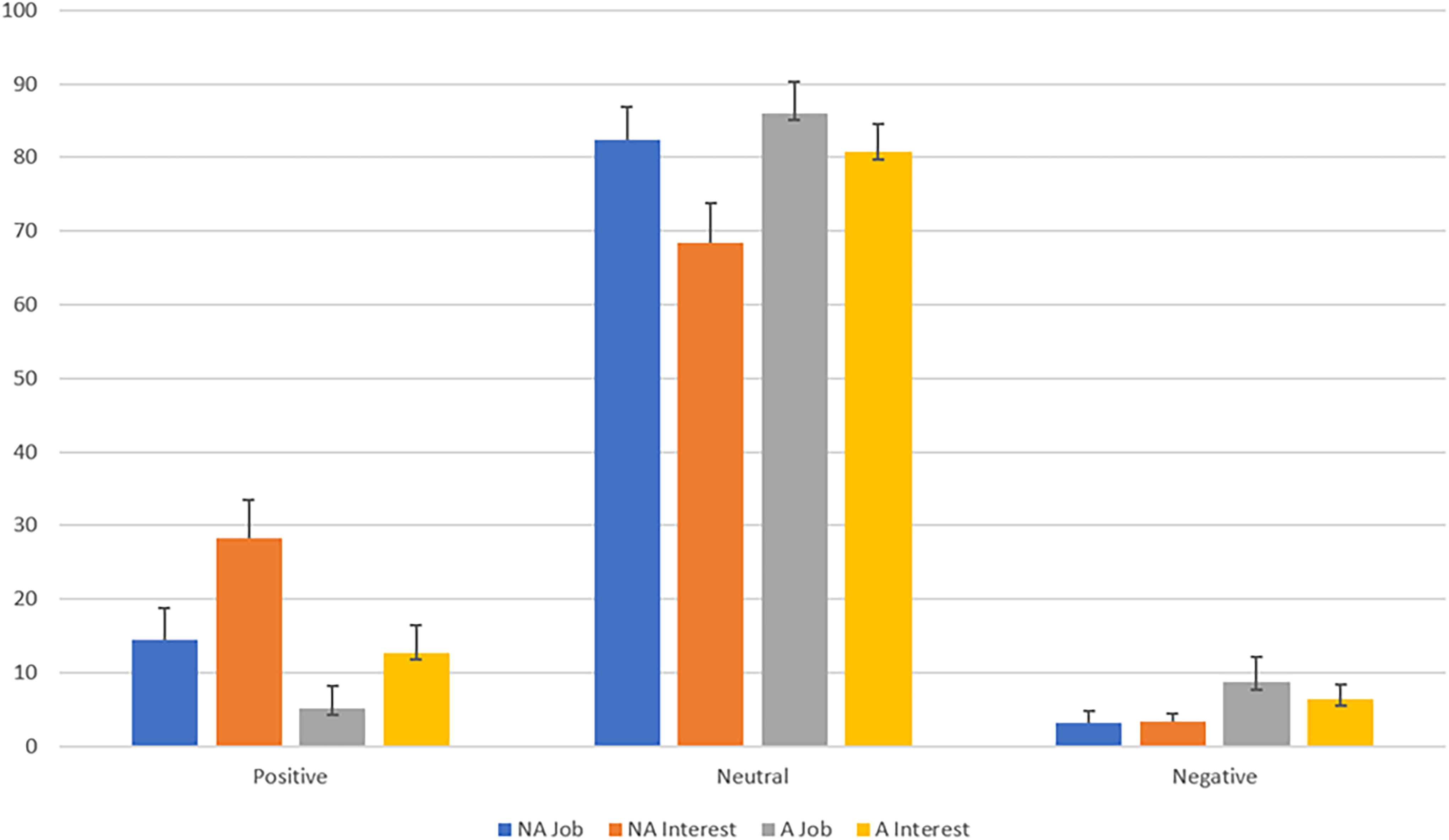
Percentages of positive, negative, and neutral affect displayed by autistic (A) and non-autistic (NA) adults in the job and interest contexts. Error bars indicate ± SE. Asterisks denote a significant difference between groups at p < 0.05.
H2 and H3: Effects of context, diagnostic group, and disclosure on first impressions
The main effects of diagnosis were found for all FIS trait and social interest items (ps < 0.001), with non-autistic participants rated more favorably than autistic participants on every item except dominance/aggressiveness (see Fig. 2). There were also significant main effects of context for every item on the FIS (ps < 0.001) except awkwardness (p = 0.47), with participants being rated more favorably in the interest context than the job context. In addition, there was a significant main effect of disclosure for every trait and social interest item (ps < 0.001). Participants were rated more positively when their diagnostic status was disclosed.
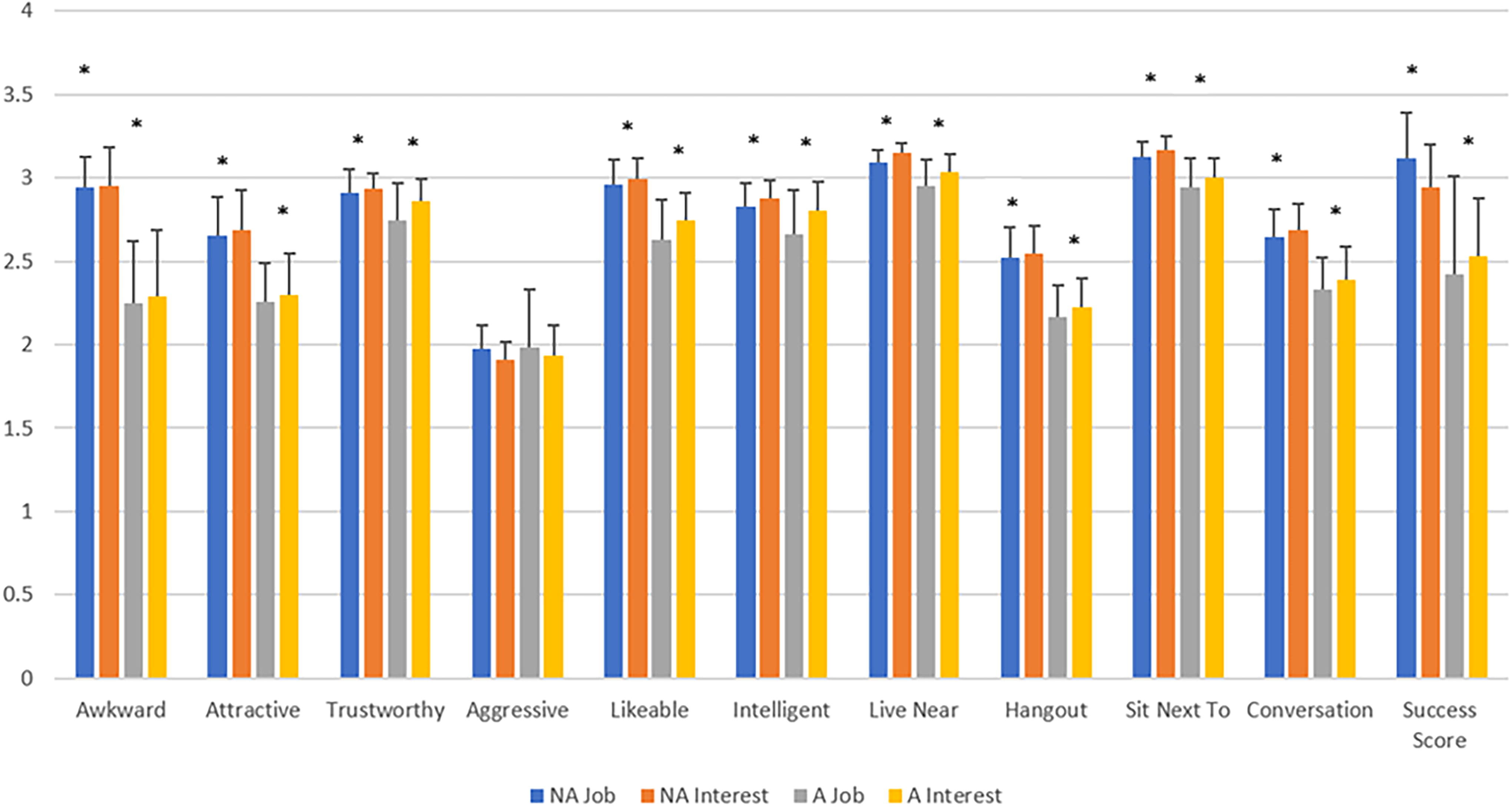
Mean first-impression and success score ratings in the interest and job context for the autistic (A) and non-autistic (NA) groups. Note: Error bars indicate ± SE. Asterisks denote a significant difference between groups at p < 0.05.
The two-way interaction between diagnosis and context was significant for awkwardness, trustworthiness, likeability, intelligence, and willingness to hang out with the participant (ps < 0.03). Raters evaluated autistic participants as less awkward, more trustworthy, more likeable, and smarter, in the interest context relative to the job context. They also indicated that they were more interested in hanging out with them when they talked about their interests. These patterns were not as strong for the non-autistic group (see Fig. 3).
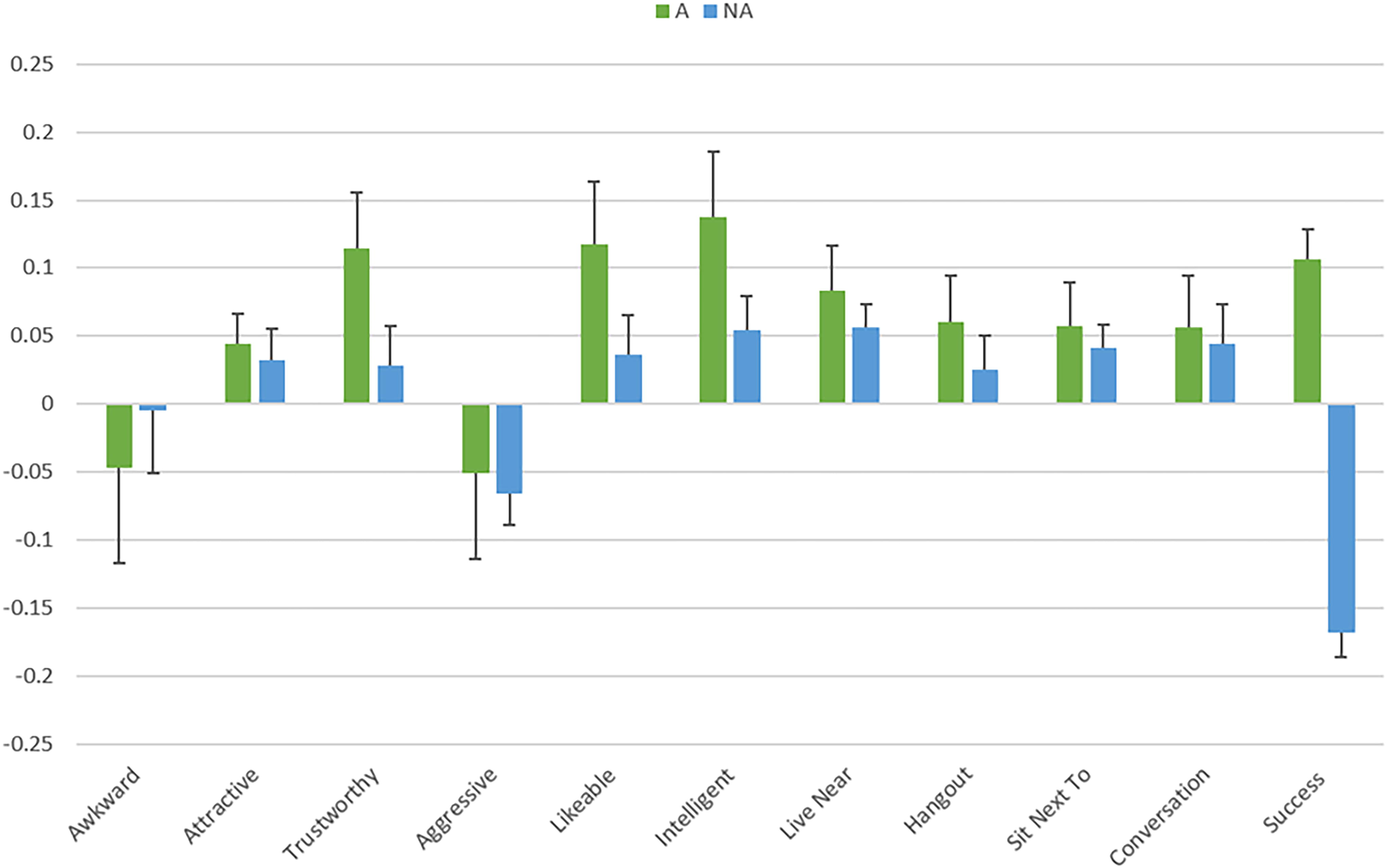
Interest minus job discrepancy scores. Note: Positive scores indicate higher ratings when talking about a personal interest than when participating in a mock job interview. Error bars indicate ± SE.
The two-way interaction between disclosure and context was significant for intelligence, dominance, attractiveness, and awkwardness, and for one’s willingness to sit near and live near the stimulus participant (ps < 0.002). Disclosure resulted in more favorable ratings in the interest context compared with the job context on all of these items.
The two-way interaction between disclosure and diagnosis was significant for likeability, intelligence, attractiveness, trust, have conversation with, hang out with, sit next to, and live near (ps < 0.001). Disclosure improved ratings on these items more for autistic participants compared with non-autistic participants.
The three-way interaction between context, disclosure, and diagnosis was significant for likeability (p = 0.02) and trustworthiness (p = 0.01). Disclosure resulted in lower trust ratings for non-autistic participants in the job context but higher trust ratings in the interest context, whereas disclosure improved trust ratings for autistic participants in both contexts. For likeability, disclosure improved ratings in the job context compared with the interest context for both groups, but to a greater degree for autistic participants.
H4: Effects of context, diagnostic group, and disclosure on success ratings
The main effects of diagnostic group (p < 0.001), context (p = 0.02), and disclosure (p < 0.001) on success ratings were significant; the non-autistic group received higher success ratings compared with the autistic group, participants were rated as more successful in interviewing for a job than they were in effectively communicating a personal interest, and disclosure resulted in higher success ratings.
The two-way interaction between disclosure and diagnostic group was significant (p < 0.001). Disclosure increased success ratings to a greater degree for autistic compared with non-autistic participants.
The two-way interaction between context and diagnostic group was also significant (p < 0.001). Whereas success ratings were higher for non-autistic participants in the job context than the interest context, the reverse occurred for autistic participants; their success ratings were higher in the interest context than the job context.
Finally, the two-way interaction between context and disclosure was significant (p < 0.001). Disclosure increased success ratings to a greater degree in the interest relative to the job context.
The three-way interaction between context, disclosure, and diagnostic group was not significant (p = 0.53).
H2: Affect correlations
As shown in Table 1, positive affect was associated with more favorable first impressions in the interest context across both groups on attractiveness, likability, hanging out, and having a conversation. However, when correlations were restricted to each diagnostic group independently, positive affect only significantly correlated with lower dominance ratings for non-autistic participants in the job context. Success ratings did not significantly correlate with positive affect.
Correlations Between Positive, Neutral, Negative Affect and First-Impression, and Success Ratings Across Autistic (A) and Non-Autistic (NA) Groups and Contexts
Correlation is significant at a = 0.05 level (2-tailed).
Correlation is significant at a = 0.01 level (2-tailed).
No correction for multiple comparisons.
As shown in Table 1, neutral affect was associated with less favorable first-impression ratings in the interest context across both groups on likability. When correlations were computed independently for each group, neutral affect was associated with more favorable first impressions on three social interest items (willingness to hang out with, sit near, and have a conversation with the stimulus participant) for autistic adults (but not non-autistic adults) in the job context. Success ratings did not significantly correlate with neutral affect.
Lastly, as shown in Table 1, negative affect was associated with lower ratings on all of the FIS items across both groups in the job context but only associated with less favorable dominance ratings in the interest context. Negative affect also correlated with worse first-impression ratings in the job context for autistic adults on all FIS items except intelligence and attractiveness. For non-autistic participants in the job context, this association only occurred for ratings of dominance and willingness to live near the participant. For both groups, success ratings inversely correlated with negative affect in the job context.
Discussion
The present study found that naturally occurring facial expressions differ between autistic and non-autistic adults across personal and professional contexts, and these differences predict some of the first-impression ratings they receive from non-autistic observers. These findings indicate that differences in emotional expressivity relate to how non-autistic observers evaluate autistic people and suggest that non-autistic people may judge autistic people unfavorably for divergent displays of facial expressivity.
Specifically, quantification of facial expressivity using an automated software package 58 demonstrated that autistic adults differed from non-autistic adults in their distribution of positive, negative, and neutral emotional displays across contexts, and this was driven, in part, by a trend-level (p = 0.05) effect of non-autistic adults displaying a more positive affect than autistic adults. This finding is consistent with prior studies indicating differences in emotional expressivity in autism,5–7 and extend them by highlighting a trend in group differences in expressions of positive affect. These results, however, cannot differentiate whether this finding is driven by autistic participants expressing rather than experiencing emotion differently from non-autistic participants. Autistic people may express positive emotions in ways that are not as easily identifiable by automated software normed on non-autistic populations. Non-autistic people may also embellish positive emotion to a greater degree than autistic participants to enhance their social appeal and improve the observer participant’s impression of them. Alternatively, a reduction in detectable positive facial emotion in the autistic group could be driven by reduced positive emotion experienced across the two contexts. Differentiating these explanations warrants further investigation.
Despite these group differences in emotional expressivity, both autistic and non-participants demonstrated a sensitivity to context. Autistic and non-autistic participants displayed more positive facial emotion in the interest context and more neutral emotion in the job context, with negative affect not significantly differing between contexts. Thus, although autistic and non-autistic adults differed in displays of emotional expressions, the groups did not differ in how they modulated their expressions between contexts. This finding suggests that contrary to prior descriptions of behavioral inflexibility across contexts in autism,7,62 autistic people were influenced by changing situational and social demands and demonstrated a shift toward displaying more positive facial emotion in the personal, relative to the professional, context. Again, however, it is unclear whether this reflects a conscious implementation of expected display rules across contexts or occurred instead as a result of greater experienced positive emotion in the interest condition relative to the job interview. It also may be the case that facial expressivity differs in the two contexts because a job interview involves interacting with, and responding to, a mock interviewer while the personal interest context is more of a monologue and less of an interaction. Regardless, the finding that expressivity changed across contexts in autistic participants contradicts prior descriptions of autistic people as demonstrating blunt, flat, or inappropriate facial emotion.13–14
The present study also assessed first impressions of autistic and non-autistic individuals to explore whether these evaluations related to facial expressivity. Consistent with previous research,3,10,21–23 non-autistic observers evaluated autistic adults less favorably than non-autistic adults. However, new to this study, we examined first impressions of autistic and non-autistic adults across a personal and professional context to assess whether and how context affects impression formation of autistic people. Although all participants were rated more favorably in the interest context compared with the job context, this discrepancy was larger for autistic participants. This finding not only confirms that contextual demands influence first impressions, but also suggests that non-autistic observers disproportionately provide unfavorable impressions of autistic people in a job interview context. This bias may contribute to the disparities autistic people face in workplace environments, and in job interviews specifically.24–31 Supporting this interpretation, observers also rated autistic participants as less successful than non-autistic participants in their job interviews. In fact, whereas non-autistic participants were rated as more successful in the job context relative to the interest context, we found the opposite pattern for autistic people. This suggests that non-autistic observers perceive other non-autistic people as more capable than autistic people of navigating the performative demands of a job interview and evaluate autistic people as more successful when communicating authentically about a personal interest. It may be that non-autistic observers are less sensitive to performance outcomes in a personal context, as this environment may require fewer social demands relative to a professional context.43–44
As has been shown previously, 23 disclosing participants’ diagnostic status improved first impressions of autistic adults. However, new to this study, the benefit of disclosure extended to perceptions of success in both contexts and occurred to a greater degree for autistic than for non-autistic participants (p < 0.001). This finding indicates that non-autistic observers judge autistic people as being more successful, including in a job interview context, when informed that they are autistic. Whether this finding would extend outside of an experimental setting to real-world interviews would be important to examine, as decisions about disclosure of autism status before, during, and after job interviews are a stressful consideration for many autistic adults, and often met with less success than has been suggested by experimental studies. 29
Finally, we found some important links between displays of facial emotion and the first impressions participants received. Across both groups, positive facial emotion was associated with more favorable first-impression ratings in the interest context, neutral affect was associated with less favorable ratings in the interest context, and negative affect was associated with less favorable ratings in the job context. Not surprisingly, therefore, non-autistic observers generally preferred participants who displayed more positive emotion and penalized those who displayed more neutral or negative affect. Specifically, positive facial affect in the interest context was associated with higher ratings on items signifying social appeal: attractiveness, likeability, and interest in hanging out and having a conversation with the participant. Given the trend-level effect of autistic participants displaying less positive affect, this may suggest that reductions in displays of positive emotion may be one mechanism by which non-autistic observers evaluate autistic people as less socially appealing.
In addition, although the power to detect significant correlations was diminished when we examined them within each diagnostic group independently, several notable patterns still emerged. Displays of negative affect by autistic participants in the job context were strongly associated with lower observer social interest on all four items, worse impressions of their trustworthiness, likeability, and dominance, and lower ratings of job interviewer success. These associations did not occur to the same degree for non-autistic participants, nor did they occur in the interest context, although these correlations may not have occurred for the non-autistic group, in part, because of their restricted range in displays of negative affect. Nevertheless, these findings collectively suggest that non-autistic observers detect and penalize autistic participants for perceived negative emotional displays. The fact that correlations were found in the job context but not in the interest context suggests that negative facial affect is perceived as inappropriate within a job interview context. Indeed, we found a positive association between neutral facial affect and many first impressions for autistic participants in the job context, indicating that observers evaluated the lack of emotional displays as more appropriate in this professional setting.
When considering these findings, it is important to note that the iMotions software categorizes negative emotional displays based on norms that likely did not include or account for autistic differences. Many autistic people often have their behaviors and facial expressions misinterpreted by non-autistic people.63–65 For instance, non-autistic people may misperceive autistic expressions as being disinterested, annoyed, or rude when this is not what they meant to convey. 66 Thus, it is unclear whether autistic people were experiencing or intending to display negative affect in the job interview context. The software may have just categorized their facial displays as such based on their alignment with displays and assumptions—assumptions that were shared by non-autistic observers, who interpreted these displays negatively and responded to them with poorer first impressions. It will be important for future work to determine whether autistic participants were intending to express negative facial expressions or whether their expressions were being misperceived by iMotions and non-autistic observers. It would also be interesting to assess whether autistic raters would interpret and respond to these expressions in the same way, as they may be just as empathetic to others’ emotions 67 without sharing the same interpretive biases about autistic differences. 68 Regardless, the findings here suggest that autistic people are perceived less favorably in job interview contexts, and this is related to perceptions of their facial expressivity. The ultimate effect of these perceptions may be particularly detrimental for autistic adults and their professional prospects.
Several limitations should be considered when interpreting the findings from this study. First, as discussed above, the software used to capture emotional expressivity, iMotions, was tested on and designed for non-autistic people. Accordingly, iMotions quantifies emotional expressivity based on displays of non-autistic affect and may not capture the subtleties in autistic facial expressions. We chose to use iMotions because it had been previously used in the field with autistic populations, but results raise the possibility that the software inadequately categorizes autistic facial emotion. Future studies should seek to validate iMotions within autism research. It could be the case that the normative assumptions used in expressivity categorization made by iMotions reflect the same biases non-autistic observers use when forming first impressions of autistic people.
Second, this study was also limited by the size of the stimulus individual samples, which may have restricted power to detect some effects. This is particularly notable for the correlations between affect and impressions when we examined groups independently, some of which were medium in size yet did not reach statistical significance due to low power. We also did not have enough power to correct correlations for multiple comparisons, and so, these should be interpreted with caution. The sample also did not have the power to explore the potential moderating effects of gender, age, race, and ethnicity for the stimulus participants, the rating participants, and the interaction between the two. These moderating effects should be considered in future research to determine how multiple marginalized identities intersect to affect perceptions of autistic people.
Third, first impressions were based on a 10-second “thin slice” video in the job and interest contexts, while quantification of emotional expressivity by the iMotions software was derived from the full 45-second videos. It is possible that emotional displays differed for some participants in the full video from the thin slice used for first-impression judgments. Furthermore, although thin slices are sufficient to produce reliable first impressions, observer ratings may have differed if they evaluated the full recordings.
Fourth, the sample of autistic and non-autistic stimulus participants lacked diversity in many ways, limiting generalizability. The sample did not include autistic participants with intellectual disabilities, nor did we measure support needs or masking behaviors. Masking can take a toll on mental health, and even highly masked autistic people may need substantial support and accommodation.69–70 Facial expressivity and impression formation may differ for different types of autistic people, and may differ depending on the presence, degree, and effectiveness of masking behaviors. Research is needed on how autistic masking across social contexts influences first-impression formations. Furthermore, although raters reported no autism diagnosis, they were not screened for autism or autistic traits. In addition, the sample of non-autistic raters were college students and may not be representative of a more general population sample.
Fifth, the amount of time we provided stimulus participants to prepare for the tasks may not approximate real experiences. Job applicants are typically afforded more time to prepare for interviews and some autistic adults may internally script conversations hours or days before a social event. Participants were also not provided with, nor did they write a script in which they could refer to during the tasks. Scripts may be advantageous to autistic adults and could mitigate negative evaluations from non-autistic adults. Indeed, some organizations committed to diversity, equity, and inclusion (DEI) recognize the use of scripts as a commendable practice that aids in fostering more neurodivergent-friendly environments.
Finally, future research should examine facial expressivity in more naturally occurring environments with familiar and unfamiliar social partners. Although this study attempted to mimic naturally occurring environments within a laboratory setting, which helped to increase procedural control, a laboratory cannot capture how expressions are generated and impressions are formed within real-life scenarios, such as actual job interviews. It may be the case that some autistic people mask their autistic traits to a greater degree when interacting with unfamiliar versus familiar social partners, affecting their facial expressions in ways that were not tested here. The present study also did not assess whether autistic and non-autistic people may respond to facial expressions differently during dyadic interactions. Facial expressivity is a communicative behavior displayed in dyadic or group interactions, which contrasts to some degree with how expressions were captured in the present study. Although expressions were captured while interacting with an experimenter, the experimenter engaged with each participant in the same way to maximize experimental control. Examining facial expressions in social interactions with another social partner or multiple social partners is important to address in future research. Despite these limitations, this study furthers our understanding regarding how facial affect displays relate to first impressions of autistic and non-autistic adults across a personal and professional context. Autistic participants differed in their patterns of emotional expressivity, and some of these differences were associated with less favorable impressions formed by non-autistic observers, particularly within the job interview context. Collectively, these findings further our understanding of non-autistic perceptions of autistic social presentations across contexts. This information may be used to increase the awareness of social differences and aid in mitigating adverse personal and professional outcomes for autistic people.
Footnotes
Authorship Confirmation Statement
N.J.S. and S.J.F. conceptualized and designed the study. A.E.P. provided the software, IMotions, and assisted with data interpretation. D.R.J. recruited and tested participants and curated data. S.J.F., N.J.S., and D.R.J. analyzed data. S.J.F. wrote the original draft, which was edited by N.J.S., D.R.J., and A.E.P. All the authors reviewed the final article.
Author Disclosure Statement
No competing financial interests exist.
Funding Information
No funding was received for this article.